Showing posts with label Sukhwinder Singh. Show all posts
Showing posts with label Sukhwinder Singh. Show all posts
It was fun working with Pharrell Williams on the track Yaara for Louis Vuitton-A R Rahman
8:07 AM

A R Rahman with (centre) Pharrell Williams and his son (left) AR Ameen
In a crossover that no one anticipated, AR Rahman collaborated with Pharrell Williams and composed a Punjabi banger – one that had Beyonce and J-Hope grooving – for the LV show at the Paris Fashion Week
Onkar Kulkarni (BOMBAY TIMES; June 27, 2025)
A R Rahman collaborated with American musician and the Men’s Creative Director for Louis Vuitton, Pharrell Williams, on a Punjabi track, Yaara, which was played at the Paris Fashion Week.
The Oscar winner shared a video from the event on Instagram and wrote, “It was fun working with Pharrell Williams on the track Yaara for Louis Vuitton.” The video featured models walking the ramp on the upbeat track that had the audience, including celebs like Beyoncé, Jay-Z and K-pop star J-Hope, vibing to it.
Talking to us about the collaboration, Rahman, who shared a picture with his son A R Ameen and Pharrell on social media, says, “Pharrell and I have known each other since the time we both were part of Hans Zimmer’s super band project. There’s always been mutual respect. When this opportunity came up, we thought, why not do something that feels truly global but is rooted in something vibrant and real? That’s where Yaara came in. It happened all of a sudden, and it was exciting. Bringing Romy on board, who worked with me earlier on Chamkila, was spontaneous. He wrote the lyrics quickly.”
‘Borders to music have blurred, and the world just needs more unique ideas’
Talking about the collab, Rahman shares, “This collaboration was an opportunity to present our heritage on a global stage while staying true to the creative vision we were given. The borders of music have blurred a long time ago, the world just needs more cool and unique ideas. I met the legendary filmmaker Spike Lee, and we bonded over the Inside Man experience, where he fondly remembered how he had wanted Chaiyya Chaiyya, sung by Sukhwinder Singh, as the title track. And then there was J-Hope from BTS grooving to it, that was lovely to see.”
‘My son Ameen is one of the main reasons I attended the event’
Interestingly, this was the first time Rahman attended a fashion show. He said, “My son Ameen is one of the main reasons I attended the event. This is the first fashion show I have ever attended, and it was a great start. The whole place was filled with celebrities from all over the world, some of whom I knew and some I had the pleasure of meeting for the first time.”
‘A track with Indian roots, taking centre stage at the Paris Fashion Week, was special’
Rahman, who has represented India on global platforms before, says that each time he does that, it feels new. “But this one was special,” he says, adding, “To have a track with Indian roots, taking centre stage at the Paris Fashion Week was special. It just highlights that our sounds, languages and rhythms are not only relevant, but also resonate globally. It’s a celebration of identity and interconnected creativity. I’m grateful to Pharrell and the entire team for embracing that spirit.”
I wish for a drug-free Punjab this Baisakhi-Sukhwinder Singh
8:35 AM

Debarati S Sen (BOMBAY TIMES; April 12, 2025)
With Baisakhi approaching, singer-composer Sukhwinder Singh reflects on the festival that shaped his early years. Known for chartbusters like Beedi, Taal Se Taal, Fashion Ka Jalwa, Haule Haule, Kar Har Maidan Fateh, Jai Ho, and more recently Doubtwa, Sukhwinder shares memories of celebrating Baisakhi in his village. In this exclusive conversation with BT, he speaks about his musical beginnings, the global rise of Punjabi music, and his hope for a drug-free, healthier Punjab.
What does Baisakhi mean to you?
Baisakhi is a celebration of all your efforts throughout the year. Farmers reap their harvest, sell their grains, earn so, it’s also the vaisakhee (or crutch), ek sahara hai jo aapko aane wale saal mein kaam aaye. Yeh poore Hindustan ka New Year hai, khaas taur par Punjabiyon ka. Baisakh pehla mahina hai, pehla season.
Is this just a festival, or does it go deeper than that for you?
I have beautiful, fond memories of Baisakhi from childhood. In Punjab, you’ll see one colour everywhere during Baisakhi, safed. White kurtas, white dhotis, white padgis. It represents purity, celebration, chamakta hai. Main bachpan mein bhi white libas, white chappal and padgi pehenta tha and I’d sing shabads at the gurdwara. I was just seven when people first heard my voice, and it was Gurbani. Guru Granth Sahib is the only scripture iss Brahmand mein where every hymn is based on a Raag. That’s the deep, divine connection between music and spirituality we have. Today I have worn a blue turban, signifying courage, patriotism and spiritual strength.
Any fond memories from your pind?
On Baisakhi, main gurdwara mein mattha tekta tha, and the whole town would be buzzing with rang-birangi Punjabi songs. I’d sing boliyan, rhythmic couplets that bring people together. Also, bhangra is huge during Baisakhi! The energy would be electric. There’d be competitions everywhere, and it's said that on Baisakhi, more than sawa lakh dhols beat together across Punjab. Though it’s a farmers’ festival and marks a new year, Baisakhi belongs to everyone, every religion, every community.
You mentioned food plays a big role in Baisakhi. What’s your most memorable food tradition?
Kam se kam do kilo mithaiyan kha jaata tha, and not the kind you go out and buy! Mithaiyon ke langar lag jaate the. Jalebi was the star, followed by imartis, rasgullas the size of apples, and crunchy patisas, (similar to soan papdi). But our favourites were always from the langar, because they were free and full of love! I remember I used to get sweets from everyone in the village because I’d sing for them. Aur sabse zyada pasand tha crispy, garma-garam jalebiyan!
Apart from food and bhangra, what other Baisakhi rituals do you remember?
One big highlight used to be kushti! Every village would have a wrestling competition. And the prizes? Pure desi style! Winners would get 100 kg of ghee, a giant cannister of milk, 500 kg of almonds. I remember seeing wrestlers gulp down a kilo of ghee right after winning.
You speak about your village with such love. What do you miss the most?
The culture and purity. The air, the food, even the silence has healing in it. No pollution, no cement, no chaos. Pind di mitti is magical. I still apply Multani mitti to my face regularly. No makeup. Gaon ki mitti ka asar hi alag hota hai.
How are you celebrating Baisakhi this year?
Baisakhi ek din nahi hota for us, its like Diwali, the buzz is for a week. This year, I’m performing in Ras Al-Khaimah, and from there I’ll fly straight to Amritsar. I’ll have langar ki mithai there. Even though I can get sweets anywhere, there’s nothing like the taste of langar. Uska swad hi kuch aur hai. I’m also wearing a special seven-coloured turban this time, satrangi pagdi. Isse badi Taj Poshi kya hogi? On Baisakhi, I forget I’m a celebrity and sing wherever I feel like. I’ll eat jalebis, laal surkh gulab jamuns, and doodh-patti ki chai (tea without water, just milk).
When did you first realize music was your true calling?
Aadat pad gayi thi gaane ki bachpan se. I gave up kites and all those fun childhood games because music had taken over. I didn’t need much, just a harmonium, a percussionist. Back then, people around me, my mentors, believed that if a child was drawn to music, it meant he was straying from studies. But for me, music gave my soul peace and my heart joy. Itna energy aur sukoon milta tha, how to stay away from that? So I chose music and left everything else behind. I went go to Darbar Sahib (Golden Temple) and would sing bhajans and shabads. The aura there, wahi mera maata-pita ban gaya.
Punjabi music has exploded globally. Why do you think it connects so deeply across cultures?
Punjab ke log zindadil hote hain, they live life king-size, even while staying within limits, maryada mein. Dushman ke saamne bhi unki awaaz khuli hoti hai, and that same energy shows up in our celebrations, our music. That’s why our instruments are bold too, dhol baja toh dharti hile. Punjab’s spirit, its poetry, its raw power, people all over the world feel it in our beats. There’s no small-scale celebration in Punjab! I’ve added Punjabi flavour to Bollywood with Aaj Mera Jee Karda (Monsoon Wedding), Chaiyya Chaiyya (Dil Se), Layi Vi Na Gayee (Chalte Chalte) and more. The rhythm, the vibe, the energy, it’s infectious!
What’s your Baisakhi wish for Punjab?
I wish for a drug-free Punjab. Punjab ko isse bhaitareen Baisakhi ka tohfa koi nahi ho sakta. I want my Punjab to return to its original glory — strong, healthy, proud.
Punjab abhi duwidha mein hain. Paani tak ka problem hai. One of the oldest rivers there has become black with chemical pollution. Punjab ke safed libas mein dard ke dhabbe hain.
Baisakhi dish you can’t resist:
Jalebi! And in savoury, samosa with teekhi chatni.
One Punjabi phrase that always makes you smile:
Ki haal hai? So simple, yet full of warmth.
Your go-to Baisakhi songs to set the mood:
Aaj Mera Jee Karda, it captures the Baisakhi spirit perfectly. And of course, Jugni, Jugni!
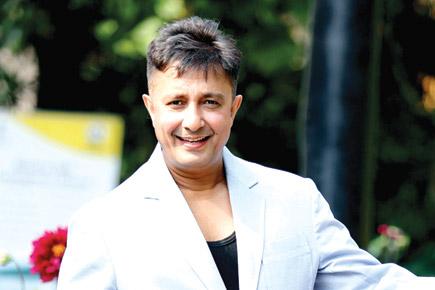
I've cut my fees so young fans don’t have to pay high ticket prices-Sukhwinder Singh
8:19 AM
Yvonne Jacob (BOMBAY TIMES; November 14, 2024)
There’s a lot more than meets the eye when it comes to Sukhwinder Singh. Although the singer dominates most of our playlists with chartbusters like Chaiyya Chaiyya, Jai Ho, Chak de India, Ramta Jogi, Dard-e-Disco, Ghanana Ghanana, and more, that barely covers one aspect of the acclaimed artist. In a recent chat, we got a chance to learn more about the singer who has successfully mastered the art of delivering hit songs in Tamil, Telugu, Kannada, Punjabi, Urdu, and Marathi as well. Excerpts:
‘Tickets for students shouldn't cost too much'
For Sukhwinder, concerts are about breaking down barriers and making music accessible to everyone. “When I plan concerts with organizers, I always have one condition—ticket prices for students shouldn’t cost them more than Rs 500. They need this money for their education. I’ve also reduced my fees at times if it means everyone who wants to attend my concert gets a chance to do so. For me, my audience is paramount.” He recalls a recent concert in Canada, adding, “I told them, Tussi raj raj ke aao, main raj raj ke gaane gaaunga (Come in numbers, and I will sing to your heart’s content).”
‘Want my songs to have a soul and good poetry’
Sukhwinder’s perspective on life is as mellow as his voice. “I’m like a toy train—slow and steady. People can join me or leave, but nobody falls.”
He also emphasises the importance of taking time to create meaningful music and says, “I cannot rush a song. I need the right composers and writers. I know that if I sing well and have the right words, 90% of my work is done. If I start thinking about promotion before even making a good song, I might not have the right content. I do experiment with sound and style, but it has to be soulful. I want my songs to feel real, with good singing and poetry.”
‘Don’t like to start my mornings by checking views and followers’
Unlike most, Sukhwinder’s mornings are deliberately technology-free. “I don’t wake up and check views or followers. I wake up and watch cartoons for half an hour. They are my morning dose of happiness,” he shares with a laugh.
During our conversation, he also opens up about his love for fashion. “I admit it—I love shoe shopping!” His style, however, is as unique as his voice. “I love colours. I don’t care much about brands; I just want my clothes to be vibrant. I think I look hot in black too,” he says with a hearty laugh.
On his love for sports…
Sukhwinder likes to make time for yoga, sports, and regular music practice. “In 1985 and 1989, I represented Punjab in a 100-metre race. I love sports, and 80% of my house is filled with sports equipment; the rest is my studio,” he shares.
On his love for touring...
Touring doesn’t mean staying behind tinted windows in a car for the singer. “When I go to Pune, Indore, Nagpur, Bengaluru or Chandigarh, I feel like I’m meeting a friend,” he says. “I don’t sit inside the car—I love stepping out and having street food, chaat, and experiencing the city.”
When I look back, I feel so fortunate that I could register my time with Haider-Vishal Bhardwaj
8:08 AM

Niharika Lal (BOMBAY TIMES; October 3, 2024)
Haider, based on Hamlet and set in 1995 during the peak of militancy in Kashmir, narrates the story of a family against the backdrop of politics. Talking about filming it in Kashmir, Vishal Bhardwaj says, “At that time, the average Kashmiri youth felt that Bollywood had cheated them, always portraying them as terrorists in phirans with AK-47s. So, they weren’t very cooperative. But later, when they saw the film, they called me.”
As the film completes 10 years, Vishal feels it was destined to be made. He says, “Now, when I look back, I feel so fortunate that I could register my time with Haider.”
As the film completes 10 years, we spoke to co-writer, director, composer, and producer Vishal Bhardwaj about the making of Haider, which has inspired numerous dissertations and research papers.
How Haider came into being
Vishal says, "I had been planning a Shakespeare trilogy and was working on Hamlet. Earlier, I had a different setting in mind for Hamlet. It was set in an espionage background. But when Gulzar Sahab read it, he mentioned that it felt like just another CIA movie with the tragedy of Hamlet in it. He was absolutely right. Then, simultaneously, things happened. I remember Rekha (Bhardwaj) reading Basharat’s book (Bashrat Peer's Curfewed Night) and her reaction to it. After that, I read the book and realized that, for a long time, I had also wanted to make a film about Kashmir. All these things came together. The structure became clear, we knew our characters, and of course, the history was there. It didn't take much time because there was so much clarity in our thoughts and in what we wanted to create."
Vishal Bhardwaj says that there are multiple scenes in the film that are not just memorable from the film, but from his entire career. He says, "And I'm not just talking about Shahid's monologue, which is very obvious. It was written for the gallery. But there are also 2-3 scenes between Tabu and Shahid, where they're in the Chinar Bagh before the interval, when they confront each other. Then there's a moment in the film when Shahid finally finds his father’s grave, and he breaks down. That scene was really... I had prepped Shahid, and we wanted to shoot with a telephoto lens, so the camera was really far. I told Shahid, 'Don't feel insecure because it's not a close-up. It's actually a very big close-up, and creatively, we want to shoot it with the tele-lens from very far'. He performed that scene so beautifully. He started crying, and we had two cameras capturing it. The way he was crying, I didn’t have the heart to shout cut. The camera was 400 meters away, and in the snow, I walked up to him, let him cry, and then hugged him, saying, 'It's cut, Shahid. It's done'."
Recalling another moment, he says, "We were shooting in the basement of a bungalow. So, -5°C felt like -15°C. Just as we were about to take the shot, Irrfan came to me and said, 'These lines are too few. Earlier, there were just 1-2 lines. I feel like saying more. I wish there was a poem written here'. I said, 'Okay, give me an hour, and I'll write a poem'. Everybody waited, and I wrote the poem right then and there. And then Irrfan performed it. My God, the way he performed it! When Shahid is leaving, and he recites that Faiz line, - Gulon mein rang bhare, baad-e-naubahaar chale, chale bhi aao ke gulshan ka karobaar chale. The way he says it - such a beautiful romantic couplet - and the way he performs it like a coded message in an espionage film. Irrfan ki kami na, every day in some way or the other, I feel the void of him not being here."
'I told Tabu that such parts are rarely written and that I'd be in pain all my life if she didn't play the role'
For casting, Vishal says, Tabu and Irrfan were both in his and Basharat's mind when they were writing those parts. He says, "But it took a long time to woo Tabu into that. She was very reluctant to play the mother. She rejected it twice, saying, 'No, I’m not going to play this. Why do you keep coming back to me? ' When I wrote the first draft and we started casting, after the rest of the cast was finalized, I went to her again, and she said, 'No, I’m not playing the mother.' The third time I went to her, I said, 'I'm coming to you because you're my friend; otherwise, I would have taken it on my ego. But you're my friend, and I want you to know that you're being blinded by the fact that you're playing a mother. Why don't you see it as Gertrude? See it as Gertrude's role, not Hamlet's mother'. I think that struck her. When she realized that, I told her that such parts are rarely written and that I'd be in pain all my life if she didn't play the role. And then she agreed to do it."
As for Irrfan, he says,"Uska toh jawab hi nahi tha. When he read the script, he said, 'This is such an important film to be made'."
One of the scenes in Haider was shot at a location where no film was shot in 30-35 years
The film was shot by cinematographer Pankaj Kumar, who was also the cinematographer for Ship of Theseus and Tumbbad. Vishal recalls, "At that time, Tumbbad hadn’t been released yet, and I was very impressed with the work on Ship Of Theseus. I then requested Anand Gandhi to show me some parts of Tumbbad, and when I saw it, I knew Pankaj was going to be my cameraman. I decided to shoot on location."
Haider’s ‘Hum hai, ya hum nahi’ monologue at Lal Chowk reminded people of Hamlet’s ‘To be or not to be’ and introduced the Indian audience to ‘chutzpah’.
About the scene’s shoot, Vishal says, “At that time, Lal Chowk was a different zone, and we were shooting behind Lal Chowk in the Press Club. And we shot it! It was destined. This film was destined to be made.”
Vishal recalls that there were multiple such locations. He says, “We went and shot at the Zaina Kadal Bridge, and nobody had shot there in the last 30-35 years since militancy started. And we went there and shot with mainstream stars like Tabu, Shahid, and Irrfan.”'
Jhelum hai ya Khul Kabhi, uss tarah ke gaane - that's the pace of my soul. It’s actually a texture of me'
Vishal Bhardwaj says that music was very close to the script of the film. He says,"Uss tarah ke deep romantic gaane banana, ya uss pace ka gaana banana jis tarah ka gaana Jhelum hai ya Khul Kabhi, uss tarah ke gaane - that's the pace of my soul. My real self is songs like Khul Kabhi Toh or Paani Paani Re (from Maachis) - those kinds of songs. It’s actually a texture of me."
Jhelum
"Jhelum gaana mera bahut purana composition hai. It had such a deep connection. The day my father died, I had composed the song that morning. I was sitting with him, and in the afternoon, he passed away. That song had such an emotional bond with me that I didn’t have the courage to use that composition for 30 years. Then Haider, being a father-son story, felt like the right place to use it. I never told this to anyone. That’s why Jhelum remains a very, very special song to me."
Bismil Bismil
"We created this song like a mousetrap where Shahid performs a play within a play. I wanted to create our own Ek Hasina Thi, Ek Deewana Tha moment in my way for Hamlet (laughs). Karz had a similar situation where Rishi Kapoor performs in front of Simi Garewal about the murder. Sukhwinder ko bahut khula gaane ki aadat hai - he's used to improvising a lot - but I told him, 'Is gaane mein track pe gaana padega, this is like an opera. We are telling a story in it'. Itna khoobsurat Gulzar sahab ne likha hai. I had only given him the phrase Bismil bismil bulbule bismil, and from that, he wrote an entire epic. He’s a master."
'Bismil is so un-Bollywood like'
The song was choreographed by Sudesh Adhana, who is a professor of contemporary dance in Norway at Oslo University. Vishal Bhardwaj met him when he was directing an opera in Paris at the Châtelet Theatre called The Flowering Tree.
Vishal says, "In that opera, I used long, oversized puppets by Dadi Pudumjee, a great puppeteer, and he introduced me to Sudesh. I worked with them for two months continuously in Paris, and right after that, I started shooting Haider. I brought all the sensibilities I learned during the opera, working with Dadi Pudumjee and Sudesh. It was so unconventional, so un-Bollywood-like. I'm saying this and I belong to Bollywood. And Sudesh won a National Award for that choreography."
Vishal shares, "There was a guy who was president of (student union) Kashmir University. When we were shooting in the university, a lot of problems occurred - there was a lathi charge, bottles were thrown, pata nahi kya-kya hua. The CRPF had to take us out and safeguard us. It felt like a battle between students and cops. The next day, we were shooting at another location, and that guy was there. We were showing the court chamber, and there was a character of a stenographer, and he was playing that role. After the shoot, he came to me and said, 'I was in disguise and wanted to check what you were shooting! (laughs). I think we made a mistake. You're not making the kind of film people usually come here to make'. When the film released, he somehow found my number and apologized to me for half an hour."
Did You Know?
-In July, when Vishal attended a tourism conference in Kashmir, he was told that after the film, the Martand Sun Temple where Bismil was shot became a popular tourist attraction, which prompted the ASI (Archaeological Survey of India) to remove encroachments from the site.
- Gulzar shot the song Tere Bina Zindagi Se Koi Shikwa Toh Nahi; at the same Martand Temple where Bismil was filmed.
- Khul Kabhi song from the film was Arijit Singh's first collaboration with Vishal Bhardwaj
I asked Saroj Khan, ‘Who is the best dancer among all the heroines’ and she responded with Aishwarya’s name-Subhash Ghai
8:22 AM
When director Subhash Ghai’s Taal was released in 1999, it revolutionised the musical genre in Bollywood. As Taal, starring Aishwarya Rai, Akshaye Khanna and Anil Kapoor, marks its 25th anniversary today, Ghai reflects on his creative process that he considers to be the pinnacle of his career
Yashika Mathur (HINDUSTAN TIMES; August 13, 2024)
RAHMAN WAS THE REAL HERO
For Ghai, composer A R Rahman was central to the film’s vision. “I told him (Rahman) that ‘my title is Taal and you are the hero’ and he was very happy,” Ghai reveals, adding “Once you name a film ‘Taal’ you have to live up to the title. For this, Rahman, who has international sensibilities, worked with lyricist Anand Bakshi and singer Sukhwinder Singh. Subsequently, the songs were recorded, and we spent some 80 days together. After that, I redrafted my script as per the music.”
DANCE MAESTROS BEHIND TAAL
The film’s choreography was a collaboration between three renowned choreographers. “Because the journey was from rural areas and cities to the cosmetic world, there was a growth in story, even in terms of costumes and presentation. So Shiamak Davar, Ahmad Khan, and (late) Saroj Khan came together for the film and helped me a lot,” Ghai says while adding that their combined efforts contributed to the film’s exemplary dance sequences.
THE NEW SUBHASH GHAI
Reflecting on the challenge of reinventing his style and creating a film that was distinct from his earlier works, Ghai shares, “I was inventing a new Subhash Ghai. I changed myself as the director [everyone knew] and went for a different trip,” adding, “The film was a very big shift from my own sensibility of commercial cinema. Since it was a pure musical, I decided to do away with villains, fights, violence as well as mirch masala.”
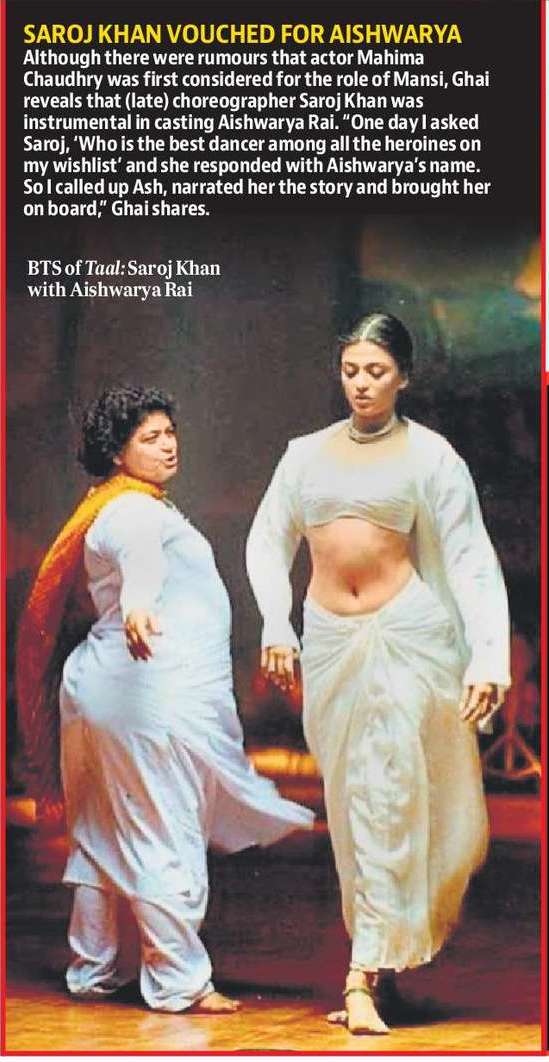
SAROJ KHAN VOUCHED FOR AISHWARYA
Although there were rumours that actor Mahima Chaudhry was first considered for the role of Mansi, Ghai reveals that (late) choreographer Saroj Khan was instrumental in casting Aishwarya Rai.
“One day I asked Saroj, ‘Who is the best dancer among all the heroines on my wishlist’ and she responded with Aishwarya’s name. So I called up Ash, narrated her the story and brought her on board,” Ghai shares.
I decided to include in my contracts that I will charge zero money for film songs-Sukhwinder Singh
8:18 AM
Rishabh Suri (HINDUSTAN TIMES; June 7, 2024)
Sukhwinder Singh, the voice behind iconic hits such as Chaiyya Chaiyya (Dil Se, 1998), Jai Ho (Slumdog Millionaire, 2008), among several others, has reached an impressive stage in his career. Naturally, one would expect his fees to be quite high, reflecting his success. But in a surprising twist, the singer has decided to charge nothing — well, close to nothing — for film songs.
“I noticed some time ago that new-age music directors may have received incorrect information about my fees, believing that I charge a lot. So, I decided to include in my contracts that I will charge zero money for film songs for the time being,” the 52-year-old explains.
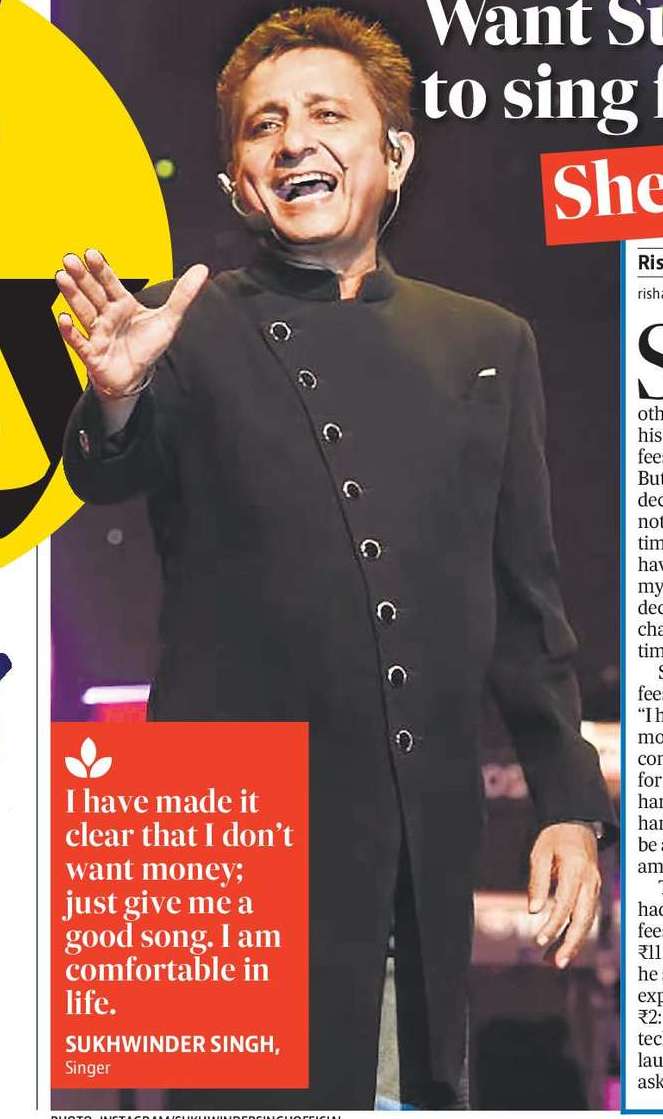
Singh reveals that rumours about his high fees were causing him to lose opportunities: “I have made it clear that I don’t want money; just give me a good song. I am comfortable in life and continue to charge for my performances at concerts. On one hand, I say music is my life, and on the other hand, I monetise it for film songs? I will only be able to learn from the new breed when I am able to reach them.”
The singer has even returned contracts he had already signed, along with the agreed fees. “Some mentioned Rs. 10 lakh, others up to Rs. 11 lakh. I returned contracts for six films,” he shares with a chuckle, while also explaining the exact reason behind charging Rs. 2: “The lawyers told me they cannot technically write Rs. 0, so I suggested Rs. 1. They laughed and said it was not acceptable, so I asked, ‘Rs. 2 toh bante hi honge?’”
Jai Ho controversy: Mere se zyada koi haqeeqat nahi janta, says Sukhwinder Singh
8:50 AM

Debarati S Sen (BOMBAY TIMES; April 23, 2024)
Jai Ho from Slumdog Millionaire won the Oscar in 2009, in the Best Original Song category. Composed by AR Rahman, penned by Gulzar and Tanvi, the song was sung by AR Rahman, Sukhwinder Singh, Mahalakshmi Iyer and Vijay Prakash. Recently, filmmaker Ram Gopal Verma claimed that the song was composed by Sukhwinder Singh. The singer clearly denied it and told us the story behind how the song came into being.
“Mujhe bhi Ram Gopal Verma ji ka video aaya hai. Woh jo keh rahein hain uske baare mein mujhe bilkul bhi kuch nahi pata," he says.
Elaborating on the how Jai Ho was recorded, Sukhwinder says, “A R Rahman presented the first draft of Jai Ho to Subhash Ghai. Mujhe laga ki iss gaane mein kuch baat hai. However, Subhash Ghai ji ne kaha ki the character in his film is a tapori and the song is too decent for that, so it won’t work. He wanted a tapori type of song, so he told Rahman saab to compose another song and he agreed to do it after a while.”
Sukhwinder adds, “When they took the decision to compose another song, Subhash Ghai ji and Rahman saab apni, apni gadi mein baithe, aur chale gaye. Only a few people were left in the studio, Gulzar saab, few of the musicians, recordists and me. Sabke chehere pe zara si udasi aayi thi ki yeh kya ho gaya. Mujhe laga ki iss Jai Ho gaane ka kya hoga. So quickly I took a decision and told everyone, ‘Come on, let’s sing this song’. But Gulzar saab said, ‘Ki gaana toh ab dusra banana hai’. Tab maine kaha ki woh ‘zari wale neele aasman ke tale’ is something special. Jitna bhi experience kiya hai music ko, I can say that I’ve never heard a line like this. Itna khubsoorat likha hai, isse kam se kam gaa toh de ek baar. So, then Gulzar saab told me, ‘Ki if you really want to sing this song, go ahead’.”
Sukhwinder further explained how he started dancing while recording the song, which eventually was selected by Danny Boyle for his Oscar-winning movie, Slumdog Millionaire. “I had the music already, and so I told my recordist to put up three microphones and he was surprised. Then I sang Jai Ho in the three different mics. I was literally dancing from one mic to the other when I was singing the song and quickly the recording was done. Gulzar saab ne mujhe mathe pe choom liya. Maine pucha, koi khaas baat? He said, ‘Ise kehtein hain music se mohabbat karna. Tumhe ishq hai music se!’ Uske baad sabha samapt ho gayi, I gave a CD of that recording to Gulzar saab and I sent one to Rahman saab,” he shared.
Around a week later Sukhwinder got a call from Rahman. “He told me, ‘Hello Hollywood singer’. I asked, “Hollywood?”. Rahman said, ‘The song you sang, Jai Ho, has been selected by a Hollywood director’. This was the song that was almost rejected. Bas iske aage peeche mujhe kuch pata nahi. Maine Jai Ho gaya hai, compose nahi kiya. Mere se zyada toh koi haqeeqat nahi janta na,” says Sukhwinder.
Ram Gopal Varma ji ko shayad kuchh galat pata chala hoga-Sukhwinder Singh
9:21 AM

Sukhwinder Singh denies Ram Gopal Varma’s claims that Rahman didn’t compose the track
Rishabh Suri (HINDUSTAN TIMES; April 22, 2024)
The question of who composed the Oscar-winning track Jai Ho (Slumdog Millionaire, 2008) unexpectedly sparked a debate, considering that music maestro A R Rahman has always been credited for it. However, recent claims by filmmaker Ram Gopal Varma in an interview with Film Companion left the internet in confusion. Varma stated that singer Sukhwinder Singh, who sang Jai Ho, actually ghost-composed it, and Rahman merely received credit.
But when contacted, Singh vehemently denies this assertion. He clarifies, “A R Rahman has composed the song; I only sang it. Ram Gopal Varma ji ko shayad kuchh galat pata chala hoga.”
Singh further explains the origins of the song, stating that it was composed by Rahman in his (Singh’s) studio in Mumbai after being impressed by the lyrics penned by Gulzar. Originally intended for Subhash Ghai’s film Yuvvraaj (2008), Jai Ho faced rejection from Ghai himself, who felt it didn’t suit the character’s evolution in the story. Despite suggestions for modifications, Ghai insisted on a completely different song.
“I was sad. I requested Gulzar sahab to stay back for 10-15 minutes. Phir maine naachte kudte gaa diya; I sent it to Rahman sahab, who in turn made Danny Boyle, director of Slumdog Millionaire, listen to it, which ultimately became the version we hear today,” Singh tells us.
We tried reaching out to Varma, but he was unavailable for comment.
Pankaj Udhas no more, ghazal loses a chart-topper
8:13 AM

Avijit Ghosh (THE TIMES OF INDIA; February 27, 2024)
He completed evenings. In the 1980s and ’90s, ghazals sung by him were mandatory at parties and gatherings. They were like companions helping listeners unwind, enlivening many a ‘spirited’ sunset. Pankaj Udhas, whose audience-friendly renditions and easy on the ear compositions sold millions of cassettes, packed hundreds of concerts and took ghazals to new followers, passed away after “prolonged illness” at a Mumbai hospital on Monday. He was 72.
------------------------------------------
Ghazal chart-topper Pankaj Udhas, the voice behind ‘Chitthi Aayee Hai’ and ‘Jeeye Toh Jeeye Kaise’ passed away at a Mumbai hospital on Monday. His daughter, Nayaab, made the announcement on Instagram.
Primarily a singer of non-film ghazals and geets, Pankaj delivered Bollywood’s biggest 1987 chartbuster: ‘Chitthi Aayee Hai’ (lyrics, Anand Bakshi; music, Laxmikant-Pyarelal; film, Naam). The song, which topped Binaca Geetmala’s annual countdown show, touched an emotional chord, especially among NRIs and PIOs.
Some of Udhas’ finest numbers are in the 1981 album, Muqarrar. ‘Tum na maano magar haqeekat hai’ (poet Qabil Ajmeri) and ‘Deewaron se milkar rona achcha lagta hai’ (poet Qaiser-ul-Jafferi). Another popular track from the same album, Sabko maloom hai main sharabi nahi (poet Anwar Farook Habadi) spurred him to do a reprise with Paimana (1983), a collection of ghazals that went down well with tipplers; it had Thodi thodi piya karo (poet S Rakesh) and La pila de saakiya (traditional).
A science graduate from Mumbai’s St Xavier’s College, Pankaj spent his early years in Gujarat. In an interview to the Sunday Guardian in 2018, the singer recalled his father playing the musical instrument ‘dilruba’, and him liking the sound.
Pankaj also remembered being fascinated by the tabla and enrolling for a course but later switching to learning Hindustani vocal from Ghulam Qadir Khan Sahab in Rajkot. “Then I came to Mumbai to learn from my guru, Master Navrang Nagpurkar. He was a very famous singer from the Gwalior Gharana,” he said in the interview.
The 1980s saw two divergent trends in popular music. One was led by the breathless beats of disco, the other by the more reflective ghazal. The peerless pair of Jagjit and Chitra Singh had already initiated a new gene ration of the middle class to the non-film ghazals. A Padma Shri recipient who also worked to eradicate thalassemia, Pankaj was among the young bunch of ghazals singers - Talat Aziz and Anoop Jalota were the other two – who were part of that wave.
------------------------------------------
RWITC mourns a horse racing enthusiast
Ghazal singer Pankaj Udhas was a keen racing enthusiast too. A member of the Royal Western India Turf Club (RWITC), Udhas owned a few horses and would visit Mahalaxmi Racecourse. “He would call and ask if his horse has a chance to win,” RWITC-based trainer H J Antia told TOI on Monday.
Antia trained his horses. “And when I would tell him yes, he would specially make time to come to the Mahalaxmi racecourse,” added Antia. The late singer would also visit the stables at the racecourse to check on the horses, he said.
“We lost a very genuine member of the club,” said RWITC chairman Surendra Sanas. “It is also a personal loss for me. He would make it a point to visit the club on Classics race days and almost certainly on Indian Derby Day,” recalled Sanas.
Surgeon Dr Mehli Nazir, who jointly-owned horses with Udhas, said, “We bought our first horse called Aliyana sometime around 2010. And then we owned a couple of more horses together. When Aliyana won in Pune the first time, he was thrilled to lead the winner. It was his first ever win,” said Dr Nazir.
“He found it difficult to devote time to racing after 2018 because he had a busy schedule,” said Adhirajsingh Jodha, who trained a horse called Speed Of Sound owned by Udhas in partnership.— Shailendra Awasthi
------------------------------------------
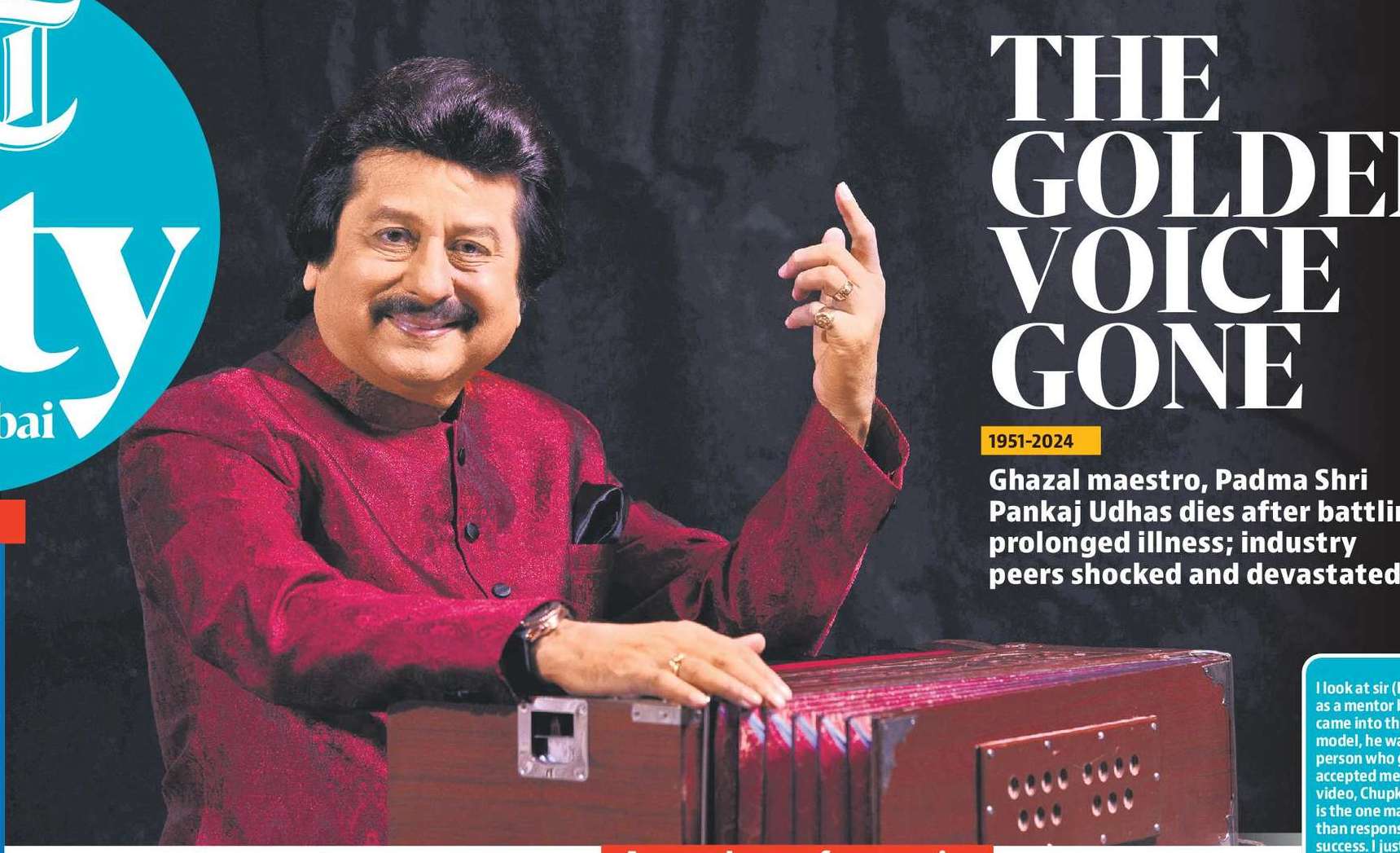
Ghazal maestro, Padma Shri Pankaj Udhas dies after battling prolonged illness; industry peers shocked and devastated
HINDUSTAN TIMES (February 27, 2024)
Inarguably one of the most renowned ghazal voices, Pankaj Udhas has died at the age of 72. His daughter, Nayaab, issued a statement on Instagram on Monday to announce the news: “With a very heavy heart, we are saddened to inform you of the sad demise of Padma Shri Pankaj Udhas on 26th February 2024 due to a prolonged illness.”
Born in Gujarat, Udhas was keen about music from a young age. It was in 1986 that his playback career took off with the cult classic Chitthi Aayi Hai for the film Naam, and there was no looking back after that. Chandi Jaisa Rang Hai Tera (Ek Hi Maqsad, 1988) Jeeye Toh Jeeye Kaise (Saajan, 1991) and more cemented his legendary status. He remained active in films until 2016, when his song Raat Bhar Tanha Raha was featured in Dil Toh Deewana Hai.
He is survived by wife Farida and daughters Nayaab and Reva.
----------------------------------------------------------------------------
A symphony of memories
In a 2016 chat with Soumya Vajpayee, Pankaj Udhas spoke about his journey as a ghazal singer and the future of the genre
ON HIS JOURNEY
It’s been interesting, challenging and satisfying. When I started out, the ghazal had just started gaining popularity. Even then, Bollywood music dominated the scene.
ON WHAT MADE HIM POPULAR AMONG THE MASSES
When I started singing, I was influenced by Begum Akhtar and Mehdi Hassan’s styles. But as I grew up, I realized that I shouldn’t keep singing like them. I wanted to create my own space. That’s when I started creating a style of my own. I wanted to reach out to the masses, as the ghazal was always limited to a very small audience. I wanted to make it more accessible. So, I composed the ghazal, Aap jinke kareeb hote hain. Anyone who could speak Hindi could understand it. That clicked, and I realized that I had found the success formula.
ON NOT SINGING FOR BOLLYWOOD ANYMORE
To be honest, I would love to sing for movies, as that’s a very exciting medium. I cannot deny that some of the Hindi film songs that I sang have had a huge impact on my career. They helped me gain popularity. Songs like Chitthi Aayi Hai and Jeeye Toh Jeeye Kaise helped me reach out to audiences across the world. It’s a different story that the style of songs and the approach to music in Bollywood has changed drastically now. Perhaps that’s why we (ghazal singers) are not called in to sing anymore.
ON LATE MEHDI HASSAN AND JAGJIT SINGH’S ROLE
After they arrived on the scene, people started talking about ghazals. There was a curiosity about this kind of music. By the time I started out, which was around 1978-79, Bollywood music was struggling to impress the masses. The audience was looking for an alternative. That’s when the ghazal started to rise. After the ’80s, it became a craze. I am glad to have been around when the ghazal ruled the roost.”
Farewell, ghazal king
SONU NIGAM, SINGER
Pankaj ji was one of the most important parts of my childhood. I will miss him forever. My heart cries.
KAVITA KRISHNAMURTI, SINGER
He was my friend since college and the nicest man I’ve known. He would always smile and talk to everyone; he’d never discriminate. The world has lost not just a singing icon but also one of the sweetest and simplest human beings.
SUKHWINDER SINGH, SINGER
During the video shoot of one of my songs from the album Nasha Hi Nasha Hai, he invited us all for dinner and lunch. He even extended our stay for the next night, just because he wanted to talk to us. The world has lost a great icon and I still can’t process that he is gone.
SALIM ARIF, THEATRE PERSONALITY-DIRECTOR
I was working on a musical show, based on (poet) Mirza Ghalib’s letters, with Pankaj ji. We couldn’t meet the last four months as he was not keeping well. It’s a personal loss.
I look at sir (Pankaj Udhas) as a mentor because when I came into this industry as a model, he was the first person who graciously accepted me in his music video, Chupke Chupke. He is the one man who is more than responsible for my success. I just told him that your voice still sounds so beautiful, it’s amazing.
TALAT AZIZ, SINGER
I can’t believe I have lost my dearest and oldest friend. Pankaj, Anup (Jalota) and I go way back. This is really shocking. I spoke to Nayaab (Udhas’s daughter), too. Rest in peace, my friend.
ANUP JALOTA, SINGER
Mera yaar chala gaya. I am heartbroken. Hum logon ne kitni shaamein saath bitaai, kitni yaadein hain... yakeen nahin ho raha. We started Khazana (annual ghazal festival) together. Now, I would like to take it forward with his daughter Nayaab.
I don’t see any reason why people wouldn’t embrace me as a singer as long as what I’m doing is not pathetic-Adarsh Gourav
8:31 AM

Syeda Eba Fatima (HINDUSTAN TIMES; August 1, 2023)
His acting chops may have got him into the limelight, but Adarsh Gourav is equally passionate about music. The trained Hindustani classical singer is now hoping to win hearts with his compositions. “I’m focusing on two songs at the moment. The plan is to record them and have them out by the end of the year,” the Extrapolations actor tells us.
Ask if there are any inhibitions about putting himself out there as a singer, and Gourav says, “Ultimately, it’s about the quality of music and singing. I don’t see any reason why people wouldn’t embrace me as a singer as long as what I’m doing is not pathetic.”
His aim is to make the kind of music that feels “personal” to him. “That is a mixture of music that I’ve grown up listening to — right from A R Rahman and Jagjit Singh (composers) to Pink Floyd (band),” says The White Tiger (2021) actor, who had also sung a track for one his films, Banana, which never got released.
“I sang for a couple of other films, too. One was Subhash Ghai’s Black & White (2008); I sang the chorus with Sukhwinder Singh,” he reveals.
Excited about his musical endeavours, the 28-year-old says he intends to go with the flow. “I’m not looking at it in a way that I have to do 100 stage shows in a year. I want to enjoy it (singing),” he ends.
20 Years of Chalte Chalte: Shah Rukh Khan told me how impressed he was with Layi Vi Na Gayi-Sukhwinder Singh
8:43 AM
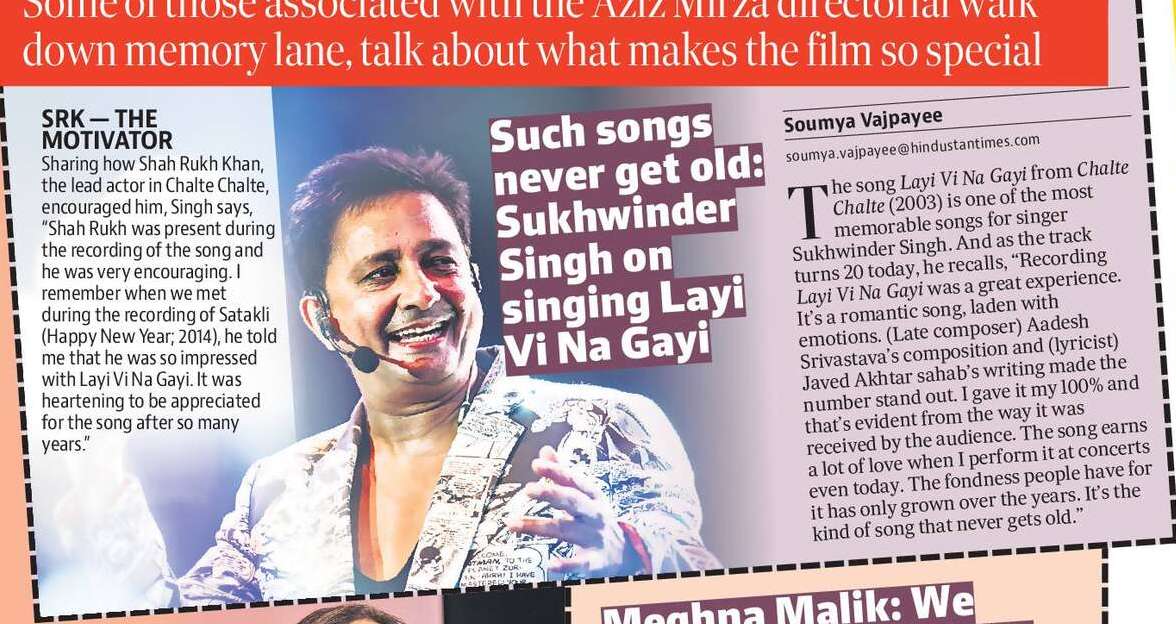
Soumya Vajpayee (HINDUSTAN TIMES; June 13, 2023)
The song Layi Vi Na Gayi from Chalte Chalte is one of the most memorable ones for singer Sukhwinder Singh. “Recording Layi Vi Na Gayi was a great experience. It’s a romantic song, laden with emotions. (Late composer) Aadesh Srivastava’s composition and (lyricist) Javed Akhtar sahab’s writing made the number stand out. I gave it my 100% and that’s evident from the way it was received by the audience,” says the singer, adding, “The song earns a lot of love when I perform it at concerts even today. The fondness people have for it has only grown over the years. It’s the kind of song that never gets old.”
Sharing how actor Shah Rukh Khan encouraged him, Singh says, “Shah Rukh was present during the recording of the song and he was very encouraging... When we met during the recording of Satakli (Happy New Year; 2014), he told me how impressed he was with Layi Vi Na Gayi. It was heartening to be appreciated for the song even after so many years.”
Lohri, for me, is all about kites-Sukhwinder Singh
8:32 AM
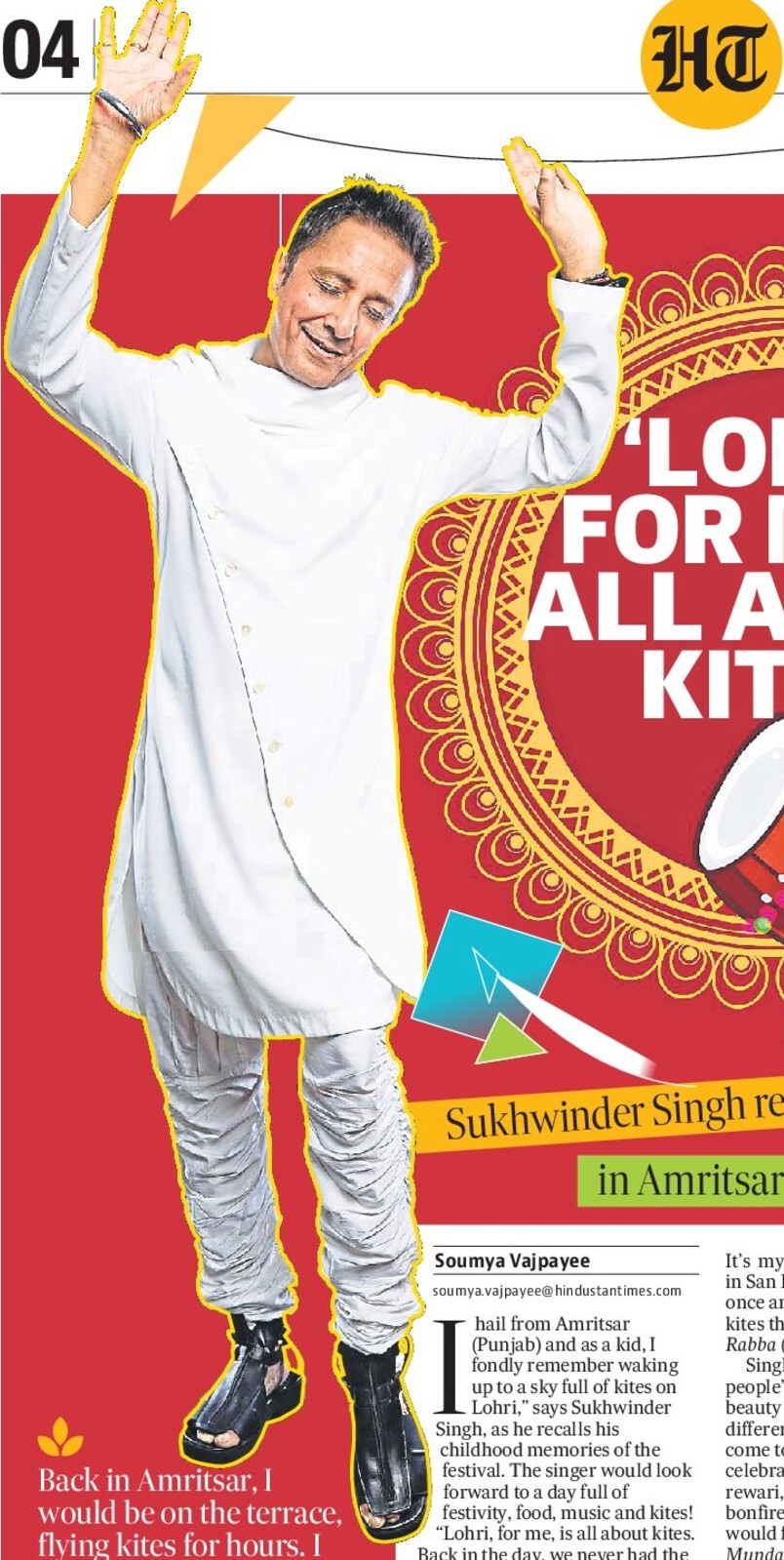
Sukhwinder Singh recalls celebrating the festival in Amritsar and what the day means to him
Soumya Vajpayee (HINDUSTAN TIMES; January 13, 2023)
“I hail from Amritsar (Punjab) and as a kid, I fondly remember waking up to a sky full of kites on Lohri,” says Sukhwinder Singh, as he recalls his childhood memories of the festival. The singer would look forward to a day full of festivity, food, music and kites!
“Lohri, for me, is all about kites. Back in the day, we never had the harmful manjhas. We would use simple strings and manjhas. I remember, there would be lakhs of kites in the sky. I would be on the terrace, flying kites for hours. I still do that, no matter where I am. It’s my Lohri ritual. In fact, I was in San Francisco (USA) on Lohri once and I spent four hours flying kites there as well,” recalls the Rabba (Cuttputlli; 2022) singer.
Singh feels that Lohri “unites people”. He adds, “I feel that is the beauty of this festival. People from different religions and cultures come together for the evening celebration. Everyone offers rewari, gur and chana to the bonfire. In fact, in Punjab, you would find people singing Sundar Mundariye Ho, the traditional Lohri song, at every nook and corner.”
Ask about his favourite Lohri number and he goes on to sing Sundar Mundariye Ho for us. But now that he resides in Mumbai, does he miss Punjab on the day of the festival? “Nahin, main jahan bhi hota hoon, wahan Lohri utne hi utsaah se manaata hoon jaise Amritsar mein manaata tha. Main kahin bhi hoon, aag jalaa kar usmein rewari, gur, chana zaroor daalta hoon,” says the Lohri Waale Din Sab singer, as he goes on to share how the festival inspires him as an artiste and human being.
“The atmosphere on the day of Lohri is so energetic. The happiness you see on people’s faces when they dress up, sing and dance is infectious. I love the energy that I experience by being near the bonfire and praying there. It instils me with a lot of confidence and self-belief,” Singh signs off.
Jab khud pe guzarti hai tab pata chalta hai-Falguni Pathak
8:32 AM

Pathak wishes she knew about owning music rights in the ’90s
Samarth Goyal (HINDUSTAN TIMES; September 26, 2022)
Of late, fans of Indian pop music have been up in arms about the recently released track, O Sajna, which is a re-imagined version of singer Falguni Pathak’s hit ’90s track, Maine Payal Hai Chhankai. The new song, composed by Tanishk Bagchi and sung by Neha Kakkar, has irked Pathak, who wishes she had the right to take legal action.
She took to social media to express her disappointment. “What else could have I done? I could not take legal action,” Pathak tells us, adding, “I was overwhelmed to see so many people write on social media that they love my music, and they didn’t like this (Kakkar’s) version.”
Pathak said in a recent interview that she “would have taken a legal route” if she could. She tells us that back then, she “didn’t know” the importance of owning music rights, which could have prevented such recreations. “I wish I was aware back then. Jab khud pe guzarti hai tab pata chalta hai. I regret that I didn’t know about it then, otherwise I would have definitely done something about it,” the Yaad Piya Ki Aane Lagi singer says.
Pathak, 53, meanwhile, clarifies that she isn’t averse to the idea of recreations. But she feels that whoever works on a recreated version should be passionate about music and work on the song wholeheartedly, rather than thinking just about its success.
“I don’t mind singing a remake,” she says, when asked if she would like to sing one, given an opportunity. “I am not averse to the idea of remixes and recreations. They have been happening for a long time. But it has to be done with a lot of passion, and the passion has to be only about creating good music. Everything else comes later,” the singer signs off.
Neha Kakkar took to Instagram to hit back at the critics with a cryptic message
”How I feel today.. Very few people in the world get what I have received in life. That too in such a young age. This kind of Fame, Love, Countless Super Hit Songs, Super Duper Hit TV Shows, World Tours, Fans from Little Kids to 80-90 years old people and What Not!! You know why I got all this because of my Talent, Hardwork, Passion and Positivity. So.. Today I just wanna Thank God and Each one of You for giving me what I have today. Thank you!! I am the Most Blessed child of God. Thank you again! Wishing you all a lifetime of Happiness (sic),” singer Neha Kakkar wrote on Instagram.
She also posted, “And for those who’re sooo, Unhappy seeing me HAPPY and SUCCESSFULL. I feel sorry for them. Bechaare.. Plz keep commenting. I won’t even delete them. Coz I know and Everybody knows What NEHA KAKKAR Is!! If talking in such a manner, saying such bad things about me, abusing me.. makes them feel good and if they think it will ruin my day. Then I’m sorry to inform them that I’m too blessed to have bad days (sic).”
REMAKE VS ORIGINAL: THE FIGHT CONTINUES
Composer-singer Anu Malik says, “I am not against anything, but the amalgamation should be a cordial and happy one. I don’t want to insult people, because new talent is also very strong. But I feel the original composer or singer should be involved in the making, and given due credit.”
Singer Sukhwinder Singh asserts that he is not against the remix culture. He says, “If I get an opportunity to sing a recreated version, I would love to because I adore songs of the past and present alike. But one thing that’s criminal is not giving proper credit to the original makers. Whether a portion of a song is used or an entire track, the music director and lyricist should be credited first. Nahin toh the generation is misguided. For instance, if one wants to recreate Mehbooba Mehbooba from Sholay (1975), how can the people reworking it call themselves the music directors of the song?”
Singer Shilpa Rao, on the other hand, urges her peers to create original music: “We have many talented composers, singers, folk artistes as well as classical artistes. I am a big supporter of original music.”.
Inputs by Sugandha Rawal
We want to know why they did it & at whose behest, says Sonali Phogat’s brother Vatan Dhaka
8:40 AM

Neha Maheshwri (BOMBAY TIMES; August 28, 2022)
The family of Sonali Phogat, who died under mysterious circumstances on August 23 in Goa, alleged foul play. Initially, the cause of death was reported as a suspected heart attack. However, a post-mortem report later stated that there were “multiple blunt force injuries” on her body. After this, Section 302 (murder) of the Indian Penal Code was added to the case.
The Goa Police has arrested Sudhir Sangwan (Sonali’s personal assistant) and Sukhwinder Singh in connection with the murder case. While addressing a press conference on Friday, Goa IGP Omvir Singh Bishnoi said that Sangwan has confessed to the crime. He added that after reaching Goa, Sudhir and Sukhwinder took Sonali to a restaurant in North Goa where Sudhir spiked her drink and forced her to consume it.
According to reports, Rinku Dhaka, younger brother of the deceased Haryana BJP leader and actress, had alleged in the complaint that Sonali was murdered by Sudhir along with Sukhwinder with the intention to take over her financial assets and finish her political career.
While talking to BT, Vatan Dhaka, also her younger brother, said, “She was fit and had no health issues or ailments. She was very particular about her diet, too. The news of her sudden death came as a shock to us.”
Talking about what made them grow suspicious about the incident, he said, “Her personal assistant called to inform me in the morning (August 23) that she (Sonali) had died of heart failure. A few hours later, I called them back to confirm and find out how it happened and their whereabouts. The irregularities in their statement and time of death made us suspect foul play. Later, we learnt that she was drugged and then killed. We just knew about Sudhir accompanying her and got to know about Sukhwinder later.”
Talking about Sudhir’s arrest, Vatan said, “We want the case to be thoroughly investigated. The family wants to know why they did it and at whose behest. Hamaara sab kuchh khatam ho gaya hai.”
While the family is still looking for answers, Rinku Dhaka is suspecting that the motive behind the murder could be Sonali’s property. He said, “A theft had taken place at Sonali’s farmhouse in Hisar on February 1, 2021. During her stay in Goa, Sonali learnt that Sudhir and his associates had planned it. She called us on the night she passed away to inform us about it and said that she would ask for a police investigation into the theft.”
He added, “Another theft took place at her farmhouse after her murder. Her laptop, mobile phone and CCTV footage were stolen. The caretaker of the farmhouse, Satish, informed us about it and we registered a complaint at the local police station. We want justice and the culprits to meet their fate.”
When I would head to Mithoon's recording studio, I would feel like I was part of a mehfil-Sukhwinder Singh
8:32 AM
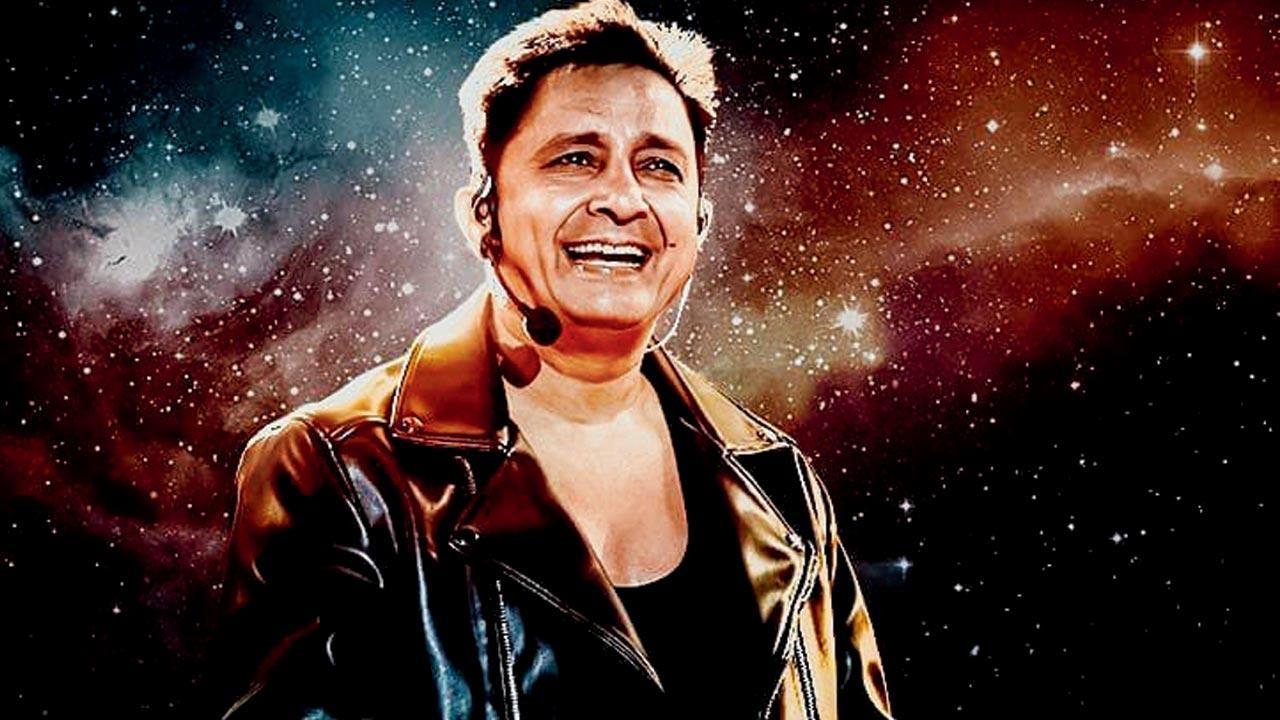
Pointing out that the Shamshera team approached the music-making process in a collaborative manner, Sukhwinder Singh on being Ranbir’s voice
Sonia Lulla (MID-DAY; July 11, 2022)
In giving voice to Ranbir Kapoor’s Balli in Shamshera, Sukhwinder Singh chanced upon an opportunity he had been seeking for long. “Working with a composer like Mithoon is desirable for every singer. When I would head to the recording studio, I would feel like I was part of a mehfil. I had heard that this was the manner in which Raj Kapoor [worked with his team]. After experiencing it, I wish that each project can be approached in a similar manner. In this process, everyone is given the chance to present their idea and enhance the final work. The team is also receptive. If I suggested that I would like to try something different, they were always keen to let me give it a shot,” says Singh, adding that occasionally witnessing the shoot at director Karan Malhotra’s behest worked in his favour.
“I have three songs in the film. Parinda is symphonic. Mithoon belongs to Pyarelal ji’s [Sharma] family. His father [Naresh Sharma] was among the best music arrangers we’ve had. Mithoon has a great understanding of how to mix music. Parinda is played against the film’s background score, across scenes of romance, action and drama. It has been designed to enhance the film’s score. Creating one piece that’s suited for different aspects was a new, but enjoyable process,” says the singer of first of three tracks rendered by him.
“The other two are earthy songs that are heavily influenced by drums, and needed a performance. I believe, that’s a gift I have — regardless of whether I am on the stage or in a studio, I am always performing in accordance with the character.”
Shamshera marks Singh’s fresh collaboration with Kapoor, for whom he previously sang Kar Har Maidaan Fateh (Sanju).
Up next, he joins hands with Vishal Bhardwaj’s son Aasmaan, for his upcoming directorial venture, Kuttey. “I have sung for his father, and I was the first choice for him.”
Singh is currently also creating a music master-class at the behest of a production. He intends to teach students aspects relating to the lifestyle of musicians as part of the course as well. “I intend to make this educational and entertaining, and not complicated. I am also working on creating pure folk music with international musicians.”
Ilu Ilu in Saudagar and Kuk Kuk Kuk in Choli Ke Peeche were Subhash Ghai's additions-Sonu Nigam
8:19 AM
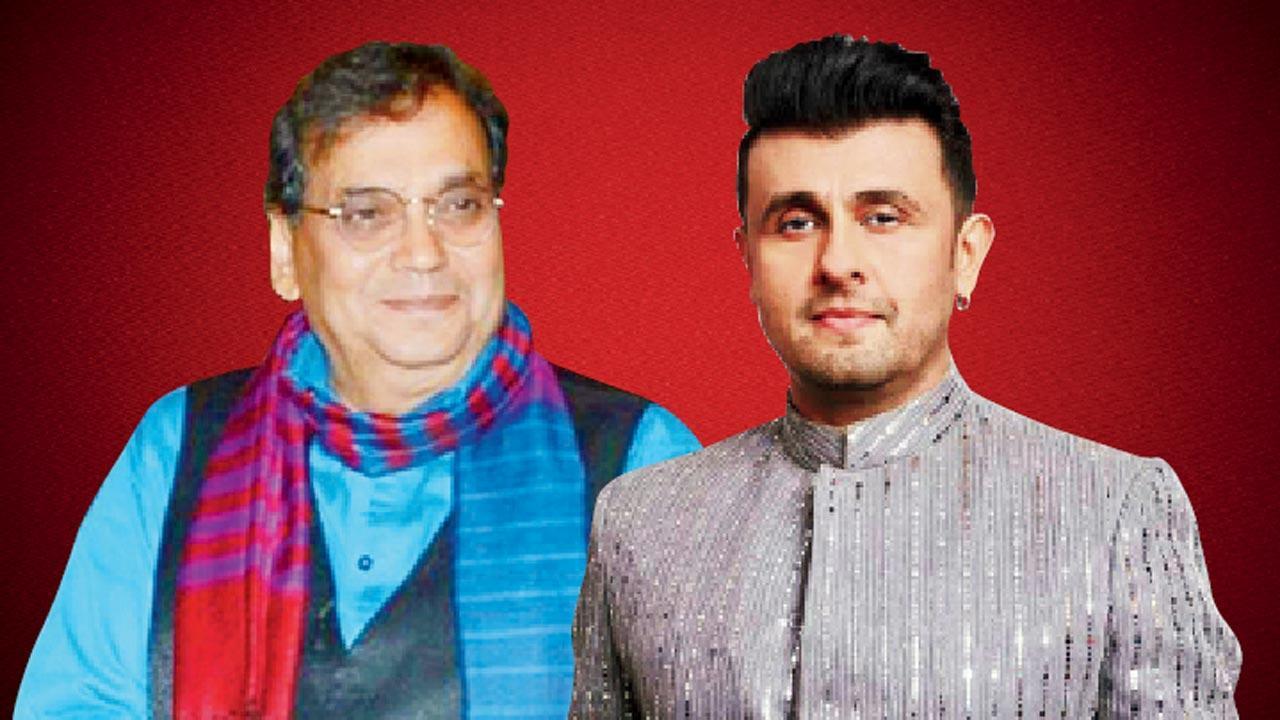
As he makes his long-overdue debut as composer for 36 Farmhouse, Subhash Ghai turns to friend Sonu Nigam for the song Mohabbat. In this chat, the duo walks down memory lane
Sonia Lulla (MID-DAY; January 17, 2022)
Asking Subhash Ghai about his decision to venture into music composition with 36 Farmhouse could be done in two ways. One, we ask him why he decided to turn composer. Two, we ask him why he decided to turn composer, so late. Anyone who has followed the filmmaker’s work understands, and appreciates, the importance he pays to music. After all, wouldn’t we have felt a void if Indian cinema didn’t have musical masterpieces like Taal and Pardes? In this joint interview with long-time collaborator Sonu Nigam, who has sung Mohabbat in 36 Farmhouse, Ghai takes the mic.
Ghai: I would listen to composers. Hearing a song is one thing, but understanding the art of singing is crucial. I learnt from Kalyanji Anandji, Laxmikant-Pyarelal, and A R Rahman. I noticed how they compose and make [music] better. When I write a film, I script its music too. So, when I discuss it with the composers, they understand the director’s vision. An integral part of the score is always scripted. It is not like picking up any song and adding it anywhere. Just like you need a good actor for the role, you need a performer who can sing the track correctly. I have experimented a lot. For instance, for the track Nahin Saamne (Taal) we [appointed] eight artistes. Sukhi (Sukhwinder Singh) had already sung Ramta Jogi, so we needed another voice. But we struggled with the right voice for the rendition of the word ‘priyasi’. Finally, we locked Hariharan, but had Sukhi render the word ‘priyasi’. Having specialists who know how to deliver, is important.
mid-day: Mr Ghai, give us a sense of the discussions you have with your composers.
Nigam: I will answer this. I remember singing the song Cham Cham (Yaadein). It had been created by Anu Malik, and while rendering it, we felt something was missing. Subhash ji told me to extend the section of the words ‘cham cham’, like we eventually did. I am sure the song wouldn’t have been successful without that. Even though I haven’t worked with him on those songs, I am sure elements like Ilu Ilu (Saudagar), and Kuk Kuk Kuk (from Choli Ke Peeche, Khalnayak), were his additions. He has a grip on these elements which will strike a chord.
mid-day: What must the current crop understand as far as making an evergreen score is concerned?
Nigam: That there needs to be one captain of the ship. In this corporate culture, we have many people willing to give opinions — I don’t think this will work, I don’t like this voice, etc. But you need to back your claim with knowledge. In the past, directors like Ghai sa’ab took the responsibility of making a film. Whether or not it is well made is a different matter. But once he has taken that responsibility, the opinions of his wife, kids, driver or anyone else, won’t matter. The casting, singing, acting will be done as per his sensibilities. In Saudagar, he got Dilip Kumar and Raaj Kumar together. Mazak hai kya in dono se acting karana. He made them do in their senior years what [no one] could when they were young. But he had the faith that he would make this film that would become memorable, and whose dialogues will be narrated for years.
Nowadays, decision-making is not backed by an understanding of the craft. You may have a degree in mass communication, but where is your knowledge of art? The music of Taal is legendary. While Rahman has created fantastic pieces of work, this one holds a special place. Ghai sa’ab had the knack of getting what he desired from Rahman for Taal.
Ghai: I back everything that he has said. Do you think artistes like Raj Kapoor sa’ab, and Manoj Kumar would have been able to do what they did if they were associated with corporates? The business of art needs to focus on art, right? If you try to control that soul, beautiful pieces won’t be made. With 36 Farmhouse, Zee Studios gave me the freedom to do as I pleased. I am responsible for this, however it turns out. Take the example of Dangal. The film [shone] because it was the work of one man’s vision.
Nigam: Yesterday, I was recording a track of Laal Singh Chaddha. Aamir [Khan] was there. Though he says he can’t sing, he has an understanding of music. He’d keep asking me to sing different sections differently. I didn’t mind doing it again and again, because the man knows his job. He understands the essence of his film, and only he could ensure that the way I sing matches the pulse of the film. A film should have its director’s personality.
Celebfie: Go on a staycation cruise with your favourite celebrities
4:40 PM

BOMBAY TIMES (August 8, 2021)
Celebfie, a new-age platform that promises to bridge the gap between celebrities and their fans, is set to ship across international waters with celebrities on a cruise. The event ‘Celebfie – Cruise with the Stars’ will have Sonakshi Sinha and Nora Fatehi flagging off the cruise to its course after a fun meet and greet session. Kailash Kher, Sukhwinder Singh, Sunil Grover, Kiku Sharda, Sudhanshu Pandey and Mandira Bedi will be on board. Asim Riaz, Himanshi Khurana, Chunky Panday, Rahul Dev, Mugdha Godse, DJ Aqeel, Flora Saini and many other popular personalities will also be going on this cruise from Mumbai, on September 16.
With this, the brand aims to be one of the world’s first FX (fan experience) platforms that gives people an opportunity to directly interact with well-known personalities. For the upcoming event, the platform has partnered with Cordelia Cruises, with the luxurious ship ‘The Princess’ offering a plethora of entertainment options. You can spend the evening at the bars and lounges or even visit the casino. You will also get to watch Sukhwinder Singh and Kailash Kher’s live music show. Not just that, there will be an entertainment show by Kiku Sharda and Sunil Grover, who will come together after four years.
“We’ll be connecting fans and brands with their choicest celebrities to create unforgettable memories. With this experience, we aim to break the limits of the online space and enter the physical realm with its core message headstrong. Guests on board will experience the time of their lives, partying alongside their favourite celebrities. The cruise will follow all required COVID-19 protocols as per the government’s guidelines, and 100 per cent staff and cruise members will be vaccinated,” said Raminder Singh, Founder and CEO, Celebfie.
The brand has collaborated with BookMyShow as their exclusive ticketing partner for this and other upcoming events. They are also coming up with more staycation concepts that will take people to places at regular intervals. “We intend to offer many such opportunities for fans to experience different destinations and connect with celebrities and artists across platforms and spaces in the near future,” Singh added.
My condition to judge a reality show is that I will not falsely praise a contestant-Sukhwinder Singh
7:56 AM

Itishree Misra (BOMBAY TIMES; July 2, 2021)
Sukhwinder Singh is happy that he got an opportunity to perform live at a private event in Lucknow, after a very long time. Sukhwinder, who has been performing virtually during the lockdowns, says that they hold less charm than a live interaction with audience. “Virtual performances are good, but what an artiste craves is a live interaction with the audience,” he says.
Ask him if he is nervous performing live in this Coronavirus pandemic and Sukhwinder says he is, but the excitement of a live performance is more. “There is definitely some nervousness regarding performing live in this pandemic, but I have to ensure a livelihood for my musicians. With nothing happening the musicians are facing a very hard time. So in fact, for this show, I have charged 40 per cent more than their usual fees so that they can sustain themselves and their families,” he says.
Sukhwinder adds, “Main bhi koi millionaire toh hoon nahi, mujhe bhi kamayi karni hai. And we have to help others, too, in whatever we can. These are difficult times for everyone and we have to make do with what is being offered.”
The singer says that the band takes all precautions during their show. He says,“We are taking all precautions regarding maintaining social distancing, masks, etc. In case of a private function, there is no problem of a crowd. Besides, I take good care of myself. I remain at home, I have got myself vaccinated, maintain all protocols so I am okay, that way.”
Sukhwinder recently appeared as a celebrity guest on Indian Idol. He has previously been a judge on a few talent hunt shows. Ask him if he is in favour of the judges praising all performances and he says, “My first condition to appear as a judge on a reality show is that I will not lie. I will not falsely praise any contestant.”
He further adds, “Tell me one thing, isn’t it corruption and lying to praise a contestant even for his bad performance? I cannot say to a bad singer that you have sung like Miyan Tansen. It is wrong. I am harming the youngster by giving him false praise. If a contestant is not performing well, I will not say ‘waah’ for him or her. Instead I will give a positive criticism, which is what we as judges should do. We should point out their mistakes so that they can improve upon them. Praising them for their bad performance is in fact harming them, and we, as seniors shouldn’t indulge in that. One needn’t be rude and brutal in their criticism, it can be given in a softer way too. That’s why you don’t see me in reality or talent hunt shows so often.”
Drugs utna nahi hai jitna ragad diya gaya hai-Sukhwinder Singh
8:13 AM

Rishabh Suri (HINDUSTAN TIMES; December 9, 2020)
Singer Sukhwinder Singh is upset. With the way the film industry is portrayed, the vilification of celebs, drug charges — everything. Not that he denies the problems.
“Itna negative hota jaa raha hai. It started with Coronavirus, then Sushant’s (Singh Rajput) death, then the thing with China. Drugs are a problem in the entire world, yet the film industry (is singled out),” he asserts.
The 49-year-old Chaiyya Chaiyya (Dil Se; 1998) hitmaker adds: “Stardom is built with hard work and dedication. People yearn for a glimpse of these celebs. Social media gives an opportunity and people say whatever they want.”
He points out that while people who consume drugs are caught, there is hardly any focus on suppliers. “Maamla jald se khatam ho jaayega. Actors (could) say they take drugs in small quantities to improve their mood. They at least work, but many others sit on the roads, near the gutter. Here (in the industry), the percentage must be five, par badnaami 100% mil rahi hai,” he says.
He gives his own example — he has sung songs such as Bidi Jalai Le (Omkara, 2006) without even looking at one in real life. He says, “Drugs utna hai nahi film industry mein jitna ragad diya gaya hai. If it were such a problem, people wouldn’t be able to shoot! People who troll think ‘Hum kabhi Ranbir Kapoor, Ranveer Singh ya Varun Dhawan se mil nahi sakte, chalo unki band bajaate hain’.”
I love old songs, but I don’t have a problem with new songs either-Sukhwinder Singh
8:02 AM

Nikita Deb (HINDUSTAN TIMES; June 10, 2020)
The Coronavirus pandemic and the subsequent lockdown in India served as a big bummer for everyone. But as we slowly move towards reopening things, people are excited about getting back to work and doing what they love.
Singer Sukhwinder Singh says he is really enthusiastic and pumped up to restart work with full gusto. “I will be releasing 12 music videos by July next year, apart from my film songs, and I am really excited,” he says, adding, “Pain and suffering will never be our well-wisher or friend so we should not spend too much time with it. We should always try and move on from bad things,” says the singer as he talks about everyone recovering from the pandemic.
“My relationship with film music will always stay but my team and I have decided to release independent singles to entertain everyone to the fullest with different genres of songs. If you constantly keep talking about sad and depressing things, it is difficult. We have to move on,” he says.
As far as the business of music industry is concerned, Singh says that if someone is making something with their heart, people will pay even their last penny to enjoy it. “There are very few special people in every industry. Making music videos is not a big deal but aap kitni shiddat ke saath usko banate hai, uska content kitna rich hai aur kis hadh tak who logon ke dilon ko choota hai is important. To give a hit film or a hit song, you have to be very passionate about your work. Agar aap kaam ke saath dillagi karoge, toh who kaam logon ke dil ko nahi chu payega. Quality is always more important than quantity. If people are not attracted or don’t get connected to your work, no matter how many things you make, it doesn’t matter,” he says.
About the changing dynamics of the music industry, Singh says that he will always be appreciative of old music, but he will never diss new trends or music. “I will continue to praise old songs but that doesn’t mean that I have a problem with new songs or new music. One must experience the past to perform better in the present. We can’t live in the past, but we have to learn from it,” says the singer.
Singh adds that nothing much changed for him during the lockdown. “I used to do the same things before that I did during this time,” he signs off.
Subscribe to:
Posts (Atom)