Showing posts with label Darr. Show all posts
Showing posts with label Darr. Show all posts
Juhi Chawla shares memories from the shoot of Holi song in Darr 'Ang Se Ang Lagana'
8:15 AM

Natasha Coutinho (BOMBAY TIMES; March 13, 2025)
The Holi song Ang Se Ang Lagana from Darr, starring Juhi Chawla, Shah Rukh Khan and Sunny Deol, remains popular to date. The track from the Yash Chopra directorial offered celebration and thrill in equal measure.
Recalling the shoot of the song, Juhi says, “We had shot the song on the lawns of a house in Lonavala. As for skin and hair care, we were young and clueless, and it was great. There were no fancy lotions, sunscreens and all that drama. The only thing was that we didn’t want to get a sunburn while shooting as there were a lot of outdoor shoots. I had a dupatta wrapped around my face for protection apart from the make-up we wore, and the big umbrellas held up by the spot boys.”
Juhi adds, “Back then, we didn’t have vanity vans, so the rooms on the upper floor of the house were used as make-up rooms, and we would come down to shoot, which was quite convenient. Shah Rukh came in for a day for his shots where he was playing drums, and Sunny ji (Sunny Deol), Anupam ji (Anupam Kher), Tanvi ji (Tanvi Azmi) and I continued with our portions. Sometimes, we would end up applying too much colour on our co-stars’ faces, but then we would realise that we went overboard and would reduce it to look pretty on screen. If you watch the song closely, you will notice jumps in continuity when it comes to the gulaal on our faces.”
‘Holi get-togethers at Yash ji’s home were unforgettable’
Talking about off-screen Holi celebrations, she says, “Holi get-togethers at Yash ji’s (Yash Chopra) home were unforgettable. They were full of fun, food, colour and camaraderie.”
This new book explores Shah Rukh Khan's fandom
3:01 PM
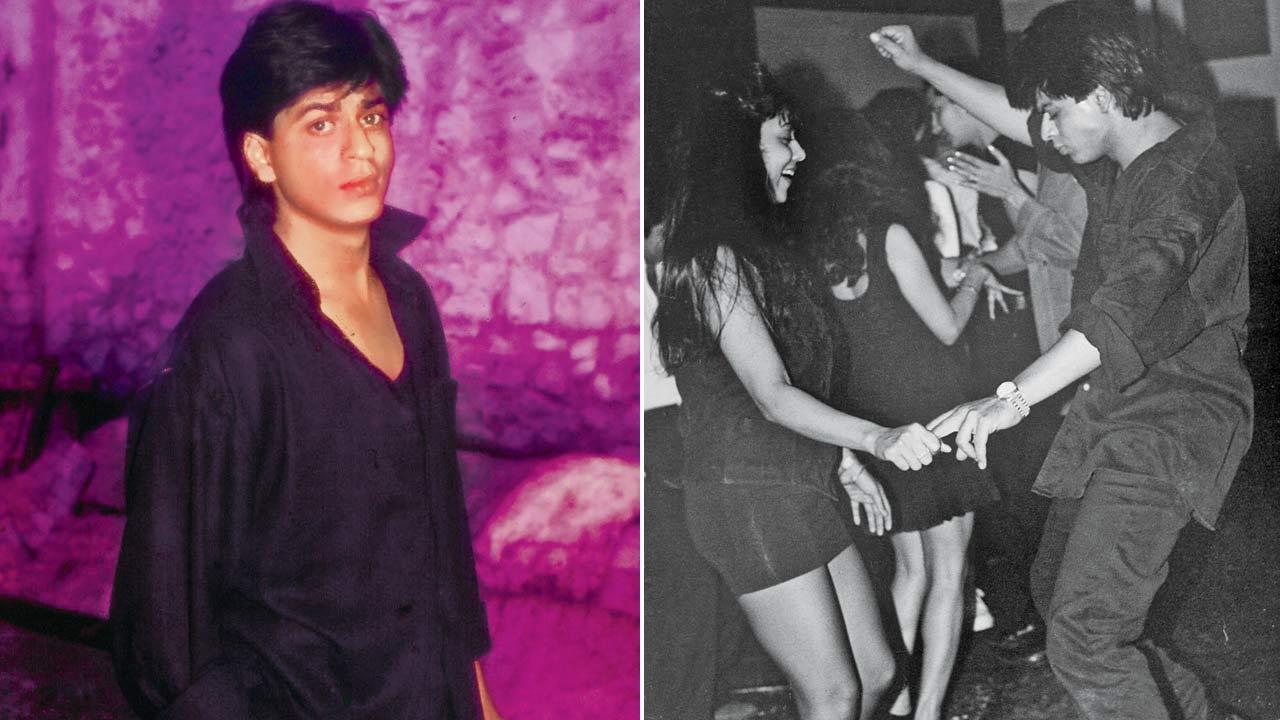
Shah Rukh Khan; (right) Dancing through life: Shah Rukh and Gauri show young love’s got rhythm
A new book aims to encapsulate what actor Shah Rukh Khan means to his fans. This extract talks about an early hit, Fauji, and how it heralded the birth of the superstar we know, and love, even now
Mohar Basu (MID-DAY; November 10, 2024)
Shah Rukh’s breakthrough in television came with Fauji, helmed by the jovial Colonel Raj Kapoor, who appeared on Jeena Isi Ka Naam Hai to talk about the actor.
Speaking about Colonel Kapoor, Shah Rukh said, “I never thought I could act on screen. Let me share a story: After my father passed away, my mother and I were searching for a house to rent. When we found one, my mother insisted that I see it first before confirming. When asked where I was, she replied, “He’s off acting.”
Kapoor’s son-in-law Kamal Dewan suggested I go to him, who was directing a serial. That’s how Fauji, which was aired in 1989 and had thirteen episodes, came to be.
Fauji served as Kapoor’s homage to the Indian Army, presenting a realistic portrayal of cadet life as young men trained to become commandos. Shah Rukh was already acting in another serial titled Dil Dariya at that time and shot for Fauji during lunch breaks—such shooting schedules were common for actors then who worked on multiple projects at the same time. The audition for Fauji involved a rigorous physical test, including a 1.5-mile run at dawn, followed by an impromptu boxing match. Shah Rukh impressed with his discipline, by not giving up on the race even when many co-auditioners dropped out. He was initially designated to land a smaller role while Kapoor’s son Bobby was to play one of the leads, Abhimanyu. But Bobby, who was already the cameraman, had to bow out.
It’s the way of this industry, as Karan Johar points out in Zoya Akhtar’s debut movie Luck By Chance: “Industry mein outsiders aise hi toh aatey hai. Koi alag tarah ka role likhta hai, koi badaa star nahi karta hai and finally ek naye ladke ko break mil jata hai [This is how outsiders get into the film industry. Someone writes a different sort of a role, big stars refuse to do it and then finally a newbie gets his break]. Zanjeer was turned down by seven actors before a struggling star, Amitabh Bachchan, picked it up.”
Shah Rukh has been destiny’s child in that sense, or probably was always at the right place at the right time. His two big Bollywood hits, Darr and Baazigar, landed in his kitty just like that.
How Shah Rukh landed Fauji, over and above the rigour he showed, is funny, to say the least. At the launch of Samar Khan’s and Sonali Kokra’s book SRK: 25 Years of a Life, he recounted, “I went there, I auditioned and he gave me a sweet role—in the whole Fauji serial, the Colonel orders me to go and count the crows on the tree. I would run and say, ‘There are four crows’. This was my role in the whole serial. I thought this was so strange… How could I tell my family that this was my role? … I did that and it was one of the nicest roles, and they’ve all loved me like a family. I am not saying this with false humility, but maybe the goodness I have at this age is because of the wonderful men and women I’ve met in my life.”
Amina Shervani, who wrote and acted in Fauji (as Kiran Kochar), said that for its time, Fauji was an extremely expensive show to make. It cost nearly Rs 2 lakh per episode to shoot. It was facing a four-year delay in its pilot launch. The Fauji team rallied in 1988 to ensure an early release the following year. They obtained permissions from the Ministry of Defence, Doordarshan and the Army headquarters. Despite challenges, the dedicated team pooled their talents and resources to bring the series to fruition.
In an interview to The Print, Shervani said, “I remember the Army was supposed to give us sten guns and other equipment to use, but they didn’t let us touch anything. So I flirted with a commando to steal a broken, defunct sten gun, and made a mould of it. We made twelve aluminium moulds that looked quite real. And one day, I was carrying them back from the studio in an auto, and the cops stopped me, and there I was—with twelve real-looking guns. Fortunately, we had done films for Delhi Police before that, so the police commissioner knew what we were really doing.”
This was the late 1980s and the turmoil in Punjab meant that procuring materials such as fuel for the demolition and explosion scenes was difficult, as the authorities had put strict rules in place. And so, for the scenes in the show, these had to be sourced from Shah Rukh’s mother, who owned a kerosene company. Dynamite was acquired through connections with friends who had contracts for stone and mica mining in the Aravallis, allowing the team to create their own explosives.
One would think these would be the biggest challenges in the making, but the real hurdle was getting Shah Rukh to cut his hair. Shervani said, ‘”Shah Rukh just wouldn’t cut his hair. He would keep smoking, and his mother would be worried that nothing would come of his passion for theatre.”
When Fauji was aired, it resonated with people in a big way. Shah Rukh’s charm captivated viewers, propelling him to the forefront of the show. His character, Abhimanyu, became central to the story, showcasing Shah Rukh’s knack for both romance and action. This was the first time he started becoming a household name. One of the many fans of Shah Rukh from that era is my own mother, Ellora Basu. When I first told her I am working on this book, she recounted to me how her love for Shah Rukh dates back to the late 1980s.
“Watching Fauji was like witnessing the birth of a superstar. Shah Rukh Khan’s charm as Abhimanyu Rai was not to be missed, and we knew he was destined for greatness from the very first day the show aired.”
As a child of that time, she told me how there was a general sense of fatigue with the trope of the ‘Angry Young Man’ that ruled movies and television then. “I wasn’t interested in television until Fauji came along. That was a young show. It had stories that my siblings and I could relate to. The show brought in young people to television viewing. A large part of our love was because of Shah Rukh. He was always a sincere actor, but more than anything else, he had the ability to charm you. It could be called screen presence, but in his unique goofy, boy-next-door way, he was someone you’d want to root for in a story. That’s the sign of a hero!”
Extracted with permission from Shah Rukh Khan: Legend, Icon, Star by Mohar Basu, HarperCollins India
----------------------------------------------------
‘Even at his worst, he finds it in himself to be a kind person’
Author and mid-day writer Mohar Basu says that the book, Shah Rukh Khan: Legend, Icon, Star, came into existence because they wanted to view Shah Rukh and his influence on cinema, culture and community from a third eye perspective including the lens of his fans. We spoke to her about what inspired her most as she wrote the book, and how she managed to write it as a detached writer, and not die-hard fan.
Excerpts from an interview.
What anecdote about SRK inspired you the most personally after writing this book?
There are a lot of absolutely fantastic stories about Shah Rukh, and a great selection of these has made it to the book. But the one that stuck with me was this story about Shah Rukh rushing back to India after his wife had a miscarriage while he was in New York shooting for Pardes. To get home quickly, he flew from LA to New York and then caught an Air India flight to India. There was rush and confusion at the airport and a fan persistently followed him for an autograph, despite seeing him flummoxed. When he finally reached his gate, he realised the lady actually was Akshay Kumar’s fan and thought he was Akshay. He didn’t want to break her heart so quickly signed an autograph as “Akshay Kumar”. This story shows what makes him as loved as he is. Even at his worst, he finds it in himself to be a kind person.
As a journalist, writing about fans and a star, what were some things you were careful about—so that it didn’t end up pandering to a star, but spoke of something deeper?
The relationship that fans have with the star they love has been a point of academic research. We all know how powerful and dynamic fandoms are. The approach we had decided early on in the project was to view Shah Rukh and his influence on cinema, culture and community from a third eye perspective including the lens of his fans. Why do people love him so much for so long is a question that was repeatedly asked at every step along the way. My editor at HarperCollins India, Bushra Ahmed, in fact, kept reminding me that fan psyche was at the forefront of this book. This is why we decided to write an entire chapter about why people love and desire him and tackled every aspect of it. Most interviews were done for this chapter because everyone found different things that drew them to him. Married women loved his love story, younger women saw him as a benchmark of what they seek from a man they are in a relationship with, some love the fact that he is a great father and everyone finds themselves drawn to him because he is respectful. The men loved his ability to work hard. The approach was pretty sociological. Some amount of my own training as a journalist and my education in sociology came in handy. We have tried to create a multi-layered, non-lateral narrative which I hope best portrays the power that SRK holds. The love for Shah Rukh runs deep and his charm is an added bonus.
What’s something your book has that you don’t think has been ever addressed about SRK before?
The impact of Shah Rukh Khan on community and culture, not just cinema, is at the heart of this book. The broad highlights of his life are well-known but this book looks deeper into the phenomenon that is SRK. For instance, take my favourite SRK film—Chak De India. The finest sports film India has ever made. And why has that movie been hard to top? It blended in entertainment and social themes perfectly. No other film has been able to reflect how diverse the country is and then SRK says that iconic dialogue— “Mujhe states ke naam na sunai dete hai, na dikhai dete hai. Bas ek mulk ka naam sunai deta hai.” Or more recently, a film like Dear Zindagi. A fan spoke about how she had always felt different and knew she wasn’t okay but Dr Jug made her to check in to therapy and she is better because of it. We often discuss how stars, especially in a country like India, actually impact real lives and how fans look up to them to inform their own perspectives. This book attempts to do show you how Shah Rukh Khan goes beyond being just a superstar.
It was bachpana, says Sunny Deol opens up on former feud with Shah Rukh Khan
9:39 AM
HINDUSTAN TIMES (September 11, 2023)
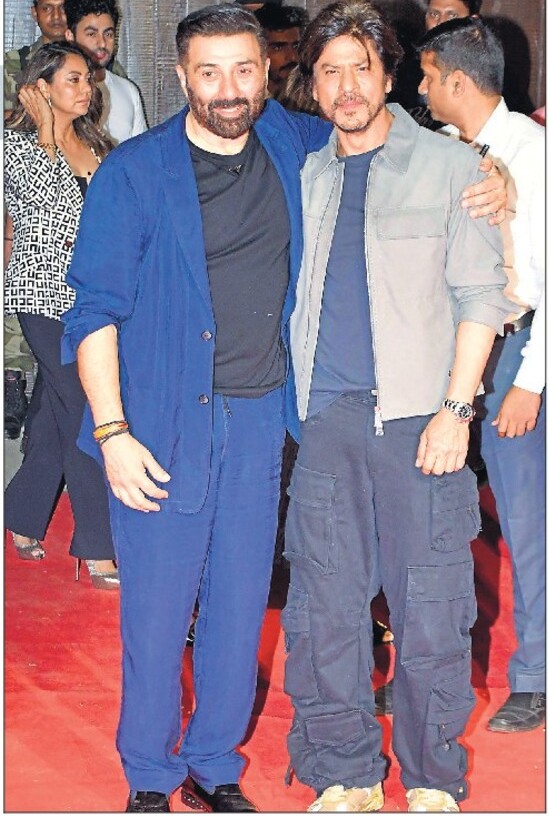
Their feud was the talk of the town when their film Darr (1993) released. While Shah Rukh Khan and Sunny Deol, the leading stars of the film remained tight lipped until now, their hug at the latter’s party recently warmed hearts.
Speaking up about what transpired and their reconciliation on India TV’s talk show, Deol said, “Woh zamana (those days) when it happened, that was a different time. I say, people forget what happened in those days. One understands such things should not have happened. It was bachpana (childish), definitely. After that, Shah Rukh and I met several times and spoke to each other about many things. We also talked about some movies. This time, he was watching my film with his entire family. And he called me up. Toh sab cheezen bahut badhiya hai. Sab kuch bahut badhiya (everything is fine now),” he said.
Meanwhile, his equation with another Khan, Salman has always been one of mutual respect. In fact, he was the first one to congratulate Deol on his film Gadar 2’s opening day collections. Deol added, “Salman and I have a different equation. Obviously, I’m senior to him. When I used to work, he used to come on the set. ...Hamesha... He had a good bond with Papa (Dharmendra)... And so that give and take, which is with very few people, was there...”
After decades, the Sunny Deol-Shah Rukh Khan feud comes to an end
8:40 AM

BOMBAY TIMES (September 4, 2023)
On Saturday night at Gadar 2’s success bash, Sunny Deol and Shah Rukh Khan posed together for the shutterbugs, burying the hatchet, officially, after many decades. While SRK, who arrived for the party with his wife Gauri Khan, walked in hurriedly, later on, when Sunny came to see him off, they both posed for cameras – making this one of those unforgettable moments of Hindi cinema.
THE FEUD ENDED WITH GADAR 2
Things took a turn for the better when SRK recently, during an ask-me-anything session on X (formerly known as Twitter), said that he had watched Gadar 2. Later, Sunny, in an interview post the film’s release, said, “Shah Rukh Khan has seen the film. Before that, he had called me and wished me well. He was so happy, and he told me, ‘I’m so happy, you genuinely deserve it’ and I said thank you. Then, I spoke to his wife and son. And he said tonight we are going to be watching this film. And after that, he saw it, and I think that is when he tweeted.”
Moreover, Sunny also spoke about how time has healed their past issues. In the same interview, he shared, “It was so beautiful. Many times, I’ve also called him up and we shared our thoughts on certain things. About the past issues whatever they were, I would say time heals everything and we move ahead. That’s the way life should be.”
THE BACK STORY
For the unversed, back in 1993, Sunny and SRK starred in Yash Chopra’s hit Darr, which is what led to the dispute. As per reports, Sunny was unhappy with SRK’s character (he played a negative role in the film) being glorified in the movie. He had voiced his displeasure in an interview the same year.
In 2009, when appeared on the TV show Aap Ki Adalat, he said, “At the end of the day, people loved me in the film. They loved Shah Rukh Khan as well. My only issue with the film was that I did not know they would glorify the villain. I always work in films with an open heart and believe the person. I believe in working with trust. Unfortunately, we have many actors and stars who don’t function in this manner. Maybe that’s the way they want to get their stardom.”
Agar kabhi Shah Rukh Khan mujhse mile, main toh ro doonga, says his lookalike Suraj Kumar
8:22 AM

Syeda Eba Fatima (HINDUSTAN TIMES; June 9, 2023)
Shah Rukh Khan’s doppelgänger, Suraj Kumar, had the time of his life when he was papped at India Gate in Delhi recently and his pictures went viral. Talking to us, the 22-year-old, who would instantly remind you of SRK from the 90s, can’t contain his excitement as he says, “I often go to India Gate to shoot videos. That’s my go-to spot to make reels. I love enact his scenes from movies Baazigar and Darr (both 1993).”
An ardent SRK fan, Kumar loves to watch his “older films such as Raju Ban Gaya Gentleman, Deewana, Chamatkar (all 1992) and Maya Memsaab (1993)”. He adds, “His style was unmatched. Unke bolne ka tareeka, baal, dance, haklaana... you don’t get to see all that in his newer films.”
Kumar, however, reveals that the response and love he has been receiving at the moment wasn’t the case a few years back. “Initially, when I used to behave like Shah Rukh in public places, people would laugh at me. After my videos went viral, they started recognizing what I do. Now, people take selfies with me and say, ‘Aap 90s ke Shah Rukh lagte ho’.
Who is Suraj?
Hailing from Jharkhand, Suraj left his home six years ago with a dream to meet SRK and become an actor. Currently living in Delhi, he says, “My family never supported me. Toh apne papa ki pocket se paise chori karke main Mumbai chala gaya. I wanted to become an actor like SRK.” He adds, “I’d go to Mannat daily, but I’ve never met him. Agar kabhi SRK mujhse mile, main toh ro doonga.”
Kumar has finally bagged a film, “which stars (actor) Pulkit Samrat. Mera sapna poora ho gaya”.
I really like the idea of playing a villain... something like a Shah Rukh Khan in Darr-Aahana Kumra
8:42 AM

Aahana S Kumra feels blessed to be a part of the OTT boom where relatable yet varied scripts are the norm
Naina Arora (HINDUSTAN TIMES; July 16, 2022)
For actor Aahana S Kumra, the most exciting aspect of OTT is that one never knows what would be “offered next” to them. “The web is an exciting space for us. You can reimagine and invent yourself,” she tells us.
And this is something that is rare for female actors, she feels. “It (the variety of roles being written) is absolutely refreshing for a female actor. For men, there are so many different roles/parts written, and women get typecast. Everyone stereotypes you so much that even you start believing ki hum issi type ke roles hi kar sakte hai bas. But sometimes you get pleasantly surprised, and they (makers) give you a role that you wouldn’t have ever imagined yourself in,” says Kumra.
The actor, who has been a part of a variety of web shows such as Marzi, Official CEOgiri, Sandwiched Forever and Betaal, recently portrayed a grey character in Avrodh 2. Talking about the experience, she says she had never imagined being cast in a negative role, and is overwhelmed by the positive response she has received for it. “I really like the idea of playing a villain... something like a SRK (actor Shah Rukh Khan) in Darr (1993). Samar Khan, my producer, imagined it for me. It’s amazing. It has opened up a new space for me,” she says.
Further opining what makes OTT such a hit with viewers, Kumra says relatable stories and characters on the medium do the trick. “There are so many times I am watching a show, and I think, ‘Oh this happened [with me]’. Shows like Panchayat and Gullak are some of my favourites. The earnestness in the character, performances and writing was very relatable in Panchayat. And, since I am from a middle class [family] in Uttar Pradesh, I could identify with the characters in Gullak. I feel relatability with a character is very integral,” she says, adding that larger-than-life stories only work on the big screen.
Does that mean she prefers working only on the digital medium and not on the big screen? She shares, “I am very happy to work in a big film if it’s offered to me because it opens avenues for you as it generates employment, and you’re seen a lot more. But I also feel on OTT, even the smallest shows gets picked up because of word of mouth.”
As many A-listers such as Ajay Devgn, Madhuri Dixit Nene also venture into the OTT space, Kumra opines it’s happening because “they are being offered the kind of work they want to do”. She elaborates, “In films, they are stuck with a certain type of a role. They also want to play characters which are relatable. For instance, in The Family Man, (actor) Manoj Bajpayee’s character became so relatable because he has the same problem any middle class man — being a father to rebellious kids and struggling to balance his work and his wife’s expectations. People saw the relatability in the story.”

Shiv Kumar Sharma passes away; to be accorded a funeral with full state honours
8:14 AM

THE TIMES OF INDIA (May 11, 2022)
Shiv Kumar Sharma, who reshaped the identity of santoor, elevating the instrument’s stature across the globe, and who composed a bunch of dulcet melodies with renowned flautist Hariprasad Chaurasia in Yash Chopra movies, passed away following a heart attack in Mumbai on Tuesday morning. He was 84.
Although the maestro was on regular dialysis, he remained active till the end and was to perform in Bhopal next week, family sources said.
“My story is different from other classical musicians. While they had to prove their mettle, talent and calibre, I had to prove the worth of my instrument. I had to fight for it,” Sharma had told TOI in 2002.
He will be accorded a funeral with full state honours, said CM Uddhav Thackeray. The last rites will be performed at the Vile Parle crematorium at around 3:00 pm on Wednesday.
-----------------------------------------
Shiv Kumar Sharma, who reshaped the personality and identity of santoor elevating the instrument’s profile and stature across the globe, and who composed a bunch of dulcet melodies in tandem with renowned flautist Hariprasad Chaurasia in Yash Chopra romances and thrillers, passed away following a heart attack in Mumbai on Tuesday morning. He was 84.
“He was on regular dialysis but was still active. He was to perform in Bhopal next week,” a family source told PTI.
With his arresting features — the shock of hair being his signature — the santoor maestro regaled music lovers in thousands of concerts over decades; his jugalbandis with Chaurasia and tabla virtuoso Zakir Hussain a treat to the ear and the soul. But the accolade and the glory came after a long struggle to gain respect for the instrument he played.
“My story is different from other classical musicians. While they had to prove their mettle, their talent, their calibre, I had to prove the worth of my instrument. I had to fight for it,” Sharma told The Times of India in 2002.
“Shiv Kumar-ji was an epochal musician. Braving almost universal cynicism, he made an obscure staccato instrument capable of a convincing presence in classical music. His ascension to the Hindustani Music Hall of Fame is even more significant because it coincided with the era ruled by formidable instrumentalists like Ustad Vilayat Khan, Pt Ravi Shankar, and Ustad Ali Akbar Khan,” musicologist Deepak Raja said.
Jammu-born Sharma was ushered into music when just five by his vocalist father Uma Dutt Sharma of Benaras gharana and showed promise in both vocals and tabla. But the notes changed when he was 13 after his father brought a gift from Srinagar. “I tore at the wrapping paper eagerly, expecting a game or something else as exciting. But the box held a strange-looking musical instrument which I hadn’t seen before! And that’s how I was introduced to the santoor,” he told TOI in 2001.
The Dogri musician’s father-guru wanted him to play this instrument. “At that time, the santoor was used only in Sufiana music in a small pocket in Kashmir. No other part of India had ever seen it. But dad wanted it to be developed for national use in Indian classical music — and he entrusted the job to me,” he said.
In 1955, Sharma came to Bombay for a concert packed with the galacticos of Indian classical music: Bade Ghulam Ali Khan, Ali Akbar Khan, Ravi Shankar, among others. He was just 17. But he made an impact. The same year Sharma also composed a background piece in V Shantaram’s film, ‘Jhanak Jhanak Payal Baaje’ (1955) for music director Vasant Desai.
But many critics were far from convinced about santoor’s range. “… connoisseurs rejected it as a complete instrument since I couldn’t play alaap. Santoor is essentially a percussion instrument played by strikers. It can’t sustain the vibrations and so, there was no scope for meend (glide from one note to another)…I modified the instrument and created a distinct character,” he once told TOI.
Much against his father’s wishes, Sharma came to Bombay in 1960, hoping to build a career as a freelance musician. Over the years, his services were utilised by top Hindi film composers, including Hemant Kumar (‘Bees Saal Baad’), Jaidev (‘Hum Dono’), SD Burman (‘Guide’) and RD Burman.
‘Call of the Valley’ was released in 1967. The long-playing record, put together by the trio of Sharma, flautist Hariprasad Chaurasia and guitarist Brij Bhushan Kabra, musically expanded on a day in the life of a shepherd through a bouquet of ragas. The album steadily entered the music shelves of the culturally-inclined and became a milestone in their careers.
When director Yash Chopra introduced Sharma and Chaurasia as a composer duo in ‘Silsila’ (1981), the film industry was surprised. Silsila was a multi-starrer and roping in two classical musicians, Shiv-Hari as they were christened, was deemed a commercial risk. In the end, the music turned out to be one of Silisila’s few highlights. Shiv-Hari became regulars for Chopra (‘Faasle’, ‘Vijay’).
In the Eighties, when melody had largely taken a backseat in mainstream commercial ventures, they provided ear-pleasing yet chartbusting scores, most notably in ‘Chandni’ (1989). That the two had internalised the idiom of Hindi film music was most evident in ‘Darr’ (1993), where they delivered a score that fused seamlessly with the demands of a thriller.
-----------------------------------------
A MUSICAL JOURNEY
- 1938: Shiv Kumar Sharma is born into music – the only son of Jammu-based musician Pt Uma Dutt Sharma of Benaras Gharana
- His music journey begins at 5 as a tabla player. At 13, gets gift of santoor from his father
1955 Sharma gives his first public performance at 17, playing the santoor in the presence of Bade Ghulam Ali Khan, Ravi Shankar, Allah Rakha Khan and other maestros
- Gets his first film as a santoor player in V Shantaram’s ‘Jhanak Jhanak Payal Baaje’. It is also the first time santoor is used in Hindi cinema 1967
- Teams up with flautist Hariprasad Chaurasia and guitarist Brij Bhushan Kabra for the concept album ‘Call of the Valley’, which becomes a huge hit 1981
- Collaborates with Hari Prasad Chaurasia for a film for the first time, composes music for Yash Chopra’s ‘Silsila’ 1986
- Sharma receives the Sangeet Natak Akademi Award 1991
- Is awarded the Padma Shri 2001
- Is honoured with the Padma Vibhushan May 10, 2022
- Dies of heart attack at 84
If we shun cinema that doesn’t fit into one’s definition of morality, we’ll have to snub The Godfather, Darr...-Vikrant Massey
8:21 AM

Titas Chowdhury (HINDUSTAN TIMES; July 13, 2021)
Haseen Dillruba has won rave reviews for its representation of the complexities of human relationships, but some sections of the audience have slammed the film for glorifying toxic relationships. However, its leading actor Vikrant Massey remains unperturbed.
“I believe I’m an honest libertarian and it’s my responsibility to not shun any voice,” he says and asserts he’d rather focus on adulation coming his way. “There’s no right or wrong in any form of art. I’d want to request anyone unable to recognise a film as a piece of art to get off from their position of privilege and visit three-tier cities, towns and villages in our country. It’s easy to hold an expensive phone and voice out your opinion on social media.”
The Ginny Weds Sunny (2020) actor rues the burden of morality which actors and filmmakers are expected to carry. “People shouldn’t carry their baggage of morality when watching a film or reading a book,” Massey says and cautions, “If we talk about shunning cinema that doesn’t fit into one’s definition of morality, we’ll have to snub classics such as The Godfather series, Braveheart (1995), Baazigar and Darr (both 1993), as well.”
Yash Chopra came to me thrice with Dil To Pagal Hai, but I was young and success had gone to my head-Juhi Chawla
8:02 AM

Roshmila Bhattacharya (MUMBAI MIRROR; October 9, 2020)
Their first collaboration was Chandni, a guest appearance, and Juhi Chawla, who was riding high on the success of Qayamat Se Qayamat Tak, was both excited and nervous to be working with her idol Sridevi, senior actor Vinod Khanna, cinematographer Manmohan Singh and of course, the legendary producer-director Yash Chopra. They started out with a photo session in the white outfit she was to wear in the song “Lagi Aaj Saawan Ki Phir Woh Jhadi Hai”, subsequently shot at Chandivali Studio. “It was choreographed by Saroj Khan and I was tense, but fortunately, the shoot went off smoothly. I met Yash ji at a suite in Holiday Inn, which had been converted into a hospital room. One look at me and Yash ji told Pandhari Dada to reduce my makeup. When Dada reasoned that since I was dying in the film, the pronounced dark circles below my eyes were justified, Yash ji told him something, I’ll remember all my life, ‘A heroine should look lovely, no matter what,’” the actress recounts 31 years later.
For the rest of the shoot, an awed Juhi remained practically tongue-tied in the presence of her seniors. “It would be years before I could have a conversation with Vinod ji. It was at the premiere of a film, maybe Dabangg, when I raved to him about what a brilliant actor his son Akshaye was. When he complained that he was too selective, I assured Vinod ji that though his films were few, Akshaye was riveting on screen,” she laughs.
Bring up the subject of Yash ji and she says that what set him apart was that while other makers sketched out the story to her in three lines, she got a full narration of Aaina, produced by him, from scriptwriter Honey Irani. And when he approached her with Darr, he himself narrated the story of obsessive love.
“Since we were flying off to Switzerland for a 25-day schedule, he had Neeta Lulla design my entire wardrobe and got his still photographer to click pictures of me in every outfit in the garden. He’d look at them closely and tell Neeta what worked and what needed to be tweaked. This was when, on other sets, I’d get my costumes on the day of the shoot and they’d be switching and tucking, minutes before I faced the camera,” Juhi shares.
Chandni was followed by Aaina, a story of two sisters, directed by Yash ji’s first assistant, Deepak Sareen. The producer himself never came on the set and only supervised the song “Goriya Re” which had remained incomplete because of unseasonal rains in Lonavla, in the end. “Aaina’s Reema, shy, bespectacled, introverted, was a lot like me. But I guess Yash ji saw something to cast me as the more glamorous Kiran in Darr,” says Juhi. “Darr followed Sri ji’s Chandni and Lamhe, so I had pretty big shoes to fill. I’d look at Adi (Yash ji’s son Aditya Chopra), who was assisting him, after every shot, to gauge how it had gone off from his reaction.”
The schedule in Switzerland was gruelling. She’d be up by 6 am and into the bus an hour later. At the location, there were no vanity vans, so while Shah Rukh Khan changed behind a tree, the curtains were drawn and she was given the bus to dress up, and do her hair and makeup. The shoot was constantly interrupted by showers and everyone would dash into the bus. Work was held up for an hour or two. “We were never bored because we had two great raconteurs in Yash ji and Shah Rukh, who regaled us with stories. Yash ji was always full of laughter, jokes and anecdotes,” Juhi reminisces.
They’d shoot till around 10 pm, drive back to their chalets, tuck into a hearty Punjabi meal, and listen to Pam Chopra sing, before calling it a night. “The next day we were back on the bus for a full day’s shoot, but it was so much fun that it never felt like work,” she marvels.
They stayed in touch even after the film, meeting at Holi bashes and Diwali parties at his home, where Gauri, Shah Rukh and Yash ji’s sons, Adi and Uday, would play cards, squabble and laugh. “Whenever we met, Yash ji would greet me, saying, ‘India’s Most Beautiful, how are you?’ Sri ji was far more beautiful, but I revelled in the warmth of his teasing words,” Juhi smiles.
They did not do another film together. “He came to me thrice with Dil To Pagal Hai, but I was young and success had gone to my head. I didn’t want to play second fiddle to Madhuri (Dixit), though Yash ji assured me that Nisha, too, was a great role. It’s something I’ll regret all my life because he went away too soon,” she rues.
On October 21, 2012, a couple of weeks after their last meeting at Amitabh Bachchan’s birthday bash, when Juhi thought Yash ji wasn’t his usual self, he passed away after contracting dengue. Eight years later, as his production company steps into its golden jubilee year, the ex-Miss India raises a toast to the memory of the King of Romance, who immortalised her as one of his ethereal heroines.
Shah Rukh Khan's character in Darr Rahul was written keeping me in mind-Rahul Roy
8:02 AM

Himesh Mankad (MUMBAI MIRROR; February 4, 2020)
 Rahul Roy, Anu Aggarwal and Deepak Tijori came together on The Kapil Sharma Show to celebrate 30 years of their 1990 musical hit, Aashiqui. The trio took a walk down the memory lane to reminisce about the good ol’ days. Rahul, who became an overnight sensation post Aashiqui’s release, revealed that he didn’t get any work for six months after it. “But suddenly I was offered almost 49 films and I didn’t know which to take and which to leave,” he confessed adding, “I remember Yash Chopra ji had called me for a narration. I was pre-occupied with other films and couldn’t take up the offer as many of the projects I had signed on were already on floors and filmmakers were fighting for my dates.”
When prodded, the actor replied, “Well, the film was Darr, which later went to Shah Rukh Khan and shaped his career. His character Rahul was written keeping me in mind. I still have the big regret of not signing that film.” Rahul also admitted that back then, opting out of the industry was his choice. “I went out for a good nine years, and that was my choice. So I can’t really complain,” he maintained.
Being Amrish Puri’s grandson is a responsibility, which I take very seriously-Vardhan Puri
7:45 AM

Rachana Dubey (BOMBAY TIMES; November 19, 2019)
Vardhan Puri will make his debut with Yeh Saali Aashiqui that releases this week. Not only is he playing a character with grey shades in his first film, but he has also penned the story and has been a part of the film’s production journey. Even though he is veteran actor Amrish Puri’s grandson, he’s not had it easy so far. In a conversation with BT, he relives the road travelled and what lies ahead for him:
 Despite being in and around the film fraternity, how did you skip the paparazzi radar?
My father is not really a member of the fraternity and doesn’t hang out with the film folks. He has a different line of work and his circle has people from the world of finance. My parents are not even social in that sense; they rarely party. Fraternity parties are where you meet people from the industry, but I seldom went to those. I worked at a film studio and was busy learning the ropes of filmmaking. I still don’t have an industry friend though I know people. My buddies are the ones who’ve been with me since my school days. The reason the paps never spotted me was that I was never at the parties. I was behind the cameras on a job. It’s important to find your film; the paps will automatically find you. No sensible casting director in the business casts you because he bumped into you at a bash. He or she will chase you if you’ve knocked it out of the park at an audition. Theatre teaches you to be focussed on the prep and rehearsals, so when the time comes, you don’t have to think too much. I worked on that without compromising on my focus.
With a lineage of strong character actors like your grandfather Amrish Puri and his brother Madan Puri, the industry and the audience expects a lot from your debut film. Do you feel that the pressure you face is different from that of a star kid, like Sunny Deol’s son Karan for instance?
I think it’s a responsibility which I take very seriously. People love them both, especially daadu (Amrish Puri). I want people to love me, too. I can’t be Amrish Puri, I don’t want to be him and I can never be him. We look and sound different. However, our core values, drawn from theatre, are the same. So, our understanding of cinema is quite similar. Veteran filmmaker Yash Chopra had once told me that if I ever decide to be an actor, I should refrain from aping my grandfather. He had also told me that the reason my grandfather became successful is that there was no one like him. Gaanth baandh li maine unki iss baat ki. A superstar is someone who lives in the minds of cinegoers forever. Amrish Puri is an eternal superstar who is in people’s minds even now. Sunny sir is a brilliant actor, and I am sure Karan will live up to his family’s name. Our job as actors is to deliver great performances. I will upset my grandfather if I don’t do that. I’m following his principles. He believed in the work he did, which is the reason you will never find his performance below par even if the film was not all that great. Daadu’s taken my family’s name to a certain level and I have to work thrice as hard to keep it up.
You have co-written your debut film and played a big role in getting the project off the ground…
I’ve been a theatre actor since I was five years old. I was trained by theatre veteran Satyadev Dubey, who was also my grandpa’s coach. After graduation, I started working with a studio where I assisted on Ishaqzaade (2012), Shuddh Desi Romance (2013) and Daawat E Ishq (2014). That’s where I decided to learn film acting because it’s different from theatre. I had picked up things while assisting filmmakers and I also learnt it formally, and then, I started auditioning. There were two films that I could have made a debut with, but they didn’t take off. I was upset and emotional with what had happened. Around that time, I met Dr Jayantilal Gada while I was auditioning and he was keen to launch me. I had an idea that I decided to develop with my friend Cherag Ruparel (director of the film). The reason we decided to write and pitch on our own is that no one wants to give you a chance. As an actor, people saw my auditions and were willing to cast me, but they didn’t want to hear my stories. A writer is the most important member of a team; it’s that content that takes the shape of a film. Also, once, Yash ji had told me that if I ever make my acting debut, it should be somewhat like Shah Rukh Khan’s role in Darr (1993). I pitched my idea to my father. He liked what Cherag and I had put together. We met Jayanti uncle soon after and things got going. It may all sound very easy today, but it was a long ride and wasn’t planned. It was destined to play out this way.
Wasn’t production, writing and acting a lot to handle for a newcomer?
This film is my baby. I did a lot of work on this project, not by choice but by chance and majboori. I needed to find something exciting and good to work on when my first two outings didn’t take off. My father is a businessman and he wouldn’t have made a decision purely on the basis of emotions. Making this film was like going to a film school three times over. Handling a 200-member team is tougher than handling babies.
While children from film families do have an advantage when it comes to getting a break, do you think that the story of your struggle might change the perception of those who think the industry is too nepotistic in its approach?
I don’t know about that, but I just feel that this struggle was a real blessing. I wouldn’t have learnt anything if all of this had fallen into my lap. I would not have appreciated things so much. When I was turned away from offices, rejected at auditions I remembered Satyadev Dubey, who had told me that rejections and humiliation teach you the most. There’s no actor who hasn’t faced rejection. I would give three auditions in a day. People were fed up of seeing my face at the auditions every day, but I was persistent. I remember that on one particular day when I didn’t turn up for an audition, one of the casting guys called to check on me. It was funny.
 Talking about your debut, it has a strong romantic angle and it taps the grey side of romance. Was it one of your own experiences that pushed you to write this?
Yes, in some way, it does stem from one of my relationship experiences. There was something crazy that I went through, and funnily enough, even Cherag went through something similar. We started questioning the very emotion. Gradually, I realised that one should never give anyone the power to influence emotions so much. Sometimes, we have these forbidden experiences where we fall for people we should not be with. The idea behind this film is to drive home the point that it’s a double-faced world, and one should be careful while choosing a companion.
Do you still believe in love?
Of course, I’m old-school when it comes to that. Main romantic aadmi hoon. If I love someone today, I will think of a life that we can make together; I’d like to marry her. I’m not the one-night-stand kind or a hook-up type of a guy. I have been in love before, but right now, I’m single and gladly so. If I was dating someone, I would not have had the time for her, which would’ve been unfair. I will be happy to tell the world about the woman I’m with. My father and grandfather should get the credit for this. Despite being a busy actor, there’s not one scandal about my grandfather. He loved being with his family when he was not at work. My parents have been together since they were in their late teens. They’re best friends.
Lastly, while you play a cross between a hero and an anti-hero, your grandfather often played characters which were pivotal to the story. Do we see you going that route, too?
I would be lying if I say that I don’t want to lead the cast in my films, but every actor wants to play a great character today, because everything is driven by that. Sometimes ensemble cast films have a lot to offer to actors. So, if a film with a great character ticks certain boxes for me, I’ll be game for it.

#MeToo: When Shah Rukh Khan teaches consent
8:44 AM

MeToo has sparked many serious conversations about the gray areas around intimacy. But teaching consent doesn’t have to be boring. A bunch of educators are using music, films, chai and chairs to explain why ‘no means no’
Ketaki Desai (BOMBAY TIMES; October 21, 2018)
‘Do people think consent is like hard cash? You can’t hold it in your hand and see it, you have to learn to sense it,” sing Shakku and Megha in a colourful and tongue-in-cheek music video that certainly puts the sensual in consensual. The two are lavani dancers, an erotic folk music and dance form from Maharashtra known for thumkas and lip-biting moves rather than lessons in consent.
But it’s precisely the reason why Paromita Vohra, filmmaker and founder of the love, sex and dating website Agents of Ishq, chose the playful lavani route. “You can’t give people a lecture. If lectures worked, people would have understood consent by now. We’re trying to help people, not scold them. When you see the music videos, the lyrics are very unambiguous about consent but what you’re getting to watch is what consent looks and feels like,” says Vohra. Her website, Agents of Ishq also has several resources pertaining to consent, from handy explainers that detail what constitutes sexual harassment to podcasts about people’s personal experiences with consent.
Vohra is amongst many in the country who are taking discussions about consent out of the realm of the abstract and serious, and using art, music, and personal narratives to talk about the issue. Sukhnidh Kaur, a 19-year-old student from Mumbai, is behind a minute-long song about consent that has garnered close to 200,000 views on social media. “Did you have to convince, say ‘babe, it’s just a kiss’? That’s pressure, my friend, and that’s not consent,” she sings.
Kaur is one of the women receiving messages about people’s stories of sexual assault as part of the MeToo movement and wanted to do something about it on a larger scale. “We shouldn’t only find out what consent is when it is breached. I felt like music is an effective form of communication,” she says. In fact, since posting the video she has received messages from men saying they understand now, and even from women who said that they didn’t realise that they had been on the receiving end of non consensual behaviour till they heard the song.
While these social media videos are largely focused on adults, there also some organisations trying to teach kids that no-means-no in a fun and relatable way. Radhika Mittal, director of Super School India which runs sexual education workshops in schools in Delhi, and uses chai and Shah Rukh Khan to explain consent. “If you ask me if I want chai, and I just smile, you will ask me again and not assume I want chai. If you do that with something as small as tea, then why not kissing or sex?” Taking the chai analogy one step further, she says, “Now, say I had tea with you twice last week. What if you come up to me, open my mouth and pour tea in it? At this point the kids laugh and say that would be a crazy thing to do, and that’s when we take it further and talk about how consent isn’t permanent.”
The non-profit also uses Shah Rukh Khan movies to differentiate between ‘cool behaviour’ and ‘ajeeb behaviour’.
For instance, the SRK character in Dilwale Dulhaniya Le Jayenge would be used to show the gentle, empathetic way to behave, while his stalker character in a movie like Darr or his alter ego in Fan would show them how not to behave.
The YP Foundation, a non-profit that works on sexual and reproductive rights in Delhi, UP, Bihar and Rajasthan, uses role play and games to explain consent to young kids. A child is asked to sit in a chair and the other children have to convince him or her to get off their chair without any physical intervention. Esther Moraes, communications manager at the YP Foundation, says, “This leads to a discussion about what the person’s consent means in that moment, and how the young people would want someone to convince them.”
She adds, “With an older group, we have facilitators role playing a situation relating to consent, like asking a girl out through a text message and her not being sure. Then, we switch our facilitator from that role play with someone from the group. They now have to figure out how to best maneuver this situation in real time.”
Storytelling is handy tool for Ameen Haque, founder of Storywallahs, to explain tricky concepts at sex ed workshops. “The moment you say ‘Now that you have turned 13 so we are having this conversation’, it makes kids uncomfortable. But, in a story we’re not talking about them, we’re talking about Rahul and Aishwarya,” says Haque. He goes on to tell the story of Aishwarya, a star basketball player who becomes friends with Rahul. Misinterpreting their friendship, Rahul posts on Facebook that they’re in a relationship. The story is chockfull of log-kya-kahenge drama and relatable teenage angst. “What we do is stop the story at the moment of conflict, and then open up the conversation about what Aishwarya should do next and why Rahul did what he did. Now, instead of a boring lecture it becomes a two-way conversation, where you can actually understand how these kids think and feel,” he says.
Vohra believes that a creative approach to teaching and talking about consent is part of the solution to the impasse we seem to have found ourselves in as a country. She says, “We need everything that is happening right now with the MeToo movement in our discussions about consent, but we also need things that are restorative, that help others and shows them the way forward. Literature, culture and art have the power to do that.”

LAVANI WITH A MESSAGE: The Amorous Adventures of Shakku and Megha in the Valley of Consent is a playful music video that succinctly explains consent and doesn’t shy away from showing women as people with sexual desires
AbRam has made me kinder and gentler-Shah Rukh Khan
8:13 AM

Shah Rukh Khan says his 25-year journey in films is like his three-and-half-year-old child; beautiful, sweet and innocent...
Roshmila Bhattacharya (MUMBAI MIRROR; January 19, 2017)
 There is a line of dialogue in his upcoming film, Raees, “Ammi jaan
kehti thi koi dhanda chhota nahin hota aur dhande se bada koi dharam
nahin hota.” What advice did Shah Rukh Khan’s own ammi give him on his
profession? The actor admits that while a chapter in his biography is
dedicated to his mother’s advice, the only thing he recalls her telling
him on this is never cut your costs and increase your income. “I do that
in my profession,” he quips.
There is a line of dialogue in his upcoming film, Raees, “Ammi jaan
kehti thi koi dhanda chhota nahin hota aur dhande se bada koi dharam
nahin hota.” What advice did Shah Rukh Khan’s own ammi give him on his
profession? The actor admits that while a chapter in his biography is
dedicated to his mother’s advice, the only thing he recalls her telling
him on this is never cut your costs and increase your income. “I do that
in my profession,” he quips.He also adheres to the old world belief that when someone works with you from the beginning, you take him along, no matter if he’s outdated and the world has moved on. “I don’t believe in letting people go,” he sips his coffee reflectively.
It’s easy to see that Bollywood’s Badshah is a much loved boss as his Red Chillies team, camped outside his vanity van in the Mehboob Studio parking lot, doesn’t scurry away when he wants to do this interview sitting in the open. The late winter sun is preferable to airconditioned chill inside.
Business, for him, isn’t only about making money, it should touch your life and when you feel like giving up and letting go, you should hold on. Has he ever felt like giving up? “Nooo, what would I do if I gave up? I find even people taking time off strange and shocking. For whatever its worth, I was born to make films and be an actor. I read, write, play with kids, take photographs, have lot of business interests but nothing turns me on as much as acting,” he admits.
Little AbRam who’s accompanied his dad to the studio has been hopping around, playing ball. His father admits that the child has made him kinder and gentler. “I was never mean, but now I’ve become more accepting of the fact that people are different and need to do things at their own time, pace, space and way. I’ve come to understand that they have their happy days and their off-days too,” he says, pointing out that he’s noticed that people have been writing that he is a humble star. “It’s not humility but kindness, with AbRam I’ve come to enjoy people.”
His late night tweets are evocative, even poetic, reflecting his philosophy of life at 51. SRK informs that the tweets are posted late because he doesn’t carry his phone at work and doesn’t look at it all day. “When I read something, I want to reach out to a person but it’s not my nature to say something specific. So I just make a comment on what I feel and assume the person will understand. If he doesn’t its alright, I’ve taken it out of my system,” he grins wryly. “If there is a reference, it will become a headline and I don’t want that. I don’t like explaining myself, giving clarifications, letting people know if I’m happy or disturbed with them. I’ve never liked expressing myself.” Is that why he likes acting, because it gives him a chance to express himself as someone else? “I guess so,” he nods, admitting he uses a lot of his observations of people and puts them in the context of a film.
Rahul Dholakia, in an interview to Mirror, had admitted to being surprised when after his narration, SRK summed up Raees, his character and why Rahul thought he was apt for the part with one line of dialogue from the film, “Baniye ka dimag and miyan bhai ki daring.” The actor points out that the director’s take on Raees is that though he’s in a bad world, doing a bad job, for him it’s business and in the wake of business, whatever he is does is fair.
“In a way it’s the Indian version of the Godfather line, ‘Nothing personal, it’s purely business.’ The moves and decisions he takes may seem wrong to others, but from his point of view he is right,” Shah Rukh reasons, quick to add that he has never been a part of this world, he’s more urban, but he could understand the emotions of the character.
The film is set in the ’80s and there is a Bachchan-esque aura about the character. Was he inspired by the Big B? SRK admits he has grown up watching the veteran star and looks up to him as an audience. “Mr Bachchan, Rishi Kapoor and Shashi Kapoor are actors I watched growing up. Yesterday, someone said Raees reminded them of Darr, you’re saying he reminds you of Mr Bachchan, I hope some role sometimes reminds one of me,” he laughs, admitting Bachchan played the common man who fights the system in his earlier films and the film’s first poster did remind people who’ve grown up in that era of Deewar.
He points out that since the film is set in ’85-’90, the cinematic qualities have been designed to remind you of that era. “It’s a world I left behind when I came to Mumbai, became a star and my life changed. Going back, seeing the a bottle of Cantharidine oil and a Ship match box and listening to songs like “Kaate Nahin Katate” made me nostalgic too,” he smiles.
The ’80s also transports one back to Yash Chopra’s Kabhi Kabhie and Sahir Ludhianvi’s poetry. He’s reportedly playing the melancholic poet-lyricist in Sanjay Leela Bhansali’s Sahir biopic. SRK admits he heard the story from Jasmeet Reen two years ago at his office when she had come by with Sanjay. He has also heard a few other scripts but he has not given the okay to any of them. “I’m supposed to meet Sanjay, not just for this but something else he wants to do. We’ve been meeting for the last year-and-a-half. It’s a nice script, everyone has liked it, but I don’t know if I’ll be able to do it,” he says.
Timing is the problem. In his next film with Aanand L Rai he plays a dwarf. Fan went ahead by nine months because of the VFX and since in Aanand’s film the visual effects are far more complicated Shah Rukh doesn’t want to give dates to anyone and get into the kind of situation where he is today, still shooting for Raees because Fan got delayed. “This film is important for me as a producer and Aanand as a director. I don’t even have the schedule yet. Aanand says we’ll finish in October but I still tell people I’m going to start in January 2018, so I don’t want to confirm dates to anyone else at the moment, I’m just listening to stories,” he says.
It’s interesting to imagine a larger-than-life superstar coming down in height and stature to play a dwarf. Shah Rukh jokes that he’s not made to be larger-than-life because he’s tall. He points out that the film actually celebrates specially challenged people. “It’s not about empathy or sympathy but about equality, accepting them as normal people. Writer Himanshu (Sharma) and Aanand are happy people so it’s a happy film. For me the exciting parts are the VFX, to get into the world and make people happy being special. If I can pull that off, I’d still be larger-than-life,” he reasons.
Of late many of his roles have surprised people, like Fan and Raees. Has he reached a curve in his career and wants to do something different? “I thought I was always curvy, I’ve done a Baazigar, Darr, Chak De! India, Asoka and Swades. Just because I do one Happy New Year and one Dilwale, people assume I’m doing only commercial films,” he grouses, pointing out that he does act in commercial films with the same aplomb, happiness and curveness that he does a Fan. “I’m an actor and I can afford to have fun instead of constantly being judged. Everybody has an opinion, but they don’t see the world from my point of view. I’m not saying it’s a better place or a higher place, it’s just a different place.”
He works 18 hours a day, he’s not cribbing or playing victim. “I get paid for that,” he says. All he wants to do is underline the fact that for him Fan was beautiful and he’d like to do another film like that irrespective of the box-office, and another Chennai Express irrespective of what the critics feel. “I’ve never done a film for any other reason than that it made me happy. Unless I’m happy how can I make the audience happy?” he argues. “I don’t get turned on by an off-beat film or turned off by a commercial film. I’m turned on playing dwarf and I don’t know if it’s curvy. I know we had fun for 10 days in the first schedule and hope it continues for a year,” he says, pointing out that the reason people are talking about a curve is because three ‘different’ films— Fan, Dear Zindagi and Raees came together—but that was just a coincidence and not by design.
 Talking of happiness the fact
that Salman Khan and he are friends today have made a lot of people
happy. SRK jokes that they don’t hang out to make people happy. “I’m
happy if people are happy, but I’m okay if they are unhappy. For me, his
family looked after my folks when I came to Mumbai and that’s the most
respect anyone has given me. The disagreements and agreements will
continue. People react to symbolism but life is deeper than memes and
tweets. Since both of us are night birds, we get more chances to meet.
We are happy when we meet each other, happy when we don’t meet also. I
wish him health and happiness,” he says. On Wednesday, Salman was
acquitted in the black buck case. Is he planning to visit him? “I’m
going to the Big Boss house on the 20th,” he smiles.
Talking of happiness the fact
that Salman Khan and he are friends today have made a lot of people
happy. SRK jokes that they don’t hang out to make people happy. “I’m
happy if people are happy, but I’m okay if they are unhappy. For me, his
family looked after my folks when I came to Mumbai and that’s the most
respect anyone has given me. The disagreements and agreements will
continue. People react to symbolism but life is deeper than memes and
tweets. Since both of us are night birds, we get more chances to meet.
We are happy when we meet each other, happy when we don’t meet also. I
wish him health and happiness,” he says. On Wednesday, Salman was
acquitted in the black buck case. Is he planning to visit him? “I’m
going to the Big Boss house on the 20th,” he smiles.Buzz is, he’s playing an army officer in the cameo he’s doing in Kabir Khan’s Salman-starrer, Tubelight? SRK is wary of talking about that role but admits Kabir is an old friend, his wife Gauri’s batch mate, and he’d go to their school sometimes to teach them theatre.
Quiz him about the ban on Pakistani artistes and he remains tight-lipped, pointing out that the IMPAA has issued a clear cut directive when he was in Europe that films which have been shot with Pak artistes earlier, were exempt and Raees is one of these films. “We should just leave it to that and let the powers that be and the people to decide how, when, what they wish to do. I have a three-pronged job—to make a good film, second, through the media inform people to buy a ticket and give the viewer a cinematic experience. It’s unfair to use me to support someone else’s point of view as it harms the three jobs I’m doing. I am here to release Raees and that’s what I should do,” he asserts, adding that in the end it’s what you believe in and think that matters, and not just say or do something to get reactions or trend.
And how would he describe his 25-year journey in films? Just then, AbRam comes dancing along to ask who I am, what I’m doing there with his daddy and why I need to work instead of playing with him. Ruffling his son’s hair, SRK says, “My 25 years have been like my three-and-half-year-old son—sweet, beautiful and innocent.”
To be honest, neither dad nor I really liked Shah Rukh Khan-Aditya Chopra
8:15 AM

Aditya Chopra on Shah Rukh Khan — from the beginning to the present day
Upala KBR (DNA; November 8, 2016)
Tomorrow, writer and filmmaker Samar Khan will launch a book, SRK 25 Years of A Life on Shah Rukh Khan. He has known the actor for the 20 years when he met him on the sets of English Babu Desi Mem. It took him four years to put the book together with co-author Sonali Kokra. Samar says, “The thought behind the book was to show why his directors thought of such iconic characters for Shah Rukh. I had made a documentary called Living With A Superstar on him where he had told me that every piece (of character) he does, leaves a piece behind and today he a culmination of all the characters he has ever played in his life. If I had to know the man completely, I had to talk to the filmmakers he has worked with, so I have spoken to all his directors except Raj Kanwar (passed away) and Shashilal Nair (whom I couldn’t contact).” Read on for an extract from the book. Meet the SRK that only Aditya Chopra knows. In his own words.
“I’ve made three movies with Shah Rukh — Dilwale Dulhania Le Jayenge, Mohabbatein and Rab Ne Bana Di Jodi. Three movies mean three characters and three stories. But in my head, all three stories are actually one person’s story. They are just three different versions of the same person. In DDLJ, I made Shah Rukh play this adorable, rich, spoilt lover-boy. He is a bad boy but he has a heart of gold. He is the kind of boy that girls are irresistibly drawn to; the stylish rogue that every girl wants to tame. Initially, I had wanted to make a trilogy based on the character’s life at different stages.
Over time, the stories evolved and changed, but yes, in a way, all of Shah Rukh’s three characters draw from each other and are interconnected. When I thought of how Raj would be 10 years after DDLJ, if he had lost the love of his life, the answer was Raj Aryan Malhotra. That was the starting point for his character in Mohabbatein. With Surinder Sahni, I was trying to portray the Raj that is hidden in each one of us. In our own love stories, we are all Raj and Simran. But just because we don’t have the paraphernalia — the leather jackets and the Harley Davidsons — is our story any lesser? It was a very sudden realisation brought about by a very everyday thing. I saw someone from my office buy flowers and chocolates for his girlfriend or wife.
And it made me realise that deep down, we all try to be the Raj that we see onscreen. Surinder Sahni is that common man who is trying to bring a little bit of the magic of movies in his own married life.
Just like the character of Raj, my relationship with Shah Rukh has also evolved over the last two decades. When we cast him for Darr, to be honest, neither dad, nor I really liked him. He was working on Rakesh Roshan’s King Uncle then and we had managed to get our hands on the reel of some footage. Neither of us were very impressed but somehow, maybe because everyone kept rejecting the negative part, we ended up signing him.
Our first shot with him was the Holi song. I think that very day itself, I knew that this man was going to be a superstar. He had a strange kind of madness in his eyes that was very exciting. I was the first assistant director on Darr.
We became casual friends, but it wasn’t like we were so pally that I’d hang out with him over beer. When I decided to make my DDLJ, I knew I had to have Shah Rukh. Mostly because in those days, Shah Rukh Khan was two people at once. There was the Shah Rukh the actual person and there was the image that he projected. Most of his roles were about this brash, arrogant and aggressive person — all the things he isn’t in real life. A good boy was playing a bad boy. In real life, he was an honest, well-read, kind boy. And that is the side of him I wanted to bring out in Dilwale... I wanted to flip his image over. Also, I didn’t want someone who had done a love story before.
I wanted the reel Shah Rukh to make the transition to the real Shah Rukh in Dilwale... So no one else would do. Initially, Shah Rukh wasn’t excited by the script. He was expecting an action hero’s role and I was asking him to play a soft, romantic character. It’s not that he didn’t like the story; it was just that it was very unexpected for him. I think being Yash Chopra’s son gave me an advantage here. His respect and reverence for my dad wouldn’t allow him to say no to me. But I think that mentally, he came onboard a 100 per cent while shooting Trimurti.
Lots of fans would come to meet the stars on the sets. One day an old lady who had been waiting to meet him, told him, “Tum itne acche ho, acche roles kyun nahi karte?” I think the woman’s words changed something in him.
By then, we had the kind of equation where I knew his dreams and aspirations for the future. I knew his ultimate goal was to become the biggest superstar in the country. I told him that he’d have to become every mother’s son, every sister’s brother and above all, every woman’s fantasy to realise his superstar dream. I told him that in DDLJ, there would be no fight sequences, no blood and chains. He would have just himself to tell his story. That was the day he said yes to the film. In retrospect, I think that old woman was an angel sent by God. By the time we started making Mohabbatein, I think I had started taking Shah Rukh for granted.
Rab Ne Bana Di Jodi happened under very strange circumstances. The company wasn’t doing well and I needed to make a movie to get the company’s finances rolling. But at the same time, I didn’t want to make a movie just for the sake of it. When I made Rab Ne Bana Di Jodi, I could have made a far bigger film with a star-studded cast. But the only story that compelled me was that of a simple man and his simple life. That is when I had the extraordinary-in-the-ordinary epiphany about love. I went to London for three weeks and came back with a finished script. I called Shah Rukh and told him I wanted to start shooting in three months and he said yes instantly.
When I narrated the role of Surinder to Shah Rukh, he got very excited. One day he walked into my office with a pile of notes and started telling me how Suri would walk, how he would speak, his clothes, his mannerisms, everything. I had never seen him do so much homework for anything. I think the contrast in the two characters he’s portraying in the film appealed to Shah Rukh’s own dual personality.
Over the years, as a producer, a director and a friend, I have seen Shah Rukh perform multiple characters and portray all kinds of emotions. But I’ve always felt, and still feel that Shah Rukh doesn’t laugh whole-heartedly. His laughter never reaches his eyes. Somehow, it’s always a bit hollow, a bit fake. I think that maybe that has something to do with the fact that he lost his parents very early in life. I don’t think he ever got over that loss. As an actor, I think he is the best actor in the whole world and that we’ve seen only 10 per cent of his talent. That 90 per cent is still to come and blow us away.
As a filmmaker and a friend, I hope that soon, he is offered roles that tap into the remaining 90 per cent. l hope I can give him roles that tell the world, ‘’You’ve seen Shah Rukh the superstar, now see Shah Rukh the actor.”
Fan's underperformance: The genre makes it tough
2:25 PM

Box Office India Trade Network
FAN dropped on the second day at key centres which basically sealed its fate and the postmortems will happen but the genre of the film always meant an uphill struggle to meet expectations which were mainly there because of a big star like Shah Rukh Khan. It could have succeeded but was never going to be a superstar level hit. The highest grossing thriller till date is HOLIDAY - A SOLDIER IS NEVER OFF DUTY at 112 crore nett and that says it all.
The next best are EK VILLAIN and RACE 2 and the list of disappointments in the genre is huge not just over the last few years but since they started being made in Hindi. The last big hit in the genre was AGNI SAKSHI way back in 1996 and this was mainly driven by Mumbai circuit which had a tax free status.
The last one to do extraordinary business all over was actually a Shah Rukh Khan film DARR in 1993. This is probably the most successful thriller genre film in India ever but the reason it went so far was that other elements that are needed in a Hindi film were blended so well in the film especially a love story and music. Also it was directed by the one of the greats of Hindi cinema Yash Chopra and there no directors of that level today in the Hindi film industry.
Basically the bigger the star, the bigger the risk with this genre. The more popular you are then the higher the expectations go which just can't be met with the genre especially the sort of number that is expected of a Shah Rukh Khan or a Salman Khan starrer. Its difficult to meet expectations anyway and if a few circuits reject the film then the gap between expectation and final result can look huge which is the case with Fan.
The downside of mega stardom is that you can't really go out of the drama, action and love story genre today as box office numbers are reported everywhere and outside these genres you need some outstanding film to put up a megastar number.
It is also interesting to note that the other superstar of the day Salman Khan has no film in the thriller genre in our database which goes back to 1994. Not only Salman Khan but even the legendary megastars of prior generations with great box office records are likely to have filmographies devoid of thrillers.
#FeministBollySongs slams Bollywood chartbusters
8:06 AM

Mohar Basu (BOMBAY TIMES; January 24, 2016)
The hashtag 'Feminist Songs'
in which Bolly people are rephrasing original lyrics, with words that
are friendlier towards women has created a frenzy on the
internet. Lyricists across the country might take offence to this new
wave of feminism, but it is nothing short of a celebration for Indian
women who have been grudging the sexist tinge in romantic Bollywood
songs and item numbers. The trend, which started on a microblogging site
last month, picks on songs with misogyny-laden words.
Over the last few weeks, feminists on social media have kept the tempo
of this movement alive by posting tweets that range from powerful to
hilarious. Sample this - Chikni Chameli chhupke akeli pauwa chadha ke
aayi, because she's independent enough to do whatever the f*** she wants
to...#FeministBollySongs. For the conventional Indian mindset, these
tweets maybe blasphemous but some of them sound just so right.
SONGS ARE CROWD-PLEASERS
The Hindi film industry has often come under scrutiny for its objectification of women. Item numbers especially have been blamed for making derogatory remarks and getting away with it because they are, after all, popular. For instance, there were mixed reactions to Munni badnaam hui...which remains a hot favourite on the list of most memorable item numbers.A lyricist, on condition of anonymity, explains, “Item songs are crowd pleasers. Lyrics are written keeping the audience in mind and such things work. What is being viewed as art by feminists is purely commercial for producers. They want the music to work because it gives the film a big impetus and the money that is made from the songs is humongous.“
BLAME THE MALE-DOMINATED PSYCHE
The quintessential chedkhani (teasing) between the hero and the heroine and all the 'uski naa mein hi haan chupi hai' (her consent lies in her refusal) doesn't make sense to the more liberal section of the youth. There is a fast growing emphasis on 'consent', which is sacrosanct, now more than ever before. Women won't take a stalker for a lover anymore. With the shift in power dynamics between genders, power no longer lies with the man. Dev Anand's iconic song Chod do aanchal zamana kya kahega has been tweaked keeping feminist sensibilities in mind and now reads - Chod do aanchal because it is not about zamana but sexual harassment.
Besides item numbers that are immediate targets, even iconic romantic songs have come under attack. Amitabh Bachchan's ever-romantic song Kabhi kabhi mere dil mein khayal aata hai found a bitter reply from feminists. A certain tweet goes, “Kabhi kabhi mere dil mein khayal aata hai ki jaise tujhko banaya gaya hai, FOR YOU. Not for me or any other man.“
Another popular romantic song from the Shah Rukh Khan and Juhi Chawla-starrer Darr, 'Tu haan kar, ya naa kar, tu hai meri Kiran' has found a sharp comeback in 'Tu haan kar, ya naa kar, teri marzi Kiran'. A lot of feminists think some classic romantic lyrics also reflect the society's male-dominated psyche.
ALL ABOUT PERSPECTIVE
The song that received maximum flak for its lyrics was Chittiyaan Kalaiyaan from the film Roy. The song which goes like this...Shopping kara de, picture dikha de, Chittiyan Kalaiyaan ve. Gulabi chunni diva de,chudi diva de Chittiyan kalaiyaan ve...has been countered with a lot of criticism on social media. A post on Twitter said, “My immediate reply to the guy who says this will be 'Main apni salary se shopping kar sakti hoon and picture bhi dekh sakti hoon. I don't like pink. I don't have white wrists, so get lost!“ When we spoke to lyricist Kumaar, who has penned the original track, he says, “People never talk to me about my songs Tujhe bhula diya (Anjaana Anjaani) or Mere nishaan (OMG Oh My God!). If a film is made on an adult subject, how am I expected to write literature. Everyone has a right to their opinion in this country. I have no grouse against those who feel my songs put women down. But that has never been my intention. When I wrote Chittiyaan Kalaiyaan, I wanted to bring out the fact that a woman feels flattered when she is complimented. She wants her life to be full of love. I feel it is cute. Lyrics are also penned in keeping with the demand of the meter.Songs are a reflection of the society we live in. My words are always based on what I observe. Gandagi nazariye mein hai, meri soch mein nahin, (the vulgarity lies in the perception, not the thought)“ he says.
In this kudiyon ka zamana, this hashtag is making the right noise.
SONGS ARE CROWD-PLEASERS
The Hindi film industry has often come under scrutiny for its objectification of women. Item numbers especially have been blamed for making derogatory remarks and getting away with it because they are, after all, popular. For instance, there were mixed reactions to Munni badnaam hui...which remains a hot favourite on the list of most memorable item numbers.A lyricist, on condition of anonymity, explains, “Item songs are crowd pleasers. Lyrics are written keeping the audience in mind and such things work. What is being viewed as art by feminists is purely commercial for producers. They want the music to work because it gives the film a big impetus and the money that is made from the songs is humongous.“
BLAME THE MALE-DOMINATED PSYCHE
The quintessential chedkhani (teasing) between the hero and the heroine and all the 'uski naa mein hi haan chupi hai' (her consent lies in her refusal) doesn't make sense to the more liberal section of the youth. There is a fast growing emphasis on 'consent', which is sacrosanct, now more than ever before. Women won't take a stalker for a lover anymore. With the shift in power dynamics between genders, power no longer lies with the man. Dev Anand's iconic song Chod do aanchal zamana kya kahega has been tweaked keeping feminist sensibilities in mind and now reads - Chod do aanchal because it is not about zamana but sexual harassment.
Besides item numbers that are immediate targets, even iconic romantic songs have come under attack. Amitabh Bachchan's ever-romantic song Kabhi kabhi mere dil mein khayal aata hai found a bitter reply from feminists. A certain tweet goes, “Kabhi kabhi mere dil mein khayal aata hai ki jaise tujhko banaya gaya hai, FOR YOU. Not for me or any other man.“
Another popular romantic song from the Shah Rukh Khan and Juhi Chawla-starrer Darr, 'Tu haan kar, ya naa kar, tu hai meri Kiran' has found a sharp comeback in 'Tu haan kar, ya naa kar, teri marzi Kiran'. A lot of feminists think some classic romantic lyrics also reflect the society's male-dominated psyche.
ALL ABOUT PERSPECTIVE
The song that received maximum flak for its lyrics was Chittiyaan Kalaiyaan from the film Roy. The song which goes like this...Shopping kara de, picture dikha de, Chittiyan Kalaiyaan ve. Gulabi chunni diva de,chudi diva de Chittiyan kalaiyaan ve...has been countered with a lot of criticism on social media. A post on Twitter said, “My immediate reply to the guy who says this will be 'Main apni salary se shopping kar sakti hoon and picture bhi dekh sakti hoon. I don't like pink. I don't have white wrists, so get lost!“ When we spoke to lyricist Kumaar, who has penned the original track, he says, “People never talk to me about my songs Tujhe bhula diya (Anjaana Anjaani) or Mere nishaan (OMG Oh My God!). If a film is made on an adult subject, how am I expected to write literature. Everyone has a right to their opinion in this country. I have no grouse against those who feel my songs put women down. But that has never been my intention. When I wrote Chittiyaan Kalaiyaan, I wanted to bring out the fact that a woman feels flattered when she is complimented. She wants her life to be full of love. I feel it is cute. Lyrics are also penned in keeping with the demand of the meter.Songs are a reflection of the society we live in. My words are always based on what I observe. Gandagi nazariye mein hai, meri soch mein nahin, (the vulgarity lies in the perception, not the thought)“ he says.
In this kudiyon ka zamana, this hashtag is making the right noise.

Priya Banerjee on a roll; steps into Juhi Chawla's shoes in Darr remake
8:01 AM

Sanyukta Iyer (MUMBAI MIRROR; December 7, 2015)

Priya Banerjee, who was last seen as Shabana Azmi's teenage daughter in Aishwarya Rai Bachchan's comeback Bachchan's comeback vehicle Jazbaa, steps into Juhi Chawla's shoes.
“The 30-day schedule in Manali will be followed by an extensive schedule in Mumbai. We are currently in the process of casting the other characters,“ a source close to the development revealed, adding that the film's premise remains the same. The makers had reportedly wanted to buy the title 'Janam' from Mahesh Bhatt, who wrote and directed the movie in 1985, starring Kumar Gaurav. However, unsure of the kind of film the Darr remake would turn out to be, Bhatt refused to oblige.
Meanwhile, newbie Priya Banerjee has her hands full she will be seen in Ankoosh Bhatt's 3 Dev, a modern take on Rajiv Rai's 1989 action thriller Tridev, has replaced Akshara Haasan in Jaideep Chopra's upcoming sci-fi drama, The End, and has also signed a film with T-Series.
Two heroines in Karanvir Bohra’s Darr remake
7:41 AM

Had finalised Pakistani actresses, but faced visa issues. Now, Priya Banerjee has been signed on for Juhi Chawla’s role, and the hunt for the other girl is on
Chaya Unnikrishnan (DNA; November 28, 2015)
While Shah Rukh Khan was obssessed with one girl Kiran (Juhi Chawla) in Darr, Karanvir Bohra’s remake will have two girls! Does that mean he will be obssessed with both the girls? Karanvir, who plays SRK’s role in the film, refuses to give details. He, however, admits that there are changes in the story. While Priya Banerjee, who made her debut with Jazbaa, has been signed on for the role that Juhi played in the original, the hunt for the other girl is on.
Interestingly, before Priya was chosen, Karanvir had finalised two Pakistani TV actresses, Ainy Jaffri and Mawra Hocane. However, visa problems at the last minute led to their cancellation. “There were a couple of reasons why I wanted to cast Pakistani actresses. One is, the story is based in Manali, so I needed girls with the pahadi look. Pakistani girls come close to it as they have sharper features. Secondly, the girl in the film is a poet and I needed that leheza and language. However, close to the time of shooting, the officials started asking for the specific city and location of the shoot. Also, here there were issues raised over Pakistani artistes shooting in India. So, I had to drop the idea.” He is however, happy that he got Priya on board as she fits the bill. “Priya is pretty, petite and has a vulnerability just like Juhi. I am more than happy at the way things have turned out,” smiles Karanvir.
Ask him who is he considering for the other role and he says it will definitely be a TV actress as he has a connect.
The actor who was last seen in Qubool Hai is also still trying to get the title Jaanam which is registered with Mahesh Bhatt. “The title is apt for my film and I am in talks with Bhattsahab to acquire it,” he says.
During QSQT's shoot, the crew used to say, 'This film will flop for sure'-Juhi Chawla
8:36 AM

Ektaa Malik (MUMBAI MIRROR; November 1, 2015)
Aiila, Juhi Chawla!" quips Masoom Gandhi, as we wait to meet the actress at the S J studios in Andheri East. "Can I say this to her face?" she asks straight-faced, albeit with a barely concealed gleam in her eyes. The 32-year-old runs a clothes and accessorises boutique in Juhu and was excited to meet Chawla. "I grew up watching Juhi's movies and I used to shut myself in my room and dance to her songs," shares Gandhi. As a child, she also memorised dialogues from many of Chawla's hit films such as Hum Hain Rahi Pyaar Ke, Ishq and the 1994 cult film Andaz Apna Apna, where the actress did a cameo.
Back in the studio, light men, spot boys, technicians and other flustered members of the crew prepare for a shoot. We brace ourselves for a long wait, fully aware of the notorious reputation that celebs have of turning up late for interviews. But to our surprise, a few minutes later, we're ushered into the actor's vanity van to meet her. Turns out, there is an unexpected break in her shooting schedule.
Looking resplendent, Chawla greets us with her trademark million-dollar smile and leads into the vanity van's inner chamber, where a gazillion bulbs light up a dresser stacked with food and make-up. "So, you are the one who wanted to meet me?" smiles Chawla, as we sit on the pull-out bed. Gandhi nods, explaining that she came to Mumbai from Patna to become an actress. "But I realised there is a lot of hard work behind the glamour," she continues. Chawla, who had visited the Bihar capital recently for the first time, says that she was left amazed by the city. "I saw a different side to life when I went to Patna for a jewellery store launch. People there are so grounded and down-to-earth. Also, I think it's very brave of young girls like you to leave their homes to pursue their dreams," says the actress.
Gandhi wants to know all about Chawla's debut movie and smash hit, Qayamat Se Qayamat Tak and how it shaped her career in the industry. "I had done a few films before QSQT, but I was still a newcomer. The whole set up was different — the story, the music — and both of us (Aamir and her) were also new. We could hear the crew commenting, 'Don't know what they are doing. The film will flop for sure'. I prayed so hard for the film to not flop," reminisces Chawla.
The prayers worked, and how. The film went on to become a huge commercial hit and continues to enjoy a cult status even today. But Chawla took some time to reap the fruits of her labour. "I didn't have any new projects for eight months after the film released. I even remember going around Cuffe Parade, carrying posters of QSQT, to paste them on taxis".
Gandhi, who is also a documentary filmmaker, is keen to know how the industry has changed with time and whether things are better now. "Definitely," replies Chawla.
"Everything is much more organised. The amenities are world class. Now all actors get a vanity van. In those times, only Poonam Dhillonji had one and we all used to be so happy when she came for a shoot. There were times when we had our lunch in our cars. I remember shooting for the song Roop Suhana Lagta Hai, in Chennai. I had to wear this green organza ensemble and I was sweating buckets. All around us, we could only see red sand, as gusts of hot air hit our faces," recalls Chawla. "But having said that, today, the industry is very demanding — for actors, directors and writers alike. The stakes and pressure are much higher too."
"So, did you ever feel the pressure?" asks Gandhi. "I just tried my best," replies Chawla, who's best remembered for her stellar performances in films such as Aaina, Hum Hain Rahi Pyaar Ke and Yes Boss. "Initially I was jittery. I learnt and got better with each film. I remember we were shooting for Darr and I was scared and nervous as it was a Yash Raj film and Yashji (Yash Chopra) was directing. Adi (Aditya Chopra) was the chief assistant director. After every shot, I would look around for Adi to ask whether I did the scene well. I guess I did okay," laughs Chawla.
Soon, it's time for her to return to her shoot and we leave the vanity van, with a QSQT tune on our minds.
Karanvir Bohra's debut Bollywood film is a remake of Darr?
7:44 AM

BOMBAY TIMES (October 28, 2015)
In his brand new innings,
Karanvir Bohra is gearing up to dazzle the big screen. The versatile
actor, who carved a niche in television by playing challenging roles in
multiple serials, is all set to make his big Bollywood debut in a film
that is directed by Lalit Mohan. Ajay Kapoor, CEO, T-Series, who is
backing the project, says, “We are supporting this film with our music
as its content and narrative are fresh.“
Taking impetus from Bollywood superstar Shah Rukh Khan's initiative to do negative roles in films like Baazigar and Darr at the start of his career, Karanvir too is attempting something different.
A source says, “Considering the fact that Karanvir has excelled mostly in dynamic characters with edgy and off-beat roles, he decided to make his debut with a role that the audience, especially his fans, could easily identify with. As they say, 'bad is the new good', the actor wants to make the right impact on the audience's mind with his debut Hindi film.
Karanvir says, “My next movie is an unseen emotion of love. I was craving to do a challenging role for my first film. It was after a lot of research and brainstorming that my team zeroed in on the edgy character that I'm playing in the movie.“ This is the second film that his company, FireBird Productions, is making. Their first film was the Punjabi romcom Love Yoou Soniye that featured his wife Teejay Sidhu and him. He is also thrilled that his father, filmmaker Mahendra Bohra, is mentoring him for his Bollywood debut.
----------------------------
Sanyukta Iyer (MUMBAI MIRROR; October 28, 2015)
Shah Rukh Khan proved his acting prowess early on in his career as the obsessive stalker in Yash Chopra's 1993 romantic thriller Darr. Now, Mirror has learnt that TV actor Karanvir Bohra is all set to co-produce a remake of the film in which he will also play SRK's character, this December.
"I can't reveal anything about the story at the moment, but I can tell you that TV director Lalit Mohan took a break from shows for a year to concentrate on the preproduction of this film and a team of writers worked with him on the script," Karanvir says.
The film will feature an ensemble cast, with Karanvir in the lead, and will be shot extensively in Mumbai and Manali. "We roll in the first week of December. I am really nervous about the film. We are currently in the process of casting the other leads," the actor reveals.
Buzz was, the makers wanted to buy the title Janam from Mahesh Bhatt, who wrote and directed a movie, starring Kumar Gaurav, by the same title in 1985. However, unsure of the kind of film the Darr remake would turn out in the end, Bhatt refused to oblige.

Taking impetus from Bollywood superstar Shah Rukh Khan's initiative to do negative roles in films like Baazigar and Darr at the start of his career, Karanvir too is attempting something different.
A source says, “Considering the fact that Karanvir has excelled mostly in dynamic characters with edgy and off-beat roles, he decided to make his debut with a role that the audience, especially his fans, could easily identify with. As they say, 'bad is the new good', the actor wants to make the right impact on the audience's mind with his debut Hindi film.
Karanvir says, “My next movie is an unseen emotion of love. I was craving to do a challenging role for my first film. It was after a lot of research and brainstorming that my team zeroed in on the edgy character that I'm playing in the movie.“ This is the second film that his company, FireBird Productions, is making. Their first film was the Punjabi romcom Love Yoou Soniye that featured his wife Teejay Sidhu and him. He is also thrilled that his father, filmmaker Mahendra Bohra, is mentoring him for his Bollywood debut.
----------------------------
Sanyukta Iyer (MUMBAI MIRROR; October 28, 2015)
Shah Rukh Khan proved his acting prowess early on in his career as the obsessive stalker in Yash Chopra's 1993 romantic thriller Darr. Now, Mirror has learnt that TV actor Karanvir Bohra is all set to co-produce a remake of the film in which he will also play SRK's character, this December.
"I can't reveal anything about the story at the moment, but I can tell you that TV director Lalit Mohan took a break from shows for a year to concentrate on the preproduction of this film and a team of writers worked with him on the script," Karanvir says.
The film will feature an ensemble cast, with Karanvir in the lead, and will be shot extensively in Mumbai and Manali. "We roll in the first week of December. I am really nervous about the film. We are currently in the process of casting the other leads," the actor reveals.
Buzz was, the makers wanted to buy the title Janam from Mahesh Bhatt, who wrote and directed a movie, starring Kumar Gaurav, by the same title in 1985. However, unsure of the kind of film the Darr remake would turn out in the end, Bhatt refused to oblige.
Subscribe to:
Posts (Atom)