Showing posts with label Smita Patil. Show all posts
Showing posts with label Smita Patil. Show all posts
My best friend was Smita Patil. Khair, woh bahut hi jaldi chali gayi-Aruna Irani
9:08 AM

Onkar Kulkarni (BOMBAY TIMES; August 1, 2026)
There’s no stopping Aruna Irani. Sixty-five years after making her debut as a child artiste in Ganga Jumna (1961), the veteran actress continues to embrace every new storytelling medium that comes her way. From films and television to OTT and now micro-dramas, she has moved with the times. While she says she still enjoys being on set and working with people, she admits that friendships in showbiz have always been complicated.
Aruna says, “When it comes to friendships, hamari industry badi ajeeb rahi hai. While we’re working together, it feels like we can’t even eat a meal without our co-stars. But the moment a project wraps up, everyone just moves on.”
Still, Irani counts herself fortunate to have found a few close friendships. Looking back, she remembers Smita Patil, Divya Bharti and Mumtaz with immense affection.
“My best friend was Smita Patil. Khair, woh bahut hi jaldi chali gayi. I also bonded really well with Divya Bharti. She too left us very early. Mumtaz was one of my first friends in the industry. She was incredibly helpful. If I needed anything, she’d immediately come to my rescue. If my makeup wasn’t right, she’d fix it. If I couldn’t afford makeup, she’d share hers. She even gave me her clothes.”
Even after more than six decades in front of the camera, Irani remains excited by the way entertainment continues to evolve. The veteran actress has now ventured into the world of micro-dramas with Don't Mess With My Grandma, and says adapting to changing formats has always been part of her journey.
“Earlier, television brought us into people’s homes, and now this format has brought us into their palms through mobile phones. It’s incredible. Through every technological evolution, we’ve remained actors. Hamara kya hai? Hume toh bas perform karna hai aur apna scene dena hai — whether it’s on stage, the silver screen, television or in a micro-drama. The crew takes care of the shooting; we just have to be ready with our dialogues.”
‘At 80, I don’t dare to play younger roles’
Having spent over six decades in the film industry, Irani has experienced it all — the highs, the lows and bouncing back. Best known for films such as Caravan, Bombay To Goa and Beta, she says she is content embracing the grandmother roles that have become synonymous with her on-screen persona. “At this stage of my career, I’m happy playing a permanent dadi. I’ve played a vamp, a sister, a mother and now a grandmother. At 80, I don’t dare to play younger roles,” she says with a laugh.
“I’ve also seen the lows in my career. Downfall aaya toh ghar baithte the. Then, by God’s grace, something exciting would come along. That’s the life of an actor. Through it all, I never once thought of taking a break. Even today, I don’t want to. I want to work till my last breath.”
That family was never there, that person (hinting at Raj Babbar) was never there in his life-Priya Banerjee
8:08 AM

Vinay MR Mishra (BOMBAY TIMES; March 23, 2025)
Prateik Smita Patil and Priya Banerjee, the newly minted husband-and-wife duo, are “finally settling into married life”. The lovebirds tied the knot on Valentine's Day in an intimate ceremony at Prateik's ancestral home in Bandra, surrounded by close family and friends. The wedding was followed by a whirlwind mini-moon in Goa.
“We feel like a responsible married couple,” Prateik declares. The lovebirds address each other as “Husband” and “Wife”. “He is very serious about me calling him husband. But he is definitely a better husband (than a boyfriend),” Priya quips. “It is cringe, but it is cute. But we are both stepping up to our new titles,” Prateik states.
The two sit down for a chat with us, talking about their “fairytale yet intimate” wedding, and all the chatter around it.
‘Our wedding was too meaningful’
Talking about the wedding, Prateik recalls the moment Priya walked in as the bride to be the most beautiful moment for him. “We automatically cried together. We were bawling but we couldn't let the tears out because she had her makeup,” Prateik recollects. Priya adds, “We had family with us. It was at home. It was so special. And this is what I wanted because I was never that girl who dreamed of a big wedding. It all fell in place in a weird way.”
Prateik states, “It was too meaningful. It had so much sentimental value for everybody involved; it was just perfect. It was blessed by my mother, my grandparents.”
‘All the controversy around our wedding was unnecessary’
Prateik and Priya's dreamy wedding was not without its fair share of drama. Prateik’s step-brother-actor Aarya Babbar made unsolicited comments about their actor-father Raj Babbar and the family not being invited for the wedding.
Ask the couple if they were perturbed by all that was going on and Priya answers, “We were unfazed. It was all noise. My mom and dad were here all the way from Canada. I had my closest friends. He had his aunts, who raised him apart from his grandparents. Everybody was there who we loved. So, whatever happened, we honestly, don’t have any comments because it didn't matter.”
Prateik, on the other hand, calls all of it “unnecessary”. “I'm really happy that it didn't matter,” he says. Priya chimes in, “It could have ruined the rest of our life. It had potential. But I feel like we've been protected. We have guardian angels around us. I felt throughout this event that we were so into the whole event, the wedding, the marriage and we were into each other, we didn't care about anything.”
‘If Prateik chooses to stay quiet, if I choose to stay quiet, that is actually out of respect and dignity’
Amidst the din of speculations, we question Prateik if he wishes to reveal the reason behind the conspicuous absence of his father and the Babbar family from the wedding. Before Prateik can respond, Priya, like a lioness protecting her partner, swiftly intervenes, “No, absolutely not. We don't want to talk about it. And it's not our place. It's all online. It's all on the internet. Let people go back in the past and read some articles perhaps from back in the day and find out what went down in anybody's life before passing a reckless comment which can affect somebody's special day. Nobody has any right to say anything about it. If Prateik chooses to stay quiet, if I choose to stay quiet, that is actually out of respect and dignity. That's it. We do not want to speak about this and get in detail because we're happy.”
‘There was never an equation with the Babbar family’
Ask Prateik if the episode will change his equation with the Babbar family and Priya replies, “There is nothing to change. There was never anything there. So, I'm confused when people comment, ‘You did this to somebody’. But no, that family was never there, that person (hinting at Raj Babbar) was never there in his life. So, I'm not sure why that question is coming up now, 30 years later.”
She adds, "Some people get limelight from talking about other people. You get a little bit of attention here and there when you talk about people. People will talk. We don't have to hear it. We have to live our life. We have to be happy. We don't have to sit and justify to the entire world. We're not here to answer anybody. Nobody pays our bills."
‘It’s complicated’
While in a previous interview Prateik mentioned about mending his ways with his family, remind that to the actor, and he clarifies, “When the time is right, I will chat about this. Let's just leave it the way it is for now. It's a bit complicated.”
Priya chimes in again, “It's too much too... and not just an interview. This is not something you can just ask and somebody can explain it. It is somebody's life we're talking about. Somebody went through something for 30 years. Not a lot of people would understand what a kid goes through when they lose their mom at first, right? That's the question I would like to ask everybody who's trolling and asking questions. Did you lose your mom when you were two weeks old? And if you didn't, I don't think you have any right to comment here. Whoever spoke during our wedding, may that be a troller, may that be some family member, whoever, nobody lost their mother at two weeks old, right? Nobody has the right because nobody can understand what this person went through. Whenever he feels the time is right to speak about it, to speak about things that he has never spoken about, he will. He's born into this industry. This industry is his friend. The media is his friend. He's nothing to hide. He's never hidden anything. His past, his present.”
Prateik further adds, "It's extremely complicated for the time being and as Priya mentioned, when I am ready to talk about things that I haven't before and that need to be spoken about, it will clear the air, not just for me, but for everybody, even that family."
‘Every time something goes down, they always point fingers at a woman’
During their wedding, a lot of allegations were made against Priya, while many including Prateik’s stepbrother Aarya hinting her to be the reason behind the Babbar snub. Priya reveals it didn’t bother her at all, however, Prateik felt otherwise. “It did bother me. It was really riling me up, as people are pointing fingers at her, saying she's the reason,” he says.
Priya adds, “It's not new to us, not new to you, not new to the world. We know that every time something goes down, they always point fingers at a woman.”
‘I'm striving to be like my mother and not like my dad’
Prateik has shed his paternal surname, rebranding himself as Prateik Smita Patil. This deliberate decision to drop the Babbar name from his identity doesn’t worry Prateik, who is unworried about the potential impact on his career or public persona.
“I'm not thinking of any of that. I'm just thinking about what makes me and my soul feel better, and what makes my heart smile, not thinking if it will negatively affect my career. I don't care about the repercussions. All I care about is the way I feel when I hear that name. I need to be wholly and solely associated with my mother (Smita Patil), her name and her legacy. I don't think any other name needs to taint that legacy, if you understand what I mean. It needs to just be her name and her legacy. That's what I'm striving to be. I'm striving to be like my mother and not like my dad. It feels like a new chapter.”
On a parting note, ask the couple if they are open to parenthood and pat comes Prateik’s reply, “I am ready”. “Our marriage and everything have been all about destiny. We are married now, we’ll see what happens next,” Priya concludes.
No one was missing from our wedding or celebrations-Priya Banerjee
8:44 AM

Priya and Prateik address the absence of his father and some family members from their wedding
Kavita Awaasthi (HINDUSTAN TIMES; February 18, 2025)
Actor Priya Banerjee and actor Prateik Babbar, who now goes by the name Prateik Smita Patil, tied the knot in an intimate ceremony on Valentine’s Day. In their first interview since the wedding, the couple opens up about their special day.
“Our wedding was exactly as we had dreamt — intimate, special and filled with the people we love the most. What made it even more meaningful was getting married at Rock Cliff, Prateik’s mother’s house. She (late actor Smita Patil) had bought it for him with the hope of raising him there, but unfortunately, she couldn’t. We believe it was her gift to us, her way of ensuring we got married in that home, and so we did,” says Priya.
While the couple has always been open about their relationship, their sudden wedding took fans by surprise. Prateik, taking a philosophical turn, says, “It feels like I’ve done this a thousand times before. It’s like another lifetime, another universe. I feel like I marry her in every lifetime, and this is just one of many more to come.”
The decision to marry on February 14 wasn’t just about Valentine’s Day. Priya explains, “What better day to celebrate love? But more importantly, my parents were visiting, and Prateik wanted to make it official. So, we gathered our closest family, kept it intimate and did the pheras. It felt perfect.”
For Priya, the most special part of the wedding was the presence of their closest family. “His two aunts and my parents were there to celebrate with us. These are the people we love the most, and getting married in his mum’s house made us feel her presence. We didn’t want a lavish event with hundreds of guests or a spectacle for the world. It was about us and the people who love us.”
ON THE BABBAR FAMILY’S ABSENCE
Addressing the speculation about Prateik’s father, actor-politician Raj Babbar, and other family members being absent, Priya clarifies, “No one was missing from our wedding or celebrations. I don’t know why there are rumours suggesting otherwise. Our families were there — my parents, his aunts who raised him, and everyone who truly matters. We were surrounded by love, and that’s all that counts.”
Prateik Babbar, Priya Banerjee married; brother Aarya Babbar reacts to being left out
9:23 AM
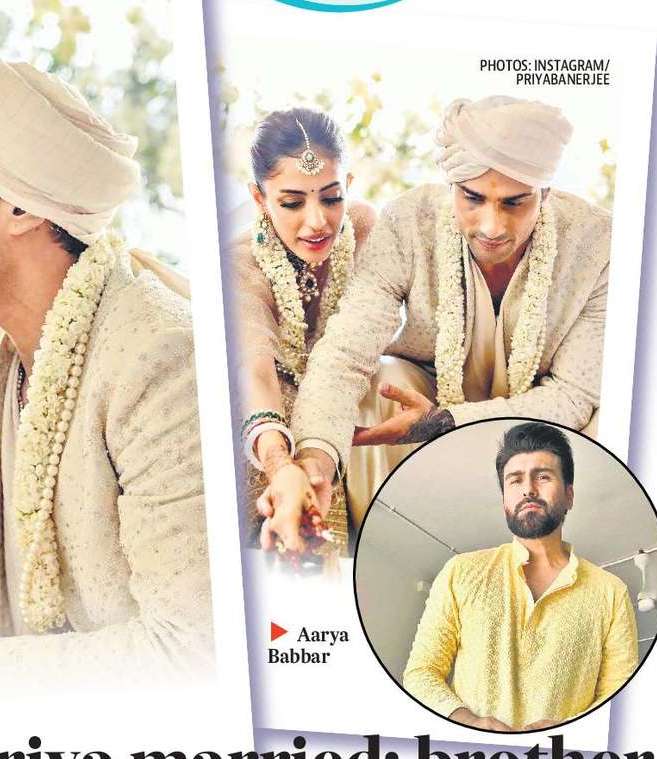
Rishabh Suri (HINDUSTAN TIMES; February 16, 2025)
February 14, a day celebrated by couples worldwide, became even more special for actor Prateik Patil Babbar and Priya Banerjee as they tied the knot in an intimate ceremony held at Prateik’s late mother, actor Smita Patil’s home.
“We wanted a ghar ki shaadi, and getting married to the love of my life here — the first house my mum bought and my home — was the best way to honour her in spirit,” Prateik told Vogue.
But his stepbrother, Aarya Babbar, son of actor-politician Raj Babbar and theatre personality Nadira Babbar, shared that the exclusion of family from the wedding left him heartbroken. “For the past few months, Prateik has decided to not answer anyone’s calls. It is hurtful,” he tells us, adding, “Hamari maa Nadira ne poori zindagi parivaar ko jodke rakha, unko nahi bulaya for whatever reason... but uss insaan ko toh bulana chahiye jisko Smita maa ne itna pyaar kiya — his dad.”
A junoon without parallel: Shyam Benegal sowed Ankur of new cinema, rediscovered Bharat
8:13 AM
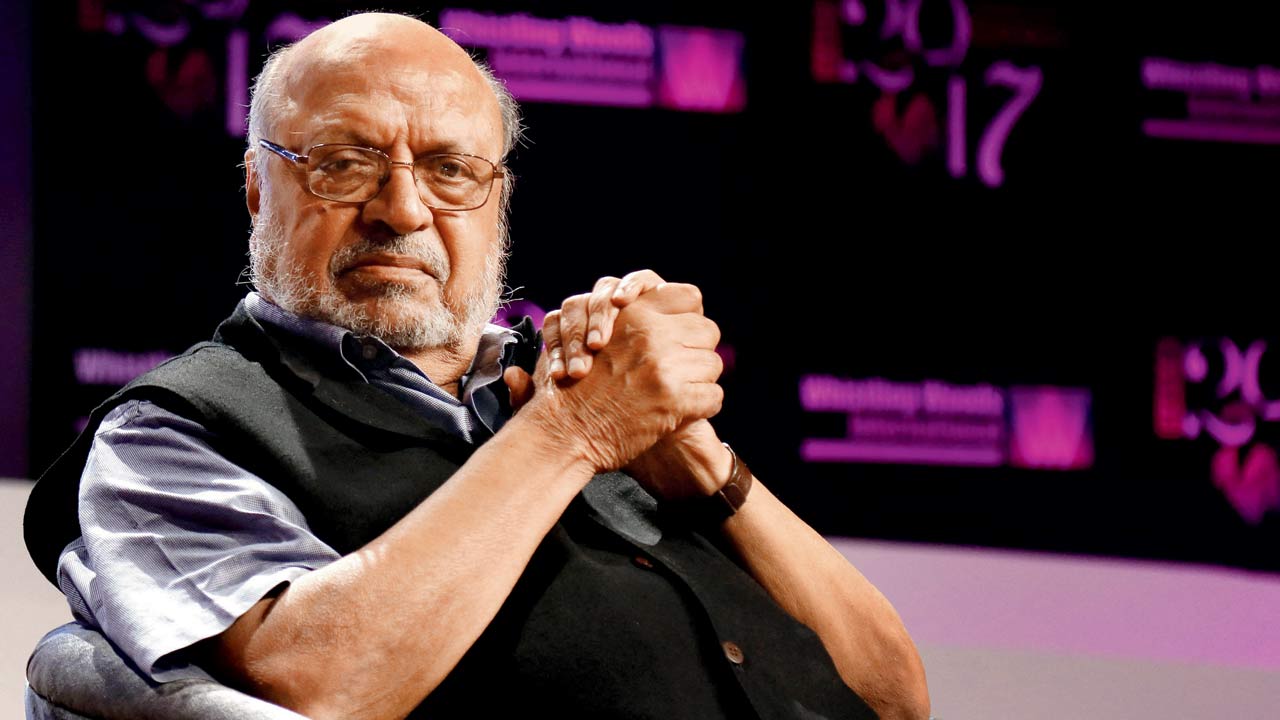
Benegal Pioneered New Wave Cinema, Created Cult Classics
Sunil Nair (THE TIMES OF INDIA; December 24, 2024)
Shyam Benegal came out of nowhere and lit up the Hindi film scene in the 1970s at a time when the industry was "an absolutely closed shop", as a close associate recalled it. It was the age of melodrama and action - 'Roti Kapda Aur Makaan' and 'Sholay' were big hits - and every release flaunted a roll-call of stars. "There was no possibility for any young filmmaker to get into it at all," is how Girish Karnad, who was then director of the Film and Television Institute of India, described it.
Benegal's neorealism struck a deep chord with a generation keen on films that would mirror the social and political tensions of their time. His debut film 'Ankur' (The Seedling), a tale of sexual exploitation set against a feudal background with a cast of unknown yet riveting newcomers, ran 25 weeks at the landmark Eros theatre in Bombay. He had begun writing the script of 'Ankur' when he was in college in Hyderabad and spent 20 years looking for a financier before an ad film distributor agreed to produce it. Its success staked out new ground for the 'art/parallel cinema' movement that over time showcased new talent such as Naseeruddin Shah, Shabana Azmi, Smita Patil, Om Puri, Govind Nihalani, Vijay Tendulkar and Vanraj Bhatia.
Benegal, who pioneered parallel cinema in India and created the 53-episode Bharat Ek Khoj, and whose last project was a 2023 biopic on Mujibur Rahman - 'Mujib: The Making Of A Nation' - passed away in a hospital in Mumbai, days after he turned 90 on Dec 14.
Shyam Benegal grew up in a cantonment town near Hyderabad in 1930-40’s where his father, a professional still photographer, introduced him to the camera. The obsession with movies began early, his appetite whetted by Hollywood and Indian releases screened at a local hall for the morale of the troops. “There used to be two programme changes a week,” he once recalled. “…like in Cinema Paradiso, I befriended the projectionist so I could see both...”
Shifting base after his education, he began working at Lintas in Mumbai as a copywriter. The next decade and a half were spent on a prodigious number of ad films and documentaries. Traces of the social concerns underpinning his cinema are evident in the shorts he made, including the earliest ones, such as A Child Of The Street, which took a compassionate look at juvenile vagrancy, and Close to Nature, a colourful take on tribal life in Madhya Pradesh.
His stint as a teacher at the Film and Television Institute of India (FTII) drew him closer to celluloid. But his bleak stories still had no takers among financiers. Lalit Bijlani of Blaze Advertising eventually stepped in. Both Ankur and Nishant, which came a year later, were set in the feudal lands of Telangana, a region under the Nizam. It was a world Benegal had seen up close in his formative years. Touted as his most striking works, the narratives and characters were situated in a rural milieu with a distinct dialect and attendant class-caste equations. Coming around the time of the Emergency, the two films spurred a movement of sorts and cemented his reputation as the high priest of the ‘New Wave’.
Benegal’s eclectic interests showed in the diversity of subjects. From Gujarat’s milk cooperatives (Manthan) to the life of a silent film era actress (Bhumika), from 1857 (Junoon) to feuding business families (Kalyug), his projects spanned periods and themes. A bearded, Renaissance figure at the centre of the ‘art film’ circuit, he was equally a mentor to actors, musicians, writers and technicians.
At a felicitation to celebrate Benegal’s 25 years as a filmmaker, actor-playwright Girish Karnad spoke of his innate ability to help artistes tap their potential. “He was not just a director but also a doctor, a psychiatrist, a father figure and a banker,” said Karnad.
The latter part of Benegal’s career was marked by biopics, including one on Gandhi’s years in South Africa and a tetralogy on Muslim women (Mammo, Sardari Begum, Hari-Bhari and Zubeidaa). By then, the ‘art film’ movement had dissipated. He had turned to a new set of collaborators, many from commercial cinema. His standout work in this period, however, was a part elegiac, part quirky interpretation of a Dharamvir Bharti novel, Suraj Ka Saatvan Ghoda. Occasional forays into television too made for interesting viewing: Bharat Ek Khoj, the mega-series based on Jawaharlal Nehru’s Discovery of India, and Samvidhaan, on the making of the Indian Constitution, were the best examples.
Benegal’s influence on the Indian film industry extended far beyond his own body of work. He headed a govt committee set up in 2016 to streamline the film certification process and lay down a framework that would allow more room for artistic expression.
--------------------------------------------
'Benegal told raw & real stories about ordinary people'
Bella Jaisinghani (THE TIMES OF INDIA; December 24, 2024)
Mumbai: The passing of Shyam Benegal, the torchbearer of New Wave cinema, evoked a lament of loss across the film fraternity Monday night. It was Shyam Babu who discovered and mentored an entire generation of the finest natural actors including Shabana Azmi, Naseeruddin Shah, Smita Patil and Om Puri, having fathered the parallel cinema movement with 'Ankur' in 1974.
In fact as recently as Dec 14, the entire clan met to celebrate Shyam Babu's 90th birthday, with happy pictures featuring Azmi, Shah, Kulbhushan Kharbanda, Kunal Kapoor of Prithvi Theatre, Divya Dutta and Rajit Kapur.
Filmmaker Shekhar Kapur posted: "He created 'the new wave' cinema. Shyam Benegal will always be remembered as the man that changed the direction of Indian Cinema with films like Ankur, Manthan and countless others. He created stars out of great actors like Shabana Azmi and Smita Patil. Farewell my friend and guide."
Actor Manoj Bajpayee whose career was baptised by his prince's act in 'Zubeidaa', termed it a "heartbreaking loss for Indian cinema. Shyam Benegal wasn't just a legend, he was a visionary who redefined storytelling and inspired generations". Actor-singer Ila Arun said, "I feel as if I lost my father. It is the end of a golden cinematic era."
Filmmaker Mahesh Bhatt said, "Shyam Benegal was a giant of Indian cinema. He told stories without pretense. They were raw and real, about the struggles of ordinary people. His films had craft and conviction. He changed Indian cinema, not with noise, but purpose."
Filmmaker Sudhir Mishra said, "Not many talk about the fact that there was a lament in his films and a sadness about the fact we were not living in the best of all possible worlds."
People from all walks of life mourned his loss. Congress leader Rahul Gandhi said, "Saddened by the passing of Shyam Benegal ji, a visionary filmmaker who brought India's stories to life with depth and sensitivity. His legacy in cinema and commitment to social issues will inspire generations. Heartfelt condolences to his loved ones and admirers worldwide."
Congress MP Shashi Tharoor recalled how Shyam Babu during his early years as ad filmmaker had photographed his sister and other children as "the first Amul Babies".
(With inputs by Swati Deshpande)
--------------------------------------------
He leaves behind a body of work so sprawling—shorts, documentaries, features, TV movies, series—that his CV alone might be longer than an obituary
Mayank Shekhar (MID-DAY; December 24, 2024)
Shyam Benegal’s last work, Mujib (2023), was possibly the most important film for Bangladesh; a biopic on the neigbouring nation’s founder, Sheikh Mujibur Rahman. He was 89, when the movie released. You did well, Mr Benegal. His first feature, Ankur (1974), was possibly the most important Hindi film for India’s art-house movement, heralding the Indian New Wave, from Bombay.
In between is a life so full of all kinds of cinema—shorts, documentaries, features, TV movies, series—that his CV alone, let alone its range, might be longer than an obituary can do justice. This would include a series of firsts; again, starting with Ankur itself, that was actor Shabana Azmi’s screen debut. Nishant (1975) was Naseeruddin Shah’s. He picked both actors, after they’d graduated from Pune’s Film & Television Institute of India.
One evening, while watching news on television, the anchor caught his eye, and he cast her in his children’s film, Charandas Chor (1975). That was Smita Patil. Bhumika remains, arguably, her greatest performance. Between Naseer, Shabana and Smita, forming an alternate, Bombay star-system of their own—besides Om Puri (Susman, Arohan), Anant Nag (Konduran, Kalyug), Rajit Kapur (The Making of the Mahatma, Suraj Ka Satvan Ghoda), and so many others—Benegal didn’t just make films.
He built an entire eco-system, for what came to be known as Hindi parallel cinema. Named such, because it did not intersect with the Bombay mainstream—remaining true to its realism, social consciousness, barely appeasing to audience’s baser instincts, or ignoring its intellect, while staying within commercial cinema, after all, for his features were still mostly privately funded (Blaze Productions, in particular).
An unassuming, gentle soul, gifted with gravitas, foremost, Benegal was a young mind. How else do you explain a career scripted over seven decades. Consider that when he made his first short, in 1962 (Ghar Betha Ganga), Jawaharlal Nehru was still India’s Prime Minister; man was several years away from stepping on the moon; and it’d be 20 years before we’d get Doordarshan (DD) for a proper national broadcaster.
Last checked, Benegal was still making movies. His partner, Nira, both in life and films, was his sounding board. He gave DD, and indeed Indian television, its greatest OTT slow-burn, decades before there was OTT, with Bharat Ek Khoj (1988), based on Nehru’s Discovery of India. He made India’s crowd-funded film, Manthan (1976), based on the life of dairy engineer, Verghese Kurien, with contribution of 500,000 farmers, decades before crowd funding became a term.
With Junoon (1979), he made the sharpest effort, until then, to take art-house into a big-budget space, with stalwarts of the time, adapting Ruskin Bond’s A Flight Of Pigeons. At the turn of the century, when multiplexes offered a short-lived window into exploring meaningful yet entertaining content, beyond simply the starry space, he brought forward intelligent comedies, Welcome to Sajjanpur (2008), Well Done Abba! (2009).
This is before he swiftly switched gear, and embarked on the astoundingly ambitious series, on the making of the Indian Constitution, Samvidhaan (2014), for Rajya Sabha TV. Yup, Benegal has always been there. Not just in terms of works, but also for how he inspired. What’s the final shot in Nagraj Manjule’s Fandry (2013), if not the stone-throwing finale of Ankur!
Given the widest possible gamut, surely, everybody has a Benegal Top 10. And each might read so different from the other. Kalyug (1981), modern adaptation of Mahabharat, set in Bombay’s corporate world, tops mine; Mammo (1994) might be a second; Mandi (1983) could be yours, or Zubeidaa (2001), if you’re younger.
A cousin of Guru Dutt, who got interested in cinema, because of his photographer-father Sridhar Benegal, who gave him access to a movie camera, when he was only 12—once Benegal moved to Bombay, from Hyderabad, he started out as a man of advertising.
It’s something he shared with Satyajit Ray, his inspiration of sorts. One of the most enlightening conversations on cinema that Benegal left behind for film buffs was his interview with Ray himself, for a documentary (that occasionally appears and disappears from YouTube).
It’s where you see Benegal for simply a curious movie mind. And a consummate movie buff, you would always spot at screenings at cinemas and festivals. The last I met him, in 2019, at his Tardeo office, which is a shrine of sorts in filmmakers in Mumbai—it was right after his Manthan actor and long-time associate, Girish Karnad, had passed on.
“Everybody’s leaving now,” he said. The very next minute, he began revealing how the then Bangladesh PM, Sheikh Haseena, had entrusted him with a film on her father, Mujib, along the lines of Richard Attenborough’s Gandhi. Benegal was 85 then—speaking about recommendations to the Indian censor board that never got implemented, or his public commitments in Goa, initiated from his Member of Parliament fund.
We discussed movies as a changing medium. He told me the cellphone was the best way to watch films—the eye’s distance should, anyway, be one and half times the length of the screen’s diagonal, and the sound doesn’t get better than a headphone. I’ve followed his advice since. There was so much more to learn. The movies remain. He lives on forever.
We actors should be considerate about rising production costs-Divya Dutta
8:18 PM

Onkar Kulkarni (BOMBAY TIMES; August 4, 2024)
As the discussion around exorbitant entourage expenses of Bollywood actors that add to production cost of films continues in the industry, Divya Dutta feels that actors should definitely be considerate and think from the producer’s point of view, too.
The Bhaag Milkha Bhaag actress says, “If you know that something is leading to an escalation in the production cost then you should self-reflect and be thoughtful. I am not saying cut down on all your demands, but try to reach a middle ground.”
Citing her own example, Divya, last seen in Sharmajee Ki Beti, shares, “I had done a film free of cost, for which I was paid later, and that too a hefty amount because it did well. So, you have to believe in the film, you have to believe that a lot of money is being spent to make it, and many people are dependent on the movie. After all, it’s not just about you because filmmaking is a collaborative process.”
Divya feels that she understands this because she comes from a different school of thought. She says, “I’ve done all kinds of movies. I come from Shyam Benegal school of filmmaking where even though we had vanity vans, we would sit outside and chat with each other. The other day, I heard Shabana ji (Shabana Azmi) say that she and Smita ji (Smita Patil) had cars to go to a set, but they refused to use them, saying, ‘Hum baaki actors ke saath jayenge’. For Stanley Ka Dabba, I didn’t ask for a vanity van because I wanted to spend time with the kids who were a part of the cast and share dabbas with them during breaks.”
In Hollywood, designers, hairdressers and makeup artists are all appointed by the producer’s team-Shabana Azmi
8:40 AM

Yashika Mathur (HINDUSTAN TIMES; June 24, 2024)
Of late, soaring production costs due to the large entourages that accompany film stars has become a cause of concern for filmmakers. “I find it astonishing that producers pick up these crazy tabs,” says Shabana Azmi, comparing the scenario with the West, where the producers have a lot of control over such things.
The actor adds, “In Hollywood, I have never seen anything like this except for personal trainers. The main dress designers, hairdressers and makeup artists are all appointed by the producer’s team.”
Recently, film bodies, including the Indian Motion Pictures Producers Association and the Producers Guild of India, met with other film bodies and talent management agencies to discuss the soaring film budgets. A major area of concern was the large entourages accompanying actors.
Azmi recalls the time when she would travel in buses: “During the 1970s and 1980s, I only had a three-member team — a hairdresser, a makeup artist and a driver. In low-budget films, we had nobody. I would use my own clothes at times, the unit’s hair and makeup person and stayed at the same hotel as the unit.”
The 73-year-old goes on to recall an interesting incident from the shooting days of her 1983 film Mandi. “I remember (late actor) Smita Patil and I were given separate cars for the shooting of Mandi. In two days, we gave them up and travelled in the bus with all the actors, because they would have so much fun together, singing and playing games,” Azmi ends.
Wearing my mom Smita Patil’s scarf at Cannes was a tribute to her-Prateik Babbar
9:06 AM

Vinay MR Mishra (BOMBAY TIMES; May 27, 2024)
It was an extremely proud moment for actor Prateik Patil Babbar to represent his mother, late actress Smita Patil, at the Cannes Film Festival this year. For the unversed, the restored version of the Manthan (1976), directed by Shyam Benegal, was screened at the 77th edition of the film festival. “This trip is now one of my most precious core memories. It’s been 37 years after her demise, this will remain one of the most symbolic and iconic celebrations of her legacy,” says Prateik.
The highlight of his red-carpet look was a scarf that belonged to his mother. Talking about the sentiment behind it, he says, “She is always with and around me. That is the privilege I have, being her son. She can hold me and hug me whenever I want. Her scarf was a symbolic addition to my custom outfit. It was a special tribute to her.”
The actor adds, “I have many of her scarves preserved in my cupboard. It occurred to me to carry something that belonged to her on her special day. During the fittings for my tuxedo, my stylist and I decided to add the scarf as a tribute to her. The scarf completed the entire look and was a perfect emotional touch for the occasion. I was glad people loved it because it belonged to my mom. I sure did.”
Reflecting on the reaction from people after the film was screened, Prateik shares, “One of the things that people keep saying about her is that there’s nobody who can get into the skin of a character like her. She is the greatest actress in the history of Indian cinema.” He also reveals that Naseeruddin Shah, who was present at the screening, got teary-eyed after the standing ovation.
“He got a well-deserved, standing ovation for his masterful performance and that brought tears to his eyes. I was fortunate enough to witness it first-hand. I hugged him tight and told him how much I was in awe of him.”
Prateik Babbar is ‘a proud son’ as Smita Patil's Manthan to be screened at Cannes
9:43 AM
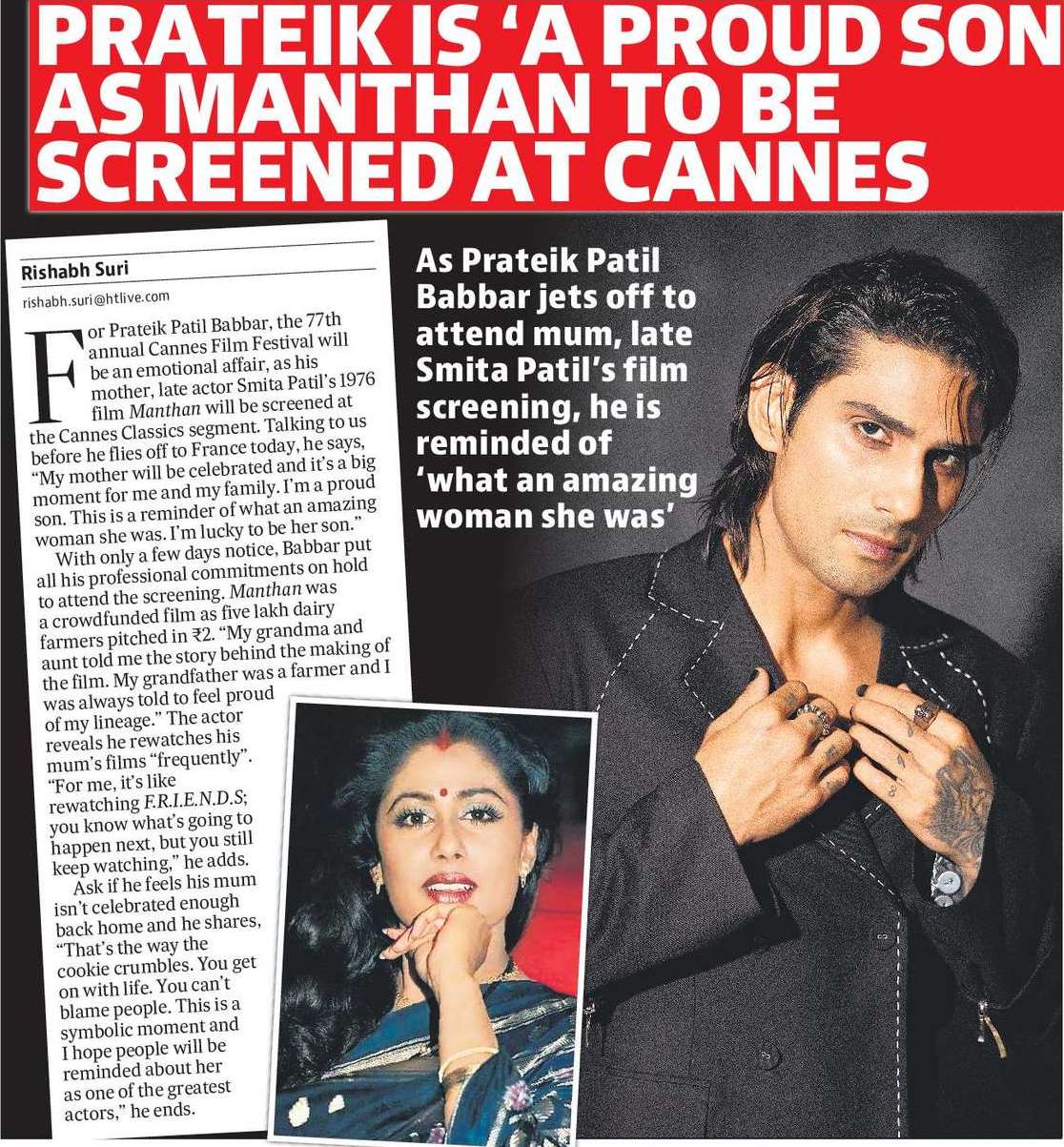
As Prateik Patil Babbar jets off to attend mum, late Smita Patil’s film screening, he is reminded of ‘what an amazing woman she was’
Rishabh Suri (HINDUSTAN TIMES; May 15, 2024)
For Prateik Patil Babbar, the 77th annual Cannes Film Festival will be an emotional affair, as his mother, late actor Smita Patil’s 1976 film Manthan will be screened at the Cannes Classics segment. Talking to us before he flies off to France today, he says, “My mother will be celebrated and it’s a big moment for me and my family. I’m a proud son. This is a reminder of what an amazing woman she was. I’m lucky to be her son.”
With only a few days notice, Babbar put all his professional commitments on hold to attend the screening. Manthan was a crowdfunded film as five lakh dairy farmers pitched in Rs. 2. “My grandma and aunt told me the story behind the making of the film. My grandfather was a farmer and I was always told to feel proud of my lineage.”
The actor reveals he rewatches his mum’s films “frequently”. “For me, it’s like rewatching F.R.I.E.N.D.S; you know what’s going to happen next, but you still keep watching,” he adds.
Ask if he feels his mum isn’t celebrated enough back home and he shares, “That’s the way the cookie crumbles. You get on with life. You can’t blame people. This is a symbolic moment and I hope people will be reminded about her as one of the greatest actors,” he ends.
Shabana Azmi lists her five special films from her 50-year career
3:10 PM

Natasha Coutinho (BOMBAY TIMES; March 15, 2024)
Five decades in the movies – and what a glorious journey it has been for Shabana Azmi. “But then, acting can’t be taught in 15 days or a month, that’s not even touching the tip of the iceberg. The greatest resource for an actor is life itself. Getting into the world of the character is not an easy task, just learning your lines is not enough,” she says.
It’s a 50-year career marked with several milestones, from winning a National Award for her debut in Ankur (1974) to choosing to play a queer character in Fire (1996). Here are five movies from her 50-year career that she exclusively spoke on during an hour-long chat.
ANKUR (1974): ‘I TOLD MY MOTHER THAT IT WAS LIKE SHOOTING A SATYAJIT RAY FILM’
I had started shooting for Faslah and Parinay, but it was Shyam Benegal’s Ankur that was my first release (Shabana won the Best Actress National Award). I was an urban, city-bred girl who spoke English and had never gone to a village. Then, Shyam Babu got Lakshmi’s costumes ready and we started working on what her gait would be like. It was interesting working with Shyam Benegal and I told my mother that it was like shooting a Satyajit Ray film. We went to the Berlin Film Festival and it was so glamorous. We got special treatment because Satyajit Ray’s film had been screened there in the past and were widely appreciated. Richard Dreyfuss and I were announced as the talented newcomers. The journey afterwards was a dream, and I was lucky as I faced no struggle.
ARTH (1982): 'EVEN TODAY PEOPLE TELL ME THAT THE FILM CHANGED THEIR LIVES’
One could give up an arm or a leg for my role in Arth. Mahesh Bhatt and I were friends and he excited me as a director. It’s like he would press a button and I would become the character. When the film released, people said it was nice, but objected to the ending – how could a woman not forgive her husband when he was apologizing? We said that we had made the film with that specific ending in mind and thank god for that! I won the National award, and it was a big hit. Even today people tell me that the film changed their lives and gave them courage. It was a small-budget film and many of the clothes I wore were my own. It didn’t have a bound script and kept developing even as we were shooting. One day, I was shooting for another film and Bhatt asked me to come over for 10 minutes. When I reached, he started shooting the important telephone call scene, with just one technical rehearsal. I started trembling, but today I’m glad it turned out that way and I did not over-prepare.
MANDI (1983): ‘I VISITED THREE BROTHELS TO UNDERSTAND THE WORLD OF THE FILM’
There was no question of saying no to Shyam Benegal and I gave 40 days for Mandi. My secretary was baffled and told me that I could’ve finished more films in that time. Most people on set were from FTII or NSD and we had a great time. Smita and I were given cars, but we gave it up to travel by bus with the others. Ila Arun would keep us entertained with her songs. I visited three brothels to understand that world. Faaroq Shaikh took me to Peela House and I noticed the girls were not garishly dressed; they wanted to look like film stars. Amrita Singh’s mother Rukhsana Sultana took me to GB Road, Delhi, that had tawaifs. Shyam Benegal took me to Heeramandi, where the madam asked one girl to perform on Dil Mein Tujhe Bitha Ke (from Fakira, that stars Shabana opposite Shashi Kapoor). Afterwards, she went back to being the person she was, a woman who had to support a family of eight. Pankaj Kapur had one scene but Shyam Babu would like the actors to be around. So he built a volleyball court and a carrom space so that we wouldn’t get bored.
FIRE (1996): ‘IT WAS NANDITA DAS’S FIRST FILM BUT SHE HAD THE COURAGE TO SPARKLE’
People still talk about Fire. It was Nandita Das’s first film but she had the courage to sparkle. We shot in a small house in Lajpat Nagar in Delhi and I knew there would be different reactions. People would be disturbed and overwhelmed, as these subjects were generally shoved under the carpet. The final confrontation between the characters played by Kulbhushan Kharbanda and me, where I talk about desire, was memorable. Deepa (Mehta) described my character as a ‘centred woman’ and for me, that’s when the penny dropped in my head. I don’t like directors showing how to act; one has to inspire the actor – not make them imitate. Having said that, the director is the most important person on the film, it’s their vision. But actors get more credit because we are on camera.
ROCKY AUR RANI KII PREM KAHAANI (2023): ‘KARAN JOHAR WOULD SAY ‘TRUST ME’ AND I WAS HAPPY TO SURRENDER’
Rocky Aur Rani Kii Prem Kahaani was a very different world for me. Karan Johar would just say ‘trust me’ and I was happy to surrender. Karan has kept up with the times and also wanted to bring in the world of Yash Chopra. The film raises such important points on gender roles. On one side I was playing Jamini and on the other side I was shooting for R Balki’s Ghoomer, I was also shooting for Shekhar Kapur’s What's Love Got To Do With It? In the same period.
Hamare yahan toh hum certain body type aur certain skin colour ko good looking maante hai-Nawazuddin Siddiqui
10:32 AM

Onkar Kulkarni (BOMBAY TIMES; February 27, 2024)
Nawazuddin Siddiqui, who’s always battled questions about good looks, emphasises that when it comes to his profession, one needs to gauge an actor’s looks through the camera lens. He explains, “Views on good looks differ from person to person. A man or woman you think is good-looking in India might not be considered good-looking in France or Germany.”
Elaborating on how unconventional beauty is also accepted by the audience, the Sacred Games actor says, “Hamare yahan toh hum certain body type aur certain skin colour ko good-looking maante hai. But for me, Smita Patil se khoobsurat actress koi aayi hi nahi hai aaj tak. Aisa lagta hai ke she was made for the camera. Camera ka kuch ek doosra perception hota hai. We have to see one through the lens. Hum log bina camera ke dekhte hai and decide karte hai ki yeh good-looking hai ya nahi. But when it comes to movies, whether an actor is good-looking or not should be decided after seeing them through the lens.”
Praising the actress who won immense love for her performances in films like Ardh Satya (1983), Bazaar (1982) and Arth (1982), among others, Nawaz said, “Smita Patil ko agar hum yahan khade karde then she will just come across as a normal Indian girl. Lekin jaise hi woh camera ke saamne aati thi, unse khoobsurat koi nahi dikhta tha. If she were there in today’s time, she would have been a delight for international filmmakers. West toh unhe kheech leta tha.”
Speaking about Slumdog Millionaire actress Freida Pinto, Nawaz says, “I was at the Cannes Film Festival, and I saw this huge hoarding that featured Freida. For many of us, she might be like any other girl next door. Lekin wahan par log keh rahe the ki yeh Hollywood ki kisi bade actress se bhi zyada khoobsurat lag rahi hai. People were clicking pictures of that hoarding. That shows the difference in people’s perception.”
If people learn smoking, vulgarity from films, then why don’t they learn when a film is telling good things?-Vidya Balan
2:24 PM

Niharika Lal (BOMBAY TIMES; December 4, 2023)
During a recent discussion on initiating change and becoming the poster girl for substantial films with women in lead roles, Vidya Balan said that it was never a conscious choice to play certain kinds of characters. “I didn’t see the glass ceiling, I saw the sky,” she said.
‘WOMEN ARE NO LONGER DEFINED BY THEIR RELATIONSHIPS WITH MEN, SO THAT’S WHAT WE ARE SEEING IN CINEMA ALSO’
Discussing how films like Bandini (1963) and Sujata (1959) had women in lead roles, and why female-led movies suddenly disappeared from the big screen, Vidya said, “Because women were not seen in society. It is as simple as that, so they were not visible in films. Society is not a mirror of films, but our films mirror society. It is as simple as that.”
Vidya added that now that women are taking centre stage in their lives, they want to see that reflected on screen. “We don’t want to see women (on screen) as sacrificial mothers, the wife who puts up with everything for her husband or a daughter who is pious. We are not defined by relationships with the men in our lives anymore. We are our own people and because we are our own people that’s what we are seeing in cinema. That’s why we are willing to go and buy tickets and watch those films,” she said.
‘I USED TO WONDER WHY CAN’T WOMEN DOING LEAD ROLES BE THE MAINSTAY’
“For me, it was never a conscious decision to break the glass ceiling. I didn’t see the glass ceiling; I just saw the sky. We had Meena Kumari, Rekha, Jaya Bahaduri, Sridevi, Hema Malini, Smita Patil, Tabu – Invariably, every female actor had one or two of those (lead) films in their entire career, spanning decades. I wondered, ‘Why can’t it be the mainstay? Why can’t women be just doing substantial films? Why can’t women be doing not just serious and intense but comedy roles too?’… I think maybe the world was moving in that direction, and that’s why I had the desire in me too. It all aligned. The universe responded with great opportunities. And today, we have a situation that is far better for women.”
‘FILMS DON’T HAVE THE POWER TO INFLUENCE SOCIETY, SOCIETY INFLUENCES FILMS’
Responding to a question on doing films with a social message, Vidya said, “Sandesh dene ka kaam politicians ka hai aur hum yahaan keval manoranjan karne baithe hain. If along with that we can compel you to think about any particular issue, then that’s a win for us. Like audience, we are also a part of the society. Yes it’s said that people learn smoking, drinking, vulgarity from the films, but then why don’t they learn when a film is telling good things? I don’t think films have the power to influence society; society influences films.”
When Prateik smiles, he looks exactly like Smita Patil-Shabana Azmi
8:16 AM
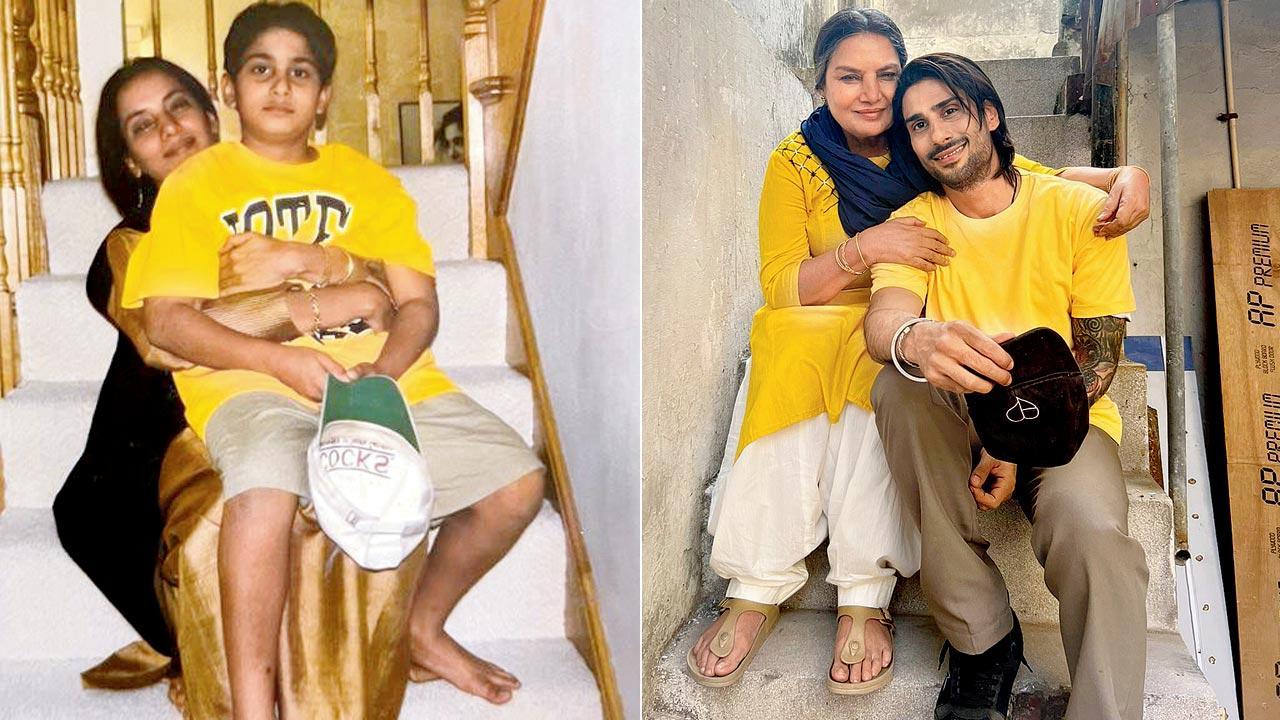
This picture of Azmi with a young Prateik Babbar was taken at Smita Patil’s sister’s Chicago home
Shabana, who did some of her most powerful films with the late Patil, says shooting with her son Prateik for Imaginary Rain was emotional
Upala KBR (MID-DAY; June 21, 2023)
Sharing screen space with the late Smita Patil remains among the most cherished memories of Shabana Azmi’s acting career. The two powerhouse performers gave Hindi cinema some of its most compelling movies in Nishant (1975), Arth (1982), Mandi (1983) and Oonch Neech Beech (1989). Today, as Azmi shares screen space with Patil’s son Prateik Babbar in Imaginary Rain, she marvels at the “surreal” nature of it all.
“It was deeply emotional for me to shoot with Prateik. He bears an uncanny resemblance to Smita. When he smiles, he looks exactly like her,” shares the senior actor. Ever since Babbar kicked off his acting career with Jaane Tu Ya Jaane Na (2008), Azmi knew it was only a matter of time before they would be cast together. Celebrated chef Vikas Khanna’s directorial venture made her wish come true.
“Prateik and I being cast together at some point was inevitable, given that Smita and I did so many films together. I was touched because Smita’s elder sister Anita Patil, who has been my friend for over 35 years, flew down from Mumbai to watch the first day of our shoot [in Amritsar].”
Babbar plays a cab driver in Imaginary Rain, which is a screen adaptation of director Khanna’s novel of the same name and chronicles his grandmother’s journey after she opened a restaurant in New York.
“Prateik and I were to do a Faraz Ansari film, which was postponed. So, we were able to shoot Imaginary Rain. Prateik is a disciplined actor. There is a shot in which he cried naturally. He said he has never been able to do that before. He also told me he wants to sink his teeth into meaty roles, irrespective of their length. That’s an actor talking,” smiles Azmi.
Madhur Bhandarkar said, ‘If you sign India Lockdown, you can pay homage to Smita Patil.’ I was instantly sold-Prateik Babbar
2:28 PM
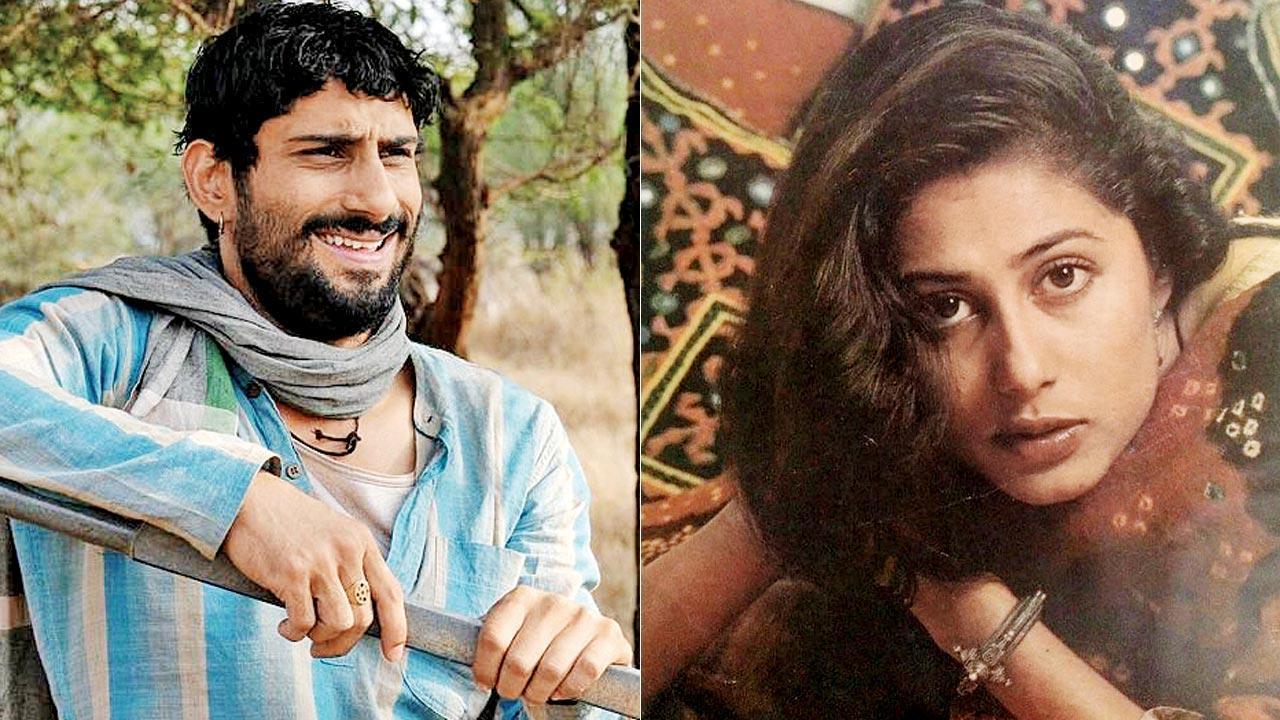
Prateik says he gave his nod to India Lockdown after the director noted that part was similar to mother Smita Patil’s roles
Uma Ramasubramanian (MID-DAY; December 16, 2022)
Working with Madhur Bhandarkar was always on Prateik Babbar’s wish-list. There was, however, a bigger incentive to be a part of India Lockdown, helmed by Bhandarkar. “When Madhur sir approached me, he told me that my mother [Smita Patil] would play such characters. He said, ‘If you do this, you can pay homage to Smita Patil.’ I was instantly sold. Also, I like to present diverse characters to the audience. Playing a migrant worker attracted me,” says Babbar.
In the ZEE5 film, the director studies the pandemic-induced lockdown through the lens of marginalised sections of society. Babbar plays a migrant worker who, with his family, tries to make his way back to his hometown.
The actor says, “This film is an emotion that we have all shared globally. [Through Madhav], I had the opportunity to relive the hardships the community faced during the lockdown. Even otherwise, on an everyday basis, they struggle to make ends meet. Portraying their heart-wrenching journey was a huge responsibility. It had to be done with utmost sincerity.”
The movie also stars Shweta Basu Prasad, Aahana Kumra and Sai Tamhankar.
Mum’s birth anniversary is an extremely vulnerable day for me-Prateik Babbar
8:22 AM
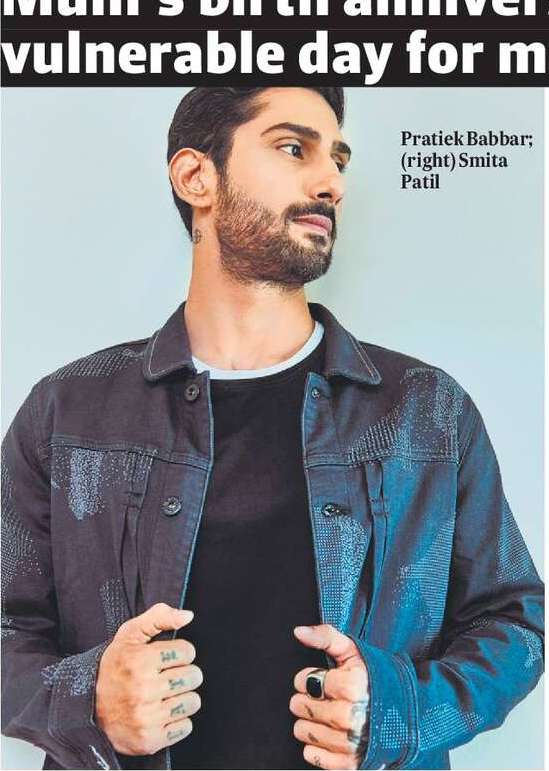
Vinay MR Mishra (HINDUSTAN TIMES; October 17, 2022)
The legacy of late actor Smita Patil lives on through her films, and her son, actor Prateik Babbar, would love nothing more than to carry it on. On her birth anniversary today, Babbar, who is gun-shy about public appearances, will be seen cutting a cake amid fans of his mum as well as the paparazzi. He also plans to commemorate the day with a charity that takes in and feeds stray animals.
“I want to get their (paparazzi) blessings. She was always loved and I want to carry forward that emotion. No one can forget who Smita Patil was. Recently, on Mr (Amitabh) Bachchan’s birthday (October 11), there were screenings of his films. Aaj Rapat Jaye To (a song featuring Bachchan and Patil from Namak Halaal; 1982), got the most whistles and applause. So many people shared the videos from the theatre,” Babbar shares.
Patil died from complications during childbirth and would have been 67 today. Babbar says, “Her birth and death anniversaries are two extremely vulnerable days for me. However, I feel blessed and humbled with all the wishes that pour in. I think about her all day and I feel lost, but there’s always lots of love.”
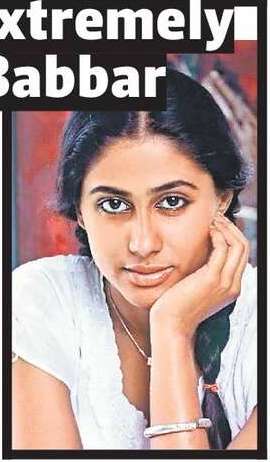
I didn’t even have money to buy a cup of coffee when I first went to Cannes-Shabana Azmi
8:14 AM
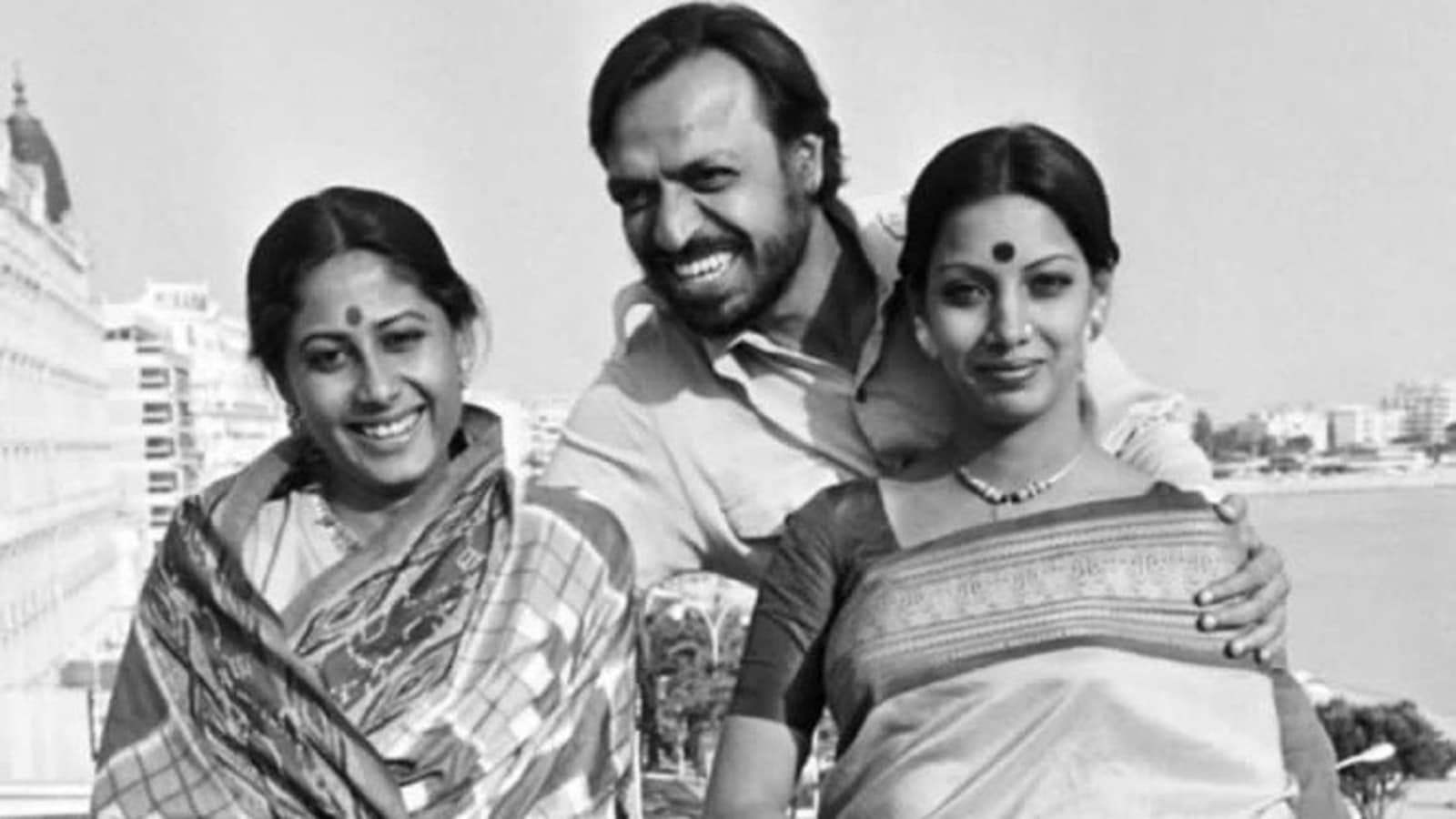
The actress recounts memories of her first experience at the Cannes Film Festival in 1976
Tanvi Trivedi (BOMBAY TIMES; May 21, 2022)
Veteran actress Shabana Azmi along with Smita Patil and filmmaker Shyam Benegal represented India at the Cannes Film Festival as early as 1976. The trio was at the prestigious film festivals to showcase their film Nishant. The actress in a recent post on Instagram shared how they had no publicity material or funds to promote their film, but they still managed a full house! BT spoke to Azmi about her experience back then and how she views the festival now. Excerpts:
You had recently posted on your social media about attending the Cannes Film Festival in 1976. What do you remember about your first experience there? How was it meeting people on a global platform?
Back then, we were not glamour struck by anything. We were experiencing terror at not having any publicity material or any money whilst others were throwing lavish yacht parties with caviar and champagne.
We were allowed the princely sum of eight US dollars in foreign exchange, so when I say we had no money, I mean it. Since breakfast was included in the room tariff, we used to fill our stomachs and survive on coffee and French fries during the day. Inevitably, we had dinner at many parties, where our intention was less to network and more to fill our stomachs! What was fascinating, however, was to have Shyam draw up a list of the films that we could watch, as we rushed from one screening to the next!
You spoke about the lack of funds. How did your team manage a full house?
Shyam came up with the idea that Smita and I should dress up in our best sarees and walk up and down the promenade to attract attention. We turned many heads because whilst there were many in bikinis and shorts, we looked like we were out of some oriental exotica! We would then rush to the curious people and say, ‘Please come and watch our film, which is in competition on so and so and this date!’ But the ruse worked, we managed a full house and even received a standing ovation.
After 1976, when did you go to the Cannes Film Festival next?
I was scheduled to go there for the screening of my film Genesis, an Indo-French-Belgian co-production directed by Mrinal Sen in 1986. A day before the trip, I decided to go on a hunger strike organised by the NGO Nivara Hakk with Anand Patwardhan and three slum dwellers for the rights of slum dwellers in Cuffe Parade, whose huts had been demolished. Five days into the hunger strike, Shashi Kapoor negotiated on our behalf with Chief Minister S B Chavan, and we managed to get the alternative land we were demanding. It was worth giving up going to Cannes and mercifully Mrinal da was very supportive. Later, I was invited to Cannes to give the award for the best documentary film in 1989. I was chuffed; I was now staying in a fancy suite of the very hotel we used to look longingly at; when we didn’t have money to even buy a cup of coffee at the Cannes Film Festival.
Celebs’ red-carpet appearances at Cannes become a talking point every year. How do you view the Cannes Film Festival now, with a huge focus on fashion, along with great cinema?
I remember some years ago it was said that any woman wearing flat sandals cannot appear on the red carpet. I was horrified and protested loudly. They received a lot of flak for it. Mercifully, they decided not to go ahead with that diktat. This business of the red carpet drawing so much attention is pure commerce. Many jewellers and fashion houses use it as an opportunity to advertise their wares. The celebrities are happy to look good without having to pay for it and so it’s a win-win for both. That’s the way the world functions today. But for me, the primary focus of a film festival remains the opportunity to watch the latest in world cinema. I am less interested in who wins the award and more interested in catching a distant film that otherwise I would be unable to.
If you were to go to Cannes now, how would you like to dress for the festival?
Without a doubt, in a saree. There is a timeless elegance to the saree, which is unmatchable.
I feel happy when television actresses reach out to me and look up to me-Mrunal Thakur
8:08 AM

Onkar Kulkarni (BOMBAY TIMES; April 18, 2022)
Mrunal Thakur is thrilled that Jersey is all set to hit the theatres after a long wait. The film’s team faced many hurdles with its release due to the pandemic. In a chat with Bombay Times, she elaborates on her smooth transition from TV to films, how filmmakers are now offering her author-backed roles and who is her inspiration in cinema. Read on...
You waited for nearly two years for the film to release in theatres. It’s finally releasing this week. Are you relieved?
I am just overwhelmed. I have waited for this film to hit the big screen for so long. I have worked really hard on this project, and I am happy that people will finally get to see it. I play the role of a mother in this film, something I haven’t experienced in real life, and so I drew references from my mother for the part. That apart, I had two releases last year —Toofaan and Dhamaka. The former was meant for a big-screen experience. It was really disappointing that the audience could not get a theatrical experience as it was released on OTT. The film was designed for a theatrical release. So, I am finally happy that a film like Jersey, with which I have been associated for over two years, is finally releasing on the big screen.
The makers decided to stick with their decision to release the films in the theatres instead of heading for the OTT space. Why was it important for a movie like Jersey to stick to its theatrical release plans?
It’s a film that’s full of mixed emotions. The characters are so relatable that the film deserves to be watched uninterrupted in a cinema hall. Often, when you watch a film on OTT, you are subjected to distractions. This is that kind of a film which will give you joy... something that will make you want to celebrate and begin a conversation about. Also, the scenes are aesthetically shot for a big-screen experience. Like, all the cricket shots you see are not computer graphics. You can see depth in the scenes, like the movement of the ball when Shahid plays cricket or the expression of people sitting in the audience when they are watching the match. Also, I am sure that once people watch the film, they will go to their parents and thank them for whatever they did for them. I want to dedicate this film to my mom and dad. My dad retired last month, and so I am very emotional about it. I am grateful to him for all the things he did for me so that I could reach where I am today.
You have come a long way...from moving out of your hometown Dhule (Maharashtra), to starting your career in the TV industry, making Mumbai your home and finally, plunging into Bollywood. Who has been your role model?
My inspiration has been Smita Patil. Whenever I used to visit my dad’s native place in Shirpur (in Dhule), he would show me a house that belonged to Smita Patil. I think she was way ahead of time. It takes lots of guts to do the kind of films she did. While growing up, I saw her movies, and one of my favourites was Mandi. I wish I had an opportunity to act with her. She has been my idol, and just like her, I want to do something extraordinary in my career. I want people to know me for my films. I want to inspire them. Today, I feel proud that I inspire many television actors. I transitioned from TV to films, and I feel happy when television actresses reach out to me and look up to me.
Television actors have always struggled to break that image and make the transition. Even if they get a break, it gets tough for them to sustain and find acceptance in Bollywood. How has it been so far for you?
I broke the image right from my Hindi debut film, which was Love Sonia. Nobody expected a TV actor to take up an arty film, instead of a typical masala venture as their launchpad. It is because of Love Sonia that people have taken me seriously as an actor, leading to me bagging stronger roles. Even in my last films, Toofaan and Dhamaka, I was very happy with the parts I got. With my work, I want to break stereotypes and set an example. I just want to say that earlier I was surviving, but now, I am living my life as an actor. And I have earned it all on my own, and nobody can stop me from living my dream. I want to be a part of stories that resonate with people, and I am glad that filmmakers are showing faith and trust in me. I am getting to meet my dream directors. I am in a very good phase of my career right now.
While you have been playing strong characters, do you also wish to play the quintessential lead heroine in a movie?
I have realised that the term ‘lead’ is very misleading. I learned that right when I was doing my TV show Kumkum Bhagya. I was very adamant that I only wanted to play the lead. I was signed as the lead, too, but eventually, it went into the second lead space. I realised it didn’t matter because I still won immense popularity. What matters is what impact you leave on the audience. Lead koi bhi ho, lekin kabhi kabhi asli masala dussre characters mein hota hai. These characters constantly add to the story and the narrative. I am new to the industry, and I don’t want to rush. I want my first 10 movies to be my learning ground. And then you need to wait and watch for my 11th or 12th film. I want to improve and take risks, too.
I was just not looked at, maybe because I was Naseeruddin Shah’s wife-Ratna Pathak Shah
8:27 AM

Titas Chowdhury (HINDUSTAN TIMES; April 11, 2022)
Actor Ratna Pathak Shah, who has been part of critically acclaimed films such as Mandi (1983) and Mirch Masala (1987), says that besides being part of the commercial cinema space, star system also penetrated the art film circuit back in the day. And that, she believes, is what kept her from working frequently: “Our filmmakers weren’t adventurous when it came to casting. They always chose the ones who grabbed eyeballs. In art cinema, it was all about Naseeruddin Shah (husband), Om Puri, Shabana Azmi and Smita Patil.”
Shah rues the dearth of opportunities for her other contemporaries, too: “It was much later that (actors) Pavan Malhotra and Pankaj Kapur got the parts they deserved. Supriya (Pathak; actor and sister) never got the parts she deserved. And I was just not looked at, maybe because I was Naseer’s wife, and they thought I was not interested in working. Thankfully, that’s done with and dusted.”
The Thappad (2020) actor heaves a sigh of relief, as she’s getting to work at a time when most people have retired. “My skill has improved in the last 20 years. Maybe that’s why I’m getting the kind of roles that you see me doing,” Shah ends.
I was hesitant about screening Disco Dancer in Russia but Smita Patil convinced me-B Subhash
8:28 AM

Sonam Joshi (THE TIMES OF INDIA; March 29, 2022)
The year was 1983. Film director Babbar Subhash’s ‘Disco Dancer’ had just been invited for the Moscow film festival by a Mumbai-based agency Sovex Fort. “I was hesitant because it was a modern film with modern music and mostly dark films such as ‘Do Bigha Zamin’ have been successful in Russia but Smita Patil convinced me otherwise,” Subhash recalls.
By the time the movie screening ended, over 3,000 people in the auditorium were clapping and dancing along to the title track. “It was one of the best days of my life,” he says. ‘Disco Dancer’ went on to sell 120 million tickets in the Soviet Union, and even WhatsApp’s Ukrainian cofounder Jan Koum recalls watching the film as many as 20 times as a kid in Kyiv.
With Hollywood movies banned in the USSR during the Cold War, the Soviet government began promoting Indian movies from the 1950s onwards. The first big hit was Raj Kapoor’s ‘Awara’ selling 64 million tickets followed by ‘Shree 420’. Then came movies such as ‘Dhool Ka Phool’, ‘Love In Simla’, ‘Bobby’, ‘Barood’, ‘Seeta Aur Geeta’, ‘Muqaddar Ka Sikandar’.
Dr Sudha Rajagopalan, senior lecturer in East European Studies at the University of Amsterdam, estimates that 210 Indian films were screened in Soviet theatres between 1954 and 1991, around 190 of which were mainstream Hindi films from Bombay. “Indian popular films often surpassed both domestic and other foreign cinema in viewer turnout,” she writes in her book.
Elena Doroshenko, a Moscow-based journalist and linguist who has watched the old hits as well as the relatively newer ‘Kal Ho Naa Ho’ and ‘Paheli’, says they struck an emotional chord with Russians. “The films spoke the same emotional language — even though we were different, we understood the emotions and passions,” she says.
The success of Hindi films in the USSR also led to joint productions such as ‘Alibaba Aur 40 Chor’ and ‘Sohni Mahiwal’. However, this changed after the fall of the Soviet Union in 1991. “There was a flood of various films from the West and we wanted to imitate that lifestyle,” Doroshenko says. “Indian films were still on TV — it’s not that they were forgotten but they stopped being a sensation.”
Dancer Svetlana Tulasi, who was born to an Indian dad and Russian mom and raised in Moscow, recalls watching Bollywood movies on cassette tapes, then cable TV, then DVDs and eventually on the internet. She shot to fame a few years ago with her viral Bollywood-Kathak fusion dances at Russia's Got Talent and Ukraine's Got Talent.
On YouTube, there are Russian fan channels devoted to Mithun Chakraborty, and dance performances set to the song ‘Jimmy Jimmy’. There are even a couple of restaurants by that name in Vladivostok and the Georgian capital of Tbilisi.
The Georgian ‘Jimmy Jimmy’ was inaugurated in 2019 by none other than Raj Kapoor’s son Rajeev Kapoor. “When we visited Georgia for the first time, we were surprised to see that taxi drivers were playing ‘Jimmy Jimmy’ and ‘Mera Joota hai Japani’,” says owner Shubham Joshi whose customer base includes both locals as well as Indian students.
My self-portraits are not pretty pictures of me-Deepti Naval
8:17 AM

Niharika Lal (BOMBAY TIMES; March 8, 2022)
Deepti Naval, who was recently in Delhi, showcased one of her paintings at an art gallery in the capital. The veteran actress, who has filmed for Chashme Baddoor and Made In Heaven in Delhi, says, “I like Delhi. I keep coming back here. That haveli (where she shot for Made In Heaven) was glorious.”
Talking about her art on display, she says, “The painting that I have put on display is a portrait of my friend, Zaki. There is a portrait of me on display as well. ”
‘MY SELF-PORTRAITS ARE NOT PRETTY PICTURES OF ME’
Her work, although not part of the festival, also includes a painting of Smita Patil. She says, “With Smita ji, I had an intense bond. When she passed away, I made her painting in the next 10 days. It was my way of dealing with the grief. In fact, there is also a poem that I have written ‘Between Smita and I’. It describes our equation. In the painting, my eyes are closed and her eyes are open and somebody asked me, ‘why you have kept her eyes open (as she has passed away) and yours closed?’ I said, ‘I am still groping in the dark, but Smita has found the light’. So, uski aankhein khul chuki hain.”
Apart from the paintings of her friends, her work also includes a lot of self-portraits. She says, “My self-portraits are not pretty pictures of me because as an actress there is enough of that. These self-portraits are all internal. It’s the state of mind that you are going through at that moment when you are painting a self-portrait. In each self-portrait, I have tried to capture different feelings and state of mind.”
‘MY PAINTINGS HAVE FOUND A HOME IN THE HILLS’
Over the years she has captured snowcapped Himalayas in her paintings while travelling in the hills. And now her paintings have found a home (at her gallery) in Haripur, Kullu. She says, “Himachal se meri personal history judi hui hai. When I was growing up in Amritsar, my parents would take us to the Kullu Valley in Himachal Pradesh and we would go and stay in Manali. So, I have this connect with Manali. I eventually got a place there but later I thought, ‘What is the point of having a place in the hills when you hardly stay there?’ Then I decided to make it a home for my artwork and that’s how it became a gallery. I enjoy going there and want to find more time to visit and paint there. ”
Subscribe to:
Posts (Atom)