Showing posts with label Meghna Gulzar. Show all posts
Showing posts with label Meghna Gulzar. Show all posts
I try to stay away from roles that are ‘best friend oriented’ or ‘hot girlfriend oriented’-Anjali Sivaraman
9:46 AM

Priyanka Sharma (MID-DAY; June 26, 2026)
Still in the early days of her career, Anjali Sivaraman has bagged an international project in filmmaker Mira Nair’s Amri. What’s next? Well, the actor is eyeing Hindi cinema. “Hopefully, my next project will be in Hindi films. I haven’t signed anything yet, but I am reading a lot [of scripts]. I’m hoping to be a part of at least one,” said Sivaraman, who has caught the attention of many filmmakers since her turn in the Tamil outing, Bad Girl (2025).
Even as the actor takes her time to decide her next, she has her wish list of Bollywood directors ready. “I want to work with Zoya Akhtar and Meghna Gulzar,” she shared, adding that she is particularly keen to team up with female directors. Reason? “They have such a strong voice and incredibly strong female characters.”
If she has her wish list worked out, she is also certain of her “non-negotiables”. “I try to stay away from roles that are ‘best friend oriented’ or ‘hot girlfriend oriented’. I like to play layered, complex characters to whom I can bring some humanity.”
Exercising her vision, however, comes at the risk of alienating opportunities. That’s a risk she is willing to take.
“It’s difficult to even get yourself into the room that gets you an opportunity. Then to say no is heart-breaking. I have said no with the fear that the person will think that I’m unprofessional or blacklist me; or now that I said no, will I ever get another opportunity? I continue to face these insecurities. But at the end of the day, my self-belief has to be greater than my insecurities,” she said.
Kareena Kapoor comes prepared, but respects the process-Upendra Chauhan
9:49 AM

Priyanka Sharma (MID-DAY; June 21, 2026)
Learning on the job, especially from veterans in the industry, is a rite of passage for any actor. Upendra Chauhan, who made his big-screen debut with Meghna Gulzar’s Sam Bahadur (2023), feels fortunate to be back on the filmmaker’s set for the upcoming crime drama Daayra, headlined by Kareena Kapoor Khan and Prithviraj Sukumaran.
Playing a cop alongside Khan in Daayra gave Chauhan the opportunity to observe her professionalism and the ease with which she carries her stardom.
“From our initial readings to being on set, she made an effort to connect as people and not just as co-actors. That helped build a genuine rapport, which was valuable because our characters also share a strong professional relationship within the story,” observes Chauhan.
What struck him most was Khan’s confidence, especially when “she doesn’t make it about herself”.
“She is extremely honest, hardworking, and disciplined. She comes prepared, but respects the process, listens to the director, and remains fully committed to the work,” he shares, adding that he learnt the importance of consistency from her.
Meghna Gulzar wrote a nasty message to me after Raazi shoot-Harinder Sikka
4:27 PM

Natasha Coutinho (HINDUSTAN TIMES; April 1, 2026)
Author Harinder Singh Sikka, whose espionage book Calling Sehmat was adapted into the 2018 film Raazi, insisted in a post on X on Saturday that choosing Meghna Gulzar to direct the film was his “gravest misjudgement”.
Speaking to us, Sikka says he has been raising the issue for a while and is bringing it up again in light of the buzz around the spy franchise Dhurandhar. “I wasn’t willing to sell the rights of the book but agreed because of a promise to (poet-filmmaker and Meghna’s father) Gulzar,” he shares, adding, “My problem is that she removed the tricolour from the movie, while the Pakistani flag was flaunted. Even the Pakistani army was shown in a soft light. While in the book the protagonist was welcomed with (the Indian national anthem) Jana Gana Mana when she returned to India, all that was missing in the film. The climax was made to show that Sehmat made a mistake by fighting for India, which harmed the cause of Kashmiris.”
Recalling his first meeting with Meghna, he says, “I told her that I was appointing her on her father’s request, even though she didn’t have a good reputation in the industry. After the film’s completion, she wrote a nasty message saying, ‘I don’t want to speak to you anymore’. The director’s cut was shown to the armed forces but not to me.” He adds that he appreciates films like Dhurandhar for showing Pakistan in its “true light”.
We reached out to both Gulzar and Meghna for a comment, but received no response till the time of going to press.
Harinder says that the changes done from the book for Raazi “undid” his hard work. “Meghna changed the story and then got her father to write the song Ae Watan Mere Watan. There is not a word about Bharat in it. It was cleverly worded and presented. It took me eight years to write the book, and with one film, the hard work was undone,” he says, adding that while the film was a commercial success, he knew that it won’t win any National Film Award: “It isn’t worthy of that. The film did India dirty.”
The author adds that he also didn’t agree to the film’s title change from Sehmat to Raazi. “Meghna didn’t want to acknowledge Sehmat for who she was. I was taken for a ride,” he says, claiming that Gulzar also got him excluded from speaking at an event: “I have a letter by the Jaipur Literature Festival team, that says Mr Gulzar pushed them to not let me speak at their event. When I questioned him, he said it was a typo.”
Sikka expresses disappointment as he feels that films like Raazi are made to show that “the tricolour need not be celebrated”. “Even though that is what our martyrs come home wrapped in,” he ends.
It’s heartbreaking, but the revival of RK Studios isn’t happening-Kareena Kapoor
9:42 AM

Vinay MR Mishra (BOMBAY TIMES; March 23, 2026)
Twenty-six years into her career, Kareena Kapoor Khan continues to reinvent herself with ease. At a recent event in Mumbai, the actress spoke to us about evolving with the times, balancing food and fitness, how her characters become pop culture icons, and why the revival of Raj Kapoor Studios is not on the cards at this point. Excerpts:
‘Perhaps Lolo and Ranbir should think about RK studios’ revival’
Rumours of cousins Ranbir Kapoor and Karisma Kapoor reviving the iconic Raj Kapoor Studios have been rife, but Kareena sets the record straight.
She clarifies, “That’s just not true. It was even being discussed in our family group, and everyone was like, ‘This isn’t happening.’ I feel people really want it to happen. I feel like Ranbir is focused on acting. He loves acting. I think he’s the best actor in India we have today. So, his focus is on that. It’s heartbreaking, but it’s not happening. Maybe Lolo and Ranbir should think about it because I don’t think I can think like a director or a producer.”
‘I’ve always wanted to do a mini series’
As the conversation flows, the actress, who made her Bollywood debut with Refugee in 2000, talks about reinventing herself.
“There is no sketch, but reinvention is trying to do something different every year. I had never worked with Meghna Gulzar. She’s a wonderful director. Our film (Daayra) is topical, and I’m really looking forward to it. My reinvention will come with my character. I am hoping to do something really different this year, maybe a good show, maybe a miniseries. In fact, I’ve always wanted to do a mini series,” she shares.
‘You have to have your own identity, that’s very important’
Many of the characters she played – like Geet (from Jab We Met) and Poo (from Kabhi Khushi Kabhie Gham) – are pop culture icons, leading to many younger-generation women enacting them.
She says, “I don’t see people intentionally trying to do that, but I feel like Poo and Geet have become such pop culture benchmarks that, in 2026, you’re kind of associating with them. But no one really intentionally wants to (ape them), because you have to have your own identity, and that’s very important.”
Bring up the topic of fashion, and Bebo admits there is pressure every time she steps out. “Of course, there is pressure, but I enjoy fashion, so I enjoy it to my comfort. I don’t like doing things or being fashionable because I will still be uncomfortable. I won’t follow a trend or do something just because it’s cool or looks cool. I’ll first see what I want to do. So, there’s never really any plan to make a fashion statement. I feel when you wear outfits that are wearable, fashion becomes a statement,” she explains.
‘I can feel my body transforming again’
Kareena, who started the size-zero trend in Bollywood, is passionate about her food. She confesses that she still loves her parathas.
“I have a great relationship with food and fitness because I like to eat. I had two parathas today. I have to have my parathas. I like to try different workouts and experiment with them, but my heart crawls back to yoga, because that’s where it lies. In fact, in 2026, I restarted my yoga journey, which I started in 2007 with Tashan. I can feel my body transforming again. I’ve tried a thousand workouts, but I always go back there. So, I’m always going to eat my parathas and continue doing my yoga,” she signs off.
I hope Vishal Bhardwaj continues making films for children like The Blue Umbrella-Gulzar
10:22 AM

The lyricist-poet talks about why his connection with young audiences endures and how their world still moves him to create with heartfelt passion
Natasha Coutinho (HINDUSTAN TIMES; January 12, 2026)
Veteran lyricist-poet Gulzar, who at 91 remains discerning about the projects he chooses, is set to return to writing lyrics for a children’s film titled Masab Tank. Speaking at his Bandra bungalow, Gulzar reflects on why writing for children continues to matter deeply to him. “It’s not just a desire or an ambition, it is an obligation. Unfortunately, it is treated in a very left-handed way by writers.”
Explaining what drew him to Masab Tank, Gulzar shares, “Masab Tank is an area in Hyderabad where children’s playgrounds have been taken away and replaced by buildings. This project really touched my heart,” he says.
Having penned some of the most memorable children’s songs in Indian cinema — from Lakdi Ki Kaathi (Masoom, 1983) to Jungle Jungle Pata Chala Hai from the iconic 1990s television series The Jungle Book — Gulzar says his engagement with children’s writing is far from over. “Writing for children will continue till I grow up enough to be a child again,” he smiles.
He hopes his protégé, filmmaker-composer Vishal Bhardwaj, will carry the baton forward. “I hope Vishal continues making films for children like The Blue Umbrella (2007). He has that rare sensitivity required to create songs that truly connect with children,” Gulzar says.
The concern for children, Gulzar adds, runs through his family as well. His son-in-law, businessman Govind Sandhu has written a book inspired by the plight of children affected by war in Gaza and Ukraine, while his daughter, filmmaker Meghna Gulzar, has authored a book focusing on differently-abled children.
Gulzar also speaks passionately about his long association with Arushi, an institute for specially-abled children. “I came across the institute while making my film Koshish (1972). Every year, these children come to the city to participate in a marathon, and I have been walking alongside them for almost two decades,” he says.
As for future collaborations, when asked whether audiences will see him working with Meghna on her upcoming film Daayra, starring Kareena Kapoor Khan and Prithviraj Sukumaran, Gulzar reveals that it may have to wait. “She said that her script doesn’t allow for any songs. So that collaboration will have to wait,” he ends.
S S Rajamouli chooses large backdrops as he excels at telling a story through big, visual stroke-Prithviraj Sukumaran
8:47 AM
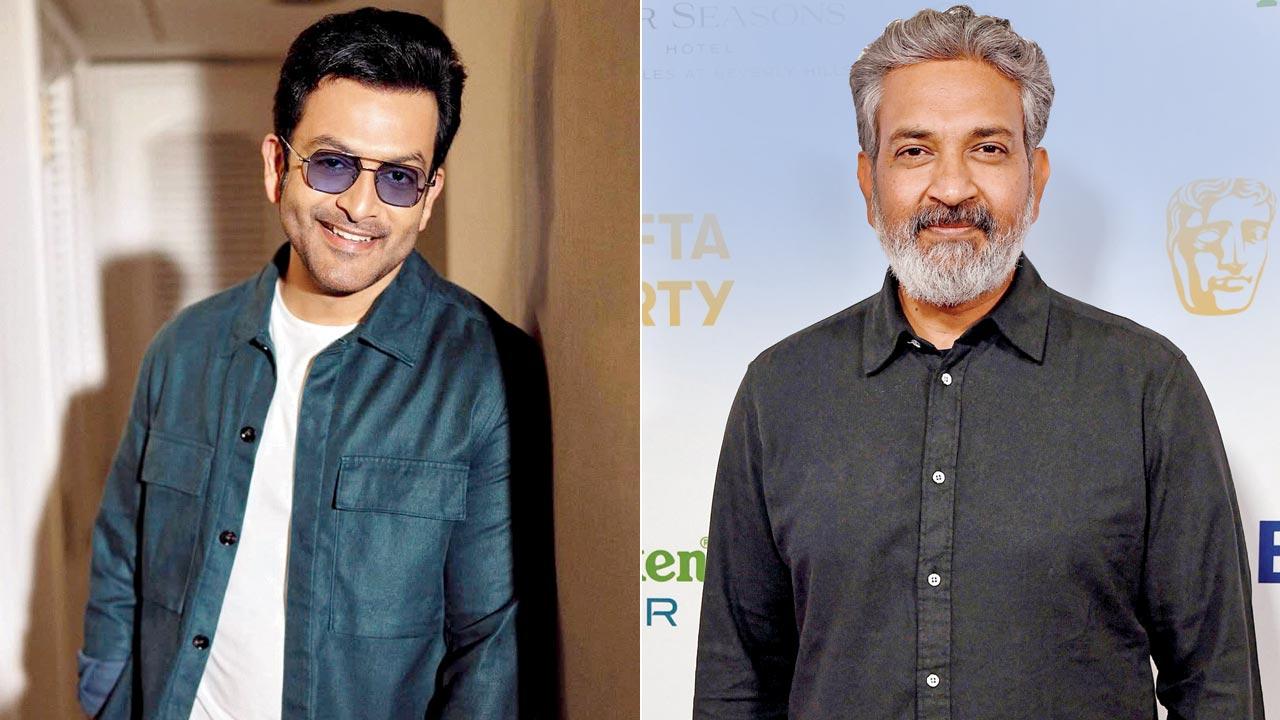
Sarzameen actor Prithviraj Sukumaran, who will also be seen in SS Rajamouli’s next, opens up about on how both films are shaped by their strong stories, not their big canvas
Mohar Basu (MID-DAY; July 24, 2025)
Banner and co-stars are hardly ever the criteria for actor and filmmaker Prithviraj Sukumaran when choosing a film. It has always been the script. That’s what drew him to Sarzameen as well — that it stars Kajol and is backed by Karan Johar are a bonus.
The actor shares, “I prefer to keep it straightforward. If a script appeals to me and I mean as a film lover, not as an actor or a filmmaker, that’s the first yes. From there, many things can make me say no. But with Sarzameen, everything was a yes at every step. I read the script in 2022. At that point, Kajol and Ibrahim Ali Khan weren’t attached. After reading it, I immediately called Karan Johar, who suggested that I speak to Kayoze [Irani].”
With his debut feature film, director Kayoze Irani attempts a complex human drama about the troubled relationship between a father and son, set against the backdrop of Kashmir. How does a seasoned actor like Sukumaran place their trust in a first-time filmmaker?
“For me, the number one requirement in a director is clarity — do they know how they want to tell the story they’ve chosen? It might be completely different from how I would tell it, that’s fine. What matters is clear vision. You can judge that quickly in a conversation. Kayoze had a vivid and focused idea of what he wanted to say.”
It’s fascinating how Sukumaran has two films mounted on a big canvas — the upcoming JioHotstar film, followed by S S Rajamouli’s SSMB29, easily among the most ambitious movies of India. He is unperturbed by their scale.
“Scale can never be the story; it’s just the canvas. Rajamouli sir chooses large backdrops because he excels at telling a story through big, visual strokes. Sarzameen has a big canvas; it has Kashmir, the army, and insurgency. But the story is human. The intricate character dynamics — my character’s relationship with his son, with his wife — were nuances [we] discovered as we shot.”
Soon, the actor will move to director Meghna Gulzar’s Daayra. He reveals that the film, which sees him opposite Kareena Kapoor Khan, has been the easiest yes he said. “Usually, you hear a narration and take some time to process it. With Meghna’s film, the narration was three-hour long, and right there in that room, I said, ‘I am doing this’. It’s a cracking script.”
Nobody can force me to do a film-Rakhee Gulzar
10:21 AM

Niharika Lal (BOMBAY TIMES; December 3, 2024)
Rakhee Gulzar attended a press conference at IFFI for her upcoming Bengali film Amar Boss (2024). When asked about her return to films after a long time, she initially refused to comment, saying, “I will not say anything about it.”
After repeated questions, she said, “I have not come back. I have not gone anywhere. I am there. I am still in the film industry. My daughter is there, I know who is doing what, who is upcoming, I keep track. But choosing a film to do – I will do that. Nobody can force me. I wanted to do this film; I did it. Usmein aap koi bhi lollipop de do toh nahi chalega chahe woh paisa ho, chahe woh kuch aur ho, it’s not going to work. First, give me the subject. The main important factor is subject.”
‘For me, new technology was a little difficult’
Sharing one of the reasons she hasn’t been doing films, the veteran actress said, “Aur ek darr tha – new technology. Hamare time ka camera, sound – ye sab alag tha. Jab main meri beti Meghna (director Meghna Gulzar) ko dekhti hoon – tab mujhe darr lagta hai – main kar sakungi kya? Ghabra gayi thi main. Main uss zamane se hoon jahan director, cameraman, sound recordist even the lightmen and the total unit would be together. Otherwise, it wouldn’t work.”
She elaborated on how technology has changed, saying, “It’s very easy for them, but for me, to digest and take it like that – it was a little difficult.”
Ayushmann Khurrana exits director Meghna Gulzar’s next with Kareena Kapoor
7:22 AM
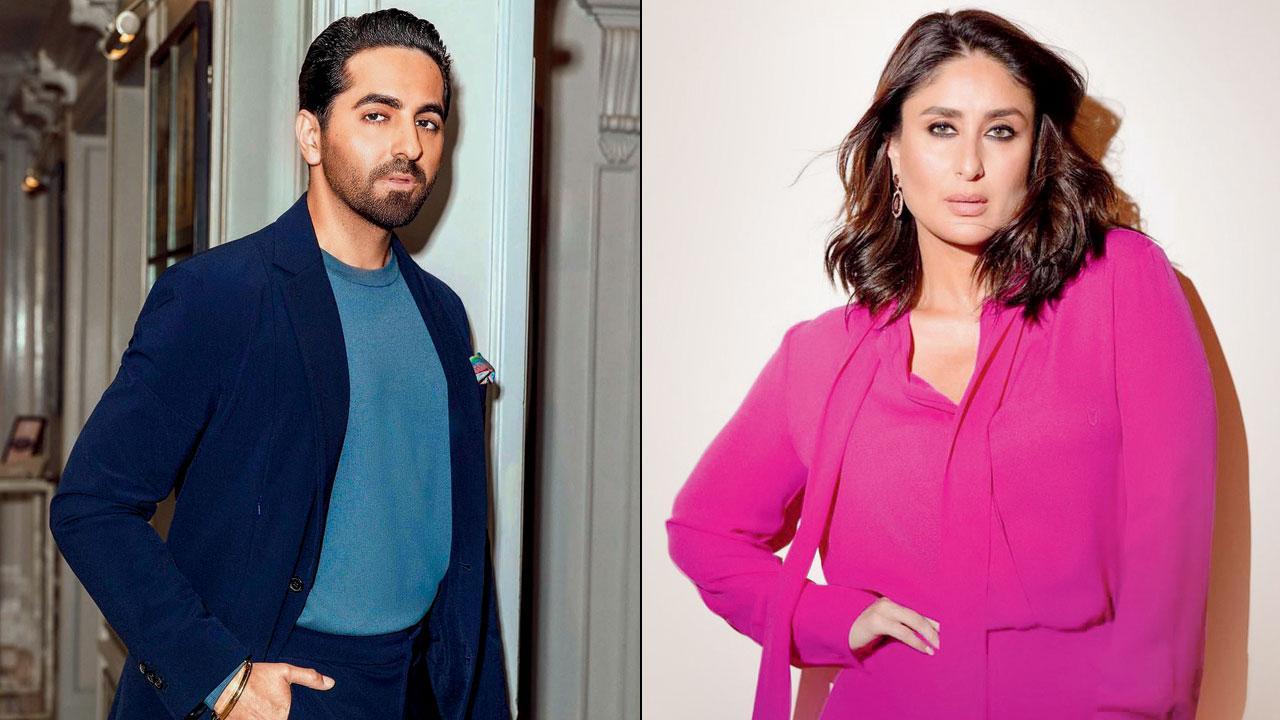
Ayushmann exits director Meghna’s next with Kareena; sources say actor unable to allot dates as he has two films, music tour lined up
Mohar Basu (MID-DAY; August 3, 2024)
In June, news broke that Kareena Kapoor Khan and Ayushmann Khurrana were being brought together by filmmaker Meghna Gulzar for a hard-hitting drama, based on the 2019 Hyderabad rape and murder case (Fresh jodi, June 18). There was much interest around the project as fans were curious to see the new on-screen pair. However, now, mid-day has exclusively learnt that the leading man has stepped back from the project.
What brought on this decision? From what we hear, a scheduling conflict. It turns out Khurrana has two major projects this year, which has made it difficult for him to fit this film in his date diary.
Sources tell us that Gulzar is planning to kick off her project, reportedly titled Daayra, by the year-end. That clashes with Khurrana’s plans, as he also has a music tour lined up in November.
A source says, “Ayushmann’s music tour is already announced, and it includes multiple performances across major US cities. Plus, besides Border 2, he has committed to two movies, one with Karan Johar and Guneet Monga Kapoor, and another with Maddock Films. The dates are currently being negotiated for all the projects, but Meghna’s movie is not on his list.”
The production team has been informed, and Gulzar is said to be scouting for a suitable replacement.
I don’t want to jinx it by talking about it too much, says Vikrant Massey on 12th Fail being a hot National Award favourite
8:25 AM
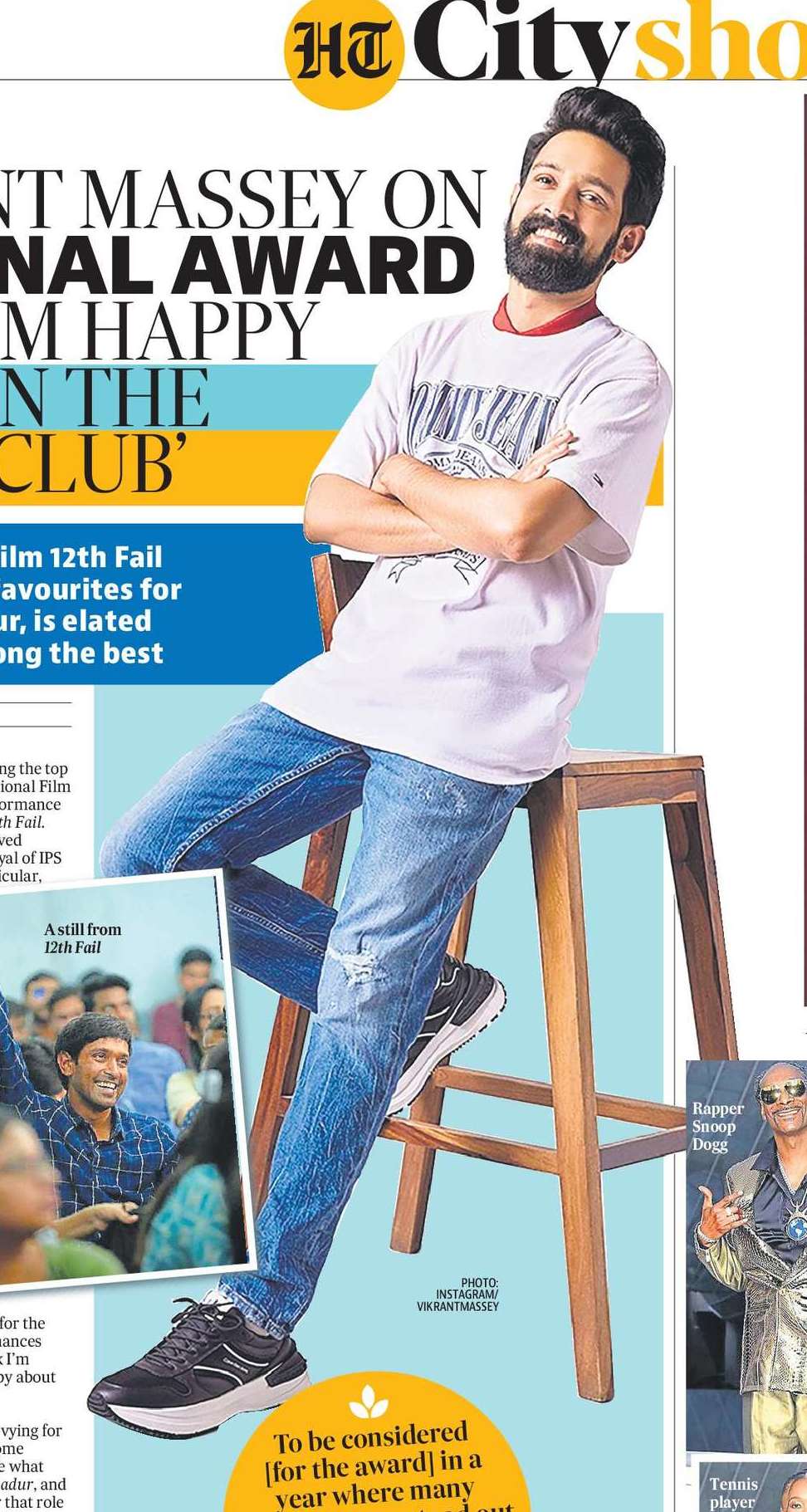
The actor, whose film 12th Fail is among the hot favourites for the coveted honour, is elated to be counted among the best
Monika Rawal Kukreja (HINDUSTAN TIMES; July 27, 2024)
Actor Vikrant Massey is among the top contenders for the 70th National Film Award this year for his performance in Vidhu Vinod Chopra’s 12th Fail. The biographical film received positive reviews, and Massey’s portrayal of IPS officer Manoj Kumar Sharma, in particular, amassed a lot of love from fans and critics alike. In fact, soon after the film released in December last year, actor Urmila Matondkar and businessman Anand Mahindra took to X and expressed that Massey’s poignant performance merited a National Award.
Ahead of the 2024 National Film Awards’ announcement next month, we ask Massey how his current state of mind is. “Let’s see, I don’t want to jinx it by talking about it too much,” he jokes.
Humbled by all the praise and encouragement coming his way, Massey states that just being considered worthy of the honour makes him feel proud of his craft. “To be considered [for the award] in a year where many performances stood out and were respected... I think I’m already in the good club, and I’m happy about that,” he shares.
The actor goes on to laud the other commendable performances that are vying for the prestigious award. “There were some incredible performances last year, like what Vicky (Kaushal, actor) did in Sam Bahadur, and the amount of hard work he put in for that role was phenomenal. I know this because Meghna Gulzar (director) is a dear friend of mine,” he continues, “Fahadh’s (Faasil, actor) Aavesham and Prithviraj’s (Sukumaran, actor) Aadujeevitham - The Goat Life were equally good.”
Massey’s co-star from 12th Fail, Medha Shankr, also received appreciation from all quarters for her role as Shraddha Joshi, Kumar’s better half.
The core of my existence remains my daughter, Meghna-Gulzar
9:36 AM

Natasha Coutinho (BOMBAY TIMES; June 13, 2024)
Gulzar’s home in Mumbai is called Boskyana, and it’s named after his daughter Meghna, whom he lovingly calls Bosky. “The core of my existence remains my daughter,” says the celebrated poet, lyricist, screenwriter and director, who was feted with the Jnanpith award earlier this year.
“I had already imagined becoming a father to a girl child much before she arrived. Once she was born, she became the apple of both our eyes – her mother Rakhee and me. Rakhee was a working mother, and I would take on the role of both a father and mother when she was away on shoots. I believe there is a strong maternal side within me. I remember how she was upset with her caretaker on one occasion because she wanted two plaits. This is why I learnt to braid her hair,” remembers Gulzar, sitting in his cosy library, sipping on green tea.
When it was time to put Meghna in school, she was taken to a kindergarten that she loved so much that she didn’t want to leave it, though other schools were available in the Bandra-Khar area.
Gulzar shares, “We decided to admit her there. Later, I found that it was run by actor Pran’s daughter. I also loved taking her along to buy books – be it from the stores or on the pavement. Once, when she was still a child, she confidently asked the shopkeeper if he had Hans Christian Andersen’s book of fairy tales. The man was surprised that a child was familiar with the author’s name!”
Talking about how Meghna grew up to become a confident young woman, who made her own decisions, he says, “She and her friends decided to join St Xavier’s College and her mother was worried how she would travel. But she learnt to take the train instead of going by car. I wish she had taken to sports, but her interest lay in dramatics. She also met her then-boyfriend and now husband Govind during that time. Like the daughters from film families, she started getting movie offers, though she wanted to complete her studies. I found out about her interest in filmmaking after she started assisting Saeed Mirza,” he recalls.
When it came to going abroad, Meghna had already decided on an institution and did not allow either parent to recommend her anywhere. “Both she and Govind moved to America. Both Govind’s parents and we knew they would marry someday and did not pressurize them,” Gulzar says.
He will turn 90 this year, but the ability to see the humorous side of life hasn’t left Gulzar. “There is the famous story of the cat and the tiger. The cat teaches the tiger all sorts of survival skills, but finally, the tiger pounces on the cat. Seeing the danger, the cat climbs a tree and escapes – and the tiger realizes that he’s not been taught this skill. Meghna learnt all the other skills I have on her own, but even today, when it comes songwriting for her films, she comes to me. She does not let me read her scripts before they are ready, but I’m proud of her journey from Filhaal to Sam Bahadur. The best gift she has given me is my grandson, Samay Gulzar Sandhu,” he tells us.
I am a headstrong director, and as a lyricist, my father always offers me that space: Meghna
“Though both my parents are famous people, I’ve had a very normal upbringing. It was nothing like today’s celebrity kids. They were always very present, and I never felt that either of them was not there for me. It isn’t easy for a father to raise a daughter, but he would tie my sash and do my pigtails just the way I wanted them. He would hold me from the back when I went cycling down the slope… these are precious memories. My parents raised me in a way that I could make my own choices and live with them. It was equal parenting and positive reinforcement – that’s how I would describe it,” says Meghna.
She adds, “Though my father writes my film’s songs, he keeps egging me on to write my own songs. I think in English, so when one of my films needs lyrics in English, I do my own writing as well. I am a headstrong director, and as a lyricist, he always offers me that space and courtesy. I hope my son, Samay, imbibes the same values, though he is developing his own personality. Samay and he share a unique bond that’s independent of me or my husband.”
I joke that Meghna Gulzar has to direct me in an item number next-Fatima Sana Shaikh
8:46 AM

Looking forward to Dhak Dhak and Sam Bahadur’s release, Fatima thrilled that biopic realised her wish of working with Meghna Gulzar
Priyanka Sharma (MID-DAY; October 6, 2023)
It’s not often that you get it all—a best friend, a mentor of sorts and a lifetime of memories —on one movie set. But Fatima Sana Shaikh found that rare mix on the set of Dhak Dhak. On reading the script of Tarun Dudeja’s directorial venture, she knew she had to join the Ratna Pathak Shah, Dia Mirza and Sanjana Sanghi-starrer that revolves around four women on a journey of self-discovery.
“If I vibe with a director, I want to work with him/her, and Tarun is a lovely guy. He gave his all for this film. He was my best friend on the set,” begins Shaikh.
What made the experience richer was the talented cast. Sharing screen space with a veteran like Shah was akin to a masterclass in acting. “She gives [valuable] suggestions. Since she has been performing for years and is also a director, her understanding of acting is so deep. Whenever she talks, I feel I have to take notes,” she laughs, before heaping praise on Mirza.
“The whole country has a crush on Dia Mirza. As an actor, I want to be as good with my craft as they are.”
Shaikh will end the year with the December release, Sam Bahadur. She had more reasons than one to be part of the biopic on the late Field Marshal Sam Manekshaw—from the opportunity to play former Prime Minister Indira Gandhi, to incredible co-stars in Vicky Kaushal and Sanya Malhotra. But to her, it is the result of her love for director Meghna Gulzar’s work.
“When you see her on set, you understand what a genius she is, just on the basis of the amount of information she can retain. She is smart, detail-oriented and so sure about what she wants.”
Having one Gulzar film on her résumé is not enough for Shaikh, who has an odd request for the director, known for her sensitive dramas. “I keep joking with her, ‘Next time, you have to direct me in an item number.’ She tells me, ‘You don’t know what you are asking for,’” she laughs.
In her seven-year journey in the movies, Shaikh has been part of several acclaimed projects, including Ludo (2020) and Modern Love: Mumbai (2022). But the success of her debut film, Dangal (2016), stands out. Does she ever feel the pressure of topping the Aamir Khan-starrer?
“I can’t compete with how Dangal has impacted people. The only thing I can do is be a better actor than I was then. I was part of something very special, and such things don’t happen too often. Dangal will never be a shackle for me.”
I’m quite okay with being underrated, because our industry is full of overrated people-Ashwath Bhatt
8:27 AM
Niharika Lal (BOMBAY TIMES; March 4, 2023)
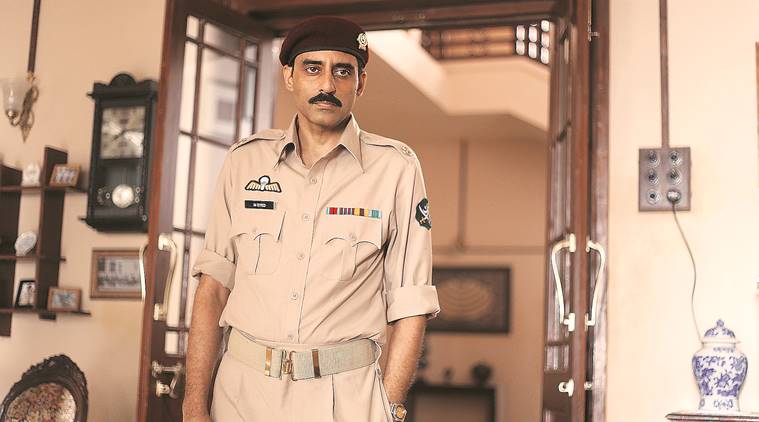
Ashwath Bhatt, who recently played the role of former Pakistan president General Muhammad Zia-ul-Haq in Mission Majnu, says that throughout his career, he has made a conscious effort to ensure that each of his roles is different from the other. Ashwath says that he doesn’t mind being called an underrated actor, but what he finds hurtful is that actors in a star-obsessed system often do not receive enough recognition or publicity, and even have to fight for credits. And so, whenever he sees someone finally getting the recognition they deserve, he feels it is divine justice for at least one such actor.
‘AN ACTOR’S JOB IS TO DELIVER THE DIRECTOR’S VISION’
Sharing an example of how he gets into a character, Ashwath says, “I’m playing a role in a film that is yet to come out, and before every scene I would start singing a song that transports me into that character’s world. Similarly, for my role in Raazi, I worked on finding answers (to questions) like ‘how would he look when he’s in family gatherings? How would he react? How would he address his father?’ These are small things. And one is fortunate when one has a director like Meghna Gulzar, who is a very tough taskmaster. I’m really lucky that all directors I have worked with, like Mira Nair and Vishal Bhardwaj, would come prepared with all their notes.”
What happens when the director is not as clear as Meghna? He says, “If the other person doesn’t know his job or is not clear about something, then you find a way to save yourself.”
‘I DON’T CARE ABOUT SCREEN TIME’
Ashwath says that when it comes to choosing films, he is more concerned about whether the role excites him rather than the screen time. He says, “Every time a role is offered to me – and they go into great descriptions – I always ask a basic question, ‘Yeh batao ki main kar kya raha hoon iss film mein?’ If you look at reputed awards like Golden Globes or the Academy Awards, you will find many examples of actors receiving awards for very short screen time. So screen time doesn’t bother me. But every part I take, there has to be something that triggers me to do it. There has to be something that clicks in my mind.”
‘OUR INDUSTRY IS STAR DRIVEN. IT WAS TRUE 15 YEARS BACK AND IT IS TRUE NOW’
Nawazuddin Siddiqui told us back in 2012, “Big films mein aisi soch hai ki ‘this man doesn’t have star status, toh isko paisa na diya jaaye’.” Has anything changed since then?
Ashwath says, “Our industry is star driven, and you have to accept this fact. You cannot deny this. It was true 15 years back and it is true now. Actors who put in huge amounts of efforts, who lift the film and bring credibility to stars are the most neglected lot.”
Talking about the nepotism debate, Ashwath says, “Everybody wants to promote their own kids, so what’s wrong with that? Suppose I give my life to the film industry and my kid wants to be an actor, I wouldn’t want them to go through all the struggles I have gone through. Aisa nahi hai ki kissi ko chance nahi mil raha. But what hurts is when talent is not promoted by production houses. They don’t even acknowledge (some actors) and that is something which is not nice. If you are promoting your child, then you must also promote those actors who are uplifting your child’s performance.”
‘I WAS NEVER IN THE RAT RACE’
Ashwath says that when he read that film critics described him as a highly underrated actor in Mission Majnu, he thought, ‘Thank God! I’m not overrated’. “I’m quite okay with being underrated, because our industry is full of overrated people. Somewhere, you have to find your own calmness, your own space and nothing is gonna come out of bitterness. I believe you just keep doing your job. Things will happen in their own time. I was never in this rat race,” he says.
Does that mean Ashwath is not in search of stardom? He says, “It would not hurt me if stardom comes to me. Well, stardom is (pauses)...if you nourish a tree then some or the other day, fruits will appear. ”
Ashwath says that his journey has been very challenging and enjoyable. “I won’t say satisfying, because the day I get satisfied is the day I will die. It’s been a beautiful journey. However, there’s still a lot to come. As an artiste, I’m hungry.”
Actors such as Shefali Shah, Jaideep Ahlawat and Pratik Gandhi became huge stars because of OTT, and Ashwath says that he genuinely feels happy for actors who get their due after putting in decades of hard work.
“It is cathartic for me, and I say, ‘Yaar, inko mila na, great! Inko milna chahiye’. Everything is not in your hands and that’s the nature of this job. One part can change your life. One song can change your life.”
‘FILMS WHERE ENTIRE CAST GET PUBLICITY ARE AN EXCEPTION’
Ashwath says, “In 90% films, the whole publicity is given to only two people, who are the leads. Of course, films like Raazi, Pink, Jolly LLB and Badhaai Ho are also there – where the entire cast gets publicity – but that is an exception. Everybody is not hungry for money, but every actor is hungry for recognition. Every artiste needs appreciation. It nourishes them. But we’re not even given proper credit. People tell me, ‘you got your fee, now move on’, but it is about respect and nothing else.”
Professionally, anything uncomfortable excites me; comfort scares me-Sanya Malhotra
8:32 AM
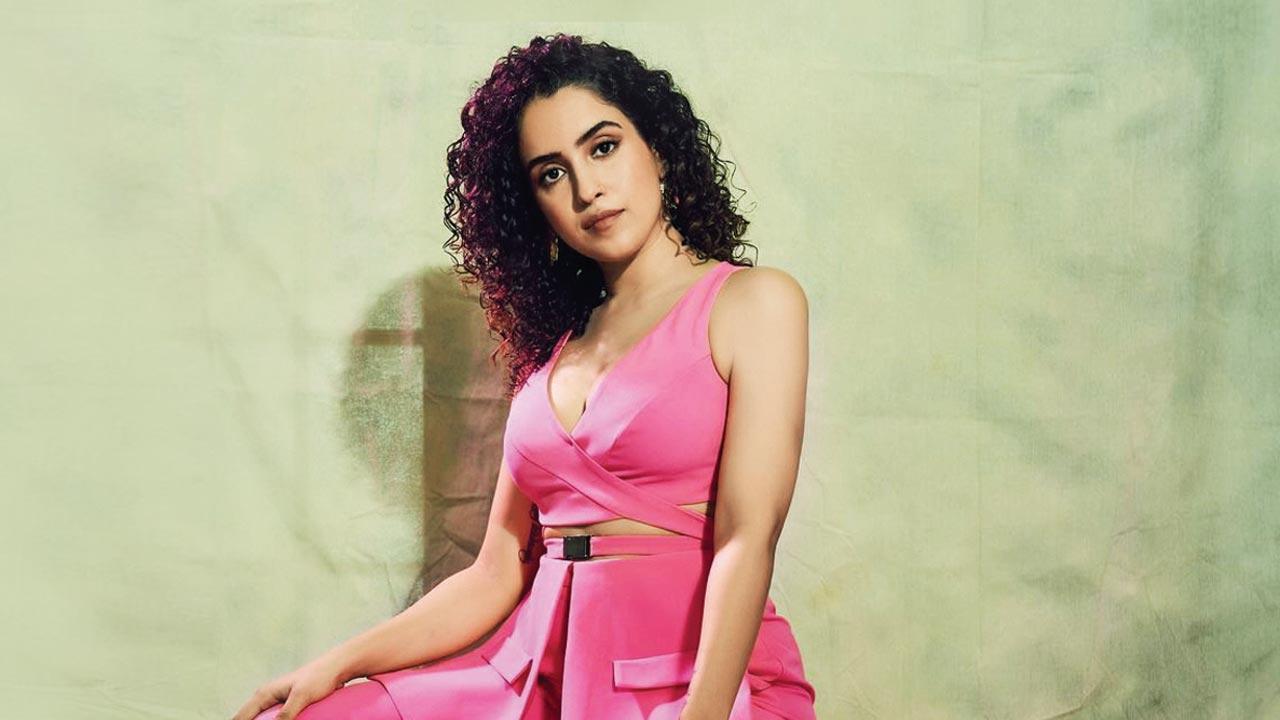
Walking into 2023 with four biggies, including Jawan and Kathal, Sanya says she seeks unconventional subjects to keep growing as an artiste
Priyanka Sharma (MID-DAY; December 12, 2022)
Sanya Malhotra has no time to pause. With four films slated to release next year, she is moving one from movie set to another. Does the frenetic pace get to her? Far from it. “There is no other way I would like it to be,” the actor grins.
“This is something that I had always imagined myself doing. [The shoots] are back-to-back. I had mentally prepared myself to live a life like this.”
Her line-up for 2023 is promising — she has Jawan that sees her share screen space with Shah Rukh Khan, the Hindi adaptation of acclaimed Malayalam film The Great Indian Kitchen (2021), a comedy in Kathal, and a period drama in Sam Bahadur. Malhotra counts herself lucky to be a part of such eclectic stories.
“These films are so diverse, yet rich in their storytelling. To reunite with Guneet Monga for Kathal [after Pagglait], work with Meghna Gulzar ma’am and Vicky [Kaushal in the Sam Manekshaw biopic], and headline a big film like The Great Indian Kitchen — [these films] helped me check many boxes on my wish list.”
In comparison, 2022 was a tepid year for the actor. Though Love Hostel with Vikrant Massey received positive reviews, it failed to attract viewers. Her second release, Hit - The First Case opposite Rajkummar Rao, didn’t make an impact at the box office either. Malhotra, however, is unfazed, continuing to front subjects that speak to her.
“I don’t look at choices as risks; I only see them as opportunities. Also, today, I feel everything is mainstream, or nothing is. My journey began with an unconventional character [in Dangal], and what followed was a natural progression. Comfort scares me. In my personal life, I like being easy-going, but professionally, anything uncomfortable excites me because I know those are the areas where I will grow in life. Growth, as it is, is not a comfortable experience. I’m constantly seeking to grow as an actor, and I hope that never stops.”
I prepare for my characters, but I am asked about my makeup routine-Sanya Malhotra
8:42 AM

Sanya Malhotra says she’s fed up of being asked who she takes career advice from
Rishabh Suri (HINDUSTAN TIMES; November 11, 2022)
Actor Sanya Malhotra has been in the film industry for over half a decade now, and is clear about the kind of projects she wishes to do as well as the ones she would steer clear of. But, the one question she’s constantly asked is, ‘Who do you take career advice from?’ And that’s something which irks her.
“I don’t know if male actors are asked this question,” she says, adding, “Auratein shayad apni [khud ki] advice le hi nahin sakti. I get triggered when I’m asked this. I’m 30 years old, don’t you think I can take my own decisions?”
Last seen in the thriller HIT- The First Case, Malhotra points out how questions directed towards female actors are more about looks and less about their work. Citing an example, she says, “Recently, I was with a co-star. He was being asked about his whole process of getting into character. Then, I was asked, ‘Aap makeup tips kya dengi?’ For a second, I was like, ‘Why is he asking me to give makeup tips? I am not a makeup artist. I am an actor’. I should have questioned it. I was not fast enough to react.”
“Maine bhi taiyyari ki hai apni films ki. I prepare for my characters, but I am asked about my makeup routine. It’s not just about looks when it comes to female actors. We work equally hard,” adds the actor, who is busy with Meghna Gulzar’s Sam Bahadur at present.
“I have completely surrendered myself to her (Gulzar), and I’m so excited to learn something new. That was my goal when I said yes to it. My life is going to change after working in this film,” concludes Malhotra.
If I can spend Diwali in front of the camera, it will be magical-Sanya Malhotra
8:05 AM
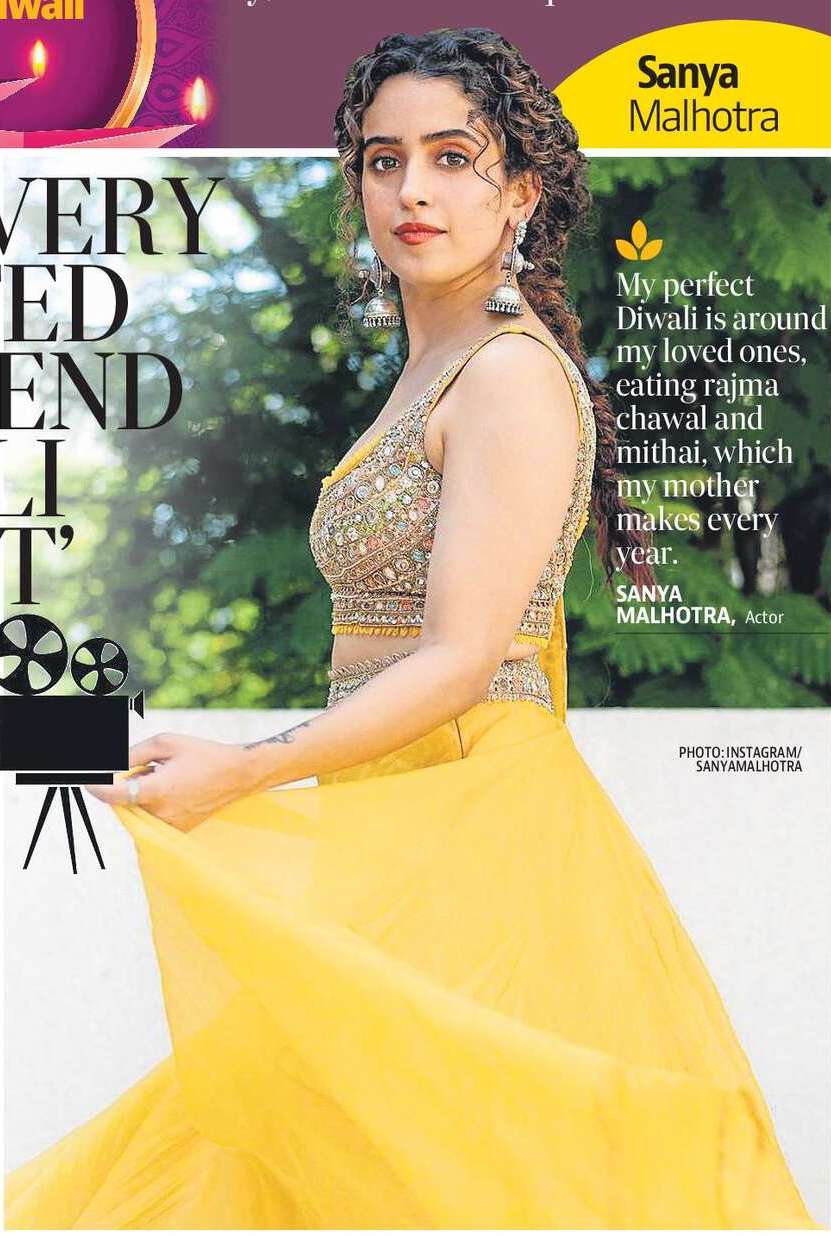
Rachana Dubey (BOMBAY TIMES; October 19, 2022)
Sanya Malhotra’s life changed gears over the last two years, with several releases on OTT platforms and a theatrical release earlier this year. She’s currently working on a host of projects, including the remake of The Great Indian Kitchen, Atlee’s next with Shah Rukh Khan and Meghna Gulzar’s Sam Bahadur. In a chat with BT, she talks about how she interprets her roles, some of the unputdownable offers and more. Excerpts:
Diwali is around the corner. After a busy year, do you have plans to head home to Delhi?
I’m shooting non-stop. So, I’ve not really drawn out any plans. But it’s exciting to think that I might spend Diwali in front of the camera. It will be magical if that happens. If I have a day off, I will go back home to Delhi and spend some time with my family, eat ghar ka khaana and participate in all the revelry. My perfect Diwali is being around my loved ones. I love all the shebang — rangoli, decoration, making diyas and the food. If I am not doing this, I’m sure I will be shooting in front of the camera.
The Great Indian Kitchen’s remake went on floors recently. With three distinct films to juggle, how do you switch between the emotional zones of your roles?
I do many things that I keep changing depending on the characters I’m playing. Like I’ve worked in a movie called Kathal, for which I drew inspiration from the interactions I had with actual policewomen in Gwalior. I could understand their approach to life and who they are beyond the uniforms that give them authority and power. They’re human, too. The idea is to get to know characters psychologically and emotionally.
Sometimes, I create memory banks for them. Like I wrote diary entries for Sandhya’s character in Pagglait. I didn’t have any experience or any emotional reference point for her. So, I started writing, and I ended up writing poetry, too, which I don’t write in my personal life. I imagine my character’s daily life, put myself in their shoes and think of what would have happened in their lives before. I love doing this exercise where I go deep into their emotional coffers.
When it comes to remakes, I think of my own way of interpreting the character, matching it with the director’s vision and the space of the film. Like The Great Indian Kitchen is something I was looking forward to diving deep into. The original was fantastic, and Nimisha Sajayan was so good in it. But I don’t know how to improvise on that. And that’s also not the intention. I just want to interpret it well without a sense of competition. I treat it as a new story and character.
What drew you to play Siloo Manekshaw in Sam Bahadur, where Sam Manekshaw will be the focal point of the story? Also, there’s isn’t much information on his wife in the public domain.
I just wanted to work with Meghna Gulzar. And you have to trust a director like her who doesn’t take any character lightly. Each one is important. I knew that I would learn something new when I work with her. It was an unputdownable offer. I’ve started shooting for it, and it’s a different experience to surrender myself to her vision. I know she’ll pull me out of my comfort zone, and I look forward to that.
The industry is in a state of uncertainty, where there is an ongoing discussion and debate over the kind of films that can potentially draw people into a theatre. What do you think about this scenario?
We’re all going through a challenging phase, which means this is the time to explore new things through scripts, new mediums and unique stories. As an industry, it’s important to push one another to do better. No one can survive this individually. It’s time to stand together, and this happens in every business. We have to see what we all can bring to the table. The ecosystem of the industry has expanded and made room for so much that we can do. We need to work on it and good will come out of this. It will pull us out of complacency and push us to experiment. Had I been stubborn about where my films (the platform) were released, my career wouldn’t have been on the upswing. Transition is about being flexible and collaborative. You have to adapt constantly. It’s pretty much like picking up the emotional spaces of different characters at different times. Being flexible pushes me to take up characters that are completely unexpected of me, and yet, people accept what I turn in. People love artistes who push their boundaries.
You have refrained from repeating yourself so far in the work that you choose to do. Isn’t it challenging to keep doing that?
That’s my biggest fear and kabhi na kabhi aisa hoga that I will end up being in a space that I have been in before. Woh main kabhi bhi karna nahi chahti. People say that I’m making unconventional choices. It has been a conscious move to not fit into a box which would’ve been easier to do. There’s so much advice that comes to me from various corners on how to dress a certain way or put things out on social media, which I’ve never followed. I work with a fabulous team that advises me, and there are seniors I reach out to periodically, but eventually, I listen to my gut. I’ve been consistently doing that for the five-six years that I’ve been here. One shouldn’t blame anyone else for anything that goes south, right? I wanted to do every kind of film and character and I have stuck to that. I’ll never put myself in a box, and no one can do that to me.
------------------------------
This year, Sanya Malhotra will be celebrating Diwali with her filmi family, and she has no qualms about it
Sugandha Rawal (HINDUSTAN TIMES; October 19, 2022)
This year, actor Sanya Malhotra will be celebrating Diwali with her filmy family, and she is pretty excited about it. She says being on set is nothing less than a celebration for her, as it reminds her of the passion she has for acting.
The actor will be shooting for the Hindi remake of the critically acclaimed Malayalam movie The Great Indian Kitchen (2021) on Diwali.
“I am very excited to spend this Diwali on the sets of my film because I absolutely love my team and I am having a blast shooting this film. On set wali Diwali will be a very special and a new experience for me,” Malhotra says.
The 30-year-old continues, “This is only because I’m working with such nice people. I am not homesick, but rather I feel at home. I love being on the set. But it’s not that I don’t like being around my family. I get very excited to work on holidays and festivals for some reason. I think it’s because being on set is nothing less than a celebration.”
“I feel extremely grateful around this time. No matter how cliché and cheesy it sounds, but it’s hard to believe that my dreams have actually come true and I’m living my dream life right now,” says the actor, who was last seen in HIT: The First Case.
However, this is not the first time that she will be spending Diwali away from her family. Earlier, while shooting for Dangal (2016) in Ludhiana, she had to be away from her closed ones during the festival. “You find that feeling of solace and being at home only with the people that you’re working with. I’m really looking forward to spending this festival with the team that I’m absolutely loving, and I know that I will have lots of fun,” says the actor.
When not working, her ideal way to celebrate the festival is to spend some time with her family during Diwali and gorge on some home-made food and sweets.
“I’m a homebody. So whenever I’m back in Delhi, around my family and friends, I don’t usually step out. I have a very close circle in Delhi. I just love being at home and around my people. It’s the most grounding thing for me as an actor because I’m constantly working and hopping from one set to the other,” she says, adding, “My perfect Diwali is around my loved ones, eating rajma chawal and mithai, which my mother makes every Diwali”.
The excitement of an acting student is intact in Rajkummar Rao-Sanya Malhotra
8:53 AM
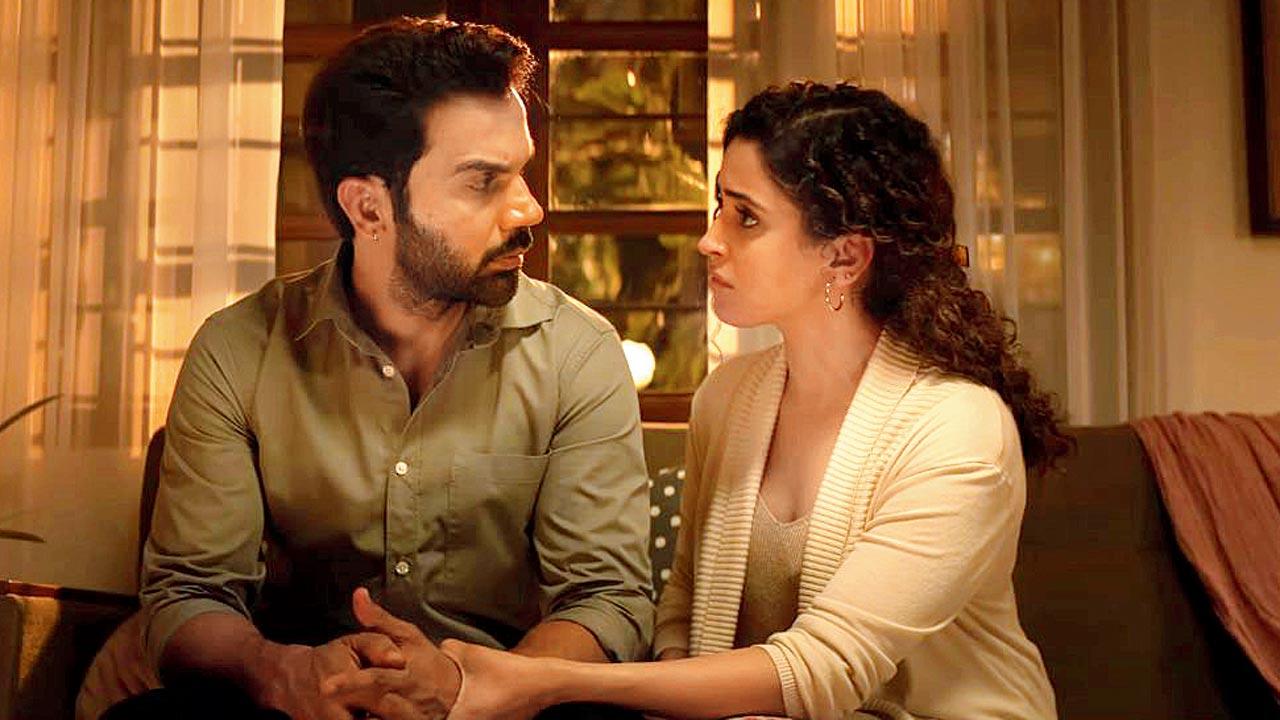
Despite HIT being an intense thriller, Sanya says being surrounded by creative minds like Rajkummar was a source of joy
Mohar Basu (MID-DAY; June 25, 2022)
Imagine you are shooting for a thriller, but off camera, it feels like a comedy,” laughs Sanya Malhotra. It is evident that the shoot of HIT - The First Case, an adaptation of the 2020 Telugu film of the same name, was a blast. The film’s trailer released on Thursday, depicting Rajkummar Rao as an officer in the Homicide Intervention Team (HIT) and Malhotra as his love interest who goes missing.
While Sailesh Kolanu’s directorial venture is a dark thriller, Malhotra says it’s the most fun she has had on a set. “Through the film’s making, I was overworked. I was juggling multiple projects. But that set didn’t feel heavy even for a day. HIT was a boost of serotonin, as I was surrounded by such creative minds.”
The actor heaps praise on co-actor Rao, with whom she has collaborated for the first time. “There is so much to learn from him. Everyone knows how good he is. He knows he has proved himself, and yet, he never stops or lets himself slack. The excitement of an acting student is intact in him,” she notes.
It’s an important month for Malhotra. The actor has also kicked off the prep for Sam Bahadur, Meghna Gulzar’s biopic on Sam Manekshaw. The film sees Vicky Kaushal as the country’s first Field Marshal, and Malhotra as his wife Siloo. She is elated to have a Gulzar film so early on in her career. “She is the kind of filmmaker you learn from. I am ready with notepads and pens, because for an actor who is learning on [the job], this is a place that will [teach me a great deal].”
Sam Bahadur is special as I am going to be working with Meghna Gulzar. It’s a dream come true-Sanya Malhotra
8:29 AM

Set to play the protagonist’s wife in Gulzar’s next, Sanya says fine script by finer director won her over
Mohar Basu (MID-DAY; January 4, 2021)
Close on the heels of wrapping up HIT with Rajkummar Rao, Sanya Malhotra took fans by surprise with the announcement of reuniting with her Dangal co-star, Fatima Sana Shaikh. Meghna Gulzar’s Sam Bahadur will see the duo join hands with Vicky Kaushal for the film based on Sam Manekshaw, the Chief of Army staff who was applauded for his heroic acts during the 1971 Indo-Pak war.
Malhotra, who plays the protagonist’s wife, Silloo Bode, reveals that she met Gulzar only at the time of the announcement. “The character of Silloo spoke to me on many levels. The film is special because I am going to be working with Meghna. It’s a dream come true,” she says.
As two sisters in the real-life inspired boxing drama Dangal, Malhotra and Shaikh’s camaraderie was indeed enjoyable. However, their off-screen bond, made evident during rounds of interviews, also became a talking point. Collaborating with Shaikh again is then another reason for celebration. “First co-stars are always special. Dangal completed five years recently, and this film is a reminder that life has come a long way. Five years ago, we were kids. I am so proud and happy for us, and so excited to work with her again. It warms my heart.”
Despite a debut alongside Aamir Khan, Malhotra’s journey to establishing a noteworthy film career wasn’t without obstacles. Carefully curating a resume with unconventional choices, Malhotra always found the approvals of cine buffs and critics alike. However, she says she was “conditioned to accept that my films will have a certain amount of risk attached with it”. “Unless you challenge yourself, you’ll never grow. I am here to evolve and learn about filmmaking and acting. I am happy with the response to my films this year. I can sense a shift in my career and there’s definitely greater responsibility attached to the stories I pick.”
Her career blueprint, she says, is simple — live one day at a time. “I didn’t have a plan post my debut, and the last five years panned out better than expected. I am going to stick to being mindful of my work and enjoying my life.”
Who is field marshal Sam Manekshaw?
Field Marshal Sam Manekshaw had played a vital role in India’s 1971 victory against Pakistan. He is famously remembered for telling Prime Minister Indira Gandhi that the Indian Army wasn’t ready for war in April 1971. After she obliged to give him time to prepare, he delivered one of India’s most noteworthy wins in the December war.
When R D Burman died, I lost both that friendship and creativity we shared-Gulzar
8:31 AM
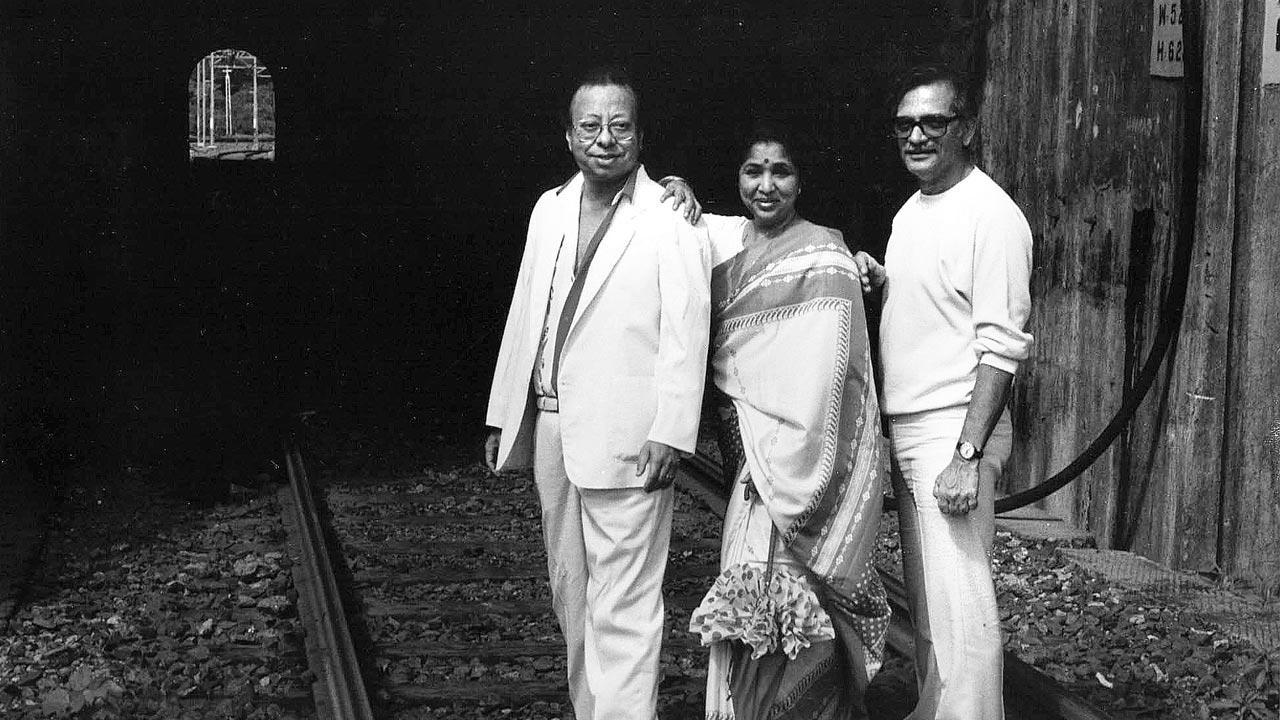
Gulzar with his music composer friend R D Burman and Asha Bhosle. Pic courtesy/Gulzar; Actually... I Met Them
When R D Burman died, a large part of Gulzar departed with him. In a new memoir, the veteran lyricist remembers his dear friend, who gave wings to his song-writing journey and the magic they created together
Jane Borges (MID-DAY; October 17, 2021)
The first rule of journalism is to remain objective, always—something, this generation of “news-breakers” are already grappling with. But, speaking with veteran film director-lyricist-poet-author Gulzar for the third time now, this writer’s struggle has never seemed more real. We can’t really put a finger on why that’s the case. Though, we must admit that when we were two years old, Lakdi Ki Kathi from the film Masoom (1983) was played on loop on our TV set — the number of rewinds terribly reduced the life of the video cassette—as the song made our toddler self dance with glee. We didn’t of course know then that Gulzar had penned it. Later, it was the ghazals that he wrote — the album Marasim (2000) being a personal favourite — that preoccupied our teenage heart. So, when the octogenarian, who is blessed with a razor-sharp memory, remembers our meeting from four years ago at his Pali Hill bungalow, we can’t help but smile. Since this time, our conversation is over telephone, we allow this slip. That’s also where we cut-short the impulses of the inner-fan. We are back to discussing his book, a new memoir, which is also several years old. Confusing?
Over three decades ago, Gulzar was approached by Sanchari Mukherjee, then a journalist with a Bengali newspaper’s Sunday edition, for a new column series. “She wanted me to write about my experience of working with veterans from the film fraternity. I told her that’s typical Filmfare [magazine] material. But, she kept insisting,” recalls the 87-year-old.
Gulzar eventually told her that he’d speak about his many interactions with those who had influenced his work. “We managed to work it out. She would fly down to Mumbai, and cover columns for two editions at one time, and leave for Kolkata the same evening. I would narrate my experiences in Bangla, Hindu, Urdu, English and hand gestures, and she’d put it all down in Bangla. She would later send the final piece, and I’d make a few edits, before it got published,” he shares.
This went on for some time, until Mukherjee “went the family way”. The column ended soon after, but took on a new life as a book in Bengali called Panta Bhate, which means “in fermented rice”, a phrase he used in one of his films. Gulzar, however, was adamant about not having it published in English, because he saw himself making new additions to this diverse cast of celebrated artistes mentioned in the original compilation. “The wave of thoughts kept churning, but I never sat down to write. This continued and time passed by.”
It was only recently when Premanka Goswami, the executive editor at the publishing house behind his book, mentioned how he wanted to translate Panta Bhate, and that he knew someone, who had worked on the first two chapters that Gulzar, in a first, re-considered the option. But that was only because the translation by Maharghya Chakraborty had bowled him over. “He had done such a good job, and had remained authentic to the text. I realised that even if I write more, it would not be in the same style.”
His new memoir, Actually… I Met Them (Penguin Random House), though an old one, will thus, for the first time, be read by non-Bangla readers. In essence, they are intimate sketches of doyens who shaped Gulzar’s early decades in cinema—from Bimal Roy, Kishore Kumar, RD Burman, Satyajit Ray, Pandit Ravi Shankar, Sanjeev Kumar to Suchitra Sen and Sharmila Tagore. “Most of them are Bengalis, and [while working on this book] I realised the extent of my collaboration with them,” says Gulzar, who considers himself as much a Bengali, as he’s Punjabi, and has also taught himself to write and speak the language.
The one Bengali who, however, doesn’t have an entire chapter dedicated to her is actress Rakhee Gulzar. He mentions her often through the book—the first time he set eyes on her, the love letters they exchanged, the pranks she pulled on him, driving away with his car with friends to eat paani puri—but beyond that “I am very shy when it comes to writing about my wife.”. We can almost hear him blush over the phone.
When it came to naming the memoir, the celebrated poet says he picked up the last sentence of the introductory note that he wrote for the book. “I find it hard to believe that all these people lived in the same era, and that I had the chance to work with most of them. Sometimes, I have to convince myself that I actually met them.”
These vignettes are unlike any other we’ve read—they aren’t short biographies, neither are they profiles. They are reflections of personal and private moments between two artistes, and show them in new light. Most moving is his relationship with Pancham (R D Burman). When the music composer passed away in 1994, Gulzar writes that “a large part of me departed with Pancham; the Gulzar that remains now is but half-complete”.
“Before my career as director took off, I had written only one song with his [Pancham] father [S D Burman]… my song-writing journey began when Pancham was an assistant with his father, and I, an assistant director. He used to come to our office holding the dugga [the left tabla]. While the grown-ups would continue their discussions, we would go out to take a stroll. A deep friendship formed between us, and I began writing more songs for him. The way I wrote when with Pancham, can’t be recreated. We grew together in this journey. When he died, I lost both that friendship and creativity [we shared],” he tells us.
Gulzar also writes about his disappointment of not being able to complete the script for Amritakumbher Sandhane that Bimal Roy and he were working on, as the former died of cancer. Another huge regret was not being able to land the opportunity to work with Satyajit Ray, an institution in himself. “It would have been like going back to college, and I missed that chance. Another person I wanted to assist was Shyam Benegal, because I admired his modern, new cinema greatly. I requested him twice actually, but he laughed it off,” says Gulzar, being absolutely modest.
He admits he has always been curious about cinema and never shied away from learning. In fact, he tells us that in the early 1980s, by which time his body of work included big hits like Aandhi, Parichay and Mausam, he wanted to study at the Film and Television Institute of India. “I was making Namkeen at the time. I approached Hrishi da [Hrishikesh Mukherjee] who was the examiner at the institute, and asked if there was a possibility of doing a three-year course there.”
He remembers being scoffed at. “Hrishi da said, ‘Huh! Who will write for my films then?’ He joked that grown-ups and married people weren’t allowed here.”
If and when Gulzar writes a Part 2 of this memoir, which he says he will, there will be certain colleagues that he definitely won’t forget to mention. A R Rahman, Vishal Bhardwaj, Shaad Ali, and his daughter Meghna Gulzar. “It might feel like I am boasting. But, I am very, very proud of her [Meghna]. She has really surpassed my filmmaking. Our generation made good films, but we weren’t the original authors — our works were inspired by other literary stalwarts. The new crop of filmmakers author their own films. Cinema after all is about your own expression, commitment and statement.”
Irrfan Khan’s questioning mind has stayed with me, I hope I can emulate it-Meghna Gulzar
8:01 AM

Meghna Gulzar, who directed Irrfan in Talvar, shares memories of the actor from her multiple meetings through the years, and how his questioning mind has stayed with her through the years
By Meghna Gulzar (BOMBAY TIMES; April 23, 2021)
‘HE ALWAYS IDENTIFIED WITH HIS ROOTS, NO MATTER WHERE HE TRAVELLED & WHAT WORK HE DID’
From whatever I understand and know of him, Irrfan sir’s philosophy and nature was to keep things simple and unassuming. He always remained rooted and identified with his roots, no matter where he travelled and what work he did. Whether he was doing an international or an Indian film, commercial mainstream or independent film or any other, he was intensely rooted to the person he was. That is the most special and endearing thing about him that everyone will remember him for.
‘FOR HIM TO PUT HIS TRUST IN ME AS A DIRECTOR & AGREE TO DO MY FILM IS A MEMORY I’LL CHERISH’
I was tremendously in awe of him. I got the opportunity to work with him at a time when my career was not flying high and he was an extremely celebrated actor, well known for his craft. For him to put his trust in me as a director and agree to do my film will be the most cherished moments of my life and career. Talvar was a rebirth for me as a filmmaker, and Irrfan sir being in the film was a big part of that. Apart from that, when we collaborated on Talvar, the relationship we shared was precious, it was extremely professional. It was a tricky subject. Not just as an actor, but even while discussing the case, he would throw questions at me, making me constantly question the knowledge I had and not get complacent at any given point – even though the script was locked and we were shooting. The way his mind worked, and therefore forced my mind to work and to question the alternative, was a precious learning experience for me. role & when he performed, you couldn’t say Irrfan sir was acting
‘THERE WAS NO OFF-THE-SET EQUATION WITH HIM BECAUSE OF THE SHEER AWE I FELT’
I can’t say consciously which part of his personality rubbed off. Unfortunately, our conversations and our equation was limited to working on the film. There was no off-the-set equation with him, not because of anything else, but the sheer regard and awe I felt. I could never think I could have a friendly dinner or a heart-to-heart with him. What has stayed back with me is his questioning mind which I hope I can emulate when the time comes.
‘THERE WAS SERIOUS HARD WORK BEHIND THE SMALL GESTURES, THE TWITCHES, THE CASUAL ONE-LINERS OR REPARTEES’
I met Irrfan sir on and off on my father’s (Gulzar) set when he was playing a part in an episode of Kirdaar. I met him in Vishal (Bhardwaj) sir’s office intermittently. But the first one-on-one conversation I had with him was when I met him at his home for the first time after we had given him the script of Talvar. We spoke about the case; he asked me for my perspective and I asked him for his. It’s ironic that he went through the film, played the CBI investigator and till date, I don’t know what his stand on the narrative, the case is. I know he was proud of the work we had done and the product we had put out, but what was going on in his mind is still a mystery to me. And there was so much going on inside but it all looked simple when he executed it on screen. That is where the unassuming part comes into play.
There was so much nuance and understudy that went into every role and when he performed, you could not say he was acting. The performance was natural, so much so that it made you believe this is how he laughs, gets angry or cries. That’s the facet of him being unassuming as a person but there was serious hard work that went behind the small gestures, the twitches, the casual one-liners or repartees. It never came off the cuff. It all looked effortless and natural when it came out and one could never call it a performance. But it took a lot of research, deep thinking for him. That is what is special about him.
— As told to Rachana Dubey

Pandemic after-effects: Bollywood zooms in on the North East
8:05 AM

Sugandha Rawal (HINDUSTAN TIMES; March 10, 2021)
As Bollywood walks on a long road to recovery after the Coronavirus pandemic-induced lockdown, the north east is emerging as a hot favourite shooting destination.
If director Anubhav Sinha is navigating a story of a spy with actor Ayushmann Khurrana in Assam, then Amar Kaushik is all set to trace supernatural tale of Bhediya in the wilderness of Arunachal Pradesh with actors Varun Dhawan and Kriti Sanon.
“While there can never be a positive side to a global pandemic, due to the setback the industry suffered, Bollywood has cemented the fact that India is a shining country when it comes to beautiful locations to shoot,” says producer Bhushan Kumar, who is backing Sinha’s Anek.
Bollywood’s affair with the northeast will continue with Salman Khan also expected to head to Arunachal Pradesh soon for a shoot.
“It is a beautiful unexplored land. The whole land is untouched. We plan to shoot responsibly, without affecting nature at all,” says producer Dinesh Vijan, who’s in Arunachal Pradesh for Bhediya.
Kaushik adds: “We required a background of deep forests, natural habitat and ethnic lifestyle, which Arunachal Pradesh offers in abundance.”
But, going forward will be a bumpy track as the place comes with its own set of challenges, such as lack of properly developed roads and many other logistical issues.
“That is one of the main factors why some of the projects had to be shifted to other locations,” says James Handique, a line producer from northeast.
So, what is contributing to the accelerating momentum? “The first thing is that the region was less affected by the virus, and secondly it is unexplored,” says Handique, who is currently working with Anek team. He adds, “It takes seven days, or maximum 15-20 days to get permission.”
Hopefully, the showbiz glare will also lend in changing the image of the place, and help in dispelling rumours.
“Yes, there are problems with the insurgency but they’ve never targeted tourists or film crews. The Anek team, shooting in a remote part of Assam, is astonished at how supportive the people are. So, the image will change,” he says, adding Meghna Gulzar is expected to shoot her next project in Meghalaya, Assam and Nagaland.
Subscribe to:
Posts (Atom)