Everyone told me he was a famous director, but that I should work with someone like Shyam Benegal-Mita Vasisht
4:47 PM
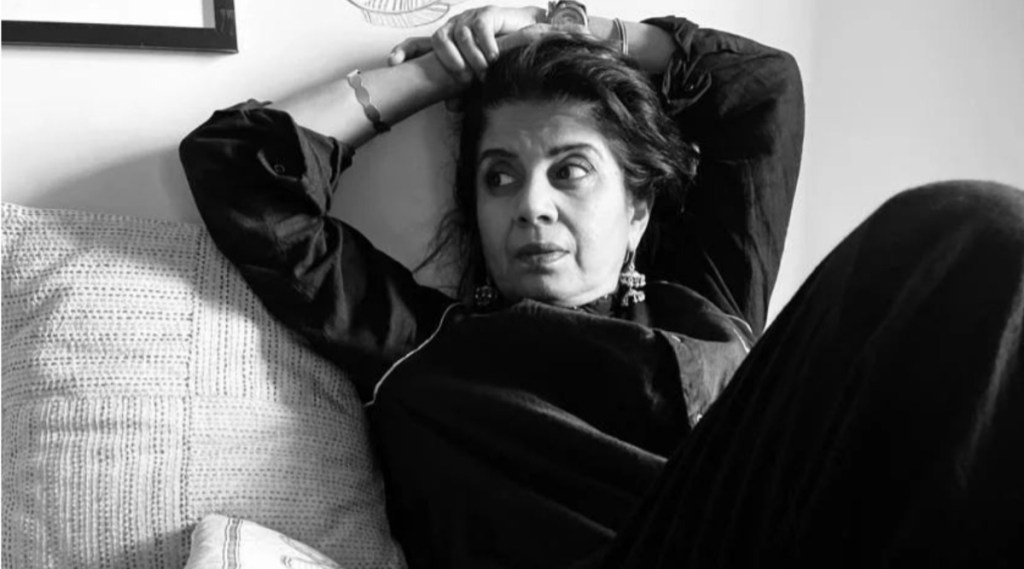
Veteran actress Mita Vasisht revisits the lessons she learned from filmmaker Mani Kaul, ahead of her feature’s Mumbai premiere
Soniya Pondcar (MUMBAI MIRROR; July 15, 2026)
It is easy to forget that before she became a familiar face across television, theatre and cinema, Mita Vasisht was simply another young actor fresh out of the National School of Drama, hoping for the role that would change everything. That opportunity came after her striking turn in Kumar Shahani’s 1986 short Var Var Vari caught the attention of Mani Kaul who, by then, had already secured his place among the defining voices of India’s New Wave cinema with films such as Uski Roti, Ashadh Ka Ek Din and Duvidha.
Kaul would go on to become her mentor, teacher and, ultimately, a lifelong guide. “It was after he saw Kumar Shahani’s film that he decided to offer me Siddheshwari,” Vasisht recalls, referring to the docu-feature on the Thumri artist that turned her from a budding actress into an arthouse regular.
“I hadn’t seen any of his films. I didn’t know who he was; I was just a young actress at the time. Everyone told me he was a famous director, but that I should work with someone like Shyam Benegal instead, to win National Awards. For some reason, though, I was drawn to him.”
Thirty-seven years after that breakthrough, Vasisht has chosen to honour the man who shaped her craft. Her film, Mani Kaul And That Thing Called The Actor, celebrates his mind. After a screening at the Film and Television Institute of India, Pune, on June 6, the anniversary of Kaul’s death, Vasisht brings the film to Third Bell Studios, Versova, on July 16.
An artistic paradox
Kaul was a man of many quirks, and one shaped the very title of Vasisht’s film: his distrust of trained actors. “He disliked trained actors,” she laughs. “I had trained for four years at NSD, and before that at the Department of Indian Theatre in Chandigarh. Yet he cast me in the lead role. I later realized he wanted to challenge me, to help me break free of every convention I had learned.”
This insistence, Vasisht discovered, was Kaul’s way of letting an audience find its own emotional response rather than have one imposed on it. “We were taught us things connected to acting: painting, sculpture, music, poetry,” she says.
“Most people considered him a non-actor director, but I found him deeply connected to the craft, with no patience for loud, outward performance.”
Real and reel
Capturing the life of such an unconventional figure proved a creative challenge. Vasisht refuses to call her project a documentary, preferring the term “fiction feature”. “It follows an actress and a young musician who travel through a director’s mind while they prepare for Siddheshwari,” she explains.
“The film moves before and after that making of the film, and deconstructs the process of its own making.” Vasisht wanted to present the auteur’s psyche, beyond the reach of a conventional biopic.
“I don’t know if Kaul ever wanted to be an actor. He thought he might, but he never appeared in a film beyond his diploma projects.”
After FTII, Kaul turned to direction and produced his acclaimed debut Uski Roti at twenty-five, “an extraordinary film by any measure.”
Both sides of the lens
“I studied Kaul closely and noted everything he told the cinematographer or the costume designer. Few realise how much work goes into a single moment on camera,” says Vasisht. Aside from him, though, she credits directors like Shahani and Govind Nihalani for her path into filmmaking.
“I observe directors very closely to see what they’re searching for. What they ask for isn’t always what they’re actually trying to achieve.”
The film is, in many ways, less a tribute than that conversation continued across time. Vasisht hopes it will introduce a new generation to not just Kaul but to ideas that remain as radical today as they were nearly four decades ago.

Subscribe to:
Post Comments (Atom)
Post a Comment