Showing posts with label Zindagi Na Milegi Dobara. Show all posts
Showing posts with label Zindagi Na Milegi Dobara. Show all posts
If Zindagi Na Milegi Dobara was made today, it would be about three girls going on a trip-Kalki Koechlin
3:55 PM

Neha Maheshwri (BOMBAY TIMES; July 16, 2026)
Travel cult classic Zindagi Na Milegi Dobara (2011) turned 15 yesterday, and Natasha Arora, the fiancée audiences loved to argue about, continues to spark conversations. Kalki Koechlin doesn’t defend the character’s flaws. Instead, she believes those very imperfections made Natasha memorable.
She shares, “I don’t think she is a perfect character. I do think she is a problematic character,” adding, “Natasha absolutely stands up for herself. If she’s not okay with something, she says so and decides not to be with her fiancé. So, absolutely, she takes control of her life. That’s what makes the character lovable. Even though she’s quite insane, you understand where she’s coming from.”
Beyond the character’s personality, Kalki admits Natasha also left an imprint on her personal style. She says, “What I took from Natasha is my sense of style. She was always outfitted so well. I felt good in those clothes. There’s a certain personality... your spine straightens up when you wear certain clothes.”
If Zindagi Na Milegi Dobara were made today...
On the topic of why Zindagi Na Milegi Dobara has endured, Kalki reaches for a broader thesis about friendship on screen. She says, “I think a lot of films about friendship really stand the test of time. There’s something about friendship that really sticks because it’s what carries us through all the ups and downs. You marry, divorce, have a child, lose a parent... and when all these things happen, only a few friends see you through all those stages. Your friends are almost like a mirror to the person you become.”
Asked what a present-day version of Zindagi Na Milegi Dobara might explore, she says, “Maybe if it were made today, it would be about three girlfriends going on a trip, and the boys are having trouble with control.”
‘In Spain, we could just be ourselves’
Apart from Natasha, what has stayed with Kalki are memories of shooting in Spain and the anonymity it offered even actors of the scale of Hrithik Roshan and Katrina Kaif.
She recalls, “We had these huge film stars like Hrithik and Katrina in a completely foreign country. When we do promotions here, or when we shoot or go for a screening, there is security, crowds shouting their names and people asking for selfies. But in Spain, it was different. We walked on the cobbled streets and nobody bothered us. Everybody sat around the water fountain in the middle of the city. It was wonderful that we could simply be ourselves and not worry about the personas around us.”
Describing Spain as a leveller for the entire team, she adds, “It made everybody more accessible to each other. We weren’t hiding in our vanity vans, which tends to be the case when we’re shooting in Mumbai or elsewhere in India.”
‘There is a comfort in having women around when doing an intimate scene’
One of the things Kalki admires most about Zoya Akhtar’s filmmaking is her ability to find humour in life’s awkward moments, even amid emotional turmoil.
She says, “Zoya is particularly good at comic timing and at writing it into the script itself. She has a knack for finding those awkward moments and building them into the story. So, even in a serious scene, there’s always a touch of awkward comedy, and I really love that. The characters may be dealing with serious problems, but sometimes humour wins. Life is also like that. It’s never just one emotion. You’re not only sad; you’re also happy, angry and frustrated.”
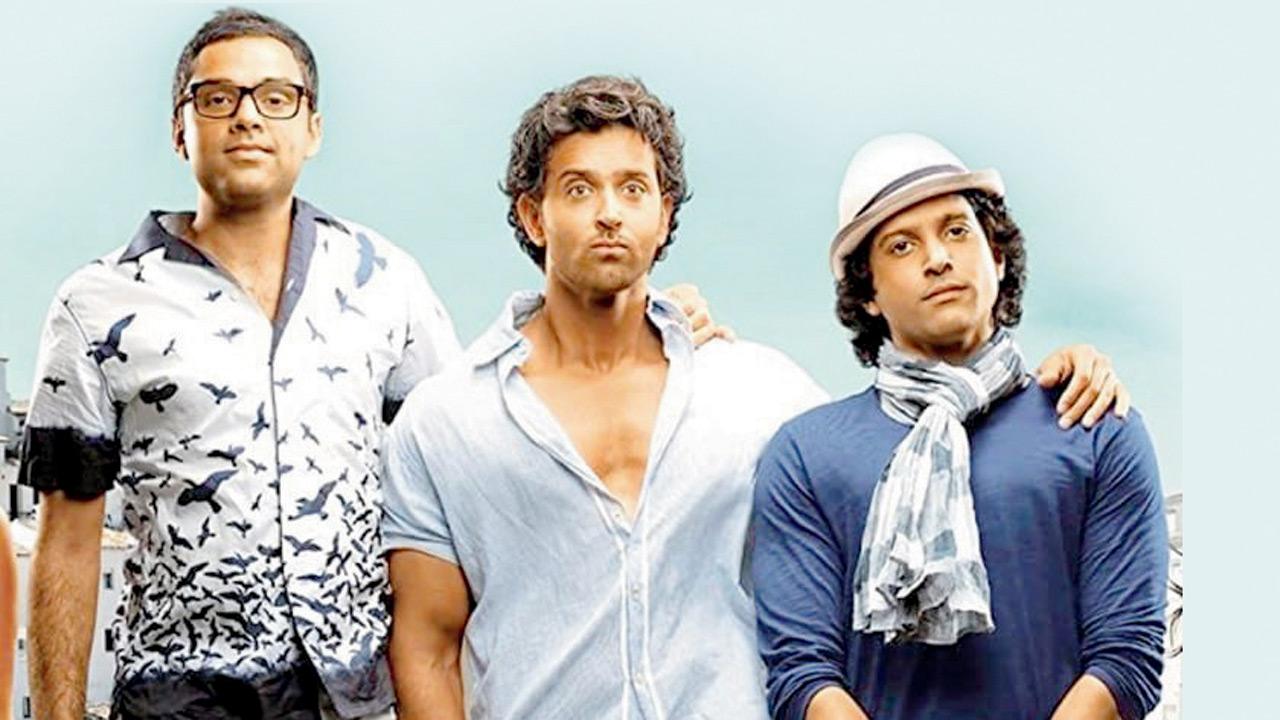
Zoya Akhtar locks first draft of Zindagi Na Milegi Dobara sequel; Hrithik Roshan, Farhan Akhtar, Abhay Deol in talks
3:50 PM
Mohar Basu (MID-DAY; February 10, 2026)
Have you ever wondered what the three principal characters of ‘Zindagi Na Milegi Dobara’ (2011) would be like in their 40s, years after their famous trip across Spain? It’s something filmmaker Zoya Akhtar is wondering about. The buzz in the industry circles is that the filmmaker has completed the first draft of the hit’s sequel, which is likely to be her next directorial venture.
From what we’ve heard, the sequel revisits the core trio — essayed by Hrithik Roshan, Farhan Akhtar, and Abhay Deol — years later, reflecting on their evolving friendships, mid-life choices, and unresolved dreams.
An insider told mid-day, “Zoya has finally locked a draft she is happy with. She was always clear that a sequel to ‘Zindagi Na Milegi Dobara’ would only happen if it had something new to say. It’s not a nostalgic rehash; the film acknowledges the time elapsed and the changes that have taken place in the three men’s lives.”
While no announcement has been made, discussions are said to be underway with the male leads. The insider added, “The intent is to reunite the boys, but it all depends on alignment of dates.”
Naseeruddin Shah on Farhan Akhtar’s comment: "He is right, but..."
10:48 AM

Rishabh Suri (HINDUSTAN TIMES; November 11, 2025)
In an exclusive chat with us, actor Naseeruddin Shah has reacted to Farhan Akhtar calling his past comments “distasteful”, saying that his remarks about Farhan’s performance in Bhaag Milkha Bhaag were exaggerated by the media.
“He is right but I think my statement has been exaggerated a bit,” he tells us. When we ask which bits were exaggerated, the 75-year-old adds, “I don’t think you need to be a genius to figure that out! Read both statements.”
In 2013, Naseer had stirred controversy with his blunt take on Farhan’s performance in Bhaag Milkha Bhaag: “I don’t care about Farhan Akhtar and I don’t watch his films. I liked his first film Dil Chahta Hai (2001)... I’m not a great fan of his acting or his films. But I admire him.”
In another interview, he said, “Building up muscles and growing your hair is not working hard on your acting. At least he should have tried to look like Milkha.”
Farhan (51) had recently told India TV, “I’ve known him for so many years. We worked together in Zindagi Na Milegi Dobara (2011)... If you want me to improve in my work, there is a way of communicating... To go in the press and say this, I found that distasteful.”
The one thing everyone has been asking me is Zindagi Na Milegi Dobara's sequel coming?-Kalki Koechlin
9:07 AM
Onkar Kulkarni (BOMBAY TIMES; December 6, 2024)
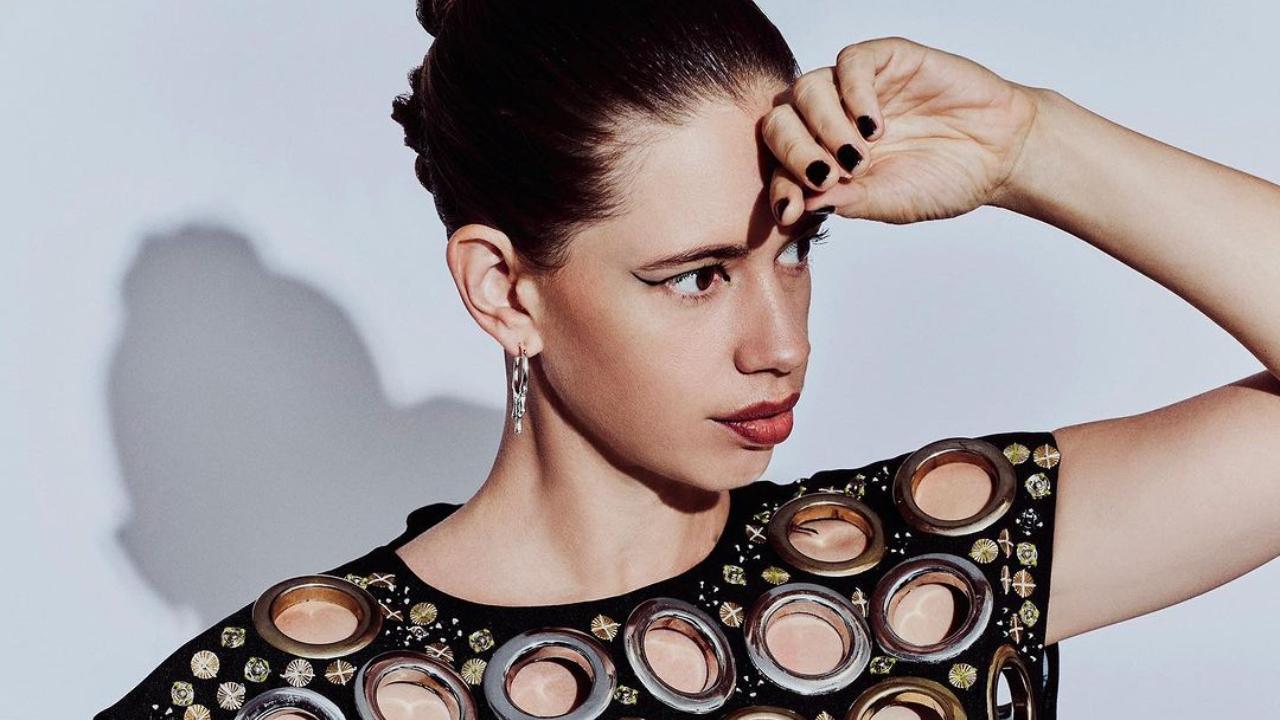
While Kalki has had a busy year, the actress always prioritises spending time with her four-year-old daughter Sappho over everything else. In a chat with us, she talks about balancing parenting duties and her career, how she longs to continue working and how excited she was when Zindagi Na Milegi Dobara (ZNMD) re-released in theatres earlier this year. Excerpts:
‘I narrate bedtime stories through voice notes for Sappho when I am away’
Kalki, who is based out of Goa, has to keep travelling for her work, even to foreign locations. Ask Kalki, who shot for Her Story this year, how she manages her shooting schedules while being a hands-on mom, and she says, “The longest I have been away from Sappho is three weeks for a shoot. Earlier this year, when I was in France for a whole month for a shoot, I spoke to her much earlier and told her I would be away. Sometimes, she bargains with me on the number of days I can be out. Whenever I am out working, I narrate bedtime stories through voice notes. She listens to them before going to sleep. It can be difficult, but we have to face it together because even I long to work.”
‘People keep asking me about the sequel to ZNMD’
Earlier this year, ZNMD, which featured Kalki along with Hrithik Roshan, Abhay Deol and Farhan Akhtar, was re-released in the theatres. Talking about the response the film got, Kalki said, “Now the one thing everyone has been asking me is when’s the sequel coming? I have no answer to this question (laughs). I feel excited that the movie has been relived and rewatched after so many years in theatres.”
The Zoya Akhtar directorial released in July 2011. Kalki, who usually doesn’t like watching her own films, has seen the film thrice. “Even Guy (husband, Guy Hershberg) enjoyed the movie. He found my character funny because it is very different from what he sees of me in real life. I think Sappho has danced on the film’s track Sooraj Ki Baahon Mein in her school,” says the actress.
‘Didn’t feel the hierarchy while shooting for ZNMD’
Reminiscing about the days of shooting ZNMD, she shares, “It was my first big Bollywood film. Of course, I did have a good start with Dev D, but it was still an off-beat kind of film. I got along well with Hrithik Roshan while shooting ZNMD. We share our birthday. We bonded over similar things. I shared with him how I struggle with dancing, and he spoke to me about his struggle with speech.”
Talking about what made the shooting experience special, she said, “We shot the film abroad (Spain), and the nature of the film was such that everybody was together. The separation was not there, and that hierarchy was not felt. I really didn’t appreciate how important and special it was at that time because as time went by and I did more movies, I realized that the separation or hierarchy is something that is ingrained in our system, and ZNMD was indeed a special experience.”
As soon as I jumped, I felt like a bird; it felt like Zindagi Na Milegi Dobara-Anushka Sen
8:26 AM
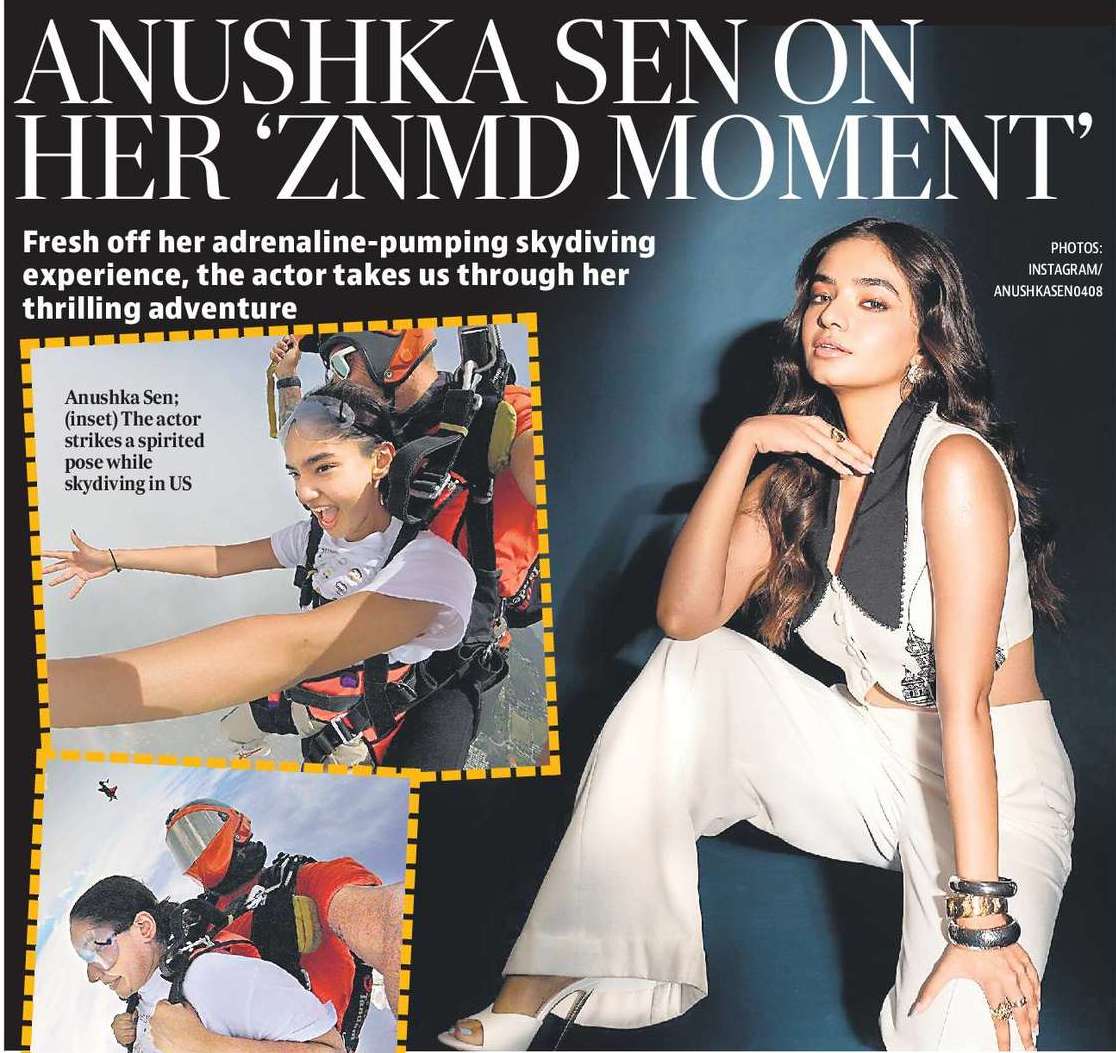
Fresh off her adrenaline-pumping skydiving experience, the actor takes us through her thrilling adventure
Navya Kharbanda (HINDUSTAN TIMES; July 29, 2024)
Actor-model Anushka Sen recently ticked off skydiving from her bucket list and her Instagram pictures are here to tell the tale.
The actor who skydived from the world’s highest tandem located in the USA talks to us about her experience, sharing how she “wasn’t prepared for it at all.”
“I was so scared and nervous when we planned the whole thing because I have only seen it in movies. I was really freaking out when I signed the papers and got on the flight,” she shares, adding, “But, as soon as I jumped, I felt like a bird and it was the best thing ever. I can easily say that it was the best experience I have ever had.”
Sen, who is fresh from a collaboration with Grammy-awardee Ken Lewis and musician AY Young for a global project titled Project 17, jokes that she tried to calm herself down as soon as she spotted the cameras.
“As soon as I saw the camera roll, I knew I had better not look scared. I was having fun. We had good company and were trying to calm each other. It felt like Zindagi Na Milegi Dobara (2011), my favourite movie,” the 21-year-old actor says.
For Sen, jumping from a height of 18,000 feet felt “liberating” once her parachute unfolded. “When I jumped off the plane, we had another person jumping right in front of me because he wanted to capture another angle of me during the free fall. I was the first one in our group, so I didn’t expect anything. I just went for it.”
She continues, “It was so cool because they had told us that they would help us do back flips in the air. After the parachute opened, I was just chilling and floating; the free fall was the scariest part,” she ends.
As a DJ, I feel more confident now to perform in front of people-Abhay Deol
10:03 AM

Kanksha Vasavada (BOMBAY TIMES; May 4, 2024)
Abhay Deol, who dons many hats (actor, producer, art lover), recently made his debut as a DJ at a newly opened arcade, Ballers Ahmedabad on Sindhu Bhavan Road, Ahmedabad. The Zindagi Na Milegi Dobara (ZNMD) actor tells us, “I love music and used to make mixtapes as a child. I learnt how to work on a DJ console, and this was a natural progression. Now, I can mix the music that I have collected over the years and play it.”
He adds, “I feel humbled by the response I received for my gig. Amdavadis are really warm.” Will he do a DJ tour now? “It is a hobby and I will be back to shoot for films soon. But as a DJ, I feel more confident now to perform in front of people. So, if I get offers, I may be up for it unless I am busy.”
‘I don’t label films as mainstream or independent’
Is it a conscious choice to choose films that aren’t exactly mainstream? He says, “I am always attracted to scripts that are relatable, insightful yet entertaining. I choose films that aren’t completely arthouse or completely mainstream. Be it Socha Na Tha, Dev D, Oye Lucky Lucky Oye or ZNMD, all my films have managed to strike a perfect balance between the two.”
Abhay, who has done independent movies like Road, Movie, adds, “Also, I don’t label films as mainstream or independent. For me, the subject is the main thing. When we use words like ‘independent’ for a film, it means it wasn’t mainstream, and was difficult to make and sell. I make movies that usually don’t get made. They get labelled as independent films as they don’t have the backing of big producers, distributors or directors. Even Ek Chalis Ki Last Local, Oye Lucky… were called independent films back then but had a big producer backed them, that wouldn’t be the case.”
‘Had a great time while working with Shabana Azmi and Zeenat Aman’
Abhay recently wrapped up the film Bun Tikki, which also stars Zeenat Aman and Shabana Azmi. Both the actresses have worked extensively with his uncle Dharmendra, whom he lovingly calls ‘papa’. Abhay says, “I had a great time. Zeenat Aman is the most warm, sweet, and polite person you will meet, and extremely professional. I have also known Shabana for a while. Zeenat ji feels papa is a gentleman, while Shabana is fond of him too. They remembered the good old days of working with him.”
‘Feel blessed that people love my film choices’
Having played unconventional characters, does he feel people expect that from him now? Abhay says, “I feel an actor’s image is built organically. I have always experimented with my characters. So, if my image is that I experiment with my roles, and people say they love my choices, it’s a blessing. I feel humbled. I want to do challenging roles-things that I haven’t done before.”
‘Being rebellious got me this far’
In recent times, Abhay has spoken about how he could have done certain things (like handling fame after Dev D) differently in his career. Elaborating on it, he shares, “When you are young and inexperienced, you are ignorant about certain things. As we grow up, we deal with the same situations in a more mature way. I was a rebel, but I am more diplomatic now. Being rebellious got me this far, as it was difficult to make the kind of movies I wanted. While the movies I made between 2005 and 2007 are considered relevant today, it was hard to make them back then. Now, I feel that being diplomatic is going to take me ahead.”
‘I hope that OTT platforms evolve more’
Abhay, who has done OTT projects like JL50 and Trial by Fire, believes there is room for improvement (for OTT platforms). He says, “When a medium is new, it has nothing to lose and you can experiment with everything. But once you grow bigger, you have a certain responsibility, and you tend to take fewer risks. When organizations prioritize business over creativity, the downfall begins. So, I hope that platforms can evolve more because I feel it’s time to be bold and take risks once again.”
Zoya Akhtar just wanted to follow around three boys, no hair/make-up for Zindagi Na Milegi Dobara-Reema Kagti
8:36 AM
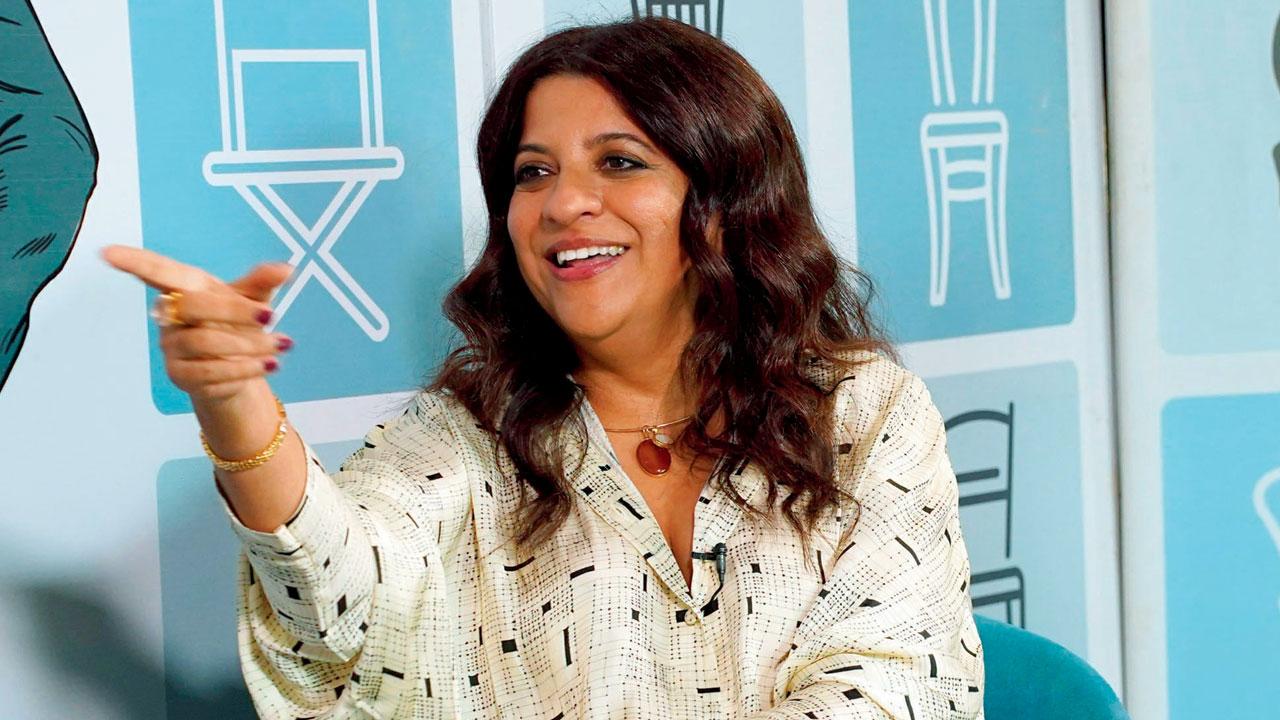
Bollywood’s top screenwriter plus producer duo, Reema Kagti, Zoya Akhtar, decode the craft behind their art
Mayank Shekhar (MID-DAY; January 20, 2024)
Made In Heaven, that’s wrapped two seasons on Prime Video—surely, you’ve seen it already—is an episodic series. In the sense that ensemble characters and stories change, with each episode, while the leads remain the same.
That is, Tara (Sobhita Dhulipala) and Karan (Arjun Mathur), who are BFFs/soulmates, single, sharing life together—also business and creative partners, at a wedding planning firm. Which involves stressful planning and production, some scripting, and creativity, too. Not very different from filmmaking itself.
It’s only while watching the show’s second season that it occurred to me—hey, these two protagonists could be inspired by the life of the screenwriting plus producer duo, Reema Kagti, Zoya Akhtar, who are behind the show themselves; no?
“No. Well, work-wise, yes. But not [so much] socially,” Zoya argues, when I bring this up. Although Reema concedes, “When we were discussing [the show, with co-writer], Alankrita [Shrivastava], this did come up—if we have set the people on ourselves. Definitely the friendship, where they are also kinda soulmates. Not that Zoya and I are soulmates.”
They are “professional soulmates,” they concur. So, the social lives are largely separate? “We do have the same gang, when we hang out. But let’s just put it this way: Zoya is extremely social. I’m absolutely anti-social,” Reema laughs.
The two have remained friends and colleagues for over two-and-half decades. Starting out as assistant directors (ADs) on Kaizad Gustad’s Bombay Boys (1998). And with a combined filmography of over 10 films/shows as credited writers on the screen, since.
Yet, while we know enough about Zoya’s background, famously daughter of writers Javed Akhtar and Honey Irani—we barely know anything about Reema.
I’ve scoured the Internet, before meeting them. It hasn’t helped much. Most of her video interviews online are with Zoya. Reema’s calmingly chilled, securely quiet. Which sufficiently explains the “anti-social” self-description, doesn’t it?
Reema says she grew up in Assam. Went to a boarding school, Loreto Convent, in Shillong, Meghalaya: “Back then, there were hardly any good schools in Assam, so it was common for parents to send their kids off to boarding schools. Unlike in bigger cities, where only the naughty kids got sent!”
She was admittedly a naughty kid, though: “I used to make my parents’ lives hell. But they were supportive.” Not as much for her filmmaking ambitions, initially.
“I think my father had this very 1980s, ’90s notion of Bollywood. He was very disappointed [with my career choice]. It’s only when I got him to watch Lagaan, that I was an AD on, that he said, okay—if this is the kind of films you want to make.”
Reema’s father was an engineer at an oil company, before leasing out a 350-acre land to farm, “four hours’ drive from China”. The umbilical cord with her home-state remains.
“You can’t really outgrow your roots. My cook is Assamese. I eat Assamese food. My family is back in Assam.” Reema had moved to Bombay for college, at Sophia, and thereafter a course in social communications at the media school, Sophia Polytechnic.
“At some point, I bumped into Zoya. We liked the same kinda films, had a lotta common ground, we began writing small stuff together” she trails off.
To be more precise, this was during the auditions for Bombay Boys (1998), where Reema was already an AD. Zoya had dropped in for the same position.
Zoya had been an AD on Dev Benegal’s Split Wide Open (1999), after returning from a diploma in filmmaking from New York University (NYU). She had assisted in the costume department on Mira Nair’s Kama Sutra (1996), before NYU.
“Only, the director, Kaizad, was keen to test Zoya for Tara Deshpande’s part in Bombay Boys,” Reema recalls. She was staffing the audition. Right after which, Zoya told Reema, “I’m the world’s worst actor!” Reema replied, “Listen, I don’t think you’re getting this job either!” Well, she got the job she wanted.
Which was as a freelance AD, the rotating culture of which only spawned in Bollywood in the late ’90s, early ’00s: “We were moving into a phase of sync-sound on the sets, shoots getting wrapped in a single schedule. To pull that off, you needed a more structured system. Unlike before, when films would take years to finish, and everyone just hung around in offices—there would be 12 ADs, and everybody did everything,” Zoya says.
Reema had earlier worked on Rajat Kapoor’s directorial debut, Private Detective: Two Plus Two Plus One (1997): “That was my film school. I got to dabble in all departments of filmmaking.” But there was one thing both Zoya and her were clear about—they were not going to assist only one person, throughout, which was, at the time, the common practice.
Zoya says, “I don’t know how we had the guts to take that call. Back then, ADs were associated with particular filmmakers, or even production houses, when it came to advertising. There was a ‘chhaap’ [creative trademark] of that director, that remained with you, even once you left them and went your own way.”
Sensing a trap, neither wished to mirror particular mentors. Writing and directing their own movie was the end-goal, anyway. They got to work on multiple sets, when they did; and wrote their own scripts, when they didn’t. It was around this time they decided to script a short film together.
Zoya remembers, “We almost killed each other—let’s do this, let’s not do that, etc. Later, I wrote Luck By Chance (2009). Reema started writing Honeymoon Travels Pvt Ltd (2007). We gave our scripts to each other for feedback. She finished the portions I got stuck at. Likewise, me with Honeymoon. While we hadn’t credited each other, we were on each other’s films. Because this worked out so well—plugging holes in either script—after that, we just wrote together. Talaash (2012) was the first script we developed [as a team], from scratch.” Zindagi Na Milegi Dobara (ZNMD, 2011), arguably the finest Bollywood entertainer in the ’10s decade, was their second.
It’s not like the creative bickering, if you may, has stopped, or receded. Zoya admits, “People around have just got used to it in our office.”
Reema laughs, “This one time [producer] Ritesh [Sidhwani] told us, you should just not work with each other anymore. During ZNMD, [Zoya’s mom] Honey aunty got a call from the neighbours—something is going on in your house; please, it’s really scary, people are shouting!”
The art of their conflict management is pretty simple, though: “Show up at work. If we are writing, it’s 10 am. No muse is gonna come. If nothing is happening, we just do other things, watch movies, just chat, gossip… Also, you should never be afraid of scrapping what you’ve done, and starting all over again,” Zoya says.
With Reema, it’s even simpler: “If you’re stuck with an idea, and neither is able to resolve it, let it stay—move on to other things. Later, you return to those ideas, and the better argument, once it stays with you, eventually wins. It works well, if you have the story first.” They’re sure of the story’s end, beforehand; working themselves backwards.
In terms of agreeing to disagree, between them, the one who’s directing the film, gets the final say: “Otherwise, we will never stop arguing.”
For instance, in the Netflix original, The Archies (2023), Reema wasn’t convinced about the placement of a song that would break the narrative: “But once I saw the way Zoya had outdone herself with the visualization, I knew she was right. It is my favourite song.”
In terms of success stories among screenwriting pairs, none beat Salim-Javed in Bollywood still. As in, script starring Salim Khan and Javed Akhtar, in the opening credits. The latter, of course, being Zoya’s father.
Only lately has Javed begun to decode how the partnership worked, having kept mum, since it broke up at the turn of the ’70s decade.
It’s clear now that Salim was the scenarist and the plot-guy, while Javed was the man of words. For instance, as Javed has mentioned before, the greatest twist in Chandra Barot’s Don (1978)—the fake don reveals, inside the jail, that he’s not the real one.
Wherein, the cops don’t believe him still. But his consiglieres, for inmates, instantly do. The dilemma worsening for the protagonist—he’s stuck between both lots, who’re gonna kill him, regardless. Now, that was Salim’s idea!
But, say, the Don’s line, “Mujhe do tarah ki ladkiyan pasand nahi aati. Ek woh, jo mere pass aane mein bahut der lagayein. Aur ek woh jo bahut jaldi aa jayein. (I don’t like women who take too long or too little time to attract).” Now, that’s decidedly Javed!
It’d be great to hear Zoya-Reema similarly break down their own scripts. Firstly, Zoya exclaims, “This comparison is freaking me out. Nothing of the sort [of Salim-Javed] had happened before, or will happen again. They were 22 blockbusters down. Let’s not put us in the same sentence!”
“[That said], our strengths are very different. We talk, talk, talk. We align on themes, characters, story, and what the film is about. Then, Reema is very strong and succinct with structure and screenplay. She gets to the point. I tend to soak.”
Reema couldn’t agree more, “The editing! You give Zoya a 100-page script, she’ll send you back 120 pages. I’m, like—what have you edited, you’ve added! But she’s better at nuances, layering, characters. And dialogues, of course.”
“Zoya feels all my characters sound like me! But she can be lazy. Zoya will refuse to write the first draft of the screenplay, once the events have been fleshed out. So, on the dialogues, I just make everyone sound like me. Because I know she will fix it!”
Zoya adds, “I get lazy, yes, but once Reema does the barebones, I take it, and juice it. I write the dialogues in English. If you want to shoot the film in English, the screenplay is completely ready.”
“Then, it goes to one of my family members—brother, Farhan (ZNMD, Dil Dhadakne Do, The Archies); father, Javed (Luck By Chance), or Vijay Mourya (Gully Boy)… They know what I want, putting it into the syntax that works best in Hindi.”
The Archies, in that sense, for the way the audiences would have watched it globally, is closest to the original screenplay with English dialogues then? “The person subtitling might approach it differently, but the English draft is the template for it,” Reema says.
While writing, per se, is a solitary job—it’s in the parleys between each other, bringing out personal experiences and influences—that the Zoya-Reema script essentially comes together.
I ask Zoya to quote examples, where there’s fully Reema in a script, that she’s directed. She points to Alia Bhatt’s part in Gully Boy (2019): “Safeena was the character, from Dharavi, in a script, that Reema had written for her movie. That film didn’t happen. But I fell in love with her. I asked her if I can just take Safeena. Yeah, why not! We supplanted and then adapted her to fit into the world of Gully Boy.”
For something more specific, in terms of moments, Zoya cites, “The scene in ZNMD, with Laila (Katrina Kaif) chasing Arjun (Hrithik Roshan) down on the bike, and kissing him! The point of the film was to follow your dreams; live in the now. Reema said Laila needed to do something [to capture that essence]. She can’t just say it. Let’s have her kissing him outside, and let her leave!”
This ready-to-film screenplay cooked between partners is also how Salim-Javed operated, staying within the realm of screenwriting still—a reason some ’70s directors fell off the crevice, once Salim-Javed were unable to send them bound scripts any longer.
For Zoya-Reema, it’s merely the end of a process: “A big hurrah moment,” as Zoya puts it. The actual movie can’t film itself. How’re they different as directors from thereon, I ask Reema, who has, thus far, directed Honeymoon, Talaash, Gold (2018), two seasons of Made In Heaven, the series, Dahaad, and the feature, Supermen Of Malegaon, that’s on its way.
She says, “Zoya visually references a lot. I tend to arrive at the visual world, after recce-ing [locations].” Zoya agrees, “It is, after all, a visual medium. I like to find a visual tone, seeing the film from before, and start recce-ing it, accordingly; to lift it off the page.”
Zoya, evidently, has her clear list of dos and don’ts as well. For instance, she was certain before the filming of Gully Boy, set in the slums, that there will be none of Bombay’s tarpaulin-blue throughout the film: “I just don’t like the colour.”
Likewise, with The Archies, the setting would be dreamy, hence, visually, story-book like: “full framing, wide-lensing, classical shots, like 1950s-60s photography.” With Dil Dhadakne Do: “mainly mid-shots and long shots, because the picture is from the POV of Pluto, the family dog.”
Besides screenwriting and direction, there’s the graduating aspect to their creative careers, which is as producing partners. Gully Boy was the first film with Zoya-Reema’s film company, Tiger Baby.
The name, by the way comes from “the nickname that Anurag [Kashyap] and all” gave Zoya: “It’s my spirit animal!” Left to Reema, the company would’ve been called Balls of a Brass Monkey: “Zoya is like, don’t be ridiculous! Also, Tiger Baby is fierce and feminine. It has a nice ring to it.”
Even as producers, the two couldn’t be as complimentarily separate from each other. As Zoya deciphers, “I’m the one meeting with the actors, Reema doesn’t wanna go anywhere. She’s better with budgets, and numbers. But both of us are into mentoring scripts. She’s better at creative packaging and producing. I handle the Tiger Baby social media.” Reema sighs, “I can barely do mine.”
An upcoming production of Tiger Baby is a documentary on Salim-Javed.
If you were to strain yourself to find connecting dots, if not a larger link, between each of Zoya-Reema scripts, it might be the fact of alternating worlds, perhaps.
Say, in the OTT space, their two releases in 2023 were Made In Heaven S02, and Dahaad (both on Prime Video). One is set around the blingy world of posh, New Delhi weddings.
The other is a police-procedural in the rugged terrains of Rajasthan, following missing women, and a serial killer on the loose.
Likewise, with films, The Archies, on Netflix—with “idealism for its point”, in the near-perfect, imaginary world, mimicking the American comic book, in 1960s India—comes after Gully Boy, that went deep into Mumbai’s underclasses. Which, in turn, came after Dil Dhadakne Do, dealing with importantly familial, but First World issues.
Zoya-Reema obviously don’t see it this way: “We just follow the world our characters live in. It’s about being authentic to the world you’re trying to create,” Reema says.
Zoya adds, “We are avid readers and movie watchers, fans of various kinds of filmmakers, not fixated on a genre. For instance, I’m actively looking for something in the big crime/underworld space. It’s exciting to be scared [trying new things]. I’ll be bored waking up for work, otherwise.”
The ideas, of course, can come from anywhere, Reema argues: “Supermen Of Malegaon was a documentary. Gully Boy came from a music video. With ZNMD, it was road trips taken [by us]. We’d also gone on a Europe tour, with Zoya and a bunch of friends. Zoya just wanted to follow around three boys, no hair/make-up, for ZNMD. Of course, it didn’t end up that way.”
One of those inspiring trips was when Reema, a “broke AD”, was in Goa, having spent all her money, with none left for a bus-ticket back to Bombay. She hitched “a car-ride with the sister of a friend. Throughout, [the host was] cautious of a plastic bag in the backseat, because it had an expensive vase, or something. We named that bag, Priscilla.”
This is how Bagwati in ZNMD came into the scene. Only, Reema hadn’t even heard of a Birkin: “What’s that Berk, Berk, whatever. When Zoya told me about it—I’m like, why would someone pay lakhs for a bag? I wanted [the motif] to be something breakable in the film. Zoya’s the director. I had to go with her!”
With ZNMD, Zoya says she was looking at a low-budget, easy-peasy production, given she had just got off a huge ensemble cast debut, Luck by Chance.
Which was about an actor getting a shoe-in to showbiz. The Archies, in that sense, is her coming full circle, since the film launched seven debutants. If she was to make Luck by Chance, how different would it be, a decade-and-half later, give how much entertainment as an industry itself has changed since?
“If I have to revisit, rewrite, I don’t know what [Luck By Chance] will be. But, thematically, it’ll still be about success, and failure. That’s what the film is about—how do you define success, and failure? Is your self-worth determining both? The rest is backdrop.”
A widely shared clip online, from Luck By Chance, is superstar Shah Rukh Khan’s (SRK) cameo in it, where he gives life’s lessons to the lead character (Farhan Akhtar). Given The Archies marked the acting debut of SRK’s daughter, Suhana, I wonder if Zoya ever got SRK over to the set, for a Chak De India type pep-talk, to a full team of debutants? “No. That is supposed to be my job!”
That pep-talk in Luck By Chance was essentially about never leaving behind those who’ve known you from before success/stardom—when it appears that you’ve probably moved ahead. Zoya says, “Shah Rukh, as a person, typifies that.” In terms of rallying the OG troops around her, so does she.
Zoya sorta admits, “I do like working with the same crew. Because they’re great at their job. There is trust, and a sync of aesthetics. Which is not to say I won’t work with someone new.
“Suzanne [Caplan Merwanji] was the set-decorator, when I was a production assistant, on Kama Sutra. [Editor] Anand Subaya and I went to school together; [costume designer] Arjun Bhasin, [hair stylist] Avan Contractor… So many around me have been friends since teens and tweens.”
“There’s Ritesh [Sidhwani], Farhan… Also, then, I enjoy going to work. I work a lot. I don’t want life passing me by, while I’m isolated, working 13-14 hours, a day. The friends are there.”
Friendships also being a recurring theme in Zoya-Reema scripts, if you casually glean through them. They could claim a friend-verse of their own. Starting out, Zoya-Reema worked as ADs on Farhan’s Dil Chahta Hai (DCH, 2001). Both believe Farhan, their former boss, to be the more methodical director, sharp with his final edits, even while on set.
Together, with DCH, and ZNMD, Netflix placed three hoardings in Mumbai, before the film Kho Gaye Hum Kahan (KGHK) dropped on the platform—terming them movies that defined friendship for their respective decades. I kinda agree.
Tiger Baby’s KGHK, directed by debutant Arjun Varain Singh, is probably the only Zoya-Reema script that neither has filmed. It peeks into the life of GenZ, through three buddies (Ananya Panday, Adarsh Gourav, Siddhant Chaturvedi), who also somewhat embark on a professional partnership together.
This is not a love triangle. It’s about friends, who are also family. They are not seeking healthy romance, but fulfilling companionship.
You sense that mental intimacy with the male-female leads over two seasons of Made In Heaven as well. I reckon, that’s the future of relationships. Zoya-Reema get that. Better than others.
We’ve been told people skipped Bandish Bandits's talkie portions to hear the music - Shankar-Ehsaan-Loy
8:34 AM
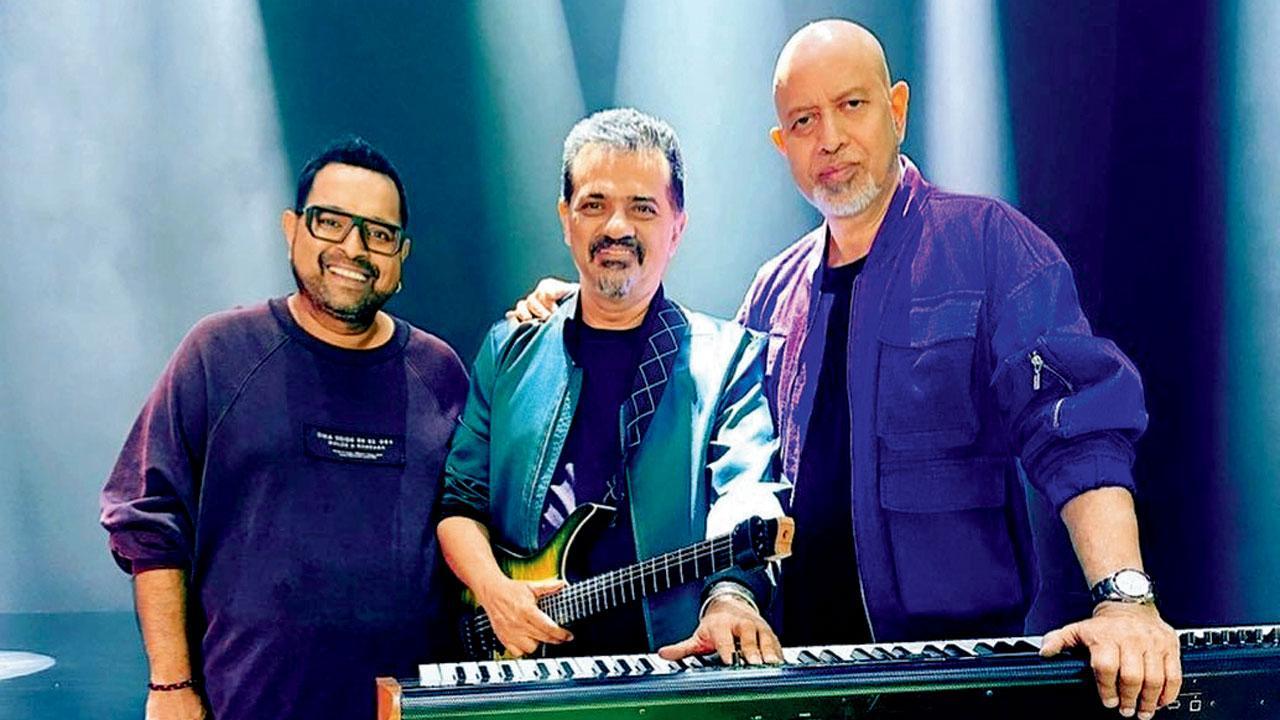
While agreeing that a song’s visual appeal keeps a web-film watcher from hitting the forward button, The Archies composers Shankar-Ehsaan-Loy say its sonic quality keeps them coming back on audio streaming platforms
Sonia Lulla (MID-DAY; December 4, 2023)
Having created six of the 17 songs that form the backbone of The Archies musical, Shankar-Ehsaan-Loy say they felt they could “smell sponge cake in the room”, when they watched the final edit. “It’s such a sweet film,” they promise, as they discuss recording with Suhana Khan, and working with Javed Akhtar.
Edited excerpts of the interview.
There’s always something special about the music you’ll make for a Zoya Akhtar-film. Why is that so?
Ehsaan: [We are given] the freedom to create. She never blocks an idea and says, ‘No, let’s try something else.’ Her attitude is respectful to the creative person.
Shankar: There are certain directors whose presence in the studio [enables] the music to flow easily. There may be parts of the music that we use or don’t use, or mould at a later stage. For example, the song Va Va Vroom came out to be as it is because he [Ehsaan] randomly played one line, and we decided to record it. Only later did we recall we had this recording. It was a founder’s ball, and we realized this would fit the scene because it has an element of rock. So, when music flows easily, it feels fresh to the listener.
Many cast members, like Dot, are also singers. Suhana has also lent her voice to a song. Did you’ll sit with them to discuss the music?
Shankar: For Suhana’s part, we wanted someone who had the required voice, age, and innocence. The singers we recorded sounded too professional. When she sang it, we said, this is it. She was nervous but practiced a lot.
Ehsaan: The song that she sang has a conversational quality. Another song has been sung by Kelly Dlima. These young singers are all unheard of. They’ve been singing in the studio, but now they’ll get this excellent break.
Shankar: There is one song that is completely picturized on skates. The kids had to learn skating for it.
Ehsaan: There’s another that has been rendered by Arijit [Singh]. People will be surprised when they hear it. It’s unlike anything you’ve heard from Arijit. He was also thrilled with it.
When creating music for the web, where it’s easier for someone to hit fast-forward when a song plays, do you believe the emphasis on the visuals of the song has increased in a bid to lure the viewer to watch it?
Shankar: I would agree that that it is valid. But, 80 per cent of the music that is consumed in the country is non-visual. It is consumed on streaming platforms, where you aren’t seeing it. So, the perception that Bollywood is the only thing [that matters in the music industry] is not true. Bollywood is a small part of the whole game. Monetarily it’s a big part. But there’s a lot happening otherwise. We did a web series called Bandish Bandits. [We’ve been told that] people skipped the talkie portions to hear the music.
Loy: Our job is to write a great song. What is done with the visuals is on the director. But, we have to create a song that sounds amazing even without the visuals.
Shankar: You know, Senorita [Zindagi Na Milegi Dobara] was not supposed to be a song. It was a situation in which they were meant to jam with some Spanish musicians, and leave. When we created that [motif] we realized it was an amazing song. So, visuals were created for it, thereafter. That was also the case with Havan Kund in Bhaag Milkha Bhaag. It was supposed to be a scene in the hostel. But Prasoon [Joshi] ji wrote a big paragraph, and that led to the making of a full song.
Since the songs are conversational, did you’ll spend more time with Javed Akhtar?
Shankar: We always do. I remember, when we were sitting with Javed saab for this film, he would tell us, ‘I have to [not consider] 80 per cent of the words in my vocabulary, because these kids are Anglo-Indians.’ Sometimes, Farhan [Akhtar] and I would playfully argue about some lyrics, and he’d say, ‘With your vocabulary, all I can do is send a telegram’. The kids in the film have limited vocabulary. So, he couldn’t write intricate poetry. He had to write simple words that still conveyed the message—whether that message was about politics or [love]. It had to be musical and the rhymes needed to fit the tune. Only he could have done this.
Deepti Naval calls her role in Zindagi Na Milegi Dobara ‘minuscule’: "It was an alarm"
8:13 AM

Vinay MR Mishra (HINDUSTAN TIMES; April 4, 2023)
Deepti Naval, who marked her acting debut with Junoon (1978), completes 45 years as an actor this year. At this stage of her career, she is looking for more defined roles. “I am hoping to get better roles, else, I’m happy writing. There is no dearth of acting offers. The typical mother roles are a dime a dozen,” she says.
Naval was certain that she didn’t want to take on just another mother role in a project and that’s something she was clear about even while signing her next release, Kavita & Teresa. “I asked the director, ‘What do you want me to play?’ It’s either the young girl or Mother Teresa. I didn’t want to do any typical mother role. My role in Zindagi Na Milegi Dobara (ZNMD; 2011) was minuscule and I thought, ‘Oh my God, is this what it’s going to be now? People are going to call me for one or two scenes?’ It was like an alarm.”
She adds, “Of course, it (ZNMD; she played actor Farhan Akhtar’s mum) was a beautiful film to be a part of. But here (Kavita & Teresa) I thought, yes, I could bring something [to the table]. I wanted to be a part of a good film, just like I wanted to be a part of Zoya’s (Akhtar, ZNMD director) movie.”
Did the entire ZNMD episode bother her? “Out of the three scenes, two were kept and only one was pulled out. That’s the freedom the director takes. I was happy, but I certainly didn’t want to be the mother and be there for just a split second,” she clarifies.
Having said that, Naval, 71, is “very comfortable” with her age. “I don’t want to try and look younger. Also, I don’t want to be desperate about how I’m looking on screen. I look my age and I’m okay with it,” she ends.
I was born an insider, but I pretty much lived as an outsider-Abhay Deol
8:53 AM
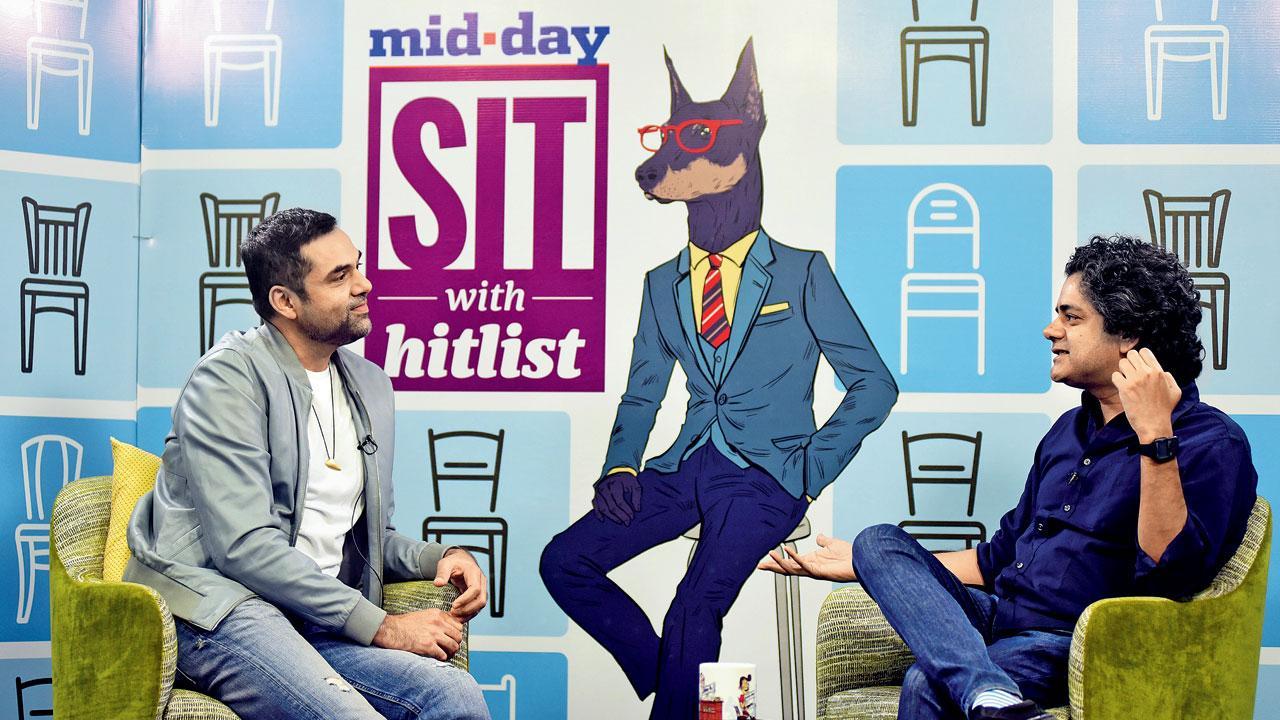
Abhay Deol with mid-day’s entertainment editor Mayank Shekhar at the latest edition of Sit with Hitlist. Pics/Shadab Khan
Decoding the rise & fall of Mumbai film industry’s ultimate insider-outsider!
Mayank Shekhar (MID-DAY; January 21, 2023)
Shortly after our conversation, before a live audience, Abhay Deol is scheduled to meet Shekhar Krishnamoorthy, the person he plays in the Netflix series, Trial By Fire — based on the life of a middle-class Delhi couple, who fought the city’s top real-estate developers, post the death of both their children, in the 1997 Uphaar Cinema fire tragedy.
Which is also when we realize Deol had chosen to consciously stay away from the real-life inspiration for his part, during the process of making the series. Deol is Punjabi by ancestry, unlike Krishnamoorthy, with the most Tamil surname. In fact, Deol has played a Tamilian before this.
That was as the bureaucrat Krishnan, for Dibakar Banerjee’s Shanghai (2012). In an episode dedicated to Deol’s films, on a podcast named Khabardaar, that I was listening to before meeting the actor, the hosts — shout-out to wonderful ladies, Aparita Bhandari, Baisakhi Roy—make an observation on Deol’s walk onscreen. They believe it is the same in all his films. Except, Shanghai, if you notice the minutiae.
Firstly does he agree, and was that consciously so, I ask Deol: “There are physical characteristics that I suppose you don’t change easily. You’re unaware of them. With Shanghai, that may be true. Not that I consciously worked on my walk, though. I did have to work on my accent. Krishnan is a Tamil Brahmin.”
“And I had to put on a Hindi, like a Tamilian would speak it, which is hard to find. Because no Tamilian really speaks Hindi — they speak to you in English. Also, we don’t have an infrastructure of accent training for actors in our country. So we found this out-of-work Tamilian writer, who I worked with, and developed a system [for it].”
If we must get deeper into this accent thing still, for instance, Deol recalls, “I hope I haven’t mixed up my memory, but I was really working on the phonetics — there is no ‘ha’ sound in Tamil, and there is no ‘ba’. In Tamil, you could pronounce my name closer to ‘Apaay’. Stuff like that was insightful. This is besides mimicking my accent-trainer off-camera — so I would know how he might say my dialogues.”
The ladies of Khabardaar podcast might wanna notice this the next time they watch Shanghai. Krsihnamoorthy in Trial By Fire, Deol points out, is different from Krishnan, because he’s a Tamilian, but essentially from Delhi.
He has what one could call a more neutrally North Indian or ‘Delhi’. Which is also a character Deol has played in Oye Lucky Lucky Oye (OLLO) — another real-life person he obviously didn’t meet, before playing him on screen. Bunty Chor was the local swindler, where would you find him?
OLLO (2008) tragically released in theatres, when the “the firings were still on” during 26/11 terror attacks in Mumbai. My favourite memory of OLLO is an off-screen one from the film’s BTS video online, where a dog is after Bunty Chor (Deol), who’s jumping off a tall building-gate. Banerjee asks him to turn around for the camera, so the audience knows the lead actor performed this himself, instead of a body-double.
Deol says, “It’s fun doing stunts, as much as I can. I think Dibakar was a bit surprised about how easily I was scaling such a large gate, and he said he wanted people to see it!”
Sticking to Delhi, and characters inspired by actual events/people still, how about Anurag Kashyap’s Dev D (2009). I learnt this much after watching the film that the role was in fact somewhat based on Deol’s own life. Meaning, obsession in love, and indeed experiments with drugs. If true, kindly elaborate?
“Well, I wanted to contemporize the (Sarat Chandra Chatterjee) book, because I felt there was something wrong there — with such a male, patriarchal view of a man-woman relationship, where women are falling over Devdas. No matter what he does, he can never be wrong. I grew up in an environment, where drugs and alcohol were all available.”
“My Chanda (Kalki’s) character was far stronger than what eventually got made into the movie. She was an East European pole-dancing escort, who is fine the way she is — making great money, traveling the world. She takes pity on him (Dev). Obviously it worked for Anurag [that] she was as vulnerable as he [Dev], and she was a victim too. For me, he was the only victim. The women only grew stronger from there.”
Did he know the Polish escort? “I am not going to tell you! I know all sorts of people; let’s just put it that way. Yeah, I know a few escorts ‘n’ all.”
Let’s pause at the movie titles here: Banerjee’s Shanghai, OLLO. Kashyap’s Dev D. Also from a time when both Kashyap and Banerjee were the ‘new-age filmmakers’, early on in their directorial careers. I wonder what Deol thinks of the trajectory they took thereafter.
Frankly, he doesn’t have much to say, besides “conforming to commercial pressure” that becomes inevitable in some cases. He could sense the “creative genius of Banerjee in LSD (2010)”. As for Kashyap, I find it surprising that he hasn’t seen any of his films since Dev D! Not even Gangs Of Wasseypur (2012)? What; did they have a fallout or something, I ask.
“Well, [Kashyap] went in public, and said a lot of lies about me.”
For example? “One lie was that I demanded a [five-star] hotel room [during the shoot of Dev D]. He had actually come up to me and said, ‘Listen you can’t stay with us, you are a Deol. So, I want to put you up in a hotel room.’ He literally told me that. What he told the press was that I demanded it.” The reference here is to Deol’s profile published in Huffington Post (June 5, 2020).
He continues, “So, there was clearly a lot going on at the time, which was not professional. I had my heart on my sleeve, and all that is great — but you get taken advantage of, and then you get reactive. So, he [Kashyap] was a good lesson for me. Then I just avoided him, because I don’t need toxic people in my life. Life is too short, and there is so much more to explore. But he (Kashyap) is definitely a liar, and a toxic person. And I would warn people [about] him.”
This outburst is evidently in response to Kashyap’s quote about Deol in the Huffington Post report. Deol adds later, “I don’t look in the past. When Anurag said that crap about me in public, he sent me ‘apology’ messages.”
“He does that all the time. He was like, ‘You want to shout at me, scream at me…’ And I was like, ‘I don’t care. It’s been 12 years. You don’t feature in my thoughts even now; get over it.’ He said, ‘Forgive me, because I have had a bad day.’”
“I said you are forgiven. I never had a personal agenda. It was far bigger than just me. That is how I feel about everything. How much of this is he going to do? And I would have never taken his name and said the things, had he not gone public [either].”
Raking this up is important only because lead actors, or stars, have always been the medium to tell stories on screen — even if in the off-stream space, so to say. And by the mid Noughties, Deol was at the centre, if not the pioneer, of a movement of sorts, within Bollywood—picking up young, untested directors to star in their scripts/films, on a leap of faith, first.
“The first five movies of mine were all by first-time directors,” he recalls. Let’s pause again to name these debutants: Imtiaz Ali (Socha Na Tha), Shivam Nair (Ahista Ahista), Reema Kagti (Honeymoon Travels Pvt Ltd), Sanjay Khanduri (Ek Chaalis Ki Last Local), Navdeep Singh (Manorama Six Feet Under).
These are also films that got defined as Hindi commercial cinema, merging with an entertaining art-house — ‘H-indies,’ if you like. At least a couple of the directors did fairly well for themselves — after that firm footing in the film industry.
I can see why it’s got Deol a li’l pissed off now that I want him to dwell on what he thinks of their careers as well — he did like Ali’s Jab We Met, more than Rockstar, which in turn was still outside Ali’s usual “love-triangle zone”, and therefore a step-up: “Why am I commenting on all this — [is that] what the show/conversation is about?” Of course not.
I guess what we’re getting at is an oft repeated jibe that a lot of these directors — take Ali, for example, who got his debut due to Deol — never worked with him thereafter. Is that a fair observation, with anything deeper to it?
“And Anurag used to say, this is why directors [don’t work with me]… I know a lot of actors don’t want to work with him. But I see what you mean. Or where you are coming from. I did sense this feeling [later towards me]: ‘You know, you are not big enough!’”
“Which is ironic, because when I worked with them, neither were they! You either believe in someone, or a vision — even if it goes against the norm. Or you can say, I will keep my vision, but I will acquire bigger powers [to execute it]. Because I will get more money, I suppose. Also, I was taking a lot of it on myself, and I know I made mistakes. I am searching for answers to give you, and I hate making it about me, when it’s about somebody else.”
Consider the career graph. In terms of box-office plus cult-grade, Zoya Akhtar’s multi-starrer Zindagi Na Milegi Dobara (2011) is possibly Deol’s high point. A string of seriously superb films right before, and after. And then there is s sharp slump 2013 onwards, almost a freefall.
He’s had a release almost every year. So he’s very much been around since. The films/series are, again, by mostly first-time directors, or fresh talents, at any rate; experimental in their own right.
You can have your views on, say, One By Two (2014), Happy Bhaag Jayegi (2016), Nanu Ki Jaanu (2018), Chopsticks (2019), What Are The Odds (2019)… Good or bad is a subjective take anyway. But you know, none of them are really, well, did he lose his mojo, how do I put it….
“It’s just a fact. You don’t have to justify [your question],” Deol comes to my rescue. As for the kind of work that comes your way, he says, “Everything is [a] collective [call]. And I don’t like talking about it, because I don’t want to come across sounding bitter, or a victim. I don’t care. But when you take a stand, then you take a stand. And that has consequences. Are you ready to face those consequences?”
Exactly what stand, for example, could do someone in? “I don’t know. Calling out people for endorsing fairness creams?” Would that mean those who endorse fairness creams would debar you right away?
“It is not as simple as that. I did a guest appearance in Shah Rukh’s Zero, and he is a really dignified man. But there is a collective [thing that happens]. Say, showing up with a black eye on a red carpet, and calling out Bhushan Kumar by name, and saying T-Series blah, blah. Or constantly saying, why do we only have song and dance [in our films]…”
Deol has been equally vocal, in public, about critiquing his own films, with misplaced intentions — whether that be Aisha (2010), or Raanjhanaa (2013). Surely that’s hardly mastering the art of winning friends and influencing people. But you can tell—frankly, he doesn’t give a damn. And that’s what makes him more fun than the current crop of polite suckers for boring heroes.
Also some of his criticisms could emanate from ideas he wished to champion, but found no takers, around that time. Navdeep Singh’s Basra famously got shelved. As did a zombie comedy called Rock The Shaadi, after shoot. I fish out an old video of him consulting a tarot card reader, in Simi Garewal’s TV show — to check if one of his dream projects would come true.
Deol remembers it was an international film, with debutant filmmakers from abroad, who nobody wanted to put money on. They still haven’t made the film, and he had to stop trying eventually.
“So yeah, post 2013, it was tough. I also took a backseat. Now I don’t want to go back and pretend like nothing ever happened, or be a different person — so, I am going to sit back, and see what comes my way. And quietly work. If that works, it works. If it doesn’t, so be it!”
As for the so-called song and dance, Deol says it’s not like he has an issue with the genre: “At least three ideas of mine are full of songs. One of them was Dev D (18 numbers in the soundtrack).”
The film was a major winner at the box-office, for its budget. Deol remembers, “Especially after Oye Lucky and Dev D, I had a red-carpet entry to whoever I wanted to work with. And this is not just because I had successes behind me. Also because I was so-and-so’s son, nephew, brother…”
Which puts him in a strange ‘middle’, in the nepotism debate, that is usually conflated to the ‘elite versus masses’ battle, pitched in the wider political/public space. Deol’s “anger and rebellion” within the family itself, he says, was his reaction to fame and its pitfalls. Something he had watched closely, growing up. Left to him, it appears, he’d rather be anonymous, but remain an actor — obviously a misnomer.
“I was born an insider, but I pretty much lived as an outsider,” says Deol. That said, his debut film was a joint-family release, from Vijayta Productions — mainly helmed by cousin Sunny, son of Uncle Dharmendra.
Interested in debutant Ali’s script, he took him to meet Sunny, who was happy to hop onboard the film, since the lead character was a lot like Abhay himself! Such is how Socha Na Tha was born, and two amazing careers took off. Only the film, that released during the low-key “exam-time, March” wasn’t hugely promoted as the proverbial ‘star is born’. Socha Na Tha is hugely loved still.
Which reminds me, why is the Deol firm named Vijayta in the first place? “On my sister, my cousin — she is younger to Sunny Bhaiya. So, it’s Sunny Deol, Vijeta and Bobby Deol? “No. Then there is [another sister], Ajeita. Then there is Bobby.”
Abhay’s father, late Ajit Singh Deol (Dharmendra’s brother), I hear, was also an actor. Except I couldn’t quite find a clip online to support this, I tell him. He smiles, “He did two movies, one of which he produced. They were all in the ’70s. One never got made. I remember Honey Aunty, Zoya’s (Akhtar) mum said the cutest thing to me once. That my father is the reason her film didn’t release. I was like, ‘What do you mean?’ She said that he had to hold her face, and he was shivering [through the scene]. She was the leading lady in that film. I didn’t even know it, because I never saw that movie!”
Insider-outsider is anyway a time/generation construct. Many of the outsiders Deol worked with at the beginning of his career are bona-fide insiders now. And maybe that’s what the revolt is about — to eventually get to the high table. The cycle continues.
“You hit success, then it doesn’t matter if you’re insider, or outsider. They all want to work with you. You have to understand it is also very cliquish — you are part of this, or that camp. I had access to all of them, but I was like, no!”
Living in the Deol household, he also had no “Bollywood Juhu gang” friends. Barring his schoolmate, director Vikramaditya Motwane, who wasn’t “Bollywood then”!
Everyone goes through their brash 20s — sometimes it lasts longer — “You wanna change the world!” I asked Deol what he thinks of, when he looks back at that decade, after which it appears, the world changes you, one way or the other!
Some of the things he says he’s learnt is being diplomatic —“also, not equating power and money, with corruption — that needn’t always be the case. Money is like energy, and it is something that you know you can make good use of — when you have a lot of it. I could do things a little smarter, to not be taken advantage of, or be gas-lit.
“Human condition is complex. Everything we have spoken about today are not black and white. You would think you’ve heard it all. There was a lot left out. Also, I am really lucky. I know I did create lot of trouble, but it was all intended for the right purpose. And I created change. People still refer to films I did 10-15 years ago.”
Which is true, once you glance at his filmography until 2013, starting 2005 — those who were born that year turn into adults in 2023, when we’re making this conversation with Deol, 46.
Also, in the intervening years, so much has changed with films itself: “The disruption we were looking at got brought in by technology itself.” So the ‘multiplex movie’ became ‘OTT content’.
Also, the Bollywood indie started hitting Rs 100 crore collections, with the likes of Ayushmann Khurrana, Rajkummar Rao. Deol was the OG ‘OTT star’, even before there were streamers: “I am not done yet. Maybe what I did was 20 years ahead [of its time]. Those 20 years have come!” Only the intentions may not be matching the outcomes for some time.
And then you watch Deol in Prashant Nair’s Trial By Fire on Netflix — a performance so subconsciously chilled, yet powerful. Without once making an unnecessary show of it. The series on the Uphaar Cinema fire tragedy is still about subtle and solid story-telling, that therefore makes the leads, the stars. Fair to say: welcome back, Abhay.
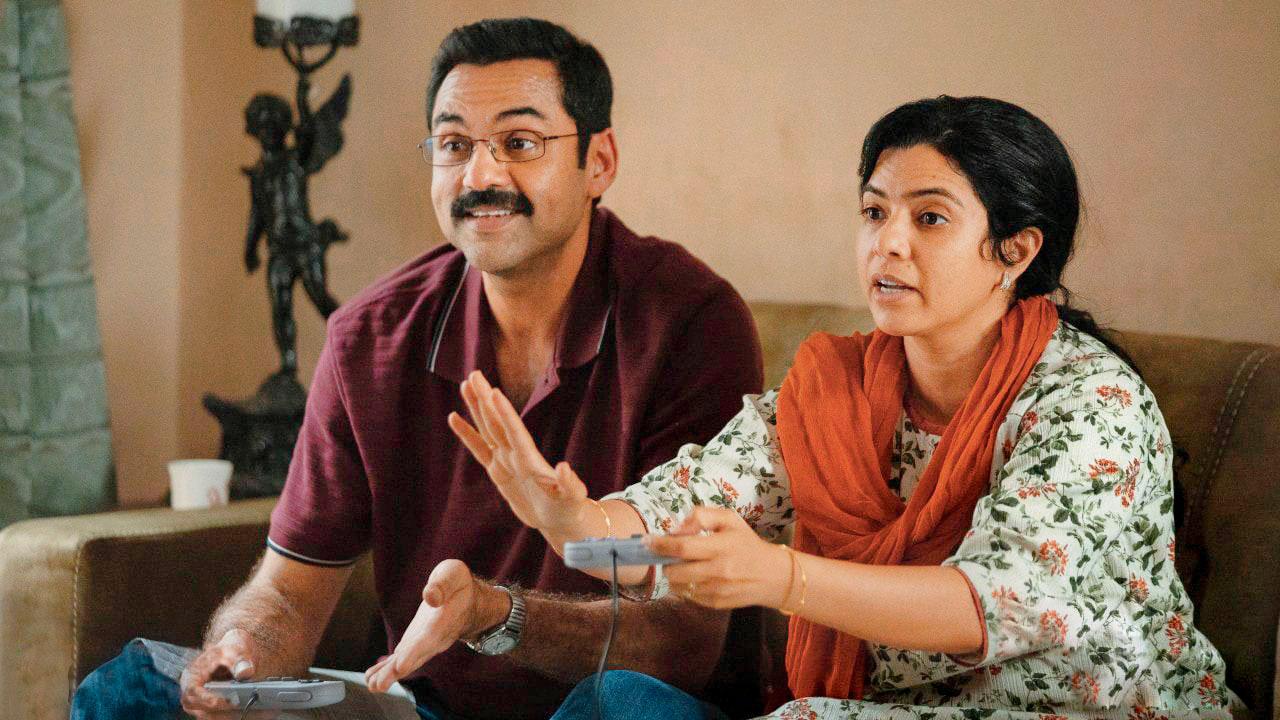
Abhay Deol and Rajshri Deshpande in Trial By Fire, which is based on the 1997 Uphaar cinema fire tragedy
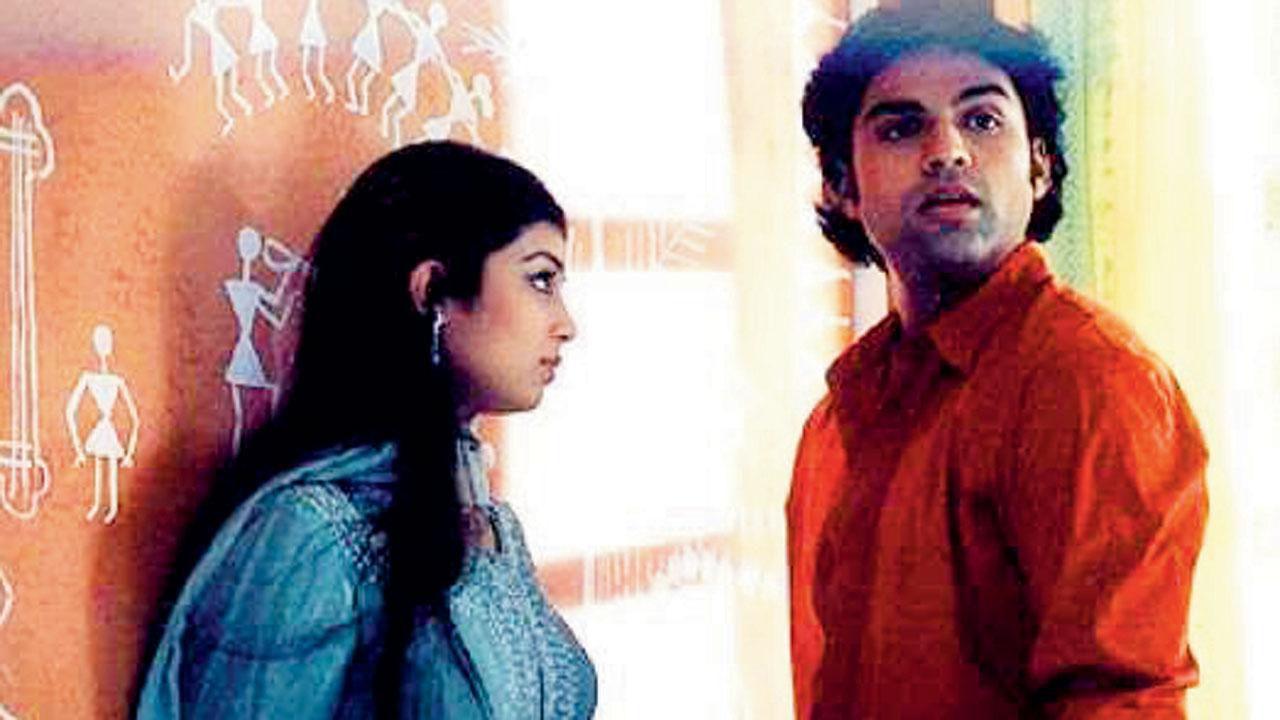
Still from Socha Na Tha (2005)
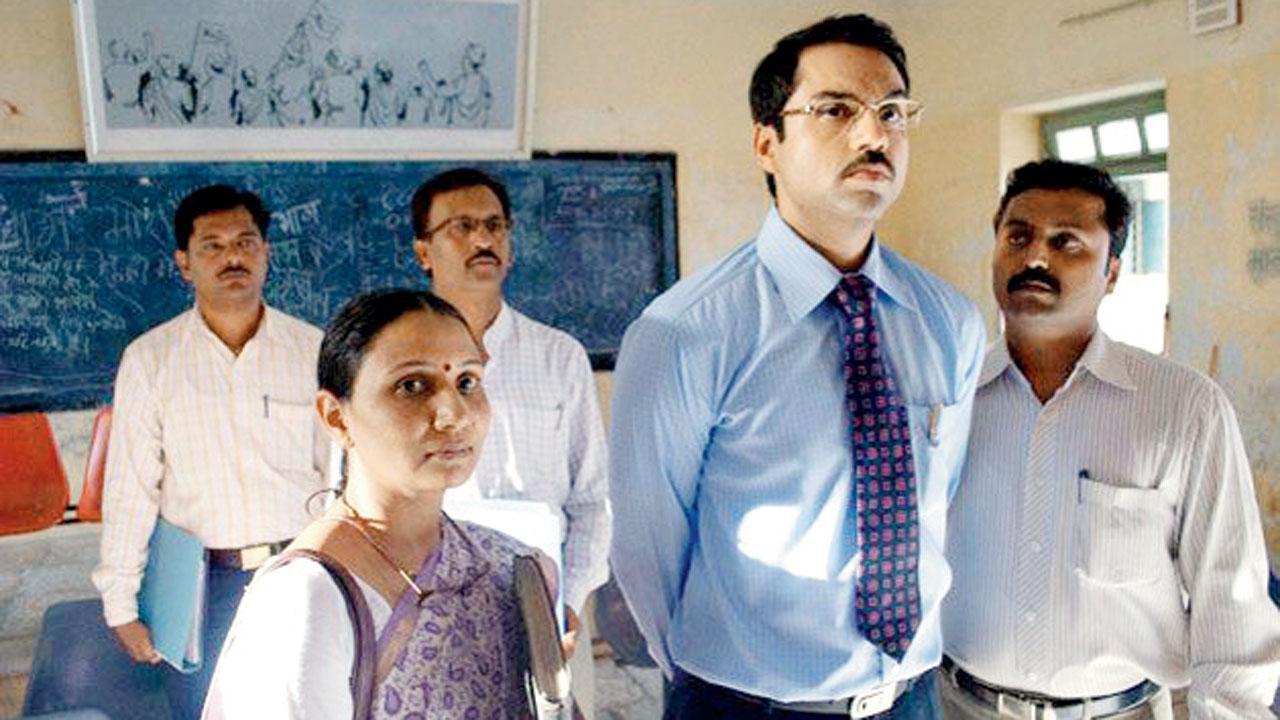
Shanghai (2012)
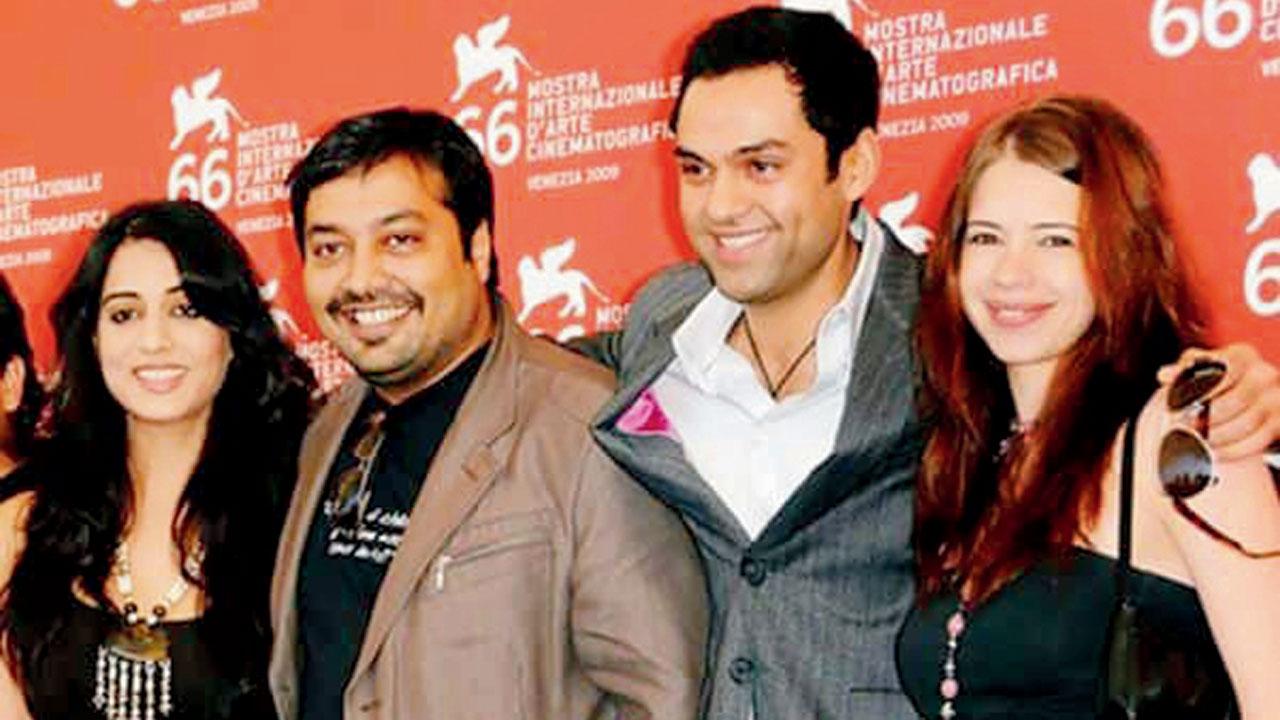
Abhay Deol with Anurag Kashyap, Kalki Koechlin, and Mahie Gill during the promotions of Dev D (2009)
Black & white classics to the ’90s favourites: Nostalgia’s a big hit on OTT
8:37 AM

Several OTT platforms are adding cult classics and evergreen blockbusters to their libraries, as viewers can’t stop watching, and rewatching, them
Niharika Lal (BOMBAY TIMES; August 20, 2022)
From series such as Mad Men, Friends and The Office to rom-coms of the ’90s and 2000s – streaming platforms have been offering a treasure trove of nostalgia to viewers. Streaming platforms’ heads say that they have been continuously expanding their library of old shows and films, keeping in mind the high engagement for this category of content. While in pre-streaming years, reruns on TV were quite common, today streaming platforms are rushing to create a library because the classics have a dedicated fan following.
Mansi Shrivastav, Senior Vice President Content Acquisitions, Alliances & Distribution, MX Player says, “People prefer watching evergreen blockbuster movies that score high on recall and familiarity. Besides, cult classics serve as a breather and become an easy solution to ‘what to watch?’ On MX, library movies from the ’90s and 2000s from both Hollywood and Bollywood are among high-performing content categories.”
Bollywood titles such as Andaaz, Raja Hindustani, Soldier and Baazigar; and Hollywood movies such as Anaconda, Karate Kid, Stuart Little and Street Fighter are popular on the platform.
A Netflix spokesperson adds, “Fans in India love the ability to watch and rewatch their favourite films and shows. We have been building a selection of licensed films and series from across the world from evergreens such as Dil Chahta Hai to international hits like Spider-Man: No Way Home.”
Popular nostalgic content on the platform include Friends, The Twilight Saga and Zindagi Na Milegi Dobara.
Manish Kalra, Chief Business Officer, ZEE5 India, says that nostalgic content always had its audience, but its availability and accessibility were limited before streaming platforms. He adds that they have witnessed that the audience is interested in older content. “The growth of in-home entertainment technologies and the popularity of family watch-time have lured back audiences to binge-watch titles from ’90s and 2000s, which, therefore, generate a sizable amount of engagement,” he adds.
Hindi TV serials of ’90s and 2000s like Hum Paanch and Hip Hip Hurray are popular on the platform.
On MUBI, there has been engagement on films by iconic directors like Krzysztof Kielowski, Satyajit Ray and Agnes Varda. A spokesperson from the platform says, “The reason nostalgia brings audiences together is that there is a sense of comfort and familiarity and we have an extensive library of renowned classics and movies by legendary filmmakers.”
French films top the popularity list on the platform, followed by English and Hindi. The platform has classics like Awara, Mirch Masala, and Salaam Bombay!
My kids have termed Zindagi Na Milegi Dobara as my best work yet-Hrithik Roshan
8:23 AM

The actor talks about Zindagi Na Milegi Dobara completing 10 years and the impact it has had on him
Rachana Dubey (BOMBAY TIMES; July 15, 2021)

Zindagi Na Milegi Dobara (ZNMD) has completed a decade, and it is still such a relatable story. What do you think makes this movie timeless?
It’s one of the few Hindi films of its time which, I think, has zero false notes. No moment, no dialogue, no intention that brings a false note. What plays out is very real. I think real cinema is devoid of the kind of heroism, which until then our films were almost reverent towards. So, this was like a breezy, refreshing, lighthearted, real film with a lot of integrity. Zoya (Akhtar, director) is the kind of person who doesn’t believe in projection, yet it reaches the audience. She doesn’t believe in preaching, yet you learn something and are inspired. She doesn’t cater to an audience, but she manages to touch the heart of every person who watches the film.
And I think that’s because she comes from a very honest space. For her, the film is bigger than any actor or any audience. A film without any false note will last forever. It’s not dependent on any kind of current fashion. It’s not seasonal and is not catering to society’s current trend. The film is all about its writing. Of course, the way Reema (Kagti) and Zoya write their films, as I said, it comes from a true place. It comes from their own experiences, their sense of reasoning and motivation, so nothing is referenced, nothing is duplicated. That’s why it’s so refreshing to read their scripts.
In retrospect, what was it about the film that made you want to be a part of it? Did you ever want to play another character other than Arjun?
Initially, I was offered Kabir’s role (which was played by Abhay Deol in the film), but Zoya left it to me to judge what inspires me the most. However, there was something about a moment that Arjun lives, which is when he sits down after scuba diving. There was something so abstract about that emotion and yet so strong. It was something that I read between the lines there that impacted me to a great degree. I understood what Zoya wanted to communicate, and I knew that I had to do that part because of that moment. I couldn’t express or articulate it, but Zoya could also see that I had absorbed what she wanted to express through that scene. In all, it’s the abstractness, I caught it, which is why I chose Arjun’s role.
In the last 10 years, have you gone back and watched the film? And do you feel that with passing years whenever you watch it, the film opens itself to a completely new interpretation?
I recently watched the film again as I was going through all my films with my children as the audience, because I wanted their feedback. I also wanted them to be conversant with my work. They had some nice and some bad things to say about my movies. But when we watched Zindagi Na Milegi Dobara (ZNMD), I genuinely saw them identifying with that film. It was very surprising because it isn’t a children’s film, but I think what again rings true with an adult also rings true with a teenager or a kid because as children, we are more attuned to what’s honest and what’s not. They reacted to ZNMD more than any other film of mine. They gave the film 11/10 because they rate all my films. The closest that came to that film was Super 30, which they gave 9/10. They also rated War 9/10 and Kaabil 8.5. I have been doing well with my recent films on their scoreboard (laughs!). For them ZNMD was above rating, they termed it as ‘the best’ yet.
When a film achieves cult status, expectations of a sequel crop up. Was a sequel to this film ever discussed? If a sequel is made, would you consider being a part of it?
The potential for a sequel is always there. It definitely can be done, be it in 5 years or 15 years, that doesn’t matter. In fact, that would be really cool! But I don’t think Zoya is the kind who would want to make it, just because people want it. She has to stumble upon an instinctive, inspired thought about the sequel that would then fuel her mind to take those steps into building it into a script. I think that is something that’s providence, if it happens, it happens. The potential does exist as the film is about life and friends — some very interesting things could happen. The more time we spend away from these characters… them coming back after years, it would be interesting to revisit their journeys.
Arjun seemed very close to what Hrithik would be in real life. Did playing that part change you on a personal level?
Most of the characters that I had played until then needed me to become somebody else in many ways. Of course, I always tend to keep my core the same. But there are a lot of exterior, superficial and sometimes quite deep changes that I have to do to become the character. In this film, it was challenging because it didn’t need me to become anybody — Hrithik was the character. And that’s why it was very intimidating. It was scary because it is apparently easier to find out how another person would say a dialogue, and for me, it was a bit of a task to find out how I would say it as myself. So, I would say it didn’t change me, but it brought me out in front of the camera. I think, I as Hrithik identified with living in a box, because I was adhering to the school of thought that was following all the rules and all the things that all books have said…basically, living in a box was quite appropriate to explain where I was at that point in my life. That’s exactly what Arjun had to be in the film. I was very aware that I was doing that, and there was already a thought that was seeded in me much before the film — that I needed to change. So, I welcomed this film with all my heart and soul because through this film, the universe was telling me that I needed to change, I needed to get out of that cocoon of mine and find my authentic self and live the kind of a life that I would live as Hrithik. What would Hrithik do if he had permission to do every single thing that he wanted to do? Would he still be in films? Would he travel? So that’s the connection that I had with the film, which is why I think I was able to impart so much of myself to it. And that’s why people reacted so much to it. I think that’s true for any actor, choosing films that speak very deeply to you are the films that you should do. And that’s what is something that I will always follow. That’s a rule of mine and not something that I borrowed from someone else. So, it rings true for me that I will always want to do films that speak very deeply to me.
Is there anything you would like to revisit about ZNMD today?
I would love to do another film like this where it’s with friends and it’s an ensemble. When I signed this film, many of my father’s friends thought I was making a big mistake, because I was playing one of the parts among three characters and it was certainly not the central character. It wasn’t like I was the hero of the film and Farhan and Abhay were small parts of the film. The general rule at that time was that you have to uphold the star status, and I knew this film was talking about exactly the opposite. It kind of empowered me because it’s a story that I believed in, and I thought to hell with the status, which is merely something that people give you. The work that you do is something that comes out of your own desire. That’s where another seed got planted in my mind about ensemble films. It’s what we don’t get to see much. Not being confined by my position in the film, or the need to remain protected, here letting go was such a beautiful feeling. I think that seed grew into me wanting to do other such films when other actors were hesitant. I love doing two-hero, three-hero, four-hero films… the more, the merrier. I think the place where I come from makes other actors feel very secure, because I’m not trying to grab more footage or impose. From my perspective, movies are bigger than stars. Look at what Zoya made me do in Luck By Chance! It was a small part and I loved doing it. He wasn’t even a hero, he was such a grey character, but look at the feedback, the reactions that it got. I thoroughly enjoyed doing that, because it was so human and real.
And, lastly, do you find yourself living by the title of this movie, Zindagi Na Milegi Dobara?
Every single day. Even before I signed this film. That is the thing that drives me, it motivates me. I keep saying that you have just one choice, and why wouldn’t you make the better choice for every single day that comes your way!
Do what’s going to make you live a better life, every time you have a choice of doing something or not doing something just ask yourself, what’s going to make your life better, and do that, because you only have one choice, one chance, one life.

I’m sorry it took someone’s death to wake everybody up-Abhay Deol
8:20 AM

Abhay Deol calls out lobby culture and award functions in the film industry; says he’s glad that more actors are speaking out now
Monika Rawal Kukreja (HINDUSTAN TIMES; June 24, 2020)
 One look at Abhay Deol’s Instagram feed and you’d notice the actor has been revisiting his earlier films — Ek Chaalis Ki Last Local, Manorama Six Feet Under (both 2007), Dev D, Road (both 2009) — and sharing a story behind them, with the hashtag #makingwhatbollywouldnt.
“I felt this was a good way to bring attention to these movies. Being non-formulaic, they didn’t have enough funds for marketing or a big release. So, not a lot of people are aware of them. I believe they’re good and that they’d be entertaining even today” he tells us.
Elaborating on the hashtag, he adds, “The ones I selected for this particular hashtag are the ones that were the most difficult to make and even tougher to release.”
However, it’s his recent post on Zindagi Na Milegi Dobara (ZNMD; 2011) that garnered the maximum traction, where Deol called out “covert and overt ways in which people in the industry lobby against you”.
“This was clearly an overt example. They didn’t even bother hiding their bias, something that they normally take efforts to do,” he says, adding, “Lobby culture has been prevalent for decades. No one thinks about standing up, or bothering to do anything. They’re all ready to conform, which is why they know that they can get away with it. The reason I can say this is because I grew up in a film family and I’ve heard of these games. As a kid, I saw through other people’s experiences, and now, I’ve seen it myself.”
Given that Deol’s post comes in wake of Sushant Singh Rajput’s death, after which many are slamming nepotism and lobbying culture in the film industry, he admits that Rajput’s death shook him up and got him thinking.
“Sushant’s death definitely sort of pushed me to speak up a little bit. But, this isn’t my first time speaking up. In the past, I’ve taken on the biggest. I’m sorry it took someone’s death to wake everybody up. But I’m glad that people have taken note and they want to be heard. What’s good today is that actors are speaking out. I had become quiet because I didn’t want to be the only one screaming. I alone couldn’t have brought about the change we need.”
He shares many commented on his post saying ‘Oh, you’re waking up now’, and he tells them he had put his career on the line from day one. “I focus on my privileges. I have a family, great friends, I have work, I’m acting, producing, working in two countries. I found my path,” he says.
In his post, Deol also called out award functions for they “demoted me and Farhan (Akhtar) from main leads to supporting actors”. But he says, he wasn’t surprised.
“It was a disappointment. By the time ZNMD came out, I was trying to be less idealistic, and more of a realist. Very rarely I had gone to these award functions. I was coming around to see the industry’s point of view and suddenly, this was a hard reminder of the systemic corruption that exists in the industry. Positioning was based on market value of the artiste not on the structure of the plot of the movie. And the shocking thing is that it was all accepted because that’s the way the industry functions,” he asserts.
----------------
CAN NEPOTISM AND LOBBY CULTURE AFFECT ONE’S MENTAL HEALTH?
It’s a highly competitive space where people are insecure and you’ll often hear them say, ‘your failure is my success’. So, people planting false stories about you, paid-for reviews being negative, gas-lighting you within the industry to sabotage you, robbing you of a nomination or a win at an award show — these are some of the ways in which it happens. Now, imagine a person with a mental illness being thrown in this toxic environment. For sure, it would take a toll. They’re, after all, more vulnerable.
Everybody in my family has a National Award except me-Zoya Akhtar
8:52 AM

Bollywood's most loved filmmaker Zoya Akhtar looks back during the lockdown
Mayank Shekhar (MID-DAY; May 15, 2020)
 Consider writer-director Reema Kagti (Gold, Honeymoon Travels Pvt Ltd) as an Australian male Ricardo Fernandes, looking for his lost brother in Mumbai, while filmmaker Zoya Akhtar is the local don Mastana's hot moll. That's really how Zoya first met Reema, during the audition for Kaizad Gustad's Bombay Boys (1998).
Reema, as the casting assistant, was standing in for Rahul Bose. Zoya, opposite her, was actually testing for the film's female lead role—mainly to humour Gustad, because he was keen she read for the part, that finally went to Tara Deshpande. Zoya was clear she wanted to AD on the movie.
AD, meaning assistant director—both a proper noun and an active verb on a film set. It's been over two decades since Bombay Boys, where Reema and Zoya were second ADs. Their partnership, as writers over the past decade though, counts amongst its achievements, Gully Boy (2019), the Amazon series Made In Heaven (2019), Dil Dhadakne Do (2015), Talaash (2012), and Zindagi Na Milegi Dobara (2011).
Bollywood wise, they could well be—albeit slightly Bonzai—versions of the '70s super-hit, Salim-Javed (Zanjeer, Deewar, Don, Sholay, Mr India)—the most successful writing pair ever, comprising Salim Khan and Zoya's father, Javed Akhtar.
I say this, while Zoya is talking to us from where Salim-Javed used to work out of—the study in her Bandra family home—that she now uses as her bedroom: "I'm just absorbing them," she smiles. She also drops a hint at working on a talkathon/documentary project of sorts to do with Salim-Javed themselves, as part of her newly launched production company.
But it's too early to talk about, she insists. Much is naturally made of Zoya as poet-lyricist Javed's daughter, eighth generation writer from the Akhtar family. Her love for films, as she points out, flows first from her mother's fine collection of world to latest cinema, projected on the screen at home, growing up.
Also the fact is that it's her mom, Honey Irani, who's the Bollywood insider in the family, having literally grown up in showbiz (Javed had moved from Bhopal).
Wikipedia rather exaggeratedly lists her as the child-star of 72 films!
Honey would've done minimum 20-30 movies as the much loved kid-face of the big screen—graduating much later to screenwriting, with popular titles like Yash Chopra's Lamhe (1991), Aaina (19993), Darr (1993), Rakesh Roshan's Kaho Naa Pyaar Hai (2000), Koi… Mil Gaya (2003), Krissh 3 (2013).
Zoya reminisces, "Now, everybody has a camera to record their children. But people in my generation did not have footage of when their parents were three years old. I was one of the few kids, who had my mother from the time she was two, to when she was 16! I've seen my mother animated [on the screen], with different expressions, speech, seen her change, and grow. It's really interesting even now, to see her like that. She was darn cute, man! She, and my aunt Daisy [Irani]!"
She rues in jest, "Everybody in my family has a National Award— my mother, father, brother [Farhan Akhtar], step-mother [Shabana Azmi], cousin [Farah Khan], everybody. Except me!" Which film did her mom get a National Award as the kid-lead? "I don't know, if it was for Pyaar Ki Pyaas or Taare Zameen Par, one of the two." There was a yesteryear film called Taare Zameen Par? "Zameen Ke Tare! Both my mom, and my aunt."
The mom's acting gene, Zoya contends, went to her younger sibling, Farhan: "He is a bona-fide performer—he always had that. I hate being on stage, or before the camera. My first thing to do with the arts was to write—watching both my parents work at home, discussing scripts… That was one of the first things [in my head]. Directing came later."
Held over video-call for the first time, Zoya is also the first filmmaker to feature on our unscripted conversation series, Sit With Hitlist—so far limited to Hindi cinema's lead actors. Reason for that of course is that she's arguably Bollywood's most loved filmmaker, and therefore a star in her own right.
That apart, little is known about her life up until her rather belated directorial debut at 36-plus, with Luck By Chance (2009), although she'd been working as a film professional for around 18 years before that. Very little worth knowing, Zoya casually reckons, jogging back to age 19, when she started interning for a copy-writer's job at a creative agency—simultaneously reading sociology at Bombay's St. Xavier's College.
"I remember watching Salaam Bombay (1988), being madly in love, and going: I want to direct. And I don't know what I'm going to make. Because Hindi films were not my scene then. Out of the blue, when I was about 21, I got a job with Mira Nair on [the sets of] Kamasutra (1996)." You can find her in a cameo appearance as one of the Kamasutra girls, "an extra part," as she puts it, because ADs are frequently expected to fill-in or add to the human backdrop on shoots.
Of all her past associates, Mira as director appears to have left a strong impression on Zoya: "Mira is just special, you can see that. When she is talking to you, you are the only person in the world. She makes people feel special. She knows everybody on a crew by name. I love that about her. And I love her aesthetics."
Post Kamasutra, Zoya recalls, "I started working mainly on American projects that came to India. Went to NYU [New York University] for a diploma [in filmmaking]. Stayed back in New York. Got a job, thanks to Ismail Merchant, in a small, cool, indie film called Side Streets, directed by Tony Gerber."
She returned to Bombay as a freelance, professional AD, of which there were only four in all of Bollywood, who did a lot of foreign films and Indian work: "Reema [Kagti], [director] Apurva Lakhia, and me. Then Kiran Rao came in." Zoya's credits during this phase include Mahesh Mathai's Bhopal Express (1999) and Dev Benegal's Split Wide Open (1999). She chose to specialise in the casting department, because there, "you get to direct actors, with a script," and that's what she ever wanted to learn/master anyway.
She was the casting director on Farhan's first film Dil Chahta Hai (DCH, 2001), and thereafter Armaan (2003), her mother Honey's directorial debut. Okay did she personally pick/cast that balloon-lover boyfriend in Dil Chahta Hai? "Oh that's actually Hassan, a childhood friend of Farhan. But we handpicked everyone, so to speak. There are very interesting cameos. Kiran Rao is one of the girlfriends in Goa. She'd come to do all the extras' casting for the film's Goa leg!"
Between freelance AD-ing, Zoya had been ideating all along for her debut feature. It's mildly ironic that while so cued into casting, she was unable to kick off her first film for want of a lead actor, for almost a decade that she'd been ready to direct. And the one she eventually cast for the lead role, in her directorial debut (Luck By Chance, 2009) was her brother, Farhan, who'd been around all along!
"You cannot cast someone, unless they are ready. And feel that they want to do this. It took Farhan a while to get there—that he wants to act, and that he is a really good actor." While practically the entire Bollywood A-list came down for cameos in Luck By Chance, including both Shah Rukh Khan and Aamir Khan (guessing, for the first time in the same film, although not in the same frame), Farhan was the seventh star to read/consider/hear the script. Hrithik Roshan played the second lead. "Luck By Chance is a book that I am going to write one day, about how that film got made," Zoya sighs.
Can't wait. It'd be quite a telling tinsel-town tale, given that nobody in Bombay does it. And Zoya is perfectly positioned to—not just as the quintessential insider, but as someone who can surprise you with her adorably random zaniness, on occasion. Recently at an interview she called herself the love-child of directors Karan Johar and Anurag Kashyap. What does that mean? "That I am halfway between Indie and commercial, you know."
One time I remember getting a smoke with a group, outside a closed-door meeting with director Oliver Stone who was in Bombay then, and Zoya casually mentioned, "You know, there are four kinds of people in the world—John, Paul, George and Ringo." What?
I bring that up again: "That is a line from a Tom Robbins book. Have you read Tom Robbins? I love him. I don't remember what the context of that conversation was. You can look at everyone, and be like—that's a Paul, Ringo, George. I am a John, for sure!"
And while her films primarily deal with real, human, often raw emotions, there is this carefree cattiness that inevitably slips in too. It's only fair that we dig into a couple of stories behind some stellar, surprising choices she's made so far. For example, why/how/when did a ladies' bag, called Bagwati, bag a proper part in the breezy masterpiece Zindagi Na Milegi Dobara?
"That comes from Reema and a close friend of ours, Shai Heredia, who's an academic, award-winning documentary filmmaker, and hysterically funny. She and Reema were on a road trip, and they kept talking to Shai's bag. Think they were just tripping! We just put it into Zindagi."
It was Zoya's second film, with Farhan and Hrithik back on her frame, but in a much wider canvas, although the script started out in her head as a small, cathartic, road movie, about three boys in a car—for all the road trips she's taken in her life. Over time, of course, the script "developed a life of its own".
The film she co-wrote after was Reema's Talaash. It's a supernatural thriller that, by the way, was based on a true story, that happened to her! "You have to stop. I am going to be the crazy lady that goes on interviews and says all this shit. I know it sounds really crazy, and I don't want to be propagating this nonsense. But, I had a strange experience on Haji Ali, while a bunch of us were driving back from a nightclub. We thought we had hit a naked woman in the middle of the road. Everybody was freaking out. This is something I told Reema about, and where Talaash came from. I am not going to repeat this story, ever again!"
Okay how about the dog called Pluto, who's the narrator/POV of Dil Dhadakne Do; where does he come from? "From my super-smart, intelligent beagle Zen, who passed away last year. You can find him on my Insta page, Zen Akhtar. Zen would look at us as though he is watching National Geographic—that we are the animals, and he is like, 'What are they doing?' That's Pluto. Even the way the film is shot [as a result] is observational—there are no close ups, only 'wides'."
After a preview screening for Aamir Khan and his wife, Kiran Rao, both of whom Zoya makes it a point to get a feedback from before her film's final cut, she asked Aamir if he'd like to voice the dog: "He was, like, after these many years, you have offered me the voice of a dog? I said, please do it. He was, like, yeah, totally! And he just came [on-board], like a sweetheart. It was great!"
Is there anything she'd like to change about Dil Dhadakne Do? "I think the title. Would have been nicer [if it had] a little more gravitas." How about the climax (that was rather OTT, compared to the rest of the film's tone)?
"I actually liked the climax (of the mom, dad, sister jumping off the ship, with lifeboats to chase down brother/Ranveer Singh's character). The whole metaphor of the trip is that you can't get rid of anyone. Family is what you are stuck with. You can't just walk out the door. Eventually, when shit hits the fan, they are the only ones who will pull you up too. So when everyone tells me, I don't like the climax; I am like, cool, so what would you do? Till now nobody has given me a better ending. If there is one, I'd be like, damn!"
What did upset Zoya even before the release of Dil Dhadakne Do though was people taking the piss out of the picture for it being centred on lives of the super-privileged—intended also as a barb against movies that Zoya had directed thus far.
"Firstly I don't think it was criticism. There is nothing for me to take home from it. It is like somebody seeing a trailer of Gully Boy and saying, oh, this is about poor people. And I made Made in Heaven, along with Gully Boy. And that is about very rich people!"
"I was being interviewed by this woman wearing diamonds and solitaires, and she was telling me, it [the film] is about rich people. I was, like: Would it bother you, if your husband has an affair? Why? But you have solitaires on, it shouldn't bother you! What does it even mean?"
Before Gully Boy — set in a Mumbai slum and the city's underground rap scene—released, it got roundly compared to the American ghetto, hip-hop biopic, 8 Miles. Did that bother her? "The two people I spoke to [to base the film on their lives] are living here. You can talk to them. So, no, I didn't get into it. It bothered me, when they compared Zindagi to Hangover [producer Ritesh Sidhwani had to respond to Warner Bros]. Now, I think that's what they do."
Inspirations from dogs and spirits apart, what makes Zoya's filmmaking process special—given what we've managed to gauge so far—is she is capable of working backwards. Where she must know end, before she locks her script. Which isn't true for many filmmakers, who often arrive at the conclusion, as they navigate the story or characters' journeys: "I have to set a goal. That goal may change. But I when I set off, I have to know where I am taking the film. Otherwise I meander. I need a direction I am shooting at, you know!"
The other thing is her complete clarity on the point she's trying to make—so much so that she can distill each film into a single line, which is different from a log-line that describes a plot: "Of course Gully Boy is about a Muslim kid from Dharavi, who expresses himself through rap. It is a rags-to-riches, coming-of-age story. You can pin it down in any log line. But at the core of it, the film is about class. Luck By Chance is really about self-esteem. Zindagi is about living, seizing the day. Dil Dhadakne Do is a film about projection—who we actually are, and what we tend to project. It is what lenses the film, creates the base."
This sort of sharpness of thought, cutting through fluff, getting to the point, is also something Zoya shares with her father Javed, as a communicator in general—whether it be his works as lyricist, screenwriter, people's poet, or popular orator. He's possibly India's finest conversationalist—whose quick repartees and general gyan stick with you, if not go viral online.
Is there something Zoya remembers he told her that she's held as talisman? "Little things, you know. That when you are writing a script, whatever your story is, you've got to be able to lift your viewer. By the end of it, just lift your viewer! Don't resort to cheap shit to get a laugh or clap. Say it in the most base-denominator way, if you have to. But find a higher level of communication." It's tough, bohot hard.

Subscribe to:
Posts (Atom)