Showing posts with label Sanju. Show all posts
Showing posts with label Sanju. Show all posts
It’s tough to make any film, aisa lag raha hai mujhe toh abhi-Paresh Rawal
8:31 AM

Rishabh Suri (HINDUSTAN TIMES; September 16, 2025)
After being embroiled in controversy, Paresh Rawal’s upcoming biopic on Uttar Pradesh Chief Minister Yogi Adityanath will finally see the light of day. The Bombay High Court recently gave the green light to Ajey: The Untold Story of A Yogi, despite the Central Board of Film Certification (CBFC) initially denying it a certificate.
Considering the knee-jerk reactions films with sensitive subjects attract, is it difficult to make a ‘political’ film in India now? “It’s tough to make any film, aisa lag raha hai mujhe toh abhi,” the actor replies, adding, “Social media kisi ke bhi upar haawi ho jaata hai. But if your neeyat and neeti are good, and the film has been made with honesty, then you should not think about people’s opinions. I’d never be able to understand what each person [in the audience] wants, I can only make something that I like.”
Speaking about the CBFC’s objections, Paresh says, “Yogi ji jaisa character hai toh maamla critical ho jata hai, CBFC saavdhan rehti hai. During the proceedings the court asked their lawyer, ‘Have you watched the film or read the book it’s based on?’ He had not.”
There’s a common perception that biopic makers tend to whitewash their subject; bring it up with Paresh, whose film Sanju (2018) faced similar criticism and he shares, “[Sanjay Dutt] is still alive and working. And this film’s story goes up to when Yogi ji reached politics. Jo public mein hai usko aap untold nahin bol sakte. There’s nothing to whitewash here.”
On Hera Pheri 3
Paresh’s next outing will see him reprise his role as Baburao Ganpatrao Apte in the third Hera Pheri instalment. The film has long dominated headlines, especially since the actor initially exited the project before coming back on board. Probe if there have been any developments in the film’s production and he tells us, “It’s a work in progress; the shoot was always scheduled to begin in February or March of 2026.”
Ranbir Kapoor on Animal, Sanju: "We have to be more responsible towards the kind of films we make"
8:26 AM
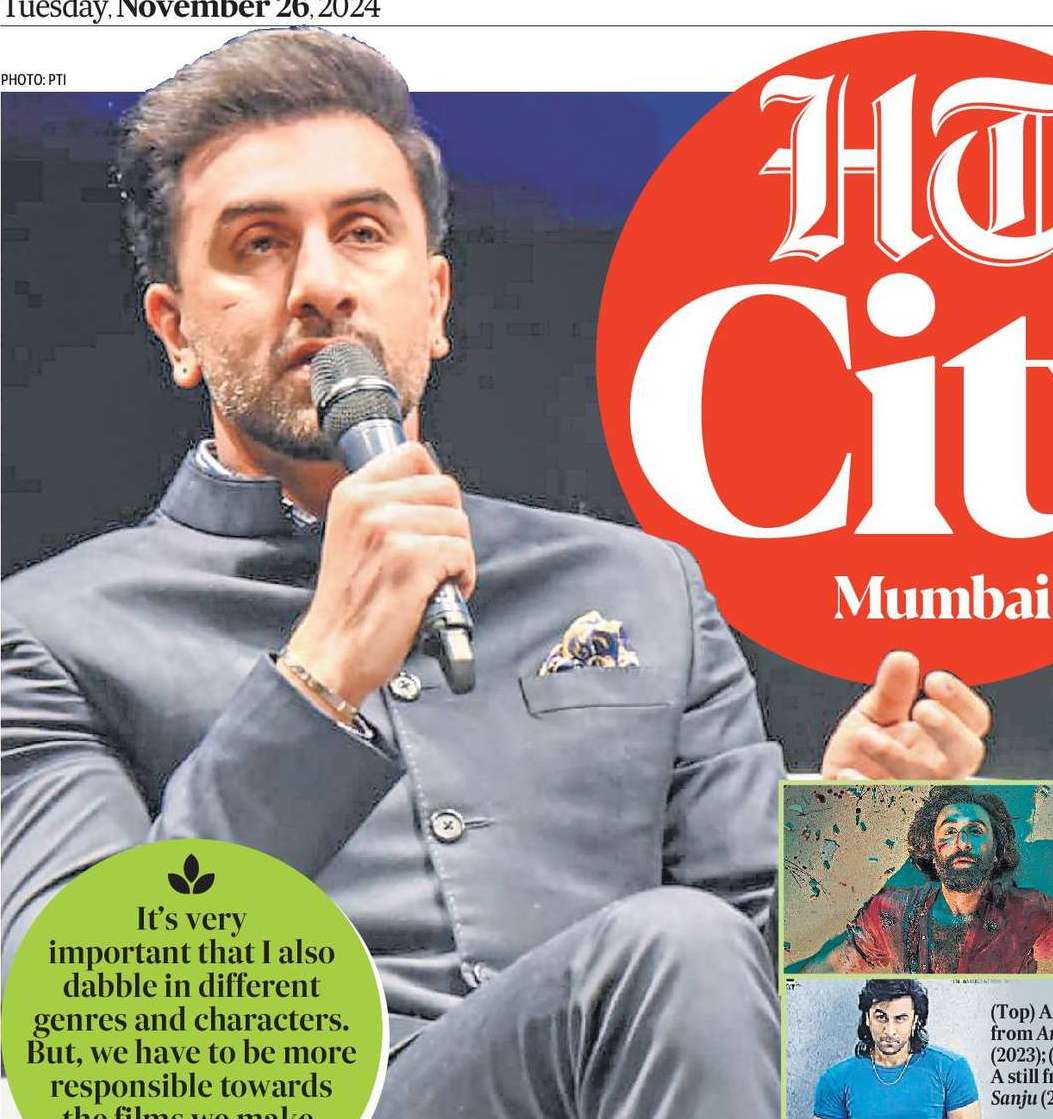
Niharika Lal (BOMBAY TIMES; November 26, 2024)
Ranbir Kapoor recently took the stage at the ongoing International Film Festival of India (IFFI) in Goa for a discussion celebrating the work of Raj Kapoor. “He was this big man with blue eyes,” the actor said as he began reminiscing about his grandfather. Ranbir confessed that it was only after he began understanding cinema that he fully grasped Raj Kapoor’s contribution to Indian cinema.
Sharing that 10 of Raj Kapoor’s films are being restored, Ranbir said that some of them will be screened at a film festival next month. “Raj Kapoor was Raj Kapoor because he didn’t follow any model. I think that if you want to carry any legacy forward, you have to approach it in a very individualistic way,” he told the audience.
‘I would love to have a take on Shree 420’
When asked which of Raj Kapoor’s films he would like to remake as a director, Ranbir said, “I would have directed every film in a different way, but all of them would have been atrocious. I don’t believe in remakes; I think every film is made to the best of its capabilities and should not be touched, especially Raj Kapoor’s. But I would love to have a take on Shree 420 – it is my favourite film.”
‘RAJ KAPOOR WAS CONSTANTLY IN TOUCH WITH THE COMMON MAN, THE MASSES’
In response to a question, Ranbir said, “Honestly, I want to say this – I’m a bigger fan of Raj Kapoor as a director than as an actor.” Raj Kapoor, the filmmaker, always explored different themes at different stages of his life.
Talking about his oeuvre, Ranbir shared, “If you look at his early films, Awara was based on casteism, in Shree 420, he spoke about greed.” Ranbir spoke about how in the later years of his career, Raj Kapoor made powerful films grounded in Indian moral values, tackling societal issues in a commercial and really entertaining way.
“Raj Kapoor had the courage to make a film with newcomers – a 50-year-old man making a film (Bobby) for the youth. It means that he really kept up with the times. He wasn’t stuck in a cocoon. He was not high up in an ivory tower. He was constantly in touch with the common man, the masses, and the kind of stories people would like to see,” Ranbir said.
The National Film Development Corporation of India (NFDC), National Film Archives of India (NFAI), and Film Heritage Foundation (FHF) and Kunal Kapoor have started restoring 10 films of Raj Kapoor. Ranbir said, “We are going to organize the Raj Kapoor Film Festival from December 13 to 15 all over India. We will show the restored version of 10 of Raj Kapoor’s films.”
-----------------------------------
Which film of his would Ranbir have wanted to be directed by Raj Kapoor?
Yeh Jawaani Hai Deewani (2013)
Which Raj Kapoor film would he like to direct?
Shree 420 (1955)
For which of his films did he take inspiration from Raj Kapoor?
Barfi! (2012)
-----------------------------------
Actor Ranbir Kapoor, who took the brunt of criticism for portraying toxic characters in his recent projects, opened up about leaning towards more responsible storytelling at a recent event
HINDUSTAN TIMES (November 26, 2024)
Actor Ranbir Kapoor’s films Sanju (2018) and, more recently, Animal (2023), have been at the end of fierce criticism for glorifying violence and toxic masculinity. Addressing the same on Sunday, the actor shared his take on the widespread debate at the 55th International Film Festival of India (IFFI) in Goa.
Prompted by an attendee, who asked him about “responsible storytelling” in context with Animal and Sanju, the actor responded, “I completely agree with your opinion. As an actor, it is our responsibility to bring movies which bring a positive change to the society.”
However, the 42-year-old maintained that doing diverse roles is important to him. “Having said that, I’m an actor, it’s very important that I also dabble in different genres and characters, and play varied roles. But what you are saying is absolutely correct. We have to be more responsible towards the kind of films we make.”
Earlier this year, in Nikhil Kamath’s podcast People by WTF, Ranbir had responded to the criticism that Animal had received, stating, “Social media played havoc. They needed something to talk about, so they really went to town claiming it was a misogynistic film.”
On a separate note, Ranbir also touched upon his dream of creating a biopic on his grandfather, late filmmaker-actor Raj Kapoor’s life, calling it a “challenging yet worthwhile endeavour.” Revealing his take on a biopic, the actor said at the event, “A biopic is not just about celebrating someone’s success but honestly portraying their struggles, relationships and low points. I’ve spoken to (filmmaker) Sanjay Leela Bhansali about it, but it’s a tough project. I’m not sure if my family would agree to show that side of his life.” htc
Ranbir reveals Alia didn’t know about Kishore Kumar
Speaking at IFFI, Ranbir disclosed that his wife, actor Alia Bhatt didn’t know about the legendary playback singer, musician and actor Kishore Kumar. “The first time I met Alia, she asked me, ‘Who is Kishore Kumar?’ [But] it’s just the circle of life. People forget [old artistes] and then new artistes come in. So, I think it’s very important to remember our roots.”
The video, which has now gone viral, has been dubbed as ‘Ranbir’s revenge’ by social media users, as a response to Bhatt’s earlier interview where she had claimed that Ranbir asked her to “wipe off” her lipstick. One social media user shared, “He took the revenge for ‘wipe it off’”, while another said, “Are these two in a competition: who can embarrass the other more... (sic).”
Sourav Ganguly is a living legend and a biopic on him will be very special-Ranbir Kapoor
8:27 AM

Ranbir Kapoor and Sourav Ganguly deny finalizing the casting for the former BCCI president’s biopic while keeping speculations alive
Ruman Ganguly (BOMBAY TIMES; February 28, 2023)
Ranbir Kapoor, who was in Kolkata on Sunday, won over his fans when he played a spot of cricket with Sourav Ganguly at the Eden Gardens. The friendly match was significant as it came at a time when speculations about the actor playing Sourav in the latter’s upcoming biopic have hit a crescendo. Though both refuted the ‘rumour’, there was enough action on and off the field on Sunday to keep the speculations alive.
RANBIR ON DADA’S BIOPIC
“I think Dada is a living legend, not just in India but also around the world. And a biopic on him will be very special. Unfortunately, mujhe yeh film offer nahi huyi hai. I think the makers are still writing the script.”
...ON PLAYING CRICKET WITH SOURAV AT EDEN GARDENS
“It’s a dream come true. Dada bowled 10 balls to me, and it’s just like every kid’s dream to play with him at Eden. I’m going to cherish this moment.”
‘I’M A BIG FAN OF MISHTI DOI’
Ranbir evidently had a finger on the pulse of the City of Joy when he said that he enjoyed aloo posto, puri and shorshe maachch for lunch. He added, “I’m a big mishti doi lover. Toh main char balti mishti doi kha ke aaya hoon.”
He was also happy discussing football leagues and World Cup matches during his interactions. At Eden Gardens, even as Sourav heaped praise on Ranbir as an actor, the star called Sourav a “national treasure”.
‘A BIOPIC TAKES A LOT OF EFFORT’
The actor said, “Har biopic ke liye bahut mehnat lagti hai. When I did Sanju, it was not just about how he walks and looks, but more about what he is as a person, his soul. I think that is more exciting as an actor. To me, understanding a human being deeply before portraying him is very important. Main gyarah saal se Kishore Kumar ke biopic pe kaam kar raha hoon. We’ve been writing that with Anurag Basu and I’m hoping that it’s going to be my next biopic.”
-------------------------------------------
HINDUSTAN TIMES (February 28, 2023)
Speculation around Ranbir Kapoor being finalised for the biopic of former India cricket captain Sourav Ganguly doesn’t seem to die down anytime soon. A bunch of photos showing Kapoor and Ganguly playing cricket at Kolkata’s Eden Gardens surfaced online on Sunday, fuelling the speculation. While the photos sparked excitement among fans, the actor has set the record straight once and for all.
During an event in Kolkata for the promotion of his next movie, the 40-year-old said, “I think dada (Sourav Ganguly) is a living legend, not just in India but around the world. A biopic on him will be very special. Unfortunately, mujhe yeh film offer nahin hui hai. I think the makers (filmmaker Luv Ranjan and team) are still writing the script.”
However, there’s one biopic that Kapoor seems to be super excited about — that of legendary singer-actor Kishore Kumar (born Abhas Kumar Ganguly).
“I have been working on a biopic on Kishore Kumar for the last 11 years. We have been writing that with (filmmaker) Anurag Basu and I’m hoping that it’s going to be my next biopic,” said the actor, who played actor Sanjay Dutt in the latter’s 2018 biopic Sanju. “But maine abhi tak dada ke upar jo biopic ban rahi hai, uske baare mein kuchh suna nahin hai. So, I don’t know,” added Kapoor.
Top ten first weeks of all time - Pathaan sets a new benchmark by a huge margin
8:35 AM

Box Office India Trade Network
PATHAAN crossed the 300 crore nett mark in week one as it collected 315 crore nett and just smashed records of all films released. The main one is KGF - CHAPTER 2 which is a recent release while others are generally old releases.
The final circuit numbers are yet to come but it looks like PATHAAN has beaten KGF - CHAPTER 2 (Hindi) in most of the circuits and that is more important than the all India number as KGF had a limited release down South due to its original format and dubbed into other languages being the main format of the film there.
PATHAANhas averaged 45 crore nett a day over its first week. This was pretty much unthinkable before release even with the advances. The numbers are there going by the market and the potential is even higher but its not about the market as eventually a film has to achieve the numbers and it becomes about the content and PATHAAN obviously had that.
Hopefully, PATHAAN is the turning point for the Hindi film industry as more action commercial mass films will be made which are original and with more of a North Indian presentation rather than South Indian.
The top ten first weeks of all time are as follows.
1. Pathaan - 3,15,00,00,000
2. KGF - Chapter 2 - 2,50,51,00,000
3. Baahubali 2: The Conclusion - 2,46,47,00,000
4. Sultan - 2,08,99,00,000
5. Tiger Zinda Hai - 2,06,04,00,000
6. War - 2,03,39,00,000
7. Sanju - 2,00,16,00,000
8. Dangal - 1,92,38,00,000
9. Bajrangi Bhaijaan - 1,83,52,00,000
10. PK - 1,81,26,00,000
We ensured Ranbir Kapoor's lifting sessions weren’t hampering his Jagga Jasoos look, while staying on track for Sanju-Kunal Gir
8:40 AM
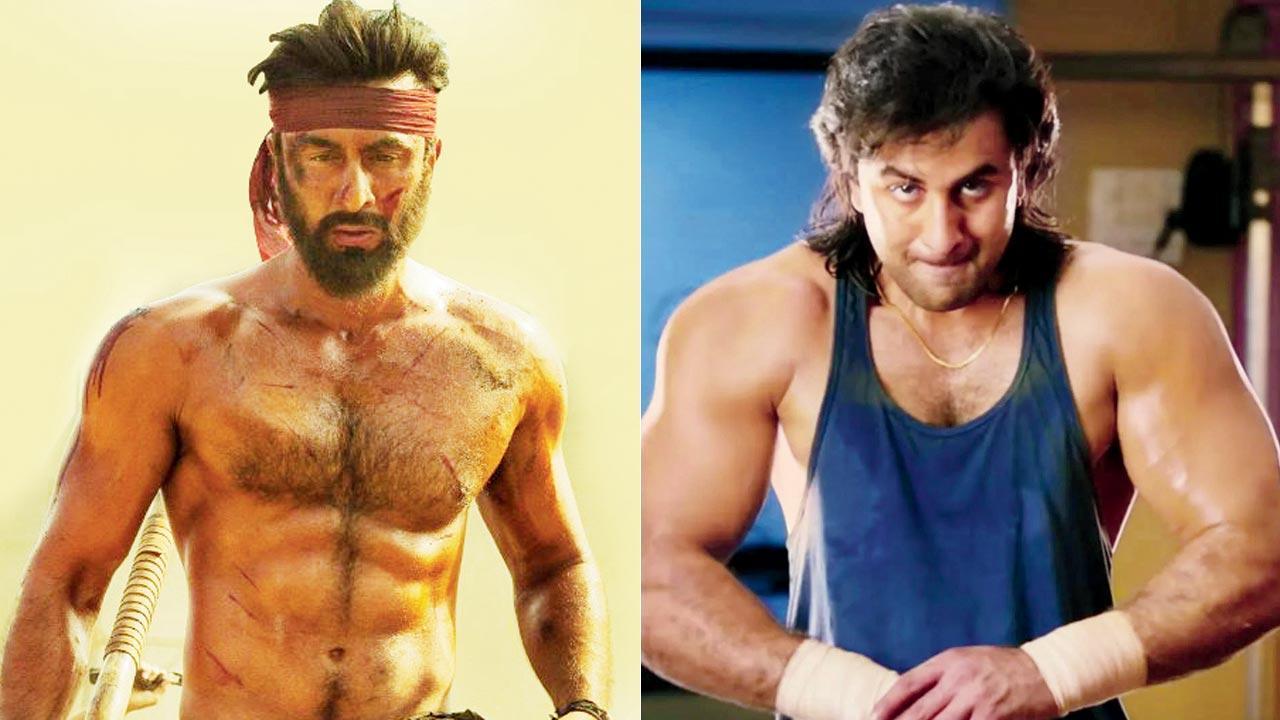
Long-time trainer to actor chronicles putting him through rigorous routines for films like Jagga Jasoos, Shamshera, and Brahmastra
Sonia Lulla (MID-DAY; October 5, 2022)
In the last few years alone, Ranbir Kapoor juggled between the shooting schedules of Sanju, Shamshera, and Brahmastra: Part One – Shiva — three films that saw him sport significantly different physiques. Aptly complementing his trainer for his astute understanding of fitness science, Kapoor has often credited Kunal Gir for enabling him to look the part in all his films.
Tracing his journey with Kapoor, Gir recalls how he had to switch his diet to mould him from the 72-kilo Jagga Bagchi in Jagga Jasoos, to the 84-kilo Sanjay Dutt, in Sanju. “In the midst of shooting for Jagga Jasoos, we had to start preparing for Sanju. We had to work in such a way that his lifting sessions weren’t hampering his look in Jagga Jasoos, but we were still staying on track to film Sanju. For Jagga, he was on a two-meal plan, because he had to have a young look. From there, we had to put him on an eight-meal plan for Sanju. Doing that was tough, so we would make him eat four meals, and then have four protein shakes as supplement,” says Gir, adding that for Dutt’s film, their aim was to build size, not definition.
“We put him on a calorie surplus and increased his workload to facilitate a 12-kilo weight gain.”
Gir says the process of muscle building is synonymous to creating a sculpture. “You first pile on as much clay as you can, which is what we do by adding the right calories and building raw muscle mass. In the process, you also gain some fat, which is why you look bigger. Then, you chip away at the fat, with cardiovascular activities, and by limiting the carbohydrate and fat intake, while keeping the protein consumption high, thereby revealing the muscular look.”
The shooting schedules of Brahmastra and Shamshera were well-timed. Kapoor needed to burn off the fat that he had put on for Sanju to acquire a lean look for Brahmastra, and the physical shape that he needed for Shamhera sat somewhere in between.
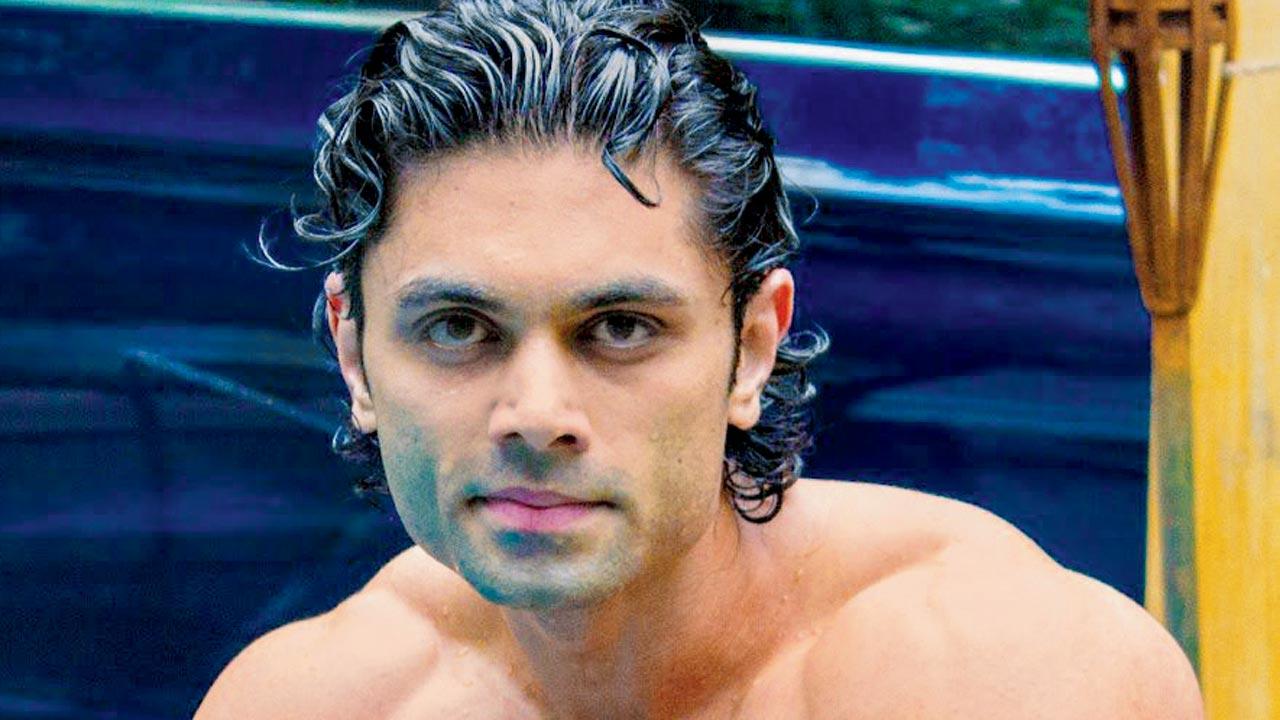
Kunal Gir
I have never used my friendships to demand a role in a film-Dia Mirza
8:04 AM

Harshada Rege (BOMBAY TIMES; January 2, 2021)
Dia Mirza is looking forward to the New Year with a lot of excitement and hope. After trying to navigate her way through the industry for years, she feels it’s finally now that she is getting the kind of work that she has always wanted to do. After starring in films like Sanju and Thappad, and her web show, Dia feels this is the 2.0 version of her career. “Yes, it has been a new lease of life. I am determined to push through and let people know that there’s more that I have to offer. The kind of roles that are coming my way and the filmmakers engaging with me, is an indication that I have managed to turn the tide over,” she says. Having been a part of Bollywood for two decades, the actress has many friends in the industry. She, however, says that her friendships are not based on her work associations.
Dia says, “I made friends along the way with people who I have worked with and found common ground with. They are long-lasting friendships, but I have never used that access to demand a role in a film. I keep the work I do and my friendships apart.”
Talking about dealing with the disappointments that came with not bagging the kind of projects she desired to do, the actress shares, “My friends know that there have been phases when I have been frustrated with the lack of opportunities or not getting the kind of jobs that I was aspiring for.”
She further adds, “Ageism is very much prevalent in our industry. The moment you hit 32-33, the kind of jobs you get and the nature of work starts changing. And there’s a lot you need to adapt to, but there are also things that you don’t want to accommodate or adjust to. You need to find your voice and say what you want to without trampling on the fragile egos around. I have never been a part of any camp. I am friends with many good people, and I benefit from their friendship in terms of being intellectually stimulated and learning more about the craft. I have never learnt to work the system, and I don’t think I ever would be able to do that.”
Right from the time Dia joined the industry, the focus has often been on her good looks. She agrees, and says, “It is an impediment. There were so many directors who I would have given an arm and leg to work with, but who haven’t cast me because they said, ‘She is so beautiful.’ And I would turn around and say, ‘No! Why?’”
In the New Year, the actress looks forward to announcing new projects, both as an actor and a producer, and making her debut in Telugu films with Wild Dog. “The Coronavirus pandemic did slow down work, but there are a lot of exciting projects on the cards,” she signs off.

I used to be heartbroken if my films didn’t work out-Karishma Tanna
8:22 AM

Kavita Awaasthi (HINDUSTAN TIMES; August 18, 2020)
“Downfall, depression and setbacks are a norm in this industry. It happens to every actor, though the degree might be different. One has to learn to move on,” says actor Karishma Tanna. While she found huge popularity on the small screen with shows such as Kyunki Saas Bhi Kabhi Bahu Thi, Qayamat Ki Raat and Naagin 3, Tanna’s journey in films wasn’t as smooth.
The actor, who debuted on the big screen with Dosti: Friends Forever (2005) and later starred in Grand Masti (2013), was looking forward to the Sanjay Dutt and Vivek Oberoi-starrer Sher, which she shot for in 2013, and later Tina And Lolo, co-starring Sunny Leone. But the former got shelved while the latter didn’t release.
Talking about the setbacks, Tanna admits, “I felt low, frustrated, angry, sad, upset and had mood swings when one after the other, my film projects didn’t work out. I used to be heartbroken as I had pinned a lot of hopes on these projects. I used to feel bad, but not anymore.”
She adds on a positive note, “Sometimes, things don’t go the way you want them to and that’s fine. I had to pull myself up. I believed God has something better in store for me. And my belief worked as He gave me Sanju (2018), where I had a small role, but the appreciation I received for it was huge. One has to stay positive and manifest what you want. That is the only way to pull out of a dark phase in your career... This industry can be draining and taxing at times. It makes you insecure. It is only natural to think about usko kaam mila, mujhe nahin mila, but that doesn’t help.”
Tanna, 36, credits her resilience and positivity to her mother’s blessings. “I have been in the industry for so long; yet I am not bored of it and neither is the industry bored of me (laughs). I have so much more to do. I never let success or adulation affect me too much. I don’t know how to behave like a star, as my mother has taught me to stay grounded. When fans tell me that they appreciate my work, I feel good, but it doesn’t sink in. Moreover, stardom never came easily to me as I always had to struggle and make my way,” says the actor, who is working on a web series next.
Rishi Kapoor: Khullam Khulla, yet so private
8:05 AM

Biographer Meena Iyer on the many contradictions of the star who never said anything off-the-record, and yet remained deeply private
Meena Iyer (MUMBAI MIRROR; May 1, 2020)
What can I write about Chintu (Rishi Kapoor) without letting him down? He was a private person. All the blabber on Twitter — which frequently struck as relevant and sometimes drew flak for its candour — was still just the tip of the iceberg. Ranbir Kapoor, when asked about his father’s social media presence, is quoted as saying in my book, Khullam Khulla: Rishi Kapoor Uncensored, “I do not have a take on his Twitter personality, though that is usually the first question anyone asks me about my father. All I can say is, so long as he is being honest and having fun, it’s his prerogative.”
I digress. But Rishi really was buried somewhere deep within the public persona, and few people were allowed to see that side of him. Most of the things I learnt about him were gauged and gathered from whispers, things he would speak about in private. Like his love and respect for his wife, Neetu, a no-tolerance policy towards certain colleagues, his love and admiration for Ranbir, and the urge to indulge daughter Riddhima and granddaughter Samaira.
He was fiercely protective of his family. Anything aimed at his siblings, parents, wife or son would hurt him. He wouldn’t bother about himself as much. Besides being a superstar, Rishi was a well-meaning father and a great companion to Neetu.
There were many highs and lows in the 40 years that we knew each other. In the early days, I recall meeting him as a cub reporter from Star & Style, sent over by senior colleagues to broker peace between him and the magazine. Rishi had been seething over something one of the columnists had written about his family. Oh boy, did I get an earful! Soon, he realised that I was just the messenger and cooled off. That was the beginning of our friendship. Chintu never asked me to keep things “off the record” and I loved that about him.
He had no patience for stupidity, especially towards the end. Perhaps, he knew that time was running out. Sometimes, I could see him exasperated by inane pleasantries. But he rarely brought up his illness with me. When my publisher asked me to do a reprint of our book, with an additional chapter on his battle with cancer, he flatly refused. “I don’t think there is any merit in it,” he said. Instead, he wanted me to do a book with Neetu on how she got through the difficult phase. “Ask her about our one year in New York.
Ask her how she brought me back from the brink. She’s the hero,” Chintu said. Some meetings with Chintu stayed in mind more than others. Like the time he returned from Mauritius in June, 2018, and we went to watch Sanju in Worli. He couldn’t stop raving about Ranbir’s performance in the film. Pouring us drinks at his house later, he thumped his chest, exclaiming that Ranbir had “surpassed” him and Neetu as an actor. When he couldn’t get through to Ranbir (the actor was rehearsing for a film elsewhere) he impatiently dialled Sanjay Dutt, who was overseas, to tell him that Ranbir had done him justice. Then, he turned around to explain, “Ranbir will call me back but I had to share my excitement with someone. Who better than the real Sanju?”
Our last meeting was on March 9, at his residence. He and Neetu had just retired to their fifth-floor apartment after participating in a Holi function. “Let’s hope all the negativity is gone in that fire,” Neetu remarked, while Chintu and I had a quick drink. He was faithful to his Johnny Walker Black Label but opened a Hibiki for me.
As Neetu and he reclined in their individual lazy-boys that evening, everything seemed normal. We watched old Hindi songs on TV and each time he, Raj Kapoor, Neetu or Randhir Kapoor appeared on the screen, Chintu would rattle off tit bits about the song. “This is my favourite pastime. I love the nostalgia it brings,” he’d confess.
At the dinner table, he reprimanded me for the umpteenth time for being a “boring” vegetarian, as he tucked into an extra-small portion of an exotic chicken dish whipped up by Neetu. That evening, I learnt that the couple and Ranbir were likely to celebrate Alia Bhatt’s birthday (March 15) together. Though he was in the middle of chemotherapy, Chintu told Neetu that he wanted to take his son and Alia out for a meal.
Later, he said to me that he would be okay if Ranbir wanted an intimate wedding. “It’s their call. I am okay with 45-odd people too. I will tell my friends, well-wishers to bless them. I will apologise and explain that everyone couldn’t be invited because Ranbir is a private person. I respect his privacy,” he said.
As I got up to leave, he apologised for not seeing me to the door and requested Neetu to walk me to the lift. Like always, a box of See’s Candies (sugar-free peanut brittle) was my parting gift. Now, I see the box staring back at me from the refrigerator. But the man who made sure I was always stocked up is gone.
Thankfully, the web world does not typecast an actor-Manisha Koirala
8:13 AM

As she headlines web film Maska, Manisha on why she is enjoying the digital medium more than the big screen
Shaheen Parkar (MID-DAY; March 29, 2020)
Five months shy of turning 50, Manisha Koirala finds herself busier than usual. “I am grateful that I am getting offers at this stage,” says Koirala, who — as a leading lady in the late’ 90s — had witnessed from close quarters how Bollywood could unfortunately be ageist when it came to female actors.
However, with the digital entertainment boom and a new wave of cinema on the rise, she acknowledges that it is a good time for female actors.
If her past outings are any indication, it is evident that she has found her groove in the digital world. Her latest release, Neeraj Udhwani’s Maska, dropped on Netflix over the weekend. Known to dive deep into her characters, Koirala enjoyed the process of playing a Parsi woman, who readies to pass on the family legacy— an Irani café— to her son. “She’s funny, eccentric and traditional. The role provided me an opportunity to do something I had not done before. I had to pick up the strong accent [that] Parsis [employ]. I also visited the various Parsi baugs in the city to observe the community.”
Teaming up with youngsters, Prit Kamani and Shirley Setia, the actor says, “Their energy is infectious.”
Koirala began her tryst with the web world with the anthology, Lust Stories, in which she essayed a banker having an extramarital affair with her husband’s close friend. She is set to reunite with director Dibakar Banerjee for his upcoming Netflix film, Freedom. While she is having a field day choosing roles for OTT projects, her appearances in Bollywood films have been few and far between. Her last memorable role on the big screen was in Ranbir Kapoor starrer Sanju (2018). “I had reservations about [playing mother to Kapoor] as I thought I would be offered only mummy roles thereafter. But thankfully, the web world does not typecast an actor. I want to break the mould. I call myself a hungry actor, and digital films are providing varied roles. What more could I ask for?”
Terrifying pieces of writing on crime come from real life-Sushant Singh
3:46 PM

Niharika Lal (BOMBAY TIMES; December 4, 2019)
 A session titled ‘Real Crime - When Truth is Stranger than Fiction’ on Day Two of Times LitFest saw Neeraj Kumar (right), former Delhi Police Commissioner, Sushant Singh, who hosts the crime show Savdhaan India on TV, and authors Kulpreet Yadav and Ravi Subramanian discuss real-life crime cases from across the country. The panellists discussed headline-making cases, the excellent work police have done in some cases, loopholes in the criminal justice system. The session concluded with a Mark Twain quote: “Truth is stranger than fiction, but it is because fiction is obliged to stick to possibilities; truth isn’t.”
‘A YOUNG MAN HELPED DELHI POLICE PREVENT TERRORIST ATTACK AT INDIA GATE’
Discussing crime-based shows on true stories, the panellists agreed that these episodes have created a greater impact as they are based on real life incidents. Sushant said, “Terrifying pieces of writing on crime come from real life.” Neeraj Kumar, who has written two books on his investigations, shared the details of a 2002 case, which has never been discussed in public domain earlier. He said, “When I was in Delhi Police, almost one month after the Parliament attack, we got to know about (the possibility of) another attack at India Gate. We knew about the date of the attack, but that’s it. We had no other information and were unable to crack the code. We took help of all the cryptologists of Delhi, but they produced no intelligence of value. We were also in touch with cryptologists from the US. But they were asking for a huge sum of money and the government wasn’t ready to sanction it.”
He added, “One day in my ACP’s office, a young man (ACP’s friend) came and he asked him as to why he was so hassled. When told, the friend asked the ACP to show him the code. And that young man cracked the code! We got the information and the planned attack at India Gate was averted. He was a saviour for us, but if you see such an incident in a film, you won’t find it believable.”
Sushant added, “If we would have shown this exact scenario in a film, toh aap log (audience) kehte, ‘Yeh kya bewakoof banate hain Bollywood walein! How’s it possible? Bade bade log nahi kar paye aur ek ladke ne aise hi kar diya?”
‘A CCTV CAMERA WHICH WAS NOT FITTED PROPERLY HELPED US IN THE NIRBHAYA CASE’
Neeraj Kumar was the Delhi Police Commissioner in 2012 when the Nirbhaya incident took place and he shared with the audience how an ill-fitted camera helped the police. He said, “My investigators went to Mahipalpur (as the bus took that route) and they checked the CCTV footage of all the cameras that were installed at the receptions of those dingy guest houses. Again, truth being stranger than fiction, all the CCTV cameras were facing the reception areas of the guest houses. But one camera at a guest house was turned towards the road because it was not fitted properly. From that camera, we got the footage of a bus that took two rounds of the same area, and then the bus was identified. It was an overnight operation.”
‘SANJU GLORIFIED SANJAY DUTT’S LIFE, BUT WHO MADE THE FILM A SUCCESS?’
As the panellists discussed crime and fiction, one of the members from the audience asked whether the film Sanju had glorified Sanjay Dutt’s life, despite the actor’s checkered past. Neeraj Kumar, who probed the 1993 Mumbai serial blast cases when he was a DIG with the CBI, said, “If Sanjay Dutt would have wanted, he could have prevented the blasts. He was in the know of at least one part of the conspiracy. But he didn’t, and whether he suffered or not, or not suffered enough... you and I can have a view on whether he should have been punished more. But we’ve to work within the ambit of the law, and what a policeman feels or people feel can’t be the law.” Sushant Singh said, “I agree with you that the film Sanju glorified Sanjay Dutt’s life, but who made the movie a success? Public. I’m not a fan of the things that our films glorify. Like stalking women — ladki ka peecha karte raho toh ek din haseena maan jayegi. In Housefull 4, they have such (demeaning) dialogues, but then who makes these films a success?”
We feel good about the emotion of being united, but are we really united?-Ashutosh Gowariker
7:58 AM

Madhureeta Mukherjee (BOMBAY TIMES; December 5, 2019)
With every film, he walks down a tough path and makes tough choices. He goes back in time, blows the dust off the thick pages of history, revisits untold stories and then, creates a cinematic spectacle of it. But every subject, however challenging, has a driving force. Like for the upcoming historical war drama Panipat, what intrigued Ashutosh Gowariker was that the Marathas were defeated in the battle, but “there was a certain spirit in that entire journey, which can’t be ignored.” Yes, his films have often been mired in controversy, but it is his unbridled passion and honest intent towards the story at hand that’s helped him battle the outside forces. Finally, he believes what matters is that a film must go down in history and stand the test of time. Excerpts from a conversation with the nuanced storyteller…
Your films are clearly driven by a certain deeprooted belief, for instance Jodhaa Akbar (2008) threw light on the subject of religious harmony, and Swades (2004) brought about the feeling of nationalism. What is the inspiration behind making a film based on the Third Battle of Panipat, one of the most significant battles of the 18th century?
The idea came from the fact that back then, we were not united, and centuries later, today, we are still asking ourselves, ‘Are we united?’ This battle happened in the 18th century, but it is relevant even in today’s times. We feel oneness and feel good about the emotion of being united. We get united when there is a cricket match against neighbouring countries, but honestly, are we really united? Panipat was the battle that we lost, but what exactly happened then and why did we lose? When I started probing, I realised that there is a huge story here. The Peshwas travelled 1,000 km up north (from Pune) to stop the invaders. They were not going to Panipat, but then a cat-and-mouse chase happened along the Yamuna river, they went up north via Mathura, Agra and other cities and finally to Delhi. And then, while they were going to Punjab, they were intercepted, and the battle happened. So, what was this journey all about and how were they going to amass such a huge army? Whenever we look at a story of defeat, we are not as interested in it. When do we want to see a cricket match that we have lost? We like talking about our victories. Hence, this story intrigued me because even if we were defeated, there was a certain spirit in that entire battle and the journey, which can’t be ignored. My motivation came from that place; I wanted to capture that spirit. I wanted the audience to get a cinematic version of the most important battle of the 18th century.
There are so many layers to such an epic story and so many characters. The dynamics of that era was also complex — that is a lot to incorporate in one movie...
Yes, a huge number of characters are involved in the story. They were the movers and shakers of those times. Also, it consisted of people from all backgrounds — Hindus, Muslims, people from different castes, farmers and others. So, who gave support and who did not, was all an outcome of the political situation and the geographical location of who was placed in which territory. The relationships amongst the kingdoms were fragile and depended on many such factors. I have explored that, too, in the film.
While the audience is often divided over the way history is portrayed in cinema, I am sure that if you interact with various historians on a particular subject, you, too, would face a dilemma. Does your film take views from various experts in the field, or have you derived and relied on information and facts from a single source?
I have yet to come across two historians who agree on something. They write an account, analyse each other’s work and disagree on several things. Here, I am just a filmmaker, trying to show a historical story on screen. I am not creating another account from another perspective. I feel the need to draw my information from the earliest account that is available to us. In this case, my reference point was historian T S Shejwalkar, who wrote the book, Panipat 1761. He wrote specifically about this battle. I have created my screenplay from the way it has been narrated in his book. There is another Pune-based historian, Pandurang Balkawade. I took him on board officially for the film, for inputs on various matters.
Your choice of casting is always well-thought-through, like Hrithik Roshan and Aishwarya Rai Bachchan for Jodhaa Akbar — they both looked gorgeous and regal. How did you zero in on the cast of Panipat — Arjun as Sadashivrao Bhau, Sanjay Dutt as Ahmad Shah Abdali and Kriti as Parvatibai?
They were absolutely my first choice, and this is the first time I got my first choice of cast (laughs!). When you get your first choice, it cuts down your waiting period, because when you don’t get an actor you want, you have to pitch it to someone else, and then, it’s a long wait for many months. For Sadashivrao Bhau, I wanted someone with a big built and someone who can make you believe that he has great force and strength. I zeroed in on Kriti as she looked so Maharashtrian and is such a detailed actress. Sanjay Dutt is someone who has gone into another league, and sometimes, just his presence is enough. You put him in a specific look and make him stand there – you feel this is the character. It was great that all three of them consented right away when I offered them this film. I always think that as a writer or director, I can create only 50% of a character, it is the blend of my character sketch and the persona of the actor that finally comes alive on screen.
Lagaan (2001) changed the course of your career. After that, has there always been immense pressure to raise the bar higher and higher?
I have not thought about a previous film as a burden. I’d like to think that every new film that I do comes with challenges of its own. I have to de-strap myself from other trappings and approach every film with new vigour. If I have the attitude of having been there and done that, I think I might lose a certain charm of making every film with a fresh approach. In Jodhaa Akbar, I shot two battles, but Panipat demands something else. Unless I detach myself from my previous work, I can’t move on to take on the next challenge.
How often do you go back and view your films scene by scene? How critical are you of your work?
I am very critical of my work and I like to keep revisiting my films. If I look at my film after five years and feel embarrassed about it, that means the film hasn’t stood the test of time. I think a good film is one that stands the test of time.
You have given us some fine and unforgettable films like Lagaan, Swades and Jodhaa Akbar, but when an ambitious film like Mohenjo Daro (2016) goes unappreciated, and the audience does not connect with your vision, does it throw you off? What do you tell yourself?
I tell myself, ‘What were you thinking??? (Laughs!). When a film does not work, there could be many, many reasons for it. Everyone could cite a different reason, but the truth is, in this case, it was the script. Everything emanates from the script — every decision you make, and every character motivation comes from it. If the audience has not engaged with the film, it is because the script failed to engage them. There are so many times we see a film that has been made shoddily, but it turns out to be a big hit. The reason is, technique was unimportant in that film, the audience connected with the storytelling and felt for the characters. For me, Mohenjo Daro is still a nice film where we created a different world, but the script could have been emotionally more powerful and that is what it lacked.
So, you do believe in the audience’s opinion, point of view and feedback, and take it seriously as a filmmaker?
For me, the audience is always right. It is also because I am always right. When I watch a film as an audience, I am ruthless. The filmmaker must have spent 200 days shooting it and a lot of money in putting it together, but if the film does not work for me, I will say that I didn’t like it. If I can react like that, even the audience has the right to do it. They are not concerned about my hardships, or how many days of hunger I went through, all they want to know is, film acchi hai ki nahin.
Talking about battles, your films have had their own share of battles. You have got flak from some quarters for apparent misrepresentation of facts in Jodhaa Akbar and then again, in Mohenjo Daro. It is always a tightrope walk when you are making a film based on historical facts, right?
Let’s look at Sir Richard Attenborough’s film Gandhi (made in 1982). Sir Ben Kingsley, who played the titular role, resembles Mahatma Gandhi in no way. But we have no trouble with that because of the way it is addressed and the way the story is narrated. After a point, we start believing that he is the Mahatma. If you compare him with the pictures of Gandhi, it’s not slightly different, it is starkly different. Another example is the film Sanju (2018). It did not matter to us that Paresh Rawal was playing Dutt saab, because Raju (director Rajkumar Hirani) was capturing the essence of Dutt saab through Paresh Rawal and the essence of Sanjay Dutt through Ranbir Kapoor. In a historical film, too, I feel that you have to capture the essence of that period and recreate it in the most authentic way possible.
How much leeway does a filmmaker give himself for creative interpretation in a film based on history?
Every filmmaker has his own censor, his own degree of variants of what he wants to show, where he wants to jump, and where he wants to be more stringent with facts. These are the choices that you have to make while writing the screenplay. For me, authenticity and realism are very important. Yes, I have some drama in my films, like I will have a scene like ‘namak kum hai’ in Jodhaa Abkar, which is not part of history. Those embellishments are important as that will keep the audience entertained, but authenticity still remains important.
Responding to various trolls post the trailer launch of Panipat, Arjun said, “It is unfair to crack jokes on historical characters, on martyrs. We should not forget the sacrifice that these men made.” How do you react to these trolls?
I believe that trolling is an art form. I feel that the trolls are thrown artistically at you; they use choicest of words and abuses, and draw sharpest of parallels with something or the other. Trolling is like a full-time job, and so, we have to take it in our stride. I wonder how some people can have so much venom, anger and hatred in them, and they purge all that through their trolls.
Reportedly, the Afghan Embassy to India, in a letter to the MEA (Ministry of External Affairs), expressed concerns over the contents of your movie with regards to the portrayal of Ahmad Shah Abdali, who led the Afghan army in the Battle of Panipat. Have they reached out to you and what is your response to it?
I think that Abdali was a great military strategist, and he is the father of the nation for Afghanistan. But this period in history is also the same time when he invaded India eight times, and when this particular battle of Panipat happened, it was his fifth invasion. If I have to show the story of why this battle happened, then I can’t escape from the fact that he was invading India at that point. So, it is not about maligning or trying to show someone in a bad light, but what I have shown is based on facts.
You were seen after long in front of the camera in 2016 for the Marathi film, Ventilator. What made you go back to acting, which was once a career option for you?
I don’t have the energy to pursue acting now. If a director comes to me and tells me that there is a part that he wants me to play, I will do it, provided I am available during that time. I have some time after this film, so if something comes my way, it will be great. It is not that acting is easy; for me, it is therapeutic.
Historical romance, period drama, epic war film… what next? Can we expect anything like a contemporary story, with characters from the period we are currently living in?
I don’t know what is next, but do I think of a story where my hero is dressed in jeans? Yes, I think in that zone, too (laughs!). It is just that sometimes you get a theme which is so great in terms of its period setting that it takes precedence over everything else. Otherwise, why would I make a Panipat after Mohenjo Daro? I had no fears. If you get motivated by the theme, then your reasons for making the new film is different. I think everything is a mix of your effort, hard-work and your luck. You need dollops of luck. After Mohenjo Daro, for me to get this kind of cast, was great. In that sense, I must say that I have been fortunate.

Kriti Sanon could easily be my 309th girlfriend, says Sanjay Dutt on The Kapil Sharma Show
7:55 AM

MUMBAI MIRROR (December 4, 2019)
Sanjay Dutt was at his candid best during his recent guest turn on Kapil Sharma’s show. The actor, who went there to promote his upcoming film Panipat, along with co-actor Kriti Sanon and filmmaker Ashutosh Gowariker, opened up about his time behind bars and revealed how he used to work day and night shifts to get his prison term reduced. The actor, who has already had a release this year, will be seen as the antagonist in the period drama.
When the comedian-host prodded him on the number of girlfriends he’s had, as documented in his biopic Sanju that released last year, he quipped that he has to still keep count as the journey continues. Amidst much laughter, the actor went on to add that he was so impressed by co-star Kriti’s performance that she could easily be his 309th girlfriend.
Wonder what Kriti and Sanjay’s wife Maanayata have to say about this.
If films can be censored, why can’t songs?-Sukhwinder Singh
7:49 AM

Singer Sukhwinder Singh appeals to lyricists to refrain from using expletives in songs; adds that the music industry is his family and he would never want anything bad to happen to it
Nikita Deb (HINDUSTAN TIMES; November 24, 2019)
One of the most popular singers of Bollywood, Sukhwinder Singh, has been enthralling audiences for almost three decades. With superhit songs such as Chaiyya Chaiyya (Dil Se; 1998), Mitwa (Lagaan: Once Upon a Time in India; 2001), Bunty Aur Babli (Bunty Aur Babli; 2005), it wouldn’t be wrong to say that Sukhwinder was ruling the music scene then. But even now, the singer doesn’t miss a chance to mesmerise his listeners. With his latest hits, Isaaqbaazi (Zero; 2018), Kar Har Maidan Fateh (Sanju; 2018), and more recently, Chammo from Housefull 4, Sukhwinder seems to be as relevant as ever. The singer talks to us about his near 30-year-old career, if he would ever sing a remix, and how he keeps reinventing himself. Excerpts:
Your recent release in Housefull 4, has over 15 million views on YouTube…
Film kaafi badnaam ho rahi thi (laughs), but when I watched it, mujhe toh bada mazaa aaya. Every song that I sing cannot be a great one, but a lot of my songs are hits and even superhits. Every song can’t win an Oscar, right?
The film didn’t get great reviews. Do you think the reviews of a film affect the music, too?
Nowadays, a few people have turned social media into a tamasha and not a resource. Social media is a great resource where you can say anything independently and freely, dil khol ke. But you can’t say anything without limits. You can’t abuse or use bad words. There are a lot of people who feel that they should do something new, so they resort to doing negative things. I am not saying that Housefull 4 Mughal-e-Azam (1960) ke level ki bani hai or Sanju ke level ki hai. But when I went to watch the film, there were barely any seats available, which clearly means that the film did good business. The makers put in a lot of effort, too, and the canvas is also big.
After so many years of being in the business, how do you keep reinventing yourself?
For that, you need to actually avoid a lot of things. Humare film industry mein kitna glamour hai and some of our activities are very aggressive. But the most important thing about the film and music industry is the creativity. Along with that, there are a lot of different branches of it. There is aggression, insecurity, greed and impatience but all of them live under the same roof of creativity. I tried to find consistency in this. I started working on that. Even before Chaiyya Chaiyya released, I had started following this pattern. When I was in England and my albums would come out, I always looked for that consistency. I was always very aware of aggression, insecurity and everything else. After Chaiyaa Chaiyya, I waited for about 70 to 80 days for my next song. Along with Om Shanti Om (2007) came Chak De! India in the same year, but I sang only three songs in that year. Most of those songs were nominated at award functions. Many people said I was very picky and I was also appreciated, but I remained quiet. And that ended up suiting me a lot. My last song was Kar Har Maidan Fateh, and after a year I sang for Housefull 4. But I am relaxed and now, I am waiting for three or four good movies to come my way. I want to sing more. I have three to four more good movies with good songs coming out. I don’t really ask the names of movies when I get offers. I concentrate on the content of the song. I am really satisfied right now.
What is your take on the trend of remixes that has become ever so popular now?
I’ve always had one big problem with this trend — original composers not being credited for their songs. So, whenever I was asked to speak about it, even during my concerts in India or abroad, I would always bring up this topic. I have been speaking about this for seven to eight years now. Thankfully, this issue has now been solved. Another thing, that really bothers me, is the usage of vulgar and bad words in songs. I feel that is really wrong. I have always maintained that if films can be censored, why can’t songs? People keep saying why do I keep involving myself in these battles, but to them I say, ‘the music industry is my family. And I can’t see wrong things happening in my family’.
As far as singing a remix is concerned, I would love to sing a remake of a Kishore Kumar song because he was my favourite (artiste). But one thing is for sure — when I sing a remix, it won’t be like the usual songs. It will be very special.
After #MeToo movement, thodi tameez aayi hai industry mein-Sukhwinder Singh
7:36 AM

Srishti Dasgupta (BOMBAY TIMES; November 4, 2019)
Carefree, candid and one who shoots from the hip — that’s Sukhwinder Singh for you. Ahead of his concert at Kolkata this week, the Bollywood singer spoke about music reality shows, the #MeToo movement and why he thinks RD Burman is the greatest composer of all times. Excerpts:
What do you have to say about the quality of reality shows?
Reality shows are a very good platform to hone talent. The best show I ever witnessed was the one I worked in as the chief guest. But in the last five years, I have noticed that 80% of the contestants’ growth as a singer coming from reality shows has drastically gone down. I don’t get time to watch reality shows regularly on TV because of my riyaaz, yoga or intense travelling for concerts. I also need to sleep for a minimum of nine hours, and amidst all this, when a friend or an associate asks me to watch some episodes of a particular show, I make it a point to watch them. Ten to 15 years back, reality shows produced better talent.
Why do you think so?
We lead a fast-paced life nowadays, there’s no patience in us. So, the contestants do not devote enough time for riyaaz or to learn the nuances of music. The aggression level has also increased a lot in us. There’s a lot of talent, but they have to be nurtured properly. The rural areas of Bengal too are a treasure trove of raw talent. We just need to find them.
You judged Voice Of India’s second season years back. After that, we have not seen you donning the judge’s hat for any reality show…
Many offers keep coming my way, but shooting till 4 or 5 in the morning is a bit tough for me. Having said that, I don’t mind being a reality show judge. A saint in Chennai once told me, whenever you learn any good thing, you must share it with others. So, I would definitely want to don the judge’s hat and share with everyone my knowledge of music.
Reality show judges openly engage in war of words. Is it part of the script to garner TRPs?
I have always told people, ‘agar aap chahte hai ki tamashe se TRPs bante hai, toh main apko music se TRP banake dikha dunga’. I bet if I get back on the judge’s seat, I will generate TRPs through music, glamour, style and fun. If you want me to get into a war of words with the rest, woh mujhse nahi hoga. Also, I am sure I will be the best looking judge in a reality show (laughs!). Many a times, judges say ‘wah wah’, ‘kya baat hai’ after a contestant’s performance. I wonder why they do so even if the performance is average. I guess, they want to continue their stint in the coming seasons as well, so they want to make the producers happy. But I can never do this.
People from the music industry were also called out during #MeToo controversy. Do you think the movement has created the impact it intended to?
It’s good that unhone awaz uthayi. In our entertainment industry, there are some people who are very cheap. But I cannot ever say that Nana Patekar is cheap. He is one of the best actors in the country. But somewhere this #MeToo campaign did work well. But usko bhi corrupt karne ki koshish ki gayi. When the campaign gained momentum, many said there were other cases too. The common complaint was ladki dikhi nahi ke mooh se laar tapakne laga. But the moment the campaign became a tamasha, it stopped. But some women, who raised their voices, were right. Nobody was saying it openly, but andar se sabko ek satisfaction mila tha ke yeh movement hua, and some people’s true colours came out. I get disturbed when I hear people using abusive language with junior artistes. You can’t do that just because she’s not Alia Bhatt or Deepika Padukone. I think after this #MeToo campaign, woh tameez thodi aayi hai industry mein.
Given a choice, will you ever enter the Big Boss house?
Main tamashe mein nahin jata. They have approached me two-three times, but as I said earlier, if I have to create TRPs, I will do it only through music. I didn’t say no directly, but I gave the makers my reasons for not going.
What do you think about Jasleen Matharu and Anup Jalota’s relationship that blossomed inside the Big Boss house? They initially claimed to share a guru-shishya bond…
Log tamasha karke publicity chahte hai, but what they don’t realise is that they are only tarnishing their own image. They will not gain anything out of this. Woh jaan bujhke badnaam hona chahte hai. For me, I can never tolerate people saying that this man, who has given hits like Chhaiyaan Chhaiyaan, Chak De! or Dard-E-Disco and others, does such things on a reality show. I am not saying Big Boss is bad. It’s a different kind of a show, but I feel I will not fit into the show’s pattern.
It’s believed that the era of melody is over in Bollywood. Do you agree with this?
Woh era aayega wapas. Sukhwinder Singh jumped in and how (laughs!)! Be it romantic songs or peppy numbers, I have done it all. From this year onwards, a new journey of mine will start — the journey of singing romantic songs. When S D Burman, R D Burman, Kishore saab, Mohd Rafi saab, Lataji, Ashaji, Mukesh ji were there, it was the golden era of music. There is no replacement for these legends. Today, you will not find another Kaushiki (Chakraborty) or a (Ustad) Rashid Khan. Melody has become a minor part of music these days, but then why do people love Arijit Singh so much? It’s also because of melody. When people want sukoon, they listen to Arijit.
You spoke about having a huge crush on renowned classical singer, Kaushiki Chakraborty…
I am a big fan of hers. I have a crush on her singing style and am sure everyone in the country loves her singing. Whenever I see her performance, be it on online platforms or on TV, I am amazed to see how can she sing such difficult classical compositions so effortlessly. Her father, Pt Ajoy Chakrabarty, too is one of the finest classical singers in our country. Kaushiki is an extremely down-to-earth person, there’s no iota of arrogance in her and that makes her even more admirable. Ek Kaushiki hai, aur ek hai Pt Jasrajji, dono ke mathe pe kabhi bhi koi shikan nahi hai jab woh gaate hai. They always smile and sing such difficult classical songs.
You have worked with several music directors in Bollywood. Whom are you most comfortable working with?
I have worked with almost all the music composers in the industry. I am comfortable working with everyone. All of them are very passionate about their craft. When they approached me for the song, Kar Har Maidan Fateh of Sanju, which was composed by newcomer Vikram Montrose and written by newcomer Shekhar Astitwa, I instantly loved it and recorded it. The song too turned out so well. When I find lack of experience in a new composer or songwriter, I share my experiences with them. But I do respect their work.
You have sung a lot of songs for SRK. Which actor suits your voice the most?
I have sung more songs for Salman Khan and Ajay Devgn than Shah Rukh Khan. Three to five songs I have recorded for Ranveer Singh and Ranbir Kapoor also. The actors play different characters, and I sing for their characters. In 2007, Shah Rukh was simultaneously shooting for Chak De! India and Om Shanti Om. I had sung two songs for him that year, one for each film. The title track of Chak De! India and Dard-E-Disco. I always go by the director’s brief. Shah Rukh zuban pe zyada aata hai kyun ki he has a lot of appreciation for other artistes and their work. He praises everyone very honestly. If he wants, he will tell the director, ‘Yaar, ek gaana toh Sukhi ka hona chahiye film mein.’
There are a lot of promising singers presently in Bollywood. Who are your favourites? Do you see them as competition?
Competition does work very well. I have been a sportsperson since childhood. Competition works well in sports, but not in music. So, I don’t see anyone as my competition. Arijit Singh is a lot better than many singers; even Shreya Ghoshal and Sunidhi Chauhan are extremely talented and versatile singers. Today, most young and upcoming singers try to copy western artistes like Shakira, Lady Gaga and others. They see their style and stage presentation, but don’t notice their practice and hard work.
Who is your favourite music composer?
R D Burman — he was the best in the world. Agar R D Burman abhi hote toh unke paas kam se kam 20-30 Oscars hota. If he got the technical support that’s available now, he would have fetched us more than 100 awards by this time.

I’m finally at a place where I don’t have to say yes to everything that comes my way-Gajraj Rao
8:03 AM

Rachana Dubey (BOMBAY TIMES; October 5, 2019)
Looking at the current trend in storytelling, films are no longer about a starry line-up leading the narrative. Gajraj Rao, who has won several accolades for his turn as Mr Kaushik in director Amit Sharma’s Badhaai Ho, has emerged as an actor who is up for any role that offers him something interesting and meaty to do. Talking about the 180-degree turn his life took with the National-Award-winning drama, the actor spoke to Bombay Times about his current stint in the movies and what lies ahead. Excerpts:
 You’re playing pivotal supporting roles in Shubh Mangal Zyada Saavdhan, Maidaan and the upcoming Made In China. Have you changed anything in the way you approach your work after the success of Badhaai Ho?
Destination se zyada aaj bhi journey important hai. At least, that’s how I see the idea of working in a team. In the last 25 years that I have been an actor, I have not worked in too many films, because for me, people who I work with matter a lot. I continue to keep in touch with some of the teams that I have worked with. One of them is the team of Badhaai Ho. They have become a part of my personal life and talking to Ayushmann (Khurrana), Sanya (Malhotra), Surekha ji (Sikhri) and Neena (Gupta) makes me happy. Today, thanks to Badhaai Ho, I can choose my projects. Story, script, the director’s temperament, and the producer, are elements that have now gained importance because releasing a film is as important as making it. In the pre-Badhaai Ho phase, I used to get work from friends, and at times, I have even worked for a much lower fee, or sometimes, no fee at all.
From doing cameos and smaller supporting roles, I’ve come to a point where people are willing to wait up to six months or a year for me. They’re writing something keeping me in mind. My talent and performance are finally being appreciated.
Reaching a point like this in your professional life is one thing and sustaining it, is another. Do you have any fears about being able to stretch this golden run for long?
I don’t know what one needs to do to sustain what one has achieved. But whatever work I do, I will do it with 200 per cent conviction. Mr Kaushik’s character (Badhaai Ho) has flagged off this phase in my career and I will make the most of it by doing some good work. I feel that every actor in his life comes across a phase where he’s at the top of his game. It’s foolish of people to think that such a phase can last forever. It doesn’t. But what does last a lifetime is what you do in this phase. If you choose your work wisely and do justice to it, you will continue to reap the benefits of the golden run, even after it’s over. I will make this phase count. Things will change for me, too. Today, I get five scripts a day; later, I might have one script in five months. Irrespective of it, I will not change my approach towards my work. I will play characters that can gradually underline my versatility.
 Your part in Made In China looks like a complete departure from what you did in Badhaai Ho. Was that a conscious decision?
I was approached for the film half-way through its shoot (laughs!). I was asked to make this extended guest appearance, which I wasn’t too keen on. Director Mikhil Musale personally reached out to me, insisting that I hear what the part is. The narration helped me change my mind. I’m aware of the kind of work Mikhil has done and I was sure he would do justice to this film, too. I play a man who is a motivational speaker on the face of it, but in reality, he is a sharp businessman. He decides to exploit Raghu (Rajkummar Rao). Working with Rajkummar was a revelation. He’s such an impressive actor who knows his entire script by heart. His memory is so sharp and he’s so prepared that you have no option but to match steps with him.
You’ve also begun to shoot Maidaan with director Amit Sharma and Shubh Mangal Zyada Saavdhan with Ayushmann Khurrana and Neena Gupta. It almost seems like a Badhaai Ho reunion?
Yes, I am very happy because while I’m working with familiar faces, I’m also experiencing newer characters. Like in Maidaan, I play a newspaper editor who has run ins with Ajay Devgn’s character. Sometimes, the excitement of doing something new can get to you, but gradually, things settle in. With Shubh Mangal…, I’m very happy to reunite with Neena ji, my first heroine (laughs!). She plays my wife again, but our dynamics are quite different from Badhaai Ho. I’m a college professor and my son falls in love with Ayushmann’s character. We were recently shooting in Banaras on a real train. From the time we all met on set, it became difficult for the director to separate us and get us to work. Our banter refused to stop.
Today, supporting actors have such solid parts in movies, in fact, their roles are as memorable or even more, than the lead cast...
(Cuts in) I think this trend is excellent for people like us. The credit for it should go to writers who curate strong and well-etched-out parts for the supporting cast. Directors are crucial in the process, because they are showing some bravado when it comes to helming such films. Everyone wants to do something unique. I should also thank leading actors like Ayushmann who are choosing films where supporting actors have plenty to do. In Dream Girl, for instance, Annu Kapoor and Vijay Raaz were not fillers. They were playing parts specifically meant for them. Vicky Kaushal played a supporting role in Sanju, but it takes a filmmaker like Rajkumar Hirani to place him the way he did in the film. Rohit Shetty also makes it a point to make every character memorable. You know, a film with Neena Gupta and me in the lead will not be as interesting as it will be when a strong star decides to join the cast along with us. Badhaai Ho is a fine example of that.
We heard that you are planning to direct a film. Won’t it eat into the time you could give to projects as an actor?
I’m very serious about doing this; I will take a gap from my acting jobs if need be, but I will direct this film, which I am planning to do. If I had decided to do this 15 years ago, I don’t think that I would have had any control over my project. Today, I can make some decisions and see them through. I can also reach out to actors and filmmakers and make a request to work with them, without the fear that they might judge me. Career-wise, I’m finally at a place where I don’t have to say yes to everything that comes my way. I am living my dream!

I know I’ve lost many years of my youth, but I’ve have taken every learning positively-Sanjay Dutt
8:06 AM

‘Sanju’s swag & style is inbuilt; I don’t think that will change with age’
Madhureeta Mukherjee (BOMBAY TIMES; September 19, 2019)
At 60, Sanjay Dutt still has the swag, style and subtle sexiness that comes with the streaks of salt and pepper, which he wears with pride. The lines on his face tell a long and deep story — one that has seen trials, trauma, surreal highs and devastating lows. But now, he’s calm and at peace. His boat is steady, and he’s set sail all over again. And his firm anchor, wife Maanayata, has also stepped into showbiz as producer, and together, they are rolling out their first Bollywood film, Prassthanam. In a chat with Bombay Times, the couple talks about their partnership (in the movies and at home), family bonds, lessons learnt and unspoken love. Read on...
Sanjay and Maanayata, now, both of you are a team in the movie business. Sitting here and giving interviews as an actor-producer duo... how does it feel stepping into this new zone?
Sanjay: It is a great feeling. She has turned producer and handled Prassthanam entirely on her own, without any help from me. I am happy about the focus with which she has handled it.
Maanayata: Cuts in… Without Sanju, I would not be able to move an inch into this zone. That is the reason I put this project on hold while he was away. As a company, we are working on interesting projects and I needed him by my side to guide me through this journey. Prassthanam was the first project that we started working on. The Marathi film Baba (which released earlier this year) just came our way; we loved the script and wanted to back it as producers. It was a small-budget film, with a smaller cast, so we could pull it off with more ease.
Sanjay, did you have a huge role to play in Maanayata turning producer? Were you more invested in this project creatively as compared to your other films?
S: I have always encouraged her to do her own thing and create her own identity. It makes me proud. This space is new to her, and I wanted her to be on her own and learn the ropes. I didn’t want to get too much into the production area, I was there mostly as an actor.
M: On set, he was always the actor. But at home, as a wife, I would take his inputs and turn to him for advice.
Maanayata, did you have to go through the process of getting Sanju on board as an actor, or was Prassthanam his idea?
M: A different producer had approached him with this film quite some time ago, and Sanju had agreed to do it. But then, we lost three-and-a-half years during his jail term. Post that, I took over the film as producer.
S: When I heard the story, I liked the way the characters were weaved in, and how the relationships played out. My character does something which he regrets all his life and then tries to mend it. The film also has romance. Well, I don’t romance in it, but Ali (Fazal) does. Even the dialogues are loaded and clap-worthy.
Now, are there more conversations at home around movies and the business of movies?
M: Not really, even earlier, he would never bring work home.
S: Home has always been about family time and hanging out with our children. That takes up all our time.
Prassthanam is adapted from the Telugu film directed by Deva Katta, who is helming the Hindi version, too. It is believed that the sensibilities of filmmakers and the audience down South, are different compared to Bollywood movies and the audience that mostly consumes Hindi cinema. Were there doubts or fears about being able to adapt the film well?
M: We have a very good writer on board — Farhad Samji — who has a good body of work. He took the core idea from the original and adapted it into a Hindi film. He understands the audience here and has written it in a way that it will appeal to them.
Sanju, your character in this film has grey shades. Earlier, you have said that you enjoy playing roles that are dark and layered. Has the all-out good boy on screen become a tad boring for you?
I don’t know about that, but for the longest time characters with grey shades have attracted me. In fact, most of my successful films are the ones in which I have played dark characters. It has worked with the audience, too. I believe that no one is black or white, we all have some grey in us. So yes, I get drawn to such roles.
You turned 60 this year. In a typical corporate job, at this stage one often goes into retirement mode. For you, it’s like a new innings in your career. A lot to look forward to?
I am truly happy in my professional space. And in my personal space, too, I am at peace seeing my children grow up. I want to see our production house grow, too, and I hope that in the next few years, this company will be known for good cinema and people will want to work with our team. There is a lot to look forward to.
Maanayata, in all these years, what do you think has changed the most about him?
He is much calmer and more at peace now. The sword that was hanging over his head for years, has gone. Also, I think that age and the fact that he is fathering two young kids, have contributed to his current state of mind. From the Sanju, who I knew a decade ago, he is a far more composed person now.
 Even after all these years, Sanju’s trademark style, swag and persona... none of that has changed. Does it ever feel like you are living with a 60-year-old, Maanayata?
M: Most actors are young at heart and vulnerable, Sanju is, too. As an actor, I guess you have to be young at heart to play multiple roles. Off screen, I still don’t feel that he is a 60-year-old. Sanju’s style and swag is inbuilt; I don’t think that will change with age. I remember that my sister-in-law, Priya, once told me that their father (Sunil Dutt) would often say, ‘Sanju ne itna drugs kiya hai ki uska dimaag grow hona bandh ho gaya hai’. Sanju always says that his dad loved Priya more, but I feel that his father had that unspoken love for him. Priya would tell me how dad would defend him and say these lines. So, I still feel that he is young, and I am dealing with three kids at home. Shahraan, Iqra (their twins) and Sanju gang up together. At home, the kids are supposed to have pizza and burgers only over the weekend, but he breaks that rule and allows it on weekdays, too. You see what I mean!
Are your kids aware of your stardom, Sanju? Have they watched any of your films?
M: They are aware, because it is spoken about in their school. They are nine years old now, and they know when he goes to shoot. We haven’t taken them out that much in public, so they don’t know about the kind of adulation he enjoys or his fan following. They know that he is an actor, and there is a certain kind of attention they get because of it.
S: We haven’t seen any of my films together. I watch kiddie films with them.
M: We all saw Sanju (2018) together. I am not an avid movie watcher in that sense. Lately, I have started watching more films, because as a producer, I need to do that. In fact, I haven’t seen Bhoomi (2017) or Saheb, Biwi Aur Gangster 3 (2018).
Sanju, talking about what Maanayata just shared with us, do you think there was unspoken love between your father and you?
Yes, absolutely. It is much later in life that he started expressing himself more. The hug that he gave me at the end in Munna Bhai M.B.B.S (2003), was so real that both of us were crying. Towards the last phase of his life, my dad started expressing his love for me, and he was proud of the way I handled myself. For any father, it is a good feeling to see things turn around — from people saying that ‘Sanju Sunil Duttji ka beta hain’, to they saying ‘Sunil Duttji Sanjay Dutt ke pitaji hain’.
Maanayata, what is your first memory of seeing Sanjay Dutt on screen? In what kind of films do you like to see him the most?
My first memory of him is from Aatish: Feel The Fire (1994). There was this scene where he burns down a godown, I still remember it. Sanju is a fantastic actor, you give him any role and he does it with ease. His filmography is so diverse — from dark roles in films like Khalnayak (1993) and Agneepath (2012), to the lovable goon in Munna Bhai, and funny roles in films with David Dhawan and Govinda. He has this larger-than-life presence on screen. I remember once I was on the same flight with Mr (Amitabh) Bachchan, from London to Mumbai, and we were talking about how he has worked with both, my father-in-law and my husband. Mr Bachchan told me, ‘Sunil saab toh bahut acche actor the, aur Sanju ke saath kaam karne mein bahut mazaa aata hai, kyunki agar aapke saamne bahut takkar ka actor ho, toh aapki performance badhti hai’. And he also said that Sanju looks ‘itna chauda’ on screen. It feels great that someone who is an institution in himself, speaks so highly of Sanju.
Back in the day, a hero had to be a certain type. But you were not like that and we saw you playing the good boy and the baddie on screen with as much conviction…
Every actor comes with this baggage of an image, which the audience has formed based on the roles he has played. For instance, Salman Khan can’t attempt something too different. Even if he tries, it is really tough. His fans want to see him in a certain way. They want to see action and songs in a Salman Khan film. I am in a similar situation. I have tried to do different kinds of roles, but it didn’t work. Like in Saheb, Biwi Aur Gangster 3, the reaction of my fans was, ‘Gangster bola kyun, gun kidhar hai?’ In Bhoomi, so many people told me, ‘Aapko courtroom ko tod dena chahiye tha’. I told them, ‘Courtroom kaun todta hai?’ They don’t want to see me standing haath jod ke in front of people. They want to see me in the avatar that they like me best in.
But you have done some prominent films as a lover boy…
Yes, I have. But during our time, a romantic hero did more than just romance on screen. They were romantic-action heroes, you know what I mean. The only full-on romantic film that I have done (without any action), which was accepted by the audience was Saajan (the 1991-film, also starring Madhuri Dixit Nene and Salman Khan). I play a physically-challenged character, who is all heart. It was a lovely love story with great music.
What has been your biggest regret and biggest learning?
I have no regrets in life. The court case went on for about 25 years and the jail term happened, but now, I look back at all of it positively. I know that I lost many years of my youth, but I have taken every learning from it positively. That experience taught me a lot, but very late in life. I wish that it had happened when I was a bit younger. It really mellowed me down.

Now, my family addresses me as ‘Pandey ji’. Earlier, I was called Pandu-Chunky Panday
8:12 AM

MUMBAI MIRROR (September 14, 2019)
During a recent turn on Kapil Sharma’s chat show, The Kapil Sharma Show, Chunky Panday revealed what made him take up villainous roles on screen. According to the actor, who was accompanied by the Prassthanam team—Sanjay Dutt, his producer-wife Maanayata Dutt, Satyajeet Dubey and Amyra Dastur—it was his wife, Bhavna, who persuaded him. “Whenever my wife and I fought, she would say, ‘Chunky you are a real villain, bade neech insaan ho,’” the actor revealed, noting that his gundagardi has earned him more respect in the Panday household. “Now, my family addresses me as ‘Pandey ji’. Earlier, I was called Pandu,” Chunky chuckled.
While Maanayata revealed that her actor-husband once tried to prank her by refusing to wear a dhoti for a scene, Kapil too got into the spirit of spilling secrets, sharing that he was in Amsterdam when Dutt’s biopic Sanju released and he was denied entry into a show after arriving late. To get in, he showed a picture of himself with Ranbir Kapoor (the film’s lead) to convince security that he was the film’s producer.
I have no clue that I've become the 'charsi of the country'-Vicky Kaushal
8:13 AM

Vicky Kaushal in conversation with Mayank Shekhar at the latest edition of Sit With Hitlist, at the mid-day office Pics/ Nimesh Dave
Vicky Kaushal reveals the story behind his evolution from indie cinema's poster boy to Bollywood's current heartthrob on a full-on dream run
Mayank Shekhar (MID-DAY; September 6, 2019)
Here's The One Question We Will Not Ask You: How's The Josh? How's The Josh… Aren't You Frickin' Tired Of Hearing It [My Ears Hurt]?
[Laughs] I don't think I'll ever be tired of this question. This line has given to me and my family something very special. Although, have to say, I had reached a point, where I could just get up in the middle of my sleep, hear it, and go, "High Sir!" [laughs]
In Box-Office Terms, Uri Really Made You A Superstar. And It Was Your First Action Film. This Is Not Ironic. Because Your Father, After All, Is An Action Director. And That Would've Shaped Your Relationship With Films Too, In The First Place; No?
To be honest, I was craving an action film. Which, as an audience, I really enjoy watching. And not in the sense over-the-top action. I wanted to do something realistic. For me, a good action film is what Aamir Khan did with Ghulam [1998]. Or, say, Black Friday [2007]. My favourite piece of my dad's work is his first film [as action director] Prahaar [1991]. That's my space, where action is a scene — part of the narrative.
How Did You Land Uri [Given The Unlikely CV]?
[Director] Aditya [Dhar] was going to make a film called Raat Baaki Hai, with [Pakistani star] Fawad [Khan], and Katrina [Kaif], where I had a character that I couldn't do, because of date-issues. That film itself got shelved 20 days before shoot, because of the [Pathankot] attacks. Now, I was shooting interior portions of Raazi in Mira Road. It was an emotional scene, when I learn of Alia's [Bhatt] truth. We canned good stuff, and it had been a hectic day.
Driving back, I got a call from Ronnie Screwvala's office that they had dropped off an action script [to be directed by Aditya, who I already knew]. I saw the title, Uri: The Surgical Strike. And now I wasn't the actor. I was actually curious to know what happened [in Uri]. It took me four-and-a-half hours to read the script, in one go, which is what I prefer — as if I'm watching a film. That's when I get a true sense of what I feel.
As An Audience?
Yes. So I started watching the film, and I just couldn't get it. There was just too much information, military-technical-logistical language. Also, I didn't feel anything. Because I hadn't taken four-and-a-half hours to read a script before. So I went off to shoot the next day. When I returned, my dad, who was equally curious about the Uri incident, and had read the script lying around, asked me what I thought of it. I said I'm not sure. He told me that if I miss this film, it'll be the biggest mistake of my life! He said that maybe I'm in a different space right now, in another kind of military film, and that's why unable to connect.
You Were Playing A Pak Military Officer, Shooting For Raazi. Of Course You're Not Going To Like Uri!
[Laughs] And then I don't know what happened. I got back to the script four days later, finished it in an hour-and-a-half, as if I was reading it for the first time. I called up Sonia [Screwvala's associate] at 3 am, and said, I will do the film.

You Essentially Have Your Dad To Thank For Uri. What I Find Most Fascinating Is Actually Your Dad [Sham Kaushal]! Tell Us His [Lesser Known] Story.
My dad and mom are from a small village in Punjab. He was good in studies, and started learning English in sixth grade. He went on to top BA, in English Literature; did his MA. And wanted to be an English professor in Punjab. But the family's financial situation was such that he could not pursue an M.Phil from Chandigarh.
At 23, he was frustrated, with no job, even after an MA degree. My dadaji [grandfather] had a very small kiraane ki dukaan [convenience store] in the village. My dad's friend Satpal was going to Bombay to become an actor. Since my dad was doing nothing at home, and frustrated, my grandfather asked him to tag along with the friend, for a few days, feel better, and come back.
In Bombay, my dad wanted to start a new life. He had a distant uncle in New Bombay, who got him a salesman's job in a plumbing-wall shop, behind RK Studios, in Chembur. He did that for Rs 350 a month, and really struggled. He's been on streets. Without letting anybody know, he used to live in the office, having done a 'setting' with the peon. He would sleep, leave early; and come back, when work started.
He Would Take A Shower In Office?
Yeah, everything. After a year, he knew he couldn't start a family with Rs 350 a month, even if he did the same thing for 15 to 30 years. So, without Plan B, he quits his job, and comes to a PG [paying-guest accommodation] in Santacruz. Here, he stays with 10 Punjabi guys, who're stuntmen. They leave for work in the morning, and come back with a tidy sum in the evening. That's when he discovers this [profession]. Purely for survival, he decides to become a stuntman, at 25. People start training at 13-15, when their body is flexible. He had never done any physical activity before. He used to sit in his father's shop, and do accounts.
So he is a stuntman for 10 years. He lands up his first film as action director with Mohanlal, because the Malayalam filmmakers were shooting in Bombay. They needed someone to handle the stunt sequences. They would've been okay with an experienced stuntman as well. So long as the person understood English, so they could communicate with him. My father was the only guy around who knew English. He got that job because of his degree in English Literature!
Amazing!
That was his lesson to me. That it doesn't matter what you're learning. I've done engineering. He said, "It doesn't matter if the circuits you're working on is going to help you in acting, or not. But your hard work, and giving your best to your 'now', will help you eventually!" But, yeah. It's been his, and my mom's journey.
You've Also Been Part Of The Journey. Did You Get To Observe Showbiz Closely As A Result?
No. Well, my brother Sunny and I knew that the good things we were getting in life was because of a lot of dad's hardships, and my mom's support to him. But it was never a house, where we wanted to meet our favourite stars, go on sets, parties, etc. We had friends line up outside our house, for an autograph of an actor who was visiting. For us, that actor was my dad's friend.
For example, Anurag [Kashyap] sir and I always have a laugh about this. He knows me since Black Friday [in which my dad was action director]. I was probably in my eighth grade. So when he used to come over for meetings, I used to call him uncle, serve him parathas, and go out to play cricket. So it was that.
But As An Aspiring Actor Later, Did You Observe Or Notice How Deeply Hierarchical Showbiz Is. It Is Perhaps The Most Capitalistic Of All Arts.
Well, it is changing now.

Of Course, But Did It Bother You, As In A System Where A Star Takes All, Or That You Would Have To Become One [In Order To Succeed]?
Not at all. To be honest, I don't know why, but I never had a sense [of entitlement] that I should be launched as a star. I knew I could make a mark by knowing my job — just going through the drill, and getting opportunities on the basis of what I know. Also, my father had made it clear that he would back my decision to be an actor, as a father alone. And not as an action director.
So I had that reality-check — that nobody is going to spend crores, because I'm Sham Kaushal's son. And he's not going to do it either. Besides, for whatever reasons, whether some sort of complex, or plain under-confidence, my dream wasn't so big — that I want to be a hero. I was just on auto-pilot — that I'll give auditions, learn the craft through theatre, be an AD [assistant director]...
You Did A Lot Of Theatre?
I did. But I started off as an intern to Anurag Kashyap on Gangs Of Wasseypur [Gangs]. I also started reading scripts that my dad would get, to match with the final film, and see changes that an actor brought in. I could visit sets with him. But realised I'd then just be a visitor. My knowledge of engineering is so bookish that I can't even repair a TV. I wanted to be an engineer, who has been at the garage for four years. So I decided to dive into acting, with on-field learning.
Was It Paid Internship?
No. Unpaid.
I Just Don't Understand Why Are So Many Movie Internships Unpaid?
[Laughs] But the payment I wanted, I got. It was not for the money, it was for the learning, and I really got paid well. Through actors on set, I got to know the importance of theatre. I'd been active on stage since school, but feared it professionally. I started doing theatre with Manav Kaul, Kumud Mishra, Naseer saab [Naseeruddin Shah], Thespo Festival, and Rage Productions — my first pay-cheque. I joined Kishore Namit Kapoor's acting academy. I also had to clean my slate, after being an assistant-director, because I wasn't looking at that profession. I completely cut off from Anurag sir.
But He Made You Act In Gangs, Though!
It's the scene where Nagma Khatoon [Richa Chadha] goes to a brothel. Last minute, everyone [junior artistes] that we'd rounded up in Benares refused to participate in that scene, once they realised it's a brothel. The entire direction team stood-in for them. I'm that silhouette you see behind the window-grille, overacting karte hue, when Naghma Khatoon is cursing Sardar Khan [Manoj Bajpayee]! That was the first time I faced a camera.

Oh, I'm Told Your First Time Before Camera Was For [Director] Michael Winterbottom?
Yes, that was the first time I faced the camera, and you could see my face! Michael Winterbottom was making a film called Trishna, with Freida Pinto. We'd just finished shooting Gangs in March, 2011, and I had these braces, and was an AD. I had gone to my native place in Punjab with family, when I got a call from Anurag Kashyap, and he said, "Item number karega (Will you do an item number)?" I was like, what? He said, it's a Michael Winterbottom film, and Huma [Qureshi] and I will dance, and that he's acting in it as well, it'll be fun.
So, Trishna, that's Freida's character in the film, comes to Bombay from Rajasthan, and a friend of hers takes her to a film-set. There's a song being shot with choreographer Ganesh Acharya, which is being picturised between and Huma and I [in the film, within the film]. That song was also supposed to be the promotional track for the film, like [Slumdog Millionaire's] Jai Ho! But the film never released [in India].
So It Was Supposed To Be Taken Seriously.
Yeah. It was a proper song. But in the film, it's a scene. I was wearing this shimmery black, typically item-number costume, which I was very conscious of. I had no idea how it feels to be before a camera, with 50 back-up dancers, and 200 people around. So, my body is dancing, but my face is like this [frozen]. Ganesh Acharya sir, who was very sweet, came up to me and said, "You're dancing well. Now just dance from your face!" Of course, with several retakes, we got it right.
This Is Before You Began Your Daily Grind Of Auditioning For Parts. Was There Any Role That You Made It To The Top Three Or Four Of, And That We May Remember From Screen?
Not lead parts. But my first audition, in fact, was for the friend's role in Bhaag Milkha Bhaag [2013], which got heavily edited out eventually. In that audition, I realised that I don't know anything about acting. Then there was a part in the film Ghanchakkar [2013]. Namit Das did that role, finally. I still remember, the character's name was Idris. That was a great role.
Masaan Was Your First Release. But Zubaan, Which Picked Up Top Festival Awards, Was Actually Your First Film. Honestly, Couldn't Understand That Movie. Should One Go Back And Watch It Again?
I don't feel an audience should change the way they should watch a film. If you can't connect, you can't. It really resonated with me — a Punjabi from Gurdaspur, going to a big city, living that life, eventually realising it's not him; and now he has to connect back to his roots, and music becomes his medium. There was a lot for me to do as an actor — the journey, plus that stammering, plus music… If I feel connected to a material, for any reason, I just plunge into it. I don't think if it's going to do any good. I went through several rounds of auditions, from a short-list of around 200-300 actors, for that role.

Even Masaan, For That Matter, I'm Told, You'd Seen The Pilot Promo Of That Film With Other Actors Already. Who Were The Other People Doing That Film Then?
I remember [director] Neeraj [Ghaywan] and I, with the entire AD team of Gangs of Wasseypur, were going to Pune. Because a friend had lost someone in her family. We were in the same car, catching up after long. He was telling me about a film he was trying to make, with a very complex title, Raand Saandh Seedhi Sanyaasi.
Are You Serious?
Yeah, I had the same reaction. He showed me the pilot-promo. It looked very interesting, and he gave me the gist. The cast was Rajkummar Rao for the part I [eventually] played, when the film became Masaan. There was Manoj Bajpayee for the part played by Sanjay Mishra ji, and Richa [Chadha], and Shweta [Tripathi]. That was the promo.
The film had to be shot in October during Durga Puja [for the song Tu Kisi Rail Si]. If they missed the deadline, they'd have to shoot the following year, which they couldn't afford. Raj couldn't make it during the time, so that slot became open. They were looking for new actors. So they auditioned me, and I passed!
That Was A Breakout Role. You Owe Your Career To Rajkummar Rao!
[Laughs] Yes. In fact, my first few films, even Zubaan or Raman Raghav [2015], had gone to somebody else, and then they started auditioning again. And let's just look at the continuing dream-run since — Love Per Square Foot, Lust Stories, Raazi, Sanju, Uri… That's crazy! It is a very surreal kind of a run that I've had, especially over the past year-and-a-half... It really does feel special, that it happened. People recognise you. Doors started opening in the industry. And I can meet the directors I want to.
Speaking Of Directors, You've Worked With Anurag Kashyap As An Intern [Gangs], Then Actor [Raman Raghav, Manmarziyaan], He Also Produced Masaan. He's Notorious For Throwing Actors Into The Deep-End, No Script, Etc. How Did That Work For You, Starting Off?
He's a very impromptu kind of a creative force, relying on impulse. If you give him everything ready on paper, then he might not know what to do on a set. He does give you the lines. He just doesn't want actors to be rigid, when it comes to them. So he wants you to enter knowing what your character is. And then allow him, the geography, and the costumes to mould you.
Give An Example?
Sometimes, we may not have the lines beforehand. For example, my last scene in Manmarziyaan. It's the separation scene between Taapsee and I, in her room. We were ready in costume. He had told the DOP [cinematographer] to keep the tracking-shot ready. And he is with his pen and paper, writing the scene, while we're in costume. He gives us the lines, and we have five to ten minutes to prepare.
I had to hug Taapsee. It is an emotional moment. My character has accepted the fact that he's not the guy in her life. He hugs her. And once a scene is over, as per the script, for the next ten to fifteen seconds, Anurag sir has a tendency to not say cut.

He Will Just Keep The Camera Rolling?
Yeah, while the actors are thinking, what do I do next? I still remember, it was my OS [over-the-shoulder] shot. I have hugged Taapsee. The moment is done. And done. And done... But I still can't hear, cut! Then I see Anurag Kashyap sitting right next to that camera, looking at me, going, "Alag ho jaa, alag ho jaa [separate]." So in that emotional, teared-up state, I don't know what to do. She [Taapsee] doesn't know what to do either. And then, I just start beat boxing. That makes Taapsee smile. And that makes me smile. And then, he says cut. That is the moment, and the scene in the film. Not the one he had written.
Is Rajkumar Hirani The Methodically Prepared, Polar-Opposite?
He is as organic. The difference between them lies in the writing, and structuring of the film. And their ways of presenting a story. As directors, they are both fine editors. They can see the film while shooting it, and so they are super-fast — no safety-shots, no safety-cuts.
I've seen on Sanju, Raju sir has called for a steady-cam operator on set for a specific shot and moment. It's a full night's shoot anyway. While shooting the scene, he captured that moment on a static camera. He was so sure that he had got the shot, that he just told the steady-cam operator to pack-up.
And Sanju Was A Huge Film For You, Too. Incredible Love And Fame. What About The Flip Side Of It — Public Scrutiny? That You Could Be At A House-Party Chilling, And Some Politician In Punjab Could Say That You're Drugged Out, When You're Having Warm Water, Recovering From Dengue? How Do You Respond To That? I'm Talking About The Karan Johar House-Party Video, Of Course.
It was a very chilled-out party. That video is put out. And right after, I am in the hills in Arunachal Pradesh, with the Army, for three-four days, where there is no network. Obviously I don't know. And I have no clue that I've become the 'charsi of the country'! I come back to Bombay, and my mom and dad know everything. They have been watching the news. They didn't tell me before, because I would get affected, sitting there [in Arunachal]. So I head to my room. Before going off to sleep, I get on Twitter, and then I'm like, "Hain? FIR! Yeh kya hua?" I'm looking at those videos circling, white thing, and light falling on the floor...
They Assumed It Was Cocaine!
So I rushed out of my room to check if my mom and dad knew about this. And then they just gave a smile, and said, don't worry. I was, like, okay, as long as they know, I'm sorted. Then the next day it started affecting me again, with TV channels circling my face in red!
I thought I should come out and speak, but realised that would be an impulsive response. That is as impulsive as them factualising an assumption, which doesn't make sense. Also, what happens on a social-media trial is this: It starts from, 'They look drunk!' Then it becomes, 'Oh, they do look drunk.' And then it becomes, 'These are actors, they are drunk!' Then it's, 'How dare they?' 'Shame on them, they're drunk!' You don't know who to answer. But there are also 10 people asking others, "Kuch toh dimaag lagao, kya bole jaa rahe ho! [What're you saying?]" So I had a choice to listen. Or react to much bigger things happening in the country than this.
Let's Look At The Brighter Side Of Fame Though. You Went To An Engineering College, Where There Are Hardly Any Females, Let Alone Female-Attention. Do Your Classmates Hate Your Guts Now That You're The Heartthrob, As It Were?
In an engineering college, whatever number of girls that there are; by the fourth year, even they become like boys!
Think You're Now Going To Be Trolled By Engineering Students.
I'm sure engineering students listening to us would completely agree with me [laughs]. But, yeah, the heartthrob element also takes me by surprise a bit. I think it is a very pleasant feeling. It's got a lot to do with the characters I've played, and that they've resonated.
It's not like I'm the handsomest man ever. There are much sexier men, with better physique and charisma. The difference is that my work has resonated with the audience, so there's relatability with this guy, on screen — that's the edge. Tomorrow there'll be another one, whose works will resonate, and he'll become the heartthrob. I'm not the first or last such. It is part and parcel.

And Of Course, Then The Question [The 'Resonated Female Audience'] Wants To Ask Then Is: Are You Single?
I am.
(Audience) Can You Tell Us About The Craziest Fan-Experience You've Had So Far?
[Long pause] Someone just landed up in my house, straight up to my apartment. There were mom and dad at home; I wasn't. The girl just rang the bell. There is building-intercom, and watchman. But my mom somehow thought, maybe some friend of mine was expected, and I may have forgotten to tell her about it. So the girl comes in. She is like, "Vicky had called me to his house. We chatted on Facebook."
Now, at least, my mom and dad know that I don't use Facebook. They figured there's something fishy. What had happened was that there was a fake-profile of mine on Facebook, with whom the girl had been chatting. And that's a bit scary. So I had to really look into my social media accounts, pull down all [fake] pages, and do one verified account. She found it very difficult to believe that it wasn't me that she had been talking to, all along. Apart from that incident, the experiences have all been sweet.

Subscribe to:
Posts (Atom)