Showing posts with label Sacred Games. Show all posts
Showing posts with label Sacred Games. Show all posts
Nawazuddin Siddiqui told me, ‘Tere Marathi mein kitna accha kaam ho raha hai, mujhe Marathi seekhni chahiye’-Amruta Subhash
4:16 PM

Priyanka Sharma (MID-DAY; September 2, 2025)
Amruta Subhash believes in miracles. Why wouldn’t she, when the journey of her latest Marathi film, Jarann, is proof of one? The psychological horror thriller struggled to get screens when it opened in cinemas three months ago. However, strong word-of-mouth propelled it to box-office success. With its recent ZEE5 première, the acclaim continues to grow. For Subhash, it’s the best kind of validation for her work.
“It’s not less than a miracle! When the film came into theatres, there was no platform attached to it. [Since] it was my producer, Amol Bhagat’s first film, he faced difficulties in making and releasing it. I didn’t take my market price for the film as I thought that such content should reach the screen. When it came on OTT, people were saying, ‘Oh God!, Why didn’t we see it in the theatre?’ I was always proud of the choices I’ve made, but when they get backing from the market, it is a double dhamaka,” she laughs.
Jarann is special for the actor as it marked her return to Marathi cinema after five years. Her last Marathi outing was filmmaker Sumitra Bhave’s Dithee (2019). Subhash cites her packed schedule in the Hindi film industry for the gap. Her recent Hindi filmography boasts several popular films and series, including Gully Boy (2019), Ghost Stories (2020), Saas Bahu Achaar Pvt Ltd (2022), and Lust Stories (2023).
Subhash believes she has been lucky to be in the right place at the right time in both Marathi and Hindi cinema. “When I was working in Marathi, I was doing films like Killa [2015] and Valu [2008]. Times were fortunate for me that wherever I was working, in whichever language, it did well. I remember Nawazuddin [Siddiqui] telling me when I started working with him in Raman Raghav 2.0, ‘Yaar, tere Marathi mein kitna accha kaam ho raha hai, mujhe Marathi seekhni chahiye.’ So when I was working in Marathi films, the industry was going through its best phase. When I started working on OTT, some of the best work was happening there.”
Besides luck, the actor credits her success to her clarity on the kind of work she wants to be associated with. That clarity has led to long waiting periods, but she reminds herself that diversity is the only way to keep the actor in her alive
“After Gully Boy, I said no to a lot of work. [I wanted to] explore something else. But I waited a lot before I got Sacred Games S02. The only tension was that I had bills to pay but [I was] not earning money. So, I’ve kept my expenses in control.”
But she admits it’s becoming increasingly difficult to find fresh, unique work on OTT. Many artistes have complained that shows are becoming formulaic and offbeat content isn’t being encouraged.
“When I started working, most of the roles that I did were first written as men, be it Sacred Games 2 or Dhamaka (2021). So something was beginning to happen, where women were getting parts that they earlier wouldn’t. Women [were not] just playing a mother on screen. But I am curious how content creators are going to place us now. It’s too early to say that there’s saturation in imagining women in unconventional roles. Creating good content is very challenging. I am ready to wait and be hopeful. And my hope has paid me well.”
Ekta Kapoor takes a veiled dig at Anurag Kashyap for mocking saas-bahu shows
3:09 PM
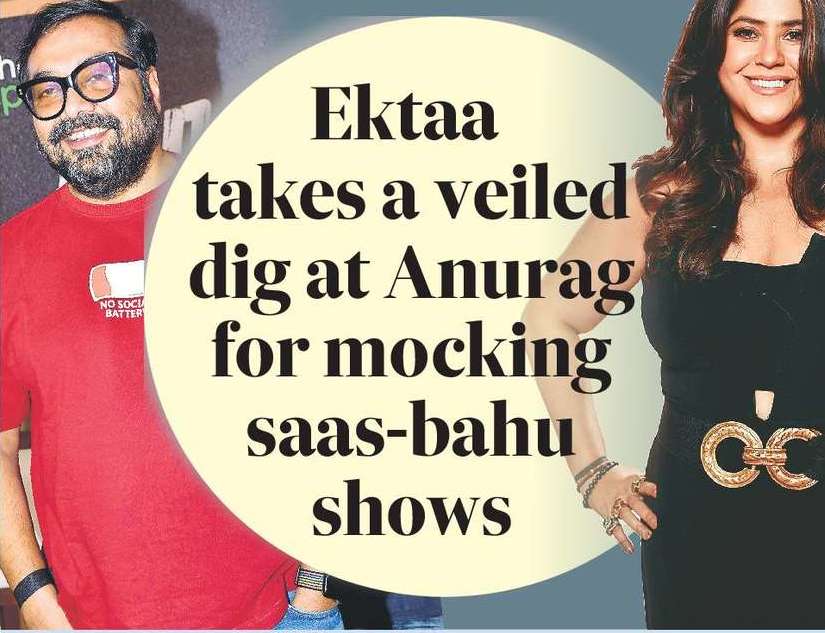
HINDUSTAN TIMES (June 10, 2025)
Producer Ekta Kapoor has taken offence to Anurag Kashyap’s derisive comment on saas-bahu shows. The filmmaker shared his reaction to Netflix CEO Ted Sarandos saying whether launching Netflix India’s original programming with Sacred Games was the right call.
An enraged Anurag wrote on Threads, “He should have started with Saas Bahu .. he would have done well. Which he is doing now Z I always knew the tech guys are dumb when it comes to story telling but tedsarandos is the definition of dumb is what I didn’t know. Good to discover that. This explains everything now (sic).”
Anurag’s remark also came in light of the streamer’s new long-term creative partnership with Ektaa Kapoor’s Balaji Telefilms. In response, Ektaa — whose saas-bahu soaps once revolutionised Indian television — hit back, calling his remark “classist”.
Ektaa, without directly naming Anurag, posted on Insta, saying, “Ur so dumb… saying this put u on an advantage “I’m smarter cooler” but naaaa! Darling how about gracious!!! N self aware??? an art a lot of artists don’t have,” adding, “But artists who talk of an inclusive world are actually the most classist! We must do away with this ‘u can’t sit with us we r better’ attitude for democracy n fair play (sic).”
We’re still not writing parts like they do for someone like Meryl Streep-Surveen Chawla
9:46 AM

Set to feature in Criminal Justice 4, Surveen Chawla says Indian storytelling for women still lacks the depth seen in global cinema
Mohar Basu (MID-DAY; May 27, 2025)
Surveen Chawla has been in showbiz since 2005, long before streaming changed the game and strong female parts became the boardroom buzzword. Today, she brings fearlessness to every project, whether it’s the layered emotional terrain of Criminal Justice season 4, the textured world of Rana Naidu, the unpredictable energy of Mandala Murders, or the horror realm of Andhera. “If I don’t feel butterflies when I read it, I don’t do it,” she tells us as we sit down for a chat.
“When I read a script, it’s not just about the story on paper, it is about the people involved. Filmmaking is like cooking a great dish. You need the right ingredients, temperature, and timing. The same goes for a good project; it’s about all the little pieces coming together. The writing was strong in Criminal Justice. It has romance, depth, and a strong sense of justice,” says the actor, acknowledging that the show has a legacy — “especially given how rare it is for Indian shows to even make it to a season two — let alone season four.”
Working with Pankaj Tripathi was the bonus for Chawla, who has long been a fan of the actor. “Getting to work so closely with him was surreal. Just being validated by someone you admire is a dream come true.”
There are two kinds of actors — those who learn on the job, and those who train at film schools. Chawla has learnt on the job, while someone like Tripathi hails from NSD (National School of Drama).
“Both paths have their strengths. Pankaj ji brings the method and discipline of a film school, a proper process to his craft. Whereas those of us who’ve learned on the job bring rawness and spontaneity to the screen. We constantly pick up things from our seniors and co-actors who are trained. I often question if I’m good enough,” she shares.
Remembering being intimidated by Nawazuddin Siddiqui in Sacred Games, she adds, “[It was] not because I lacked belief in my own craft, but because of his background and training. It overwhelmed me at first. But you learn. You realise it’s really about honesty. Between ‘action’ and ‘cut’, it’s how present and truthful you are. That doesn’t need a degree.”
This year marks two decades in front of the camera for Chawla. After doing everything from iconic TV shows like Kahiin To Hoga (2003), to series like Haq Se (2018), India’s first Netflix original Sacred Games (2018), and more, she has seen a seismic shift in how female characters are written. Is she happy with the progress made?
“They’ve gotten better, but yes, just about better. We are still far from where we need to be. Sometimes, I feel we’re trying to emulate the 1960s version of Hollywood. We’re still not writing parts like they do for someone like Meryl Streep. That said, even globally, patriarchy is deeply ingrained. The struggle isn’t exclusive to our industry. The grass always seems greener on the other side, but I’m sure female actors in Hollywood are talking about their own hurdles too. The first step is to not be in denial about that reality. I’ve been lucky to be working with the most amazing men, who do not have a gender bias towards who is speaking up. I had to break the shackles to be able to speak up. Because we do hear, and it’s very real, when a woman speaks up on set, [it is said that] you’re difficult and opinionated, and that is a problem. I [know] what I bring to the table,” she asserts.
Chawla, who has a packed year, says that the work she is getting now is exciting. “What’s thrilling for me is that every show and character is different from the other. As excited as I am, I’m also incredibly nervous and curious about how these roles will be received. I feel like a kid waiting for exam results!”
Maha Kumbh Mela: Kubbra Sait got entry in Kinnar Akhara as she played Kukku in Sacred Games
8:27 AM

Deep Saxena (HINDUSTAN TIMES; February 6, 2025)
Actor Kubbra Sait recently visited the ongoing Maha Kumbh Mela in Prayagraj and soaked in festive vibes. “Being there and feeling different energies, and being with people from all over the globe, is a feeling beyond description. We get to see one India, one world at a place. Once you take a dip in the Ganga, you are full of gratitude. It has nothing to do with religion or which part of the country you come from. It’s a spiritual fair! Anyone who has a hunger of knowledge, curiosity, and energy must go there,” she tells us.
Explaining what drew her there, Sait adds, “This will happen once in my lifetime, and it’s something that is not divisive, but unifying in nature. We talk so much about unity, and when you get such an opportunity, then you need to embrace it. It is an opportunity where you get to feel from within — not from the mind.”
The actor, who has projects such as The Trial (2023) and Dolly Kitty Aur Woh Chamakte Sitare (2020) to her credit, agrees that there are too many people around and it’s chaotic, but “wahan apko shanti mil jaati hai, which is amazing.”
Meeting with sadhus and nagas was a different experience for her. “It was very new for me. I have only seen them in photos and videos, but here I saw them up close and personally. I had an opportunity to meet them, and the kind of tapasya they have done is incredible. It was a great learning experience.”
Being from the glamour industry came in handy for her. “I found immense love and respect. I went to the Kinnar Akhara (transgender ascetic group), but it was closed, and they were not letting me in. So, a fan came forward and told them I am the one who played Kukku (a transgender character in the OTT series Sacred Games), and I was allowed in. So, I got the entry because of my work. Also, I am so grateful to the policemen, government, and volunteers who are helping people achieve their dream,” Sait ends.
Many people still don’t know that I speak and write Hindi really well-Elnaaz Norouzi
8:39 AM

Masumi Shah (BOMBAY TIMES; June 1, 2024)
Iranian-German actress-model Elnaaz Norouzi, who has done OTT shows like Sacred Games, Made in Heaven, and Ranneeti: Balakot & Beyond, talks about still struggling to get good roles, her desire to explore different genres and more.
‘Many people still don’t know that I speak Hindi really well’
As someone who wasn’t brought up in India, Elnaaz has faced some unique challenges. She shares, “I used to struggle with offers in the beginning. To be able to meet producers and convince them that I’m not just a pretty girl, but someone who can act, was a task. Many people still don’t know that I speak and write Hindi really well. I don’t mind auditioning, but it takes time, and it’s still the same. I’m still struggling.”
She adds, “I started big with Sacred Games, but I don’t expect similar success every time. There is only one Sacred Games. I am okay with projects not working well. Even the biggest stars have flops. As actors, you have to live with that.”
‘I didn’t have anybody to guide me when I came to India’
The actress adds, “When I came to India, I didn’t have anybody to guide me. I said no to a lot of projects before Sacred Games because I believed that something good was going to be offered to me. It was hard because those projects were offering me a lot of money and back then, I had none. I wish I had more guidance. I feel the reason why star kids do so well is because they are trained from childhood. They have seen all of this. I just came into this country where I didn’t know anybody. So, getting myself into the circles of Zoya Akhtar or Anurag Kashyap was tough as an outsider. I believe I have done well, and wouldn’t want to change anything, but I wish I had more ideas about Bollywood before coming here. It’s tough to get into Bollywood’s inner circles.”
‘I want to act and not just be glamorous’
Elnaaz shares, “I recently did action in Ranneeti, but I also want to do more comedy. I would love to play a psychopath, somebody with a disorder, or a mentally challenged character. I’ve always wanted to act and not just look glamorous. But I’ve been managing both well. I’ve played de-glam characters and also done dance numbers. I want to show that I can act and don’t just need to look good. I love to go on sets without any makeup.”
OTT space is like a bazaar now; original OTT audience was very different-Nawazuddin Siddiqui
8:28 AM

Onkar Kulkarni (BOMBAY TIMES; December 17, 2023)
It’s been five years since Nawazuddin Siddiqui made his digital debut with Sacred Games. The OTT space has evolved considerably since. In conversation with us, the actor points out the pros and the cons of this change. He shares, “Things have evolved, yes. Shuruwat jo hai woh bahut honesty ke saath hoti hai, and later it just becomes a commodity… uska ek dhanda ban jata hai. And this happens in every industry, not just showbiz.”
‘When you are starting off there’s a certain honesty’
Talking about how the change in the outlook towards the medium affects the content that’s created for it, he says, “It leads to downgrading of the quality of all the departments because it becomes a race…bas jald se jald banado aur logon ko dikha do. Likewise, when you are starting off there’s an honesty, but later, that fades away too.”
Having said that, he shares that there are a few shows that definitely caught his attention. “I have seen Panchayat and Scam 1992. And I saw it not because of its marketing or PR buzz, but because common people were talking about it and that generated my interest,” he says.
‘Content matters the most on OTT’
Ask the actor if OTT, like Bollywood, has become star-driven too, and he says, “Ab ho gaya hai waise, pehle nahi tha. I feel that doesn’t matter to the OTT audience though; what matters to them is the content. Over a period of time stars ne bhi behti Ganga mein apne haath dhone ki koshish karli. But as far as I know, the original OTT audience was very different.”
‘OTT is TV plus, which means TV se thoda behetar’
Nawaz, who has been a part of OTT films like Serious Men, Haddi and Tiku Weds Sheru, feels that there’s a certain kind of fatigue when it comes to consuming OTT content now. “I do feel the audience is now tired. There are many actors who come and tell me that they have done so and so web show, but I haven’t even heard the names. Due to this abundance, humein pata hi nahi chal raha ki kitne series ban rahe hai aur release ho rahe hai.”
So, is it time makers introspect? “No, no... why should they do that? See, directors and actors are waiting for opportunities. The medium has plenty of work for all. We wait ki koi hamare paas kuch interesting project leke aaye, but there’s this rush ki we need to finish the shoot as fast as we can and drop the show online. I like what my friend actor-writer Hussain Dalal once told me ki OTT is TV plus, which means TV se thoda behetar.”
Doing similar roles isn’t typecasting, doing them in a similar manner is-Nawazuddin Siddiqui
9:25 AM

Niharika Lal (BOMBAY TIMES; November 27, 2023)
In recent years, many books have gained a new audience through on-screen adaptations. Discussions on screen adaptations and how they can breathe a new life into stories have become a major section at film festivals and literature events across the country.
Nawazuddin Siddiqui, who played leading roles in Sacred Games and Serious Men, recently shared his experience of working on book adaptations.
“A film or a web series may start from a particular point in the book or could be a slice from the book, but I still make sure to read the book along with the screenplay because the book provides a solid background.”
He added, “I didn't want to do Sacred Games because I thought I had played a similar character in Gangs Of Wasseypur. However, Anurag Kashyap convinced me that this character will have more layers and will be deeper. While doing this role, I realized the true meaning of versatility. I understood that playing similar roles doesn't mean typecasting, but portraying different rolers in a similar manner is.”
‘THE AUDIENCE DIDN’T JUDGE GAITONDE’
“I was cautious about that; I didn’t want it to be another Faizal Khan (Gangs of Wasseypur) or Raman Raghav (in Raman Raghav 2.0) because they were also gangsters. Gaitonde was a gangster, but he got so much love because the audience never judged him. When I’m playing any character, I ask 10-12 crew members ‘What are you thinking about this character?’ Whatever is the common view among all of them, I keep that in mind while playing the character.”
‘I PLAYED MYSELF IN MANTO’
“For Manto, I thought, why not play myself? Because I also have similar thoughts. I never tried to play Manto in the film. I asked – how would I react to these situations? Hum log keh toh nahi paate apne thoughts, apne characters ke zariye hi keh sakte hain.”
I FOUND A DEEP CONNECTION WITH MY SERIOUS MEN CHARACTER’
“Serious men ke mere character mein ek khalish hai jo shayad mere andar bhi hai. This could be due to my appearance or perhaps because of my background. So, I found a deep connection with the character. There is a scene in Serious Men, where my character talks about his caste and he is comfortable talking about it. I, as Nawaz, I’m also comfortable saying those dialogues because I come from a similar background. However, what my character did with his child is something I could never imagine doing with my own children.”
OTT has given me the opportunity to have a big car and a big house-Amruta Subhash
8:08 AM

Amruta Subhash credits the digital medium for giving her the space to reinvent and experiment like never before
Rishabh Suri (HINDUSTAN TIMES; June 24, 2023)
Amruta Subhash’s career graph shot up after Gully Boy (2018). But, it came with the risk of being typecast as a mother. This is why the actor waited patiently for the right kind of work to come her way — and that paid off. What followed were web shows Sacred Games 2, Bombay Begums, Saas Bahu Achaar Pvt. Ltd., Dhamaka (2022) and now, the upcoming Lust Stories 2, all of which gave her the chance to showcase her range as an artiste, within a span of five years.
“Earlier, I used to say no to roles I wasn’t satisfied with and sit at home, not earning,” Subhash tells us. But now, with the abundance of opportunities that the web offers, things have changed for the 44-year-old, who says, “I don’t know about other actresses, but as far as I am concerned, I am paid very well here. I shifted into my big, wonderful house just two-three months back. OTT has given me the opportunity to have a big car and a big house.”
‘OTT made me the protagonist’
It was only in a web project that Subhash got the chance to lead a show. “The [film] industry tries to put you in slots and I have always tried to break [out of] them. But this thing (perception) was still there, ‘Yeh actor toh sirf supporting cast mein rahegi’,” recalls the National Award winner, adding, “It was in Saas Bahu... that I was presented as a protagonist. [For that,] I am really grateful to the makers.”
‘Films offer less variety’
The content landscape has changed drastically with the advent of OTT, and Subhash can vouch for it with her body of work on the platform: “After Gully Boy, everybody told me not to get slotted as a mother. Then Sacred Games 2 came my way. I am grateful to Anurag Kashyap (filmmaker), who kept visualizing me in different ways, whether it was Choked, Sacred Games or Raman Raghav 2.0... I am glad OTT happened to India. When Bombay Begums came to me, for instance, I could never have imagined I’d get to play a seductress at my age!”
But, Subhash is well aware that things haven’t always been this way. “Some years ago, I was interviewing actor Deepti Naval for her book and she told me that after a certain point of time, she left acting because she didn’t want to get slotted in similar kinds of roles. There was no OTT during her time,” she recalls.
This is precisely why Subhash feels the industry has come a long way: “My favourite line is that earlier, content was king. But now, content is queen too, with women being offered so many amazing characters on OTT.”
So much focus on the glamour, and so much silence around our work-Alokananda Dasgupta
8:17 AM

Jubliee musician Alokananda Dasgupta is ready to indulge in conversation around her work as she says enough interest in the composition of the background score exists among music aficionados
Sonia Lulla (MID-DAY; May 22, 2023)
Alokananda Dasgupta can romance characters in ways that perhaps even those who create them cannot. The daughter of the late Buddhadeb Dasgupta refers to herself as a morbid person, yet, she infuses life into every conversation when discussing her work on score composition. Her latest endeavour brought her back under the familiar wings of Vikramaditya Motewane after the duo’s celebrated association for Sacred Games. In this interview, she discusses what drew her to Jubilee.
Edited excerpts from the conversation.
You’ve probably developed a comfortable equation with Vikramaditya, considering your past projects. Does he discuss the brief with you or does he leave you to it?
For this project, he said that while he was creating a period project, I needn’t worry about that. He wanted that to be reflected via the songs. For the background score, he said that while I should avoid using instruments that didn’t belong to the era, I did not need to think about the period that the series was set in while creating the music design and melody. He wanted me to only focus on the narrative and characters. He knows me well, and knows that vague things work for me. He used words like ambition and pride, and those words helped me build the characters.
What was the initial idea that you had when this was offered to you?
In Sacred Games, there were elements that deal with death and life. I am a morbid person, so, dark things work for me. I didn’t know how I could bring out my darkness in Jubilee until I came across these words. In [music] school, we’d speak about the life of tragic heroes. Think about the characters in this project; such characters have always existed, and are timeless. The [character] has everything he desires; he makes one mistake that’s fuelled by pride, and that leads to his downfall. This is [seen in] Macbeth, it’s [seen in] my friends, and also in characters in my family.
I chased these two words, drew a draft of each character, and thought of how their [trajectories] are different, even though they are both [consumed] by pride and ambition. I realised that this is equally morbid. Morbidity need not only be death. There is a scene when one character leaves his house and everyone stares at him because he is a [star]. I’ve used an element which is like bipolar music. It’s a grand celebration, and an ode to joy. But then, I used certain melodies, and changed keys and motifs to make it darker. That paradox is what I tried to create with instrumentation.
As a composer who studies the characters you are set to work on, how did these characters influence you?
Initially, the team shot a small chunk. I was shown some rushes, and then they went on their major shoot. When I had initially read the script, it was all in theory. I am someone who is inspired by moving images. Reading and discussion don’t provoke within me what visuals can. I knew it was a period drama, and shed light on the politics between characters. But, when I saw the first clipping of Binod [character] in the dressing room where Jamshed was applying make-up before his act, I was moved. This was the first time when Binod [was shown in poor light]. The image of him sitting, the colour palette used, it was all inspiring. Music composition is not all romantic, and not every frame will inspire you. But this one was inspirational. It was ominous, it had elements of [Satyajit] Ray, and was like a horror still without it being a regular horror. That made me understand the multiple layers in this story. I knew I had found something dark to sink my teeth into. I connected it to [Roman] Polanski’s Macbeth, when he sees Banquo’s ghost. When I was composing it, my father was on his death-bed. Everything was so dark. All of these things combined with that one image.
Given how deeply invested you are in your projects, do you believe this job takes a mental toll?
I know I am a film composer, and not an independent one. It drains me, and is exhausting. But, I have understood that I need to [accept my work], because I will never stop being self-critical. I am not trying to wallow in self-pity, but the work I do is not glamorous enough to bring me to the forefront. People still think music means songs alone. My popularity count is marginal. I’m not seeking that, but I’ve made peace with the fact that this will be a solitary process. But, this is how I know to express myself. If you take this away from me, I will have repressed feelings.
Is there anything about your work that you believe needs to come to the forefront?
I have my complaints. I understand that everything in the industry is about survival. But, there are so many people who stay up at night and look up the background score of a Nordic series. I would love to talk about the process for people to know that not all of it is only about the songs. I don’t do 10 shows, or own a studio with 15 programmers, but [there are people who are still interested in my work]. People want to know how a score is composed. There is so much focus on the glamour, and so much silence when it comes to the work of a score composer.

Self-regulation of OTT platforms has been successful, say panellists at FICCI Frames
8:17 AM

Niharika Lal (BOMBAY TIMES; May 9, 2023)
From “overdose of kissing” to “excessive alcohol consumption” to content hurting sentiments, OTT platforms have been subjected to various complaints and FIRs in the past. From Sacred Games, Tandav, Mirzapur to A Suitable Boy, many complaints have been filed against makers of shows. There is a constant controversy vs creative freedom tussle on OTT. During a discussion titled ‘Digital Media: taking stock of self-regulation’ at FICCI Frames 2023 in Mumbai, the panellists – which also included Vikram Sahay, Joint Secretary, I&B – spoke about how self-regulation of content on OTT platforms has changed the scenario for the better.
‘ONLY 13 COMPLAINTS HAVE COME TO THE SECOND TIER IN THE LAST 22 MONTHS’
Producer Madhu Bhojwani, who is a member of grievance redressal board, shared her experience of being on the board for two years and said, “I think in 2021, when this document titled Code of Ethics was circulated, it was read with a lot of trepidation. But I think the community (of creators) has taken it very well. When the IMAI (Internet and Mobile Association of India) approached me to join the Council I was very happy because I had the privilege of learning what are the grievances and complaints that are coming forward.”
Talking about complaints, she said, “It’s been two years since and over these last 22 months, only 13 complaints have come to the second tier. On the advice of the ministry, there have been two reviews that have happened on certain platforms. I think pre-2021, the amount of litigation and discord that was prevalent and willy-nilly cases were being filed and creators were taken to the court. At that time there was a lot of concern among creators, but post 2021, once this regulatory framework has come into place, the first tier has become an interesting filter. This is such a robust framework that complaints are being addressed at the first level. What doesn’t get rectified at the first level as a filter comes to us (second level).”
‘IF CITIZENS HAVE A GRIEVANCE, THEY HAVE A FORUM TO GO TO’
Vikram Sahay, Joint Secretary, I&B said that when the self-regulatory structure started, they were not clear about what to do because the OTT space is different. He added, “We were grappling with ideas from abroad and we had various options. Some people said films coming to OTT should be pre-certified. We also had a Singapore model where they have digital media authority and then we had an e-commission model from Australia. We looked at all those options and we said, ‘No, the government has a lot of trust and faith in the creators of films and web series.’ With that faith we embarked upon the concept of co-regulation with a strong citizen-centric framework of grievance redressal. So that if citizens have a grievance they have a forum to go to. We have been working on a co-regulatory model.”
A THREE-LEVEL GRIEVANCE REDRESSAL SYSTEM
Currently, there’s a three-level grievance redressal mechanism in place for OTT content, where platforms are required to have a Grievance Redressal Officer and self-regulatory bodies, while the I&B ministry has an inter-departmental committee for hearing grievances. Majority of the OTT platforms are either registered with IAMAI-DPCGC (Internet and Mobile Association of India – Digital Publisher Content Grievances Council) or DMCRC (Digital Media Content Regulatory Council).
I’ve never said this publicly, but I think Bhavesh Joshi Superhero should have been a woman-Vikramaditya Motwane
8:17 AM
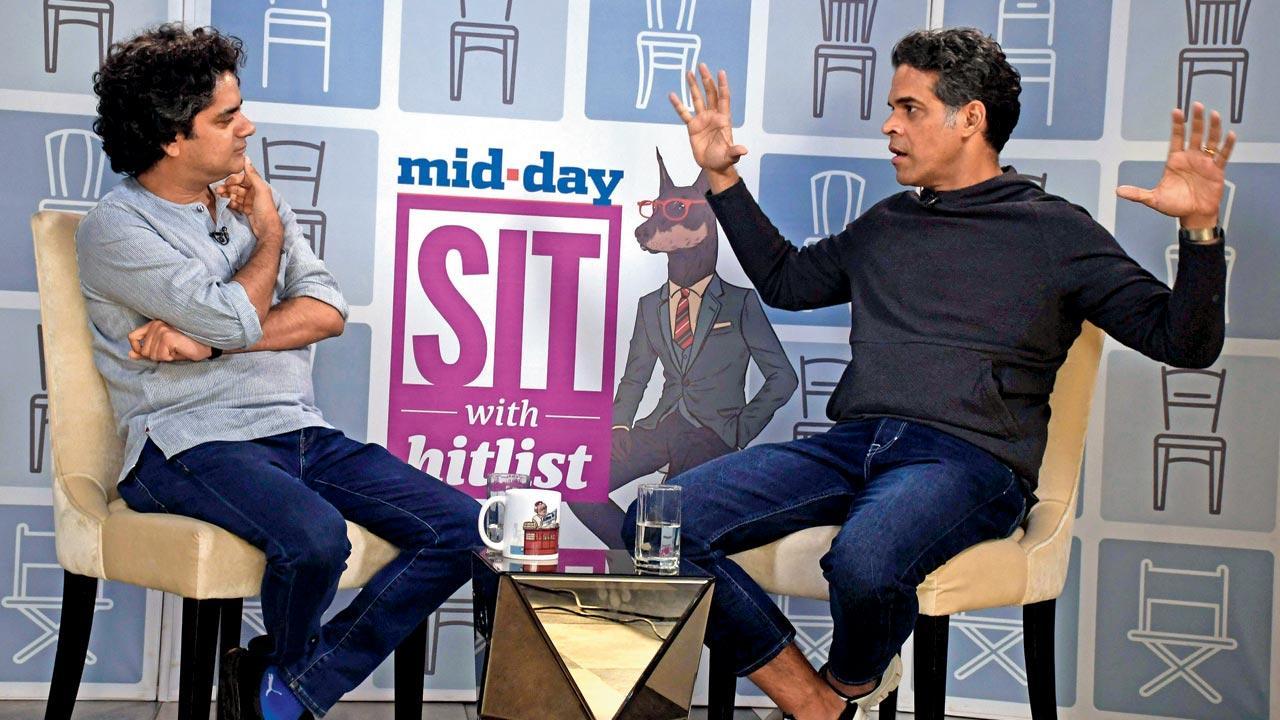
Vikramaditya Motwane joins Hitlist editor Mayank Shekhar for the latest edition of Sit with Hitlist. Pics/Ashish Raje
Motwane, on the movies — from Udaan (2010) to Jubilee (2023), both near-masterpieces!
Mayank Shekhar (MID-DAY; April 27, 2023)
At age 25, Vikramaditya Motwane was set to direct Amitabh Bachchan for his debut film, Bombay Talkies. It’s about a great filmmaker making his return to the sets after years. And what all had changed about Hindi cinema, including stardom, in the interim. Bachchan was going to play this aged director — think of him as Hrishikesh Mukherjee, who was alive then, he says.
The star in the movie, I’m guessing, would have been an arrogant, prick type. Motwane found it impossible to cast a lead actor for this part. Which is why the film never got made. Until then, Motwane had extensively assisted Sanjay Leela Bhansali. Which, firstly, explains the access to Bachchan.
We only wondered about it because of the title, Bombay Talkies. Which is what his latest series, on Amazon Prime Video, Jubilee, is modelled on. Namely, Himanshu Rai’s (Prosenjit Chatterjee) state-of-the-art film studio in the 1940s, along with Devika Rani (Aditi Rao Hydari), down in Malad, in Bombay.
And which once had in its payroll stars like Ashok Kumar (Aparshakti Khurana), Raj Kapoor (Sidhant Gupta), Dilip Kumar, Madhubala… All these characters have been heavily fictionalized, of course. And Jubilee itself has no relation to that Bachchan script.
It’s actually a mammoth exercise in world-building, without the filmmaker getting overawed by it — sticking to drama and storytelling still. While so classical in its production design and shot-taking, it isn’t placed wholly inside a filmy bubble either. So many such films/series consciously tend to be — including the best ones, like The Offer (on the making of The Godfather), or Mank (on Citizen Kane).
It isn’t full of the usual exaggerations that naturally come with surveying showbiz either — take the best film on contemporary Bollywood, Luck By Chance, for instance.
Jubilee captures the real world around it, equally. Whether that be the bloody Partition, or the Cold War. Once you buy into this world — and it takes a while, perhaps fourth episode onwards — we know no other Indian series that progressively gets better with every minute. It may even age better with time!
Also, it’s to do with the dialogue. Compare it to Mira Nair’s A Suitable Boy, from the same time-setting. It sounds so coy, because they’re too obsessed with the period. Motwane says, “We wanted the language to be accessible. The language may not be completely correct to the period. But it’s not incorrect.”
“No one can point out and say, people needn’t speak like that. In fact, somebody’s criticism, which was actually funny was, ‘Gaaliyaan uss waqt kab hoti thi (When did people use expletives so much?)’ Gaaliyaan picture mein nahi hoti thi (Actors didn’t abuse on screen). That doesn’t mean people in real life weren’t abusing. Of course, they were.” For all its grandiose scale and sharp, layered storytelling, you come off Jubilee, exhaling, “Madan Kumar, behn****!” Isn’t it?
Motwane recalls the idea really took off in 2016: “What if we did our own definitive story of the Indian film industry, from the ’40s and ’50s onwards — the behind-the-scenes, the producers, directors, actors, press, all that sort of stuff coming together. This could be a season, or multiple seasons. Atul [Sabharwal] wrote a cracking pilot, Amazon loved it, and suddenly we were off in the races.”
It took seven years to see the light, because Motwane got busy with Sacred Games for Netflix, shortly thereafter.
If Jubilee does go through multiple seasons, leading up to Bombay cinema, late ’90s onwards as well, there will be few filmmakers more qualified to relive the times than Motwane.
On one end is Bhansali, who he was the chief handyman for, on Hum Dil De Chuke Sanam (1999), and Devdas (2002), that he represented at Cannes, along with the director. At the other end is filmmaker Anurag Kashyap, who he’s partnered with since the unreleased Paanch. There aren’t more separate filmy worlds that you could belong to simultaneously in Bombay!
Bhansali and Motwane’s mother once ran an advertising production house together. He first met Kashyap on the sets of Deepa Mehta’s Water, where his job as the “wrangler” was to ensure the procrastinator Kashyap, as all writers are, delivers dialogues on time — not an easy task!
“Anurag’s wife, [editor] Aarti [Bajaj], his ex-wife now, was with me at XIC [Xavier Institute of Communications], when we were doing a film production course in 1994-95. Anurag had done the same course a year before that. He says I met him then. I have no recollection of this.”
Also, few directors own a CV as varied as Motwane’s — so far as filmmaking departments go. What all has he been credited for? Let’s start: Sound design? “Yes, for Devdas, and Paanch.”
Choreography? “Directed songs for Paanch. For Water as well. Well, choreography is a broad term. Because there was no dancing in Water. Deepa wanted me to help her with songs, because she felt I had a better music sense.” Acquired from Bhansali, one’s guessing.
Okay, cinematography? “Short films: Shaanu Taxi, Midnight Lost And Found.” How about acting? “Acting in cameos in certain places, which I am not very proud of.” Like, Kashyap’s No Smoking (2007)? “Yeah, everybody sees me in No Smoking!” What’s left, production design? “No, I don’t like that part.”
Yet, in terms of capturing the fuller gamut of Bollywood, his most uncanny credit might well be as the writer of a film by director Vivek Agnihotri, titled Dhan Dhana Dhan Goal (2007).
No, seriously, how did that happen? “So, UTV was producing this film. Vivek had approached them. He said he had this story idea about football. He wanted a really good writer. They called up Anurag, who said he doesn’t know anything about football. But he knows this guy, who knows everything about football. So, they approached me. I have loved this game since I was eight years old. I said, let me write you an original script instead.” What, they gave him a DVD to rip? “Something like that!” Something like that, as in?
“So, well, I wrote the script. But the film that got made was not exactly the way that Anurag and me, to put it mildly, kind of wanted. I liked the time though. Beggars can’t be choosers. We got paid for the work, and that was more important than anything else. I still believe the original script of mine is one of the best things I have written.”
Motwane’s first script to be made into a film, after Bombay Talkies got aborted, of course, was the near-masterpiece, coming-of-age, Udaan (2010), that went straight to Cannes in the prestigious Un Certain Regard section, where he was competing against, among others, Jean Luc Goddard: “That was really trippy!”
It’s set in Jamshedpur (now in Jharkhand), about a boy who finishes school with ambitions in arts and poetry, but is forced into the mundane, by a disciplinarian father, who brooks no dissent.
It’s almost the opposite of Motwane’s own life, since he was actually driven into the media world, because his mother needed help with a TV show she was producing for teenagers. He was a teenager then, chilling all day in the Mithibai College canteen.
What did he even know of a strict boarding-school or small-town life, let alone the Tata Steel township, Jamshedpur, to get it so right with Udaan, we wonder. Motwane says Udaan was originally set in Nashik, in his head, because that’s a similarly industrial, small-town he knew, since his father owns an audio-equipment factory there.
“They live in nice little bungalows. The town is very organized. So, I wrote it as a generic place, in fact. Because I knew that world. I could not write in Nashik. It’d be too close to home. And I didn’t want it to be that. So, I wrote it like a Ghaziabad or Faridabad kinda set-up — outskirts of Delhi, where the family lives. The boy sneaks out, comes into Delhi-proper, to party and stuff.”
And then he handed the script to director Imtiaz Ali: “Imtiaz read the script and he’s like, ‘You know what, just take a train, go stay with my family in Jamshedpur. Have a look. I am reading this, and I can see those streets.’ I was going to cast Imtiaz’s younger brother, Sajid, in the lead, at that time. This was 2005.”
“Sajid and I hopped on to a train, went to Jamshedpur, spent four to five days with his family, saw the place — this was perfect! I moved the film to Jamshedpur. The film finally got made in 2009, which is also great, because by then, the viewership had changed; audiences had changed. In 2005, multiplexes were still not what they were by 2010, when we did the film with UTV, with a 225-screen release, which is a big deal for a small film.”
Kashyap produced Udaan, post the commercial success of Dev D (2009). This also means the original lead actor, Imtiaz’s brother Sajid, would have passed his teenage by then. Young Rajat Barmecha was brought in for the Holden Caulfied type protagonist. The homework Motwane gave him was “the literature I’d read growing up, movies I’d watched — 400 Blows, Richard Price’s books, and a lot of things that come into Catcher in the Rye…”
The directorial career that Motwane scripted for himself after Udaan is indisputably marked by a range that’s hard to match — going from a period piece (Lootera) to super-hero (Bhavesh Joshi Superhero), a one-man survivor drama, set in a building, suggesting the dystopia of cities (Trapped), to the ultimate Mumbai-mafia sweeping-epic (Sacred Games), that he was the showrunner for — first Indian to hold that title (in case Limca Book of Records is interested in listing!).
The leaps are so wide that it piques your interest to know what inspired each film, since none suggest self-expression alone. Firstly, where the heck did AK vs AK (2020) come from — a meta movie that firstly defies genre, about a director and actor playing themselves. The director turns rogue, kidnaps the actor’s daughter, to film in real-time, what happens next! Wut?
“It’s just such a great one-line idea. Which is what excites you most. As a young filmmaker, you fight the fact that the idea of your film should be encapsulated into one, single line. As you grow older, you realise that one, single line is what drives you forward. Writer Avinash Sampath, who’s now become a good friend of mine, sent the script to us. He’d written it for Aamir [Khan] first. I was sure Aamir is never gonna do it, so let’s not even try!
“There is Akshay Kumar, who we did approach, and it was a very interesting meeting — I mean, he didn’t sort of outrightly say, ‘Get out of my office,’ but it was close enough! For a while, I was making it with Shahid [Kapoor], which kind of happened, and then it didn’t. The [actor] AKs kept changing. The [director] AK, that is Anurag Kashyap, was a constant. He’s a fantastic actor.”
Well, Kashyap says he sucks at acting! “I think he is fab. In fact, everybody on the AK set was talking about Anil Kapoor. I think Anurag, especially in the last scene, is incredible. You actually tear up, when shit happens to him.”
Okay, how about Lootera? It’s practically a Bengali film! “Practically. And that [part is all Satyajit] Ray. I wanted to do a thriller, with a love story in it, as opposed to a tragic love story. Our first trailer got it right. And then there became a problem with the pitching to the audience. People were expecting to watch this epic love story. And they probably went, ‘Hang on a second, this is not that!’”
Maybe because he plays with such diverse subjects —you sense that probably puts Motwane in a more objective position to judge his own work in hindsight — most think of their films as so much like their heart’s outpouring, that it’s hard to discuss it with them, without fawning over with delight. Consider Motwane’s take on Bhavesh Joshi Superhero (2018).
While he loves the film the way it is, immensely, he says, “I’ve never said this publicly, but I think Bhavesh should have been a woman. As in, Siku’s character should have been female. [Firstly] the world thinks there’s a guy, who turns out to be a girl. When she unmasks, you go, ‘What the f***’.
“Also, then the film is not about a friend, saving a friend, in terms of the Ashish Verma character. He is actually deeply in love [with the female superhero], but has never been able to tell [her that]. The conflict is way deeper. The layers get more interesting too.”
As for reasons for smoothly jumping styles and genres, where each Motwane movie is unrecognizable from the other — unlike a subtle or strong voice/style that laces through most auteurs; think Bhansali, Kashyap — the impetus is quite simple.
“It’s the excitement of trying something new. So, Jubilee is exciting, because it is something I have never done before — a classical style of storytelling, 10 playback songs, and all that stuff — the fact of telling a specific story, in the form that is most suited to it. I feel that the film is always the boss. I am not.”
Motwane says his forthcoming film is titled Control. It’s a ‘computer-generated’ movie, flitting between screens, centred on an Instagram influencer: “Again, it is a cyber thriller, it is new. I get excited by it. And you learn. Every film is an audition for the next one, having learnt from the last one!” That said, surely, if one looks deep enough, they’ll be able to spot a personal thread.
Take Jubilee, for that matter. Consider a character called Jotwani, a film businessman, who shows up in it. It’s unclear exactly what he does in the movies. Maybe there is some association with working with sound or audio equipment. That’s precisely what his paternal family dealt with.
If you go through any archival footage of public rallies of politicians from the ’50s, or pre-independence vintage, the most common brand-name you’ll notice is Chicago Radio, that’s attached to the microphone.
That company was started by Motwane’s great grandfather. His grandfather thereafter also once produced a film: “It was called Andolan, in 1949, with young Kishore Kumar in the lead. It was a film about the freedom struggle. It didn’t do well, which is why nobody in the family talks about it. Because I think the family lost a lot of money on it.”
You also see the Sindhi refugee camp in Jubilee. Given his own Sindhi lineage, we wonder if there is a personal history to it as well? “So, my family didn’t have to make their way during Partition. We were already here from the 1930s. The business was already set up. But for a while, my family house in Khar was a refugee camp. I have seen photographs. People were also demarcated into tents in garden-area or permanent structures, depending on the social status of the refugees.”
Motwane says he learnt of his family’s film lineage, only much after he became a filmmaker: “Nobody tells me anything! Now, I’m the family archivist.” He’s named his production company, Andolan, after his grandfather’s maiden and only production.
AK vs AK and Jubilee are Andolan productions. Of course, the more famous production company he’s been associated with is Phantom Films, which shut down, following allegations of negligence, dealing with a sexual harassment case against one of the partners, Vikas Bahl, in 2017. Prior to that, it was a company rolling out quality films after another.
We recall an interview about Phantom, where Motwane compared it to Pixar, in terms of credibility and ambition: “Very ambitious! Peak-Phantom was something else. Eventually, we would have all perhaps gone our own ways, anyway. Maybe running our own companies under the umbrella of Phantom as the larger studio. It was an unfortunate end to what was a good journey.”
“Interestingly enough, I actually met Tanmay Bhat and Rohan [Joshi] and we were talking about how peak-AIB and peak-Phantom happened at the same time. Some great stuff went down.” The comedy collective, All India Bakchod, similar to Phantom, folded up, following a #MeToo storm.
Is there anything that Motwane thinks they could have done differently over the workplace sexual harassment issue? “Externally, we could have [handled it better]. But again, this is in hindsight. If you’re going through something you haven’t before, you may not know how to handle it. From a professional, empathetic and personal point of view — I am saying all three — we could have done better.”
While this is obviously the first time Motwane has been on Sit with Hitlist, our long-form conversational series, it does occur to me that he’s regularly mentioned in chats with other guests. With Kashyap, of course.
The last one was with actor Abhay Deol. As it turns out, Motwane and Deol were buddies in school: “He used to invite us over to his house to watch movies.” Isn’t that a close enough Bollywood connection for someone who claims to have grown up far removed from showbiz in general, with no practical understanding or ambition to enter films as such?
“But it’s a movie star’s house, ya. That way, Abhishek Bachchan used to be in my school [Jamnabai Narsee] for a couple of years. His cousin Namrata is a close friend. I have been to Abhishek’s birthday parties in Madh Island, where [Amitabh] Bachchan made an appearance. This is peak-Bachchan, in 1984. You are seeing the hero of your dreams, standing in front of you! He’d come off the set, wearing boots. We hero-worshipped him, and I’d gone to Dharmendra’s house to watch movies. There used to be a badminton court. Maybe it’s still there. We were like, wow, Dharmendra plays baddy here!”
As for Abhay: “It’s when he returned from LA that we became close. Because when he came back, we shared an interest in the same kind of music and movies. We were hanging together, and writing some stuff together.
“We worked together on [the script of] Dev D, and on a couple of things before that. I was actually in the room, when Imtiaz [Ali] narrated to him Socha Na Tha [his debut film]. So, yeah, that historical moment happened in my presence! We have tried a couple of times [to work together] and then it just has never happened, and then we have sort of given up.”
The other time Motwane figured similarly, in conversation, was with Saif Ali Khan, who was rather salty, we have to say. He wholly trashed the second season of Sacred Games altogether — speaking about how a friend and him had popped a champagne to catch it together at home. A little later, they just shut off the frickin’ TV. Rather harsh!
“But that’s Saif. You can’t hold a grudge against things he says. He speaks his mind. That is exactly the way he is. I totally love him for that. You can say things back to him, and he will take it. He respects that. We respect him.”
That said, Sacred Games season one (S01), that Motwane put together for Netflix, based on Vikram Chandra’s tome of the same name, was incredibly received. While Netflix seldom shares its viewership numbers, they were quick to point out that two out of three viewers of Sacred Games came from outside India — making it truly the first Indian global show.
What one noticed was the sheer audacity of the characters. Again, the world-building. And just the use of uninhibited, uncensored visuals, language, grime, grit, and the madness of Nawazuddin Siddiqui’s Gaitonde, opposite the vulnerability of Saif’s Ali Khan’s Sartaj.
And then, whatever happened to Sacred Games in the second season — the thriller lost its sheen, veering into spaces so separate from the first. For all the criticism its way, it was hardly the ghastly season it was made out to be. Just not close enough to the first.
Motwane admits, “I think what happened with Sacred Games is that on S01, we had the luxury of time. Once Netflix said, okay, fine, we are going to do it — we got about a year to write the stuff, before starting shoot. I just wanted to do it without any assistance. I wanted to create a writers’ room, come together, make it without having to say, ‘Oh let’s get some firangi to come in and guide us on how to do this, because we’ve never done it before!’”
“What happened on S02 was that we had to turn it around in 12 months! So, while I was almost in the middle of shooting [S01], there is already the idea [that you have to start to work] on what to do with S02. While I was on post-production, the writing was actually happening. By the time I’m free to be able to get far deeper into [the writing of] S02, it’s too late for me to make my presence felt.”
“In the way that I wanted to make it felt. Which is not to say [there’s] anything wrong with the writing. It’s just that, okay, it’s not mine. It has gone in a different way from what I would have done.”
Time, Motwane says, is what he had the luxury of, with Jubilee (2023; seven years). As with Udaan, of course (2010; five years).
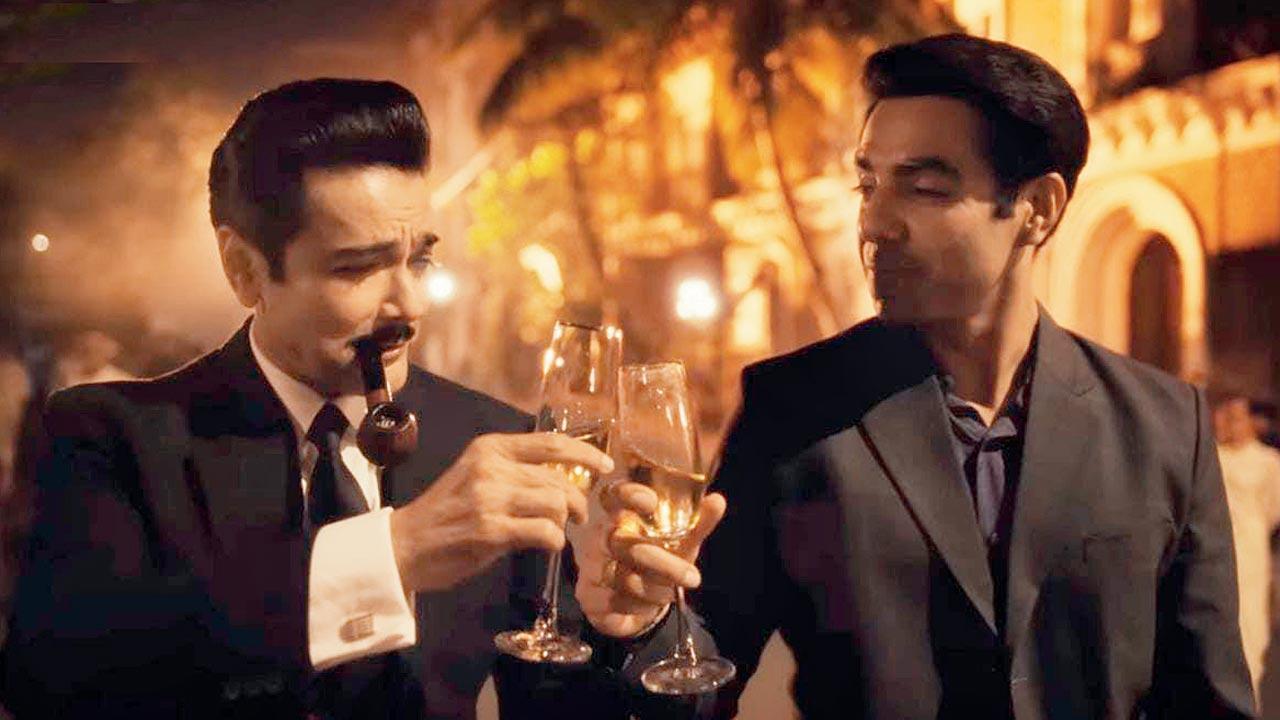
Harman Baweja's Rukmani Krishnamurthy biopic to go on floors in last quarter of 2023
8:15 AM

Rukmani Krishnamurthy breaks the stereotypical image of a crime investigator. The 72-year-old has helped solve some of India’s biggest crimes, including the 1993 Mumbai blasts and 26/11 terror attacks. In a conversation with ET, she reminisces about her 5-decade career
Kiran Somvanshi (THE ECONOMIC TIMES; March 11, 2023)
Mumbai: The thought of a crime investigator is unlikely to bring in mind the image of a soft-spoken, motherly woman dressed in a traditional Indian sari complimented with jewellery and a bindi. But 72-year-old Rukmani Krishnamurthy breaks the stereotypical image, ostensibly as well as figuratively.
Dressed in a blue sari, white hair parted in the middle, adorned with sindoor, a pearl necklace and gold bangles, Krishnamurthy stands tall. She chuckles as she recalls anecdotes from the past and she heaves at the end of a long answer. But behind the calm demeanour and conventional look is the not so conventional job that she does.
Krishnamurthy is one of the biggest names in Indian criminal forensics. She has been among the top notch crime investigators in Maharashtra. She is also the founder of India’s first private forensic lab and is India’s first female forensic scientist. She has helped solve some of the biggest crimes in the country—the1993 Mumbai bomb blasts, Telgi stamps scam, 26/11 terrorist attacks, Nagpur Naxalite murder case, Kingfisher Airline scam, VSNL corporate espionage case besides scores of cases related to underworld gangsters, dowry deaths, rapes and murders.
Starting her career in forensics almost 50 years ago, armed with a post-graduation degree in analytical chemistry an d later a PhD, Krishnamurthy rose through the ranks to become director of the Directorate of Forensic Science Laboratories of Maharashtra government.
“In the 1993 blast investigation, findings of our report matched with those of Interpol,” Krishnamurthy said.
After retiring from the Maharashtra government, Krishnamurthy in 2012 started her own private forensics lab—Helik Advisory—the country’s first such lab. Explaining the rationale of her move, Krishnamurthy said, “the government forensic laboratories take cases only from the police and other investigating agencies and I wanted to ensure that companies and individuals are able to access forensic services without having to approach the police”.
“The lie-detector test is playing havoc among the corporates,” said Krishnamurthy. A large pharma company’ s management suspected the leak of its intellectual property to be an inside job and approached Helik Advisory on the advice of the police. Lie-detector test was administered on 100 employees of the pharma company and six of them were zeroed in. They eventually confessed to having committed the theft.
As crimes are turning online, Helik Advisory has also ramped up its digital forensic services ranging from detection of cybercrimes, bank frauds and economic offences. It is one of the fastest growing branches of forensic investigation in the country today.
As director of the Directorate of Forensic Science Laboratories, she created six world-class forensic labs at Mumbai, Nagpur, Pune, Aurangabad, Nasik and Amravati between 2002 and 2008, and provided new techniques like DNA, cyber forensic, speaker identification, tape authentication, lie detector, narco-analysis and b rain signature profiling to cater to hi-tech crimes.
Krishnamurthy has published 110 research papers, was a member of all central forensic committees, received 12 national and international awards, including best forensic director and lifetime achievement in forensic from the government of India. She has established a corporate forensic training centre in Mumbai in collaboration with National Forensic Science University of the ministry of home affairs to help corporate organizations and SMEs to forensically tackle in-house threats and internal disputes.
Krishnamurthy has advised the makers of TV shows and movies to stop showing depictions of DNA tests and crime investigations that are clearly misleading and far from the truth.
“The situation is changing now as some in the film industry have started approaching us for advice on how to show crime scenes and their investigation,” she said.
OTT show Sacred Games got Krishnamurthy on board as a forensic advisor for all their crime scenes. Actor-producer Harman Baweja’s Baweja Studios has acquired the rights to her life story for making a biopic. “We shall complete the script in another six months and we should be ready to start the shooting by the last quarter of 2023”, Baweja told ET. (ET’s The Morning Brief Podcast team comprising Kiran Kabtta Somvanshi, Anirban Chowdhury and Sumit Pandey met Krishnamurthy at her FBI Chicago-styled office in Mumbai Central.)
I always feel failure is part of the game-Rajshri Deshpande
8:13 AM
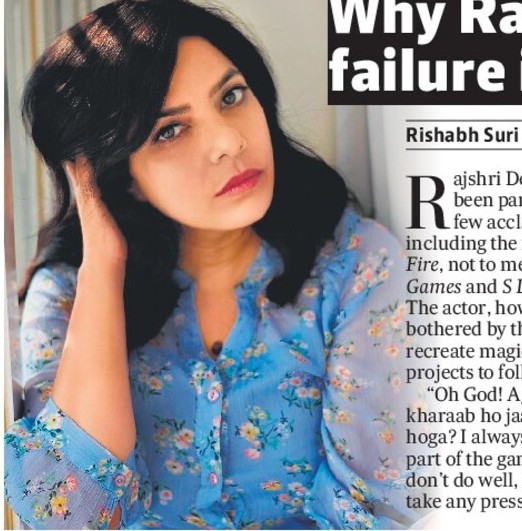
Rishabh Suri (HINDUSTAN TIMES; March 1, 2023)
Rajshri Deshpande has been part of quite a few acclaimed projects, including the recent Trial By Fire, not to mention Sacred Games and S Durga (2017). The actor, however, is not bothered by the pressure to recreate magic again with the projects to follow.
“Oh God! Agar next project kharaab ho jaayega, toh kya hoga? I always feel failure is part of the game. Even if I don’t do well, I don’t want to take any pressure. That show worked because of the cast and crew. Everyone was involved in it. If tomorrow, I do something that is not edited or directed properly, [it’s out of my control]. I don’t understand this pressure [for] my next project,” she says.
The 40-year-old is not a believer in the numbers game either, and doesn’t let fame get to her head. “If the project doesn’t work, will you say Rajshri failed? It’s part of the game. Aaj theek hua hai, kal nahin hoga, parson shayad ho jaayega. I always feel, this is not a race we are running — at least I am not. Number one, box office position — what’s all this?” asks Deshpande, who was also seen in web series The Fame Game.
It’s only the craft and her passion that drives her, and not quantifiable results. “This industry is so volatile... Why I am here, is to do meaningful projects. This is my joy, love, my passion for cinema. I have come from zero in my life, I don’t mind being zero again. I am in a comfortable space,” she signs off.
A lot of companies that try to run India out of California get frustrated early on-Ted Sarandos
8:03 AM

Strong slate of content coming up; India team getting better every day
THE ECONOMIC TIMES (February 18, 2023)
New Delhi: India will get a bigger slice of Netflix’s $17 billion content budget given the growing engagement with its offerings and rising revenue from viewers in the country, co-CEO Ted Sarandos said at the Economic Times Global Business Summit on Friday.
“In India, we’ve had the best year of our existence,” he said. “Our content watching grew by 30% last year in India and our revenue grew by 25%.”
Engagement is the key measure of success, Sarandos said, and growth indicators have to start with this.
“Do people care enough to spend their viewing time with you? Are they spending their screen time with Netflix? That's why that engagement metric is so important,” he said during the session, Cracking The Content Code.
“It wouldn't have happened if it wasn't tied to that engagement lift. Subscriber numbers make nice headlines, but they're not a real business metric. What is behind that subscriber number? Is there engagement? Is there revenue? Is there profit with Netflix? Yes, there is,” Sarandos said.
The company plans to plough more resources into India. “You are basically trying to constantly get just ahead of or just behind the growth in the market and figure out what's working and keep investing,” he said. “So I would say that we are going to be investing more and more in India as we continue to grow engagement and revenue.”
Netflix has a strong slate of content coming up for India, he said. “This idea of really getting into the grid, into the rhythm and the groove of local tastes and local desire…I think we're better at that than we ever were. The reason that we got there is that our team that runs India, runs it from India,” Sarandos said.
The key to success in the country was having teams on the ground with a feel for what people want, he said. “A lot of companies that try to run India out of California get frustrated early on because they just don't learn anything. Here, our team really does understand the local culture and the local storytellers. And they themselves are part of the local audience — that gives us a large advantage. That's why we've invested so heavily on not just production in India, but we have 250 people in an office in Mumbai. We have an office in Delhi. These are people who really care about making great content in India.”
Netflix has produced 100 original projects in India so far with 28 of them last year. Sarandos said the India team is getting better every day. “What I figured out early on when we started launching in various countries is that you didn't learn much in one country that was helpful in the next country,” he said.
“You have to be there, you have to be on the ground, and you have to understand consumer tastes and you have to understand the culture. You have to understand the history of the industry.”
He cited new Netflix release, The Romantics, about the legacy of Yash Chopra, as an example. “You have to understand creators in that country,” he said. “What are the challenges to getting movies made and series made? And in the case of India, I think India has got this beautiful, rich cinema culture and it was not that much around television at that time when we first got here. So, Sacred Games was our kind of early attempt to say, well, what if you took the principles of cinema and infused them into television and the Indian audiences loved that.”
His top priority is reigniting growth at the company, Sarandos said.
If actor’s fee is more than the budget of the show, then something is wrong-Sumeet Vyas
8:32 AM
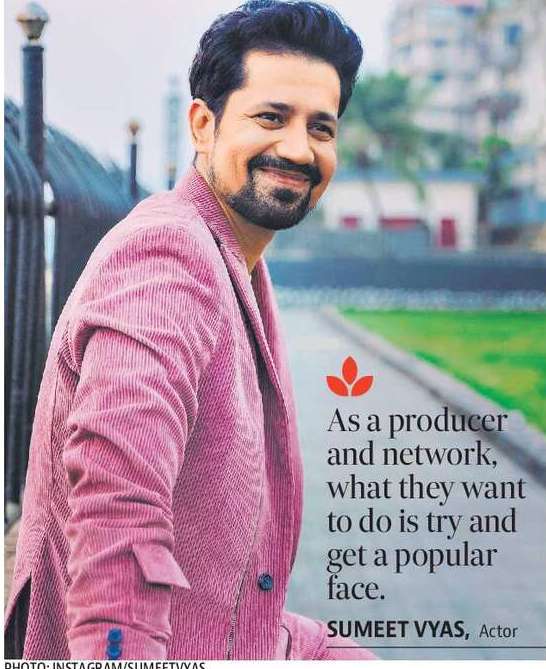
Actor Sumeet Vyas has been part of the Indian web space since the very starting, having seen its growth as well as the changes that have come with the mo
Syeda Eba Fatima (HINDUSTAN TIMES; February 9, 2023)
Actor Sumeet Vyas has been part of the OTT world since its inception and has seen its growth as well as the changes over the years. While the actor agrees that makers at times cast popular faces for the shows for various reasons, he feels that there is nothing wrong in doing so.
He explains, “I do not feel there is anything wrong in casting a film actor, if he is right for the part. But, if his acting fees is more than the entire budget of the show, then there is something wrong. There is a certain budget for the salaries of the entire unit, for the shoot to happen and if twice that number is being paid to one actor, then that’s not right. I do not think any actor brings that much value to any project. It’s the balance that we need to learn.”
Emphasising on his point, Vyas gives example of the shows that have done well in the digital sphere, which do not feature well-established film stars.
“Pataal Lok (2020), Mirzapur (2018), Rocket Boys (2022), Pitchers (2015), Permanent Roommates (2014), Panchayat (2020) and many more. These are all those shows that did not have stars and still they were superhit. In fact, shows which had bigger stars in them and ridiculous money spent did not do well.”
He adds, “Sacred Games (2018) would be exception where they had two stars (Saif Ali Khan and Nawazuddin Siddiqui) and it performed nicely. My point is, nine out of the ten shows that did well, were the ones with actors you did not think were stars. They were just good actors who suited the part.”
Ask if biases are even more apparent when stars are cast for big projects, Vyas agrees but explains that it happens because of the commerce.
“As producers and networks, what they want to do is try and get a popular face so that they are at least covered on those grounds,” he signs off.
We don’t have the concept of silence on our film sets-Nawazuddin Siddiqui
8:36 AM
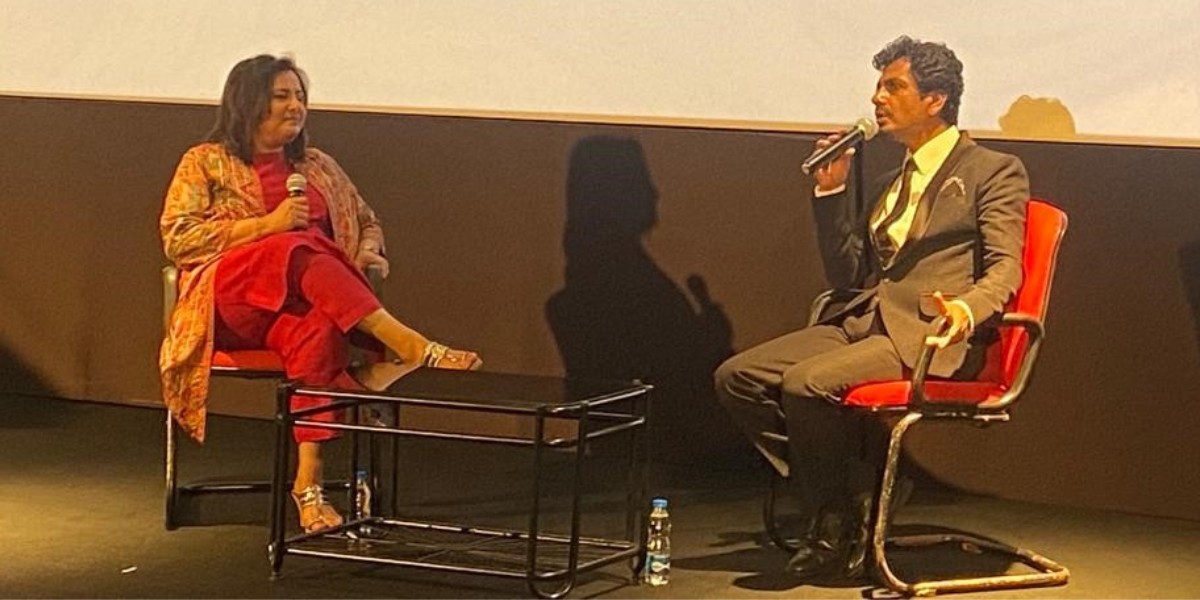
At his IFFI session, the actor spoke about how he starts afresh for every role he does, the lack of character details in movie scripts & what he expects from his directors
Niharika Lal (BOMBAY TIMES; November 25, 2022)
During his masterclass titled Journey as an Actor at the 53rd edition of the International Film Festival of India (IFFI), Nawazuddin Siddiqui shared with the audience what he expects from his directors, how he approaches his characters and why he never gets tired of acting.
‘I HAD TURNED DOWN SACRED GAMES BECAUSE I DIDN’T KNOW WHAT A WEB SERIES WAS’
In conversation with Central Board of Film Certification (CBFC) member and IFFI steering committee member Vani Tripathi Tikoo, Nawazuddin revealed to the audience that he had initially refused to do Sacred Games because he had no idea about what a web series was.
“When Vikramaditya Motwane (director of the series) contacted me to do Sacred Games, I was not really sure. I didn’t know much about the concept of web shows. It was Anurag Kashyap who convinced me to do the series. Anurag showed me a world map and said that the web show would be available in every country that was lit up on the map, and that was when I understood the reach OTT has and agreed to take up the role,” he recounted.
‘HAMARE YAHAN JAB SHOOT HOTA HAI TOH BAHUT SHOR MACHTA HAI’
Tikoo informed the audience that Nawaz has been working in international projects and asked him about the difference he has noticed while working with directors in India and abroad. “Hamare yahan shoot par bahut shor machta hai. Silence ka koi concept nahi hai. Aur director chahta hai ki ismein ye actor apna best kare,” he said.
Nawaz added, “Itni awaazein ho rahi hain aur usmein kehte hain — ‘aaiye, aap ka shot ready hai. Lights, camera, action’. Thoda silence do na yaar usko, toh woh shayad behtar kar sake. Main bolta hoon silence do, lekin hamare yahan nahi ho pata. Hamare yahan silence ka concept nahi hai.”
‘I UNLEARN AND LEARN EVERY TIME I START A PROJECT’
When Vani asked her National School of Drama (NSD) senior about his approach towards acting, Nawazuddin said, “Whenever a senior director used to visit NSD, he used to ask us to unlearn all the techniques and start it all over again, and that felt like a tedious process back then. Later, I realised that whenever you do a new role, you have to start learning all over again. If you think that you know everything, then you will not be able to excel in your craft. You have to start from zero. I unlearn and learn every time I start a project. Pehle se agar mind mein le kar aao ki main toh har baar century marta hoon toh bahut mushkil ho jayega.”
‘ACTING ITNA BADA FIELD HAI KI LAGTA HAI PAANCH ZINDAGI BHI MILEGI TO BHI PURA NAHI KAR PAYENGE’
Talking about an actor’s fatigue while goingthrough the psychological and physical transformation every character might need, Vani asked Nawaz what drives him every day to act all over again. “Kahin na kahin woh aadat bhi ban jati hai jo aap ko junoon de ki har roz subah kaam karne ki. Acting mera shauq hai, main usse kyun thakunga? Mujhe realise hota hai ki acting mein hi toh duniya basti hai meri. Ismein mujhe thakna kyun hai? Kabhi kabhi toh lagta hai ki ek zindagi bhi kam hai. Jab aap deep jate hain acting mein, tab aap ko lagta hai ki abhi to bahut kuch karna hai. Sirf acting itna bada field hai ki lagta hai paanch zindagi bhi milegi toh bhi pura nahi kar payenge hum log,” responded Nawaz.
‘I WANT MY DIRECTORS TO GIVE ME EVERY LITTLE DETAIL ABOUT A CHARACTER’
Responding to a question on what he expects from his directors, Nawaz said, “I need everything from my directors. I want them to tell me every single trait of the character that they are aware of. But unfortunately, very few directors are like that in our country. When you read a script, you’ll find that there are only dialogues and hardly any details about the kind of person a character is — details about his temperament, his physicality. Set par bolte hain aisa character hai, lekin yaar yeh script mein toh likha nahi. Dialoguebazi bahut hai hamare yahan. Do page ka dialogue likhne ki kya zarurat hai jab ek eyeball se express kar sakta hai scene ko? Hum bolte bahut hai.”
He further shared, “Once Irrfan bhai was directing me in a short film and I told the actress, ‘Aa ja meri cycle mein baith ja,’ aur Irrfan bhai ne kaha, ‘Cycle toh dikh rahi hai, toh bol kyun raha hai?’” While talking about dealing with mediocre actors, he said, “Scene do logon ki wajah se banta hai. Agar koi mediocre hai toh scene nahi banega. Lekin hamare yahan chalta hai. Insaan achcha hai toh le lo usko yaar. Arey insaan achcha hai toh ghar pe bula ke dawat do usko, role kyun de rahe ho?”
When someone asked Nawazuddin, what should one do when they are not getting a role even after 10-20 auditions, he said, “Once an actor came to Piyush bhai (Piyush Mishra) and said that he wants to leave acting and Piyush bhai responded, ‘Haan sahi soch raha hai, chala ja.’ That actor was expecting that he would be encouraged and consoled. Kya hai na humein koi sambhalne nahi aayega, humein khud ko hi sambhalna hoga. Humein puri zindagi deni padegi, agar 55 saal mein mil jaye success toh koi buri baat nahin hai.”
Mujhe serials mein bhi lena band kar diya tha-Nawazuddin Siddiqui
2:18 PM
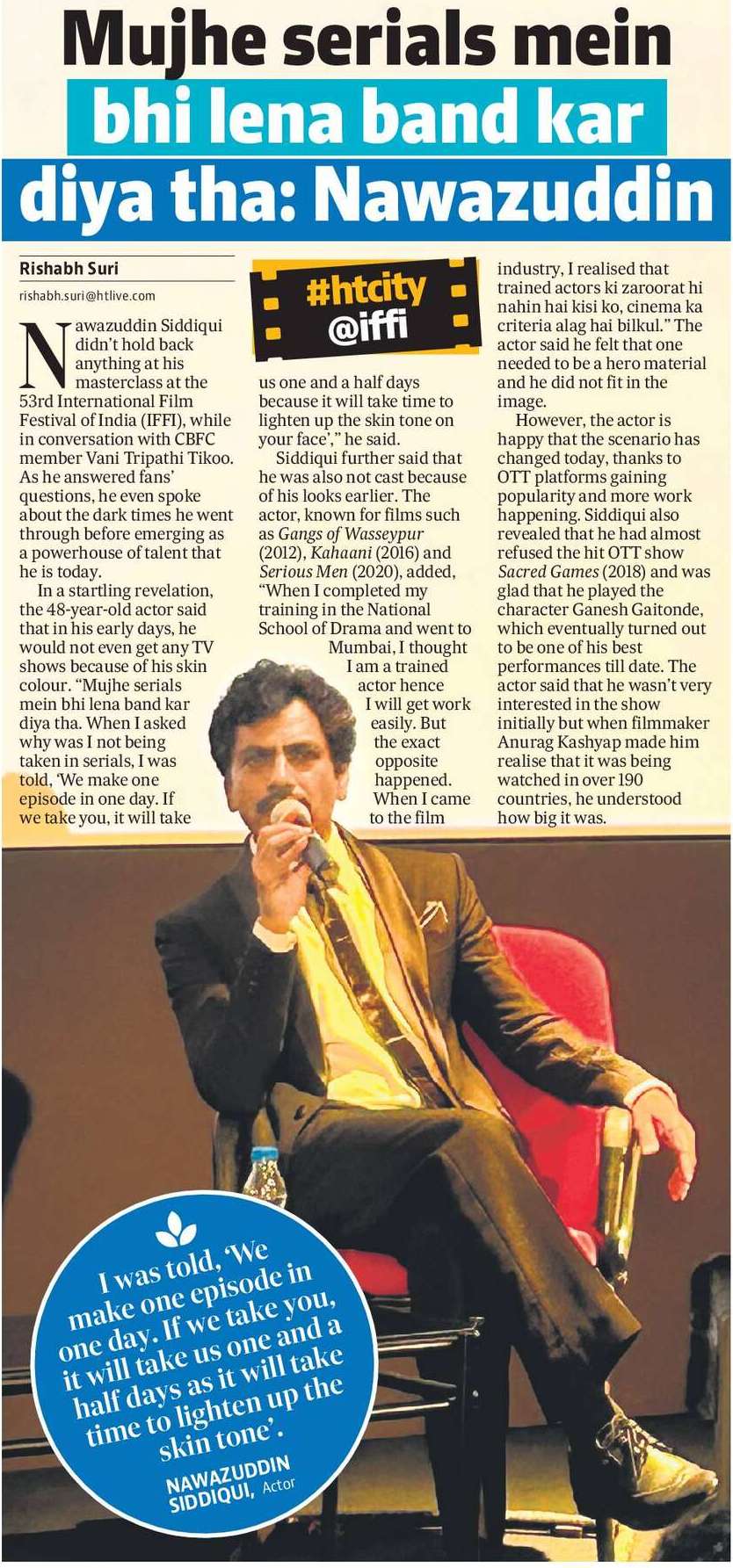
Rishabh Suri (HINDUSTAN TIMES; November 24, 2022)
Nawazuddin Siddiqui didn’t hold back anything at his masterclass at the 53rd International Film Festival of India (IFFI), while in conversation with CBFC member Vani Tripathi Tikoo. As he answered fans’ questions, he even spoke about the dark times he went through before emerging as a powerhouse of talent that he is today.
In a startling revelation, the 48-year-old actor said that in his early days, he would not even get any TV shows because of his skin colour. “Mujhe serials mein bhi lena band kar diya tha. When I asked why was I not being taken in serials, I was told, ‘We make one episode in one day. If we take you, it will take us one and a half days because it will take time to lighten up the skin tone on your face’,” he said.
Siddiqui further said that he was also not cast because of his looks earlier. The actor, known for films such as Gangs Of Wasseypur (2012), Kahaani (2016) and Serious Men (2020), added, “When I completed my training in the National School of Drama and went to Mumbai, I thought I am a trained actor hence I will get work easily. But the exact opposite happened. When I came to the film industry, I realised that trained actors ki zaroorat hi nahin hai kisi ko, cinema ka criteria alag hai bilkul.” The actor said he felt that one needed to be a hero material and he did not fit in the image.
However, the actor is happy that the scenario has changed today, thanks to OTT platforms gaining popularity and more work happening. Siddiqui also revealed that he had almost refused the hit OTT show Sacred Games (2018) and was glad that he played the character Ganesh Gaitonde, which eventually turned out to be one of his best performances till date. The actor said that he wasn’t very interested in the show initially but when filmmaker Anurag Kashyap made him realise that it was being watched in over 190 countries, he understood how big it was.
Saif Ali Khan to juggle mediums; signs next web show
8:12 AM

Rishabh Suri (HINDUSTAN TIMES; July 1, 2022)
Saif Ali Khan was among the earliest film stars to make a successful OTT debut. His series, Sacred Games, ushered in the web revolution in India, and he followed it up by starring in the second season, too. While his last web show, Tandav, was mired in controversies, the actor continues to juggle both film and OTT commitments.
Khan, whose upcoming projects include films Adipurush and Vikram Vedha, confirms to us that he has given his nod to a web show as well. “We are just inking a contract (for the web series), and there will be an announcement in the future,” the 51-year-old shares, adding, “I like dividing my time between film and web shows. I look forward to producing and acting for the digital medium.”
Talking about his upcoming films, he says, “Adipurush is something that people will have high expectations from! Vikram Vedha is a new narrative. There’s something very different about how the story is told.”
Ask him if there’s anything he would want to change about the Hindi film industry today, and he replies, “It’s going really well, I love it. Just try and have a little more silence sometimes. It takes a while to get things quiet because there’s so many of us, and we don’t like being quiet.”
I am excited about my OTT debut and eager to start work on the project-Kareena Kapoor
8:32 AM

In an exclusive chat, Kareena opens up about her acting comeback after second baby
Sugandha Rawal (HINDUSTAN TIMES; March 16, 2022)
For a long time, there’s been buzz around actor Kareena Kapoor Khan’s OTT debut. And, in an exclusive chat with us, she’s confirmed that her first web project will be Netflix’s screen adaptation of Japanese author Keigo Higashino’s acclaimed work, The Devotion Of Suspect X, helmed by director Sujoy Ghosh. This also marks Khan’s return to the acting world after delivering her second baby, Jeh, last year.
“I’m very excited to be a part of this project for several reasons. This film will mark my streaming debut and it’s my return to acting after my second child with a stellar cast and crew,” Khan says, adding that the layered narrative of the murder mystery convinced her to take the plunge.
She explains, “The film is a screen adaptation of a global bestseller. It has so many aspects to it — murder, mystery, thrill and much more, which put in the hands of our inimitable director Ghosh is something I am keen to start work on. I’ve seen his films and I love his work. I love that he has his own method and style and is so sure of what he wants to do. Every actor appreciates a director with a vision.”
The freedom to push boundaries as an artiste is something that got Khan curious about the web. “I am excited about my OTT debut and eager to start work on the project. I’m a huge consumer of content on OTT and I’m blown away by the quality of content available that suits every kind of audience. The web world is not new in our house, especially with Saif (Ali Khan, actor-husband), who starred in one of India’s most well-known shows, Sacred Games,” she says.
Lauding the medium for writing a new script for creative voices, especially women, Khan adds, “The films and series (on OTT) these days are more content driven than they used to be, which offers creators, actors and viewers the freedom to experiment, engage and experience an ocean of new stories. And women are definitely leading the way when it comes to this space. The scripts written for them have no confines and that, to me, is the most exciting part.”
The 41-year-old will feature alongside actors Jaideep Ahlawat and Vijay Varma in the project that is yet to go on floors: “I am looking forward to working with them. Both of them are such fine actors.”
I wasn’t getting the kind of work I wanted; I started feeling low and depressed-Jatin Sarna
8:38 AM

Vinay MR Mishra (HINDUSTAN TIMES; March 13, 2022)
Although Jatin Sarna’s role as Bunty in Sacred Games earned him widespread acclaim, the actor went through a period where he didn’t get the work he wanted. To top it off, the pandemic made it even more difficult for the 37-year-old to find roles that he loved.
“While worrying about tomorrow, I stopped living in the present. And instead of being grateful for what I have, I started looking at what else I could do. And that led me to depression,” Sarna says.
The ’83 actor continues, “I wasn’t getting the kind of work I wanted. And I used to wonder, ‘Why am I not getting work when people know I’m a good actor?’ I felt that nothing was happening around me and started feeling low and depressed. Moreover, I was staying alone. So I was even more unhappy because I love being around people.”
Sarna didn’t take “any clinical help” but “a year of introspection” and “good friends” helped him heal. “I am sorted now. I understood that it’s better to enjoy life. Above all, I had to think about myself that it is my life and I cannot destroy it. I thought of my family as well,” he ends.
Subscribe to:
Posts (Atom)