Showing posts with label Japan. Show all posts
Showing posts with label Japan. Show all posts
Satyajit Ray's filmography is capturing hearts anew in Japan, paving the way for Blu-ray release
11:10 PM

Yuka Okuda, a Rabindrasangeet performer, delivers a talk on Ray’s ‘Charulata’.
Priyanka Dasgupta (THE TIMES OF INDIA; March 6, 2026)
All seats look taken in a mediumsized Tokyo theatre on an Aug evening in the Japanese summer. The audience listens rapt to a woman sitting on stage, framed by the movie screen behind her. Clearly, it’s not just another screening, but then, neither can the topic be called usual for this part of the world. For the woman on stage is discussing Rabindrasangeet, and the context is ‘Charulata’, maestro and auteur Satyajit Ray’s 1964 masterpiece, one of the seven films that were shown last year in Japan as part of a retrospective of his works.
The lineup — featuring ‘Jalsaghar’ (1958), ‘Mahanagar’ (1963), ‘Charulata’ (1964), ‘Kapurush’, ‘Mahapurush’ (both 1965), ‘Nayak’ (1966), and ‘Jai Baba Felunath (1979) — earning their first theatrical release in Japan, spans a two-decade arc of some of Ray’s most memorable films. The films were also made available on VOD and home video with Japanese subtitles. The demand has grown to the point that these films are set for a Blu-ray release in March.
To Sandip Ray, filmmaker and Ray’s son, however, none of this is surprising. After all, it was the Japanese film great Akira Kurosawa who’d said, “Not to have seen the cinema of Satyajit Ray means existing in the world without seeing the sun or the moon.”
Sitting in his Lake Temple Road residence in Kolkata, he recalled the role of a Japanese distributor, Toho-Towa Co. Ltd, founded in 1928 by film pioneer Nagamasa Kawakita, and said Kawakita’s wife, Kashiko Kawakita, was a Ray admirer.
“She was very close to our family and a die-hard Satyajit follower right from the start,” he said. When Ray first visited Japan, it was Kashiko who arranged a meeting between Ray and Kurosawa in 1966. “I think till the 80s, they distributed all of Baba’s films in Japan. The films must have done good business. Otherwise, why would she ask about new films every year?” said Sandip Ray.
The seven restored titles began their theatrical run on July 25 at Le Cinema Bunkamura in Tokyo. The retrospective was to run for three weeks, but a further week was added due to the demand. “The films were not only screened in Tokyo, but in cities like Hiroshima, Osaka, Kyoto, etc, covering 15-20 cinemas nationwide,” said Varsha Bansal, who helmed the restorations of the Ray classics produced by her grandfather, R D Bansal.
The screenings were paired with discussions and talks. If film researcher and producer Eri Morinaga spoke after ‘Mahanagar’, Asian cinema researcher Tamaki Matsuoka delivered a talk following a screening of ‘Jalsaghar’. Yuka Okuda, a Rabindrasangeet performer and Bengali language instructor, led a session after a ‘Charulata’ screening. “I offered some reflections on the impact of the Rabindrasangeet in the film... Some in the audience said they wanted to watch the film again. It made us realize all the more that Ray’s cinema is a deeply layered and magnificent creation,” Okuda told TOI.

A Tokyo theatre that took part in the retrospective
When Sandeep Reddy Vanga narrated Animal to me, I found the character extremely scary-Ranbir Kapoor
10:58 PM

Priyanka Sharma (MID-DAY; February 6, 2026)
Such is the popularity of Animal (2023) among Ranbir Kapoor’s fans that they’ve kept their eyes peeled for Animal Park. As the superstar recently united with director Sandeep Reddy Vanga for a virtual press meet, ahead of the blockbuster’s release in Japan on February 13, the duo talked about the way ahead for the franchise.
Expressing his excitement to play two characters — Rannvijay and his cousin Aziz — in the sequel, Kapoor said, “I can’t wait to get back on set with Sandeep and play these characters. Sandeep and I keep chatting through the week or month and keep discussing different ideas.” Vanga, who is currently helming Spirit, shared that Animal Park will go on floors by mid-2027.
Besides Rockstar (2011) and Barfi (2012), Animal has become a career-defining movie for Kapoor. The actor admitted that Vanga’s faith in him convinced him to say yes to a “scary character”. “Before this, I was always playing the lover boy and coming-of-age characters. When Sandeep narrated Animal to me, I found the character extremely scary to approach for an actor like me. But [thanks to] his confidence, I believed I could do it,” he said.
Ranbir Kapoor said he felt a deep bond with Japan, thanks to his late grandfather Raj Kapoor. “I have such a deep connection with Japan. One of my grandfather’s most popular songs around the world is ‘Mera Joota Hai Japani’,” he reasoned, adding that he now wants to take his daughter Raha to the country. “I cannot wait to show Japan to her.”
Donald Trump's 100 per cent tariff on foreign films could hurt Indian cinema, experts warn
8:52 AM

After US President Trump announces 100 per cent tariff on movies made outside the country, trade says move detrimental for Indian films as America is a key market
Mohar Basu, Komal RJ Panchal (MID-DAY; May 7, 2025)
On May 4, US President Donald Trump announced a 100 per cent tariff on movies produced outside the country, believing that the move would boost the number of films made in America. The result was chaos and confusion within Hollywood as well as film industries around the world, as Trump did not provide details on how the tariffs would be implemented. Even as the President softened his stance on May 5 and stated that a decision would be made only after he met with members of Hollywood, the news has sparked concern in the Indian film industry. After all, the US is a key overseas market that contributes significantly to the box-office revenue of major Hindi, Telugu, and Tamil films.
As mid-day reached out to producers and trade experts, they unanimously noted the ambiguity of the current situation as it is unclear whether the tariff would apply to payments made to acquire distribution rights of foreign films for their US release. There is also a lack of clarity whether tariffs would apply to movies on streamers as well.
Trade expert Ramesh Bala pointed out, “Many American films are shot in Canada, Europe, and elsewhere to lower production costs. If the tariff applies to any part of the film made outside US borders, then many Hollywood films would technically qualify as foreign.”
America, a crucial market
Bala agreed that the move, if implemented, would be detrimental for Indian films. “The US market is crucial for Indian theatrical releases, especially because of the sizeable South Asian diaspora,” he stated, pointing to blockbusters like RRR (2022) and Jawan (2023) that earned significantly from their US market.
“High price points due to tariffs will dissuade distributors, reduce the number of films reaching theatres, and ultimately limit consumer choice. Small or medium-budget movies will likely skip theatrical release in the US entirely, missing out on a potentially lucrative market. The governments of affected countries, including India, will need to step in and engage in dialogue with the US administration to either seek exemptions or negotiate a more balanced trade approach,” he stated.
Trade analyst Akshaye Rathi said it was too early to respond to Trump’s announcement “with assumptions”. He, however, said that this could serve as a trigger to fortify our own ecosystem. Citing the example of Russia, he said, “After the Ukraine conflict, Hollywood studios stopped releasing films in Russia, cutting off nearly 95 per cent of their box-office content overnight. The Russian government actively invested in its local film industry boosting both volume and quality. Within two-three years, they’ve managed to nearly return to pre-war box office numbers. The Indian film industry is still operating at a fraction of its potential.”
Don’t panic before the policy rollout
Housefull 5 will be one of the first big Bollywood releases in the wake of the announcement. With Akshay Kumar, Abhishek Bachchan and Riteish Deshmukh leading it, the laugh riot is targeted as much at the Indian audience as at the diaspora. Diljit Dosanjh’s Sardaar Ji 3, slated for June 27 release, too is aimed at the diaspora.
Bala assumed the films would go unscathed, reasoning, “The proposal is under consideration and is part of a broader USTR [United States Trade Representative] investigation. There is no final rollout date. This gives a buffer, but later films will have to review [their distribution plans].”
An executive from Jio Studios, who did not wish to be named, dialled down the fear with facts. “The US market contributes only around four per cent to the total box-office earnings of an average Indian film. So, the overall damage is limited. If the tariff doesn’t apply to OTT platforms, it might even benefit producers, as they can sell their films directly to streaming services.”
Supriya Yarlagadda, executive director, Annapurna Studios, which backed the Telugu film franchise, Goodachari, admitted that the policy will hurt not only Hindi films, but also their South counterpart. “US is a large distribution territory for various Indian language films. While the latest news is of concern, we will have to wait for the policy details to emerge before panicking,” she said.
A new territory to capture
A question on the mind of many is: Can China or Japan replace the US? Bala said a hard no. “China’s annual foreign film quota [around 10 titles under revenue-sharing rules] makes it an unreliable replacement for the US. Other regions like Australia and Southeast Asia are much smaller. The US remains the only overseas market with scale, infrastructure, and a sizeable diaspora audience.”
Bollywood needs government support to nurture bold storytellers-Vivek Agnihotri
8:46 AM

Vivek Ranjan Agnihotri pens an open letter to Union Commerce and Industry Minister Piyush Goyal
HINDUSTAN TIMES (April 7, 2025)
Dear Piyush Goyal ji,
Your recent remarks at the Startup Mahakumbh about Indian startups needing introspection and real value-addition in the face of global competition — especially against China’s strides in EVs, semiconductors, and robotics — were deeply resonant. Your push to move beyond superficial ventures like “fancy ice cream and cookies” and focus on meaningful innovation is timely. In this vein, I wish to highlight a sector with immense cultural and economic potential — Indian cinema — which, despite its legacy, is failing to innovate, compete globally, or harness its soft power potential like South Korea or Japan.
Globally, cinema and OTT thrive on bold storytelling and technological disruption. Films like Boyhood (shot over 12 years and released in 2014), the single-take illusion of 1917 or the social commentary of Parasite (both 2019) and even a raw, real-time dive into teenage chaos shot in one take such as that in Adolescence, showcase how innovation drives cultural influence.
Today, K-entertainment contributes over $12 billion (approximately Rs. 1,200 crore) to Korea’s economy, while Japan’s anime industry exceeds $20 billion (about Rs. 2,000 crore) in revenue. Hollywood dominates through streaming platform Netflix’s $31 billion (Rs. 3,100 crore) content budget, making it a global content empire.
Meanwhile, Indian cinema remains stagnant — copying formats without mastering their essence. We are the world’s second-largest film producer, yet ironically, most of our content ends up being sold to American platforms. It’s the East India Company syndrome all over again — we create the raw material, but others own and profit from our stories.
The decay is evident. Studios are shutting down; producers flee to real estate. Visionary filmmakers struggle to survive, while the system promotes non-actors better suited to making Instagram reels or dancing in weddings than meaningful cinema. Rooted, Indic stories are missing. Bollywood, once a soft power beacon, is now “flower power” — style without substance.
The viewer experience is equally dismal with outdated multiplex screens, exorbitant ticket and food prices, and theatres that now resemble food courts. Cinema, once a middle-class joy, is now an unaffordable luxury with diminishing returns. I speak from experience. The Kashmir Files (2022) — a non-starrer, risky narrative — broke Bollywood’s formulaic mould; but this came at a personal cost: fatwas, security threats, relentless backlash and character assassination. If truth invites such hostility, how can we expect innovation?
The industry needs government support — funding, incentives, and platforms — to nurture bold storytellers, not just star-driven fluff. Indic cinema can be the biggest startup of India, with potential to generate jobs, export cultural capital, and build global influence just as South Korea’s entertainment industry has done. Just as startups must prioritize real value, Bollywood must shift from elite appeasement to global relevance. Cinema can be an economic and cultural powerhouse, India’s leading soft power but only with introspection and disruptive innovation.
I urge your intervention to empower filmmakers who dare to dream—help Indian cinema reclaim its place as a global leader, not a copycat.
Sincerely,
Vivek Ranjan Agnihotri
Indic Filmmaker
Disclaimer: The views shared in the above article belong solely to the author
Sameer Uddin was there when I needed him the most-Neha Bhasin
11:16 PM

Almost a decade after getting married to music composer Sameer Uddin, singer Neha Bhasin opens up about how she knew he was the one
Samarth Goyal (HINDUSTAN TIMES; February 13, 2025)
For singer Neha Bhasin and music composer Sameer Uddin, it was anything but love at first sight. Neha says she wasn’t even impressed with Sam — as she calls him lovingly — when they met for the first time.
The couple’s paths first crossed in the early 2000s when she was looking for someone to produce her music. And she was introduced to Sam by a mutual friend. “He (Sam) charged me Rs. 5,000 for that! I still get angry when I think about it,” she laughs.
After their first meet, they went their own separate ways. And it wasn’t until years later that they reconnected. “We met again through the same mutual friend. This time, we discussed music and my dream of becoming a pop star,” she recalls, adding, “Everyone then was switching to film music, but I wanted to carry on in the non-film and independent space. And he was the only one who supported me. I guess that is why I fell in love with him.”
As time passed and the two got to know each other better, Neha soon realized that Sameer was the one. “Though I’ve had boyfriends who wanted to marry me, I never saw myself settling down with them,” the 42-year-old shares, musing, “Sam is the only person I ever felt like being with for the rest of my life.”
Discussing the supportive side of her husband, she explains, “There have been times I went to award shows alone. He might have not been there at award functions with me, but he was there when I needed him the most. And that’s what matters to me.”
Their relationship blossomed over shared dreams and melodies, culminating in a memorable proposal. “We were in Japan when he proposed. I was not initially convinced about going to Japan; I wanted him to propose in Paris or somewhere. But the way he proposed was just magical, and I wouldn’t want to change any of it,” Neha reflects.
In 2016, Neha and Sameer tied the knot in an intimate ceremony in Tuscany, Italy.
Reflecting on their wedding, which was a private affair, Neha says, “Everybody talks about what looks good, how dreamy it was, but ours was very simple. In my mind, it was perfect. We were surrounded only by the people who really knew us and our families. It didn’t have to be a big affair,” she signs off.
Mohammed Rafi at 100: From a barber shop to India’s heart
8:08 AM

From Chaudvin Ka Chand Ho to Chahe Koi Mujhe Junglee Kahe…Yahoo to Sar Jo Tera Chakraye, Hindi films wouldn’t have been the same without the magically versatile voice of Mohd Rafi, whose 100th birth anniversary falls today
Avijit Ghosh (THE TIMES OF INDIA; December 24, 2024)
On returning from a trip abroad sometime in the 1960s, Shammi Kapoor gave a listen to a song recorded for him by Mohd Rafi and was astounded by how the singer had captured his verve and andaaz to the last detail. “I asked him how he did it. Rafi saab smilingly said, ‘I imagined this is how Shammi would jump or roll or lift his hand or shake his leg or head, and sang accordingly,” the filmstar told TOI in 2010, a few months before he passed away.
It was this ability to infuse an extra dimension to any song – courting duets, farewell ballads, boisterous qawwalis, immersive devotionals, up-tempo folk, soft ghazals, complex classicals, naughty nightclub numbers – that made Rafi the most popular and versatile male playback singer of the 1950s and ’60s. He could even yodel; just listen to Unse rippi tippi ho gayee (film: 'Agra Road', 1957). Shringar, karuna, hasya, roudra, veera – his voice could effortlessly express each rasa (emotion).
On his 100th birth anniversary, it’s evident that Rafi’s popularity is undiminished. On every digital music platform and online video portal, Rafi playlists abound. There are adoring fans in the unlikeliest of places and a Rafi clone in every small-town orchestra.
But talking to those who shared both the recording booth and stage with him, one realises that their indelible memories are as much tied to Rafi, the singer, as Rafi, the man. And they run out of adjectives in describing his humility, nobility and gentleness. As singer Sudha Malhotra says, “He was perfect in everything.”
Singer Usha Timothy remembers how he made her relax during the recording of her first duet, Tu raat khadi thhi chhat pe (film: 'Himalay Ki God Mein', 1965). “Kalyanji [Anandji’s composer half] told me, ‘Jamm ke gaana, aapke saamne sher hai. [Sing with gusto, you are facing a tiger].’ I was a teenager, got nervous and fumbled during the recording. But when ‘saab’ (as she refers to Rafi) came to know why, he immediately put me at ease with his gentle talk.”
Other singers, too, acknowledge his human touch. Malhotra talks of Naa To Karvaan Ki Talash Hai and Yeh Ishq Ishq Hai, two iconic qawwalis from the film, ‘Barsaat Ki Raat’ (1960). “He was very encouraging and made me feel like I know everything and am singing very well,” says Malhotra. The qawwalis had multiple singers with Manna Dey, Asha Bhosle and S D Batish also joining in.
Rafi didn’t have any pretensions. Preeti Sagar remembers recording for comedian Mohan Choti’s film, ‘Dhoti, Lota aur Chaupati’ (1975), when a musician said something in English that Rafi couldn’t comprehend. “When the guy went away, he just asked me, ‘What's he saying?’. He didn't feel embarrassed asking me. He didn’t pretend to understand. Everyone knows he was an extraordinary singer. But he was also an honest soul. He never behaved big or flaunted his seniority. He was very affectionate, just wonderful.”
Another incident showcases his professional and benevolent side. In 2010, music director Khayyam told TOI that during the recording of the poignant Jaane kya dhoondti hain (film: 'Shola Aur Shabnam', 1961), Rafi had a 102-degree fever. “But he was worried about the producer’s losses and we went ahead with the recording. Despite the fever, nobody could have sung it better.”
Loved In Tokyo
Rafi captivated listeners home and abroad. Timothy, who toured worldwide with Rafi as part of a musical troupe, recalls a show in Tokyo for a mostly Japanese audience that didn’t know Hindi or Urdu. “We wondered how they would react. But when he started singing, Madhuban mein Radhika naache (film: 'Kohinoor', 1960), there was all-round applause. The announcer later told him, ‘We just love listening to your voice, even though we don’t understand the words. His voice had that kind of taseer [effect],” she says.
Born in Kotla Sultan Singh village, about 20km from Amritsar, Rafi left for Lahore when he was 12 to assist his elder brother, who ran a barber shop. But as Sujata Dev writes in the neatly-detailed biography, ‘Mohammed Rafi: Golden Voice of The Silver Screen’, he was obsessed with music. In a radio interview, Rafi named the peerless K L Saigal, Vidya Nath Seth and Pankaj Mullick as singers who had influenced him.
The biography also recounts how Rafi, still a teenager, was “giving a shave to a customer” and singing when he was heard by chance by Jiwan Lal Mattoo, All India Radio’s Lahore programme executive. Impressed, Mattoo offered him an audition in 1943, which he passed easily.
A year later, he left for Bombay with mentor Hameed, a friend of his brother Deen, to try his luck in films. “The ’40s tested Rafi’s tenacity and desire to become a successful singer,” writes Dev.
Shining Bright Among Stars
Male playback was a crowded place those days with Mukesh, Manna Dey, Kishore Kumar, Talat Mehmmod, Hemant Kumar – all masters in the making – jostling for space on the podium. Rafi rose to the top in the 1950s and stayed there for most of the 1960s, as Binaca Geetmala records show, when the Kishore Kumar reign began.
Rafi’s success spawned a generation of singers influenced by his voice and style to a greater or lesser degree. Anwar, Shabbir Kumar, Mohd Aziz, Jaspal Singh, Sonu Nigam being some of the notable ones. “Whatever I am, my name, my livelihood, it’s because of him. Woh mere rom rom mein baste hain. [He’s in the breath of my being],” says Baroda-born Shabbir.
“His voice made us aware of every twist in life, of every season that comes and goes. Every song he sang was complete from the adayegi to expression. He wasn’t just singing songs; if you listen carefully, he was also acting and choreographing them. Some actors are remembered only for what Rafi saab sang for them,” says Shabbir.
Jaspal says Rafi could sing in any octave and it made no difference to his voice. “His throw of words remained matchless,” says the singer, who still regrets that the only song he recorded with Rafi was for an incomplete film, ‘Sarhad’. Adds Timothy, “For him, singing wasn’t a profession, but a form of prayer.”
Rafi stormed back to prominence with ‘Laila Majnu’ (1976) and kept the momentum up in ‘Hum Kisi Se Kum Nahin’ (1977) and ‘Sargam’ (1979). The untimely end came following a heart attack in 1980. He was 55. Mukesh and Kishore Kumar, too, died in their 50s.
Over the decades, Rafi fans have carried out campaigns and online petitions demanding the Bharat Ratna for him. In his lifetime, he had only received the Padma Shri. But it’s undeniable that across the globe Mohammed Rafi remains Bharat’s Ratna.


Laapataa Ladies is still running in Japan, and I’ve been receiving wonderful DMs-Kiran Rao
8:21 AM

Niharika Lal (BOMBAY TIMES; November 11, 2024)
After Laapataa Ladies was selected as India’s Oscar entry, director Kiran Rao has been busy with the film’s Oscar campaign. In a chat with us, the filmmaker spoke about the film’s Oscar campaign and how it’s heartening to see its global recognition.
‘THE FILM IS SPARKING CONVERSATIONS ON GENDER PARITY’
Ask her how the campaign is going so far, and Kiran shares, “We’re just taking one step at a time, and I am grateful for both the opportunity, as well as the fact that the film is able to spark conversations around womanhood, gender parity and the need for self discovery.”
For Kiran Rao, the Oscar campaign has been a truly exciting journey so far. “We’re trying to share the film with as many people as possible and connect with a diverse audience. There’s a lot of work that goes into it behind the scenes, but it’s been heartening to see the kind of interest and appreciation the film is getting on the global stage,” she says.
‘IT’S BEEN A GREAT LEARNING EXPERIENCE’
More than recognition, the joy of sharing the film with a wider audience matters to Kiran. She says, “At this point, I think the journey is a blend of strategy, belief, hard work, and a whole lot of magic. For me, it’s been a great learning experience. I’ve met so many incredible people and been part of some very insightful conversations. While this is my first, I am grateful to have Aamir (Khan) by my side who has done this multiple times earlier.”
Talking about the reactions to the film, she says, “Laapataa Ladies is still running in Japan, and I’ve been receiving wonderful DMs and emails, with audience reactions. It is overwhelming and very humbling. Audiences are really connecting with the story, which feels so personal, yet universal.”
‘A FILM ON STREAMING PLATFORM BREAKS BARRIERS IN TERMS OF GEOGRAPHY’
For any film selected as an official entry for Oscars having a presence on streaming platforms is an added advantage.
Kiran says, “In a world where content is available on phones and tablets, I think, a film’s presence on streaming platforms is absolutely crucial. These platforms provide wonderful reach and accessibility, allowing people all over the world to watch a film at their own convenience. They break down barriers in terms of geography and allow films to reach audiences that might not have had the chance to see them otherwise. For an Oscar campaign, this is incredibly valuable.”
Prasanth Varma to re-release Hanuman in 3D
4:16 PM
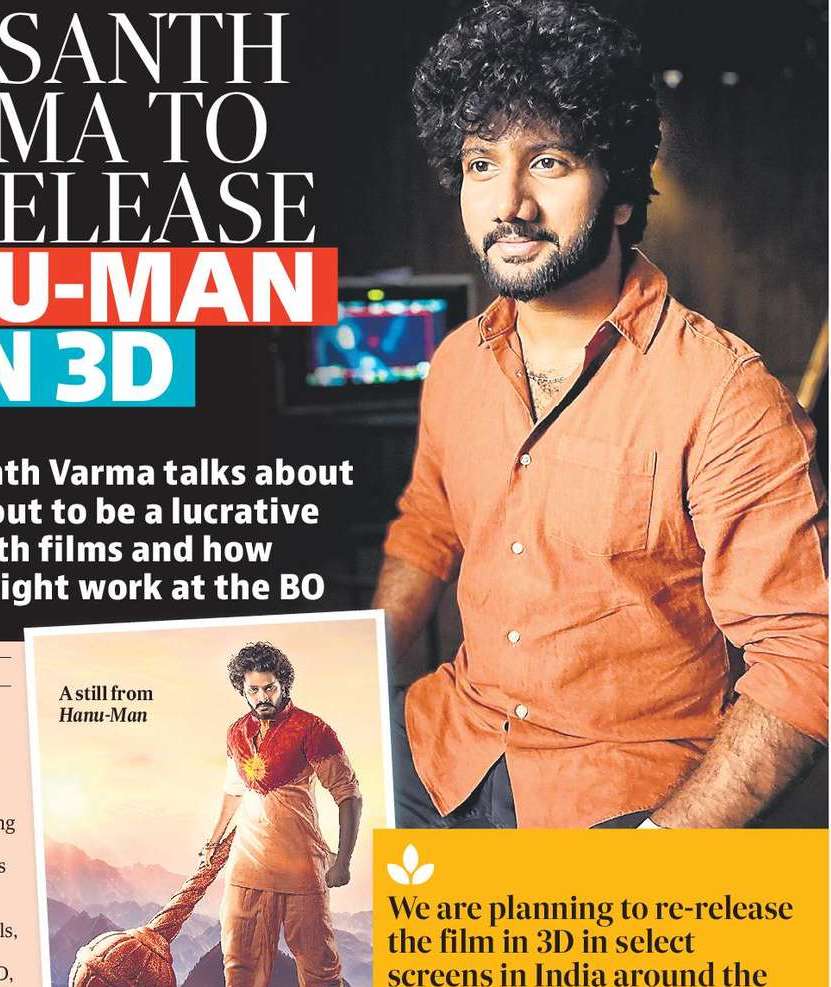
Director Prasanth Varma talks about Japan turning out to be a lucrative market for South films and how “going local” might work at the BO
Akash Bhatnagar (HINDUSTAN TIMES; August 21, 2024)
Prasanth Varma’s Telugu film Hanuman became one of the biggest hits of 2024 and now it is heading for a release in Japan this October. In addition, the makers are planning a re-release of the Teja Sajja-starrer in India too. Talking to us, the director reveals, “The international versions of Hanu-Man will be released in 3D, and we are planning to re-release the film in 3D in select screens in India around the same time as the Japanese release as well.”
Discussing how Japan is turning out to be a lucrative market for South films following the success of RRR (2022) and Kalki 2898AD in Japan, he says, “The South Indian sensibilities are very similar to Japanese and Korean sensibilities, and if your film has potential, the Japanese audience will embrace it.”
Explaining why the Japanese market has more demand for South films compared to Hindi, he opines, “Over time, Hindi films have had a heavy influence of the West, and started imitating it, whereas it’s comparably quite less in the South.”
Varma adds that they aren’t dubbing the film instead will release the original audio with Japanese subtitles. “Apparently these days, people are accustomed to watching films in their original language with subtitles. They don’t want to watch the dubbed versions,” he shares.
Hanu-Man emerged a massive box office success in a year that has been quite challenging for Hindi films. Reflecting on it, Varma says, “People today are going to theatres only if the film is good. Ticket pricing plays a major role now as earlier, going to the cinemas didn’t use to be that expensive. One of the main reasons for Hanu-Man working is because we kept the ticket prices very low. The number of people who saw Hanu-Man is actually higher than many big budgeted films and that’s why we got the collection we did — even at low ticket prices. The audience didn’t feel that they’d have to spend a fortune to see it.”
According to Varma, what might work at the box office is “going local”. He suggests, “Don’t try to make films like Hollywood, try telling your own stories. If you look at films like Kantara (2022), even the global audience is embracing them because that’s a story they don’t know. But if you are making a spy film, Hollywood has already made better ones. I would suggest finding stories that are not there elsewhere. Make films with stories that your grandma told you because that works.”
I can eat as much as 15 to 20 sushis at a time-Vaani Kapoor
2:28 PM

Onkar Kulkarni (BOMBAY TIMES; June 18, 2024)
Ahead of International Sushi Day, Vaani Kapoor took a break from her shoot schedule and spent an afternoon learning how to prepare sushi. From placing the nori (the thin layer of dried seaweed used to make rolls) on the rolling mat and topping it with a layer of rice and vegetables, including her favourite asparagus, Vaani’s dish looked picture-perfect till she rolled it and attempted to slice it into bite-size pieces.“Gosh, it looks like biryani more than sushi now. The Punjabi in me was so alert that you can’t put it to sleep,” the actress laughed, as the ingredients started spilling out. Vaani, who loves vegetarian sushi, added, “I thought I’d get it right in one go, but now I realise that rolling, cutting and plating sushi is an art.”
‘I was 17 when I had my first sushi’
Vaani’s first experience with sushi was when she was interning at a luxury hotel. She said, “I had just completed a tourism course in Delhi and was doing an internship at a five-star hotel. They were teaching us back-end jobs and a part of the program was to spend time with chefs and pick up skills in the kitchen. I was 17 when I had my first sushi back there. The wasabi was too pungent for me, but I developed a taste for sushi and have been a sushi fan ever since.”
‘I enjoy vegetarian sushi’
The Chandigarh Kare Aashiqui actress said that she can easily tuck in over a dozen sushis in one go. “I can eat as much as 15 to 20 sushis at a time. Now I am planning to host a sushi party for my friends at home,” she shared.
Talking about her favourite vegetarian sushis, she said, “Veg sushi is a very healthy option. I love binging on asparagus and tofu sushi. Veg sushis have a delicious mix of vegetables like bell peppers, avocados and asparagus that are healthy and keep you full.”
‘My best friend lived in Japan’
Vaani was introduced to Japanese cuisine in her growing-up days. She said, “When I was a kid, my best friend lived in Japan. She would come to India to see her nani during the summer holidays. We were neighbours and she would get me packets of dried seaweed, which is eaten as a snack. I was just 11 when I was introduced to Japanese food. Now, I enjoy eating nori quite often.”
Anime Kingdom: OTTs step up investments to draw youth
9:20 AM

Javed Farooqui (THE ECONOMIC TIMES; May 15, 2024)
Anime content is taking centre stage on over-the-top (OTT) platforms in India as streamers look to ape the traditional TV model of offering diverse content slate that caters to different age groups and demographics, amid the summer vacation for schools and colleges.
With a fan base of 180 million and growing, India is poised to become one of the most significant markets for anime content in the world after China even as the global popularity of anime, which has its roots in Japan, is on the rise.
Anime market in India is projected to grow at a compounded annual growth rate (CAGR) of 13% from 2024 to 2030, driven by factors such as Japanese pop culture, global media exposure, and demand from millennials and Gen Zs, as per the US-based Grand View Research.
It estimates the global anime market to be $31.2 billion in 2023, with a projected 9.8% CAGR from 2024 to 2030.
Experts said anime offers OTT platforms an opportunity to target teens and youngsters in the 12-24 age groups.
"Anime is a global favourite for early teens. Very little content is made for that age segment," said Uday Sodhi, senior partner at digital strategy consulting firm Kurate Digital Consulting. "OTT platforms need to start seriously looking at anime content."
Sony Group Corporation-owned Crunchyroll, which is dedicated to anime content, set up shop in India last year by incorporating a wholly owned subsidiary and earmarking an initial investment of $10 million.
The platform has over 800 anime titles in India with 8,000 hours of content. Over 70 shows have been dubbed in Hindi, Tamil, and Telugu. Globally, Crunchyroll has 13 million paid subscribers.
Prime Video Channels, the OTT aggregation arm of Prime Video, launched Animax + Gem and Anime Times last year to cater to a growing anime audience base in the country.
Recently, Jio Cinema launched a dedicated Anime Hub as part of its premium offering priced at Rs. 29/month. The platform will provide real-time global releases and a library of hundreds of hours of top anime titles.
"Over the past few years, there has been a significant growth in the popularity of anime in India, with this genre attracting a considerable fandom owing to its captivating storytelling and visually striking animation," a Jio Cinema spokesperson said.
Disney+ Hotstar and Netflix, too, have a good amount of anime content in their libraries.
Other OTT platforms, too, are expected to explore anime content due to its potential.
In an earlier interview with ET, Crunchyroll president Rahul Purini had said India is the second largest anime market in the world after China and is growing very fast. "In the regions where we are present, India would be the largest market in terms of potential audience. We expect 60% of the global anime growth to come from India," he had said.
The Crunchyroll head said 53 million Indians watch anime content from official sources. He also stated that the anime audience is split 60:40 between males and females.
Hrithik Roshan to have an action sequence set in a Japanese monastery in War 2
8:39 AM
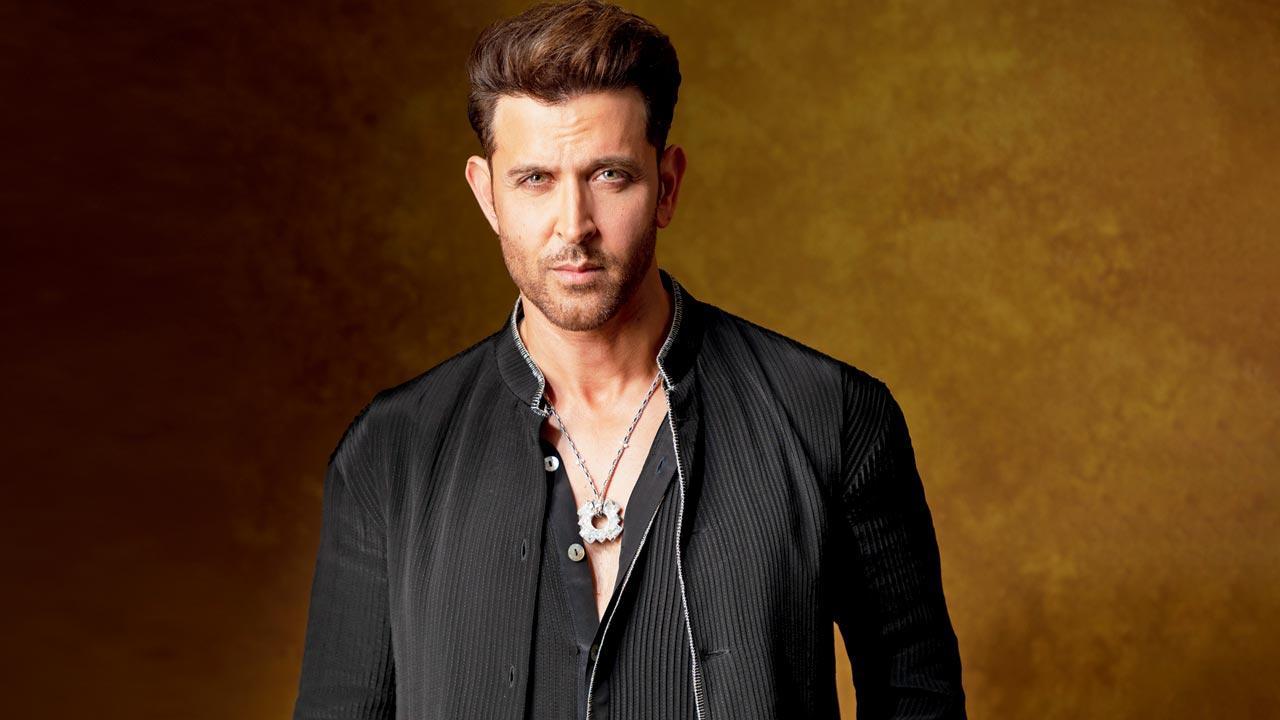
Sources say War 2 makers built set of a Japanese monastery in Andheri studio for ambitious martial arts sequence that sees Hrithik take on warrior monks
Upala KBR (MID-DAY; March 19, 2024)
In War (2019), Hrithik Roshan’s R&AW agent-gone-rogue Kabir Dhaliwal’s covert operations took him from Morocco to Portugal and Italy. So, which countries will the globe-trotting super spy tick off his list in War 2, directed by Ayan Mukerji? For starters, Japan. Only this time, instead of Roshan heading to the country, it has come to him.
Sources say that last week, the actor shot an ambitious set-piece for which an elaborate set of a Japanese monastery was built at the YRF Studios in Andheri. The action sequence was choreographed by Se-yeong Oh, who previously worked with the production house on Pathaan (2023).
With War 2, the latest offering in the YRF spy universe, producer Aditya Chopra wanted to up the ante in action, and hence, roped in 12 action directors. The makers were scrambling for ideas to bring something new to the table when it struck them that they haven’t explored the Orient at all in the franchise. It was then decided that an action sequence would be set in a Japanese monastery.
A source reveals, “A huge set was constructed, along the lines of a 300-year-old heritage monastery on a hilltop, by art designer Rajat Poddarr and his team. In the set-piece, Hrithik’s character takes on warrior monks specialised in martial arts. Before shooting the portion, the actor not only trained in martial arts for weeks, but also learnt to use a katana, a Japanese sword. The scene sees him employ hand-to-hand combat as well as katanas.”
Mukerji kicked off the first schedule of War 2 in Spain last October, while the superstar began work on the spy thriller this month. Jr NTR, who plays the antagonist, and leading lady Kiara Advani have yet to join the shoot. Word is that the two superstars will unite in front of the camera sometime in April.
The source adds, “Ayan will begin Jr NTR’s shoot with a deadly face-off between him and Hrithik. It has been planned as a nine-day schedule in India and international locations. Hrithik has allotted the next three months to the thriller as both Aditya and Ayan want to ready it before the year-end.”
Junaid Khan commences shooting for his untitled love story, co-starring Sai Pallavi
8:33 AM
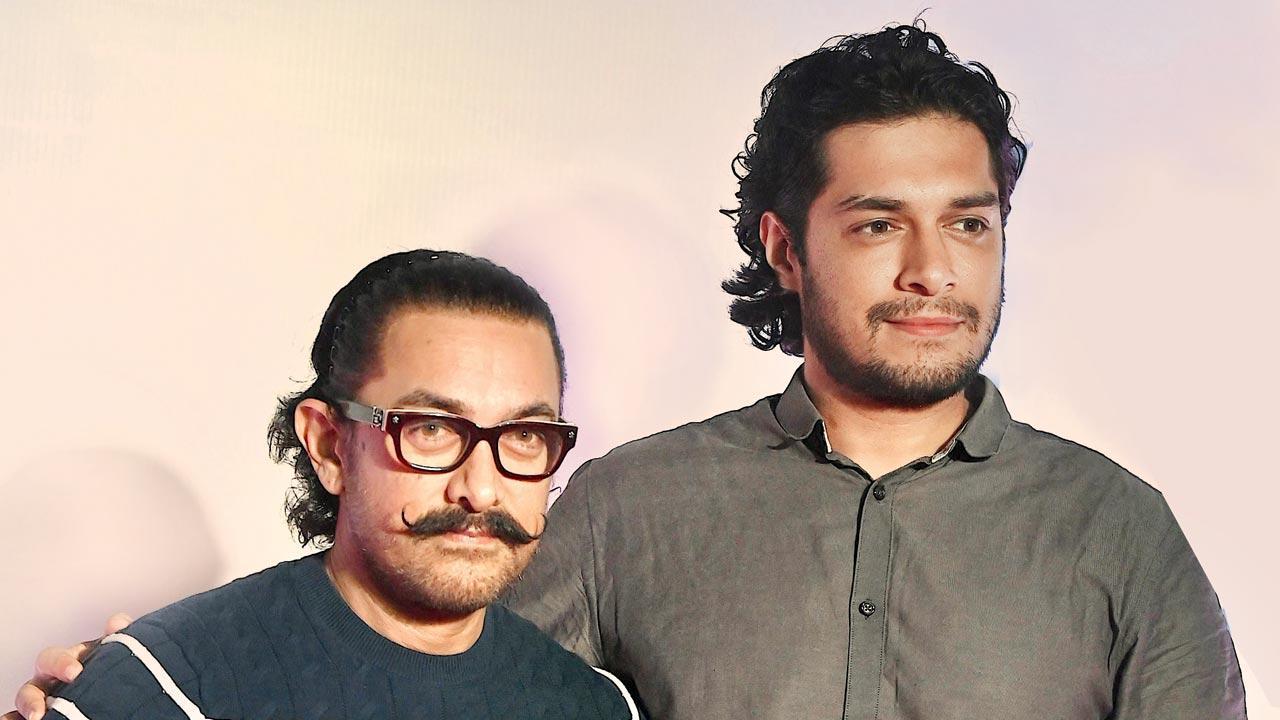
Sources say Junaid’s next, backed by Aamir, rolled in Powai yesterday; film marks star kid’s third offering
Mohar Basu (MID-DAY; December 2, 2023)
In May, mid-day had reported that actor-producer Aamir Khan had greenlit a movie that would be headlined by son Junaid Khan, with a portion of it to be shot in Japan (Land of the rising son, May 4). The yet-untitled love story, which marks the star son’s third outing after Yash Raj Films’ Maharaja and Aamir Khan Productions’ Pritam Pyare, went on floors at a Powai studio yesterday.
A source reveals, “For the first day, director Sunil Pandey had lined up some scenes featuring Junaid and leading lady Sai Pallavi. They made an early start, wrapping up work by evening. A fortnight before the project rolled, the makers did an elaborate photoshoot with Junaid at Mehboob Studios in Bandra.”
The film was originally supposed to roll in Japan. However, the team had to rework the plan. The source adds, “Japan is too cold to shoot right now. So, the first schedule will be canned entirely in Mumbai. Sunil, who has also directed Pritam Pyare, plans to shoot over the next fortnight before calling for a break. The team will then resume work in January.”
Junaid will make his Bollywood debut next year with Maharaja.
Sumo Didi, based on wrestler Hetal Dave, to premiere at the Tokyo International Film Festival
8:03 AM
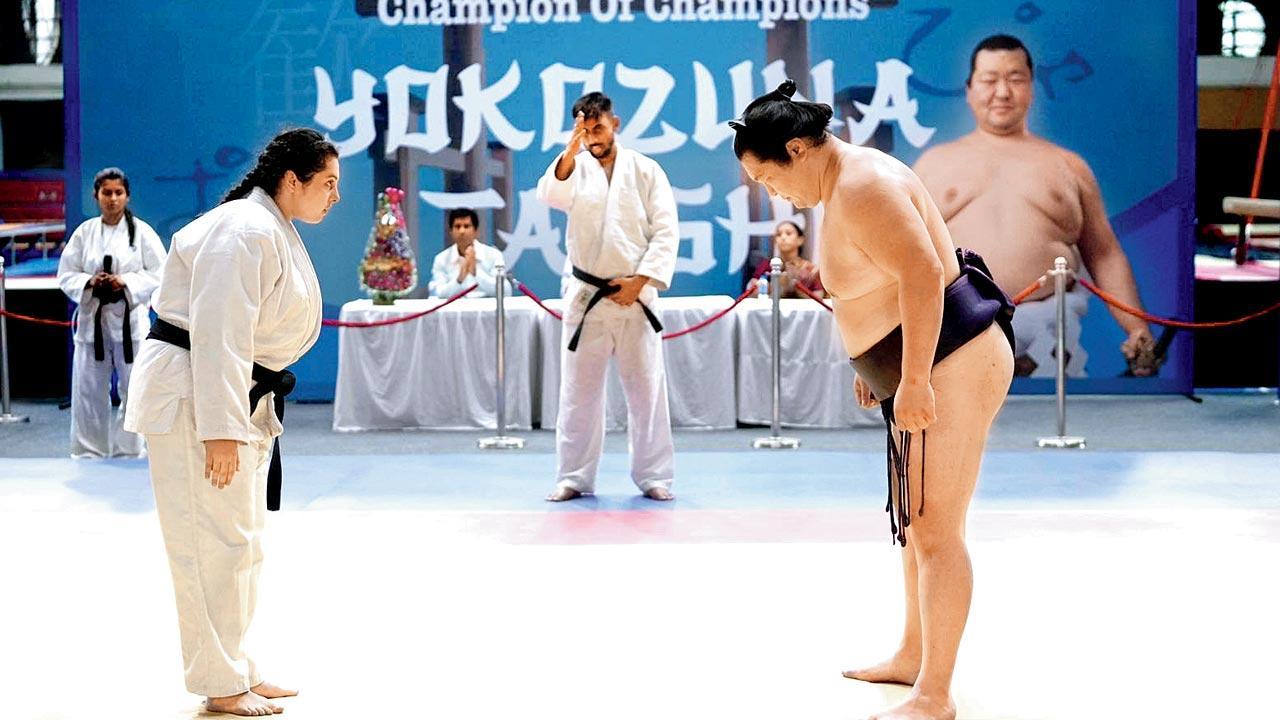
Sumo Didi, based on wrestler Hetal Dave, to premiere at the Tokyo International Film Festival. The biopic stars Shriyam Bhagnani
Mohar Basu (MID-DAY; October 25, 2023)
In April, Jio Studios had announced Sumo Didi, which is inspired by the journey of India’s first female sumo wrestler Hetal Dave. Now, the sports drama, which sees Shriyam Bhagnani step into the titular role, will have its world première at the 36th Tokyo International Film Festival. It has been officially selected in the competitive Asian Future section of the festival, and will be screened on October 27.
For director Jayant Rohatgi, it is only fitting that the movie, set in the world of sumo wrestling, start its journey from Japan. He shares, “Sumo Didi is an inherent human story about resilience in the depths of despair. I am grateful to our partners, my cast and crew for their support in accomplishing this selection. What better way to celebrate this than to showcase our film in Japan, the birthplace of sumo wrestling!”
Sumo Didi—shot in Mumbai, Kolkata and Japan—celebrates the determination of a girl, who defies fat-shaming, by turning the so-called weakness into her strength and representing India globally.

Hetal Dave
Australia is a heaven for anybody who loves animals, wildlife and food-Bhumi Pednekar
8:59 AM

Onkar Kulkarni (BOMBAY TIMES; August 21, 2023)
"Travelling means re-educating myself. It is decompressing and relaxing,” says Bhumi Pednekar who’s back to the bay after a week-long trip in Australia. It’s a country she loves visiting and this was her third visit. What made her trip even better is that she had her sister Samiksha for company – and together, they are a cool travel jodi.
While during her earlier trips to Oz, Bhumi covered the Gold Coast and Sydney, this time around she explored Melbourne.
“If you are a foodie, then there can’t be any other better place than Melbourne. It truly has some of the best food to offer. Food is always one of the highlights when Samiksha and I travel together, and our days are usually planned around our meals, so this really completed our trip. This time, I really enjoyed binging at this pizzeria which is rated the fourth best pizzeria in the world,” she says.
Talking about what else she did in Australia, Bhumi says, “The coast and the water is just so beautiful. I am a beach baby and I love going into the water there. The wildlife is also so different from what we have around our parts of the world, like the koalas, kangaroos and even marine life. This place is a heaven for anybody who loves animals, wildlife and food!”
Another interesting addition to her itinerary was a visit to an art gallery. Bhumi says, “At the gallery, we saw some beautiful pieces by Picasso. I learned that he also made sculptures, and I loved seeing those. There was an entire area dedicated to female Australian artistes, and you could just see how female energy would transition.”
My sister Samiksha is my favourite travel buddy:
My sister Samiksha is my favourite travel buddy. We have literally seen the world together. We have travelled together ever since we were kids. From London to Paris, Canada to Dubai, we have travelled across Europe and also in India
‘I enjoy walking on the streets in a new city’
Bhumi says, “It is fun meeting people from different cultures because when I travel, I love living the local life, eating local cuisine and going to local markets. I also love walking around. I feel when you are walking on the streets is when you learn the most about the place. I learn a lot about life when I travel.”
What’s Bhumi’s next destination?
“The one place I do want to go to is Japan. It’s at the top of my travel list. I can’t wait to do that trip with my sister.”

Aamir Khan is producing a slice-of-life film set in Japan for son Junaid
8:39 AM
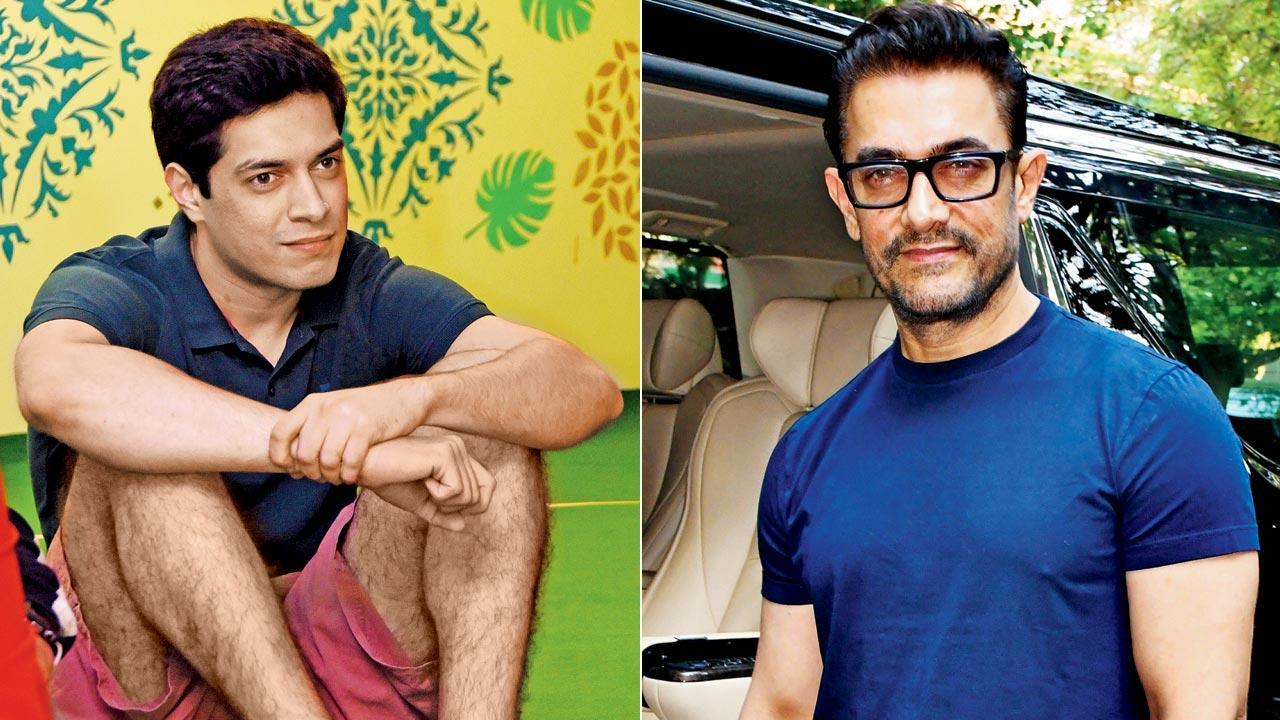
Sources say Aamir is producing slice-of-life film set in Japan for son Junaid; team in talks with Japanese govt for subsidies
Mohar Basu (MID-DAY; May 4, 2023)
Junaid Khan, who is following in his superstar-father Aamir Khan’s footsteps, has his work cut out for him. But he appears to have made a promising start with two films under his belt, Yash Raj Films’ Maharaja and his home production Pritam Pyare. Now, it is heard that a third movie is in the offing. It turns out that Aamir’s production house has developed a slice-of-life film that will be fronted by Junaid. Interestingly, a chunk of the offering will be set in Japan.
With Aamir having greenlit the production, work is on in full swing. While the team is currently looking for a suitable director, they have also initiated talks with the Japanese government regarding shoot subsidies.
A source reveals, “Aamir has a distinct vision for the heart-warming film, and believes Japan is the perfect setting for it. About 70 per cent of the movie will be shot across the country. Well-aware that filming in a foreign country can be an expensive affair, Aamir’s production team has reached out to the Japanese government to procure subsidies. That would offset some of the costs, thus enabling him to make the film without worrying about the budget and scale.”
If they get a positive response from the government, a team will head to the country for a recce next month, paving the way for a two-month shoot from September. The leading lady will be finalised in the coming weeks.
I haven’t been to a place more beautiful than Gulmarg-Aahana Kumra
8:24 AM

As told to Renuka Vyavahare (BOMBAY TIMES; January 25, 2023)
I have quite a few favourite places when it comes to holidays, but Japan tops the list, followed by England. My first solo trip was to Japan. I went to Hiroshima, Kyoto, Osaka and Tokyo. I didn’t know the language, but the trip turned out to be incredible. It’s a very safe country for solo female travellers, and I never felt unsafe or uncomfortable.
I met wonderful people, stayed in guest houses and hotels, and ate interesting food. People were helpful when I felt lost. It’s a country that’s super punctual, so if a train is late, they would apologize for the delay and give a valid reason. I met an Indian guy in Kyoto and we became good friends. He got me a thermos full of chai and a dabba of parathas.
I find the energy of London to be reminiscent of Mumbai. You can roam around alone, and I would go jogging to Hyde Park. In India, I love Kashmir and it is the wonderland of India. I remember waking up to a snow-clad vista in Gulmarg. I have never seen a more beautiful place.
I always have an itinerary in place when I’m travelling. I love eating, skiing, walking… it’s best to see a city on foot – just wear comfy shoes and clothes, and walk. That’s how I explored Paris.
I chased the northern lights in Finland-Sonakshi Sinha
8:21 AM
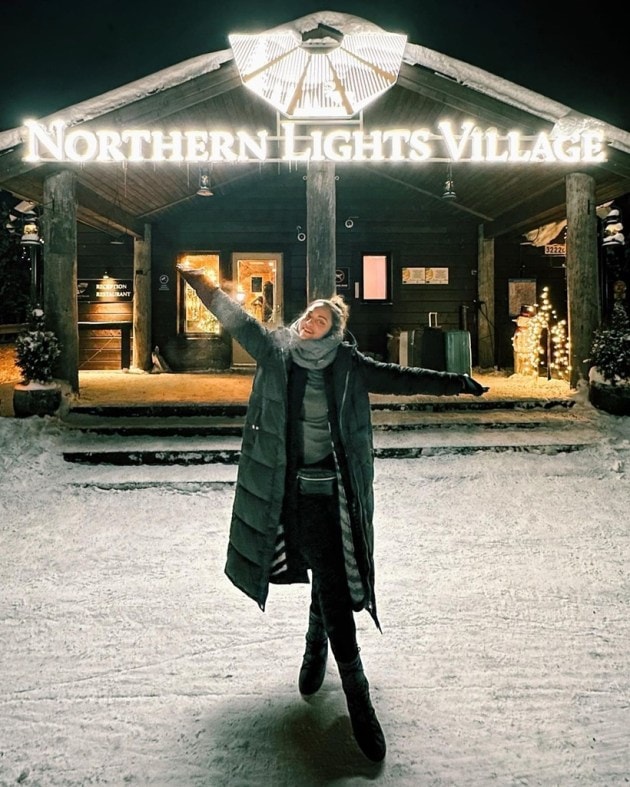
Onkar Kulkarni (BOMBAY TIMES; January 25, 2023)
She’s travelled across the world on holidays and for work, but what’s the one travel goal Sonakshi Sinha hasn’t met yet? A solo trip, which is still on the bucket list! “I really enjoy travelling with friends. We like doing the same things together and are not fussy. It’s important to have likeminded people while travelling,” shares the actress, who always plans a holiday to coincide with her birthday in June.
Sonakshi, who rang in 2023 in Finland, says that the Christmas New Year period is the best time to travel. “By Christmas everybody has checked out of work mode and wants to take a break, leave the year behind, focus on how the next year is going to be and be in a positive mind space. I think travelling is very enriching for the soul,” she adds. Here are some highlights from her travel diaries.
‘I AM PLANNING AN AFRICAN SAFARI NEXT’
I went to Finland and witnessed so much snow for the first time! I did husky sledding, chased the northern lights, went on a snowmobile – and a lot more. I want to visit Japan in the cherry blossom season, though I don’t know if I’ll be able to make it. Among other places that I want to visit is Africa, where I want to go on a safari. I also want to see Machu Picchu in Peru.
‘THE UNDERWATER LIFE IN MALDIVES OPENED MY HORIZONS’
I am an adventurous person, so I like to do stuff that I don’t get to do back home. On the beach, I spend more time in the water, scuba diving and doing water sports. No surprises for guessing my favourite travel destination – Maldives! It has the most beautiful seas I have ever seen. The underwater life – the corals, reefs, sea animals – opened my horizons and changed the way I look at nature.
‘BUDAPEST WAS MY FAVE OUTDOOR SHOOT’
My favourite outdoor shoot was in Budapest for Force 2. I was there for about 50 days, and when I was not shooting, I would take off on my own to explore the city – and it was just stunning. One day, I took a bus tour and saw all the main sites.

Akshay Kumar and Ram Charan take the stage to put an end to all lines dividing Indian cinema
8:36 AM

HINDUSTAN TIMES (November 13, 2022)
Yeh dosti hum nahin todenge — superstars Akshay Kumar and Ram Charan used the iconic song from Sholay (1975) to wipe out, once and for all, the lines that divide Indian cinema, with a surprise performance that brought to the fore the spirit of cinematic unity.
The actors joined Sonal Kalra, Chief Managing Editor (Entertainment & Lifestyle), Hindustan Times for an engaging session at the 20th Hindustan Times Leadership Summit 2022 in Delhi on Saturday, where they discussed how the entertainment world has changed after the pandemic, as well as the emergence of pan-India cinema.
“We never saw Hindi films as projects coming from different regions. They have tremendous exposure. We get inspired by them to make better films,” said Charan, mentioning how all industries have now come together as one. “It is Indian cinema. We all co-exist,” he said.
His thoughts were seconded by Kumar, who has worked in several remakes of regional films. “Why must we talk about regions?” he asked, suggesting “collaborative projects with big stars” from all regions as a step towards coming together as one.
Taking their resolve to come together a notch higher, Kumar enthralled attendees with a performance on Charan’s Telugu song, Rangamma Mangamma while lip-syncing to the lyrics. Charan, too, brought out his filmi side, with a performance on Kumar’s Tu Cheez Badi Hai Mast Mast, perfectly symbolising co-existence in cinema.
The actors also weighed in on the strategy that the industry must devise to come up with a new success mantra at the box office, in light of the recent developments.
“Dismantle and reinvent, that’s the only way forward,” said Kumar, adding that not just actors, even producers need to revisit costs that are involved in making a project.
Charan, too, was of the opinion that “rethinking and restructuring the whole game” will surely help makers get the desired results.
As the session progressed, Kumar took the opportunity to address the constant chatter around him doing multiple films a year: “I don’t know what is wrong in working. Why do people question me about working too much, as if it is a bad thing? Some say, ‘Aap subah jaldi kyun uththe ho’. Subah uthne ke liye hi toh hoti hai!”
When asked about the unprecedented success of his film RRR, not only in India but on foreign shores as well, an elated Charan shared that while filming it, nobody expected the film to cross boundaries.
“I am going to countries like Japan, which is a very conservative market, and being appreciated there. It is very heartwarming,” he said.
Kumar also spoke about his decision to step back from the third part of the hit comedy franchise Hera Pheri, saying: “The film was offered to me, but I wasn’t too excited about the way the script and the screenplay shaped up. The movie has been an important part of my journey and I wanted to give something that my audience expects from me. I apologize to my fans, I’m as sad as they are.”
Very soon: Akshay Kumar shares an update on Indian passport status
Akshay Kumar’s citizenship is something that has been widely discussed in the public forum. Back in 2019, the actor had revealed that he would be giving up his Canadian citizenship. When he took the stage for his session at HTLS 2022, he shared that his application is under process.
“I want to make one thing clear. Not having an Indian passport does not make me any less of an Indian. I got it many years back and I don’t want to get into the reason why and what happened. I said it in 2019 that I have applied for it, but then, the pandemic happened and everything was shut for the last two years. Now, I have got the renounce letter and very soon, my whole passport will be renounced,” Kumar stated.
RRR to release in Japan on October 21; Jr NTR flies to Japan for promotions; Ram Charan, S S Rajamouli to join him today
8:16 AM
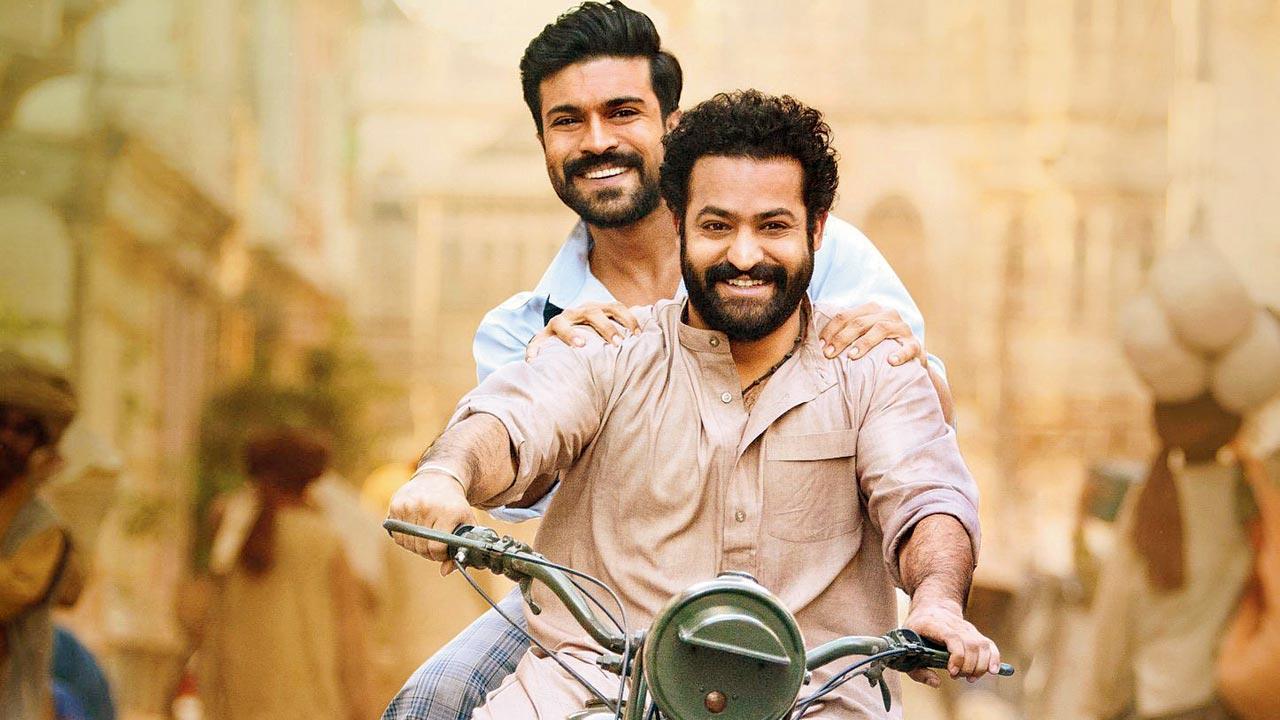
Ahead of RRR’s Oct 21 release in Japan, Jr NTR starts week-long promotions that include two premières and multiple fan events
Mohar Basu (MID-DAY; October 19, 2022)
SS Rajamouli’s Baahubali franchise had travelled to Japan, opening to much acclaim. Now, it’s the turn of RRR to make waves in the Land of the Rising Sun. The filmmaker’s magnum opus, which has been one of the biggest hits of the year, will première in Tokyo on October 21.
Ahead of the release, Jr NTR — who plays tribal leader Komaram Bheem to Ram Charan’s Alluri Sitarama Raju in the period drama — has flown to the country to promote the film. Co-star Charan and Rajamouli are expected to join the actor today for the promotional activities.
It is heard that the makers have lined up a two-day première on October 21 and 22. The team is decidedly going big with the events to amplify the buzz around RRR after its recent submission to the Oscars. A source reveals, “Jr NTR has a massive fan base in Japan, and this is an ideal opportunity for him to meet his admirers. Besides the double première that will be attended by the cast, multiple fan events have been scheduled over the next few days. A few meet-and-greet events in and around Tokyo are also on the itinerary. The team is expecting the turnout to be in thousands.”
Interactions with the local media will be a key feature of the week-long promotions. The source adds, “The lead actors and Rajamouli will discuss the joy and difficulties of pulling off a project of this scale, thus bringing more attention to the movie before the Oscars’ shortlist.”
Japanese cinematographer Tetsuo Nagata has shot Kangana Ranaut-starrer Dhaakad
8:24 AM

BOMBAY TIMES (May 15, 2022)
Soham Rockstar Entertainment’s Dhaakad is shot by Japanese cinematographer Tetsuo Nagata, who is based in France. The veteran cinematographer is known for his work in La Vie En Rose, Paris and Narco among others.
Talking about how the team brought Nagata to India to shoot the Kangana Ranaut-starrer, director Razneesh Ghai says, “I knew all along the film had to look a certain way. I look at cinema from a visual point of view, where the cardinal rule is ‘Show, don’t tell!’ This is the reason I needed a world-class DOP. I have been a huge fan of Tetsuo Nagata. He has beaten the best in the world to win the César Award for Best Cinematography twice. I happened to meet him at a cafe and we kept in touch ever since. When the time to shoot Dhaakad came, I reached out to him.”
Nagata makes his Bollywood debut with the movie. Ghai says, “He has made movies for Hollywood, France and Japan, but I really wanted mine to be his first Hindi film. It took me a month to convince him. He prepped with me for around four months. Whatever he has brought on screen in this film, is new for him as well. Some of the techniques he hasn’t even used in any of his other films.”
Soham Rockstar Entertainment presents Dhaakad, which is produced by Deepak Mukut and Sohel Maklai and co-produced by Hunar Mukut. The movie is produced in association with Zee Studios, Kamal Mukut, Sohel Maklai Productions and Asylum films. Dhaakad’s music is produced under the banner of SRE Music.
The film, distributed by Zee Studios Worldwide, releases on May 20.
Subscribe to:
Posts (Atom)