100th anniversary special: How Guru Dutt made the camera sing
9:12 AM
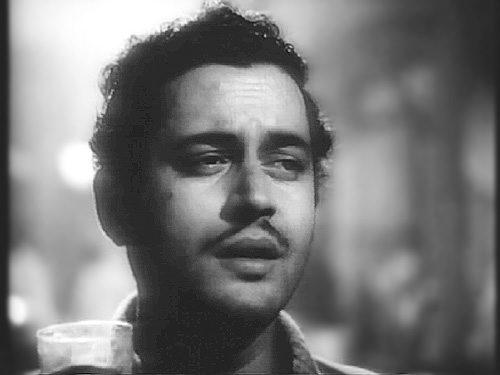
The director of Pyaasa and Kaagaz Ke Phool, whose 100th birthday anniversary falls on July 9, brought a lyricism to his craft that shone through in some unforgettable tracks
Avijit Ghosh (THE TIMES OF INDIA; July 6, 2025)
Songs are bookmarks of mainstream Hindi films. Long after a movie disappears from theatres and memories, they suddenly waft over a cabbie’s FM radio or emerge on an algorithm-driven app. They become a movie’s reference point, keeping them alive. In Guru Dutt films, the songs are more eloquent. Works of care and empathy, they not only take you on a guided tour of his art and aesthetics, but also offer a peep into his emotional world.
The songs also carry his signature. Dutt, who spent his early years in Kolkata, loved dance, having trained at visionary dancer-choreographer Uday Shankar’s centre in Almora and performed with his troupe. The films he made had a dance director but his contribution to their picturization is well-acknowledged.
“He was the first to make the songs visually interesting... he gave them much thought, he would spend nights thinking of song situations,” lyricist Majrooh Sultanpuri is quoted as saying in Yasser Usman’s biography of the actor-producer-director.
Tight close-ups, interplay of light and shade, symmetry of movement — Dutt, in tandem with cinematographer V K Murthy, produced a bouquet of soundtracks that feel contemporary even today, both visually and musically. They also provide meanings beyond the frame. Here are four songs, all from black-andwhite movies directed by him, that offer a glimpse into his craft:
HOON ABHI MAIN JAWAAN AE DIL
FILM: Aar Paar, 1954
MUSIC: O P Nayyar
LYRICS: Majrooh Sultanpuri
SINGER: Geeta Dutt
In ‘Aar Paar’, Dutt lensed songs in the unlikeliest of places: a construction site (‘ Kabhi aar kabhi paar’), a taxi (‘Ee lo main haari piya ), a garage (‘Sun sun zalima’). ‘Hoon abhi main jawan ae dil ’ is set in a storeroom of sorts. The actual filming hardly uses 10ftx10ft space. But we never feel the need for more.
The track begins with the sound of the accordion. The movie is halfway through and we see the back of a familiar head, the one always with a tilted cap and mostly a cigarette on lips. The protagonist follows the music. Philosophically, ‘Hoon abhi main jawaan ae dil’ is the B side of ‘Babu ji dheere chalna, pyaar mein zara sambhalna’.
The gangster’s moll (played by Shakila) who invitingly sang those words of warning, while dancing amidst covetous men in a crammed nightclub, did not follow her own advice. She has fallen for the amiable rake whose heart belongs to another girl. Unrequited love has taken the fire out of her eyes. But she doesn’t want to be pitied. When she falls on the ground and the protagonist picks her up, she gently brushes him off. She has lost in love, but she isn’t a loser. Through these little directorial gestures, Dutt imbues her persona with strength and beauty. The song is filmed in tender close-ups, underlying the director’s empathy for the outsider.
JAANE KAHAN MERA JIGAR GAYA JEE
FILM: Mr & Mrs 55, 1955
MUSIC: O P Nayyar
LYRICS: Majrooh Sultanpuri
SINGER: Geeta Dutt, Mohd Rafi
Offices served as avenues for fun numbers in the past, too, notably ‘Lara lappa’ (film: Ek Thhi Ladki, 1949). But in this romantic comedy by Dutt, we witness Office Romance 2.0 in the energy and the effervescence of funnyman Johnny Walker and Yasmin, the dimpled steno with eyes that seem eager to spring out of their sockets. The newspaper office transforms into the most romantic place in the world.
Majrooh prefers using ‘jigar’, instead of the normally used ‘dil’ for heart. And it adds to the song’s distinctiveness. So does the expression, ‘Kahin maare dar ke chuha to nahi ho gaya’. How many times before or since have we heard of the heart being compared to a rat? Crawling on the floor in search of a lost heart, amid chairs, tables and typewriters, never looked cuter.
THANDI HAWA KAALI GHATA
FILM: Mr and Mrs 55, 1955
MUSIC: O P Nayyar
LYRICS: Majrooh Sultanpuri
SINGER: Mohd Rafi, Geeta Dutt
We don’t feel the breeze blowing. Or, see the dark clouds the song talks about. Shot by an open swimming pool at Bombay’s well-known PM Hindu Bath in Chowpatty, ‘Thandi hawa kaali ghata’, could have been just another number that a heroine and her friends sing in a 1950s movie. Only that it is better and different. The camera showcases and maximizes every inch of the physical space that the outdoors offers. The track is marked by a fluidity and symmetry of movement, evident in every frame. The girls slide slowly on the railing. The distant men swim to its melody. And the boys dive into the pool to its rhythm. It is the twirling umbrellas, though, that’s the song’s takeaway visual. Holding these, the group of girls, with the ethereal Madhubala in lead, frolic and frisk like a musical marching band. The track is more than its infectious melody and easy-on-the lips lyrics. It is a celebration of space, freedom and dancing umbrellas.
BICHDE SABHI BAARI BAARI
FILM: Kaagaz Ke Phool, 1959
MUSIC: S D Burman
LYRICS: Kaifi Azmi
SINGER: Mohd Rafi
He walks into an empty studio, a metaphor for his own isolation. Everything is in the shadows. He, too, is a shadow of his old self. This was his empire. The empire remains, but the kings have changed. He is a trainwreck now; broken in personal and professional life. The protagonist’s life, told in flashback, begins with the song that has the melody of a requiem, its words his distilled truth of the film world. The track sets the movie’s tone, prepares us for the denouement.
The movie ends with the song, too. The man who had created the star is worn out, like the sweater he is wearing. But she, his one-time protégé, recognizes him. He can’t bear to talk to her and runs away as the song plays in the background. When he steps out of the studio gates, she cannot catch up with him as fans besiege her. The film cuts back to the scene where it all began. The perch where he sees his life flash by. How it starts and how it ends. The silence that accompanies the protagonist’s death is music at its best. It’s hard to encapsulate a life in a song. Guru Dutt Padukone captures it.
Just before he died, Dutt had planned a visit to TOI office
On Oct 7, 1964, a reporter from TOI visited Guru Dutt Studios, where ‘Baharen Phir Bhi Aayengi’ was being shot. Dutt was playing a journalist in the film and asked the reporter if he could visit the newspaper’s Bombay office for research. A visit was planned. But three days later, Dutt was found dead. There was a Hindi novel by his side, and a glass with a pink liquid — sleeping pills Sonaril crushed and dissolved in water. The movie would be finished with Dharmendra in the lead.
(Source: Guru Dutt: An Unfinished Story by Yasser Usman)
------------------------------------------------
COMING SOON: SEVEN RESTORED DUTT FILMS
Seven Guru Dutt films, including the iconic Pyaasa (1957), are being restored by National Film Archives of India (NFAI) as part of the National Film Heritage Mission (NFHM), a govt-funded initiative for digitisation and restoration of Indian cinema.
The other films are: Baazi (1951), Jaal (1952), Baaz (1953), Aar Paar (1954), Mr. & Mrs. 55 (1955), and Chaudhvin Ka Chand (1960). Barring the last, which was directed by M Sadiq, the other films were all directed by Dutt, whose 100th birth anniversary falls on July 9.
“The restoration is likely to be complete by Aug 15. The larger aim is to exhibit the restored films on the big screen after discussion with the rights holders,” said Prakash Magdum, managing director, NFDC-NFAI. NHFM’s budget is about Rs 550 crore.
Experienced industry professionals have been brought in for the task. “Senior cinematographers, familiar with Dutt’s cinematographer V K Murthy’s work, are supervising the restoration,” Magdum said.
The restoration is being done keeping in mind a film’s genre. Chaudvin Ka Chand was a blockbuster romantic drama where Dutt played the lead. The film’s music, composed by Ravi, was a chartbuster. “It was important for us to maintain the vocal texture as well as the innocence in the vocals to do complete justice to the landmark songs in this film,” said Leenali Khairnar, manager, film preservation, NFDC-NFAI.
“The music was rather muffled in the original print we had. We were fortunate that another print with a matching film type had the desired quality and punch. We restored from the primary print and replaced the songs from the alternative source, which allowed us to bring out what was perhaps intended by Dutt,” she said.
Earlier this year, NFDC-NFAI had restored Muzaffar Ali’s Umrao Jaan (1981). Sholay (1975), now in its golden jubilee year, was restored by Shivendra Singh Dungarpur’s Film Heritage Foundation. — Avijit Ghosh

Subscribe to:
Post Comments (Atom)
Post a Comment