Showing posts with label V K Murthy. Show all posts
Showing posts with label V K Murthy. Show all posts
100 years of Guru Dutt: The filmmaker who changed the way we ‘see’ songs
9:14 AM

Namrata Joshi (THE TIMES OF INDIA; July 6, 2025)
Guru Dutt was a man of many parts — a consummate actor, a perceptive writer, a trailblazing director and an accomplished producer. A significant element of his oeuvre, worth a deep dive on his birth centenary this July 9, is his flair for conceiving and conjuring up musical set-pieces that haven’t just stood the test of time but become touchstones for visualizing a film song for generations of filmmakers.
Take the most popular composition in Dutt’s romantic noir, ‘Jaal’ (1952). It comes as a double bill — two different versions in two distinct situations. Lata Mangeshkar’s sad counterpart — Chandni raatein pyaar ki baatein kho gayi jaane kahan —to the preceding S D Burman-Sahir Ludhianvi song sung by Hemant Kumar— Ye raat ye chandni phir kahan — is striking in the way Dutt slips it into his storytelling.
Fisherwoman Maria (Geeta Bali) is pining for the stranger Tony (Dev Anand) she has fallen hopelessly in love with. Her father Carlos (K N Singh) has warned the bad boy to stay away from his daughter and got her formally engaged to Simon (Ram Singh). After the church ceremony, she returns to the same spot by the beach where Tony had once serenaded her — the guitar placed in the backdrop a symbolic reminder of lost love. Once Dutt sets up the scene, he opens it deftly with Hemant’s call for love playing in the background, as a prelude and launchpad for the Lata melody. He then keeps weaving the Hemant line in and out as a memory of Tony that won’t fade.
It’s a unique aural throwback. Voice as a memory. “Filmmakers commonly use flashback of images. Guru Dutt does an audio flashback through a song split over time,” explains author-filmmaker Nasreen Munni Kabir, who made ‘In Search Of Guru Dutt’, a three-part documentary on the actor-writer-filmmaker-producer and has written two books on him.
Another song used by Guru Dutt to great cinematic effect is in the romantic comedy ‘Mr and Mrs 55’ (1955). Unlike ‘Jaal’, here the song is in the same time frame but divided across two separate spaces. Geeta Dutt warbles Preetam aan milo (originally a 1945 non-film song of C H Atma) that Anita (Madhubala) is shown listening to on the radio. As her aunt Seeta Devi (Lalita Pawar) switches it off, Dutt cuts to Preetam (Dutt himself) packing his bags to leave town with the song playing on his radio as well. The song becomes a subtle representation of the couple’s estrangement. Later, in the climax, it again plays behind the scenes but this time as a marker of their reconciliation.
“Dutt had a unique understanding of the form, the shot-taking and editing across time and space. His songs are pure cinema,” says Kabir. Dutt’s songs were integral and drove the narrative, be it any genre he directed — the early crime thrillers, the romantic dramas in the middle and the two classic tragedies that have immortalised him. A Guru Dutt song had an identity of its own while always being in harmony with the larger picture. “Just listening to the songs can give you the vision of a Guru Dutt film even though you may not have seen it,” says film historian Pavan Jha.
The magic of black and white and his steady collaborator, cinematographer V K Murthy, were keys to his singular craft such as the signature tracking shots, the eloquent closeups, use of light and shade, the looming shadows and the elemental melancholia alongside slivers of desultory merriment. “The vision was Guru Dutt’s, but Murthy was the one to execute it,” says Jha. Their most potent collaboration was in Waqt ne kiya (‘Kaagaz Ke Phool’, 1959) with the play of light writing exquisite poetry on Waheeda Rehman’s face.
There are several seminal aspects to a quintessential Guru Dutt song. The special way he framed the scenes like the iconic “poet Vijay (Dutt) as Christ image” in Ye duniya agar mil bhi jaaye to kya hai (‘Pyaasa’, 1957). Or the way he designed Saakiya aaj mujhe neend nahin aayegi in ‘Sahib Bibi Aur Ghulam’ (1962), a film credited to Abrar Alvi with speculations of Dutt having ghost-directed parts of it. In the song, the lead Meenu Mumtaz’s face is brightly lit to keep the focus on her, while the background dancers stay in the shade. The years spent at Uday Shankar’s cultural centre in Almora would have been crucial in imparting Dutt a sense of rhythm that is reflected in the tempo and flow of his scenes and song sequences. Dutt alternates between the Baul singer and Gulabo (Waheeda Rehman) in Aaj sajan mohe ang laga lo in ‘Pyaasa’ to create an inimitable mix of the sacred and the profane as an expression of her inner desires.
Though he gets identified with melancholy, some of his best songs have a conversational beat and a sense of playful banter like Taqdeer se bigdi hui and Aaj ki raat piya (‘Baazi’, 1951); Chori chori meri gali aana hai bura (‘Jaal’); Mohabbat karlo jee bharlo, Ye lo main haari piya, Babuji dheere chalna, Kabhi aar kabhi paar and Sun sun sun sun zaalima, all in ‘Aar Paar’ (1954), the last one with another version, Ja ja ja ja bewafa.
On the other hand, a seemingly fun song like Sar jo tera chakraaye in ‘Pyaasa’ becomes an oblique but effective comment on class divides. And who can forget the scathing critique and protest embedded not just in Sahir’s words, but the many tableaus of nation’s troubles and the wry cynicism of Dutt’s face filmed in Jinhe naaz hai hind par wo kahan hain?
Guru Dutt is one of the rare Indian directors to have made a film both his crowning achievement and a grand box-office failure — ‘Kaagaz Ke Phool’ (1959). Instead of lengthy dialogue, the almost five-minute song Ud ja ud ja pyaase bhanware captures the once-successful Suresh Sinha (Dutt) — now lonely and forgotten — meeting his end on his rightful director’s chair.
It’s with the likes of Guru Dutt that songs have spoken louder, and more profoundly, than words.
100th anniversary special: How Guru Dutt made the camera sing
9:12 AM
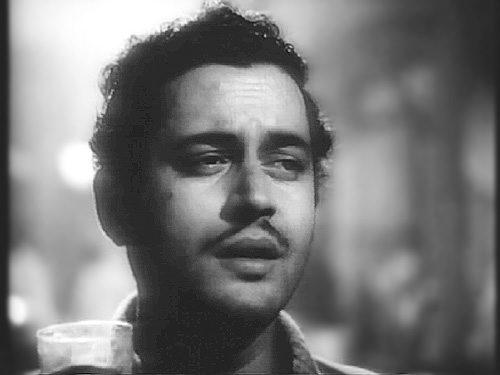
The director of Pyaasa and Kaagaz Ke Phool, whose 100th birthday anniversary falls on July 9, brought a lyricism to his craft that shone through in some unforgettable tracks
Avijit Ghosh (THE TIMES OF INDIA; July 6, 2025)
Songs are bookmarks of mainstream Hindi films. Long after a movie disappears from theatres and memories, they suddenly waft over a cabbie’s FM radio or emerge on an algorithm-driven app. They become a movie’s reference point, keeping them alive. In Guru Dutt films, the songs are more eloquent. Works of care and empathy, they not only take you on a guided tour of his art and aesthetics, but also offer a peep into his emotional world.
The songs also carry his signature. Dutt, who spent his early years in Kolkata, loved dance, having trained at visionary dancer-choreographer Uday Shankar’s centre in Almora and performed with his troupe. The films he made had a dance director but his contribution to their picturization is well-acknowledged.
“He was the first to make the songs visually interesting... he gave them much thought, he would spend nights thinking of song situations,” lyricist Majrooh Sultanpuri is quoted as saying in Yasser Usman’s biography of the actor-producer-director.
Tight close-ups, interplay of light and shade, symmetry of movement — Dutt, in tandem with cinematographer V K Murthy, produced a bouquet of soundtracks that feel contemporary even today, both visually and musically. They also provide meanings beyond the frame. Here are four songs, all from black-andwhite movies directed by him, that offer a glimpse into his craft:
HOON ABHI MAIN JAWAAN AE DIL
FILM: Aar Paar, 1954
MUSIC: O P Nayyar
LYRICS: Majrooh Sultanpuri
SINGER: Geeta Dutt
In ‘Aar Paar’, Dutt lensed songs in the unlikeliest of places: a construction site (‘ Kabhi aar kabhi paar’), a taxi (‘Ee lo main haari piya ), a garage (‘Sun sun zalima’). ‘Hoon abhi main jawan ae dil ’ is set in a storeroom of sorts. The actual filming hardly uses 10ftx10ft space. But we never feel the need for more.
The track begins with the sound of the accordion. The movie is halfway through and we see the back of a familiar head, the one always with a tilted cap and mostly a cigarette on lips. The protagonist follows the music. Philosophically, ‘Hoon abhi main jawaan ae dil’ is the B side of ‘Babu ji dheere chalna, pyaar mein zara sambhalna’.
The gangster’s moll (played by Shakila) who invitingly sang those words of warning, while dancing amidst covetous men in a crammed nightclub, did not follow her own advice. She has fallen for the amiable rake whose heart belongs to another girl. Unrequited love has taken the fire out of her eyes. But she doesn’t want to be pitied. When she falls on the ground and the protagonist picks her up, she gently brushes him off. She has lost in love, but she isn’t a loser. Through these little directorial gestures, Dutt imbues her persona with strength and beauty. The song is filmed in tender close-ups, underlying the director’s empathy for the outsider.
JAANE KAHAN MERA JIGAR GAYA JEE
FILM: Mr & Mrs 55, 1955
MUSIC: O P Nayyar
LYRICS: Majrooh Sultanpuri
SINGER: Geeta Dutt, Mohd Rafi
Offices served as avenues for fun numbers in the past, too, notably ‘Lara lappa’ (film: Ek Thhi Ladki, 1949). But in this romantic comedy by Dutt, we witness Office Romance 2.0 in the energy and the effervescence of funnyman Johnny Walker and Yasmin, the dimpled steno with eyes that seem eager to spring out of their sockets. The newspaper office transforms into the most romantic place in the world.
Majrooh prefers using ‘jigar’, instead of the normally used ‘dil’ for heart. And it adds to the song’s distinctiveness. So does the expression, ‘Kahin maare dar ke chuha to nahi ho gaya’. How many times before or since have we heard of the heart being compared to a rat? Crawling on the floor in search of a lost heart, amid chairs, tables and typewriters, never looked cuter.
THANDI HAWA KAALI GHATA
FILM: Mr and Mrs 55, 1955
MUSIC: O P Nayyar
LYRICS: Majrooh Sultanpuri
SINGER: Mohd Rafi, Geeta Dutt
We don’t feel the breeze blowing. Or, see the dark clouds the song talks about. Shot by an open swimming pool at Bombay’s well-known PM Hindu Bath in Chowpatty, ‘Thandi hawa kaali ghata’, could have been just another number that a heroine and her friends sing in a 1950s movie. Only that it is better and different. The camera showcases and maximizes every inch of the physical space that the outdoors offers. The track is marked by a fluidity and symmetry of movement, evident in every frame. The girls slide slowly on the railing. The distant men swim to its melody. And the boys dive into the pool to its rhythm. It is the twirling umbrellas, though, that’s the song’s takeaway visual. Holding these, the group of girls, with the ethereal Madhubala in lead, frolic and frisk like a musical marching band. The track is more than its infectious melody and easy-on-the lips lyrics. It is a celebration of space, freedom and dancing umbrellas.
BICHDE SABHI BAARI BAARI
FILM: Kaagaz Ke Phool, 1959
MUSIC: S D Burman
LYRICS: Kaifi Azmi
SINGER: Mohd Rafi
He walks into an empty studio, a metaphor for his own isolation. Everything is in the shadows. He, too, is a shadow of his old self. This was his empire. The empire remains, but the kings have changed. He is a trainwreck now; broken in personal and professional life. The protagonist’s life, told in flashback, begins with the song that has the melody of a requiem, its words his distilled truth of the film world. The track sets the movie’s tone, prepares us for the denouement.
The movie ends with the song, too. The man who had created the star is worn out, like the sweater he is wearing. But she, his one-time protégé, recognizes him. He can’t bear to talk to her and runs away as the song plays in the background. When he steps out of the studio gates, she cannot catch up with him as fans besiege her. The film cuts back to the scene where it all began. The perch where he sees his life flash by. How it starts and how it ends. The silence that accompanies the protagonist’s death is music at its best. It’s hard to encapsulate a life in a song. Guru Dutt Padukone captures it.
Just before he died, Dutt had planned a visit to TOI office
On Oct 7, 1964, a reporter from TOI visited Guru Dutt Studios, where ‘Baharen Phir Bhi Aayengi’ was being shot. Dutt was playing a journalist in the film and asked the reporter if he could visit the newspaper’s Bombay office for research. A visit was planned. But three days later, Dutt was found dead. There was a Hindi novel by his side, and a glass with a pink liquid — sleeping pills Sonaril crushed and dissolved in water. The movie would be finished with Dharmendra in the lead.
(Source: Guru Dutt: An Unfinished Story by Yasser Usman)
------------------------------------------------
COMING SOON: SEVEN RESTORED DUTT FILMS
Seven Guru Dutt films, including the iconic Pyaasa (1957), are being restored by National Film Archives of India (NFAI) as part of the National Film Heritage Mission (NFHM), a govt-funded initiative for digitisation and restoration of Indian cinema.
The other films are: Baazi (1951), Jaal (1952), Baaz (1953), Aar Paar (1954), Mr. & Mrs. 55 (1955), and Chaudhvin Ka Chand (1960). Barring the last, which was directed by M Sadiq, the other films were all directed by Dutt, whose 100th birth anniversary falls on July 9.
“The restoration is likely to be complete by Aug 15. The larger aim is to exhibit the restored films on the big screen after discussion with the rights holders,” said Prakash Magdum, managing director, NFDC-NFAI. NHFM’s budget is about Rs 550 crore.
Experienced industry professionals have been brought in for the task. “Senior cinematographers, familiar with Dutt’s cinematographer V K Murthy’s work, are supervising the restoration,” Magdum said.
The restoration is being done keeping in mind a film’s genre. Chaudvin Ka Chand was a blockbuster romantic drama where Dutt played the lead. The film’s music, composed by Ravi, was a chartbuster. “It was important for us to maintain the vocal texture as well as the innocence in the vocals to do complete justice to the landmark songs in this film,” said Leenali Khairnar, manager, film preservation, NFDC-NFAI.
“The music was rather muffled in the original print we had. We were fortunate that another print with a matching film type had the desired quality and punch. We restored from the primary print and replaced the songs from the alternative source, which allowed us to bring out what was perhaps intended by Dutt,” she said.
Earlier this year, NFDC-NFAI had restored Muzaffar Ali’s Umrao Jaan (1981). Sholay (1975), now in its golden jubilee year, was restored by Shivendra Singh Dungarpur’s Film Heritage Foundation. — Avijit Ghosh
On screen, I was Guru Dutt’s girl, but off it, everyone knew I was Fali Mistry’s girl-Shyama
8:23 AM

Roshmila Bhattacharya (MUMBAI MIRROR; June 15, 2019)
She had already taken the curtain call by the time we met but Shyama ji was still a star, conducting the interview from her four-poster bed, surrounded by four wardrobes which, she admitted, were full of clothes none of which had been worn more than once and many not even once, while the cosmetics strewn across the dressing table had been flown in from Dubai. But what caught my eye were the photographs on the wall, many of them clicked by her late husband, cinematographer Fali Mistry, which were pointers to their beautiful life together.
“Have you seen any of my movies?” she asked, flashing that maar-dala smile.
Nodding shyly, I muttered, “Aar Paar (above), you were Guru Dutt’s sweetheart Nikki and your 'Yeh Lo Main Haari Piya' ranks amongst my all-time favourites.”
She responded with peals of laughter, “Yes, on screen, I was Guru Dutt’s girl, but off it, everyone knew I was Fali’s girl and our cinematographer V K Murthy who had been his assistant, kept a hawk’s eye on me on the set, ensuring I wasn’t out of line with our hero.”
Not that there was any chance of that ever happening because as Shyama ji went on to reveal, she had accepted the film only on Guru Dutt’s singer-wife Geeta’s request. “Geeta didi came home to convince me to do Aar Paar, how could I say no? I told her I would not even charge my price, she could give me whatever she wanted,” she recounted more than four decades later.
The whiff of a real romance was tantalizing and I pressed her for details. Her eyes dancing, she recalled how her Fali had once reduced her to tears on the sets of Sazaa, a 1951 family-drama directed by him. “Why?” I wondered. “Because he insisted on chopping off my beautiful tresses and giving me a cascade of fashionable curls,” she replied with a twinkle, adding that she had been absolutely aghast when the hairdresser, Mrs Green, had strolled in wielding a pair of scissors. “If this was my sazaa for becoming a heroine, I told Fali and her, I didn’t want to be one, I’d rather save my hair. Of course, neither of them listened to me.”
In time she came to fall in love with the debonair Parsi boy who courted her for two years despite her parents’ outraged protests. Then, one morning, she slipped away to tie the knot with him before reporting for shoot only to be told that she was getting married on camera too.
Born Khurshid Akhtar in Lahore, Shyama ji, like Alice, had entered wonderland by accident, when she had come to Prakash Studio with a bunch of her friends to see her idol, Noor Jehan, in action. Zeenat was being filmed and the film’s director and the leading lady’s husband, Shaukat Rizvi, suddenly caught sight of the young girls and wondered if they would like to feature in a qawwali being shot. While the others were too surprised to react, Khurshid instantly nodded, “Hum karenge, we will do it.” And that’s how two years before the Partition which took Shaukat Rizvi and Noor Jehan across the border to the newly-formed Pakistan, the girl with the sparkling smile made her debut with a song.
From the chorus, she graduated to become a child star with Parwana. Interestingly, it was because she shared her name with one of Meena Kumari’s siblings, along with a popular vamp, that Khurshid was rechristened Shyama by Vijay Bhatt. “I liked my new name. There were other Khursheeds but no Shyama in Hindi movies, neither then, nor in later years, which made me unique,” she pointed out, her laughter tinkling like ice cubes in a glass.
 Among her films as a heroine, beside Aar Paar, she is also remembered for Barsaat Ki Raat (right), which featured some of the best qawwalis, including “Mujhe Mil Gaya Bahana Teri Deed Ka, Kaisi Khushi Le Ke Aaya Chand Eid Ka”. This song was to be picturised on Madhubala but I read somewhere that she wasn’t too impressed with Sahir Ludhianvi’s lyrics and refused to shoot for it. Since Roshan had already set it to tune, it went to Shyama ji on the rebound.
When I quizzed her on it, she told me simply that Madhubala wasn’t keeping well, so the director (P L Santoshi) decided to film it on her because she too is in love with Bharat Bhushan in the film. Interestingly, Ratna, Bharat Bhushan’s wife in real life, is also seen matching her, step for step, swing for swing, in the qawwali sequence.
On November 14, 2017, Shyama ji passed into the ages to join her Fali and continue with their love story. But her songs live on, as does the memory of that tinkling laughter, even though we never met again.
Three generations of Jaaferi family - Jagdeep, Jaaved, Meezaan - speak up on entertaining audiences
8:19 AM

Three generations of the Jaaferis on what it takes to keep audiences entertained
Kunal Guha (MUMBAI MIRROR; June 9, 2019)
All of 80 years, veteran comedian Jagdeep has an elephant’s memory. Precisely half-a-century ago, he escorted his son to the premiere of his film Anmol Moti (1969) — the first Indian film to feature an underwater fight sequence —in which his character wrestles with an octopus. When the creature eliminates his character in the scene, his son Jaaved Jaaferi, barely six then, was reduced to a howling mess. “He felt his father was no more,” says Jagdeep, whose film career spans over 70 years. Ahead of his grandson, Meezaan’s debut in Sanjay Leela Bhansali’s Malaal, three generations of the Jaaferi clan collect at the patriarch’s Versova home to mull over their shared legacy.
Most know Jaaved as an accomplished actor, host and voiceover talent, the one who introduced Indian audiences to freestyle dance. But ask Jagdeep about his son’s earliest achievements and he returns to the filming of Wardat (starring Mithun Chakraborty) in Kashmir. At an after-shoot party, Javed, then just 15, beat the film’s baddie Shakti Kapoor in a dance battle. “Woh bola ‘kiske saath mukabla kara rahe ho?’” the veteran actor recalls. Looking back at the incident that occurred four decades ago, Jaaved, credits his youthful exuberance for the win. “I was in Class 10 then, and could dance for an hour non-stop.” He remembers being introduced to freestyle dancing on the streets of New York in 1983, while on a family vacation. “We came across street performers ‘body popping’ and ‘moon-walking’, and we were so mesmerised by their moves, we watched them for a whole hour, I remember.” On his return, Jaaved worked on mastering those moves, and, it proved a game changer at college fests — he topped the All India Dance Competition the following year.
Jaaved remembers accompanying brother Naved Jafri to nightclubs — “only during the day” — to put his skills to test. “We would brave muggy Mumbai afternoons to frequent a place near the airport called Take Off (later dubbed Go Bananas) every Sunday, dressed in shimmery outfits,” says Jaaved, who also remembers that his parents didn’t entirely approve of those ‘nightclub visits’. “Before disco became a thing, nightclubs had a negative connotation, because films depicted them as dens for sharab, jua and cabaret,” says Jaaved.
On becoming a parent, Jaaved says, he allowed Meezaan more room to keep up with his social calendar. “By my time, no one went out dancing though. Most of my friends would just go out for a drink,” says Meezaan, who played basketball for Maharashtra. He also attended New York Film School before dropping out to assist Sanjay Leela Bhansali in Padmaavat, an experience he describes as “a learning experience that no film school can possibly deliver”.
“I was well-versed with the industry and my parents prepared me for every job that comes being on the sets. I was told, ‘Even if someone says ‘chai laao’, you have to do it,’” says Meezaan, who will be making his debut in Bhansali’s forthcoming production. Javed was delighted and apprehensive about Meezaan’s decision. “I wanted him to complete the course. But then, Sanjay [Bhansali] convinced me that he would groom him,” says the concerned father.
While Meezaan’s entry into Bollywood seems meticulously planned, Jaaved’s was left more to chance. In his final year at RD National College, when he was the secretary of the drama club — and would hold a crowd with his immaculate impressions — he learnt about a casting call. “Subhash Ghai’s wife had seen me dance at college fests. So when he [Ghai] was looking for someone to play a suave villain, who could dance — something that was unheard of then — I decided to give it a shot,” he says about his debut film Meri Jung (1985), when he created quite a stir with his slick moves in the number Bol Baby Bol.
“Jaaved ke dance ne disco ko maar diya,” says Jagdeep proudly, who, for his part, got a head start as a child actor in films such as Afsana (1951) and Do Bigha Zamin (1953). His modest beginnings carved his socialist outlook — something he shared with filmmakers who he worked with at the time — K Asif, Guru Dutt, V Shantaram and Bimal Roy. “When Aar Paar became a hit, people asked Guru Dutt to throw a party at Taj Mahal hotel, but he refused. He said ‘I won’t host a party at a place where my workers will feel uncomfortable’. Eventually, the celebrations took place at a film studio,” he says, remembering the stupendous success of the 1954 noir comedy.
Jagdeep, who played a minor in that film, remembers how resourceful Dutt could be when it came to ironing out production niggles. “A mob of 500 had assembled in the garage where the song Sun Sun Sun Sun Zaalima was being shot,” Jagdeep recalls. “The crowd was making it impossible to get the desired shot. The ruckus even ticked off the garage owner who demanded that the shoot be wrapped up soon,” says Jagdeep. It didn’t help that the film’s female lead Shyama, a huge star then, was willing to shoot for only three hours. “So, Dutt asked cinematographer V K Murthy to set up his camera inside the car and experiment with angles and close-shots to ensure the crowd didn’t spill into the frame,” says Jagdeep. The end result was a number that was lauded for its avant-garde picturisation. “Necessity is truly the master of invention,” says Jaaved.
An enterprising maverick himself, Jaaved reinvented his career in TV after his son Meezaan was born in 1995. “When I moved to TV, people said only flop film actors turn to the small screen, but I was confident that I was connecting with the youth,” says the actor-turned-VJ, who engineered a new coolth with his ‘Hinglish’ speak. “They were saying ‘Yo’, but I flipped it, and started ‘Oye’.” Straddling music and film-based shows, Jaaved soon became the highest-paid actor on TV. “I was making a lakh per episode then,” says the actor known for his exceptional impersonations of virtually every Hindi film actor, as well as his original avatars, such as ‘Abdul Cutpiece’ and ‘Irani Boxer’. Like his son, Jagdeep, too, was known for his masterful impressions. “I would encounter these colourful characters while travelling by train and bus, and at Irani hotels, and adapt them in my onscreen avatars,” says the Jagdeep, whose iconic turn as Soorma Bhopali in the 1975 blockbuster Sholay turned him into an overnight sensation.
But Jagdeep modestly shifts the praise to Salim-Javed’s writing. “Javed would actually demonstrate the Bhopali twang, I only had to copy it,” says Jagdeep, crediting the writers for detailing the nuances of the quirky character. The character itself, he says, was borrowed from a theatre production the writer duo worked on 15 years prior to Sholay.
Today, as Meezaan enters the industry his father and grandpa have made a mark in, Javed feels his journey will be different. “When I got into films, the hero had a mould — he flaunted the same hairstyle for 10 years, and was different from the character actors. But today, the hero alters himself based on the character.”
He trusts his son will wear the Jaaferi name like a badge of honour. “When I came into the industry, I was known as Jagdeep’s son, and I am still proud of that tag. My father was a comedian, and I was introduced as a stylish actor who could dance. But then, you have to make it on your own.”
The Jaaferis will, no doubt, be keenly watching, like the rest of us, to see how Meezaan shapes his own identity.
Slowly, word spread that I was Fali's girl and that made things really difficult for me-Shyama
7:21 AM

MUMBAI MIRROR (July 28, 2015)
Recently, in Kangna Ranaut's film, Tanu Weds Manu Returns, a snatch from Geeta Dutt's evergreen hit, Ja ja ja ja bewafa, rang across the auditorium bringing back nostalgic memories of a heartbroken Shyama in Guru Dutt's Aar Paar. Interestingly, the singer herself had approached the actress to act in her husband's 1954 noir comedy.
"I was so touched that I told Geeta didi I would not charge anything, she could give me whatever she wanted," Shyama had admitted in an interview, listing Aar Paar as one of her favourite films and Guru Dutt as a wonderful director who would act out every scene for his artistes. He also choreographed the songs which ranged from the above mentioned Ja ja ja ja bewafa, Arre na na na na tauba tauba and Sun sun sun zalima to Babuji dheere chalna, Mohabbat kar lo ji bharlo and Ye lo main haari piya. There was also the title track Kabhi aar kabhi paar crooned by Shamshad Begum and Shakila's cabaret track, Hoon abhi main jawaan aye dil. The songs were shot in real locations like a car, a club, a zoo and a garage, in real time. It was O P Nayyar's first hit score as he struck a chord with lyricist Majrooh Sultanpuri and entered people's hearts with Geeta's versatile voice.
Apart from the music, the thriller revolving around a cab driver, Kallu, a car chase and a bank robbery, is remembered for its evocative monochromatic visuals, credit for which go to Guru Dutt's cinematographer V K Murthy. However, for Shyama, Murthy turned out to be a spy in disguise.
Cupid had struck on the sets of Sazaa (1951), though it wasn't love at first sight. Fali Mistry, the cinematographer who directed the Dev Anand movie, did not endear himself to the film's leading lady after he ordered her hairdresser, Mrs Green, to snip off her unfashionable Rapunzel tresses. "We'll have a cascade of ringlets instead," he decided. Shyama sobbed her heart out as she watched her lovely locks fall to the ground, wondering why she was being punished for wanting to become a heroine.
Fali, a perfect Parsi gentleman, wiped away Shyama's tears, wooed her with his quiet words and won her heart with his gentle smiles. Soon, they started meeting clandestinely and then after a while, got bolder.
Fali would often drive past her house, honking loudly. That was Shyama's signal to rush to a window and flash him one of her bewitching smiles. Unknown to them, this exchange was watched by Johnny Walker, who was a regular at the restaurant beneath Shyama's house.
"We tried to play it cool but Johnny bhai suspected we were up to something. Slowly, word spread in the industry that Shyama was Fali's girl and that made things really difficult for me," Shyama had laughed at the memory.
Johnny Walker was a part of Aar Paar but more than him, Shyama learnt to be wary of V K Murthy during the shoot. Fali's former assistant kept a hawk's eye on her and if he ever caught her even playfully trifling with her hero, he would immediately report to the boss who would pull up Shyama that evening.
"I'd wave him away saying, 'Of course, I'm your girl Fali, but thoda flirting kar liya to kya,'" reminisced Shyama, adding that deep down, her Parsi boyfriend knew that she was his. She proved it by going against the wishes of her orthodox Muslim parents and tying the knot with him quietly one morning. Later, she reported on the sets of Laadla where she was told to her bemusement that they were shooting a wedding sequence. "But I got married this morning," she giggled. No one knew that she was serious.
Aar Paar elevated Shyama into the top league and Guru Dutt wanted to pair up with her again in Mr & Mrs 55. But this time, she asked for double the amount she had been paid for Aar Paar. And he dropped her for Madhubala.
Pyaasa, Kaagaz Ke Phool cinematographer V K Murthy passes away
7:45 AM

MUMBAI MIRROR (April 8, 2014)
Renowned cinematographer and Dada Saheb Phalke awardee V K Murthy, who won encomiums capturing breathtaking images in Guru Dutt's classics like Pyaasa, Sahib, Bibi Aur Ghulam and Kagaz Ke Phool, died in Bangalore yesterday at the age of 91.
Known as 'Guru Dutt's eye', Murthy also worked with the pioneer of Indian cinema in Aar Paar and later teamed up with Kamal Amrohi in Pakeezah and Razia Sultan.
"He passed away this morning at his Shankarapuram residence here; he had only age-related issues," said Murthy's niece Nalini Vasudev. The ace cinematographer is survived by his daughter Chaya Murthy.
Murthy was the first technician to be honoured with the Dadasaheb Phalke Award, Indian cinema's highest honour, since its inception in 1969. He won the award in 2008. Murthy, who shot India's first cinemascope movie Kagaz Ke Phool in 1959, also won the International Indian Film Academy Lifetime Achievement Award at Amsterdam in 2005 during his four-decade-long career. His picturisation of the song Chaudavin Ka Chand is still considered one of the best cinematographic works that Hindi cinema has seen and his work in films like Kaagaz Ke Phool and Sahib, Bibi aur Ghulam won him Filmfare Awards.
From his early collaboration with Guru Dutt in the 50's to his work in Shyam Benegal's mega-serial Bharat Ek Khoj, Murthy has also to his credit one of the most acclaimed Kannada movies titled Hoova Hannu in 1993, where he made his acting debut, though he never tried his luck in acting after this. Born in 1923 in Mysore, Murthy earned his Diploma in Cinematography from S J Polytechnic, Bangalore, in 1946. He later shifted base to Mumbai, where he met Guru Dutt.
—Agencies
Subscribe to:
Posts (Atom)