Showing posts with label Vivek Agnihotri. Show all posts
Showing posts with label Vivek Agnihotri. Show all posts
'Operation Sindoor' title finally allocated to a film
3:13 PM

The fight to register the official film title on India’s historic tri-service military strike on terror camps in Pakistan has finally come to an end
Yashika Mathur (HINDUSTAN TIMES; May 7, 2026)
On the first anniversary of Operation Sindoor today, as India marks the triumphant strike against the Pakistan-based terror camps, production house Bihar Film Company has secured the official rights to use the title Operation Sindoor for a film. The company is backed by Ankit Singh and Sangram Singh.
The title had drawn massive interest, with over 150 applications submitted to the Indian Motion Picture Producers’ Association (IMPPA).
Confirming the development, IMPPA president Abhay Sinha says, “There were several applications for this name, but it was allocated to the first applicants who wished to register it.”
Among others who applied was filmmaker Vivek Agnihotri, who had earlier announced that he had acquired the rights to make a film based on the book Operation Sindoor: The Untold Story of India’s Deep Strikes Inside Pakistan by Lt Gen KJS ‘Tiny’ Dhillon. “Vivek Agnihotri has been given two titles, Kashmir Files 2 and The Night of Operation Sindoor,” says Sinha.
--------------------------------------------------------
The title has been given to Bihar Film Company by producers Ankit Singh and Sangram Singh. There were several applications for this name but it was allocated to the first applicants who wished to register the title.
- ABHAY SINHA, PRESIDENT, IMPPA
No filmmaker has been given the Operation Sindoor film title yet-IMPPA
4:23 PM

Niharika Lal (BOMBAY TIMES; April 22, 2026)
Last year, after the Army’s press conference on Operation Sindoor, producers rushed to register film titles on the operation, prompting industry bodies to urge applicants to stop registering variations. The producers, however, did not stop.
Almost a year on, more than 150 titles related to Operation Sindoor are still pending.
Abhay Sinha, president of the Indian Motion Picture Producers’ Association (IMPPA), shares that no producer has yet been allotted the title. He explains, “We have over 150 applications for ‘Operation Sindoor’ and its variations, but none has been approved. As the volume of applications for a single title was so high, we decided to defer a decision. There are also five to seven film title applications for the Pahalgam attack.”
Studios that have announced projects on the operation have continued to follow up with the body, he said.
A decision is expected at a meeting next week, where titles will be allotted, which is on a first-come, first-served basis. Trade analysts and industry insiders say they are not aware of many films actually going into production.
Industry insiders say titles are snapped up after major incidents, but few projects move beyond the announcement stage. Despite the rush for registration of film titles, only two films on Operation Sindoor have been formally announced.
‘Producers sometimes want to register titles only for publicity’
Industry insiders say that registering titles is like a gold rush after an important incident, but what actually gets made is only a small fraction of what is registered.
T P Aggarwal, former IMPPA president, explains, “Our producers sometimes want to take advantage of publicity. They register titles only for publicity. If a big producer registers a title, it usually means they will make a film, but most of the time, after an incident, small producers from regional industries rush to register titles without intending to make a film. Sometimes they sell these to bigger banners for credit.”
Veteran trade analyst Raj Bansal adds, “Most producers just take advantage of a situation and, in a rush, register titles, but a film never actually gets made. They announce the film, and once the discussion dies down, it goes into cold storage. What gets made is a fraction of the titles registered.”
‘WE WERE DISCUSSING WHETHER ‘GALWAN’ SHOULD HAVE BEEN REGISTERED AS A FILM TITLE IN THE FIRST PLACE’
Recently, Salman Khan’s film Battle Of Galwan underwent a title change. After the Galwan attack, producers had rushed to register that title as well.
T P Aggarwal shares, “Of course, if the Army says you have to change the title, then you have to. We should not have registered a title like ‘Galwan’ in the first place. Some time back, we were also discussing that for films based on operations or sensitive geopolitical issues, such titles should not be registered. I don’t know why it was registered.”
Abhay Sinha adds, “Yes, ‘Battle Of Galwan’ was given another title, Maatrubhumi: May War Rest In Peace. But as we do not have any orders not to give titles on operations, we will proceed with our system and allot titles accordingly.”
Projects which are announced
A year later, as per official announcements, only two films are being made. Last month, filmmaker Vivek Agnihotri announced that he would be making a film on Operation Sindoor with T-Series, based on Lt Gen KJS ‘Tiny’ Dhillon’s (retd.) book Operation Sindoor: The Untold Story of India’s Deep Strikes Inside Pakistan.
He wrote on X, “Rooted in the aftermath of the Pahalgam terror attack and backed by extensive, ground-level research in collaboration with multiple wings of the Indian Armed Forces, this is a story drawn from reality – not to create noise, but to confront it: with facts, with clarity, and the magic of cinema.”
A source shares, “There are rumours that Varun Dhawan has been contacted to play a role in this film.”
A source associated with The Terror Report shares, “The Terror Report , which was announced as a film on major terror attacks in India spanning from 1998 to 2025, was originally only on the Pahalgam attack. However, to avoid a clash with the film based on Lt. Gen. ‘Tiny’ Dhillon’s book the script is being modified. At present, the film is at the scripting stage.”
Trade analyst Girish Johar says, "From industry buzz, I am not aware of any films being released in next couple of months. We have only heard about a couple of films which are at script stage."
Vivek Agnihotri, Bhushan Kumar confirm Operation Sindoor film, say ‘some stories choose you’
10:07 AM

Natasha Coutinho (HINDUSTAN TIMES; March 26, 2026)
After reports about Vivek Ranjan Agnihotri helming a film on Operation Sindoor, India’s military response to the April 2025 terror attack in Jammu and Kashmir’s Pahalgam, we have learnt that it is based on Lt Gen K J S ‘Tiny’ Dhillon’s book, Operation Sindoor: The Untold Story of India’s Deep Strikes Inside Pakistan.
Speaking to us, Vivek, 52, calls the story both urgent and necessary. “I have always believed in telling stories that are uncomfortable but necessary. My effort is to bring this story of courage, professionalism, and strategic clarity to audiences with authenticity, while also presenting it as an edge-of-the-seat cinematic experience,” he tells us.
The project, co-produced by Vivek’s I Am Buddha Production and Bhushan Kumar’s T-series, will depict a detailed account of the operation that unfolded between May 6 and May 10, 2025.
The filmmaker adds, “We have conducted ground-level research in collaboration with multiple wings of the Armed Forces to understand not just what happened, but how and why it happened. What emerges is far more complex and precise than what’s available in the public domain.”
Meanwhile, Bhushan, 48, describes the film as more than just a retelling. “Some stories are not chosen; they choose you. Operation Sindoor is one such story,” he says, adding, “When a nation goes through events of such magnitude, it becomes important to document them truthfully.”
Further details, including casting and release timelines, are yet to be announced.
Vivek Agnihotri’s film on Operation Sindoor to go on floors this year
9:08 AM

HINDUSTAN TIMES (February 21, 2026)
Filmmaker Vivek Agnihotri and producer Bhushan Kumar have come together to make a film on India’s strategic military campaign Operation Sindoor, conducted in May last year. The film will explore India’s strike back at Pakistan in the aftermath of the terror attack in Jammu and Kashmir’s Pahalgam in April of the same year.
A source close to the production confirms to us, “Yes, Bhushan Kumar and Vivek have come together to make this film on Operation Sindoor. It is in a very initial stage and they are currently in the process of finalising the cast, locations, etc.”
The source adds that the project is in its nascent phase, with work beginning this year itself: “The film will definitely go on floors this year, but since it is in the initial stages, it is tough to give the exact plan of release.”
We reached out to Vivek and Bhushan for a comment or clarification on the development, but did not get any response till the time of going to press
I don’t know why I’m not afraid. I have nothing to lose-Vivek Agnihotri
9:51 AM

Yashika Mathur (HINDUSTAN TIMES; October 6, 2025)
Filmmaker Vivek Agnihotri has often drawn polarized reactions for his work, the most recent being The Bengal Files. While his subjects are frequently termed controversial, Vivek says he isn’t afraid of backlash.
“I don’t know why I’m not afraid. I have nothing to lose because I have no needs and I don’t care about glamour, money, and all those kinds of things. That’s why I don’t get losing anything and that’s why I’m able to do that,” the 51-year-old tells us.
But confidence in his storytelling, he admits, also makes him prone to being misunderstood: “Anyone who has met me says I am a very different person. People think I am a certain way, but in reality, I am very chilled-out and philosophical. I’m a poet at heart, but because of my films, there is a persona that is created and people misunderstand me because of that.”
However, the National Award-winning filmmaker sees an upside to such perceptions being created.
“I don’t spend time creating an image, and I don’t have a social circle that can announce that fake image like typical Bollywood film stars do. That’s perhaps why I’m misunderstood, but I’m also very happy because it gives me space to make these sort of films. It’s better to be misunderstood but my films are not misunderstood, and that is important,” he ends.
What we need right now is for all politicians to shut up for five years-Vivek Agnihotri
3:33 PM
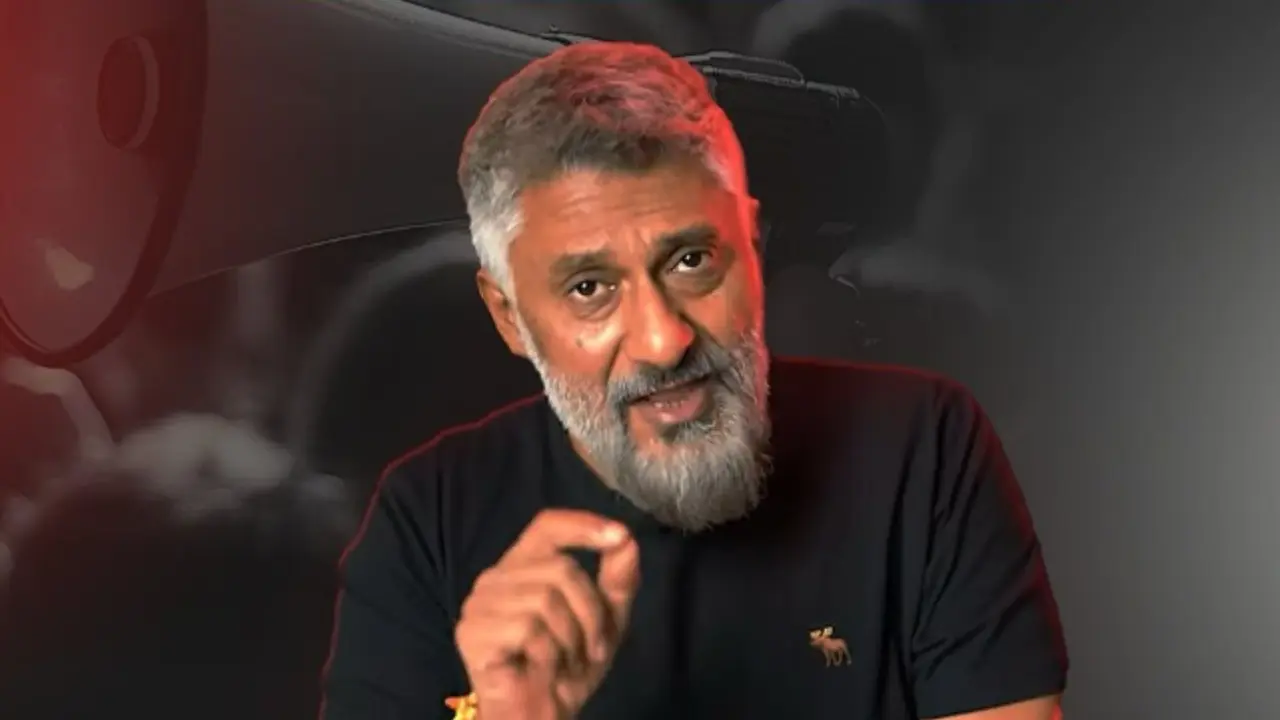
Chandrima Pal (BOMBAY TIMES; September 4, 2025)
Vivek Ranjan Agnihotri likes to make all the right—pun intended—moves. Ahead of the release of The Bengal Files, the third instalment of his Files series, he picks a Bengali-themed restaurant in suburban Mumbai for an interview, tells us that he likes Kishore Kumar’s Bengali songs and settles down for a Bengali meal with shukto and fish paturi . Excerpts from the conversation.
Let us imagine you had zero opposition to The Bengal Files, which releases in theatres tomorrow. That you had no political outfit, entity or individual to name and blame in your interviews. How would you promote your film?
I would have felt suffocated. I would have failed. My idea was to pick up taboo subjects, and in my mind the problem was that even after 78 years of Independence, we are still fighting with the same problems that led to the Partition. Unless you acknowledge there is a problem there can be no healing, no solutions. The purpose, the whole objective of my movies is to start a conversation. Since the trailer has launched, everybody is writing about Direct Action Day or Gandhi’s role, they are dissecting the film. Many Bengali Hindus are now admitting that their parents or grandparents had spoken about Direct Action Day and the Partition trauma. This, I believe, marks the beginning of healing from a generational wound.
No other place has sacrificed as much as Bengal: it was the cradle of the Renaissance, the wellspring of nationalism in all its shades—Congress, communist, centrist—with both Vande Mataram and Jana Gana Mana emerging from here. Bengal gave India its cultural crown, from cuisine and poetry to cinema, the Bengal School of Art shaped by Abanindranath Tagore. For me, Bengal is India’s lighthouse. My purpose was to shock people into realising how much we’ve lost.
How can you connect Bengal’s loss of cultural and intellectual capital directly to the Hindu– Muslim conflict at the heart of your storytelling? Isn’t it too much of an oversimplification?
That’s a very deep question. Which other state in the world has been divided three times? Without Direct Action Day or the Noakhali genocide, there would not have been Partition. Gandhi himself spent seven months in Noakhali, yet afterwards Bengalis were told not to speak of their pain—silenced by political forces that wanted to take India on a different path.
Later, communist ideology took deep root in Bengal, but it viewed everything only through oppressor versus oppressed. That western lens does not fit India, where the so-called majority was ruled and persecuted by minorities for 1,200 years—our literature, music, architecture, everything was distorted. That is why, I argue, Bengal’s decline cannot be seen separately from communal fault lines.
Films have been made on the Holocaust, Hiroshima, slavery— always with a core of humanism, empathy. Many feel your films don’t address that.
First, let’s be clear—which lot of people? Viewers? Critics? I am very research-oriented. And why should I force closure when history itself has none? Lal Bahadur Shastri’s death has no closure. Kashmir still has no closure—people were killed in Pahalgam just recently. But this film does have closure. What I believe should be done, that’s the closure.
Suppose this film triggers unrest. Would your role as a filmmaker end with reopening certain chapters in history?
Look at The Kashmir Files. People warned it would cause unrest. Nothing happened. Instead, I received thousands of emails from Kashmiri Pandits saying the film began their healing process. I can guarantee Bengali Hindus will say the same after this film; they already are, across screenings in the US.
Both communities suffered losses. Isn’t everyone part of the healing process?
Of course. Healing belongs to everyone. But not everyone had the luxury of moving on. Many were forced. Did we really move on? Germany and Poland confronted their past—they outlawed Nazi glorification, built museums, preserved Auschwitz.
Should India simply say “move on”? Or acknowledge that we have a genuine Hindu–Muslim faultline—Partition, Bombay blasts, Pahalgam killings, constant election rhetoric. If America could confront slavery through films, articles, debate, why are we in India told to stay silent about our own history?
Some of the cast members of your film — Saswata Chatterjee and Sourav Das — are facing backlash for being part of the film.
What backlash? Sourav and I had lunch recently. He never distanced himself. A journalist twisted his words, and he immediately asked, “Show me my tweet, quote me if I said that.” Same with Saswata. He never disowned the film.
Saswata did say he wasn’t told the full context.
That’s media manipulation. Do you think an actor of his calibre would sign without reading the script? He has to say things to survive in Bengal. I even spoke to his family—they shrugged it off. Look, he speaks Bengali throughout, eats paturi maach, plays a Murshidabad MLA. He knew what he was doing. After Nana Patekar in Parinda, we have not had such a cold-hearted villain in our cinema.
You say there will be closure at the end of the movie. What kind of closure?
Cinematic closure. But let’s be real—I cannot close the Hindu– Muslim conflict in Bengal or India. Who am I?
You often say you listen to your audience, pick stories that people want told. There are so many other stories that need to be told.
Honestly, what India needs right now is silence. All politicians should shut up for five years. Dalit leaders, Brahmin leaders, Muslim leaders, TV anchors— everyone. Just shut down the noise. And focus only on eradicating corruption. Solve that and 90% of India’s problems vanish.
Do you have political ambitions?
I’d rather die than join politics. But yes, I understand politics deeply. My father was a freedom fighter, I’ve debated politics since childhood. That’s why I can say what I say; most filmmakers can’t.
Many filmmakers, despite festival acclaim and dealing with socially relevant issues, can’t get theatrical releases. You always manage to make controversial films and take them to your audiences. What’s your secret?
Conviction. A filmmaker must guard their work like a mother rabbit protecting her babies from vultures. Most filmmakers lack that instinct. I don’t. I fight till the end.
But is it right to say they do not have the conviction to fight for their creative freedom?
Look, if you make a film on caste, someone’s offended. On women’s persecution, men are offended. On Muslims, Hindus are offended. Everyone is offended. But cinema cannot be hostage to sentiment. Honestly, I do not understand Muslim trauma or pain. Maybe if I am born as a Muslim in my next life, I would. But I still have the right to tell stories drawn from history and testimony.
And when films like Santosh don’t make it to audiences?
Then I fight for them. I don’t know why they don’t come to me, I would be happy to fight for them. Even my ideological enemies, I defend their freedom of speech. I fought for comedians like Kunal Kamra and Samay Raina.
Would you speak up for Umar Khalid?
He’s in jail, it’s sub judice, so I won’t comment.
Gopal Mukherjee aka Gopal Patha is a complex character. North Kolkata always remembered him as one of those powerful, street-cred strongmen—like Fata Keshto.
Yes, yes. They were the fiercest. Part of the akharas, too.
Utpal Dutt wrote in Towards a Revolutionary Theatre that after Direct Action Day, leaders used people like Gopal Patha to settle political scores—a muscleman on hire. He ran a family meat business, he ate meat, he spoke Bengali, he was no saint. You have said that after this film, kids will see him as a hero. Given the ideology to which you are aligned, are you okay with glorifying a figure like that?
Why? Bengalis eat meat. What’s wrong with that? Hindus in Kerala eat beef, Kashmiri Pandits ate meat too. India is not a vegetarian country; 73% of Indians eat non-veg. To reduce Gopal to food habits or language is just superficial politics. I believe in total freedom of food, speech, lifestyle.
----------------------------------
‘I hate disclaimers. They assume audiences are stupid’
Trailers don’t need disclaimers. The film will have one, because the law demands it. I hate disclaimers. They assume audiences are stupid. Does a painting carry a disclaimer? Cinema is art. My disclaimer will be the usual: “based on true incidents, survivor accounts, historical texts… intention not to hurt anyone.” Plus the silly statutory warnings—smoking kills, animals unharmed, etc. But because Jinnah was a chain-smoker, I was forced to add two extra minutes of anti-smoking ads.
----------------------------------
‘I am a storyteller, not a social scientist’
I am nobody to find answers. I am not the Prime Minister, not a social scientist. I am a storyteller. My job is to observe and narrate, not to prescribe solutions. People expect too much from filmmakers. Journalists often ask me — why don’t you rehabilitate Kashmiri Pandits? I tell them, I am not a politician. It’s like asking Satyajit Ray after Pather Panchali to eradicate poverty. That’s not how art works.
"Bollywood needs a reboot": Makers speak out on crisis within
8:39 AM
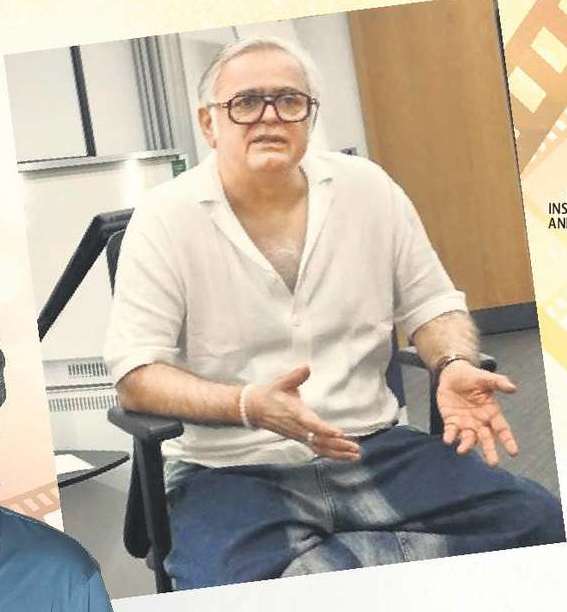
Compiled by Rishabh Suri (HINDUSTAN TIMES; April 25, 2024)
Over the past year, much of the conversation in the Hindi film industry has been around rising entourage costs, films failing to draw audiences to the theatres, escalating fees of actors, and the need to rein them in. From Hansal Mehta to Shoojit Sircar, filmmakers weigh in on why not just production budgets but also the overall quality of films are impacted. Here’s what they said:
Bollywood hardly has any independent producers; there’s no fresh ideas; no innovative distribution or marketing strategies
Vivek Agnihotri, who’s been vocal about issues related to the film industry, recently wrote on X, “Bollywood is in shambles. And that’s good for the industry. To erect a new building, you must demolish the old one. This is that time. Today, Bollywood has hardly any independent producers. No new producers. No fresh ideas. No innovative distribution or marketing strategies. A few years ago, there were a dozen studios — now just two or three remain, and they too are monopolistic and here for reasons other than filmmaking.”
The 51-year-old The Kashmir Files filmmaker further added that the ‘passion’ for making films was overpowered by ‘corporate greed’, and claimed, “...there are no promising new stars. If you want to cast someone from the 21–35 age group, you’ll find almost none — neither heroes nor heroines...”
Make movies for Bharat, not for a small group of people watching in 25, 50 or 100 selected multiplexes
Vipul Shah, known for directing hits such as Namaste London (2007) and producing box office successes such as The Kerala Story (2023), too weighed in on why today’s films struggle to resonate with the masses the way they once did.
“I feel there are many reasons for this, and we are going through a phase which has lasted for quite some time...,” he recently told ANI. He further pointed out that the core problem is that filmmakers have stopped making movies for the larger Indian audience. “The first issue is that we have stopped making movies for Bharat. We make movies for a small group of people watching in 25, 50, or 100 selected multiplexes. Our expectations are that only those people should like our films,” he added.
Everyone forgot the masses
Vikram Bhatt, whose latest directorial Tumko Meri Kasam tanked at the box office, criticized Bollywood’s pause on “massy” films. The 56-year-old told ANI, “Everyone forgot the masses and went to niche films. And during Covid, the audience’s habit of watching films in theatres disappeared. We stopped making massy films. If you see the South industry, it’s flourishing because it always prioritises the mass audience. They still want to see superheroes, want to see Pushpa, want to see Kantara. They still consider the villain a villain, still whistle and clap. Hum toh waisi films banana bhul gaye jise dekhkar audience seeti aur taaliya bajaye.”
Recycled, formulaic approach needs to end
Hansal Mehta, who is currently shooting for his upcoming series Gandhi, had a pointed response for those who predicted the “doom” of Bollywood. “...pause. The industry isn’t dying. It’s waiting to be disrupted,” the filmmaker wrote on X, adding, “The problem isn’t the audience losing interest. It’s that investment is being funnelled into the safe, the recycled, the formulaic.”
The 56-year-old, known for his works such as Shahid (2012), Scam 1992 (2020) and Scoop (2023), further wrote, “The future of Hindi cinema lies in betting on raw talent, bold storytelling and directors who can take a script and direct the hell out of it. The past few years have proved: stars don’t necessarily bring audiences; conviction does. A new generation of actors, filmmakers, and writers is ready to change the game.”
He went on to name actors such as Adarsh Gourav, Vedang Raina, Ishaan Khatter and Zahaan Kapoor as promising talents that Bollywood can place its hopes on.
Popular actors will have to lower their fees
Shoojit Sircar voiced his displeasure over the steep fees demanded by certain actors. The filmmaker, whose 2024 release I Want to Talk underperformed at the box office, said, “I won’t say much about people’s entourages or what they charge, but I am sure of one thing: Popular actors will have to lower their fees. If they don’t, directors will stop approaching them. We have to make a film within cost now, if we want the audience to come and watch it. Go expensive wherever needed. If the director visualizes a shot a particular way, pay more for that. The director should not compromise on his vision to save money for the actor’s fees.”
Bollywood needs government support to nurture bold storytellers-Vivek Agnihotri
8:46 AM

Vivek Ranjan Agnihotri pens an open letter to Union Commerce and Industry Minister Piyush Goyal
HINDUSTAN TIMES (April 7, 2025)
Dear Piyush Goyal ji,
Your recent remarks at the Startup Mahakumbh about Indian startups needing introspection and real value-addition in the face of global competition — especially against China’s strides in EVs, semiconductors, and robotics — were deeply resonant. Your push to move beyond superficial ventures like “fancy ice cream and cookies” and focus on meaningful innovation is timely. In this vein, I wish to highlight a sector with immense cultural and economic potential — Indian cinema — which, despite its legacy, is failing to innovate, compete globally, or harness its soft power potential like South Korea or Japan.
Globally, cinema and OTT thrive on bold storytelling and technological disruption. Films like Boyhood (shot over 12 years and released in 2014), the single-take illusion of 1917 or the social commentary of Parasite (both 2019) and even a raw, real-time dive into teenage chaos shot in one take such as that in Adolescence, showcase how innovation drives cultural influence.
Today, K-entertainment contributes over $12 billion (approximately Rs. 1,200 crore) to Korea’s economy, while Japan’s anime industry exceeds $20 billion (about Rs. 2,000 crore) in revenue. Hollywood dominates through streaming platform Netflix’s $31 billion (Rs. 3,100 crore) content budget, making it a global content empire.
Meanwhile, Indian cinema remains stagnant — copying formats without mastering their essence. We are the world’s second-largest film producer, yet ironically, most of our content ends up being sold to American platforms. It’s the East India Company syndrome all over again — we create the raw material, but others own and profit from our stories.
The decay is evident. Studios are shutting down; producers flee to real estate. Visionary filmmakers struggle to survive, while the system promotes non-actors better suited to making Instagram reels or dancing in weddings than meaningful cinema. Rooted, Indic stories are missing. Bollywood, once a soft power beacon, is now “flower power” — style without substance.
The viewer experience is equally dismal with outdated multiplex screens, exorbitant ticket and food prices, and theatres that now resemble food courts. Cinema, once a middle-class joy, is now an unaffordable luxury with diminishing returns. I speak from experience. The Kashmir Files (2022) — a non-starrer, risky narrative — broke Bollywood’s formulaic mould; but this came at a personal cost: fatwas, security threats, relentless backlash and character assassination. If truth invites such hostility, how can we expect innovation?
The industry needs government support — funding, incentives, and platforms — to nurture bold storytellers, not just star-driven fluff. Indic cinema can be the biggest startup of India, with potential to generate jobs, export cultural capital, and build global influence just as South Korea’s entertainment industry has done. Just as startups must prioritize real value, Bollywood must shift from elite appeasement to global relevance. Cinema can be an economic and cultural powerhouse, India’s leading soft power but only with introspection and disruptive innovation.
I urge your intervention to empower filmmakers who dare to dream—help Indian cinema reclaim its place as a global leader, not a copycat.
Sincerely,
Vivek Ranjan Agnihotri
Indic Filmmaker
Disclaimer: The views shared in the above article belong solely to the author
Santosh, United Kingdom’s Oscar entry, blocked in India? Shahana Goswami says, "It's a shame"
8:42 AM

Anjali Jhangiani (THE TIMES OF INDIA; March 27, 2025)
Santosh, the UK’s official entry in the Oscars’ international feature category and a Bafta nominee for best debut feature, has been blocked by Indian film censors, according to a report in UK daily Guardian.
Written and directed by British-Indian filmmaker Sandhya Suri, the film was made in India and is in Hindi. According to the Guardian report, Central Board of Film Certification refused to clear the film over concerns about its negative portrayal of police — “depicting deep-rooted misogyny, discrimination against Dalits and the normalization of mistreatment and torture by police officers.”
Censors’ decision disappointing and heartbreaking: Suri
Several CBFC board members TOI spoke to said they were unaware of reasons behind uncertainty over the release in India. “The film also grapples with the issue of sexual violence in India, particularly against lower caste women, and the rising tide of anti-Muslim prejudice in the country,” adds the report.
Author and CBFC board member Ramesh Patange said, “I attend movie reviews once a month, and my role is limited to that. Only the chairman is privy to the board’s day-to-day functioning.” Other board members declined to comment, saying only CBFC chairperson Prasoon Joshi would speak on the issue. Efforts to contact Joshi were unsuccessful at the time of going to press.
CBFC board member and filmmaker Vivek Agnihotri told TOI from Puducherry that he was unaware of any issues with the film.
“In my personal capacity, not as a representative of any organization, I feel deeply distressed that a society which considers itself the spiritual leader of the world is so insecure that it resorts to censorship. Only an insecure society censors art in any form Art, creativity, and literature form the soup that nourishes society. Without it, a society cannot grow,” said Agnihotri.
The Guardian report says Sandhya Suri described the censors’ decision as “disappointing and heartbreaking”.
It also quotes her as saying the censors had demanded a list of radical cuts so lengthy and wide-ranging that they would be impossible to implement, adding that the list of cuts demanded went on for several pages, and included concerns about themes relating to police conduct and wider societal problems “which are deeply baked into the film”.
“It was very important to me that the film is released in India so I did try to figure out if there was a way to make it work. But in the end it was just too difficult to make those cuts and have a film that still made sense, let alone stayed true to its vision,” the Guardian report quoted Suri as saying.
------------------------------------------
Yashika Mathur (HINDUSTAN TIMES; March 28, 2025)
Actor Shahana Goswami is extremely disheartened by the Central Board of Film Certification’s (CBFC) decision to block the theatrical release of Santosh in India. Despite earning international acclaim and being the UK’s official entry for the 97th Academy Awards, the Sandhya Suri-directed film has hit a roadblock in its home country due to censorship demands.
The 38-year-old finds it particularly disappointing since the film’s story is deeply rooted in India. “It makes me feel very sad. It’s upsetting that audiences here — where the film is set — won’t get to see it. The fact that Santosh has been appreciated at film festivals, even in India, makes it even more unfortunate. It’s a shame that it will not have a theatrical release.”
Santosh, which premiered at the 77th Cannes Film Festival in 2024, is already available online for Indian viewers.
However, the team had hoped for a broader theatrical release, which now seems unlikely unless a resolution is reached. “About the release in India, the censor has given a list of changes they require for the film to release and we as a team are not in agreement with the cuts as they would change the film too much, and so it is in a dead lock where it probably won’t release theatrically in India,” says Shahana.
While she refrains from specifying the CBFC’s objections, reports indicate that the board has raised concerns over the film’s depiction of Islamophobia, misogyny and violence within the Indian police force.
Bipasha Basu, John Abraham broke up couple of days ahead of Billo Rani shoot-Vivek Agnihotri
9:19 AM
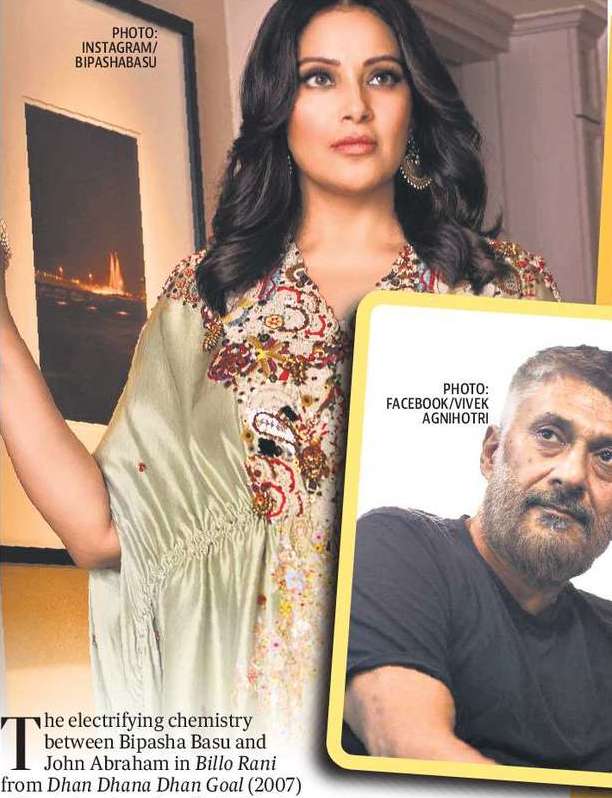
HINDUSTAN TIMES (February 16, 2025)
The electrifying chemistry between Bipasha Basu and John Abraham in Billo Rani from Dhan Dhana Dhan Goal (2007) still sets hearts racing. But behind the scenes, sparks of a different kind were flying.
Director Vivek Ranjan Agnihotri recently spilled the beans, revealing that the song was filmed in the midst of intense personal turmoil — the duo had broken up just days before the shoot. Taking to X, Vivek shared that their on-screen passion was a masterful illusion, crafted despite real-life heartbreak.
Reposting a clip of the song, he wrote, “This song has a history. Producers didn’t want it. Javed Saab was against the hook ‘Billo Rani,’ Pritam wasn’t sure about the qawwali style. John and Bipasha had broken up just days before, so there were a lot of issues.”
However, it was the late choreographer Saroj Khan’s unwavering belief that turned things around. “Only Saroj ji believed in me. She said this will become the biggest hit — and it did. Big salute to Pritam, Javed Saab and Saroj ji,” he added.
The song, from the film, also features Arshad Warsi and Boman Irani. Sung by Anand Raaj Anand and Richa Sharma, Billo Rani became an instant chartbuster. Bipasha and John’s love story, which began on the sets of Jism (2003), spanned nearly a decade. And while their real-life romance may have ended, Billo Rani remains a timeless onscreen memory of their sizzling magic.
Vivek Agnihotri has not seen Freedom At Midnight, the trailer. He has not seen anything-Nikkhil Advani
4:46 PM
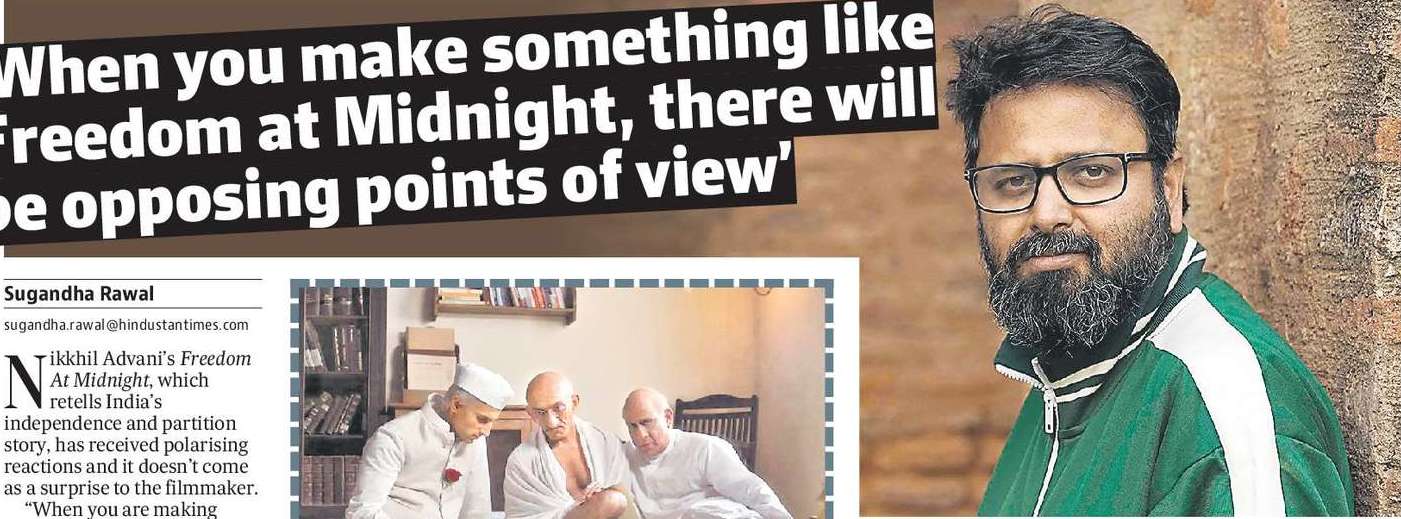
Sugandha Rawal (HINDUSTAN TIMES; November 23, 2024)
Nikkhil Advani’s Freedom At Midnight, which retells India’s independence and partition story, has received polarising reactions and it doesn’t come as a surprise to the filmmaker.
“When you are making something like Freedom At Midnight, there will be opposing points of view,” Advani tells us, adding, “I’m sure there are experts who know more about the partition and days leading to independence. And they will have some point of opinion”.
He asserts, “What we have tried to do is just stick to the events that took place between August 16, 1946, to January 30, 1948, which are indisputable. These events took place in history. We have just followed events and tried to take the audience into those rooms.”
Mention director Vivek Agnihotri’s tweet that criticises the filmmaker for allegedly not depicting the history with full honesty, he replies, “He has not seen the show, the trailer. He has not seen anything (about the show). He has just read an article from a magazine and shared the tweet.”
Advani further states that he has done his best to give a balanced narrative, stressing that he was only focused on capturing the harrowing pain of the tragic chapter of Indian history and not on taking any sides. “There’s only one side here. And it is that the partition was horrible and it should never have happened. People were torn apart, and friends were torn apart. There is no other side,” he stresses.
Sharing his own experience, he reveals, “My grandparents were part of that (partition). I’m a second-generation refugee. Although I was born in 1971, my grandparents spoke about the times. I have heard some of the saddest and most tragic stories. It is indisputable that partition was a very tragic consequence.”
“The show has a definite end,” Advani concludes by saying that he doesn’t plan to turn it into a franchise.
In the season of general elections, political thrillers grips the nation’s psyche
8:08 AM
Mimansa Shekhar (HINDUSTAN TIMES; February 7, 2024)
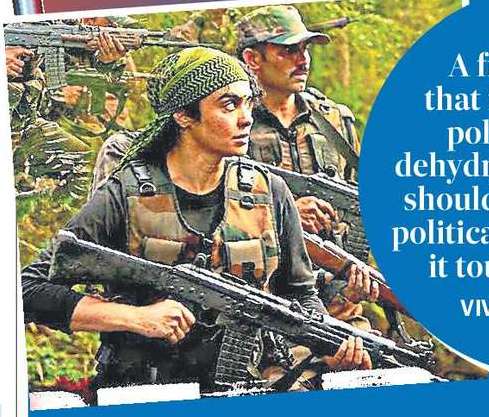
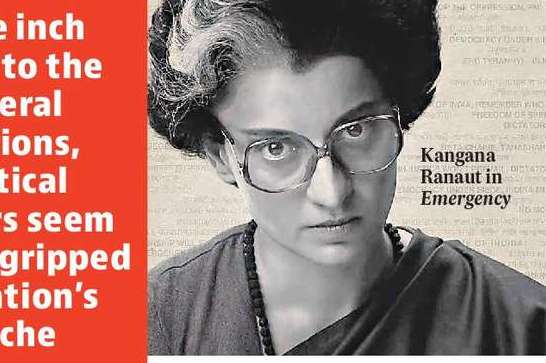
Bollywood’s love for political stories is not new, but with the upcoming general elections, there is an increase in political dramas. The year started with Pankaj Tripathi starrer Main Atal Hoon, biopic on former Prime Minister, late Atal Bihari Vajpayee. Several other political thrillers, including Article 370, Emergency, Bastar - The Naxal Story, Section 108, The Sabarmati Report, The Delhi Files, are set to hit the screens as filmmakers vie to present intriguing stories on political leaders and key events. But what makes such films click?
The Tashkent Files (2019), The Kashmir Files (2022) and The Vaccine War (2023) filmmaker Vivek Agnihotri says, “A film industry that isn’t making a political film, is dehydrated. Every film should address socio-political issues because it touches our life.” The filmmaker is helming The Delhi Files, which is reportedly based on the 1984 Sikh riots in New Delhi.
In the past, filmmakers like Raj Kapoor, Manoj Kumar, Dev Anand, Guru Dutt, Shyam Benegal, Prakash Jha, Sudhir Mishra, among others brought socio-political commentary in their films. And this genre continues to be a loved by the current crop of filmmakers.
While Yami Gautam Dhar‘s Article 370 is set against the revoking of Article 370 that gave Jammu and Kashmir a special status; Emergency, headlined by Kangana Ranaut, biographical historical drama based on Indian Emergency during former Prime Minister, late Indira Gandhi’s term.
Another reason political thrillers pull in the crowds is the relatability factor. Even if not directly, several movies have subtle political undertones. Pointing at films such as Inquilaab and Aaj Ka MLA (both 1984), Gadar 2 (2023) director Anil Sharma asserts that politics is an integral part of our cinema, “Even today, if you go to the rural areas, people discuss politics sitting under a tree. Political films are a popular sentiment in India, hence it works with the audience.”
Actor Adah Sharma, who spearheaded The Kerala Story (2023), will be seen next in Bastar - The Naxal Story, that traces the Naxal movement in Chattisgarh. The 31-year-old says the final verdict of a film is in the hands of the audience: “In 2023, the biggest movies were Jawaan and Pathaan, which weren’t political thrillers, [but] The Kerala Story was part of the top films. Since time immemorial, movie watchers have embraced all genres equally. Bastar... is a political thriller, if the audience decides it’s well made, it will work.”
With Rang De Basanti (2006), Raajneeti and Rakta Charitra (both, 2010), Aarakshan (2011) and Maharani (2021), we’re seeing an upswing in this genre. The crux remains that important stories are told from every lens and aspect of the political spectrum because that’s what makes the nation think.
Experts share their views
Trade expert Atul Mohan says, “The political thrillers releasing this year don’t have an edge as the audience knows that it can only be agenda driven. Poore desh ka mahaul election ka hai, so news mein zaroor reh sakti hain, but it doesn’t necessarily mean they will do well at the box office also.”
Film exhibitor Akshaye Rathi says, “It’s tough to avoid cricket, cinema and politics in our country. People might say a film is right-leaning, like The Kerala Story or The Kashmir Files, but we’ve also had films like Mulk (2018) or Article 15 (2019), which spoke from the other side of the political leaning.”
Producer and film expert Girish Johar says, “Bheed (2023) was released at the perfect time, but didn’t do well as audiences seek both relevance and entertainment. [For political films], it’s topical as everyone is talking about elections.”
Filmmakers versus critics: How ‘Animal’ brought out the claws
8:44 AM

Unkind reviews are not new, even ‘Sholay’ was skewered. But, are critics harsher now or directors more thin-skinned? A look at how film criticism is changing in the digital age
Mohua Das (THE TIMES OF INDIA; January 14, 2024)
Seventeen years ago, this reporter’s foray into journalism had kicked off with an unexpected curveball. The editor across the table didn’t expect a discussion on current affairs or social justice.
Instead, the initiation hinged on a simple question, “What were the last two films you watched, and can you review them?” He wasn’t scouting for a film writer, and neither did I become one. For him, this seemingly whimsical examination was a litmus test of sense and sensibility, social observations and cultural understanding that became a silent judge of journalistic acumen.
Fast forward to the present, and the once-revered art of film analysis is under siege, caught in the crossfire of social media opinions, paid reviews and a chilling shift in filmmaker-critic dynamic. While differences in opinion between the two are a tale as old as the movies, disagreements now quickly erupt in nasty trolling, often fuelled by the filmmakers themselves.
A telling example is when a film critic with a movie portal recently criticized Sandeep Reddy Vanga’s latest film ‘Animal’ for its portrayal of toxic masculinity, unwarranted violence and not being entertaining enough. The film team retaliated with box-office numbers and used its official account to tag her on social media and unleash vitriolic fans after her.
This wasn’t an isolated incident. Earlier, filmmaker Vivek Agnihotri had labelled another veteran film critic as “the Shoorpanakha of Bollywood” openly accusing her of “sabotaging” his movie ‘The Kashmir Files’.
“This is not a great time to be a critic,” says Pratim D Gupta, a filmmaker with over a decade-long background as a film critic, wistfully recalling the days of Khalid Mohamed, the late Rashid Irani, and other veteran critics, now a dwindling tribe. “Back then reviews weren’t just verdicts. People read them for the quality and fun in the writing. That practice of analyzing or even strongly criticizing a film has become obsolete.”
Why? The culprit, Gupta argues, is: “A surge of influencers, trade analysts, and online film critics who have eclipsed the value of well-founded film critique with their quick takes.”
This, says Gupta, has also led to the birth of an unspoken culture — the “rate card”, with money dictating the tone of reviews. “Suddenly a lot of self-appointed film critics, with inflated follower counts, are passing judgement. And film PRs go to town splashing their 4 or 5 star ratings and one-liners on their posters,” says Gupta.
But don’t filmmakers like Vanga have a point about critics getting it wrong? Gupta points out that box-office triumph was being equated with cinematic excellence.
“In the case of ‘Animal’, the critic was talking about the merit of the film while the filmmaker countered with how much money it has made. These are two vastly different yard sticks. But today, box office success is equated with a good film and a ‘Pathaan’ or ‘Jawan’ are looked upon as the best films of the year when they’re actually just the biggest blockbusters. That line today has become very blurred.”
“Big box-office numbers don’t necessarily mean a great piece of filmmaking,” agrees film writer Aseem Chhabra, who has been reviewing movies for over two decades. Weighing in on the broader implications of aggression, he adds: “Filmmakers can be insecure and vicious, even if they make a lot of money. What’s getting dangerous is the targeting of critics with methods eerily similar to how political fanatics attack dissenters.”
Chhabra also concedes that “good criticism doesn’t mean dissing.” He admits having given poor reviews to some popular films, including director Karan Johar’s, in the past. However, a handful of critics cannot significantly impact a film’s success, says Chhabra, pointing to box office successes like the films of Rohit Shetty, Sandeep Reddy Vanga, and Vivek Agnihotri which were loved by audiences despite being panned.
One of the most famous examples is ‘Sholay’ which, in 1975, was dubbed ‘average’ by a newspaper critic who felt it lacked “high intelligence, art and purpose”. He was proved wrong and how!
Filmmaker Anurag Kashyap, who has weathered harsh criticism for films like ‘Bombay Velvet’ and continues to endure trolling on social media, dwells on the need for “discerning critics” and “champions of cinema” amidst all the “noise in the name of film criticism and good writing on cinema getting drowned in the tsunami of mediocrity.” The filmmaker says, “It’s hard to find the discerning voices amongst them… Gone are the days when I as a filmmaker waited for a particular film critic to write about my film to know his or her opinion on the film.”
This disillusionment, however, hasn’t translated to indifference. Kashyap advocates for constructive criticism, the kind that dissects the work, not the artist. “In the times of social media everyone has a voice, and we can’t ignore it. What is offensive to some is the truth or fact to others. It applies to both sides of the fence. We need to stop the moral posturing and outraging over what offends us,” says Kashyap.
Instead, he emphasizes the importance of taking criticism in stride and recognizing that every film has its share of lovers and haters. “And that will always be the case. We need to just do our thing to the best of our ability. You never know what works and what doesn’t.”
Vanga’s visceral ‘Animal’ finds resonance with him. “It doesn’t offend me,” he clarifies, “It provokes me, outrages me, it’s also impacted me. And I will fight for Vanga’s right to make his film and tell his stories his way.” This, for him, is the power of cinema, and ‘Animal’, despite its flaws, he sees as a game changer. “With all the trashing and criticism and also celebration of it, you cannot ignore the impact it has had on filmmaking and filmmakers — good, bad or ugly.”
Filmmaker Vasan Bala, on the other hand, views the critic-filmmaker relation ship through a historical lens. The “love-hate relationship” is nothing new, he maintains, citing past spats. “A search on the internet will throw up several examples from the past 15 years. It’s never been a simple disagreement. Ridley Scott just fired back at French critics who disliked ‘Napoleon’. Todd Phillips has publicly pushed back on criticism of gun violence in his film ‘Joker’ as far-right extremism.”
While Bala urges critics to “fully express themselves and stay true to their feelings,” he encapsulates a filmmaker’s post-release emotional odyssey. “A filmmaker is not really left with much after the release. Emotionally it’s like ‘you are on your own, good luck’ kind of a state.”
The relationship between reviewers and filmmakers has dipped to such an extent that legal action is being taken. The Kerala police recently registered a complaint filed by Malayalam director Ubani E against online film reviewers and social media platforms accusing them of intentionally posting negative reviews to extort and damage reputation. This came around the same time that a gag order was imposed on social media influencers and film-reviewing vloggers to not publish any reviews for at least seven days after a film is released.
Both Kashyap and Bala see this as a temporary blip that cannot silence genuine critique. Gupta voices his apprehensions. “You already censor films. Now if reviews get regulated by a state body, too, it’s going to be a darker day for film criticism,” he says.
Chhabra echoes similar concerns. “Taking someone to court over a critique, unless it’s pure malice without basis, is a terrible sign for our culture. It sets a dangerous precedent.” He calls film criticism a “two-way street”, where critics and filmmakers should respect each other and the art form.
“Some critics suffer from an inflated sense of expertise, while some filmmakers dismiss critics entirely. Free speech is crucial but it comes with responsibility,” he concedes. “No crossing lines into maliciousness or gossip just to settle scores. As long as your arguments are solid and truthful, no case should stand.”
But Chhabra is also firm. “Look, a review is a review. My job isn’t to worry about box-office numbers or bankrupt producers. It’s to tell the truth as I see it, without flinching and worrying that ‘bechara, film flop ho jayegi’.”
Moviegoers burst crackers during Tiger 3's screening; exhibitors and trade experts express concern
8:41 AM

After firecrackers were burst in a Maharashtra movie theatre during a screening of Tiger 3, endangering both life and property, we speak to exhibitors and experts
Rishabh Suri (HINDUSTAN TIMES; November 14, 2023)
On Sunday, a show of the latest of 2023’s big-ticket theatrical offerings, Tiger 3, saw fans setting off literal fireworks to celebrate the actor’s entry sequence, in a theatre in Malegaon, Maharashtra. The scary visuals in the video being circulated online show audience members running for cover in a situation that could have easily turned disastrous.
“It’s highly deplorable. Strict action should be taken against those responsible,” says Shibasish Sarkar, President of the Producers Guild of India. Pranav Garg, exhibitor and managing director, Maya Palace Multiplex, Muzaffarnagar (UP), shares, “The theatre in this video must have been a single-screen cinema with no guards. It is the responsibility of the licensee, or the cinema owner, for the life and safety of the viewers. How can firecrackers be allowed inside? This is very wrong.”
A similar incident had taken place in 2021 during a screening of Khan’s film Antim: The Final Truth, which the actor had condemned in a statement. The latest incident has left exhibitors, too, worried. Akshaye Rathi tells us, “I love to see people have a good time in theatres, but it’s important that we take cognizance of the fact that something like this both damages property and endangers lives.”
Fans had got cakes, garlands and firecrackers at our property, too, but we only allowed them to burst them in a 100% fireproof area in the parking lot, with no vehicles around.
- Pranav Garg, Exhibitor
I am against even dancing inside the theatres. This rowdy behaviour must be checked, not only by authorities but also condemned by the stars. Otherwise, in the long term, the audience will stop coming to theatres.
- Vivek Agnihotri, Filmmaker

Name one director who is not a propaganda filmmaker-Vivek Agnihotri
8:20 AM

Agnihotri says he made The Vaccine War so that people, down the line, know how India created its own vaccine
Hiren Kotwani (MID-DAY; September 26, 2023)
Over a year after The Kashmir Files (2022), Vivek Ranjan Agnihotri is ready with The Vaccine War. With the film, the director wants people to celebrate India’s achievement of making its own vaccine to combat the Coronavirus.
“It’s also a story about our women scientists, and the shift in the narrative from ‘India can’t do it’ to ‘India can do it’. I made it [so] that 30 years later, people know what happened during its making,” he says.
Through the Anupam Kher, Pallavi Joshi, Raima Sen and Nana Patekar-starrer, the director also offers his take on the “politics” that, he says, surrounded the vaccine’s creation.
“At that time, people were trying to create doubts about our own vaccine. Akhilesh Yadav [initially] said he won’t take the ‘BJP [Bharatiya Janata Party] vaccine,’” says the director, whose The Kashmir Files won two National Awards last month.
Last year, the movie sparked controversy at the International Film Festival of India when Israeli filmmaker and jury head Nadav Lapid described it as “a propaganda and vulgar movie”.
Tell him that he is labelled a propaganda filmmaker, and Agnihotri retaliates, saying, “Name one director who is not a propaganda filmmaker. Everyone is propagating a certain idea or ideology. Like, some [director] says there is nothing but love. Is that true?”
He adds that the label attached to him makes it tough for him to get financial backing. “The Vaccine War is a solo production, made with our own resources.”
I’m happy that The Kashmir Files has got validation now-Vivek Agnihotri
8:57 AM
Navya Kharbanda (HINDUSTAN TIMES; August 26, 2023)
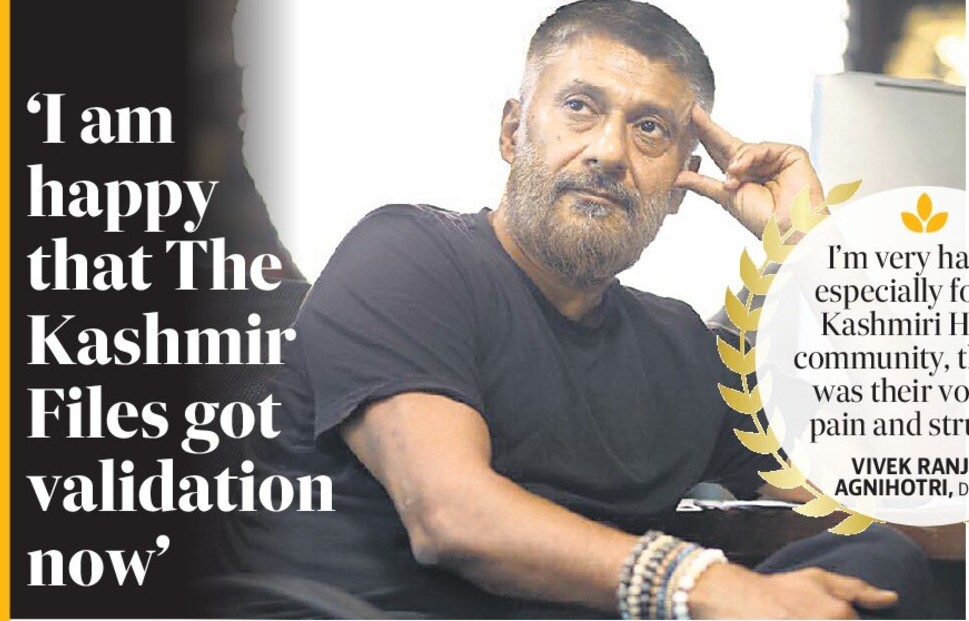
In a momentous turn of events, filmmaker Vivek Ranjan Agnihotri’s The Kashmir Files, won the National Award for Best Feature Film on National Integration. Elated about the news, the director, who is in the US, tells us, “It was very early in the morning [here] and my phone kept buzzing — that’s how I got to know! I’m very happy, especially for the Kashmiri Hindu community, because the film was their voice of pain and struggle. I was just the medium. We made our film honestly and presented it in front of the world. I’m happy that it has got validation now.”
The 49-year-old anticipates a potential surge in negative attention — similar to what he faced, from some factions, during its release — despite the honour. “Do you think that the trolls won’t hate or attack me anymore? The backlash [might] increase after the National award, because we stand vindicated,” says the filmmaker, who’s gearing up for the release of his next, The Vaccine War.
Brushing off detractors as naysayers, Agnihotri states, “Some 8-10 voices mean nothing to me. There were more people who loved the film and some trolls with a different political inclination.”
The filmmaker whose wife, actor Pallavi Joshi also bagged a National Award for The Kashmir Files in the Best Supporting Actress category, believes that this accolade will serve as an inspiration to other filmmakers to delve into real subjects and produce meaningful cinematic narratives. “Getting the most prestigious recognition will definitely encourage many other filmmakers to make films on such real subjects,” he wraps up.
I respect Prabhas who is a mega mega star doing mega mega budget films-Vivek Agnihotri
8:49 AM
HINDUSTAN TIMES (July 29, 2023)
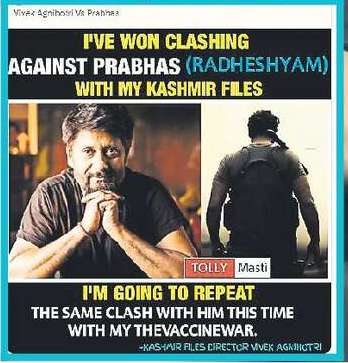
Director Vivek Ranjan Agnihotri refuted news that he allegedly said he is ‘already winning’ the box-office battle against actor Prabhas, as their films The Vaccine War and Salaar: Part 1 – Ceasefire, respectively, will clash on September 28.
He tweeted: “Who is spreading such fake news attributing fake quotes to me? I respect Prabhas who is a mega mega star doing mega mega budget films. We make non-starrer, small budget, people’s films. There is no comparison between us. Pl spare me (sic).”
He retweeted the image with the quote attributed to him that read, “I’ve won clashing against Prabhas (Radhe Shyam) with my Kashmir Files. I’m going to repeat the same clash with him this time with my VaccineWar (sic).” Both the films had released on March 11, 2022, with The Kashmir Files emerging as a blockbuster, while Radhe Shyam didn’t get a good response.
Merry Christmas vs Yodha: Karan Johar's cryptic message triggers new debate
8:59 AM

Rishabh Suri (BOMBAY TIMES; July 19, 2023)
The trend of box-office clashes isn’t new in Bollywood. But a clash among filmmakers over a movie’s release date seems to be the norm. Filmmaker Karan Johar, who is producing the Sidharth Malhotra-starrer Yodha that releases on December 15, recently said that studios and producers should “stand united in these tough theatrical times”.
The cryptic post hinted at Johar taking a dig at the makers of the Katrina Kaif and Vijay Sethupathi-starrer Merry Christmas, which is also slated for a December 15 release.
Amused by Johar’s post, filmmaker Onir tweeted, “Big Bollywood releases get so upset when there is another big budget release the same day and they talk about how we should all care for each other in the industry, but don’t think for a second when they deprive a small budget indie film of a tiny number of good shows to survive (sic).”
Merry Christmas co-producer Ramesh Taurani says, “Mujhe nahin lagta mere liye bola hoga Karan ne.”
RAMESH TAURANI , CO-PRODUCER OF MERRY CHRISTMAS:
As far as clashes are concerned, there are enough screens in India these days. Also, both our films are completely different in terms of the genres, so both will do well.
TARAN ADARSH, TRADE ANALYST:
We live in a democratic country and no one has a monopoly on a date. I feel both the films (Yodha and Merry Christmas) are quite different from each other. I hope the issue gets sorted out.
ANIL SHARMA, DIRECTOR:
Gadar 2 aur OMG 2 (both will release on August 11) bahut alag hain. Main apni film ka second part paise ke liye nahin bana raha hoon. Back in 2001, Gadar and Lagaan also released on the same day (June 15).
VIVEK RANJAN AGNIHOTRI, FILMMAKER:
I am an independent filmmaker, so I am not into all that (his film The Vaccine War releases alongside Salaar on September 28). Had a Jawan released with it, you could call that a clash.


Bollywood actors have no spine to express the purpose of a film festival-Vivek Agnihotri
11:03 AM
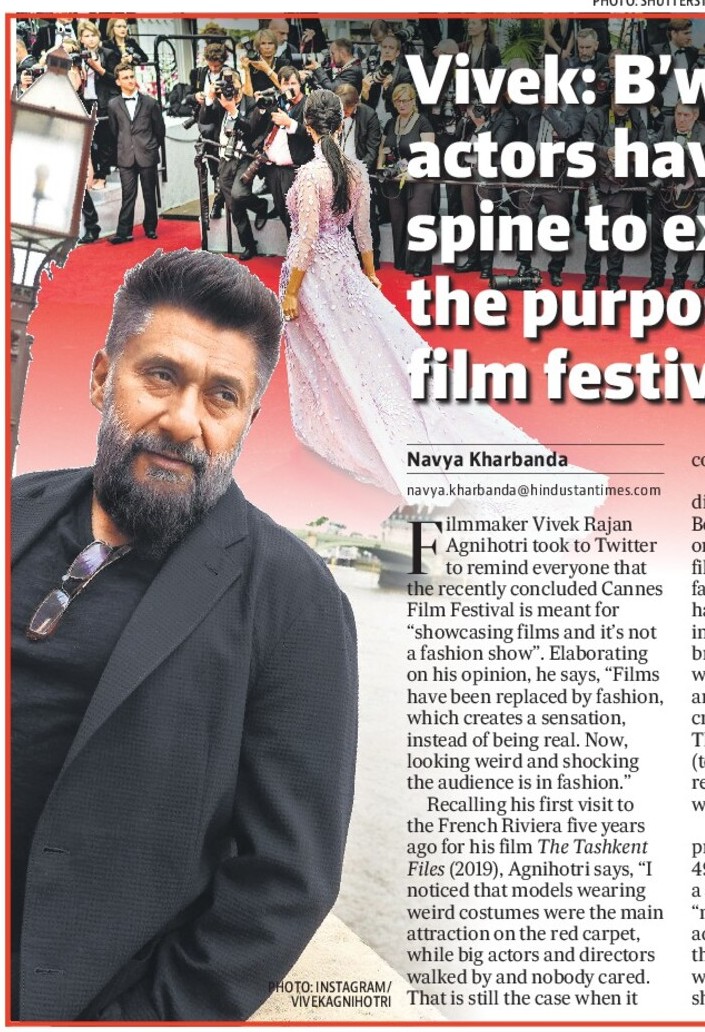
Navya Kharbanda (HINDUSTAN TIMES; May 31, 2023)
Filmmaker Vivek Rajan Agnihotri took to Twitter to remind everyone that the recently concluded Cannes Film Festival is meant for “showcasing films and it’s not a fashion show”. Elaborating on his opinion, he says, “Films have been replaced by fashion, which creates a sensation, instead of being real. Now, looking weird and shocking the audience is in fashion.”
Recalling his first visit to the French Riviera five years ago for his film The Tashkent Files (2019), Agnihotri says, “I noticed that models wearing weird costumes were the main attraction on the red carpet, while big actors and directors walked by and nobody cared. That is still the case when it comes to Cannes.”
The Kashmir Files (2022) director, when asked why Bollywood actors remain quiet on the current scenario of a film festival changing into a fashion show, he says, “They have become like social media influencers and are busy doing brand promotions. It’s like when you dance at a wedding and take money for it, you can’t criticize the food that’s served. They (actors) have no spine left (to understand and express the real purpose of the festival and what it stands for).”
Hoping for better sense to prevail the next year, the 49-year-old feels that Cannes is a space for important films that “make bold statements”. He adds, “I am talking about films that aren’t mainstream and won’t get a platform to be showcased otherwise.”
The Kerala Story row could set tone for looming 2024 poll battles
8:31 AM

After MP, UP Set To Make Film Tax-Free
Akhilesh Singh (THE TIMES OF INDIA; May 10, 2023)
You won’t be able to watch ‘The Kerala Story’ in West Bengal as it has been banned across the state in a bid to maintain “peace and harmony”. In Tamil Nadu, the film has been taken out of almost all theatres as “a precautionary measure”. However, in Madhya Pradesh and Uttar Pradesh, you can watch it at a discount with the BJP governments in these states making it tax free.
Such widespread polarization on films, rarely seen before, is set to dominate the political discourse in the year which will witness assembly polls in five states in a few months, followed by the general elections next year.
The success of the film amidst the ongoing controversy over its storyline which has given boost to BJP and other saffron organisations’ claims of forced conversions, love jihad and radicalization of the Muslim youth under Islamic State (IS) influence.
Since the controversy erupted, BJP has been vocal about the issues depicted in the film and even PM Narendra Modi made it a major poll issue in Karnataka saying the movie has exposed the consequences of terrorism in a society, especially in a state like Kerala, a beautiful land of hardworking, talented and intellectual people.
His reference to the movie at a rally in Ballari set the tone for other party functionaries as they highlighted the “menace” in Kerala which has a long boundary with Karnataka. Law minister Kiren Rijiju called the ban in some states an “absolutely intolerant act.”
SC to hear plea against HC’s refusal to stall film
The SC on Tuesday agreed to hear on May 15 a plea challenging an order of the Kerala HC refusing to stall the screening of ‘The Kerala Story’. Accepting the request of senior advocate Kapil Sibal, a bench of CJI D Y Chandrachud and Justice P S Narasimha slotted the special leave petition for hearing on Monday. The Kerala HC had last Friday said it didn’t find anything offensive in the film’s trailer.
Producer should be hanged in public: Awhad
NCP leader and former Maharashtra minister Jitendra Awhad has said ‘The Kerala Story’ producer should be hanged in public. “They have not only tarnished the image of Kerala but have also insulted the women of the state,” he said. “They had said 32,000 women from Kerala had gone missing and joined the terrorist group ISIS, but the real figure is three,” he told a news channel.
Didi gets notice for ‘The Kashmir Files’ remarks
Filmmaker Vivek Ranjan Agnihotri on Tuesday said he has sent a legal notice to West Bengal CM Mamata Banerjee for defaming his movie “The Kashmir Files”. Banerjee on Monday banned the screening of “The Kerala Story” and criticized “The Kashmir Files” as a movie made to humiliate one section of society.
Director asks Mamata to reconsider ban
The director of “The Kerala Story”, Sudipto Sen, said he hoped West Bengal CM Mamata Banerjee would “reconsider” her decision to ban it. “It is more unfortunate that it is coming from the state which is the champion of human rights, free spirit, free souls,” Sen said.
TIMES VIEW:
Banning a film or a book is never a good idea in any modern, progressive and democratic society. Neither is granting tax exemption to a film on the basis of a government’s ideological affinity. Both moves are avoidable.
Subscribe to:
Posts (Atom)