Showing posts with label Tehran. Show all posts
Showing posts with label Tehran. Show all posts
There are so many projects that I can’t audition for-Elnaaz Norouzi
8:29 AM
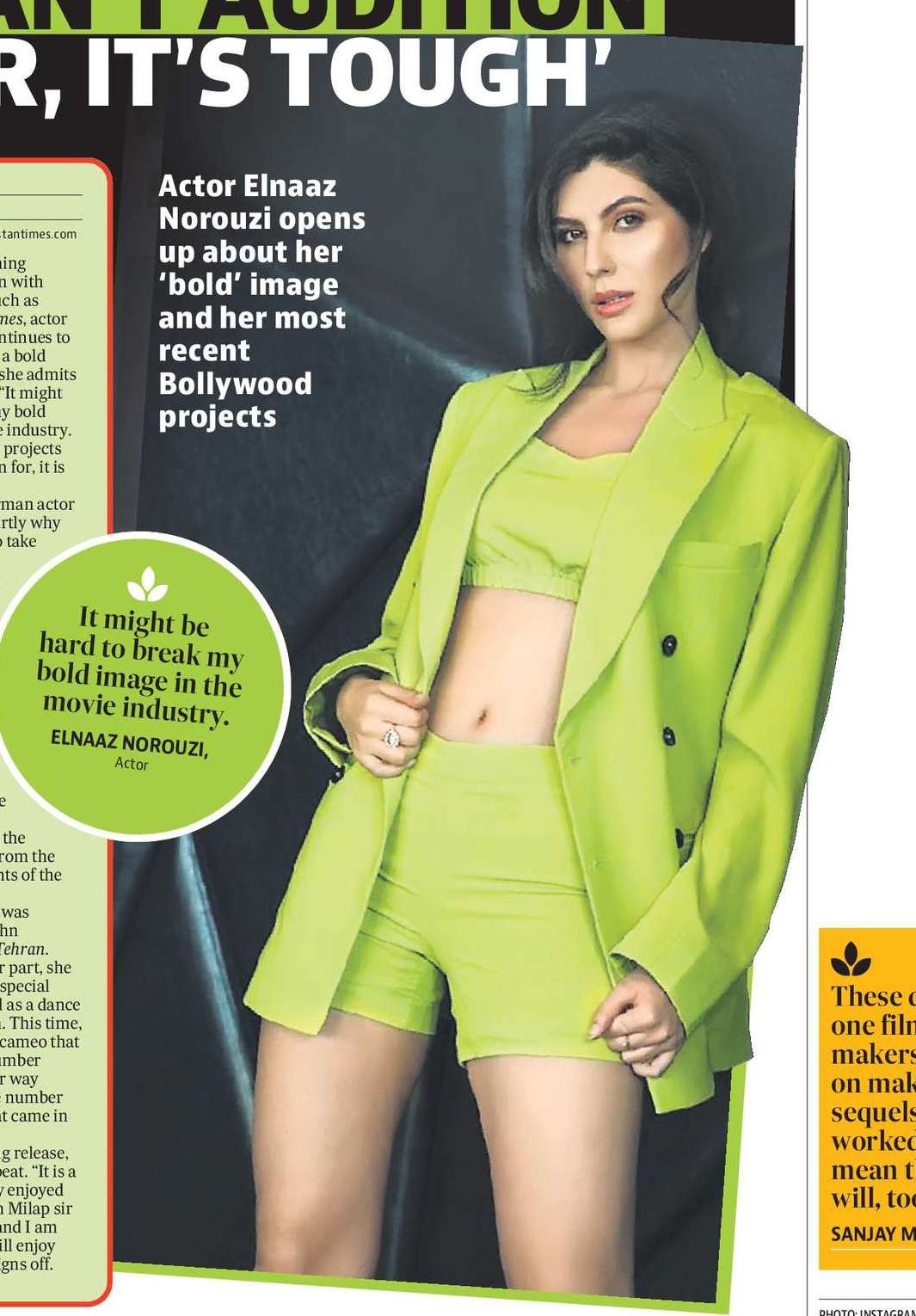
Actor Elnaaz Norouzi opens up about her ‘bold’ image and her most recent Bollywood projects
Rohit Bhatnagar (HINDUSTAN TIMES; August 18, 2025)
Despite earning recognition with projects such as Sacred Games, actor Elnaaz Norouzi continues to be associated with a bold image, something she admits has been limiting. “It might be hard to break my bold image in the movie industry. There are so many projects that I can’t audition for, it is tough,” she says.
The Iranian-German actor reveals this was partly why she was hesitant to take on her role in the upcoming Masti 4. While tight-lipped about details of Milap Zaveri’s adult comedy, she recalls, “I actually had inhibitions initially; I was thinking I would not do the film until I met Milap sir. He narrated the script to me and convinced me that the script is different from the previous instalments of the franchise.”
The 29-year-old was recently seen in John Abraham-starrer Tehran. Speaking about her part, she explains, “I have a special appearance as well as a dance number in the film. This time, it was actually the cameo that led to the dance number instead of the other way around. The dance number was something that came in much later.”
On her upcoming release, Elnaaz sounds upbeat. “It is a cool script. I totally enjoyed listening to it when Milap sir narrated it to me, and I am sure that people will enjoy watching it,” she signs off.
Raj Kapoor to Ranbir Kapoor, the India-Iran reel connection lives on
8:34 AM

‘Subah-o-Shaam’ was the first official Indo-Iranian project to be shot in Iran
Tehran was among the first global stopovers for Hindi cinema. Even as that bond survived the revolution and censorship, Iranian auteurs found a devoted audience in India
Shruti Sonal (THE TIMES OF INDIA; June 29, 2025)
When a 20-something Sreemoyee Singh was first introduced to Iranian films as part of her film studies program at Kolkata’s Jadavpur University, she had no idea that one day, she’d roam the streets of Tehran, with a camera in her hand and legendary filmmaker Jafar Panahi by her side. Or that seven years after first landing in the country, her documentary would be screened globally — from film festivals like Berlinale to packed auditoriums in Delhi.
“I wanted to see for myself how artists could live in a place where they were heavily censored and yet tell their stories,” says Singh. That curiosity led her to Iran in 2015 — after four years of planning, enrolling in a PhD, saving every rupee, and learning Farsi. The result was ‘And, Towards Happy Alleys’, a love letter to Iranian poetry and cinema, also chronicling the fight of women for their rights, especially their resistance to the mandatory hijab.
Farsi helped, but Singh says her Indian identity opened many doors in Iran, where love for Hindi cinema has persisted despite the strict film censorship.
“From taxi drivers to govt officials, many had memories of watching films like ‘Sangam’ and ‘Sholay’ in theatres while they were growing up. Younger fans would invite me to watch parties, as local TV channels showed films of Shah Rukh Khan on Sundays,” she adds.
A FORGOTTEN GOLDEN ERA
While stories of Amitabh Bachchan being mobbed in Egypt and SRK’s fame in Germany are well-known, Iran was in many ways the first global stopover for Bollywood, says veteran film critic Ajit Rai. “From the 1950s to 1979 was the golden period for Hindi cinema in Iran. Raj Kapoor’s ‘Sangam’ ran in Tehran theatres for three years, while ‘Sholay’ and ‘Mother India’ also ran successfully for a whole year,” Rai says.
Surprisingly, this cultural bridge was built by industrialists. As Rai details in his book ‘Hindujas and Bollywood’, Parmanand Deepchand Hinduja opened an office in Tehran in 1919, and later his sons brought Hindi films to entertain Indians working there, as well as to promote Indian culture. In 1955, they released ‘Shree 420’ in Iran with Persian subtitles. Raj Kapoor even attended the premiere. Soon, Hindi films began replacing Hollywood ones in theatres. Adjustments were made for local sensibilities: ‘Durgesh Nandini’ became ‘Farman-e-Akbar’. ‘Guide’ was retitled ‘Rahnuma’.
Poet-professor Akhlaque Khan ‘Ahan’ of JNU’s Persian Studies department says the crossover worked because of shared language and values. “Bollywood films and songs had a long history of using farsi words like dil, deewana, shayad etc. Epics like Laila Majnu, Rustom and Sohrab, and Razia Sultana are popular in both countries, while themes of honour and family are also common,” says Khan.
FILMI CROSSOVERS
It wasn’t just Hindi films making their way to Iran, but also a few Indian filmmakers. In 1933, Ardeshir Irani — credited with directing India’s first film with sound ‘Alam Ara’ — produced and directed the first Persian talkie, ‘Dokhtar-e-Lor’. The script was written by Iranian film writer-director Abdolhossein Sepanta who also acted in the film.
Many years later, Tapi Chanakya directed the 1972 film ‘Subah-o-Shaam’, which was the first official Indo-Iranian project to be shot in Iran. Two years later, another joint production called ‘International Crook’ (titled as ‘Kala Bazaar’ in Hindi) was released, directed by Pachhi and starring Dharmendra, Feroz Khan and Saira Banu.
THE CURTAIN FALLS, AND RISES
The Islamic Revolution of 1979 brought an end to this exchange as public screenings more or less came to a halt, and dance, song, and ‘vulgarity’ was looked down upon. In their place arose state-sanctioned cinema, glorifying the revolution and war with Iraq. Though they rarely got a domestic release, the circulation of bootleg copies and secret film clubs kept the love for cinema alive among Iranians.
Against this backdrop, there also emerged a new wave of Iranian filmmakers like Panahi, Abbas Kiarostami, Majid Majidi and Mohammad Rasoulof who won acclaim abroad though they faced travel bans and even jail time at home. Panahi’s ‘This Is Not A Film’ was smuggled out of Iran on a USB stick buried inside a cake. Rasoulof’s Oscar-nominated ‘The Seed Of The Sacred Fig’ was conceived in prison, directed secretly from his sofa, and finished in exile.
Though they may not have got screenings at home, Iranian filmmakers have been part of most major Indian film festivals winning fans for their refined visual language. In 2022, filmmaker Mahnaz Mohammadi sent a lock of her hair to the International Film Festival of Kerala because she could not come in person to receive an award.
There have been some joint collaborations too, with ‘Salaam Mumbai’ directed by Ghorban Mohammadpour, starring Iran’s Mohammad Reza Golzar and India’s Dia Mirza in the leading roles. A year later, ‘Beyond The Clouds,’ a Hindi drama film written and directed by Iranian legend Majid Majidi, starring Ishaan Khatter, was released. Last year, ‘Jamal Kudu’, a Persian song from the 1970s went viral after it featured in the Bollywood film ‘Animal’.
SECRET SCREENINGS
Back in Iran, the soft corner for Bollywood persists. Khan says, “A few years ago, I went to a friend’s home in northern Iran. Her mother told me that she wants to see some of the old films like ‘Sangam’ and demanded that I get DVDs on my next visit.”
During another trip to the country, the poet-professor was surprised when he found locals glued to a dubbed version of Dharmendra’s ‘Hamla’ on a long bus journey from Tehran to Ishafan. Even contemporary films get dubbed in Persian and are pirated into the country, Khan adds, noting that he also found a channel dedicated to Indian films in Persian.
A book printed by the ministry of culture in 1982 that this reporter found stocked in Delhi-based Iran Cultural House library also spoke of Indian cinema in a favourable light. “It should be a matter of grave concern to us that we should feel more at home with the cultures of a consumer society cunningly represented to us through glossy vehicles such as Elizabeth Taylor and John Wayne, than with the more humane traditions we encounter in films by first rate directors from Japan, India or Algeria.”
Lina*, an Iranian married to an Indian, says Bollywood fandom continues through small private screenings attended by young women like her. Inside the dark theatres, fans mouth dialogues, hum the songs that they know by heart, and even try to copy the hook steps in dance sequences. “Many people in Iran are still crazy about Bollywood. They just can’t talk about them openly,” she says over email.
*Name changed on request
I don’t understand why women can’t be single and happy till whenever they want-Madhurima Tuli
8:43 AM
S Farah Rizvi (HINDUSTAN TIMES; August 17, 2023)
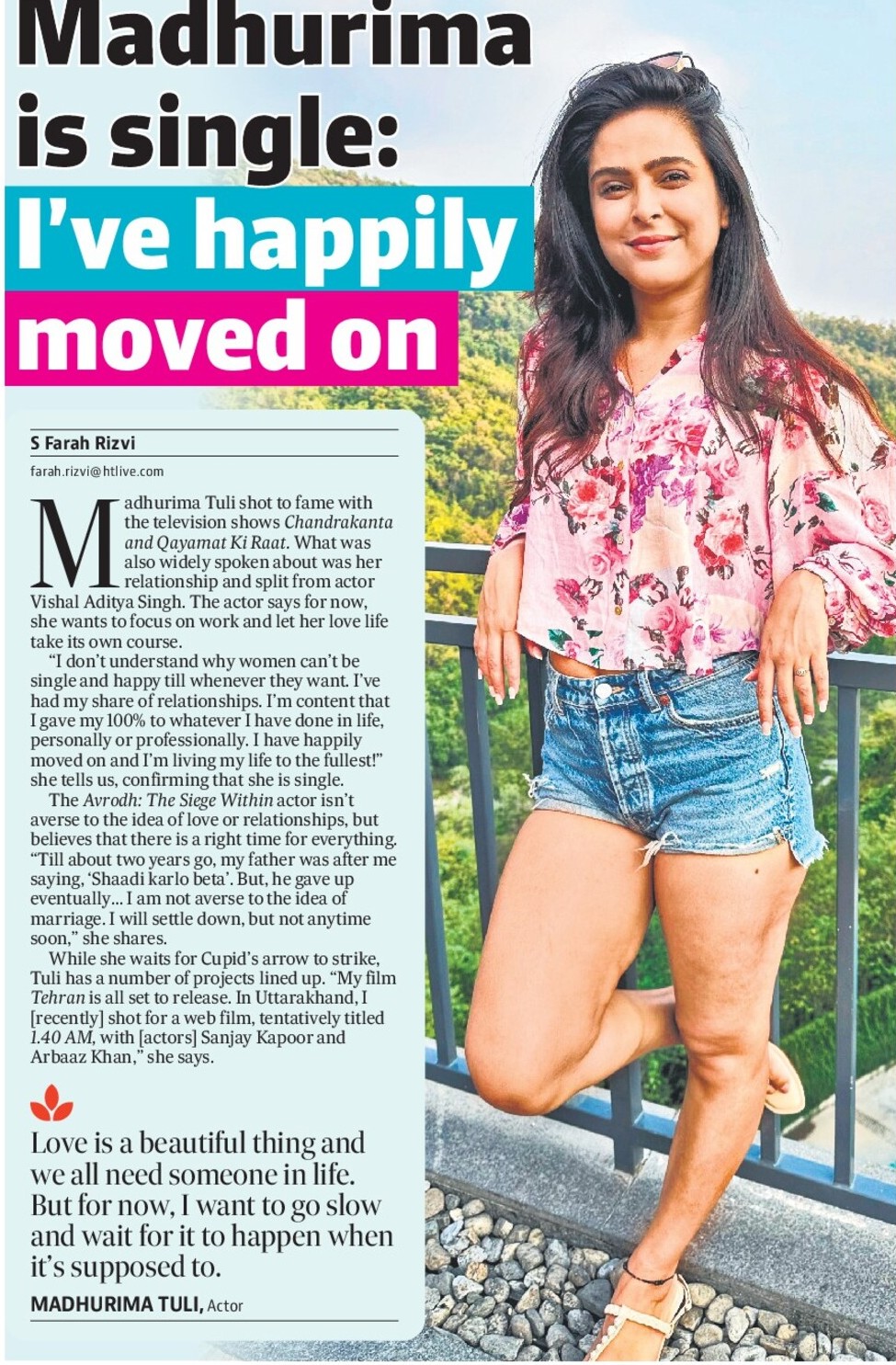
Madhurima Tuli shot to fame with the television shows Chandrakanta and Qayamat Ki Raat. What was also widely spoken about was her relationship and split from actor Vishal Aditya Singh. The actor says for now, she wants to focus on work and let her love life take its own course.
“I don’t understand why women can’t be single and happy till whenever they want. I’ve had my share of relationships. I’m content that I gave my 100% to whatever I have done in life, personally or professionally. I have happily moved on and I’m living my life to the fullest!” she tells us, confirming that she is single.
The Avrodh: The Siege Within actor isn’t averse to the idea of love or relationships, but believes that there is a right time for everything. “Till about two years go, my father was after me saying, ‘Shaadi karlo beta’. But, he gave up eventually... I am not averse to the idea of marriage. I will settle down, but not anytime soon,” she shares.
While she waits for Cupid’s arrow to strike, Tuli has a number of projects lined up. “My film Tehran is all set to release. In Uttarakhand, I [recently] shot for a web film, tentatively titled 1.40 AM, with [actors] Sanjay Kapoor and Arbaaz Khan,” she says.
I couldn’t tell Gerard Butler that I had a crush on him-Elnaaz Norouzi
8:01 AM
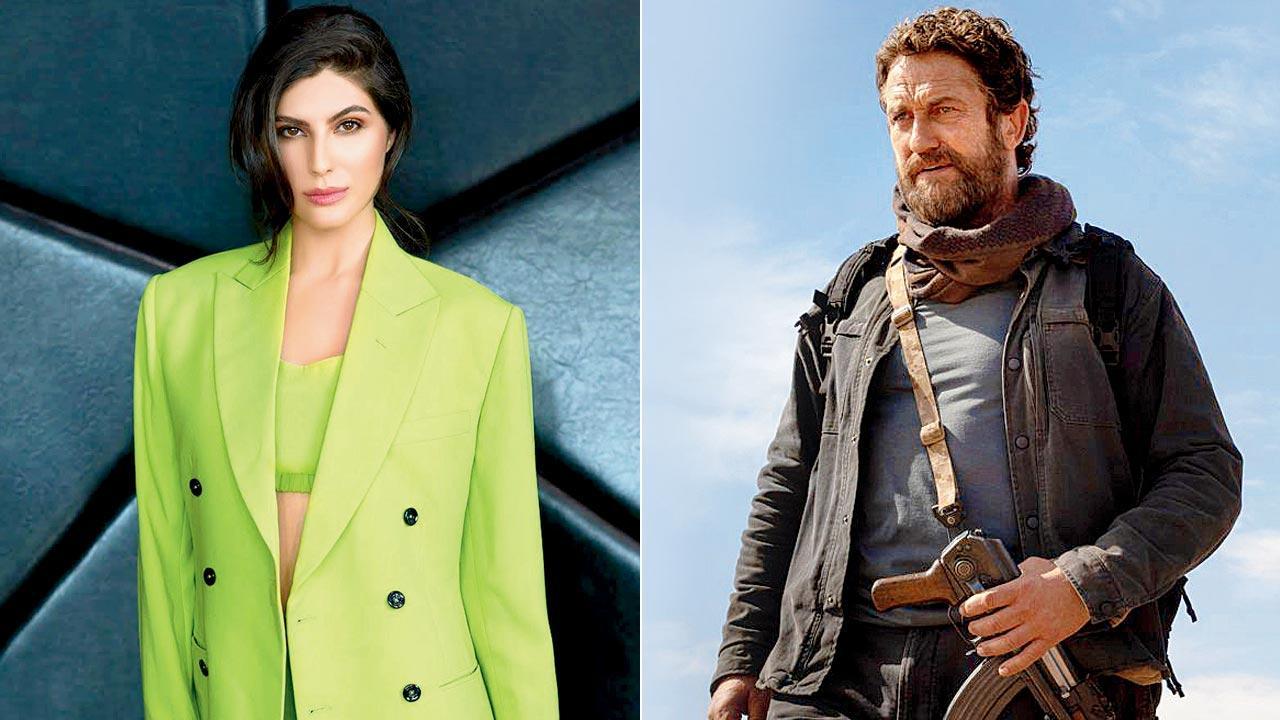
Playing a key role in Kandahar, Elnaaz on striking up an instant friendship with Gerard Butler and her learnings from foreign projects
Letty Mariam Abraham (MID-DAY; April 14, 2023)
Kandahar isn’t Elnaaz Norouzi’s first international project. The Sacred Games actor previously featured in the Apple TV+ series, Tehran. But there was something about the set of the Gerard Butler-led spy drama that made Norouzi want to soak in its creative energy. She credits director Ric Roman Waugh for building an atmosphere where every artiste was given complete freedom.
“[He] trusts what you are bringing to the table. Ric sir didn’t direct me [every step of the way]. Once everything was prepared, he would say, ‘I am ready when you are ready to go.’ It is so empowering to know that you are important because you are the one who has to perform,” she recounts.
Also starring Ali Fazal, the upcoming thriller sees Butler as CIA operative Tom Harris, who is stuck in Afghanistan during a mission, while Norouzi plays an Iranian woman. Having shot for the movie in the past two years, she admits that there is a vast difference between the functioning of a Hollywood film set and its Hindi counterpart.
“When the day starts, everyone is in a huge trailer, getting their hair and make-up done. It is like a family [working together], unlike in India, where everyone is in their own vanity van. [This practice] establishes closeness between the cast and crew.”
The cherry on top was Butler who made everyone comfortable on the set. “Before I reached, I didn’t know how he was. When I finally met him, [we struck up an] instant friendship. I couldn’t tell him that I had a crush on him. That would have been embarrassing,” she laughs.
Madhurima Tuli to play John Abraham’s wife in Tehran
7:39 AM

Neha Maheshwri (BOMBAY TIMES; November 4, 2022)
Seven years after her last Bollywood outing, Baby, in which she played Akshay Kumar’s wife, Madhurima Tuli is all set to try her luck again in films. For those uninitiated, Madhurima had quit the popular show Kumkum Bhagya for Baby. She will now be seen as John Abraham’s wife in Dinesh Vijan’s action-thriller, Tehran. She says, “I am playing a cop’s wife, and will portray her struggle and the perennial fear of losing him anytime. I feel mera army aur cops se gehra rishta hai ki main judd jaati hoon (smiles).”
The actress admits that she was apprehensive about playing a star’s wife again. She says, “It felt like a repeat and also because they approached me after watching Baby. I had declined many films in the past and in turn, lost a lot of projects. Now, when I wanted to get back into films, I couldn’t afford to be too selective. I have realised that I will have to compromise on some aspects. So, this time around, I thought whether the character is big or small, if the film and the makers are good, I should just do it. Also, this seemed like a great project.”
A lot of her contemporaries from TV, including her Kumkum Bhagya co-actor Mrunal Thakur, have made a smooth transition from the small screen to Hindi cinema. Does she ever compare her journey with others?
“I am happy wherever I am. Beech mein mujhe thoda sa lagta tha ki sab logon ne itna achha kar liya hai aur main abhi tak yahin par hi atki hui hoon. But now, I am quite content and happy. Everybody has their own journey and so do I. If I start comparing myself with others, I will be stuck and unhappy. In fact, I am happy for all of them. They have worked hard to reach where they are and they chose the right projects. Maybe, I didn’t. It’s my fault and I can’t blame anyone else for it. Kyunki young age mein mujhe itni badi film mil gayi thi, and sometimes you don’t know the right step to take next,” she replies.
Now that she has bagged a film after a long gap, will she take a break from TV? “I am open to finite series, as it would be a little difficult for me to take up a full-fledged TV show. Honestly, I am not getting the right project. I am keen on exploring all mediums. I will take up whatever piques my interest. I don’t mind sitting home and relaxing a bit if I don’t like something,” she signs off.
For Tehran's shoot, I ended up with 15 sleepless nights, but I was satiated as an artiste-Manushi Chhillar
8:07 AM
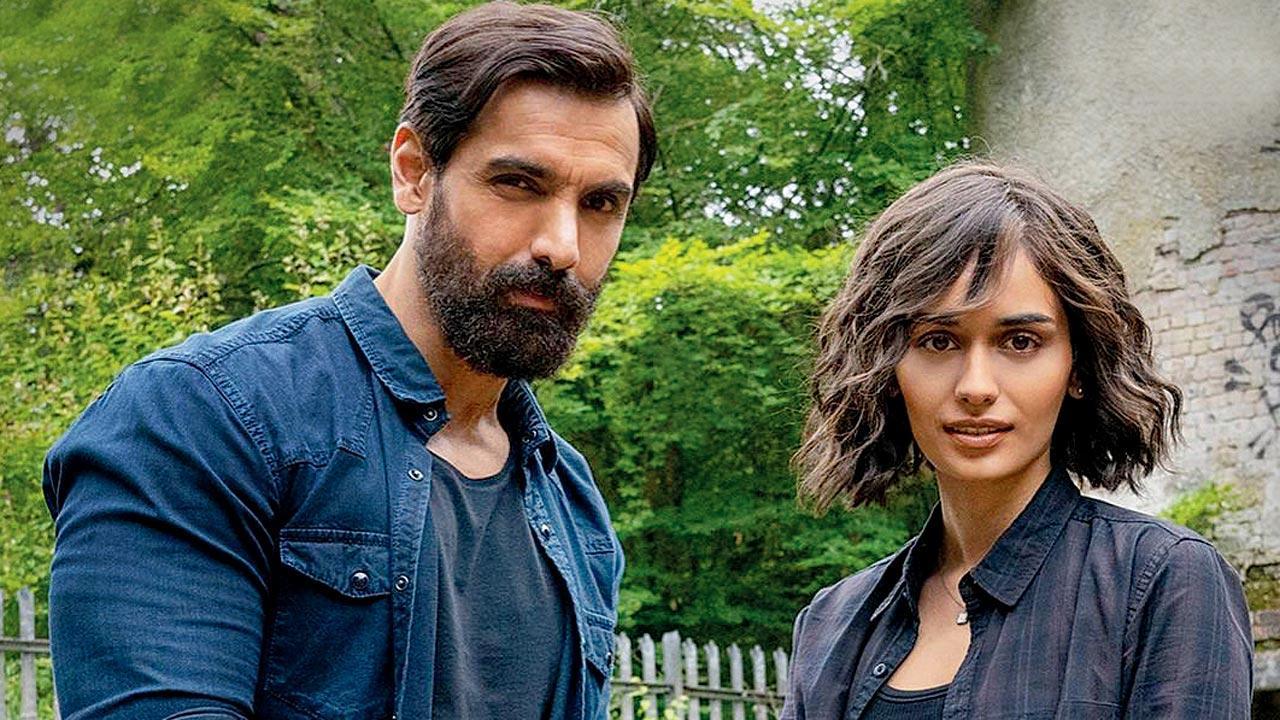
Former Miss World Manushi on how shooting nights for Tehran was tiring yet satisfying
Mohar Basu (MID-DAY; October 14, 2022)
Manushi Chhillar has wrapped up her second project, Tehran, which sees her opposite John Abraham. If her debut venture Samrat Prithviraj taught her about the hard work that goes into creating a period drama, she has learnt the rigour of night shoots, thanks to the upcoming geopolitical thriller. For the final schedule in September, director Arun Gopalan lined up a fortnight-long night shoot in Delhi. The former Miss World says that the stint was as stimulating as it was tiring.
“Shooting for Tehran was an enriching experience. I learnt something new every day. In the run-up to the film’s wrap, I was only shooting nights. So, I might have ended up with 15 sleepless nights, but I was satiated as an artiste because I got to understand the craft so differently,” says the actor.
Little is known about the thriller that is said to be inspired by true events, and marks the directorial debut of ad filmmaker Gopalan. The film’s first look was unveiled in July, and saw Chhillar in a gun-toting avatar. Glad that her second offering sees her in a dramatically different role, she says, “I want to learn with every project, and evolve into an actor who is powerful in her craft.”
The movie has been shot across Glasgow, Mumbai and Delhi.
What happened to Mahsa Amini in Iran could’ve happened to me-Elnaaz Norouzi
8:31 AM

The Iranian actress, who has made a name for herself in India, says that the world needs to hear what’s happening in Iran
Divya Kaushik (BOMBAY TIMES; September 27, 2022)
Over the last week, there have been widespread protests in Iran and across the world after a 22-year-old Iranian woman, Mahsa Amini, died in the custody of the country’s morality police. She was detained for not wearing her hijab properly. News reports suggest that so far, over 40 people have died in the protests in Iran.
The women of Iran have found supporters across the world, as politicians, international organizations and celebrities have spoken up about it. Protests have also been organised in the US, France, Canada, Turkey, Spain and the UK. Among those sharing videos of protests and urging people to speak up against barbaric laws is Iranian Bollywood actress Elnaaz Norouzi.
Along with one of the videos, she wrote, “My Indian friends and followers — I request you all to spread the news and help Iran fight this battle which has been going on for 43 years. Please create awareness, they are killing people every day on the roads and have blocked the internet and all ways of communication so their voices can’t be heard.”
Elnaaz’s family is in Iran and she tells us that she spoke to them a few days ago and as the internet services in the country are disrupted, it is difficult to get in touch with her family. “They have cut the internet so that people cannot get in touch with the world and show what’s happening in Iran. This is dictatorship,” says the actress.
‘AFTER YEARS OF OPPRESSION, IRANIAN WOMEN ARE TIRED OF IT ’
Elnaaz says that while it is “heart-wrenching to see how people are being killed and beaten on roads,” these protests were bound to happen. She says, “We are saying that we want to be free to do what we want to do as women. We just need the world to hear, see what is happening, because they are killing our people. What happened to Mahsa Amini is just barbaric. After so many years of oppression, women are tired of it. The young women (of Iran) now don’t just sit at home and listen anymore. Even the men are out on the road protesting. It is not about hijab anymore, it is about what they have done to our country, the sanctions in our country. The people are poor, they have no money to eat.”
‘I’VE BEEN CAUGHT BY THE MORALITY POLICE MYSELF. IT IS SCARY’
In one of the first videos she shared about Iran protests, Elnaaz spoke about her close brush with the morality police in Tehran. She said, “What happened to Mahsa could have happened to Elnaaz. A few years back I was in Iran and it was my last day in Tehran. I was on the road with my cousin when a woman suddenly came in front of me, and asked me ‘what is this?’. I really didn’t know what she was talking about and she repeated ‘what is this?’. I was then taken by the morality police, Gasht-e Ershad, because my pants (pant legs) weren’t wide enough. They were tight, so you could see my ankles.”
Elnaaz continues, “Even though my manto, which is that thing you have to wear to cover your bum and cover everything, was long enough to cover my ankle, my pants were not wide. I was taken in a van to the ‘re-education center’, where they took Mahsa as well, until someone came and picked me up with the right clothing. Now my cousin was freaking out, my family was freaking out. When I reached there, they took my passport and my phone. The way they scare you, the things they do with you, this is not the way anyone should live in Iran. They take you for the weirdest reasons...your nail colour, hijab, clothing, anything...I don’t want any woman to live like this. This small story was just so you understand that what happened to Mahsa could have happened to me and it can happen to any woman in Iran.”
Sharing more about her experience, Elnaaz tells us, “It is scary, they take your pictures like you are in prison, they take your number, your details. You never know what they can come for. And sometimes, these girls and women who are taken away might never come back. We just want this to stop. The last video I posted on Instagram shows how the police rammed a woman’s head on the road, she might just bleed internally and die, just the way Mahsa died. She suffered internal bleeding because they hit her head. They keep lying and tampering with evidence and saying she had a heart attack.”
‘IT’S NOT ABOUT WOMEN’S RIGHTS ANYMORE, IT’S ABOUT HUMAN RIGHTS’
In her video, Elnaaz also spoke about Iranians needing help. “We need the world to see what these oppressors are doing with our women, with our people and we are just fed up with them and we don’t want them anymore. We don’t want another Mahsa. We don’t want the Islamic Republic of Iran, we just want Iran back. It is not just about women’s rights anymore; it is about human rights. This is a scary situation. We want the world leaders to do something about what’s happening in Iran and that’s why we are trying to talk about this more. We need everyone to spread the word,” she says.
-----------------------------------
Sugandha Rawal (HINDUSTAN TIMES; September 27, 2022)
Actor Elnaaz Norouzi is spending anxious days and fretful nights as she remains out of contact with her family in Tehran, Iran, amid the ongoing turmoil. She wants to use her voice to bring people’s attention on “how women continue to get oppressed” in her homeland. She explains, “It is very important for us to talk about what is happening in the country because it is human rights violation. They have cut off the internet, so that people cannot communicate with those outside.”
Norouzi hails from Iran, the country that’s witnessing a series of violent protests following the death of Mahsa Amini, a 22-year-old Iranian woman, in custody. The 30-year-old continues, “I am not able to reach my family. Every way of communication is blocked. Unless we become the voice and make sure that it comes to everyone’s notice, nothing is going to change.”
She recently received a text message from her cousin back home and the message didn’t paint a happy picture. “She got access to the internet for five minutes, so she messaged me and informed that they were well. Not being in contact with them (her family) leads to so much anxiety. My cousin told me there is tear gas everywhere. I am so worried,” shares the Sacred Games and Abhay actor.
Explaining her state of mind, she says, “When I wake up and see new videos every morning, I cry all day. I pray and hope for better days. I keep posting on social media so that I can create awareness.”
Bollywood is not using its full potential-Majid Majidi
8:17 AM

Sharmila Ganesan (THE TIMES OF INDIA; April 8, 2018)
No, Mumbai's Irani cafes do not remind Majid Majidi of home. The Iranian filmmaker—who has lost count of the number of times he has visited Mumbai in the last two decades—has eaten at several Parsi-run restaurants in South Mumbai, only to emerge a tad dissatisfied each time. “I haven’t found a single dish that is pure Iranian,” the 58-year-old says in Farsi, joining his index finger and thumb, even as his interpreter smiles before translating his food review. Authenticity-—as the world that discovered Majidi’s talent through his Oscar-nominated 1998 film ‘Children of Heaven’ knows—is precious to this director, whose habit of casting unknown faces lend his films their raw, unglamorous realism.
Majidi—whose soon-to-release first Indian film ‘Beyond The Clouds’ tells the story of an estranged brother-sister duo from Mumbai-—betrays an aura as unassuming as that of most of his protagonists. The auteur is in the city for the re-opening of Lower Parel’s Matterden Carnival cinemas, previously called Matterden Deepak Cinema, the iconic single-screen that has recently reinvented itself as a hub for world cinema.
Here, following the screening of 1998's ‘Children of Heaven’—the first Iranian film to have been nominated for an Oscar—Majidi will be presented with the Enlighten award, previously given to Mrinal Sen, Amitabh Bachchan and Shabana Azmi. "He is the undisputed star in terms of foreign filmmakers," says Pranav Ashar, founder of Matterden, who will be hosting a chat with Majidi. Be it ‘Baduk’—Majidi's first feature film that dwelled on the hardships of an impoverished sibling duo or—‘The Song of Sparrows’ in which an ostrich-rancher tries to replace his daughter's broken hearing aid before a crucial exam, his films dig deep into human relationships. "I like to explore the essence of humanity,” says the Satyajit Ray fan who grew up in a middle-class family in Tehran. “If I start commenting on social and political issues, my films will start looking like newspapers," he says. All the same, Majidi —who is weary of the western media's tendency to exaggerate stories of the artists’ struggle in Iran—believes cinema can shatter stereotypes about Islam in an increasingly exclusivist world.
What drew Majidi, who as a teen acted in amateur theater groups and even studied art at the Institute of Dramatic Art in Tehran, to the “vast and amazing” medium of cinema was the urge to translate his many experiences during Iran's Islamic Revolution of 1978-79. Majidi writes the characters himself and later seeks them out from the crowd, "like they were people who had gone missing". He spent four months auditioning over 10,000 kids to finally find the faces that play the thin-voiced sibling duo in ‘Children of Heaven’.
Predictably, when probed for his impression of Bollywood, he looks away: “Don’t ask me such tough questions." Majidi feels that Indian films, despite good directors and talent, are still confined by commercial trappings. In fact, when he first arrived in Mumbai almost 20 years ago, he was struck by how different India looked from the picture that Indian films painted. South Mumbai’s heritage buildings and the intimate coexistence of the poor alongside the rich were stereotype-shattering visuals for the Iranian even as friends back home enquired about Indians: "Were they all dancing?"
Majidi fears the Indian film industry might hit a dead end if it continues on its escapist path. “India is no less than the US from a technical point of view," he says. "It has a lot of potential but it hasn’t been using this for some reason.”
Subscribe to:
Posts (Atom)