Showing posts with label Taran Adarsh. Show all posts
Showing posts with label Taran Adarsh. Show all posts
2026 January to June: Bollywood finds its mojo again
8:44 AM

Vinay MR Mishra (BOMBAY TIMES; July 4, 2026)
Just six months ago, Bollywood was staring at another uncertain year. Today, the mood is noticeably brighter. Driven by the record-smashing success of Dhurandhar The Revenge, strong performances from the war action film Border 2, followed by the horror comedy Bhooth Bangla, and now the sleeper hit Main Vaapas Aaunga, the Hindi film industry finally has something it has lacked for years: momentum.
Yet beneath the celebrations lies a reality check. While a handful of films have soared, many others have struggled to survive, making 2026 a story so far, one of spectacular highs and equally visible lows. As trade analyst Taran Adarsh puts it, "It has been a case of kam khushi zyada gham. We've had successes, but very few that you can count on your fingertips."
'The biggest hit of 2026 is the word of mouth’
If the first half of 2026 proved anything, it is that Bollywood's audience has become more discerning than ever. Films that connected emotionally and generated strong word-of-mouth continued to grow beyond their opening weekend. Films that relied solely on star value found the road much tougher.
"The biggest trend in the first half of 2026 was the power of word-of-mouth," says trade analyst Ramesh Bala. "Films like Main Vaapas Aaunga, Border 2, Bhooth Bangla, and Dhurandhar The Revenge sustained because audiences connected with them."
Akkshay Rathie, Director - Ashirwad Theatres Pvt Ltd, adds, "To see Main Vaapas Aaunga open small but grow day by day purely on the merits of word-of-mouth is extremely encouraging.”
Novelty is winning. Formulas aren't
One of the clearest shifts this year has been the audience's appetite for fresh storytelling. "I don't think audiences are rewarding the repetition of a genre or style that has worked before. What people really appreciate is novelty and bravery from filmmakers. The repetition and herd mentality of trying to replicate success is something that we should put well behind us and we should have filmmakers staying true to their conviction to the stories that they really want to tell and to genres that come very naturally to them. And the more we see that happening, the more successful we'll be as an industry at the box office," says Rathi.
The Dhurandhar Effect
The biggest winner of the year was undoubtedly Dhurandhar The Revenge, which shattered box-office records and redefined the upper ceiling of Hindi cinema's theatrical potential.
Rathi shares, "One movie that really towers above every other movie in the last six months is of course Dhurandhar The Revenge. The box-office collections that we witnessed were truly historic. We realized that the glass ceiling we thought existed at the Rs. 500-600 crore benchmark has been shattered. The potential of the Hindi-speaking market is humongous."
He adds, "I hope more films attempt to build the intrinsic value that allows them to go closer to those numbers."
'Average films won't survive'
While the industry celebrates its winners, films like O'Romeo, which was highly anticipated due to the reunion of Kaminey duo Shahid Kapoor and Vishal Bhardwaj, and Chand Mera Dil starring Ananya Panday and Lakshya that looked promising didn’t quite shine at the box office.
While Hai Jawani Toh Ishq Hona Hai may have recovered its budget, the film's poor reviews and underwhelming box office performance have left a lingering sense of disappointment. Do Deewane Seher Mein, won appreciation from critics and the audience, but the film couldn’t draw in the crowds. Ikkis, Ek Din and Pati Patni Aur Woh Do also failed to attract the kind of audience they were expected to.
"The gap between films that work and films that don't has become very evident," says Taran Adarsh. Ramesh Bala echoes the concern. "Audiences have become far more selective, making it difficult for average films to survive."
The second half could be even bigger
The industry now turns its attention to a packed second-half slate. From King and Toxic, Dhamaal 4 and Ramayana, the coming months are loaded with franchise titles, star vehicles and large-scale spectacles.
"With the kind of movies lined up in the second half, 2026 is well on its way to being an iconic year," says Rathi.
Bala adds, "If these films live up to expectations, the second half could be even stronger than the first."
-------------------------------
Rishabh Suri (HINDUSTAN TIMES; July 2, 2026)
The first half of 2026 has delivered a much-needed boost to the film industry, with audiences backing films across genres, languages and budgets. Strong theatrical footfalls, breakout regional successes and the return of comedy have helped restore confidence in the business after a volatile few years.
“For the industry, admissions are up by at least 10%, and the box office, our estimate is, would be up by at least 16-17%, if not more,” says Kamal Gianchandani, president of the Multiplex Association of India.
What worked
From patriotic dramas and comedies to regional cinema, the year’s biggest successes came from varied genres. Sunny Deol’s Border 2 emerged as one of the biggest hits of the year, while Dhurandhar The Revenge became the highest-grossing Hindi film of 2026 so far.
Comedy also found favour with audiences. Akshay Kumar’s reunion with Priyadarshan in Bhooth Bangla paid off at the box office, while his latest release, Welcome To The Jungle, has continued the momentum, netting over Rs. 80 crore within five days of its release.
For Devang Sampat, managing director, Cinepolis India, the biggest takeaway has been the diversity of successful films: “Dhurandhar The Revenge, Border 2, Bhooth Bangla all did well, but for me the real takeaway is how broad the success has been. The business has come from all kinds of films, across languages and across budgets, not just the big titles.”
One of the biggest surprises of the year has been Imtiaz Ali’s Main Vaapas Aaunga. Despite a modest opening, strong word of mouth helped the film steadily gain momentum and move towards hit status.
Reflecting on the film’s journey, Imtiaz had earlier told us, “It’s the audience who has embraced the film. Somewhere, the industry had started saying ki ‘Arre kuchh bhi halka phulka de do audience ko, chal jaayega, emotional mat do’. But the people proved this wrong.”
What didn’t
Yet, not every well-reviewed film translated into ticket sales. Vishal Bhardwaj’s O'Romeo, Ananya Panday and Lakshya’s Chand Mera Dil, Anurag Kashyap’s Bandar and Kangana Ranaut’s Bharat Bhhagya Viddhaata failed to generate the expected box-office momentum despite positive reviews and strong subjects.
Trade analyst Atul Mohan believes financial discipline is becoming just as important as content in determining a film’s fate. “The first half has been so far, so good. Like Akshay Kumar and Ranveer Singh, actors need to shoulder the responsibility of a film, and not burden it with their high fees,” he says.
The message from the first half of 2026 is clear: audiences are showing up for good stories, regardless of genre or budget. But they are also more selective than ever, making strong content and positive word-of-mouth Bollywood’s safest bets.
Why 2020s haven’t been able to deliver generational comedies like years before
9:01 AM

The 2020s have not been able to deliver a generational comedy like Jaane Bhi Do Yaaro, Munna Bhai MBBS, and Hera Pheri. What are we missing?
Akshita Maheshwari (MID-DAY; April 5, 2026)
“Comedy films are a good indicator of where a country is,” argues film commentator Karan Mirchandani. He names a list of films that defined a generation and highlighted its problems: Jaane Bhi Do Yaaro (1983) and builder corruption; Munna Bhai MBBS (2003) and systemic issues and red tape within our education system; Hera Pheri (2000) and the struggles of a common man; Badhaai Ho (2018) or the plethora of films from this genre which tacked socio-familial issues.
The 2020s have not been able to produce a generational comedy. What’s changed? Actor Pratik Gandhi, from Madgaon Express (2024), says that it’s the audiences. The inherent nature of comedies is that they offend, but “today, anything can offend anybody. And in comedy, you have to just let loose. Only then, it’s fun,” says Gandhi.
“Censorship has also become wild,” Gandhi says, “You’ll hear things like, ‘Don’t say sex, instead say sambhog, then it’s fine’.”
Actor Abhishek Banerjee, who was last seen in Stree 2 (2024), also agrees. “The 1990s comedy style is no longer funny. I don’t think today’s generation will enjoy it the same way,” Banerjee says, “Comedies like the ones David Dhawan and Govinda made, or Andaz Apna Apna (1994), or Jaane Bhi Do Yaaro — those are evergreen.”
What does it take to make an evergreen comedy? “They have satire. They have irony. I think what we lack today is satire,” Banerjee answers.
As soon as we realized not-so-politically-correct humour doesn’t work, we stopped trying to find other forms of comedy. Gandhi adds, “Comedy has many sub-genres, and we still haven’t explored them fully. For example, survival comedy. Most of the time, films fall into slapstick comedy. That’s usually the first instinct. But there are many more genres as well.”
Banerjee says, “Situational comedy is becoming more important than dialogue-based comedy. It’s not about saying a funny line — it’s about being in a serious situation and saying something completely unexpected. Layering that with intelligence helps even more.”
The 2020s have also been the decade of the Reel. Banerjee says, “I keep watching comedy Reels and they’re genuinely funny.” When people already have their appetite for funny filled on their phones, why should they come to the cinema for it? Gandhi says, “I never thought a two-hour film would have to compete with a 30-second Reel. But here we are.”
In the last few years, one comedy has broken into the 100-crore club — Crew. Director Rajesh A Krishnan tells us, “If you open social media, you’ll get a laugh. And Instagram doesn’t even need a subscription.”
Throughout the country too, laughter is not dying. “It seems like comedies are reducing but how much comedy content are you actually also consuming from Kerala? If you isolate comedy films coming out of the Hindi film industry, then it starts feeling like there is less comedy. Otherwise, people have been making comedies,” he says, “The scope of comedy has also changed. It’s crossed genres now like comedy-thriller, action-comedy, or horror-comedy.”
In the Hindi film industry, comedy films are surviving on franchise fame. “If we think from the producer’s perspective, franchises have been working well,” Krishnan says, “Sometimes standalone projects work so well that they get turned into franchises.”
The onset of OTT has meant that the theatre is saved for larger-than-life spectacles. So why should you step out to watch a comedy today? “I always feel like great comedies are a tool or even a weapon to critique the establishment. It has a softer touch to do it. And it’s one that lasts with you.”
From the times of the Angry Young Men, films have centred around the common man and his problems. Today, he is no longer at the core of our cinema, instead he is a “big, bearded, angry man on screen,” says Mirchandani.
Mirchandani also points out, “Films today exist in a kind of hyper-reality. They’re not rooted in a specific time or context. Because the moment you ground them — show real problems or systems — you’re also making a critique, and that’s something people are avoiding.”
A lot of comedies like Andaz Apna Apna, though were box office flops, found a second life on DVD. “That pipeline is gone today,” Mirchandani adds. Nothing comes close to a theatre for Gandhi, though. He says, “Any comedy film works best in theatres. Three hundred to 500 people laughing together — it is very, very contagious. You have a lot of fun in those two hours.”
Paisa bolta hai: Is there money to be made with a theatrical comedy?
The comedy genre is an evolving one, says trade analyst Taran Adarsh. “Right now, we’re seeing a lot of horror comedies. But the out-and-out comedies excelled by Akshay Kumar and before him the Govinda-David Dhawan style really worked. But there has been a vacuum since then.”
But is there money to be made in this genre? “Lots. Who doesn’t want to laugh, smile, and come out of a film feeling happy? That’s what cinema is about.” Then why is the genre slowing down? “The market scenario has changed. Profits, losses, hits, and flops dictate the industry more strongly now. Especially since the stakes are higher,” he says, “Actors also tend to follow what’s working because everyone wants to stay relevant, popular, and deliver hits.”
All hope is not lost though. “In the last couple of years, Madgaon Express has done well,” with a box office collection of Rs. 49 crore, “Crew (2024) was a smashing success,” as it sits happily in the Rs. 100-crore club with a box office run of Rs. 157 crore.
Comedy is no funny business: All sources tell us that making a comedy film is the toughest genre to crack
Niren Bhatt, who’s written films like Stree 2 (2024), Bala (2019), and Bhediya (2022), says, “Comedy is highly subjective. What lands for you, might not land for me.” He adds that what appears effortless on screen is often the hardest to write. “You can’t just have characters delivering one-liners. That’s stand-up. It has to be woven into a story, with conflict, world-building, and character arcs,” he explains.
“You might write 10 lines and only one works,” he says, noting how audiences respond differently to the same jokes. While some enjoy meta humour or wordplay, others dismiss it as overdone or “too literary”.
For actors too, comedy is all about instinct. Pratik Gandhi says, “All other emotions have a range. On a scale of one to 10, you can adjust. But in comedy, if it has to land at two, it has to land at exactly two. Unlike drama, where intensity can fluctuate, comedy requires precision down to 0.0001 and years of riyaz.”
Abhishek Banerjee adds that the genre leaves actors exposed. “In comedy, you’re on your own. You have your dialogues, your co-actors of course, but timing is everything. Nobody can teach you comic timing. If you don’t have the funny bone, it will fail.”
Dhurandhar The Revenge marching towards beating Dangal to become India’s highest grosser
9:20 AM

With Dhurandhar 2 raking in Rs 440 cr over the opening weekend, trade says the film may beat Dangal to become Indian cinema’s highest grosser
Priyanka Sharma (MID-DAY; March 23, 2026)
Expectedly, ‘Dhurandhar The Revenge’ has taken the box office by storm. By the evening of March 22, the Ranveer Singh-starrer collected about Rs 440 crore, including its paid previews, in the domestic market. The film’s run is far from done. According to trade analyst Taran Adarsh, director Aditya Dhar’s action drama could cross the Rs. 1000 crore mark in domestic collections.
“Like the first part, ‘Dhurandhar 2’ has come like a tsunami. I am confident it will cross Rs 1000 crore in the domestic market. Many theatres are facing capacity issues where there are more people to watch the film [than shows]. The demand will spill over to Monday,” Adarsh told mid-day.
Given its unstoppable run, trade is buzzing with speculation that the movie could beat the worldwide collection of Aamir Khan’s ‘Dangal’ (2016) to become the biggest grosser of Indian cinema. “It cannot be ruled out right now,” said Adarsh.
However, sections of the audience have criticized the movie’s propagandist nature. Some also felt that it ran too long at three-hour-55-minutes.
About the polarizing reactions, exhibitor and trade analyst Akshaye Rathi said, “Whether it’s ‘Dhurandhar’, ‘Animal’ [2023], or ‘The Kashmir Files’ [2022], they wouldn’t have done that kind of business had those polarizing opinions not come into play. The more [the opinions are] polarized, the more it creates a debate and generates curiosity among people to see what the hype is all about.”
When films miss the Gulf market, how much does it impact?
8:17 AM

From Border 2 to Dhurandhar and The Diplomat, films remain unreleased across key Gulf markets — a pattern trade can’t ignore. We speak to experts to understand how it impacts business
Yashika Mathur (HINDUSTAN TIMES; January 30, 2026)
Border 2, starring Sunny Deol, may be flying high at the Indian box office, but the war drama will not release across key Gulf markets including Bahrain, Kuwait, Oman, Qatar, Saudi Arabia and the UAE. While no official reason has been issued, industry insiders point to the film’s India-Pakistan war backdrop and strong military narrative as the likely factor behind the decision, a pattern seen with several recent titles in the region.
Why the Gulf matters
The Gulf Cooperation Council (GCC) region remains a crucial overseas market for Hindi cinema, often contributing 3-5% of a big film’s global business. Trade figures suggest a well-performing Hindi film can earn between Rs. 30 crore and Rs. 50 crore from the region.
Film exhibitor Akshaye Rathi explains: “For a film like Border 2, expectations are massive, so the loss is felt. At the same time, exhibitors in the Gulf also lose out by not being able to screen big titles. For Indian films, 3-5% of business going away is still a large number.”
Border 2 isn’t the first high-profile Hindi film to face resistance in the Gulf. Last year, Ranveer Singh-starrer Dhurandhar did not release in the region despite a strong global run. Earlier, The Diplomat, starring John Abraham, and Fighter, led by Hrithik Roshan, faced similar roadblocks, though Fighter was later cleared for release in the UAE.
Trade reactions
Trade analyst Taran Adarsh believes the impact varies by film: “A Shah Rukh Khan film would mean something very different in the Gulf compared to others. In Dhurandhar’s case, which has already done well without a Gulf release, the loss could be Rs. 20-40 crore. For Border 2, it’s early to judge, but business in other territories could compensate.”
Filmmaker Ashoke Pandit, president of the Indian Film and TV Directors’ Association, has called for diplomatic clarity. “We are told India shares strong relations with the UAE. If a film talks about fighting terrorism, why should it be blocked?” he asks.
Aditya Dhar, Dhurandhar makers eyeing to sell broadcast rights of both parts together to maximize revenue
10:15 AM

Ahead of ‘Dhurandhar 2’ release, director Aditya Dhar to sell broadcast rights of both parts together; trade predicts the move will maximize revenue
Upala KBR (MID-DAY; January 21, 2026)
Dhurandhar’s (2025) smashing success has made its second part one of the most anticipated films of 2026. Director Aditya Dhar and the makers are leveraging the heightened interest around the Ranveer Singh-led action drama as they crack the movie’s satellite, DTH (direct-to-home), cable, and other transmission deals. Earlier this month, the makers issued a public notice that they are in the process of procuring a license for exclusive linear transmission and retransmission rights through satellite channels, DTH, IPTV (internet protocol television), cable, and other media.
What’s notable is that unlike other franchises, they are securing the rights for both instalments together, even though the second part — titled Dhurandhar The Revenge — has yet to arrive in cinemas.
The public notice was published in trade magazine Complete Cinema, which stated that the license date for Dhurandhar 1 will start from March 31.
A source revealed to mid-day, “Aditya and Jio Studios have begun discussions with satellite channels. While the first part is expected to start airing from March 31, the second instalment — that hits theatres on March 19 — will make its way to TV screens only 117 days, roughly almost four months, after its release. The team is finalizing worldwide transmission deals, except for the territories of China, Taiwan, and Macau.”
The buzz in the trade industry is that by offering the two instalments as a package deal, the makers will maximize their revenue from satellite television channels.
Trade analyst Taran Adarsh noted that it’s a shrewd business move that also shows the makers’ confidence in the sequel. He said, “If true, it’s a practical decision. Sometimes in the past, producers have clubbed two or three projects together. That way, they are assured of getting a good amount. Since Dhurandhar has broken many records, the makers can demand what they want. While they suffered some losses in the UAE [due to a ban on its release], the business they earned in the international market covered lost ground.”
Trade analyst Atul Mohan echoed that a package deal will give the makers an advantage. He noted, “Jio Studios and Aditya Dhar will get good value for the [joint] deal as everyone, everywhere is discussing Dhurandhar.”
mid-day reached out to Jio Studios and Dhar, who remained unavailable for comment.
Someone else from Bollywood might have gone louder. Dhanush keeps quiet, promotes less-Taran Adarsh
10:00 AM
Mohar Basu (MID-DAY; December 1, 2025)
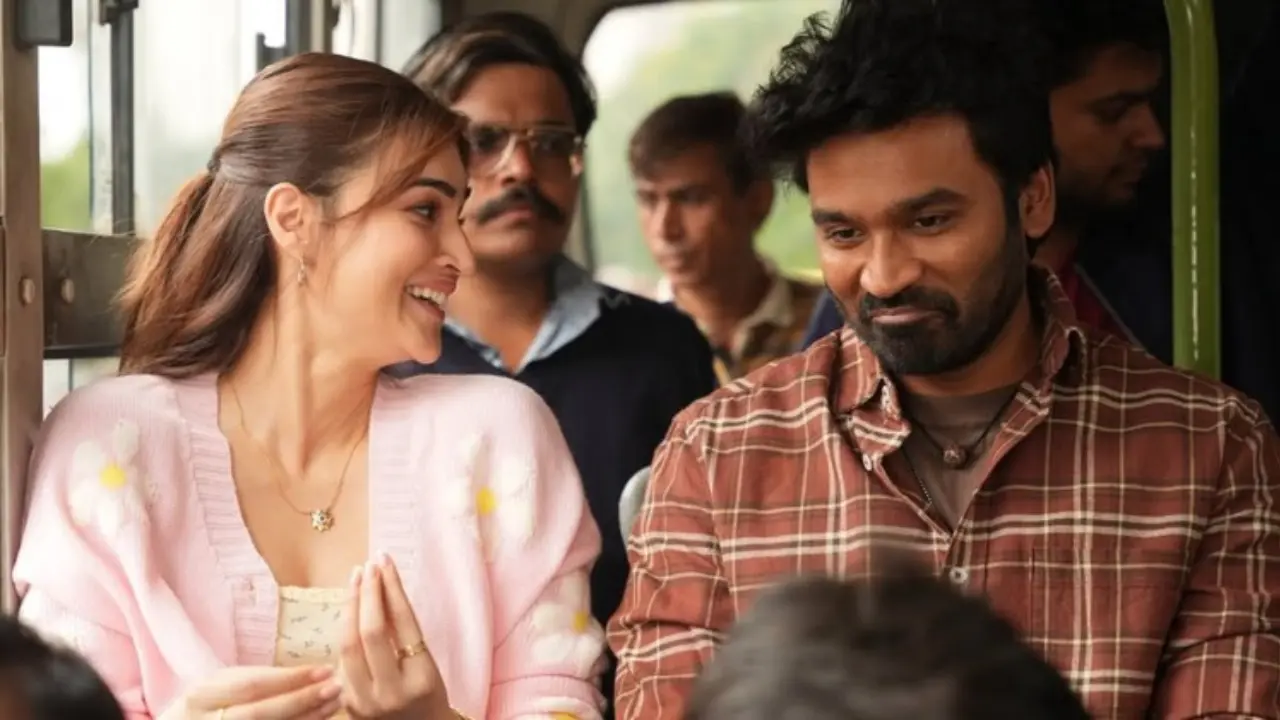
Aanand L Rai’s Tere Ishk Mein has turned out to be the box-office surprise that Bollywood has been waiting for. The Dhanush and Kriti Sanon-starrer opened at over Rs 15 crore on November 28, and is expected to close the weekend at approximately Rs 60 crore. What about the film has worked when most Hindi movies struggle to stay afloat at the box office?
Delhi-based exhibitor Gurmeet Seble points to its depiction of the dark side of love. “There is a real pull for stories where love feels dangerous and high-stakes.”
Dhanush’s performance as the heartbroken lover is among the film’s biggest draws. Videos from theatres across Chennai, Hyderabad, Delhi, and Mumbai show crowds reacting to the climax with feverish energy. Trade analyst Girish Wankhede points out that it has as much to do with the leading man’s portrayal as with the unrequited love story’s writing.
Wankhede elaborates, “Saiyaara was Gen Z–friendly and stylish, and Ek Deewane Ki Deewaniyat found strong loyalty among tier-2 and -3 viewers. Tere Ishk Mein knows exactly whom it is speaking to. This one is for jilted lovers everywhere.”
Wankhede believes such love stories will almost always find takers in India. He reasons, “We’re used to such love stories – Khilona [1970], Darr [1993], Tere Naam [2003], and so on. Break-ups and unrequited love are part of our system. We love underdogs who are madly in love, but not getting that love back. We are a country of Devdas-es.”
Another encouraging sign is that Tere Ishk Mein is performing well across urban centres as well as mass pockets like Punjab, Bihar, and Rajasthan. Trade analyst Taran Adarsh notes that Rai’s movie has broken the recent pattern of Hindi cinema making “multiplex films catering only to five cities”. “It’s rooted. A common man in Jabalpur or Patna is responding to it just as much as someone in Mumbai is. [In the past few months], we alienated our mass pockets. Our actors became metro-centric. Those choices don’t get you numbers.”
On Dhanush’s crossover appeal, Adarsh dismisses old industry binaries. “Calling him a ‘Tamil superstar working in the North’— these are compartments we’ve created. The audience doesn’t care. They want a good story. And Dhanush delivers.”
He credits the film’s opening momentum to the trailer. “The trailer did the trick. People instantly connected with a man who falls in love, loses it and the tone felt raw. And importantly, it’s not a dubbed film. That authenticity matters.”
Adarsh also believes the cult following of Raanjhanaa has directly transferred to Tere Ishk Mein. “There’s a comfort the audience has with the Dhanush–Aanand L. Rai pairing. You can feel it in the film.”
What elevates the performance, he says, is Dhanush’s restraint. “A hallmark of a fine actor is that he doesn’t need to show off. Someone else from Bollywood might have gone louder. Dhanush keeps quiet, promotes less, and lets the work speak.”
He also uses the film’s reception to critique Bollywood’s recent approach. “Tere Ishk Mein is proof that when you give people a story with emotional heft, they turn up. Even the music broke internal trade assumptions. They saved a song like ‘Aawara Angara’ for later and now post-film, that's all over our social media."
Will Kantara: A Legend – Chapter 1 affect Sunny Sanskari Ki Tulsi Kumari at the box office? Trade speaks up
8:50 AM
Mohar Basu (MID-DAY; September 29, 2025)
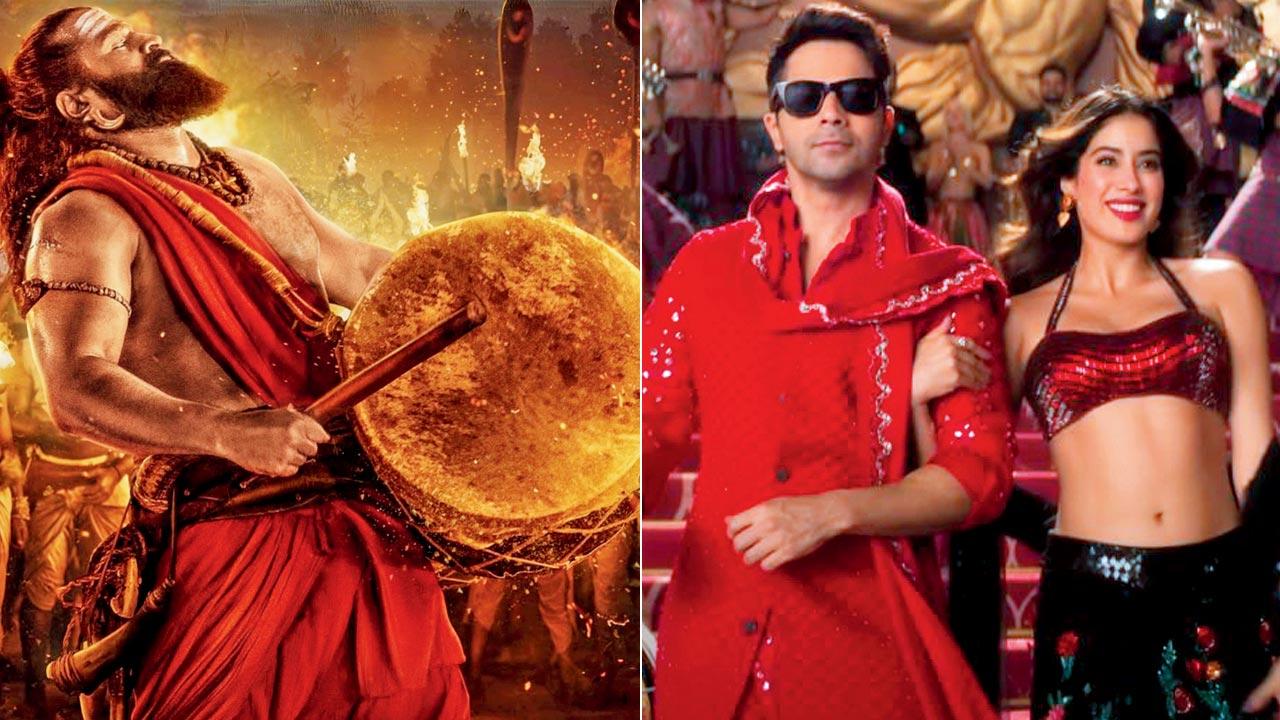
Festival releases often translate into a box-office clash. With Sunny Sanskari Ki Tulsi Kumari and Kantara: Chapter 1, however, the war has begun even before they hit the theatres on October 2. The two releases are engaged in a screen war, which started when the distributors of the Rishab Shetty-starrer asked that the mythological action drama be allotted all single-screen theatres across the country and a dominant share of prime shows in multiplexes. This sparked a backlash from the makers of Sunny Sanskari Ki Tulsi Kumari, who have now insisted on equal screen division across key territories.
Even as the two movies’ advance booking has opened, exhibitors fear being the worst hit as they will end up disappointing at least one major distributor no matter what they decide. Single-screen owners, especially in Tier-2 and -3 towns, are said to be under intense pressure from each party to increase the respective film’s shows.
The ongoing clash has left the trade on edge. Delhi-based screen owner Gurmeet Seble told mid-day, “Such clashes hurt everyone — producers, exhibitors, and sometimes even the audience, who may find their choice of film unavailable at their nearest theatre.”
Ramesh Bala, a leading trade analyst, noted that while Kantara: Chapter 1 is expected to dominate screens in South India, the Varun Dhawan and Janhvi Kapoor-starrer will benefit in the northern region.
“In the past, Kantara commanded the maximum share of screens in the South. In the North, the division of screens depends on advance bookings, with multiplex chains adjusting their show counts closer to release based on early demand. Dharma Productions has influence in the North, especially in multiplex circuits. That gives Sunny Sanskari... a negotiating edge in those markets,” he analysed.
Bala pointed out that the two films belong to different genres, and hence, will target different sections of the audience. “A middle ground will have to be found before the release weekend. By the Monday after the release, word-of-mouth will decide the hold.”
Trade analyst Taran Adarsh revealed that there isn’t a neat 50-50 division across Mumbai screens. “In most multiplexes here, Kantara is getting more screens. The buzz is based on the euphoria of the last part [Kantara, 2022]. Sunny Sanskari... is a happy family film with a wedding backdrop and will pull crowds in the North sector.”
Aamir Khan's YouTube release for Sitare Zameen Par receives mixed reactions from exhibitors and audience
8:07 AM
Bypassing the industry’s eight-week digital release norm and backtracking on his ‘theatre-exclusive’ stand, evoked mixed reactions from audiences and industry insiders alike
Priyanka Sharma, Komal RJ Panchal (MID-DAY; August 3, 2025)
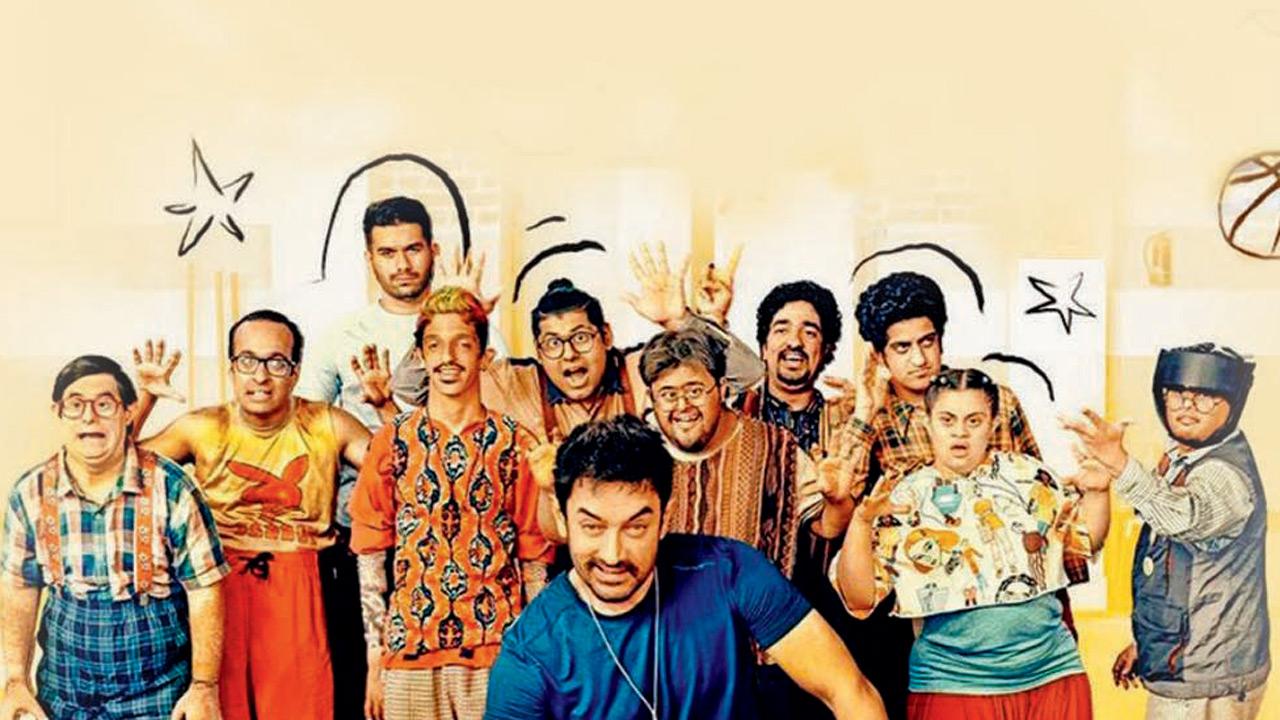
Aamir Khan dominated the news cycle last week by announcing that Sitaare Zameen Par would be available on YouTube from August 1 for Rs 100 per view — just six weeks after its theatrical release. Bypassing the industry’s eight-week digital release norm and backtracking on his ‘theatre-exclusive’ stand, evoked mixed reactions from audiences and industry insiders alike.
Now, two days after the film’s YouTube premiere, mid-day speaks to audience members, trade analysts, and exhibitors to understand whether Khan’s decision has the potential to become a game-changer in film exhibition and revenue generation for Indian producers.
Trade analyst Taran Adarsh believes the actor-producer’s decision undermines a film’s theatrical business, which he had earlier claimed to safeguard
“This is a debatable issue. At one point, he said that he was looking out for the theatre people by refusing a digital release. Then suddenly, he is releasing it on YouTube in six weeks. He even made a statement, saying, ‘I’m protecting the cinema. I want the theatres to survive.’ How do you expect theatres to survive if people are going to watch it in six weeks in their home for Rs 100? It’s a bold move, but it doesn’t benefit theatres,” he says, before adding that perhaps the superstar’s logic is to reach areas with minimal or no theatre access, given YouTube’s wider reach thanks to the growing digital penetration in India.
“Maybe his logic is that at smaller centres where there are no theatres, people still have access to YouTube. That is understandable,” adds Adarsh.
Bihar-based exhibitor and trade observer Vishek Chauhan begs to differ, as he views film exhibitors as the “opening batsmen.” “Most people watch films at home. Theatres serve only two to three per cent of the population. As exhibitors, if our only value is the exclusivity window, we’re in the wrong business. Our job is to launch films, discover price, and create visibility. We’re like the opening batsmen.”
The pay-per-view model differs from selling the film to an OTT platform because it allows the star to build a direct relationship with his viewers. It also gives him greater control and flexibility over pricing and release on his channel, unlike OTT premieres, where streamers set the price, release plan, and enforce a stringent eight-week window.
To release a film on YouTube, a creator doesn’t need to pay the platform. Gunjan Soni, managing head of YouTube India, mentioned earlier this week that the platform works on revenue revenue-sharing model with the concerned creator/filmmaker. Reportedly, YouTube and Khan have struck a 45/55 deal, with the larger share reserved for the star.
In contrast, once a filmmaker sells a film to an OTT platform, they cannot earn any additional revenue from new subscribers the platform may earn. “The pay-per-view model isn’t strong in India, where subscription platforms dominate. What Aamir is doing is risky and idealistic, not pragmatic. He’s bypassing giants like Netflix and Prime Video. It may backfire, but it’s also courageous. I wouldn’t advise producers to skip OTT deals. But it’s his film, his choice,” says Chauhan.
But shouldn’t Khan have waited eight weeks to release the film digitally, considering he had earlier advocated a longer gap? “Aamir hasn’t made the film free. Two weeks ago, Housefull 5, which was on rent at Rs 279, is now streaming on Prime Video. Tamil films have long followed a four-week window. We need a flexible model — not every film can wait eight or 12 weeks. What if a film doesn’t do well theatrically? Why hold it back? Pirated prints are available within a day. If the theatrical run is exhausted, let the producer monetize it elsewhere,” Chauhan argues.
We ask an audience member who watched the film in theatres whether they would watch it again on YouTube. “Given its emotional appeal, Sitaare Zameen Par is likely to be watched repeatedly, especially among family audiences. Its availability at Rs 100 rental makes it an accessible weekend entertainer, particularly for viewers who don’t subscribe to OTT platforms — a segment that still forms a considerable share of India’s digital audience. Strategically, this move not only widens the film’s reach but also aligns with Aamir’s track record of pioneering unconventional distribution methods in Indian cinema. This model could further cement the film’s place as a contemporary Bollywood classic,” says Yash Pandit, a Mumbai-based PR executive.
Soumil Kamat, content consultant, who consumes films and shows on OTT, believes Khan’s earlier statement about not releasing the film digitally created a sense of urgency among theatregoers. “But now, since it is available so early at Rs. 100, I am thrilled because I missed it in theatres. However, many who spent a lot of money in theatres might feel cheated by Aamir’s previous misleading statement about not releasing it online.”
Ahaan Panday and Aneet Padda's Saiyaara becomes one of the biggest openers of 2025
8:34 AM

Mohit Suri’s romantic drama defies box office norms, becoming the biggest opener of the year for a film starring newcomers
Priyanka Sharma (MID-DAY; July 20, 2025)
If recent box office trends are anything to go by, Mohit Suri’s Saiyaara can be described as something that came out of the syllabus. Headlined by newcomers Ahaan Panday and Aneet Padda, the film has amassed an opening collection of Rs 21.25 crore, becoming one of the biggest openers of 2025 so far. It has also registered the biggest opening for a Bollywood film starring newcomers. It’s being talked about because it challenges the notion that romance is dead on the big screen, and that you need a star to open a film big.
But did anyone see this coming? mid-day asks trade experts. Bihar-based exhibitor and trade observer Vishek Chauhan says people who had their ears to the ground, did. “We got the first indication when Laila Majnu [2018] re-released and did tremendous business, followed by re-releases of Rockstar [2011] and Veer Zaara [2004] in 2024. When Sanam Teri Kasam [2016] re-released, it blew the lid. With their attendance, the audience told makers that they wanted more intense romantic films with solid music,” he explains, adding that it’s the youth who has championed the film.
“Saiyaara is being pushed and patronized by Gen Z. If the youth is not interested in your film, it cannot have a big opening. Since Saturday, calls have been pouring in from the family audience. It is breaking out in a different demographic now,” he says.
“Shah Rukh [Khan] started his career [with romance]. For me, he is my hero. But for this generation, he doesn’t have the same impact. He is either Vikram Rathod or Pathaan [his characters in Jawan and Pathaan, 2023]. Ranbir Kapoor gave his generation many romantic films — Rockstar, Yeh Jawaani Hai Deewani [2013], and Tamasha [2015]. Sadly, this generation did not have one, until Saiyaara,” he adds.
Trade analyst Taran Adarsh says Saiyaara showcases the power of music and visual assets, and proves that excessive promotion yields no benefit. “Back in the day, filmmakers focused on music. Even today, when we play Antakshari, we sing old songs because they are [still] fresh. Today, music is not given importance. It could have been a risk to not have actors promote the film, but the makers of Saiyaara were relying on the trailer and the music, which worked big time.”
Ground reality vs online rumours
There’s chatter that the number hype around Saiyaara, a YRF venture, is partly manufactured, aided by PR. Freelance journalist and filmmaker Fenil Seta calls it “denial”. “When I went [for a morning show], I was shocked to see 60-70 per cent occupancy. So, the hype is real and organic. We should [know] what is happening on the ground beyond online claims.”
First six months of 2025 a mixed bag for the box office
10:59 AM

The first six months of 2025 have been a mixed bag for the box office, with small films working, and heavyweight projects tanking
Rishabh Suri (HINDUSTAN TIMES; July 1, 2025)
The first six months of 2025 have been a roller-coaster ride for India, with the Pahalgam terror attack and India’s brave response in the form of Operation Sindoor being everyone’s focus. However, the film business remained unaffected. According to an Ormax report, the cumulative total for 2025’s releases, till May, stood at Rs. 4,812 crore, 27% higher than the same period in 2024.
JANUARY
Actor Sonu Sood’s Fateh (Rs. 12.85 crore), Rasha Thadani and Aaman Devgan-starrer Azaad (Rs. 6.32 crore), actor Kangana Ranaut’s Emergency (Rs. 16.52 crore) and actor Shahid Kapoor’s Deva couldn’t set the cash registers ringing. Sky Force featuring Akshay Kumar did manage to break even.
FEBRUARY
Vicky Kaushal-starrer Chhaava became this year’s highest grosser so far. Made on a budget of Rs. 130 crore, the period drama earned Rs. 600 crore. Actors Junaid Khan and Khushi Kapoor’s Loveyapa only collected Rs. 7 crore, against a budget of Rs. 60 crore.
MARCH-APRIL
While Sunny Deol’s Jaat (Rs. 89.50 crore) and Akshay Kumar’s Kesari Chapter 2 did well, Salman Khan’s Sikandar, made on a budget of Rs. 200 crore, failed.
MAY
Ajay Devgn-starrer Raid 2 did well with Rs. 173.28 crore. Also, Rajkummar Rao and Wamiqa Gabbi’s Bhool Chuk Maaf had a decent run with Rs. 74.18 crore.
JUNE
June had two clean hits so far — Housefull 5 and actor Aamir Khan’s Sitaare Zameen Par, which has been running successfully. Actor Kajol’s horror-mythological drama Maa got a slow start.
“Barring Chhaava, we have not had a true blockbuster. Raid 2 and Jaat did well. I hope the second half is better. I feel the smaller and medium-budget films need to do well in theatres, as we don’t have a big release every week. Bhool Chuk Maaf did well in the two-week window it had between theatrical and digital release.”
- Taran Adarsh, Trade analyst
“2025 has not been so good. Sikandar not working was a shock. Kesari Chapter 2 and Housefull 5 worked. Before the pandemic, such films would run, not just work. We are still struggling, businesswise.”
- Atul Mohan, Trade analyst
“The first half of 2025 saw strong theatrical momentum, led by Chhaava, Raid 2, Bhool Chuk Maaf, Kesari Chapter 2, Sitaare Zameen Par and Jaat. Hollywood also contributed with Mission: Impossible – The Final Reckoning becoming the first Hollywood release to cross ₹100 crore in 2025 and a solid performance by Final Destination Bloodlines and How to Train Your Dragon. Regional cinema, including Telugu, Tamil and Malayalam films, contributed ₹3,600 crore to the box office.”
- Devang Sampat, Managing Director, Cinepolis India
BIG HITS
Chhaava - Rs. 600.10 crore
Raid 2 - Rs. 178.08 crore
Sky Force - Rs. 131.44 crore
Housefull 5 - Rs. 156.40 crore
Kesari Chapter 2 - Rs. 93.28 crore
Sitaare Zameen Par - Rs. 107.68 crore
BIG MISSES
Sikandar - Rs. 103.45 crore
Deva - Rs. 32.07 crore
Loveyapa - 7.04 crore
(Figures as per all-India collections, according to trade estimates and Bollywood Hungama)
Be it Triptii Dimri or Deepika Padukone, a woman lost-Susmita Bandhopadhyay
10:19 AM

Deepika Padukone’s walkout from Sandeep Reddy Vanga’s Spirit laid bare Bollywood’s double standards where male egos are indulged, but women demanding equity are branded “difficult”. Industry insiders say the rot runs deep and in the end, women suffer
Mohar Basu (MID-DAY; June 1, 2025)
When Deepika Padukone walked out of Sandeep Reddy Vanga’s Spirit, it exposed the deeply gendered fissures within Bollywood’s power structures. This is an industry where exits by leading men are often romanticized as acts of creative rebellion, like in the case of Salman Khan leaving Sanjay Leela Bhansali’s Inshallah.
The narrative surrounding Deepika’s exit was, however, aggressively shaped with slander. From the very first piece itself, she was branded “unprofessional” for asking for strict eight-hour work days, remuneration in the range of Rs 40 crore, an additional fee if the shoot extends beyond the allotted number of days, and a share of profits, which is customary for male stars. Her male co-star Prabhas, reportedly commands a fee ranging between Rs 100 to Rs 200 crore per film.
Deepika was promptly replaced by Triptii Dimri the next day. Dimri made it to national fame for her extended cameo in Vanga’s last film Animal. And then appeared a news report about how a major bone of contention between Padukone and Vanga was the number of “bold” scenes in the movie.
Vanga lashed back with a tweet, “When I narrate a story to an actor, I place 100 per cent faith. There is an unsaid NDA [Non Disclosure Agreement] between us. But by doing this, You’ve ‘DISCLOSED’ the person that you are... Putting down a Younger actor and ousting my story? Is this what your feminism stands for ? As a filmmaker, I put years of hard work behind my craft & for me, filmmaking is everything. You didn’t get it. You won’t get it. You will never get it. Aisa karo... Agli baar poori kahani bolna... kyunki mujhe jarra bhi farak nahi padtha. #dirtyPRgames I like this kahawath very much :-) खुंदक में बिल्ली खंबा नोचे!” [an embarrassed person tends to vent their feelings by quarrelling].
Padukone, who was attending a Cartier event in Copenhagen the same day, said in an interview, “I think what keeps me balanced is just being truthful, being authentic. Whenever I am faced with complicated or difficult situations, I listen to my inner voice and make decisions that give me peace. That’s when I feel most in equilibrium.”
What followed thereafter was a battle between Vanga supporters and Deepika stans.
Lawyer and activist Devrupa Rakshit tells us, “Watching this play out in the media has been nothing short of whiplash. This goes far deeper than an industry spat, and is a great case study in how patriarchy punishes women who know their worth, and label them ‘difficult’ or ‘replaceable’ the moment they stop playing nice or demand equity. As soon as a woman, no matter how accomplished, dares to set boundaries or ask for compensation comparable to her male counterparts, the system is very quick to remind her where it thinks she belongs. The rhetoric about whether Deepika is ‘worth Rs 20 crore’ is so hypocritical! Why are we even asking that when we rarely interrogate the sky-high demands of male actors, even when they consistently deliver flops?”
She posted about this on her social media, a post liked by Bollywood star Sonam Kapoor.
Rakshit continues — “The responses to my post were so telling! They made the gender divide painfully clear. For many women, obviously, it resonated deeply, seeing their own experiences of being dismissed for asking for raises, for setting work-hour boundaries, for not overextending themselves just to appear “dedicated” reflected here. On the other hand, a large chunk of men are justifying the hate Deepika is receiving, with arguments like how she’s not a box-office draw, how there are thousands of girls who’d do it for free, or how she should be grateful she’s getting paid at all. There were also comments trying to sidestep the gender issue entirely, by framing it as a purely business decision. We don’t hear these same arguments when male actors charge three to four times more despite flopping repeatedly. At the heart of it is a deep-rooted discomfort with women asserting agency, especially around money and autonomy. This is also why stories like Deepika’s strike such a nerve. If someone with her fame, skill, and track record isn’t ‘allowed’ to ask for better, what hope is there for the rest of us?”
Filmmakers routinely bend over backwards to accommodate male superstars, adjusting shoot schedules, rewriting scripts, and sometimes even shelving projects. Which is why when Rhea Kapoor waited for a year for Kareena Kapoor Khan to make Veere Di Wedding, it made headlines.
One top female producer, speaking on condition of anonymity, says, “The industry has long known that there are certain directors who maintain control through fear and manipulation. But now we’re seeing that actresses like Deepika are no longer willing to trade dignity for screen time. That’s a tectonic shift. And it threatens the old order.”
This kind of shift isn’t new. The subtext of this exit echoes past incidents, like Anushka Sharma’s push for better roles under her production banner or Kareena Kapoor discussing pay parity and lack of insurance for pregnant women on Bollywood sets. The industry’s patriarchal core is met with fierce resistance from women working here now. An image manager at Matrix the company who reps Varun Dhawan and Alia Bhatt, says, “Deepika has made it clear she won’t tolerate creative environments that don’t serve her. Kareena, too, left Yash-starrer Toxic due to monetary disputes with the makers. The ladies are saying that they won’t be tossed around. They know their worth and won’t short-sell.”
This is perhaps why Padukone’s brand emerges stronger post-exit. Industry whispers indicate that several directors have approached her since, and she is on the verge of locking Atlee’s next alongside Allu Arjun, for whom this is the next after the success of Pushpa 2. A male screenwriter comments, “This is the era of image-led storytelling. When an actress becomes symbolic of a larger cultural stance, like not tolerating toxicity, she doesn’t need a hit film to stay relevant. She becomes the story.”
And Vanga? He may ride the wave of attention into a successful release, but his penchant for controversial masculinity may have once seemed audacious, now it risks coming across as repetitive.
A senior publicist believes that this is a classic eyeball-grabbing move by Vanga. “He is playing a long game here. Every time he positions himself as misunderstood or vilified, he strengthens his appeal among a very specific demographic of viewers, mostly young men. And now, he is going after a top actress and accusing her of things like leaking the plot of his film. But nothing about the film is known except the fact that it is a cop thriller.”
Trade analyst Taran Adarsh rubbishes this theory. He says, “When a writer narrates a story, it is meant to be a secret. It’s an unspoken fact. You can’t tell the story. A filmmaker would feel hurt. Even in the 1970s and ’80s, actors would pass on films because of scheduling conflicts. Sholay had multiple casting changes but the story never got leaked. Stars and even directors need to part ways amicably. And no, I don’t believe negativity is publicity because no one wants or benefits from publicity like this.”
Female agency is suffering the most, Kolkata-based sociologist Susmita Bandhopadhyay tells Sunday mid-day. Padukone’s supporters, who made the issue about feminism, gave the issue an ugly turn and worked overtime to run down Triptii, who only took up a new film that someone else was supposed to do.
“Feminism, at its core, is about women pulling each other up. So what’s happening right now is not feminism. It’s a PR show that uses feminists as pawns. What happened to Deepika is unfortunate, but the minute Triptii’s slut-shaming began, it became counter-productive. In the end, it became the classic woman-pitted-against-woman and be it Deepika or Triptii, a woman lost.”
Q1 Report Card: Cold star for Bollywood this year
8:10 AM

With only one film scoring major success at the box office, Bollywood’s performance in the first quarter of this year is far from impressive
Rishabh Suri (HINDUSTAN TIMES; April 2, 2025)
Bollywood’s box office ‘report card’ for the first quarter of 2025 projects a rather bleak picture. Only one film has done extraordinary business in the first three months of this year — Chhaava, featuring Vicky Kaushal in the lead role. Two other films have just about managed to draw audiences to the theatres — Akshay Kumar’s Sky Force and The Diplomat, starring John Abraham.
Compare this to the corresponding period last year, and there were multiple hits such as Shaitaan, Article 370, and Crew. The industry is understandably unhappy.
Talking about Sikandar, the big-ticket Eid release, trade analyst Taran Adarsh says, “One didn’t expect this performance from a Salman Khan film. It started off okay due to the Eid holiday, but the foundation is weak for the numbers to sustain in the weekdays. Also, the BOGO and free ticket offers for the film are very unfortunate. It shows the phase the industry is going through.”
The silver lining
Amit Sharma, managing director of Miraj Cinemas, however, is optimistic: “After five years of struggle, we now have a release every week. It’s a spread-out calendar unlike last year, when multiple films released on the same day.”
There’s room for improvement in the second quarter, feels Devang Sampat, CEO, Cinepolis Cinemas. “Q2 looks very good, especially the combination of Hollywood and Bollywood films will give a huge boost this summer,” he says.
---------------------------------------------------
“I won’t say that there should be a Chhaava every week, it’s not possible. We needed more hits; we can’t survive on one hit or one plus film to carry us till the next quarter.”
- Taran Adarsh
“It’s important for films like The Diplomat (to earn) because we have only about 10-15 tentpole releases in a year. The exhibition sector needs smaller films to do well to stay afloat.”
- Akkshay Rathie
---------------------------------------------------
MAJOR RELEASES SO FAR
Chhaava: Rs. 545 crore
Sky Force: Rs. 131.44 crore
The Diplomat: Rs. 30 crore (still running in theatres)
Deva: Rs. 32 crore
Badass Ravi Kumar: Rs. 9.66 crore
Sikandar: Rs. 55 crore (still running in theatres)
(All figures according to Box Office India and trade estimates)
Salman Khan's Sikandar unlikely to surpass his highest opener Tiger 3, say trade analysts
10:49 AM

Even as Sikandar earns over Rs. 10 crore in advance booking, trade analysts skeptical of its Day-One figures surpassing Salman Khan’s biggest opener Tiger 3 at Rs 43 crore
Mohar Basu (MID-DAY; March 29, 2025)
From the look of things, it will be a grand Eid for Salman Khan fans. The advance booking window for Sikandar opened on March 27, and earned over Rs 10 crore on the first day. Despite its strong advance booking figures, buzz in the trade is that Sikandar is unlikely to smash Khan’s highest opener, Tiger 3 (2023), which had raked in Rs 43 crore on its first day.
Trade analyst Taran Adarsh notes, “There are lots of factors [going in Sikandar’s favour]—it’s an Eid release, it stars Salman, and A R Murugadoss is the director. The assets may not have tracked as expected, but Sajid Nadiadwala [producer] and Salman know the pulse of the audience. Spot bookings will be the main focus. Since Tiger 3 made Rs 43 crore, Sikandar has the pressure to not settle at a final figure of Rs 25 crore [on Day One]. It has to top Tiger 3, which will be a challenge.”
Like Sikandar, Tiger 3 was not only a festival release but also a Sunday offering. One could argue that the 2023 Diwali offering had the advantage of being part of the YRF Spy Universe. In contrast, Sikandar is a standalone action drama, which may not have the same multiplex appeal. But trade circles are confident that single-screen theatres, in cities as well as in tier-2 and -3 towns, will be the film’s stronghold.
Manoj Desai, executive director of Gaiety-Galaxy, states, “Salman’s films have an unmatched pull in single screens. His fans don’t care about reviews or [box-office] comparisons; they come for the experience. They should increase the number of screens; Bhai’s film on Eid is bound to do well.”
Industry insiders talk about block booking and why it is so rampant
11:09 PM

Rishabh Suri (HINDUSTAN TIMES; February 13, 2025)
The terms ‘block bookings and ‘corporate bookings’ have created a lot of buzz recently. It began when trade analyst Komal Nahta accused the makers of actors Akshay Kumar and Veer Pahariya’s recent film Sky Force of resorting to booking out theatres in order to paint a rosy picture in the film’s box-office report.
Things took a turn after the same accusation was levelled against Vicky Kaushal and Rashmika Mandanna’s upcoming Chhaava, which is bankrolled by the same producers — Maddock Films. In light of these allegations, insiders worry that the industry’s credibility is at stake, considering anyone can manufacture numbers to favour their films.
‘An old practice’
According to trade analyst Taran Adarsh, big names in the film industry were fudging the numbers even in the 1970s and ’80s: “In those days, block bookings was called ‘feeding’. A top actor I spoke to would buy tickets at certain cinemas for houseful boards to create a certain perception. Films wouldn’t release simultaneously then — a film might premiere in Delhi today, Mumbai after a week and so on. But public sab jaanti hai.”
However, exhibitors do not complain since tickets are technically being sold. He adds, “Aaj kal toh bade level pe ho raha hai yeh sab. Exhibitors are happy, ab chaahe producer khud khareed raha hai ticket, ya actor, ya studio.”
So, is it all fake?
Also accused of using this tactic were the makers of Ram Charan and Kiara Advani-starrer Game Changer. The makers claimed that it grossed Rs. 186 crore worldwide on premiere day. But according to number crunchers Sacnilk and Box Office India, the actual worldwide gross was Rs. 80 crore.
With the growing buzz, filmmakers have begun adding their two cents to the debate. Recently, filmmaker Kunal Kohli called block bookings “rubbish”. In an interview with YouTuber Aleena Gandhi, Kohli said, “Matlab we make the film, we release the film and then we only buy tickets to watch the film? The reason you are doing [this] is ego, to pamper a star and not show him the reality, or to pamper that director, that producer.”
Shibasish Sarkar, the president of Producers Guild of India, asserts that this is fraud against the masses: “I think ultimately what is happening is bringing the credibility of the industry down. The only logic here is to create a perception about the demand.”
Tracking the numbers
As for fake numbers, Sarkar notes, “In developed markets worldwide, there are systems like Rentrak (to track the numbers). In India, unfortunately, that has not happened. While this isn’t new, things are happening on a scary proportion. So, even if you get a system to bust fake numbers, how would you see who is fraudulently booking the tickets in bulk? You cannot install CCTV cameras inside every theatre.”
We reached out to Dinesh Vijan, founder of Maddock Films, but received no response by the time of going to press.
After the makers of several tentpole films were accused of ‘block booking’, we ask industry insiders about the practice and why it is so rampant
What is corporate and block booking?
Trade expert Atul Mohan explains, “If an actor endorses 20 brands, they ask one brand to, for example, purchase 10,000 tickets for their latest film. In return, they waive off some fees, or shoot an ad for free. This means 10,000 tickets are legitimately being sold, even if the theatres turn out to be ultimately empty. Then there’s block booking, where a producer, actor, or studio pay for multiple seats out of their own pockets. In both cases, when you open booking apps, you see theatres are filling fast. That creates a positive perception around the film.”
Blake Lively vs Justin Baldoni: Decoding the effect of a smear campaign on a celebrity's social currency
8:32 AM

In the wake of the Blake Lively-Justin Baldoni lawsuit and very public online smear campaign, we ask Bollywood publicists, managers, entertainment editors and trade gurus about just how much can a smear campaign affect a celebrity’s social currency
Mohar Basu (MID-DAY; January 12, 2025)
It all started with conspiracy theories as to why Hollywood actors and stars of the 2024 movies, It Ends with Us, Blake Lively and Justin Baldoni, were unable to get along during the shoot of the said movie. “Creative disagreement” was the popular term used for it, but what lay underneath was slander, and an effort to put down the other. Soon, social media was rife with conspiracy theories—some experts reading body language of the two stars—some just pondering on why they were both not seen together during promotions of the movie. It was declared: the two couldn’t stand each other.
There was some truth to the fire, as in the past two week, both Lively and Baldoni have filed lawsuits against each other. Lively’s account, where she accuses Baldoni of sexual harassment, was also reported in the New York Times by Megan Twohey (who has reported on the Harvey Weinstein case) with the headline: “We Can Bury Anyone: Inside A Hollywood Smear Machine”. What took centrestage: the use of social media and the Internet to create a narrative (true or not) of the other.
But how is Bollywood viewing this? A celebrity manager, on condition of anonymity, says the best way to attack a star is to attack their “image”. “They care for nothing as much as their image. And creative disagreements and celebrity fall-outs are rampant in this industry. For instance, Salman Khan walked out of Sanjay Leela Bhansali’s film after announcing it. Of course, that couldn’t have been pleasant. But what separates that from the Baldoni-Lively case is that neither party went out of their way to pull the other one down. A classic case of a Bollywood smear campaign is what happened to Kangana.”
Actress Kangana Ranaut has publicly admitted to being at the receiving end of the industry’s inability to stomach her. In 2021, she said, “Just last week, I lost more than five lakh followers on Instagram. They gang up on you, boycott you, and if that leaves you happy and content, they ruin your image and brand. That’s how they killed Sushant [Singh Rajput]. That’s how they harass outsiders who don’t need them for work. There are paid smear campaigns happening on Instagram as well… Many derogatory memes and fake information about me are spread. Instagram is also paid as my followers numbers automatically drop, fans who unfollow don’t even realize it... There is a proper investment of troll army, creative budget to make memes, to write lies to spread smear campaigns, movie mafia + political mafia + jaded actors who are rejected lovers, you are jealous of even a fruit bowl...”
These observations were following an incident when Ranaut posted a picture of herself having breakfast, and got trolled.
A former publicist of Ranaut’s, who worked with her for a year, told us, “This whole impression that Kangana is difficult and a loose cannon, has been created. She is very professional and believes in doing her work and going home. She has a certain political leaning and believes in it strongly, but who isn’t leaning towards the establishment today. Why should she be vilified? Then it all boils down to—is she good at her work? Oh yes, she is. It’s a good question to ask then—why is she not getting films? Some part of the answer is that she has managed to offend her directors. She has wanted creative control and I personally believe, directors allow men the creative control, when women ask for it, there’s an issue. There has been a systematic smear campaign on Kangana—where videos of her using a fake horse have been leaked when every actor does that for period films. Money has been spent on bringing her down. If one wishes to study a smear campaign, they should go through Kangana’s career post 2015.”
The problem happens when a one-off dispute shifts from professional disagreements to personal attacks, with media outlets amplifying unverified claims from anonymous insiders. This pattern is a textbook example of how celebrity feuds are orchestrated and sustained in the digital age. Earlier this week, a slanderous article on Triptii Dimri appeared on a website, which claimed that she was removed from Aashiqui 3 because makers weren’t comfortable with her bold avatar in Animal. In Triptii’s case, the story may be planted by professional rivals who want to cost her an opportunity/or envious of the fact that she is currently shooting for Vishal Bhardwaj’s film with Shahid Kapoor.
But it could be a reach to say this only happens to the women in the industry. An industry veteran pointed out that in 2014, Aamir Khan met Mumbai Police to complain about “false and malicious messages” that were being circulated in social networking sites Facebook, Twitter and WhatsApp to damage his image and reputation of his issue-based show Satyamev Jayate.
“Aamir Khan complained to us about some objectionable messages getting circulated (against him),” a police official had told the press then.
But how do the smear campaigns work, and more importantly, do they succeed in today’s media landscape? Let’s take a closer look at Bollywood’s modus operandi.
Tushar Joshi, entertainment editor of India Today, tells us, “These smear campaigns are age-old in the industry. Sometimes they are direct and sometimes they are proxy. But what is going on in Hollywood is something actors in Bollywood have faced. These campaigns happen via publicists, production houses, actors and colleagues and friends who have agendas different from their rivals. Maybe emails, voice calls haven’t been made public. They might have been exchanged in private to sway the minds of the opinion makers. The only difference is most of what happens in Bollywood happens behind closed doors. With the Baldoni-Lively case out in the open now, new norms are being set.”
Smear campaigns are rarely explicit. They are carefully orchestrated efforts that exploit the vulnerabilities of digital ecosystems. A lot of the battle has moved to Redditt.
In an email interview, the Reddit account, Bollywood, tells us, “We frequently get requests to post leaks and we do so. So far, we haven’t got commercial deals but it’s only a matter of time until we get there. We list it under unverified goss. We have noticed a lot of gossip on Kartik Aaryan, Akshay Kumar, Ranbir Kapoor, Ranveer Singh and the things that we get told are juicy. Clearly, someone wants to feed these stories to the public. The tabloids have stopped carrying gossip, so we have to. A post can look organic, but it’s often the first step in a much-larger campaign.”
A Bollywood publicist tells us, “Earlier, the approach was subtle. Journalists were given insider tidbits—sometimes, stories were planted by mentioning them in passing. The goal is to create a seed of doubt in their audience’s mind. But now, it has become all about money. Influencers with followers ranging from 5,000 to 50,000 are often paid to post seemingly neutral content that’s actually part of a coordinated campaign. A simple Instagram story about a '“troubling blind item' can snowball into a full-blown scandal.”
“Smear campaigns work because they tap into our collective love for drama. Controversy sells, and people are quick to believe what aligns with their existing biases. It’s classic voyeurism,” says a Bollywood podcaster. But at the same time, a smear campaign has little correlation to a film. There is plenty of hate against Ranbir Kapoor but his film, Animal, made nearly Rs 1,000 crores.
Veteran director Anurag Kashyap had said before that a smear campaign might work for a weekend, but it can’t sustain itself if the audience connects with the work of an actor. At the end of the day, content is king.
In the end, none of the bitterness matters, says trade analyst Taran Adarsh. “The goal is that a film must work. Smear campaigns pique curiosity and fuels the news cycle. But the audience wants a movie, they want to be entertained. Often films have gone through political controversies and personal issues and have powered through because the film is good. Also none of this affects an actor’s brand value. It is a he said/she said story until someone goes to the cinema hall and says ‘oh what a film’. I have to quote a story here. B R Chopra and Madhubala went into a famous trial over a film. She was replaced by Vyjayanthimala and the film did very well despite this controversy. Collections remained unaffected. I had asked Chopra sa’ab, ‘Aapko laga nahi negativity aajayegi’ and he had said, ‘Kaam karma hota hai. Acha kaam kariye and the audience will reward you’. The interpersonal dynamics may be shaken, but cinema will last forever.”

Bollywood in 2024 saw a mix of scares, sequels and surprises
8:53 AM

Bollywood’s 2024 saw a mix of scares, sequels and surprises, with horror hits and small-budget triumphs outshining big-budget disappointments
Rishabh Suri (HINDUSTAN TIMES; December 31, 2024)
If 2023 marked Bollywood’s comeback year with a blockbuster revival, 2024 has been a “semi-hit” year, unanimously state trade experts. “The year started with a whimper,” rues trade analyst Taran Adarsh, adding, “Fighter (first release of this year starring Hritik Roshan-Deepika Padukone) didn’t meet expectations, especially with (filmmaker) Siddharth Anand riding high after Pathaan. It ended similarly with Baby John, which crashed on day two. Between these films, it’s been a case of kabhi kabhi khushi, kabhi bahut saara gham. Last year, we had four Rs. 500-crore grossers — Pathaan, Jawan, Gadar 2 and Animal. This year, big-budget films like Bade Miyan Chote Miyan and Maidaan tanked, and even Singham Again fell short of expectations.”
‘SCARY’ NEW SUCCESS
Surprisingly, horror turned out to be Bollywood’s lucky charm this year. Films like Munjya, Shaitaan, Stree 2: Sarkate Ka Aatank and Bhool Bhulaiyaa 3 broke genre barriers. Trade expert Atul Mohan observes, “Horror has been a hit-or-miss genre for our industry. These films changed that narrative.”
RE-RELEASES RULE
Old films found new love in 2024. The Avinash Tiwary-Triptii Dimri-starrer Laila Majnu (2018) became a sensation during its re-release. Similarly, Rockstar (2011), starring Ranbir Kapoor, saw renewed love. Movies such as Rehnaa Hai Tere Dil Mein (2001) and Veer-Zaara (2004) also pulled crowds to theatres. This trend shows no signs of slowing, with Yeh Jawaani Hai Deewani (2013) gearing up for a return.
SMALL TO MID-BUDGET FILMS
A major conversation this year revolved around escalating production costs and actor fees. Consequently, films made on controlled budgets stood out. Munjya, made on Rs. 30 crore, tripled its investment. Its director, Aditya Sarpotdar, says, “Even we didn’t anticipate these numbers, because it starred newcomers, was local in its flavour, had a CGI character.”
Yami Gautam’s Article 370 and Prasanth Varma’s HanuMan were other winners, with HanuMan delivering an impressive 241% ROI on a Rs. 25-crore budget.
Another triumph of controlled budgets was Laapataa Ladies. Sarpotdar credits its success to producer support: “Aamir Khan backing the movie further elevated its success. Even small profits matter when you consider the economics.”
FRANCHISE FACTOR
Franchise films continued to wield power this year, with Pushpa 2 – The Rule raking in massive numbers, especially from its Hindi-dubbed version. Other sequels like Stree 2 and Bhool Bhulaiyaa 3 (BB3) also performed exceptionally well.
Anees Bazmee, director of BB3, says, “Sequels enjoy goodwill, but you must deliver a good film. If one part fails, it’s not just the film that suffers; the entire franchise collapses.”
BIG HITS BUDGET BOX OFFICE
STREE 2
Budget: Rs. 60 crore
Box Office: Rs. 579 crore
PUSHPA 2 - THE RULE
Budget: Rs. 450 crore
Box Office: Rs. 700 crore
MUNJYA
Budget: Rs. 30 crore
Box Office: Rs. 107 crore
SHAITAAN
Budget: Rs. 60 crore
Box Office: Rs. 148 crore
BHOOL BHULAIYAA 3
Budget: Rs. 150 crore
Box Office: Rs. 245 crore
KALKI 2898AD
Budget: Rs. 600 crore
Box Office: Rs. 285 crore
ARTICLE 370
Budget: Rs. 20 crore
Rs. 77 crore
BIG MISSES
BADE MIYAN CHOTE MIYAN
Budget: Rs. 350 crore
Box Office: Rs. 59 crore
FIGHTER
Budget: Rs. 250 crore
Box Office: Rs. 200 crore
BABY JOHN
Budget: Rs. 160 crore
Box Office: Rs. 19 crore
MAIDAAN
Budget: Rs. 250 crore
Box Office: Rs. 51 crore
JIGRA
Budget: Rs. 80 crore
Box Office: Rs. 31 crore
Diwali brings cheer to the industry as Singham Again and Bhool Bhulaiyaa 3 set cash registers ringing
9:19 AM
Diwali brings cheer to the industry as Singham Again and Bhool Bhulaiyaa 3 set cash registers ringing; analysts say Bollywood may see a “strong box-office finish” to 2024
Mohar Basu (MID-DAY; November 4, 2024)
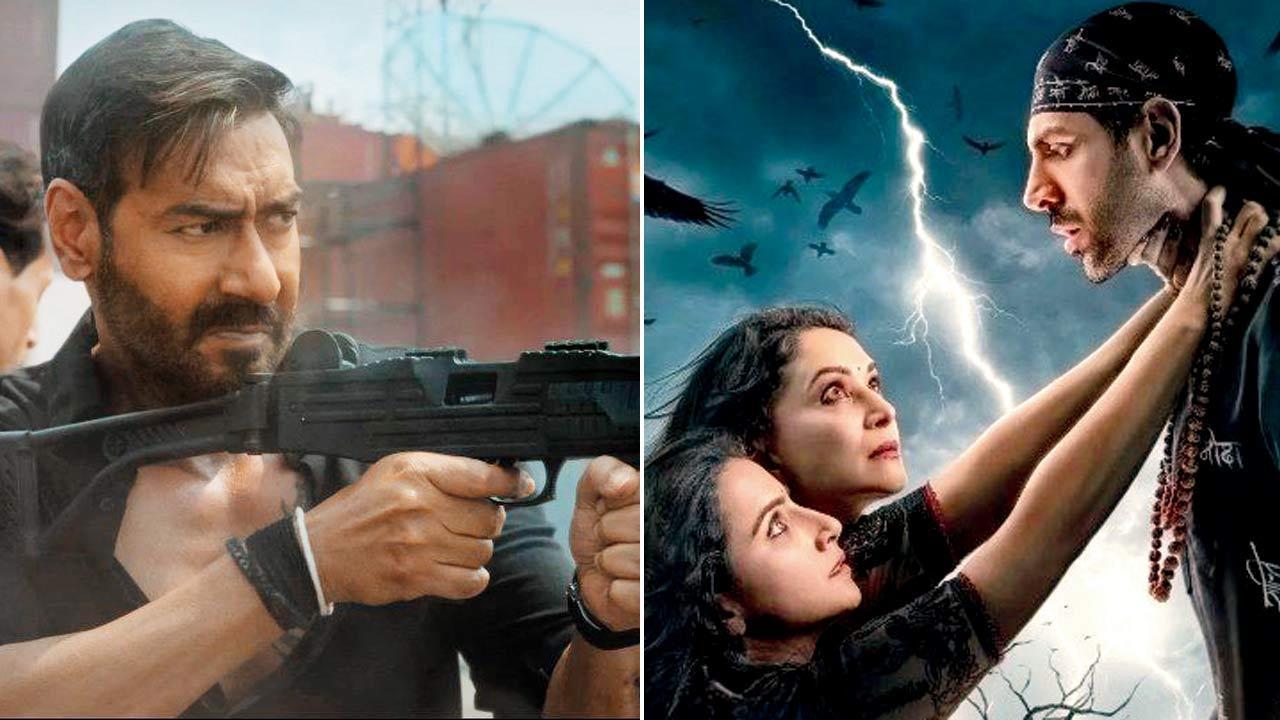
After a seemingly uneventful 2024, fan-favourite franchises Singham and Bhool Bhulaiyaa have brought relief to the box-office, with the third edition of both films setting cash registers ringing on Diwali. Rohit Shetty’s cop comedy Singham Again achieved a significant head-start, earning Rs 43 crore on its opening day, and continued its successful run on day two, collecting Rs 41.50 crore.
While the actioner found favour among fans of the franchise’s outlandish stunts, Kartik Aaryan’s horror comedy, Bhool Bhulaiyaa 3, also drew a different set of viewers. The Vidya Balan and Madhuri Dixit-starrer earned Rs. 35 crore on day one, with its collections seeing a marginal jump to Rs. 36.50 crore on the second day.
While filmmakers go to great lengths to avoid locking horns with one another on the annual film calendar, this clash, trade experts agree, served well for both parties.
“Singham Again appeals largely to an action-loving audience, while Bhool Bhulaiyaa 3 offers a blend of comedy and supernatural elements. The diverse genres have allowed the films to cater to distinct [audiences] even though the demographics overlap,” says trade analyst Taran Adarsh, adding that the movies are tapping into the holiday crowd and benefiting from positive word-of-mouth.
“Both films are designed for the masses, and the clash is drawing crowds back to theatres; it’s encouraging for Bollywood. Distributors can finally heave a sigh of relief as the numbers have brought cheer. The momentum must continue. One expects that each film will earn a lifetime revenue of Rs. 200 crore. The makers of Singham Again would feel the pressure to earn more than that.”
As per early projections, Singham Again is expected to cross the Rs. 100 crore mark by today, while Bhool Bhulaiyaa 3 may breach Rs 90 crore. Trade expert Girish Wankhede agrees that the films are “not competing but complementing each other”.
“Contrasting genres that are simultaneously released often mutually benefit each other,” he says, adding that the collections are likely to see an up-tick in the following week as well.
Singham Again predicted to open at Rs. 40 crores
8:49 AM
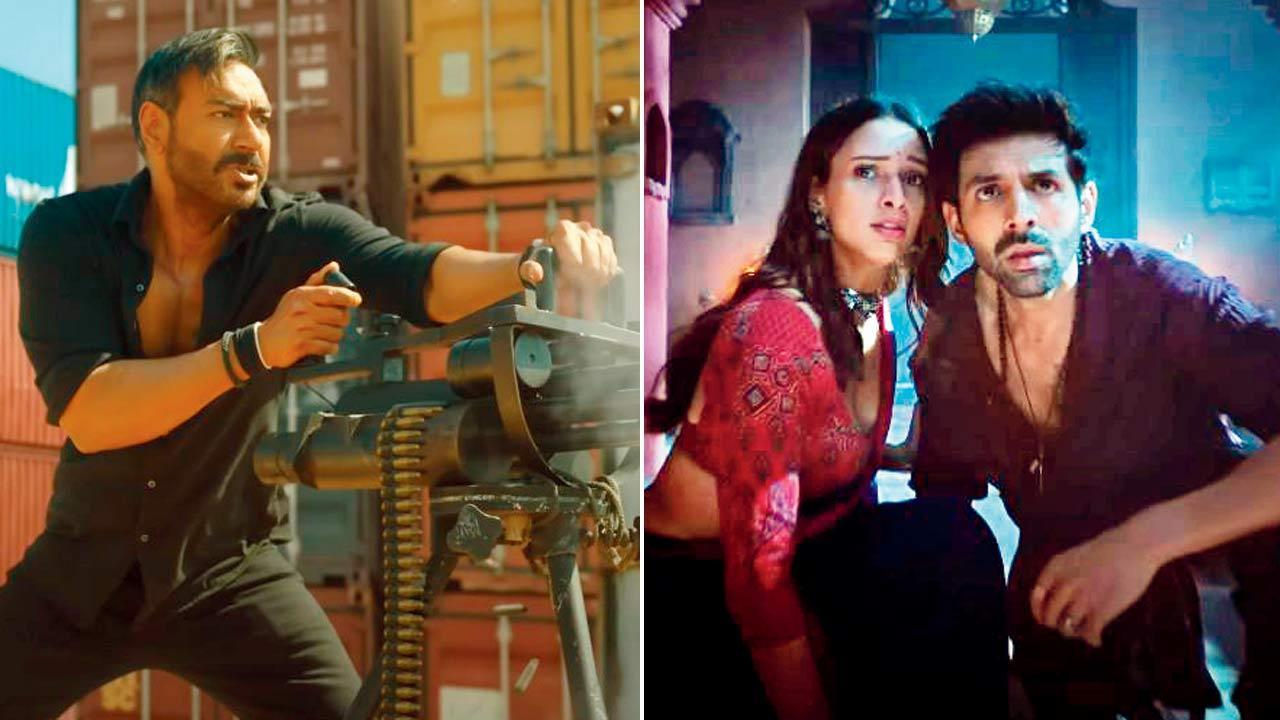
With Singham Again and Bhool Bhulaiyaa 3 starting advance booking in select theatres, Ajay-starrer projected to have upper hand at Rs. 40 crore opening; trade says dynamics could change depending on films’ quality
Mohar Basu (MID-DAY; October 30, 2024)
There have been enough fireworks even before the two Diwali releases have hit the theatres, with the makers of Bhool Bhulaiyaa 3 filing a complaint with the Competition Commission of India (CCI), alleging that Singham Again’s makers are employing unfair practices in screen allocation. Even as the fight for screens is ongoing, the advance booking for the two movies finally opened, albeit in select theatres. So, who is emerging as the winner in this box-office clash between Ajay Devgn’s super cop and Kartik Aaryan’s ghostbuster?
Bhool Bhulaiyaa 3, which began ticket sales on Monday, had garnered about Rs 12.83 lakh in advance collections by Tuesday afternoon. With Singham Again’s advance booking starting only on Tuesday morning, it had earned Rs 11.72 lakh by afternoon. Director Rohit Shetty’s cop actioner—with an all-star cast of Devgn, Kareena Kapoor Khan, Akshay Kumar, Ranveer Singh, Deepika Padukone, Arjun Kapoor and Tiger Shroff—however, has a slight edge over the horror comedy as it is poised to capture a larger screen share.
Trade analyst Girish Wankhede says that PVR-Inox being the distributor of Singham Again has given it a strong start. “PVR-Inox wants to allocate around 60 per cent of screen time to Singham Again. That means if a screen has five shows, three would go to Singham Again and two to Bhool Bhulaiyaa. This tussle delayed advance bookings, and in such cases, audiences tend to gravitate towards the bigger release. Anil Thadani, who is distributing Bhool Bhulaiyaa 3, is insisting that the screen sharing be made equal. It is currently divided at a 55-45 ratio. Still, both films should do well, as Diwali’s holiday spirit boosts spending power. We are expecting a Rs. 40-crore opening for Singham Again, and Rs 25-30 crore for the horror comedy. But if the latter is a better film, the dynamics could change.”
Manoj Desai, executive director, Gaiety-Galaxy, says the clash has harmed exhibitors as they have been barred from opening advance bookings until the screen allocation is finalized. At present, Singham Again’s bookings have been opened at only a few PVR properties, and Bhool Bhulaiyaa’s at certain single-screens.
“This is Diwali time, and we aren’t allowed to start advance bookings because they can’t sort out their differences. This is damaging to us,” rues Desai.
Trade analyst Taran Adarsh backs Desai, noting that the films are only two days away from release. “Pune exhibitors are telling me that the advance bookings haven’t started for their city. The lion’s share of theatres remain undecided on which film they are screening or which film gets more screens. Diwali is a lucrative time for the industry. These movies have to work, but both parties are prioritizing personal egos. Eating each other’s business will only damage the industry.”
Trade experts say figures of Alia Bhatt's Jigra are not tampered with
8:07 AM

After Savi actor Divya accuses Jigra makers of inflating earnings and sparks row with Karan Johar, trade says Alia-starrer’s figures not tampered with; cites the thriller’s ‘limited storytelling’ for its low numbers
Mohar Basu (MID-DAY; October 14, 2024)
Alia Bhatt’s Jigra has sparked a war of words between one of its producers Karan Johar, and actor-filmmaker Divya Khossla Kumar. On Saturday, Khossla took to social media to question the veracity of the film’s earnings, which was reported to have opened at Rs 4.25 crore, making it Bhatt’s lowest opener since Highway (2014). Posting a picture of an empty theatre, Khossla insinuated that Jigra’s box-office figures were being inflated by the makers, possibly through bulk ticket purchases. Soon, Johar posted a cryptic message on social media—“Silence is the best speech you will ever give to fools”—that was viewed as a jab at her.
This public spat is said to have its roots in Savi. In the May release, Khossla played a woman who breaks into a prison and frees her husband. With Jigra being a jailbreak thriller where Bhatt’s character hatches a plan to save her brother, a section of the audience has drawn parallels between the two plots.
As Khossla continues to challenge the box-office numbers of Vasan Bala’s directorial venture, which released alongside Vicky Vidya Ka Woh Wala Video (VVKWWV), the one question on everyone’s minds is: Are the figures fudged?
A trade analyst, on the condition of anonymity, says, “No, the figures are low. Jigra opened in 2,800 screens, and VVKWWV in 3,500 screens. On day one, the average occupancy for both was 20 per cent. So, they earned Rs 4.25 crore and Rs 5 crore respectively. The reason why the films aren’t working is because the storytelling is limited. VVKWWV isn’t for the urban sectors, and Jigra is doing okay in multiplexes. Figures being fudged is a general problem; all big films do this. But this time, it isn’t the case. Divya’s theatre might not have had people, but many screens are witnessing [moderate] occupancy.”
Trade analyst Taran Adarsh says Jigra and VVKWWV had come amid high expectations. “That’s because Alia Bhatt is a bona fide star and Rajkummar was coming after Stree 2’s success. Despite it being a holiday weekend, the collections aren’t great. All eyes are on the Diwali releases already.”
Jigra’s two-day collections reportedly stand at Rs 11.13 crore and VVKWWV’s at R12.77 crore. Trade expert Akshaye Rathi is surprised that the films didn’t witness a jump over the weekend. “Jigra deserved a wider viewership. But the first weekend is too early to gauge the fate of both movies,” he states.
Does the audience’s tepid response indicate that it’s story over stars for them? “The storytelling has to appeal to the widest possible audience. What separates Rajkummar’s Stree 2 and Vicky Vidya are their telling. This happened with Ajay Devgn too. He had a [runaway hit in] Shaitaan and then [a flop in] Auron Mein Kahan Dum Tha.”
Joker: Folie a Deux set for a huge opening in India
9:06 AM

With Joker: Folie à Deux’s advance booking opening a month before its Oct 2 release, trade says the move signals India is an important market for Hollywood
Mohar Basu (MID-DAY; September 24, 2024)
This year, Bollywood doesn’t have a big release slated for October 2. But cinephiles have already pencilled in the holiday as their date with Joaquin Phoenix’s Joker: Folie à Deux. Knowing the anticipation around Todd Phillips’ directorial venture, Warner Bros Discovery seems to have found a way to maximise early ticket sales. While films usually open their advance booking a week ahead of release, the studio opened the counters on September 2, a month ahead of its October outing. Local trade experts suggest that the Hollywood studio is capitalising on the absence of big domestic films.
To the suits at the studio, the early access is their effort to provide Indian audiences the same experience that is enjoyed in international markets.
Denzil Dias, VP & Managing Director, India Theatrical, Warner Bros Discovery, states, “To provide fans with ample opportunity to secure their preferred seats, we have made tickets available well in advance. This early access aligns with international practices, offering Indian fans the same experience enjoyed by audiences worldwide.”
Trade expert Akshaye Rathi views the development as another sign that India has become an important market for Hollywood. He cites the example of Oppenheimer’s (2023) incredible run in India, making the country among the film’s top five markets.
“Hollywood has always looked at India seriously for the sheer population and the market size that they get. Avengers: Endgame [2019] was among that year’s top three grossers in India. So, now, many studios are all the more focused on enhancing their market share in India. Sony Pictures and Disney have become aggressive with their promotional campaigns,” he explains.
In the month since Stree 2’s runaway success, the box office hasn’t seen a Bollywood hit. Trade analyst Taran Adarsh points out that Joker: Folie à Deux has the potential to end the dry spell in urban centres. “It’s too early to give projections, but Joker will [open] huge. The only film that could be a competition is Devara - Part 1.”
The Telugu action drama stars Jr NTR, Saif Ali Khan and Janhvi Kapoor. Rathi states there is little chance of Joker hampering the September 27 release’s box-office prospects.
He notes, “It is a fact that Indian movies are not doing as well as they should. But I don’t think Hollywood cannibalizes our business. In fact, [films] doing good numbers encourages more theatres to flourish. Devara and Joker have different audiences; the former is [for] the masses and Joker has an urban reach.”
Subscribe to:
Posts (Atom)