Showing posts with label Shanghai. Show all posts
Showing posts with label Shanghai. Show all posts
Some of our best work has come from creative clashes - Vishal-Sheykhar
4:29 PM

Debarati S Sen (BOMBAY TIMES; March 25, 2026)
From Dil Diyan Gallan, Aankhon Mein Teri, Sheila Ki Jawani to Besharam Rang, composer duo Vishal–Sheykhar have shaped the sound of Bollywood for 25 years.
Known for their instinct-driven partnership and genre-bending hits, the two continue to reinvent themselves while keeping the fun, and the music, at the heart of their collaboration. In this conversation with Bombay Times, they look back on their journey, the trust that binds them, and the madness behind their melodies. Excerpts...
After so many years, do you finish each other’s musical sentences, or argue over commas?
Vishal: Absolutely. We do finish each other’s musical sentences. That’s uncannily true about us. But yes, we also have those “commas” you mention. We argue, we debate, we break things down—where a song can go, where it should go, what it should sound like, the beat, the energy—everything is discussed to the bone. And yet, somehow, we always end up on the same page.
Sheykhar: At this point, we know each other so well musically that one of us can easily complete a thought that begins in the other’s head.
Twenty-five years is a long time in any profession. What has been the glue that’s kept you both together all this while?
Vishal: Honestly, it doesn’t even feel like 25 years. We still have fun doing what we do, we love the process, and we’re always laughing—whether we’re working or just hanging out. There’s a deep respect for each other, and just as importantly, we give each other space. Every person needs an individual identity, even within a partnership, and I think holding on to that individuality has kept us strong all these years.
Sheykhar: At the heart of it, it’s always been about the music—the joy of creating something bigger than either of us. That singular purpose has been the driving force of our collaboration from day one.
When you both hit a deadlock in opinions, how do you break it?
Sheykhar: Taking a break usually works best. Stepping away gives us distance and helps us regain perspective. Sometimes, even a really long break has done the trick. As our friend, lyricist Irshad Kamil, once wrote, “Kuch rishton ka namak hi doori hota hai, na milna bhi bahut zaroori hota hai.” That thought has stayed with us. At the end of the day, it’s always about the music, and whatever makes the song better is what wins.
Vishal: Honestly, we don’t really have deadlocks. We don’t see them as conflicts, just as strong opinions. Both of us are secure enough in our partnership to voice what we feel without ego getting in the way. But if ever there was a deadlock, we’d just step away for a couple of days, come back refreshed, and move on.
Do you have unspoken rules at work, or do you still surprise each other?
Vishal: In many long-term partnerships, roles get fixed. Thankfully, that’s never happened with us. Sheykhar is a far more qualified musician, he’s taught me a lot, but our process is symbiotic. Anyone can do anything. If he sings me a tune and I tweak it, he runs with it. If I sing him an idea and he adds a line, that becomes part of it. It’s fluid.
Sheykhar: Life would be boring without surprises. Over time, we’ve both grown individually, and those experiences naturally shape how we collaborate. The ‘rules’ keep rewriting themselves as we go.
Looking back, is there one moment in the studio or on stage that perfectly sums up your equation as collaborators?
Sheykhar: Honestly, every day in the studio or on stage asks something different of us. Each director is unique, every audience responds differently, so our collaboration keeps shifting too. We’ve learned to recalibrate pretty organically—whether it’s composing for a film or performing live. That ability to adapt has kept things seamless for us all these years.
Vishal: If I had to pick one defining moment, it would be the composition of Jo Bheji Thi Dua (Shanghai). That song was pure instinct. I’d been carrying the hook melody in my head for a couple of days, and when I walked into the studio, Sheykhar already had the mukhda. The hook just slipped in there like they were meant to be together.
If your 25-year journey as a duo were to be described as a track, what genre would it fall into—rock, pop, EDM, or a mashup? Or name a song.
Sheykhar: I’d definitely describe it as a Mashup.
Vishal: For me, it’s Dus Bahane Karke Le Gaye Dil (Dus). By hook or by crook, you’ll end up loving our music, we’ll draw you in. Our songs are meant to become part of people’s lives, and we want everyone to feel included in that experience. I still remember the first time a car drove past playing Woh Pehli Baar from Pyaar Mein Kabhi Kabhi. It blew my mind! I’ve been hooked to that feeling ever since.
Take us inside a Vishal–Sheykhar jam session—how does a melody or beat usually find its way from your minds into a finished track?
Vishal: And these sessions don’t always happen in a studio. It could be in the car, at a coffee shop, or even on the phone when we’re in different countries. Wherever we are, once we’re in the zone, it becomes a session. It’s unstructured, but it has its own rhythm, a method to madness. Sometimes we begin with a melody, sometimes with words, sometimes by just sitting with a script or listening to a director’s narration. Ideas can spark from anywhere.
Sheykhar: The seed of an idea or melody can come from either of us, but it’s our different perspectives that merge to create something we’re both proud of. Sometimes, even the occasional casual jam has turned into a hit unexpectedly.
You’ve often been described as having very different temperaments. How has this contrast been a superpower, and how has it sometimes been a stumbling block?
Sheykhar: Disagreements and differences are inevitable in any partnership. In fact, some of our best compositions have come out of creative clashes. Even when we don’t see eye to eye, the key is trusting each other’s instincts. If one of us feels strongly about an idea, the other gives it room to breathe. Over the years, we’ve learned when to push, when to pull back, and when to simply listen.
It is important to say no to more films than say yes-Emraan Hashmi
9:33 AM

Onkar Kulkarni (MUMBAI MIRROR; January 21, 2026)
Emraan Hashmi has steadily evolved from romantic leads and anti-heroes to playing layered officials and intelligence officers in projects like Shanghai, Bard of Blood and Tiger 3. His latest web show, Taskaree: The Smuggler’s Web, features him as a customs officer.
On preparing for diverse roles, Emraan says, “It’s a very chaotic thing. There is no particular streamline where I play different characters. There is a journey you see on paper... the arc of the character through the episodes. What is great is that in a show you get seven episodes to play it out, so you get more meat.”
Research and observation, he adds, are key. “My memory bank of constantly travelling and seeing people in different countries… the decorum they follow when on duty, the body language, it is there in my memory bank. Jamming with the director, the team, other actors, writers is what helped.”
Discussing roles he hopes to explore, Emraan says, “I have never played an Air Force pilot — that is something I want to portray on screen. A man in uniform is always interesting to play. We are just about scratching the surface… theatrically or on OTT. I hope more writers tap into that.”
Reflecting on his career, he notes, “There are some actors who probably want to play the same variation of roles. I have done that earlier in my career. But what I found merit in was getting into the skin of different characters through the journey.”
He said, “My first taste of it was in Shanghai (2012). Even in my first film, Footpath (2003), this thrill was there. You come back home and you know you pushed yourself… you are emotionally spent because you play another personality.”
That pursuit of novelty continues to guide his choices. “That has been my goal — always surprise the audience with something they have not seen you do. After so many years, it becomes very difficult sometimes. That is why you have to say no to more films than say yes.”
With nearly 50 films behind him, Emraan says, “When something like a customs officer’s role in a Neeraj Pandey project comes to you, then you grab it with both hands.”
If you don’t challenge yourself, before you know it, the audience will boo you out-Emraan Hashmi
10:03 AM

Emraan Hashmi explains why he decided to break the mould and not do the kind of films he started out with; adds he’s happy with the work coming his way
Rishabh Suri (HINDUSTAN TIMES; March 23, 2024)
Emraan Hashmi turns 45 in two days (March 25). He was all of 24 when he was nudged by his uncle (filmmaker Mahesh Bhatt) to get into films. And there’s been no looking back for him. In a no holds barred chat, the actor admits that his film choices have changed. Hashmi recently earned rave reviews for Showtime. He also had a resurgence of sorts with Tiger 3 (2023).
Ask if he’s in a comfortable space now, professionally, and he says, “I have always been secure, even if I felt my films were not faring well. I believe this industry is fair. If you are a thorough professional and you do your work well, work will eventually flow in. I am in a happy space because of the offers I am getting now. Projects are more acting oriented. I’ve done movies that people found disastrous in my career, like Shanghai (2012) between Murder 2 (2011) and Raaz 3 (2012).”
‘TWO FILMS NOT WORKING HIT ME HARD’
Hashmi’s earlier string of hits, including Murder (2004), Jannat (2008) and Once Upon A Time In Mumbaai (2010), had intense stories, great soundtracks and kissing scenes. However, Hashmi shocked the audience when he started changing gears. While Ek Thi Daayan (2013) was a horror drama, Why Cheat India? (2019) was about the education system. The time between 2016 to 2023 wasn’t kind, with films such as Ghanchakkar (2013), Raja Natwarlal (2014) and Baadshaho (2017) not working.
He says, “The audience was perhaps shifting. OTT had started creeping in. What really hit me was Why Cheat India not working. I did something different, but since OTT was coming in, people were engaged with that material on the medium. I was hearing chatter like, ‘Films like these are already on OTT’. I didn’t play up to the star. I showcased my acting chops, but people didn’t want to see me doing that. Another film, The Body, was a delayed release. It was a confusing time for me.”
NO BARD OF BLOOD 2
Realizing that the audience was taking to OTT, he gave a nod to the spy series Bard Of Blood (2019) that marked his OTT debut: “It did well. But unfortunately, a second season is not happening. The team had to zone in on a script. It was almost green lit. But none seemed to work. The first season was based on a book, but we couldn’t crack the script for a second one.”
‘PEOPLE WHO WATCHED MY EARLIER FILMS ARE MARRIED NOW’
Why didn’t he stick to his template of films and the bad-boy avatar from a commercial point of view? Hashmi explains, “It wouldn’t have done well beyond a point, and it didn’t. The audience is ever-changing. If you keep serving the same meal to the audience, they get fed up. Challenging yourself is what an actor is all about. If you don’t, before you know it, the audience will boo you out.”
He says the young audience from back in the day, who loved his kind of films, are all married now. So he has a new fan base to cater to: “Now there’s a Gen Z, millennial audience. People grow up, a younger audience comes in. Their heroes are different, they watch OTT. I’ll have to give them something new and up my game, else I’d sink.”
JANNAT 3?
Ask if Jannat 3 is happening and Hashmi says, “I’d love to do that. The makers (Mahesh and Mukesh Bhatt) have to come together again to make it happen, which I, unfortunately, don’t see happening. If by some stroke of luck or miracle that happens, it’ll happen. Till then, my life goes on. I have a couple of projects that will be announced soon, solo films that have that streak that the audience loved to see me in... as the bad boy. I will try to kick-start that again.”
In Bollywood, we play it too safe. I think we should change that-Emraan Hashmi
10:05 AM

Onkar Kulkarni (BOMBAY TIMES; February 13, 2024)
Bollywood’s OG serial kisser boy has evolved. It has taken him time to break out of the box, but he did. In recent years, he’s been seen experimenting with a range of roles, including two-film hero projects like Selfiee and Tiger 3. The latter where he played the anti-hero brought him back into the spotlight. Emraan talks to us about why he doesn’t want to be slotted as a villain, his foray into south films and more.
‘Earlier, my idea of a villain was that he will only be painted as this dark character’
Talking about the switch in his career, Emraan says, “People wouldn’t have thought of me featuring me in a Salman Khan or Akshay Kumar starrer. They are two different worlds and when they collide, there’s something that sparks off. I think Once Upon A Time In Mumbaai would be one of my first films in that space. It took a lot of convincing on Milan’s (Luthria, director) part to get me to do that part. I was reluctant because I was playing just the main leads until then. Earlier, my idea of a villain was that he will only be painted as this dark character. But in that film, I played the anti-hero. The same goes with my role in Tiger 3. He is the hero of his own narrative. I wouldn’t like to play a one-toned villain in a film. I am grateful to filmmakers to have realized that and experimented with that. I just go with the flow, and I don’t yearn to do films in a certain genre.”
‘I don’t want to get slotted as a villain’
He enjoys playing the antagonist in films, but he doesn’t want to do that repeatedly. He elaborates, “I have done few antagonist roles. I don’t want to get slotted in villainous roles. Yes, it is an interesting time to experiment. People are liking the larger-than-life experience in films where two titans are taking on each other.”
‘There was a deliberate effort to try something different’
When he had started out, Emraan was known for a certain kind of cinema – intimate and bold. He was trapped in the image for years before he finally broke away from it. Ask him what’s his hook as an actor today and he says, “I think that finding a groove is dangerous because that could put you in a box again. I hated the fact that I was boxed into certain kind of roles for almost 15 years. There was a deliberate effort to get out of that box and try something different because I wasn’t growing as an actor. I was sleepwalking on every set. That is when I took up films like Shanghai and Once Upon A Time In Mumbaai. It’s actually a huge trap. A lot of actors from the West also probably bail out from doing characters like Bond, because you gradually get boxed in sometimes. They say it is detrimental to your career because people can’t see you as anything else when you come out of that.”
‘I never imagined myself getting into the south film industry’
Between all the leaps he has been taking as an actor, the biggest plunge is venturing into a pan-India south project. Talking about the film, where he features with Telugu star Pawan Kalyan, he says, “I never imagined myself getting into the south film industry. But it was a fantastic script and a great character. Sujeeth is a great director and is making this film on an enormous canvas.”
‘We have a lot to learn from the way south films are made’
Ask him how different it is working in the south film industry, and he says, “I think south filmmakers are way more disciplined than we are (in Hindi cinema). Every penny that they spend on their film shows on screen. I think we often spend money in the wrong areas in Hindi films, and it doesn’t eventually translate on screen. They have finesse in their films when it comes to VFX, the scale and choice of path-breaking stories. We have some ground to cover before we can match that and we have a lot to learn from the way they make films.”
I was born an insider, but I pretty much lived as an outsider-Abhay Deol
8:53 AM
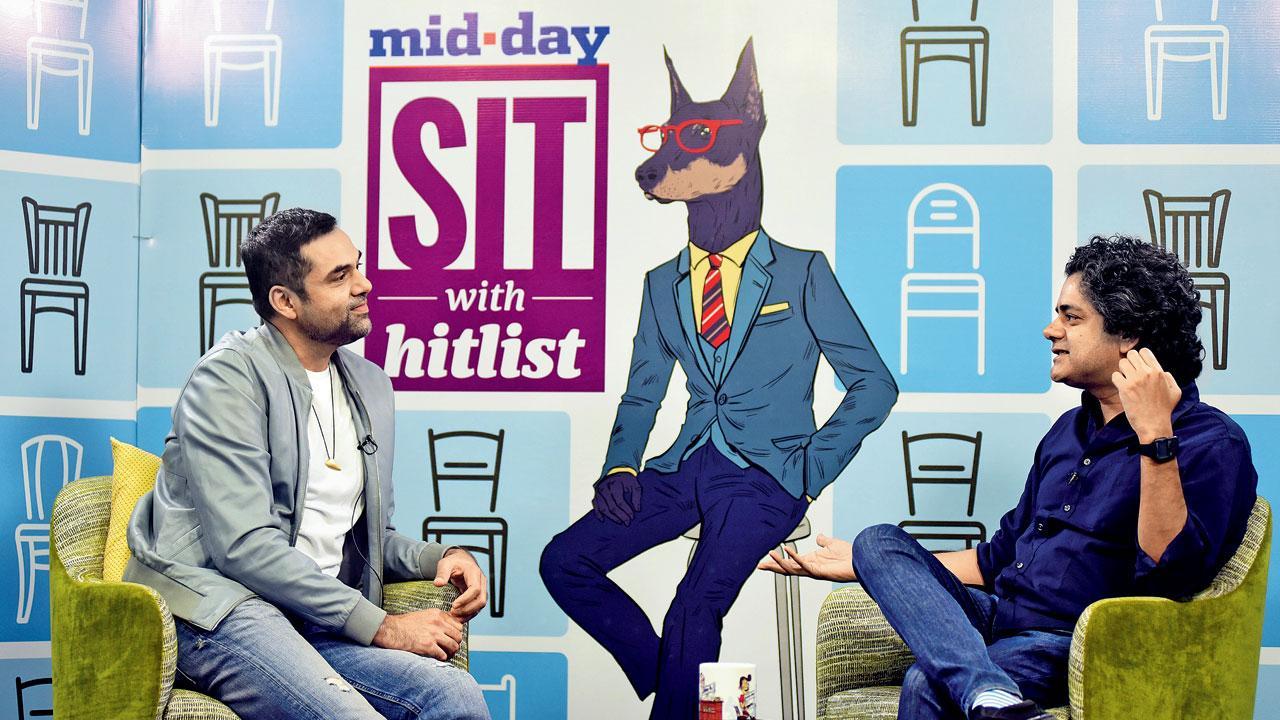
Abhay Deol with mid-day’s entertainment editor Mayank Shekhar at the latest edition of Sit with Hitlist. Pics/Shadab Khan
Decoding the rise & fall of Mumbai film industry’s ultimate insider-outsider!
Mayank Shekhar (MID-DAY; January 21, 2023)
Shortly after our conversation, before a live audience, Abhay Deol is scheduled to meet Shekhar Krishnamoorthy, the person he plays in the Netflix series, Trial By Fire — based on the life of a middle-class Delhi couple, who fought the city’s top real-estate developers, post the death of both their children, in the 1997 Uphaar Cinema fire tragedy.
Which is also when we realize Deol had chosen to consciously stay away from the real-life inspiration for his part, during the process of making the series. Deol is Punjabi by ancestry, unlike Krishnamoorthy, with the most Tamil surname. In fact, Deol has played a Tamilian before this.
That was as the bureaucrat Krishnan, for Dibakar Banerjee’s Shanghai (2012). In an episode dedicated to Deol’s films, on a podcast named Khabardaar, that I was listening to before meeting the actor, the hosts — shout-out to wonderful ladies, Aparita Bhandari, Baisakhi Roy—make an observation on Deol’s walk onscreen. They believe it is the same in all his films. Except, Shanghai, if you notice the minutiae.
Firstly does he agree, and was that consciously so, I ask Deol: “There are physical characteristics that I suppose you don’t change easily. You’re unaware of them. With Shanghai, that may be true. Not that I consciously worked on my walk, though. I did have to work on my accent. Krishnan is a Tamil Brahmin.”
“And I had to put on a Hindi, like a Tamilian would speak it, which is hard to find. Because no Tamilian really speaks Hindi — they speak to you in English. Also, we don’t have an infrastructure of accent training for actors in our country. So we found this out-of-work Tamilian writer, who I worked with, and developed a system [for it].”
If we must get deeper into this accent thing still, for instance, Deol recalls, “I hope I haven’t mixed up my memory, but I was really working on the phonetics — there is no ‘ha’ sound in Tamil, and there is no ‘ba’. In Tamil, you could pronounce my name closer to ‘Apaay’. Stuff like that was insightful. This is besides mimicking my accent-trainer off-camera — so I would know how he might say my dialogues.”
The ladies of Khabardaar podcast might wanna notice this the next time they watch Shanghai. Krsihnamoorthy in Trial By Fire, Deol points out, is different from Krishnan, because he’s a Tamilian, but essentially from Delhi.
He has what one could call a more neutrally North Indian or ‘Delhi’. Which is also a character Deol has played in Oye Lucky Lucky Oye (OLLO) — another real-life person he obviously didn’t meet, before playing him on screen. Bunty Chor was the local swindler, where would you find him?
OLLO (2008) tragically released in theatres, when the “the firings were still on” during 26/11 terror attacks in Mumbai. My favourite memory of OLLO is an off-screen one from the film’s BTS video online, where a dog is after Bunty Chor (Deol), who’s jumping off a tall building-gate. Banerjee asks him to turn around for the camera, so the audience knows the lead actor performed this himself, instead of a body-double.
Deol says, “It’s fun doing stunts, as much as I can. I think Dibakar was a bit surprised about how easily I was scaling such a large gate, and he said he wanted people to see it!”
Sticking to Delhi, and characters inspired by actual events/people still, how about Anurag Kashyap’s Dev D (2009). I learnt this much after watching the film that the role was in fact somewhat based on Deol’s own life. Meaning, obsession in love, and indeed experiments with drugs. If true, kindly elaborate?
“Well, I wanted to contemporize the (Sarat Chandra Chatterjee) book, because I felt there was something wrong there — with such a male, patriarchal view of a man-woman relationship, where women are falling over Devdas. No matter what he does, he can never be wrong. I grew up in an environment, where drugs and alcohol were all available.”
“My Chanda (Kalki’s) character was far stronger than what eventually got made into the movie. She was an East European pole-dancing escort, who is fine the way she is — making great money, traveling the world. She takes pity on him (Dev). Obviously it worked for Anurag [that] she was as vulnerable as he [Dev], and she was a victim too. For me, he was the only victim. The women only grew stronger from there.”
Did he know the Polish escort? “I am not going to tell you! I know all sorts of people; let’s just put it that way. Yeah, I know a few escorts ‘n’ all.”
Let’s pause at the movie titles here: Banerjee’s Shanghai, OLLO. Kashyap’s Dev D. Also from a time when both Kashyap and Banerjee were the ‘new-age filmmakers’, early on in their directorial careers. I wonder what Deol thinks of the trajectory they took thereafter.
Frankly, he doesn’t have much to say, besides “conforming to commercial pressure” that becomes inevitable in some cases. He could sense the “creative genius of Banerjee in LSD (2010)”. As for Kashyap, I find it surprising that he hasn’t seen any of his films since Dev D! Not even Gangs Of Wasseypur (2012)? What; did they have a fallout or something, I ask.
“Well, [Kashyap] went in public, and said a lot of lies about me.”
For example? “One lie was that I demanded a [five-star] hotel room [during the shoot of Dev D]. He had actually come up to me and said, ‘Listen you can’t stay with us, you are a Deol. So, I want to put you up in a hotel room.’ He literally told me that. What he told the press was that I demanded it.” The reference here is to Deol’s profile published in Huffington Post (June 5, 2020).
He continues, “So, there was clearly a lot going on at the time, which was not professional. I had my heart on my sleeve, and all that is great — but you get taken advantage of, and then you get reactive. So, he [Kashyap] was a good lesson for me. Then I just avoided him, because I don’t need toxic people in my life. Life is too short, and there is so much more to explore. But he (Kashyap) is definitely a liar, and a toxic person. And I would warn people [about] him.”
This outburst is evidently in response to Kashyap’s quote about Deol in the Huffington Post report. Deol adds later, “I don’t look in the past. When Anurag said that crap about me in public, he sent me ‘apology’ messages.”
“He does that all the time. He was like, ‘You want to shout at me, scream at me…’ And I was like, ‘I don’t care. It’s been 12 years. You don’t feature in my thoughts even now; get over it.’ He said, ‘Forgive me, because I have had a bad day.’”
“I said you are forgiven. I never had a personal agenda. It was far bigger than just me. That is how I feel about everything. How much of this is he going to do? And I would have never taken his name and said the things, had he not gone public [either].”
Raking this up is important only because lead actors, or stars, have always been the medium to tell stories on screen — even if in the off-stream space, so to say. And by the mid Noughties, Deol was at the centre, if not the pioneer, of a movement of sorts, within Bollywood—picking up young, untested directors to star in their scripts/films, on a leap of faith, first.
“The first five movies of mine were all by first-time directors,” he recalls. Let’s pause again to name these debutants: Imtiaz Ali (Socha Na Tha), Shivam Nair (Ahista Ahista), Reema Kagti (Honeymoon Travels Pvt Ltd), Sanjay Khanduri (Ek Chaalis Ki Last Local), Navdeep Singh (Manorama Six Feet Under).
These are also films that got defined as Hindi commercial cinema, merging with an entertaining art-house — ‘H-indies,’ if you like. At least a couple of the directors did fairly well for themselves — after that firm footing in the film industry.
I can see why it’s got Deol a li’l pissed off now that I want him to dwell on what he thinks of their careers as well — he did like Ali’s Jab We Met, more than Rockstar, which in turn was still outside Ali’s usual “love-triangle zone”, and therefore a step-up: “Why am I commenting on all this — [is that] what the show/conversation is about?” Of course not.
I guess what we’re getting at is an oft repeated jibe that a lot of these directors — take Ali, for example, who got his debut due to Deol — never worked with him thereafter. Is that a fair observation, with anything deeper to it?
“And Anurag used to say, this is why directors [don’t work with me]… I know a lot of actors don’t want to work with him. But I see what you mean. Or where you are coming from. I did sense this feeling [later towards me]: ‘You know, you are not big enough!’”
“Which is ironic, because when I worked with them, neither were they! You either believe in someone, or a vision — even if it goes against the norm. Or you can say, I will keep my vision, but I will acquire bigger powers [to execute it]. Because I will get more money, I suppose. Also, I was taking a lot of it on myself, and I know I made mistakes. I am searching for answers to give you, and I hate making it about me, when it’s about somebody else.”
Consider the career graph. In terms of box-office plus cult-grade, Zoya Akhtar’s multi-starrer Zindagi Na Milegi Dobara (2011) is possibly Deol’s high point. A string of seriously superb films right before, and after. And then there is s sharp slump 2013 onwards, almost a freefall.
He’s had a release almost every year. So he’s very much been around since. The films/series are, again, by mostly first-time directors, or fresh talents, at any rate; experimental in their own right.
You can have your views on, say, One By Two (2014), Happy Bhaag Jayegi (2016), Nanu Ki Jaanu (2018), Chopsticks (2019), What Are The Odds (2019)… Good or bad is a subjective take anyway. But you know, none of them are really, well, did he lose his mojo, how do I put it….
“It’s just a fact. You don’t have to justify [your question],” Deol comes to my rescue. As for the kind of work that comes your way, he says, “Everything is [a] collective [call]. And I don’t like talking about it, because I don’t want to come across sounding bitter, or a victim. I don’t care. But when you take a stand, then you take a stand. And that has consequences. Are you ready to face those consequences?”
Exactly what stand, for example, could do someone in? “I don’t know. Calling out people for endorsing fairness creams?” Would that mean those who endorse fairness creams would debar you right away?
“It is not as simple as that. I did a guest appearance in Shah Rukh’s Zero, and he is a really dignified man. But there is a collective [thing that happens]. Say, showing up with a black eye on a red carpet, and calling out Bhushan Kumar by name, and saying T-Series blah, blah. Or constantly saying, why do we only have song and dance [in our films]…”
Deol has been equally vocal, in public, about critiquing his own films, with misplaced intentions — whether that be Aisha (2010), or Raanjhanaa (2013). Surely that’s hardly mastering the art of winning friends and influencing people. But you can tell—frankly, he doesn’t give a damn. And that’s what makes him more fun than the current crop of polite suckers for boring heroes.
Also some of his criticisms could emanate from ideas he wished to champion, but found no takers, around that time. Navdeep Singh’s Basra famously got shelved. As did a zombie comedy called Rock The Shaadi, after shoot. I fish out an old video of him consulting a tarot card reader, in Simi Garewal’s TV show — to check if one of his dream projects would come true.
Deol remembers it was an international film, with debutant filmmakers from abroad, who nobody wanted to put money on. They still haven’t made the film, and he had to stop trying eventually.
“So yeah, post 2013, it was tough. I also took a backseat. Now I don’t want to go back and pretend like nothing ever happened, or be a different person — so, I am going to sit back, and see what comes my way. And quietly work. If that works, it works. If it doesn’t, so be it!”
As for the so-called song and dance, Deol says it’s not like he has an issue with the genre: “At least three ideas of mine are full of songs. One of them was Dev D (18 numbers in the soundtrack).”
The film was a major winner at the box-office, for its budget. Deol remembers, “Especially after Oye Lucky and Dev D, I had a red-carpet entry to whoever I wanted to work with. And this is not just because I had successes behind me. Also because I was so-and-so’s son, nephew, brother…”
Which puts him in a strange ‘middle’, in the nepotism debate, that is usually conflated to the ‘elite versus masses’ battle, pitched in the wider political/public space. Deol’s “anger and rebellion” within the family itself, he says, was his reaction to fame and its pitfalls. Something he had watched closely, growing up. Left to him, it appears, he’d rather be anonymous, but remain an actor — obviously a misnomer.
“I was born an insider, but I pretty much lived as an outsider,” says Deol. That said, his debut film was a joint-family release, from Vijayta Productions — mainly helmed by cousin Sunny, son of Uncle Dharmendra.
Interested in debutant Ali’s script, he took him to meet Sunny, who was happy to hop onboard the film, since the lead character was a lot like Abhay himself! Such is how Socha Na Tha was born, and two amazing careers took off. Only the film, that released during the low-key “exam-time, March” wasn’t hugely promoted as the proverbial ‘star is born’. Socha Na Tha is hugely loved still.
Which reminds me, why is the Deol firm named Vijayta in the first place? “On my sister, my cousin — she is younger to Sunny Bhaiya. So, it’s Sunny Deol, Vijeta and Bobby Deol? “No. Then there is [another sister], Ajeita. Then there is Bobby.”
Abhay’s father, late Ajit Singh Deol (Dharmendra’s brother), I hear, was also an actor. Except I couldn’t quite find a clip online to support this, I tell him. He smiles, “He did two movies, one of which he produced. They were all in the ’70s. One never got made. I remember Honey Aunty, Zoya’s (Akhtar) mum said the cutest thing to me once. That my father is the reason her film didn’t release. I was like, ‘What do you mean?’ She said that he had to hold her face, and he was shivering [through the scene]. She was the leading lady in that film. I didn’t even know it, because I never saw that movie!”
Insider-outsider is anyway a time/generation construct. Many of the outsiders Deol worked with at the beginning of his career are bona-fide insiders now. And maybe that’s what the revolt is about — to eventually get to the high table. The cycle continues.
“You hit success, then it doesn’t matter if you’re insider, or outsider. They all want to work with you. You have to understand it is also very cliquish — you are part of this, or that camp. I had access to all of them, but I was like, no!”
Living in the Deol household, he also had no “Bollywood Juhu gang” friends. Barring his schoolmate, director Vikramaditya Motwane, who wasn’t “Bollywood then”!
Everyone goes through their brash 20s — sometimes it lasts longer — “You wanna change the world!” I asked Deol what he thinks of, when he looks back at that decade, after which it appears, the world changes you, one way or the other!
Some of the things he says he’s learnt is being diplomatic —“also, not equating power and money, with corruption — that needn’t always be the case. Money is like energy, and it is something that you know you can make good use of — when you have a lot of it. I could do things a little smarter, to not be taken advantage of, or be gas-lit.
“Human condition is complex. Everything we have spoken about today are not black and white. You would think you’ve heard it all. There was a lot left out. Also, I am really lucky. I know I did create lot of trouble, but it was all intended for the right purpose. And I created change. People still refer to films I did 10-15 years ago.”
Which is true, once you glance at his filmography until 2013, starting 2005 — those who were born that year turn into adults in 2023, when we’re making this conversation with Deol, 46.
Also, in the intervening years, so much has changed with films itself: “The disruption we were looking at got brought in by technology itself.” So the ‘multiplex movie’ became ‘OTT content’.
Also, the Bollywood indie started hitting Rs 100 crore collections, with the likes of Ayushmann Khurrana, Rajkummar Rao. Deol was the OG ‘OTT star’, even before there were streamers: “I am not done yet. Maybe what I did was 20 years ahead [of its time]. Those 20 years have come!” Only the intentions may not be matching the outcomes for some time.
And then you watch Deol in Prashant Nair’s Trial By Fire on Netflix — a performance so subconsciously chilled, yet powerful. Without once making an unnecessary show of it. The series on the Uphaar Cinema fire tragedy is still about subtle and solid story-telling, that therefore makes the leads, the stars. Fair to say: welcome back, Abhay.
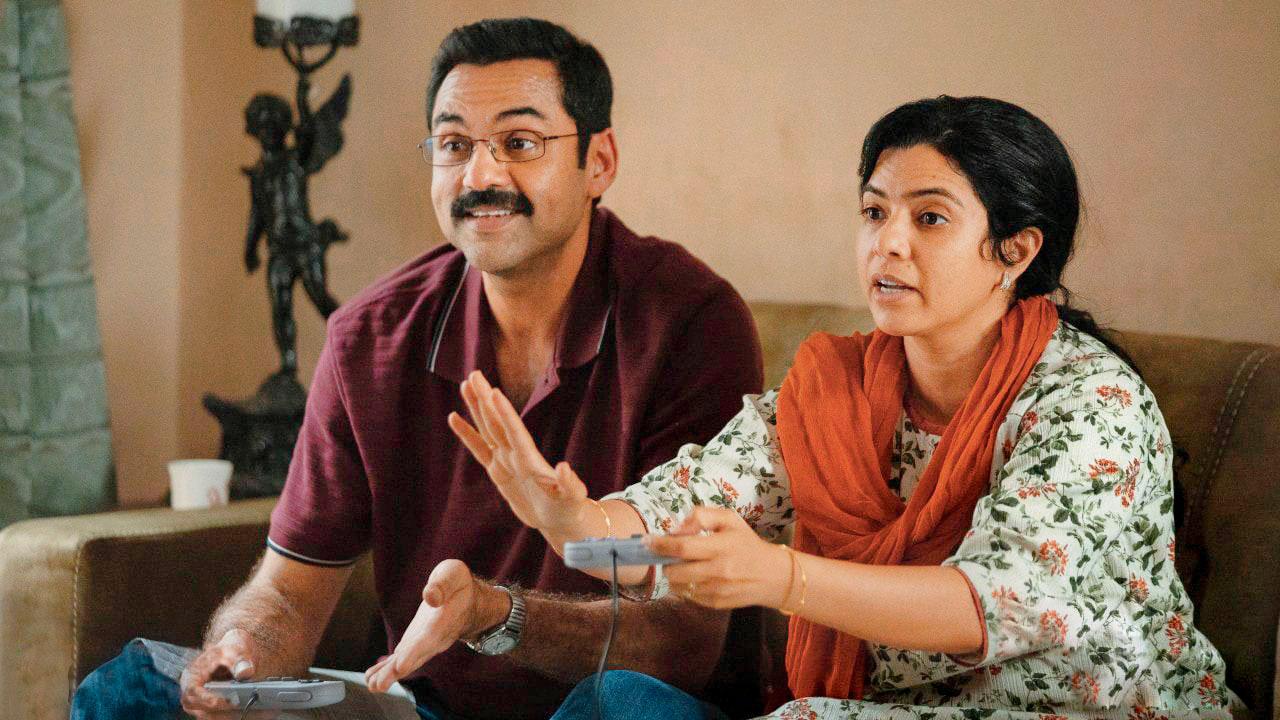
Abhay Deol and Rajshri Deshpande in Trial By Fire, which is based on the 1997 Uphaar cinema fire tragedy
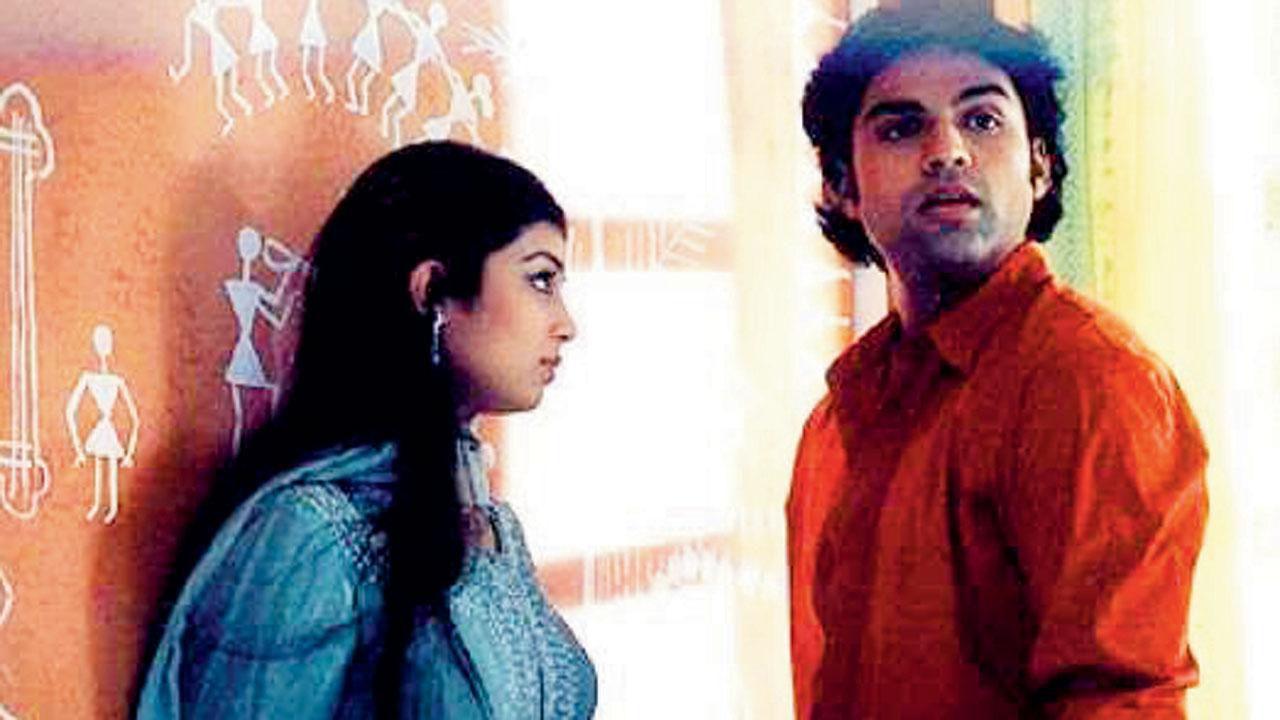
Still from Socha Na Tha (2005)
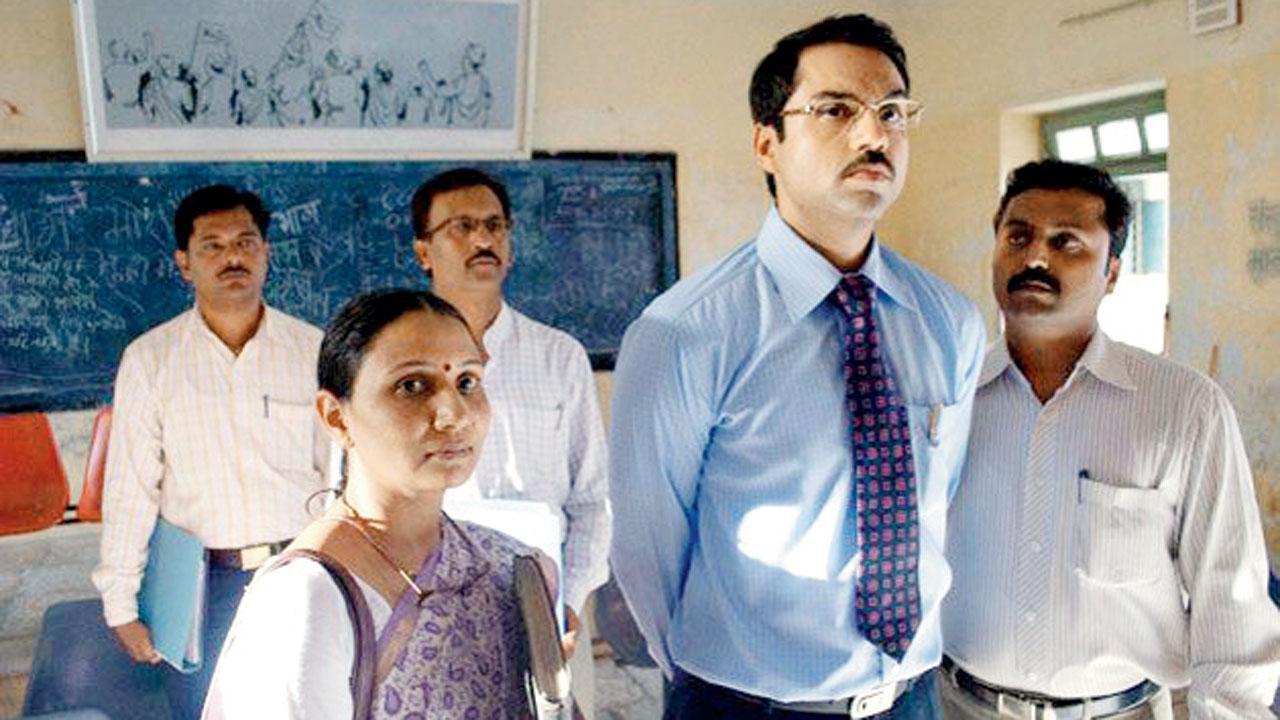
Shanghai (2012)
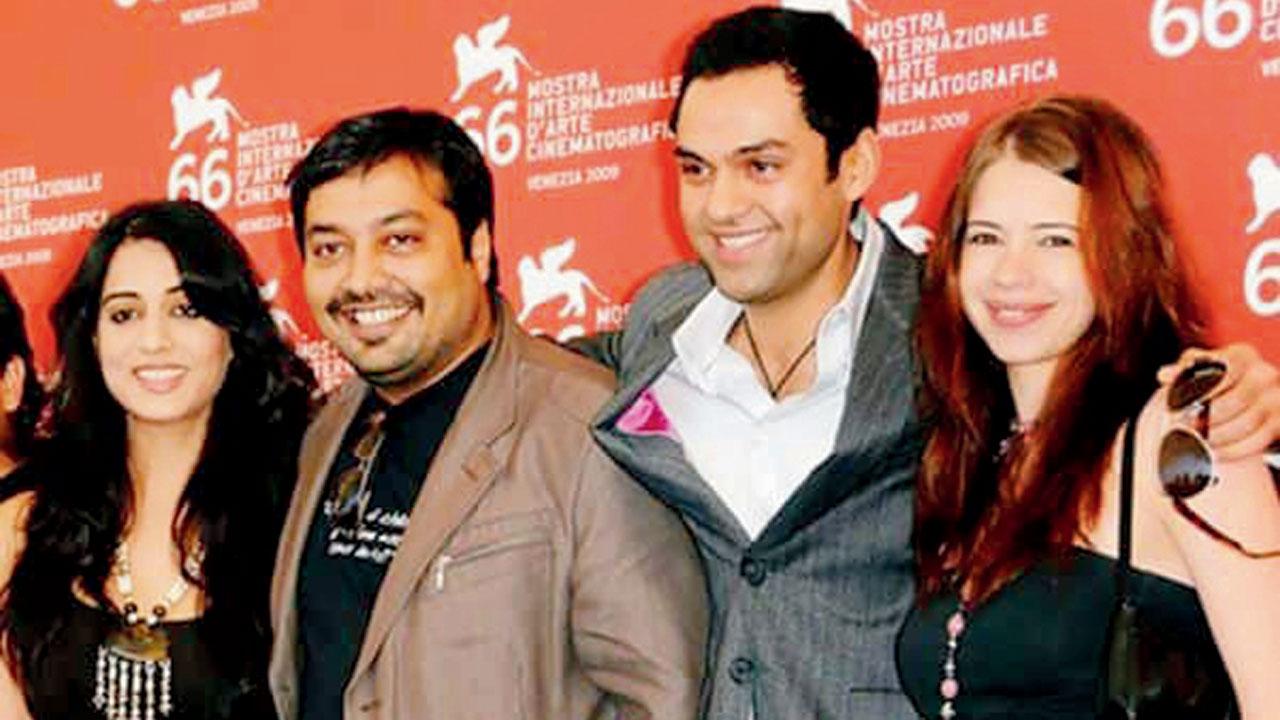
Abhay Deol with Anurag Kashyap, Kalki Koechlin, and Mahie Gill during the promotions of Dev D (2009)
I need to be convinced as to why a director wants to cast me in their Hindi films-Prosenjit Chatterjee
8:11 AM

Titas Chowdhury (HINDUSTAN TIMES; April 15, 2021)
Nine years after his film Shanghai (2012) released, Prosenjit Chatterjee has returned to Mumbai to shoot for his upcoming Hindi language project. The actor had recently kick-started the first schedule of his debut web series, titled Stardust, in the city. He says that the spike in Covid-19 cases and shoots getting stalled are surely matters of concern, but one has to push their fears back and keep working once they resume.
“The situation is tough not just for actors but technicians, too. Shooting during these times will be a major challenge. But this is an exercise that we need to learn and adapt to. There is a fear button within all of us, but we should know when to turn it off,” Chatterjee says.
Ask him about what kept him away from the Hindi entertainment industry for so long and the Bengali film star says, “It’s not like I consciously kept myself away. When Dibakar Banerjee (filmmaker) had approached me for Shanghai, my first question to him was why he wanted to cast me in his Hindi directorial. The same thing happened when Vikramaditya Motwane (filmmaker) approached me for my upcoming collaboration with him. I need to be convinced as to why a director wants to cast me in their Hindi films.”
On the occasion of the Bengali New Year, the 58-year-old says that had the situation been normal, he would have flown back to Kolkata (West Bengal) to spend the day with his family.
So, what is his wish for this new year? “It is going to be a year-and-a-half that we’re living with the pandemic. I pray to God that we overcome this and go back to our normal lives. The process of vaccination has started and I hope we all get vaccinated soon. I also wish for everyone’s good health,” he signs off.
You generally get labelled...you can’t really push the envelope too much-Emraan Hashmi
8:01 AM

Emraan Hashmi says his endeavour has always been to break the mould and surprise his audience
Shreya Mukherjee (HINDUSTAN TIMES; December 2, 2020)
Emraan Hashmi doesn’t like “walking on the beaten path”. This becomes clear with his choice of films. He has time and again chosen parts that are different from his regular onscreen appearances.
In his latest film, Harami, he plays a 50-year-old professor who trains a gang of poor kids to pick pockets. Hashmi says, “I don’t think I would’ve been given a role of such an aged guy in a regular commercial film. That’s not how those scripts are penned. So along with enjoying my mainstream journey, l love dabbling into other kind of cinema.” Hashmi feels that sometimes these limitations in the industry don’t let an actor experiment much.
“You generally get labelled and are seen in sync with certain kind of films. You can’t really push the envelope too much,” he explains.
Hashmi recalls how when he did Shanghai (2012), he was told that after having done successful films this move might affect his career. “As a performer I need to gratify my creative itch. And every time I get a good opportunity I don’t let it go,” he says.
While the response from the viewers is kept in highest regards, the actor doesn’t choose films thinking “how the audience will react”. “I choose projects instinctively. If I feel a story is important and needs to be told and I would be proud associating with it, I take it up. I know some actors only see commercial viability and there is nothing wrong to that. I want to have that balance,” he shares.
Hrithik Roshan indulges in noodles and pancake-making sessions in China
7:47 AM
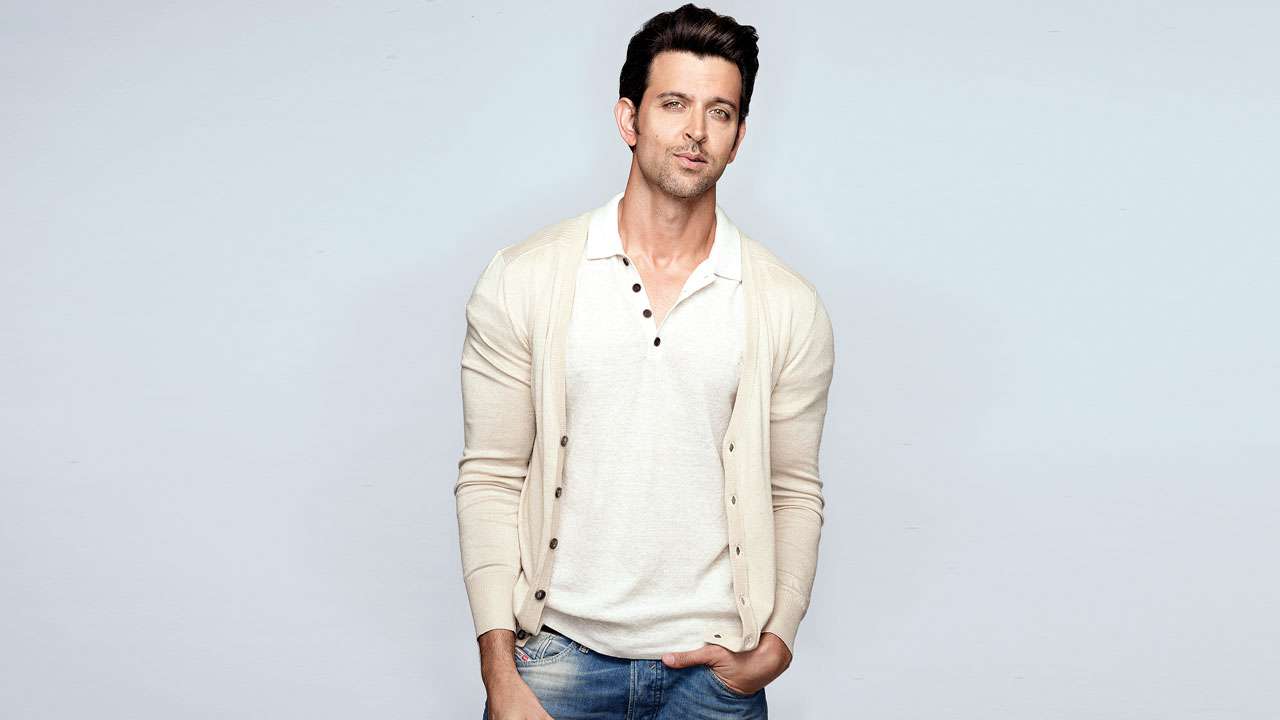
Deepali Singh (DNA; June 6, 2019)
It was back in 2005 that Hrithik Roshan first visited Shanghai to train for the action sequences of Krrish. This time, the light-eyed actor was in the East Asian country for the release of his 2017 action-thriller, Kaabil. The superstar, who returned to Mumbai on Monday evening, shared that he had a great time there. “I was amazed and overwhelmed by the warm welcome I got,” he said.
While there, the superstar indulged in noodles and pancake-making sessions and even took a subway train ride to see the country in all its glory. His fans, who had been referring to him as Da Shuai (the handsome one), presented him with Chinese artefacts, which he’s brought back with him, along with all the amazing memories.
To his fans’ delight, the actor, known for his dancing skills, shook a leg on Ek Pal Ka Jeena from Kaho Naa...Pyaar Hai (2000). And one of his fans even sang the title track of Kaabil for him!
One of the highlights of his visit was his meeting with Jackie Chan. He even received a personalised jacket from the international star, something he would always cherish. Comparing his upcoming film Super 30 — inspired by the life of Mathematician Anand Kumar — to the country, he said, “The movie talks about the power as well as the value of education and teachers. And, I think that is a similarity between China and India. Both countries give a lot of respect to teachers,” he added.
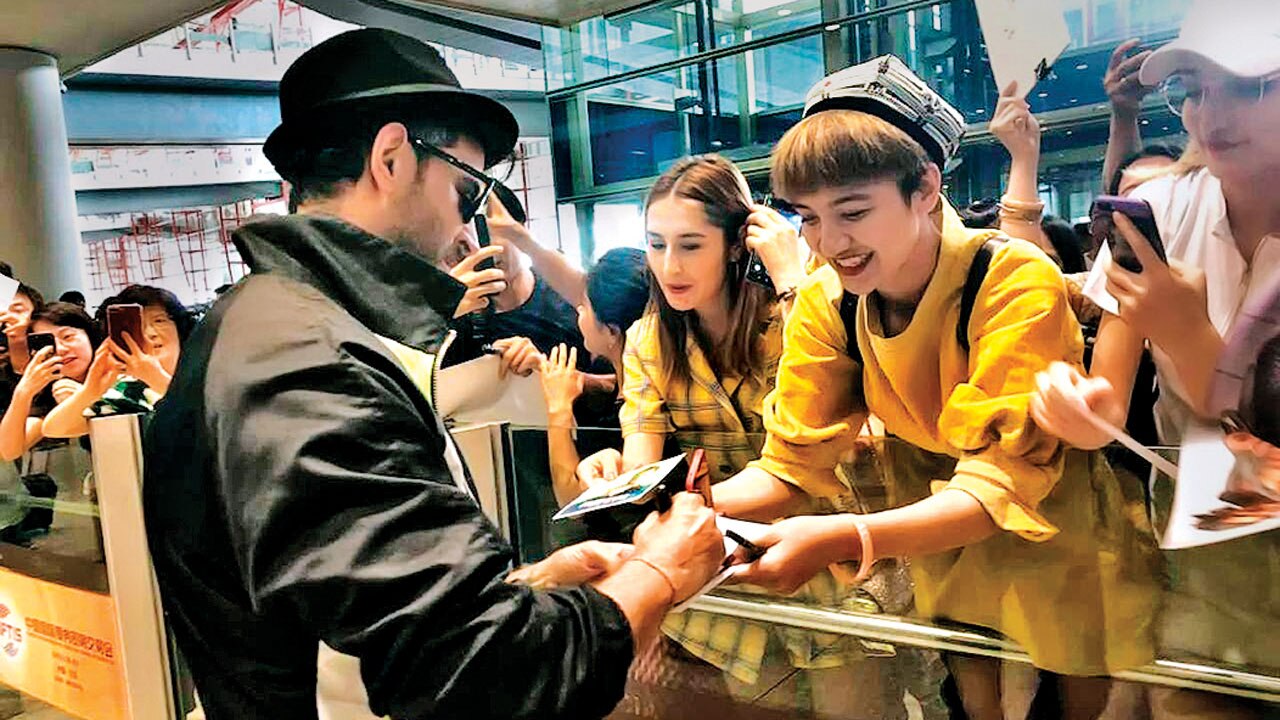
The actor signs autographs for his fans
I am here because of films like Raaz and Murder, but I am not the same guy I was 15 years ago-Emraan Hashmi
8:25 AM

Renuka Vyavahare (BOMBAY TIMES; January 13, 2019)
Emraan Hashmi has portrayed varied characters in a career spanning over 15 years, and proved his mettle in films like Awarapan (2007), Jannat (2008), Once Upon A Time In Mumbaai (2010) and Shanghai (2012). And finally, one can see the ‘serial kisser’ tag, which he unapologetically carried for years, wearing off. Known for playing morally ambiguous screen characters and the one to call a spade a spade, Emraan tells BT about his upcoming film Why Cheat India and how he is finally done with kissing on screen. Excerpts…
 Your upcoming film, Why Cheat India, revolves around some of the problems plaguing our education system. Tell us about your character in the film...
Rakesh (his character) is not a torchbearer or a vigilante, he wants to make money and be successful. He finds a hack in the education system and goes down that road. He isn’t apologetic about what he does. He wonders why nobody is holding the system responsible for students’ suicides. Lack of seats in universities and the pressure it causes... no one’s addressing that. He feels that at least no one’s dying because of him.
Your wife, Parveen, is a co-producer on the film. Did any alarming personal experience convince you to make this film?
We are busy building colleges, but is knowledge being imparted there? Our education system is all about how much information you can withhold as opposed to sharing practical knowledge, analytical thinking or communication skills.
Education system teaches you two things — how to make a living and how to live. Sadly, our education system for most part teaches you the former and it’s not very good at it either. I don’t want to put my son through the torture that I went through as a child. I hated school and the homework. I used to daydream in class, while some wise teachers talked for eight hours a day. It’s a factory system that cultivates home-grown ‘yes men’. Emphasis is on things that you barely use in day-to-day life. Basic choices were science, maths, and engineering. Right now, arts has gone blazing ahead, but back then, it had no standing. Poetry or dance was looked down upon. Basically, you can’t enjoy what you study. I always found that appalling. Kids need to be kids. You can’t make them competitive by pitting them against each other and labelling them as winners and losers. I felt like a loser when I didn’t score a certain percentage. It affects their morale and self-esteem early on. Why Cheat India is a two-hour film, so we cannot show everything in it, but it does put the spotlight on these long-standing issues. It also emphasises on the scams that are built around the education system. You have to get rid of the age-old system and the middle men who are eating into it.
With socially relevant films like Why Cheat India, are you trying to reinvent your image as a hero?
I don’t see it as a reinvention. I don’t know how people will perceive or accept Rakesh. I did the film, because it’s a fantastic concept that hasn’t been explored in our country. I love taking risks. It’s relatable not just for students and educational faculties who are in denial, but also future parents. On the infrastructure front, though we are a country that’s blazing ahead, we could be going faster. The most important part is educating a child’s mind and if you can’t contribute to that, it’s a dark road ahead.
Lately, you have been working in films which have been a clear deviation from the kind of work that people have seen you doing in the past. Are you trying to keep pace with the changing trends of Hindi cinema?
Hindi cinema has changed in the past three years, but before that, in the kind of films that I did — and I don’t mean to dis them — I didn’t get to play ‘characters’. You get stuck in a box. You can’t step out of it, as the industry sees it as a safe bet. If you are a commercial actor, this is what you will have to do. Agar aapko arty film karni hai, toh aap Shanghai kijiye, which I did. It’s a divided industry. Certain critics understand cerebral cinema and they push for it, but there’s another side that dismisses it. Such films are closest to my sensibilities. Somewhere, I had to bend my sensibilities to cater to my audience and my country. I am not complaining, but it’s far from my world. Now, there is a new dawn. The audience and the industry have woken up. You can’t dole out shit year after year and expect it to work. We have had a couple of massive big-budget debacles last year and that’s because the audience’s intellect was taken for granted. It’s great that people now look forward to good subjects. Why Cheat India is one such topic.
Did you reach a point where you thought, ‘Not anymore! I can’t keep doing what I have been doing’?
I said that the first day I entered this industry (laughs!). I feel that you don’t look for scripts, the scripts find you. At least in the initial stage of your career, there are people who will say, ‘This kind of films work for him, let’s give him that only’. My need to explore myself as an actor along with the risk that producers took to make movies like Jannat, Once Upon A Time In Mumbaai, Shanghai and Awarapan helped add a different dimension to me. These films are the reason why people feel that I can do a Why Cheat India. I could have done this long ago, but growth and maturity takes time. Ten years ago, good scripts rarely came my way. Ghanchakkar (2013) was ahead of its time. People dismissed it because they didn’t understand the comedy. It is relatively easier for these new-age talented actors like Nawazuddin Siddiqui, Rajkummar Rao, Vicky Kaushal and Ayushmann Khurrana, because the scripts have evolved.
Today, do films solely work on content, as opposed to entertainment?
Not just content. Through a documentary, I can reach a few houses, but by bringing in the commercial element, retaining the script’s authenticity and not making it a jingoistic fest, you can reach millions of people. Films can’t bring about a change overnight, but it can get the conversation started.
Looking back, do you feel that films like Raaz Reboot(2016) and Murder (2004) restricted you to a certain image as the bad boy of Bollywood? Did such roles hinder your growth as an actor?
Bollywood is like a dish in which you add various ingredients to add tadka. It follows norms and is formulaic. Everyone has had their share of massy films. Fight hai, paanch gaane daal doh, film chal jayegi. But after a while, it has changed. I am here because of films like Raaz and Murder, but I am not the same guy I was 15 years ago! Lot of things happened after that. Marriage changes you, your child changes you. That change has to reflect in your films, or you stagnate. I wanted to grow as an actor and it was frustrating when it didn’t go my way. Now, I am happy with the roles that I am doing. I choose scripts that make me happy as opposed to what will work.
Almost every actor today has no qualms about kissing on screen, but the serial kisser tag refuses to leave you...
I am done with it. I am letting it go now, because I am just fed up of it. Kissing is fine. I don’t have an issue with kissing on screen, but it’s what happens after that. Everyone puts the spotlight on whether I have a kiss in a film or not. My producers have been guilty of using the kissing scenes for promotions of films, but I feel things are different today. Youngsters are okay with it. Call it a generation gap or anything, but I shut my ears on hearing half the things. It’s a culture shock for me! I fear for my son when he grows up (laughs!).
Have you ever wondered why you never get offered noble, righteous or heroic characters?
I think it’s my face (laughs!). I don’t look like a noble person. I am not saying nobility doesn’t exist in society, but I also feel that it’s a big sham. Anyone who says that they haven’t done anything wrong in their life is a big scam artiste. We all function in grey zones. I hate people who pretend to be saints. I won’t touch them with a barge pole. I can’t stand their holier than thou attitude. I look for a certain reality in films. A man who saves the day, does everything right or is super sweet... a hero like that doesn’t exist.

Aamir Khan tries out popular Chinese cuisine in Shanghai
8:55 AM

Upala KBR (MID-DAY; January 26, 2018)
The past five days may have been frenetic for Aamir Khan, but he is not complaining. The superstar is on a whirlwind tour across China, promoting Secret Superstar. When he is not reaching out to his fans or attending press conferences, Khan has been taking in all that China has to offer - from trying out their delicacy to playing a round of table tennis.
Turns out, during his Shanghai visit on Monday, the superstar set out to taste authentic Chinese cuisine with his good friend, Chinese actor-director Deng Chao. A source in the know reveals that Chao made him try a special Chinese dish called Century Egg. "As Aamir was about to pop one into his mouth, Deng warned him that a recent CNN poll rated it as one of the world's most horrible foods. However, Aamir enjoyed the dish," says the source.
Another event in Shanghai saw the actor match his table tennis skills with Liu Guoliang. The Olympic gold medallist gifted an autographed racquet to Khan, who reciprocated by gifting him a guitar.
With the Zaira Wasim-starrer marking Khan's fourth film to release in China, he has built a steady audience in the neighbouring country - fans have given him the moniker 'Uncle Aamir'. The source adds, "There was a special event organised for Aamir. Since Jackie Chan couldn't attend it, he sent across a video message, welcoming Aamir back to the country." Talking about Secret Superstar's success in China, Khan said, "I'm happy to see the way the film resonated with the youth of China."
Box-office superstar
China got a taste of Aamir Khan's box-office pull as Secret Superstar earned Rs 265 crore in less than a week of its release. With this, the Chinese collections have surpassed the lifetime earnings in India of Rs 64 crore. The film that hit screens in China on January 19 raked in Rs 174 crore over the first weekend, besting Dangal's opening weekend collection of Rs 80 crore.

Khan having Century Egg with Deng Chao
A Tamilian is one of the biggest caricatures in Hindi cinema-Abhay Deol
7:51 AM

As told to Natasha Coutinho (MUMBAI MIRROR; October 16, 2017)
Dibakar Banerjee, who
directed the 2012 political thriller, Shanghai, had told me about the
film a few years before he started working on it. He told me he was
bringing Vassilis Vassilikos's novel, Z, to the screen and wanted me to
play a Tam-Brahm IAS officer. He was adapting a real life incident that
happened in Greece in the '50s to the political and economic landscape
of current-day India. I loved the idea right away.
The challenge was to play a Tamilian authentically. We debated over his Hindi accent given that he'd been stationed in Maharashtra for a few years and learnt Hindi from Maharashtrians. We wondered if technically he should be speaking Marathi. They eventually hired a dialect coach who was essentially a writer taking time off work to write his novel. While my teacher was good, it was left to Dibakar to work on the finer nuances and this collaboration between the director and the dialect coach helped shape my character. It's possibly the only film for which I had learnt all my lines well before we starting shooting.
Tamil is a difficult language but I love learning different languages and accents so it didn't feel like work. It was more of an adventure though, I admit, this was a tough adventure because a Tamilian is one of the biggest caricatures in Hindi cinema, even more than the jovial sardar or the miserly Parsi. It was difficult getting the accent right without falling for the stereotype.
We focused on T A Krishnan's travels, the time he'd spent in another state, picking up other dialects and languages along the way. The one common language that most people use within different communities and across states is English. That's why it's easy to speak English with a Tamil accent than Hindi with a Tamil accent. Given my character's background, he'd be speaking English mostly. But there are IAS officers from every part of the country who speak the local language of the state they are based in fluently. This was how we created a character with layers unique to him which defined who he was and not who you expect him to be.
Focusing on the way a character speaks automatically opens the doors to his body language. For example, a soft-spoken person is often gentle in his demeanor while extroverts are usually loud and introverts intense or boring. The way you speak speaks volumes about you and I use that as a guide to the rest that follows. I went on to recite a prayer in Tamil but to be honest, I don't recall much of that scene because my attention was on the bottle that was to be thrown at me. I was more concerned about the bottle hitting me.
I don't remember any reference points. There was another film based on the book with the same name that opened in France during the '60s. I didn't watch it though because Dibakar didn't want any influence of the original playing in my head. I wish he had told me this before I bought the DVD!
The prep for Shanghai didn't really help with that for my Tamil film, Idhu Vedhalam Sollum Kadhai, because in the latter I spoke Tamil and not Hindi with a Tamil accent. In fact, because my role in the Tamil film dates back to the 3rd century AD and I had to learn Tamil the way it was spoken back then. Rathindran, the director, once joked that I could as well have been speaking Greek. I'd go so far as to say that Greek would have been easier.
Another interesting prep was rolling out a joint for Dev D. But that was not new, I had mastered the skill when in college.
The challenge was to play a Tamilian authentically. We debated over his Hindi accent given that he'd been stationed in Maharashtra for a few years and learnt Hindi from Maharashtrians. We wondered if technically he should be speaking Marathi. They eventually hired a dialect coach who was essentially a writer taking time off work to write his novel. While my teacher was good, it was left to Dibakar to work on the finer nuances and this collaboration between the director and the dialect coach helped shape my character. It's possibly the only film for which I had learnt all my lines well before we starting shooting.
Tamil is a difficult language but I love learning different languages and accents so it didn't feel like work. It was more of an adventure though, I admit, this was a tough adventure because a Tamilian is one of the biggest caricatures in Hindi cinema, even more than the jovial sardar or the miserly Parsi. It was difficult getting the accent right without falling for the stereotype.
We focused on T A Krishnan's travels, the time he'd spent in another state, picking up other dialects and languages along the way. The one common language that most people use within different communities and across states is English. That's why it's easy to speak English with a Tamil accent than Hindi with a Tamil accent. Given my character's background, he'd be speaking English mostly. But there are IAS officers from every part of the country who speak the local language of the state they are based in fluently. This was how we created a character with layers unique to him which defined who he was and not who you expect him to be.
Focusing on the way a character speaks automatically opens the doors to his body language. For example, a soft-spoken person is often gentle in his demeanor while extroverts are usually loud and introverts intense or boring. The way you speak speaks volumes about you and I use that as a guide to the rest that follows. I went on to recite a prayer in Tamil but to be honest, I don't recall much of that scene because my attention was on the bottle that was to be thrown at me. I was more concerned about the bottle hitting me.
I don't remember any reference points. There was another film based on the book with the same name that opened in France during the '60s. I didn't watch it though because Dibakar didn't want any influence of the original playing in my head. I wish he had told me this before I bought the DVD!
The prep for Shanghai didn't really help with that for my Tamil film, Idhu Vedhalam Sollum Kadhai, because in the latter I spoke Tamil and not Hindi with a Tamil accent. In fact, because my role in the Tamil film dates back to the 3rd century AD and I had to learn Tamil the way it was spoken back then. Rathindran, the director, once joked that I could as well have been speaking Greek. I'd go so far as to say that Greek would have been easier.
Another interesting prep was rolling out a joint for Dev D. But that was not new, I had mastered the skill when in college.
Baaghi 2 makers put China schedule on hold owing to India-China strained diplomatic relations?
7:45 AM

Mohar Basu (MID-DAY; August 9, 2017)
Strained diplomatic relations between India and China, owing to the tense situation at the border, has affected the shoot of Tiger Shroff’s Baaghi 2, which was expected to kick-off in Shanghai.
A source close to the production house tells mid- day that though producer Sajid Nadiadwala had stated that the team had struck a deal with the Chinese Government, who invited them to the country to film the actioner, the strained Sino-Indian ties have called for a change in plan. “The film will now be shot in Pune, followed by a schedule in Ladakh, Bangkok and Mumbai. The China schedule has been put on hold for now.”
In April, mid-day had reported that Shroff was set to fly down to China to undergo martial arts training under action choreographer Tony Ching. “The action in this sequel will be several notches higher. Thankfully, I have Tony Ching,” Shroff had said. However, it appears that the actor will now head to Hong Kong for the practice.
Farah Khan & I would joke that we had contributed hugely to China's GDP-Sonu Sood
8:28 AM

Avinash Lohana (MUMBAI MIRROR; September 26, 2016)
 Beijing, China's capital, is
the country's second largest urban city after Shanghai and its politi
cal, cultural, and educational centre. It's also the headquarters of
most of China's largest state-owned companies and a hub for the national
highway, expressway, railway, and high-speed rail networks. After
Akshay Kumar's Chandi Chowk to China (2009), a large portion of which
was shot
around the Forbidden City, actor Sonu Sood landed in Beijing last
November for a threemonth schedule of Stanley Tong's next directorial,
Kung-Fu Yoga, with Jackie Chan in the lead. Here's Sonu's impressions of
the Chinese metropolis:
Beijing, China's capital, is
the country's second largest urban city after Shanghai and its politi
cal, cultural, and educational centre. It's also the headquarters of
most of China's largest state-owned companies and a hub for the national
highway, expressway, railway, and high-speed rail networks. After
Akshay Kumar's Chandi Chowk to China (2009), a large portion of which
was shot
around the Forbidden City, actor Sonu Sood landed in Beijing last
November for a threemonth schedule of Stanley Tong's next directorial,
Kung-Fu Yoga, with Jackie Chan in the lead. Here's Sonu's impressions of
the Chinese metropolis:
THE 'CHILL' PILL
We shot for the film between November and January in minus 10 degree Celsius. It was a challenge to do action sequences in sub-zero temperature. We would do warm-up exercises on stretching machines the makers had installed for us between takes. Shooting with Jackie and his stunt team was a lot of fun.
RETAIL THERAPY
I visited the historical Forbidden City which earlier had housed emperors and their households. Now, it is home to the Palace Museum besides Taoist and Buddhist temples surrounded by flee markets. They open only early in the morning and at night. Hebei Lake which is frozen for nearly four to five months of the year is another tourist attraction. One can even drive cars on its frosted surface. We shot a sequence with Jackie there. I went back to Beijing again in April to picturise a song choreographed by Farah Khan. Since both of us love shopping, we indulged in some retail therapy, enthusiastically hitting both the malls and the local shops. We would tease each other saying we had contributed hugely to China's GDP with all the shopping we did. I like home décor stuff and ended up buying a lot of fridge magnets, among other things.

Climbing the Great Wall Of China, one of the seven wonders of the world, was also memorable. Five minutes into my visit, I began to wonder how the Chinese soldiers stationed there handled the cold for extended periods.

This June, I was in Shanghai for a film festival. I visited the Jackie Chan Film Museum there. It has statues and mementos from his films, including the cars and bikes he has used.

FOOD FRIGHT
 The most difficult part of my stay there was
the food since I am a vegetarian and the Chinese are mostly carnivores.
Another problem is that the Chinese hardly use any salt in their food;
the cooking style is very different from ours so the first schedule was
tough but I got used to it after a while. I survived on omelettes, rice,
salad and tofu. Tofu is really healthy and was served in large
quantities. Jackie would force-feed everyone tofu as he believes it's
very healthy. He'd also cook for us. He must have rustled up at least 40
dinners for me. His tofu salad is to die for. Our director Stanley Tong
is another fantastic cook and even Farah will vouch for that.
The most difficult part of my stay there was
the food since I am a vegetarian and the Chinese are mostly carnivores.
Another problem is that the Chinese hardly use any salt in their food;
the cooking style is very different from ours so the first schedule was
tough but I got used to it after a while. I survived on omelettes, rice,
salad and tofu. Tofu is really healthy and was served in large
quantities. Jackie would force-feed everyone tofu as he believes it's
very healthy. He'd also cook for us. He must have rustled up at least 40
dinners for me. His tofu salad is to die for. Our director Stanley Tong
is another fantastic cook and even Farah will vouch for that.I did a 40-hour course in Mandarin before the shoot but the language barrier reared its head many times, especially when we went to local restaurants. I'd click pictures of rotis and omlettes to explain what we wanted to order. It was hilarious! We didn't party much but the entire unit would get together every weekend. And everyone, from the actors to light men and drivers, would eat together.
DABANGG MOMENT
Bollywood isn't too big in China but we worked with a few Indians who were huge fans of Hindi movies and wanted to know every detail about us. A handful of the locals recognised me and came up requesting for some pictures. They'd seen Dabangg and Entertainment. During this trip I realised China and India have a lot in common in terms of lifestyle and work culture so I didn't really miss home.
PARTING SHOT
Jackie gifted me a leather jacket, producer, Barbie, gave me a custom-designed traditional Chinese dress. Jackie also taught me Arnis, a Filipino martial art form.

Tiger Shroff-Shraddha Kapoor to reunite in Shanghai for Baaghi sequel in January 2017
11:33 AM

Sanyukta Iyer (MUMBAI MIRROR; July 13, 2016)
After Tiger Shroff and Shraddha Kapoor starrer Baaghi set the cash registers ringing this April, producer Sajid Nadiadwala announced at the ensuing success bash that the film had made a 100 per cent profit at the box-office and was one of the most satisfying projects of the year for him.
Now, Mirror has learnt that the entire team is set to reunite for a sequel to the action-romance, which kicks off in January, 2017 in Shanghai. Sabbir Khan, who has earlier directed Tiger in Heropanti and Baaghi, has also signed Tiger for a third film, Munna Michael, which rolls this September. "It was earlier decided that Baaghi 2 would kick off by the year-end, however, Munna Michael will take off first, while Tiger and Shraddha will return together only next year," reveals a source close to the development.
Meanwhile, instead of taking the story forward, the sequel is touted to be a completely different film but with the same theme and premise. One portion will be shot in India and the other one in China. Turns out, the Ministry of Tourism of China reached out to Sajid's banner, inviting the makers to shoot upcoming films in the country. Sajid confirmed the reports to Mirror, adding, "It's been a great experience working with Sabbir, Tiger and Shraddha and the Baaghi story needs to be taken ahead. We plan on starting the shoot in Shanghai in 2017."
Sabbir added, "Action and romance are my signature themes and I love working with Sajid bhai since he is an extremely director-friendly producer. He stands in the background like a pillar, letting the director do his job to the best of his ability. The film is still being scripted and casting for a fierce villain is underway. We'll just have to wait and watch now."
Baaghi 2 to be shot in Shanghai
8:01 AM

BOMBAY TIMES (May 11, 2016)
After much speculation about
a sequel to Sajid Nadiadwala's latest hit, Baaghi, it has been
confirmed that the second instalment is indeed in the pipeline. The
Chinese government has invited the makers of the Tiger Shroff Shraddha
Kapoor-starrer to shoot it in their country.
Confirming the news, Sajid says, “Yes, it's true. It's been a great experience working with director Sabbir Khan, Tiger and Shraddha. The story for our next part needs to be taken ahead. We plan on commencing the shoot in Shanghai in 2017.“
Sabbir, who will helm the second part too, adds, “Shooting with Sajid bhai was a great experience and I'm excited to start work on Baaghi 2.“
Rumour has it that Tiger may even be trained by expert martial art trainers from China. He says, “Sajid sir is the best mentor I could have asked for. I'm looking forward to take the sequel to the next level.“
Confirming the news, Sajid says, “Yes, it's true. It's been a great experience working with director Sabbir Khan, Tiger and Shraddha. The story for our next part needs to be taken ahead. We plan on commencing the shoot in Shanghai in 2017.“
Sabbir, who will helm the second part too, adds, “Shooting with Sajid bhai was a great experience and I'm excited to start work on Baaghi 2.“
Rumour has it that Tiger may even be trained by expert martial art trainers from China. He says, “Sajid sir is the best mentor I could have asked for. I'm looking forward to take the sequel to the next level.“
Cinema is dear to me. Its teaching must be free of political agendas-Dibakar Banerjee
8:58 AM

Dibakar Banerjee is set to return the national award for his first film, Khosla Ka Ghosla, in solidarity with FTII students and to protest rising intolerance. The filmmaker tells Anahita Mukherji that his decision is not politically motivated and that the country needs the BJP as a viable and successful national alternative in order to function as a democracy
Anahita Mukherji (THE TIMES OF INDIA; November 1, 2015)
Writers and filmmakers
usually protest through their work. What has prompted so many to turn
activists and return awards now?
I think all of us - you, me and the average silent Joe on the street - are extremely afraid of what is going on in India today. I have heard sentiments of fear expressed by people irrespective of whether they voted for Congress or BJP. People who voted BJP in the hope of an alternative to the absolute inertia and corruption of the Congress are now expressing extreme anguish over the state of the economy, public safety and the manner in which any view is being expressed with extreme violence. A rightist has every right to disagree with leftists. But in a democracy nobody should be killed for their views. And if that happens, the government must be agile and act fast. That urgency and agility is not being seen. But I know there are people within the current government who want the situation to be different. Things can only change if the average Indian wants them to. If the situation persists, day by day it will become harder to effect change.
It is being alleged that the returning of awards was politically motivated and timed with the Bihar elections.
No. This has nothing to do with elections or parties. I deeply want BJP as a viable and successful national alternative. The more national alternatives we have, the better for democracy. I would want neither the Congress nor the BJP to be the only viable national party. My film Shanghai highlights the problems of Mumbai under successive Congress governments. I want all BJP supporters who are smart, aware and constructive not to look at this protest as politically motivated but one that is fundamentally about the education we impart to our students.
Anupam Kher's tweet says filmmakers returning awards insults the jury that selected them.
I know Anupamji very well and we are good friends. If there has been any insult to the jury, my apologies to them. But my conscience tells me I am not insulting the jury. I am trying to raise the level of consciousness of the writers and filmmakers that were part of the jury and the larger body of citizenry. If they find that someone to whom they had given a national award, and who has nothing personal against any of them, wants to return it, they will want to know why I am doing so. I am doing it because the education of what I hold dear is being governed not by merit but by political agendas.
Some say the FTII student stir is basically a left-wing rejection of a right-wing chairperson.
If BJP MP Paresh Rawal or party supporter Anupam Kher were made FTII chairperson, do you think these protests would have taken place at this level? Between Paresh Rawal and Gajendra Chauhan, who would one imagine, instinctively, as more qualified to head FTII? I do not care whether the chairperson is affiliated with the current party in power or the previous one. Students questioned whether Chauhan had a body of work to his credit that qualified him to head the institution. Students had also objected to four members appointed to the FTII panel whose very bio data shows that their work propagates a monochromatic view and pushes the political agenda of the party they support in a very violent and rabid manner. Individually, they have every right to do what they want to further a political ideology. But it is not their job to teach cinema or sit on the apex body of India's premiere film institute.
The religious Right usually cites Indian culture and tradition to back their cause. Yet you use the same argument to justify the FTII protest.
When it comes to imparting an education, we want it to be unbiased. This means all cultural thought is offered up equally. The tenets of the Indian education system were developed well before Left or Right came into existence. A teacher who spoke of one school or philosophy also spoke of another. Debates and arguments are part of India's culture. You see this in the Upanishads which are a series of arguments between the vaadi and vivaadi (opposing chords). The Gita is a series of questions between Arjun and Krishna, as friends. Whether Right or Left, one can easily see the need for unbiased teaching, for which a teacher must have a history of work that allows for a breadth of knowledge that gives the student a complete picture of the discipline. If this is absent, students will not respect the teacher and the education will not be valid.
I think all of us - you, me and the average silent Joe on the street - are extremely afraid of what is going on in India today. I have heard sentiments of fear expressed by people irrespective of whether they voted for Congress or BJP. People who voted BJP in the hope of an alternative to the absolute inertia and corruption of the Congress are now expressing extreme anguish over the state of the economy, public safety and the manner in which any view is being expressed with extreme violence. A rightist has every right to disagree with leftists. But in a democracy nobody should be killed for their views. And if that happens, the government must be agile and act fast. That urgency and agility is not being seen. But I know there are people within the current government who want the situation to be different. Things can only change if the average Indian wants them to. If the situation persists, day by day it will become harder to effect change.
It is being alleged that the returning of awards was politically motivated and timed with the Bihar elections.
No. This has nothing to do with elections or parties. I deeply want BJP as a viable and successful national alternative. The more national alternatives we have, the better for democracy. I would want neither the Congress nor the BJP to be the only viable national party. My film Shanghai highlights the problems of Mumbai under successive Congress governments. I want all BJP supporters who are smart, aware and constructive not to look at this protest as politically motivated but one that is fundamentally about the education we impart to our students.
Anupam Kher's tweet says filmmakers returning awards insults the jury that selected them.
I know Anupamji very well and we are good friends. If there has been any insult to the jury, my apologies to them. But my conscience tells me I am not insulting the jury. I am trying to raise the level of consciousness of the writers and filmmakers that were part of the jury and the larger body of citizenry. If they find that someone to whom they had given a national award, and who has nothing personal against any of them, wants to return it, they will want to know why I am doing so. I am doing it because the education of what I hold dear is being governed not by merit but by political agendas.
Some say the FTII student stir is basically a left-wing rejection of a right-wing chairperson.
If BJP MP Paresh Rawal or party supporter Anupam Kher were made FTII chairperson, do you think these protests would have taken place at this level? Between Paresh Rawal and Gajendra Chauhan, who would one imagine, instinctively, as more qualified to head FTII? I do not care whether the chairperson is affiliated with the current party in power or the previous one. Students questioned whether Chauhan had a body of work to his credit that qualified him to head the institution. Students had also objected to four members appointed to the FTII panel whose very bio data shows that their work propagates a monochromatic view and pushes the political agenda of the party they support in a very violent and rabid manner. Individually, they have every right to do what they want to further a political ideology. But it is not their job to teach cinema or sit on the apex body of India's premiere film institute.
The religious Right usually cites Indian culture and tradition to back their cause. Yet you use the same argument to justify the FTII protest.
When it comes to imparting an education, we want it to be unbiased. This means all cultural thought is offered up equally. The tenets of the Indian education system were developed well before Left or Right came into existence. A teacher who spoke of one school or philosophy also spoke of another. Debates and arguments are part of India's culture. You see this in the Upanishads which are a series of arguments between the vaadi and vivaadi (opposing chords). The Gita is a series of questions between Arjun and Krishna, as friends. Whether Right or Left, one can easily see the need for unbiased teaching, for which a teacher must have a history of work that allows for a breadth of knowledge that gives the student a complete picture of the discipline. If this is absent, students will not respect the teacher and the education will not be valid.
I haven’t migrated to the US-Abhay Deol
7:42 AM

The actor who has been missing in action after his last outing One By Two, talks about his plans
Subhash K Jha (DNA; March 4, 2015)
He’s been missing in action. We haven’t seen Abhay
Deol on or off screen for quite a while. Has he moved to the US
permanently? Deol whose understated performances in Dev D, Shanghai and
Zindagi Na Milegi Dobaara made him one of the most natural actors seems
to have cut loose from the film industry. In an an interview from the
USA, Abhay clears the air about his future.
It’s been a while since we saw you on screen. Where are you? Have you migrated to the US?
(Laughs) I haven’t migrated to the US!
Your last Bollywood outing One By Two proved to be damaging on many counts. In hindsight, do you think it was premature for you to turn producer?
Nope, I learnt a lot in my outing as a producer and it has opened many new doors for me. In life you only learn by taking chances.
You also took on the music mafia in Bollywood. Is there a sense of vinidication since now Zee Music has opened up as a feasible alternative route for movie producers to release their soundtracks?
It’s good that Zee has opened up their own company. I hope in the future, filmmakers have more than one or two choices. For a market to thrive, there has to be a level playing field for all professionals.
In spite of such thoughtful performances in recent films like Shanghai and Chakrvayuh why do we see so little of you on screen?
It’s a media-driven world and I guess I need to be more media savvy. I’m also very picky with my films. It’s hard to find the right fit. After so many years I still need to fit in! I’ve heard many people say that to me. Maybe that is true maybe or maybe that is not, I believe if a filmmaker wants to work with you and use you for what you have then he/she will do it. That’s how both Oye Lucky and Dev.D happened.
Do you think American filmmakers take Bollywood seriously?
American filmmakers, as I have understood, look at Bollywood with an amused curiosity. Musicals, traditionally, are rare in Hollywood, so that automatically puts all of Bollywood into one genre. Bollywood also relies much more on spectacle than Hollywood barring the superhero movies. Bollywood for them is a genre by itself. The word brings up images of bright colours, music, spectacle, beautiful women and muscular men. Funnily enough, most of them haven’t seen any Bollywood film but the name is something they are aware of. Oxford dictionary, zindabad!
Which films so far have been the most satisfying and most unfulfilling for you?
Most satisfying would be Dev.D, Shanghai and Manorama Six Feet Under. They were heavily driven by the characters. Least satisfying would be the ones where I didn’t have much to do. I leave that to you to decide!
You’ve always been a bit of a maverick. I remember you did a course in welding?
Ups and downs come and go, the important thing is to live them fully and understand them. The more experiences you have, the more you understand as long as you remain open.
Any chances of turning director in the near future?
Right now, most of my focus is on the acting and producing front. All my energies are concentrated on making the next film that will break the mold. I have no plans to turn director, I wouldn’t go there until I feel sure that I am ready.
When do we see you and Preeti Desai tie the knot? How would you define your relationship with her?
(Laughs) I’m often asked this question! Not anytime soon. I don’t define relationships that can’t be. It’s everything and nothing at the same time. The kind that that makes you learn how to live and how to be.
When do you return to India?
I will return soon. I’m having too much fun here in the US! I have two confirmed projects back at home, a big commercial film and a small offbeat radical one. I may have found the perfect balance.
I couldn't approach Aishwarya to play Emraan Hashmi's wife-Danis Tonovic
8:07 AM

Roshmilla Bhattacharya (MUMBAI MIRROR; September 1, 2014)
 Oscar-winning filmmaker
Danis Tanovic is in town for the postproduction of his upcoming film,
the Emraan Hashmi-starrer Tigers, which will have it world premiere on
September 8 at the Toronto Film Festival.Along with him is the
co-producer and the film's co-writer, Andy Paterson. Together they talk
about the film that intends to blow the lid on a baby food scam.
Excerpts:
Oscar-winning filmmaker
Danis Tanovic is in town for the postproduction of his upcoming film,
the Emraan Hashmi-starrer Tigers, which will have it world premiere on
September 8 at the Toronto Film Festival.Along with him is the
co-producer and the film's co-writer, Andy Paterson. Together they talk
about the film that intends to blow the lid on a baby food scam.
Excerpts:
Have you seen Emraan Hashmi's latest release, Raja Natwarlal?
DANIS TONOVIC: Yes, it's an entertaining film. But Emraan is very different in Tigers. That proves what a good actor he is.
DANIS TONOVIC: Yes, it's an entertaining film. But Emraan is very different in Tigers. That proves what a good actor he is.
What made you think he'd be able to carry off Ayan, a salesman
recruited by a multinational company to sell infant formula food, who
switches sides after learning a few ugly truths?
DANIS: Anurag (Kashyap) recommended Emraan to me. I saw a couple of his films and was especially impressed by his performance in which he has a paunch (Shanghai). I flew all the way to met him. He's a nice, good looking guy who could be himself in my film. In Bollywood he carries the baggage of an image. I don't see people dancing on the road here or even kissing... so I wonder why they are expected to do it in the movies.
Emraan's son is also called Ayan...
ANDY PATERSON: It wasn't a conscious decision to name Emraan's character after his son, Ayan.
DANIS: You could call it a happy coincidence, even destiny. Ayan is my David who takes on a big buck Goliath--a rich corporate that doesn't really need this blood money to fill its coffers. According to WHO statistics, 1.5 million infants die each year from unsafe food. If there's anything more frightening than confronting your own death it's confronting the death of your child.
ANDY: We learnt these harsh truths from a report of an action group. We'd thought these horror stories from our student days had ended in the '70s but discovered otherwise when in Pakistan seven years ago.
How did Danis enter the picture?
ANDY: I knew him socially and I'd see him become a phenomenon after winning the Oscar, the Golden Globe and the other awards for No Man's Land. He's a serious director and a father of five. The story made him angry.
DANIS: I'm still angry. I hope through our film we can whip up public opinion and bring about change.
ANDY: We started shooting Tigers during the Berlin Film Festival. Danis filmed the whole day, at 8 pm changed into a black tie, collected two awards for An Episode In The Life Of An Iron Picker and then went back to work as if nothing out-of-the-ordinary had happened.
You think Tigers has a chance at the Oscars if the corporates give it a clear run given its controversial subject?
DANIS: The idea is to take the story to as many people as possible.
Indians were distraught when Lagaan lost the best foreign film Oscar to your No Man's Land in 2001..
DANIS: You are implying that Lagaan was supposed to win. I and Andy Paterson (left) liked the film, but I'm glad I won.
You are one of the co-producers of The Lunchbox which was a strong contender for the Oscar last year till our jury nominated The Good Road as India's official entry.
DANIS: Even if it hadn't won, it would've been nominated. It's still playing and has touched a chord with people across the world, even those who doesn't know the language.
ANDY: Yes, I saw it with Hindi subtitles.
DANIS: In France, Japan, the US, everywhere people were talking about it. That's doesn't happen with Indian movies often. I have been shortlisted for nine films. I would have happily given up my place to The Lunchbox.
Will you co-produce another Indian film?
DANIS: It would depend on the story. Tigers is a very commercial title...
ANDY: When Ayan joins the company he's told to work like a tiger. He ends up fighting like one. It was the working title. For a while we toyed with White Lies but decided to stay with Tigers.
Since the story came out of Pakistan, didn't you think of filming it there?
DANIS: India is more shooting-friendly. India and Pakistan were once one country but today they are two different worlds. I've only visited Lahore and that too seven years ago. A lot changes in seven years. India has changed astonishingly in the last decade. Economy is booming. And new generation of young directors are making an impact.
ANDY: He's named one of his daughters India! Has Bosnia changed too?
DANIS: It's no longer no man's land. But the population of the country is still less than the number of people you see on Juhu beach.
Besides Emraan, any other Bollywood actors you'd like to work with?
DANIS: I saw Shah Rukh Khan dancing at an event, he was entertaining. I've known Aishwarya (Bachchan) for years. She's gorgeous and witty but I couldn't approach her to play Emraan's wife in a little village, could I? For that matter I'd kill to work with Al Pacino, but I need a script to go to him with.
DANIS: Anurag (Kashyap) recommended Emraan to me. I saw a couple of his films and was especially impressed by his performance in which he has a paunch (Shanghai). I flew all the way to met him. He's a nice, good looking guy who could be himself in my film. In Bollywood he carries the baggage of an image. I don't see people dancing on the road here or even kissing... so I wonder why they are expected to do it in the movies.
Emraan's son is also called Ayan...
ANDY PATERSON: It wasn't a conscious decision to name Emraan's character after his son, Ayan.
DANIS: You could call it a happy coincidence, even destiny. Ayan is my David who takes on a big buck Goliath--a rich corporate that doesn't really need this blood money to fill its coffers. According to WHO statistics, 1.5 million infants die each year from unsafe food. If there's anything more frightening than confronting your own death it's confronting the death of your child.
ANDY: We learnt these harsh truths from a report of an action group. We'd thought these horror stories from our student days had ended in the '70s but discovered otherwise when in Pakistan seven years ago.
How did Danis enter the picture?
ANDY: I knew him socially and I'd see him become a phenomenon after winning the Oscar, the Golden Globe and the other awards for No Man's Land. He's a serious director and a father of five. The story made him angry.
DANIS: I'm still angry. I hope through our film we can whip up public opinion and bring about change.
ANDY: We started shooting Tigers during the Berlin Film Festival. Danis filmed the whole day, at 8 pm changed into a black tie, collected two awards for An Episode In The Life Of An Iron Picker and then went back to work as if nothing out-of-the-ordinary had happened.
You think Tigers has a chance at the Oscars if the corporates give it a clear run given its controversial subject?
DANIS: The idea is to take the story to as many people as possible.
Indians were distraught when Lagaan lost the best foreign film Oscar to your No Man's Land in 2001..
DANIS: You are implying that Lagaan was supposed to win. I and Andy Paterson (left) liked the film, but I'm glad I won.
You are one of the co-producers of The Lunchbox which was a strong contender for the Oscar last year till our jury nominated The Good Road as India's official entry.
DANIS: Even if it hadn't won, it would've been nominated. It's still playing and has touched a chord with people across the world, even those who doesn't know the language.
ANDY: Yes, I saw it with Hindi subtitles.
DANIS: In France, Japan, the US, everywhere people were talking about it. That's doesn't happen with Indian movies often. I have been shortlisted for nine films. I would have happily given up my place to The Lunchbox.
Will you co-produce another Indian film?
DANIS: It would depend on the story. Tigers is a very commercial title...
ANDY: When Ayan joins the company he's told to work like a tiger. He ends up fighting like one. It was the working title. For a while we toyed with White Lies but decided to stay with Tigers.
Since the story came out of Pakistan, didn't you think of filming it there?
DANIS: India is more shooting-friendly. India and Pakistan were once one country but today they are two different worlds. I've only visited Lahore and that too seven years ago. A lot changes in seven years. India has changed astonishingly in the last decade. Economy is booming. And new generation of young directors are making an impact.
ANDY: He's named one of his daughters India! Has Bosnia changed too?
DANIS: It's no longer no man's land. But the population of the country is still less than the number of people you see on Juhu beach.
Besides Emraan, any other Bollywood actors you'd like to work with?
DANIS: I saw Shah Rukh Khan dancing at an event, he was entertaining. I've known Aishwarya (Bachchan) for years. She's gorgeous and witty but I couldn't approach her to play Emraan's wife in a little village, could I? For that matter I'd kill to work with Al Pacino, but I need a script to go to him with.
Once bitten, always shy: Bollywood actors who returned to commercial films
3:03 PM

Sonali Joshi Pitale (MID-DAY; August 5, 2014)
 There are actors who venture out of their comfort zones and then there are
those who want to play it safe. And while the former option sounds very
exciting, it’s not everyone’s cup of tea. Indeed, some actors have
successfully straddled both worlds of cinema – the commercial and the
art house variety. But there’s also a segment of names out there who
tried to make inroads in alternative cinema only to come back to their
forte: commercial ( read: masala) films.
There are actors who venture out of their comfort zones and then there are
those who want to play it safe. And while the former option sounds very
exciting, it’s not everyone’s cup of tea. Indeed, some actors have
successfully straddled both worlds of cinema – the commercial and the
art house variety. But there’s also a segment of names out there who
tried to make inroads in alternative cinema only to come back to their
forte: commercial ( read: masala) films. Money over acclaim
An instance that comes to mind is Emraan Hashmi. The actor said in a recent interview that while he has done some serious films in his career (Dibakar Banerjee’s Shanghai is one such film), he is now returning to commercial cinema with Raja Natwarlal.
The serial kisser even admitted that it’s the commercial films that help him earn his bread and butter. Turns out that despite getting good reviews, Shanghai didn’t recover its money and the actor decided to stay away from offbeat cinema since then.
 In his career spanning over two decades, Akshay
Kumar is known to have done several out-and-out action and comedy
films. Till date, he hasn’t veered off course except the one time when
he joined hands with Nagesh Kukunoor for the film, 8X10 Tasveer. The
film was stuck for quite some time and the title, Tasveer, was changed
because it was considered to be jinxed. To add to this, when it finally
released, it garnered negative reactions from both audiences as well as
the critic. This meant that the actor learnt that non- commercial cinema
was not for him. Since then, he has gone back to doing masala films.
In his career spanning over two decades, Akshay
Kumar is known to have done several out-and-out action and comedy
films. Till date, he hasn’t veered off course except the one time when
he joined hands with Nagesh Kukunoor for the film, 8X10 Tasveer. The
film was stuck for quite some time and the title, Tasveer, was changed
because it was considered to be jinxed. To add to this, when it finally
released, it garnered negative reactions from both audiences as well as
the critic. This meant that the actor learnt that non- commercial cinema
was not for him. Since then, he has gone back to doing masala films. Learning their lessons
Among actresses, Kareena Kapoor debuted at age of 20 with Refugee. After the initial phase of her career where she did a few commercial films, she decided to give offbeat dramas a chance. As a result, films such as Chameli, Dev and Omkara followed. And while she did win appreciation for having taken up these films at an early stage in her career, she did a rethink later on. Now the actress is open about her preference for masala films.
Similarly, over a decade ago, Shah Rukh Khan and Rani Mukerji had starred in Amol Palekar’s Paheli, but SRK realised that he wanted to go back to delivering blockbuster hits.
Failed experiments?
 Sonakshi Sinha displayed her acting skills in Vikramditya Motwane’s
Lootera. The film did good business at the box office and even garnered a
lot of praise from the critics. That said, it didn’t win any awards, a fact that had the cast and crew all riled up. Snubbed at most award dos, Sonakshi and co-star Ranveer Singh took to
social networking sites where they expressed their displeasure. And then they both gladly moved on to starring in mainstream cinema.
Sonakshi Sinha displayed her acting skills in Vikramditya Motwane’s
Lootera. The film did good business at the box office and even garnered a
lot of praise from the critics. That said, it didn’t win any awards, a fact that had the cast and crew all riled up. Snubbed at most award dos, Sonakshi and co-star Ranveer Singh took to
social networking sites where they expressed their displeasure. And then they both gladly moved on to starring in mainstream cinema. Saif Ali Khan took a risk by featuring in Homi Adjania’s maiden project Being Cyrus, as it was an English film. Encouraged by the response, he played an intense character in Omkara.
And while this role was also well-appreciated, Saif seemed to have had
enough with alternative cinema. Since then, the actor hasn’t taken up
any such films.
Saif Ali Khan took a risk by featuring in Homi Adjania’s maiden project Being Cyrus, as it was an English film. Encouraged by the response, he played an intense character in Omkara.
And while this role was also well-appreciated, Saif seemed to have had
enough with alternative cinema. Since then, the actor hasn’t taken up
any such films.Vidya Balan may have starred in many women-oriented projects, but post Kahaani, she has apparently shied away from non-commercial films. The National Award - winning actress’s recent filmography, which has masala films like The Dirty Picture, Ghanchakkar and Bobby Jasoos, reiterates this.
Safe formula
Sanjay Leela Bhansali’s Black is easily among Rani Mukerji’s most acclaimed films. But when the film did average business at the box office, the actress went back to the song and dance routine and didn’t look back.
An ardent admirer of Madhuri Dixit, renowned painter MF Husain managed to get her to star in his first film, Gaja Gamini. The film was supposed to be ode to the actress but it turned out to be a disaster. She hasn’t signed any offbeat film since.

Subscribe to:
Posts (Atom)