Showing posts with label Rangoon. Show all posts
Showing posts with label Rangoon. Show all posts
Every time Shah Rukh Khan and I meet, he repeats, we have to do a film together-Vishal Bhardwaj
9:02 AM
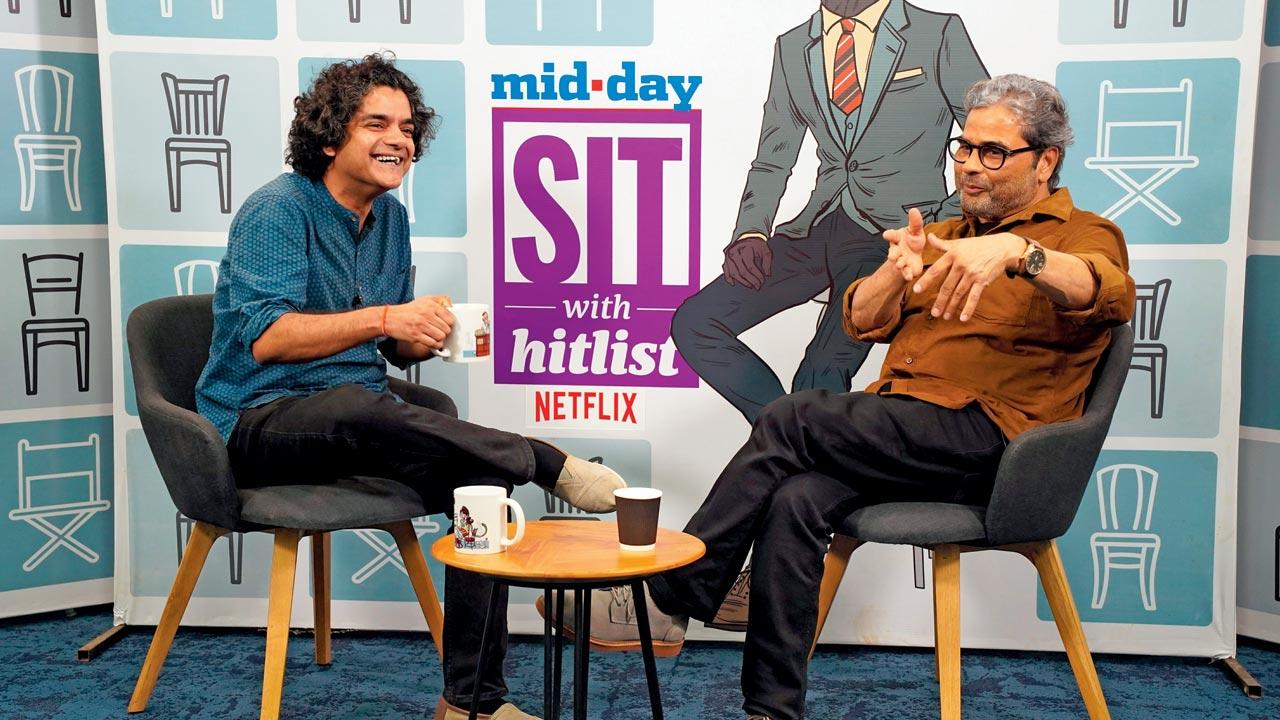
One of India’s greatest filmmaking talents ever, polymath Bhardwaj, opens up on the man behind the movies
Mayank Shekhar (MID-DAY; December 16, 2023)
Gulzar-Vishal Bhardwaj's musical combo is top of the charts’ stuff. But Vishal’s first mentor, from the world of poetry was, in fact Dr Bashir Badr, whom he calls the “greatest poet of the century, an asset to [his hometown] Meerut,” who had to flee Meerut, however, because of the riots in 1984.
Bashir Sahab had heard rumours of a likely attack on his house in Shastri Nagar. His home was indeed burnt down by a raging mob later.
In the rush that he fled for Bhopal, Bashir Sahab left behind his diary, with all his poetry, written over the past year. When he briefly revisited Meerut, he asked for two people—one, Mr Bhandari, who was 70 years old, and the other, Vishal, who was 19 then.
He asked both if they remembered the ghazals and his poetry from the destroyed diary. Bashir Sahab had gone into depression. Between the old man, Bhandari, and teenager, Vishal, they recalled all of the great poet’s works to him, word for word as he penned them back again: “This is how Bashir Sahab got out of depression.”
Vishal used to spend every evening, listening to Bashir Sahab’s words of the day. With poetry, he says he has a photographic memory: “At one point, I could recite the entire book of Gulzar.”
This Bashir Badr story I’d heard before, over drinks, with his former associates once. As is with such nights, I’d forgotten most of it the next morning.
Including details of the tragic events preceding Vishal’s father Ram Bhardwaj’s demise—which he recounted in detail, before a live audience, during this conversation. Only, a few weeks later, he sent in a word if that anecdote could be omitted. It’s about father and son. Too sensitive. We left it at that.
Earlier, he would cry, recalling the incident to do with his father’s death. But he says, “I found my catharsis in that scene in Haider [2014], when Shahid [Kapoor] returns to his home that’s burnt down, and he’s holding a cricket bat.”
The other story about Vishal that I have stored in my hazy memory, hanging with his former colleagues, is about how, as a kid in Meerut, he was caught in a crossfire, and he saw a dead gangster, right in front of him.
“Oh, those are actually two separate incidences,” Vishal says. “There was Tyagi Hostel in Meerut, where all these gangsters used to live. There was a wall, with a hole, between my school and the hostel. That’s the short-cut route we took to get to school. This is where the [chief] gangster used to live in the warden’s house. The warden used to live in the hostel!”
“On my way, I would see him lay out and dry his bullets, guns, grenade, in the sun. The gangster was very fond of me and other kids. He would offer us to hold his gun, tease us with pulling the trigger.”
“Once, during school exams, we heard gunshots fired. We went over to the gangster’s courtyard after. And he was lying dead, right there, with fresh blood, killed by cops, in a gang war! That’s the first time I saw a dead body. I was in Class VII, so must’ve been 12 or something.”
The other incident has to do with Hindu-Muslim riots, which Vishal says was common enough in Meerut: “But even then, the level of enmity [that we see now] didn’t exist.”
Vishal’s house was next to a Muslim family’s: “They had a large bungalow. The father was a learned gentleman. He had three daughters. My landlord was a police sub-inspector, with 10 children. Those kids decided ki hum Muslim kama lete hain, meaning score/kill Muslim people [during the riots]. That’s how it worked. I even heard them plan on going after one of the daughters.”
“There was word from the police station that these boys had an hour [to do whatever they liked]—kama lo toh kama lo. That’s before the police would charge in. This is also how it worked. I knew about these boys’ plans. They had bought country-made pistols. They intended to enter the house, and blast the gas cylinder.”
“The Muslim man inside had a Donali [double-barrelled gun] that he shot in the air. During what ensued, I got caught in the crossfire, and found my way out of it, into another house. My family got worried, because I had gone missing.”
This is when Vishal naturally pauses in the chat: “That’s the psyche of a mob. I have seen it. You ask an individual to kill another? They won’t. You get 50 people to do the same, without taking on guilt and moral responsibility? They will. This is why incidences like lynching and mob behaviour pain me. The support comes from the system.”
As with many great artistes, you only have to dig into Vishal’s past to figure what informs his life as a filmmaker and public figure too. Although pretty much all of his films, as a director, have been based on works of literature.
It might be fair to say, that’s only on paper. Consider his last feature, Khufiya (2023, on Netflix). It’s adapted from Amar Bhushan’s novel, An Escape To Nowhere.
I first read the book in 2013, basis a recommendation in Swapan Dasgupta’s column in The Times of India. Page for page, the film barely reflects the original text, which was more a survey of bureaucrats, fighting over foreign postings. Which is probably what R&AW really is, on a daily basis, anyway. Rather than Salman/SRK like James Bond agency, banging it in the killing fields.
Vishal says, “The book is a cold account of a surveillance operation. The detailing is so good. [Author] Amar Bhushan-ji was once the counter-espionage chief himself. Now, such a book is not even possible. Because the government has placed a ban. No officer can write such a book anymore.”
What about the leap of faith that he takes thereon from the book—surely, he had R&AW agents/officers vet the script, in case it seems too far-fetched? The original research, Vishal says, came from “seven to eight years spent”, working on a film based on the IC 814 hijacking (of 1999).
“I met Mr Ajit Doval [currently India’s national security adviser] several times. He had then retired [as the Intelligence Bureau chief]. Doval Sahab is a fascinating man, and a great storyteller! I also interacted extensively with ex-R&AW chiefs, Mr [A S] Dulat, Mr [C D] Sahay… Along with Mr [Vivek] Katju, the foreign secretary—these were the gentlemen chiefly negotiating with the hijackers. In any case, they really tell you what they want to. They might make you believe they’re answering your questions. But they’re not. It’s their point of view.”
Vishal’s film on the IC 814 hijack subsequently got shelved: “After the Tandav episode, Amazon Prime Video got paranoid. They pulled the plug on the project. They said they don’t want to touch anything political. The film actually had nothing to do with politics. The whole country was humiliated in that episode. It had nothing to do with a party. Now, Anubhav Sinha is making a series on it for Netflix.”
During the IC 814 homework, Vishal also met the IPS officer Arun Kumar, who was associated with the incident. In 2008, Arun became the first investigating officer from the CBI on the Aarushi-Hemraj Noida double-murder case (still unsolved, by the way).
Hence, Meghna Gulzar’s Talvar (2015), which Vishal produced and scripted, with precious/incisive details from Arun who, in turn, inspired late Irrfan’s character in the film.
Tabu, Vishal’s other muse, plays the lead in Khufiya, while the spy-thriller follows this R&AW sleuth’s story of love and loss with her Bangladeshi handler. None of which, of course, exists in the novel that the film is based on.
Citing his Shakespearean adaptations (Maqbool, Haider), to works of Ruskin Bond (The Blue Umbrella, Susanna’s Seven Husbands), Vishal says he’s essentially keen on the basic plot: “I have to know the drama I’m creating—and find a three-act structure, voice, characters, and my own politics and social environment in it.”
To illustrate this best, no better example than to go back to the aforementioned Tyagi Hostel, along with Meerut’s Kachehri Road, full of gangsters, Anand Shukla, Rampal Tyagi, et al. All of whom treated Vishal as their “blue-eyed boy.” Because he could sing and play cricket well. Watch them placed together in Omkara (2006), i.e. Othello. Shakespeare feels like an excuse.
One of the gangsters Vishal knew there was Langda Rathee, who got onscreen as Langda Tyagi. And that’s Saif Ali Khan, in what was easily the greatest casting-against-type for the decade. Vishal thanks Aamir Khan for this unusual choice.
Around the time, Aamir and him were zeroing in on a script, Mr Mehta & Mrs Singh, to work together: “Aamir was seeing the film a certain way. When we were close to the shoot of Mr Mehta & Mrs Singh, he was uncomfortable about how I was seeing the film. We are both headstrong people. We parted ways. But he’s great fun to spend time with, and during our chats, I told him about Langda Tyagi, the character I was writing.”
Aamir was fascinated by the world (of Omkara), and Langda Tyagi’s language, in particular, and wished to be considered for the part. He got busy with his next (Rang De Basanti).
Vishal was too eager to hit the set, rather than wait for Aamir, which would take long. But he realised, “Aamir is intelligent, and commercial. If this role can excite him, I’m sure it should excite another star.” Hence, Saif 2.0 (post Dil Chahta Hai).
There’s been was a similar hit-and-miss between Vishal and Shah Rukh Khan. They were to adapt Chetan Bhagat’s 2 States together (later filmed by Abhishek Varman on Arjun Kapoor, Alia Bhatt). What happened there?
Vishal says, “We had differences over the setting. I wanted to set the film in a bank like ICICI, and not in a college, or elsewhere, that Shah Rukh would’ve preferred. We felt the pain, though. I recently wished him for Jawan. Every time we meet, he repeats, we have to do a film together.”
While his sensibilities are innately artistic, it’s evidently clear, Vishal has throughout aimed for a spot in the mainstream, and achieved it, in his own right. He emphasizes, “Maqbool [2004] opened the doors for me!”
----------------------------------------------------
An apt way to introduce Vishal, as we did in this conversation, is as one of India’s greatest filmmaking talents, ever. There have been few polymaths with that many hyphenated top-end talents, within desi filmmaking—director, producer, music composer, singer, lyricist, writer of screenplays, and dialogues (often separate in Hindi cinema, because most don’t hold an equal command over language).
Vishal writes dialogues in pen on A4 sheets. But gets confused with his own handwriting later. One thing he misses his former associate Abhishek Chaubey (Ishqiya, Udta Punjab) for is deciphering what he’s written. Now, he has to figure it out himself. The instructions on the screenplay he keys directly into the computer.
The greatest polymath of all in Bombay was probably Kishore Kumar who, Vishal tells me, he shares his birthday with (August 4)!
But much before all of the above, Vishal was an “all-rounder” cricketer once—batter, and right-arm spinner—with an eye on international cricket. Former Test player Gursharan Singh spotted him in a match in Meerut, and suggested he move to Delhi. Which is the reason he did.
“I couldn’t have made it to the Indian team from UP. It was too big a state then [Uttarakhand hadn’t been bifurcated]. The facilities weren’t up to the mark. And the UP team barely made it up the chain in the Ranji Trophy. So, I would have never got noticed.”
In Delhi, he played with the likes of Manoj Prabhakar, Maninder Singh, Sunil Walson, Tilak Raj (who Ravi Shastri hit for six sixes), Chetan Sharma… Speaking of the latter, did Vishal whack Chetan out of the park, ever? “Yeah, I did.” That’s one thing he has in common with Javed Miandad!
Reminiscing those times is a lot like, as Vishal quotes Ghalib: “Yun hota toh kya hota!” Dealing in ‘counter-factuals’: “I came to Delhi. Right before the match, I broke my thumb. Couldn’t play the whole year. Next year, my father died. If cricket hadn’t left me, though—how would I have been in music, or the movies then? This world has no retirement age!”
“Since then, I’ve learnt that if something unlucky happens to me—a greater reward awaits. I feel bad, of course, when something happens. But I don’t get disappointed.” From an early age, Vishal used to dabble in musical instruments lying around. Music was internal to his home.
Although with a day-job, Vishal’s father Ram—“everyone called him Ram Sahab”—was a lyricist in Bollywood. He would often visit Bombay, from Meerut, with family.
This is when Vishal spent time with film/music folk in Bollywood. On one such evening, his dad mentioned to his friends about how Vishal, “around 18 then”, had composed a short tune over his father’s lyrics.
His dad’s friends were hugely impressed. They got composer Usha Khanna on the phone to hear it. Usha loved it enough to include it in the final composition.
“That someone like Usha-ji took my tune to expand into a whole song gave me my first validation. That validation gave me confidence.” The song, Khuda Dosti Ko Nazar Na Lage, is from the film, Yaar Kasam (1985). At 19, Vishal recorded his first composition. Asha Bhosle was on the microphone.
After college in Delhi, he moved to Bombay with a job at a music label to pursue music, professionally. Vishal also had a brother, Rajeev, seven years elder to him, in Bombay—struggling to make it in films as a producer: “He had no money. But he wanted to produce movies. How do you?”
Rajeev passed away early. Decades later, Vishal became a formidable producer in Bollywood. I wonder if he feels, in some ways, it’s the story of two siblings coming full circle? He just wishes his brother was around to see it.
Filmmaking itself was an invisible milestone in his head, he says. “I had no intentions. I had seen nothing. Manmohan Desai to Blue Lagoon [for the sex scenes] was the range of my film knowledge!”
It was during the making of Maachis (1996) that he was composing music for, Vishal recalls, “Gulzar Sahab told me, I’ll become a director in five years. He actually pushed me into it. I used to ask him too many questions during the filming, editing…” The children’s film Makdee (2002) marked Vishal’s directorial debut.
Given he was a musician first, isn’t it strange that he’s never attempted a proper musical in films? He reasons, “In my earlier movies like Omkara, Maqbool, I did have actors lip-sync to songs. Because I also wanted to retain my power as a composer. With time, the purity of cinema took over. How do you then justify lip-syncing? The background score is the director’s voice. Anyway, India has a long tradition of cinema and music. Even if I do a musical, it would have to be on a subject that is totally non-musical.”
By the looks of it, his current obsession may be mystery/thrillers. After Khufiya on Netflix, his series Charlie Chopra & The Mystery Of Solang Valley, based on Agatha Christie’s The Sittaford Mystery, dropped on Sony LIV. Which, he says, happened primarily because of the pandemic.
“The world was under lockdown. I was convinced we were in it for five to 10 years, or perhaps forever. How does one survive creatively for that long? Many years ago, I had been offered Agatha Christie’s entire library of Hercule Poirot and Miss Marple titles to adapt. Well, this is what we could do, I thought—shooting in constrained settings [during a pandemic]. I got back to the person, who had connected with me back then.”
What does he find in common between films and music, I ask Vishal. He says, “That they both work on the three-act structure, inspired from life, of course—bachpan, jawani, budhapa [childhood, youth, old age].
“Also, like with films, we don’t know what works in music. It cannot be calculatedly recreated, even though there are really seven notes.”
How about films and cricket—what does he find similar between the two: “Captainship. That you take along a team, especially when things aren’t going right. And they seldom do.
“Also, to accept defeat gracefully, and learn from the defeat.” Are there instances from his films that he’s learnt from, in terms of failure?
“It would be on the technical aspects. Take Rangoon [2017]. The release date was set. But we were not getting the VFX for the final scene right. I should have put my foot down. Held the release, like Sanjay Leela Bhansali does. I was making a Rs 70 crore film in a Rs. 35 crore budget. I had become overconfident from all that we had managed to achieve, even on the VFX front, coming from Haider.”
----------------------------------------------------
There is genuine integrity/sincerity that Vishal exudes during conversations, and in general too, as his former peers/associates always testify, when his name crops up.
At a recent concert in Mumbai with singer-wife Rekha Bhardwaj, their first time together—they met at Delhi’s Hindu College in the ’80s—she called him a “genius”. Which was one way to put it, as we watched Vishal go from soft ghazals to unexpectedly banging it with the vocals to Kaminey’s Dhan Te Nan on stage!
But along with the ‘shayrana’ mellow, there is also a hardcore side to his personality, I reckon. For instance, I point to him a tweet I came across long ago, where he made a political statement. A troll in the comments section taunted him, asking who did he thinks he was?
Normally, people ignore response, when none is merited. Scrolling down the screen, I noticed Vishal, 58, tell the troll: “Tera baap hoon [I’m your pop].”
He laughs, but declaims, in all seriousness: “There is a gangster in me. Maybe in retirement, the poet is taking over. But the spirit is there—against injustice, or if things aren’t going my way.” Consider this untold story of Maqbool (2004), his breakout film, that is on its 20th year.
One of the things I noticed about Maqbool, seeing it after long, is how little Bombay there is, in terms of live location, in a film about the Bombay underworld. Which can also be said for Mani Ratnam’s Nayakan (1987), upon re-watch.
Some of this is deliberate, Vishal says: “By 2002-03, the Bombay underworld scene had shifted to terrorism. We actually wanted to show a more old-world mafia with Maqbool.” He had knocked on every door to fund the film. Including the possible cast—for instance, Kamal Haasan was the original choice for the title role.
IDBI Bank had launched a scheme to finance films then. Vishal applied there as well. Producer Manmohan Shetty was on its script consultation committee. As was producer Bobby Bedi.
Manmohan had him over for a drink, simply to tell Vishal that he had saved his ass: “You have actors like Naseer, Om Puri, Pankaj Kapur… How would you’ve ever recovered a Rs 2.86 crore loan? I did you a favour, by rejecting it.”
Bobby, however, showed interest in the script, to come on board, with the funds. That’s how Maqbool kickstarted. How does one arrive at the old-world look?
Vishal says, “I had seen a haveli in Bhopal, which is exactly where we needed to shoot [Don Abbaji’s world]. So, 25 days in Bombay, 25 days in Bhopal. That was the shoot.”
“Only, that once we got to the Bhopal leg, Bobby said there was no budget for it. And that there is a mansion at the Films’ Division office [on Pedder Road in Mumbai]—it’s colloquially called the ‘Films Division haveli’—where we could shoot. I said I won’t. He said he won’t make the film then. I said, let’s not make the movie!”
It was a Friday evening, Vishal remembers. He got home, made himself a few stiff drinks, and switched off his phone for the next two days. Bobby came knocking at his door on Monday, asking why he’d gone incommunicado?
“I told him, what’s the point of meeting? My fees for the film, including music composition, direction, script, was Rs 30 lakh. Bobby suggested that the Bhopal shoot would cost Rs 60 lakh. And that he was willing to put in Rs. 30 lakh, and I could put in my Rs 30 lakh.
“I just said—if you had told me earlier, I wouldn’t have drunk so much on Friday! Even to this day, while I was the producer, I didn’t make a single penny from Maqbool. But how does it matter? Look at all that I earned!”
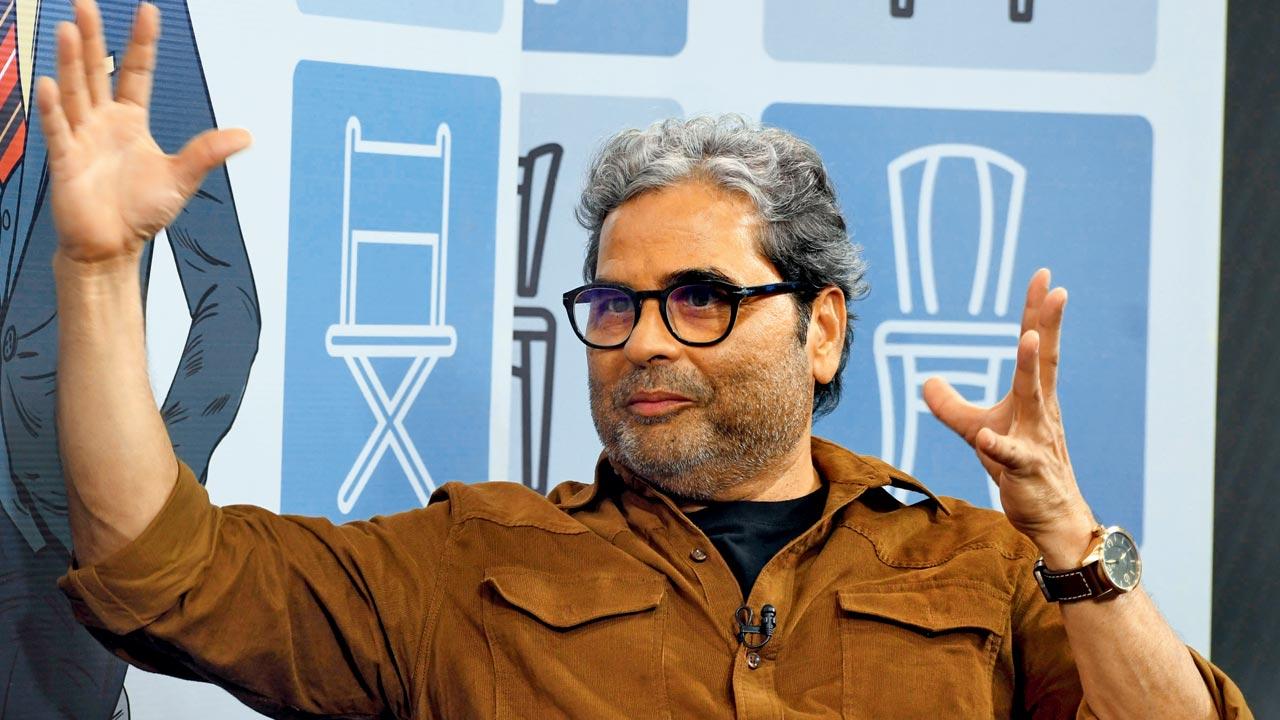
I kept thinking, ‘Why did I do Padmaavat?’ I had no perspective-Shahid Kapoor
8:23 AM
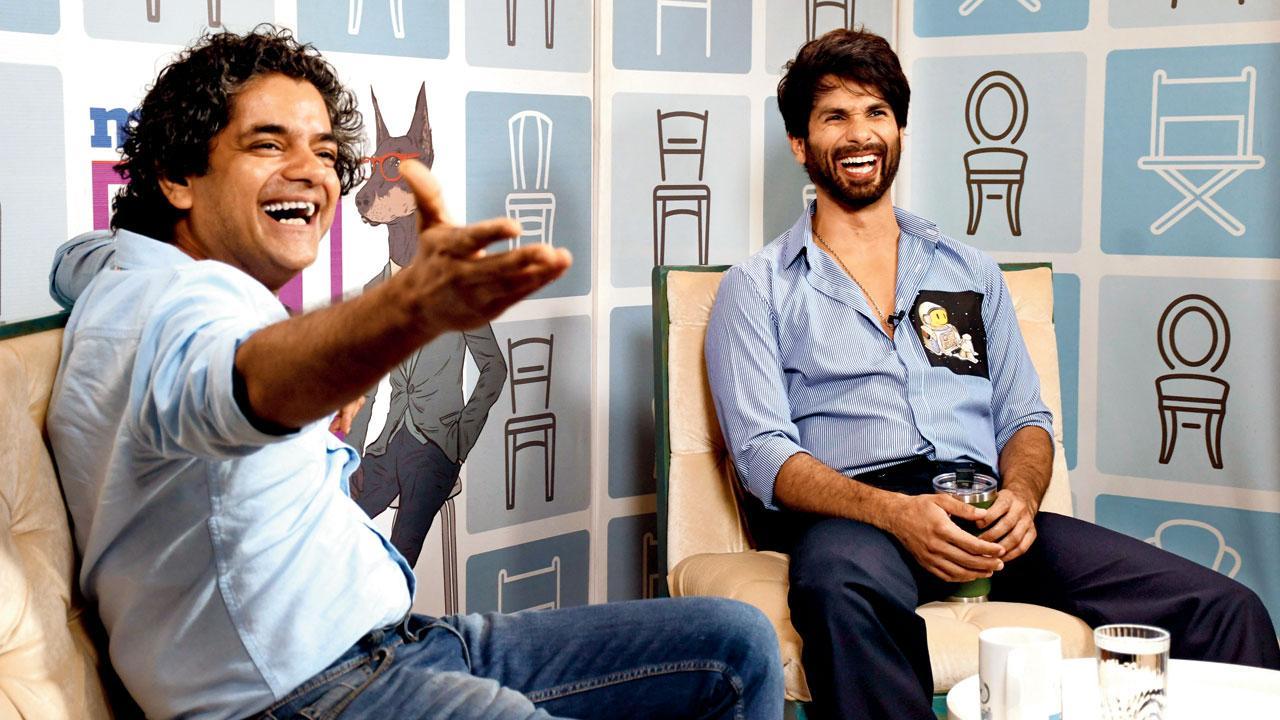
Ishq Vishk to Jab We Met, Kaminey to Kabir Singh—Shahid Kapoor on his 20 years of Bollywood
Mayank Shekhar (MID-DAY; July 8, 2023)
It was around when he was about six or seven, Shahid Kapoor recalls, his father Pankaj Kapur took him out to New Delhi’s popular food joint, Nirula’s, for a meal. Unbeknownst to what would hit them, the two were suddenly surrounded by “a hundred people, who’d picked up gajar [carrots], and were charging at them on their restaurant table—almost like zombies, going, Hehehe…. Gajar khaiye, gajar, hehehe…”
“Par mein bete ke saath pizza kha raha hoon [But I’m having pizza with my son],” Pankaj Kapur shot back. But no avail. The public was, of course, responding to Pankaj Kapur’s iconic role of Detective Karamchand, and his love for gajar, in the 1980s, on Doordarshan.
Father-son had to eventually rush out of Nirula’s. Shahid told his dad, who was visiting him from Bombay then, to never take him out again! “By virtue of distance, the interaction between him and me was anyway limited.”
Shahid’s parents had separated/divorced, when he was quite young. He was then growing up in Delhi, with his mother, Neelima Azeem, and his maternal grandparents, who were both journalists with the Russian publication, Sputnik.
Sasha, that’s the “ghar ka naam” his grandparents gave him—and that his tribe of fans, self-named Shanatics, call Shahid by—is also a common Russian name, he points out.
It was only when he turned 10, that Shahid also moved to Bombay to be with his mom, a trained classical/Kathak dancer, who was looking at a career in acting.
Shahid himself was one of the top dancers at Shiamak Davar’s dance academy—moving up from the back rows, at dance performances, to the front row, and eventually becoming a trainer at the institute, “which is how it works at Shiamak’s school; you have to prove yourself, every step of the way.”
In fact, if you notice closely, you can find Shahid dancing in the group in Subhash Ghai’s Taal (1999), even Yash Chopra’s Dil Toh Paagal Hai (1997). On stage, he was ecstatic to be “moving right behind Aishwarya Rai, Salman Khan, at popular award shows.” By 16, Shahid says, he was already earning enough to manage without pocket money from home, “even help out with the household income.”
A picture, from a trivia night, we show Shahid, is of him with actor Ayesha Takia. They’re both such lovely children, posing with coffee mugs to the TV screen. Shahid and Ayesha were the OG: “I’m a Complan boy, she’s a Complan girl!”
He laughs, “Ayesha was a really big [child] star at the time. We had to wait for her to turn up on the set, while I got my solo shots done!” But these were “one-off appearances on screen, because I was a cute kid, and someone or the other saw and cast me.” His mom was clear she didn’t want him to get full-time with commercial/advertising work still.
Cut to: 2003. Which is when I first met Shahid, seated quietly at the reception area of the mid-day newspaper office, in Lower Parel. A publicist had called to check if I might be free to say hi to a young kid he’d brought along. I was a young recruit/intern type at that office myself.
Having stepped out for a minute as a favour to the publicist, you could see other people quizzically wondering who this boy in their midst was. They had seen him somewhere, just not sure where.
“Back then, before there was social media, it used to take years for you to reach out to people. Now, it can happen in weeks and months,” Shahid recalls. The exact date for that first meet-up is not hard to figure. Shahid says his debut film, as lead, the teenage romcom, Ken Ghosh’s Ishq Vishk, released on May 9, 2003.
On that Friday, he’d excitedly gone over to Bombay’s Sterling cinema to watch himself on the big screen for the first time: “Between noon, and when the film finished, while I had just been around doing nothing, the people’s perception of me had totally changed. Barricades were put up. I was too young, at 23—which from an exposure point of view, is very different from how 23-year-olds are, now. And I thought, oh, wow, is this what stardom is?”
That ‘media round’ must’ve taken place a couple of days after. Which is almost exactly 20 years since, that we’re recording the episode of Sit with Hitlist, at the mid-day office again (this time in Bandra East).
Only that Shahid is full of confident banter that’s hard to reproduce in text—he’s a major Bollywood star (with over 50 releases to his credit). Having been through a “turbulent journey, of ups and downs”, and indeed a cracker, eclectic career—over those two decades.
Starting out as the ‘chocolate boy’ romantic lead (Ishq Vishk to Jab We Met), graduating to a more action/masala hero (Bloody Daddy, his last release), and even layered parts, whether on the big screen (Kaminey to Kabir Singh), or OTT platforms/series (Farzi).
Even at the beginning of his stint, young Shahid never introduced himself as son of the great Pankaj Kapur. We might have seen him differently. It was a conscious, self-respecting call he had taken—of making it on his own.
For four years, Shahid remembers, between age 18 and 22, he’d simply been incessantly screen-testing for parts: “I like the word ‘struggler’, they use [only] for aspiring actors. It’s true. It’s a life full of rejections. Four years means about 1,200 days—and I would have easily given about 200 auditions.”
None of those films apparently made anybody’s career, so he’s glad for it. One of which, Shahid says, he rejected himself—N Chandra’s Style (2001), because he was clear, even at that age, that he would debut only as the solo-lead.
It’s another matter, he says, that once Ishq Vishk did well, commercially—he was considered too young for producers to cast opposite existing, established female leads: “They’d rattle out names of three-four popular, female stars, and say, ‘You’ll look like a kid with them! Where’s your ‘mardaangi’ [manliness]? There was no work for my age-bracket, and for the way I looked.”
Also, he submits, there was a perception in Bollywood at the time, that a star was born, at best, only once every half a decade: “And Hrithik [Roshan] had already become huge [with Kaho Naa... Pyaar Hai] in 2000. Vivek Oberoi quickly followed [with Company] in 2002. So, apparently [by law of averages], I didn’t stand a chance!”
Of course, all these rules are assumptive. They fail in the face of public choice, which is impossible to predict. Another such rule I point out to Shahid is how, when it comes to a loyal female following—the credibility built from a particular film cements it so much for a male lead sometimes, it can easily lead last them a lifetime.
Take Ryan Gosling, for instance. Take The Notebook (2004) out of his filmography. And he wouldn’t garner half the female fans that’s stuck around him since. Likewise, with Shah Rukh Khan, and Dilwale Dulhania Le Jayenge (1995). The connect is irreversible. The persona sustains. I wonder if it’s the same relationship with the female demographic that Shahid attained with Imtiaz Ali’s Jab We Met (2007), first. He says, “I know Jab We Met gets a lot of credit [as it should]. But let’s not forget Vivah [2006]. It was a small-budget film—by the legendary [producers] Barjatyas’ standards.”
“Their [more expensive film, with modern sensibilities] Main Prem Ki Diwani Hoon had just failed. Sooraj [Barjatya] and his father [Raj Kumar Barjatya] were planning to do a movie, with new actors, to test their original, traditional lower middle-class audiences/sensitivities. Vivaah is the last Indian movie to do a ‘silver jubilee’ (25-week run in theatres),” Shahid claims.
Audiences like me, of course, remember him more for Vishal Bhardwaj’s Kaminey (2009)—decidedly from the dark side of the moon, which was as diametrically a U-turn for his onscreen image.
We wonder how different could it be to be on a Barjatya set, over Bhardwaj’s: “Chalk and cheese. Vishal doesn’t like anything sweet. He’d keep asking me to go ‘kamina’. Sooraj would want me to throw way all city [slicker] influences, and be sweet. It’s schizophrenic [to be on both sets]!”
As for Imtiaz Ali, Shahid recalls, “He was a new director, when he came to me. The first thing that struck me was how good-looking he was, himself, [lost] in his dreamy thoughts. Then the fact that he narrated out of a bound script, which wasn’t common. Back then, you heard a 30 to 40-minute narration that the director would then develop, if you said yes [to it].
“The script had ‘Geet’ written on it. I asked him, ‘What does this mean?’ He said that’s the heroine’s name. I told him, ‘The next time you go to a hero—don’t go with a script with the heroine’s name on it!’
The next time, he came to me with the same script, he had ‘The Train’ written on it,” Shahid laughs.
Eventually they settled on Jab We Met, because big daddy Pankaj Kapur came up with the title over dinner: “I was telling him about how I want an English-Hindi mixed title, and what the story was about.
He said, call it Jab We Met.” Which was one of the titles entered into a public poll held by a newspaper. “The other was Bhatinda Express. The third one I don’t recall. People picked Jab We Met!”
As for his female following—evidenced from the fact that this conversation itself is being recorded with an all-women audience—Shahid attributes much to his more recent, by far the biggest hit of his career, Sandeep Reddy Vanga’s Kabir Singh (2019), as well.
The film was a scene-by-scene remake of Arjun Reddy in Telugu, by the same director. So Shahid knew exactly what he was walking into—the part of a drug-addled abusive boyfriend, that remains his most controversial yet. So much so that it’s been four years, and he feels the need to defend it still.
He says, “There were so many people refusing to accept that people are liking the film. I was like, ‘Arey bhai, logon ko acchi lag rahi hai, tum log baithe ho apni [high] chair mein—suggesting, how dare you like the film? Well, accept it.”
He’s also willing to engage on the criticism. Which is perhaps not that people were refusing to acknowledge the commercial numbers/footfalls. But that the film was about the sort of character, who may exist in real life, surely. But who was instead being lauded as a hero of sorts. That was the issue that some people may have had with arguably a misogynist subject.
Shahid disagrees, “Well, Kabir slaps the girl [Kiara Advani]. She slaps him back. But when he slaps her, it is so shocking that it stays with you, and it disturbs you, right? Everything that happens to him after in his life, is a downward spiral. Until the last moment when somehow, the girl agrees to be with him! He is a complete mess. A very cinematic character. It is like Taxi Driver, or Scarface.”
The deranged Travis Bickle (Robert De Niro) in Taxi Driver ultimately kills himself, though. “Kabir Singh is actually about how everyone should get a second chance. In love, who hasn’t messed up? And if you see it, right from the promo—at no point is it being said that he is a great guy.”
“I’m nothing like him. But as an actor, it’s my job to play different characters. You don’t have to like him. You should like my performance. He’s not the hero. He’s the protagonist.”
Which can be said of Shahid’s equally messed up, Punjabi hip-hop star, Tommy Singh, from Abhishek Chaubey’s Udta Punjab (2016). What did he find in common between both the characters?
“Nothing, besides that they are both Singhs,” Shahid laughs. “There is a scene [in Udta Punjab], where Tommy says that he’s never done anything for anyone else. And that he must [for Alia Bhatt’s character]. He’s been completely self-centred. Which is how he’s different from Kabir, who gives it all [for his love]. And she’s nice enough to have him back. Love stories must end with a note of hope.”
The other thing common between Tommy and Kabir is, of course, that they are both substance abusers, isn’t it? “Yes.” Played by an actor, who’s a sworn vegan, and teetotaler! It’s something you don’t associate with movie-stars still. “You can call me boring, I don’t mind,” Shahid smiles.
The other thing unusual for a movie star is getting into an arranged marriage, which is what Shahid made as a life-decision, when he married young Mira Rajput, in 2015.
“Well, if you’d asked me then, I’d have said arranged marriages don’t make sense to me, either. But it happened [organically].” He says they met through family: “We were part of the same spiritual group that I was obviously aware of. She was all of 20 years old. I was 34. I was a little embarrassed [about that].
“But I was really looking for someone who could understand both aspects of my life—the spiritual side, and that I’m an actor [a public figure]. She was genuinely interested in figuring me out as a person. And you can tell, when these things are real. She was not affected [by my profession].”
The first time they got on the phone, Shahid remembers, they spoke for seven hours straight. He knew he’d found the one. He feels the same way about her family, that he treats as his own: “They’re very classy, and sorted people.”
During the two years of the pandemic, Shahid says, he stayed over with his in-laws’ throughout, in a place called Dera, in Punjab: “We had reached there, just three days before the lockdown got announced.”
A few years back, Shahid had recounted to us a trigger point on this aspect of his life. He’d been single for a while. He was returning home, alone, having had won the Filmfare Award for Vishal Bhardwaj’s Haider (2014).
That big night, he slept with his statuette. Acknowledging a thing amiss, that he must do something about: “I felt the need for a companion. But even then, I didn’t know I’d find a perfect life-partner. It’s tough.”
Up until then, you could describe Shahid as ‘seriously monogamous’: “I had always been that guy in my 20s—in long, settled relationships.” The other aspect that early success in showbiz thankfully affords the young is a rich, rockstar life, when you’re merely in the 20s. Sports stars are similarly privileged. I’m sure that must’ve been a legit high, before he decided to proverbially settle down.
“It’s a stupid high,” Shahid explains. “So, I’d go and buy myself a fancy sports car, and then I would feel like, ‘Why did I do this? Now, I am broke, again!’ You’re a little stupid in your 20s—making stupid choices, and then you blame other things. When I look back, I’m like, ‘Okay, I should have made better choices, I would have been more comfortable, yar!’”
Which is to say, “I also didn’t have time for anything—too busy holding on to my position [professionally], working on the set 240 days of the year; let alone promoting my films thereafter.”
How about dating the hottest women in Bollywood, though—surely that’s a great perk of being a star into only life’s second decade, when most others are busy moving up from the low rank/station, attempting a half-decent living!
Shahid isn’t particularly impressed/nostalgic by that reminiscence: “See, at the end of the day, you are dating good-looking women. But you are also considered desirable, and good-looking, right?
“So, it is not something that you are getting three levels above your own league! I mean, there were enough women interested in me as well, right?” Spoken truly with that feisty swag of a 20-something!
Looks apart, going by talent from pedigree alone—as a star performer, doubtlessly, Shahid has picked up his dancing skills from the mother, and acting prowess from the father. He’s quick to point out here,
“I was more happy about getting my hair from my mom, and acting chops from dad! I was like, ‘Dad, I don’t want your hair!’
“He was semi-bald at 30, and he used to keep messing with me saying, ‘I’m an actor, I can play all kinds of characters. Abhi toh tu hero ban gaya hai, agar tere baal udd gaye toh tujhe kaam hi nahi milega [You’ve become a star. Now if you lose your hair, you’ll get no work!].’ He used to mess with me, dude!”
Much as the father and son couldn’t have had a more separate career graph, from the looks of it, Shahid did indeed imbibe the ambition of gaining respect as an actor from Pankaj Kapur. It’s part of his natural training.
“I’d seen all my father’s film, growing up—whether that be Rui Ka Bojh [1997] or Ek Doctor Ki Maut [1990]. Jaane Bhi Do Yaaro [1983] is, of course, one of my favourite films ever.”
The two collaborated most ambitiously as actor-director, in fact. Wherein Pankaj Kapur debuted as filmmaker with Mausam (2011), starring Shahid in the lead. They’d produced the film as well—charting a story as wide in scale as The Gone with the Wind, no less.
This was around the time, Shahid says, that he’d himself gone through a makeover, in terms of how he’d go about his career goals.
“I was done with walking into a set, being given dialogues to perform right there, and carrying on. I wanted to approach films with a sense of commitment, and had chosen to work in one project a year.” Which is the time and energy he spent on Mausam, along with his father, who spent over year and half on it.
“But we realized, that’s not how everyone else works. And so, while the film was in production, others had moved on. We were finding it hard to match dates [with cast/crew]. Even when I saw the film’s final cut, I knew this was not going to land [well]. It wasn’t the film that my father had envisioned.” Mausam bombed at the box-office, causing a career setback for Shahid, to start with.
One of the things, it appears, that Shahid regrets about stardom is the sort of time it takes to finally get a hang of the system: “By the time you know exactly what’s going on, you’ve already lost eight to 10 years. When you come from a [mainstream] film family, on the other hand, you’ve experienced much, up, close and personal, already.” That’s the advantage, he says, his half-brother, young Ishaan Khatter, has.
Having grown up under the wings of Shahid: “He’s watched me and my choices closely, and always had an opinion on it. For instance, he wouldn’t like me in a [Dil Bole] Hadippa, but totally love me in Kaminey. As an elder brother, you sort of become the guy riding the motorcycle, with him on the back seat!”
Having seen all his films, it would be fair to suggest some of Shahid’s early script-sense could be befuddling, at best. For instance, I point out, what could have made him sign up for a pic like Paathshala (2010), that I remember wondering the same, even while watching it: “That was a friend who asked me to give him seven days of my life, and he badly needed it.” All choices have a reason.
Consider Prabhu Dheva’s R… Rajkumar (2013), and Rajkumar Santoshi’s Phata Poster Nikhla Hero (2013), that Shahid hit the screens with, soon after Mausam hadn’t worked, theatrically.
“That was [me seeking] commercial success. If you’re not successful, you actually have no power to make any choices. So, you just have to get successful, first. It’s simple. R… Rajkumar, in fact, did well. And Phata Poster did not.”
From a film industry POV, he looks at movies very differently, Shahid concedes. Namely, you need films of all palette to march on as an industry: “What I don’t get is people who can only make dosas saying, that those who eat burgers, are no good. That’s not how it works. I stay away from such people.”
And it’s not that commercial success, or massive footfalls, is the only criterion, surely. Soon after the release of Sanjay Leela Bhansali’s blockbuster, Padmaavat (2018), there were news reports suggesting Shahid wasn’t pleased with his own presence in the pic, along with Deepika Padukone and Ranveer Singh, who evidently stole the show. Was there any merit to these assertions?
He candidly admits, “It’s true. Everyone was lovely in that film. And I don’t want to get into details. But I kept thinking, ‘Why did I do this film?’ I had no perspective. And I don’t want to blame anybody.”
Which also relates to insecurities that come naturally with an actor’s mercurial job? To take another example of published reports, there was one about how Shahid didn’t get along with co-star Kangana Ranaut, during the making of Vishal Bhardwaj’s Rangoon (2017). True?
“Not true. I got along fine with Kangana. She’s a fine actor.” Long pause. Okay, that is a long pause. “What do I say? You’re not asking me anything else. You’re talking about insecurities, looking in from the outside into an actor’s life. But it may not be [those] insecurities. There are so many things that can be there, if first of all, there is a problem!”
Which is fair. And being a star, as against a professional actor alone, inevitably involves media scrutiny—as part of the job, even if an occupational hazard, on occasion. Surely, over two decades of being right at the centre of Bombay showbiz, has come with its own potholes.
The one story I remember concerning Shahid, and in fact mid-day—shortly after we met first at the newspaper’s office reception—were a series of paparazzi pictures that the tabloid had published in 2004, starring Shahid and his girlfriend then, taken at a Juhu nightclub, Rain.
Those pictures were clicked by a bunch of kids randomly hanging around in the nightclub, with a digital camera. There were no feature-phones with cameras at the time.
Those juvenile delinquents arrived at the mid-day office, demanding Rs 500 for the set of blurry but innocuous images/video of Shahid, kissing, in love, evidently. Unmindful of possible minders around.
I wonder what that did to Shahid, once those pictures appeared, in what became a big, salacious, tabloid story. Which was hardly a big deal though, if you look at it objectively, rather than voyeuristically.
“Of course, it was a big deal. Let’s be honest—putting out pictures like that would get you a lot of eyeballs. That’s the honest truth of it. It’s okay. You know, we all take it with a pinch of salt. But what was your question, again?”
The question was, what did he feel about it, when that happened, then? I don’t think he’s spoken about it in all these years.
“Oh, I was destroyed at the time. I was just 24 years old, a kid. I felt my privacy had been invaded, and I could do nothing to protect it. I was a mess. At that age, especially—because you don’t even know your own feelings. You are figuring out how to be with a girl you are dating. And in the middle of all that, this happens…”
What’s changed with stardom and the media landscape since, of course, is that practically everyone is with a smart phone, making videos, pictures, selfies in public. Shahid, 42, reasons, “Now, you are aware that [a paparazzi snap] like that is 100 percent going to happen. At that time, we were caught off guard by it.
“So, that is like an informed devil, as opposed to an uninformed-devil scenario, then. You at least know, ‘Yeh toh hone wala hi hai. Also, ab toh meri shaadi ho gayi hai, bacche ho gaye hain (Now, I’m married with kids). Nobody is interested in those things about me. They have other 24-year-olds to focus on.”
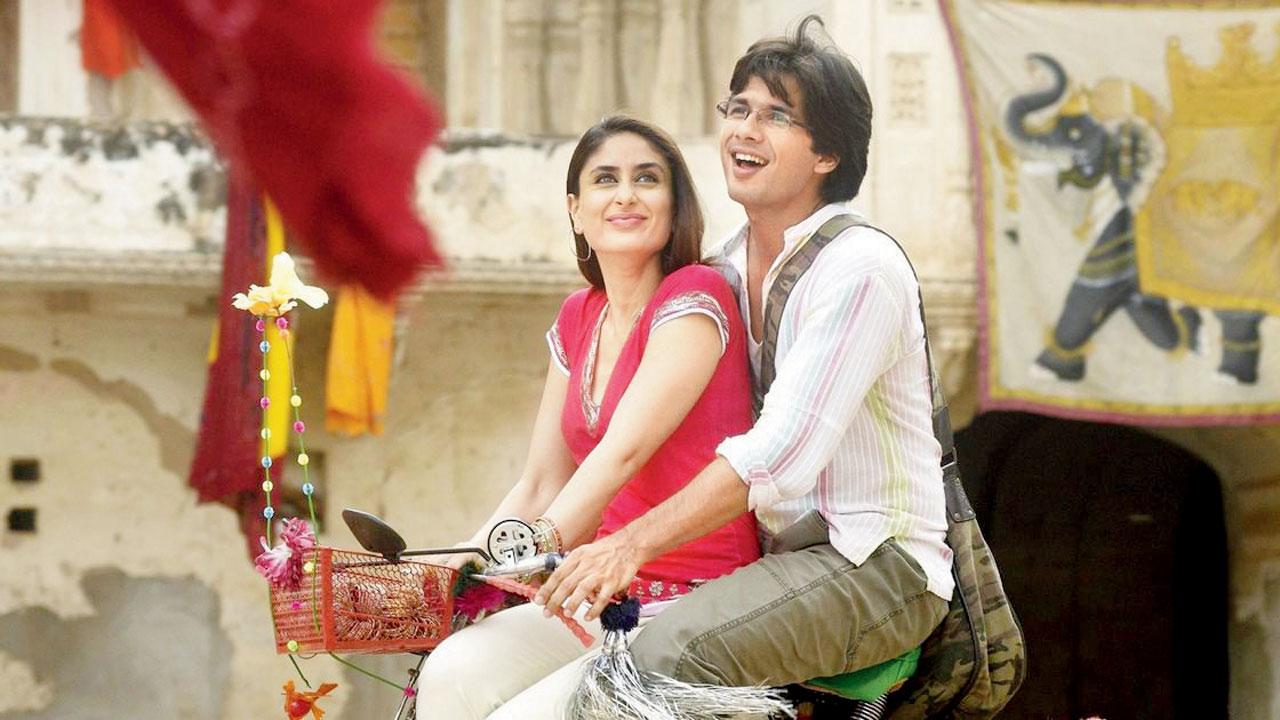
Shahid Kapoor to team up with Vishal Bhardwaj for the fourth time?
7:42 AM

Akash Bhatnagar (BOMBAY TIMES; November 22, 2019)
Shahid Kapoor, who is riding high on the success of Kabir Singh, and getting ready to kick off the Hindi remake of the South film Jersey, in which he plays a 36-year-old cricketer who wants to be picked for Team India, has set tongues wagging with a recent visit to the office of Vishal Bhardwaj. The actor-director duo has collaborated on three occasions—Kaminey (2009), Haider (2014) and Rangoon (2017). And on Wednesday, instead of playing the usual game of hide-and-seek, the two were happy to pose and smile for the paparazzi.
Shahid and Vishal, who share a great personal equation and professional relationship, have always been vocal about their keenness to work together again. A source told Mirror that they have been discussing a subject and a fourth film could be on the cards.
During the release of Haider, Vishal had raved about his lead actor saying, “I cast Shahid in Haider not because he was Pankaj’s (Kapur) son but because I needed a young actor and he’s the best in his age group. I’d done away with Othello’s last monologue because I felt it was too stagey but I have retained Hamlet’s. And listening to Shahid rattle off a sixpage monologue in the climatic scene where Haider turns mad, I was reminded of Pankaj’s body language and Naseeruddin Shah’s voice.”
During the freedom struggle, Dilli Chalo was Lal Qila Chalo-Tigmanshu Dhulia
8:20 AM

Divya Kaushik and Abhimanyu Mathur (BOMBAY TIMES; August 15, 2019)
Though it is the Red Fort where the Prime Minister unfurls the tricolour every Independence Day, curiously enough, it is the India Gate that has come to signify patriotism in most films and TV shows. Tigmanshu Dhulia is one of those rare filmmakers who have shot inside the Red Fort, an opportunity he got while making Raag Desh, a film based on the famous Indian National Army (INA) trials.
According to Tigmanshu, the Red Fort does not feature so prominently on the screen because of Bollywood’s laziness when it comes to research. “This has happened recently. I think it is basically ignorance. Not many filmmakers are inclined towards history because more research is needed there. Research is a recent discipline in Hindi films, it wasn’t there earlier,” says the director.
A student of history before he became a filmmaker, Tigmanshu delves into how before the India Gate was even constructed, it was the Red Fort that stood tall as the symbol of India’s freedom struggle. “India Gate is publicised in a certain way in popular culture. Maybe it is because of that that whenever we speak of freedom or anything nationalistic, we show the India Gate. But when Netaji was at Bahadur Shah Zafar’s grave in Rangoon, he pledged that aapko main Hindustan wapas leke chalunga. Hum aapko Red Fort mein baithayenge. This is a fact. It was always the Red Fort. Dilli Chalo was Lal Qila Chalo,” says Tigmanshu.
The director-actor has had a strong bond with the Indian freedom struggle. His grandfather was a freedom fighter. “During the Quit India Movement, he was in prison for four years. The legacy of that period is the eczema that he contracted there, which has stayed in the family. I also have it,” the filmmaker says with a smile. It was only natural for someone who grew up with that background to look for stories associated with the freedom struggle to show on the silver screen, and this quest culminated in Raag Desh, which brought him to the Red Fort.
The director admits that though he lived in Delhi for years, it was Raag Desh that introduced him to the history of the monument. He shares, “When I went for the recce, it was very overwhelming. Uske pehle main saat saal Delhi raha hoon, three of them with NSD, but Red Fort kabhi gaya nahin tha. I had gone as a tourist but I hadn’t seen that side (the barracks) even once. But when I had to make the film, then I went there. The uniforms of Prem Sehgal, Shahnawaz Khan, Gurbaksh Singh Dhillon are all kept there. It was overwhelming to see that, to think that they must have walked there at one time. It was a great experience.”
Inside the Red Fort, Tigmanshu shot at the very place where the barracks that housed the INA officers once existed. That is when he learnt about the significance of the monument for the British. He tells us, “The Britishers had this idea that these guys are trying to challenge us, so let’s set an example, let’s have the trial at the Red Fort as it was an iconic place. Bahadur Shah Zafar ko unhone dethrone kiya. They wanted to set an example by putting all INA prisoners inside the Red Fort and decided that the trials will happen there. They were so foolish that they chose these three officers – one Sikh, one Hindu and one Muslim – which was kind of representing the entire country. That went completely against the Britishers.”
Tigmanshu says the INA Trials were the final nail in the coffin for the British Raj. He recounts an incident from then to prove his point. “When the trials were taking place at the Red Fort, the three officers used to live there. Red Fort had barracks where the museum stands now. From the barracks, the officers were taken to the room where the trials took place in a truck. This one time, a British officer and his Gorkha soldiers were leading the officers. This scene is in the film too. The British officer pushes the INA officers. Gurbaksh palat ke ek maarta hai usko. Aur koi bhi Gorkha soldier uss officer ki madad ke liye nahin aata. Uss din inko lagta hai ki yeh kya ho gaya! That was a big setback. Even Nehru ji spoke about it. That triggered the thought among British that if soldiers are not with us, who will save us? We need to get out of here. Otherwise, Churchill had openly said during World War II ki woh India nahin chhodne wale. Woh toh Labour party jeet gayi wahan aur INA hua yahan and that changed everything,” he says.
Tigmanshu further says that even Clement Attlee, who was the British Prime Minister when India became independent, attributed the independence to the INA. He shares, “Clement Attlee, who was the British Prime Minister for one term (from 1945-51), had come to India on an unofficial visit once. The Governor of Bengal (P B Chakraborthy, the then Chief Justice of the Calcutta High Court and the acting Governor of Bengal) invited him for tea. There, he was asked, ‘What do you think was the role of the Indian National Congress in independence?’ He just smiled and said, ‘It was not the Indian National Congress but the INA that sort of propelled us to leave India.’”
The director feels that the Red Fort and the history of freedom struggle associated with it symbolise religious harmony. He elaborates, “Red Fort stands as a symbol of an India that was there before the Britishers arrived and 1857 symbolises the Hindu-Muslim unity in this country. Woh jo mutiny hui thi, woh soldiers Hindu thay, Muslim thay, sabko East India Company ke khilaf ladna tha aur unhone bola Badadur Shah Zafar humara raja hai, toh sabne bola, Dilli chalo, Red Fort pahuncho. Red Fort humare Hindustan ki integrity, secular nature ko represent karta hai.”
In fact, during his research for Raag Desh, Tigmanshu came across several incidents related to the freedom struggle and the INA, which showed the secular fabric of the movement. He shares his favourite, “Burma had many south Indians at that time. There were Sikhs also. Netaji went to one south Indian temple. He was accompanied by some Muslim soldiers and the temple priest refused to let them enter. Netaji ne kaha mujhe toh yahan poore Hindustan ke liye puja karni hai. When he said that, the temple priest called them aur tika lagaya sabko. When they all came out of the temple, Netaji asked everyone to wipe off the tika from their foreheads and said the day we would start wearing religion on our faces, India will be divided. It was such a big thing. Don’t flaunt your religion. Religion is a very personal thing, aur aaj dekho kya haal hai.”
It was at the Red Fort during the INA Trials that the Hindu Mahasabha, Muslim League, and the Indian National Congress came together for the first time in support of one cause. The director sees certain lessons in this for the current populace in this fragmented climate. He tells us, “The right history was taught to us and we are a product of that era, but if that history is changed then there won’t be any meaning left in icons like Red Fort. People will forget 1857. In earlier days, roti and lotus flower had certain significance. Roti symbolises the moon or crescent and lotus flower has been Lord Vishnu’s symbol. So if one village wanted to convey it to the other that they are united, then one man from the village would carry a roti and a lotus flower. Even if that person would get caught, no one would realise what it was. So they started a system with these elements that were religious symbols, but the motivation was not religious. Kamaal ka daur tha 1857!”
Since I saw trailer of Modi biopic, I have realised films can even impact elections-Vishal Bhardwaj
8:43 AM

Riya Sharma (BOMBAY TIMES; April 20, 2019)
He is an alumnus of Hindu College and like any other former Delhi University student, filmmaker Vishal Bhardwaj does not leave a chance to visit the campus whenever he can. On Wednesday, Vishal attended the inauguration ceremony of the Campus Short Film Festival, organised by Hansraj College. “Mera yahan se purana naata hai, main yahin ka pala-bada hoon,” he said at the event. He spoke at length about how he became a filmmaker after attending film festivals, the impact of movies on society, and why he might take another three-four years to analyse the failure of his film Rangoon.
‘MAYBE IN THE FUTURE, AN ACTOR WILL BECOME A PM’
Talking about the impact of cinema and cricket, Vishal said, “We all have lots of opinions about both movies and cricket — ‘Hero ne aisi acting ki hoti toh achha hota’, ‘Cricket mein yeh over usko diya hota toh jeet jate’. Cinema has a lot of impact, it is the reflection of our society. Now, I think it has an impact over the elections as well, jabse Modi ji ki biopic ke trailer dekhe hain. Filhaal toh use dikhaya nahi ja raha hai, but I think that it is a big deal that we can make a film on the PM. So, for the next five years, we (the film industry) will try to contribute in politics. Yeh bahut badi baat hai that we (the film industry) can (contribute to) make a Prime Minister, (and in the future) shayad humara koi hero hi (PM) bann jaye!,” he said. The filmmaker added that anybody who wants immediate publicity, targets films. “Films ek soft target toh raha hai, dekhiye Padmaavat mein jo hua. Our lives are difficult. Whoever wants immediate publicity, woh seedha films ko target karta hai, hum logon pe bahut hamlein hote hain.”
Speaking at an event in a Delhi college, the filmmaker discussed the impact of movies, how film festivals shaped his career and why he can’t objectively analyse the failure of Rangoon yet
‘I LEARNT FILMMAKING FROM FILM FESTIVALS’
Telling the audience how film festivals have a major role to play in his life, Vishal said, “I have learnt filmmaking from film festivals. I entered the industry as a music composer and never thought that I could become a writer or a director. The first time I attended a film festival was in 1996, when I had given the music for Gulzar sahab’s movie Maachis. We had gone to Trivandrum and there I saw a series made by Polish director Krzysztof Kieslowski, called Dekalog. It was the modern interpretation of the Ten Commandments, and when I saw it, I realised films can have such a big impact. Before that, I was not exposed to world cinema.”
He added, “After that, I kept attending film festivals and I decided I wanted to become a filmmaker, because cinema is a combination of many different forms of art. Film festivals aapki life mein kya kar sakte hain, main uska sabse bada example hoon.”
‘IT WILL TAKE ME ANOTHER THREE-FOUR YEARS TO OBJECTIVELY ANALYSE WHY RANGOON DIDN’T WORK’
The filmmaker also interacted with the audience. When an audience member asked him whether he has analysed why Rangoon failed, he replied, “After watching all my films, 50 per cent people ask, ‘Kya banaya hai?’ Not just Rangoon, many of my films were not successful, par main fir bhi kamyaab hoon, that’s a big deal for me. As far as the analysis is concerned, you are always too close to your work. So you are not objective about your work. I finally have an opinion about my trilogy (Maqbool, Haider and Omkara) after so many years. I saw those film like the audience now. Rangoon ki bahut burayi huyi hai, so it’s possible that it was a bad film, but I will be able to analyse that after three-four years,” he said.
MUST READ: Bollywood’s Foley artists aka Sultans Of Sound create a bewildering variety of everyday sounds
8:38 AM

From thumps and thwacks in Dangal to Amitabh Bachchan’s ‘subtly intimidating’ footsteps in Sarkar, Bollywood’s Foley artists create a bewildering variety of everyday sounds
Kunal Guha (MUMBAI MIRROR; August 19, 2018)
When Karan Arjun Singh was tasked with creating the sound effects for the climax in Vishal Bhardwaj’s Rangoon, he was in a fix. The scene had the film’s leads Shahid Kapoor, Kangana Ranaut and Saif Ali Khan perched precariously on a dilapidated rope-and-bamboo bridge which eventually gives way. Since recreating a bridge inside his 10x16 ft studio wasn’t feasible, Singh had to innovate. “I removed the string from a charpoy and tied a thick metal wire across it. Then, I balanced myself on it and created all the sounds,” says the 45-year-old Foley artist who has produced sound effects for over 2,000 films including Tiger Zinda Hai, Dangal, Sultan, Neerja, Raees and Baahubali.
Initially referred to as ‘sound effects’ or ‘live effects’, the function was dubbed ‘Foley’ after Jack Foley, who pioneered various sound-effect techniques for Western films. Crushing a film reel to convey the rustling of leaves; gently shaking an ageing almirah to create the creaking of a bullock cart; or twisting a plastic bottle to produce the eerie ambient noises synonymous with horror films, are all part of Foley. “It includes reproducing everyday sounds such as footsteps, objects being placed, moved or broken, to even punches, crashes and explosions,” says Singh, who is among the top Foley artists in the industry today. Shankar Singh, who has worked with Karan on some 1,000 films, adds that since cinema is larger than life, the sound effects must be too. For instance, a punch is no longer a simple ‘dhishoom’ — it, too, must have character. Which is why the two Singhs once collaborated to create a distinctive punching sound. They recorded the ‘thud’ of a slab of meat being punched, and layered it over with sounds of a watermelon and a head of cabbage being hit. The cumulative effect — fine-tuned and assembled like a musical arrangement — packed a real punch, says Shankar.
Interestingly, some of the most commonplace sounds are produced in unusual ways. For instance, flapping a wallet recreates the sound of a flight of pigeons; waving a cloth through the air replicates the whooshing of wind; and one of the most popular effects — that of heavy rainfall — is made by dropping large granules of salt over an umbrella. And these touches cost filmmakers anywhere between a lakh and six lakh on an average per film. Depending on the level of customisation required, Foley for a film can be wrapped up in anywhere between 15 days to a month.
In these days of CG effects, one wonders why Foley artists are still relevant. But filmmakers attest that no software can deliver all the sounds required in a film. And if you want to be authentic — and original — you have to go to the experts. “Today, films are made with sync sound, but that largely captures the dialogue. Once the dialogue is cleaned by the sound engineer, the rest fades. So, to give the feel of a location, we come in,” says veteran Foley artist Karnail Singh, who has worked on over 3,000 films in the last 33 years, along with collaborator Sajjan Chowdhry of Aradhana Studio.
Right foot forward
Seated in his busy Goregaon recording studio, littered with props — from jewellery and shoes of varying styles and sizes, to door knobs, garage equipment and other curios — Karan points to a small dugout in a corner of the room. “That’s where we recorded all the thumps and thwacks for Dangal,” he says. Karan even invited a wrestler from Jaipur to the studio to recreate the body-to-body contact sounds. “A wrestler’s body is perfectly tuned to replicate the sounds we hear in the akhada,” he adds. The Olympic bouts shown in the movie required a more expansive, booming sound, so Singh recorded them at a larger studio in Andheri.
While production houses supply Foley artists with props used in the film, Karan says they don’t always deliver the desired sound. “In Singham, Ajay Devgn’s shoes couldn’t produce the firm-footed sound required to convey the determination of Bajirao Singham (the lead played by Devgn), so we used the shoes worn by Murali Sharma’s character instead, as they seemed more appropriate.” Apart from conveying the correct body-weight in every step, a character’s walk is moderated by various factors. “Har jootay mein alag tone hai, har character ki apni chaal hai,” he explains. “A regular office-goer’s footsteps won’t sound the same as a villain’s.” Syed Aslam, 53, another veteran Foley artist, specialises in this particular aspect and is credited with ‘creating’ the footsteps of stars such as Amitabh Bachchan’s Subhash Nagre in Sarkar and Hrithik Roshan’s Akbar in the historical, Jodhaa Akbar. “In Sarkar, Bachchan wore chappals and in Jodha Akbar, Hrithik wore mojris. But the characters’ mood, state of mind and personality still had to come through from the sound of their footsteps,” says Aslam, adding that “a badshah strolling imperially in his courtyard required a different sound from the footsteps of Bachchan’s Nagre, which had to convey subtle intimidation”. Aslam’s enterprising streak was evident when he replicated a canine’s footsteps in the animated film, Roadside Romeo by wearing long, artificial nails and tapping a table.

Sajjan Chowdhry and Karnail Singh recreate the clip-clop of a horse cart (PIC: NILESH WAIRKAR)
Sourcing sounds
Most Foley artists have a catalogue of stock sounds, which include the smashing of glass, the breaking of wooden objects and their signature interpretations of mundane, onscreen actions. But often, films demand an entirely new sort of sound. In Krrish 3, the supervillain, Kaal, had a serpentine tongue with which he lashes at his victims. “After testing various objects, we decided to create the ‘zupppp’ sound of the whipping tongue by whirling a long nylon rope in the air,” says Singh, with understandable pride.
While productions today are more helpful in enabling Foley artists achieve the precise sound by providing actual props, this wasn’t always the case. Old-timers Singh and Chowdhry remember having to recreate a fight sequence for the 1989 film, Parinda. They had to produce the sounds of footsteps on a tin roof, a body falling on the roof, and even the ‘clang’ of a dropped sword. “We used a metal sheet that used to serve as a makeshift bridge over a gutter between Natraj Studios and Seth Studios for that,” remembers Singh, who has kept the metal sheet in his studio as a memento. Today, however, the duo rarely goes prop hunting. In fact, they have filmmakers reaching out to them for suggestions. “While recording for Raazi, Meghana [Gulzar] came to the studio with the spy equipment used in the film, to explain the kind of sounds she wanted,” says Karnail.
Devil in the details
Karnail and Sajjan consider Bajirao Mastani as their most challenging yet gratifying work. “We sourced a ‘dandpatta’ (a gauntlet-sword) to get the precise swish of a sword being waved around in the air. But they didn’t actually use one in the film because it was too dangerous,” they explain. While Sajjan enjoys recreating the sound of “punches and clothes tearing”, Karnail is a master of more nuanced noises such as the ruffling of garments and the clink of cutlery. “When we worked on Parinda, Vidhu Vinod Chopra wanted a certain kind of mood for the grim scene in which Madhuri and Anil Kapoor’s characters are killed. So we created some wiretaut tension with just the sound of a creaking chair,” adds Karnail, whose forthcoming films include Paltan, Manmarziyaan and Rajma Chawal. The duo, however, has had to contend with the fact that 50 to 60 per cent of their work may get drowned out by a background score and often, even escapes the notice of the audience. “But some filmmakers ensure Foley sounds are audible alongside the score, since they help establish the mood.” He refers to the scene in Rajkumar Hirani’s Sanju in which Paresh Rawal, playing Sunil Dutt, invites his son to have a drink with him. “He pours himself a drink, sits down with a sigh and then gulps it down,” says Karnail. “I had to create the gulping sound as well, along with the others.” And, he says, it is simple sounds like these that often “create atmosphere for an entire scene and elevate it from the mundane”.

Karnail Singh sourced a dandpatta to create authentic sounds in Bajirao Mastani
I am not in the ‘character actor’ bracket, not yet-Saif Ali Khan
8:28 AM

Rachana Dubey (BOMBAY TIMES; July 22, 2018)
When you meet him, you’ll invariably feel that there’s a certain oldworld charm about the man, who’s fashionably inching towards his 50s. His choice of films proves that he’s moved on from the fear of the fickle Fridays. A traveller at heart, in his profession, too, Saif Ali Khan has explored a variety of characters and zones of filmmaking, which are anything from interesting to fairly daring. In a chat with BT, he talks about his cinematic journey in the last one year, the risky choices he has made and the ups and downs in his personal life. Excerpts…
This year is particularly special for your family. While Sara (daughter) will make her debut, Kareena’s first film after Taimur’s birth, Veere Di Wedding,worked wonderfully. Taimur is of course growing up really quick, and wowing us all with his adorable pictures...
I am quite happy for Bebo. She says that I push her to stay fit and do the work she likes, but I am happy to see her do whatever she wants to do. She has a creative job, which she really likes. It’s in the Kapoor DNA to be actors. I’ve seen this — she is happy being at work. She goes to shoot and comes back without making a fuss. There is no drama about ‘Oh! I am shooting tomorrow’. She balances everything well in life. It’s important for us to give Taimur a lot of time. Kids get affected if they are with their nannies all the time. It’s also a privilege for us to be able to be around him. Taimur is so happy when he’s with us. Balancing time between work and family is important. Our profession is so unstructured that sometimes, you really wish you had stipulated work hours. I mean, there are occasions when we work from 9 am to 9 pm, and sometimes in a shift that’s the exact reverse, and these kind of work hours can get really tiring. I wish we could start early and wrap up by sundown.
Your film Baazaar has been pushed to a release date later this year, and this is not the first time that this project has been postponed. What’s holding it back?
These days, finding a release date is not easy. The makers of Kaalakaandi went berserk finding the right date for release. Baazaar moved from April 27 to avoid a clash with Avengers: Infinity War, and then something else came up. So, it’s a cross between trying to crack the best deal with a studio and getting the best date. But that doesn’t bother me; I’ve done my job and I would like to see it release. The team has sent me ecstatic messages, but there’s no point in me saying how great the film is. I just hope it’s turned out fine. Like my interviews, even my acting needs good editing. My interviews, if edited well, can sound quite sensible. Edited badly, they can land me in trouble. It is the same case with my films (laughs!).
Would you say that lately, you’ve worked on some risky projects, which haven’t really paid off?
I’m worried that my films have not had good runs, but weirdly, though I have concerns, I don’t regret doing Chef or Kaalakaandi. I don’t think I could have been more committed to these projects. When I look back at Bullett Raja (2013), Phantom (2015) and Happy Ending (2015), I feel I shouldn’t have had the same haircut in such distinct films. Also, those films shouldn’t have happened around the same time. I should have been committed to one project and been with it throughout. I don’t think I was able to do justice to each character, individually. I regret those couple of years; a lot of money was at stake and when I look back, I feel it could have been handled better. Now, that wasn’t the case with Kaalakaandi or Chef. I don’t know what didn’t work for those films — was it the marketing or was it me? Sometimes, you just go wrong. I don’t want it to sound like a case of ‘sour grapes’, but maybe the marketing strategy could have been better. Probably, people found the trailer boring, though the films were made well. When Chef was offered to me, at that point, director Raja Krishna Menon had made a Rs 100-crore movie called Airlift, and so, he could make all the decisions. A lot of guys that I have worked with want to change cinema, which is great, but I don’t think our industry takes too kindly to change. There’s a pattern we like to work with. Rangoon, despite its casting coup, couldn’t run at the box office either. People didn’t like that movie, though I enjoyed playing my part and working with Vishal (Bhardwaj). I don’t know what really backfired. It’s okay to have things in life that you don’t quite understand. Failures are a part of your being. Darkness is also a must in your colour palate. When Rangoon had released, my mother (Sharmila Tagore) told me, ‘You’ve got great reviews. You can’t do anything beyond this.’
Would you give the same advice to Sara, when her first film is up for release?
I don’t know about that yet, but the good part is that she’s convinced about the scripts that she’s given a go ahead to. The lesson to be learnt with her experience is to always go with a sound producer and a good studio. Things can easily go wrong in the filmmaking business. I am happy she’s working with Karan (Johar) and Rohit (Shetty). Even if something doesn’t work, I feel her future is secure. I hope Kedarnath works out well, but I’m so happy that Sara already has good movies on her plate. The entire incident around Kedarnath was unfair on Gattu (director Abhishek Kapoor) and the movie, but sometimes, things go wrong and it’s not because of you. Today, I feel reassured that she has a mentor to keep an eye on her, which is better than not having one.
Talking about your children, Taimur is undoubtedly a social media sensation and he grabs more eyeballs on social media than most actors do. While Kareena has expressed her concerns about it, how do you react to so much focus on a one-and-a-half-year-old?
You can find a 100 things to feel victimised. He’s a privileged kid, which he will know with time. I will be happier if he could lead a normal life, but as celebrities, we don’t get to enjoy peace in our country. We can’t even walk to the gym because someone will click pictures of us and point to those shorts which we had worn two days ago. There are very few places in our country where we could go for a walk and just be ourselves without attracting any media attention. Pataudi is one of them. Taimur is already used to media attention, so I’m hoping that when he grows up, it won’t impact him much. He knows this is the family he belongs to and he must learn to behave well with the press that follows his folks. You know, it feels like there’s a different world for people who can walk out whenever they want, have pani puri and take a stroll down the street. I wish sometimes we could experience that without 10 people chasing us for a photo.
Apart from your films, you were in the news for being acquitted in the Black buck case, earlier this year. Did that come as a relief?
(Cuts in...) It’s not over yet. I am not comfortable talking about the case beyond saying that it’s still going on for some of us. Apart from anything else, having a court case against your name is very expensive. You want to avoid trouble. These cases go on for years and take up a lot of time, money and it affects people’s careers.
You are an actor who has always bagged good projects in spite of the fact that several of your films have not worked in the last couple of years. But did you ever fear being written off at any point?
No, I feel like a complete person today. I’m absorbed in my work. I never felt the need to compromise on my work because of some films that haven’t done well. Work wise, I’m one step up with the kind of projects I’m working on. Today, I want to be fit, I want to eat and drink in moderation and I want to monetise every asset I have. It’s not the time to be manipulative about my career. I would be happy if some of my films worked at the box office, because people still count on me to deliver. I am not in the ‘character actor’ bracket, not yet!

I did Padmaavat because I am a secure actor today-Shahid Kapoor
8:04 AM

Shahid on doing Padmaavat despite not having strong role like co-stars
Mohar Basu (MID-DAY; February 3, 2018)
After making the cumbersome journey to its release, did the protests over Padmaavat kill the joy of watching it?
We are overjoyed that despite a huge handicap, Padmaavat has made the numbers that it has. For us, the positive word of mouth was essential [for the film’s success].
Why did you decide to do this role when you knew yours was not an author-backed one?
I agreed to do it even before hearing the script. It wasn’t about the character I was playing. I did it because Sanjay Leela Bhansali said he can’t do this film without me. He couldn’t helm the movie on such a big scale if an actor of my calibre wasn’t on board. Doing a film in which the parallel characters are author-backed is like an enticing roller coaster ride. I didn’t mind it because I am a secure actor today. I had recently wrapped up Udta Punjab (2016) and Haider (2014). So, I was confident.
Did you feel envious?
I am not jealous. I had to focus on my role. If I was bothered [with the attention given to other characters], my energy would have dissipated. There are many who, despite having the best roles, are insecure. No one put a gun to my head. If I am doing the film, I will with dignity. You don’t become stronger when things are served to you on a platter. You have to earn the tag.
It appears the success of your professional gambles has given you this confidence.
I was not this secure four years ago. But now, I do it [offbeat roles] to keep boredom at bay. I am not a newcomer who is merely excited about being in the industry. Of course, the movies is my magical space, but being part of Bollywood is not a driving force. Something [film] needs to sweep me off my feet to convince me to do it. In Udta Punjab, I got the drive from the fact that my character had to be high [under the influence] to the point of being abusive. I’ve never been high. That kept me on the edge. In Haider, it was the monologue I had to deliver. In Padmaavat, it was the sheer fact that I found myself scouting for my lines while reading the script. I had a line or two, here and there. But there’s a kick in being able to pull that off.
Playing safe doesn’t guarantee success anymore. Does it?
Nothing succeeds like success. Success and quality aren’t the same. Actors must chase quality, the by-product of which is success. I want to be that actor whose repertoire has a plethora of roles to show, not a couple of stray performances.
Did the debacle of Rangoon bother you?
Vishal sir [Bhardwaj, Rangoon director] and I make a great pair, but we didn’t make a great film. A lot of things went wrong with Rangoon. It was made on a large budget, but failed to connect with the audience. He is a great filmmaker, one who helped me redefine myself and search for [good] characters. It’s not easy for a filmmaker to hear criticism. It’s like commenting on his/her baby. It’s better to have that conversation a few years later, when they’re able to see the faults.
A woman, who is always seen as fighting for what she believes in, is not looked upon as desirable-Kangana Ranaut
7:59 AM

Madhureeta Mukherjee (BOMBAY TIMES; January 18, 2018)
If there is a cause that she believes is worth fighting for, she picks a battle. Yes, she could be a lone warrior, but lethal nonetheless. Last year, the actress went through phases of dramatic highs and lows — clashes at the box office, raging war of words with industry folks and a scary accident on the sets of her film. And amidst all the personal and professional pandemonium, she found peace in building her dream home in Manali. She was shaken up at times, but never lost steam. She tells herself, “I have never done anything in my life without obstacles, here is another,” and moves on. That’s Kangana Ranaut — chin up, confident and all charged up. Excerpts from a conversation with BT…
While shooting for Manikarnika — The Queen Of Jhansi, you suffered injuries during an action scene, and had to get 15 stitches on your forehead. Did that unnerve you? While such action scenes with swords and horses could be thrilling, there is a lot at stake for the sake of a role, right?
My accident was nerve-wracking, I was shooting an action scene and someone missed the beat and hit me on the wrong cue. That’s the thing about action, you can be sure about yourself, but there are other people too, and what if one misses the mark? The incident shook me up and I went through a phase where I thought that this is not for me. Even the greatest films are often forgotten quickly, so I was dealing with the conflict of whether it was all worth it. I had thoughts of running away so that no one could find me and I didn’t have to go back to shoot (laughs!).
Don’t you fear that a film based on one of the most revered female figures in history, the Rani of Jhansi, will be closely scrutinised by various bodies and the audience? If the recent Padmaavat controversy is anything to go by…
Well, it did concern me initially, because when such things happen, even the actors get hugely affected. I believe that when you are making a story based on a historical character, you have to take responsibility. You have to be precise and can’t take liberties. You can always add a disclaimer if the makers of the film are ready to compromise on that, because some things are not recorded in history. The biggest success of last year was Baahubali; it was a fantasy film, but there were inspirations and references from mythologies. A lot of artistes say that people shouldn’t get so sentimental about movies. I don’t agree with that. If I am making a film on Rani Lakshmibai, why wouldn’t I want people to be sentimental about it? Why else would I ever make a film on her life? For that matter, why would I ever make a film if I don’t want people to be sentimental about it? Generally, films shape a part of our lives, our psyche, and reflect our social behaviour. Films are always going to be a means to evoke emotions and thoughts in people. Artistes need to be respectful of that, too. I greatly admire Lakshmibai’s life — it is the story of one woman taking on an empire to save her people and motherland. For two years, I was trying to get it made and when Krish (director) came along, he had a different interpretation. For him, she is not a woman you can identify with, she is someone you worship. It took me some time to get into that space. He saw her as the reincarnation of Goddess Durga. The entire film is very well researched and is an ode to her greatness. The action in the film is extraordinary; it is the kind you see in superhero films. Initially, this was different from my understanding of the character. In that way, Manikarnika... is somewhat in the superhero space.
Today, a lot of people, especially creative people, believe that their freedom of expression is under threat in our country. There is a feeling that the concept exists in theory, while in reality, we are shunned for speaking our minds. Your views?
Going by that logic, let’s say that we had the freedom of expression that you are talking about… I want to know what we have done with that freedom in our movies. I am not saying that what is happening is the ideal situation, but there are a lot of things in our movies that I find objectionable — the depiction of women, sexism, eve-teasing and things like that. Even after over 100 years of cinema, the world often refers to us as a premature industry. We have to see where we go from here and what we will do next. I have no problem with the mass entertainers that we are making, but that cannot be the only kind of cinema that we want to make. Today, we are rehashing stories, making manipulative cinema to titillate senses and backing movies that will make big money. It took me two years to make a film on Rani Lakshmibai, as I didn’t have the money to back it. Finally, people who truly believed in it came on board. Today, if I want to make films like Living Room Part 3 or Bedroom Part 4, it is easier, but people don’t have the money to make films on historical figures like Maharana Pratap, Rani Lakshmibai, Chandragupta Maurya, Prithviraj Chauhan and Chhatrapati Shivaji Maharaj. If people are happy watching films on contemporary heroes like Milkha Singh and Mary Kom (both did good business, too), why won’t they see stories of other great people? No one can give me this bullshit that people don’t want to see such stories. In that sense, the industry has misused its freedom. So the point I am making is, what are we going to do with the freedom that we have?
In 2017, your performances in Rangoon and Simran were appreciated, but the films failed to deliver at the box office. Was that heartbreaking? Expectations were skyhigh from both, one being a Vishal Bhardwaj movie and the second being your solo lead...
It was unfortunate that the films didn’t do well, but they weren’t creatively disappointing for me. With Rangoon, from the point of marketing too, the film didn’t gather excitement. I’ve seen the audience going and watching so many movies only to realise later that they were debacles. Sadly, in the case of Rangoon, people didn’t even give it a chance, they didn’t care about it. It was a revelation… I think that a film has to generate excitement. Not just the book, even the cover of the book has to be interesting. Simran was never meant to be a Rs 100-crore movie, but we were expecting decent success. I did get some fairly good reviews, but somewhere, the feedback that I got from my friends who saw the film was that they wouldn’t recommend it to others. Well, Simran is not a woman you want your family to be influenced by. This was a concern even when I was writing the film, as she is a woman in her thirties who has a dark side and is unabashed about it. Lucknow Central clashing with it and Bhoomi releasing in the following week didn’t help either. Having said that, I belong to that tribe of artistes who believe that when something fails, that’s because it lacked something. I never feel that the audience didn’t understand me, I take responsibility for it. People come to the theatres to like a film; nobody spends money to bash a film. I genuinely believe that with Simran, we lacked somewhere.
Do you think that the string of interviews you gave during the release of Simran distracted the audience? More than the movie, your personal life and revelations that you made became the talking point…
There is only so much that you can control in life. When there are so many controversies around, you will be asked about them. Also, it gives me an opportunity to come clean on many issues and answer all the questions and doubts that people might have about me. I am not the kind of person who plans and picks one day to come clean and talk about everything. I could be talking about my craft or giving the audience a glimpse into my inner world — I personally see every interaction that I have during interviews as an opportunity to come closer to my audience. I am answerable to them for my actions. As a public figure, why pretend to give an interview when you don’t want to talk or give one? Why pretend to go around in circles when you have no desire to let the audience enter your world? I don’t do that. I’d rather not be in that space. Sometimes, I am asked questions that are very intimidating, but I make sure that I answer them. It makes me feel much closer to my viewers.
Aren’t there questions that you fear? Or questions that you want to dodge?
Yes, there are, and at times, the way my past is spoken about sounds tacky. I believe in the Vedanta philosophy that your secret is very powerful. Whatever you keep as a secret has a life of its own, it starts to grow like a tree and takes over your existence. Anything that I hate and I can’t stand — whether it is about me or about my past — I speak about it openly because I feel that if it rests inside me, it will take over my life one day. I know it sounds trippy and twisted. Whenever I fear that a question will be asked, or someone’s name mentioned, I let it be asked as that is exactly what I should be doing — answering it. Why let a secret grow and flourish inside you? Would you like to let the demons flourish inside you? They will eat you up, right? Whenever I have shared horrific secrets of my life with people, they have been very kind and empathetic. It felt like detox. So many religions have given importance to confession. Whenever you confess to people, they start thinking about your miseries and battles, while you go home and get a good night’s sleep. Why else would a young woman like me bare my heart? When I share my secrets with people, it frees me. Ten years ago, when I would approach people, they would turn away. Now, they come across and give me a hug. I like the environment that I have created for myself.
You ventured into scriptwriting with Simran (credited as co-writer), and you have also been talking about directing a film. Will that happen anytime soon?
Somehow, the failure of Simran caused a setback in my plans to direct a movie. The entire onus came on me, though I was only the co-writer. I am not being able to get the kind of money that I needed for my directorial debut. I have never done anything in my life without obstacles, here is another one. Now, I need to wait for the tide to turn so that I can get a favourable environment. As an actor, people have a lot of faith in me and they value me, and I can say that with gratitude and humility. Likewise, if I am directing a film, I want people to have faith in me and invest in what I am doing without any doubt.
You are playing a warrior on screen (Rani of Jhansi); do you see yourself as a warrior in real life, too? You have fought battles to create your space, defend it and fortify it. Right?
Yes, I see myself as a warrior. I think fighting is underrated. A woman, who is always seen as fighting for what she believes in, is not looked upon as desirable. My team tells me that if I want beauty brands to sign me, I can’t have that image. Most brands propagate the stereotypical image of a girl whose life is a cakewalk. There is nothing dark about her and she’s not a struggler, but the lucky one. For their brands, they don’t want the face of a person who is associated with things like sexual exploitation, physical abuse and harassment. I think I am the perfect face of the young Indian woman today, but it’s a shame that they don’t think like that. Today, everything is about the survival of the fittest; if you don’t fight, how will you survive? We have to tell our women that some things are worth fighting for. It is subjective whether you are right or wrong, but you have to be strong to fight for what you believe in.

You can never be friends with your kids while they are growing up-Saif Ali Khan
8:07 AM

Madhureeta Mukherjee (BOMBAY TIMES; October 5, 2017)
He has a voracious appetite
for movies, conversations, and food, of course. Yes, he admits that he
is a 'good proponent of the urban guy', but the actor in him is hungry
for more than just that. He admires heroic characters, but he is
fascinated by the dark side. On the eve of his next release, Chef,
directed by Raja Krishna Menon, Saif Ali Khan
talks to us about dinner table chats with his family, his views on our
modern-day society, parenting, relationships, films and fads. He serves
it up in small helpings, but leaves you with enough food for thought.
Chew on...
Chef talks about how 'The family that eats together, stays together'. Do you believe in it, too? Were 'family meals' a big part of your growing-up days?
It's more like the family that doesn't eat together, doesn't stay together. What makes Chef special is that it deals with urban issues, like not having enough time to spend with your children, prioritizing matters in your life and following your heart when it comes to your job and dreams. Then there is this unconventional relationship, which is common in India today. Couples are getting divorced, and it is getting increasingly tough to balance work and family life. It's a story that speaks to urban India. Yes, even my mom tried it at one point, it's a good rule. It's good to sit at the table, turn off the television and talk. There is always a discrepancy between the ideal family lunch and the reality. And of course, if you are forced to do it, then it's not the same. It's like communism then...when someone tells you that you have to do this (laughs!!) I guess parents understand that if you don't pay attention to all this, then families drift apart. In this digital age, people tend to have controlled conversations. However, I think relationships need open conversations, vigilance and constant communication. Food is the glue that can keep it all together.
Did you have open dinner table conversations with your parents?
Yes, sometimes, but my parents were definitely authority figures. We had more such figures in our family. My grandmom (daadi), who was the matriarch and the Begum of Bhopal, was an incredible woman who called the shots. My parents were liberal; my mom (Sharmila Tagore) would have a couple of glasses of wine and ask me, 'Have you started smoking yet?' I would confess and tell her, 'Yes, little bit'. Then, I would nearly get chucked out of the house and I'd wonder if I was being too honest (laughs!). I think you can never be friends with your kids while they are growing up. People try to be cool and be friends with their children, but it doesn't work. I think that you have to be a parent and an authority figure. You can be friendly with them, but not their friend, because they have their own set of friends. Later in life, you can hopefully reach that stage.
Talking about your movies, with Chef, you are in your comfort zone again, playing the urban, suave and sophisticated character that you pull off with ease. Personally, you are drawn to characters with negative shades (Omkara, Rangoon), though urban romances have worked best for you...
When I am playing urban roles, I have a lot of fun with improvisation, because it's at the same mental level that I am at. While playing characters that are different from my social strata, I have to manufacture everything, as I can't react spontaneously. I am a good proponent of the urban guy. I think Vishal Bhardwaj is fascinated by dark shades, he writes such characters very well. I think a little bit of the darker side suits me, it comes naturally to me. I would love to do it more, but sometimes, it gets difficult to constantly play against the audience's emotion. When you are playing heroic characters where your moral compass is correct, it is much easier. In Vishal's world, it's always far more exciting to be the negative guy than the hero. Given the choice between Omkara's title role and Langda Tyagi, there is no question about which one I would pick. Again, given the choice between Shahid's role in Rangoon and Rusi Billimoria, it's a clear choice for me. Having said that, sometimes, it is nice to see the audience rooting for you. The whole screenplay is written around everyone rooting for the heroic character. Now, I would like to play slightly more heroic parts in my movies.

When a few back-to-back films don't fare well at the box office, does it give you sleepless nights? Does it rattle your confidence?
You can think all sorts of things when your films don't work; you can even start doubting yourself, but the point is that people were not interested in watching the story. An actor can easily take the failure of a film personally, but I don't think the audience dislikes the actor personally. We aren't important enough for people to feel that way. Of course, when a film fails, there is a general atmosphere of gloom for a while. It is like a mini death and then you get over it. I have never been too shocked by a movie's result. It's like they say... that your doom never really surprises you, and you can see it coming (laughs!). It is a real pity that a film like Rangoon doesn't work. The intention is honourable - it is the marriage of commerce and art. So, when it doesn't work, it deters people from being experimental with intelligent cinema. Characters like Langda Tyagi (Omkara) and Rusi Billimoria (Rangoon) - I would do them again in a flash. So, does failure matter there? No, because you are still doing great stuff. If you are going to be regressive in order to be successful and then fail, you will get nailed, which I guess you then deserve.
If we look at the industry this year, the films that have been lapped up by the audience aren't big-starrer, big budget movies, barring a few. Do you think that the industry needs to focus on being more content-driven, than star-driven? Your thoughts?
The fact that you can make Rs 60-80 crore from a small film is great, but we haven't become a more intellectual society overnight. The star-driven blockbusters are also important. Yes, the volume of those smaller films will go up, as they are less scary to make. I am glad that we aren't just looking at the West. I think we need to look more inwards in terms of our own culture and stories, as that is the most international thing we can do with our movies. You can show Dangal to an American audience, rather than showing an urban, wannabe American romcom. In our country, we have always been schizophrenic in our growth in modern times. There are parts of our culture that's medieval and backward, and then there are parts which are extremely modern and forward thinking. I think it's the duty of those who are carrying the culture forward to carry more than their fair share of the load. Films are a reflection of what's going on in our society. That's how India is moving forward. There are also huge changes and modernity of thought, which shows in our movies. People keep saying that it is a really bad time and they talk about the economy, doom, left wing, right wing, et al. Sometime ago, the term intolerance had become a fad, and now it's gone. There are also good things happening in the city, but no one focuses on that.
Talking about fads, the hottest topic of debate in the industry over the past few months has been nepotism. Everyone has a view on it, you voiced yours, too. Do you think too much time has been spent ruminating on this?
We are symbols and we stand for something. I think there will always be some ongoing issues and debates; we like to discuss things and we even get heated up about it. I also like to argue and come up with different points of view. First of all, what happened at the awards show was a stupid joke. Later, people seemed to think that I was justifying it. I have never justified nepotism; I was simply trying to make a distinction between whether star kids getting launched is nepotism or something else. Probably, it is something that suits the producer. Anyway, all I have to say is that nepotism is awful. If you try and discuss it further, it sounds like you are justifying it.
Tell us about your memories of eating street food in Mumbai...
I remember eating bhelpuri after school (Cathedral) every day. This guy would sit with his thela at the corner of Carmichael Road, and I would eat teekha bhel for Re 1. I would tell him to not tell my mom or I would probably get beaten. While growing up, my whole experience of Indian cuisine was my mother trying to give me really safe, clean and boring food. So, I would run off to the servants' quarters and eat there, or while I was in Bhopal, I would eat mountains of rice, daal, fried bhindi, mirchi and pyaaz with the farmers. In my school in Bhopal, the boy next to me would eat aam ka achar and paratha, while my dabba had a pear and cheese sandwich. I would beg him to give me his food, and I think once I even stole his food and ate it. I would still love to wander around Mumbai and eat junk food, as that is a part of the city's lifestyle that I miss, but I don't do that anymore. In today's scenario, the media will land up there and it will become an event.
Are you excited about Sara's debut film, Kedarnath? Were you part of the selection process?
I am very excited about her debut, I think she is one of the most hard-working, humble and focussed people that I know. She wanted to be an actor ever since she did a television advertisement as a young girl. She has done some pretty serious theatre in New York, too. Sara is one of my most favourite people, I love her. I know everyone will say that about their children, but I admire the way she is. I wasn't involved in the selection of her first film. Having seen what I have signed recently, she probably thought that she'd rather ask somebody else. I don't think she is interested in my opinion (laughs!). On a serious note, Sara knows what she is doing, and we would hate to have one of those set-ups where papa is reading scripts for her, I can't even picture it. I've told her that the first thing she needs to know is which world she wants to be a part of and where does she see herself. To some extent, anyone can do some acting, but the trick is what you want to act in. If you get that right, it is amazing.
Chef talks about how 'The family that eats together, stays together'. Do you believe in it, too? Were 'family meals' a big part of your growing-up days?
It's more like the family that doesn't eat together, doesn't stay together. What makes Chef special is that it deals with urban issues, like not having enough time to spend with your children, prioritizing matters in your life and following your heart when it comes to your job and dreams. Then there is this unconventional relationship, which is common in India today. Couples are getting divorced, and it is getting increasingly tough to balance work and family life. It's a story that speaks to urban India. Yes, even my mom tried it at one point, it's a good rule. It's good to sit at the table, turn off the television and talk. There is always a discrepancy between the ideal family lunch and the reality. And of course, if you are forced to do it, then it's not the same. It's like communism then...when someone tells you that you have to do this (laughs!!) I guess parents understand that if you don't pay attention to all this, then families drift apart. In this digital age, people tend to have controlled conversations. However, I think relationships need open conversations, vigilance and constant communication. Food is the glue that can keep it all together.
Did you have open dinner table conversations with your parents?
Yes, sometimes, but my parents were definitely authority figures. We had more such figures in our family. My grandmom (daadi), who was the matriarch and the Begum of Bhopal, was an incredible woman who called the shots. My parents were liberal; my mom (Sharmila Tagore) would have a couple of glasses of wine and ask me, 'Have you started smoking yet?' I would confess and tell her, 'Yes, little bit'. Then, I would nearly get chucked out of the house and I'd wonder if I was being too honest (laughs!). I think you can never be friends with your kids while they are growing up. People try to be cool and be friends with their children, but it doesn't work. I think that you have to be a parent and an authority figure. You can be friendly with them, but not their friend, because they have their own set of friends. Later in life, you can hopefully reach that stage.
Talking about your movies, with Chef, you are in your comfort zone again, playing the urban, suave and sophisticated character that you pull off with ease. Personally, you are drawn to characters with negative shades (Omkara, Rangoon), though urban romances have worked best for you...
When I am playing urban roles, I have a lot of fun with improvisation, because it's at the same mental level that I am at. While playing characters that are different from my social strata, I have to manufacture everything, as I can't react spontaneously. I am a good proponent of the urban guy. I think Vishal Bhardwaj is fascinated by dark shades, he writes such characters very well. I think a little bit of the darker side suits me, it comes naturally to me. I would love to do it more, but sometimes, it gets difficult to constantly play against the audience's emotion. When you are playing heroic characters where your moral compass is correct, it is much easier. In Vishal's world, it's always far more exciting to be the negative guy than the hero. Given the choice between Omkara's title role and Langda Tyagi, there is no question about which one I would pick. Again, given the choice between Shahid's role in Rangoon and Rusi Billimoria, it's a clear choice for me. Having said that, sometimes, it is nice to see the audience rooting for you. The whole screenplay is written around everyone rooting for the heroic character. Now, I would like to play slightly more heroic parts in my movies.
When a few back-to-back films don't fare well at the box office, does it give you sleepless nights? Does it rattle your confidence?
You can think all sorts of things when your films don't work; you can even start doubting yourself, but the point is that people were not interested in watching the story. An actor can easily take the failure of a film personally, but I don't think the audience dislikes the actor personally. We aren't important enough for people to feel that way. Of course, when a film fails, there is a general atmosphere of gloom for a while. It is like a mini death and then you get over it. I have never been too shocked by a movie's result. It's like they say... that your doom never really surprises you, and you can see it coming (laughs!). It is a real pity that a film like Rangoon doesn't work. The intention is honourable - it is the marriage of commerce and art. So, when it doesn't work, it deters people from being experimental with intelligent cinema. Characters like Langda Tyagi (Omkara) and Rusi Billimoria (Rangoon) - I would do them again in a flash. So, does failure matter there? No, because you are still doing great stuff. If you are going to be regressive in order to be successful and then fail, you will get nailed, which I guess you then deserve.
If we look at the industry this year, the films that have been lapped up by the audience aren't big-starrer, big budget movies, barring a few. Do you think that the industry needs to focus on being more content-driven, than star-driven? Your thoughts?
The fact that you can make Rs 60-80 crore from a small film is great, but we haven't become a more intellectual society overnight. The star-driven blockbusters are also important. Yes, the volume of those smaller films will go up, as they are less scary to make. I am glad that we aren't just looking at the West. I think we need to look more inwards in terms of our own culture and stories, as that is the most international thing we can do with our movies. You can show Dangal to an American audience, rather than showing an urban, wannabe American romcom. In our country, we have always been schizophrenic in our growth in modern times. There are parts of our culture that's medieval and backward, and then there are parts which are extremely modern and forward thinking. I think it's the duty of those who are carrying the culture forward to carry more than their fair share of the load. Films are a reflection of what's going on in our society. That's how India is moving forward. There are also huge changes and modernity of thought, which shows in our movies. People keep saying that it is a really bad time and they talk about the economy, doom, left wing, right wing, et al. Sometime ago, the term intolerance had become a fad, and now it's gone. There are also good things happening in the city, but no one focuses on that.
Talking about fads, the hottest topic of debate in the industry over the past few months has been nepotism. Everyone has a view on it, you voiced yours, too. Do you think too much time has been spent ruminating on this?
We are symbols and we stand for something. I think there will always be some ongoing issues and debates; we like to discuss things and we even get heated up about it. I also like to argue and come up with different points of view. First of all, what happened at the awards show was a stupid joke. Later, people seemed to think that I was justifying it. I have never justified nepotism; I was simply trying to make a distinction between whether star kids getting launched is nepotism or something else. Probably, it is something that suits the producer. Anyway, all I have to say is that nepotism is awful. If you try and discuss it further, it sounds like you are justifying it.
Tell us about your memories of eating street food in Mumbai...
I remember eating bhelpuri after school (Cathedral) every day. This guy would sit with his thela at the corner of Carmichael Road, and I would eat teekha bhel for Re 1. I would tell him to not tell my mom or I would probably get beaten. While growing up, my whole experience of Indian cuisine was my mother trying to give me really safe, clean and boring food. So, I would run off to the servants' quarters and eat there, or while I was in Bhopal, I would eat mountains of rice, daal, fried bhindi, mirchi and pyaaz with the farmers. In my school in Bhopal, the boy next to me would eat aam ka achar and paratha, while my dabba had a pear and cheese sandwich. I would beg him to give me his food, and I think once I even stole his food and ate it. I would still love to wander around Mumbai and eat junk food, as that is a part of the city's lifestyle that I miss, but I don't do that anymore. In today's scenario, the media will land up there and it will become an event.
Are you excited about Sara's debut film, Kedarnath? Were you part of the selection process?
I am very excited about her debut, I think she is one of the most hard-working, humble and focussed people that I know. She wanted to be an actor ever since she did a television advertisement as a young girl. She has done some pretty serious theatre in New York, too. Sara is one of my most favourite people, I love her. I know everyone will say that about their children, but I admire the way she is. I wasn't involved in the selection of her first film. Having seen what I have signed recently, she probably thought that she'd rather ask somebody else. I don't think she is interested in my opinion (laughs!). On a serious note, Sara knows what she is doing, and we would hate to have one of those set-ups where papa is reading scripts for her, I can't even picture it. I've told her that the first thing she needs to know is which world she wants to be a part of and where does she see herself. To some extent, anyone can do some acting, but the trick is what you want to act in. If you get that right, it is amazing.

Subscribe to:
Posts (Atom)