Showing posts with label Pinjar. Show all posts
Showing posts with label Pinjar. Show all posts
There was no fallout between Ram Gopal Varma and me-Urmila Matondkar
8:34 AM

Renuka Vyavahare (BOMBAY TIMES; January 21, 2025)
Urmila Matondkar made fitness fashionable much before Bollywood lapped up the gym culture. Her chiselled body and glam quotient, especially in Rangeela, and her dance moves in songs like Kambakth Ishq and Chamma Chamma were a game changer in the ’90s. When it came to her performances, the director with whom she delivered some of the highs of her career was Ram Gopal Varma (RGV) with films like Rangeela. Bhoot, Jungle, Kaun? and Satya. With Satya (1998) back in the cinemas, Urmila reunited with the talented cast and crew of the film recently, including RGV, who for the longest time considered Urmila his muse. Over the years, rumours of a fallout between the two have been a topic of chatter within industry circles. In an exclusive conversation with us, Urmila addressed the speculations for the first time and recalled her memories of Satya.
‘Rangeela made me a huge star and Satya made me unlearn that’
Talking about how she had to drop the glam girl image and remodel herself as a girl-next-door for the film, Urmila says, “When Satya happened, I was probably the only known face in the movie. Rest were talented newcomers. RGV was counting on me to pull it off. Rangeela made me a huge star and Satya made me unlearn that. When you have spent many years trying to become somebody and have to shed that status overnight to become a nobody, that was me in Satya. My character Vidya in the film has no identity of her own, she is literally relevant because she happens to be Satya’s neighbour. To step back into a girl next door avatar was a huge challenge. I remember using my mother’s old saris which she was on the verge of giving up and draping them because I felt it was perfect for the role. I am glad I could use my star status in a film that went on to become one of our finest.”
‘RGV is one of our finest filmmakers’
Appreciating RGV’s contribution to cinema, Urmila adds, “Ramu ji is undoubtedly one of our finest filmmakers. Look at his body of work and the kind of talent he got into the film industry. Not just actors, but cinematographers, technicians, writers and music directors. At the screening of Satya’s re-release, Sriram Raghavan, Madhu Mantena and Anurag Kashyap were there for him as they all had started out with him. He is an institution in cinema. I am proud of the work I have done with Ram Gopal Varma. If the right opportunity comes along, I would love to collaborate with Manoj Bajpayee and Ramu ji again.”
‘I made it on my own without anyone’s backing’
Dismissing rumours about their fallout, Urmila revealed, “There is no such thing as we stopped working. There was no fallout between RGV and me. I even did special songs in his movies like Company and Ram Gopal Varma Ki Aag. The 90’s media was obsessed with everything about me except for my acting capability. Today, people openly talk about nepotism. Back in the day, too, there were actors around me who came from film families. Many couldn’t handle the fact that this nobody coming from a middle-class Marathi background was simply doing her work and shining. I made it on my own without anyone’s backing. I will say this proudly, that I am a people made star. My work has always spoken for itself.”
‘I’m glad the media today has a different perspective on women’
Urmila’s biggest grouse is her portrayal by the media in the 90’s. “My body of work included films like Kaun?, Bhoot, Ek Hasina Thi, Pinjar, Rangeela, Maine Gandhi Ko Nahin Mara… but I was still slotted as an item girl or a sex siren. Rangeela is also about a simple girl, who dreams big. The sexy image you see of her is her screen image or a character’s fantasy. I am glad the media today has a deeper understanding and a different perspective on women,” she says.
The great and not so great side of working with RGV
Speaking of the process of working with RGV, Urmila says, “It’s not that I was in every movie that Ramuji made. I am sure he didn’t think that he would put me in every movie either. He is a director who gives you great freedom to explore and that is a lot of work. He expects the actor to do a lot of work. He puts you in a dark room and tries his voice to guide you through that room, but it is you, who has to find your way out. It is you who must take that character to the finality. This work process is great and not so great part of him. It grows you tremendously as an actor, but those who cannot find their own way will not be able to make it.”
----------------------------------------------
Want to spend my life creating something as worthy as Satya - RGV
In a post on X, filmmaker Ram Gopal Varma talked about Satya and wrote, “Some of my later films might have been successful but I do not believe that any of them had the same honesty and integrity which is in SATYA.”
He added, “When Francis Coppola was asked by an interviewer about a film he made after GODFATHER, whether it would be as good, I could see him squirming because I could see that it didn’t occur to him. No one asked me about any film I was about to make post SATYA whether it will be as good, but what’s worse is that I didn’t ask myself… whatever little of my life is left, I want to spend it sincerely and create something as worthy as SATYA.” Addressing Urmila, he added, "“Satya went so beyond the rangeela glamorous quotient you were already known for. It is you alone in Satya who made the film much more than just a gangster drama to give it a deeper soul. It’s no small feat to stand out in such a man’s world, but you did it unbelievably effortlessly.”
What else do people expect from a Joram? It can’t become a blockbuster-Manoj Bajpayee
8:16 AM

Unfazed that his maiden production is releasing in a volatile market, Manoj says people want to see heartland stories like Bhaiyya Ji and not urban films
Mohar Basu (MID-DAY; May 16, 2024)
At one point in our interview, Manoj Bajpayee abruptly pauses our chat because he remembers he had to make a call two hours ago. That is just a glimpse of how swamped he is as a first-time producer. The actor is not only leading Bhaiyya Ji, but also turning producer with it—a role that he describes as “a hell of a job!”
“As an actor, when the shoot is over, the film is over. But here, the work starts early and it ends way after the release. I’m taking baby steps, trying to get a hang of it,” he smiles, visibly happy about the next chapter in his three-decade career.
The idea is to produce all kinds of stories, some that won’t even star him. “The purpose is to find fresh voices, new directors and talent. I want to give people a chance to tell their piece. I don’t want to be genre-restricted; middle of the road, massy, indie, I want to create a home for every story. It’s important that storytellers get the space to tell their tales how they want to and be treated with respect.”
For his first step in that direction, the actor-producer has reunited with Sirf Ek Bandaa Kaafi Hai (2023) director Apoorv Singh Karki. With Bhaiyya Ji, the duo has designed a masala action fare set in Bihar. It is a monetarily turbulent time with most movies under-performing at the box office, but Bajpayee is unperturbed.
“Call it my naïveté or faith, but selling a film isn’t such a tough job as people make it out to be. Get the budget right. I’ve tried to make sure that every stakeholder feels safe and happy. The industry is in a flux. So, the solution is to plan well, stick to the budget, get a good story, make the best film you can and minimize risks, but certainly make the films,” he explains.
To him, the action fare—also starring Zoya Hussain—has the advantage of being a story rooted in Indian culture. He believes that is what the Indian audience is seeking.
“If we are to get past this phase [of uncertainty in movies], we should go back to our stories. Stories should be rooted in our world, and the hero has to represent the people of the country. I believe this is why south Indian films are working; their emotions are pure, they are rooted in our culture and people relate to the protagonist’s fight. Our [Hindi] films are set in urban areas and most of these characters are alien to the country’s masses.”
A few weeks ago, Bajpayee’s acclaimed work Joram (2023) was the subject of a social-media furore. On behalf of director Devashish Makhija and him, netizens were angry that the thriller was released on YouTube. Was it not getting OTT takers?
The actor clears the air, stating, “People took past interviews where Devashish had spoken about how hard it is to make an indie film, and posted them on social media. When the news came, the film was running on Apple TV, Amazon Prime Video, and then Zee Music released it on YouTube. It is being watched and recovering money. What else do people expect from a Joram? It can’t become a blockbuster! People like Devashish and I make a Joram because cinema is art for us. What hurts me is that despite winning love from people, the film hasn’t been getting many mainstream awards. When it comes to giving respect, films like Joram are forgotten. It happened to me with Pinjar (2003) too. When I won the National Award for it, I felt there was some poetic justice.”
When Wadali Brothers said no to Veer-Zaara, Bajrangi Bhaijaan
4:29 PM
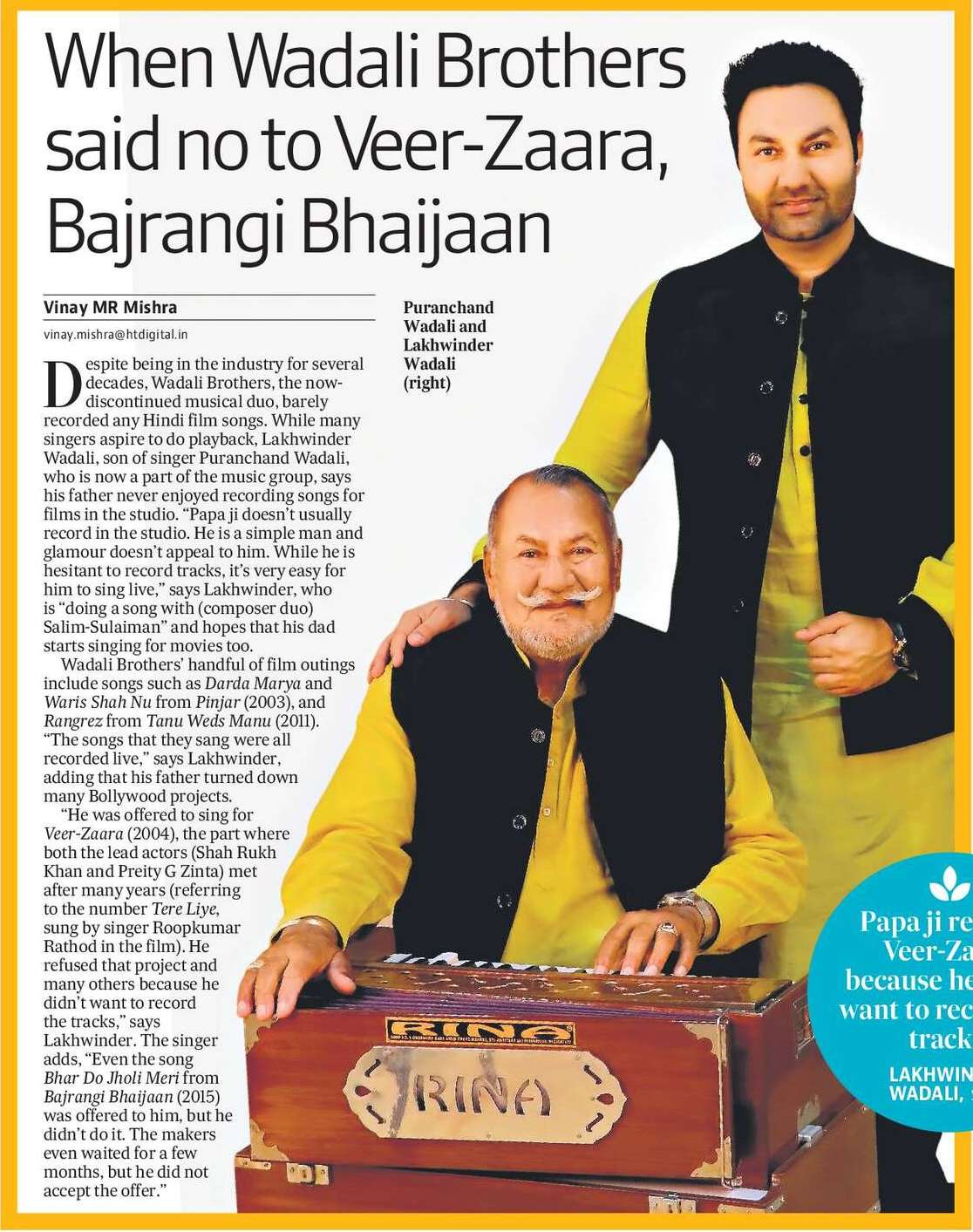
Vinay MR Mishra (HINDUSTAN TIMES; January 5, 2023)
Despite being in the industry for several decades, Wadali Brothers, the now-discontinued musical duo, barely recorded any Hindi film songs. While many singers aspire to do playback, Lakhwinder Wadali, son of singer Puranchand Wadali, who is now a part of the music group, says his father never enjoyed recording songs for films in the studio.
“Papa ji doesn’t usually record in the studio. He is a simple man and glamour doesn’t appeal to him. While he is hesitant to record tracks, it’s very easy for him to sing live,” says Lakhwinder, who is “doing a song with (composer duo) Salim-Sulaiman” and hopes that his dad starts singing for movies too.
Wadali Brothers’ handful of film outings include songs such as Darda Marya and Waris Shah Nu from Pinjar (2003), and Rangrez from Tanu Weds Manu (2011). “The songs that they sang were all recorded live,” says Lakhwinder, adding that his father turned down many Bollywood projects.
“He was offered to sing for Veer-Zaara (2004), the part where both the lead actors (Shah Rukh Khan and Preity G Zinta) met after many years (referring to the number Tere Liye, sung by singer Roopkumar Rathod in the film). He refused that project and many others because he didn’t want to record the tracks,” says Lakhwinder.
The singer adds, “Even the song Bhar Do Jholi Meri from Bajrangi Bhaijaan (2015) was offered to him, but he didn’t do it. The makers even waited for a few months, but he did not accept the offer.”
A National Award makes you forget everything wrong that’s happened in the past-Manoj Bajpayee
7:53 AM

Rishabh Suri (HINDUSTAN TIMES; March 24, 2021)
Manoj Bajpayee is no stranger to awards, and the latest addition to his list is the top recognition at the National Film Awards. He’s been named Best Actor for the film Bhonsle (2019), an honour shared with Dhanush, who won for Tamil film Asuran (2019).
Bajpayee is recovering from Coronavirus at the moment, but the excitement is palpable in his voice: “I am feeling so happy, not only for myself, but also for my director Devashish Makhija, who put all his belief and energy into it. I also feel thankful to Sandiip Kapoor, Piiyush Singh, and all the producers who have put in their energy and support. And everyone in the jury who thought if fit to give me this award.”
This is his third National Award. “Many times in the past, I felt many of my deserving films got left out, but Bhonsle getting it has completely made me forget everything I didn’t get in the past. I thank everyone,” he adds.
Asked if this award is again proof that acclaimed films such as Bhonsle are often ignored by other film awards, which usually focus on ‘commercial’ cinema, Bajpayee is non-committal. “I don’t know, these are very controversial questions. Putting one against the other is not something which is my scene. But it has happened in the past, my film Pinjar (2003) didn’t get any mention in the ‘mainstream’ awards. Getting the National Award definitely makes you forget everything wrong that has happened in the past. But why think about it? You celebrate, be thankful to the Almighty, to all the people who have shown so much belief,” he says.
Bhonsle, he shares, is more than an important film to him. “It is a mission, which has come full circle and completed its journey. It took us four years to arrange the finances, and my association with Devashish started because of this film. There were no takers in this industry. We have done it all alone, with the help of a few people like Sandiip and Piiyush, and many producers who have put little money into it. I really think this award is not only for me, but all these guys,” Bajpayee signs off.

Banning and boycotting doesn’t do any good to any industry or any society-Manoj Bajpayee
8:03 AM

The actor feels creative liberty and dissent should be respected
Kavita Awaasthi (HINDUSTAN TIMES; February 25, 2021)
With the rise in content consumption on streaming platforms, Manoj Bajpayee is not only enjoying a successful ride on the web, but is also delighted by the fact that his older films are being rediscovered by audiences.
“The respect I’ve got over the years has grown and the emergence of OTT has added to it. Today, people are looking up my films, which is quite flattering. Many of my earlier releases are getting the attention that they didn’t get when they had released in theatres. Theatres, too, didn’t give these films enough shows or slots or the respect back then. Pinjar (2003) and Kaun (1999) have been favourites with viewers and even Satya (1998) and Shool (1999). Getting compliments even after so many years, is really inspiring and encouraging,” says Bajpayee.
With his hit web show, Family Man and the ongoing OTT boom, the Padma Shri awardee is elated that actors today have so many choices but cautions that they should choose wisely.
“Don’t rush. There are many exciting, interesting and out-of-the-box stories being offered to me, but I would never do anything for the heck of it,” he shares.
As he waits for the second season of his show to drop, ask him about the recent controversy with Tandav, and how makers ended up deleting some scenes and the kind of precedence it set, and he says, “I haven’t seen the show and if the makers have done it, it depends on them. I think people should be a little patient and forgiving when it comes to creative content. If they don’t agree with something they can voice their opinion, even encourage like-minded people not to watch it, but not ask for a ban or boycott. Banning and boycotting doesn’t do any good to any industry or any society. I am not in favour of it. There are many social media posts I don’t agree with but I don’t want them to be taken off as I believe a healthy debate and discourse is a sign of a healthy democracy,” says the two-time National Award winner.
His last film, Suraj Pe Mangal Bhari (2020) released in theatres and he will soon be seen in a web original film.
How important are box office numbers to him, as OTT doesn’t quite measure a film’s popularity on that benchmark? “I believe that each film should be should be measured on the basis of quality, not on how many crores it earned. This yardstick is ruining the intention of filmmaking in India. OTT has brought in a huge change and I hope it continues to create interesting content,” Bajpayee adds.
They tried to pull me down but I am a tough nut-Manoj Bajpayee
8:08 AM

Actor Manoj Bajpayee says his career’s low phases made him stronger
Rishabh Suri (HINDUSTAN TIMES; September 2, 2020)
Padma Shri, National Awards, critical acclaim — actor Manoj Bajpayee’s journey has had several high points. But that doesn’t mean he got it all easy. Low points were aplenty, too, one such phase being after the release of Pinjar (2003). Bajpayee tells us, “When such a great film didn’t see that kind of footfall in theatres, and was not even nominated at any mainstream award functions, it put the truth right in front of my eyes. No matter what I do, or what I’ve been trying to do, these people are not going to award or recognise me, and the audience is somewhere not interested in watching my films, so I’m on my own.”
His career went “down completely” after that, but he remained focused on working hard. “I’ve used those low phases in bettering my craft and myself as an actor and person... Sometimes, I’ve done a few wrong films just to keep the kitchen going. It was a phase where I was not getting offers, but my resolve was 100%,” shares the 51-year-old, who went on to do films such as Gangs of Wasseypur (2012) and Aligarh (2016).
The star tag might have come to be attached with him, owing to his powerful performances and knack of handling both masala and independent films, but Bajpayee reveals, “They called me all sorts of things. People have done so much of back biting, tried to pull me down. Those close to me know I am a tough nut. You put a thousand people in my opposition, I’ll never be scared, rather it challenges and motivates me.”
With 26 years in the industry, and counting, the actor has witnessed several changes. “Earlier, when I’d ask for the script, they’d laugh at me and say ‘Where has this guy come from?’, but now you get scripts, contracts are signed, fee is given via cheque, shooting usually starts and ends on time. People try to stick to budgets. But, there’s still no space for independent films. When it comes to exhibition, they still struggle,” he adds.
He feels transparency needs to be implemented in that aspect. “OTT platforms are changing a lot of things... I hope things will change drastically once the pandemic restrictions are lifted. Opposition is something you have to be ready to face every time, and when you have no one, it’s better as there is no confusion in your mind. You’ve to fight it on your own; it gives you immense power,” he says.
My journey has benefitted the likes of Rajkummar Rao and Vicky Kaushal-Manoj Bajpayee
9:11 AM

Hiren Kotwani (DNA; August 5, 2018)
Patience and perseverance are among Manoj Bajpayee’s biggest strengths. After being rejected thrice by the National School of Drama, he proved to be so good at his craft that the same institute offered him a teaching position when he applied for the fourth time. Not surprising then that a majority of the roles he has played in his 24-year innings are considered memorable performances. What’s more, the two-time National Award winner has opened doors for several others and the younger generation of actors express gratitude for reaping the fruits of his labour. We catch up with the actor who will be seen next in this Independence Day release, Satyameva Jayate. Excerpts…
Apparently, it was the makers’ unanimous view that you were the best bet for the top cop’s role. What was your reaction when you heard the script?
Producer Nikkhil Advani and I had promised each other a long time ago that we would work together. I had refused his offers twice before. We’ve known each for more than two decades, since the time he was assisting Sudhir Mishra and I was struggling after Bandit Queen (1994). He was very fond of me and over a period of time, we became close friends. He is an amazing guy. When he offered this film to me, he said, ‘You’ll have to do it’. So I took it up primarily for him. The second reason is the engaging manner in which the story is told, it’s a commercial film, something I do in four-five years. So, it’s a nice break for me, it’s an action-packed movie in which people will love the dialoguebaazi and the confrontations between John (Abraham) and me.
You’ve played a cop several times before, starting with Shool (1999) to Baaghi 2 in recent times. What sets this one apart from the previous ones?
If you give the uniform to 50 people, each one of them who wears it will be different from the other. So, it’s never the uniform, but the character. DCP Shivansh Rathod of Satyameva Jayate is an intelligent cop and it goes without saying that he’s not a corrupt guy. You can’t say anything illegal when he’s around. He won’t avoid the call of duty. You can’t beat him in mind games. At the same time, he’s an easy-going man. He’s chilled out, his family takes him for granted and he maintains a healthy atmosphere in his office, too. People are scared of him, but he’s also approachable. As for Baaghi 2, DIG Ajay Shergill was a bad person. He wanted to become powerful. I did the movie for director Ahmed Khan. You can’t see till near the end that my character is the bad guy. It was about seven-odd days of work. The film is a big hit, so I’m very happy for the team.
It’s been 24 years since you began your innings as an actor. How has the journey been?
It has been a roller-coaster ride. If you come to the industry when only commercial films are being made and you expect people to make something that you want to be a part of, it’s very difficult. It hasn’t been an easy journey. It’s very difficult to be in the shoes of Manoj Bajpayee. Look at the time when I arrived in the city, look at the rejection that followed. Yes, you will definitely enjoy the success of Satya (1998), but you will definitely not enjoy the waiting for the right film after that; the waiting used to be very long. You will never enjoy getting your first home seven years after Satya. The film became a huge hit and was widely accepted and Bhiku Mhatre was acclaimed. But I have been patient. And now, it’s all paying off.
Kay Kay Menon has said that it’s thanks to you that actors like him and Irrfan got work and you opened the doors for them with Satya.
Yes, he says that. I really thank Ram Gopal Varma for all this — the manner in which he trusted me, gave me the roles and the freedom to perform them. I’m happy to have contributed immensely, as Kay Kay says, for actors to come after that. Look at the kind of films we’re making now, look at the actors who are being celebrated. You feel good about that.
Do you feel satisfied with the roles, subjects, films that came your way?
I don’t think anyone else would be more satisfied. Of the 63-odd characters I have essayed, 50 have been reviewed well and talked about till date. Whether the films were hits or flops, these are the roles I’m remembered for.
Actors who have been around for long talk about the clear difference in the kind of films they were offered initially and which they get in their later years. Do you feel the same too?
After Satya, there were only commercial films that were being made, so I was being offered villainous roles. But I said no to them. After Kaun and Shool (1999), I was offered several cop roles, and again, I refused to play them. Then Zubeidaa (2001) happened, but most of the lead roles I was getting weren’t great enough. So you’ll see that between Satya and Pinjar (2003), I did hardly one film a year. I was choosy because I didn’t want to be a part of those commercial films. When I did Aks (2001), people wondered what I was doing. Today, the film is talked about and is called as one of my memorable performances. It was the same with Pinjar. While a few people asked me why I took it up, I remember Yash Chopra ji went gaga over the film and my performance in it. You may not get your due then, but you will definitely get your due in future. Just as it’s getting paid off for me now.
You also ventured into regional films…
I did two-three films in Tamil and as many in Telugu. And I did them only at the insistence of the directors. They were admirers of my work and wanted me to be a part of their movies.
That’s because you’re a fantastic actor and they know you will add credibility to the film and the role.
I don’t know about that. Barring Happy (2006) with Allu Arjun, none of the films were commercial successes. But I had a gala time shooting with those actors and directors. I got to see a different part of India, I’ll always cherish that time and it was an amazing experience.
The internet has also opened a new avenue for shorts, web series and even films.
Definitely. Short films have changed the platform. I did shorts like Taandav, Kriti and Ouch, which forced mainstream awards to have a category for Short Films. Now, I’m doing an Amazon Original Series, The Family Man, with Raj (Nidimoru) and (Krishna) DK.
Do you feel the web has opened up at the right time or it would have been better if it had come when you were refusing lopsided villainous roles?
That’s what I tell Rajkummar Rao, and it goes for Vicky Kaushal too, that they are here at the right time and the right age. I tell Rajkummar, ‘Hamari mehnat ka phal aap ko mil raha hai’ and he agrees with me. Vineet Singh of Mukkabaaz too says, ‘Aapne jo mehnat ki hai, hum ussi ka phal kha rahe hain’.
Don’t you feel bad that you couldn’t reap the fruit of your perseverance and efforts in time? Do you think you could have done anything differently?
How different could it be? When actors like you were not accepted, today, with your perseverance, patience and hard work, you’ve created a space not just for yourself, but for other actors like you too. I feel good about myself and definitely, my journey has benefitted many.
What’s next after Satyameva Jayate?
The Family Man and Gali Guliyaan/In The Shadows. The film has been acclaimed at various film festivals across the world, earned me awards and I’m dying to show it to audiences here. Next year, there is Son Chiriya and Bhosale, of which I’m also one of the producers.
Having ventured into production, is direction also on the cards?
Let’s see... I’m still dabbling with the idea.
Subscribe to:
Posts (Atom)