Showing posts with label Pahalgam. Show all posts
Showing posts with label Pahalgam. Show all posts
Vivek Agnihotri’s film on Operation Sindoor to go on floors this year
9:08 AM

HINDUSTAN TIMES (February 21, 2026)
Filmmaker Vivek Agnihotri and producer Bhushan Kumar have come together to make a film on India’s strategic military campaign Operation Sindoor, conducted in May last year. The film will explore India’s strike back at Pakistan in the aftermath of the terror attack in Jammu and Kashmir’s Pahalgam in April of the same year.
A source close to the production confirms to us, “Yes, Bhushan Kumar and Vivek have come together to make this film on Operation Sindoor. It is in a very initial stage and they are currently in the process of finalising the cast, locations, etc.”
The source adds that the project is in its nascent phase, with work beginning this year itself: “The film will definitely go on floors this year, but since it is in the initial stages, it is tough to give the exact plan of release.”
We reached out to Vivek and Bhushan for a comment or clarification on the development, but did not get any response till the time of going to press
Hamari koshish hai ki Jammu and Kashmir mein dobara filmein bane-Omar Abdullah
8:06 AM
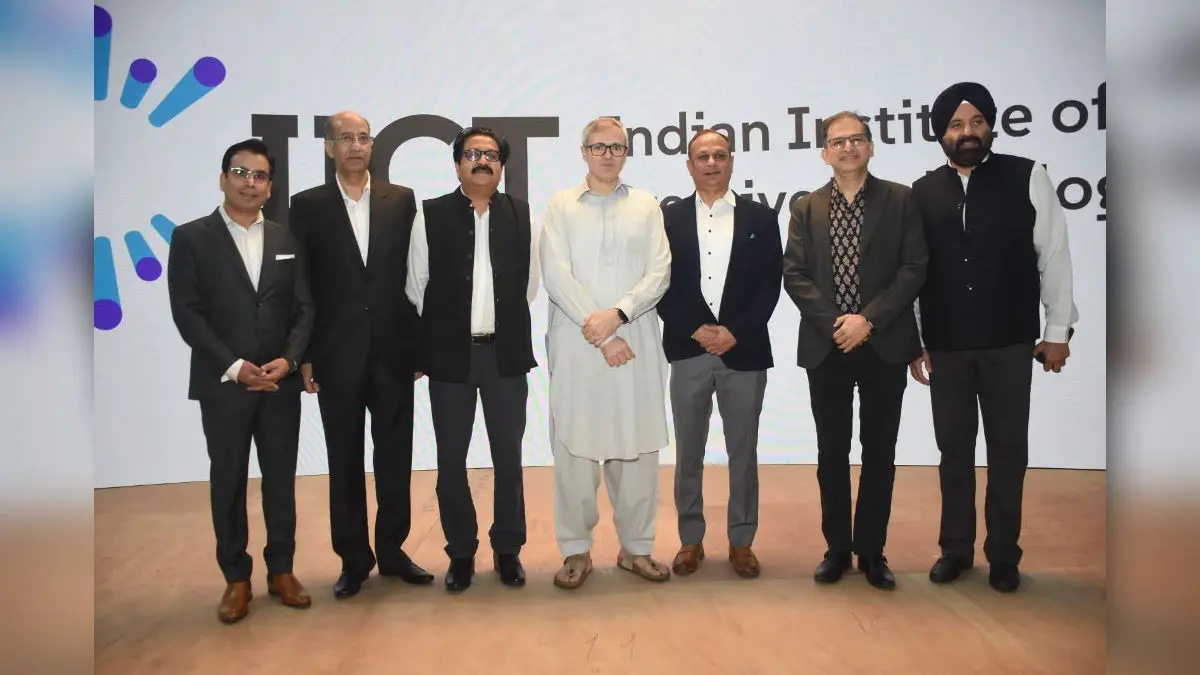
During his recent visit to NFDC campus in Mumbai, J&K Chief Minister Omar Abdullah spoke about reclaiming the Valley’s place as Bollywood’s one of the most-loved backdrop
Niharika Lal (BOMBAY TIMES; January 29, 2026)
For Hindi cinema, Kashmir has long been synonymous with snowy peaks, chinar trees and shikaras . Recently, when Jammu and Kashmir Chief Minister Omar Abdullah visited the National Film Development Corporation of India (NFDC) campus in Mumbai, he reminisced about a time when almost all Bollywood films shot at least one song sequence in Kashmir. “Uske bina film ko film nahi mana jata tha ,” he recalled.
Over the decades, films – especially song sequences – have been shot at scenic locations such as Pahalgam, Sonamarg, Gulmarg and the Baisaran Valley, a long-time favourite among filmmakers. However, last year, following the Pahalgam terror attack, film shoots came to a halt and now efforts are on to revive shoots and create infrastructure for film production in J&K.
Addressing the change, Abdullah said, “Pehle song sequences ki shooting zaroor Kashmir mein hua karti thi. Lekin haalat badal gaye. Aise halaat aaye ki wahan pe film banana hi naamumkin hua.”
‘To make J&K an attractive film destination, we need to develop infrastructure, human capital’
Talking about the plan ahead, he said, “Badalte haalat ke saath hamari koshish hai ki filmon ka jo Jammu Kashmir ke saath rishta tha, uss rishte ko hum dobara se bahaal karein. Lekin iss 20-30 saal ke arse mein film banane mein bhi bahut tabdili aayi hai. If you have to make a film where absolutely everything has to come from Mumbai, it becomes cost-wise prohibitive,” he added. “Therefore, if we want to make Jammu and Kashmir an attractive destination for film shoots, a certain amount of infrastructure and human capital has to be developed within the state.”
‘J&K ki film industry dobara kaayam ho aur apni kahaniyaan hum hi dohra sake, yeh koshish hai’
Emphasising on the revival of local cinema, Abdullah said, “Hamari koshish hai ki Jammu and Kashmir mein dobara filmein bane. Doosra, Jammu-Kashmir ka apna film industry dobara kaayam ho, kyunki hamari apni kahaniyaan jo hain, woh hum hi dohra sakte hain. Mumbai se koi aaye aur hamari kahani batana shuru kar de, woh utna hi galat hoga jitna main Mumbai ki kahani batana shuru kar doon.”
Post-2024 boost for film shoots in J&K
In recent years, films such as Ground Zero (2025) , Sam Bahadur (2023) and Laila Majnu (2018) have been shot in Pahalgam. The Jammu and Kashmir Film Policy 2024 aims to give filmmakers easier access to the region, opening up scenic areas closer to the Line of Control (LoC), including Gurez, Machil and Tangdhar, for the first time in several decades.
“A well-nurtured film industry can be a major source of wealth creation, employment generation, and an effective tool and platform for the preservation of culture and the expression of the people of Jammu & Kashmir,” the policy states.
‘Over 80% of Ground Zero was shot in Kashmir, boosting its authenticity’
The beauty of Kashmir has served as the backdrop for classics such as Kashmir Ki Kali (1964) and Kabhi Kabhie (1976), as well as more recent films like Laila Majnu (2018).
Arhan Bagati, co-producer of Ground Zero, said during the film’s release, “Initially, many locations were being discussed for the movie. My reaction was, ‘Why not Kashmir?’ – because it is a film set in Kashmir. I thought the authentic way to do the film was by shooting in Kashmir and going to actual locations. We went to the locations where the encounter happened, for instance. That authenticity can’t be created with CGI. More than 80% of Ground Zero was shot in Kashmir. The administration was extremely helpful, the LG supported it, and the J&K Police was indispensable through the entire process – not just showing us where the actual encounter happened, but also in giving us access to the locations. All that together made it an authentic film.”
Jab koi pooche tumse kya karte ho, seena thok ke kehna, desh ki raksha karta hoon-Shah Rukh Khan
9:17 AM

SRK salutes India’s soldiers, honours victims of 26/11 Mumbai attacks, Red Fort blast & Pahalgam attack at Global Peace Honours 2025
BOMBAY TIMES (November 24, 2025)
Shah Rukh Khan on Saturday paid tribute to the victims of terror attacks, and the security personnel who continue to bravely defend the country. Speaking at the Global Peace Honours 2025, SRK remembered the people who lost their lives in 26/11 Mumbai attacks in 2008, the Pahalgam terror attack in April this year and the recent blast near Red Fort in Delhi.
Talking about the resilience shown by security forces, he said, “No one has been able to stop us, defeat us or snatch our peace away because as long as this country’s superheroes, the men in uniform are guarding us, peace and security will always stay in our land. I want to salute the mothers who gave birth to such brave sons. I salute the spirit of their fathers; I salute their partners. Even though the soldiers were on the battlefield, you also fought that battle with immense bravery.”
Few lines for soldiers...
Dedicating a few lines to the country’s soldiers, SRK in his deep timbre voiced, “ Jab koi pooche tumse kya karte ho, seena thok ke kehna, desh ki raksha karta hoon. Pooche agar ke kitna kama lete ho, halke se muskurakar kehna ki 140 crore logon ki duayaein kama leta hoon. Aur agar mud ke pooche tumse ke kabhi darr nahi lagta, toh aankh se aankh mila ke kehna... ke jo hum pe hamla karte hain, unko lagta hai.”
-----------------------------------
HINDUSTAN TIMES (November 24, 2025)
Actor Shah Rukh Khan attended the Global Peace Honours 2025 in Mumbai on Saturday, where he delivered a moving tribute to victims of recent terror attacks and praised the courage of India’s security forces.
In a clip shared by ANI, Shah Rukh honoured those killed in the 26/11 attacks, the Pahalgam terror attack and the recent Delhi blast, saying, “My humble tribute to the innocent people who lost their lives… and my respectful salute to our brave security personnel who were martyred in these attacks.”
He went on to recite lines dedicated to Indian soldiers, urging people to rise above caste and discrimination and “walk the path of humanity” so that the sacrifices of the country’s heroes “are not in vain”.
The event was attended by Ranveer Singh, Sara Tendulkar, A P Dhillon, Rakul Preet Singh, Jackky Bhagnani and members of the Ambani family. A heartwarming moment from the ceremony also won the internet, showing Shah Rukh entering the stage hand-in-hand with two young girls. He bent down to receive kisses from them and hugged them before escorting them offstage, prompting fans online to praise his warmth and kindness.
An artiste may not be political but is definitely a patriot-Adnan Sami
9:16 AM

Singer Adnan Sami emphasizes the need for Indian artistes to unite against terrorism and talks about why the ban on Pakistani artistes was ‘justified’
Rishabh Suri (HINDUSTAN TIMES; September 27, 2025)
Adnan Sami is a patriot above all else. For him, the country is the first priority, even above his music. Born in Pakistan and granted Indian citizenship in 2016, the singer shares his take on the intersection of politics and art, especially in light of the ban on artistes from across the border after the Pahalgam terror attack in April.
“Politics is something else, nationalism is something else. An artiste will always belong to a country. An artiste may not be political but is definitely a patriot. You can turn around and say, ‘This artiste doesn’t conform to any political ideology’. Okay, that is understandable; you can’t force them,” Adnan tells us, reiterating, “But an artist will always belong to a country.”
The 54-year-old, who returned to playback singing with the song Bheegi Saari from Param Sundari, explains, “The nation has to come first,” adding that there’s no distinction between one’s home and country. He says, “You have to stand by the home you belong to and protect it. If people came to disrupt an artiste’s residence, wouldn’t they stand up and fight?”
Content featuring Pakistani artistes has also been banned in India, such as actor Fawad Khan’s film Abeer Gulaal. Adnan feels the move was “justified”.
He continues, “The point of the matter is right now our country, our home, has been threatened, attacked. So in that situation, we have to stand by and protect our home. We have to take a united stand. If an artiste is expecting the government to protect them, then they also have the responsibility.”
What we need right now is for all politicians to shut up for five years-Vivek Agnihotri
3:33 PM
Chandrima Pal (BOMBAY TIMES; September 4, 2025)
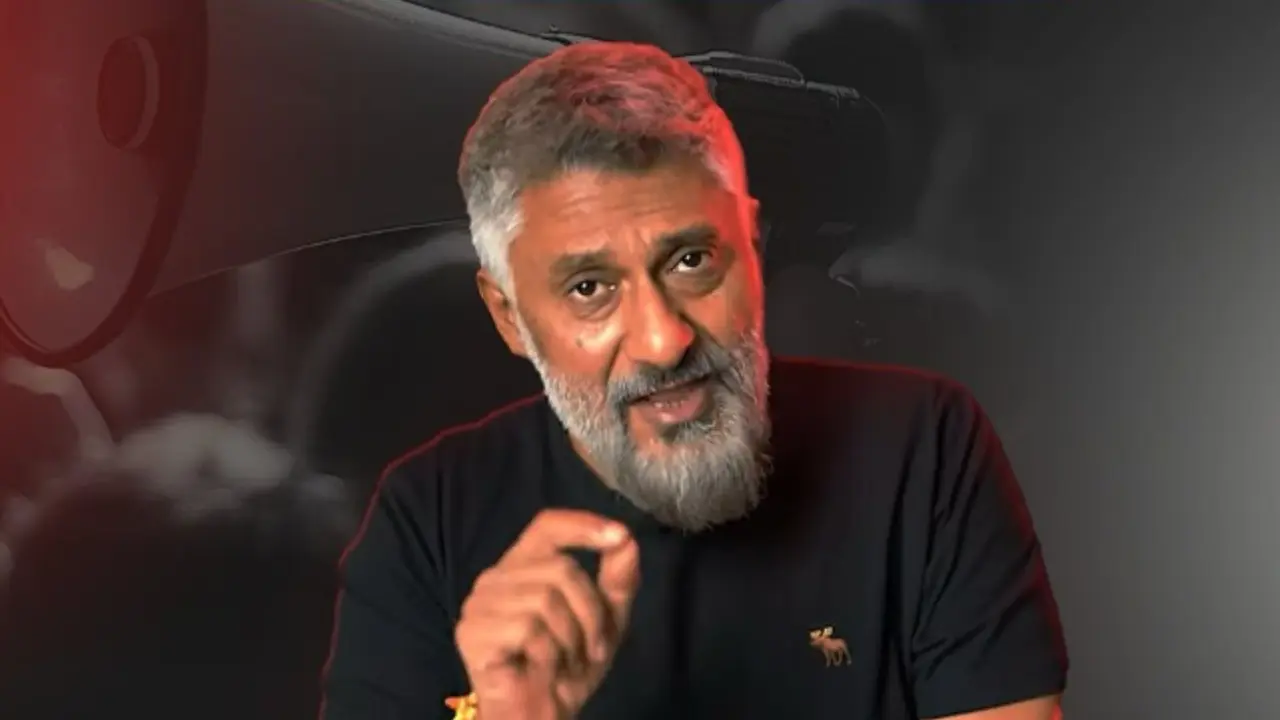
Vivek Ranjan Agnihotri likes to make all the right—pun intended—moves. Ahead of the release of The Bengal Files, the third instalment of his Files series, he picks a Bengali-themed restaurant in suburban Mumbai for an interview, tells us that he likes Kishore Kumar’s Bengali songs and settles down for a Bengali meal with shukto and fish paturi . Excerpts from the conversation.
Let us imagine you had zero opposition to The Bengal Files, which releases in theatres tomorrow. That you had no political outfit, entity or individual to name and blame in your interviews. How would you promote your film?
I would have felt suffocated. I would have failed. My idea was to pick up taboo subjects, and in my mind the problem was that even after 78 years of Independence, we are still fighting with the same problems that led to the Partition. Unless you acknowledge there is a problem there can be no healing, no solutions. The purpose, the whole objective of my movies is to start a conversation. Since the trailer has launched, everybody is writing about Direct Action Day or Gandhi’s role, they are dissecting the film. Many Bengali Hindus are now admitting that their parents or grandparents had spoken about Direct Action Day and the Partition trauma. This, I believe, marks the beginning of healing from a generational wound.
No other place has sacrificed as much as Bengal: it was the cradle of the Renaissance, the wellspring of nationalism in all its shades—Congress, communist, centrist—with both Vande Mataram and Jana Gana Mana emerging from here. Bengal gave India its cultural crown, from cuisine and poetry to cinema, the Bengal School of Art shaped by Abanindranath Tagore. For me, Bengal is India’s lighthouse. My purpose was to shock people into realising how much we’ve lost.
How can you connect Bengal’s loss of cultural and intellectual capital directly to the Hindu– Muslim conflict at the heart of your storytelling? Isn’t it too much of an oversimplification?
That’s a very deep question. Which other state in the world has been divided three times? Without Direct Action Day or the Noakhali genocide, there would not have been Partition. Gandhi himself spent seven months in Noakhali, yet afterwards Bengalis were told not to speak of their pain—silenced by political forces that wanted to take India on a different path.
Later, communist ideology took deep root in Bengal, but it viewed everything only through oppressor versus oppressed. That western lens does not fit India, where the so-called majority was ruled and persecuted by minorities for 1,200 years—our literature, music, architecture, everything was distorted. That is why, I argue, Bengal’s decline cannot be seen separately from communal fault lines.
Films have been made on the Holocaust, Hiroshima, slavery— always with a core of humanism, empathy. Many feel your films don’t address that.
First, let’s be clear—which lot of people? Viewers? Critics? I am very research-oriented. And why should I force closure when history itself has none? Lal Bahadur Shastri’s death has no closure. Kashmir still has no closure—people were killed in Pahalgam just recently. But this film does have closure. What I believe should be done, that’s the closure.
Suppose this film triggers unrest. Would your role as a filmmaker end with reopening certain chapters in history?
Look at The Kashmir Files. People warned it would cause unrest. Nothing happened. Instead, I received thousands of emails from Kashmiri Pandits saying the film began their healing process. I can guarantee Bengali Hindus will say the same after this film; they already are, across screenings in the US.
Both communities suffered losses. Isn’t everyone part of the healing process?
Of course. Healing belongs to everyone. But not everyone had the luxury of moving on. Many were forced. Did we really move on? Germany and Poland confronted their past—they outlawed Nazi glorification, built museums, preserved Auschwitz.
Should India simply say “move on”? Or acknowledge that we have a genuine Hindu–Muslim faultline—Partition, Bombay blasts, Pahalgam killings, constant election rhetoric. If America could confront slavery through films, articles, debate, why are we in India told to stay silent about our own history?
Some of the cast members of your film — Saswata Chatterjee and Sourav Das — are facing backlash for being part of the film.
What backlash? Sourav and I had lunch recently. He never distanced himself. A journalist twisted his words, and he immediately asked, “Show me my tweet, quote me if I said that.” Same with Saswata. He never disowned the film.
Saswata did say he wasn’t told the full context.
That’s media manipulation. Do you think an actor of his calibre would sign without reading the script? He has to say things to survive in Bengal. I even spoke to his family—they shrugged it off. Look, he speaks Bengali throughout, eats paturi maach, plays a Murshidabad MLA. He knew what he was doing. After Nana Patekar in Parinda, we have not had such a cold-hearted villain in our cinema.
You say there will be closure at the end of the movie. What kind of closure?
Cinematic closure. But let’s be real—I cannot close the Hindu– Muslim conflict in Bengal or India. Who am I?
You often say you listen to your audience, pick stories that people want told. There are so many other stories that need to be told.
Honestly, what India needs right now is silence. All politicians should shut up for five years. Dalit leaders, Brahmin leaders, Muslim leaders, TV anchors— everyone. Just shut down the noise. And focus only on eradicating corruption. Solve that and 90% of India’s problems vanish.
Do you have political ambitions?
I’d rather die than join politics. But yes, I understand politics deeply. My father was a freedom fighter, I’ve debated politics since childhood. That’s why I can say what I say; most filmmakers can’t.
Many filmmakers, despite festival acclaim and dealing with socially relevant issues, can’t get theatrical releases. You always manage to make controversial films and take them to your audiences. What’s your secret?
Conviction. A filmmaker must guard their work like a mother rabbit protecting her babies from vultures. Most filmmakers lack that instinct. I don’t. I fight till the end.
But is it right to say they do not have the conviction to fight for their creative freedom?
Look, if you make a film on caste, someone’s offended. On women’s persecution, men are offended. On Muslims, Hindus are offended. Everyone is offended. But cinema cannot be hostage to sentiment. Honestly, I do not understand Muslim trauma or pain. Maybe if I am born as a Muslim in my next life, I would. But I still have the right to tell stories drawn from history and testimony.
And when films like Santosh don’t make it to audiences?
Then I fight for them. I don’t know why they don’t come to me, I would be happy to fight for them. Even my ideological enemies, I defend their freedom of speech. I fought for comedians like Kunal Kamra and Samay Raina.
Would you speak up for Umar Khalid?
He’s in jail, it’s sub judice, so I won’t comment.
Gopal Mukherjee aka Gopal Patha is a complex character. North Kolkata always remembered him as one of those powerful, street-cred strongmen—like Fata Keshto.
Yes, yes. They were the fiercest. Part of the akharas, too.
Utpal Dutt wrote in Towards a Revolutionary Theatre that after Direct Action Day, leaders used people like Gopal Patha to settle political scores—a muscleman on hire. He ran a family meat business, he ate meat, he spoke Bengali, he was no saint. You have said that after this film, kids will see him as a hero. Given the ideology to which you are aligned, are you okay with glorifying a figure like that?
Why? Bengalis eat meat. What’s wrong with that? Hindus in Kerala eat beef, Kashmiri Pandits ate meat too. India is not a vegetarian country; 73% of Indians eat non-veg. To reduce Gopal to food habits or language is just superficial politics. I believe in total freedom of food, speech, lifestyle.
----------------------------------
‘I hate disclaimers. They assume audiences are stupid’
Trailers don’t need disclaimers. The film will have one, because the law demands it. I hate disclaimers. They assume audiences are stupid. Does a painting carry a disclaimer? Cinema is art. My disclaimer will be the usual: “based on true incidents, survivor accounts, historical texts… intention not to hurt anyone.” Plus the silly statutory warnings—smoking kills, animals unharmed, etc. But because Jinnah was a chain-smoker, I was forced to add two extra minutes of anti-smoking ads.
----------------------------------
‘I am a storyteller, not a social scientist’
I am nobody to find answers. I am not the Prime Minister, not a social scientist. I am a storyteller. My job is to observe and narrate, not to prescribe solutions. People expect too much from filmmakers. Journalists often ask me — why don’t you rehabilitate Kashmiri Pandits? I tell them, I am not a politician. It’s like asking Satyajit Ray after Pather Panchali to eradicate poverty. That’s not how art works.
Sardaar Ji 3's Hania Aamir casting controversy: Criticism, clarifications and a balancing act...
9:19 AM

Post the India-Pakistan conflict, Diljit Dosanjh’s Sardaar Ji 3, featuring Pakistani actress Hania Aamir, is going for an overseas-only release. The decision to release the film, even if not in India, has left some fans with a sense of betrayal. The makers and Diljit have however maintained that the film was shot before Pahalgam, and they stand with the country as much as anyone else
BOMBAY TIMES (June 26, 2025)
Before releasing any content that involves artistes from across the border, they should think twice: Mika Singh
In a statement on Instagram, singer Mika Singh criticised Diljit and wrote, “Desh Pehle (Nation First): Guys, as we all know, the relationship between India and Pakistan isn’t going well right now. Yet some people continue to act irresponsibly. Before releasing any content that involves artists from across the border, they should think twice – especially when our nation’s dignity is involved.”
He added, “There was a film featuring Fawad Khan and Vaani Kapoor that many of us opposed, and yet, some still don’t seem to get the message. What’s more shocking is that a fake singer, after doing ten shows in India with thousands of fans buying tickets, has now disappeared – leaving fans betrayed and helpless.”
‘Diljit carries the Indian flag proudly and now, that same man is being dragged down’
In a lengthy post on Instagram, CEO of Ripple Effect Studios Sonali Singh, who has been managing the artiste, wrote how “Diljit has chosen to respect the sentiments of the Indian public and authorities and is not releasing the film in India, standing in alignment with the nation’s current mood.”
Excerpts from her post: This recent wave of criticism surrounding his upcoming Punjabi film Sardaar Ji, due to the presence of a Pakistani co-star, is both disheartening and unfair especially considering the timing and the nature of the project. The film was shot long before the current political climate intensified.
What hurts the most is this: On one hand, the global media celebrates him as the first Indian to perform at Coachella, to appear on Jimmy Fallon carrying his traditional identity, to walk the Met Gala carrying his culture & roots. And every single time, he proudly carries India with him.
But on the other hand, in his own country how quickly we forget. How conveniently we celebrate him when he puts India on the map, and how easily we trash him when the narrative turns. Does anyone think this doesn’t break his heart? Does anyone imagine how demoralizing it is to fight for visibility as a brown Indian artiste on the world stage and still have to fight for belonging in India? Diljit is the same man who: Was addressed by the honorable Prime Minister as “Bharat ke gaon ka beta”, a recognition of what he truly represents. Cancelled a major US show overnight when FWICE requested knowing it would cost him crores and invite a two-year legal battle in a foreign country. He handled it all silently and respectfully, without retaliation. The damage was personal and he bore it alone. Chose to stand by his producers not to protect himself, but to protect the families behind the film.
(Diljit) carries the Indian flag on his shoulders, proudly, as he leads the wave that’s transforming India’s live entertainment economy with authenticity, humility, and unmatched pride. Helped lift regional cinema especially Punjabi onto the global map. And now, that same man is being dragged down by a manufactured storm.
‘The film was shot before Pahalgam, no Pak artiste was signed after the attack. We stand united with our country’
Sardaar Ji 3’s team also issued a clarification in a post on Instagram, stating that the film was shot before the terrorist attack in Pahalgam. “Sardaar ji 3 was shot well before the prevailing situation that our country is facing now and it was never ever the case that any Pakistani artiste was signed or was engaged after the terrorist attack in Pahalgam. We stand united with our country and our fellow countrymen during this sensitive time. Considering the same, we had decided not to release the film or any of its promotional content in India until the situation becomes opportune,” they wrote.
Jab maine film sign ki thi tab sab theek tha
Addressing the film, which is set for an overseas-only release, Diljit said in a BBC Asian Network interview, “Jab yeh film bani thi tab toh situation sab theek tha. Humnein shoot kiya tha February mein. Toh producers ne decide kiya ki film obviously ab India toh nahi lagegi, toh isko overseas release karte hain . Unka (producers) bahut paisa laga hua hai aur jab yeh film bann rahi thi tab aisa kuch tha nahi. Unke dimag mein hai ki loss toh hoga hi kyuki ek territory aap minus kar rahe ho. Maine bhi jab film sign ki thi tab sab theek tha. Ab situation hamare haath mein hai nahi. Toh bahar release karna chahte hai toh main saath hoon.”
-----------------------------------------
Controversy brews over crossborder collab as film federations, celebs demand accountability
HINDUSTAN TIMES (June 26, 2025)
Actor-singer Diljit Dosanjh is facing heat for casting Pakistani actor Hania Aamir in his upcoming film Sardaar Ji 3. With tensions high after the Pahalgam terror attack and Operation Sindoor, and a renewed ban on Pakistani artistes, calls to boycott the film and Diljit are intensifying.
The makers have clarified that the film will not release in India, and Diljit, who also co-produced it, has now broken his silence. Speaking to BBC Asian Network, he said many decisions were out of his control and backed the producers’ call for an overseas release: “Jab yeh film bani thi tab situation sab theek tha. We shot this in February... Uske baad, bahut saari badi cheezein humare haath mein nahi hai. Producers ne decide kiya ki film obviously ab India mein toh nahin lagegi, toh overseas release karte hain. Producers ka bahut paisa laga hua hai aur jab yeh film bann rahi thi tab aisa kuch tha nahin. They know there will be a loss because you’re removing an entire territory. Even when I signed the film, everything was fine. Now the situation is not in our hands. So, if the producers want to release it abroad, I support them.”
Makers issue statement
The makers of Sardaar Ji 3 have released a statement that echoes Diljit’s remarks: “This is to bring to everyone’s kind notice that the film named Sardaar Ji 3 was shot well before the prevailing situation that our country is facing now, and it was never ever the case that any Pakistani artist was signed or was engaged after the terrorist attack in Pahalgam.”
The note further read, “We stand united with our country and our fellow countrymen during this sensitive time. Considering the same, we had decided not to release the film or any of its promotional content in India until the situation becomes opportune”.
FWICE seeks strict action
“When an entire country is against that nation, you cherry-pick a Pakistani actor. You are trying to be arrogant, trying to be careless about the emotions of this country. That is why FWICE has taken note of it. Diljit has not responded and condemned what this actress [Hania] has spoken about Operation Sindoor and our country,” says Ashoke Pandit, chief advisor of Federation of Western India Cine Employees (FWICE).
Birendra Nath Tiwari, president of FWICE, disputes Diljit and the makers’ claim that the film will face major financial losses if it is not released. He emphasizes that the federation holds no personal grudge against Diljit but insists that the call for action is in the country’s best interest. He says, “Film ka foreign mein shoot hua hai, Pakistan ke 4-5 artiste hain, aur Diljit itne bade star hain, to paise to lagenge. Agar paise itne hai, to hum chanda ikatha kara sakte hai aur India se de denge. India mein bohot patriotic.”
Mika slams actor-singer
Singer Mika has called Diljit irresponsible for working with a Pakistani actor. On Insta Stories, the singer asserted that India’s interests should come first, given the strained Indo-Pak relations. He wrote, “Before releasing any content involving artists from across the border, they should think twice — especially when our nation’s dignity is at stake.”
He also referenced Abir Gulaal — starring actor Fawad Khan, which was denied a theatrical release in India amid controversy — saying it should have served as a lesson for Diljit before choosing to work with Hania.
Diljit’s former manager speaks up
Sonali Singh has defended him. Part of her Insta post read, “In a career spanning over two decades, Diljit Dosanjh has become a cultural icon not only for India but for the global stage. Yet, time and again, he has been placed under the scanner, especially as a proud Sikh, a Punjabi, and an artist who has chosen to represent India with quiet pride rather than loud declarations. Despite being repeatedly targeted, Diljit has never resorted to outrage. His consistent message in interviews, music, films, and public appearances has always been rooted in love, unity, and kindness.”
Inputs by Yashika Mathur
Diljit Dosanjh-Hania Aamir's Sardaar Ji 3 to not release in India; film bodies call for ban on Diljit
10:00 AM

BOMBAY TIMES (June 24, 2025)
Diljit Dosanjh’s Punjabi film Sardaar Ji 3, featuring Pakistani actress Hania Aamir, is going for an overseas-only release. Post the Pahalgam attack and India’s Operation Sindoor, this is the first Indian film with a Pakistani actor which is set to be released, because of which it has faced a lot of backlash online. While some fans felt “betrayed”, others were disappointed by the decision to release the film.
Amid the ongoing hostilities between India and Pakistan, Abir Guaal starring Pakistani actor Fawad Khan and Vani Kapoor was not released keeping the national sentiment in mind. Post Operation Sindoor, the social media handles of many Pakistani artistes, including Hania’s, were also blocked in India.
Won’t let them release any films or songs if they don’t apologise: FWICE
Reacting to the news of an overseas release, Federation of Western India Cine Employees (FWICE) President Birendra Nath Tiwari says, “They have time till June 27 to apologize to the film industry and the country and say that they will not release the film. If they don’t, we will not let them release their other films too, be it Diljit or the producers. We will not let them have a concert here. The entire film industry and federation will take the strictest action against them. We will give the producers of Border 2 a letter that there’s a risk if they continue to work with Diljit.”
Countries are at war, and we don’t have control over these things: Diljit
While Diljit has not directly commented on the issue, he shared a link to his interview with Panos Panay, President of the Recording Academy (which presents the Grammys), in which he says, “Countries are at war, and we don’t have control over these things. But I believe music is something that unites nations. I feel blessed to be part of something that spreads love across nations... I think we need to look beyond nations and focus on Mother Earth.”
Trailer blocked?
Diljit posted about the film’s overseas release, along with a link to the trailer. However, the YouTube trailer link leads to a message that says, “The uploader has not made this video available in your country.”
‘Stop trolling artistes, he’s not the producer’
Reacting to the trolling that Diljit is facing after he posted about the film’s release, director Onir wrote, “Fools just need a reason to troll artists especially if they are not from the majority community. They don’t know anything about film making to realise that @diljitdosanjh film was not shot, edited and ready for release in two months. Was shot much before the horrific attack and an artist once the film is shot has no right to when and where its released. The film is NOT getting released in India and he is NOT the producer to be able to stop it. So stop the ignorant narrative (sic).”
------------------------------------
Federations are voicing strong disapproval after the release of his film’s trailer featuring Pak actor Hania Amir
Rishabh Suri (HINDUSTAN TIMES; June 24, 2025)
After weeks of speculation, Pakistani actor Hania Amir’s involvement in Diljit Dosanjh’s Sardaarji 3 has officially been confirmed.
On Monday, the actor-singer dropped the film’s trailer on social media, and it seems Hania has a meaty role in the film. The move has prompted strong reactions from film bodies in particular following the terror attack in Pahalgam.
After Operation Sindoor, there has been a ban on Pakistani artistes and a crackdown on their social media profiles in India. The trailer is currently unavailable in India and the film will not release in the country, but the move to cast Hania is being seen by many as “anti-national”.
Anger is mounting among major film federations. Ashoke Pandit, president of the Indian Film and Television Directors’ Association (IFTDA), tells us, “We had written a letter to the Central Board of Film Certification (CBFC) earlier, and they refused to give it a certificate.”
He adds, “I had seen Hania’s tweets as well during Operation Sindoor. We are going to take action and tell the producers to not work with [Diljit]. He should be boycotted by music labels and Punjabi film industry. Diljit is a compulsive Pakistani lover.”
Birendra Nath Tiwari, president of the Federation of Western India Cine Employees (FWICE) echoes a similar sentiment: “Federation ne soch liya hai 100%. Jo nation ke saath nahin, woh humare saath nahin. Hum deshdrohiyon ke saath kaam nahin kar sakte. It doesn’t matter if the film is not releasing in India — they (actors) shouldn’t come to India only.”
When we reached out to the film’s director Amar Hundal, he said, “Main ispe kuchh nahin bolna chahta hoon.”
--------------------------------------------------------
Diljit se lekar film ke producers ko, sab ko ban kar denge India mein, dobara film nahin bana payenge. Jo nation ke saath nahin, woh humare saath nahin.
- B N Tiwari, President, FWICE
We are going to take action and tell producers to not work with Diljit. He should be fully boycotted in the country by music labels and Punjabi film industry.
- Ashoke Pandit, President, IFTDA
Vijay Deverakonda booked under SC/ST Act for ‘insensitive’ remarks against tribals
9:48 AM
HINDUSTAN TIMES (June 24, 2025)
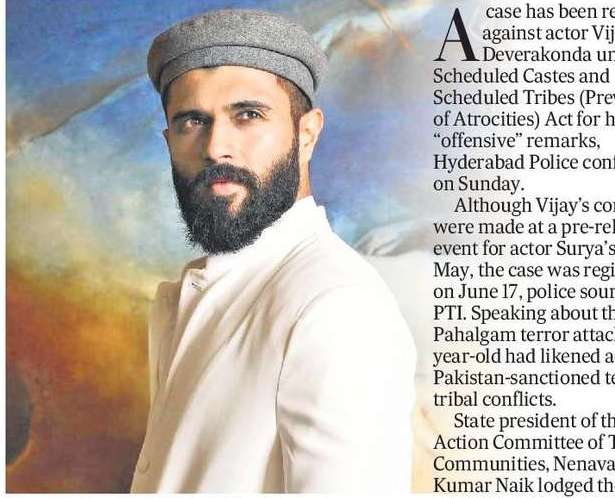
A case has been registered against actor Vijay Deverakonda under the Scheduled Castes and Scheduled Tribes (Prevention of Atrocities) Act for his “offensive” remarks, Hyderabad Police confirmed on Sunday.
Although Vijay’s comments were made at a pre-release event for actor Surya’s Retro in May, the case was registered on June 17, police sources told PTI. Speaking about the Pahalgam terror attack, the 36-year-old had likened acts of Pakistan-sanctioned terror to tribal conflicts.
State president of the Joint Action Committee of Tribal Communities, Nenavath Ashok Kumar Naik lodged the complaint, describing the comparison as “racially insensitive”.
Speaking about the attack during the event, Vijay had said, “Kashmir belongs to India, and Kashmiris are ours. India doesn’t even need to attack Pakistan because Pakistanis are fed up with their government and will attack them if this continues.” He continued in Telugu, “They behave like tribals did 500 years ago, fighting without common sense.”
Soon after, the actor apologized for his comments with a long note on X. “I wish to sincerely clarify: there was absolutely no intention to hurt or target any community,” a part of the post read.
Welcome To The Jungle delayed due to logistics, not financial crunch, says source
8:05 AM

Onkar Kulkarni (BOMBAY TIMES; June 18, 2025)
Ahmed Khan’s star-studded directorial venture Welcome To The Jungle is reportedly facing turbulent times. The multi-starrer has apparently hit a series of roadblocks, the latest being financial complications that have reportedly thrown the film’s June schedule into disarray. Featuring an ensemble, including Akshay Kumar, Paresh Rawal, Suniel Shetty, Disha Patani, Jacqueline Fernandez, Raveena Tandon, and Lara Dutta, was slated for a Christmas 2024 release. Industry insiders suggest unresolved monetary issues are at the heart of the disruption.
However, a source close to the project informed BT that things will be back on track soon. Talking about the reason behind cancellations of the shooting schedule, the source told us, “The team was supposed to begin shooting from June 7 in Kashmir. However, after the Pahalgam terror attack, the team was on the lookout for alternate locations.”
The schedule includes a major climax sequence. “It involves shooting with 200-300 horses. The team has to shoot with army helicopters, fighters and around 1,000 junior artistes. With these logistics, it was tough to relocate quickly. Also, it’s quite a task to get dates of all the main actors for the multi-starrer.”
Talking about the rumours about financial issues being the reason for the delay, the source says, “Money is not the barrier or even a speed breaker here. The shoot will commence only post monsoon in September-October. The film is 70 per cent complete. Only 30 per cent is left, which includes the climax and songs. They will get down to finishing all this soon.”
Amit Trivedi on Abir Gulaal getting stalled: "It’s always India first for me"
8:35 AM
Soumya Vajpayee (HINDUSTAN TIMES; May 24, 2025)
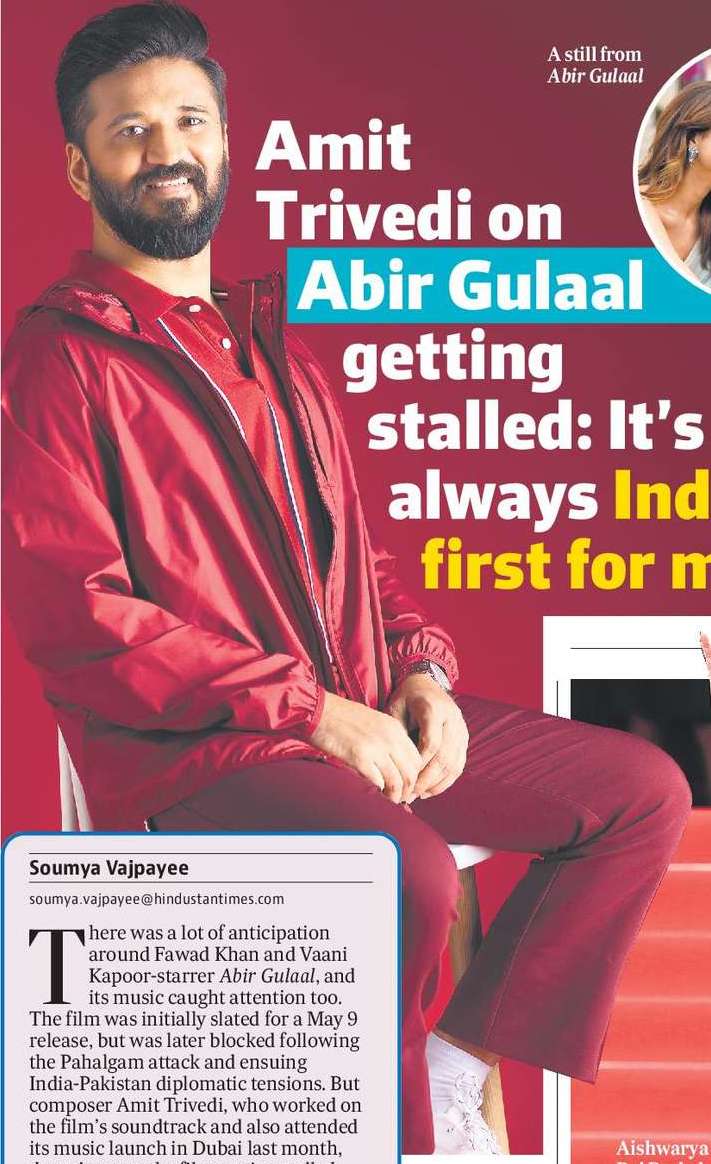
There was a lot of anticipation around Fawad Khan and Vaani Kapoor-starrer Abir Gulaal, and its music caught attention too. The film was initially slated for a May 9 release, but was later blocked following the Pahalgam attack and ensuing India-Pakistan diplomatic tensions.
But composer Amit Trivedi, who worked on the film’s soundtrack and also attended its music launch in Dubai last month, doesn’t regret the film getting stalled. “The decision [to not release it] was taken keeping India first and I am in support of it completely,” Amit tells us, exclusively.
As a music maker, who invests a lot of time and effort in putting together the soundtrack of a project, does it prick when the project doesn’t see the light of the day? “Yes, it hurts. And it’s not just about this film. I work on all my projects with a lot of honesty and hard work, and they become a part of me. So, when a project gets stalled, it’s bound to disappoint you. We make music for the audience, and as artistes, that’s all you want (your music to reach the fans). But in this case, the scenario was very different. My country comes first, above everything else,” says Amit.
Meanwhile, he is set to perform a charity concert in Mumbai tomorrow to raise funds for cancer survivors. “I associate with such causes whenever an opportunity presents itself. Cancer treatment is very expensive and this is my way of doing my bit,” he ends.

A lot of people told me ‘Aapki film mein koi masala nahin hai, koi heroism nahin hai’-Tejas Prabha Vijay Deoskar
3:16 PM
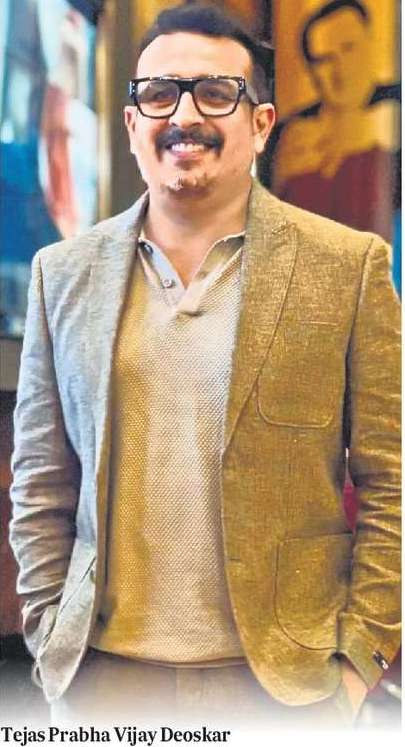
Mugdha Kapoor (HINDUSTAN TIMES; May 17, 2025)
Director Tejas Prabha Vijay Deoskar, whose latest film Ground Zero released days after the terror attack in Pahalgam last month, recalls the turmoil he felt when he heard the news. “I have seen the Kashmir where [the attack] took place. We had a screening of the film in Srinagar, just three days before this incident. Mujhe dhakka laga,” he says.
Ask if he was worried about how this might affect the film’s performance and Tejas replies, “It wasn’t mentally and emotionally possible for us to even think about our film when we heard the news. The entire team was shaken. If I start thinking about whether this will benefit our film, I’ll be finished as a person.”
Starring Emraan Hashmi, Ground Zero tells the story of Border Security Force officer Narendra Nath Dhar Dubey, who led a 2003 operation to track down Ghazi Baba, the terrorist behind the 2001 Parliament attacks.
Despite its theme, the film opened to mixed reviews and a tepid box-office response, collecting around Rs. 1 crore on opening day. “I do not take criticism as negative reviews. The audience gives unbiased reviews and I’ve only received positive messages from complete strangers,” the director reflects.
He does admit, however, “A lot of people told me ‘Aapki film mein koi masala nahin hai, koi heroism nahin hai’, but I take that as a compliment. Achcha hai na, I’m true to the subject. I wanted to make a realistic movie and not something ‘filmi’.”
Is Amitabh Bachchan’s X silence not an eccentricity, but actually a tribute?
11:09 AM
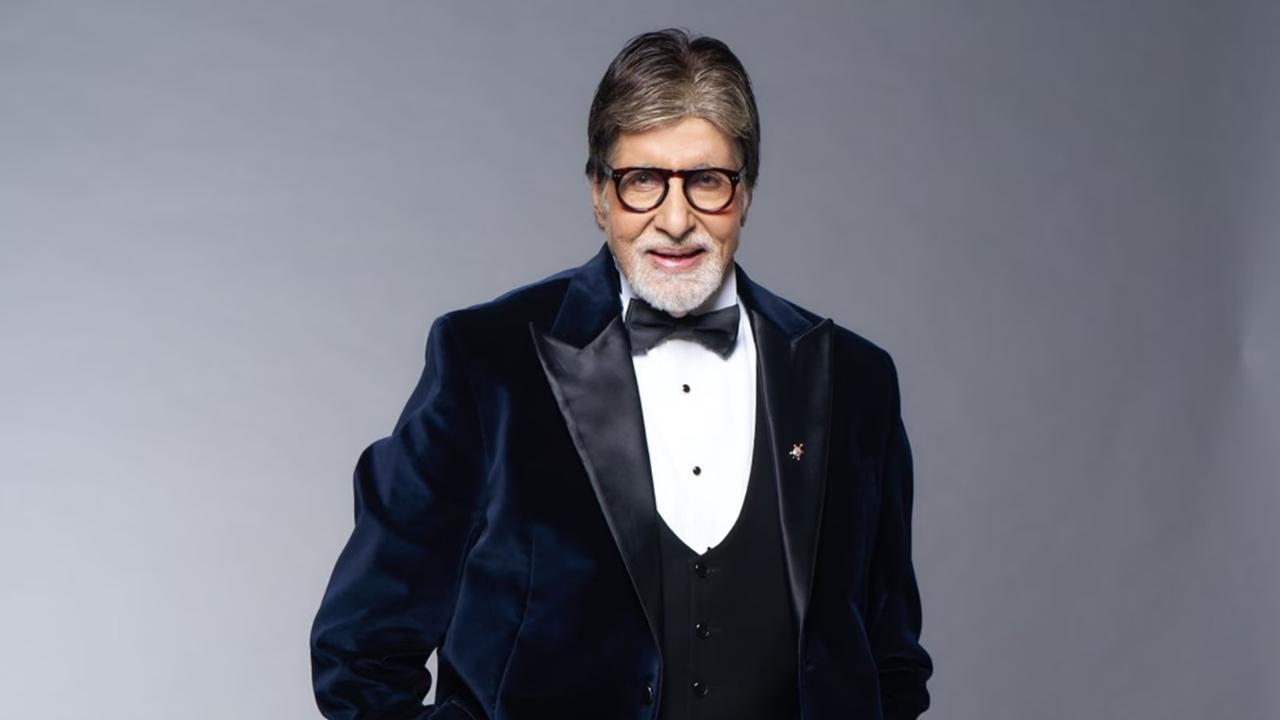
Niharika Lal (BOMBAY TIMES; May 10, 2025)
Something strange has happened with Amitabh Bachchan’s Twitter, and it hasn’t gone unnoticed. His daily tweets continue – counted, numbered, timestamped. He is still showing up, but not saying a word. While his posting schedule is intact, his comments are missing. Fans are starting to worry. “Sir, are you talking in code?” one follower asked. “Sir, you should have spoken by now,” said another. The tweets keep coming – blank, but counting. Even as memes and comments on them get thousands of engagements on social media.
So, what’s this silence about? This isn’t a glitch. A source close to Amitabh Bachchan offered an explanation – it’s grief – and it’s protest. “This new silence isn’t some kind of mood shift. It’s a protest and a statement,” says the source.
“He treats X like a personal journal. He’s really disturbed by the Pahalgam terror attack. His social media is his voice. By choosing to only document numbers, he’s protesting. And right now, he doesn’t feel like speaking. The terror attack deeply affected him,” he adds.
Bachchan’s last post where he said anything on social media was on April 22, when he wrote, “T T 5355 The Silent X chromosome.. deciding the brain..(sic)” So, while the latest run of silent, stamped tweets has puzzled some, perhaps it’s his own quiet tribute to Pahalgam.
The Royals song launch event cancelled following Operation Sindoor on Pakistan’s terror camps
9:24 AM
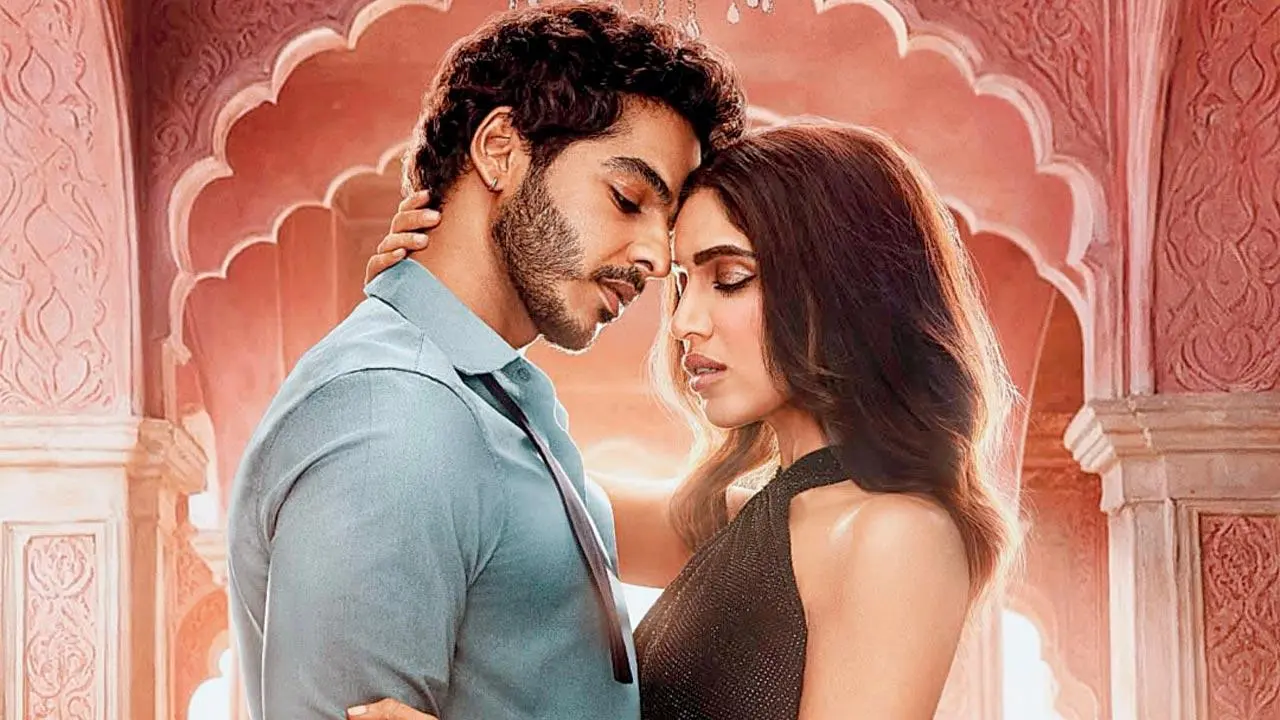
In the wake of Operation Sindoor, Netflix India cancels The Royals’ music launch, deeming it insensitive to have a grand event
Mohar Basu (MID-DAY; May 8, 2025)
In a decisive move, Netflix India, on May 7, called off the music launch of its upcoming series, The Royals. The cancellation came after India’s military launched Operation Sindoor, striking nine terror camps in Pakistan in the early hours of Wednesday. In a statement, the government said that its military had targeted “terrorist infrastructure in Pakistan and Pakistan-occupied Kashmir from where attacks against India have been planned and directed”. This comes as a response to the April 22 attack in Pahalgam.
The music launch of the Zeenat Aman, Bhumi Pednekar and Ishaan Khatter-starrer was scheduled to take place at a Juhu venue yesterday. The event was to be hosted by singer and composer duo Ruuh and Joh, with performances by Neeti Mohan, Sukriti Kakar, Jubin Nautiyal, and Jonita Gandhi, among others. Invitations had been sent out, and preparations were on in full swing before the decision to cancel was made Wednesday noon.
Sources within the production team confirm that the top bosses at Netflix India deemed it “insensitive” to host a celebratory event at a time when the nation is witnessing escalating conflict at the border, and emotions are running high in the country.
“This isn’t the right moment for glamour and red carpets. The optics of hosting a launch while the country is bracing for developments on the frontlines didn’t sit right with the team,” said a source.
While the series will drop online as scheduled on May 9, all promotional activities have been paused until further notice.
Hope the Pahalgam terror attack victims and their kin find peace-Jaspinder Narula
9:18 AM

Rishabh Suri (HINDUSTAN TIMES; April 30, 2025)
Singer Jaspinder Narula has dedicated her Padma Shri to the victims of the Pahalgam terror attack. “I was honoured on Monday in Delhi, but meri Padma Shri ki khushi aadhi ho gayi kyunki mera mann bahut dukhi tha. The incident which happened in Pahalgam recently disturbed me. I pray to God that the people who were killed, and their families find peace. I dedicate my honour to them,” says the 54-year-old.
Talking about receiving the honour from President Droupadi Murmu, she says, “Madam President remembered that she had also honoured me on April 12 at another felicitation ceremony held at the Panjab University (in Chandigarh). Waqt kam hota hai Padma Awards mein baat karne ka unse, but she did remember our last meeting.”
Ask about her career and Jaspinder, who is popular for songs such as Tare Hain Barati (Virasat, 1997) and Bumbro (Mission Kashmir, 2000), says, “Every song gave me so much gratification. I got so much love from music lovers.”
Bad people want the country to stop. We don’t want the country to stop. The country is unstoppable-A R Rahman
3:59 PM
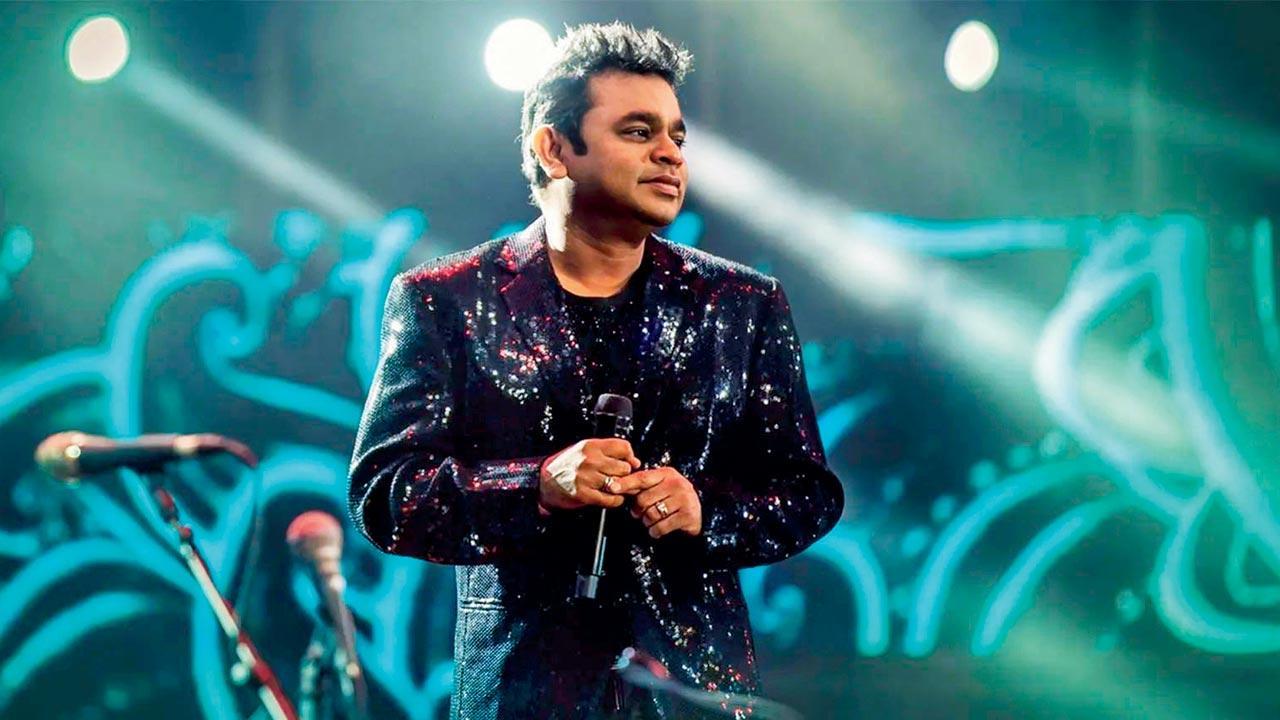
While many artistes have called off their concerts in the wake of the Pahalgam attack, A R Rahman on going ahead with his tour to show that the country is ‘unstoppable’
Komal RJ Panchal (MID-DAY; May 1, 2025)
A music studio is probably where A R Rahman feels most at home, and the stage, a close second. The Mozart of Madras is preparing to take to the stage again with his highly anticipated The Wonderment Tour, which kicks off at DY Patil Stadium in Navi Mumbai on May 3. Even for someone as shy and quiet as him, the composer and singer’s excitement is palpable, when we meet him days ahead of the concert.
We begin by asking him if he follows any dos and don’ts before getting on stage. “You need to save energy. You need to save your voice. I shut off. I meditate or try to be silent,” smiles the Oscar winner.
Tension, planning, rehearsals, sound check — all of that happens before. When it’s time to perform, the maestro turns inward, seeking stillness. But outside, it hasn’t been quiet. The country is mourning the loss of innocent lives in the recent Pahalgam attack. While many artistes, including Shreya Ghoshal and Arijit Singh, called off their concerts in the wake of the tragedy, Rahman remains resolute: the music must continue.
“Bad people want the country to stop. We don’t want the country to stop. The country is unstoppable. God willing, we will make this a success for WAVES [World Audio Visual and Entertainment Summit], for the government of India, the government of Maharashtra, and for all the people buying tickets,” he states.
But there is much noise on the work front too. Last week, the Delhi High Court ordered Rahman and filmmaker Mani Ratnam to pay Rs 2 crore for copyright infringement after their Ponniyin Selvan - Part 2 (2023) song, Veera Raja Veera, was deemed ‘identical’ to the classical composition, Shiva stuti, by the Junior Dagar Brothers. When releasing the song, Rahman and his team had attributed it to a “traditional composition created by Narayana Panditacharya in the 13th century”.
“Even at the risk of getting sued, we gave the credit, and we [got] in trouble for that. But it was worth it. It gave a new vibe to the movie,” he says, before adding, “Ultimately, we don’t want to deny any credits. If you fear everything, you can’t do good things. You need courage.”
Courage and grace underpin Rahman’s professional life. He displayed grace last year, too, as his personal life came under scrutiny when his now-estranged wife Saira Banu and he announced their separation. Did the attention on his personal life over his work get to him?
He reflects, “We are all human. Everybody goes through [difficult phases]. I went through my mother’s death, and my father’s death. It’s all part of life, and everybody has the right to express their views — but be respectful. That’s it.”
Does he ever get angry? The musician breaks into a smile at that, before saying, “Getting angry and not showing it is the art I’m learning slowly. Peace is a choice you make every morning. I want to be peaceful. I don’t want to be angry today.”
Salman Khan holds meeting in Panvel farmhouse to reschedule UK tour; likely to happen in August
3:50 PM
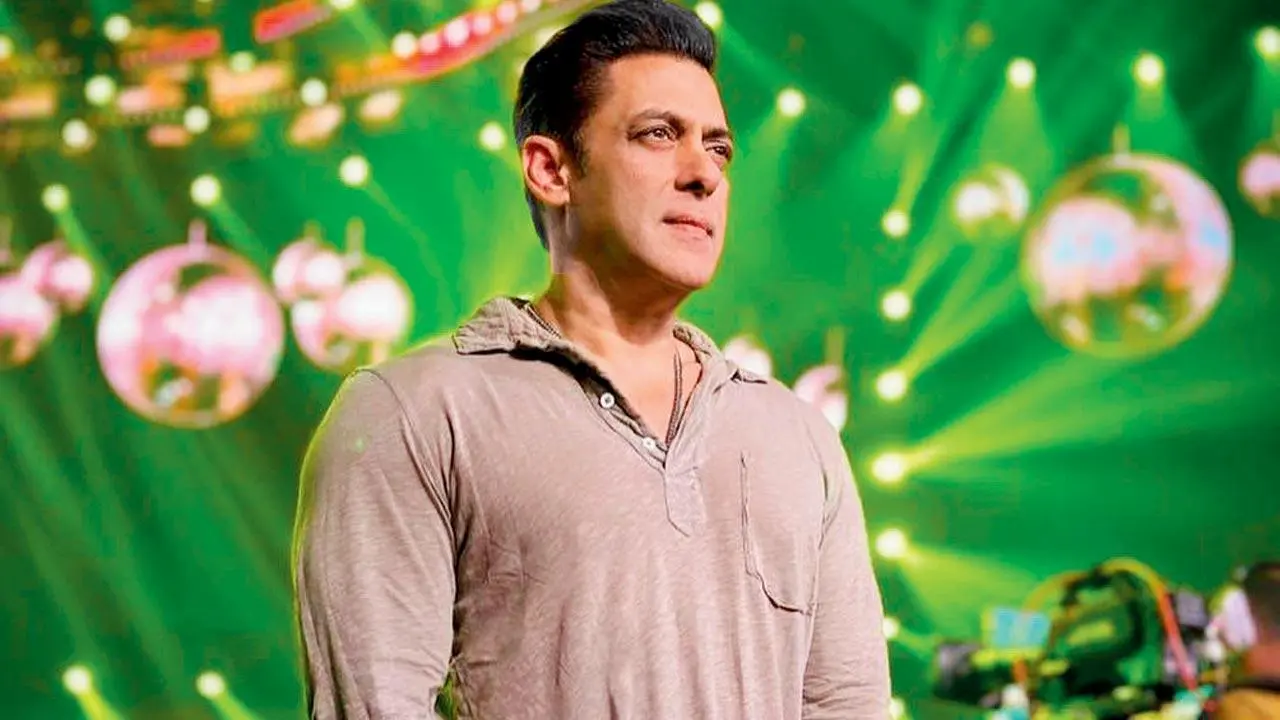
As Salman Khan postpones his UK tour in light of the Pahalgam attack, sources say the actor took the call after a long meeting at his Panvel farmhouse; shows likely to be held in August
Upala KBR (MID-DAY; April 29, 2025)
On the morning of April 28, Salman Khan announced on Instagram that The Bollywood Big One, his upcoming shows in the UK, was postponed in the wake of the terrorist attack in Pahalgam on April 22.
The superstar’s post read, “In light of the recent tragic events in Kashmir, and with profound sadness, we have taken the difficult decision to postpone The Bollywood Big One shows... We feel it is only right to pause during this time of grief.”
Scheduled to take place at Co-op Live Arena in Manchester on May 4 and OVO Arena in Wembley on May 5, the shows were to include performances by Salman, Varun Dhawan, Kriti Sanon, Madhuri Dixit-Nene, and Tiger Shroff, among others.
mid-day has learnt that the decision was taken by Salman after a long meeting with brother Sohail Khan, organisers Jordy Patel and Farhath Hussain, on Sunday.
An insider shares, “Rehearsals had begun and the shows were a sell-out. But on Sunday, Salman called for a meeting at his Panvel farmhouse, where Sohail and Jordy were in attendance while London-based organiser Farhath joined over a video call. The superstar was clear that given the tragedy the country is going through, the timing was not conducive to host such a show. The organizers understood that the move would incur losses as both the venues were sold out, and there was high anticipation among the fans as Salman was to perform in the UK after a long time. But they unanimously agreed that rescheduling the tour was the respectful and right thing to do.”
We’ve heard that the two shows may happen in August, but the final decision will be taken only later. For now, the ticket holders will be issued refunds.
When mid-day reached out to Patel, one of the organizers, he said, “It was a big event, and we had got an excellent response from the audience, but that is fine. The shows will happen only when the time is right. It may be sometime in August, but only after everything settles down. It was a decision taken by all of us as we felt it wasn’t correct to go there and perform when such a big tragedy had taken place in our country. The current sentiment doesn’t allow us to perform. The money will be refunded to the ticket holders.”
We’ve received Pakistani artistes with open arms but it’s never reciprocated-Javed Akhtar
3:28 PM
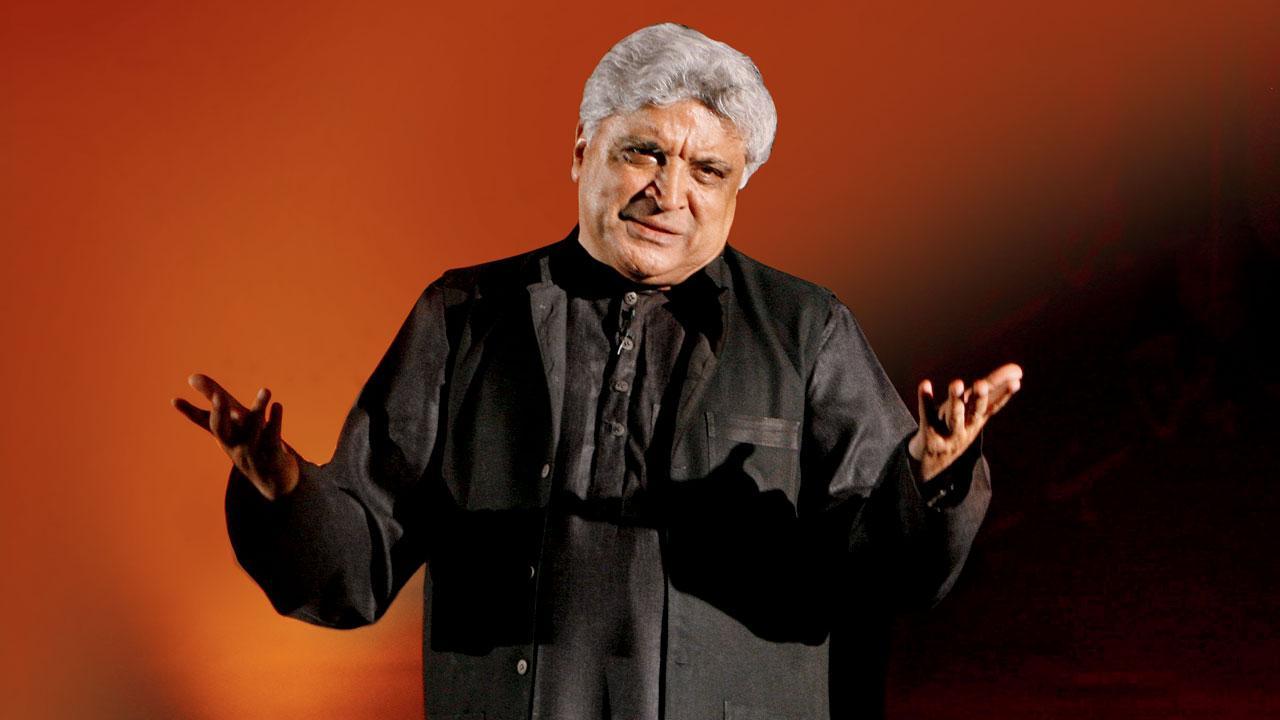
Javed Akhtar speaks on whether Pakistani artistes should work in India
BOMBAY TIMES (May 1, 2025)
In the aftermath of the Pahalgam terror attack, the debate over Pakistani artistes working in India has reignited. When asked at a recent event in Delhi whether Pakistani artistes should be allowed to work in India, Javed Akhtar said, “This could be thought about in better times, and hopefully, after some years some sense will prevail. And there’ll be a better attitude towards India from the establishment of Pakistan. And then this can be considered. But at the moment, this question should not be asked. Not possible.”
‘THE KIND OF RESPECT PAKISTANI ARTISTES GET HERE IS NEVER RECIPROCATED THERE’
Discussing the great reception Indians have always given Pakistani artistes, Akhtar referred to Faiz Ahmed Faiz. “He was the poet of the subcontinent, a poet of peace and love. When he came to India, during Mr Atal Bihari Vajpayee’s Prime Ministership, he was treated like a state head. The kind of respect he was given by the government and the way they looked after him and so on, I’m afraid, this has never been reciprocated. In the 60s and 70s, Lata Mangeshkar was, hands down, the most popular Indian in Pakistan. But why was there not a single performance of hers in Pakistan? We have received their artiste with open arms but it was never reciprocated by the establishment.” he said. PTI
‘If we block Pakistani artistes, who are we pleasing in Pakistan – the army and the fundamentalists’
Talking about a ban on artistes, he added, “If we block Pakistani artistes in India, who are we pleasing in Pakistan – the army and the fundamentalists. This is what they want – a tall wall between the countries so the Pakistani should not be able to see what kind of freedom, what kind of privilege every citizen of India enjoys. They want the distance because that suits them. This kind of bonhomie that we are working with Pakistanis doesn’t suit them at all.”
This is my Kashmir, this is my country; terrorists don’t get to tell me not to come here-Atul Kulkarni
3:18 PM

Renuka Vyavahare (BOMBAY TIMES; April 29, 2025)
At a time when tourism has taken a hit in Kashmir, noted actor, writer and filmmaker Atul Kulkarni landed in Pahalgam on Sunday – merely four days after the heinous terror attack in Baisaran valley that took civilian lives. Speaking from Pahalgam, he told Bombay Times, “I’m not shooting here. None of my films are releasing in the next three to four months, so this is not a publicity stunt. No travel agency has sponsored me either to do this. People need to know this.”
‘The terrorists are telling us, ‘If you are a tourist, don’t come to Kashmir’
In a telephonic interview, he tells us, “There’s no panic but sadness here. What happened was a horrific incident, and of course, we all are extremely sad about it. But I believe in action. Usually what happens is that we write something on social media, we talk to our friends and relatives or probably send some WhatsApp messages. While that also has its purpose, I wanted to take some action as a civilian. What more can we do beyond sharing stuff on social media? I was reading that 90% of the tourist bookings have been cancelled in Kashmir. We all know that for the past few years, tourism has been thriving here. We need to understand what the terrorists are trying to do. They are telling us, ‘If you are a tourist, don’t come to Kashmir’. So, I thought, you can’t dictate that to me. This is my Kashmir, this is my country, and you don’t get to tell me not to come here. I will come to Kashmir, and I did. Only love can defeat hate and terror. The government, the bureaucracy, what they are doing is, of course, commendable, and that will take time. We should trust the security over here, and we should come here. I thought this message can’t be given and should not be given while sitting in Mumbai. I felt if I say these things from Kashmir, then it will make sense. So, I came here.”
‘Five to ten per cent tourists are here and they are safe’
The actor further explains how this is a complex situation wherein we need to trust the governance. He states, “Terrorist and terrorism are two things. We will catch the terrorists, but what do we do with the thought of terrorism? Of course, we need to punish them. One is not saying that it should not be done, but we must also think pragmatically. Are we saying that those six people, whenever they are caught, and punished, will end the problem? Is it that simple a problem? It’s a complex thing, and when things are complex, we need to be a little bold, and we need to trust what the governance is doing. It is safe here… I’m telling you. Five to ten per cent tourists are here and they are safe. Some of them didn’t leave, and some came here, that’s courageous. We need to make this 100% and respect those 10%, who are showing this courage.”
‘Yes, money is important, but tourism is not only about money.’
Some stories floating on the internet spoke about the alleged hostility of the locals and price hike of the airlines and tourism sector. What’s the ground reality?
Atul clarified, “People need to dismiss all these notions from their mind. Meet the Kashmiris to understand them. How will you know what’s true unless you come here. Yes, money is important, but tourism is not only about money. Tourism is about people meeting each other, discovering each other’s culture. Ask anyone who has visited Kashmir in the past and they will tell you Kashmiriyat kya hoti hai. Love is the only remedy. You cannot hate and try to find solutions. I met a group of 20-25 people yesterday, who are here from Kanyakumari, and they said, ‘A few of us dropped out, but we didn’t’. A drop in tourism will hurt Kashmir, but what we risk to lose more is our connection with Kashmir. That is the purpose of this attack, that Kashmir loses its connection with the rest of India and the world. My appeal to those who have cancelled the bookings is that they should re-book themselves and those probably who had planned to go somewhere else, should also come to Kashmir, because as common people, this is what we can do to defeat terrorism.”
'Can an attack like this be executed without any local support? This sentiment is also there'
Atul will travel to Srinagar from Pahalgam before returning to Mumbai in the next two days. He says some tourist spots in Pahalgam are cordoned off for obvious reasons, but that’s just a few places, otherwise, tourists are free to roam around.
He explained, “I explored the Pahalgam market yesterday. It was completely open. I am meeting the local people, and you can see the sadness in their eyes. Can an attack like this be executed without any local support? This sentiment is also there. Even if there is local support, what is the percentage? No responsible citizen should blame local support without any verification as it’s dangerous. You are including every Kashmiri in that word, which is not the case. You cannot generalize. The families I met here were talking highly about the local people, why are we not spreading that?”
Hum filmein banate hain peace ke liye, lekin Pakistan peace maanta kahan hai-Anil Sharma
8:07 AM

Niharika Lal (BOMBAY TIMES; April 28, 2025)
"Sab ne apne-apne tareeqe se bataya hai India aur Pakistan ka conflict. Yashji had his take, Border showed it in a different way. When we made Gadar, we wanted to say, ‘mohabbat hi sab kuch hoti hai,’” shares director Anil Sharma. In the aftermath of the Pahalgam attack, the veteran filmmaker, who is also one of the original voices of the Indo-Pak conflict on screen, shares his take on how the subject has been portrayed in cinema over the years.
‘Made Gadar with the perspective of humanity’
Through his films, Anil Sharma tried to talk about the power of humanity in the face of conflict. He says, “More than 10 lakh people lost their lives during the partition – one of the greatest tragedies the world has ever witnessed. We asked ourselves, ‘When the people on both sides of the border were so alike, what was the need to create two nations?’ Most of the Muslims living in India at that time could trace their ancestry, in some way or another, back to Hindus. There was a deep sense of brotherhood. It is also true that it was said at the time that Hindus living in Pakistan will continue to live there and Muslims living in Hindustan will continue to live there. Then why did it happen that those summons came, like we showed in Gadar, that Hindus living in Pakistan must leave their homes? Why did that violence happen? It was all because of the game of power and religion – the game that kills humanity. That’s what we tried to show in Gadar. We made the film with this perspective – tread the path of humanity.”
‘Uri showed that aakrosh hai janta mein’
In Uri, the sentiments are very different from that of a Veer-Zaara. “If (Pakistan) comes to our home and kills us, like they killed a few days back in Pahalgam, toh hum kya karenge? Hum bhi ja ke ghuss ke maarenge. Aakrosh hai janta mein – Uri showed that. I showed the same long back in my film Tahalka (1992),” says the director.
‘If we have to improve our relations, we have to think of humanity’
Talking about the attack on tourists, the director adds, “What happened in Pahalgam – why did it happen? Naam puchh-puchh ke maara – matlab kya hai iska? Aur kyun maara pehle toh? Aap ye phailana chahte hain ki Hindu-Muslim mein jhagde ho? Aur ye unki political thinking hai, unke political achievements hain, woh poore ho? Hindustan aur Pakistan ke rishton ke baare mein baat ye hai ki ek baar dono deshon ki awaam soche – politicians toh politics karte rahenge, woh badlenge nahi. Ek baar sab log soche ki hum chalein insaaniyat ke raaste par. As long as we are alive, we must spread love and peace, and that is what can improve Indo-Pak relations.”
He adds, “Consider this : we are spending billions on weapons made by foreign countries and growing poorer by the day. How does that help us? If we have to improve our relations, then we have to think of humanity. I have always made films with that purpose.”
‘Yash ji’s Veer-Zaara was a reminder Aap mohabbat ke raaste chalein’
Our films have often captured the ebb and flow of the relations between the two countries. Sharma says, “How Yash ji depicted Indo-Pak conflict in Veer-Zaara was beautiful. Having survived the partition, he brought a mature perspective that was beautifully reflected in Veer-Zaara. It was a coherent, heartfelt reminder – ‘Aap mohabbat ke raaste chalein.’”
‘We never attack first. But there is a limit to our tolerance’
For those who have lost their loved ones to conflict, there can be no “anti” or “pro” Pakistan film. Hum film banate hain peace ke liye, lekin ye (Pakistan) peace maante kahan hain?,” says Sharma, adding, “Our films are out there for the world to see what really happens. India has always been a peaceful country. We never attack first. But there is a limit to our tolerance. Whenever they attack – we give them a fitting reply. They started the Kargil war, they started the 1965 war, Pulwama, the Parliament attack – and now Pahalgam too. Whenever India reacts to their violence, provocation, or war, we make films that show how peace is possible – but only when the truth is faced.”
The director adds that our films are 100 per cent realistic. “We haven’t portrayed all of Pakistan in a negative light. Several Pakistani characters in Gadar 1 and Gadar 2 were genuine and came from a place of understanding. Hum awaam ko positive dikhane ki koshish karte hain. Awaam ko kabhi negative nahi dikhate. Hum dikhate hain politicans ko negative, jo satya hai. I believe common people in every country are inherently good. Awaam bechari ko kya chahiye? Awaam ko toh keval roti chahiye khaane ko,” he says.
Pahalgam, Gulmarg, Sonamarg, Srinagar: The Kashmir you’ve mostly seen on screen
8:05 AM

Niharika Lal (BOMBAY TIMES; April 28, 2025)
For Bollywood, Kashmir has often meant snowy peaks, chinars, and shikaras. The scenic sites of Pahalgam, Sonamarg and Gulmarg are among the most frequently filmed locations in Indian cinema. Be it the likes of Roja to the recently released Ground Zero, the valley has been woven into our filmi narratives – often becoming a character in itself. Even this year, multiple productions were lined up for shoots in Pahalgam. However, in the wake of the recent terror attack in Baisaran, film shoots might be affected. We revisit the films that were shot in these scenic locales.
Talking about shooting in Kashmir, Sudhir Mishra, who shot his series Tanaav there, told us recently that people were really welcoming, “I just love Kashmiris. They are really compassionate people. The people in Kashmir are really warm, but they are also very sad, so you have to work with that rhythm. I tried to bring out the human aspect. After making Tanaav, I understand Kashmir better. I emotionally connected with Kashmir through the characters. When I direct, I have to feel the pain of the mother, the brother, the son. Conflict zones are complex.”
Speaking about films on Kashmir and how he managed to avoid controversies while making a series about the region, he says, “Most films about Kashmir are made by outsiders, and I don’t think many of them have a deep enough connection to the place in real ways. If your purpose is not to offend, and you approach things without bias – seeing things as they are – I don’t think anyone gets offended.”
‘Laila Majnu was filmed in Khilanmarg, Pahalgam, Srinagar’
The beauty of Kashmir was the backdrop for not only classics such as Kashmir Ki Kali (1964) and Kabhi Kabhie (1976), but the 2018 release Laila Majnu.
A staff member at a cinema in Srinagar says, “When we re-released Laila Majnu last year, it was houseful for months. The film has shown the culture and tradition of Kashmir. Kashmiri youngsters could relate to it, and they see the film as their own. It was shot in Nishat Bagh, Zero Bridge, Nigeen Lake, Khilanmarg and Pahalgam, and people from across Kashmir came to watch the film.”
‘More than 80% of Ground Zero was shot in Kashmir’
Arhan Bagati, co-producer of Ground Zero, shares, “Initially, many locations were being discussed for Ground Zero. My reaction was, ‘Why not Kashmir?’ Because it is a film set in Kashmir. I thought the authentic way to do the film was by shooting in Kashmir and going to actual locations. We went to the locations where the encounter happened. That authenticity can’t be created with CGI. More than 80% of Ground Zero was shot in Kashmir. The administration was extremely helpful, the LG supported it, and the J&K Police was indispensable through the entire process – not just showing us where the actual encounter happened, but also in giving us access to the locations.”
The valley through Indian cinema in the recent years
- In 2014, Fitoor was shot at Srinagar’s Dal Lake and Pahalgam
- In 2014, Alia Bhatt’s Highway was also shot in Pahalgam’s Aru Valley
- The qawwali scene of Bajrangi Bhaijaan was shot at Aishmuqam Shrine. The film’s end was shot in the Baisaran Valley
- Ground Zero was filmed across Kashmir
- Shah Rukh Khan’s Jab Tak Hai Jaan was shot in Betaab Valley, around the Lidder River, Aru Valley, and Baisaran. The Jiya Re sequence was filmed in and around Betaab Valley
- Ranbir Kapoor and Deepika Padukone shot segments of Yeh Jawaani Hai Deewani (2013) in Pahalgam
Gurez, Machil also open up for filming: J&K Film Policy 2024
In recent years, Ground Zero, Sam Bahadur, and Laila Majnu were all filmed in Pahalgam. The Jammu and Kashmir Film Policy 2024 aimed to give filmmakers easier access to the region. It opened up scenic areas closer to the Line of Control (LoC) including Gurez, Machil, and Tangdhar for the first time in several decades. “A well-nurtured film industry can be a major source of wealth creation, employment generation, and an effective tool and platform for the preservation of culture and the expression of the people of Jammu & Kashmir,” it states.
Subscribe to:
Posts (Atom)