Showing posts with label Om Puri. Show all posts
Showing posts with label Om Puri. Show all posts
I’m tired of being the 12th man-Samir Soni
8:25 AM

Samir Soni reflects on his film journey, calls for more layered roles
Tanvi J Trivedi (MUMBAI MIRROR; April 1, 2026)
After more than two decades in films, Samir Soni finds himself at a crossroads. In a recent post, he made it clear that he no longer wishes to remain on the sidelines. “I would rather quit acting than play a good brother, husband, father or any other supporting role. After waiting for over 25 years, it’s my time to play the lead now,” he wrote.
The candid admission reflects a long-building restlessness. Despite being part of notable films like the recent Khuli Kitaab and sharing screen space with some of the industry’s biggest names, Samir says his journey has often felt constrained. “How long will I continue to do supporting roles?” he asks — a question that, by his own account, has lingered for years.
One of his earliest setbacks came with his debut film, China Gate, where much of his role was cut during editing. “On the editing table, my whole role got chopped off,” he recalls. The experience, he says, set a pattern. “The worst part if anything happens on the editing table, the first thing that goes is the supporting character,” he says.
The actor remembers a formative piece of advice from the late Om Puri that shaped his understanding of the craft. “He said, ‘We are supporting actors. Our job is to support the main protagonist and antagonist, to prop up the main leads.’”
While he acknowledges this reality, he admits it can be frustrating. “There’s not that much importance given to the supporting cast. Their job is to make sure the main leads shine,” shares Samir.
Over the years, he has worked alongside stalwarts, holding his own in scenes. Yet, he feels that hasn’t translated into substantial roles. “If indeed I’m that good to stand my own against big actors, how come no one thinks of backing me with a decent character which has more depth?” he asks. Even when he delivers, he adds, the final cut often sidelines his contribution. “You’re just there to be the catalyst to move them forward.”
He sums up his career with a striking cricket analogy: “I’m like a 12th man who never gets to bat. I’ll be in every team but I never get to play a match.” Despite the frustration, Samir remains grateful for the opportunities he has had. “Not many people can boast of playing the son to Amitabh Bachchan and Hema Malini, and years later to Pankaj Kapur and Dimple Kapadia,” he says.
What he now seeks are layered, emotionally complex roles. “I like roles which have more angst, more layered, more complete,” he says, adding, “even non-lead parts can leave a lasting impact if written well.”
Being told TV actors can’t act hit me hard-Vikrant Massey
10:10 AM

(L-R) Rashmi Doshi, Rashi Agarwal, Vikrant Massey, Prathibha Kunda (Chairperson FICCI FLO Hyderabad), and Shilpa Raju
Shreya Varanasi (BOMBAY TIMES; February 9, 2026)
From television breakout to National Award-winning lead, Vikrant Massey has redefined the “outsider” success story. The 12th Fail star recently sat down with the FICCI Ladies Organisation (FLO) in Hyderabad to discuss his transition to films and the widespread acclaim following his 71st National Film Award win.
‘I was fascinated by the hustle of film sets’
Money was the reason I stepped out of my home at the age of 16. My goal then was simple – to earn for education, a home, and eventually Rs. 1 lakh a month. I grew up in Andheri Versova, where all the shootings used to happen. I was one of those kids standing in a crowd, watching Jackie Shroff, Anil Kapoor, and Sanjay Dutt shoot from the sidelines. I was fascinated by the lights, the walkie-talkies, and people running around with scripts.
‘Being told TV actors can’t act hit me hard’
Despite making a mark on TV with shows like Balika Vadhu, I faced skepticism when he transitioned to films. There was this unfortunate preconceived notion that TV actors can’t act. That was the first sting, the first jab I took on my chin. It honestly surprised me, because I felt these people didn’t know where actors like Naseeruddin Shah, Shah Rukh Khan, Om Puri, Irrfan Khan came from. Some of the greatest stalwarts came from television. Amid many challenges, one thing I always felt very strongly, and still continue to hold on to, is that what I do in front of the camera, between action and cut, is what matters the most.
‘Insider or outsider, it’s performance that matters most’
Today, with 21 years of experience, I can honestly say that people who are sitting at a certain stature are there because of the quality of work and dedication. Success doesn’t come easily; you have to work relentlessly for it. For every role, I must perform and position myself as a strong contender. Yes, there is that insider-outsider divide, but it’s only up until access.
‘The impact of 12th Fail meant a lot to me’
Vidhu Vinod Chopra sir told me very honestly, ‘I want to make a theatrical film, but OTT gives you Vikrant Massey for free — why would anyone come to see you in a theatre?’ That was brutal, but it was true. I was very lucky to be part of 12th Fail. People didn’t see the story of an IPS officer; they started seeing themselves. I would quietly enter theatres in the final minutes, sit in the last row and watch people completely immersed. Once, an elderly man sitting next to me started weeping, his chest was shaking, and he held my hand very tightly. That was the moment I realised I had done something that would last.
I don’t know how Om Raut decided to cast me as Chhatrapati Shivaji Maharaj in Tanhaji: The Unsung Warrior-Sharad Kelkar
10:54 AM
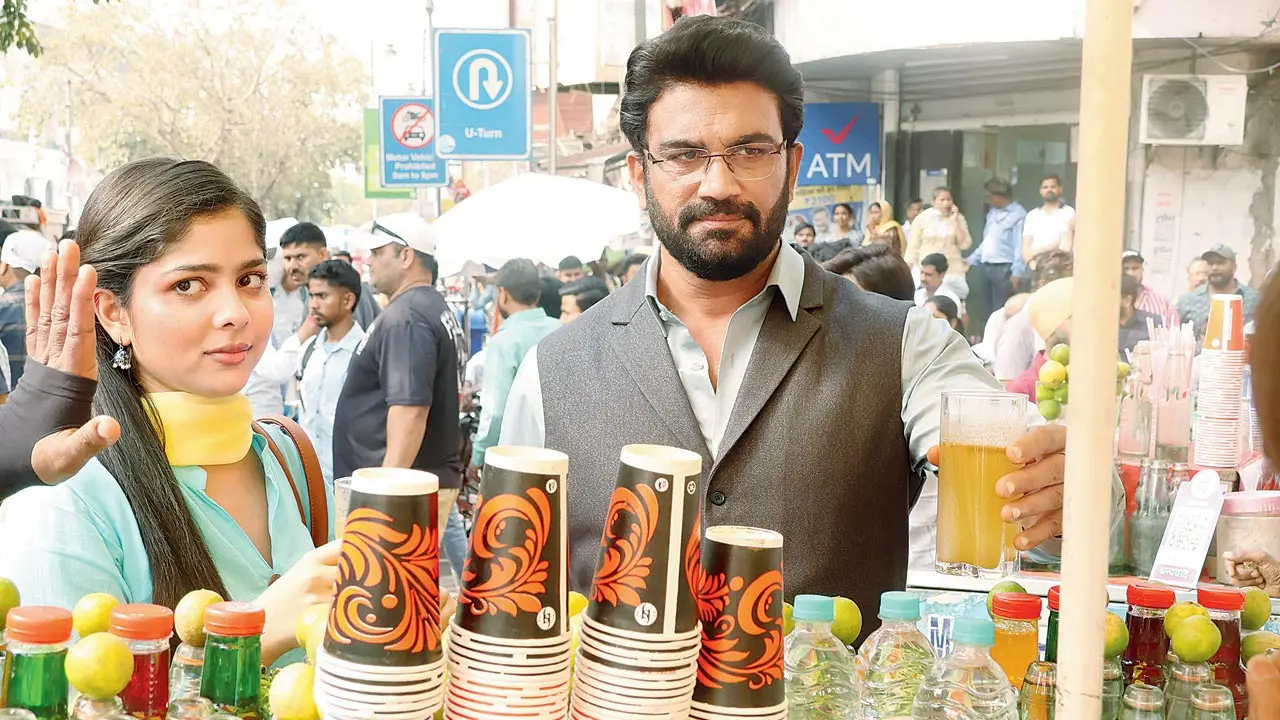
(L-R) Niharika Chouksey and Sharad Kelkar in ‘Tumm Se Tumm Tak’
Actor Sharad Kelkar argues against expecting television and film to carry social responsibility beyond their entertainment value
Letty Mariam Abraham (MID-DAY; July 29, 2025)
Acting is his forte, regardless of the character he plays. Sharad Kelkar, who returns to television after eight years, is excited to explore his romantic side — one he rarely gets to showcase onscreen. In Tumm Se Tumm Tak, the actor plays a 46-year-old business magnate who falls for a spirited 19-year-old. Ask him why, and Kelkar says it was the perfect choice for his comeback to TV. While many are surprised by the age gap between the lead characters, he maintains, “It proves that when two hearts truly connect, age is just a number.” In conversation with mid-day, he discusses his evolution as an actor, why television should be viewed purely as a source of entertainment, and why no amount of money is worth losing his peace of mind. Excerpts from the interview.
Do you ever have self-doubts about a character you are playing?
I have always strived to do things I have never done before. Of course, there are times when you end up doing similar things because the scale of the project is huge, especially in films. Sometimes, it is the story that intrigues you — even if you are repeating a character — but I try to do it as differently as possible. I’m ideally a director’s actor; I never go to the monitor to watch my shots. The director knows what he is shooting and what I’ve done, and he will tell me if it needs to be reshot. Who am I to judge? In fact, I welcome such criticism because it’s good for the project and for me.
Over the years, have you come across a director who has contributed to your growth as an actor?
It has been amazing throughout my career. Most of my roles have been unexpected — roles I never thought I would get to portray. Director Nishikant Kamat was the first to see me in a negative role when I was doing positive characters in TV shows. He offered me Lai Bhaari [2014]. If you go into the interiors, they still call me Sangram [his character in the film]. I don’t know how Om Raut decided to cast me as Chhatrapati Shivaji Maharaj in [Tanhaji: The Unsung Warrior, 2020]. Then there’s Raghava Lawrence, who chose me for Laxmii [2020]. I think I’ve been blessed to receive such different and unexpected roles.
There’s a rumour that you are the highest-paid actor on television. Is that true?
Actually, someone said that I’m the highest-paid on TV after Salman Khan and Amitabh Bachchan. Maybe in fiction shows, yes, but I still feel Smriti [Irani] would be the highest-paid actor. Rupali [Ganguly], who is doing Anupamaa, must be on the list. And Shabir [Ahluwalia] would be on the list too. However, I cannot be sure.
Is money a deciding factor for you?
It is one of the important aspects, I won’t deny it. If I am getting it, why not? When I do films, if you start doing them only for money, you may get two or three projects — then nobody will call you. Your work has to be substantial, earn that place in the industry, and be dependable. Money is still secondary. Sometimes you compromise; at times, you [demand] more if you’re in a better position. I have done a lot for friends. Money is important, but my peace of mind takes priority.
Tumm Se Tumm Tak is an adaptation of the Kannada show Jothe Jothiyali, which ran for three years. Have you committed for three years?
I haven’t seen the show. We spoke about it; the pace of our show is faster than that of the other. If people start liking it, then I may consider it. How can I decide in advance? I don’t sell my life that easily [laughs]. My contract, for now, is only for a year, which is standard policy. The show is divided into two tracks. As per the tagline, it is the meeting of two worlds. The advantage I have is that I don’t have to shoot for 20 to 25 days at a stretch. I get time to do my films, go on holiday, and spend time with my family.
There’s been a lot of talk about the age gap between your and Niharika Chouksey’s characters. Do you think such a storyline will find acceptance?
This is a fictional story. Everything should be seen from the right perspective. You cannot expect comedy from a film like Aligarh [2016]. I feel films are not meant to improve society. They are stories. They can’t be real. We are selling dreams, not [shaping] moral codes.
Any visual medium acts as an influencer, so don’t you also have the responsibility to give the right messaging along with entertainment?
Parents are spending money to send their children to school and colleges, but instead of getting influenced there, why is the onus on films, shows, and actors to guide or influence people the right way? These are just for entertainment. Inspiration should be only about the craft; the rest is fictional. I feel their perspective is wrong. How many of us would say, after watching Mirzapur, that we want to be like Kaleen Bhaiyaa? But someone who already has that instinct will obviously get influenced. We are not putting the idea there. It’s not like people started honour killings after watching movies and shows.
I was typecast as a commercial actor during my prime-Deepak Tijori
9:41 AM

Ancela Jamindar (BOMBAY TIMES; July 26, 2025)
Deepak Tijori, who was in Ahmedabad recently for the muhurat of Get Set Go, is excited about doing a Gujarati film after a long time. The Jo Jeeta Wohi Sikandar actor shares, “I did a Gujarati film (Hun Tu Ne Ramtudi) more than two decades ago. I have been watching Gujarati films and fortunately, things have changed for the better and interesting concepts are being explored. I was offered a couple of other films prior to Get Set Go, but I felt I should explore this one. Ahmedabad has changed a lot over the years, but I have always enjoyed coming here. The city has a rich culture, with the right blend of modernity, and I love the people. Whenever I am here, I never miss eating dal dhokli, which is among my favourite dishes.”
‘After almost 20 years, I am reinventing myself’
Talking about how he was stereotyped as an actor, he says, “I always wanted to do contemporary films which were out of the box, but I was typecast as a commercial actor during my prime. I grew up watching actors like Naseer sahab (Naseeruddin Shah) and Om Puri sahab, and I had a theatre background. Once, I met Govind Nihalani and asked if I could work in his films. He told me that I could never work with him as I was recognised as a highly commercial actor. This had such a big impact on me that I never approached any makers of art films, as I didn’t know how to change this perception.”
He adds, “Now, after almost 20 years, I am reinventing myself with a new look in Veena Bakshi’s Ittarr. I always wanted to do such films, the kind that Irrfan did. Once, I even met Irrfan to discuss a film on these lines, but unfortunately, it was too late. Now, I am getting opportunities to experiment. I want to do roles which suit my age and have depth. I would love to do a sequel of Jo Jeeta Wohi Sikandar with Aamir (Khan). It should be a continuation of the story. May be, we can play headmasters of rival schools.”
‘After the slump, I’m now ready with interesting films’
Recently, he was nominated for the Best Actor award at the Independent Short Awards, Los Angeles, for his short film Echoes of Us. He shares, “I wrote and acted in it as I wanted to explore something beyond stereotypical roles like playing a father or other supporting roles. I wrote this movie in English as I did not want to limit it to regional languages, as it then gets considered in the foreign language category at international film festivals, thus limiting the scope. This movie received laurels at film festivals, and I was excited to be nominated for the Best Actor award.”
While he has also directed and produced films, he says, “My passion has always been acting. But I took a step back intentionally as I was swayed into the wrong kinds of roles. I put myself in a bracket where producers did not bank on me. Once, when Bhatt sahab (Mahesh Bhatt) tried to offer me a lead role, producers said that I can’t be a hero. I idolized Sanjeev Kumar and dreamt of the kind of roles he played in films like Trishul and Sholay. After the slump, I’m now ready with interesting films. I hope directors offer me more character roles suitable for my age. I don’t want to play just a father.”
Asked about his thoughts on the OTT boom, he shares, “OTT is a haven for hidden talents and artistes who never got recognition. There are many stories that can’t be told on the big screen due to time limits, and OTT doesn’t have this constraint. It has its pros and cons. Audiences now know that even if they don’t watch a film in theatres, they can watch it on OTT after a month.”
‘I fully support Deepika Padukone’s demand for an eight-hour workday’
Recently, Deepak had supported Deepika Padukone’s decision to opt out of Sandeep Reddy Vanga’s next film due to a disagreement over working hours. He says, “I fully support her demand for an eight-hour workday because she wanted to spend time with her child. She has worked in 12-hour shifts in the past. It (working hours) should be one’s individual decision and she shouldn’t suffer because she is a mother. While there are factors like budget, time, and availability constraints, I feel these things can be managed. Earlier, actresses had to give up acting after marriage or having kids, but the industry has evolved, and we need to be more progressive.”
We are fortunate to have actors like Om Puri, Manoj Bajpayee, Irrfan Khan-Nawazuddin Siddiqui
9:38 AM
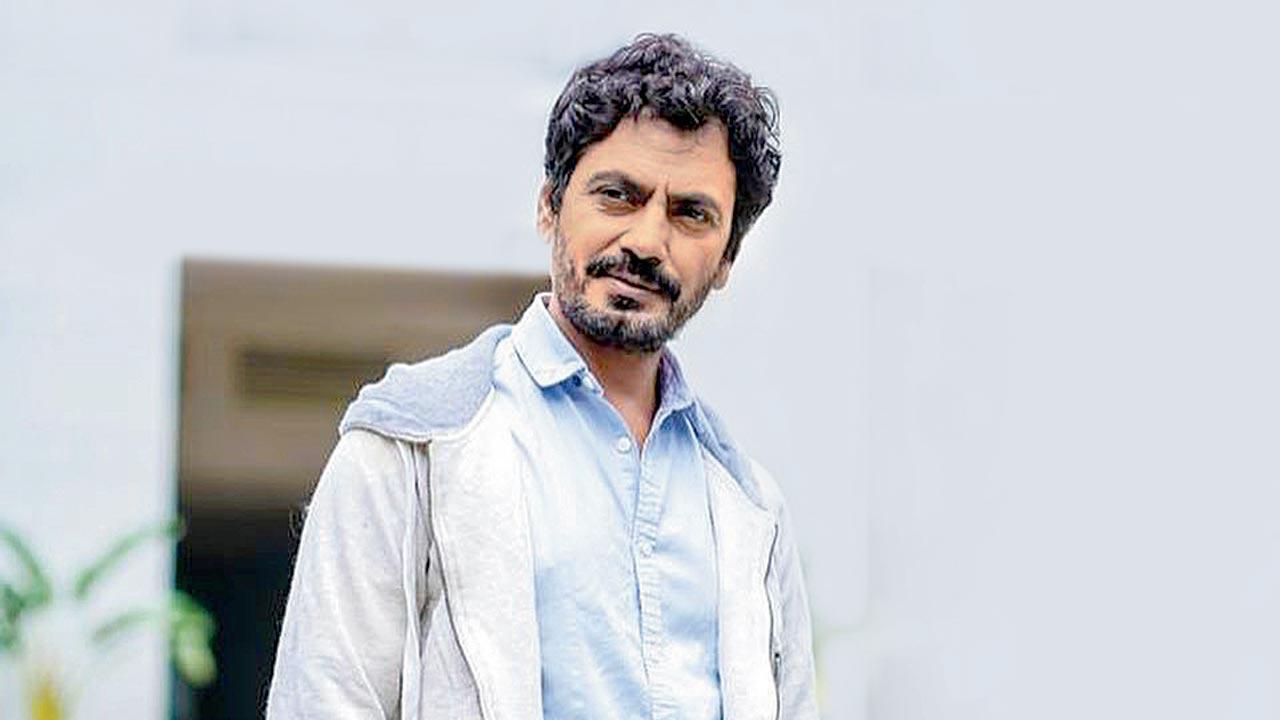
Niharika Lal (BOMBAY TIMES; June 23, 2025)
Nawazuddin Siddiqui, whose cinematic journey began in a theatre in the remote village of Budhana (Uttar Pradesh), believes that Indian cinema’s global recognition has been largely driven by independent filmmakers. With their work being appreciated in Europe, this acknowledgment, he feels, was long overdue and keeps him anchored to the kind of cinema he has always loved – from Naseeruddin Shah’s powerful performance in Sparsh (1980) to Irrfan’s in The Lunchbox (2013).
“These films, performances, and my theatre training shaped me into the actor I became,” he says. In conversation, Nawaz speaks to us about the deep impact films have had on him.
‘BERLIN HO YA CANNES YA VENICE, ITNE LOG AATE HAIN SIRF CINEMA KE LIYE’
According to Nawaz, film festivals expanded his vision of what Indian cinema could be. Sharing that he has been in screening rooms from Venice to Berlin, where audiences come for cinema, not spectacle, Nawaz says, “Berlin ho ya Cannes ya Venice, itne log aate hain sirf cinema ke liye. You go there, watch films from around the world, and then you see the ones that went from India, aur tab lagta hai ki ‘Thank God! Hamare yahan se bhi itni achhi filmein gayi hain.’ Even if they didn’t run in India, even if people here didn’t know about them – they worked globally.”
He adds, “Be it All We Imagine As Light (2024) or The Lunchbox – these films went on to become global phenomenon.”
‘OUR INDEPENDENT FILMS ARE MORE APPRECIATED IN EUROPE’
This year, Neeraj Ghaywan’s Homebound made it to Cannes. Payal Kapadia was on the Cannes jury. About the growing global recognition of Indian indie films, Nawaz says, “Indian cinema ko global level pe kisi ne crack kiya hai toh woh independent directors ne . Most of our commercial films are preferred by Indian diaspora and Middle East. But in Europe, our independent films are more appreciated.”
‘I keep going back to Dilip Kumar’s films and Naseeruddin Shah’s Ijaazat, among others’
Nawaz reveals he has always been a cinephile, drawn to movies by actors who pushed boundaries. “There are so many films I keep going back to Dev Anand and Dilip Kumar’s films, Naseeruddin Shah’s Ijaazat (1987), Om Puri’s Ardh Satya (1983), Pankaj Kapur’s Ek Doctor Ki Maut (1990). Yeh filmein main baar-baar, hazaar baar dekh sakta hoon .”
For him, it’s not genre or director, but the power of performance that links them. “It’s the actors,” he says. “Hamare country mein aise actors ka hona, yeh hamari khushnaseebi hai. Naseeruddin Shah, Om Puri, Kamal Haasan, Manoj Bajpayee, Irrfan – they’re great actors.”
“The first film I ever watched in a cinema hall was Jaggu (1975),” Nawaz recalls, adding, “I must’ve been five or six. Hamare yahan toh Shatrughan Sinha bahut hi popular thay western UP mein.”
Suniel Shetty opens up about becoming a grand dad: "Evaarah is Athiya 2.0 for me"
9:02 AM

Vinay MR Mishra (BOMBAY TIMES; April 22, 2025)
The arrival of Athiya Shetty's baby girl, Evaarah, has brought immense joy to the Shetty household, with Suniel Shetty wholeheartedly embracing his new role as a grandfather. The actor's eyes light up as he talks about the little bundle of joy, for the first time with us. "That's all Mana (Shetty, wife) and I were looking for. It is the best feeling in the world." he says.
As he settles into his new role, Suniel shares his thoughts on grandfatherhood. "It is a feeling of bliss. There couldn’t be a better or a bigger feeling than this. They always say, ‘Mul se sut pyaara (interest is far, far more exciting when you receive it compared to the capital).”
‘Now the biggest excitement in my life is my granddaughter’
With his schedule now revolving around his grandchild, Suniel, who was recently seen in Nadaaniyan, talks about managing his time with the baby. "Life is not hectic. That's the way my life was always. I work and I come back home, and I do that with a lot more excitement now. I look forward to coming back home and spending time with Mana and the baby. The biggest excitement in my life now is that child. And now I want to do everything with my granddaughter that I probably missed out on with Athiya and my son Ahan because I was constantly working. I was on call 24X7 with my work. Of course, I manage my time to the best of my ability. But today I need to do more. Evaarah is Athiya 2.0 for me."
‘The beauty of shooting for Hera Pheri after 25 years is that it doesn’t feel like it’s been so long.”
On the work front, Suniel is currently shooting for the third instalment of Hera Pheri. Ask him how it feels to reunite with Akshay Kumar and Paresh Rawal, and he says, “The beauty of that is that we never felt that it’s been 25 years. Shooting for it didn’t feel that 25 years have gone by. It's just that we are looking different and now we have different get ups, but otherwise, we're the same. Everybody is the same, right from the producer to the director. We are just going to miss Om Puri dearly. He was one of the pillars of Hera Pheri 1.”
‘Nobody else can play those characters in Hera Pheri’
The actor who reprises his role of Shyaam in the movie, doesn’t reveal much about the plot, but he adds, “Even when we were shooting, it didn’t seem like we were playing a character. Nobody else can play those characters.”
There were rumours of Kartik Aaryan stepping into Akshay’s shoes for the sequel. Bring that up and Suniel says, “Whoever else was coming in was never supposed to replace anybody. He was coming as a new character, but now the makers have gone back to the old script and it is Hera Pheri 10 times more fun”.
My friends started out with me, but raced ahead-Ira Dubey
9:16 AM

Accepting that everybody has their own career path, Bollywood actor Ira Dubey on her connection with Fatima Jinnah as she gears up for Freedom At Midnight 2
Letty Mariam Abraham (MID-DAY; February 18, 2025)
In the last decade-and-a-half, Ira Dubey has largely concentrated on acting, be it in a wide range of plays or in shows like Potluck and Scoop. But now, the actor is ready for the next step in her career—writing and direction. Will wearing multiple hats be overwhelming? Maybe. But Dubey is excited about the road ahead that will see her not only direct her first film but also return to the new season of Freedom At Midnight where she plays Fatima Jinnah, a leading women’s rights activist in Pakistan. In conversation with mid-day, she talks about life of an actor on stage, films and OTT, her love for writing, and battling self-doubt. Edited excerpts from the interview.
Does juggling writing, acting and producing a show get overwhelming?
One has to try and find [the time]. I have been a stage actor for almost 20 years. Theatre is close to my heart. I won’t ever give it up. If you had the good fortune of having theatre in your life, I don’t think you’d ever give it up for that very reason. Whether it’s Naseer [Naseeruddin Shah] sir or late Om Puri or Shabana ji [Azmi] or my mother [Lillete Dubey], some of our finest actors come from theatre and still go back to it. That’s because it’s an actor’s medium more than a film.
Are you planning to foray into direction as well?
I’ve been a festival director and I’ve directed [plays] for stage, but I haven’t helmed anything on film yet. I’m writing something that I would like to direct. The journey of writing and directing films began last year. Every time you want to try on a different hat, you become a student. I didn’t go to film school to learn directing, I haven’t assisted any directors. But then, some of the most successful directors never studied film. It can be overwhelming, but you have to strike a balance. When you live in a city with rent and bills to pay, [it becomes difficult] to sustain your writing career and enjoy yourself. I have to balance that now with finding the time to write and research.
How do you deal with writer’s block?
I don’t even know if I have experienced writer’s block. I used to enjoy writing very much when I was younger. I used to write poetry, I was a voracious reader. I used to read a book a day up to my 20s. Then, life took over and I focused more on my acting career. I moved away not only from reading, but also from writing. So, it’s like I’m opening a very old door. Writer’s block is something that you have to [go through]. It’s like that famous Robert Frost quote: The best way out is always through.
Do you battle with self-doubt?
I think all of us do. I think self-doubt is healthy in a way, and in some ways, it’s not. Again, it’s about finding out how you walk that line. I’m a perfectionist. I was an overachiever in school. It has taken me 15 years to find that part of myself. You don’t have to be the master at everything you do. It’s more about coming into your own, knowing that a lot of it is about the process, and is not result-oriented.
When did you start asking yourself these questions?
Some of it began after I lost my dad in 2015, and some I’ve always had. I went through a dark period in my 20s. It’s something I may talk about in a film someday. There are certain low periods in everybody’s life. How you deal with those and emerge out of them teaches you so many things in retrospect. Going through [a dark phase] in my late teens and early 20s, and then losing my father at 31 propelled me towards this self-awareness.
How do you view your film career?
I don’t know where I am in my film career, to be honest with you. I always quote this example—my mother started working in films in her 40s. Clint Eastwood started directing in his 70s. People’s careers have turned around in their 50s and 70s. Life is unpredictable. When I look back, there were moments in those 15 years where I have been very frustrated, wished things were different, been envious of other people and wondered why things were happening for them and not for me. I have friends who started out around the same time as me, but they’ve raced far ahead of me. I felt the pinch. But at the end of the day, the belief in yourself, your ability, and your talent are far more important because those will carry you forward.
What is the status of Potluck season 3 and Freedom At Midnight season 2?
We were hoping there will be a third season of Potluck. The second season of Freedom At Midnight will be out in August. In 2017, I was asked to do a reading of a book called Mr And Mrs Jinnah: The Marriage That Shook India. I completely fell in love with the book and acquired the rights to develop a two-season show that didn’t ever get made. I remember meeting Nikkhil [Advani] and Mira Nair [for it]; she was quite interested, but she needed time as she was working on a couple of things at the time. Just before COVID hit, I had to give it up because somebody wanted the lifetime rights and I couldn’t afford that. In 2022, Nikkhil offered me Fatima’s character in Freedom At Midnight. Nikhil’s partner, Madhu Bhojwani, had watched me in three plays and loved me in them. The role just made perfect sense. I didn’t give a damn about the fact that she had grey hair or that she was older. Fatima is an absolutely fascinating character.
I have been thrown out of films and learned about it via the press-Huma Qureshi
9:17 AM

Huma Qureshi, who features in the new edition of the thriller series Mithya, says extending a helping hand to artistes is essential considering the cut-throat competition prevalent in the industry
Priyanka Sharma (MID-DAY; November 4, 2024)
Twelve years after she made her industry debut, Huma Qureshi holds several lessons that she learned as a newbie close to her heart. Evidently then, when it came to extending support to her Mithya co-stars Naveen Kasturia and Avantika Dassani, the actor ensured the duo received the same help that she did, early on in her journey.
Recalling an incident with late actor Om Puri from the shoot of Viceroy's House (2017), she says, “We were filming a difficult scene in Gurinder Chadha’s film. It was my first international production, and I was overwhelmed. There was an emotional scene involving Om sa’ab and me. As a newcomer, I didn’t know what I could and couldn’t say. I didn’t know if I could ask for another take. Om sa’ab sensed that I was hesitating [to ask for another take], and said, ‘Gurinder, one for me.’ I looked at him, and he said, ‘Do one for me.’ It was an act of kindness. He was great, but he knew I wanted one more take. I can never forget that. A lot of people did that for me when I started out, so I try to pay it forward.”
Qureshi, who features with the actors in the new edition of the thriller series, says extending a helping hand to artistes is essential considering the cut-throat competition prevalent in the industry. In an attempt to “break the dysfunctional cycle”, she steers clear of the tendency to treat others poorly simply because she was often subjected to hostility.
“I have been thrown out of films and learned about it via the press. I keep telling myself that nobody is targeting me and that I shouldn’t play the victim card. You have to elevate your own game. However, today, I am vocal about how I feel if something wrong happens with me, even if I may not go to the media to discuss it.”
Chadha’s Mithya: The Darker Chapter follows the 2022 original drama that explored the intense rivalry between half sisters.
I would love a companion but I don’t miss out on it-Divya Dutta
7:54 AM

Divya Dutta (left) as Shabbo in with Preity Zinta in Veer Zaara (2004)
Iti Shree Misra (BOMBAY TIMES; October 2, 2024)
Divya Dutta, who celebrated her birthday recently, also completed three decades in the industry this year. In conversation with us, the actress looks back on her choices, both profession and personal, and how she is in a comfortable space in both aspects of her life.
People would wonder what category to fit me in
Starting her career in an industry known for its defined boxes — commercial cinema vs parallel cinema, the quintessential heroine vs character actors — Divya Dutta often found herself walking a path less travelled.
“People would wonder, what category do I fit into? Is she a commercial or parallel cinema actress? A heroine or a character actor?” Dutta recalls.
“But despite the industry’s initial confusion, I was determined to create my own path. 30 years later, I still get roles written for me,” she adds with a sense of gratitude. “When someone comes and says, ‘This is for you, you can do this,’ it’s the most gratifying feeling. It’s not common to be in a profession where you are exactly where you want to be, doing what you love,” she says.
There’s been a lot of ‘nos’ along the way
From playing a romantic lead to a negative character, Divya has done it all. “I was often told I couldn’t do certain roles. I was told I was too soft for negative characters. But when someone tells me I can’t do something, it becomes a challenge for me,” she says with a laugh. “There were lots of ‘no’s’ along the way,” she admits.
“People thought I was crazy for turning down the offers I got, but I followed my gut. Nobody can say I’m just a romantic heroine or a softy or a lady don. I’ve worked hard to ensure that my body of work is as diverse as possible. There was this production house that offered me a role and halfway through the narration I said no, I don’t want to do this. They asked me kya hua so I told them that I don’t think I will enjoy playing this character. They were also very sporting and accepted my decision. Now, I just say no if I don’t like a role. I don’t like any ambiguities, pretence mujhe karna nahi aata. Bahut kar li diplomacy, jab nayi-nayi aayi thi tab karti thi, but now I just like to be straighforward. Ab pyaar so bolna nahi aata hai, ab toh bas ‘chup kar, mujhe nahi karna hai’ kehti hoon. And I think I deserve it now and trust me, I have worked in better projects with the same people.” (laughs)
OTT and theatre-watching will never be in competition
With several releases lined up on the big screen and OTT, Divya feels the two can never compete. “I think OTT and theatrical releases need a good marriage, like a film released in theatres should be on OTT after 6 months. Also we need OTT for small films. A film like Laapataa Ladies had a backing of Aamir Khan Productions, 12th Fail had Vidhu Vinod Chopra backing it, so they could be marketed, publicised and released in theatres. But ab agar ek chhoti film hai, kam budget wali, woh kahan hi jayegi. So for such projects OTT is a boon. But theatrical releases will never go. In recent times we have had so many re-releases, toh woh charm to badi screen ka rahega hi,” she says, adding, “What I really feel is that we need good writers. Film chahe chhoti ho ya badi, agar story gripping nahi hai toh audience nahi dekhegi, chahe OTT pe ho, ya theatres mein. The audience these days is very clever and discerning, so we now need big names in acting only for the initial push, uske baad toh story is what counts. Content nahi, toh audience nahi.”
I don’t want any kind of toxicity in my life
Single and being very happy about it, Divya says she is very happy being by her ownself. “I would love a companion but I don’t miss out on it. I think that’s because I am very content in my space now, with all your experiences that you come with. I don’t want any kind of toxicity in my life now. When a good partner comes into my life, I think I will know. Until then I don’t want any timepasses,” says the actress who celebrated her birthday earlier this week.
“I do have a lot of male attention, but sometimes you are in that phase where you are very happy with the work that you’re doing and I think I am in that space. Also, at this stage in my life, for me what is of utmost importance is peace of mind. So when you’re peaceful in your heart and mind, then only you can give your best in any situation you are in, personal and professional. Baki I think woh completeness hum jo doosron mein dhoondte hain, I don’t think I’m in that place where I want completeness with someone. But companion most definitely. I would love to travel with someone, would love to go on these romantic outings as I am a diehard romantic. But with a very right person. I’m not wanting marriage in my life, surely. I mean I shouldn’t say no ever, but I think I will be happier with a companion. Until then, I am my best companion right now and I wouldn’t like it any other way. Maje aa rahe hain!”
Lesson for life
Dutta fondly recalled a lesson she learned from filmmaker Rakeysh Omprakash Mehra while working on the film Delhi-6. “I was playing Jalebi, a foul mouthed woman and I just couldn’t speak the dialogues because there were all these seniors in front of me. Waheeda ji, Rishi ji, Om Puri sahab and I was very hesitant in speaking like that in front of them. So after several retakes, Rakeysh finally came to me and told me, ‘Set Divya aside. She is too sweet. Think of the person Jalebi is and let her character take over.’ That advice has stayed with me.”
— Inputs by Ankita Bharti
It was Kareena who recommended me for Dev-Fardeen Khan
10:54 AM

BOMBAY TIMES (June 14, 2024)
Fardeen Khan took a trip down memory lane as his film Dev completed 20 years recently and also reminisced the memories from the sets. Directed by Govind Nihalani, the film also featured Amitabh Bachchan and Kareena Kapoor Khan.
The No Entry actor took to Instagram to share a clip featuring scenes from the film and wrote, “20 years of Dev. It was my third film with Kareena (the two also worked together in Fida and Khushi) and it was she who recommended me for the role, and I will always be grateful to her for that. Being signed by Govind Nihalani for a film with legends like Amitabh Bachchan and Om Puri was a huge endorsement for any actor. Govindji was highly respected and was known for his careful direction and powerful storytelling.”
He added, “This role gave me the chance to work on a film that was relevant and meaningful, which was rare at the time. But the greatest take away for me from Dev was getting to share the screen with Amit ji, an actor I idolize. His life and most amazing career have had a profound influence on Indian cinema and has left an indelible mark on not just me, but on every Indian. It was a once-in-a-lifetime opportunity, a true honour and an absolute privilege to work with him, making it one of the highlights of my career (sic).”
Every heroine refused Jaane Bhi Do Yaaro-Sudhir Mishra
8:17 AM

Jaspreet Nijher (BOMBAY TIMES; April 4, 2024)
Award-winning filmmaker Sudhir Mishra who is credited with critically acclaimed films like Hazaaron Khwaishein Aisi and social commentaries like Dharavi, debunks the “myth of a good time to make films.” At a discussion on the stage of a film festival in Chandigarh, Sudhir spoke about the need to make more films for the sake of promoting cinema.
“Making films is better than not making films, regardless of their outcome. The film which worked is the one only you could have made. As a filmmaker if you stop making films thinking this is not a good time, tell me, which is that mythical great time? If you come into cinema with that individualistic view, you will be in trouble, even with yourself,” he said, adding, “If you are a filmmaker, you should have 20 stories in your bag, if one is rejected you have others.”
Reflecting on the time he worked in the iconic Jaane Bhi Do Yaaro as the screenwriter, Sudhir says filmmaking was not as organized in that era. “Every heroine said no to that film at the time and the actors who were shooting for it didn’t have a better opinion either. One day on the set, Om Puri saab said, ‘ye kya likha hai tumne?’. I told him, ‘padha nai tha apne?’, and he said no. Naseeruddin Shah thought the film was a mess. At that time films got made basis personal equations, ‘tu bana raha hai film? Mein krta hun,’” he recalled.
Sudhir says despite setbacks, “I make films because that's all I know. I don't need research as I have a view on what's happened in real for subject of each of my films,” he said, adding, “Until it doesn't make me smell of the world, I don't know it's a film.”
Ask him if he considers himself a legend and he shot back, “I not a legend, because I'm not retiring. But yes, there's too much celebrityhood in this industry and people assume too much importance. All young actors of today will be forgotten in five years, because too much is happening in the world.”
15 Years of Delhi-6: How could I receive death threats for making a film about national integration?-Rakeysh Omprakash Mehra
8:17 AM

Niharika Lal (BOMBAY TIMES; February 21, 2024)
Delhi-6 won the Nargis Dutt Award for Best Feature Film on National Integration at the 57th National Film Awards in 2010. However, it was also a film for which Rakeysh Omprakash Mehra received death threats. Reflecting on the moment he learnt about the award, he wrote in his book, “Suddenly, the dark humour came back full circle: how could I receive death threats for making a film about national integration?” As the film completes 15 years, let’s take a closer look at it.
Delhi-6: What’s in the name?
During the research of the film, Rakeysh Omprakash Mehra and scriptwriter Kamlesh Pandey were walking in the lanes of Old Delhi and encountered a street fight.
Pandey, who stayed as a guest at Mehra’s Old Delhi house for a month, told us, “While roaming in the bylanes of Old Delhi, we spotted a 14 or 15-year-old boy getting cornered by other boys. They were about to hit him, when he said, ‘Haath na lagaiyo, Delhi-6 ka launda hoon main’. I loved that attitude! That’s when we changed the film’s title from Monkey Man to Delhi-6. Delhi-6 isn’t just a pin code of the Walled City; it is an identity.”
‘The characters are based on real people from Old Delhi’
Most of the characters in the film are based on real people. Pandey said, “Do bhai jinhone deewaar toh khadi kar li beech mein, lekin taana sunaate hain deewar ke paas se (referring to characters played by Om Puri and Pavan Raj Malhotra). Woh dono saath mein drink nahi karte thay lekin dono do glass rakhte thay. I met these two brothers in Old Delhi. We have included everything that Old Delhi residents do.”
The Venice Cut of Delhi-6
The film didn’t perform well at the box office in India. But six months after Delhi-6 released, Mehra and his team spent three days shooting a new beginning and modifying the ending.
In the new version, they retained what was in the original script so the audience would know from the beginning that Roshan (Abhishek Bachchan’s character) would die. The new version went to the Venice International Film Festival, where it got a late night slot in the main theatre.
DID YOU KNOW?
- Two climaxes were shot for the film: one in which Abhishek’s character Roshan dies as mob lynches him and another in which he survives.
- The pigeon, Masakali, wasn’t in the script initially. “(A R) Rahman kept humming Masakali, and made me hear the track in the middle of the night. After which, I added the pigeon Masakali to the script,” says Mehra
- The film premiered at the Museum of Modern Art (MoMA) in New York
- Samir Chanda received the National Award for best production design for his re-creation of Old Delhi
- Scriptwriter Kamlesh Pandey met many girls in Old Delhi who would leave home in salwar-kameez and change clothes after leaving the area, Sonam’s character, Bittu, took inspiration from that
—With excerpts from A Stranger In The Mirror
---------------------------------------
Every actor has that one song that makes them a star. For me, it was Masakali. Even after so many years, I am remembered as Masakali
- Sonam Kapoor
I've always found old Delhi to be a microcosm of India. It's as if India has shrunk, and everything that's in India has been placed within the Walled City. And that was my whole mindset as we were writing and filming Delhi-6. It's my favourite film, my favourite child.
- Rakeysh Omprakash Mehra
There were too many challenges in shooting at the real location. So, we created sets in Sambhar near Jaipur and filmed there. From signboards, havelis and lanes to even posters on the walls - everything was a replica of what we saw in old Delhi
- Nitin Wable, art director

"Lakeer ke fakeer mat bano": Pankaj Tripathi's advice to young actors
7:56 AM
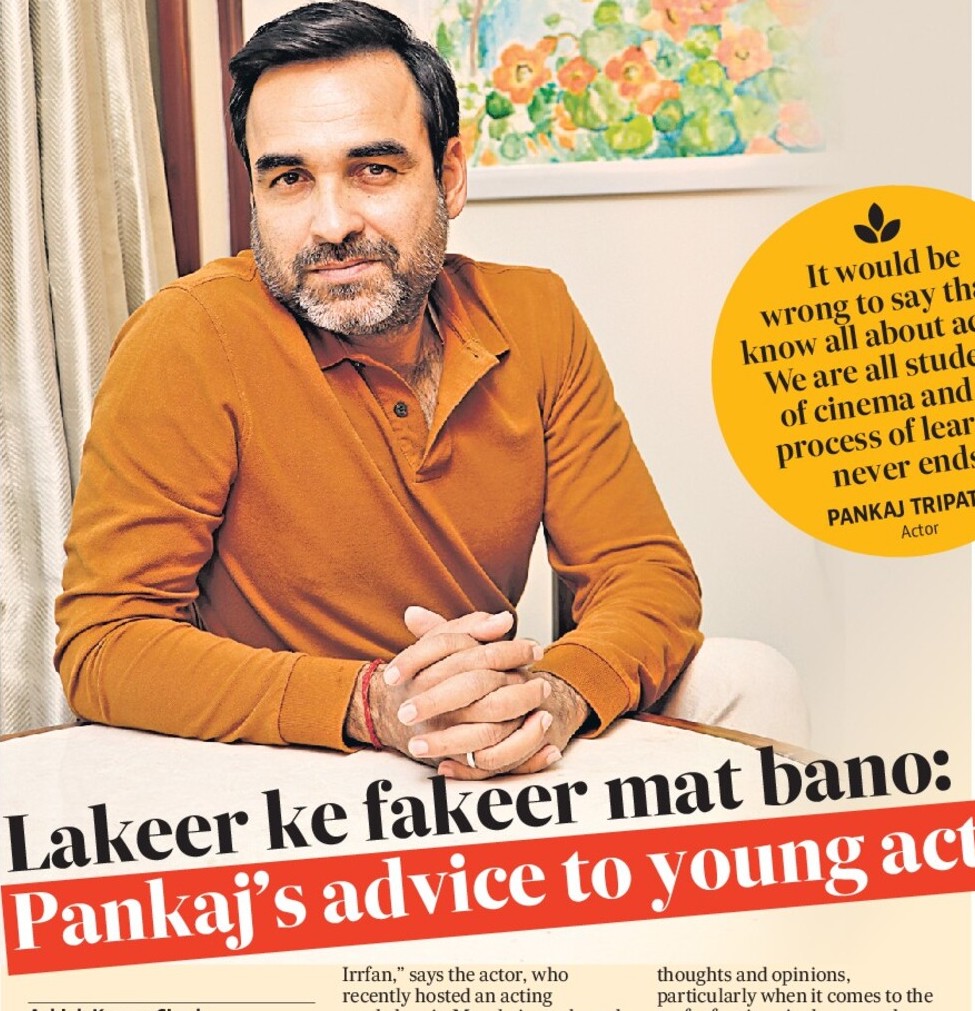
Actor Pankaj Tripathi talks about the essentials of the craft that every budding artiste must know
Ashish Kumar Singh (HINDUSTAN TIMES; December 30, 2022)
Actor Pankaj Tripathi never misses a chance to remember and thank the industry veterans who have helped him hone his craft. “I’ve taken acting lessons from many seniors, such as (actors) Naseer Sahab (Naseeruddin Shah), Manoj Bajpayee, Piyush Mishra, the late Om Puri sir and Irrfan,” says the actor, who recently hosted an acting workshop in Mumbai, conducted by his teacher from National School of Drama, Delhi.
“As actors, we barely get to revisit the basics of acting. The whole purpose of the workshop was to brush up on the skills and revisit the art,” he tells us.
Tripathi, known for his roles in Mirzapur and Mimi (2021), doles out some advice for budding actors: “Lakeer ke fakeer mat bano. Don’t be rigid with your thoughts and opinions, particularly when it comes to the craft of acting. And, ensure that glamour and success are not the sole purpose of doing it.”
The 46-year-old feels that actors must constantly evolve and unlearn. “It’d be wrong to say that I know all about acting. We are all students of cinema and the process of learning never ends,” shares Tripathi, who will be seen in the film OMG 2 and season three of the web show Mirzapur soon.
Om Puri’s swansong Khela Hobe gears up for a theatrical release on June 24
8:15 AM
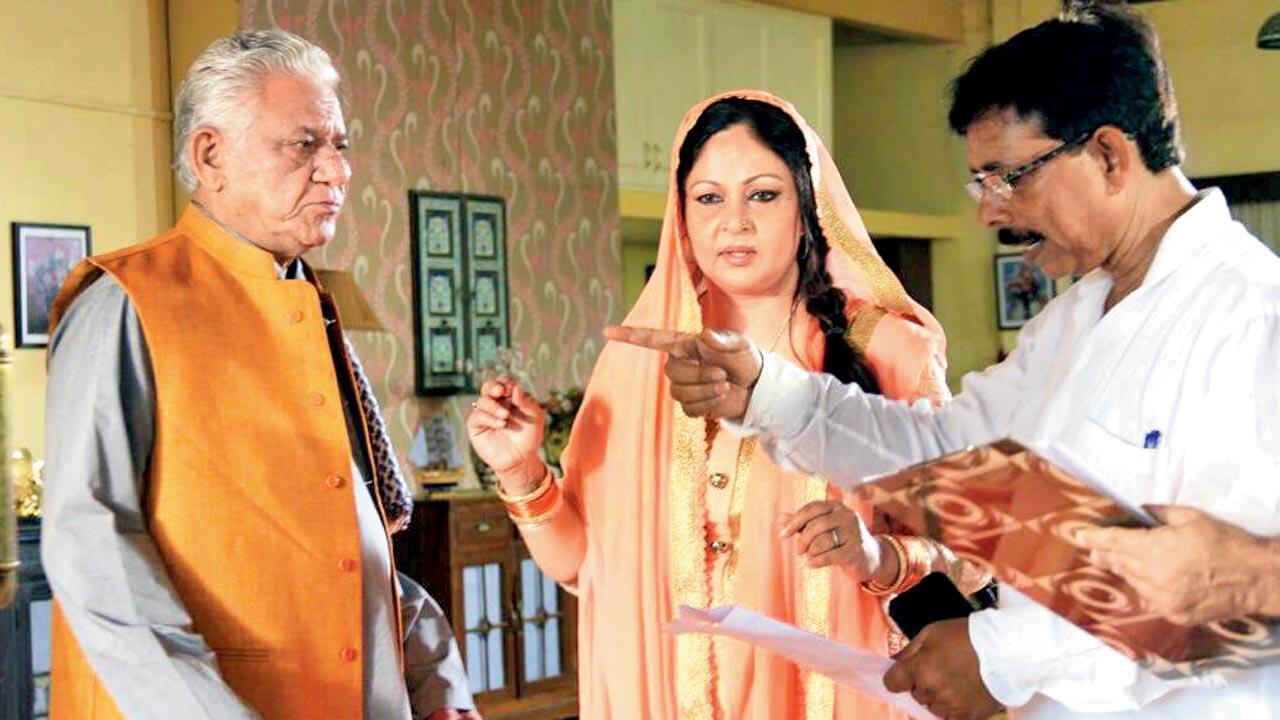
Om Puri with Rati Agnihotri and Sunil C Sinha
As Om Puri’s swansong Khela Hobe gears up for theatrical run, director says the movie was ready since 2019-end
Uma Ramasubramanian (MID-DAY; June 1, 2022)
Over five years after his demise, Om Puri’s swansong Khela Hobe is gearing up for release. Director Sunil C Sinha’s movie tapped into the late actor’s humorous streak, depicting him as a leader who contests elections for several years unsuccessfully, believing that he has the public’s support.
Though Khela Hobe rolled in 2016, it was stuck in the cans for the past six years. Asked about the inordinate delay in the movie’s release, Sinha says, “We had completed post-production by the end of 2019. But due to the pandemic, we were unable to release the film in theatres.”
The project, also starring Rati Agnihotri and Mugdha Godse, is now slated to hit the marquee on June 24. The makers recently took the film to the Central Board of Film Certification (CBFC), which greenlit it, save for one change.
The writer-director says, “In the film, Om ji’s rival is a woman. The censors objected to a scene that saw him abusing her. We had to remove the dialogue.”
I was just not looked at, maybe because I was Naseeruddin Shah’s wife-Ratna Pathak Shah
8:27 AM

Titas Chowdhury (HINDUSTAN TIMES; April 11, 2022)
Actor Ratna Pathak Shah, who has been part of critically acclaimed films such as Mandi (1983) and Mirch Masala (1987), says that besides being part of the commercial cinema space, star system also penetrated the art film circuit back in the day. And that, she believes, is what kept her from working frequently: “Our filmmakers weren’t adventurous when it came to casting. They always chose the ones who grabbed eyeballs. In art cinema, it was all about Naseeruddin Shah (husband), Om Puri, Shabana Azmi and Smita Patil.”
Shah rues the dearth of opportunities for her other contemporaries, too: “It was much later that (actors) Pavan Malhotra and Pankaj Kapur got the parts they deserved. Supriya (Pathak; actor and sister) never got the parts she deserved. And I was just not looked at, maybe because I was Naseer’s wife, and they thought I was not interested in working. Thankfully, that’s done with and dusted.”
The Thappad (2020) actor heaves a sigh of relief, as she’s getting to work at a time when most people have retired. “My skill has improved in the last 20 years. Maybe that’s why I’m getting the kind of roles that you see me doing,” Shah ends.
I was a misfit in the film industry; I was every director’s nightmare-Somy Ali
8:24 AM

The former actress who quit showbiz in the late 90s, and went back to her home in the US, in a rare interview, opens up about her brief Bollywood career, her teenage love Salman Khan and finding a new purpose in life through her social work
Harshada Rege (BOMBAY TIMES; February 8, 2021)

At 16, you came from Miami to Mumbai in pursuit of love. Looking back, does it feel like it was one of those reckless teenage acts?
It was 1991 and I was 16. I saw Maine Pyar Kiya, and I went, “I have to marry this guy!’ I told my mom that I am going to India tomorrow. She, of course, sent me off to my room, but I kept pleading that I have to go to India and marry this guy — Salman Khan. That night, I had a dream that I have to go marry Salman because he is going to be my saviour. Since she wouldn’t relent, I called my dad. Of course, I didn’t tell him why I wanted to visit India.
I told my dad that we have relatives in Mumbai and I wanted to meet them. I also told him that my biggest dream is to see the Taj Mahal, which I must admit, I haven’t seen to this day (laughs!). I was born in Pakistan and had lived there for a few years before I move to Miami, so I spent a week there, and then landed in India and checked into a five-star hotel. People used to make fun of me because I was this “struggling actor”, who was staying at a plush hotel.
Considering you had no connections in the film industry, how did you bag your first project?
You know, it all happened in such a bizarre manner. I got my portfolio done by ace photographer Gautam Rajadhyaksha, who asked me to go to certain production houses. When I went to a production house, strangely, Salman was there to meet some friends. I didn’t see him, but he saw me. They saw my pictures and called me as they were casting for a film titled Buland (unreleased). I auditioned for it and signed the film. After that, I got more films. It started off like a fairy tale, but unfortunately, it didn’t end that way. But, I met and worked with some amazing people like Saif Ali Khan, Chunky Panday, Mithun da, Suniel Shetty, Om Puri ji and Jeetendra ji. Ironically, my last film, which was with Om Puri ji, was titled Chupp (1997), and after that, I went completely chup and left India (laughs!).
Given that you hadn’t really groomed yourself to be an actor, neither did you harbour any aspiration to be a star till that point, how comfortable were you being on a film set?
I was every director’s nightmare and refused to go for rehearsals. I was different from others. I was too Americanised and too much of a tomboy. I was such a misfit in the film industry. I had no interest in pursuing a film career, and my only goal, which sounds preposterous at this age, was that I have to marry Salman.

I made a lot of mistakes. Imagine at 16, I lived in a hotel alone because my father had to go back and look after his business. I was exposed to things that as a teenager, no child should be exposed to. But I learnt a lot from those experiences. I also feel that I ruined some relationships because I was misguided by someone else. Other than that, I formed some amazing relationships. Chunky was hilarious, Saif was so funny, and Suniel and I were in acting classes together. See, there are positives and negatives to everything, you take away the good things and leave behind all that is bad.
When did you decide to return to Miami?
In December of 1999, I decided to return to the US. The reason primarily was that the relationship had become very unhealthy. Keep in mind that I had dropped out of ninth grade, and had no education. I was yearning to go back and finish my education. I think that was the best decision I took, because had I not left thousands of people would not have benefitted from my organisation. Once I returned to Miami, I got a bachelor’s degree in psychology. I have a certificate as a victim advocate, so I am trained to work with people who have faced abuse. I also have a master’s degree in broadcast journalism.
Initially, what drove you to contribute to this field of social work?
I grew up in a home (in Pakistan), where I witnessed domestic violence. I have no qualms about admitting that a house help sexually abused me from the age of five to nine. Then, when I moved to the US at 11, I was a victim of rape, and later, domestic violence, too. For me, it was like taking all the bad that I had endured and building something good out of it, in the form of this organisation. See, you can be sorry for yourself, or make sure that whatever happened to you doesn’t happen to others.
Tell us about your life in Miami.
Most of my time is dedicated to my organisation. I often do media interactions because I am a human trafficking expert and domestic violence expert. Also, I work with various police departments to rescue people. I have had experiences like death threats, a gun held to my head, but my thought is that if I am meant to go doing this work, then that’s my destiny.
As per reports, there was a spike in domestic abuse incidents globally during the pandemic. Did that change a lot for you in your area of work, too?
Since the pandemic began we have rescued, housed, given jobs to and provided education to over 192 men, women and children. We also work with human trafficking victims and children who have faced physical and sexual abuse.
Salman, too, has his organisation, which helps those in need. Have you two been in touch?
No, I haven’t spoken to Salman in many years, and I think that’s the best way to go about things. When people come into our life, we learn from them — what we should do and what we shouldn’t. And there’s a time when you should move on. However, I respect him for his foundation, and I have heard that they do phenomenal work. I did meet his mom, Salma aunty, when she was in Miami two years ago. It was wonderful to catch up with her.
Do you ever watch the films that you acted in?
Why would I do that? I highly advise others not to watch them either (laughs!). On second thoughts, you could watch them if you are drinking wine, because then, they may seem funny.
So, making a comeback to acting is definitely not on the cards?
Bachpan mein nahi kar saki toh ab kya hoga? I have no interest in acting, but I will be facing the camera for a US-based network that will be filming a docu-series about the rescues that we carry out.
Do you miss the vibe of Mumbai?
I miss the pani puri and pav bhaji there. I miss having five people helping me at home. Now, when I look back, I wonder why did I need those many people? I miss certain people, too. There were some who were very good to me and some who were awful, but I wish them all well. In my 40s, as a mature woman, I have taught myself to forgive the people that hurt me. I would love to come to India, and I promise you that when I come down this time, I will actually go see the Taj Mahal.
As someone who relocated to another country to find love at 16, have you found love?
I am happily married to my organisation (laughs!). When you look for love, it doesn’t come your way. I don’t want to have children now, but I did when I was in India. Back then, I wanted to get married and have five children, but now in my 40s, I don’t. If love comes my way and if it’s someone who has a similar mindset, I would definitely take that initiative, but I haven’t found anyone like that yet.

Indian cinema isn’t only about Bollywood-Ali Fazal
7:53 AM

Kavita Awaasthi (HINDUSTAN TIMES; November 23, 2020)
Having forayed into Hollywood, actor Ali Fazal says he is thankful to Indian actors such as Om Puri and Irrfan, who have worked in the West for decades to earn a respectable place for brown actors. After making a name in Bollywood, trying to build a career from scratch in a new industry can be daunting.
The Mirzapur actor adds, “Choices don’t come to you on a platter no matter which industry you belong to. And when it’s an industry that’s not familiar with you, your body of work and judging your abilities from their own set notions is an even tougher feat. For decades, master filmmakers and actors have systematically worked towards depicting the real India on screen.” After his Hollywood debut Victoria & Abdul (2017), he is awaiting the release of Death On The Nile and is looking forward to shooting for Code Name Johnny Walker.
“Indian cinema is not only about Bollywood and that’s a barrier that’s been hard to break. I am so indebted to the incredible work of Irrfan bhai, Om Puri saab, Saeed Jaffrey and Shashi Kapoor who have strived to secure better roles and created better opportunities for us. Lead roles have been possible for me because of their contribution and bravery,” he signs off.
Art ka kaam hai aaina dikhana, talwar leke maarna nahi-Vishal Bhardwaj
7:36 AM

Itishree Misra (BOMBAY TIMES; December 16, 2019)
On the last day of a recently concluded literature festival, filmmaker, singer, composer Vishal Bhardwaj shared his thoughts on an array of subjects. With acclaimed films like Haider, Maqbool and Omkara to his credit, the recipient of seven National Film Awards in various categories offered some insights into the contextual relation between his work and Shakespeare’s plays. He commented on the factors that drove him to adapt certain works of the Bard with an Indian context.
Vishal elaborated, “I realised that I cannot get the depth in plot lines and character study that Shakespeare achieved. Hence, I thought of recreating his works in the Indian context because a good storyline transcends caste, creed and nationality.” The filmmaker, who was born and educated in Meerut in his formative years, added that seeing a lot of gangsters in the city was crucial to his adaptation of Othello into Omkara, which was filmed in Lucknow. He also underlined the importance of using local dialect in a movie and the portrayal of characters, while criticising Bollywood for sticking to ‘filmy’ language.
Insisting that he wanted to tackle social issues in India with the plot lines that Shakespeare created, the filmmaker also spoke about Kashmir, which was at the core of his film, Haider, starring Shahid Kapoor. “It’s essential to bring the issue of the Kashmir valley into focus. For an issue that is historic, complicated and massive, it’s vastly under-represented in Indian cinema. Most of the work that has been done on this subject has been through an outsider’s perspective. Hence, I wanted to delve into a fresh perspective, the inner perspective of the valley. That’s why I set the story of Haider, based on Shakespeare’s Hamlet, in the state.”
Talking about his first film, Maqbool, which was adapted from Macbeth, Vishal delved deep into the police officers played by Om Puri and Naseeruddin Shah. “In the traditional style, the witches would have probably been shown as aghoris, but mera aur mere co-writer ka yeh idea tha ki jo bhi log hain, woh hamare ird-gird ke hi log hain, so we should make the witches people whom we encounter frequently, and those who are an integral part of our society. So usmein sabse pehle yeh hi aaya ki cops make the best witches, which they prove every day as you all see. Iss tarah Om Puri aur Naseer sahab Maqbool ki witches bane.”
As the evening progressed, Vishal narrated some of his poetic works to the audience, while expressing his nervousness to narrate them in front of Nana Patekar, who was seated with the audience. In reference to his inclination towards poetry, he gave an anecdote from the sets of Haider. Vishal said, “In Haider, there was a dialogue of two-three lines that was supposed to be recited by Irrfan. It was one of the poetic verses derived from Shakespeare’s Hamlet. However, Irrfan didn’t quite like the dialogue, and couldn’t connect with it. So, in that moment, I decided to rewrite that whole poetic sequence, which I believe, turned out to be one of the strongest cuts of the movie.”
When the house opened up for questions, the audience asked him to speak about the stylistic variation across his works and how he sees those differences in the context of his repertoire as a filmmaker. Vishal responded, saying, “Ek artiste ka sabse bada darr hota hai ki usko kisi ek cage mein na qaid kar diya jaye, ya ek category mein na daal diya jaye. I try to explore a lot of genres and make a conscientious effort to explore varying subjects. That’s why main consciously try karta hoon ki meri har film ka subject alag ho.”
Nana Patekar, at that point, casually asked Vishal, “Main kab kaam kar sakta hoon tumhare saath? Aur kitne saal mujhe wait karna padega yeh jaanne ke liye ki main bhi thoda sa actor hoon? Zara soch ke jawaab dena, main bahut serious hoon.” Looking embarrassed and delighted simultaneously, Vishal said, “Ismein sochne wali koi baat hi nahi hai. Main aapka fan hoon, aur aapko yeh pata bhi hai, lekin main usko abhi tak prove nahi kar paya hoon. I’m looking forward to working with you.”
The audience also asked Vishal to elaborate on how art could potentially influence the society. The filmmaker replied, “Yeh kaam art ka nahi hain na, yeh kaam toh janta ka hai... Art ka kaam hai aaina dikhana, art ka kaam talwar leke maarna nahi hai. It’s the job of the people to draw a meaning out of art and evaluate their choices. The job of art is to hold a mirror to the society instead of attempting to make the decisions for the audience. That decision-making is based on the fabric of the nation.”
— With inputs from Yashi Agarwal

It feels good to know that people from other countries are also appreciating my work-Nawazuddin Siddiqui
2:26 PM

Renuka Vyavahare (BOMBAY TIMES; November 27, 2019)
One of Bollywood’s finest actors, Nawazuddin Siddiqui’s work has been getting global acclaim for a while now. In fact, he was felicitated at various international film festivals recently. In a chat with BT from New York, Nawaz spoke about crossing borders, overcoming language barriers and what he thinks he needs to work on at this stage of his career. Read on...
You were conferred the prestigious Lesley Ho Asian Film Talent Award at the Singapore International Film Festival recently, for your contribution to International cinema (for International Emmy-nominated original series Sacred Games).You were also honoured with the Golden Dragon Award at the Cardiff International Film Festival for excellence in cinema in the international market. And your British show McMafia won the Best Drama Series at International Emmys. Are you now aware of how popular your work is globally?
People abroad have seen my films, but the mass connect and reach of Sacred Games was perhaps higher. Unko Ganesh Gaitonde ka kirdar mazedaar laga. Initially, I wasn’t aware of the reach it had globally. Dheere dheere mujhe pata chala that people have seen it across the world and they have liked my character. Even Paulo Coelho wrote to me about it. Being appreciated by him was most special to me. I admire his writing a lot. I remember when we shot the show’s second season in Nairobi, there was a lot of frenzy around it. Even when I shot for Roam Rome Mein in Italy, people would come to me and talk about that show. It feels good to know that people from other countries are also appreciating my work. Sacred Games was nominated and my British gangster series McMafia won the Best Drama Series at International Emmys. This feels great.
What is it about your characters that you think appeals to the global audience and filmmakers?
Many people, and a lot of young filmmakers, want to see experimental cinema. All good films may not work at the box office, but they give you worldwide recognition. A well-made film never dies, and good work never goes unnoticed. Kabhi Kabhi toh lagta hai ki apun hi Bhagwan hai — people make me say this dialogue (from Sacred Games) a lot, so much that I am bored of it now. Jo bolne mein mazaa nahi aaya, wohi popular ho jaata hain. Maine woh dialogue bola bhi kharab tha. I could have said it better, with more thehrav, but people loved it. On the contrary, I loved my dialogues and the writing in Manto, but shaayad logon ne woh samjha hi nahi, ya phir difficult dialogue logon se boley nahi jaate. It is possible that those Urdu lines weren’t easy to emulate, and so, didn’t get as popular. But all of us still remember Dilip Kumar saab’s lines from Mughal-E-Azam. There was a lot of Urdu in that, too, so you can’t predict what people will or won’t like.
Cinema has no boundaries or language barriers per se, but it is always challenging for an actor to get the language or accent right when he/she does foreign language shows or films, isn’t it?
My upcoming international film, No Land’s Man is in English. Roam Rome Mein was predominantly an English film, too. English mein acting karna aasan hai. Om Puri wasn’t very fluent in English either. He was a hardcore Punjabi, but he has perhaps done maximum international films and his work was appreciated because he was a good actor. For one, the problem occurs when you try and copy their accent.
You recently said, ‘I only take criticism from people of my standard.’ It’s too strong a statement to make...
Aaj kal social media par har koi critic ban jaata hai. Let the film critics do their job. You need a certain understanding of cinema to be able to analyse a film, and that comes with certain years of experience and knowledge of cinema. I am always open to criticism, but you need to earn that right. Anyone can’t pass an opinion as a review and say, ‘I give this film 2 stars.’ It reminds me of my Sacred Games dialogue, ‘Har koi Bhagwaan banke baitha hai’ (laughs!).

I want to do plays that sock you in the gut-Naseeruddin Shah
8:22 AM
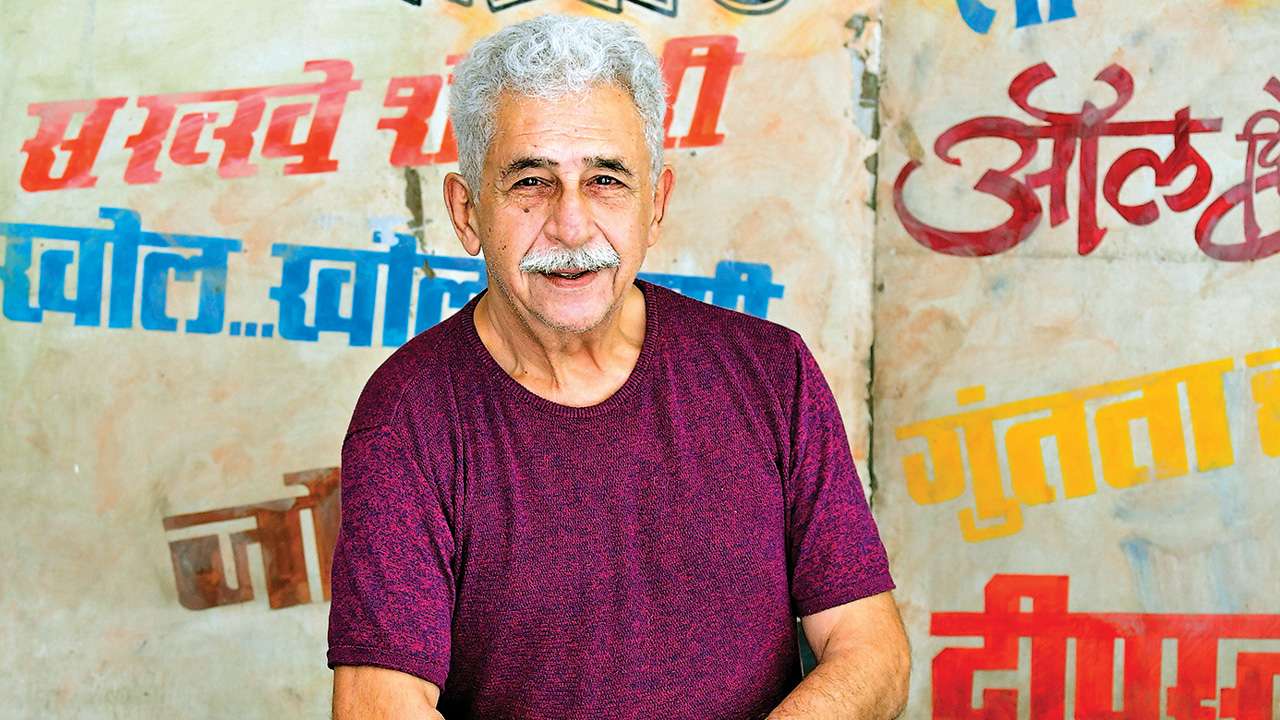
Naseeruddin Shah talks about the past, present and future of his theatre group, Motley, which celebrates its 40 years this month
Deepali Singh (DNA; July 15, 2019)
Circa 1978. Naseeruddin Shah and Benjamin Gilani sat in a small coffee shop in Lucknow and decided to make plays that aroused their curiosity. On July 29, 1979, they opened their first play, Samuel Beckett’s Waiting for Godot at the newly-inaugurated Prithvi Theatre in Juhu, although they didn’t have a name in mind for their group yet. Forty years and 42 productions hence, Motley continues to stage plays that resonate with them. They are now staging some of their most popular ones, including Manto Ismat Haazir Hain, Aurat Aurat Aurat, Dear Liar and Ismat Apa Ke Naam among others, and also doing a couple of readings at the Motleyana Festival to celebrate the milestone. We caught up with Naseer to tell us more…
The line in the 40 years celebration logo, ‘In Godot We Trust’, is quite apt for Motley. Who came up with it?
I did! It’s actually a meme that’s going around. Initially, there was something about the 40-year celebrations but I wanted this motto because if it hadn’t been for Waiting For Godot, Motley wouldn’t have existed. We owe Godot a great deal. We performed it for so many years. We will be reading portions from it for one of the shows and introducing all the actors who were in it — those who are still alive and around. Some who are not in India will be sending video messages. The people who played the boy are now all grown up, like Akarsh Khurana, Imaad (Shah, his son) and others. We will talk about the fun we had doing the play. I believe people should attempt drama they don’t necessarily understand. The process occurs only when you tackle the script.
Can you rewind to the early days of performing it?
There was no Motley name when we first performed it! Om (Puri) had a theatre group called Majma for which I had done several plays. We didn’t have a banner, so he said, ‘Do it for Majma’.
It wasn’t a particularly tough time. Ben chose Godot because he thought it would be a practical play to do, not because of its greatness. He said it’s just four men and we needed a child actor. He knew cinematographer Ishan Arya had a 10-year-old son called Sameer, so, we went ahead with it. The play was so difficult to comprehend and we didn’t know what the hell we were doing! Gradually, the references to Chaplin, circus, religion and all began to strike us. So, we tried to convey those as best as we could. I think it cost us around Rs 3000. We had to get one suit made, while the rest of us were in rags. We just produced our old clothes for that.
Please continue...
We didn’t expect it to make money but we did it because we wanted to do it and found more and more meaning to it. Then it began to get us revenue with full houses in Prithvi Theatre and other venues. And that’s how Motley established itself. I don’t remember it as being a very traumatic time. Tom (Alter) had a very large apartment in Juhu and we would often rehearse at his or Ben’s place. Sometimes, while working with Om, we have rehearsed on local trains, buses, at Juhu Beach, wherever we could find space. Looking back, even then it was great fun as we were doing what we loved.
Can you tell us about the influence theatre doyens Ebrahim Alkazi and Satyadev Dubey had on your works?
I spent my childhood in places like Ajmer, Aligarh, Meerut and Nainital. I studied at Aligarh University, where I met some inspiring teachers who introduced me to modern literature and encouraged my dreams. The plays we did there were shabby productions. There were hardly any resources or money. Then a teacher of mine took me to National School of Drama in Delhi and I was dazzled by the plays I saw! I didn’t know theatre like this happened in India but Alkazi was doing it. They were spectacular productions staged at the Red Fort and Talkatora Stadium, with a cast of 50-60 people. Every detail, right from the rings and shoes they wore, was looked after. That is what I have absorbed from him.
Then I saw Dubey’s plays. He often did works that Alkazi had done, but with no budgets at all. I consider his production of Hayavadana as one of the most memorable things I’ve seen on stage. There were Amrish Puri, Amol Palekar, Priya Tendulkar and Kalpana Lajmi among others. It was a spectacular play with nothing on stage but the actors. He and Alkazi detested each other and I can understand why now (laughs). I’ve learnt from both equally but I follow Dubey’s path. I want to do what he did — to reach out to an intimate audience, do plays that sock you in the gut, not ones which dazzle you. There are so many rudiments of staging I picked up from them. Alkazi was a genius at crowd scenes, while Dubey was great at handling actors and creating moments of dynamism on stage. The value of the word is what I learnt from Dubey most.
You rely a lot on the spoken word…
I love the spoken word. I believe it is the most important thing on stage. I admire well-spoken languages, whichever they may be. I’m not dismissing physical theatre. I admire it but unfortunately, I’m incapable of doing it. So, I stick to what I am good at — the spoken word.
What’s the one thing that’s been a constant for Motley in these 40 years?
To do the plays that we want to do. We once tried to do a crowd-pleaser — The Odd Couple. That was at a time when comedies were popular and we wanted to make some funds. All we did was lose money because nobody came to see it (laughs). So, we want to do the plays we feel the urge to do and that’s a rule we have followed. Sometimes we succeeded, sometimes we failed. Doing Julius Caesar was a dream I had since school. We attempted it, we failed. I think I was a little muddled in my head as to what kind of play it should be. It was part Alkazi, part Dubey. The mix didn’t work.
Is there a play on your wish list?
Saint Joan by George Bernard Shaw that I will certainly do at some point. It needs 15 male actors, all of whom have extremely important parts. It’s a tough task to find 15 outstanding male actors who can speak well. I’m also yet to find an actress who can play Joan. I’m gradually accumulating the cast but I want to be certain how to do the play, so I haven’t launched into it.
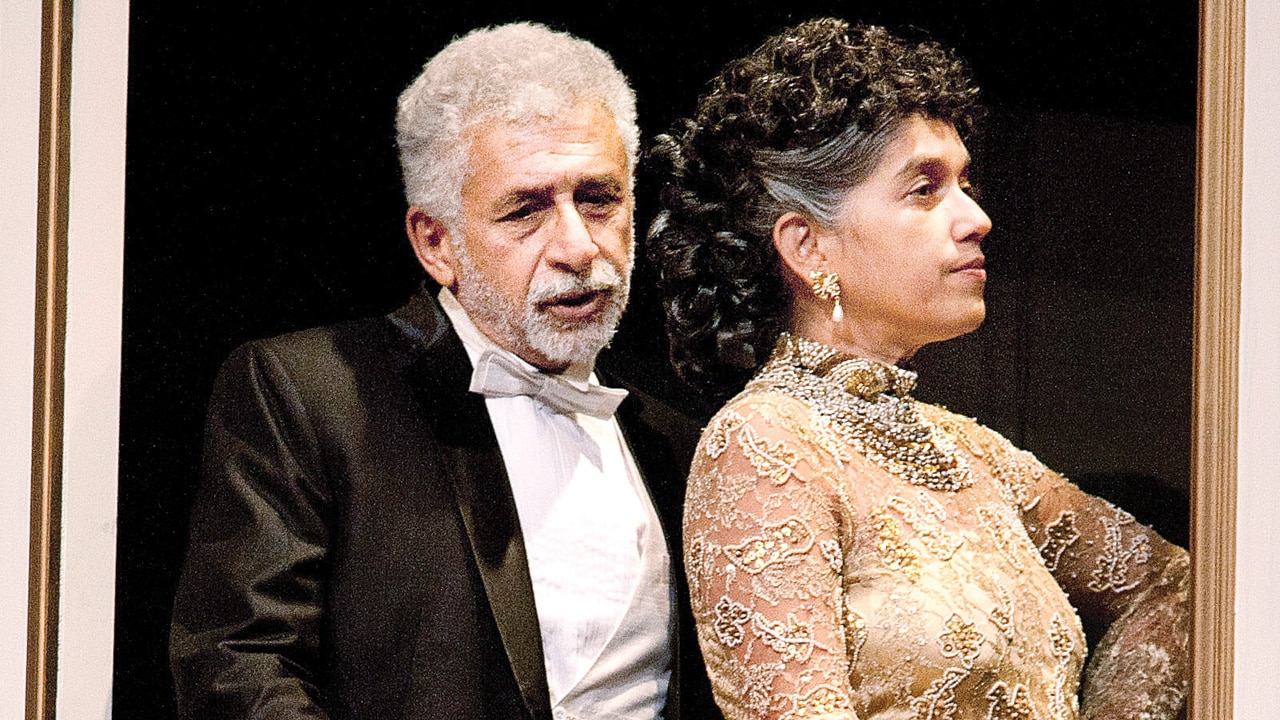
The actor with Ratna Pathak Shah in Dear Liar
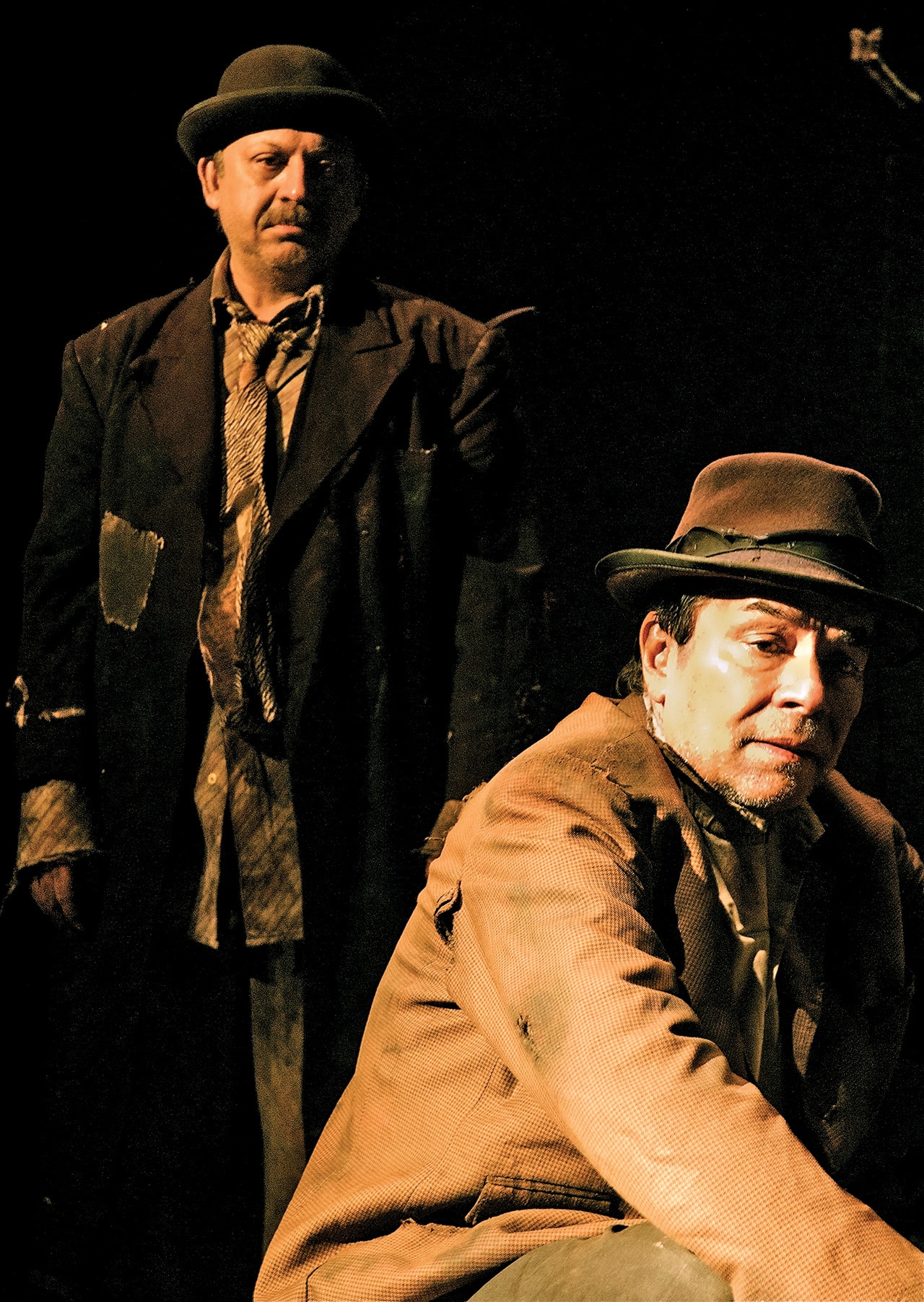
Akash Khurana and Benjamin Gilani in Waiting For Godot
Subscribe to:
Posts (Atom)