Showing posts with label Neerja. Show all posts
Showing posts with label Neerja. Show all posts
Living without waxing or make-up for three months was more challenging than expected-Nikita Dutta
8:19 AM

Crediting filmmaker Ram Madhvani for crafting strong female characters, Nikita Dutta discusses why she couldn’t refuse The Waking Of A Nation
Letty Mariam Abraham (MID-DAY; March 4, 2025)
Nikita Dutta has been a history buff since childhood. So, when Ram Madhvani’s The Waking Of A Nation came her way, she knew she had to be part of it. Even when the filmmaker mentioned the ‘no grooming clause’ for the character, she agreed without hesitation. The Waking Of A Nation revolves around the Hunter Commission, which is an investigation of the 1919 Jallianwala Bagh massacre. The actor, who previously starred in Ek Duje Ke Vaaste (2016), Gold (2018), Kabir Singh (2019), The Big Bull (2021), and Khakee: The Bihar Chapter (2022), among other things, discusses the privilege of working in a Madhvani show and why it features one of the “strongest characters” she has ever played. Edited excerpts from the interview.
How did you become part of The Waking Of A Nation?
I was called for this show while attending yoga school. I had to audition over the phone, which I had always believed never worked because there was no brief. I initially resisted, as the scene was one of the toughest in the show. But they insisted, so I recorded it without much thought. A week later, they called me. When I visited the office, Ram sir explained his 360-degree shooting style—no rehearsals, no lighting, no marks. He also asked if I was okay giving up vanity completely for the 1919 setting. I immediately agreed. I completed my yoga school and was vacationing in the Maldives when I got the call welcoming me on board.
Was it easy to give up vanity completely?
When we started workshops, I realized how much vanity I had to abandon. While I had no issue with it, living without waxing or make-up for three months was more challenging than expected. However, in front of the camera or during workshops, I felt free and liberated. It gave me a new sense of independence and allowed me to experiment.
What were the workshops like?
The workshops focused on two aspects: getting comfortable with the 360-degree shooting style and understanding the period’s [nuances]. We did extensive improvisations and worked on speech and reactions from that era. So they made us go through many workshops. That’s why we were able to pull it off. We were properly cooked by the time we came on set.
How much did you know about the Hunter Commission?
I, of course, have read about it because I am quite a history buff. The period of India’s independence struggle is something I’ve always been very fascinated with. What I did realize is that there are a lot of people who don’t know about this chapter of history. Of course, we all know about the Jallianwala Bagh massacre, but we do not know what happened before and after it. The Waking Of A Nation is inspired by all those historical events, while we have also fictionalized it a bit. I remember Ram sir had gifted us a book when we just started with our workshops and it had a lot of first-hand testimonies of people who have been a victim or have lost their relatives in the massacre. That was hard-hitting.
What excited you most about the era?
In the show, I run a printing press with my friend Albaksh [played by Sahil Mehta]. We shot in an actual 1919 printing press with fully functional machines. Witnessing how newspapers were printed—like small alphabets are put together on a slate and how an article comes together and the amount of strength you had to apply on it to print—was fascinating.
What do you think of Ram Madhvani as a filmmaker?
I think he’s one of the finest filmmakers I have worked with. He is one of the nicest persons apart from being a great filmmaker. There is, of course, his process of shooting, which is widely discussed, but there is so much more than that. Not many filmmakers give a lot of substance and priority to their women characters, but if you see his body of work—from Neerja [2016] to Aarya—you will see the women playing [strong characters]. You don’t just see Sonam [Kapoor], but also notice Shabana [Azmi] ma’am’s character standing out. He says he gets his inspiration from the women around him because he’s surrounded by strong women, from his wife to his mother. That reflects not just in front of the camera, but even off it. This entire show has been shot by four women cinematographers. They have been holding those heavy cameras on their shoulders and shooting. There is no concept of trolleys in his world of filmmaking. He took care of all the basics on set, even crew members. He made sure we had clean toilets exclusively for the women in all sorts of locations that we’ve shot.
How is your character, Poonam, depicted?
She is a strong, bold, and fierce woman—not in the stereotypical loud Punjabi way. He’s chosen to show me as a woman who has a voice, who worked back in the day, and as someone who can take control of situations within her capabilities. As an actor, it’s not every day that you get to play characters like this. It has been a privilege to be part of his filmmaking world. This is probably one of the strongest characters I’ve portrayed on screen in my life.
The kind of music and story Sirf Tum had, it would have been a perfect OTT film today-Sanjay Kapoor
8:15 AM

Rishabh Suri (HINDUSTAN TIMES; August 17, 2022)
Actor Sanjay Kapoor feels it’s great that makers have started exploring different kinds of stories and are not hell-bent on making projects that cater to audiences across India: “Now, actors are offered different kinds of roles, something that didn’t happen earlier. The makers weren’t capable of taking risks and had to cater to the whole of India. Today, they are comfortable in making films for a certain target audience, which is great.”
Kapoor, 56, adds that makers have more confidence in their stories now and are certain that even a film with an offbeat subject will find an audience. “Sometimes, there are films that even run in the interior parts of India. Neerja (2016) by Sonam (K Ahuja, actor and his niece) and (actor) Alia Bhatt’s Raazi (2018) for example. Though they were very different, such films suddenly got a universal appeal. These were some breakthrough films,” shares the actor, who will soon be seen in filmmaker Ali Abbas Zafar’s Bloody Daddy and director Sriram Raghavan’s Merry Christmas.
Kapoor feels had his 1999 film, Sirf Tum, released today, it’d have been ideal for OTT. “The kind of music and story it had, it would have been a perfect OTT film today,” the actor ends.
Kartik Aaryan’s personal journey to become a star is inspiring-Amruta Subhash
8:20 AM
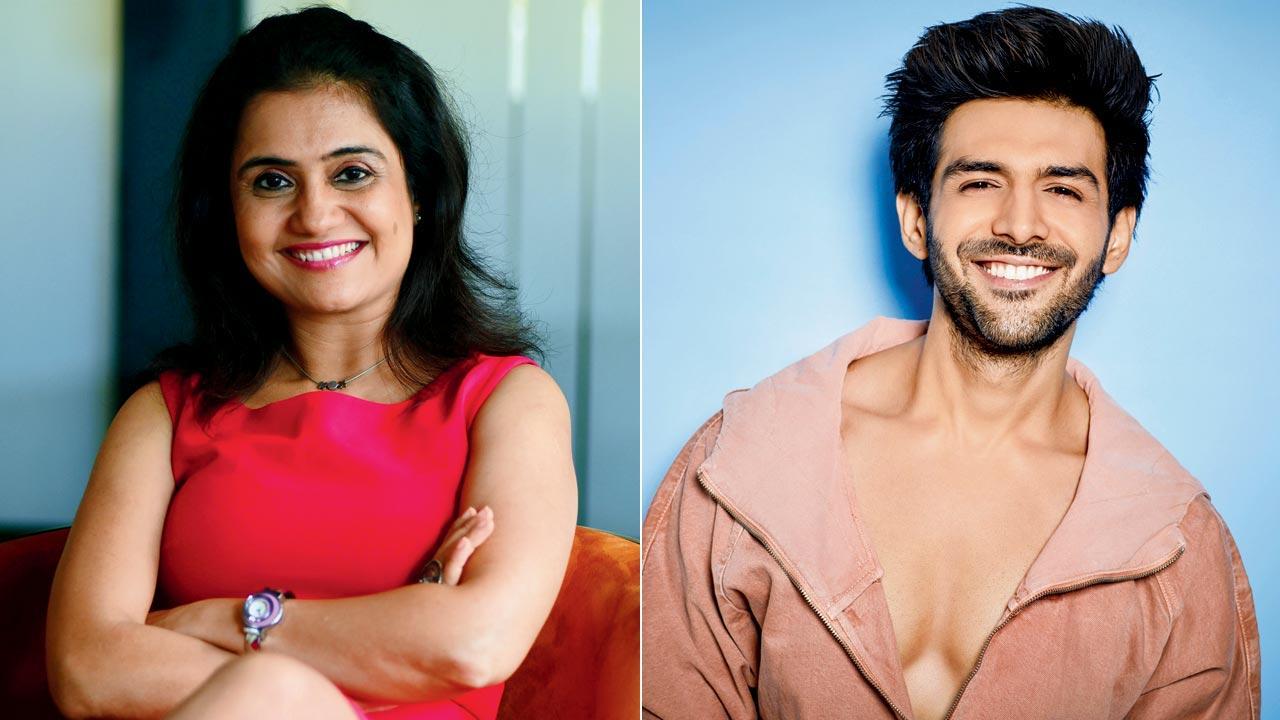
Amruta Subhash discusses dubbing from home for Kartik Aaryan starrer Dhamaka, directed by Ram Madhvani
Uma Ramasubramanian (MID-DAY; May 23, 2021)
With a penchant for not doing run-of-the-mill roles, Amruta Subhash has managed to make her mark with projects like Shwaas, Astu, Gully Boy, Sacred Games 2, among others. After playing Lily in Bombay Begums, the actor is now gearing up for Ram Madhvani’s Dhamaka, which will stream on Netflix. “I was promoting for Bombay Begums when the teaser of Dhamaka released,” says the actor, who strongly asserts that both her characters are poles apart.
While the shooting was wrapped up before the second lockdown, Subhash still had to complete her dubbing. “[Major portion of the] dubbing was wrapped up before the lockdown. However, I had to do certain [voice recordings] from home. I used an app to align the tone,” says the actor, adding that “the pandemic has taught everyone to be independent and learn new things”.
Subhash, who plays boss-lady to Kartik Aaryan’s character, says she has slipped into the power role with much ease. “I have always wanted to work with Ram since Neerja [2016]. His working style is completely in sync with theatre actors like me,” says Subhash, who is glad that “filmmakers are noticing my work and not slotting me in specific roles”.
On teaming up with Aaryan, who has had his own struggles before shining in the limelight, she says that the Bhool Bhulaiyaa 2 actor is an “instinctive actor”. “Kartik’s personal journey to become a star is inspiring. It was great to know him [off camera].”
While she waits for Dhamaka, Subhash is excited about her film with late filmmaker Sumitra Bhave, Dithee, which recently dropped on Sony LIV. They had previously worked together on the National Award-winning film Astu. “Dithee is an intense film that talks about coming to terms with the loss of a loved one. It deals with the complicated experience of grief. Ironically, I never thought this would be my last film with Sumitra Bhave.”
Sushmita Sen had faith in me because of Neerja-Ram Madhvani
8:06 AM

Ready with his new web series Aarya, director Ram Madhvani shares how he convinced Sen to return to acting after five years
Mohar Basu (MID-DAY; June 10, 2020)
 Following up the masterfully told Neerja (2016) is a tall order. But director Ram Madhvani is set to return with another promising outing, Aarya. Even though the series — based on the Dutch drama Penoza — has the tonality of a thriller, the director views it as a story about a family. "To me, Neerja wasn't as much a hijack story as it was a mother-daughter tale. Here, I wanted to explore the interpersonal relationships in a family. I watched Penoza nine years ago and fell in love with the protagonist," recounts Madhvani, who then set out to create an Indian adaptation. "Two years ago, I spoke to the original creators [Pieter Bart Korthuis and Diederik van Rooijen], appraising them of the changes we are making. It was important to have it rooted in our reality."
The Disney+ Hotstar show marks the return of Sushmita Sen, who was last seen in the Bengali film, Nirbaak (2015). Madhvani considers himself "blessed" that she gave her nod. "She is a star, in the position of saying yes or no [to a project]. When I met her, I walked her through our process. The opportunity and the story excited her. She put her faith in me because she had liked Neerja. In some ways, she is a true star who has an unusual aura."
Though Madhvani is currently writing a comedy, one wonders about the fate of the ambitious historical series, Bodhidharma. The 10-part show, which was to be helmed by him and penned by Prasoon Joshi, was reportedly shelved after a fallout between the duo. "Prasoon is a friend and one of the most talented artistes. But, shows are hard to make. It took nine years to make Aarya, and 14 years for Neerja. I hope the universe conspires to develop this show."
If you can be choosy, that’s great. Sonam does what the heart says-Anil Kapoor
7:49 AM

Father Anil Kapoor addresses speculations that Sonam has slowed pace on films because she plans to go the family way
Rishabh Suri (HINDUSTAN TIMES; November 21, 2019)
 This year marked 36 years since Anil Kapoor joined Bollywood, and the actor continues to rule the hearts and box office figures. Besides being a successful actor, Anil is a proud father to three industrious kids — Sonam and Harsh Varrdhan, who are both actors, and Rhea, who is a producer.
Sonam K Ahuja was the first in the family to follow daddy’s footsteps to join Bollywood, but unlike her contemporaries has done fewer films. Speculations are rife that she is slowing her professional pace as she plans to go the family way with husband Anand S Ahuja. Reacting to rumours, Anil says, “It’s not the question of… family is important, but Sonam has always been selective. For her, to balance her priorities are much easier. She always had a lot of time. After Neerja (2016), which was a blockbuster, she didn’t do a film for one year! She waits for the right film and role to come to her, and then does it. That has really helped her balance her professional and personal life. She hasn’t slowed down. Lot of films are being offered to her, but she has only said yes to filmmaker Sujoy Ghosh.”
Anil feels that his daughter has been fortunate to be able to be selective. “In the last 11 years of her career, she has hardly done any films. If you can be choosy, that’s great. She does what the heart says.” Anil says his children are unique in their own way. He says, “Harsh watches world cinema; he knows a lot. He is carving his journey. Sonam is a voracious reader, and that comes across in her films. Rhea doesn’t watch films. She doesn’t want any other film to influence her. That’s why she comes up with something straight from the heart.”
The Pagalpanti actor has shown his acting prowess in both Indian and international films. And, he is now set to enter the historical space with Karan Johar’s ambitious epic Takht with Ranveer Singh. “I’ve given three look tests. Karan is working hard, and is excited about the film. I will be working with a lot of people for the first time, including Vicky Kaushal. We look forward to spending time with Janhvi (Kapoor, his niece). Besides being Karan’s most ambitious project, the fact that we are doing a film together is also very important,” he adds.
Neeraj director Ram Madhvani’s next will be a search for Kohinoor
7:53 AM

MUMBAI MIRROR (October 4, 2019)
It is being reported that Ram Madhvani, who had won the National Film Award for Best Feature Film in Hindi for the Sonam Kapoor starrer Neerja, is all set to collaborate with a studio on his original script next.
The film, that is reportedly set in contemporary times, is a rollicking comedy and an action adventure film about finding the real Kohinoor diamond.
Presently, the director is enjoying his stint as a co-writer. He is working on the projects that he is developing with his company, Equinox Features. The projects also include a film on climate change.
You can’t go to the movies in this Punjab town
10:03 AM

The magic of watching a movie in a dark theatre is forever lost in many Indian towns which have gone from single screen to no screen. Avijit Ghosh travels to Batala to find out how Fridays became so dull
Avijit Ghosh (THE TIMES OF INDIA; February 18, 2018)
 Every frame in journalist Rakesh Rekhi’s memory of youth is about Krishna Talkies. It didn’t matter that the visuals were hazy. That the sound was so muffled that he and others in the audience had to guess the dialogues. That the fans seemed to move in a drunken stupor, often forcing the gatekeepers to open the doors in late-night summer shows to let the cool air in. Krishna Talkies was his theatre of dreams, and Rekhi would save every five paise so that he could buy the cheapest 85-paise, front-row ticket. And sometimes, he would plead with the ushers to allow him to watch a movie in two halves over two days to avoid arousing suspicion back home. “I braved a police lathicharge to watch Dharmendra’s superhit Ankhen (1968),” says Rekhi, now 57.
That was then. Krishna Talkies, which came up before Independence, is history. Along with Rose Cinema, Krishna Talkies called it curtains in 2004-05. For the past decade and a half, this Punjab town has had no theatre.
Batala isn’t really an isolated case. According to industry estimates, India had 11,000-12,000 cinema halls in the late 1980s. By December 2017, the numbers had dipped to less than 5,000 single-screen theatres, partly compensated by the advent of more than 3,000 multiplex screens.
For Batala’s theatres, the hard times began in the early 1980s when pirated video cassettes began luring family audiences away. The rise of insurgency in Punjab made it worse. Krishna Swarup, its former co-owner, recalls: “During 1983-84, militants twice tried to set fire to Krishna Talkies. A desi bomb was also hurled once. People became too scared to visit theatres.”
With the state government imposing a fixed high entertainment tax, losses mounted. “It was difficult to pay salaries to the staff,” Swarup adds. Blockbusters such as Hum Aapke Hain Koun, Dilwale Dulhania Le Jayenge and Border ran for months in the 1990s but those were the last high notes. For a few years, the theatres survived on a diet of “sex movies” before the end credits rolled.
Thanks to satellite TV, pirated CDs, and streaming sites, viewers have many more options today. But everyone admits that nothing quite equals the experience of watching a movie in the darkness of a theatre — where belly buttons always had silver dust, and fantasy overwhelmed reality. For the tea-stall boys, rickshawpullers and daily wagers, it was the only escape from the ordinariness of life. As Santokh Singh, a resident of Kotli Bhan Singh village nearby, says succinctly, “TV majboori hai.”
A generation of boys and girls in Batala and its surrounding villages has grown up without going to the movies. Shopkeeper Deepak Mahajan did travel once with his wife to Amritsar, about 35km away, to watch the Punjabi hit Channa Mereya. But such occasions are rare as they cost money — for toll, petrol, multiplex ticket, lunch — and require planning. “We spent more than Rs 1,000, while a trip to the local theatre would have cost less than Rs 200 for the entire family,” says Mahajan.
The absence of a movie theatre is particularly hard for those who can’t afford smartphones. For some undergraduate students at R R Bawa DAV girls’ college, going to Amritsar for a movie is a once-a-year kind of thing. One of them said she borrows her brother’s smartphone to watch movies. A couple of years ago, the college treated the girls to the Sonam Kapoor starrer, Neerja. But they miss having a local theatre. “Television has only increased our appetite for movies,” says Anureet Kaur, a student.
It’s not going to change anytime soon. No theatres or multiplexes are coming up in Batala. Krishna Talkies, located in the heart of the town, was bought by a local businessman, Harvinder Singh. “The area wasn’t enough to construct a miniplex,” he says. Part of Krishna’s compound has morphed into a food street where hawkers peddle dosa, chowmein, momos, tikki and burger. The Rose complex is overrun with wild undergrowth and dying trees. Barring the fading letters, R and S in iron, there is no evidence of its cinematic past.
What survives are memories. Singh talks about the time he could hear a film’s dialogues from his roof. Rekhi remembers the time the Punjabi classic Nanak Naam Jahaz Hai, starring Prithviraj Kapoor and Vimi, celebrated a silver jubilee, and people thronged from villages to watch the mythological blockbuster Jai Santoshi Maa.
Raj Kumar, who worked for nearly 30 years as an usher in Rose, says the theatre staff were like celebrities because knowing them meant access to tickets for the first day, first show. “Even a gatekeeper like me was in demand. They used to refer to me respectfully as paaji (elder brother),” says Kumar. After the theatre shut down, he was unemployed for months. Now, he sells eggs for a living.

Malik Kafur and Alauddin Khilji were a good pair of sociopaths-Jim Sarbh
8:10 AM

Chaya Unnikrishnan (DNA; February 8, 2018)
While Ranveer Singh has walked away with laurels for his evil turn as Alauddin Khilji in Padmaavat, there’s another actor who has been getting rave reviews for his stellar performance as the Sultan’s slave, Malik Kafur. We are talking about Jim Sarbh, who as Malik, perfectly complements Khilji with his dark thoughts and undertones of lust for his master. The scenes between Ranveer and Jim stand out in the film and the two share an amazing chemistry, especially in the song Binte Dil! Here Jim takes us through his journey in the film, his interpretation of the character, and how one can see Alauddin Khilji, the man, through Malik Kafur’s eyes.
Amidst stars like Ranveer Singh, Shahid Kapoor and Deepika Padukone, your performance has stood out in Padmaavat. When you were offered the role of Malik Kafur, what were your thoughts?
I was excited to be a part of a Sanjay Leela Bhansali film. I was excited to act with Ranveer, who I heard was a great co-actor. Ranveer also mentioned, at our first meeting, that he suggested me for the role, which gave me the confidence as we mutually admired each other. I enjoyed the audition scene, Sanjay sir spoke with a lot of love for the character, as did the entire team working on the project. When I read the script, I could see why.
How did you interpret the character and what was your approach to the role?
I thought of him as a lithe, fierce black panther, who slinks around with his big, grizzled tiger, master Alauddin Khilji. He is a slave, who has hit the jackpot. He doesn’t take people very seriously. He finds them amusing and their very obvious, silly motivations. He’s like the fool, cavorting around with kings and queens, irreverent and if so commanded, deadly.
Ranveer Singh said that you enhanced his performance in Padmaavat. What do you have to say to that?
His performance would have been groovy with or without me. However, sometimes, I feel the only times we can truly see Alauddin Khilji, the man, is through Malik Kafur’s eyes. Ranveer is a wonderful co-actor, the kind of actor where we are always hoping to strike magic. Sometimes we did, sometimes we didn’t, but the attempt was always there.
He is always bringing new ideas and fresh energy to the set, and he was always kind and supportive of me. I would be messing up takes, over and over again, somehow not cracking the moment, and he would not bat an eyelid. If he was frustrated, he didn’t let me feel it, he shielded me from it, and instead was supportive and showed he believed in me. What more can you ask for? I felt my character could easily understand his principles, because I was a version of him, just born in very different circumstances. Kafur was also extremely ambitious, dangerous, and was not bound by the same morals and scruples as the people around them. A good pair of sociopaths.
From Neerja, Raabta to Padmaavat, you have grabbed attention with your performance. So far which role of yours did you find more challenging?
Each had their own challenges, really. Neerja was hard because it was so intense, for such a short burst; like a serious sprint. Raabta was more like a triathlon, a little running, a little cycling, a little swimming. Padmaavat was like a serious marathon.
Going ahead, what are the kind of roles that you would like to do?
Interesting, complex ones. What kind would you like to see me in?
How do you balance films and theatre? Which medium do you enjoy more and why?
Well, since the film work has picked up, I haven’t done any new theatre, just continued to act in the shows that were already up and running. I enjoy the power of a live performance, but I prefer the medium of film, on the whole. I am only just starting to learn the technical aspects of film acting — I think Padmaavat has been essential in that regard — and I hope to continue to explore playing around with my slowly growing knowledge of the power of the frame.
That said, I hope to do a play later this year, around May, with one of my favourite directors of all time, Rehaan Engineer. The text he has chosen, as usual, is gorgeous: the kind that makes you sit up as you read, because you can’t help imagining playing it out, because you are grappling with a mysterious sentence, the intention of which is still hidden from you on first read. Fingers crossed.
Which films will you be seen in next?
The Sanjay Dutt biopic releases in June, in which I have quite a bombastic part, so I am very interested in seeing how that plays out. I have a day left on Made In Heaven, a web series helmed by Zoya Akhtar and Nitya Mehra, which I have enjoyed working on for the last few months. I am also in a web series called Smoke, and am wondering when that will see the light of day. I have also acted in a film called Teen Aur Aadha, directed by Dar Gai, with Zoya Hussain. I am hoping that receives a theatrical release, because it is a very sensitive and beautiful script. Three stories occurring in the same house, the same room, are told with three long takes, each about 30-40 minutes long.
I am extremely ambitious, but earlier my ambition was misplaced-Sonam Kapoor
9:51 PM

Lasyapriya Sundaram (BOMBAY TIMES; February 5, 2018)
With her recent professional choices, she may have silenced some of her harshest critics, but there’s a long way to go. Having earned a name for being the most stylish among the young crop of Bollywood stars, Sonam Kapoor, in her 10 years in the industry, has also managed to create a space for herself as an artiste. In a no-holds-barred chat with BT, the actress talks about the lessons learnt under the arc lights, how privilege gives her the opportunity to make brave choices and how the society we live in is deeply misogynistic. Excerpts…
Your film Pad Man chronicles the life of Arunachalam Muruganantham, who invented a low-cost sanitary pad-manufacturing machine. He is a man who set out to solve an issue — menstrual hygiene — faced by millions of women in our country. On a lighter note, do you think that the world would be a different place if men menstruated?
Absolutely! We won’t be reproducing as much (laughs). I don’t think that they could have handled it. Talking about Arunachalam Muruganantham, his life is inspiring and it’s amazing to have Akshay Kumar play him in Pad Man. He is one of the leading heroes of commercial cinema and when he is at the helm of affairs, the message reaches far and wide. Plus, it is entertaining as well.
Over the past few years, one has seen you become extremely selective about films. Having spent close to a decade in the industry, would you agree that your career can be categorised into the pre- Neerja and post-Neerja phase?
I disagree, because I think I had a pre-Raanjhanaa and post-Raanjhanaa phase. I would like to give credit to Aanand L Rai (director) and Himanshu Sharma (writer), more than anybody else. Of course, I would also like to take some credit for it (laughs). Before Raanjhanaa, I took a break for one-and-a-half years and that was when I realised that there are two sides to my ambition. One is to be the biggest superstar in the country and the other is to become the best possible artiste and human being that I can be.
As soon as I shifted gears from wanting to be famous to becoming a better actor, I became more successful. That’s the reason I got to work in films like Raanjhanaa, Khoobsurat and Neerja. I am extremely ambitious, but earlier, my ambition was misplaced. A lot of people tell my parents, ‘She is not ambitious enough. She doesn’t have the drive to be the biggest superstar.’ And, my dad (Anil Kapoor) replies, ‘You have no idea how ambitious my daughter is.’ I work very hard, but I do it for the right things. I will kill myself for a film like Neerja and for shooting in a place like Maheshwar for Pad Man. I want to work with artistes and filmmakers who challenge me as an actor and help me become a better artiste. I might not be the most talked-about celebrity, but that’s not what I am gunning for. It’s important that R Balki tells me that a role was written with me in mind or Rakeysh Omprakash Mehra says that he thinks of me first when it comes to casting for his film. That’s the kind of relationship I want with my directors and my audience.
While we have seen an increase in the number of women-oriented subjects, the roles written for heroines in films that are fronted by leading men still leave much to be desired. Do you think that’s changing, albeit very slowly?
I don’t know whether it’s changing or not, but I hope it is. Everybody tells me that I am born with a silver-spoon, and that I have my dad. I know that it gives me an advantage over a lot of young girls out there. And, given my position, if I don’t make brave choices, shame on me! I made those choices because I have a safety net, but I hope that it encourages other women to make braver choices. If I am doing a Neerja and a Veere Di Wedding and refusing to work in films where I am not being paid the same amount as the hero, perhaps I will start something new and set a precedent of sorts. I hope other girls aspire to do the same. I joined the industry when I was 17. I know a lot of girls who have made some stupid choices between the ages of 17 and 25. My parents tell me that I have not made that many mistakes. My 20s were amazing, but honestly, my 30s supersede my 20s. The other thing is, I want to be able to front films with another leading lady, like Kareena Kapoor Khan in Veere Di Wedding. We should set an example that it’s okay to work with other women and understand that another woman is not your enemy. In fact, if you get the support of another woman, there is so much that you can achieve.
In an industry where diplomacy is the keyword, you are known for speaking your mind. However, of late, have you decided to be more politically correct?
I was reading a book on the Ramayana that’s narrated from Ravana’s perspective. I wondered why he was such a hated man, though he was so accomplished. It made me understand that there are always two sides to a story, everything needs to be seen in context. So, when people tell me that I am not as politically incorrect as I used to be, I disagree. I see both sides now and I don’t believe in judging anybody.
That might be the case with you, but generally speaking, haven’t actors clammed up a bit in the past few years? Do they fear being misquoted?
I don’t clam up. I just feel, why should I talk about someone who is not relevant to my life? I can be politically incorrect about things that matter and are going to make a difference. Be it about ridiculous bans, the tax imposed on sanitary napkins or critiquing things that are unjust — I speak up on these things. At times, when I say something, it gets sensationalized because it makes for a good copy, but what I wanted to say gets sidelined. Also, I have never treated journalists as my enemies. I never take offense to anything they say because I know that they are doing their job.
Do you think Bollywood actors will come together and say Time’s Up to sexual offenders, like Hollywood showed its solidarity for survivors of sexual assault at the Golden Globe Awards this year?
I feel we are light years behind Hollywood when it comes to saying #TimesUp for sexual offenders. Eventually, it will happen. If something like that were to happen to me, I would talk about it because I am protected and I am also so-and-so’s daughter/granddaughter/niece/sister. People are scared of misbehaving with me. Two of my closest friends, Swara Bhasker and Jacqueline Fernandez, have had their struggles, but everybody needs to be ready to talk about it. Right now, it’s difficult to do that, given the misogynistic society we live in. India, in general, is male-dominated and subliminally, even women are chauvinistic. During the making of Prem Ratan Dhan Payo, women were not allowed to be make-up artists. Strangely, the men were not against it, but there were women hairdressers who said, ‘Our sons are going to become make-up artists and their jobs will be gone.’ It’s up to the mother to tell her son that he’s not better than a girl, but they are equal. Daughters should also be made to understand their self-worth.
Along with your upcoming releases, there’s also a lot of buzz around your impending marriage. So, are you tying the knot?
Unfortunately for everyone, I have never spoken about my personal life in the last 10 years that I have been in the industry and I will not start doing it now. I cannot comment on whether I am getting married or not. It’s okay if people speculate, I am glad that they are talking about some positive things (laughs).

Nobody offers me flower pot roles anymore-Sonam Kapoor
8:41 AM

Nayandeep Rakshit (DNA; January 14, 2018)
Sonam Kapoor is one of the few actresses who celebrates her unabashed honesty and sartorial choices with equal panache. As her forthcoming film, Pad Man, gears up for release on January 25, the actress talks about the social drama and how the perception towards women is changing at large.
‘I VEER TOWARDS UNTOLD STORIES’
After Bhaag Milkha Bhaag and Neerja, this is the third time Sonam will be seen in a film that is based on a real-life story. She admits that she gets drawn ‘towards untold tales’. Sonam says, “These are stories that the audience doesn’t know about. I’m conscious about telling tales that will resonate with them. It has to inspire and motivate everyone to be better human beings. That’s how I look at things when I sign such films.”
NOTHING LIKE NEERJA
While Neerja was about Neerja Bhanot, a model and purser who sacrificed her life while protecting 359 passengers, Pad Man is about Arunachalam Muruganantham, a living visionary. Sonam agrees it’s easy and difficult in its own ways. She says, “Having the person around helps hugely. With Neerja, it was completely different because we had photographs and people who could be reference points but the person, in question, wasn’t in front of us. In Pad Man, you can see Akshay Kumar sir capturing the spirit of Arunachalam because he’s right there. So, in a way, it’s easier. But then it’s also tough because the comparisons are immediate.”
‘I WOULD NEVER REFUSE A FILM LIKE PAD MAN’
It’s easy to presume that a star is apprehensive to play a role with limited screen time but Sonam exclaims that she doesn’t plan her career in a typical way. About what prompted her to give a nod to Pad Man, she says, “I’m a huge fan of R Balki and it’s such a huge privilege to work with him. He’s an amazing person and an incredible director. He is somebody who wants to tell stories that make a difference. So, when he called me, I was super excited. After hearing the narration, I thought to myself that he had offered me a fantastic role. There was no way I would have refused a film like this.”
SIZE DOESN’T MATTER
At a time when her contemporaries are shying away from doing films that offer them less screen space, Sonam doesn’t deem it as a risky move. “Why should it be a risk? It’s any day better than doing a movie with a leading actor where you have three songs and two scenes. At least I’m relevant in these films (refers to Pad Man). The size of the role doesn’t matter; it has to be meaty,” she exclaims. “Why should screen-time matter when your role adds value to a story? I was there for 15 minutes in Delhi 6 and had three-four scenes in Bhaag Milkha Bhaag but they resonated with the audience because they were integral to the film. They weren’t there just for fluff,” she adds.
MEN ARE RIDICULOUS SOMETIMES
Pad Man aims to increase awareness about menstrual hygiene, which is considered a taboo subject in India. But with taxes implied on sanitary napkins, calling it an item of luxury more than a necessity, it’s called for a raging debate. Moreover, some countries distribute condoms for free but charge taxes on sanitary pads. Appalled at such state of affairs, the actress says, “It’s because most men are stupid and they are making such ridiculous decisions. They feel a condom is more important than women having sanitary napkins. So, a film like Pad Man is relevant because there are only 12 per cent of women in India who have access to sanitary pads and understand menstrual health. That is scary.”
NEED TO START A DIALOGUE
Akshay Kumar’s last film Toilet - Ek Prem Katha (TEPK) had brought in a change. Will Pad Man do the same? Sonam asserts, “I hope any film that I do starts a dialogue about something that’s required. I hope Pad Man is such a movie. I want it to entertain because a subject like that needs to reach a wider audience. And when it does, I hope it starts a conversation. We’ve already started doing that by our promotions, so it’s important.”
DON’T CARE ABOUT IMAGE
There’s hardly an A-list actor doing what Akshay has done in the film (wearing a panty with sanitary napkin in it). Although many would call it ‘unmanly’, Sonam takes a staunch stand against such pre-conceived notions.
“The very fact that he is doing something like this is laudable and amazing. How many actors will take up such a role and do that scene? It will make a huge difference as Akshay sir is a mainstream star. And it should. He’s backing a film like this, which is produced by his wife and stars two other staunch feminists like Radhika Apte and me.” Many would and have shied away from such roles, to maintain a certain prototype of a star. But the leggy lass says she doesn’t have ‘such trappings of stardom’. “I honestly don’t give a s**t about my image! I just believe in doing the right thing and the correct films. Which is why what people think of me is their problem, not mine.”
NOTHING’S TABOO ANYMORE
Movies such as TEPK and Shubh Mangal Saavdhan have explored topics that have hitherto been unspoken about. Sonam says such movies are the need of the hour. “I feel it’s important for actors and filmmakers to talk about subjects and touch upon things that will affect change in society. Whether it’s taboo or not, it shouldn’t deter you from doing what you really want to do. That’s why you need to make it a bit more entertaining. Which is also why an Akshay Kumar needs to come in. Even though Pad Man is a story about menstruation and an amazing man who brought in a revolution, it’s also a love story. That’s something we shouldn’t forget.”
THINGS ARE CHANGING SLOWLY
Sonam points out that the perspective towards women is changing but it’s happening very slowly. “I wish it was faster and more relevant so that I am around to see the complete change. But I think we are at least a 100 years behind Hollywood,” she says.
Recently, the actress had claimed that producers and investors weren’t willing to invest as much money in her film (Veere Di Wedding), compared to male-centric movies, as it features four actresses. Is that changing too?, we ask. “I don’t know if they will give us as much because you cannot ignore the fact that there’s still a massive pay disparity, which is insane. It’s important to get what you are worth. Otherwise, there needs to be a staunch stand for what you believe in. And women need to step up for sure,” she responds.
NO NEUROTIC ROLES
With films like Raanjhanaa, Khoobsurat and Neerja on her list, Sonam is not keen on doing nonsensical films anymore. She laughs, “People don’t come to me with neurotic roles anymore. Nobody expects me to do a flower pot role. And I love that because I don’t want to waste my time listening to something that’s irrelevant and I wouldn’t do.” Does that mean she’s against the idea of a masala blockbuster? Pat comes the reply, “No, I’m not averse to the idea of a masala film at all. I’m against ridiculous roles for actresses. At the same time, I’m open to doing a film like Prem Ratan Dhan Payo where I get to work with some amazing commercial directors who give women the gravitas that they deserve. So, if someone offers me something of that magnitude and dignity, then why not?”
CAN’T JUDGE OTHERS
She also explains that it’s wrong to judge heroines who are taking up such roles in a commercial film. “They are doing whatever they think works for them. My job is to do films where I can make a difference and which I can be proud of. What anybody else does is not something I can judge because again, none of us know the situation they are in.”
Given the prep that I put in for Neerja, I won’t lie and say that it didn’t hurt to not get it-Neena Kulkarni
7:44 AM

Model, theatre artiste, film and TV actor, Neena Kulkarni discusses her career spanning 40 years...
Yogesh Pawar (DNA; September 23, 2017)
As a model, theatre person, film and TV actor, filmmaker and columnist, Neena Kulkarni wears several hats and brings the sincerity of her craft to every frame making each character she portrays, real and imbuing even similar ones with an edge that make them different. To do this once in a while is itself worthy of admiration so what does one say to someone, who has done this for four decades. On the completion of 40 years in the industry, the seasoned actor opened up on her exceptional work, her life and her hopes from the future...
It’s been four decades of acting. Does it still thrill you like when you started in the mid-70s?
Of course, it does. Nothing gives me the same high as acting. Acting will always be my biggest love. I think that’s happened because I’ve enjoyed and made the most of every part, however, big or small. I’ve almost never taken up a part that I didn’t like under compulsion.
Do you feel the Padma awards have taken their time to find you? After the National award for Shevri (2006) and state awards for theatre and films, not many have come your way?
What is recognition after all? Recognition and love I get from people when I step out? The way someone recalls/praises a play/serial/ad I did even from the early 80s? Or the respect and warmth I receive from people in the fraternity? Isn’t that more important and satisfying? Having said that, I haven’t stopped hungering. Who knows, a better, more challenging role and the recognition it will bring in its wake may still be ahead. After all, we live in really interesting times when filmmakers are pushing the envelope, both with subjects and genres.
How does that affect you?
You know how this plays out. An actress is assumed to have a certain shelf life after which she’s thrust into a ‘character role.’ I’m 62. There was a time when someone my age would be just another glorified prop, but not so anymore. One of the nicest things about contemporary takes on gender and sexuality have meant assertive women. And filmmaking has had to make space for that. That is why films are being written for a Meryl Streep, a Judi Dench or a Sridevi here. Even if one has to etch a mother she isn’t simply filling the frame. Look at how wonderfully Shabana ji (Azmi)’s character stood out in Neerja.
Didn’t you too audition for that part?
Well, I did. And given the prep that I put in, I won’t lie and say that it didn’t hurt to not get it. But when I saw the film, I was floored with what Shabana ji brought to the role. We come from really different schools of acting so obviously her take on the character is very different from mine.
You did not grow up in a filmi family.
Not at all. I was always the upper middle-class Mahim girl. My parents were both doctors and really well-respected names in the medical fraternity and I schooled at Canossa Convent and then pursued my BA from Elphinstone College. So acting happened as a matter of chance.
Really?
You can blame that on our short college hours and lack of diversions like social media. (Laughs) We’d have a lot of time on our hands. I’d begun doing fashion shows and modelling for a lark even doing the odd experimental play. My progressive parents were quite supportive and never resisted. And so I carried on.
And then you met Pt Satyadev Dubey?
Satyadevji is known as a director, actor, playwright and screenwriter. But his greatest contribution has been his mentoring of an entire generation of actors helping them discover their own strengths. Imagine my luck that I met this walking encyclopedia of theatre and went on to be part of several productions under him. Though extremely moody and temperamental, he was a very generous teacher. I was young and all of this was totally new, so I’d be excited about everything. I hadn’t had any formal training in acting. It all began with Satyadev ji. He’d make us learn the whole play, all dialogues for all parts. And anyone could be called to play anyone if that person didn’t turn up. It trained and opened up doors for me to act in other plays like Mohan Rakesh’s Adhe Adhure, Shankar Shesh’s Mayavi Sarovar and Willie Russell’s Educating Rita.
You were to shortly meet your second mentor Vijaya Mehta...
All of us call her 'Bai' respectfully. She was already quite a big name and I was quite chuffed she chose me to play Shabbo in Anil Barve's Hamidabai chi Kothi (1978). The grammar, craft and technique of her theatre work is at a complete variance from Satyadev ji. She wants you to find your character yourself. Given my enthusiasm, I adapted and picked up soon. It set the stage for me to do iconic plays like Mahasagar and Savitri with her. Later I did other plays like DhyaaniMani, Prem Patra and Vatvat Savitri. A few years ago in a hugely emotional development, I got to step into Bai's shoes and play Hamidabai's character which she played when the play was revived. At her behest, I have joined her to conduct workshops for young actors.
You also did a play with autobiographical shades of the dynamics between Medha Patkar and her ex over her career and cause choices.
Yes, a lot of people saw resonances of her life in a play I did with my late husband Dilip, Aaicha Ghar Unhaat. I only met her much later personally when she was asking many of us to join her in the Narmada Movement.
And did you?
No, I didn’t. I felt it should be something one does full-fledged and not as occasional photo-ops. I was by then faced with the prospect of running a home by myself and couldn’t make time.
Are you talking about the passing away of your husband Dilip Kulkarni?
Yes, till it happened very suddenly in 2002, I’d thought of what I do as only a passion. True, I contributed to the family kitty, but he was the man of the house in my head. You know, he acted as a part-time thing, but worked in a cooperative bank full time. With his passing away, once I was past the sorrow what stared at me was providing for my two children and running the house.
Do you still miss him?
I know it’s been 15 years. I’ve reconciled to the idea of his passing away, but how can one not miss a partner one loved and shared a life with? You know when we first met during rehearsals for a play, he’d maintain a shy distance. That drew me to him and made me fall in love. We came from really different backgrounds. He came from a working class background in Deolali and was settled here in a bank job. On my insistence, he agreed to buy a flat in the same housing society I grew up in from early childhood and set home here. Even now when I’m by myself I feel like talking to him.
Your children are both in the entertainment industry now.
Yes, but both have decided to be behind the scenes. My daughter is into TV production and my son is into advertising.
Speaking of the latter, you are an Indian model with one of the longest innings. Aren’t you?
Well, I began early. I was the Clearasil girl when I was barely 16. I have played everything from young girl, wife, mother, elderly old age home inmate selling everything from hair oil, insurance and what have you. I have never sought work. But over the years, people have always approached me and I feel lucky to have done campaigns like Bisleri, Sprite, Mother Diary, Cadbury and Life Insurance Corporation and others. Besides, ads don’t tie you down to a project for long.
You mean daily soaps like Yeh Hai Mohabbatein where you are Madhavi Vishwanathan Iyer since 2013?
TV is no longer the poor cousin of the big screen. With its wide reach, it has pulled actors towards it. Actors of my seniority too get a lot of different characters without getting stereotyped. Many big actors are coming to the small screen since it gives them a direct connect with fans. But I must mention here that sometimes TV can be a blur. Some people think as long as they look good and say their lines properly, it’s fine. This is unfair to other actors really working on their craft. But given the rush, even a not-so-good take is canned and often makes it on air too. That hurts because I come from a culture of worshipping my work.
Will you continue to do plays?
I’ll continue to do theatre till I breathe. I only feel the work should challenge me. Wedding Album or a Mahatma versus Gandhi with Naseeruddin Shah was quite fulfilling and I want more of that kind of work. The last play I was doing was Chaapa Kaata. After I point, I was unhappy about turning up at work. The idea of travelling long distances for a three-hour-show, which is not doing anything for me got to me and I stopped doing that play.
And you’re equally selective about films?
The medium seems to love me. I’ve worked with greats like Mani Ratnam, Amol Palekar, Priyadarshan and Shankar. I even played a cameo opposite Amitabh Bachchan (Bhoothnath) because it was a BR Films project. Also, many new indie filmmakers are doing fascinating stuff. It will be great to work with them. Unlike TV, here it matters who the director is and what the set-up is.
You have to talk about working with Judi Dench.
The modesty and humility of a legend like Judi Dench can only be seen to be believed. For a scene in The Best Exotic Marigold Hotel where she was not even in the frame, just to cue me she came and stood in front. Here if an actor realised that s/he was not in the frame a spot boy would replace her/him.
You've done a French TV series Raani which ran to great acclaim on channel France Deux and a French film Noces. Did you learn especially learn French?
French was what I majored in while graduating from Elphinstone College. I did occasional translation jobs till I got drawn to fashion, modelling and acting. Of course, my French is quite rusty but in both these projects, it suited the context of my characters. I haven't quite gotten over the fun we had while shooting for Noces in Luxembourg last year.
Who are your favourite young actors among the current lot?
I think almost all of them bring such energy and drive to what they are doing that its almost inspiring. When we began we were just looking for work. These guys come looking careers.
Any advice for the younger actors?
Who am I to advise anyone anything when I learn so much from them? I have learnt to lighten up, live the moment and have fun. They help me stay young. Who would have thought, but it’s also kept me busy on social media.
Who are you closest to in the industry?
Given my innings, I get along with almost everyone. But in the passing away of Reema Lagoo, I have lost a soulmate. A fellow acolyte of Vijaya Bai, I’d discuss anything personal/professional with her with complete ease. I’ve now reached a stage where I prefer being a loner.
Neerja Bhanot's family drags producers to Chandigarh High Court
2:22 PM

Mohar Basu (MID-DAY; June 24, 2017)
Ram Madhavi's 2016 biographical-drama put the spotlight on Pan-American World Airways' late purser, Neerja Bhanot's valour, and brought her sacrifice to the attention of the country after over 30 years. But, Bhanot's family has been left to struggle with the deception of the film's producers, after apparently being denied their share of the film's profits.
On Friday, the family moved Chandigarh High Court, accusing Atul Kasbekar's Bling Unplugged and Fox Star Studios of criminal conspiracy. Speaking to mid-day from Chandigarh, Bhanots' legal counsel, Hemant Saini says, "The parties entered into an agreement which promised the family 10 per cent profits, over and above the initial stipulated amount. Now, the producers are indicating that the contract referred to the percentage made by Bling alone, and not by both the producers. They claim that the amount the family is demanding belongs to Fox, which, they say, is not party to the agreement. They say most of the profits have gone to the studio and they can only give what they have. However, it was made clear that if the producers assign the rights to anybody else (in this case, to Fox), they too will be bound by this agreement. It's a clear case of cheating."
The petition claims 'the producers have conducted a planned conspiracy and dishonestly induced the family members of late Rama Bhanot (Neerja's mother) with the intention of wrongful gains to themselves.' Saini adds, "The movie made over Rs 135 crore, but Kasbekar's company said the studio would keep 80 per cent of the profits. The family was given a small amount (nearly Rs 25 lakh), which they refused to accept. They wanted to use the profits to set up a charitable trust to help women in need."
Though, Atul remained unavailable for comment, in an earlier statement, he had said the family's demands were "a retrospective negotiation and not as per what is signed by them years ago".
Neerja's brother Aneesh believes in the fairness of the judiciary and preferred to stay mum. "The matter is up before the Court next Friday," Saini added.
In life, we only meet grey characters-Jim Sarbh
2:03 PM

Renuka Vyavahare (BOMBAY TIMES; June 5, 2017)
A known name in the theatre
circuit, Jim Sarbh caught our attention in Ram Madhvani's Neerja. While he revels in his new-found fame, he's fiercely guarded about his
life beyond the silver screen. Among his next releases is Dinesh Vijan's
Raabta, starring Sushant Singh Rajput and Kriti Sanon. BT caught up with
the Parsi boy over a cuppa coffee...
From studying psychology to doing theatre and now acting in commercial cinema, how challenging was it for you to adapt?
I never look at it as Bollywood versus Indie versus theatre. You just learn the rules of each medium. Even theatre productions have different rules. You can be completely bombastic in Atul Kumar's Noises Off. Rehaan Engineer's plays require you to be a bit real. Likewise, each film is different. The acting that Sanjay Leela Bhansali wants is different from what Rajkumar Hirani expects (He will be seen in SLB's Padmavati and Hirani's Sanjay Dutt biopic).
Any myths about movies that were broken once you got into them?
You think there's a lot more magic in it than there actually is. At the end of the day, it's just a job. Once you get into it, you realise how some things are just practised to manipulate the camera. When you work in a film, you wonder 'Oh, they are putting glycerine in their eyes. This person is not feeling anything!' When you watch it, you go, 'It worked so well. How did that happen?'
What drew you to Raabta?
The fight in Raabta is about what will be versus what you want to make it. I liked how if things had gone slightly different, my character would have been the hero of his own little story. In life, we only meet grey characters. There are some who veer towards the white and some towards the black end of the spectrum. While we are still stuck doing films about such (unrealistic) characters, what struck me about Raabta is that, if Zak (his character) can only let go of his desire to control destiny, he could be a perfectly happy human being.
Isn't it a tad cynical to believe that everyone has a grey streak in them?
Everyone has the potential to be all kinds of things. No one is one thing or the other. Do you know of anyone who sweeps you off your feet and is always good to you all the time? No way. People are shi*** most of the time. Nobody has the patience and energy to be always good to you. Miss and Mr Right don't exist. We are fed this fairy tale from the beginning and we suddenly wake up at 24 or 25 and realise that everyone cheats, everyone lies and no one lives in this fantasy of monogamy. No person is going to come and save you. We are constantly fighting our desire to be those people. We keep telling ourselves, 'this is wrong', 'that is bad', 'it doesn't happen'. Not only does it happen all the time, but it need not necessarily be wrong or bad. That's just the way things are. The more we understand and accept that, the more we can decide how we want to live.
Neerja earned you some massive female fan following. How does it feel to be liked and hounded for pictures?
It feels very nice. I like to be appreciated but I don't completely understand this selfie thing. What happens afterwards? Do you frame it or show it to other people? When I see somebody who I have admired or when I see somebody in a film or otherwise, there's an excitement to let him/her know how much I appreciate their work. I can tell my friends later that I met so and so and they will believe me. Why do I need photographic documentation? Also, I am not a photo guy anyway. I never say, 'Guys, let's take a picture of this moment'. I'd rather be in the moment.
There is a tendency in the film industry to stereo type actors based on their popular roles.
I don't believe in these binaries. A good actor will always get his due. I hope I can play all kinds of diverse roles.
You are quite outspoken. If you don't agree with the sensibility of a director, do you give your inputs?
I feel everyone should be given an opportunity to say what's on their mind. I try, but in the end, it's the director's medium. I do my thing within the realms of what he wants. That or you just have to wait till a point where you can call the shots. I am not at that point yet. I also feel that people let you try your thing if they know you can act or have successful films to your credit.
On a lighter note, you shifted from South Mumbai to Versova a year back. How has the change been?
It was an easy transition. I felt like I slipped into my real home in Mumbai. Also, I recently realised that I don't have any friends in South Mumbai anymore; everyone is in the suburb. I just miss my Parsi food though, as you don't get that a lot around this area.
How do you unwind? Going offline is the new luxury, isn't it?
I like to do movie marathons. Since I am travelling too much, I like to just alone, sit in my house whenever I can. Stay watch films. If I manage to get a few days off, then I like to go to Goa or Kamshet, where I don't have the desire to look at my phone. I keep it in the room and go for a swim.
You are fiercely private about your personal life...
I don't understand why my love life is of anybody's concern. I don't know why anyone even cares about it. Read on any other subject in the world other than who I am dating. Who gives a damn?

Neerja producers refute accusations by Bhanot family
7:40 AM
MUMBAI MIRROR (May 24, 2017)


After it was reported that
Neerja Bhanot's family is set to sue the makers of the eponymous Sonam
Kapoor-starrer over sharing of profit, the film's co-producers, Atul
Kasbekar, said in a statement, “We'd like to say that we are immensely
grateful that the Bhanot family trusted us with making a movie on the
life of the braveheart, Neerja Bhanot. We started the exercise of making a
difficult movie with utmost honesty and the effusive acclaim the film
has received is testament to the fact that we succeeded in our
endeavour.“
Presenting their side of the
story, Kasbekar added, “It was always abundantly clear that we would
partner with a studio, in this case Fox Star India. The Bhanot family was
always aware of the same and have in fact met the studio reps on many
occasions. To imply otherwise is simply untrue...All financial
transactions post release have been shared with the Bhanot family
immediately and in a transparent manner. Their share of the profits,
which is a share of ours, has been immediately offered. They have
declined to accept the same and now wish to get a share of the studio
profits. This is effectively a retrospective negotiation and not as per
what is signed by them years ago. It is unfortunate that despite having a
clear contractual arrangement the Bhanots have decided to dispute the
financial understanding at this belated stage.“
Neerja director Ram Madhvani STUCK in legal tussle between film producer and the Bhanot brothers
8:14 AM

Subhash K Jha (DNA; May 23, 2017)
Was Neerja Bhanot’s family shortchanged, despite the film on her life becoming a critical and commercial success? Well, that is exactly what her brothers Aneesh and Akhil are alleging. The Bhanot bros are dragging the film’s co-producer Atul Kasbekar to court, over breach of contract.
The brothers allege that the co-producer has not lived up to his commitment — he supposedly promised the family 10 per cent of the film’s profits.
Neerja’s brother Aneesh refused to share details of the case, but maintained, “Neerja always believed and said, ‘Do not tolerate any injustice’, and that is what we are doing: not tolerating injustice. The rest is up to the courts to decide.” Atul, too, kept it terse. “As you know, there are two sides to any issue. We will issue a statement soon,” said he.
Director Ram Madhvani chose to steer clear of controversy. “Atul is a friend. And as far I am concerned, the Bhanots will always be a part of my family. My commitment to them is for a lifetime. I’ve nothing to do with the financial dynamics of the film. I am not a producer on Neerja. I wish the matter is resolved at the earliest,” he says.
Bhanot family to sue makers of Neerja over profit sharing?
7:48 AM

MUMBAI MIRROR (May 22, 2017)
Makers of the Neerja biopic
may have landed in a legal soup with the family of Neerja Bhanot, the
brave-heart flight purser on whose life the National Award-winning film
was based. The issue is over the commitment to share 10 per cent of the
box office collections with the Neerja Bhanot Trust and the
family. Reportedly, the Bhanots are moving the Punjab and Haryana High
Court and a legal notice has already been sent to the makers.
The Ram Madhvani-directed film recently bagged the National Award for Best Hindi Feature Film and earned a Special Mention by the jury of the 62nd National Awards for Sonam Kapoor, who had portrayed the titular character.
The Ram Madhvani-directed film recently bagged the National Award for Best Hindi Feature Film and earned a Special Mention by the jury of the 62nd National Awards for Sonam Kapoor, who had portrayed the titular character.
I've seldom been criticised for what I wear-Sonam Kapoor
7:52 AM

Rachana Dubey (BOMBAY TIMES; May 20, 2017)
Sonam Kapoor, ahead of her
seventh visit to the French Riviera, spoke to BT about the inevitable
red-carpet scrutiny that follows every appearance at Cannes, living out
of a suitcase and juggling her professional commitments back home.
Excerpts...
By the time our readers see this interview, you'd be on your way to the Cannes Film Festival. It's your seventh year at the French Riviera. Feeling the itch?
(Laughs) No itches, ya! I'm looking forward to the trip. These three days are going to be hectic - it's literally like living out of a suitcase. Even when I return to the bay, I won't have time to rest. I have to head right back to the studios. I'm shooting for Rajkumar Hirani's Sanjay Dutt biopic and R Balki's film Pad Man. There's a deadline to be met and I can't take a break now.
What do you plan to do at the French Riviera?
Take it easy! I have no plans this time. And honestly, there's no time for anything other than the red-carpet appearances and watching a couple of films, all dressed up. My gowns have already reached the venue. I just have to get there, slip into them and look great. It's one of those events where the idea is to not take yourself seriously.
Indian women are scrutinised for their outfits on the red carpet. Does that not worry you?
I'm not worried because I've seldom been criticised for what I wear. The press has been kind to me, and I also don't bash the media for what they write about me. Fashion is not as much about what you wear as it is about your attitude. You wear a great outfit and carry it with befitting attitude, and you've nailed it. The more you fret over things, the more chances of them going haywire. I'm so happy representing India there that I don't over-analyse anything.
Back home, with the National Award for Neerja in your kitty, do you feel a sense of greater responsibility towards your work coupled with a career high of sorts?
I didn't take the lows to my heart and so, I don't take the highs to my head or heart either. Filmmaking is a collaborative process. If something works, it's not your success alone. It's the success of an entire team that worked towards making your performance look great. So, I don't take any credit for whatever I've achieved. Right now, I'm happy with the kind of work coming my way.
When do you start work on Veere Di Wedding?
Once I wrap up my current projects, we'll all plunge into Veere Di Wedding. We should be on floors soon. It's a very special project for Rhea (Kapoor), Ekta (Kapoor), Bebo (Kareena Kapoor Khan) and me.
The delay in rolling the project has fanned rumours...
That's naysayers doing their bit. Those are sexists who are 'spreading' a word about the film. A lot of people can't handle so many strong women collaborating on a film. Our idea is to change the way the industry sees women and the space they're allocated to function. The reason we teamed up with Ekta is that she's a successful woman in her own right. Having said that, we couldn't have helped the delays despite being ready. We couldn't have left Bebo out of the scene just because she was pregnant. She's back on her feet now and will be ready to shoot soon. Rhea and I are such feminists...we would never leave a teammate's side just because she chose to invite a beautiful change into her life. More power to girls!
I am a misfit and proud to be so-Sonam Kapoor
8:11 AM

A day before she collects her National Award title, Sonam talks about the win; says she wants to experiment with roles
Mohar Basu (MID-DAY; May 3, 2017)
As Sonam Kapoor readies to pick up her first National Award for Neerja (2016) today, she looks back at her decadelong career in Bollywood so far with a sense of satisfaction. “I have had a turtle’s journey so far. There is no pressure to up the ante, but yes, I will do films that are impactful,” she says.
Sonam asserts she is open to smaller roles that make an impact. “I don’t want to play only lead or titular parts. I want to do projects that have something to say beyond just being entertaining, films like Dutt biopic and Padman, which entertain and yet, are all heart. I’d love to be a vain actor, but it’s important to work with men like R Balki [Padman director] and Raju Hirani [Dutt biopic director],” she adds.
After an emotionally-draining week with her grandmother passing away, Sonam is trying her best to chin up. “I was in Beirut when the news came; getting a flight back was impossible. It has been hectic all week. The rehearsals [for the National Awards ceremony] are making it feel more real. I am grateful for the honour, but it is eventually Neerja [Bhanot]’s blessings and her mother’s.”
At an awards show earlier this year, Sonam had told mediapersons on the red carpet that she won’t win a trophy that night, reopening the debate on credibility of award functions. “Usually, at such events, you get an idea whether you are winning or not. Only a few awards are authentic in this country. Even when I have known I wasn’t winning, I have sportingly gone and cheered for my colleagues.”
Being recognised by the National Awards jury was something she hadn’t expected at all. “I was privileged enough to be acknowledged for something I gave my heart and soul to. Neerja was about celebrating a strong woman’s spirit in today’s world that’s all about survival of the fittest. With this film, I am ready to walk any red carpet to celebrate what it stood for, even without an award. The film itself was my biggest award; the National Award is a cherry on top. Ram [Madhvani, director], and my parents wanted me to win, more than I did.”
Ask her if it’s a cue for her to stop taking up roles just for the fun of it and she retorts, “No role is frivolous. I am never going to do stop doing films like Khoobsurat (2014). It had a lot to say about women who are expected to change themselves for society. I am a misfit and proud to be so. No one needs to change to win someone’s love, even if it’s Fawad ‘handsome’ Khan [Khoobsurat co- star]. For someone falling in love with me, it’s his privilege.”
Sonam Kapoor was at Neerja shooting spot when news about her National Award win trickled in
8:05 AM

Shilpi Sampad (MID-DAY; April 8, 2017)
"You remember the last scene in Neerja where we showed her ashes being scattered? I am at the same spot now,” exclaims Sonam Kapoor as we connect with her after the much acclaimed biopic on braveheart Neerja Bhanot bagged the Best Hindi Film honour. The actress, who is shooting for Akshay Kumar- tarrer Pad Man in Maheswar (Madhya Pradesh), also got a special mention for her performance in the gritty biopic.
Evidently overwhelmed by the news, Sonam admits she is “very shocked”. “Initially, I didn’t understand what the award was for. Then Anupam [Kher, actor] uncle told me he’d won it for Saaransh (1984) and Daddy (1990), and that the jury award is the most coveted honour. I am grateful to the Bhanots, (director) Ram Madhvani and team Neerja for believing in me.”
She believes the best way to celebrate is to work and says her family is ecstatic. “Dad (Anil Kapoor) has been my guiding light; he said he’ll accompany me to the awards function as my date.”
After Neerja promotions, I was exhausted, so I took time off-Sonam Kapoor
8:04 AM

Upala KBR (DNA; March 27, 2017)
Most stars sign several films if one is a success at the box-office. And if their performance has won critical acclaim, it’s a double bonus. Ram Madhvani’s Neerja was not just a superhit at the B-O, Sonam Kapoor’s performance was also a much-lauded one. But last year, rather than signing films by the dozen, the actress chose to take a break for a year. She tells us why…
“The beginning of 2016 was really hectic for me when Neerja released in February. I needed time. I don’t know if people have noticed it, but I take a lot of time off between my films. I just needed to refresh myself and understand where I wanted to go next. I needed a break from Neerja as it was a heavy film for me to do. And after the promotions, I was exhausted, so I took time off…”
This year, Sonam is back with a bang after signing three top banners — she has Rajkumar Hirani’s Sanjay Dutt biopic, sister Rhea Kapoor’s Veere Di Wedding and R Balki’s Padman.
This hardly gives her any time to prepare for the Cannes red carpet event, which she will walk for an international cosmetics brand. Sonam says, “It’s true. Now, what has happened is that though I will be going to Cannes in May (as everybody knows), unfortunately for me, I am shooting for two films (Veere Di Wedding and Dutt biopic) at that time, so I will just go there blind as far as my clothes are concerned. Whatever happens, will happen! If people don’t like the clothes I wear, it’s not my fault.”
Subscribe to:
Posts (Atom)