Showing posts with label Kiran Rao. Show all posts
Showing posts with label Kiran Rao. Show all posts
"None of my wives converted": Aamir Khan shuts down ‘love jihad’ talks
9:45 AM

HINDUSTAN TIMES (July 16, 2026)
Actor Aamir Khan broke silence on his recent wedding to entrepreneur Gauri Spratt after it drew criticism from political figures. Minister of Ports Development of Maharashtra Nitesh Rane labelled the marriage “love jihad”, whereas Maulana Ibrahim Hussain, the Shahi Chief Mufti of the Muslim Personal Darul Ifta, issued a fatwa against Khan.
Responding to these allegations Khan told Rediff, “The truth is that ours is a very inclusive family. Both my sisters are married to Hindus; my daughter is also married to a Hindu. My cousin Mansoor is married to a Christian,” clarifying that neither of his ex-wives — Reena Dutta (married in 1986) and Kiran Rao (married in 2005) — nor Gauri converted to Islam, because all three marriages were civil.
As per the fatwa, Ifta stated that a Muslim man cannot marry a non-Muslim woman under Sharia law unless she converts to Islam, calling the marriage “impermissible”. “Gauri is not even Hindu, she is Christian, and not even a practicing Christian at that. Life is getting more comical as time passes,” Khan added.
The couple had a private wedding at his Mumbai residence on July 5, registered under the Special Marriage Act. It was attended by around 150 guests, including his children Junaid Khan, Ira Khan and Azad Rao Khan, as well as Gauri’s son Quinn.
Aamir Khan, Gauri Spratt kept their wedding intimate with just 100-150 guests
9:36 AM
Mohar Basu (MID-DAY; July 6, 2026)
On one of Mumbai’s rainiest days, Aamir Khan and Gauri Spratt wrote a new romantic song as they tied the knot in an intimate ceremony at his Pali Hill home on Sunday (July 5).
Staying true to his promise of a “gharelu shaadi”, Aamir kept the celebrations away from Bollywood’s trademark extravagance. “Around 100 to 150 guests, comprising immediate family, childhood friends, and a handful of industry colleagues, attended the ceremony, which was solemnised under the Special Marriage Act before a private lunch. The signing was done by 12 pm,” a source told mid-day.
Among those in attendance were filmmaker Ashutosh Gowariker, politician Raj Thackeray, cricketer Zaheer Khan, and actor Rhea Chakraborty. Khan’s children — Junaid, Ira, and Azad — and Gauri’s son, Quin, were also present.
The official photograph was released by the family on social media. In one of the videos on Instagram, Khan was seen singing and dancing with his family. “The couple had hoped for a low-key vibe. The home was tastefully decorated, lit by fairy lights, and adorned in elegant white décor,” the source added. Despite heavy showers causing traffic snarls in Bandra, the festivities went ahead as planned.
Rains briefly halt Ambani convoy
Heavy rain led to a tree collapsing near Aamir Khan’s Pali Hill residence, briefly halting Mukesh Ambani’s convoy and delaying vehicles headed to the wedding venue. The obstruction was cleared soon after, allowing guests to reach the ceremony as the celebrations continued uninterrupted
Third time lucky
Aamir first married Reena Dutta in 1986. The couple divorced in 2002. He married Kiran Rao in 2005. They announced their separation in 2021
Aamir Khan, Gauri Spratt to marry on July 5
11:21 PM

Wedding bells are ringing for actor Aamir Khan and his partner Gauri Spratt. On Wednesday, social media was abuzz with reports that the couple are set to tie the knot, with July 5 being widely cited as the big day.
According to the several reports, Aamir and Gauri are planning an intimate ceremony with close family and friends and are likely to opt for a simple signing ceremony rather than a star-studded Bollywood reception. The reported wedding comes over a year after Aamir introduced Gauri to the media on his 60th birthday and confirmed their relationship.
“Aamir and Gauri have been living together as a family for a little over a year now. They have built a happy, stable life together and decided to mark it formally with their families present,” a source told Hauterrfly.
Aamir, 61, was previously married to Reena Dutta, 57, with whom he shares son Junaid, 32, and daughter Ira, 29. He later married filmmaker Kiran Rao, 52, in 2005. Despite their separation in 2021, Aamir and Kiran continue to co-parent their son Azad, 14. Gauri, 47, is also a mother to a seven-year-old son from a previous marriage.
----------------------------------------------------
HINDUSTAN TIMES (June 5, 2026)
A day after rumours of an upcoming wedding began circulating, actor-producer Aamir Khan confirmed that he will marry partner Gauri Spratt next month.
“The news about the marriage is true. It’s on July 5,” Aamir told Variety.
Earlier, the actor had said that marriage was not something the couple actively thought about. Explaining the change, he said, “Yes, that is true. But now we both feel we are ready to take our relationship to the next level. I am at peace. Gauri and I are serious about each other and we are in a very committed space. We are partners, we are together. In my heart, I’m already married to her. So, to formalize our togetherness just seems like a natural progression of our partnership.”
Aamir publicly introduced Gauri as his partner for the first time during his 60th birthday celebrations in Mumbai on March 14 last year. At the time, the actor had said he was “already married” to her in his heart and that they were enjoying each other’s company. Since then, the couple has made several public appearances together. Gauri is from Bengaluru and works in the wellness and beauty sector.
Aamir, 61, was previously married to Reena Dutta for 16 years, with whom he has two children, Junaid, 32, and Ira, 29. He was later married to filmmaker Kiran Rao for 16 years, and they share a son, Azad, 14. Gauri, 47, also has a seven-year-old son from a previous marriage.
The Oscar Hustle: Calculations, campaigns and crores
9:40 AM

Niharika Lal (BOMBAY TIMES; January 21, 2026)
Insiders once associated with Harvey Weinstein have famously described Oscar campaigning as a “blood sport.” For Indian films, which largely compete in the International Feature Film category, entering this arena is a daunting challenge. The goal might be simple but what’s difficult to achieve is ensuring Academy members actually watch the film. As voters are not required to see every submission, visibility is everything, but it comes at a high price.
Karan Johar, who has backed the Oscar-shortlisted Homebound, recently highlighted the staggering financial and logistical hurdles involved, describing the campaign process as a “bottomless pit.” So what does it take to ace the Oscar campaign?
‘It’s about positioning the film in the minds of Academy members’
It’s the season of the Oscars – or rather, the season of the Oscar campaign trail. PR firms are hired. Strategists are deployed. Social media campaigns are organized. Several people work their phones to drum up support.
And it costs a lot. By some estimates, an Oscar campaign may cost even more than making the film.
Dheer Momaya, producer of Chhello Show, which was India’s official entry for Oscars and won shortlist nomination, says, “Running an Oscar campaign is one of the most challenging and misunderstood parts of filmmaking. People often call it lobbying, but it’s really about positioning a film in the minds of Academy members and, most importantly, getting them to actually watch it and vote for it.”
He explains, “That requires a sophisticated strategy and usually multiple publicist separately for North America, UK and Europe, each organising high-profile screenings at premium venues. In Los Angeles alone a single screening at places like the Ross House can cost $50–60,000, the Four Seasons around $30–40,000, and then there are events at Soho House in London or MoMA in New York. Beyond screenings, there is an enormous advertising push. Full-page ads in the LA Times, The New York Times, Variety and The Hollywood Reporter, and often billboards on Sunset Boulevard targeted directly at voters.”
‘AN OSCAR WIN UNLOCKS LONG-TERM VALUE FOR THE IP AND GLOBAL VISIBILITY.’
The campaign run can be one expensive marathon for the film. “It’s not unusual for the campaign to cost more than the film itself,” shares Dheer, adding, “Neon reportedly spent around $20 million on Anora when the film cost about $5–6 million, and Apple invested a similar amount for CODA. Distributors do this because an Oscar win unlocks long-term value for the IP and global visibility. Each branch of the Academy, directors, writers, editors has to be engaged separately, especially when competing in multiple categories. I saw this firsthand with Last Film Show; we were up against Netflix titles like Bardo and All Quiet On The Western Front, with campaigns well over $10 million, flying teams across continents for Q&As from Tokyo to Los Angeles. It’s exhilarating, but it’s also an expensive marathon few people truly see from the outside.”
So many expensive campaigns (including Paheli, Gully Boy, Peepli Live/Taare Zameen Par, all from huge banners) did not make it, even though they spent money. Producers say that however, it’s not just about the money, the film has to actually resonate with the academy voter base.
You don’t have to rely on screenings. What you rely on is the buzz: Kiran Rao
Screenings are crucial for the buzz they create, far beyond just getting eyes on the screen, said Kiran Rao in an interview last year. “Everyone’s films are now online. You don’t have to rely on screenings. What you rely on is the buzz. The multitude of online viewing options means it’s still easy for some films to be overlooked. The sound surrounding it has to be pretty loud. Back then, screenings were the only option, and you relied on word-of-mouth to get people to come. You do screenings regardless of the fact that your film is available online,” she explains.
Oscars are an American awards, you have to work with American distributors: Guneet Monga
Guneet Monga explained to us in 2023 when The Elephant Whisperers won the Oscar for Best Documentary Short Film, “I’ve been trying to articulate and explain for so many years that you have to get into that country’s distribution. It’s important to select films with US distribution because hum log jo wahan ja kar campaign karte hain, at that time, we have like 40 or 30 days for the campaign. In 30 days, you can’t learn the market and ace it, right? Woh campaign khatam ho jata hai, and by the end, every filmmaker is like achha, ab humein samajh aaya karna kya hai. It’s basically American awards, so you have to work with American distributors. It’s the core of it. Lagaan got nominated (for the Best Foreign Language Film at the 74th Academy Awards) because Sony Pictures Classics did the campaign with Aamir. And The Lunchbox would have been nominated agar India select karta, the film would have gone far. And if we do good campaigns, hum paanch saal mein nominate bhi ho jayenge, jeet bhi jayenge. But as of now, we don’t do good campaigns. With Period: End of Sentence and The Elephant Whisperers, we had an American distributor.”
Main work is to get the members of the Foreign Language committee to watch: Aamir Khan
Ensuring that your film doesn’t get overlooked is key, said Aamir in an interview last year. “There are separate committees for the foreign language category and for the documentary category. The (Academy’s) entire membership doesn’t get involved. Roughly 600 to 800 people sign up to watch these films and then vote. Your main work is to get the members of the Foreign Language committee to watch your film. Given that voters are only required to watch 80% of the submissions, ensuring your film doesn’t get overlooked is a critical part of the process,” he explained.
How strategists pitch films for Oscars
- Awards campaigns often rely heavily on statistics and timing narratives rather than just performances or films. Negative narratives are also a part of the strategies
- As The New York Times notes, narratives don’t always work, but the right one can overpower a bad film.
- Strong personal or comeback narratives can outweigh weak or poorly reviewed films, as seen with Brendan Fraser’s nomination for The Whale.
Who runs Oscar campaigns
Oscar campaigns are often run by professional strategists. In Hollywood, sometimes their work starts a year before the award ceremony. These strategists advise where a film should premiere, what should be the campaign platform.
According to an NYT report, "Sometimes several strategists work on a single film, and the war room of an Oscars campaign can grow to be as many as 10 or 20 people.”
How Ira Khan rounded up her clan for Mumbai Marathon
9:14 AM

Anil Dias (MUMBAI MIRROR; January 14, 2026)
For years, the Khans have been a familiar sight at the Tata Mumbai Marathon, but always on the sidelines. Aamir Khan, with family and friends, would turn up before sunrise with posters, drinks, and loud encouragement for runners he knew and many he didn’t.
This year promises to change that. That’s thanks to Ira Khan, who didn’t just sign up as a fundraiser but also assembled one of the city’s most unexpected running crews: Her mother Reena Dutta, father Aamir, father’s ex-wife Kiran Rao, and Ira’s husband, Nupur Shikhare. They may be running in different categories, but there’s one undeniable thread tying them together, and that’s Ira’s refusal to let anyone off the hook.
The way she tells it, this wasn’t the result of any dramatic speech or emotional pitch. It began, instead, with what she calls being “bullied into it” by her husband, a long-time TMM participant.
“He kept telling me: ‘You have to walk the walk. You can’t keep standing on the sidelines,’” she said at the press conference. Ira, who loves football but admits to “dreading running long distances”, responded as most reluctant runners would, by flatly refusing.
“I told him, ‘I cannot do this run.’ He said, ‘Of course you can. You can do the Dream Run. Look at the categories and pick one.’”
Around the same time, the Agatsu Foundation, her two-and-a-half-year-old mental health community centre, signed up for TMM’s philanthropy programme. So did the Paani Foundation, run by her parents and Kiran Rao. Suddenly, the idea of showing up “only on Instagram” felt insufficient. “It felt like the right thing to do,” Ira said. “But also a very scary thing to do.”
One late-night Google search led her to the ‘Home Run Squad’ initiative, a category celebrating families that run together. “I thought, this is perfect,” she said. “Now I just had to convince my family.”
There was, by her admission, “a lot of cribbing” and a fair amount of confusion. The family group was flooded with questions like: “What happens if I don’t finish?” and the more existential, “What happens when I do finish?” Ira sidestepped all of it, sensing she was close to converting the sceptics. But once everyone tentatively agreed, she realised the danger wasn’t opposition, it was someone backtracking. That’s when she deployed what she now calls her “masterstroke”: Going public.
Before anyone could reconsider, Ira announced on social media that the entire family had officially joined the Home Run Squad. “I publicly announced it so no one could back out,” she said, half amused, half proud.
To cement the commitment, she created a WhatsApp group and added everyone. “It’s been very interesting to see all of us try to wake up at 7 am,” she laughed. “We’re all suffering together.”
Beyond humour and bonding, the marathon is serious business for Ira. Agatsu, which she set up after her own struggle with clinical depression, now sees nearly 1,200 people a month. The centre offers low-cost therapy, peer-support groups, movement classes, senior citizen hours, and, most importantly, a safe space where people can simply be.
“Mental health is hard to fundraise for because it’s not tangible. You can’t say you built 10 classrooms or vaccinated 200 children,” she said. “People don’t oppose donating; they often just don’t respond.”
As a first-time fundraiser, she’s now witnessed how much persistence and patience it takes. “A lot of people think I don’t need money because I come from a certain family, but Agatsu doesn’t run on assumptions.”
Post surgery, Kiran Rao’s still keen to complete the Dream Run at Mumbai Marathon
9:14 AM

Onkar Kulkarni (BOMBAY TIMES; January 16, 2026)
Filmmaker Kiran Rao was training hard to participate in the Mumbai Marathon this year. However, her preparations were unexpectedly interrupted when she had to undergo an appendectomy last month. But she will join thousands of Mumbaikars by walking in the marathon.
‘My appendectomy derailed my plans to run’
The Laapataa Ladies director, who was planning to participate in the Dream Run (6 km), says, “I had started training for the Dream Run to build endurance. Unfortunately, my appendectomy derailed my plans. My surgeon advised me not to exercise for a month post surgery. But I didn’t want to withdraw completely, so I decided to participate by walking instead. For me, it’s about showing up and being part of something meaningful. I plan to walk in the Dream Run, depending on how I feel on the day.”
She further adds, “The focus now is on recovery and gentle movement. I’m doing light walks, breathing exercises, and following a very cautious routine. It’s more about pacing myself, staying comfortable, and enjoying the experience rather than pushing any limits.” Kiran will participate alongside Aamir Khan and their son Azad. Ira and Junaid, along with Ira’s husband, Nupur Shikhare, will also join them.
‘There’s a lot of positive energy & excitement around the marathon’
Junaid will participate in the Open 10K category, while Aamir’s son-in-law, Nupur Shikhare, is set to run the gruelling 42K full marathon. “This has given us yet another reason to spend some time together, discuss our strategies to get fit and pretend to compete with each other. Everyone is very encouraging, and there’s a lot of positive energy, laughter, and shared excitement. All of them have been extremely supportive. They are the ones that keep reminding me that participation matters more than performance and that my health comes first,” Rao says.
‘What motivates me most is the spirit of the marathon’
Talking about why she decided to participate, she shares, “What motivates me most is the spirit of the marathon, the collective energy, the sense of purpose and the causes it supports. I also wanted to challenge myself physically and mentally. Most importantly, this time we as a family are running to support Paani Foundation, a non-profit that works in watershed management and sustainable agriculture in Maharashtra, as well as Agatsu Foundation, a non-profit for mental health.”
Gauri Spratt brings a lot of calm, she brings a lot of steadiness-Aamir Khan
4:43 PM

The actor speaks of bonds that outlast marriage, co-parenting with grace, and the unexpected arrival of new love at HTLS 2025
HINDUSTAN TIMES (December 8, 2025)
Celebrated actor-filmmaker Aamir Khan, long known as Bollywood’s Mr Perfectionist, has often drawn attention not just for his work but for the unusually warm relationships he maintains with his former partners. On Sunday, at the 2025 Hindustan Times Leadership Summit in Delhi, he spoke candidly with Sonal Kalra, Chief Managing Editor (Entertainment and Lifestyle) about the harmony within his blended family and the new chapter in his personal life.
WE DIDN’T PART AS HUMAN BEINGS: ON REENA DUTTA
Aamir married Reena Dutta in 1986. The couple were together for 16 years and have two children: Junaid and Ira. Their marriage ended in 2002, but their friendship endured. “Reena is an amazing person. She’s someone I have grown up with… The fact that we fell apart as husband and wife does not mean we fell apart as human beings. I truly value the time that I’ve spent with her.”
WE ARE FAMILY: ON KIRAN RAO
Aamir married filmmaker Kiran Rao in 2005, and the two parted ways in 2021 after 16 years of marriage. They continue to co-parent their son Azad Rao Khan and remain closely connected. “Kiran is an amazing person. She and I decided to part ways as husband and wife, but we are family. And I’m not kidding when I say that, I really mean it.” He expanded on the unusual yet harmonious dynamic: “Kiran, her parents, my family, Reena, her parents... we are all actually one family.”
FINDING LOVE AGAIN AT 60
When asked whether he imagined finding love again at 60, he admitted, “No, I didn’t actually. I felt I probably wouldn’t be able to find someone who can be my partner. I was not expecting it.”
SHE BRINGS CALM AND STEADINESS: ON GAURI SPRATT
Describing what Gauri brings into his life, Aamir said with a laugh: “Oh! She brings a lot of calm, she brings a lot of steadiness. She’s a really amazing person and I’m so fortunate that I met her.”
The HTLS 2025 Gala wasn’t just a dinner; it was Delhi’s most eclectic mix of thinkers, stars and changemakers.
‘Nepo kids’ coming into the industry have baggage they cannot avoid-Kiran Rao
8:14 AM

The filmmaker opens up on entourage costs, nepo kids in Bollywood, and death of the star system
Akash Bhatnagar (HINDUSTAN TIMES; October 24, 2025)
The rising entourage costs are still a hot topic in the Hindi film industry, and filmmaker Kiran Rao says that the high cost of teams is one of the reasons that push her to work with newcomers.
“Even if the budgets have grown from Dhobi Ghat (2011, debut) to Laapataa Ladies (2024), my filmmaking is very independent. We believe in making things as tightly as possible, with fewer resources and trying not to be wasteful. Fresh actors are much easier following those rules,” she tells us.
The 51-year-old launched three actors — Nitanshi Goel, Pratibha Ranta, and Sparsh Shrivastava — and has also seen ex-husband, actor Aamir Khan’s son Junaid debut around the same time. She notes, “When you have a ‘nepo kid’ coming into the industry, they have baggage they cannot avoid. They’re looked at through the lens of privilege. But in most cases, I’ve seen how hard and equally difficult their journey is.”
She insists that star kids face “the obstacles of perception”, adding that it’s easier for an outsider to make a mark in the industry today: “I agree with it. I also feel that in today’s world, people want to discover talent. They have a curiosity about stars and their kids, but in order to make a person a star, they feel a responsibility.”
Highlighting “the death of the star system”, Kiran says, “Stars are now found in different ways. They could come from a Reel, a series, a film, or could even be a director. Those are the new stars, whose work is being followed more closely. Everybody has their own echo chambers and following. That’s the new world now, the idea of stardom has changed.”
Mujhe kabhi nahi laga ki Laapataa Ladies keval ladies ki film hai-Sparsh Shrivastava
9:09 AM
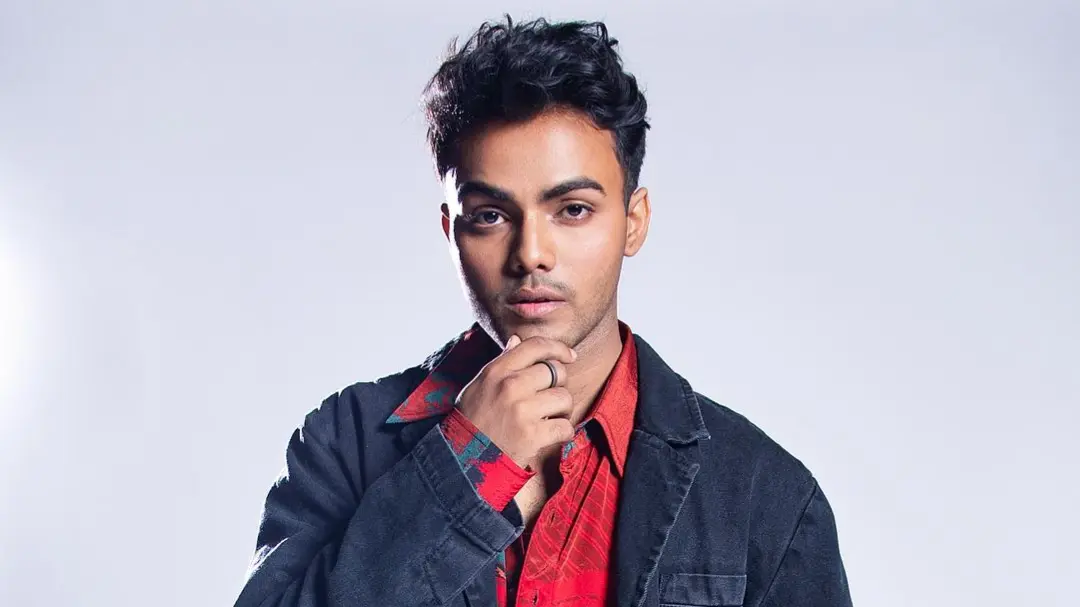
Niharika Lal (BOMBAY TIMES; July 24, 2025)
When Sparsh Shrivastava first read the script of Laapataa Ladies, he didn’t see Deepak just as a boy who loses his wife on a train. He saw someone carrying the entire film. “Deepak ka jo character hai, woh shuru mein apni wife ko leke chalta hai, then he loses his wife, and in the entire film, he’s only searching for her. That’s the whole character,” he says, adding, “There was nothing much. Pata nahi kyun, mujhe kabhi laga hi nahi ki yeh keval ladies ki film hai. Mujhe hamesha laga yeh utni hi meri bhi film hai.”
In a recent chat with us, he recalled his Agra and Delhi days and spoke about finding footing in the industry.
‘JITNA ZYADA AAP APNE CHARACTER KE SAATH TIME BITANE LAGTE HO, WOH AAPKE ACTING MEIN AANE LAGTA HAI’
Sparsh says the honesty of his character Deepak was in the eyes. “Jitna zyada aap apne character ke saath time bitane lagte ho, woh aapke acting mein aane lagta hai. Meri honesty uss character ko leke, zara sa bhi corrupt nahi hui. Mujhe hamesha laga yeh utni hi meri bhi film hai jitni makers ki.” At a meeting at Aamir Khan’s house after the film finished, he remembers, “Aamir sir ne bola, ‘You’ve brought the character above the paper.’”
‘MAKERS ARE LOOKING FOR ACTORS, NOT NAMES’
Sparsh isn’t naive about the way the industry treats people differently. “People say there’s no balance in the industry and different people get treated differently. But aaj bahut badal gaya hai. Makers are looking for actors, not names. Having worked with directors like Kiran Rao, Soumendra Padhi, and Sonam Nair, I’ve seen them treat the spot boy with as much warmth as someone coming in to shoot for just an hour.”
‘AB JAB AGRA JATA HOON, TOH TOURIST KI FEELING KE SAATH JATA HOON’
Sparsh says the joy of working still colours his memories – whether it was 17-hour rehearsals as a child or shuttling between Agra and Delhi for dance classes, and between Agra and Mumbai for work. At 8 or 9, he’d travel to Delhi for classes at Shiamak Davar’s institute. And even now, he finds himself caught between the cities. “Jab main Mumbai mein hota hoon, toh sabse zyada Agra ki language miss karta hoon. Aur jab Agra jata hoon, toh tourist ki feeling ke saath jata hoon,” he laughs.
‘I’m a really good dancer’
Sparsh says what matters more than dialogue is silence. He says, “I love playing parts where I don’t have to say much and I could emote through my body, eyes, movements.” “The reason might be simple – ‘I’m a really good dancer,’” he admits, grinning. “To be a good dancer, you have to express a lot.” At 11, he won Chak Dhoom Dhoom, a reality dance show, after hours of daily rehearsals.
In the web show Dupahiya, Sparsh did danced to the Photua song in a ghaghra-choli. “Ganesh Master ji (Ganesh Acharya) choreographed it. Sabko ghaghra-choli pehnake perform karwaya. Earlier we thought the back dancers would be girls, but it was his idea to keep everyone – even the background dancers – as men. It’s really unusual to see a song like that in a web show,” he says.
I would it take at least six months to get Abhishek Banerjee on board for Stolen-Gaurav Dhingra
8:36 AM
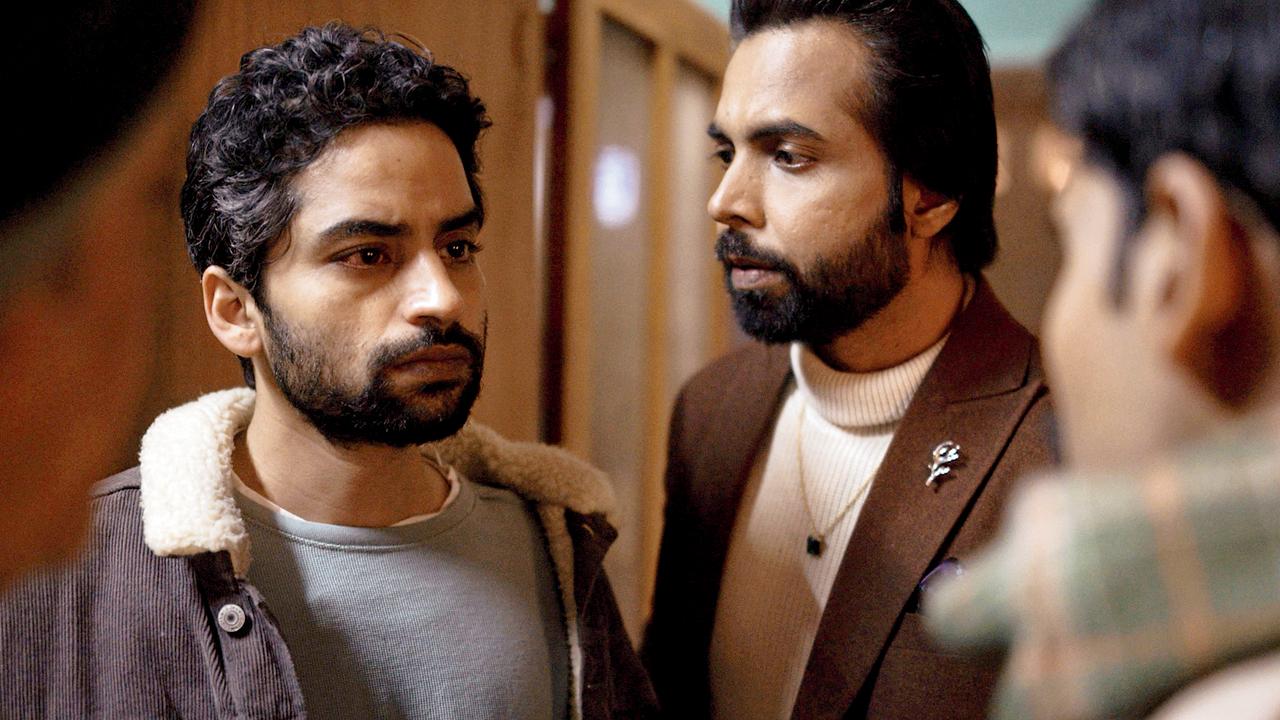
Co-writer and producer Gaurav Dhingra discusses how he got Abhishek Banerjee for Stolen in three days
Priyanka Sharma (MID-DAY; June 1, 2025)
Actor Abhishek Banerjee-led thriller, Stolen, is finally arriving home following its acclaimed international film festival run. But the film’s origin can be traced back to 2019, when debutant director Karan Tejpal shared with producer Gaurav Dhingra a story about two boys who were mistaken to be child lifters.
“Karan showed me some videos of two Assamese boys from Mumbai, who had gone fishing in Karbi Anglong, in Assam. They were mistaken to be child lifters, and then lynched [by a mob]. Karan wanted to explore the idea and shoot it in one take. That got me excited,” says Dhingra, who has also co-written the film.
At the same time, the producer was working on a separate series about missing children in India. “While this was going on, one of the stories we found, for the series we were doing, was about missing children being picked up from a bus station. Both the Karbi Anglong and the child lifting stories merged, and gave birth to Stolen,” he says, adding that it took them almost two years to write the script.
The time spent, however, was worth it as every actor they approached gave their nod after reading the first draft itself. Banerjee’s confirmation came in three days, shares Dhingra.
“We had just seen Paatal Lok. I felt Abhishek had a lot of range. He read the script the very next day. Usually, you need to give a lot of narrations. I was shocked because I thought it would take at least six months. But Abhishek said he wanted to take a day to read it again and respond. Two days later, he said he wanted to do it. It was that simple,” he shares.
Heaping praise on the actor, Dhingra says, “Abhishek is fantastic. We couldn’t ask for a better person.”
Another rarity that has happened with Stolen is the coming together of four top Bollywood filmmakers — Anurag Kashyap, Vikramaditya Motwane, Kiran Rao, and Nikkhil Advani — as executive producers. How difficult was this feat to achieve? Dhingra says he actually didn’t have to do anything.
“Everything is in the power of the material. We did a screening in Mumbai, and called some friends from the industry. Nikkhil and Vikram saw the film and were blown away. They asked me what I needed. I said that I was trying to sell the film. But then the industry was down. Later, Anurag called me, and said that he had heard much about the film and wanted to see it. Kiran, who saw it last, [was someone] I knew [as an assistant director] from Swades [2004], and Mangal Pandey [2005]. Earlier this year, I brought them together to present the film so that the audience sees their credibility and makes the film bigger. I’m so grateful. It’s extremely rare that such level of filmmakers come together to push a film.”

Gaurav Dhingra, Kiran Rao, Nikkhil Advani, Anurag Kashyap, Vikramaditya Motwane
My script of Laapataa Ladies was registered in 2018; painful to be accused of plagiarizing-Biplab Goswami
8:50 AM

BOMBAY TIMES (April 7, 2025)
Following claims that Kiran Rao’s Laapataa Ladies bore similarities to the Arabic short film Burqa City (2019), writer Biplab Goswami issued a statement dismissing the plagiarism allegations. Meanwhile, Burqa City director Fabrice Bracq, in an interview to IFP World, expressed shock over the similarities between the two films, citing several overlapping scenes and character dynamics.
Surprised to see the similarities: Burqa City director Fabrice Bracq, director of the 2019 Arabic short film Burqa City, recently spoke to IFP World and detailed his observations on the similarities. “First of all, even before watching the film, I was surprised by how closely the pitch matched that of my short film. Notably – and this is by no means an exhaustive list – the kind, loving, naive husband who loses his wife, contrasted with the other husband who is violent and despicable. The scene with the police officer is also striking: a corrupt, violent, and intimidating policeman surrounded by two sidekicks. Of course, there’s the moment with the photo of the veiled woman,” Fabrice said.
He added, “The scene where the kind husband searches for his wife in various shops is particularly revealing – he shows the shopkeepers a photo of his veiled wife, just like in the short film, and then the shopkeeper’s wife comes out wearing a burqa, almost like a nod to Burqa City. There’s also the similarity in the plot twist at the end, where we learn that the woman deliberately chose to run away from her abusive husband.”
‘SURPRISED WITH SIMILARITIES’
Fabrice Bracq, director of the 2019 Arabic short film Burqa City, said, “I watched the film, and I was both surprised and shocked to see that, although the story had been adapted to Indian culture, many aspects of my short were clearly present.” He added that the short was written in 2017 and was also shown at two festivals in India in Dec 2019 and Jan 2020. Bracq says that he found out about Laapataa Ladies after being contacted by journalists for comment
First registered the story in 2014: Laapataa... writer
In a statement, Laapataa Ladies writer Biplab Goswami said, “I first registered the film’s detailed synopsis, outlining the entire story with the working title Two Brides, with the Screenwriters Association (SWA) on July 3, 2014. Even within this registered synopsis, there is a scene that clearly describes the groom bringing home the wrong bride and being shocked and stricken upon realising his mistake because of the veil, along with the rest of his family. This is where the story takes off. I had also clearly written about the scene of the worried groom going to the police station and showing the only photograph he had of his missing bride to the police officer, but the bride’s face was covered with a veil, resulting in a comedic moment. On June 30, 2018, I registered the feature-length script Two Brides with the SWA. This script won the runner-up award at the Cinestaan Storytellers Competition in 2018. Again, in this screenplay, I had the scene of the policeman amused by the photograph of the veiled bride.”
He added, “Our story, characters, and dialogues are 100% original. Any allegations of plagiarism are completely untrue.”
-----------------------------------------
Rishabh Suri (HINDUSTAN TIMES; April 7, 2025)
Biplab Goswami, who wrote the original story of Laapataa Ladies (2024), is unhappy with the plagiarism allegations levelled against his work. He took to Instagram and X on Saturday, calling the accusations untrue. Trouble started recently, when social media users pointed out similarities between the Kiran Rao-directorial and Arabic film Burqa City (2019), directed by Fabrice Bracq.
Speaking to us, Biplab rues: “I got my story registered with the Screenwriters Association (SWA) in 2014 and the full script was registered in 2018. Koi poocha bhi nahin mujhse (about the controversy). I didn’t know it was being compared with Burqa City until Saturday.”
He adds, “The Laapataa Ladies team had a chat about these allegations, everyone was concerned. As a writer, one’s credibility gets affected when something like this happens. Kharab lagta hain, aur dukh iss baat pe hota hai ki koi pooch toh leta ek baar. It’s very painful. I worked on my story for 10 years. the film’s team worked on it so much.”
This isn’t the first time Laapataa Ladies is accused of being ‘inspired’. Actor-filmmaker Ananth Mahadevan had earlier raised concerns about its resemblance to his 1999 movie, Ghoonghat Ke Pat Khol. Addressing the allegation, Biplab says, “Honestly, (Laapataa Ladies) meri khud ki kahaani hai, it has no connection with any other story or novel. There is no basis to these allegations.”
‘Surprised and shocked’
Meanwhile, in an interview to IFP, Fabrice said that he wrote his short film in 2017, shot it in 2018 and presented it the following year. He claimed, “Even before watching the film (Laapataa Ladies), I was surprised by how closely the pitch matched that of my short film. Then I watched the film, and I was both surprised and shocked to see that, although the story had been adapted to Indian culture, many aspects of my short were clearly present... Of course, there’s the moment with the photo of the veiled woman.” However, in the proof shared by Biplab, the same scene existed in the story registered with the SWA in 2014.
We reached out to Fabrice for a response on the timeline of his film, but there was no response till the time of going to press.
There’s a sense of diffidence that even the most vocal and liberal women have-Kiran Rao
10:13 AM

Anshul Chaturvedi (BOMBAY TIMES; March 9, 2025)
It was 2011 when Kiran Rao debuted as a director with Dhobi Ghat, a critically acclaimed project that made everyone sit up and take note of her. Thirteen years later, she gave the world Laapataa Ladies – which made waves internationally for its theme of women finding identity, empowerment and agency. While the film was a critical and box-office success, Kiran says that she often found herself in a loop of questioning and self-doubt - admitting that even the most liberal and vocal women are afflicted by a “sense of diffidence.” The filmmaker speaks about how millennia of conditioning and constant questioning of themselves have made generations of women underconfident in a room full of men. Excerpts.
‘Why has it been so long’ is the question so many viewers had after watching Laapataa Ladies. Where did Kiran go after Dhobi Ghat?
It wasn’t intentional. I have been working consistently since Dhobi Ghat. I was writing. In fact, I had an idea for a story – which hopefully will now get made – about a woman’s struggles to get pregnant. I have had many, many stories, sort of developing and swimming around in my head. But for multiple reasons, and reasons that are all in some way interconnected, I wasn’t able to arrive at a draft that I was happy to make. And I think that that happens with a lot of women who are juggling a lot of balls at the same time. In many cases it is family, work… sort of almost... I don’t know. It’s a kind of conditioning where women overthink, and men are much more confident to do whatever they do. And there’s a sense of perhaps diffidence that even the most vocal and the most so-called educated, liberal of us have.
Could you expand on that – why are women more diffident?
Because for millennia, women have been told to be seen and not heard. In fact, been encouraged not to speak. Encouraged to sort of just keep the heads down and do what it takes to keep a family together and running. I feel, for millennia, women have kind of not had... not been given the encouragement to speak up. We have seen this in many different cultures, and it was only till much later that women got suffrage.
Very few would correlate to the fact that Kiran Rao is not sure of herself. That’s not how it looks from the outside.
Yeah, it’s not that I am not sure of myself, in that sense every artiste has their self-doubt…
But isn’t this gender-specific – what you are saying right now?
It is. Perhaps it takes us longer to do what we do. And it comes from a place of perhaps constantly questioning ourselves. You find that in a room, men are much more confident to just say whatever they feel and what they think. That’s because from when they are young and from many, many generations, they have been taught to be confident and to go out and exercise their point of view.
Women, on the other hand, have been encouraged to make a good home, look beautiful and you know, not really included in the most important conversations. And I think that is something that, whether we like it or not, is part of conditioning of women from when they are very young. And perhaps, for me, I wouldn’t say it was under confidence, but more this loop of questioning what I was doing, whether it was good enough. You know, there’s this instinct almost to not do anything until it’s perfect. Until I’m super satisfied with it. Which is a trap. Because nothing ever is perfect. I think it was partly because I was so absorbed with being with Azad. I’ve had so much trouble having a child in the first place, so creatively and just emotionally, I was so satisfied that I wasn’t in a rush.
Other than that, I think it was that I was in the same sort of loop that many writers get into when they are writing alone – I would find it very hard to break certain logjams that I would reach and have now realized that I do work much better with a co-writer, or at least somebody that I can bounce the story. For many reasons, I was sort of struggling in my writing, but I had stories that, now when I look at them, were fairly good to go. Then, in 2018, the story of two brides came to me through Aamir, and I kind of became quite obsessed with that. And then we got the rights to make it in 2019 and then started working on it. So that’s the journey of the last 12-13 years.
Post-success acclaim is part of this industry as default. But the gap between this film succeeding and your last project – in that phase, did you face questions like is she a one-film wonder? Is she ever going to do anything else, or is she just known because of the bigger name in the background? Have people come with that tonality to you?
I feel like perhaps they had all these impressions of me, but I think I am a much bigger critic of myself than anyone else can be. So, I think I was putting myself through the ringer a lot more than anybody else could. I am sure people thought maybe I will only make one film. It’s wonderful actually to think that people really expected me to do more work. It’s a privilege to make films. So, it’s great that people were hoping I would make another, and I knew what I was doing. I was very involved with the world of film, even when I was not making a film myself.
This period between the 2 movies – was it a phase of emotional vulnerability, before you could finally prove yourself, so to say?
No, I kind of plot my life as pre-Azad and post-Azad. And post-Azad, my life has been emotionally very, very fulfilling and complete. I have been inordinately fortunate in having a child that I have a great relationship with and enjoy so immensely. So I have not been emotionally vulnerable. I was fulfilled in other ways.
Going back to what you said earlier – it takes so much longer for women to believe in themselves. When you said that my first thought was that then the paradox is you have to wait till you’re older to be fully confident, at which point the other insecurities that you will have, men won’t have.
Yes, for instance, it’s harder for mothers to come back to work. To return to the same level that they were working at after having had a child and taken leave and things like that. Or women who are empty nesters who want now to get back to work, it’s much harder for them to find a place for themselves. That’s the reality, you know?
I think it’s a function also of how women in some way internalized certain filters, certain checks on themselves and sometimes it is more convenient because you know that it is a patriarchal society. You could get into all kinds of danger if you express your thoughts too openly and in some of the more conservative parts of our society. And even in a more urban and liberal environment, women find that there is a glass ceiling on their growth even in say a corporate setup. Different women have had different journeys and certainly I have been very fortunate, but still… It took me time to find my own voice, to find out what I wanted, to make the kind of stories that I felt I could make.
When you look around in the space of pop culture you see so many more young women who take their place confidently in conversations, especially when these conversations have to do with their own lives. For too long, women have not had a say in how they can live their own lives. That’s how Indian conservative society has traditionally been, where women had to follow certain rules, and you had to get married, and you had to have children at a certain time. And once you had your first child, you expected to have your second. Things have been internalized by our earlier generations... Now when you look around, I feel it is definitely getting better.
How much of that did you internalize? How much of did you have to fight to find your own mental space and independence?
I did not consciously have to fight in that sense. I am very, very lucky to have had an education, been confident enough to live alone in a city by the time I was 18 and find my own work and make my own connections, drive my own career. I did feel that I wanted a family. I did feel that I kind of had the sense that I would like to have a child, but even that was a bit of a struggle for me. But it was not like consciously I felt… Like for me, it was not a sense of that I can’t do this because socially it’s not acceptable. That’s never been for me a consideration. Because I’ve done things... had an inter-religion marriage, had a surrogate child. So, there are many things, and, in many ways, I have lived life the way I wanted to.
Did it take time for people to recognize you for yourself, as opposed to the hyphenation with Aamir?
On some level, I would think that you would be able to answer it better than me, because I only have a sense of the people I am surrounded by. I have stayed away from social media and now of course it’s at another level, but let’s say 20 years ago, when I first started seeing Aamir – you know back then if there had been social media, I would have perhaps been very influenced by what people perceived me as. But I haven’t changed. Perhaps the only change I have seen has been post Laapataa Ladies. The film kind of gave me in some ways a distinctly personal identity as a filmmaking voice, as a filmmaker. And I am grateful for that, because people know what I am interested in, what kind of things I am capable of doing, so perhaps they view me differently also in this journey.
From when we started working on this film to the release of this film, Aamir and I got separated and then divorced. Quite naturally, by the end of it, when we were making the film, and also because Aamir as a producer is pretty hands off, I was pretty much helming the project, and I think people saw that… I am not just tag-on. You know how they say, ‘Produced by Aamir Khan and Kiran Rao’ and people naturally assume that your name is there because you are his wife or something. But then they got to see that okay, this is what she is on her own. The fact that they saw me separately with my actors – producing, directing, releasing the film, marketing the film – it sort of became easier to see me as a standalone human being, with my own personality and my own world view.
You spoke about looking at your life as pre-Azad and post-Azad. What did you see changing about yourself in that second phase?
I think the change really was this feeling that my life in some way was very complete. I felt immense gratitude, immense satisfaction being able to be part of his phases of growing up, of getting to know him as an individual, of sharing time with him. Except that I think a lot of parents will say… that this kind of overwhelming love sometimes is quite frightening. Because with all that great love you always worry that it’s almost too much happiness. It’s a double-edged sword. I think a lot of people feel it when they are in love - that you will lose it. I think that having Azad made me aware that such a… lose-yourself kind of love is possible. I don’t think other than that he changed me necessarily. He made me also much more aware of certain ways I look at myself or live my life because as they say, children do as you do, not do as you say. And so, it made me examine some things. In that sense, it did change, it made me more aware that I wanted to be a better person. I wanted to be living life the best I could for him, with him.
If you could write a note to your Jamia self, what would you say today?
I would say don’t be so hard on yourself. Don’t be afraid to explore and discover everything that life has to offer. There are lots of good things out there. There’s lots of good people, good ideas, good things to come. So… be free.
Are you still hard on yourself?
Yes! (laughs) So maybe it’s a note to myself continuously. Forever.
----------------------------------------------------------------------------
I had people sort of shake me and rail at me and tell me, ‘How can you not be making more films?’ and express their disappointment that I am not doing things. But that was nothing compared to what I was putting myself through
----------------------------------------------------------------------------
It took me time to find my own voice, to find out what I wanted, to make the kind of stories that I felt I could make, which is why there is such a stark difference maybe in scale or in the appeal between Dhobi Ghat and Laapataa Ladies
----------------------------------------------------------------------------
For me... I wouldn’t say it was under-confidence, but more this loop of questioning that I was doing, whether it was good enough... It’s a kind of conditioning where women overthink, and men are much more confident in whatever they do
Golden age is over, OTT in India has seen a bubble burst-Kiran Rao
9:47 AM
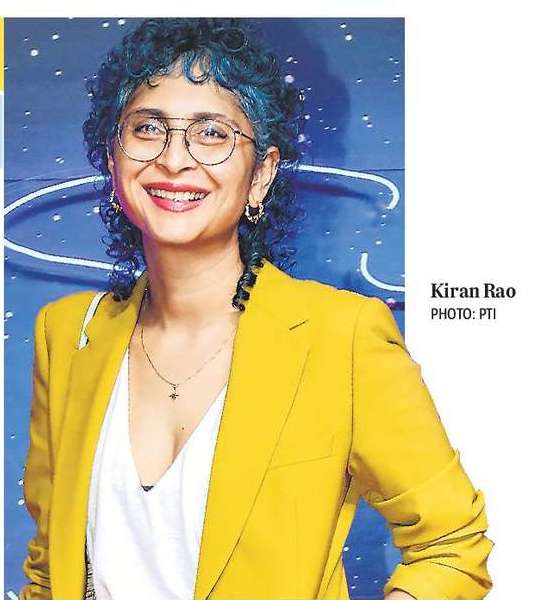
HINDUSTAN TIMES (February 17, 2025)
Filmmaker Kiran Rao feels that the “golden age” of streaming platforms in India is over. Speaking at the 7th edition of the Indian Screenwriters Conference (ISC), hosted by the Screenwriters Association of India (SWA), the director said, “OTT was this golden egg; everyone could do everything that they dreamt of, and it had to come full circle. There is a lot of promise there, a lot of stories to be told, I just don’t know how many people are commissioning them and (if) the economics allows one to do. Like everything, there was a golden age, but I am not sure where it goes from here. We still have some great writing on OTT in India, but there is a lot more to be done.”
She was in conversation with moderator-writer Mitesh Shah, known for penning Tumbbad (2018), for a masterclass session at the event. Kiran also noted that there was hardly any difference between the content on OTT and films today: “Now, more and more, you see the kind of things that are so-called ‘working’ or big on OTT in India are usually stuff which isn’t vastly different from what we would see in films. So, the promise of world-building and doing other stuff may not have been (fulfilled). That’s also because I think there has been a bit of a bubble burst.”
Kiran’s directorial Laapataa Ladies was well received when it dropped on a streaming platform. When asked if she plans to start another OTT project, she said, “I have a couple of series ideas, including a mini-series, but I don’t know where to go with what I am doing. I feel like taking the ideas that I wrote for my series and making them into films!”
Payal Kapadia scripts history, bags twin Golden Globes nods for All We Imagine As Light
8:18 AM
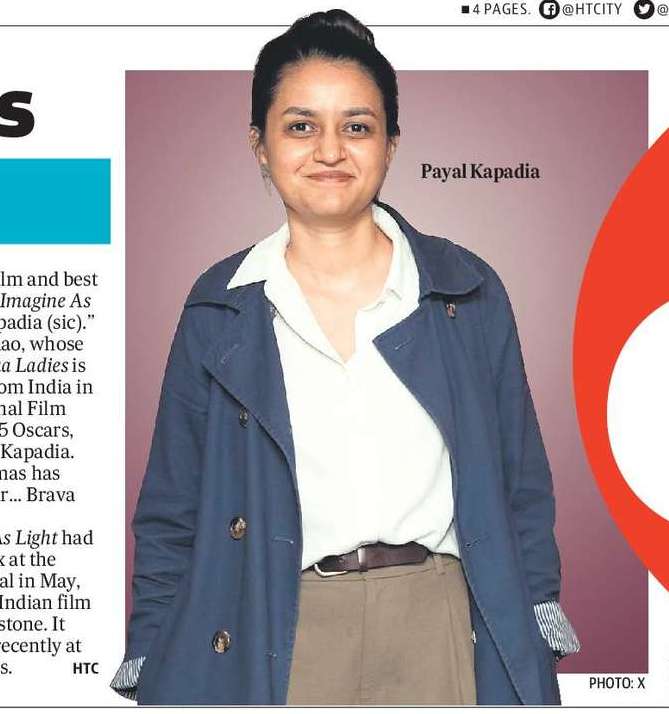
Payal Kapadia’s All We Imagine As Light receives twin Golden Globe nominations for Best Director and Best Motion Picture in Non-English Language categories
BOMBAY TIMES (December 11, 2024)
Payal Kapadia’s All We Imagine As Light is on a winning streak this year. After bagging the Grand Prix award at Cannes, it was recently named the best international feature at Gotham Awards. Now, Payal has been nominated for the Best Director category at the 82nd Golden Globe Awards and the film has secured a nom in the Best Motion Picture in a Non-English Language category.
Reacting to the news Payal stated, “I’m deeply honoured by this nomination and grateful to the HFPA for this recognition. This is a celebration of everyone who worked so passionately on the film. To everyone in India, All We Imagine as Light is still in theatres, please go watch it and support us!”
Filmmakers and actors also congratulated the team on social media. Laapataa Ladies director, Kiran Rao wrote on Instagram Stories, “Christmas has come early this year! Brava, Payal!” Divya Prabha, who is a part of AWIAL shared her story and added, “Let’s celebrate this together”. Anil Kapoor called it “what a monumental recognition of Indian cinema and storytelling prowess of Payal Kapadia. So incredibly proud!”
The film will be competing with Emilia Pérez, The Girl with the Needle, I’m Still Here, The Seed of the Sacred Fig and Vermiglio in the Best Motion Picture in a Non-English Language category. Earlier, Shekhar Kapur was nominated in the Best Direction – Motion Picture category at the 1999 Globes for Elizabeth. – Inputs by Mihir Bhanage
Golden Globes 2025 race
Emilia Pérez is leading the noms list with 10 nods. The Brutalist (7), Conclave (6), Anora (5) and Wicked (4) will be among the other films contending for the top prizes. In the TV space, The Bear, Shogun, Only Murders in the Building and Baby Reindeer are among the top contenders for key categories.
---------------------------------
HINDUSTAN TIMES (December 11, 2024)
Payal Kapadia has scripted history at the 82nd Golden Globe Awards by becoming the first Indian director to be nominated in the Best Director— Motion Picture category. She was nominated for her debut fiction feature, All We Imagine As Light.
The film also scored a nomination in the Best Motion Picture in a Non-English Language category. The 38-year-old reacted to the nomination and expressed her gratitude in a statement: “I’m deeply honoured by this nomination...This is a celebration of everyone who worked so passionately on the film. To everyone in India, All We Imagine As Light is still in theatres — please go watch it and support us!”
Soon after the announcement, congratulations began pouring in for Kapadia. Actor Anil Kapoor tweeted, “What a monumental recognition of Indian cinema and the storytelling prowess of @PayalKapadia86! So incredibly proud!” Filmmaker Hansal Mehta, who has long supported the movie as India’s “official selection for the Oscars”, too, took to X: “India’s official selection for the Oscars secures 2 nominations at the Golden Globes. Best non-English language film and best director for All We Imagine As Light and Payal Kapadia (sic).”
Director Kiran Rao, whose film badge Laapataa Ladies is the official entry from India in the Best International Film category at the 2025 Oscars, also congratulated Kapadia. She wrote: “Christmas has come early this year... Brava Payal!”
All We Imagine As Light had won the Grand Prix at the Cannes Film Festival in May, becoming the first Indian film to achieve the milestone. It was also awarded recently at the Gotham Awards.
Laapataa Ladies is still running in Japan, and I’ve been receiving wonderful DMs-Kiran Rao
8:21 AM

Niharika Lal (BOMBAY TIMES; November 11, 2024)
After Laapataa Ladies was selected as India’s Oscar entry, director Kiran Rao has been busy with the film’s Oscar campaign. In a chat with us, the filmmaker spoke about the film’s Oscar campaign and how it’s heartening to see its global recognition.
‘THE FILM IS SPARKING CONVERSATIONS ON GENDER PARITY’
Ask her how the campaign is going so far, and Kiran shares, “We’re just taking one step at a time, and I am grateful for both the opportunity, as well as the fact that the film is able to spark conversations around womanhood, gender parity and the need for self discovery.”
For Kiran Rao, the Oscar campaign has been a truly exciting journey so far. “We’re trying to share the film with as many people as possible and connect with a diverse audience. There’s a lot of work that goes into it behind the scenes, but it’s been heartening to see the kind of interest and appreciation the film is getting on the global stage,” she says.
‘IT’S BEEN A GREAT LEARNING EXPERIENCE’
More than recognition, the joy of sharing the film with a wider audience matters to Kiran. She says, “At this point, I think the journey is a blend of strategy, belief, hard work, and a whole lot of magic. For me, it’s been a great learning experience. I’ve met so many incredible people and been part of some very insightful conversations. While this is my first, I am grateful to have Aamir (Khan) by my side who has done this multiple times earlier.”
Talking about the reactions to the film, she says, “Laapataa Ladies is still running in Japan, and I’ve been receiving wonderful DMs and emails, with audience reactions. It is overwhelming and very humbling. Audiences are really connecting with the story, which feels so personal, yet universal.”
‘A FILM ON STREAMING PLATFORM BREAKS BARRIERS IN TERMS OF GEOGRAPHY’
For any film selected as an official entry for Oscars having a presence on streaming platforms is an added advantage.
Kiran says, “In a world where content is available on phones and tablets, I think, a film’s presence on streaming platforms is absolutely crucial. These platforms provide wonderful reach and accessibility, allowing people all over the world to watch a film at their own convenience. They break down barriers in terms of geography and allow films to reach audiences that might not have had the chance to see them otherwise. For an Oscar campaign, this is incredibly valuable.”
I am 59 now, mushkil lag raha hai, says Aamir Khan on marrying again
3:33 PM

BOMBAY TIMES (August 27, 2024)
Aamir Khan has had two “unsuccessful marriages,” but he isn’t averse to the idea of relationships. In a recent episode of Rhea Chakraborty’s podcast, the actor opened up about marriage and companionship and said, “I have had two unsuccessful marriages, so don’t ask for marriage advice from me. I don’t like living alone, I need a partner. I am not a loner, I like companionship. I am very close to both my ex-wives Reena and Kiran, we are like one family.”
When asked if he plans to get married for the third time, the actor said, “I am 59 now, ab kahan shaadi karunga, mushkil lag raha hai mujhe... I am very happy just being with people who are close to me. I am working towards being a better person.”
It was so enjoyable for both Aamir Khan me to watch Laapataa Ladies at Supreme Court-Kiran Rao
7:59 AM

Niharika Lal (BOMBAY TIMES; August 11, 2024)
Almost six months after its release, and six years after she first heard the idea of Laapataa Ladies, Kiran Rao is still receiving stellar reviews. Last week, however, it was not regular moviegoers but judges of the Supreme Court who watched the film and discussed its unique theme with Kiran and Aamir Khan after the screening. After the screening, Kiran spoke to us about her experience of visiting the Supreme Court, interacting with the judges, and how, after six months, she feels enveloped by the love for the film.
“Now I literally see hearts in people’s eyes when they look at me,” she said at the screening in Delhi.
‘Wanted to touch upon the kind of experiences women have’
Two scenes from the film that got the biggest reactions were one, the dialogue between two elderly ladies about why women of the house can’t become friends, and second is the dialogue, ‘Iss desh mein ladkiyon ke saath fraud ho raha hai – uska naam hai bhale ghar ki bahu-beti’.
Talking about what she wanted out of these moments in the film, Kiran says, “The kind of experiences that women have in their workplaces and homes were some of the experiences we wanted to touch upon. I feel that these two scenes resonated with the audience because they were genuine interactions between the characters, not lectures making a point. Both came very organically.”
‘THE GOAL WAS REALLY TO START A CONVERSATION WITH PEOPLE ON THE MANY THEMES THAT THE FILM TOUCHES UPON’
Because of the overwhelming response to Laapataa Ladies, Kiran says that she has had some of the most memorable months of her life.
“Honestly, I have been feeling enveloped in the affection and the great love that the film has been receiving. The reaction is something I didn’t expect at all, it has really affected me personally. I feel very humbled by the fact that not just women, but people in general, have been moved by the film. I have had interactions with people whose stories have been very similar. The goal was really to start a conversation on the many themes that the film touches upon and the film seems to have gone beyond themes or issues and touched people’s hearts. That is the most incredible feeling as a filmmaker.”
Kiran shares that the film speaks to people across the board. “Most of us relate to the experiences of the characters in the film, even though we may not belong to rural India or be a woman. The film has a universal humanity, which we were hoping to convey. Even when we were showing the film at the Toronto Film Festival and whenever I was traveling in Europe, the reactions have been similar across the board. People react to the fact that it reminds them of someone in their lives, resonating with the ideas it presents. So, it has become broader than just this specific story, which is what I think every filmmaker hopes to do – to create something memorable that connects with people.”
A special screening
I had to pinch myself several times to believe it was really happening. The screening was full, and there was so much warmth. People may have seen the film before, but they were watching so kindly, engaged, with so much laughter in the hall. It was so enjoyable for both Aamir and me to watch it with an audience again – especially such a responsive one.
Aamir Khan to retire from acting?
8:54 AM

L-R: Actor Aamir Khan, filmmaker Kiran Rao and Chief Justice of India DY Chandrachud
At his film’s screening at Supreme Court, the actor revealed that he might pursue producing full-time
HINDUSTAN TIMES (August 11, 2024)
Actor Aamir Khan and his ex-wife, director Kiran Rao, attended the screening of their film Laapataa Ladies at the Supreme Court on Friday. At the event, while talking about his motivation to produce the film, Khan also hinted at retiring from acting and pursuing production.
“During Covid, at the age of 56, I realized this is the last leg of my career... I might have 15 more years of active work left. I thought that I could do one film a year as an actor, but as a producer, I can [do] more films,” he said during an interaction with Chief Justice of India D Y Chandrachud, adding, “Laapataa Ladies is the first project in that sense. I want to promote this kind of talent and hopefully, I can produce four to five films a year.”
The screening was part of a gender sensitization programme and was held to commemorate the 75th year of the Supreme Court of India.
Aamir’s next is Sitaare Zameen Par, which he is producing as well. He is also producing two other films — son Junaid Khan’s next and Lahore 1947, directed by Rajkumar Santoshi, starring Sunny Deol.
Aamir Khan told me, “I am retiring, why don’t you take over.” So, that’s the phase when I stepped in-Junaid Khan
7:26 AM

Madhureeta Mukherjee (BOMBAY TIMES; August 3, 2024)
Junaid Khan made a fine debut with the historical drama Maharaj, directed by Siddharth P Malhotra recently. There was no massive marketing campaign or a tizzy on social media around the launch of superstar Aamir Khan’s son. He quietly and gracefully made an entry, made a mark and left everyone curious about him. On a rainy Sunday morning, he hopped out of a rickshaw and rushed in for an interview with us (minus the entourage and all that jazz).
Refreshing! Between laughs and a few words, our conversation unfolded. He listened more, spoke less and let his charm do the rest. Curious? Read on...
Congrats on an impressive debut with Maharaj! Many people thought it was an unconventional debut. What are your thoughts? Is this the kind of debut you had envisioned for yourself?
I think the story is highly dramatic and that it is a fairly mainstream film. I don’t think it is a niche film at all. I guess different people find different things unconventional. About my debut, I actually didn’t put much thought into it. I have been doing theatre in Mumbai since 2017 and whenever I was called for a reading or an audition, I would go for it. So, I never had any grand plan for my debut film.
Did you hope for your debut film to be a big screen release? Does the medium or format matter to you?
I don’t think it does. What is important to me is that people watch my film, where they watch it is not relevant. In an ideal world, I would say put it up for free on YouTube, but obviously, no one will do that (laughs).
The film is set in a different era, you had a distinct look and a certain dialect, too. How long did it take you to get into the skin of the character?
We spent a year prepping for it. The language in the film is heightened, and there is a slight Gujarati dialect. We worked on that as well to understand how much Gujarati we should include in the dialogues. We also did a lot of look tests and dance rehearsals.
You confessed that you aren’t a good dancer. Are you honing your dancing skills?
Yes, I am not a very good dancer. But at the end of the day, everything is practice, so I will get there (laughs).
Did your experience as a theatre actor prepare you for the big screen?
The craft is the same. However, I didn’t do theatre to prepare for the big screen. There are technical differences in both, but what’s similar is that the more you do it, the better you get. You have to be thorough with what you are doing – whether it is theatre or films. You don’t have the luxury to be unprepared in any medium. That luxury doesn’t exist. Today, no director or producer will appreciate it if an actor comes unprepared.
Was there a certain point in your life when you decided you wanted to be in the movies?
I don’t think there was a point as such when I decided that. I was doing what was coming my way. I had tested for a bunch of roles, like I had auditioned for Laal Singh Chaddha. When I tested for it, the film was in the initial stages, it hadn’t even been budgeted. They were trying to figure out what to do with it, I guess that was one of the reasons it didn’t work.
Maharaj was waiting in the wings for three years to be released. Did you get impatient and restless during that waiting period and have to deal with a lot of questions around its release?
I don’t think I was asked much about what was going on with the film, because I don’t think anyone even knew this film was being made. It wasn’t announced by the producers, and I think it was announced only sometime last September. So, I didn’t feel any pressure during that time, and I trusted that the producers would do what’s best for the film.
All this time, you have been really low-key. Like even your director Siddharth P Malhotra, in an interview, said that many didn’t know you were Aamir Khan’s son. Even now, it’s not like you are spotted much by the paps, nor are you on social media. Was it part of a plan to not overexpose yourself in the media before your launch?
I don’t think there was a plan per se. Most people still don’t know me. I have just been this way (laughs). Long ago, I had a Facebook account, but that was a different time on social media. I haven’t been drawn to Instagram and I don’t think social media is my thing.
You come from a culturally diverse family with creative people who have diverse views and opinions. Has your upbringing shaped your personality and thoughts on life, movies, et al?
I think it definitely has. I think our upbringing and families shape our lives quite profoundly. I have a very supportive and diverse family, and we encourage debate and disagreements. I am thankful for the family that I have.
Did your father’s work have an impact on you and your film choices?
I don’t think so. He’s done some fantastic work and he’s done some work that’s perhaps not all that good also. Everything can’t be the best work ever, as filmmaking is not a science. So, what I have learnt is that you have to take the learnings and move forward.
What was your parents’ (Aamir Khan and Reena Dutta) reaction when they learnt about your debut film? During the release, were they anxious?
Not really (laughs). They weren’t anxious, they were happy for me. They are not anxious people generally, as they have been through all of it and more (being part of the industry for so long). The fact that they weren’t anxious also helped me with everything that was going on with the film. They both liked it. Dad liked it quite a lot He tends to be an easy audience, as he goes in to watch something wanting to enjoy it. My mom is a tougher audience to please.
Did he ever drop in on the set of your film?
He was never on our set. He only came on the first day of the shoot with my three grandparents and then he directly watched the film.
You got a lot of love for your first film, but a huge part of being an actor is about being able to deal with criticism that comes your way, which isn’t always easy. How did you deal with it?
As an actor, you are always learning and growing. Film is an art form, and it encourages diverse opinions. Not everyone will like everything. I know there are a lot of people who didn’t like Maharaj as much as we would have liked them to, but that’s fine. You learn from the good and bad and grow.
Generally, actors step into production much later in their careers. You have already taken on the role of a producer with Pritam Pyaare. What prompted you to do that?
Yes, I have. I have been on film sets and behind the camera on the set of PK. I have assisted in ad shoots as well. After we completed the shoot for Maharaj, there was a film we were working on at AKP (Aamir Khan Productions). At that point, Kiran (Rao) was making Laapataa Ladies and dad was going through this whole ‘I-am-retiring phase’, and he even spoke about that (smiles). He told me, “I am retiring, why don’t you take over.” So, that’s the phase when I stepped in. I think I have a decent understanding of production. It’s probably one of the toughest jobs in filmmaking.
Have you warmed up to the idea of media attention, interviews and the fandom that will follow?
It is definitely a new world, and I am getting used to it.
I'm grateful to Kiran Rao and Aamir Khan that they thought I could do this character of Manju Mai-Chhaya Kadam
8:12 AM

Niharika Lal (BOMBAY TIMES; June 26, 2024)
When Chhaya Kadam attended Cannes this year, she debuted with a double punch: All We Imagine As Light in the main competition and Sister Midnight in the Directors’ Fortnight. While Payal Kapadia’s debut became the first Indian film to be awarded a Grand Prix, the films at Cannes are not the only ones that have captured Kadam’s versatility so far. With small roles in hits like Jawan, Andhadhun and Sairat, Kadam often leaves audiences scratching their heads, trying to recognize her from one film to the next.
She recalled an incident where, upon exiting one of her screenings, she was asked, “How was the film?” because the questioner didn’t recognize her.
However, her recent role as Manju Mai in Laapataa Ladies and her dialogues became so viral that now she’s even stopped at grocery stores by fans eager to recite her lines from the film. In a chat at the MIFF closing ceremony, Chhaya spoke to us about her Cannes debut, Laapataa Ladies, and how she picks her roles.
'Everybody who is working in films must attend Cannes'
The cast of All We Imagine As Light didn't just attend the screening - they broke into a celebratory dance on the red carpet. Later, at the award ceremony, Payal Kapadia brought her three leading actors on stage to accept the historic award.
Recalling her Cannes visit, Chhhaya says, "As an actor, after attending Cannes, I feel that everybody who is working in films must attend Cannes. Film ho toh bohot hi badi baat hai, film na bhi ho toh bhi jana chahiye. Jo filmon se pyaar karne wale log wahan ikattha hote hain na toh woh filmon ka shehar ban jata hai. When the film was selected then itself it was decided for us that we will go to Cannes. It was our producers who took us there, otherwise not all producers take their actors to Cannes. Ye log hi kamaal thay. Even stage pe agar Payal humein nahi leke jati..."
After the Grand Prix was announced, Chhaya said at the press conference that she knew they would win. She had even booked her tickets for after the ceremony and decided on clothes for the award ceremony. How did she have that confidence?
Chhaya says, "I don't know where I got that confidence from. But I had that confidence in our film. Ab main jab apne aap ko dekhti hoon, toh Cannes jane ke pehle itna (dar) tha - Main pehli baar out of India itni door gayi. Toh mujhe ye bahut doubt tha ki yaar mujhe samajh aayega na? Language problem bhi. Par doston ne kaha - kuch nahi, tu ja. Then I had to look for a house there, so I went a little early. Ab to mera confidence itna badh gaya hai."
Talking about her role, she says, "All We Imagine As Light is a story of three women. Usually, in films, women are shown at loggerheads, but in this film, it is about three different women and their friendship. The film is about Mumbai. Mumbai ek aisa shehar hai jahan kahan-kahan se log aate hain aur bas jate hain Mumbai mein. Ye film unki kahani hai. I played the role of Parvati in the film, who is from Konkan and is staying in Mumbai. When I heard about Parvati's role, I realized that I had Parvati in me. When I heard about that role, I felt that it was written for me. Ye sirf main hi karungi. We filmed in Mumbai and Ratnagiri."
'During Laapataa Ladies audition I kept saying - Marathi actress ko kyu lenge?'
Her recent role as Manju Mai in Laapata Ladies and her dialogues became so viral that now she's even stopped at grocery stores by fans.
Talking about the film, she says, "Kiran ji had done a lot of work on that film. We had a dialect trainer, Sonu Anand, who worked really hard with us on getting the dialect right. I would call him at midnight so that he could check whether I was getting the dialect right. Mujhe khud alag-alag language aur har language mein ek lehja hota hai - woh karne mein bahut maza aata hai. Lekin Laapataa Ladies ke waqt mujhe thoda darr tha. Tab tak maine jo Hindi filmein ki thi - film Hindi thi lekin mera character usmein Maharashtrian hota tha. Bolti thi Hindi lekin thi woh Marathi aurat. But this character was from UP, so I was like I don't want to get caught. My friend Romil Modi, who was the casting director of the film - I used to keep saying to him, 'Romil, nahi hoga. Ye log audition lenge aur kisi Hindi wale ko lenge, Marathi actress ko kyu lenge?' But I'm grateful to Kiran Rao and Aamir Khan that they thought I could do this character of Manju Mai."
"For me, the most important thing is my character; the director or production house comes later. I want to do different characters, and I want to get a chance to learn with every film. Otherwise, it will be like picking the same character and pasting it in every film. Kiran Rao kamaal ki director hai aur kamaal ki insaan hai. She did Dhobi Ghat; even at that time, I was offered a small role, but I couldn't do it because of my operation."
Recalling an encounter, she said, "If I'm asked, I will not remember the dialogues of Manju Mai instantly, but I keep meeting people who know the dialogue by heart. A few days back, I went to a shop and met a family from Gujarat. Aur woh log sab mujhe mere dialogue suna rahe hain. One of them told me that she tells her daughter, 'Boorbak hona sharm ki baat nahi hai, boorbak hone pe garv karna sharam ki baat hai.' (laughs)."
'I'll never say - maine kya bakwas film ki thi. Nahi. Uss waqt mere liye woh bahut important film thi isliye maine ki'
Kadam played roles of strong women such as Naani in Fandry, Suman Akka in Sairat, and Chandrakka in Nude. Talking about how she chooses scripts, she says, "Jab kuch alag karne ko milta hai toh main karti hoon. Lekin hamesha aise nahi hota. Sometimes, there is a good script, sometimes there are good people, and sometimes it’s about the bank balance - that also happens. Sometimes, I also feel like - why did I do this film? But one thing I want to say is that at present, people are talking about my good films. But what the audience thinks are my good films, I was able to do these good films because I also did some other films. Un filmon ne mujhe uss waqt ek support diya financially. Un filmon ki badaulat hi aaj main achhi film kar rahi hoon. I'll also not say - maine kya bakwas film ki thi. Nahi. Uss waqt mere liye woh bahut important thi. Uss waqt uss kaam ke liye bhi maine utni hi koshish ki thi."
How Chhaya Kadam started acting
Her acting career started when she took part in former NSD director Waman Kendre's workshop. Recalling how it all started, she said, "Mere bade bhai aur pitaji dono chhor ke chale gaye, main dono se bahut connected thi. Jab woh chale gaye toh mujhe aisa laga jaise life mein ab kuch nahi hai. Kuch karna nahi hai, aisa lagta tha sab khatm hai. Bas aisa hi hua tha mere saath. I never used to leave home and I was the youngest one. I felt like I have to get out of this, and then one day I saw Prof. Waman Kendre's acting workshop ad in the newspaper and I thought I will get out of my home and will get to meet people who will have no idea what's happening in my life. Kisi cheez mein khud ko dhaalna tha, khud ko bhool jana tha. That's what I had in my mind and that's how I ended up doing the workshop. I really enjoyed doing the workshop and he also showed me what I had and what I was lacking."
"Just yesterday, when I did an interview for Doordarshan, I remembered that someone had told me that an actor was needed in Doordarshan, and I went there and the director told me that the casting was over, but he needed an assistant. Mujhe aisa laga - yaar, main actress lag hi nahi rahi hoon kya? (laughs).
Later, she joined as an assistant and acted in the short film when the lead actress didn't turn up. She has done several films that have not been released yet. Doesn't it hurt to work in films that were not even released?
She says, "Dukh to bahut hota hai. Par woh dukh mera akele ka nahi hota. When we start discussing a project, from that time we start discussing that character. Whether the film is released or not, the preparation that one does for playing characters, it somewhere adds."
Chhaya Kadam has turned producer with her upcoming film Bardovi. She says, "It was a good subject with such good people associated with the film that I felt my name should be associated with it. Bardovi means the place between death and rebirth. It was quite challenging for me to play that role. When working with people who love their work, even if they are few in number—let's say just 50—their energy feels like that of 100. That's how I worked on that film."
Subscribe to:
Posts (Atom)