Showing posts with label Jackie Shroff. Show all posts
Showing posts with label Jackie Shroff. Show all posts
Jackie Shroff shoots for 12 hours a day after Tiger Shroff's firing incident
10:31 AM

Mohar Basu (MID-DAY; October 20, 2026)
The Shroffs are determined not to knuckle under the Bishnoi gang’s threats. Speculation was rife that the ongoing shoot of Jackie Shroff’s Nanavati vs Nanavati would be called off after shots were fired at Tiger Shroff on Sunday evening. However, sources say Jackie reported to the Powai set on Monday (October 19), “a day after the incident, and worked a 12-hour shift”.
Tiger suffered minor abrasions, while his driver and a fan/bystander sustained injuries when three assailants opened fire at the actor’s vehicle after his football game. The incident prompted security concerns.
A source close to the production says, “Jackie reported to set as scheduled and worked a 12-hour shift. The timings have been altered to accommodate the situation, so he started early and left by 5 pm. He has made it clear that work should not come to a standstill, either for him or Tiger.”
Jackie is determined to honour his commitments while ensuring safety. “Calling off a shoot has monetary repercussions which will affect the schedules of over 300 people on set. There are no changes to the schedule as of now, but the intention is to not shut down the ongoing schedule,” adds the source.
In the pipeline
Tiger Shroff has about five projects lined up, including Raj Mehta’s ‘Lag Jaa Gale’, Remo D’Souza’s ‘Rambo’, and Ram Madhvani’s ‘Vajra’. Jackie Shroff’s upcoming projects include Salman Khan and Vamshi Paidipally’s ‘Monster’, and Ahmed Khan’s ‘Baap’.
Jackie Shroff says his astrologer father predicted he would become an actor
4:40 PM

Upala KBR (MID-DAY; September 27, 2026)
Jackie Shroff’s Bollywood destiny was apparently written in the stars. During the finale shoot of India's Best Dancer 5, the actor recalled how his astrologer father predicted that he would find his calling in the film industry, even before he had considered acting as a career.
After completing Grade 11, Shroff was ready to take up a job. But his father had other plans. “My father didn’t speak much. He was focused on his work, and he had some good clients. He predicted my future as well. He told me, ‘Son, you will become an actor.’ And his astrological prediction turned out accurate in my case,” shared Shroff.
Given the dance reality show setting, the actor also recalled his first dance sequence was for the title track of Hero (1983), Apni Taqdeer Toh Hero Hai, informed a source. With no formal dance training, Shroff often found himself caught between conflicting instructions from director Subhash Ghai and late choreographer Saroj Khan.
“The camera was behind me, and there were 12 reflectors shining on my face. I couldn’t keep my eyes open. So Saroj ji would always say, ‘Hey, open your eyes’, while Subhash ji would say, ‘Don’t open them’. So while trying to balance between the two, I would move my head, and then Saroj ji would say, ‘Hey, Dev Saab’s sixth child, don’t move your head.’ Then Subhash ji would say, ‘Move it’,” reminisced the actor.
Shroff admitted that his lack of dance training worked in his favour, as his co-star Meenakshi Seshadri, a trained dancer, carried the song with ease, allowing him to simply play the character.
Sunny Deol, Mithun Chakraborty, Sanjay Dutt, Jackie Shroff shoot music video for Baap
8:41 AM

Upala KBR (MID-DAY; September 3, 2026)
Put Mithun Chakraborty, Sunny Deol, Sanjay Dutt, and Jackie Shroff in one frame, and you can expect an action extravaganza. That’s exactly what Baap promises. Now, producer Ahmed Khan has also woven in an element of dance in it.
While the movie’s principal shoot was wrapped up in April 2025, mid-day has learnt that Khan and director Vivek Chauhan recently filmed a music video with the four leading men and Johny Lever.
Think of it as a stylised promotional track that will highlight the heroes’ action set-pieces from the movie.
A source from the creative team revealed, “A peppy dance number featuring the four actors, and another track celebrating their camaraderie were to be shot last year. However, only the latter was filmed in the jungles of Mizoram and in Film City, Mumbai. The dance track was finally shot in June. A set depicting a mill was created at Madh Island for the purpose.”
Considering Baap is high on stunts designed by action directors Parvez Shaikh and Ravi Varma, Zee Studios as well as Khan felt portions of it should be incorporated in the single. The source added, “It’s intercut with different action set-pieces. For instance, one sequence has Sunny and Sanjay fighting on top of a Boeing plane; it may make the cut.”
For Khan, it was wonderful to see the four stars shake a leg together. “It was great fun to have the true action heroes dancing and doing dialoguebaazi,” he told mid-day, while the director added, “Seeing these macho icons together in one frame is a cinematic feast!”
There was never any other choice for 1942: A Love Story but R D Burman-Vidhu Vinod Chopra
3:07 PM

Renuka Vyavahare (BOMBAY TIMES; August 17, 2026)
Set against India’s freedom struggle, Vidhu Vinod Chopra’s 1942: A Love Story returns to the big screen on August 21, 32 years after its release. The film’s tender romance, timeless storytelling and R.D. Burman and Javed Akhtar’s iconic soundtrack have transcended generations. Ahead of the re-release, director Vidhu Vinod Chopra and lead actors Anil Kapoor, Manisha Koirala and Jackie Shroff spoke exclusively to Bombay Times about the film’s enduring appeal. Niharika Bijli, Lead Strategist at PVR INOX, said, “We are delighted to re-release 1942: A Love Story, a film that remains one of the defining musical and cinematic landmarks in Indian cinema.” Excerpts:
1942 was a love story set against India’s freedom struggle. Has the concept and exploration of freedom changed in cinema over the years?
Vidhu: To me, the idea of a period romance, with the softness and simplicity of that time was appealing. There is a dialogue in the film, ‘Saare desh mein aag lagi hai, aur tumko pyaar ki suji hai!’ The response is, “Agar saari duniya pyaar kare toh duniya jale hi kyon?’. I deeply believe in the philosophy of love and the choice of choosing love over hatred. Freedom is a theme that our films have returned to time and again. What I do miss is some of the earliest interpretations, how Haqeeqat (1964), captured the imagination of our country. How some of Dilip Kumar’s films like Naya Daur, Ganga Jumna explored not just freedom, but caste divide. Of course, the concept of freedom is different for this generation of Indians, as it should be for someone who hasn’t witnessed our struggle for it. We have explored this in so many of our titles like 3 idiots, Ek Ladki Ko Dekha Toh and even 12th Fail. Each of these films depict what freedom meant to the young generation of that time.
Manisha Koirala and Anil Kapoor’s unique pairing and chemistry made history. How challenging was the casting process?
Vidhu: I auditioned countless actors for Naren (Anil) and Rajjo (Manisha), but none of them convinced me. Eventually, I met Anil and shared my dilemma with him. He was hesitant at first and said, “If you give me six months to prepare for the character, I’ll do it.” I told him to take as much time as he needed. Manisha’s audition, too, stayed with me. Her transformation from the first half of the film to the second was incredible. Ultimately, it was the sincerity of Anil and Manisha that made them the perfect choice.
Manisha: Anil had already done so much wonderful work, and as a young actor, I learnt a lot simply by observing him. He came to the set with immense energy every single day. He is spontaneous, generous and always completely present in a scene. We rehearsed, chatted and laughed between takes, and gradually developed an ease that translated beautifully on screen. Looking back, I feel very fortunate that people still remember our pairing with so much affection. That is perhaps the greatest compliment an actor can receive.
Anil, what took you longer to say yes to 1942: A Love Story? What were your apprehensions?
Anil: I wasn’t keen to do the film initially because I had never played such a young romantic lead before. At that stage in my life, I was already a father of three, so mentally, it took some convincing. I kept asking myself, “Can I really pull this off?” In the mid-’90s, Shah Rukh was coming into his own, Aamir was already established, and Bobby Deol was entering the scene. I even asked Vidhu, “Why don’t you cast Aamir or Bobby?” But Vinod’s late elder brother, Veer ji, was convinced that I should do the film. I think he was the one who pushed me to say yes. And, of course, R D Burman’s music drew me in. I remember thinking, yaar, yeh music jo hai, yeh gaane aur koi nahi gaa sakta, main hi gaaunga (smiles). Once I said yes, though, there was no looking back. I committed to the film completely. I lost a lot of weight, cut my hair and transformed myself physically, but the real work was internal. I wanted to be as truthful as possible. That’s something Vinod demanded from all of us—absolute honesty. As an actor, that process was demanding, but also incredibly rewarding.
Manisha, you became the epitome of natural beauty and simplicity at the time. Has your understanding of beauty changed over the years?
Manisha: When I look back at this film, I see a younger version of myself with a lot of affection. At that age, beauty was largely about the external, you worried about your hair, costumes and whether the camera loved you. (Laughs.) Life has been a great teacher. Today, I feel beauty has more to do with how you carry your experiences, compassion, courage and even your scars. Time has softened my idea of beauty. I also think cinema has slowly become kinder; there is more space now for people to be themselves rather than fit into a mould.
Vidhu: Even before I cast her, Manisha had stopped shaping her eyebrows, keeping them natural, as was the norm in the 1940s. It was a small detail, but it showed how sincerely she approached the role. All her auditions were also without makeup, which spoke volumes about her commitment as an actor. Almost 80 per cent of her screen time in the film is makeup-free.
Jackie Shroff: Manisha, I would describe as ethereal beauty. I’ve worked with her in several films, and she has always possessed a rare, almost otherworldly quality.
The film’s soundtrack composed by the legendary R D Burman and lyrics penned by Javed Akhtar, is regarded as one of the greatest in Hindi cinema. Take us through its musical journey.
Vidhu: There was never any other choice for me but Pancham da. I didn’t care about his track record in the decade before the film. I had worked with him on Parinda and had always loved his music. But when we began work on 1942, he wasn’t the same person I had known. The industry and time had not been kind to him. I remember the first tune he composed for Kuch Na Kaho sounded like any other Bollywood dance number. I told him, “If this is the kind of music you want to make for me, then we should part ways.” He asked me for a week. When I went back a week later, he played the revised song on his harmonium and hummed the melody. My eyes were closed, and my hands just automatically went up in a ‘waah’. From there on, it was a dream. He was a true artist and I am so grateful that we got to work on this soundtrack together. This album remains a personal favourite of mine.
Anil Kapoor: R D Burman, Javed Saab... what they created was extraordinary. Music is the soul of 1942: A Love Story. Those songs have become timeless, and they continue to introduce the film to every new generation.
What, according to you, defines the enduring legacy of 1942: A Love Story? What makes it relevant even today?
Vidhu: Cinema should inspire, provoke and make you feel seen. With 1942, we wanted to tell a simple love story against the backdrop of one of the most historically significant moments in India’s freedom struggle — the Quit India Movement. I wanted to explore how ordinary people participated in such a monumental movement. There must have been countless untold stories like this, and I wanted to bring some of them to light. Stories like these hadn’t been told in this way before. But I think the film’s greatest legacy will always be its music. We never imagined, while making the film, that 32 years later, its songs would still be such a vital part of popular culture.
Anil: I don’t believe nostalgia alone keeps a film alive. Emotional truth does. Vidhu Vinod Chopra created a world where love felt pure, dignified and deeply emotional, and I was fortunate to be a part of it. What I’ve always admired about him is that he never treats only the lead actor as important. As a director, the final call is always his, but he listens to you. Sanjay Leela Bhansali brought his vision to the songs, Binod Pradhan was behind the camera, Renu Saluja edited the film, and Nitin Desai created that incredible world. Every department was filled with exceptional talent, and that collective brilliance is a big part of what made the film special.
Jackie Shroff: I wasn’t taken seriously as an actor until Vidhu Vinod Chopra cast me in Parinda, which won me acting awards. I had played police roles many times in my career, but he cast me as a patriot-revolutionary in 1942 and then as a terrorist in Mission Kashmir. He never put me in a box. He may seem rigid, but he is actually quite flexible when he believes in something. Anil is like a brother, so it was a treat to work with him and Manisha ji.
Vamshi Paidipally creates Afghanistan in Mumbai for Salman Khan's action scenes in SVC63
9:58 AM
Mohar Basu (MID-DAY; August 12, 2026)
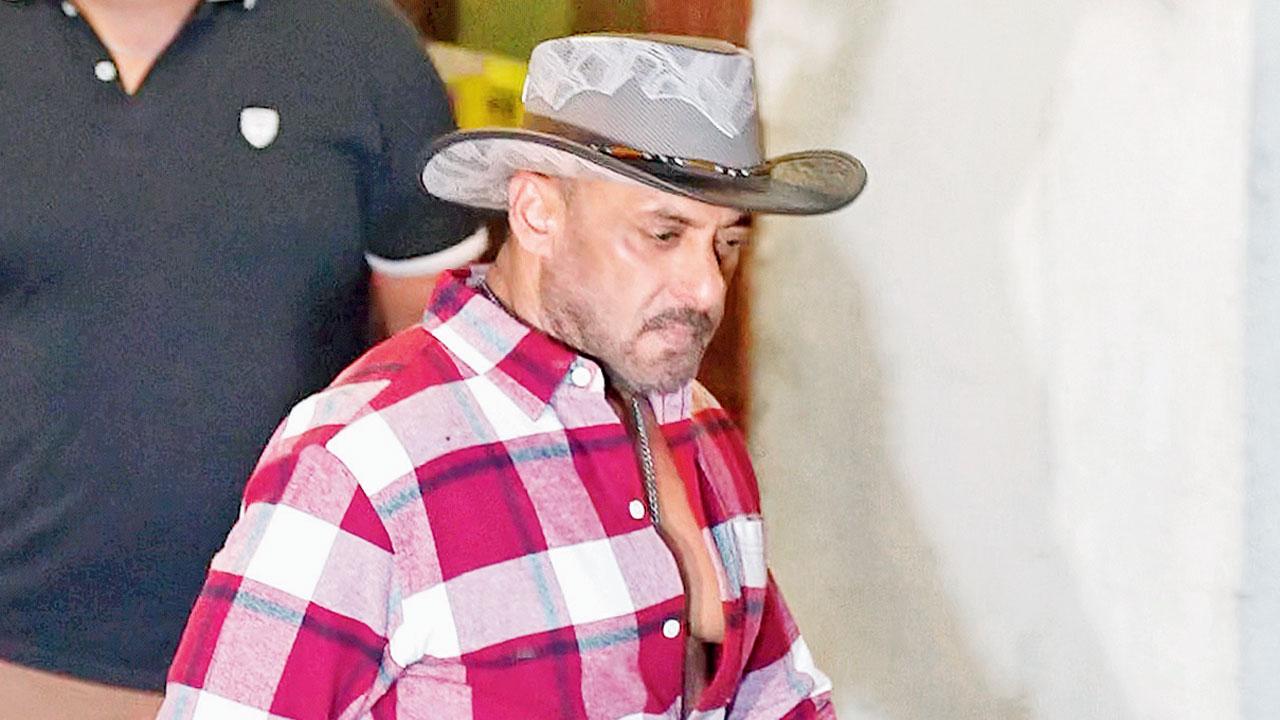
Salman Khan’s journey is taking him to Afghanistan. On screen, at least. mid-day has learnt that director Vamshi Paidipally has recreated an Afghan village at Prime Focus Studio in Film City, Goregaon, for the ongoing schedule of his next with Khan, the working title of which is ‘SVC63’.
The set comprises mud-plastered structures, narrow lanes, and weathered homes, designed specifically for several crucial action sequences.
A source revealed, “Nayanthara has joined Salman for this portion of the shoot. The duo will feature together in key action set-pieces. The Mumbai schedule, which began on August 6, is among the most important stretches during which the director plans to wrap a chunk of the action material.”
We’ve learnt that Jackie Shroff will also join the unit in the leg that will go on till early September. The veteran actor apparently plays a pivotal character who steps in when Khan’s protagonist finds himself in a difficult situation.
Meenakshi Seshadri reunites with Jackie Shroff after 40 years for Nanavati vs Nanavati
4:50 PM

Mohar Basu (MID-DAY; July 22, 2026)
Barely two months after Meenakshi Seshadri announced that she had relocated to Mumbai for good and was seeking acting opportunities, she has bagged a Prime Video series. What’s even better is that the project, titled Nanavati vs Nanavati, reunites the actor with Jackie Shroff, alongside whom she had delivered her first smash hit Hero (1983) at the start of her career. mid-day has learnt that the series went on floors this week.
Sources have told us that the eight-episode series, directed by Vipul Shah, is currently being shot at Bar Stock Exchange in Andheri West, with a packed ensemble that includes Bhagyashree, Ram Kapoor, and Anupriya Goenka.
An insider said, “Bringing Meenakshi and Jackie, the hit pair of the 1980s, together again after four decades is one of the show’s biggest talking points. Their scenes are expected to tap into the nostalgia associated with Hero, while placing them in age-appropriate characters. Bhagyashree and Ram will play the other couple. Since Ram is on another show right now, he will join the shoot later. The primary schedule is expected to be conducted in Powai.”
An official announcement from the streamer is expected closer to the completion of the shoot.
mid-day reached out to Shah, who didn’t respond till press time.
Humne Ranveer Singh ko ban nahi kiya, humne toh non-cooperation bola hai-Ashok Dubey
9:32 AM

Film body FWICE clarifies it has only issued a Non-Cooperation Directive, not a ban
Yashika Mathur (HINDUSTAN TIMES; May 28, 2026)
The Federation of Western India Cine Employees (FWICE)’s decision to issue a Non-Cooperation Directive (NCD) has sparked reactions across the film industry and on social media. While many questioned whether a film body can “ban” an artiste, FWICE General Secretary Ashok Dubey clarified that the organization has not banned anyone.
Dubey tells us, “Agar ye trend chalta raha to kaafi filmmaker aur producers nuksaan mein jaayenge. Humne Ranveer Singh ko ban nahi kiya, humne toh non-cooperation bola hai. Federation ke members ka decision hai ye. Film body ka internal decision hai that our members will not work with him until the Don 3 matter gets resolved.”
‘Hope issue is resolved soon’
Actor Manoj Bajpayee reacted to the controversy while speaking at the trailer launch of his upcoming film, when he was asked about safeguarding actors in such situations. As per PTI, while saying he hopes “the matter is resolved soon”, the actor clarified that he “does not have detailed information about it” and that the “industry currently only knows about the matter through social media”.
WHAT SANJAY GUPTA POINTED OUT
One of the first reactions came from filmmaker Sanjay Gupta, who questioned the move, arguing that banning an actor ultimately affects film productions and the livelihood of hundreds of crew members. Taking to X, Gupta wrote, “When an A-list hero shoots there are more than 300 workers working on sets. Ban him and you are not stopping him but depriving the workers of their livelihood. What sense does it even make???”
‘WHERE WAS THIS OBJECTION DURING MUMBAI SAGA...’
Reacting to Sanjay Gupta’s remarks, Ashok Dubey, General Secretary, FWICE, said film bodies have consistently supported filmmakers during production-related disputes. “I want to ask Sanjay Gupta ji that when his film Mumbai Saga (2021) was being shot and Jackie Shroff ne aane se mana kar diya, he came to us. IFTDA and FWICE intervened and sorted the matter. Where was this objection then?” he said.
The absence of my character should derail the story-Bhagyashree
2:42 PM

Neha Maheshwri (MUMBAI MIRROR; May 17, 2026)
Stepping into the shoes of Rajmata Jijabai came with immense responsibility for Bhagyashree, who essays the role in the recently released film Raja Shivaji starring Riteish Deshmukh in the titular role. The actress reveals that every aspect of the performance demanded precision and restraint.
She says, “Portraying a historical figure is not only difficult; it comes with a humongous responsibility. While cinematic liberty might be taken to narrate a story, the same does not apply while performing a role. The public scrutinizes every detail. Rajmata Jijabai is so highly revered that no mistake would be forgiven. I was extremely conscious of all these factors. There is a grace, gravitas, strength and serenity that I had to convey through my demeanour, look, voice and actions.”
Mastering the language and pronunciation was equally important, with dialect coach Ketki helping her achieve the required authenticity. She notes, “Yes, I am Maharashtrian, but we in Mumbai speak a very colloquial Marathi, and that would not have worked for the film. Ketki, the dialect coach, was a boon. She helped me achieve that perfection.”
Bhagyashree also reflects on the limited and often stereotypical roles written for actresses over 50, especially when compared to their male counterparts who continue to headline romantic and larger-than-life roles well into their later years.
She says, “The imbalance exists because cinema reflects society. We are gradually nudging towards equality, but things like this do not happen overnight in a patriarchal society like India. That change and its acceptance will happen with time. Meanwhile, we can only navigate those waters by choosing what we wish to do with competence.”
Meaningful, narrative-driven roles continue to interest her. She shares, “All the characters I play should be catalysts that move the story ahead. The absence of that role should derail the story. That means the character should be imperative to the narrative. In that way, I am assured that the character I play will be remembered.”
The actress will next be seen in The Great Grand Superhero - Aliens Ka Aagman alongside Jackie Shroff. She says, “I have collaborated with Jackie Dada for a children’s film. Though it is a special appearance, I wanted to be associated with it for two reasons: one, to connect with children, and second, to enjoy sharing screen space with Jackie.”
Tiger Shroff told me ‘It will be very difficult to go to the washroom in the bodysuit’-Jackie Shroff
9:43 AM

Jackie Shroff says son Tiger Shroff, who played a superhero earlier, gave him tips about handling a bodysuit for his role in ‘The Great Grand Superhero’
Priyanka Sharma (MID-DAY; May 23, 2026)
If there’s a role reversal that a father loves, it is when his kids are old enough to teach him something new. That’s what Jackie Shroff experienced while prepping for The Great Grand Superhero: Aliens Ka Aagman. With his son Tiger Shroff having played a superhero a decade ago in A Flying Jatt (2016), the senior actor turned to him for tips when it was his turn to portray one in Manish Saini’s directorial venture.
Talking to mid-day, Jackie said, “He gave me a few pieces of advice. He told me, ‘The bodysuit will make you hot. So, stay hydrated. If you don’t drink enough water, your muscles will tear. Also, it will be very difficult to go to the washroom in the bodysuit.’ This role reversal is so beautiful. You should listen to the kids. Listening to them gives you a lot of strength.”
The Great Grand Superhero is a natural choice for the actor, who has an affinity for children’s films. Jackie revealed that his kids have influenced his love for the genre.
“When Tiger and Krishna [daughter] were young, I saw how they loved watching kids’ films. That remained in my heart. It’s nice to give entertainment to kids,” he said.
Tiger Shroff told me it would be tough to play a superhero-Jackie Shroff
10:18 AM

Neha Maheshwri (BOMBAY TIMES; May 12, 2026)
Forty-three years is a long time to stay in the game. Long enough to not just watch empires rise and fall, but also for a young man from a Mumbai chawl to become one of Hindi cinema’s most handsome and enduring actors. Today, Jackie Shroff, who began his journey as a leading man with Hero (1983), is strapping on the costume of a superhero with Manish Saini’s The Great Grand Superhero – Aliens Ka Aagman.
Over the years, he has become synonymous with the ‘cool guy’ persona and remains no different today. Ask him about box office anxiety; he laughs it off. Ask him about the National Awards; he shrugs warmly. From the brooding, smouldering Hero of 1983 to becoming India’s first superhero grandpa in 2026, he carries the ease and satisfaction of a man who has made peace with every chapter of his story.
‘Mere haath-pair tootele hain, muscles phatele hain while doing the action’
Before taking on the role, Jackie says he spoke to his son, Tiger Shroff, who played a superhero in A Flying Jatt (2016). He shares, “He told me, ‘It’s very tough, dad. The costume keeps you so hot, your skin can’t breathe. It’s an ordeal. Jitna easy dikhta hai, utna easy hota nahi hai’.”
Playing a superhero at 69 is not simply a matter of saying yes; it comes with physical challenges. “Mere haath-pair tootele hain, muscles phatele hain while doing the action. People don’t see what goes into it. Recovery mein bhi time lagta hai, bhidu. Shooting action koi khaane ka game nahi hai. Dum nikal jaata hai,” explains the actor.
‘My mind is still stuck at 19’
While he credits Tiger’s discipline for his own physical resurgence, Jackie insists that in his mind, he is still young. He says, “My mind is still stuck at 19. My genetics don’t let me grow old. The power and energy are still there. In fact, I feel stronger now than I did in my teens.”
Tiger, Jackie proudly says, has also shaped his outlook towards fitness. “Tiger has always been my inspiration. I had never worked out, but looking at him makes me want to push my limits. I’m grateful to my son for making me see the real light. Woh hamesha bolta hai ki jitna strong main rahunga, utna strong hamaara parivaar rahega.”
‘Relationships matter more than strategy’
What has remained unchanged through the decades, however, is Jackie’s approach to relationships within the film industry. In an environment often driven by networking and strategy, he says he still values personal bonds over professional calculations. “Relationships matter more than strategy. If a cameraman offers me a role that requires four days of shooting, I’ll do it without thinking, if it helps him,” he says.
Speaking about his equation with actors like Salman Khan and Shah Rukh Khan, Jackie adds, “I’ve known Salman, who is five years younger, since my modelling days, when I was the cool dude in the area. When he says, ‘Meri picture kar’, how can I say no? How can I say no to Shah Rukh? If he says, ‘I want you to do a film and just look good,’ I say, that’s easy,” he laughs and adds, “You have to reciprocate and stay open to people, friends and colleagues.”
Jackie traces that outlook to his upbringing in Mumbai’s chawls. “I am a chaali boy. Living in chawls means community. Ek doosre ke ghar mein jhaakte hain, khaana milta hai. Kahin se baraf aati hai, kahin se biryani. You help each other. There were 21 chawls where I lived. Six of us, including my parents, stayed in a 10x10 house. That life makes you see everyone as equal,” he says.
I would lie in Asha Bhosle and Lata Mangeshkar’s lap when they would do riyaz-Mumtaz
8:19 AM

Natasha Coutinho (HINDUSTAN TIMES; April 14, 2026)
Singer Asha Bhosle died on Sunday at the age of 92 due to multi-organ failure. With a career spanning over eight decades and 12,000 songs, she left a legacy as one of India’s most versatile voices, transforming music across genres.
Now, recalling her final memory of the singer, veteran actor Mumtaz says, “I rushed when I heard she was hospitalized… I wanted to speak to her, but couldn’t as the doctors informed us she is critical. As I was leaving the hospital a few minutes later, her family called to say she had passed away. The next day I visited her home, and when I saw Asha ji, her face had a certain noor.”
The duo has delivered hits such as Koi Shahri Babu (Loafer, 1973) and Duniya Mein Logon Ko (Apna Desh, 1972). “Asha ji would always tell me the song Aaja O Mere Raja has been the most difficult song of her career because of the voice variations,” the 78-year-old shares.
Sharing personal memories from their days as neighbours in Mumbai’s Walkeshwar, she shares, “I remember lying in Asha ji and Lata (Mangeshkar, Bhosle’s sister and late veteran singer) ji’s lap when they would do riyaz with their tanpura.”
Earlier, Mumtaz had shared a video from Diwali 2023 on Instagram, dancing with the late singer that had instantly gone viral.
“We danced at Asha ji’s home… Jackie Shroff (actor) had egged me on to get her on the floor, but she was shy,” the veteran recalls.
Shilpa Shetty exits Jackie Shroff’s slice-of-life drama Coke; makers approach Shefali Shah
10:09 AM

Mohar Basu (MID-DAY; April 9, 2026)
In February, mid-day had reported that Shilpa Shetty Kundra and Jackie Shroff were set to reunite for a slice-of-life series (Life in a metro with ’90s stars, Feb 21). But it looks like there has been a casting change in the series, tentatively titled Coke. Sources close to the development have told us that Shetty has exited the project.
Apparently the actor’s exit comes down to scheduling conflicts. A source revealed, “Shilpa was excited about the material and the chance to collaborate with Jackie again after Jung [2000]. But the dates could not be aligned, given her existing commitments.”
The show, backed by Boong producers Shujaat Saudagar and Vikesh Bhutani, is expected to go on floors later this month.
With the timeline locked, the makers have moved swiftly to secure a replacement. And a strong performer at that — Shefali Shah. Word is that the actor is in advanced talks to headline the story. Another insider shared, “The makers needed someone who could bring gravitas to the part. Shefali was always on their wishlist. The conversations have been positive, and the teams are now finalising the paperwork and dates.”
mid-day reached out to Bhutani, who didn’t respond till press time.
Akshay Kumar's Welcome To The Jungle team to wrap shoot after filming post-credit song
10:09 AM

Sources say final song of Akshay Kumar-led ‘Welcome To The Jungle’ is being shot; comedy to wrap in 10 days
Mohar Basu (MID-DAY; February 22, 2026)
Director Ahmed Khan has brought Welcome To The Jungle to the finish line. Well, almost. All that’s left is the shoot of an elaborate song featuring the ensemble cast, including Akshay Kumar, Suniel Shetty, Raveena Tandon, Disha Patani, Jackie Shroff, and Arshad Warsi. We’ve heard that Khan called action on the song earlier this week, and intends to conclude the shoot in 10 days.
Sources close to the unit describe it as a high-energy celebratory number. An expansive set depicting a jungle has been built at Bahubali Studios in Borivali for the track, choreographed by Adil Shaikh.
“Shooting a song with so many stars isn’t easy. Every actor has their moment in the song. Before beginning filming on February 17, extensive rehearsals were conducted so that principal actors and background dancers move seamlessly through the frame without disrupting camera continuity. It will be used as a post-credit track,” revealed a source.
After this leg, Welcome To The Jungle will move to post-production.
Shilpa Shetty, Jackie Shroff reunite for Amazon Prime Video series
9:31 AM

Mohar Basu (MID-DAY; February 21, 2026)
In what could shape up to be an interesting on-screen pairing, Shilpa Shetty Kundra and Jackie Shroff are said to be in advanced talks to headline an Amazon Prime Video series. Sources indicate that the project is an eight-episode slice-of-life drama that explores urban relationships and second chances.
An industry insider told mid-day, “The idea is to mount an intimate show with strong writing, real locations, and minimal gloss. Both actors bring credibility and warmth, which is crucial for this world.”
The script is said to be finalised, and the production team is currently conducting a recce in Mumbai and Pune. The unit plans to take the show on floors in March.
The insider added, “A 60-day window has been carved out for principal photography. The team is waiting for a go-ahead from actors on the dates.”
Tiger Shroff has given a lot to his craft. He works on it thoroughly-Krishna Shroff
11:14 AM

Onkar Kulkarni (MUMBAI MIRROR; December 16, 2025)
Krishna Shroff has recently found her footing in the reality TV space. The sister of Tiger Shroff and daughter of Jackie Shroff took her time figuring out her true calling. Certain that she did not want to enter films like the rest of her family, she discovered her passion in the world of fitness and MMA.
Talking about how her life unfolded, Krishna says, “It used to make me feel miserable. I come from a family of successful people. I didn’t want to be that privileged, spoiled kid who lives off daddy and mommy’s name, fame and money. Independence is power. I am grateful, but I knew very early on that I needed to break away and be my own person. I have a very alpha thought process and personality, so I’m not okay just being in the background or being a side character. I love having that main-character energy. That phase where I was figuring out what to do in life was hard. But I did find fitness at that time. The gym became my therapy. It gave me discipline and focus, and I channelled all that frustration in a very positive way.”
In an earlier conversation, Krishna had mentioned that she never wanted a career in films because the industry gives a lot but takes away much more. Elaborating on that thought, she says, “My father is a lot more free-spirited than my brother. Success or failure doesn’t really matter to him as much as it matters to my brother. My brother has given a lot to his craft. He works on it thoroughly. He doesn’t have a social life. Even on his days off, he is working on his body. For someone like me, I need balance in life. I’m happy to work hard, but I also need my long vacations. I want to explore cultures, etc.”
Krishna, who was last seen in the reality show Chhoriyan Chali Gaon, recently launched her own fitness brand. Reflecting on her journey into fitness, she says, “My brother got into fitness at a very young age. I got into it much later. I would always look at him doing these things, and it was very inspiring. So he has definitely been the pioneer of fitness in our family.”
Rangeela shifted the pay scale for actresses majorly-Urmila Matondkar
10:05 AM

Onkar Kulkarni (BOMBAY TIMES; December 1, 2025)
Rangeela has just hit the screens once again, 30 years after its release, in a restored version. In a candid conversation with us, Urmila Matondkar looks back at the film that has become a cult classic. “Rangeela represents, in the biggest and best ways, a flight of fantasy that takes you to an alternate reality — a world that is glamorous, beautiful, yet so very real. Characters like Mili (Urmila) and Munna (Aamir Khan) are so real, you feel you could literally see them walking down the street. It’s also a story of an underdog making it big. That’s why it remains timeless and iconic,” says Urmila.
‘Rangeela changed things overnight for me’
The film’s release marked a turning point in Urmila’s career. “Rangeela changed things overnight for me — becoming a star and receiving tremendous public adulation. I always say the film showcases the navarasas that are at the core of Indian performing arts. It’s a huge gamut of emotions that people and the audience witness through the characters. The beauty of the film is that it was shot on a pretty minimalistic budget, with no foreign locales, just Mumbai and a bit of Goa. It encapsulates the beauty of life itself magnificently. Playing the character came easily to me because it resonated with me.”
‘I used Rangeela to seek films that were waiting to be made’
The actress says that besides its impact on pop culture, the movie also influenced the remuneration offered to actresses. “After the release of the film, not just mine, overall actresses’ remuneration shifted majorly. But I cannot compare — I don’t know what Aamir was paid, but both Aamir (Khan) and Jackie (Shroff) were huge stars when I did the movie. I was a huge fan of them myself.”
It also brought along opportunities that helped Urmila step into characters that weren’t stereotypical. She further adds, “What I am extremely proud of is that I didn’t use that stardom to throw my weight around or to hike my price unnecessarily. I used it to seek films that were waiting to be made. I took risks with different kinds of characters and became part of movies like Pinjar, Pyaar Tune Kya Kiya and Judaai. Rangeela gave me the chance to do those kinds of projects.”
‘I haven’t seen Rangeela as many times as people might think’
Despite the film’s impact, she has watched it far less than people might imagine. “I really haven’t seen Rangeela as many times as people might think. I am not megalomaniacal (laughs), and I don’t get happy seeing myself on screen. The name of the movie – Rangeela – brings a smile to my face, and I hope it has the same effect on others who remember it after so many years.”
‘Saroj Khan told me I should get credit as a choreographer for Rangeela’
The dance sequences in Rangeela were among the talking points of the film. Urmila remembers, “Choreography in Rangeela was path-breaking, with the great Saroj Khan doing Tanha Tanha and Hai Rama, and then Ahmed Khan, a newcomer, doing brilliant work as well. In fact, Saroj Khan told me I should get credit as a choreographer as there were quite a few sequences where there wasn’t any choreographer really. There is a white saree sequence in the song Pyaar Ye Jaane Kaisa Hai, and other such pieces with no choreographer, where I was asked to do whatever comes to my mind.”
Saroj Khan told me that I should have also been credited as Rangeela's choreographer-Urmila Matondkar
10:05 AM

As ‘Rangeela’ re-releases today after 30 years, Urmila Matondkar reflects on the movie’s timeless quality and how she choreographed some portions of its iconic songs
Upala KBR (MID-DAY; November 28, 2025)
Urmila Matondkar running on the beach in an oversized white ganji. Or dancing on the streets of Mumbai with abandon, as others join in. Some images of Rangeela (1995) remain iconic even today, 30 years after its release. “It’s thrilling because it shows that people never forget such timeless movies,” says Matondkar of the film that has been restored by Ultra Media and is re-releasing today.
Centred on Matondkar’s Mili, the Aamir Khan and Jackie Shroff-starrer told the story of a girl-next-door pursuing her acting ambitions and love. In a way, Mili redefined the Bollywood heroine — while the styling influenced fashion trends across the country, Ram Gopal Varma’s directorial venture gave us a heroine who celebrated her sensuality.
“I certainly didn’t think of it from that perspective when I did Rangeela,” reflects the actor. “There was a lot of relatability as she was from a middle-class family. Manish Malhotra and Ram Gopal Varma created Mili’s look. The entire team contributes to a film’s success, and it’s one of the career-best works of these people.”
Another element that made waves was the unusual choreography to AR Rahman’s chartbusters — be it dancing by the beach in Tanha Tanha, or Mumbai streets becoming Matondkar’s stage in Rangeela Re. Legend has it that the leading lady stepped in for choreographer Saroj Khan on more than one occasion and designed some steps herself.
Mention this to the actor, and she shares, “When I met Saroj ji after Rangeela’s release, she told me that I should have also been credited as a choreographer. I was so embarrassed. [Such a compliment] coming from a master like her was something to be proud of. There were some pieces like the opening of Hai Rama and Pyaar Yeh Jaane Kaisa Hai, and a few steps here and there that I had done. I have done that in other movies as well.”
Rangeela marked the beginning of a successful collaboration between Matondkar and Varma. Why haven’t we seen them team up after Varma’s production Ek Hasina Thi (2004)? She says, “There is really no reason. He had great collaborations with most of his actors like Amitabh Bachchan ji or Manoj Bajpayee. He worked more with them. I was [cast], depending on whether the movie required me or not.”
On Jackie Shroff
“If my character is the epitome of femininity on celluloid, then Jackie’s is the ultimate male portrayal in cinema. He was such a phenomenal co-star to someone like me, who was still trying to find her way at that time.”
On Aamir Khan aka Munna
“I was crushing on Aamir after ‘Qayamat Se Qayamat Tak’ [1988]. He was playing a tapori for the first time here, and was a true perfectionist. His beauty is that even after 15 takes, he makes the last shot look spontaneous.”
Sunny Deol, Jackie Shroff, Mithun Chakraborty, Sanjay Dutt wrap Baap shoot; to release in 2026
9:59 AM

Upala KBR (MID-DAY; October 17, 2025)
Missing the testosterone-driven Hindi films of the 1990s? Ahmed Khan’s got you covered. His production Baap — which brings together the biggest action heroes of the 1980s and ’90s, Sunny Deol, Sanjay Dutt, Mithun Chakraborty, and Jackie Shroff — is finally complete and readying for a 2026 release. mid-day has learnt that the action drama, which went on floors in June 2022, was recently wrapped up with the completion of two songs.
Directed by Vivek Chauhan, Baap’s talkie portions were completed in April this year. Next on the plan were two songs — a peppy number featuring the four actors, and another track celebrating the protagonists’ camaraderie. Both songs have been choreographed by Khan.
A source revealed, “Earlier, the brotherhood song was to be shot on a set depicting an under-construction building, as the four actors play labourers working at a construction site. But the makers did a rethink and it was filmed earlier this year in the jungles of Mizoram, followed by a portion on a set constructed in Film City. It has been treated like Chappa Chappa Charkha Chale in Maachis [1996]. The peppy track will be used as a background number when the four actors appear together, and will enhance the mood.”
Now, the makers are focusing on the post-production and VFX. The source added, “It’s a VFX-heavy movie. All actors have begun dubbing, and the film should be ready by the year-end, after which producers Zee Studios and Ahmed will decide the release date.”
The film is said to be designed as an action extravaganza, complete with helicopter chase sequences, explosions, and hand-to-hand combat choreographed by action directors Parvez Shaikh and Ravi Varma.
For Khan, who is currently supervising the post-production process, it has been a matter of pride and joy to back Baap.
When mid-day reached out to him, the elated producer said, “The shooting of Baap is complete and right now, it’s in the final stages of post-production. It’s any producer’s dream to get these superstars together for one frame, and we have them in a full movie!”
These days, the industry has lost freshness in creative work-Meenakshi Seshadri
8:55 AM

Sundas Jawed (BOMBAY TIMES; October 8, 2025)
Graceful and composed, Meenakshi Seshadri, the star of films like Hero & Damini, was in the city on Sunday to perform at the Durga Puja Carnival on Red Road. On her Bengal connect, she said, “I was born in a town near the Bihar-Bengal border, so I grew up with a Bengali influence. Coming here feels like being back home.” The actress spoke to CT about her break, the roles that defined her and more.
‘Damini’s role felt real’
Reflecting on her journey, Meenakshi admitted, “I’ve had a chequered career with more flops than successes.” Yet her role in Damini continues to define her. “People accepted me because, like her, I’ve always stood for what my conscience says is right,” she said.
Her real-life resilience mirrored her character’s: “There was a fallout with the director just as shooting was about to start, and they wanted to replace me, but the situation turned around. Many later echoed what I just said, that Damini was a lot like me by nature. Maybe that’s why the role felt so authentic.”
‘People love drama & dance’
Looking back at the film that made her a star, Meenakshi recalled Hero’s unexpected rise. “Hero (with Jackie Shroff) was my second film after Painter Babu. Its popularity surprised me. The first few weeks were lukewarm, but then it picked up and ran for a year, even in south Indian cities, which was unheard of.”
She credits its success to filmmaker Subhash Ghai and its timeless appeal. “Indians love romance, dance and drama. Hero had all of that, along with a believable story, that connected with the audience,” said the actress, who danced to Odissi dancer Avirup Sengupta’s choreography at the Durga Puja Carnival.
Hope in new platforms
Candidly reflecting on cinema, Meenakshi said, “These days, the industry has lost freshness in creative work. One person makes a supernatural drama and 30 others blatantly copy it.” However, she believes the industry is “more professional and hi-tech now.”
On the portrayal of women, she said, “We’ve always had strong female actors, but in the 80s, defined roles were rare.” Though she finds the use of women in suggestive ways vulgar, she is hopeful: “With OTTs creating stronger characters, I hope to make a mark again after years.”
---------------------------------------------
Leaving the industry to move to the USA and be with the person I love never felt like compromise. It made me embrace my true path
– Meenakshi on her sabbatical
---------------------------------------------
I relate strongly to Damini. I am straightforward, simple-minded, traditional and not overly critical, and I think that also came through in my performance
– Meenakshi on her role in Damini
I made Rangeela because of Urmila Matondkar-Ram Gopal Varma
8:40 AM

Renuka Vyavahare (BOMBAY TIMES; September 11, 2025)
Thirty years after its release, Ram Gopal Varma’s iconic Rangeela still enchants the audience with its blend of sweetness, sensuality and cinematic magic. The film has been restored in 4K and will be rereleased in India theatrically on October 10. We caught up with RGV to discuss his celebrated film, featuring Mili (Urmila Matondkar), Munna (Aamir Khan) and Raj Kamal (Jackie Shroff). Excerpts:
Rangeela was a sleeper hit. Did no one expect it to succeed the way it did?
Around that time, Aamir’s films hadn’t worked. Urmila’s films also didn’t work. I am from the South, so no one really knew what to expect from this film. In fact, even the music was a new form. Rangeela’s songs didn’t sound like the hit film songs of that time. Whenever something new comes, people tend to get disoriented, but by the time the release came close, the music caught on.
Munna’s “AC idhar ghuma, kanda kaatke la” dialogue is remembered even today, among other special moments from the movie. Three decades later, what do you think gives Rangeela its lasting appeal?
Huge credit to writers Neeraj Vora and Sanjay Chhel. What really makes a film last is how unforgettable its characters are, because no matter how much time goes by, human emotions remain the same. With Munna (Aamir Khan), Mili (Urmila Matondkar) and Kamal (Jackie Shroff) still etched in our minds, the passage of time doesn’t matter anymore. The story of Rangeela will find appeal today or 30 years before it was made.
What inspired you to make Rangeela?
Cinematically, I would say my inspiration was the 1960s Hollywood musical, The Sound Of Music. Although it’s not the same story, Rangeela is also a love story where there’s no conflict at all. There is no antagonist either. Everyone is nice – Mili, Munna and Kamal. There’s not a single bad person, but the situation creates the conflict. I love the aspect that Rangeela is a sad kind of a story where your heart goes out to Aamir, but at the same time, you can’t really hate the other person either.
You have made some memorable films with Urmila. Do you consider her your muse?
When you’re working together for a long time, and especially when a film becomes so successful, you tend to make the next film with the same actor.
Urmila can give versatile expressions, which I realized after seeing her in the song Hai Rama. That’s the reason I cast her in such a wide variety of films – a horror film like Bhoot, the gangster film Satya and a caper like Daud. I made Rangeela because of her. Why I wanted to make Rangeela was because I felt inspired seeing a song of hers in my Telugu film (Drohi with Nagarjuna). The origin of Rangeela stemmed from my desire to showcase Urmila’s sensuality and her beauty. She had never worn such revealing clothes in the films she had done before that, but I told her, if you feel beautiful about your body, you shouldn’t be conscious. That bindaas attitude, the fact that she’s not aware of herself, and the fact that she’s not intending to create an effect on somebody else created a wild, animal-like, exotic feeling in the audience. The most memorable aspect of Rangeela was to look at Urmila through the camera.
On roping A R Rahman for Rangeela’s music
When I heard the songs of Roja, I was blown away. The kind of new sound, packaging and production that Rahman created was something no one had ever heard. It was inspiring for me to capture that visually. When the music is generic, everyone from the choreographer to the actor comes up with a predictable output, but because it was so unpredictable that no one had a choice but to reinvent themselves.
Subscribe to:
Posts (Atom)