I found my Cannes ‘Best Actress’ on Facebook-Konstantin Bojanov
7:43 AM

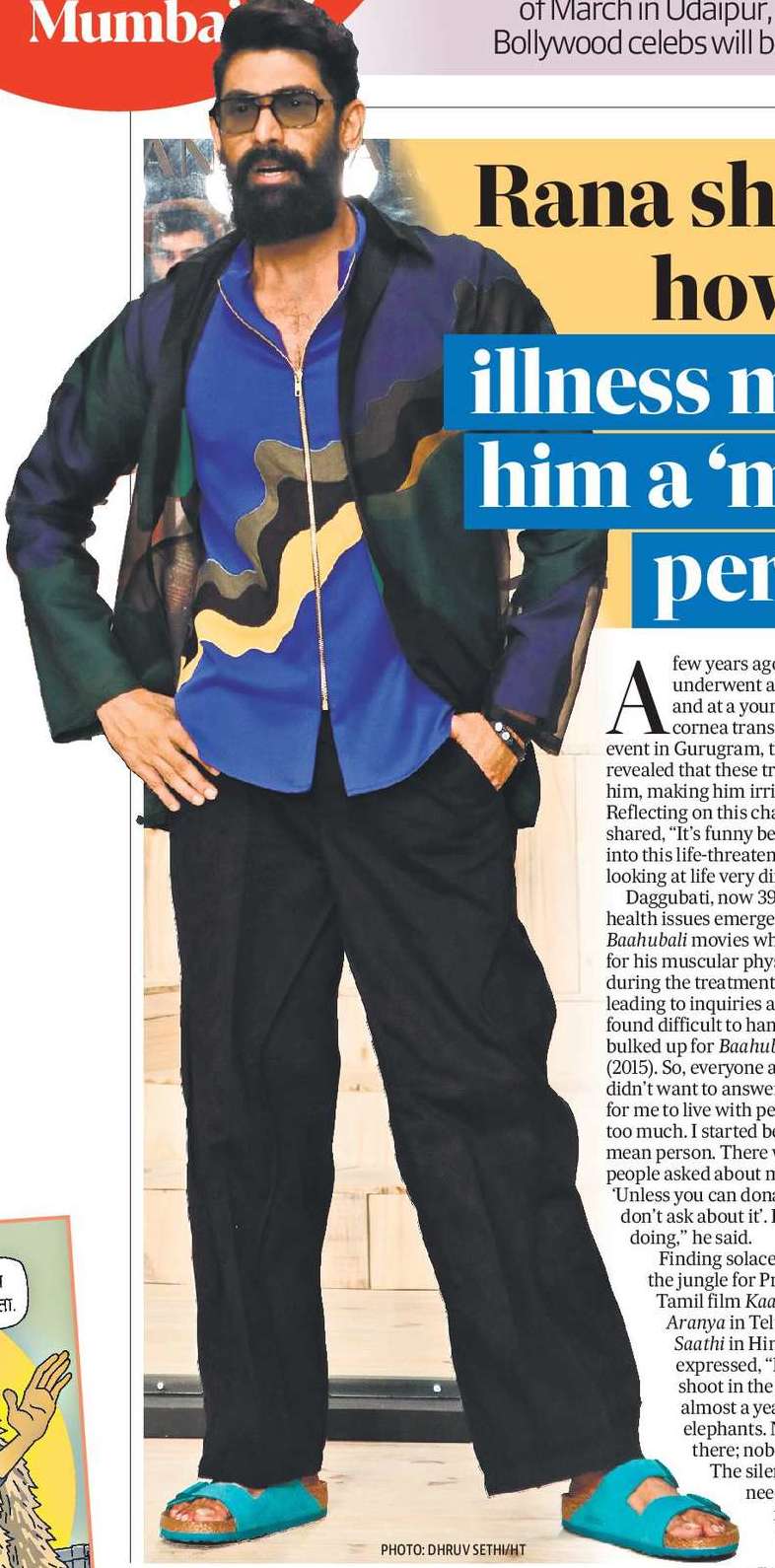
Rana Daggubati shares how his illness made him a ‘mean person’
8:59 AM
Nepotism, by definition, is applied to political hierarchy or public sector companies-Rana Daggubati
8:10 AM

Haathi Mere Saathi’s Hindi version to now directly premiere on television
4:31 PM

The bifurcation between what’s suited for big screen and what’s better for OTT will become clearer-Rana Daggubati
8:54 AM


Eros Now called out for non-payment of dues; CEO denies claims
8:16 AM
Today, run of a film, whether it’s in theatre or not, it is longer because of OTT-Rana Daggubati
8:04 AM

Fenil's Bollywood Talk # 667
10:16 AM

APRIL SUDDENLY TURNS DRY; 2 FILMS TO STILL TRY ITS LUCK TOMORROW
Last week, we mentioned that the rising cases of Coronavirus led to the indefinite postponement of the Hindi version of Haathi Mere Saathi. It was scheduled to release on March 26. In the last 8 days, a lot of other films got pushed. Bunty Aur Babli 2, scheduled for April 23 release, has been delayed indefinitely. 2 days back, the makers of Chehre too made it clear that they’d release when the situation would be better. This also became crucial after Maharashtra declared a night curfew, starting as early as 8:00 pm. As a result, the last show in a theatre needs to be held at 5:15 or 5:30 pm.
Interestingly, the last week also saw the release of Godzilla vs. Kong and it did phenomenally well. Our projection went completely wrong – we had predicted a weekend of around Rs. 10 crore. But the film surprisingly opened at a huge Rs. 6.25 crore when it released on Wednesday March 24. It ended up collecting Rs. 32.25 crore in 6 days, including healthy collections on Monday, the day of Holi. These are the best collections for a Hindi and English film since the beginning of a pandemic and ideally, it should have cheered up the trade and industry. However, when one sees the collections minutely, one realizes that a major chunk of the earnings came from the South. The cases in the South are not that high and the cinema business there is more or less normal. An average Hindi film meanwhile does limited business in the South. It relies majorly on West and North to score and these areas were doing poorly since the cases began to increase significantly. The not-so-great performance of Mumbai Saga and Saina also indicated that releasing a Hindi film in this scenario would not be able to fully perform as per its potential.
As of now, now only two major films, Thalaivi on April 23 and Sooryavanshi on April 30, are scheduled for release. However, it is being said that Sooryavanshi is definitely getting postponed as it’s a big film and in such conditions, it’ll prove to be a commercial flop in cinemas.
However, two Hindi films, both small budget ones, will be releasing tomorrow despite the challenges. The first one is Flight. It stars Mohit Chadda, Pavan Malhotra, Zakir Hussain, Viveck Vaswani, Shibani Bedi, Pritam Singh and is directed by Suraj Joshi. The film has an unknown star cast and yet, it has grabbed some eyeballs. This is because it’s trailer is very thrilling. It tells the story of a man trapped in a mid-air flight! Despite the fact that the trailer impressed people, the excitement is obviously minimal. The rising cases will also prove detrimental to an extent. But on the positive side, if it’s a good film, it can grow through positive word of mouth. And it’ll have a long run in cinemas now that hardly any film is releasing.
The other film releasing tomorrow is Koi Jaane Na. It stars Kunal Kapoor and Amyra Dastur and is a suspense saga. It is directed by actor Amin Hajee, of Lagaan fame. The film was shot around 2 years back and is finally seeing the light of the day. This movie features Aamir Khan along with Elli AvrRam in the song ‘Har Funn Maula’. This song has been noticed but many have not been able to realize that it’s a part of the film. Hence, while the song is known, the film is still unknown for most people. Just like Flight, it’ll open to poor houses but might have a chance if public reports are encouraging.
Fenil's Bollywood Talk # 666
4:49 PM

The Holi weekend is a few days away and it’s a time when exciting films usually release. What’s interesting is that on the second day of Holi, many theatres are shut till 1:00 or even 4:00 and 6:00 pm. But the occupancy is superb once cinemas open for the day. That’s the reason some big films have released on the festival in the past like Badrinath Ki Dulhania, Kesari, Baaghi 3 etc. This year, despite the Coronavirus scare, 3 films were scheduled to be released. One of them, Haathi Mere Saathi, has been postponed indefinitely. It’s a jungle adventure film starring Rana Daggubati, Pulkit Samrat and Zoya Hussain. It’s a tri-lingual film and interestingly, it’s Southern versions – Kaadan (Tamil) and Aranya (Telugu) – are all set to release, as per the schedule, on March 26.
The other two films of this week are as follows:
2. SAINA: As the name suggests, it is the biopic of Saina Nehwal, the legendary Indian badminton player. It stars Parineeti Chopra in the lead role and is directed by Amole Gupte. At one point, Shraddha Kapoor was supposed to play the lead part. She had even begun the prep and the makers had released those pictures as well. But due to date issues, she had to leave the project. That’s when Parineeti stepped in. The trailer is decent and it can be an entertaining and inspirational fare. The buzz, however, is very limited. The opening might be in the Rs. 1 crore range and it might be even less. If the word of mouth is positive, it can see a huge jump. With theatres shut in Punjab and some cities under lockdown, the collections can get affected. Saina releases on March 26.
Finally, Pagglait releases on Netflix on March 26 as well. It stars Sanya Malhotra in the lead role along with Sayani Gupta, Raghubir Yadav, Rajesh Tailang, Ashutosh Rana and others. The trailer is quirky but not that impressive. It remains to be seen if the film proves to be better than its promo.
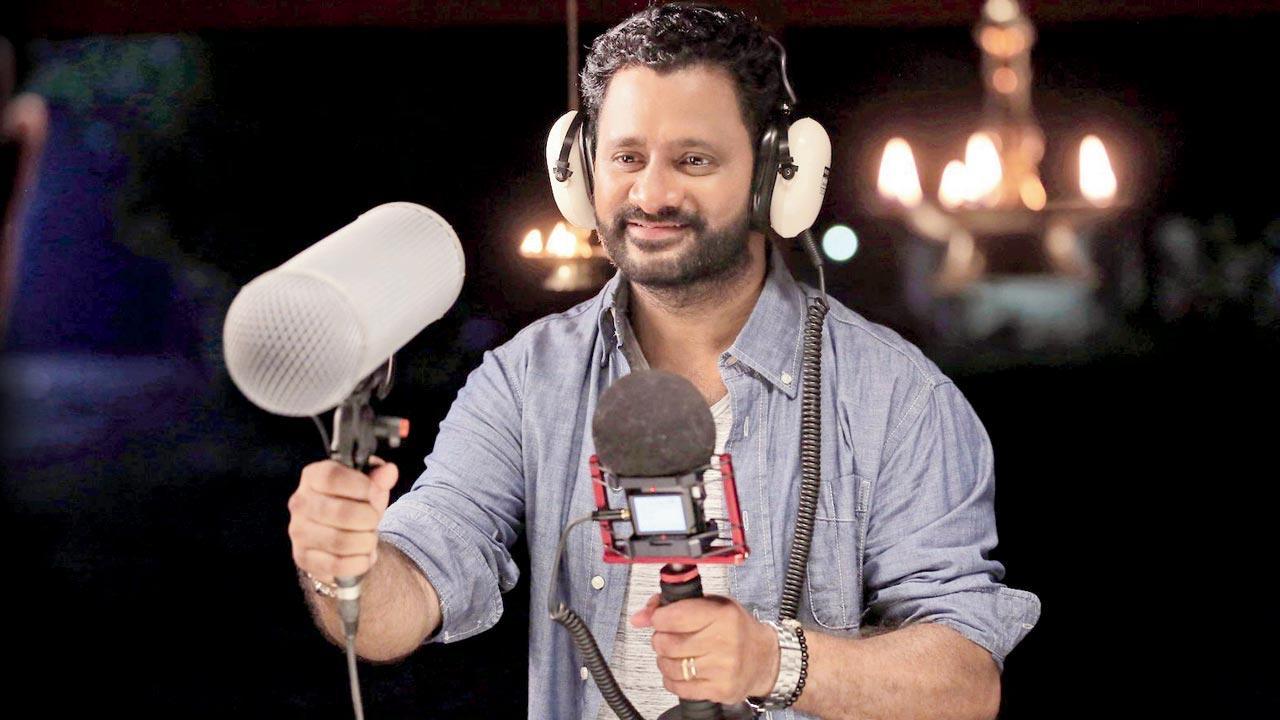
For Haathi Mere Saathi, we wanted to recreate the ambiance of a forest in Dolby set up-Resul Pookutty
2:47 PM
We made Haathi Mere Saathi film for the big screen experience-Rana Daggubati
8:23 AM
On this day, Amitabh Bachchan's first film Saat Hindustani released in Mumbai
8:16 AM
Box Office India Trade Network
On this day exactly 49 years ago the first Amitabh Bachchan film SAAT HINDUSTANI hit Mumbai. The date was 21st May 1971 and the film released at Maratha Mandir in matinee shows only. It was a low key release as it was earlier released in Delhi/UP and fared very badly.
Coincidentally, the film clashed with a release of the box office king of that time Rajesh Khanna. HAATHI MERE SAATHI also released in Mumbai on 21st May 1971 though the film had released earlier in Delhi/UP and East Punjab. This film became the first film in history to collect 1 lakh nett in Mumbai on day one. It was released on 27 theatres and Rajesh Khanna beat his own day one record in Mumbai city which was set with SACHAA JHUTHA in 1970.
SAAT HINDUSTANI was the first release of Amitabh Bachchan but it was not the first time that Mumbaiites got to see the star that was going to become a future megastar. The other coincidence that in Mumbai the first sight of Amitabh Bachchan also came in a Rajesh Khanna starrer which was released a couple of months before Saat Hindustani in Mumbai city. The film was called ANAND.
Another point here is that last year there were celebrations of fifty years of Amitabh Bachchan hitting the big screen and that was not the case. The fifty years were actually hit a couple of months back. It was funny to see fifty years of SAAT HINDUSTANI celebrated when the film did not even release in 1969. It showed a lack of knowledge with these commentators and even the millions of fans but they cant really be blamed as the media has a tendency to follow what is out there rather than actually collect facts. Then the fans follow what the media has to say. Its understandable that the date of the first film is not known of some small actor but this is Amitabh Bachchan who is the biggest star the country has seen till date.
The fifty years of Amitabh Bachchan were hit on 27th March 2020 as SAAT HINDUSTANI first released in Delhi/UP on 27th March 1970. Amitabh Bachchan made his debut in 1970 and not 1969 as it is claimed by the media. The main cinema for SAAT HINDUSTANI was Sheila and it also released in Eros, Minerva, Amba, Ajanta and Radhu Palace as well as some theatres in UP. The release in Delhi of 6 cinemas was a good release as it was a small film and the biggest films released on around 8 theatres in the city at that time. The collections were horrific with just Rs. 10,000 apprx coming on day one with capacity of around Rs. 40,000. The film was out of theatres very fast and next it went to Mumbai a year later but the response in Delhi meant it was more of a token gesture release. The other circuits saw a release when Amitabh Bachchan had become a star with more creative posters keeping in mind the image Amitabh Bachchan but it was a black and white film and pretty much an art film so had no takers.
Just like SAAT HINDUSTANI had no takers, there will not be many takers that Amitabh Bachchan actually debuted in 1970 as there has already been a false picture painted by the media but facts are facts and anyone with access to genuine sources can do the research and easily check what is fact and what is fake.
Like Star Wars, Baahubali has changed cinema-Rana Daggubati
8:07 AM

Rana Daggubati on decade-old career replete with surprises, including a rapper turn
Akash Bhatnagar (MUMBAI MIRROR; April 27, 2020)
In 2010, Rana Daggubati debuted as an actor in the Telugu film Leader. A year later, he stepped into the Hindi film industry with Rohan Sippy’s Dum Maaro Dum. Reflecting on his decade-long journey, the actor, who has become a household name with Baahubali, says that he feels fortunate for the variety and diversity in his filmography. “I guess, that’s what growing up means. Today, I can confidently say that I’m a better actor, with a better knowledge of cinema,” asserts the actor who has a Telugu production coming up and intends to produce Hindi films in the future.
 Several actors from down South have forayed into Bollywood, but have quickly returned to their original fan base and not ventured out again, but Rana continues to do the occasional Hindi film, his last outing being Housefull 4, despite remaining rooted in Tollywood. How does he manage to shuttle between the two industries? “That’s something even I’ve been trying to figure out,” he chuckles. “A Telugu film usually takes 10 months to a year to wrap up, so, I realised early on that I couldn’t be a part of Mumbai’s pop culture ever. There won’t be frequent airport sightings nor would I be papped leaving the gym. So, I focussed instead on scripts and that’s lead to interesting career choices, be it the submarine film, The Ghazi Attack, the epic Baahubali or the upcoming Haathi Mere Saathi with 15 elephants as my co-stars.”
His jungle adventure was to open on April 2, and while it’s disappointing to have to wait for people to see it, Rana has found a positive co-relation between what is happening around the world and the film, which is about nature fighting back to survive. “The animals are happier today and the waters are cleaner as humans stay home,” muses the actor, who, during the Coronavirus lockdown, is revisiting his first love, animation.
Starting out in 2004, Rana worked as a visual effects coordinator for about eight years. Now, he is back to watching, reading up on and exploring different animation forms. He admits something is brewing on that front, but won’t divulge details.
Mention Baahubali, a special effects extravaganza, which, he admits, “took exactly half of my career”, and Rana remembers the thrill of being a part of something really big for five years, before it was unveiled to the world. “Nobody on that set had done anything like this before in their career, be it an actor or a technician. It was like being in an acting school, a film school and a visual effects school all at once, with a great teacher, S S Rajamouli. Like Star Wars in the ‘70s, this is one landmark film that has changed cinema forever,” he asserts, adding that Baahubali opened up the industry to bigger gambles and higher stakes. “India has scale now. An Indian film today is not restricted to any one language.”
Rana was supposed to do Ajay Devgn’s Bhuj: The Pride of India, but pulled out of the film last year. He informs that he couldn’t accommodate it because he was shooting for a Telugu film then, plus, his look in Haathi Mere Saathi was so unique, he couldn’t transition out of it to do another project so quickly.
But while he couldn’t fly high in Bollywood, he did make his debut as a singer last year in the Telugu film, Action, featuring Vishal and Tamannaah in the lead. “This was a con job, Vishal is a good friend and one day, he landed up in Hyderabad and asked me to rap a portion for the song 'Lights, Camera, Action'. I did it just like that,” he says nonchalantly. Will we see him rap and sing in Hindi too? “No, that I will leave to the singers and try to focus on saying my dialogue properly,” guffaws the actor.

Fenil's Bollywood Talk # 615
11:10 AM

THESE ARE THE BOLLYWOOD FILMS AFFECTED BY CORONAVIRUS OUTBREAK – PART 2
Last week, we threw light on the 7 films that got affected due to the lockdown as a result of Coronavirus outbreak. Here’s a list of more films whose release has been postponed:
1. HAATHI MERE SAATHI: This is a trilingual film and will be released in Tamil as Kaadan and Aranya in Telugu. It stars Rana Daggubati in the leading role and as the name suggests, it is set in jungles amidst elephants. It looks quite different and much better than the last year’s action adventure Junglee, which also dealt with elephants. The teaser is spectacular with Rana in a never before seen avatar. Even Pulkit Samrat, who features in what seems like a supporting role, looks great. The film would have released tomorrow if the situation was normal. This could be one of the first releases once the theatres open
2. COOLIE NO 1: After Judwaa 2, David Dhawan and his actor son Varun reunited for another remake of the former’s film. Also starring Sara Ali Khan, Paresh Rawal, Jaaved Jaaferi and others, there’s a lot of excitement for this one. Such films often work well pan India and also later on television. It was scheduled to release on May 1 and it’ll take a while for it to release after the lockdown ends. That’s because its promotion hadn’t start at all and it’ll need at least 3 weeks to a month to promote its trailer and songs.
3. THE GIRL ON THE TRAIN: It is a remake of the Hollywood film of the same name and stars Parineeti Chopra in the lead role. The other actors in the film are Aditi Rao Hydari, Avinash Tiwary, Kirti Kulhari and Ishita Dutta. It’s a very small film aimed at urban centres. It should release probably in a week which will have no biggie’s release. There’s no way it’ll get a solo release and it’ll clash with a film or two of similar size.
4. DIL BECHARA: This is a remake of the Hollywood classic The Fault In Our Stars and marks the directorial debut of casting director Mukesh Chhabra. It stars Sushant Singh Rajput and Sanjana Sanghi in the leading role. The film is ready since almost a year and there are reports that producers Fox Star Studios are unsure of its commercial prospects. It was also said that they are in talks with Amazon Prime for a direct OTT release but the studio has denied it. Like The Girl On The Train, this remake of a Hollywood film was to also hit screens on May 8. And just like the Parineeti Chopra starrer, it’ll have to contend with a clash on a Friday which won’t be taken over by a biggie.
5. JHUND: This was the third film that was to release on May 8. It marks the Hindi debut of director Nagraj Manjule, of Sairat fame. Amitabh Bachchan stars in the lead as a football coach who teaches the sport to a group of slum kids. The presence of Big B and Nagraj’s direction will give this film a slight boost when it finally releases.
6. SHAKUNTALA DEVI: This was the fourth and final flick that was to release on May 8. Vidya Balan plays the role of Shakuntala Devi who was a famous mental calculator and called ‘human computer’ for her talent. Sanya Malhotra plays her daughter and looks quite unrecognizable. The film has potential to strike a chord among the multiplex audience, especially of the trailer is impactful.
7. RADHE: This is supposed to be the grand Eid release of 2020. It stars Salman Khan, Disha Patani, Randeep Hooda and Jackie Shroff and is directed by Prabhudheva. Due to Salman’s presence, there’s a lot of excitement for the film. Sadly, the shoot is still pending and with Eid around 50 days away, it’s difficult to say if the film can be completed and be ready on time. Also, there’s question mark if things will get normal by Eid. Even if it does, the films that were to come in March and April like Sooryavanshi and ’83 would arrive first. But knowing how important Eid is for Salman, Radhe might end up coming up on this holy festival.
8. LAXMMI BOMB: This was to clash with Radhe on Eid and stars Akshay Kumar in the role of a transgender. It is a remake of the famous Tamil horror comedy Muni 2: Kanchana and just like the original, Laxmmi Bomb is also directed by Raghava Lawrence. Akshay’s films are working big time and hence, trade is confident that it can work big time. However, fans would have to wait longer because Akshay’s Sooryavanshi would arrive first and Laxmmi Bomb would arrive only after at least 6-7 weeks.
Whenever the situation improves, Hindi filmmakers will have a big ‘challenge at hand’, say trade experts
8:35 AM

As movie theatres get shut in several important overseas markets for Hindi films due to Coronavirus, experts say whenever the situation improves, Hindi filmmakers will have a big ‘challenge at hand’
Prashant Singh (HINDUSTAN TIMES; March 27, 2020)
 Did you know that overseas markets contribute as much as 30- 40% to overall box office business of Hindi films? Or, that China topped the highest collection list in the overseas region at over ₹1,900 crore in 2018, to become the largest international market for Indian films? That’s why overseas markets have gradually become an extremely critical component of a Hindi film’s total earnings, and so, no filmmaker — quite understandably — wants to let go of that lucrative source of income.
Total lockdown
Currently, amid the Covid-19 outbreak across the globe, overseas film theatres — like in India — have been shut. All theatres in Australia, New Zealand and Fiji are shut for eight weeks till May-end; and AMC Theatres in the US have been closed for 6-12 weeks. Furthermore, theatres are also shut in many parts of Europe as well as Canada, Dubai and China, too. And trade experts feel it “throws a challenge of a new kind” at filmmakers considering the fact that “we live in the age of simultaneous releases across the globe.”
“Be it US, UK, Europe, Australia, New Zealand, Canada or Fiji, they are really important markets for Hindi films. Also, today, we live in a world wherein all the films — regardless of its budget — have to be released simultaneously in the international markets too. All the release dates have to be synchronised in a manner that it hits theatres at one go. So, whenever things come under control, filmmakers have to keep the global situation in mind because it won’t be possible to release the films till theatres open in overseas markets, too,” says trade analyst Taran Adarsh. Experts also point to the fact that there will be a barrage of international/Hollywood releases once the Coronavirus threat subsides.
 Keeping the hope
At the same time, trade expert Komal Nahta is hopeful that the global situation vis-à-vis Coronavirus “will improve” before India because the outbreak happened in India “quite late.” He explains: “Countries such as China, US, UK, Italy, Dubai and other parts of Europe were hit by the virus before India, so they should, hopefully, recover before us. So, that shouldn’t be a problem. But the fact remains that overseas market is a huge contributor to our total earnings, and so it just can’t be ignored.”
Besides the fact that foreign markets contribute about 30- 40% to overall Hindi films’ pie, newer territories such as China and Australia have grown big in recent times. In China, for example, Indian films have seen massive growth in terms of the release cycle — it went from just two releases in 2016 to 10 in 2018. “Small films don’t release overseas so they can release only in India but biggies such as Sooryavanshi or ’83 can’t let go of the huge international pie. If Sooryavanshi expects to make ₹50 crore internationally, why would they let it go? It’s simple mathematics,” says trade expert Amod Mehra.
Thinking of movies
However, Adarsh feels “we are looking a bit too ahead”. “Don’t forget that even when things settle down a bit, watching films in theatres will be the last thing on people’s minds. That habit will have to be re-cultivated. We have spoken so much about ‘social distancing’ that people will be iffy about going into public places,” he says. And lastly, when can we realistically expect a new film release? “That’s a billion dollar question because no one will have an answer to that,” say experts unanimously. Adarsh adds: “If you have noticed, makers of Sooryavanshi, ’83 and Haathi Mere Saathi have moved their films but without any fixed release date.”

Coronavirus scare brings Tamil-Telugu film industries to a standstill
8:22 AM

MUMBAI MIRROR (March 19, 2020)
 Like the cinema, television and OTT production across the world, the Tamil and Telugu film industries, too, which contribute a sizeable share to the annual box office in India, are witnessing a shut down. Movies that were scheduled to release in the coming days have been deferred while shootings have been halted with actors, filmmakers and technicians choosing caution over commerce. Production will resume and movies will release when the situation returns to normalcy.
Films directly hit include Mohan Krishna Indraganti’s V, featuring Nani, Sudheer Babu, Nivetha Thomas and Aditi Rao Hydari, which was scheduled to open on March 25, and Hemanth Madhukar’s Nishabdham starring Anushka Shetty and Madhavan, have been deferred. Rana Daggubati’s trilingual jungle adventure, Kaadan (Tamil), Aranya (Telugu) and Haathi Mere Saathi (Hindi), slated release on April 2, has been postponed indefinitely.
For Haathi Mere Saath, I increased cardio, turned vegetarian-Rana Daggubati
8:13 AM

Rana Daggubati on how he shaved 30 kilos for the role of a jungle man in Haathi Mere Saathi
Mohar Basu (MID-DAY; February 26, 2020)
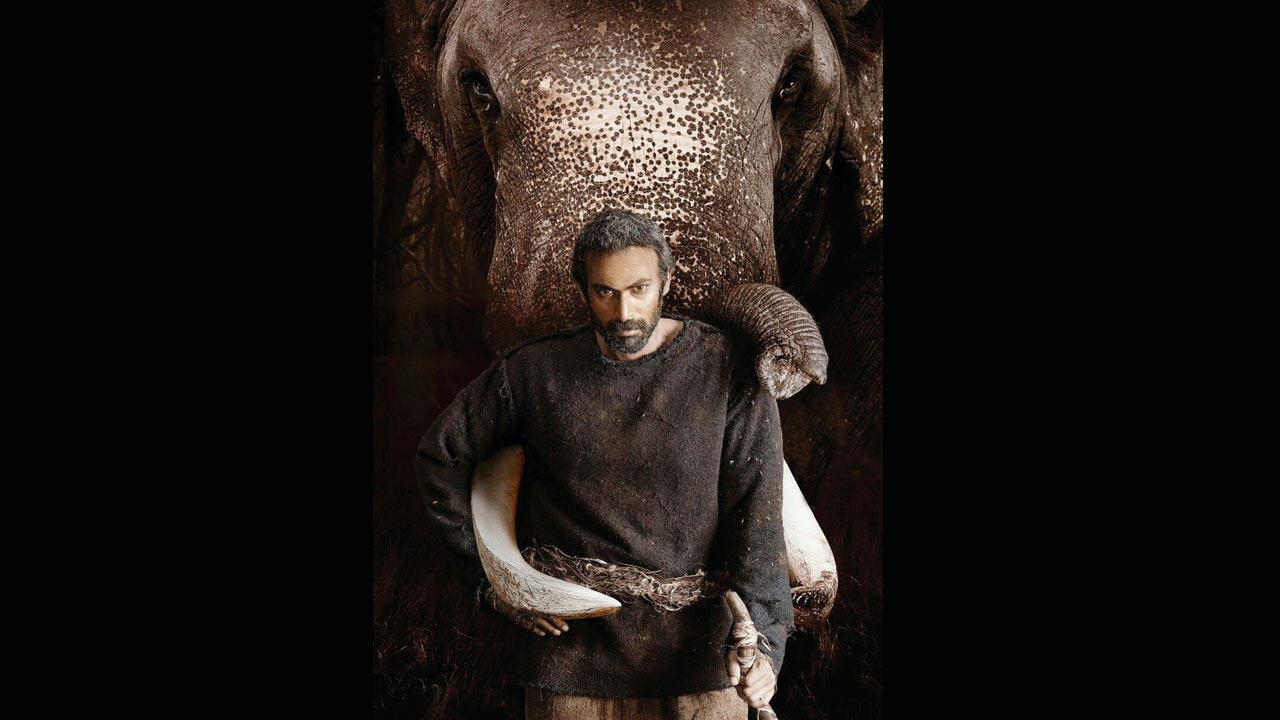
A far cry from his humongous frame in Baahubali, Rana Daggubati's next avatar sees him 30 kilos lighter and leaner, as he plays jungle man Bandev in Haathi Mere Saathi.
The actor tells mid-day he had to severely monitor his calorie intake to shed the kilos. "Prabu sir [Solomon, director] wanted the film to look real. It was difficult to lose all the weight since I have always had a large physique. I had to undergo extensive physical training to look lean and make adequate dietary changes. My workout was altered entirely; focus was paid on agility [training]."
Instead of continuing his weight-training, the actor took to longer cardiovascular sessions that lasted about an hour. However, he attributes the weight-loss primarily to dietary changes.
"I [stopped consuming] protein-rich [foods] and turned vegetarian for a couple of months. I also reduced the intake of salt, and, in general, ate less," says the actor, adding that he maintained this regimen throughout the two-year filming duration.
A source tells mid-day that Daggubati will be seen sporting a heavy beard and grey hair in the film. "His character walks with one shoulder constantly tilted. The makers tried several appearances, and interestingly, his final look was revealed to him only on the first day [of shoot]."
Set to release on April 2 as Haathi Mere Saathi in Hindi, Kaadan in Tamil and Aranya in Telugu, the film is based on the encroachment of elephant corridors in Kaziranga, Assam.

Rana Daggubati incorporates popular Tinkle comic character, Kalia The Crow, in Haathi Mere Saathi
8:00 AM

Sonil Dedhia (MID-DAY; December 25, 2019)
 If you're a '90s kid who grew up on a steady diet of Tinkle comics, Rana Daggubati's upcoming film, Haathi Mere Saathi, may pique your interest. Turns out, the actor — who has a stake in Amar Chitra Katha — has woven in the popular character, Kalia The Crow, in the narrative of the social drama.
"Tinkle has an association with Haathi Mere Saathi. The film includes the elephants in the Big Baan [the forest that has its origin in the] Shikari Shambu franchise, and Kalia The Crow. So, we have encouraged the crossover of these characters from the comic book to the film," he says.
A self-confessed comic book geek who devoured copies of Amar Chitra Katha, the actor hopes to revive the charm of the lost culture among the youth. "The idea is to bring our culture alive in the digital world. We have set up Amar Chitra Katha learning centre in Hyderabad. I'm also in talks with people who develop augmented reality [games] and theme parks to see how we can take [the idea] further."
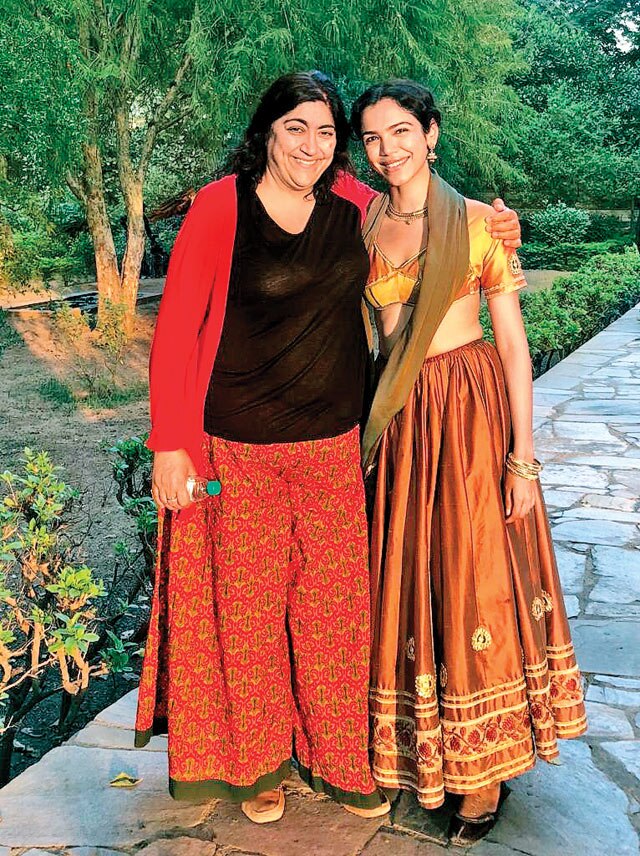
Both, Gurinder Chadha and I, enjoy history-Shriya Pilgaonkar
8:26 AM

Deepali Singh (DNA; June 15, 2019)
After Shriya Pilgaonkar auditioned for the British TV series Beecham House, she didn’t hear from them for quite some time. “One day, I was suddenly called to their office and I thought I was going for a meeting, but they started taking measurements for the outfits!” she recalls with a laugh. Directed by Gurinder Chadha, the period drama set in 1795 was shot across London and Rajasthan and was an engaging and interesting process for the Mirzapur actress. Shriya tells us more about the show and her role...
Was it daunting to be a part of an international production?
I have done a French film earlier, but this is my first British series and one of the primary parts. In that sense, I was a little nervous about it, especially because it’s a period drama and this is the first time I’m speaking English on screen. Everyone had to undergo voice lessons and diction training workshops because the English spoken in a period drama is a little different from how one would speak otherwise. It’s slower and the sentences are fuller. I wasn’t daunted as I was excited about the experience. Also, it was a diverse cast and crew from all over the world and I was really looking forward to that setup.
Tell us a bit about the show and your character.
It’s a drama about family, relationships, love and loss. These are universal themes. Hence, they’re quite relatable. My character is an intriguing one. There is not much known about her. She is a young girl who comes to the house as the caretaker to John Beecham’s baby and ends up falling in love with his brother. She is ambitious, adventurous and loyal. A part of her wants to explore the world and she is always torn and conflicted about what she wants to do. What makes her more intriguing are the choices she makes. She is unafraid and uninhibited.
How was it to work with Gurinder Chadha?
She really represents diversity in the true sense because she is able to keep her team together, which I think is the most important quality of a director. She has a good understanding of the script and working with actors. Both of us enjoy history. There was so much energy on the sets and she deserves credit for that.
What’s next?
I have a film titled Bhangra Paa Le with Sunny Kaushal and Anubhav Sinha’s Abhi Toh Party Shuru Hui Hai. Then I have Haathi Mere Saathi, a trilingual with Rana Daggubati. It’s my first Tamil-Telugu project. There is also a project for an OTT platform.
After decades, Junglee brings back magic of jumbos on big screen
2:59 PM

Hindi cinema has not seen real elephants since the ’60s and ’70s.As Junglee fills that jumbo-sized gap, those that remember the thrill of watching elephants in theatres relive the era
Niharika Lal (BOMBAY TIMES; March 18, 2019)
”When the elephant cried, I cried too”, “I wanted an elephant friend whom I could call by name”, “petting an elephant was my only dream” — these were just some responses we got from the generation that still remembers the magic of watching elephants ‘act’ on the big screen, when a handful of elephant movies were made in the ’60s and ’70s. Since then, it’s only been CGI elephants or animated characters, leaving later generations with only the imagination of what it would have been like watching real elephants in action in theatres.
In fact, Haathi Mere Saathi (1971) was such a huge hit that moviegoers stood in never-ending queues to get tickets. Those associated with these films of yore say that they gave the elephant characters their most human characteristics, and that the ’60s and ’70s were a defining period for elephants in Hindi cinema.
More than four-and-a-half decades later, that magic is set to be revived with Junglee, which stars Vidyut Jammwal and Bhola, the mighty elephant. With Bhola and his jumbo friends ready to take over the screens on March 29, kids finally have a chance to watch the story of a real elephant.

WE USED TO WAIT FOR HOURS TO GET ONE SHOT WITH ELEPHANTS: DHARMENDRA
Dharmendra, who shot with elephants in films like Maa (1976) and Shola Aur Shabnam (1961), says that the shooting was challenging, but “one of the best experiences” an actor can have. He tells us, “In my career, I’ve got quite a few opportunities to shoot with animals, including elephants and tigers. One of the prominent ones was Maa, which was all about a mother elephant’s love for her little one and how she fights a man (played by Dharmendra) trying to trap the baby elephant. It was a beautiful film that conveyed an important message through a touching story. The film was loved not just in India, but was a huge hit in Russia as well. I really enjoyed shooting it. We were shooting in Mudumalai in Karnataka and it was interesting, but very challenging, too. Those elephants and other animals we were shooting with were trained, but you need a lot of patience while shooting with them. We used to wait for hours just to get one perfect shot. It was a lot of hard work for everyone but I enjoyed every bit of it. I also got a chance to shoot with elephants in my second film, Shola Aur Shabnam. We shot that in Karnataka as well.”
WE SHOT IN A FOREST WITH TRAINED AND WILD ELEPHANTS: KALA PARVAT DIRECTOR
M S Sathyu, best known for directing Garm Hawa (1974), also directed Kala Parvat (1972), an India and Soviet Union co-production. The film was jointly directed by M S Sathyu and Alexander Zagurdi. Sathyu says, “We shot the film in a forest with 80-90 real elephants, with a Russian group. Shooting this film was difficult because we had different types of elephants — trained ones, wild elephants and baby elephants. But we had the expertise of a Russian crew, who advised us on how to deal with animals, and forest officials helped as well. It was indeed a mammoth task, but children loved the film, and even now it is screened for kids.”
He adds, “Of course, a film shot with real elephants will work even in today’s time; children will especially love it. We don’t make films with real elephants anymore. Now, everything is animated.”

‘HAATHI MERE SAATHI WAS A MASSIVE SUCCESS BECAUSE IT WAS RAJESH KHANNA’S FIRST FILM TO CONNECT WITH KIDS’
Gautam Chintamani, who has written Rajesh Khanna’s biography, had come across a number of anecdotes about Haathi Mere Saathi during his research. He tells us, “When I was talking to Salim Khan (who wrote the screenplay with Javed Akhtar), he told me that one of the major reasons behind the massive success of Haathi Mere Saathi was that it was Rajesh Khanna’s first film that connected with children. A number of scenes with elephants were included just to entertain kids. Other than its success at the box office, the film had a message for animal rights, too.”
Chintamani adds, “For me, another film which is memorable is Safed Haathi. As a kid, I related to this film so well because it was full of adventure. I also found Maa very exciting as a kid because of the animals. Those films had such a huge impact that you’d want to have an animal friend whom you could name and pet.”
CHILDREN LOVE ELEPHANT MOVIES, BUT DIRECTORS DON’T MAKE THEM: CHILDREN’S FILM SOCIETY OF INDIA
The Children’s Film Society of India’s (CFSI) catalogue lists only a few films on elephants, like Kala Parvat and Haathi Ka Anda (which doesn’t have any elephant). Nagraj Kulkarni, a CFSI official, says, “We have films like Kala Parvat, and a few other regional films on elephants, but most of those are old. Nowadays, there are very few films on elephants. One reason could be that shooting permission is difficult to get.”
Dharmendra agrees, “In the ‘70s, it was easier to shoot with elephants and other animals, but now, the law is very strict and therefore we don’t see many films on elephants. I’m glad to hear that after so many years, there is this film called Junglee that’s coming soon. I hope this film wins hearts and that it’s a big hit, and more and more people go to watch it. There are very few films now where we see elephants as part of the main story.”
‘WANT TO SEE HOW THE ELEPHANTS IN JUNGLEE ACT AND REACT’
As Junglee has been shot with real elephants, those who have seen elephant movies in theatres are quite excited about the movie. Jaisingh Rajput, Assistant Officer in Production at CFSI, says, “As a kid, I’ve seen all the movies with elephants — be it Haathi Mere Saathi or Kala Parvat — and I’m a huge fan of them. There are a few films with real elephants in them, and where the elephant is not just an animal, but a character. I’m looking forward to watch the film to understand how they have dealt with the animal, check if he is also acting in the film and how he responds in the scenes.”
— With inputs from Divya Kaushik
