Showing posts with label Gujarat. Show all posts

Akshay Kumar to play a character inspired by Jim Corbett in Priyadarshan’s next

 Akshay Kumar. Pics/Instagram, Yogen Shah, Facebook

Upala KBR (MID-DAY; September 1, 2026)

Eight films down, and ninth is on the cards. In July, mid-day had reported that Akshay Kumar and Priyadarshan would reunite after Haiwaan for their ninth collaboration (Reunion party that goes on and on, July 1). Now, we’ve got more deets on the project. Turns out, their yet-untitled next is centred on the theme of wildlife conservation, with Kumar playing a character inspired by Jim Corbett.

When Priyadarshan is at the helm, the element of comedy is non-negotiable. The filmmaker has envisioned it as a comic thriller set in India of the 1960s. We’re told Kumar portrays a tiger hunter who eventually has a change of heart. The character is modelled on British-Indian hunter, naturalist, and author Corbett.

A source revealed, “Akshay’s character, a hunter and tracker, learns to read the forest long before becoming a famous hunter. He kills several man-eating tigers and leopards that terrorize his village. Later he becomes an advocate of wildlife conservation as he understands the devastating impact of poaching and deforestation, and realizes that preserving their habitat is important.”

The filmmaker will begin pre-production in October, intending to call action on the movie in January 2027. The source added, “After Haiwaan’s release, Priyadarshan and his team will go on a recce in the jungles of Rajasthan and Gujarat. The movie will be shot in a start-to-finish schedule in a forest.” The makers have yet to zero in on the female lead.

Who was Jim Corbett?
Born Edward James Corbett in Nainital, he was a hunter and tracker who killed several man-eating tigers and leopards in North India. Eventually, he became a passionate advocate for wildlife protection and helped establish India’s first national park in Uttarakhand. Originally called Hailey National Park, it was renamed Jim Corbett National Park in 1957 after him.

Freddy Daruwala bags Tapas, based on real-life incidents

Freddy Daruwala plays a cop in ‘Tapas’. Pics/Instagram, Youtube

Upala KBR (MID-DAY; June 17, 2026)

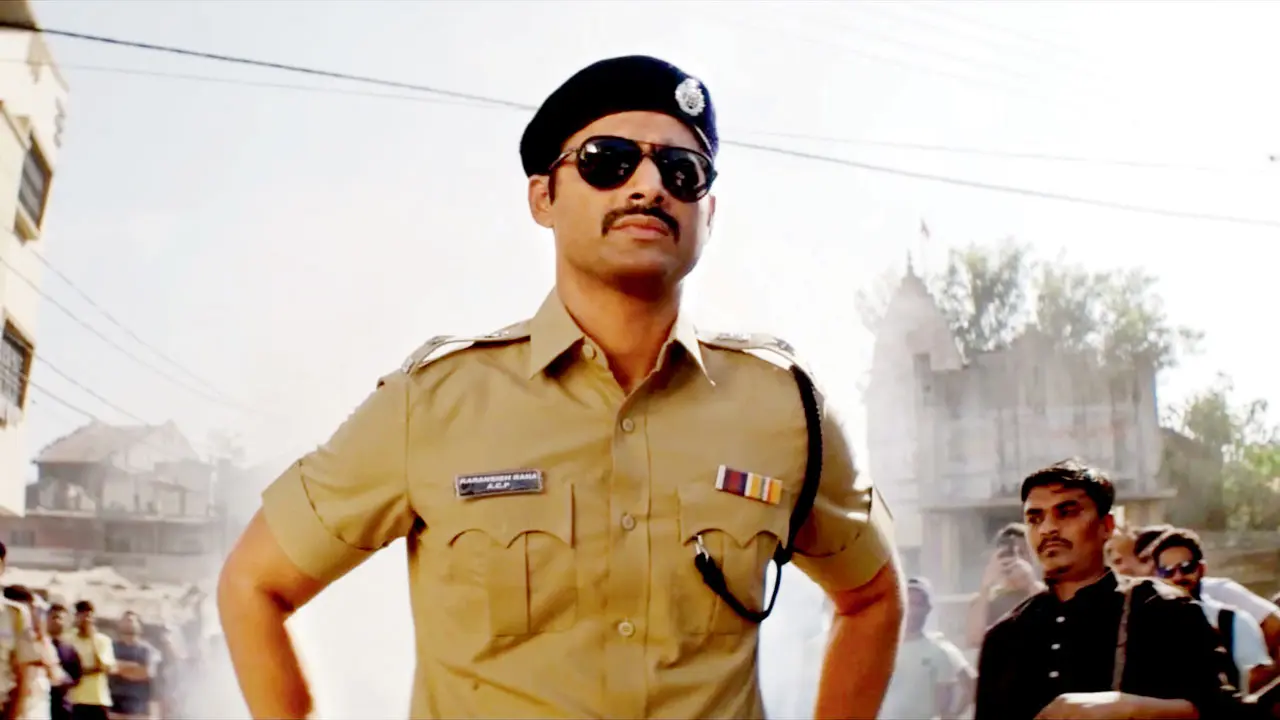
Inspired by real-life incidents from Porbandar, director Krrupesh Vayeda’s Hindi feature film Tapas throws light on a lesser-explored side of Gujarat’s underworld. Set in 2017, the crime drama stars Freddy Daruwala as a special officer navigating the challenges of taking on an entrenched criminal network.

Speaking about the film, Vayeda says that authenticity was central to the project. “The narrative is engaging, realistic, and emotionally connected as it delves into a world where crime and political connections thrive. While the story is fictional, it is inspired by the realities of contemporary Gujarat and reflects the efforts of law enforcement agencies to keep crime under control across the state.”

For Freddy, who was last seen in Dharavi Bank, the role marks a departure from the larger-than-life cop archetype.

“Karansinh isn’t a superhero. He makes mistakes, faces setbacks, and evolves through the story. Tapas is close to my heart because it is set in Gujarat, my home state. I finally got the opportunity to play a realistic police officer — a role I always wanted to portray.”

A part of me is gone with Asha Bhosle’s passing-Jamie Lever


Kanksha Vasavada (BOMBAY TIMES; April 29, 2026)

Having “first discovered by a Gujarati magazine 20 years ago”, Jamie Lever says she owes “so much to this community”. For the actress-comedienne – who is set to perform in the city tomorrow – shares, “The Gujarati audience has supported me more than anyone, and since the start of my career, they have constantly invited me to perform. I owe so much to this community. I love how people here appreciate the art and know how to have fun, which is why Gujarati theatre is still so popular, even in Mumbai.” 

She adds, “I had a lot of Gujarati friends in school, so I picked up the language at a young age and speak it fluently. Now, many people naturally start chatting to me in Gujarati, and I am absolutely thrilled to finally bring my show to a community that has encouraged me from the beginning.”

‘My focus is on offering family-oriented content’
With international artistes like Russell Peters and Trevor Noah bringing their hit tours to India, is it challenging for comics like her to keep their content relevant? “There is so much content available today that audiences are spoilt for choice, making it tougher for artistes to stand out and offer something unique. Having said that, people know what I do and appreciate my impersonations, which is where I have found my niche. My performances feature a lot of physical comedy, much like my father when he performed on stage, and the audience enjoys seeing a glimpse of him in my work.”

She adds, “I focus on keeping my content clean and family-orientated, because I want my family to be able to watch me without feeling awkward. There are fewer young comedians performing clean comedy today, so I am proud to have maintained my father’s style that way. I have created a show where 16-year-olds can come with their parents and grandparents, and everyone’s having a good time.”

‘I take each show as my start from zero’
Talking about comparisons with her father, Johny Lever, Jamie shares, “My father has worked in the industry for over 40 years and has spent 50 years on stage. He’s performed many a time in Gujarat, where the audience knows his content inside out, and often requests specific sets – which translates to added pressure and higher expectations. After 12 years of performing and perfecting my craft, I finally feel confident in what I have to offer, but I never take it lightly. Every show feels like starting from zero. I always feel that pressure, but I think it keeps me grounded.”

‘A part of me is gone with Asha ji’s passing’
Having mimicked Asha ji for 12 years, I feel a deep connection with her, and when I heard the news of her passing, I could not hold back my tears. I felt as though a part of me was gone, and I am saddened that the chance to meet her has been taken away. However, many people have written to me, asking me to keep her voice and spirit alive through my performances, and I would love to continue singing in her voice for them. I will do my best to honour her memory through my art.
-----------------------------------------------
On mimicry, Jamie shares, "Impersonation involves an in-depth observation of artiste’s mannerisms, expressions, and vocal modulation. I wonder how much effort someone like Sunil Grover must put in, as he becomes a perfect replica of a person. We observe artistes with detail and precision, and while it is hard work, I love that audiences truly appreciate it."

Talking about her acting career, Jamie said, "I played a serious character recently and found it challenging. While comedy is my first love, I have also viewed myself as an actor. So, I don't want to restrict myself and want to get out of my comfort zone."

Shoojit Sircar, Ajay Gahlaut remember working with Piyush Pandey on 2 memorable Amitabh Bachchan campaigns


THE ECONOMIC TIMES (November 5, 2025)

Ajay Gahlaut, Former Group CCO, Dentsu Creative Services
UNICEF’s Pulse Polio, ‘Do Boond Zindagi Ke’ (2002): Do Boond, One Brilliant Idea

I wrote the line ‘Do Boond Zindagi Ki’ for the Pulse Polio campaign. But the real genius of the campaign, the central idea, came from Piyush Pandey. And that idea was showing Amitabh Bachchan angry with people who had not immunized their children against polio. Only Bachchan could get away with berating an entire nation. Only he commanded that kind of respect and love. And only Piyush could have come up with that idea. Stunning in its simplicity, understanding of Indian culture and impact.

One day, I read a criticism of it on social media. Some random guy had written: “What’s so special about this campaign? Just another celebrity talking to the camera.” I was furious and wanted to reply with a sarcastic tirade. I sent Piyush a screenshot of the tweet and told him that I was going to write a riposte. Piyush smiled and said, “Tere paas kaagaz-kalam hai?” I said yes, excited that he would give me some points to write.

“Likh Dhenchu, Dhenchu, Dhenchu!’”said Piyush. (The Hindi equivalent of ‘Hee-Haw’, a donkey’s call) “Matlab?” I asked, puzzled.

“Is gadhe ko aur kya samajh mein aayega?” said Piyush with a laugh. What a lesson.
-----------------------------------------------------------
Shoojit Sircar, Filmmaker 
Gujarat Tourism, ‘Khushboo Gujarat Ki’ (2010): Two Giants, One Simple Act

The Gujarat campaign started off with one film, but it went on for nearly five or six years. During filming, Piyush and I would eat, sleep, discuss and shoot side by side, often with Amitabh Bachchan, since he was part of this campaign.

Piyush was the country’s top creative mind, but he was open to everyone — be it a client, a director or someone from the crew. He would listen to, and manoeuvre ideas as long as the core remained intact. My production manager, Kumar Thakur, became his best friend because they both came from the heartland.

Once we had a 6 am shoot call time. The previous day we had an early pack-up, so we were partying a little and it got late. Next morning, Piyush knocked on my door at 6 am, saying, “He [Amitabh Bachchan] has reached the location, nobody’s there!” We ran to Kumar who scurried out barely dressed, and Piyush told him, “Arre pant toh pehno!”

Piyush and I then ran to see Mr Bachchan in the distance, picking up all the garbage people had left from the previous evening. We started apologizing, after which Piyush said, “Main bhi aapke saath saaf karta hoon,” and joined him in the clean-up as we readied for shoot. The visual of him and Piyush cleaning up after everyone will remain etched forever in my mind.

Manthan did brilliantly in Gujarat because its largest audience was also the film’s producers-Shyam Benegal

 Unveiling  the story  behind  Manthan
Shyam Benegal shares how Manthan was brought to life and how Dr Verghese Kurian made it happen
Shyam Benegal (THE ECONOMIC TIMES; September 10, 2012 | Republished in BOMBAY TIMES; April 26, 2024)

I used to work for an ad agency that advertised Amul products. And Amul launched its first product, milk food for babies. Dr Kurien had this idea to launch this baby food with buffalo milk, which nobody believed could be done. Of course, it worked wonderfully.

Then came the iconic butter which we used to advertise and I used to write for that. But the milk revolution was yet to take place in its entirety.

Now came NDDB, post the then Prime Minister Lal Bahadur Shastri’s visit to Anand. Shastri asked Dr Kurien to replicate his model but he refused to move to Delhi saying, Delhi didn’t have farmers, only bureaucrats!

Around 1972-73, I got to make two of the three documentaries on Operation Flood, called Operation Flood I and II, which led to the White Revolution – all because of Dr Kurien and his rural marketing initiative IRMA, which was a pioneering institute. While doing these documentaries, I used to travel around the whole country and I came across many beautiful places. And I said to Dr Kurien that these documentaries will be seen largely by those who have already been converted to the cause. What about the larger public? He agreed with me but said that there was no money (for a large project). Dr Kurien never allowed anyone to spend any money that he didn’t get value from.

So he asked me, how much do you need? I said Rs. 10 lakh. He did a headcount and said, if I collect Rs. 2 from each member, we can make the film.

He did not take any money from the farmers. He told the collection centres that when they come for their daily morning and evening collection, ask them not to take Rs. 2 and instead they can all be producers of a film!

Then came Vijay Tendulkar who was blown away by the cooperative and wrote several scripts. I chose one and that’s how Manthan was made.

Dr Kurien released the film first in Gujarat before its all India release. The film did brilliantly because its largest audience was also the film’s producers! Everyday, we had this incredible sight of truckloads of people coming in from all over to see the film.

The film’s success gave Dr Kurien another idea. To use the film to woo other parts of the country into the movement. So prints of 16 mm would be used by spearhead teams to persuade farmers to create cooperatives of their own. Like in Manthan, a vet, a milk technician and a fodder specialist who can explain the value of cross breeding would go and help set up cooperatives. That is how this man made India the largest milk producing nation in the world. Quite an extraordinary man.

There are very few stories like him and the only other person I can think of like him is MS Swaminathan.

When Dr Kurien said: “I am a milkman, I am a servant of the farmers,” it was not just rhetoric. He meant it. He never suffered fools. He would never stand for any obtuse ways, if he could help it he never went to Delhi.

He was a delightful, marvellous man with a great sense of humour. I enjoyed his company and we had lots to talk about.

I am lucky to have met him because of Sylvester D’Cunha and Usha Kartak who were hands on. When I left for filmmaking, I made several other documentaries for him. Films for farmers.

A Movie Pure as Milk
Dr Kurien never complimented anyone! But I took the film to the UN that helped the UNDP to use the film for other countries, like a few in Latin America, to set up similar cooperatives.

Rajiv Gandhi asked Dr Kurien for a print of Manthan, which he gifted to the Soviet Union. Dr Kurien was both a leader and the backbone of the movement. I have never known someone with so much integrity like he said at an award function last year, "If I am proud of anything it’s my integrity."

He was a man who took people with him. He made money for the farmers. He took just Re 1 as salary from NDDB and took his salary from Amul right till the end. He should be the person every Indian wants to be like, especially in the material world we live in.

(As told to Nandini Raghavendra)

 Unveiling  the story  behind  Manthan

Shyam Benegal's restored Manthan selected for Cannes screening

BENEGAL’S RESTORED  MANTHAN SELECTED   FOR CANNES SCREENING

Niharika Lal (BOMBAY TIMES; April 24, 2024)

The restored version of Shyam Benegal’s 1976 film Manthan will be screened at Cannes in the Cannes Classics section this year. Naseeruddin Shah, who began his career with Benegal’s 1975 film Nishant (which was in the competition at Cannes), and played the role of Bhola in Manthan, will present the film on the red carpet at the festival.

Manthan reminds the world of the power of cinema: Benegal
“I was absolutely delighted when Shivendra told me that Film Heritage Foundation was going to restore Manthan in collaboration with the Gujarat Milk Marketing Federation Ltd. Manthan is a film that is very close to my heart as it was funded by 500,000 farmers and was instrumental in the growth of an extraordinary cooperative movement that was aimed at breaking the shackles of economic inequality and caste discrimination whilst empowering the farmers. It will remind the world of the power of cinema as a vehicle of change and also the legacy of the great Verghese Kurien, the Father of the White Revolution.

Govind Nihalani and I have been following the progress of the restoration closely and I am amazed by the meticulous approach to the restoration. It is wonderful to see the film come back to life almost like we made it yesterday.

Film Heritage Foundation has been doing remarkable work in film restoration. Not only are they beautifully restoring films from every region of India, but bringing them back to the public at festivals and screenings around the world in a way that showcases our unique film heritage to contemporary global audiences.”

I am so happy to hear that the restoration of the film will be premiered at the Cannes Film Festival this year: Govind Nihalani
“It is remarkable that Film Heritage Foundation is restoring Manthan nearly fifty years since it was made. Being involved in the restoration has been an emotional experience. It has taken me back to 1976 when the entire unit lived like a family in the village of Sanganva in Gujarat for 45 days during which the film was shot. The shooting was challenging because we had to use a patchwork of different film stock – Eastman and Gevacolor besides Kodak, 35 mm for the film and 16 mm for the film within the film. I began my career as a cinematographer with Shyam Benegal first shooting ad films and then his early feature films. We’ve had an immensely creatively satisfying relationship over the years as Shyam involves you as a partner in the creative process of the film and not just as a cameraman. I am so happy to hear that the restoration of the film will be premiered at the Cannes Film Festival this year.”

I will be at Cannes to present Manthan: Naseeruddin Shah
“I started my career as an actor with Nishant followed by Manthan, both directed by Shyam Benegal. Manthan was a runaway success when it released almost 50 years ago and it is a film that is remembered even today. I remember that during the shooting of Manthan; I lived in the hut, learnt to make cow dung cakes and milk a buffalo. I would carry the buckets and serve the milk to the unit to get the physicality of the character. I am so glad that Film Heritage Foundation has restored this remarkable film and that this small film made with the support of the farmers has been restored with so much love and care. It is thanks to the persistence, hard work and efforts of Film Heritage Foundation that the film will be premiered in its second life, as it deserves to be, at the Cannes Film Festival and I am so glad that I will be there to present it myself.”

The restoration of a Shyam Benegal film has been on Film Heritage Foundation’s wish list for years: Shivendra Singh Dungarpur
“I am so delighted that Film Heritage Foundation will have a red-carpet world premiere of another one of our restorations of an Indian classic at the Cannes Film Festival for the third year in a row after Thamp in 2022 and Ishanou in 2023. The restoration of a Shyam Benegal film has been on Film Heritage Foundation’s wish list for years as he is one of India’s most venerated filmmakers whose early films were iconic in India’s Parallel Cinema movement. Manthan is not only one of his finest films from that time, but also the story behind it was so unique – that 500,000 farmers contributed Rs. 2/- towards the making of the film that told the story of the birth of the milk cooperative movement while touching on so many issues like caste, class, gender and economic discrimination. The film was integral to spreading the message of the benefits of the cooperative movement to farmers across the country and a vital part of building the movement and the storied brand.

The restoration process has been an incredible experience, especially working so closely with Shyam Benegal and Govind Nihalani to painstakingly bring the film back to life. Almost half a century later, the power of the narrative and the compelling performances of the actors, especially Smita Patil, remains undiminished. I wish she was here to see the beauty of the restoration.”

THE RESTORATION PROCESS
Film Heritage Foundation used the best surviving elements for the restoration – the original camera negative and the 35 mm print preserved at the NFDC – NFAI. Unfortunately, the sound negative was not available. We digitized the sound from the 35 mm print preserved at Film Heritage Foundation. The film elements were repaired by the Film Heritage Foundation conservators and the scanning was done in Prasad Lab in Chennai We found that due to the deterioration of the print, there were vertical green lines on many parts of the film. While the scanning and digital clean-up was done at Prasad under the supervision of L’Immagine Ritrovata in Bologna, the grading, sound restoration and mastering was done at the lab in Bologna. Both Shyam Benegal and Govind Nihalani, the cinematographer of the film, have been involved in the restoration of the film.

Pankaj Udhas no more, ghazal loses a chart-topper

Jeeye to jeeye kaise... Udhas no more, ghazal loses a chart-topper

Avijit Ghosh (THE TIMES OF INDIA; February 27, 2024)

He completed evenings. In the 1980s and ’90s, ghazals sung by him were mandatory at parties and gatherings. They were like companions helping listeners unwind, enlivening many a ‘spirited’ sunset. Pankaj Udhas, whose audience-friendly renditions and easy on the ear compositions sold millions of cassettes, packed hundreds of concerts and took ghazals to new followers, passed away after “prolonged illness” at a Mumbai hospital on Monday. He was 72. 
------------------------------------------
Ghazal chart-topper Pankaj Udhas, the voice behind ‘Chitthi Aayee Hai’ and ‘Jeeye Toh Jeeye Kaise’ passed away at a Mumbai hospital on Monday. His daughter, Nayaab, made the announcement on Instagram.

Primarily a singer of non-film ghazals and geets, Pankaj delivered Bollywood’s biggest 1987 chartbuster: ‘Chitthi Aayee Hai’ (lyrics, Anand Bakshi; music, Laxmikant-Pyarelal; film, Naam). The song, which topped Binaca Geetmala’s annual countdown show, touched an emotional chord, especially among NRIs and PIOs.

Some of Udhas’ finest numbers are in the 1981 album, Muqarrar. ‘Tum na maano magar haqeekat hai’ (poet Qabil Ajmeri) and ‘Deewaron se milkar rona achcha lagta hai’ (poet Qaiser-ul-Jafferi). Another popular track from the same album, Sabko maloom hai main sharabi nahi (poet Anwar Farook Habadi) spurred him to do a reprise with Paimana (1983), a collection of ghazals that went down well with tipplers; it had Thodi thodi piya karo (poet S Rakesh) and La pila de saakiya (traditional).

A science graduate from Mumbai’s St Xavier’s College, Pankaj spent his early years in Gujarat. In an interview to the Sunday Guardian in 2018, the singer recalled his father playing the musical instrument ‘dilruba’, and him liking the sound.

Pankaj also remembered being fascinated by the tabla and enrolling for a course but later switching to learning Hindustani vocal from Ghulam Qadir Khan Sahab in Rajkot. “Then I came to Mumbai to learn from my guru, Master Navrang Nagpurkar. He was a very famous singer from the Gwalior Gharana,” he said in the interview.

The 1980s saw two divergent trends in popular music. One was led by the breathless beats of disco, the other by the more reflective ghazal. The peerless pair of Jagjit and Chitra Singh had already initiated a new gene ration of the middle class to the non-film ghazals. A Padma Shri recipient who also worked to eradicate thalassemia, Pankaj was among the young bunch of ghazals singers - Talat Aziz and Anoop Jalota were the other two – who were part of that wave.
------------------------------------------
RWITC mourns a horse racing enthusiast
Ghazal singer Pankaj Udhas was a keen racing enthusiast too. A member of the Royal Western India Turf Club (RWITC), Udhas owned a few horses and would visit Mahalaxmi Racecourse. “He would call and ask if his horse has a chance to win,” RWITC-based trainer H J Antia told TOI on Monday. 

Antia trained his horses. “And when I would tell him yes, he would specially make time to come to the Mahalaxmi racecourse,” added Antia. The late singer would also visit the stables at the racecourse to check on the horses, he said.

“We lost a very genuine member of the club,” said RWITC chairman Surendra Sanas. “It is also a personal loss for me. He would make it a point to visit the club on Classics race days and almost certainly on Indian Derby Day,” recalled Sanas.

Surgeon Dr Mehli Nazir, who jointly-owned horses with Udhas, said, “We bought our first horse called Aliyana sometime around 2010. And then we owned a couple of more horses together. When Aliyana won in Pune the first time, he was thrilled to lead the winner. It was his first ever win,” said Dr Nazir. 

“He found it difficult to devote time to racing after 2018 because he had a busy schedule,” said Adhirajsingh Jodha, who trained a horse called Speed Of Sound owned by Udhas in partnership.— Shailendra Awasthi
------------------------------------------
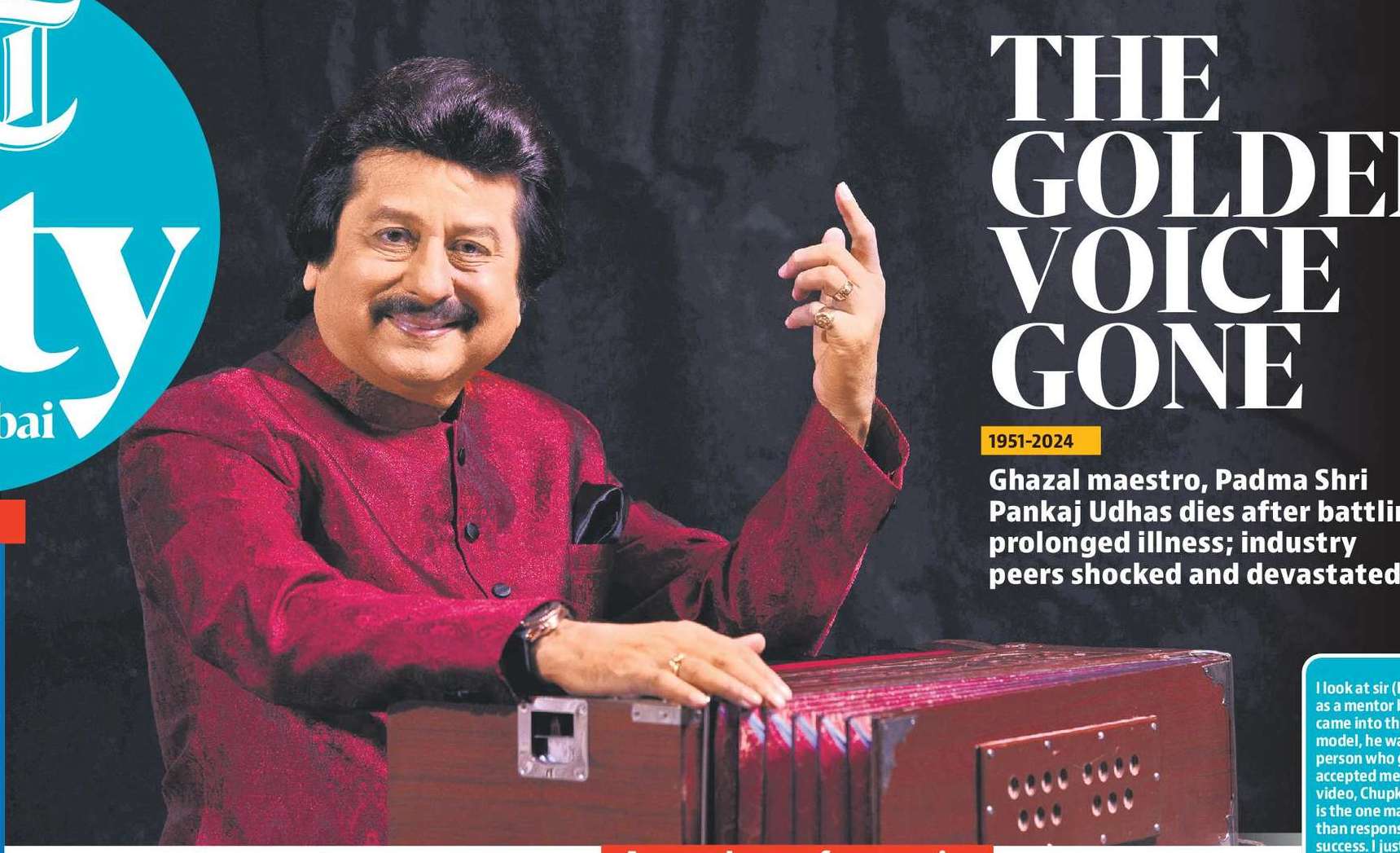
Ghazal maestro, Padma Shri Pankaj Udhas dies after battling prolonged illness; industry peers shocked and devastated
HINDUSTAN TIMES (February 27, 2024)

Inarguably one of the most renowned ghazal voices, Pankaj Udhas has died at the age of 72. His daughter, Nayaab, issued a statement on Instagram on Monday to announce the news: “With a very heavy heart, we are saddened to inform you of the sad demise of Padma Shri Pankaj Udhas on 26th February 2024 due to a prolonged illness.” 

Born in Gujarat, Udhas was keen about music from a young age. It was in 1986 that his playback career took off with the cult classic Chitthi Aayi Hai for the film Naam, and there was no looking back after that. Chandi Jaisa Rang Hai Tera (Ek Hi Maqsad, 1988) Jeeye Toh Jeeye Kaise (Saajan, 1991) and more cemented his legendary status. He remained active in films until 2016, when his song Raat Bhar Tanha Raha was featured in Dil Toh Deewana Hai.

He is survived by wife Farida and daughters Nayaab and Reva.
----------------------------------------------------------------------------
A symphony of memories

In a 2016 chat with Soumya Vajpayee, Pankaj Udhas spoke about his journey as a ghazal singer and the future of the genre

ON HIS JOURNEY
It’s been interesting, challenging and satisfying. When I started out, the ghazal had just started gaining popularity. Even then, Bollywood music dominated the scene.

ON WHAT MADE HIM POPULAR AMONG THE MASSES
When I started singing, I was influenced by Begum Akhtar and Mehdi Hassan’s styles. But as I grew up, I realized that I shouldn’t keep singing like them. I wanted to create my own space. That’s when I started creating a style of my own. I wanted to reach out to the masses, as the ghazal was always limited to a very small audience. I wanted to make it more accessible. So, I composed the ghazal, Aap jinke kareeb hote hain. Anyone who could speak Hindi could understand it. That clicked, and I realized that I had found the success formula.

ON NOT SINGING FOR BOLLYWOOD ANYMORE
To be honest, I would love to sing for movies, as that’s a very exciting medium. I cannot deny that some of the Hindi film songs that I sang have had a huge impact on my career. They helped me gain popularity. Songs like Chitthi Aayi Hai and Jeeye Toh Jeeye Kaise helped me reach out to audiences across the world. It’s a different story that the style of songs and the approach to music in Bollywood has changed drastically now. Perhaps that’s why we (ghazal singers) are not called in to sing anymore.

ON LATE MEHDI HASSAN AND JAGJIT SINGH’S ROLE
After they arrived on the scene, people started talking about ghazals. There was a curiosity about this kind of music. By the time I started out, which was around 1978-79, Bollywood music was struggling to impress the masses. The audience was looking for an alternative. That’s when the ghazal started to rise. After the ’80s, it became a craze. I am glad to have been around when the ghazal ruled the roost.”

Farewell, ghazal king

SONU NIGAM, SINGER
Pankaj ji was one of the most important parts of my childhood. I will miss him forever. My heart cries.

KAVITA KRISHNAMURTI, SINGER
He was my friend since college and the nicest man I’ve known. He would always smile and talk to everyone; he’d never discriminate. The world has lost not just a singing icon but also one of the sweetest and simplest human beings.

SUKHWINDER SINGH, SINGER
During the video shoot of one of my songs from the album Nasha Hi Nasha Hai, he invited us all for dinner and lunch. He even extended our stay for the next night, just because he wanted to talk to us. The world has lost a great icon and I still can’t process that he is gone.

SALIM ARIF, THEATRE PERSONALITY-DIRECTOR
I was working on a musical show, based on (poet) Mirza Ghalib’s letters, with Pankaj ji. We couldn’t meet the last four months as he was not keeping well. It’s a personal loss.

I look at sir (Pankaj Udhas) as a mentor because when I came into this industry as a model, he was the first person who graciously accepted me in his music video, Chupke Chupke. He is the one man who is more than responsible for my success. I just told him that your voice still sounds so beautiful, it’s amazing.

TALAT AZIZ, SINGER
I can’t believe I have lost my dearest and oldest friend. Pankaj, Anup (Jalota) and I go way back. This is really shocking. I spoke to Nayaab (Udhas’s daughter), too. Rest in peace, my friend.

ANUP JALOTA, SINGER
Mera yaar chala gaya. I am heartbroken. Hum logon ne kitni shaamein saath bitaai, kitni yaadein hain... yakeen nahin ho raha. We started Khazana (annual ghazal festival) together. Now, I would like to take it forward with his daughter Nayaab.

THE
GOLDEN
VOICE
GONE

Arijit Singh is a blessing from God; he is today’s Kishore Kumar, say Sachin-Jigar

Sachin-Jigar: A song as innocent as this found a place

Composer duo Sachin-Jigar discuss how folk offering Ada sai became the crux of Saas Bahu Aur Flamingo, a series based on a drug cartel
Sonia Lulla (MID-DAY; June 5, 2023)

As music journalists who consume cinematic pieces with intention, rarely are we so moved by the background score of a series that we feel compelled to research about the composers and request for an interview. More often than not, however, such moments lead us to musician duo Sachin-Jigar, whose deftly crafted musical motifs brought Homi Adajania’s recently released web series, Saas Bahu Aur Flamingo, to life.

“We went to Gujarat and recorded folk artistes, and instruments like the jodia pawa, which is a double flute, and the banjo, which is also called the bulbul tarang. We needed those flavours in the background score,” says Sachin of the Dimple Kapadia-fronted series that follows a group of fierce women who run a covert drug cartel.

“We got these raw sounds from there. We allowed the artistes to perform like they would [in their natural setting]. We recorded each instrument individually, returned to Mumbai and then thought about how we wanted to layer them,” he says, crediting Adajania for giving them the freedom to chart the series’ auditory course.

Inarguably the musical crux of the show, the folk offering, Ada Sai, emerges to be a special track for the duo. “To be able to adapt something so free-willing and pious into this series is special. The show, [based on drugs], and discussing family legacy, has many layers. Within this, for a song as innocent as this one to find its space is wonderful. Also, the song in itself has a journey of its own — from the first episode to the last one, you can see how it evolves. We hope that people can fall in love with the story so deeply that they eventually begin to think of the score, and say that they liked the music behind a particular scene,” says Jigar.

Meanwhile, their collaboration with Arijit Singh has been the latest attraction across streaming platforms, with aficionados dubbing the Zara Hatke Zara Bachke track, Phir Aur Kya Chahiye, a musical masterpiece.

“Arijit is a boon for every composer. A voice for a song is like an actor for a film — it is what most people are drawn to. Arijit is a blessing from God. It’s natural for him to comprehend the vibe of a song. If you tell him to do something, the way in which his voice obeys his mind is amazing. We have recorded with all playback singers. Each one is unique, but he is today’s Kishore Kumar. He can sing any song in any style. He’s a composer, and arranger, and has [a grasp] on many instruments.”

In the battle of bans and tax-free benefits, cinema is the loser

The Kerala Story, The Kerala Story ban in West Bengal, The Kerala Story director speaks on The Kerala Story, movie banned on WB after Censor Board's green signal, indian express, indian express news

Avijit Ghosh (THE TIMES OF INDIA; May 21, 2023)

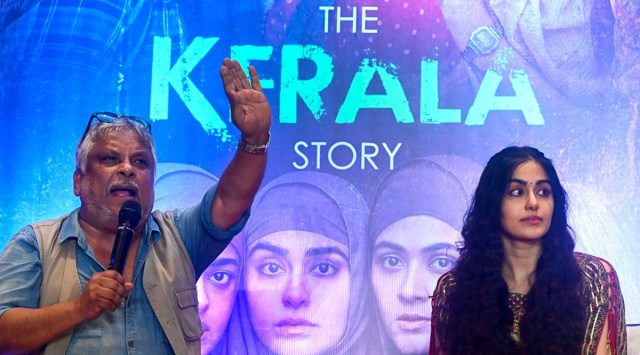
Nothing reflects India’s polarized polity better than the conflicting reactions to ‘The Kerala Story’, a film that recounts the ordeal of three girls — two Hindu and one Christian — who suffer in different ways at the hands of a bunch of radicalized Muslims. One of them ends up accompanying an ISIS terrorist.

On Thursday, the Supreme Court stayed a ban on the film imposed by Trinamool-run West Bengal. The film is not banned in DMK-ruled Tamil Nadu but theatres in the southern state are not showing it; just like cinema halls in Gujarat had once bypassed ‘Parzania’ (2005) and ‘Fanaa’ (2006). ‘Parzania’ was based on the 2002 Gujarat riots. ‘Fanaa’ landed in trouble after its lead actor Aamir Khan spoke up for those displaced by the Narmada dam project.

On the other hand, several BJP-ruled states such as Uttar Pradesh, Madhya Pradesh, Haryana and Uttarakhand have declared ‘The Kerala Story’ tax-free. Similarly, ‘The Kashmir Files’, which focused on the impact of terrorism on the lives of Pandits in the Valley, earned a tax-holiday in at least eight BJP-governed states last year. Assam even granted a half-day leave to its government employees to watch the film.

Granting tax exemption or banning a film is a state government’s prerogative. However, the privilege was meant to be given to award-winning films and to movies that helped forge a more progressive social order. But as recent events show, banning a film or declaring it tax-free is part of a new playbook where support or opposition depends on the ruling party’s ideological moorings and vote base. In this running battle, ‘ban’ is the other of ‘tax-free’.

It wasn’t always like this. To understand how the sands have shifted in the politics of tax exemptions and bans, one must look at the past. Since Independence, dozens of films have been banned temporarily (like ‘Aandhi’ during the Emergency) or permanently in India. Hundreds have been declared tax-free, many for dubious reasons.

In June 1970, TOI reported that many big daddies of Bombay cinema were rushing to Bhopal for tax exemptions. In a short period of 10 months, as many as eight films were declared tax-free in then Congress-ruled Madhya Pradesh.

“Some ministers and ex-ministers are alleged to have specialized in exerting pressure on reluctant officials, who see no point in sanctioning such requests at the cost of the state exchequer. One such official who refused to attend a special show of a third-rate film and be a party to the exemption business incurred the wrath of a prominent ex-minister,” the report said.

In 1980, Feroz Khan’s guns-and-glamour yarn, ‘Qurbani’, which began with a panegyric to the late Sanjay Gandhi, was declared tax-free by the Congress government in Maharashtra. “The controversial award…was widely discussed in the media,” noted Ashish Rajadhyaksha and Paul Willemen in ‘Encyclopaedia of Indian Cinema’.

According to the Bombay Entertainment Duty Rules, 1958, exemption could be granted to films winning the President’s Gold medal (later National Award winners) or to films which fulfilled criteria of educational, cultural or social purpose of a high order, following the recommendation of an advisory committee appointed by the state government.

But the Maharashtra government routinely flouted rules announcing tax-holidays for 55 films over a period of seven years in the 1990s, a CAG report said. The report, which did not mention these films by name, estimated that the government had lost at least Rs 19 crore. Congress (1990-95) and BJP-Shiv Sena (1995-99) were at the helm then.

Several of the tax-exempted films were routine formula films. ‘Agni Sakshi’ (1996), a remake of the Julia Roberts thriller, ‘Sleeping With The Enemy’ (1991) produced by Binda (Bindumadhav) Thackeray, the eldest son of Shiv Sena supremo Bal Thackeray, received tax exemption. That apart, regular commercial films got a no-tax run.

Producer Pooja Bhatt’s film, ‘Dushman’ (1998) starring Kajol and Sanjay Dutt, was given a 40% tax exemption by the BJP-Shiv Sena government after a special committee endorsed its “social and educational value”. The same year, letters to TOI raised questions over the tax-free status of films like ‘Major Saab’ and ‘Satya’.

The trend continued in the new millennium. In 2005, ‘Fareb’, an extra-marital thriller with Manoj Bajpayee and Shilpa Shetty in lead roles, was granted tax exemption in UP, then governed by Samajwadi Party (2003-07).

Evidently either proximity to power or corruption were key to earning tax exemption to undeserving films. The reasoning is different in the case of ‘The Kashmir Files’ and ‘The Kerala Story’, both major box-office winners. In these cases, it seems, tax concessions are being weaponized to boost ideologically aligned films in an effort to capture cine-goers’ minds and hearts.

On the other hand, banning the same film reveals the hollowness and the cynical side of those claiming to offer an alternative, discourse-driven politics.

Ironically last year, director Nagraj Manjule’s ‘Jhund’, a sledgehammer film on caste, class and the transformative power of sports, was denied the concession. Art and film lovers were the losers.

I have no regrets that I haven’t done films after 2015 because it was my choice-Jay Bhanushali

Jay Bhanushali: No regrets about not doing films after 2015

Returning to fiction shows after 11 years with Hum Rahein Na Rahein Hum, Jay Bhanushali on why his Bollywood career didn’t take off
Letty Mariam (MID-DAY; April 11, 2023)

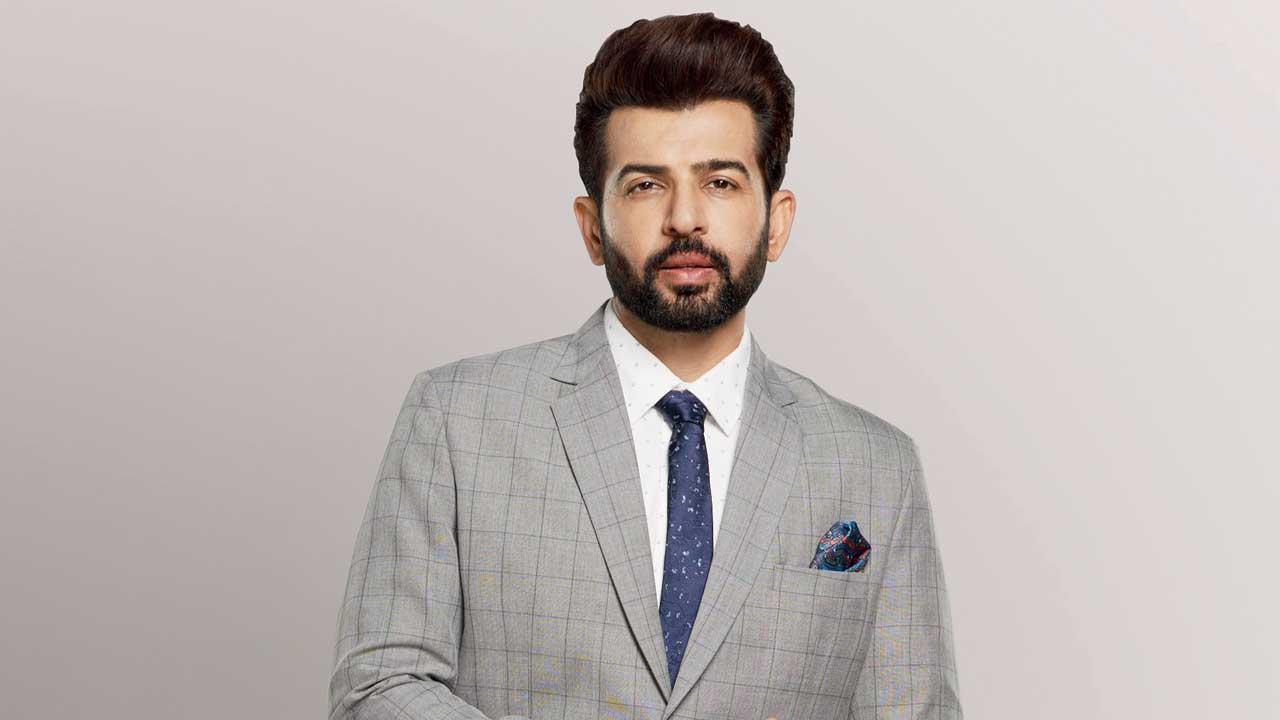
Between 2005 and 2012, Jay Bhanushali was a permanent fixture on popular daily shows, including Kayamath, Kis Desh Mein Hai Meraa Dil, Geet — Hui Sabse Parayi, and Kairi — Rishta Khatta Meetha, before turning towards anchoring completely. Now, the actor is ready to end his 11-year break from fiction shows with Hum Rahein Na Rahein Hum, in which he plays Shivendra Barot, the eldest prince of Ranakgadh. As he returns to acting in television shows, Bhanushali reflects on his career, his stab at Bollywood, and how his kids are his biggest motivation.

Edited excerpts from the interview.

What made you return to fiction after 11 years?
When I saw the Turkish show [Istanbullu Gelin], I told Mahhi [Vij, wife] that this is what I was looking for, and I have waited for a long time to do such a show. In the second week of the [Turkish show], I received a call [from the producers of HRNRH] asking me to be part of the show. I felt the same excitement that I did when I had received my first project call from a producer.

How did Hum Rahein Na Rahein Hum push you as an actor?
I am playing a serious role in the show. I wanted to do something in contrast to what I do on reality TV. The audience has seen my [comic timing] on reality shows. So, this time, I was looking for something serious because I want to be known for my [versatility] in acting

In a career spanning 18 years, how have you grown as an actor during the journey?
The best way of giving your best in acting is having the [hunger] of performing. Since I had an 11-year gap, I was eagerly waiting for [a suitable project]. In between, I was offered several fiction shows, but I felt that I wouldn’t be utilized [fully] on them. Because I was hungry, I strived hard to improve myself.

Do you think your Bollywood career didn’t take off because people were prejudiced against your TV background?
I don’t think so. Between 2014 and now, if I wanted to, I could have featured in 40 films. But if I get an inclination that something is not going to work, I can’t do it even if the [producers] are offering me big [money]. I want to be known as an actor who delivers quality projects. I don’t want to do [a movie] for the sake of doing a Bollywood film. I am very secure in whatever I am doing; I get my happiness through anchoring. I have no regrets that I haven’t done films after 2015 because it was my choice.

Have you ever felt insecure as an actor?
[Maybe I did] at the start, since I hadn’t carved a niche for myself. But once I realized that I have shown my talent in fiction and non-fiction, I knew nothing could stop me if I worked hard. Healthy competition is always good. During my struggling days, I had created a chain of 50 people wherein I would forward news of an audition call event when we didn’t have WhatsApp. That way, we would never miss an audition call. We believed that whoever was destined to get the role, would get it eventually. Now, I am secure in whatever I am doing.

Do you pick up roles keeping in mind that your children will see it some day?
I want to make my children proud of whatever I am doing. There is a reason why I have travelled all the way to Gujarat to shoot this show. My kids are my motivation. I am trying to build a good life for them, and want to work hard every day for them.

Have you considered branching out in other areas of filmmaking?
You will see me [producing] content for television or OTT platforms soon. I have been focusing on that for a long time. When the time is right, everything will fall in place.

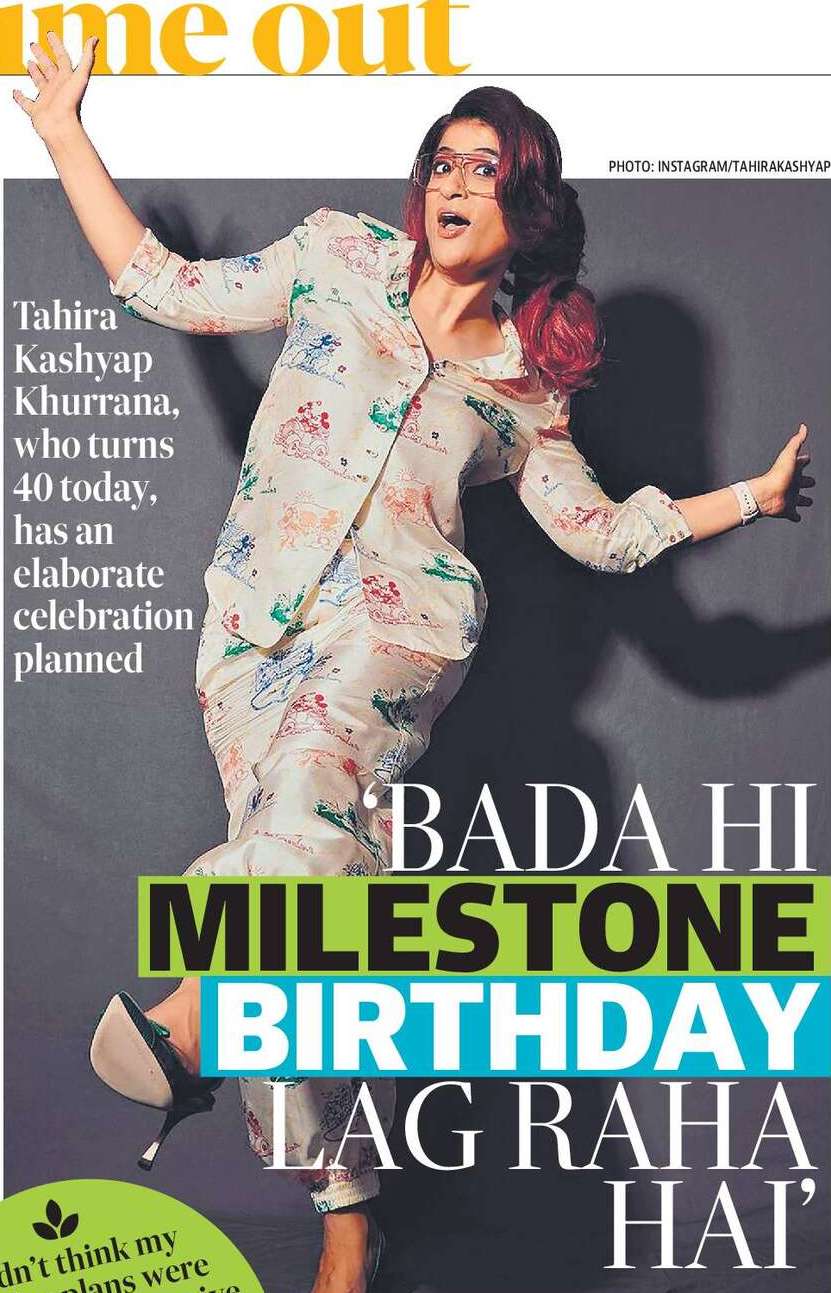
Bada milestone birthday lag raha hai-Tahira Kashyap Khurrana

‘Bada hi milestone birthday lag raha hai’

Tahira Kashyap Khurrana, who turns 40 today, has an elaborate celebration planned
Sugandha Rawal (HINDUSTAN TIMES; January 21, 2023)

Much fun and merry is in store for author-filmmaker Tahira Kashyap Khurrana, who is spending her 40th birthday today with her family and friends at the Gir National Park in Gujarat.

“My family and friends from college are in Gir. Last year, we went to Ranthambore for the safari. We will be back on 23rd from Gir. On 26th, I’m off to Dubai with 15 of my girlfriends. Bada milestone birthday lag raha hai,” she quips.

“My parents used to call all my friends for my birthday party. After I got married, kuch hota hi nahin tha. That’s when reality hits you... With time, you choose who you want to celebrate with,” she says, adding, “It need not be extravagant. Like, this is a small trip to Gir which we are taking and then going out with my girls… It is the big 40, so sab kuch kar rahi hun!”

Professionally, too, it’s a big year for Khurrana. Her first feature directorial, Sharmaji Ki Beti, is lined up for release and then she will start work on her second project.

“It is with Guneet Monga (Kapoor, producer). She was the first person I showed Toffee (short film) to. At that time, I didn’t know her at all. Later, I made Pinni with her and we got to know each other on a deeper level. We feel strongly about many issues. So, I took a script to her and she is on board. I am very excited to start. I am getting back into action as soon as I am back from the trip,” she signs off.

Tigmanshu Dhulia cancels Afghanistan leg of The Great Indian Murder 2 shoot due to the political scenario

Afghanistan out of the picture

Sources say Tigmanshu has cancelled Afghanistan leg of The Great Indian Murder 2 shoot due to the political scenario; scouting for similar locales in India
Mohar Basu (MID-DAY; May 25, 2022)

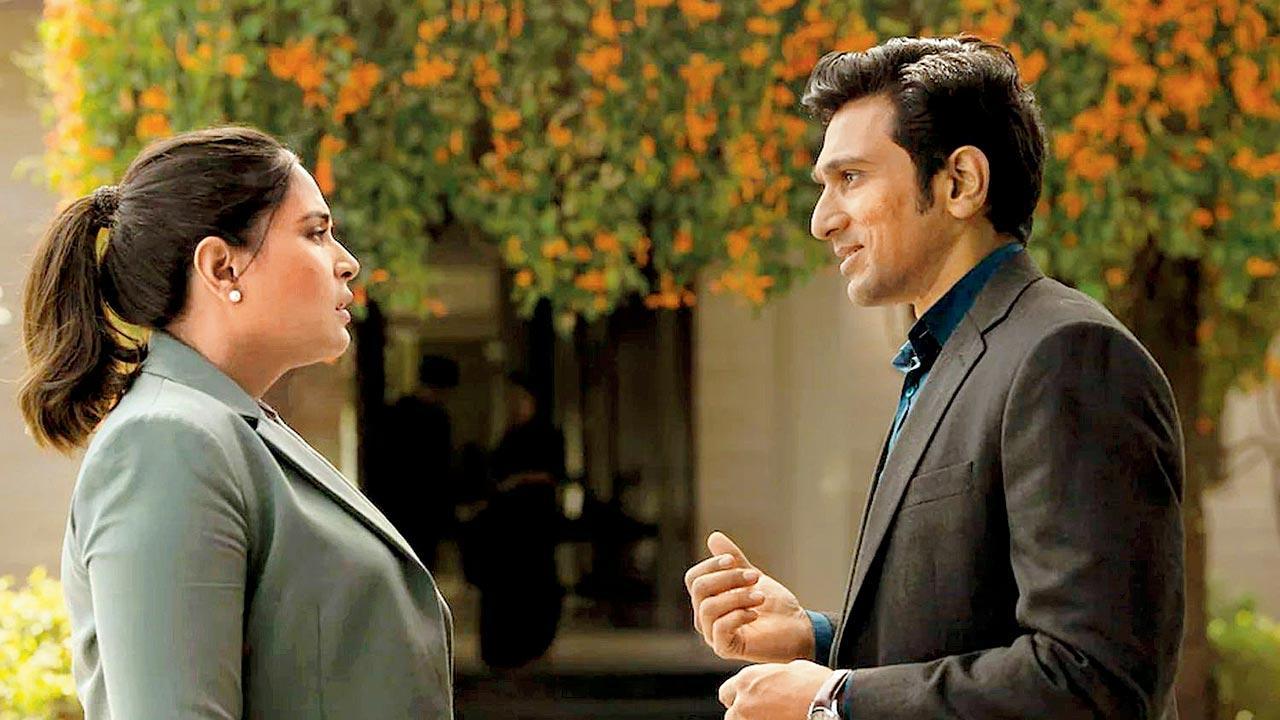
Having left the first season of The Great Indian Murder on a cliffhanger, writer-director Tigmanshu Dhulia is gearing up for the second edition. A chunk of the upcoming instalment of the Pratik Gandhi and Richa Chadha-starrer was to be shot in Afghanistan, primarily in and around Kabul. However, owing to the current situation in the war-torn country, the makers have cancelled the plan. With the series expected to go on floors by July, the team is now working at a brisk pace to find alternative locations. 

A source close to the production team reveals, “Filming in Afghanistan is out of the question because of the change in the country’s leadership. We are now looking at places with a similar landscape.” It is heard that the makers are considering Uzbekistan, and parts of Gujarat and Rajasthan for the stint.

The Disney+ Hotstar series is adapted from Vikas Swarup’s bestseller, Six Suspects, and traces the murder investigation of a politician’s son. While one of the suspects was shown dead at the end of the first season, the spotlight will now be on the remaining five characters — essayed by Ashutosh Rana, Raghubir Yadav, Paoli Dam, Sharib Hashmi and Shashank Arora.

Fenil's Bollywood Talk # 706

LAST FRIDAY OF THE YEAR TO BE A DISAPPOINTMENT AS JERSEY GETS POSTPONED

All was going well as the Coronavirus cases in the country were dropping steadily. The cinema business, too, had come on track with films like Sooryavanshi, Spider-Man: No Way Home and Pushpa: The Rise - Part 01 emerging as super hits. Sadly, the Omicron variant entered the country, and has led to a significant rise in the number of cases. Nevertheless, the fear of the virus isn’t there like last time and life was going as usual. In states like Madhya Pradesh, Gujarat, Uttar Pradesh etc, night curfew was introduced, mainly to avoid gathering of people post evening during the festival of Christmas and during New Year’s Eve. The business was slightly impacted but no one was complaining.

But then on Monday, December 27, the government of Delhi decided to shut down cinemas with immediate effect. Shahid Kapoor-starrer Jersey was all set to release on December 31. An hour after Delhi’s Chief Minister Arvind Kejriwal made the announcement, Jersey’s producers revealed that their film has been postponed indefinitely. A few people wondered if this was the right call. After all, just Delhi city was shut; the rest of the country is functioning. However, what’s the guarantee that other states won’t follow suit and shut down theatres in their respective territories? Last year, the producers of Angrezi Medium burnt their hands when they decided to release the Irrfan Khan-starrer in cinemas on March 13, 2020, despite the Covid-19 threat looming over their heads. Within 72 hours, most states shut down the theatres and the business of that film was disastrous.

Hence, it can’t be ruled out that the makers of Jersey must have also feared that if the crucial state of Maharashtra shuts from Thursday or over the weekend and so do the other important states, the film will bomb at the ticket window.

Meanwhile, the Omicron cases continue to increase in most parts of the country. In Mumbai, the capital of Maharashtra, the number of cases were around 600 on December 24 while on December 29, the number jumped to around 2500! Such a huge jump has been rare. The good news is that most cases are asymptomatic or mild and don’t require oxygen beds or even hospitalization. A few voices in the medical and scientific community are predicting that Omicron can be a blessing in disguise because though it’s more virulent, it’s also less likely to cause severe illness or even death. Hence, a prediction is made that very soon, herd immunity will be achieved and the pandemic will come to an end.

Sadly, no credible organization or government can afford to put their gear down over these beliefs. One needs scientific evidence and it’ll come in a few weeks. The industry stakeholders do understand that the government will need to put some restrictions in place. They are asking various state governments to not shut down cinemas; instead, they are requesting them instead to reintroduce the rule of 50% occupancy in cinemas in states where 100% occupancy is allowed. Also, they are also requesting that only fully vaccinated individuals be allowed inside cinemas.

Sadly, there’s no guarantee the state governments will listen to the rule, especially the Maharashtra government which has been strict in putting restrictions. Despite cases jumping to 2500+ in Mumbai, the government hasn’t told cinemas to halt operations. However, as seen in the past, if cases continue to rise exponentially, cinemas can be told to stop functioning. If this happens in a lot of states, the fate of the upcoming films can be in limbo. Next week, January 7, sees the release of arguably the most expensive film of Indian cinema, RRR. The makers are going ahead with the promotions as scheduled. However, everyone associated, including exhibitors, are prepared for any eventuality.

It is an established fact that the chances of one getting infected with Covid-19 in a cinema hall is negligible. Also, it’s bewildering to see that political rallies are allowed in a state like Uttar Pradesh, where a night curfew is in place. These rallies attract lakhs of people and where wearing of masks, social distancing etc goes for a toss. Even weddings are permitted and so are restaurants and pubs. Masks are required to be put down in these situations and it can lead to a spread of Covid-19 as compared to a cinema hall where viewers have to wear a mask compulsorily. Hence, the way cinemas are shut in the first sign of rise of cases is highly unjustified but the industry sadly, is yet to develop a spine to question the authorities over this logic.

Earlier conceptualised with Aishwarya, Siddharth-Garima’s Dukaan to roll next month with Jamtara actor Monika Panwar

Aishwarya Rai Bachchan and Monika Panwar

Aishwarya Rai Bachchan and Monika Panwar

Mohar Basu (MID-DAY; December 25, 2021)

In 2018, there was much talk about Aishwarya Rai Bachchan headlining Jasmine, a surrogacy drama. Popular writer-duo Siddharth Singh and Garima Wahal, whose resume includes hits Ram-Leela (2013) and Toilet: Ek Prem Katha (2017), were to make their directorial debut with the movie.

However, it was soon reported that Rai had bowed out of the project, post which it was put on hold. Three years on, Siddharth-Garima are ready to revisit the story, now rechristened Dukaan. Monika Panwar, better known as Gudiya from Netflix series Jamtara: Sabka Number Ayega, will headline the film.

A source reveals, “Siddharth-Garima have woven a new narrative, taking the central idea of Jasmine. While mainstream films like Mimi have delved into the subject of surrogacy, this movie will tell the story from a fresh gaze.”

Sikandar Kher, who was recently seen in the second season of Aarya, has been roped in as the leading man. The film will kick off next month in Gujarat where the story is set. “Monika and Sikandar have started prepping for their roles,” adds the source.

Sooryavanshi comfortably beats all outright Hindi films in Gujarat

Sooryavanshi Box Office Collection Day 6: Akshay Kumar's Film Is Super 'Strong' At Rs 112 Crore
Box Office India Trade Network

SOORYAVANSHI is comfortably the second highest grossing film of all time in Gujarat despite coming after the pandemic as it stands at 41.50 crore in the state after its fifth weekend. Only BAAHUBALI 2: THE CONCLUSION stands ahead with a huge 60 crore nett plus.

The Diwali period helps in Gujarat but SOORYAVANSHI has comfortably beaten Diwali HITS like GOLMAAL AGAIN (36 cr) and HOUSEFULL 4 (33 cr) and there is still some gas left in the film and may just edge past the 42 crore nett mark. The Gujarat market is as strong as it was before the pandemic and its not just about the record collections of SOORYAVANSHI but even ANTIM - THE FINAL TRUTH and TADAP have pretty much performed as they would before the pandemic. 

The business of the film in Ahmedabad is on par with Delhi city which is phenomenal as for most films in Ahmedabad would not even be 50% of Delhi city.

The top Nett Grossers in Gujarat/Saurashta of all time are as follows. 
1. Bahubali 2: The Conclusion - 63.28 crore
2. Sooryavanshi - 41.50 crore apprx (31 days)
3. Golmaal Again - 36.04 crore
4. Housefull 4 - 33.28 crore
5. PK - 33.17 crore
6. Tiger Zinda Hai - 32.09 crore
7. Bajrangi Bhaijaan -31.59 crore
8. Sanju - 29.13 crore
9. Dangal - 28.54 crore
10. Prem Ratan Dhan Payo - 28.07 crore

Gujarat’s magnificent heritage sites continue to attract filmmakers


Abhimanyu Mishra (BOMBAY TIMES; November 27, 2021)

Gujarat is home to a number of heritage structures. While some are known for their historical significance, others attract thousands of tourists for their structural beauty. And filmmakers are no exception. Be it Bollywood, the regional film industry, or filmmakers from the Southern film industries, a number of films have captured the timeless beauty of these heritage monuments that sizzle on the silver screen adding more beauty to every scene.

Be it the Ahmedabad’s Adalaj Ni Vav, Jama Masjid, Ellis Bridge or the pol houses, or Vadodara’s Laxmi Vilas Palace, the fort of Devgadh Baria, Gondal Palace and Champaner’s Jami Masjid, these marvellous gems have remained in the backdrop in some memorable films. As we celebrated Heritage Week recently, we tell you what’s about these heritage sites that continue to attract filmmakers from across film industries:


‘THESE BEAUTIFUL MONUMENTS ADD SO MUCH TO A SCENE’
Giving a perfect take with the majestic Laxmi Vilas Palace in the background, shooting around the beautifully carved pillars at Champaner’s Jami Masjid, or capturing the beauty of Adalaj Ni Vav, the heritage sites add a lot of character to the scene, believe filmmakers. “The heritage sites in Gujarat are known for their architectural beauty and bring a very unique aesthetic to the film. It is hard to get that kind of essence anywhere else,” says filmmaker Vipul Mehta.

Others feel that heritage sites like the pol houses of Ahmedabad are so deeply ingrained in the culture, that shooting a scene there effortlessly brings that cultural nuance of life. Filmmaker Tapan Vyas says, “The heritage sites like the pol houses are such an important part of the Gujarati culture, that the moment you shoot a scene there, it adds that cultural richness into it. You can’t recreate that essence anywhere else.”


‘IT’S A DELIGHT TO SHOOT AT THESE MAJESTIC SITES’
Their architectural beauty and majestic structures not only make a scene look beautiful, but it also is a delight for the actors to shoot in such lovely locales. Several actors, who have shot at different heritage sites in Gujarat have gone back to visit.

Actress Nandana Sen, who shot for the film Rang Rasiya at the Laxmi Vilas Palace in Vadodara, had told us, “Shooting at the Laxmi Vilas Palace was magical and will remain one of my favourite memories in life. It’s a really majestic palace and also, the museum is a treasure trove of some great paintings by Raja Ravi Varma.”

In 2016, a Hindi film starring Prosenjit Chatterjee was shot at Darbargadh, a large haveli, in Bhadarwa. Bhadarwa, an approximately 45 minutes’ drive from Vadodara, was a princely state once. At that time, Prosenjit had told us, “When I stood at the terrace of Darbargadh, I fell in love with the location. I loved the view from the top. We don’t get to see too many havelis like this anymore and it was an absolute delight to shoot here. It is one of those rare locations which can add a lot of value to a film.”


‘THE PROCESS OF GETTING PERMISSION IS EASY, AND PEOPLE ARE QUITE HELPFUL’
For long, Gujarat has been one of the easiest states for getting shooting permissions. And getting permission to shoot at a heritage site is no exception. The only criteria film crew members must follow is that there should be no damage to the property. “The state government has made the process of getting the permissions quite easy. And it is a big help for the local industry as well as for filmmakers coming from Bollywood as such shoots help in generating revenue,” says producer Harsh Vasanani.

In 2012, some portions of the film Grand Masti were shot at the Laxmi Vilas Palace in Vadodara. Producer Ashok Thakeria had told us, “We loved shooting at the Laxmi Vilas Palace. It was an unforgettable experience. In Gujarat, people go out of their way to help and that makes shooting a cakewalk.”

— With inputs from Soumitra Das


A Hindi film starring Prosenjit Chatterjee was shot at Darbargadh, a large haveli, in Bhadarwa

Gujarat allows 100% occupancy in cinemas; huge boost for Sooryavanshi

theatres in kerala
Box Office India Trade Network

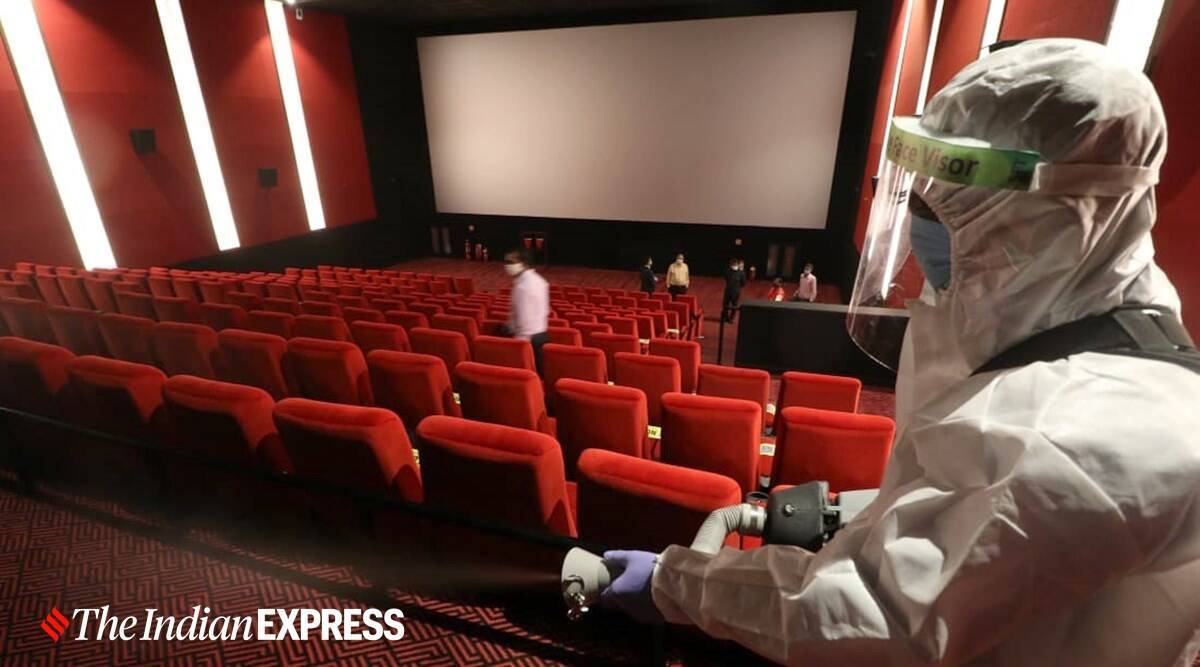
Cinemas across Gujarat will be screening films with 100% occupancy from today (29th Oct) which will be a huge boost for SOORYAVANSHI. Cinemas have been open for over 2 months in Gujarat and collections have been decent on Sundays.

BELLBOTTOM recorded excellent collections in Gujarat on its first Sunday and was good on the next few Sundays and other holidays. On Diwali, there is a long holiday period in Gujarat and now with 100% occupancy, it should yield very good results. Records is a word which actually should not be used at the moment but just maybe SOORYAVANSHI can make some in Gujarat, content willing.

Delhi city, Punjab and Gujarat are the best collecting areas in the Hindi circuits and these should lead the way for SOORYAVANSHI as other areas have some catching up to do. The films of Rohit Shetty underperform in Delhi city and Punjab with DILWALE (2015) being the exception. Punjab will also have a major Punjabi release which will mean Gujarat will easily be the best performing area for SOORYAVANSHI by a distance. The advance is so so at the limited theatres it has opened in Gujarat but that will not be an issue here as crowds are sure to return next Friday.

Rajasthan also has 100% occupancy and Madhya Pradesh could have 100% occupancy by next week but for these places to out perform Gujarat, they will really have to come by leaps and bounds from where what collections have been seen since reopening. It could be that most of the market maybe allowing 100% occupancy by the time SOORYAVANSHI releases.

The position at present is as follows.

100% Occupancy Allowed
Gujarat
Delhi city (2nd November)
Rajasthan
Bihar/Jharkhand 
Odisha 
Andhra Pradesh
Karnataka
Tamil Nadu

Others
Maharashtra - 50%
Goa - 50%
UP - 50% (100% expected by Diwali)
Punjab - 66% (100% expected by Diwali)
Haryana - 50% (100% expected by Diwali)
Jammu and Kashmir - 50%
Madhya Pradesh - 50% (100% possible by Diwali)
Chhattisgarh - 50%
Kerala - 50%
Asaam - 50%

Travel has helped me create some of my best songs-Amit Trivedi


The composer travelled across India to add folk and earthy essence to his new outing
Soumya Vajpayee (HINDUSTAN TIMES; October 27, 2021)

Every musician has a different source of inspiration for making music. For Amit Trivedi, it’s travel. The composer-singer usually travels across the world to make music and to add essence of different places to his work. In the latest instance, Trivedi travelled to various places in India to connect with earthy Indian voices, traditions and stories to create songs for his new independent project, Songs Of Soil.

“Travel has always been my main source of inspiration and that has helped me create some of my best songs. I visited five states: Gujarat, Rajasthan, West Bengal, Tamil Nadu and Maharashtra. I ended up visiting Rajasthan twice, because there was so much to cover from that region. It was fun. I got to meet some of the best folk artistes of the country,” says Trivedi, who took around a year to work on the project, given the ongoing pandemic.

The National Award-winning composer wanted the songs to have an earthy touch. “The idea was to get some of the best folk artistes of the country together to create something different and original, which the audience has never heard before,” says Trivedi.

This travel experience was a huge learning for the Dear Zindagi (2016) composer. “I had to understand the culture and folklore of every region and jam with the local artistes. One of the songs features me with an instrument called parai, which I am still learning to play. It was gifted to me by Anthony Daasan (folk singer from Tamil Nadu),” Trivedi ends.

We shot across four states and didn’t have a single case on our set, says State Of Siege: Temple Attack creator Abhimanyu Singh


Creator Abhimanyu Singh discusses shooting 'State of Siege' across four states successfully, without any COVID cases reported on set
Mohar Basu (MID-DAY; July 10, 2021)

Creator-producer Abhimanyu Singh of Contiloe Pictures knew that convincing Akshaye Khanna to headline State Of Siege: Temple Attack, the second instalment of the ZEE5 franchise, wouldn’t be easy. The creator was relieved when the crackling script by William Borthwick and Simon Fantauzzo lured the actor, who is known to be painfully selective.

“It’s a good thing that Akshaye is choosy; he has a great sense of script. We approached him with a bound script. He hadn’t seen [State Of Siege: 26/11], so it was the written word that drew him,” says Singh.

Like the 2020 series, the makers have adopted a humanist approach in the retelling of the 2002 Akshardham Temple attack. “It’s a crime against humanity. Our intention is clear — we wish to put the focus on the bravado of the Indian soldiers.”

Filming the ambitious project in the post Coronavirus pandemic world was no mean feat. Singh, who along with director Ken Ghosh led the team, says, “We shot across four states — Himachal Pradesh, Gujarat, Rajasthan and Maharashtra — and didn’t have a single case on our set. There were no vaccines available at the time, but we took precautions.”

Gujarat govt announces property tax waiver for cinema owners; exhibitors request the same in Maharashtra


After Gujarat govt announces property tax waiver for cinema owners, Multiplex Association meets Maharashtra’s revenue minister to discuss similar relief measures
Mohar Basu (MID-DAY; June 10, 2021)

On Tuesday, the Gujarat government announced a complete waiver of property tax for the owners of multiplexes, cinema halls and gyms from April 1, 2021 to March 31, 2022. Trade and exhibitor Akshaye Rathi informs that encouraged by the move, members of Multiplex Association of India (MAOI) met Balasaheb Thorat, Maharashtra’s revenue minister, on Wednesday to urge that a similar relief be provided to the cinema owners in the state.   

“We hope that the Maharashtra government will follow suit. The state contributes close to 30 per cent of the national box-office revenue. The sector needs to be protected by the state government. Besides exemption from property tax, they should charge us for electricity as per industry rates and not commercial rates. Additionally, the renewal of cinema license shouldn’t be charged [this year], or the license should be extended,” says Rathi as the exhibition sector reels under the second lockdown.

In the 15 months since the first lockdown was imposed, cinemas in Maharashtra have been operational only for five months — from November 2020 to April 4, 2021 — with losses running into hundreds of crores. With the state gradually easing the lockdown restrictions, Rathi says that movie halls may be operational only by August.   

Kunal Sawhney, senior vice president, Carnival Cinemas, says the meeting with Thorat comes months after the stakeholders had a virtual meeting with Chief Minister Uddhav Thackeray. “The MAOI also discussed the electricity charges levied on us. The minimum charge is close to 20 per cent of our expenses. When we had met Uddhav Thackeray on video call, he was positive in his approach. I am confident the recent dialogue will give us a breather,” he says.