Showing posts with label Bhoomi. Show all posts
Showing posts with label Bhoomi. Show all posts
I was being extra pleasing just to meet people who were in important positions in the industry-Sidhant Gupta
8:49 AM

Onkar Kulkarni (BOMBAY TIMES; September 1, 2023)
Sidhant Gupta, who won immense praise for playing a pivotal role in Jubilee, believes that the Vikramaditya Motwane web series has paved the way ahead for him. After his television show Tashan-E-Ishq (2015), he got several offers, but he chose to step away from the medium to seek creative satisfaction through movies. He talks to us about how his career has taken a new turn with the OTT show.
‘I can spend a lifetime on Vikramaditya Motwane’s set’
Sidhant, who hails from Jammu, gives the credit for all the appreciation he has received for Jubilee to Motwane. He says, “I can spend a lifetime on a Vikramaditya Motwane’s set, which is a vibe. The atmosphere is so creative. The set only allows characters to be present. It doesn’t allow you to walk in with the baggage of your filmography. Everyone’s doing their own work and treating each other with respect.”
‘I found a dream role in Jubilee’
Talking about his role, Sidhant tells us, “There was something about Jay Khanna which the audience could connect with. He knew that life goes beyond the bubble of pain and fear. I could connect with this character, because, like Jay, even I have a never-give-up attitude. The show changed my life 360 degrees. The character gave me a perspective and brought out aspects of me like never before. This was like a dream role. Aise roles baar-baar nahi likhe jaate. I don’t know how it found me.”
‘I kept rejecting TV shows as there was no creative satisfaction’
Sidhant’s story is different. While many actors have used TV as a stepping stone to get an entry into films, Sidhant grabbed a role in a movie right after he moved to Mumbai to pursue a career in showbiz. He was seen in Tutiya Dil (2012) and Badmashiyaan (2015). The TV show Tashan-e-Ishq got him noticed, but somehow, he felt disconnected from the medium.
He says, “TV gave me popularity. After doing the show for a year, I quit because that was not what I had come here for. Then, I did a cameo in Bhoomi (Sanjay Dutt starrer). The film didn’t work at the box office. Meanwhile, I kept rejecting TV shows as there was no creative satisfaction, and I felt that I was doing the same thing over and over again. For me, acting goes beyond earning just fame and money.”
‘When you become like everyone else, you lose your individuality’
Sidhant feels that it is easy to lose your individuality in the movie business. He says, “I wasted a lot of time being like others in the industry. I was being extra nice and extra pleasing just to meet people who were in important positions in the industry (to get work). When you become like everyone else, you lose your individuality. What I liked about working with Motwane is that he encourages you to show your edgy side. He also gives you that comfort to be whatever you are and own it, and that has been the best part of my experience of working in Jubilee.”
‘Acting is not just about facing the camera and delivering lines’
To change gears in his career, Sidhant took a break to focus on himself and work on his acting skills. He shares, “I went to London in 2018 and took acting workshops. After my first session, for the first time, I felt the magic of being an actor. I realized that acting is not just about facing the camera and delivering your lines. I found an intention that went beyond the little things I was trapped in. It also liberated me and helped me get rid of my self-doubts.”
I thank God I didn’t give up. Thank God, I didn’t know how to give up-Sidhant Gupta
8:44 AM
Vinay MR Mishra (HINDUSTAN TIMES; May 7, 2023)
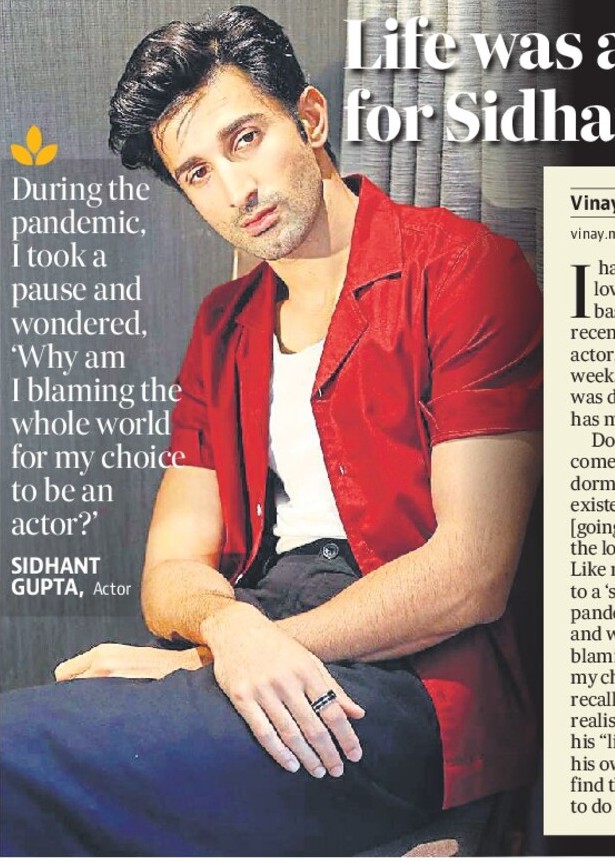
“I have never felt so much love,” says Sidhant Gupta, basking in the glory of his recent release, Jubilee. The actor, who turned 34 last week, adds, “[The birthday] was different. Suddenly, life has meaning,” he muses.
Does that mean he’s just come off a period of dormancy, maybe even an existential crisis? “I was [going through one] before the lockdown,” he confesses.
Like many, Gupta’s life came to a ‘standstill’ during the pandemic. “I took a pause and wondered, ‘Why am I blaming the whole world for my choice to be an actor?’” he recalls, adding that this realization helped him take his “life’s steering wheel” in his own hands. “You have to find the reason why you want to do this work and it has to go beyond everything. This birthday is when it all felt very meaningful,” he says.
The Inside Edge actor’s turn as a penniless, aspiring filmmaker in Jubilee caught everyone’s attention, with some even billing him a star in the making. The actor says that although he has been active for over a decade now, he, too, “discovered” himself not too long ago. “I thank God I didn’t give up. Thank God, I didn’t know how to give up,” he shares.
What does he mean by giving up? “There are moments where you feel that nothing is going your way. Like after television, when I wanted to just move away from it because I wasn’t really happy. I did films such as Bhoomi (2017) and nothing was going my way. I didn’t have any work, except TV, where you don’t have space to create,” Gupta ends.
Yash Chopra ji had asked me to visit Amritsar before we began working on Rab Ne Bana Di Jodi-Salim Merchant
8:26 AM
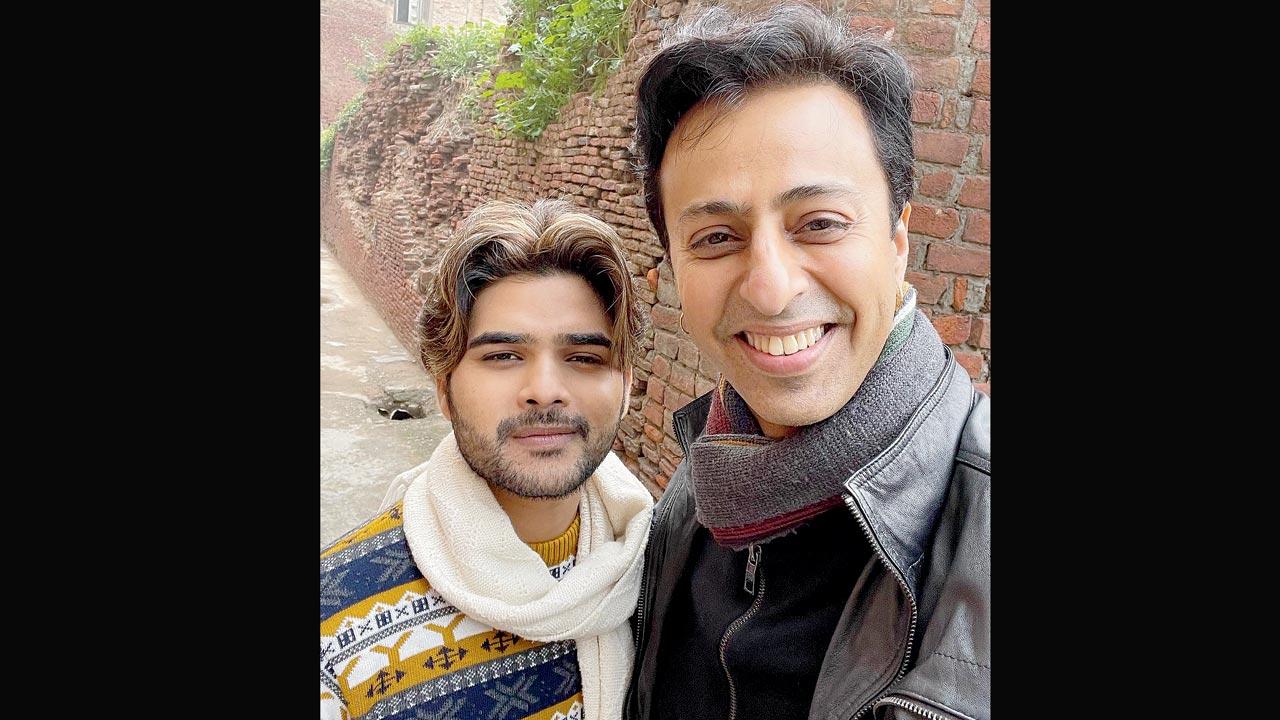
Merchant with Ali on set
Inundated with requests to recreate the magic of Rab Ne Bana Di Jodi’s music, Salim Merchant ropes in Salman Ali for a love track set in Amritsar
Sonia Lulla (MID-DAY; February 14, 2022)
Within a matter of a few minutes, Salim Merchant paints for us a picture of Amrtisar’s Darbar Sahib, its residential properties, the Attari border situated kilometres way, and its people’s love for food. “Whenever you meet anyone, the first thing they ask is, ‘Kya khaoge?’” says the composer, having evidently romanced the world that his latest song is set in.
Merchant developed a fondness for Amrtisar when he first visited the Northern city to “soak in the vibe” ahead of his work on Rab Ne Bana Di Jodi. “The late Yash Chopra ji had asked me to visit the place before we began working on the film. It is devotional, and simplistic. The people’s love for food is unmatched. We shot a love song called Rab di sau in Attari for Valentine’s Day,” says the composer of the song that has been penned by Kumaar, and rendered by Indian Idol singer Salman Ali.
The conspicuous terraces of the city’s smaller towns flashed through his mind as he composed the track and weaved the narrative. “I needed [to locate] the buildings with those terraces where we could showcase the boy and girl looking at each other. This is how small town love stories actually begin. I wanted to showcase the open fields, and include simple elements like bicycles to recreate the old-world charm. The song showcases a boy who is [returning home], thinking about his lover, and looking at her pictures on his phone. Creating the story while composing the song helps me arrange it better, and select the right instrumentation.”
The assorted array of tracks coming out of the Merchant Brothers’ stable is rather noteworthy. Apart from their annual passion project, Bhoomi, the third edition of which is underway, the musicians have collaborated with the who’s who of the industry for their two-year old music label. “Our next is a Maha Shivratri song with Indian Idol singer Pawandeep Rajan. We follow it up with a playful Holi track, and near Diwali, we bring out Bhoomi again. So, we do follow the calendar and cater [to the important days]. There is an indie single, a beautiful song with a new singer named Muheet Bharti, a dance track with Raj Pandit, and a few Punjabi tracks to cater to current tastes.”
In a bid to back female singers in need of a worthy platform, the brothers are also finalising a few names to associate with. “It is so nice to be part of the musical journeys of all these artistes who we are involved with.”
A simple parameter helps Merchant sieve a song that should make it to the Bhoomi album from one that should not. “Bhoomi is a specific project — a reflection of India’s culture, our folk roots, and traditional [practices]. It is a reflection of our country.”
I feel Sandip Ssingh should come out and speak his side of the story. Running away will lead to more speculation-Shekhar Suman
8:34 AM

Rachana Dubey (BOMBAY TIMES; August 30, 2020)
For the last few days, producer Sandip Ssingh is drawing a lot of attention in the Sushant Singh Rajput case, with allegations of foul play being levelled against him by social media users and TV channels reporting that he was planning to leave the country. While Sushant Singh Rajput’s family members have reportedly stated that they don’t know him, he was seen handling all the formalities at the hospital post Sushant’s demise and even made arrangements for the actor’s funeral.
Literally caught off guard, Sandip was seen dodging the cameras on Friday. Actor Shekhar Suman, who had started the Justice For Sushant Forum, speaks to BT about his equation with Sandip Ssingh. Excerpts:
Tell us about your equation with Sandip Ssingh...
He was the producer of Sanjay Dutt’s Bhoomi (2017). We spent a month shooting in Agra together. I have known him for longer than that, though it was off and on. He had contacted my son Adhyayan for a movie, which didn’t work out, but that is how it began. There was a professional relationship. Going by my equation with him, I felt he was a fun-loving guy who was totally engrossed with a lot of projects of his own, and he knew people and people knew him in the film industry. That was it. These recent developments have come as a huge surprise. Let the investigation go on and let’s see what happens. But before this, there was nothing abnormal or unusual about him that I noticed.
Did he ever mention to you that he was a close friend of Sushant?
No, he never mentioned anything, except once in a casual conversation, he had spoken about how Ranveer Singh got Goliyon Ki Raasleela: Ram-Leela, Bajirao Mastani and Padmaavat. He did mention that these films had gone to several actors and one of them was Sushant, who had turned them down. I asked him why Sushant would do that to Sanjay Leela Bhansali’s films. He said, ‘I don’t know, maybe he didn’t like the role or something.’ Why I remember this is because one would give an arm and a leg to work with that filmmaker. This was a casual chat and I really don’t know how close he was with Sushant or anyone else. Lately, he was planning another film with Sanjay Dutt called Blockbuster. We have had a couple of close friends chatting about it. He was excited about this project, which was to be produced by Anand Pandit. He would talk about this movie. In fact, I don’t think I had much of an interaction with him when he was making the film, PM Narendra Modi, though I used to read about the film in the newspapers.
So, how did both of you touch base again after Sushant’s death? You even visited Sushant’s family in Patna at their residence along with Sandip...
I saw him on TV, managing everything around Sushant. I didn’t want to call him right then, because I felt it wasn’t the right time to do that. I started tweeting about Sushant on my own. I interpreted his demise differently from day one. I felt there is more to it than meets the eye. I felt a different sort of a connection — he was a Bihari boy, people could barely make it to his funeral because of the Coronavirus situation and I am someone who has lost a son years ago. I wanted to meet Sushant’s father and share his grief. I have lived with my tragedy for years now and I haven’t been able to get over it. My family asked me why I was getting so involved, and that I should not go to Patna in the thick of the pandemic. I said to them, ‘Let me speak to Sandip, maybe he knows the family.’ I called him. That is the first time I asked him what had happened really and he said, ‘I will tell you later.’ I asked if there was a way to meet Sushant’s father K K Singh. Sandip told me that he was planning to go to Patna after the terahvi, post June 28. I said, ‘Fair enough. Can you please let them know that I will be coming, too?’ And that’s how we went. It would have been awkward to go just like that. In Patna, I stayed with my cousins at my maternal granny’s house and he stayed elsewhere. I think it was on June 29 that we went to Sushant’s house. We didn’t exchange words with the family. We just sat there for 10 minutes. I wanted to meet (Bihar Chief Minister) Nitish Kumar for some political support for my Justice For Sushant Forum. I remember Sandip had asked me, ‘Why do you want to go ahead with this forum?’ I had said, ‘I want to, because I feel there is foul play and I should fight for it, instead of looking the other way.’ No one was talking about it at that time. It was my battle and I was okay with it being that way. I again asked him what had happened. He said, ‘I think it is suicide.’ I didn’t delve further into it. I met Tejashwi Yadav (Rashtriya Janata Dal leader), since Nitish Kumar could not make it, and told him about the forum. Prior to this meeting, Sandip, in fact, had asked me if I wanted to get Sushant’s father on to it and I said, ‘No. Later, if he wants to, he can be a part of it.’ After the press conference with Tejashwi in Patna, I didn’t speak to Sandip. And then he got into the thick of things as they are now. You see, I knew Sushant as a co-competitor from a reality show in 2010. But that was it. He had not even joined films. He was in the transition phase. I remembered him as a sweet boy. I don’t think I ever met him again after that, but I did watch some of his films.
Sushant’s family and friends have been saying that they don’t know Sandip Ssingh. How did he then make arrangements for the Patna visit?
There is a contradiction in this. From the footage that I saw on TV, he was seen with his arm around Sushant’s grieving sister. It seemed that he knew the family. He had even taken Ankita (Lokhande) to meet his family, so obviously he knew them. Also, I think for him, it’s not a big deal. And, when we went to Patna, everything was arranged and his family knew I was coming over.
On Friday, Sandip ran from the scene when he saw TV cameras following him. Reportedly, he has been dodging cameras by changing his locations, and not going to the house where he lives. Why do you think he is doing this?
I have no idea. Maybe because of the pressure and the intense media trial; anyone would be scared, especially if one feels he or she is getting cornered. But if you are honest, you should just come out and speak. That goes for everyone who knows Sushant or has anything to say. There is no need to hide and avoid speaking up. I feel Sandip should just come out and speak his side of the story like he did earlier. Running away will only lead to more speculation as to what it is that he is hiding. The investigating agencies will eventually make people speak and they will have to answer. They should come out and say it anyway. There is nothing to fear if you have been honest and have done no wrong.

Bhoomi is our best work in 15 years - Salim-Sulaiman
8:35 AM

Set to present their labour of love, Bhoomi, as part of their newly launched record label, Merchant brothers Salim, Sulaiman on creating music devoid of commercial tropes
Sonia Lulla (MID-DAY; July 13, 2020)
A sense of agitation is making itself evident in the Bollywood music industry. It began with disregard for the trend of rehashing old ditties — with some original composers even threatening to take legal action against those meddling with their compositions — and extended to expressing disdain over creative calls being taken by the men in suits running record companies. However, the disquiet is paving the way for something great. Weeks after revered musician Amit Trivedi vowed to celebrate music that appeases his heart with his label, AT Azaad, composers Salim-Sulaiman have launched Merchant Records, which will also celebrate talent that is discredited by Bollywood.
"We have been making non-film music, and collaborating with artistes from India, America and UK for a while. We want to continue to do so; take the back-seat as composers and bring new talent [to the fore]," says Salim, adding that the label's first release, Mangi duaein will feature Raghav Chaitanya, who "didn't get a chance in the past due to the mafia labels".
Set to release today, the song will be followed by another Merchant Record-offering towards the close of the month, and successively, with a new single every 15 days. "The track at the end of July will be helmed by two incredible artistes who are more established. They've also come together for a song of ours in the past. Next month, another commercial Punjabi dance track will be out. It will feature a new singer. Then there are two more tracks that eye a September release," says the musician, who also hopes to collaborate with his favourites from the industry, including Mithoon, Clinton Cerejo, Ranjit Barot and Karsh Kale.
It is, however, another venture being presented by the label that particularly piques our interest. In a previous interaction with mid-day, the musician jumped to the edge of his seat when discussing his "most desirable, cherished and revered project". "It's the best thing we've done in the last 15 years," he had said of his upcoming album, Bhoomi, which was to initially release in April before the pandemic compelled them to defer it. "Twenty years ago, we had created an album by the same name, and got singers from across India for it. It had artistes from Kashmir and Bengal being featured in it, and language wasn't a barrier. Record labels said India wasn't ready for it. Then, we got busy with making film music, but continued to cherish that album. No one had created something of that kind before," Sulaiman said, as Salim added that the experience encouraged them to take things into their own hands.
The seven-track offering features artistes including Arijit Singh, Shreya Goshal, Jonita Gandhi, Nikita Gandhi, Salman Ali, Osman Mir, and Kaushiki Chakraborty, among an array of other musicians. "While most of these are our own compositions, we've revisited two classic thumris. We had wanted to give them a different touch and colour. While doing that, there is so much that I learnt about my own music [sensibilities]. I found a different way to [express] myself because we were not bound by the commitments of creating it around a story, or other commercial requirements. It was an effort to experiment with music, and the result has been magical. We will continue to [bring out such albums] each year."
Before the pandemic established a new normal, the composer duo would frequently log air miles as they travelled for live gigs across the globe. Cooped up at home, Salim finds himself busier than he has been as he breathes life into projects that were stuck in limbo owing to their busy schedule. "One of those is our merchandise brand," he says of the recently launched apparel line that features lines of their Bollywood songs.
I know I’ve lost many years of my youth, but I’ve have taken every learning positively-Sanjay Dutt
8:06 AM

‘Sanju’s swag & style is inbuilt; I don’t think that will change with age’
Madhureeta Mukherjee (BOMBAY TIMES; September 19, 2019)
At 60, Sanjay Dutt still has the swag, style and subtle sexiness that comes with the streaks of salt and pepper, which he wears with pride. The lines on his face tell a long and deep story — one that has seen trials, trauma, surreal highs and devastating lows. But now, he’s calm and at peace. His boat is steady, and he’s set sail all over again. And his firm anchor, wife Maanayata, has also stepped into showbiz as producer, and together, they are rolling out their first Bollywood film, Prassthanam. In a chat with Bombay Times, the couple talks about their partnership (in the movies and at home), family bonds, lessons learnt and unspoken love. Read on...
Sanjay and Maanayata, now, both of you are a team in the movie business. Sitting here and giving interviews as an actor-producer duo... how does it feel stepping into this new zone?
Sanjay: It is a great feeling. She has turned producer and handled Prassthanam entirely on her own, without any help from me. I am happy about the focus with which she has handled it.
Maanayata: Cuts in… Without Sanju, I would not be able to move an inch into this zone. That is the reason I put this project on hold while he was away. As a company, we are working on interesting projects and I needed him by my side to guide me through this journey. Prassthanam was the first project that we started working on. The Marathi film Baba (which released earlier this year) just came our way; we loved the script and wanted to back it as producers. It was a small-budget film, with a smaller cast, so we could pull it off with more ease.
Sanjay, did you have a huge role to play in Maanayata turning producer? Were you more invested in this project creatively as compared to your other films?
S: I have always encouraged her to do her own thing and create her own identity. It makes me proud. This space is new to her, and I wanted her to be on her own and learn the ropes. I didn’t want to get too much into the production area, I was there mostly as an actor.
M: On set, he was always the actor. But at home, as a wife, I would take his inputs and turn to him for advice.
Maanayata, did you have to go through the process of getting Sanju on board as an actor, or was Prassthanam his idea?
M: A different producer had approached him with this film quite some time ago, and Sanju had agreed to do it. But then, we lost three-and-a-half years during his jail term. Post that, I took over the film as producer.
S: When I heard the story, I liked the way the characters were weaved in, and how the relationships played out. My character does something which he regrets all his life and then tries to mend it. The film also has romance. Well, I don’t romance in it, but Ali (Fazal) does. Even the dialogues are loaded and clap-worthy.
Now, are there more conversations at home around movies and the business of movies?
M: Not really, even earlier, he would never bring work home.
S: Home has always been about family time and hanging out with our children. That takes up all our time.
Prassthanam is adapted from the Telugu film directed by Deva Katta, who is helming the Hindi version, too. It is believed that the sensibilities of filmmakers and the audience down South, are different compared to Bollywood movies and the audience that mostly consumes Hindi cinema. Were there doubts or fears about being able to adapt the film well?
M: We have a very good writer on board — Farhad Samji — who has a good body of work. He took the core idea from the original and adapted it into a Hindi film. He understands the audience here and has written it in a way that it will appeal to them.
Sanju, your character in this film has grey shades. Earlier, you have said that you enjoy playing roles that are dark and layered. Has the all-out good boy on screen become a tad boring for you?
I don’t know about that, but for the longest time characters with grey shades have attracted me. In fact, most of my successful films are the ones in which I have played dark characters. It has worked with the audience, too. I believe that no one is black or white, we all have some grey in us. So yes, I get drawn to such roles.
You turned 60 this year. In a typical corporate job, at this stage one often goes into retirement mode. For you, it’s like a new innings in your career. A lot to look forward to?
I am truly happy in my professional space. And in my personal space, too, I am at peace seeing my children grow up. I want to see our production house grow, too, and I hope that in the next few years, this company will be known for good cinema and people will want to work with our team. There is a lot to look forward to.
Maanayata, in all these years, what do you think has changed the most about him?
He is much calmer and more at peace now. The sword that was hanging over his head for years, has gone. Also, I think that age and the fact that he is fathering two young kids, have contributed to his current state of mind. From the Sanju, who I knew a decade ago, he is a far more composed person now.
 Even after all these years, Sanju’s trademark style, swag and persona... none of that has changed. Does it ever feel like you are living with a 60-year-old, Maanayata?
M: Most actors are young at heart and vulnerable, Sanju is, too. As an actor, I guess you have to be young at heart to play multiple roles. Off screen, I still don’t feel that he is a 60-year-old. Sanju’s style and swag is inbuilt; I don’t think that will change with age. I remember that my sister-in-law, Priya, once told me that their father (Sunil Dutt) would often say, ‘Sanju ne itna drugs kiya hai ki uska dimaag grow hona bandh ho gaya hai’. Sanju always says that his dad loved Priya more, but I feel that his father had that unspoken love for him. Priya would tell me how dad would defend him and say these lines. So, I still feel that he is young, and I am dealing with three kids at home. Shahraan, Iqra (their twins) and Sanju gang up together. At home, the kids are supposed to have pizza and burgers only over the weekend, but he breaks that rule and allows it on weekdays, too. You see what I mean!
Are your kids aware of your stardom, Sanju? Have they watched any of your films?
M: They are aware, because it is spoken about in their school. They are nine years old now, and they know when he goes to shoot. We haven’t taken them out that much in public, so they don’t know about the kind of adulation he enjoys or his fan following. They know that he is an actor, and there is a certain kind of attention they get because of it.
S: We haven’t seen any of my films together. I watch kiddie films with them.
M: We all saw Sanju (2018) together. I am not an avid movie watcher in that sense. Lately, I have started watching more films, because as a producer, I need to do that. In fact, I haven’t seen Bhoomi (2017) or Saheb, Biwi Aur Gangster 3 (2018).
Sanju, talking about what Maanayata just shared with us, do you think there was unspoken love between your father and you?
Yes, absolutely. It is much later in life that he started expressing himself more. The hug that he gave me at the end in Munna Bhai M.B.B.S (2003), was so real that both of us were crying. Towards the last phase of his life, my dad started expressing his love for me, and he was proud of the way I handled myself. For any father, it is a good feeling to see things turn around — from people saying that ‘Sanju Sunil Duttji ka beta hain’, to they saying ‘Sunil Duttji Sanjay Dutt ke pitaji hain’.
Maanayata, what is your first memory of seeing Sanjay Dutt on screen? In what kind of films do you like to see him the most?
My first memory of him is from Aatish: Feel The Fire (1994). There was this scene where he burns down a godown, I still remember it. Sanju is a fantastic actor, you give him any role and he does it with ease. His filmography is so diverse — from dark roles in films like Khalnayak (1993) and Agneepath (2012), to the lovable goon in Munna Bhai, and funny roles in films with David Dhawan and Govinda. He has this larger-than-life presence on screen. I remember once I was on the same flight with Mr (Amitabh) Bachchan, from London to Mumbai, and we were talking about how he has worked with both, my father-in-law and my husband. Mr Bachchan told me, ‘Sunil saab toh bahut acche actor the, aur Sanju ke saath kaam karne mein bahut mazaa aata hai, kyunki agar aapke saamne bahut takkar ka actor ho, toh aapki performance badhti hai’. And he also said that Sanju looks ‘itna chauda’ on screen. It feels great that someone who is an institution in himself, speaks so highly of Sanju.
Back in the day, a hero had to be a certain type. But you were not like that and we saw you playing the good boy and the baddie on screen with as much conviction…
Every actor comes with this baggage of an image, which the audience has formed based on the roles he has played. For instance, Salman Khan can’t attempt something too different. Even if he tries, it is really tough. His fans want to see him in a certain way. They want to see action and songs in a Salman Khan film. I am in a similar situation. I have tried to do different kinds of roles, but it didn’t work. Like in Saheb, Biwi Aur Gangster 3, the reaction of my fans was, ‘Gangster bola kyun, gun kidhar hai?’ In Bhoomi, so many people told me, ‘Aapko courtroom ko tod dena chahiye tha’. I told them, ‘Courtroom kaun todta hai?’ They don’t want to see me standing haath jod ke in front of people. They want to see me in the avatar that they like me best in.
But you have done some prominent films as a lover boy…
Yes, I have. But during our time, a romantic hero did more than just romance on screen. They were romantic-action heroes, you know what I mean. The only full-on romantic film that I have done (without any action), which was accepted by the audience was Saajan (the 1991-film, also starring Madhuri Dixit Nene and Salman Khan). I play a physically-challenged character, who is all heart. It was a lovely love story with great music.
What has been your biggest regret and biggest learning?
I have no regrets in life. The court case went on for about 25 years and the jail term happened, but now, I look back at all of it positively. I know that I lost many years of my youth, but I have taken every learning from it positively. That experience taught me a lot, but very late in life. I wish that it had happened when I was a bit younger. It really mellowed me down.

It's difficult to break out of action hero image-Sanjay Dutt
8:10 AM

Having stepped out of his comfort zone in recent outings, Sanjay Dutt explains why he has returned to his favourite genre with Prasthanam
Sonil Dedhia (MID-DAY; September 7, 2019)
 Counted among the original macho men of Bollywood, Sanjay Dutt tried to steer away from the action hero image in his last few outings. If Kalank saw him try his hand at an emotional drama, the thriller, Saheb Biwi Aur Gangster 3 (2018), was far removed from the star's brand of cinema. However, his attempt to step out of his comfort zone was met with little success. With his home production Prassthanam, Dutt tells mid-day that he wants to regain his credibility as an action star.
"I played a father in Bhoomi [2017]. In the climax courtroom sequence, the audience expected me to bash up the villains [and were disappointed when it didn't happen]. In Saheb Biwi Aur Gangster 3, my fans complained that the gangster element was missing from my role. There is a certain image that I have of an action star; it's difficult to break it and do something else. It's difficult to reinvent. If people love me for my macho roles, it is my responsibility to give them that. Prassthanam has everything that the audience expects me to do," he explains.
In his second innings in Bollywood, Dutt is keen to go beyond his role as an actor. His desire to back meaningful cinema has led to the creation of his studio, Sanjay S Dutt Productions. "We decided to back Prassthanam because it's a great film that provides entertainment. We chose politics as the backdrop as we wanted to target the heartland of the country," says the actor-producer, who forayed into production with an unlikely choice — the Marathi film, Baba. "It will be screened for the jury of the Golden Globes on September 14. We hope they nominate it [for the awards]. We are making a small Punjabi film, and a few Hindi films are in the pipeline. The aim is to make content-driven cinema without losing out on entertainment."
Today, the film industry has become far more competitive, it wasn’t like this in the past-Sanjay Dutt
5:46 PM

Madhureeta Mukherjee (BOMBAY TIMES; April 10, 2019)
A38-year-long career dotted with some unforgettable films, a personal life underlined with trials of the toughest kind, and triumphs that were life-changing — Sanjay Dutt has seen it all. What’s not changed, though, in all of this is his unbeatable style, swag, spirit — attributes that earned him the title of the Deadly Dutt. The two films (Bhoomi and Saheb, Biwi Aur Gangster 3) that marked his comeback, didn’t leave an impression on the audience or the box office, and without a moment’s hesitation, the actor confesses that they were ‘mistakes’. But now, he’s all set to steer his career in newer directions, starting with Abhishek Varman’s upcoming period drama, Kalank. In a quick chat with BT, he tells us about working with the new breed, how the ways of the industry have changed, and most of all, how he wants the youth to learn from his life’s experiences. Read on…
Apparently, late filmmaker Yash Johar had discussed the story of Kalank with his son Karan Johar many years ago. Were you part of any of those discussions?
Yes, I briefly knew about it. He had spoken about it and I am glad that Abhishek (Varman) turned Yash uncle’s dream into reality on celluloid. For me, this is like working in my home production because of Yash uncle and the relationship that we have shared with their family for so many years. It feels great to be part of such a huge film. Aaj kal people don’t make as many multi-starrers, like we did back in the day. So, I must say that it is a fantastic attempt. Even with so many actors working together, there wasn’t ever an iota of insecurity in any one of them.
When you work with the newer breed, do you see a huge difference in the way they operate, as compared to the way the actors of your generation did?
The young actors are far more prepared than we were. I love their confidence and the interest they take in every project that they sign up for. Their honesty shows in their performance. At a press conference, when Varun (Dhawan) was asked about his part in Kalank, he said, ‘Mein Zafar ko nahin jaanta tha, toh uske bachpan ke baare mein pata karna tha’. I don’t think most actors from our generation did such detailed research for our roles. Hum logon ne yeh sab kabhi kiya hi nahin (laughs!). We didn’t ask Ballu (his character in Khalnayak) ka bachpan kaisa tha? We just went on set, the camera rolled and we acted. I think the younger generation functions differently, which is good.
I guess it is also because the volume of work the older generation did in a year, was probably far more than what the newer actors do. Hence, they have the liberty to give that much more time to each project, right?
Yes, we never had the time to research our roles, or get into the part. We were doing so many films at the same time and going from one set to the other. Mahesh Bhatt saab ne phone karke bola, ‘Yeh film karni hai’, and without hearing anything more about it, bas, we would start working on it. Subhash Ghai would call and say, ‘Sanju, yeh picture hai, sign kar dena’. Bas, kar diya. That was the kind of trust we shared with filmmakers. And we knew that the onus is on Subhash ji and Bhatt saab. So, if they are signing us on, they will do justice to our part in the film. They always did and hence, we formed the kind of strong relationships that we did.
Talking about that, a lot of actors from the previous generation would agree that today, relationships are different in the industry…
(Cuts in) Yes, the relationships within the industry are very different now. Today, the film industry has become far more competitive, it wasn’t like this in the past. Back then, we didn’t pay much attention to things like… doosre actors kiski picture kar raha hai, kaise kar raha hai and all that. We took on all the work we got, and we were happy with that.
Was there nostalgia on the sets, when Madhuri Dixit-Nene and you came together to face the camera after a gap of around 25 years?
We have worked together in so many films, so to come back and work together after so many years was an amazing feeling. At least, for me. She was a fantastic actor then, but to progress and become the kind of actress that she is now, is commendable. She is so dynamic. Everybody gets older, but to still look the way she does, and continue being in such form as an actor is something else.
Like the film industry, the media has also undergone a huge change over the years. Observing you at any press conference, one can say that you feel awkward at such huge media events…
Haan, thoda awkwardness ho jaata hai when I am on stage at such events, and when the media is asking me questions. In the past, we had a more personal connect with every person of the media and we had time to bond with them. Even now, when I meet some of these older photographers, I love them as they have grown up with me. That old equation we had with the media has changed over time.
Your last couple of films — Omung Kumar’s Bhoomi and Tigmanshu Dhulia’s Saheb Biwi Aur Gangster 3 — didn’t leave the kind of impact you expected. Did that make you rethink the kind of films that you want to do?
I feel that Bhoomi and Saheb Biwi Aur Gangster 3 were mistakes. That is not how the audience wants to see me. Wherever I travelled to, that’s the feedback I got from the audience. They want to see me as the ‘Baba’ that they have seen on screen all these years. I am not criticising those films, what I am saying is that they were not meant for me. Lekin theek hai, now I am trying different roles and I am excited about my line-up of films.
So, a lot more thought is going into choosing roles?
Yes, absolutely. A lot of thought is going into every film that I am doing now. I know that it has to be commercial; I need to do some action, and a few comedies, too.
How did you feel watching your biopic (Sanju) on screen? Is there anything that you would like to change? Were there some specific moments that really moved you?
It was a great, humbling feeling. The film did extremely well and Ranbir (Kapoor) was fantastic in it. The way they put out my story… it was like jo hai woh hai, aur yehi hai. There were several moments in the film when I got emotional, but the scene where my dad passes away, it brought back a lot of memories.
The original Sadak (starring Pooja Bhatt and Sanjay Dutt), which was a huge success the year it released (1991), is getting a sequel with Alia Bhatt, Aditya Roy Kapur, Pooja Bhatt and you. The best part being, Mahesh Bhatt is returning to direction after nearly 20 years. Given your equation with him, did you have a role to play in convincing him to helm the film?
It feels awesome doing this film, especially because it is Bhatt saab who is directing it. For him to get excited again and make this film, yes, it is a big deal. And yes, I was partially responsible for convincing him to direct the film. At first he said, ‘Main likh ke de doonga, koi doosra direct karega’. During the narration, I was so moved that I told him, ‘If you don’t direct it, I won’t do it’. I put him in a spot! My main reason for doing it is Bhatt saab, as I believe that he’s one of the most amazing directors that we have.
The theme of Kalank is that…love conquers all. Do you personally believe that?
In my life, I am blessed and lucky that I have received so much love from family, the film industry, media, fans and friends. Yes, love helped me conquer everything, even through my toughest phase and my jail term.
You have been doing your fair bit to involve yourself in campaigns that spread awareness about drug abuse. You have openly spoken to the youth at various forums to address this issue, which is a growing concern in our society. Apart from your film career, is this also an area you plan to focus on?
I am doing this campaign along with guru ji (Sri Sri Ravi Shankar), and I am trying to do something else with the help of the government. This cause is extremely close to my heart. I think this is one cause people are not focusing on as much as they should. We are talking about tomorrow’s generation; they can’t go down a path, which will destroy them. I want to tell them my story, as I want them to learn from my mistakes. My whole life has been an open book, right from the beginning, so mujhe kya chupana hai? If my experiences can help them follow the right path, I will do all that I can to engage with them and talk about my experiences. The youth should know that drug addiction is a disease and it’s not something that can’t be conquered. Yes, it is difficult, but one faces a lot of difficult things in life. For instance, to walk up all the way to reach the shrine of Mata Vaishno Devi is very difficult, but ultimately, when you reach there, it is bliss, right? What I am trying to say is that, it is tough to deal with this disease, but it can be fought and conquered.
There were rumours of you contesting the 2019 Lok Sabha elections, but you denied it. Such speculations always surface because your family has been associated with politics for years. You have no political ambitions right now?
I will definitely be a part of my sister Priya’s (Dutt) campaign, I will support her. Other than that, I am not interested in being a part of politics. Woh ho gaya tha ek time, now I just want to do movies.

I don’t feel the pressure just because of my National Award-Riddhi Sen
7:55 AM

Lasyapriya Sundaram (BOMBAY TIMES; October 10, 2018)
He is just 20, but has already bagged a National Award. Now, Riddhi Sen is all set to play the lead along with Kajol in Pradeep Sarkar’s Helicopter Eela, a film that revolves around the relationship between a mother and son. In a candid chat with BT, Riddhi talks about why he was eager to do Helicopter Eela, how winning the National Award (in the Best Actor category) last year, inspires him to do good work and how it was easy for him to slip into the role of a transgender in the Bengali film, Nagarkirtan. Excerpts…
You have acted in Hindi films earlier, but you are playing a prominent role for the first time in Helicopter Eela. Tell us about your journey of getting here.
Yes, I have acted in Hindi films like Kahaani, Parched and Bhoomi. I also did Children of War, which was Farooq Shaikh’s last film, but sadly, it didn’t get much recognition. I also featured in Chauranga that was produced by filmmaker Onir. In Helicopter Eela, I am playing the lead role.
Actors dream of getting an opportunity like Helicopter Eela and the credit goes to my director, Pradeep Sarkar. There are many actors waiting to land a role like the one I play in this film, but Pradeepda was confident about me essaying this role. Two years ago, I worked in a commercial with him in Kolkata and that's when he decided that I could pull off my role in the film. I didn’t have to audition a lot. In fact, I was cast in the film because my work in my earlier movies was appreciated. When Sujoy da (Ghosh) came to shoot in Kolkata for Kahaani, people from the Bengali film industry referred me to him. I thought I might have to audition for Helicopter Eela, but I didn’t have to.
Last year, you won a National Award in the Best Actor category at the age of 20 for the Bengali film Nagarkirtan. Having achieved that kind of recognition so early on in life, does it put pressure on you?
I have a long way to go. The fact that I won a National Award right at the start of my career scares me, because I have a lot to learn and explore. Today, thanks to the internet, I can familiarise myself with films which are being made all over the world and stay updated. More than being affected by people’s expectations, I want to live up to my own. I don’t feel the pressure to deliver because I have won a National Award. In fact, I have forgotten that chapter of my life. I have very high regard for the award, as well as for the jury who chose me, including Shekhar Kapur and I am extremely grateful for it. However, if I keep thinking about that achievement, I will not progress. I was the best, according to some people, but the next year somebody else’s performance will be lauded. In the next ten years, if I do good work then I can proudly say that I had won it.
The mother-son relationship that’s being portrayed in Helicopter Eela talks about how parents are overprotective and sometimes can also go overboard. Tell us about your relationship with your mother?
The film talks about what happens in most Indian homes. In the process of bringing up their children, parents don’t pay heed to their needs. They focus on only looking after the children and that is common in Indian society. Also, many parents feel that children should not have an opinion of their own. Some aspects of the relationship showcased between the mother and son in the film are similar to the bond that I share with my mother. Whatever I have achieved in life is because of her. Children observe their parents and I have seen my parents strike a balance between work and home. Both my parents are actors and they don’t have a nine-to-five job. However, that never affected my upbringing. They were there for me when I needed them and they also managed to work as well. My mother is my best friend and I have no inhibitions when it comes sharing my thoughts with her.
You have the experience of working in the Bengali, as well as the Hindi film industry. How different are they from each other?
The industries are different when it comes to the budgets of films. We have talented directors in Kolkata. If a Hindi film is shot in 50 days, a Bengali film has to be shot within 16 days. However, the end product is the same. The preparation before the shoot is immense. I played a transgender in Nagarkirtan for which I won the National Award. Usually, actors get close to six months to prepare for a role like this. The film was shot in 18 days. In the beginning, nobody was willing to produce a movie that revolved around a transgender. My director really rallied for the film. I had to prepare myself for the role much before the film went on floors. I knew the film will be made, but I didn’t know when it would go on floors, so I had to be ready to shoot at any given time. A low budget film shouldn’t look like one and that’s the trick the Bengali film industry has managed to pull off.
Was it important for you to do Nagarkirtan because it focusses on the love story of a transgender man? It’s a brave attempt and relevant to our times…
Aligarh is one of my favourite films. Nagarkirtan also addresses a similar concept. I am proud that the film’s director Kaushik Ganguly chose to narrate a tale that revolves around the love story of a transgender. I could play the role of a transgender with ease because of my upbringing. I grew up in a family of artistes. Also, I was part of theatre. I grew up surrounded by people like Aparna Sen, Soumitra Chatterjee and Rituparno Ghosh, who influenced me as far as my choice of roles was concerned. My upbringing helped in cultivating awareness on what happens. While growing up, my parents didn’t childproof conversations. They always gave an explanation. I watched my first ‘A’ rated film, Parzania, when I was seven years old. I was explained why the film was ‘A’ rated and also why a film with such a rating didn’t indicate that it was bad. By the time I was 19, I had an evolved understanding of gender. My parents also considered acting as a subject. In India, acting is not considered among subjects like Physics and Chemistry. But I hope things change some day.

Age is not just a number, it’s something that does a number on you-Shekhar Suman
8:58 AM

The actor talks about his fitness fundas and how he has managed to maintain the six-pack abs that he built a decade ago
Roshni Olivera (BOMBAY TIMES; May 31, 2018)
Ten years ago, Shekhar Suman surprised the world by getting himself a brand new six-pack look. Many thought of it as a passing phase and felt that the actor wouldn’t be able to sustain it. But he has proven them wrong. As he says, “Uneasy lies the head that wears the crown and uneasier lies the stomach that has six packs. You have to be at it, there is no choice. At the end of the day, fitness is not about being better than someone else, it’s about being better than what you used to be.”
In a candid chat with BT, Shekhar speaks about his penchant for fitness, why age is not a deterrent and his return to acting on television after many years. Excerpts...
Ten years ago, you surprised everyone with your six-pack abs. How have you managed to maintain your physique?
Building your physique is the toughest thing in the world; maintaining it is tougher. It comes at a price — you have to forego plenty of gastronomical delights, follow a routine and be a strict disciplinarian. To train your body, you have to first train your mind. The mind is a powerful tool and if there is even a glimmer of doubt, it will set up obstacles. I always say that if there is anything harder than pleasing your wife, it’s your body. Take good care of it and in turn, it will look after you like a dedicated wife!
Over the last few years, was there ever a time when you slipped and had to start all over again?
I had put in so much hard work 10 years ago that I didn’t want to throw it away. Of course, it has not been easy. I would keep reading about fitness and look at people who have achieved a certain level of fitness to keep myself motivated. Like the saying goes, ‘Today I will do what others won’t, so tomorrow I can accomplish what others can’t’. Fitness will be my epitaph.
What about the age factor? Or would you say that age is just a number?
Age is not just a number, it’s something that does a number on you! It is a reality; we are all born to age and die. The trick is to die young, as late as possible. Fitness may not add more women into your life, but it will certainly add more life into your women! On a serious note, if you are, say 50, and are fighting fit, you may not look like a teenager and there is no need to, but you will certainly look and feel 20 years younger, which is enough reason to boost your confidence and feel on top of the world. I can still climb up 22 flights of stairs. Some people ask me to take it easy, but I tell them that I’m not overdoing it. If you constantly build up stamina and strength, nothing is impossible. It’s all about conditioning and also doing things the right way, without taking shortcuts and with the right guidance. You can’t just go on the internet and start doing things because there is a lot of misinformation, too.
After a long gap, you recently returned to acting on television with Saat Phero Ki Hera Pherie. How has the experience been so far?
It wasn’t exactly a return to acting, because I was doing Ek Mulaqat on stage, but yes, what I am doing on TV right now is something I’m doing after 12 years. Given the scenario and what we have on television right now, I am happy with it. I did a cameo in the film Bhoomi (2017) and a lot of people appreciated it. I am at a point where I’m open to experimenting with different kinds of roles in movies and on television. I am an actor and I derive my biggest pleasure from that.
Your show Movers & Shakers was a huge hit and thereafter, you hosted and judged TV shows for many years. Do you feel that Shekhar Suman, the actor, was somewhere lost in all of that?
There are different ways of looking at it. I was acting even on Movers & Shakers. There was a role and an image that I had to follow — there were gigs and sketches and so, I was still acting. Since I had been a part of many fiction shows before Movers & Shakers, yes, the satisfaction of acting was missing. Also, I realised that I was getting too much into the comedy zone and that was not me; I am quite the opposite. Comedy is the last on my list of priorities. I like intense roles or roles with shades of grey, but comedy just happened along the way and I did something that India had not seen before — stand-up. Even I didn’t know then what stand-up comedy meant. I just enjoyed standing in front of the audience and performing. I am happy because I learnt a new craft. Getting into a zone where you are completely on your own was a huge challenge and television doesn’t give you any time. I did a few films back then, which I enjoyed doing. I was offered Chunnilal’s role in Devdas (2002), which I couldn’t do, and that remains my biggest regret. But then, you win some, lose some... you cannot have everything in life.
Is Movers & Shakers returning on TV sometime soon?
I’m constantly asked if Dekh Bhai Dekh and Movers & Shakers will return. Of course, I would love to be a part of Dekh Bhai Dekh. Movers & Shakers needs a lot of time and research, and we are on it.

From Farhan Akhtar to Priyanka Chopra, these actors are out pricing themselves?
8:33 AM

DNA (February 13, 2018)
When Farhan Akhtar told a reputed filmmaker that he would do his film, the latter rejoiced. But only for a short while. Next, the producer was conveyed that the actor’s asking price was reportedly Rs 11 crore. Naturally, the guy thought he had been socked hard on the jaw.
Of course, even before the second round of negotiations could take place, Farhan’s Lucknow Central released. The all-India nett gross box office earning of the film was approximately around Rs 12 crore. So, the maths just didn’t add up. Consequently, the project didn’t take off.
As of today, Farhan is taking his time, leafing through scripts more carefully before he green-lights his next acting assignment. But trade sources say he also needs to think hard about his fee. Yes, every now and then, producers find actors/stars making outrageous price demands that are hard to justify, especially when their previous film outings come unstuck at the ticket windows. But Farhan is not the only one whose ‘reported asking price’ is considered ridiculous.
A source says, “Sanjay Dutt and Saif Ali Khan are also asking for remunerations that are not justified.” One hears Sanjay’s reported price is Rs 11 crore (seems to be everyone’s favourite number). Incidentally, there are a few producers who are willing to pay Dutt this amount because he has been a huge star and they feel he comes with a legacy. However, the 57-year-old actor’s last outing, Bhoomi, collected Rs 9.50 crore at the Indian box office. So, once again, there is no match between the asking price and the return on account of having Dutt in a film. Priyanka Chopra is an internationally known name in showbiz today. However, when she allegedly asked for Rs 14 crore for a Bollywood film, the makers found it unreasonable, especially in the domestic market.
Incidentally, at this moment, Deepika Padukone remains the highest-paid Bollywood actress. Her last outing Padmaavat, in which she played the title role, justified her demand. Interestingly, her fee is a little less than what Priyanka is reportedly asking for.
Saif Ali Khan has also been asked to reconsider his fees. The actor, who has been having a poor run at the ticket windows, has been reportedly quoting Rs 7-8 crore as his market price. However, his last two outings haven’t fared as well as expected. Chef collected less than Rs 7 crore in the domestic market, while Kaalakaandi garnered around Rs 5 crore, locally. Guess, Saif will have to sell himself ‘sensibly’ for the moment.
Once hot, now not: Has Sunny Leone lost her charm as Bollywood's favourite dancing diva?
7:59 AM

Deepali Singh (DNA; October 24, 2017)
In recent years, Bollywood has started believing that an item song featuring Sunny Leone was the sure-shot way to bring audiences to the theatre. She is hugely popular, and everyone wanted to cash in on her fan base. Even big stars Shah Rukh Khan (Raees) and Akshay Kumar (Singh is Bling) succumbed and worked with her. But, lately, it has become clear that her massive fan following does not follow her to the theatres.
WRONG MESSAGE
Ajay Devgn admitted in a recent interview — if you care to read between the lines — that he had a problem with the promotional strategy of his film, Baadshaho. He hinted at the item number Piya More picturised on Sunny, which was released immediately after the chartbuster song Mere Rashke Qamar. Ajay was quoted saying, “After the first trailer, even the multiplex audience wanted to watch it. Then came the first song, again, everyone liked it. We went wrong with the material that came out after that, as that is not something the multiplex audience wants to watch. I had an issue with that. The film opened very well, but some things harmed the multiplex business.”
SUNNY SHINES?
Comments a film enthusiast, “Look at Sanjay Dutt’s Bhoomi, how many even know that there was a song called Trippy Trippy featuring Sunny Leone? It came and went without making any splash whatsoever. There are other Sunny Leone special song-and-dance appearances, too, in recent times that have gone unnoticed, like the one in Dongri Ka Raja (Choli Block Buster) or Fuddu (Tu Zaroorat Nahi Tu Zaroori). The last time her item number was noticed in a big way, it was Laila Main Laila (Raees), but that film had Shah Rukh Khan, so how much can we really credit her for the movie’s success?”
WHY BLAME HER?
To be fair, in current times it is not just Sunny, but item numbers, in general, aren’t helping sell more tickets for the multiplex audiences. Even Deepika Padukone’s Raabta track couldn’t help the Sushant Singh Rajput-Kriti Sanon film of the same name. No one steps into theatres to watch item numbers today; there is always an online medium. Moreover, it is also an issue when there is over-exposure. Of late, Sunny has been seen in a slew of films, so dilution has happened.
SHOW RESTRAINT
It is not Sunny’s fault. She is doing what is expected of her. However, the film industry needs to have restraint when it comes to adding item songs to the narrative. A veteran filmmaker says, “If you are making an adult film, for example, Hate Story 2, you can have her do a Pink Lips. However, if you are looking at a Rs 100 crore entertainer, by default, you need family audiences to come in. You take a call if you really think Sunny’s presence can help the cause. In any case, Ajay is not naming Sunny; he is talking about the promotional campaign in general. However, there are a few lessons to be learnt for all.”
Today, people either want to see meaningful cinema or a film like Baahubali-Bhushan Kumar
8:08 AM

Lasyapriya Sundaram (BOMBAY TIMES; September 24, 2017)
Bhushan Kumar was only 19
when he was straddled with the responsibility of carrying forward his
father Gulshan Kumar's legacy. Today, apart from being a big player in
the music industry, his company, T-Series, is packing an interesting
mix of films, which include smaller content-driven movies and big-starrer
projects. In a chat with BT, Bhushan talks about his upcoming films and
how he wants to fulfill his dad's dream. Excerpts...
While you have produced out-and-out commercial films in the past, many of your releases this year are small-budget projects driven by content. Has there been a shift in the kind of movies that you want to back?
Our focus is to make content-driven films because that's what the audience seems to like. Pucca commercial projects haven't done well at the box office recently. This year, our film, Hindi Medium, became a huge success. That movie was a real test for us and we didn't expect it to open big at the ticket windows. We were of the opinion that if it doesn't work, then we are on the wrong path. But clearly, realistic narratives and films with strong and relatable stories are making a mark. Our recent film Raabta, which was based on the concept of reincarnation, didn't work. People couldn't relate to it. Baadshaho was a big-budget multi-starrer, but the backdrop of the film was based on a real incident. That helped pique people's curiosity. Two of my upcoming projects, Kedarnath and Raid, are also based on real events. While the former is a love story set during the 2013 Uttarakhand floods, the latter is a thriller about a real-life income tax raid.
There was a time when it was believed that people went to the theatres to indulge in fantasies and leave behind their daily struggles. Now, the tide has turned, and people want to see more realistic cinema even while getting entertained...
Today, people either want to see meaningful cinema or are demanding a film like Baahubali. With the latter, the audience knows that willing suspension of disbelief is a prerequisite. In such a film, the protagonist fighting a thousand adversaries alone and emerging victorious without a scratch is palatable because of the superb quality of production and visuals. On the other hand, mere star-driven films fail to earn box-office revenue.
There are also more takers for films driven by women today? Is that the reason that many of your recent and upcoming films - Simran, Bhoomi and Tumhari Sullu - have women-oriented narratives?
With women empowerment becoming a talking point, the number of films with women as protagonists has been on the rise. While some women-centric films are impactful, some are not. I recently saw the rushes of our film Tumhari Sulu, starring Vidya Balan, and realised how relevant it is to our times. Bhoomi is a father-daughter story which also highlights a current issue.
It is to be noted that an important aspect of making a content-driven film is to keep the budget tight...
I am a passionate filmmaker, but at the same time, I also ensure that my films are budgeted smartly. I don't believe in pumping in any amount just to fulfill my passion. Producers who don't keep a check on their budget end up losing money. We put in our own money, we don't borrow from anyone. I earn from my music business and use it to produce films. Actors now insist that a movie's budget shouldn't be on the higher end of the spectrum, and often reduce their remuneration to help make the film a profitable venture.
You have been part of the music business and film industry. As a businessman, which one do you find tougher to handle?
I have been in the music business for close to 18 years. Now, filmmakers consult me before they zero in on the songs for their films. So, as far as music is concerned, I know the game. However, I haven't nailed it as far as ascertaining what makes for good content in movies. In fact, I have green lit films that I was not sure about and admitted ki mujhe nahi maloom ki yeh chalegi ya nahi. I did that because I wanted to take a chance and learn. The turning point for our production house was the Salman-starrer Ready, which turned out to be a huge hit. That's when we decided to get into full-fledged production. At that time, franchises like Raaz and Murder were in vogue and so, I thought of making Aashiqui 2. Aashiqui was my father's first film, and I was anyway keen on taking it forward. It was my father's dream to make films after music, and I wanted to carry his legacy forward. Talking about my father, Mogul is a very special film for us, as it's his biopic. Akshay will essay the lead role; I didn't even narrate the script (penned by Subhash Kapoor) to him. I simply told him that we wanted to make the film. While my father is my idol and inspiration, my mother has been my biggest support. Twenty years back, when I took over the business, it was her encouragement and belief that helped me. She would keep telling me that my father would guide me and help me take the business forward even though he was no more.
(Crisp) Movie Review: BHOOMI by FENIL SETA
2:01 PM

Bhoomi comes too late in the day. Audiences have seen films like Kaabil and Mom that were also on the same lines. Hence, the impact of Bhoomi is limited. Moreover, the film is interesting but only at places. The revenge bit takes a lot of time to begin and even then it drags. What works are some of the sequences and also of course, the revenge element as it gives an exhilarating feeling. Sanjay Dutt does a glorious comeback. The manner in which his eyes do the talking is terrific and worth it. Aditi Rao Hydari too puts her best foot forward. Shekhar Suman is strictly okay while the other supporting actors like Sharad Kelkar, Puru Chibber, Veer Aryan and Riddhi Sen do a very good job, especially Sharad. All in all, an average fare and a must for Sanjay Dutt fans!
My rating - ** ½ out of 5!
Trishala is sending all her love to Papa dukes — that’s what she calls me - Sanjay Dutt
7:47 AM

Shaheen Parkar (MID-DAY; September 22, 2017)
Sanjay Dutt is a relieved man. Bhoomi, his much-discussed Bollywood comeback — after he was released from prison in February 2016 following his conviction in the 1993 Mumbai serial blasts case — is out today. Though his wife Manyata and kids Shahraan and Iqra are by his side on his big day, the actor misses sharing the joy with daughter Trishala Dutt (from first wife, late Richa Sharma).
“Trishala is unable to come down as she is busy with her studies,” rues the actor before adding with a smile, “But, she is sending all her love to Papa dukes — that’s what she calls me.”
Staying true to the father-daughter drama, in a sentimental move, Dutt had released the trailer of the film on Trishala’s birthday (August 10). Trishala’s recorded message was played at the event, which had left him teary-eyed. “It gives me so much joy to know that you’ve chosen a film based on a father-daughter relationship as your comeback film. I’m proud of you Dad,” she had said.
Dutt’s last stint in front of the camera was PK (2014). About the experience of facing the camera after a long haul, Dutt says, “Once the camera rolled, it was the same feeling again.”
Fenil's Bollywood Talk # 483
10:08 AM

WILL SANJAY DUTT’S COMEBACK FILM BRING CHEER?
Sanjay Dutt was released from jail last year in February. But it took a while to ascertain with which film he will do a comeback. A lot of names were tossed around like Marco Bhau, Siddharth Anand’s action flick etc. But finally, it was confirmed that it’s Bhoomi that shall serve as his first film in almost three years.
Bhoomi is directed by Omung Kumar, who has made Mary Kom and Sarbjit in the past. It also stars Aditi Rao Hydari, Shekhar Suman and Sharad Kelkar and is majorly shot in Agra. From the trailer, it looks like a decent hard-hitting entertainer that has been handled well. The songs haven’t worked. Moreover, the trailers give a déjà vu of Sridevi’s recently released film Mom and also Sanjay Dutt’s 2002 film Pitaah. The opening won’t be huge but it would definitely be the top opener of the week. Sanjay Dutt hasn’t given a solo hit since 2006 (his last clean hit as a leading hero was Lage Raho Munnabhai). The costs of Bhoomi are reasonable and it remains to be seen if this film manages to succeed at the box office.
The other significant release is Haseena Parkar, based on the life of Dawood Ibrahim’s sister. It stars Shraddha Kapoor in the leading role and Dawood is essayed by Siddhanth Kapoor, who is also the real-life brother of Shraddha. It is directed by Apoorva Lakhia, who handled a similar underworld film Shootout At Lokhandwala in the past and succeeded. Haseena Parkar however looks poor and not something that would impress the audiences’ big time. Also, Shraddha looks as a miscast in this role that ideally should have been played by someone like say Sonakshi Sinha or Vidya Balan. Haseena Parkar’s opening is bound to be poor and it might do a bit well if reports are fine. But even then, its reach would be limited. As evident from the business of Daddy, underworld films mainly work in an around Mumbai and in the rest of India, it has no market as such.
Lastly, Newton, starring the very talented Rajkummar Rao also releases tomorrow. It is based on an interesting idea of a rookie government officer trying to conduct election in a remote area where Naxalism rules. The film is quite niche but it got a push when Aanand L Rai and Eros International came on board as presenters. Its release would be very limited and it’s box office prospects seem low. But content-wise, it should be the best film of the week!
WHICH FILM WOULD YOU LIKE TO SEE AND WHY? DO LET ME KNOW!
How Aditi Rao Hydari got her stammering right for Bhoomi
8:00 AM

MUMBAI MIRROR (September 21, 2017)
Aditi Rao Hydari, who plays Sanjay Dutt’s daughter in his comeback film, Bhoomi, was required to stammer with just a slight hesitation in her voice. Talking about the actress perfecting her speech in the film, director Omung Kumar says, “I was clear that I didn’t want her stammering to look forced or artificial. Aditi and I did several workshops in order to understand how it would come across, and whether it would work better in the form of a slight hesitation or a complete stammer. It was tough but she did it effortlessly.”
Talking about her own prep for the part, Aditi added, “Bhoomi is every girl in India or atleast how every girl should be; confident, independent, loving, free-spirited. We wanted every girl to identify with her and every parent to be able to see her as their daughter and therefore we decided to go without any make-up and an imperfect speech which did not come in the way of her confidence. My stammering had to look natural as if I had grown up with it. Bhoomi, like every girl, needs to accept her imperfections and celebrate her uniqueness.”
Bhoomi, an emotional-drama, is produced by Bhushan Kumar and Sandeep Singh, and releases worldwide on September 22.
Bhoomi: Sanjay Dutt films six-page courtroom scene in just one take
7:46 AM

MUMBAI MIRROR (September 19, 2017)
Sanjay Dutt is a master of his craft who has been a part of close to 200 films. After a hiatus of a few years, the actor returns on the big screen with the revenge drama Bhoomi, an emotional story of a father and daughter.
A large part of the film was shot in Agra save for a courtroom sequence which was filmed in Mumbai. It was a six-page-long emotional scene with powerful dialogues.
The day it was to be canned, Sanjay spent most of his time making everyone laugh, which made the producers Bhushan Kumar and Sandeep Singh wonder how he would mentally prepare himself to deliver the emotional scene. Nerves were particularly frayed on the set towards the evening.
At 7.30 pm, as the cameras came on in a jam-packed courtroom, Sanjay just stood in front of it and enacted the full six-page-scene in just one take. The cast and crew was moved to tears as it waited for director Omung Kumar to call ‘cut’, when all of them just starting clapping spontaneously.
Bhoomi, produced by T-Series and Legend Studios, releases worldwide on September 22.
I don't want to pander to the hero. I am an actress; I am not the hero's play toy-Aditi Rao Hydari
7:43 AM

Lasyapriya Sundaram (BOMBAY TIMES; September 19, 2017)
This has been a significant
year for Aditi Rao Hydari. An interesting variety of roles and a chance
to collaborate with filmmakers she has always wanted to work with - this
almost seems like a turning point in her eight-year-long career. She was
the leading lady in Mani Ratnam's film Kaatru Veliyidai, is the
protagonist in Omung Kumar's Bhoomi, which also marks Sanjay Dutt's
comeback, and also has a cameo in Sanjay Leela Bhansali's magnum opus,
Padmavati. In a freewheeling chat with BT, the actress talks about how
perpetrators of sexual crimes should be severely punished, how women
should believe that their dignity or self-worth is not confined to their
anatomy and the way she is combating sexism in the film industry. Excerpts...
You play the title role in Bhoomi. Do you think with this film, you have finally got your due in Hindi cinema?
I don't know if I can ever say that and it's not born out of any bitterness. I am making my way into the industry on my own and there is no hero recommending my name. There is no producer ensuring that my next project is announced the moment the trailers of Bhoomi hit the airwaves. There is no plotting as such. I have seen this happening with some of my peers. Even as one of their films is coming out, their next project is announced. That's done by the (PR) machinery and I don't have that. Whether a film comes out or not, some actors are still in the news. I don't create stories about myself. I don't know if things are going to get better, but my belief has always helped me. My dream of working with certain directors has always fallen into place. I want to carve a niche for myself and I can't be part of the race where one person is shouting louder than the other. I want my actions to be louder than my words. When the promos of Kaatru Veliyidai and Bhoomi came out, everybody said, 'We didn't expect this'. Instead of me shouting about how good I am, I want people to appreciate me. There is always a lot of work, but getting good work is always a struggle. I probably would be struggling till the very end because of the way I work. But, if I am getting to work with the directors I want to, then the struggle is worth it. Whether it's Mani Sir, Sanjay Leela Bhansali, Anurag Basu or Vishal Bhardwaj, I want these filmmakers to call me because I want to work with them.
This year, we have seen female characters in Hindi films like Bitti (Bareilly Ki Barfi), Sugandha (Shubh Mangal Saavdhan), Jaya (Toilet - Ek Prem Katha) and Praful (Simran), who are outspoken, opinionated and have a strong identity. How would you describe Bhoomi?
Bhoomi stands for many things. It means the Earth, which is nurturing. But the question is, do we nurture her? There is a question that my character asks in the film, 'I have my parents' home and my in-laws' home, but where is my home?' Home is where the heart is and heart is where there is love. There should be love and support in every girl's life. The film is set in Agra and Bhoomi is a simple girl. The film aims to say that a simple girl, who lives in a small town, can be empowered so that when she faces adversities, she can stand up for herself. It also highlights the fact that just because you are simple or you have a modest life, you are not weak. Somewhere, I know that strength comes from within and not the machinery around you. A girl's belief in her stems from a father treating the mother well and every family treating the girl and boy equally.
Sexual violence against women is a deep-rooted problem. Your co-star Sanjay Dutt believes that perpetrators of sexual crimes should be given capital punishment. Do you agree?
I can't comment on some that falls under the legal purview, but, I can tell you one thing - I felt tortured and humiliated while shooting for Bhoomi. I felt wretched and it used to be difficult for me to disconnect from what was happening on the set. I was only playing a role and I am a switch-on-switch-off kind of actor. If the role affected me to such an extent, can you imagine how it would be for a person who is going through it in reality? We read newspapers and our blood boils. A lot of people don't speak up about sexual crimes because they think it's part of the curse of being a woman. That's what needs to change. I believe that the punishment should be as severe as possible because people have to be dissuaded from committing such crimes. Women need to realize that their dignity or self-worth doesn't lie in a body part. There is a sense of having lost everything when the truth is that you haven't lost anything. The shame belongs to the person who has treated you badly.
Sexism is something that women always deal with at work and on the home front, too. Have you faced it and how do you combat it?
I have faced sexism when I lost out on a film because the hero didn't want me in it. I don't want to pander to the hero. I am an actress; I am not the hero's play toy. I am not a two-in-one. Also, why are item numbers not called dance numbers? Does it imply that a woman is an item?
It is brave of you to say that, but do you feel that if you speak about these issues openly, there will be an attempt to muzzle you?
In my industry, I don't think people want you to shut up, but they will slut-shame you. But, ultimately, if the person believes in herself and her family stands by her, the slut shaming won't have any effect. Then, the ones indulging in it look like idiots and not the person who is standing up for herself. A lot of actresses have spoken out against a lot of these issues, but I guess some people don't want to address it. I don't judge them at all. They are working with certain people and they don't want to bite the hand that feeds them. On one hand, they say that I am talented and on the other, they want me to be their play toy. I have actually been even told that I am talented, but I probably won't get too many films because I don't spend time with them. So, I didn't get those films, but I did other films. Ultimately, you have to be comfortable with yourself and I guess it comes from my upbringing. Having said that, I am not sitting on a high horse and judging anybody.
After playing the lead in Mani Ratnam's film and now in Omung Kumar's film, you are doing a cameo in Padmavati. Is it tough for actors to dabble in supporting and lead roles at the same time in Bollywood?
It's a cameo. If Jennifer Lawrence and Natalie Portman can do it, why can't I? The point is to be part of good cinema. This is how I think and I may be wrong or right. Of course, Deepika (Padukone) plays the title role and I am opposite Ranveer Singh. They are all great actors and I am happy to work with them. It was my dream to work with Bhansali sir, and he has given me a beautifully fleshed-out role.

What I fear the most is going back to jail and losing my freedom-Sanjay Dutt
8:24 AM

Madhureeta Mukherjee (BOMBAY TIMES; September 17, 2017)
He's the original Rocky of
Bollywood. He had it all swag, super style, sexiness and stardom. Deadly, alright. More than three decades after his launch, and several
tragedies and trials later, nothing seems jaded about Dutt - not his
spirit, nor his stardom. Life's been
tough, but he's gotten tougher. But now, that's a heart-breaking story
of the past. The actor has seen many comebacks, but this time, with his
next, Bhoomi, coming up for release, Dutt displays the enthusiasm of a
newbie, the super confidence of a star, and the readiness of an actor
who wants to rock and reign, once again.
During those years in jail, did you spend a lot of time mulling over your comeback film? Everyone was anxiously waiting to know which filmmaker will clinch it. After all, it is a fresh beginning of sorts...
I don't know if I thought more about it because it is my comeback film. As an actor, I believe that I give every film more than 100%. The premise of Bhoomi is socially relevant. I believe in women empowerment, and the idea of beti bachao, beti padhao. I have been surrounded by amazing women all my life like my mom, cousins and my sisters, and I have always believed in them. When I was in jail someone told me, 'Baba, ek taraf se hum Durga Ma, Kaali Ma, Lakshmi ki puja karte hai, aur doosri taraf hum stree ke saath aisa karte hai'. This is such a shocking contrast. Today, we wear modern, fashionable clothes, yet, our sanskaar within our families is still the same. The film has a strong message, at the same time, Omung Kumar (director) didn't want to make it a docu-drama.
Talking about God, we believe that while in jail, you had immersed yourself in religious books and texts. Has the whole experience made you more spiritual?
I have always been spiritual, ab jail mein jaake I knew that I had to stay in there for those many years. Toh rona-dhona, aur sochna ki mere saath yeh kya ho gaya... is pointless. Instead, I thought that I should use the time to do something positive for myself. I am a big Shiv bhakt and I wanted to read what I believed in. So, I went ahead and read our Hindu scriptures, the Bhagavad Gita, Ramayan, Mahabharat, Shiv Puran and Ganesh Puran. I read about our Vedas, and about Rahu and Ketu. I have become a pandit of sorts (laughs!). In fact, ab jab bhi panditji puja karne aate hai, I tell him... 'Panditji aap iske liye yeh shlok bolo'.
A lot of people, especially celebrities, would be wary of talking about the dark experiences in their lives as openly as you have. You had no fear doing that?
I don't know about others, but I feel that if I have gone through something and come out a winner, then I should talk about my story. There are few people who come out of drug addiction, but I have. Hence, I have no qualms in saying that yes, I have done it, so that I can help other addicts. Our future generation and our kids are being affected by drugs. I want to start rehab centres, talk to groups and tell the youth that if I could come out of drug addiction, anyone can. Well, I know that the way I have lived my life is crazy, and I wouldn't want anyone to live that way. Instead, they should learn from my mistakes.
While Bhoomi is your first film after your release, the moment you stepped out of those walls, your first shot in front of the camera was for Rajkumar Hirani's biopic on you? Tell us about that moment...
I don't know what happened to me that day. I couldn't sleep the previous night thinking about the fact that I will walk out a free man the next day. The sipahis (they are not policemen, they are rakhwalas) in prison were so amazing that I survived my jail time only because of them. Even they stayed up with me all night before my release. At 6 am, they told me to pack my bags and get ready. I did that and I walked out of my cell. I wanted to meet some of the other people with whom I had formed a radio station in prison. It was such an emotional moment. I couldn't believe that when I was leaving the jail, I was crying. It was such a confusing emotion. When I stepped out, I was in a daze. I touched mother earth, kissed it and saluted the Indian flag (which was the shot Hirani captured). In jail, we would do that during Independence Day. We weren't allowed to leave our barracks, but we would stand up in our cells and salute.
In the past, you have spoken about some of your jail experiences. Like you mentioned how you had daal with a makkhi floating in it. Has all of that changed your perspective? Do you value the little pleasures of life now more than before?
Well, all that didn't make a difference to me - what I ate, and the floor that I slept on. That is the way my parents have raised me. I was in boarding school for 11 years and in the dorms, there was no air conditioning. My parents had trained me such that if life got tough, I could deal with it. I was raised like a regular child, not as Sunil Dutt aur Nargis Dutt ka beta. My dad bought me a second class train pass, and I would walk from home to Bandra Station to board a train to go to Elphinstone College. I would get off at Churchgate and walk to my college. So, being driven around was not even an option. Yes, while in jail, there was makkhi in the food...toh kya karen? Makkhi hai wahan. Bhookha rahne se better hai khana kha lo.
In Bhoomi, you are playing father to Aditi Rao Hydari. In our movies, we often see that male protagonists don't play their age. So, I guess you are not someone who is in denial about his age. Or the characters that you can suitably play onscreen?
I am not in denial about my age. I want to play roles that suit my age, like they do in the West. I love the roles that actors like Denzel Washington (The Equalizer), Mel Gibson (Blood Father) and Liam Neeson (Taken) play in their movies. These are such superb parts and that is the genre that I want to get into. I want to tap some genres that are not there in our film industry. On one side, we have the younger actors like Ranbir Kapoor, Varun Dhawan, Ranveer Singh and Sidharth Malhotra, and on the other side there is Amitji (Amitabh Bachchan). Then there is Salman Khan, Shah Rukh Khan and Aamir Khan who are in a different zone. But today, there is no one in the mature, 50+, tough guy zone - and that's the space I want to get into.
Bhoomi is about a father-daughter relationship, and your real-life daughter, Trishala has been through a rough ride along with you. She stood up for you during those tough times. How is your relationship with her today?
Ab woh badi ho gayi hai, so she has become like my mother. She checks on me all the time, and asks me, 'How are you doing, Pops?' She has seen me go through ups and downs and has been like a rock in my life. I don't think I could have raised Trishala the way her grandparents and aunt did. I will always be thankful to them for raising her so beautifully in America, with all our Indian values.
In contrast, given that your twins, Shahraan and Iqra, are so young, they have been oblivious to all this...
I am so happy that I went to prison when Shahraan and Iqra were only two years old. I never want them to see me that way. It broke my heart, but I had to tell Manyata (wife) to never bring them to see me in jail. I would never want my kids to stand on the other side and see me in those jail clothes, topi and beard. I didn't want that image to stay with them ever. They always knew that papa is on a hill shooting somewhere. Luckily, now the jail authorities allow a phone system. So for 5 minutes (I think once in 15 days) you can talk to your family. Whenever I talked to the kids, I would tell them that I've come down the hill to talk to them because my phone doesn't work on top of the hill. I missed out on some years of their childhood, so now I am making up for lost time. Manyata has also been like a rock in my life, I couldn't have asked for a better wife. The way she raised our kids without me during those years, it was tough. Our mulaqats were once a month. During one of her visits, while talking to me she collapsed on the other side. Fortunately, she was accompanied by my lawyer, and he told me that she was running high fever, but she didn't want to miss the slot given to us for our meeting. I know how that feels because for a person living in prison, we long for that one day of the month.
It is very rare to see a biopic being made on an actor, while he's still being sought after for roles. How does that make you feel?
I don't know if it has happened before, and I feel humbled by it. Only Rajkumar Hirani could do this. When he asked me about the film for the first time, I was surprised and I said, 'Huh, what's so interesting about my life?' Those few days, when I was out on parole, were one of the best days of my life. Raju, Abhijat Joshi (writer) and I would sit for hours and talk about my life and record it. That period was amazing because while letting them into my life, I was able to reflect on all those years that have gone by.
You have been in the film industry for over 35 years; do you feel that the dynamics of the industry - whether it is business or personal - have changed drastically over the years?
The relationships within the industry are becoming more professional. People don't have time for each other. Earlier, we would interact a lot more, there was togetherness and a personal connect. All that has changed now. A few days ago, I was talking to some industry people about how a movie's success has now become a matter of three-four days. It wasn't like that before. In our days, we would celebrate silver and golden jubilees of our films. We had lavish premieres and celebration parties. How is it that the Tamil and Telugu film industries are flourishing so much? They are making movies that we can't even think of making. I recently saw Ajith sir's (Tamil superstar) movie trailer, and I couldn't believe the way they have shot the film. Even a film like Baahubali was unbelievable. Why can't Bollywood do something like that? We call ourselves the biggest movie industry and all that, but there is something which is going wrong. I don't know what it is. I think as a film industry, we should support each other more and be like a family, so that we can make good cinema. Only then can we survive and flourish.
A movie release after three years, are you very anxious?
Well, every release makes me anxious. I think that having a hit on hand is great, but if you have a flop, you have to be a man and face it. But don't try to change numbers and do all that. The best policy is to not look back and move on to the next film quickly.
Today, after having survived those terribly trying times, what do you fear the most?
What I fear the most is going back to jail and losing my freedom. Sometimes, freedom is taken for granted, and only when you lose it will you know what it truly means. You can get everything in life, money can buy a lot of things, but it can't buy you a piece of freedom.

Subscribe to:
Posts (Atom)