Showing posts with label Awara. Show all posts
Showing posts with label Awara. Show all posts
Restored & reborn: The 4K revolution reviving Indian cinema
10:00 AM

With recent film releases providing more misses than hits, the industry has turned to restoring old classics in 4K. Rajesh N Naidu writes about what this trend portends for our movie-going experience
Rajesh N Naidu (THE ECONOMIC TIMES; November 12, 2025)
Films from a bygone era are getting a new lease of life, in restored, 4K resolution. It’s introducing a new generation of audiences to cinematic legends, but it’s also having another, more unexpected benefit: It’s bringing families closer.
Imagine a situation in which a grandfather and his grandson are leaving a theatre after watching the 4K restored version of the 1957 Hindi classic Pyaasa. The grandson, a product of today’s highly visual world, says, “The dream song in Pyaasa was shot so well for its time.”
After almost a minute, the grandfather asks the grandson, “Didn’t you like the ‘lift’ metaphor in the scene after the dream song in which Mala Sinha’s character unconsciously conveys to Guru Dutt’s character that she wanted to rise in life and wouldn’t settle for a relatively poor and impractical life with him?’ The grandson says, “Yes, that scene was also shot so well” The grandfather smiles and understands that he relived what he had cherished from the classic and his grandson experienced what he chose to experience—an exquisite marriage of ‘substance’ and ‘visual fidelity’. And just like that, the two, generations apart, have something to bond over as they leave the theatre.
This is a common experience for many Indians in recent months, as several old classics in many regional languages are being re-released in theatres following a 4K restoration. Films such as Awara (1951), Pyaasa (1957), Silsila (1981), Umrao Jaan (1981), Chandni (1989), Samrajyam (1990), Ravanaprabhu (2001) and Varsham (2004) all got theatrical re-releases, and industry observers have said there is a line-up of at least six more films which are undergoing restoration. These include Pakeezah (1972), The Godfather II (1974) and Shiva (1989).
“Film restoration has two benefits: One is preservation, where you restore a valuable piece of film, but which may not make money even after a theatrical release. And second, you restore a classic like Sholay, which is likely to be a commercial success as well. This differentiation of films is key,” said Shivendra Singh Dungarpur, founder and director, Film Heritage Foundation, a non-profit that’s into restoration.
The Film Heritage Foundation, in association with director Martin Scorsese’s film restoration company, Film Foundation, restored Uday Shankar’s 1948 film Kalpana in 2012, the first Indian film to be restored in 4K.
Need of the hour
At a time when more mainstream cinema is being rejected for being too crass, violent or over-the-top, audiences are craving the simplicity of stories and depth of the performances from another era. Meanwhile, a different set of viewers appreciate the grand expanse of a visually clear classic on 70mm film. The re-released masterpieces thus offer something to everyone, creating a celebratory environment where the two sections of viewers appreciate old classics in their own unique ways.
This wave of restorations can also be attributed to more and better access to mobile streaming. “In the past few years, people have become used to a certain quality of content which they consume on smart TVs, smartphones, tablets, etc,” explained Hiren Gada, CEO, Shemaroo Entertainment.
If anything, streamers and platforms don’t even prefer to accept films that aren’t in 4K anymore. “Rights holders of old films in 4K version have an advantage over rights holders of the same old film in a non-4K version, because avenues of monetizing films are limited for the latter,” said Sushil Kumar Agrawal, CEO, Ultra Media and Entertainment Group.
Pandemic boom
The trend properly took off during the pandemic. With millions of people locked down at home and the pipeline of new films firmly turned off, restored films became a lifeline. “During Covid, there was no new content. It was a steady supply of old films in 4K which [entertained] audiences,” said Kavita Prasad, managing director, Prasad Corporation, one of the oldest film laboratories in India.
Even post-lockdown, in the early phase, it was film festivals honouring legendary actors such as Amitabh Bachchan, Dilip Kumar, Dev Anand and A Nageshwar Rao, organized by the Film Heritage Foundation in collaboration with rights holders of these films, that revived footfalls in theatres. “The Amitabh Bachchan Film Festival in October 2022, which showed 11 of his films, was a phenomenal success. It did two things: It brought people back into cinema halls, which wasn’t happening since Covid. And it showed the success of old classics,” Dungarpur said.
“It then culminated with the release of 4K versions of Telugu film icon A Nageshwar Rao’s movies on his birth centenary in September last year.”
Poor box-office performance of new Hindi films in the past few years has also hastened the trend. “Today, most new films don’t run beyond a week or 15 days. Multiplexes with multiple screens need [more] content. This need is being fulfilled by the old classics in 4K. In the South, this trend has caught on quite a bit thanks to the loyal fan bases of actors,” Prasad added.
And then, there are the producers who look at it as a form of reviving cultural memories and reliving nostalgia. “Nostalgia has value and it always sells. The 4K restoration movement marks a turning point for Indian cinema. It is about reviving our cultural memory for a new generation of audiences. It also provides today’s audiences opportunities to experience the same grandeur and emotion that once defined the golden age of Hindi cinema,” explained Suniel Wadhwa, co-founder and director, Karmic Films.
Talking business
But this has also triggered a natural question among industry observers: Will it be a fleeting trend, or does it make long-term business sense? One key advantage of restoring old films is the cost.
According to leading film laboratories, restoring an old film in 4K costs about Rs 20 to 60 lakh, depending on the condition of the original source material. “The cost of restoring old films is lesser than making a new film. One would have to invest at least Rs 10 to 50 crore to make a new film. But restoring an old film not only costs less, but also saves on marketing costs. Moreover, these films have already been made and were proven to have an appeal among audiences,” Prasad added.
But not all old classic films (especially Hindi) restored in 4K have met with success. “We restored a bunch of Guru Dutt films. But not all of them worked out commercially. There were no takers for Baaz (1953), but Pyaasa (1957) worked,” shared Sushil Kumar Agrawal, CEO, Ultra Media and Entertainment Group, which restored Guru Dutt’s films.
So, rights holders of these old films have been forming portfolios of 10-15 restored movies and then gauging their long-term performance, instead of assessing those of individual restored works. “A portfolio of old films restored in 4K can easily provide an internal rate of return (annual return) of at least 20% in the next three to five years post its restoration,” Gada added.
Companies which are into the business of film restoration also pointed out that 4K films provide premium advertising rates on CTVs and YouTube. According to a recent study by media and entertainment research firm Ormax Media, the CTV audience in India has grown by 85% to 129.2 million in 2025 from 69.7 million in 2024, reflecting the swift adoption of CTVs.
“Restoration is a one-time exercise. It increases a film’s reach significantly. A film’s rights holder can monetize it on more, bigger or better screens, targeting more premium audiences,” Gada said. “A 4K film on CTVs can easily fetch premium advertising rates, as it is targeted specifically to premium viewers who prefer superior visual quality,” added Gada.
At present, on average, at least 10% of libraries of aggregators have been restored in 4K, including other stages of upgradation in the visual format. Overall, these aggregators have restored 80-90% of their libraries in HD formats. And in the coming years, the restoration of films in 4K is likely to increase even further, given the available avenues for monetization. Industry observers believe that a lack of clarity regarding the lineup of new Hindi films for the next year may also work in the restored films’ favour.
They also believe that a genuine classic made 20 years later will have takers rather than merely re-releasing an old film in 4K. “A classic film which has a popular appeal can provide a huge 300-400% profit when monetized through theatrical and non-theatrical ways. Genuine classics have better stories which are highly engaging. People relate to these and want to see them in a better proposition, like in 4K,” explained Koushik Bhattacharya, founder, Quality Matters, a company which is into film restoration.
Understanding: What is a 4K film?
4K is essentially a display resolution of a screen. A 4K film typically shows the size of a screen horizontally and vertically in terms of pixels. Typically, a 4K film would have the following format: 4096 (size of the horizontal screen) x 2160 (size of the vertical screen) pixels.
| NFDC-NFAI Charges for 4K Film Restoration | ||
| Key Components | Per minute charge* | **Charge for 2-hour film |
| Reel Assessment & Storage | Free | Free |
| Digitisation and Grading in 4K | Rs2216 | Rs2.66 lakh |
| Restoration & Digitisation in 4K | Rs22836 | Rs27.40 lakh |
| Includes GST* | ||
| Estimated charges** | ||
Awara then went on to become one of Mao Zedong’s favourite films-Swapnil Rai
8:29 AM

Diplomacy is not always about govts, or even intentional. Raj Kapoor’s ‘Awara’ enamored Mao Zedong, Big B was mobbed in Egypt, and SRK became a sensation in Germany. Swapnil Rai, a professor at the University of Michigan who has dived deep into this topic in her book ‘Networked Bollywood: How Star Power Globalized Hindi Cinema’, talks to Shruti Sonal about cinema as a potent tool for diplomacy
Shruti Sonal (THE TIMES OF INDIA; March 30, 2025)
Last month, a delegation from Indonesia surprised everyone by singing ‘Kuch Kuch Hota Hai’ at a banquet hosted by President Murmu. How influential is Bollywood as a tool for cultural diplomacy and have we used it well?
Since its inception, the mainstream Hindi film industry, or Bollywood, has had a very global value chain. Its films became popular in a lot of non-Anglophone regions, and that created soft power. However, that soft power remained very dissipated and stayed as a sort of undercurrent. It was never utilized in the way that it could have been by the Indian state or our embassies. Their programming was mostly focused on very traditional mediums like classical music, or classical dance. Even in terms of cinema, only parallel cinema was thought of as high culture. However, mainstream cinema has existed and circulated — especially with certain stars as its key drivers — outside of the nation state. This is quite different compared to countries such as China, that always wants to cultivate a kind of soft power through its English news channels like CGTN, or even the US through shows like Voice Of America. In the 1960s, for instance, a lot of American TV shows like Dallas were heavily subsidized and travelled around the world. India did not do any of that.
So then how did a film like Raj Kapoor’s Awara or Aamir Khan’s 3 Idiots become so popular in China?
Bollywood’s soft power has existed outside the confines of the nation-state. To understand its influence, it’s good to go back to archives. For instance, in 1952, India was sending a cultural delegation to China, being the first country to recognize Mao Zedong’s govt. Mao asked for mainstream films to be sent along so he could understand India and its culture through cinema. I found a few letters that were exchanged, showing how everybody was scrambling, and mulling over which films to send. Eventually, they picked ‘Awara’ and Marathi film ‘Amar Bhoopali’. Of course, ‘Awara’ then went on to become one of Mao’s favourite films.
Why was the influence of stars like Raj Kapoor so potent?
My theoretical framework is that these stars hold ‘switching power’. To put it simply, a star can be a switch, which connects a circuit and illuminates a connection that did not exist before, in this case, new global markets. Hindi cinema has been very unique in the way that it has evolved because stars have been so central to the industry as businessmen, right from Raj Kapoor’s RK Films to SRK’s Red Chillies Productions. These are more than production companies; they often act as vertically integrated large conglomerates that have a lot of influence. Even today, when Netflix comes to India, they first meet SRK and Aamir Khan to strike deals. By combining their business acumen with their emotional and market pull, these male megastars have helped cinema go global. Interestingly, Hollywood has always been based on conglomerate-led productions, and only now do we have productions led by stars like Brad Pitt and Reese Witherspoon. There’s almost a Bollywoodizing of Hollywood.
The Khans turn 60 this year and many have talked about whether this is the end of the superstar era. Do you agree?
These stars have established themselves so much within the business that they will continue to have that power. The question is what is going to happen with a new crop of actors? The industry is now different than before. A lot of intermediaries such as casting and talent agencies have come into play. The kind of power that the older stars could possess doesn’t exist anymore. But with the coming of streaming platforms, a lot of the hierarchies based around networks of families, friends and kinships that existed before are being recreated. It’s just a different kind of power and it’s not as expansive as it was before.
Why has this nature of cross-border influence mostly excluded female Bollywood stars?
It’s very interesting how female stars are perceived through a very gendered lens, not just in India but abroad as well. When ‘Awara’ became popular, Nargis also became a huge star, travelling to the Soviet Union as part of delegations. ‘Pardesi’, one of the first Indo-Soviet collaborative films, had her as the female lead with a Russian as the male star. But despite all that, she wasn’t received in the same way as Raj Kapoor. I cite a particular letter about how nobody bothered to even drop her off at the airport in Moscow. In contrast, in an interview I did with the late Shyam Benegal, he told me how when he was in the Soviet Union with Raj Kapoor, they travelled in a train coupe used for the tsars! Years later, there was Aishwarya Rai who had the global press gushing about her superlative beauty, her eyes, and the fact that she spoke English better than the Royals. But even then, she did not have the same kind of direct business power as the male stars. It’s only in moments of flux, when industry structures change, that women get to have momentary agency. When Priyanka Chopra went to Hollywood, things were in a state of flux with the coming of streaming and she found a talent manager in Anjula Acharia, who made her a crossover star. There was another moment of change in the ’90s with liberalization, which is when people like Juhi Chawla got into production with SRK.
100th birth anniversary of Raj Kapoor: The phenomenon of India’s first major global star
9:18 AM
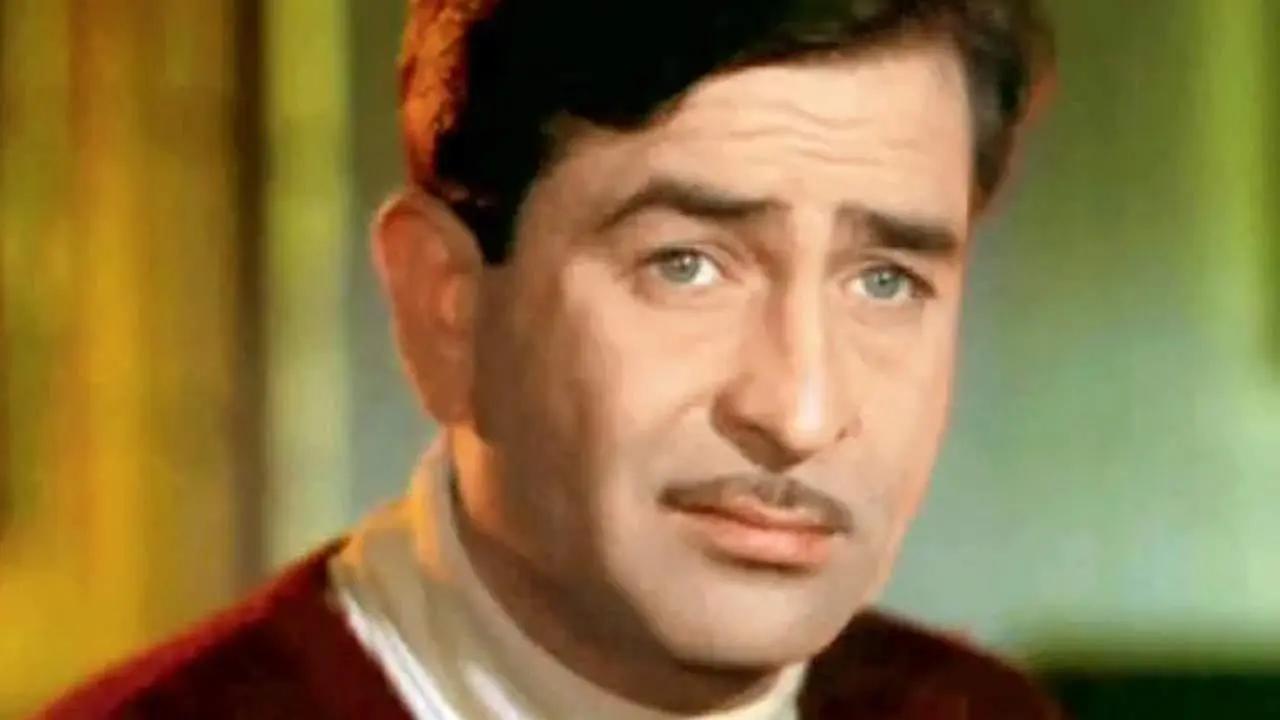
From USSR to North Africa and from South America to Iran, Raj Kapoor’s films swept the world in the 1950s and 1960s. On his 100th birth anniversary today, TOI rewinds to recreate the phenomenon of India’s first major global star
Avijit Ghosh (THE TIMES OF INDIA; December 14, 2024)
On arriving in Moscow in the summer of 1982, Raj Kapoor discovered that he’d left behind his visa papers. The actor-director was stopped by immigration. Frantic telephone calls were made. Nobody was sure what was to follow. But they need not have worried. A senior official soon arrived, embraced Kapoor, kissed him on both cheeks and warmly escorted him out.
“Is there anybody else in the whole wide world who could enter Soviet Russia without a valid visa? You should have seen that sight — it was a sight for the gods,” actor-director Sanjay Khan, who was also part of the film delegation, is quoted as saying in ‘Raj Kapoor: The Fabulous Showman’ by Bunny Reuben.
Another encounter of the fondest kind further underlines how Kapoor continued to command a hallowed place in the land of Tolstoy and Tarkovsky decades after the Awara craze swept the USSR like a forest fire in 1954.
In 1993, Russian president Boris Yeltsin told Kapoor’s daughter, Ritu Nanda, “I was in love with your father Raj Kapoor, and I remember him even today.” The anecdote is recounted in the book, ‘Raj Kapoor: The One And Only Showman’.
It wasn’t just the post-Stalin Soviet Union. In the 1950s, China, Iran, Turkey, Israel, Greece, North Africa and Eastern Europe were captivated by Kapoor’s movie and its title track. Slowly the film and its title song became an unofficial anthem, a cultural marker and a totem of national recognition.
It was also a diplomatic ice-breaker. TOI reported in 1994 that the then Chinese Premier Li Peng recalled Awara and its title track when he met India’s human resources minister Arjun Singh in Beijing. That hasn’t changed. “Every Chinese knows this movie,” goes a comment on YouTube. Awara anecdotes can fill a book.
As the nation today celebrates the 100th birth anniversary of India’s first actor-director who became a major global star in a pre-globalised era, what better time to re-appraise the magnitude of the impact that Kapoor’s movies have had across the world.
Inspiration For Turkish Poets
Awara has provided inspiration to much that is popular in Turkish culture: films like Genclik Hulyalari (1962) and Kader Bu (1976), songs and even novels, Turkey based academic and critic Ahmet Gurata told TOI. “A favourite of my mine,” Gurata said, “is a poem by Lale Muldur, which goes like this: ‘“Awaara hoon / Those kids who neither have a Barbie nor a Ken / They always wanted to be visited by Raj Kapoor one night / They would like him to enter their room and bring milk with gold-leaves... and baklava too / How many stories are embedded in the eyes of those shoeshine boys / Who have been paying the price for their genetic sins, / Did you know awaara hoon?”’
Muldur was born in 1956, a year after Awara was released in Turkey. The poem, taken from her ‘Book of Series’ (1991), is yet another testimony to how the gold hearted tramp continues to stir a generation’s imagination.
In his seminal article, ‘The Road to Vagrancy’, Gurata quotes a newspaper advertisement that says “the film was attended by 100,000 spectators during its first week and another 100,000 were unable to watch the film since it had sold out”. He also notes that Awara was voted as the best movie of 1955 by the readers of the popular daily Milliyet, beating Hollywood films such as Roman Holiday (1953) and Limelight (1952). “The film’s director and star Raj Kapoor ranked third on the list of best actors in the Milliyet survey,” he adds.
The title song was a top-selling record and even featured in official functions. “Several Turkish singers circulated it as a Turkish record in music markets. The song literally became part of folk culture when Turkish folklorist Ilhan Basgoz recorded a folk version in 1957,” Gurata writes.
‘Tramp’ Who Was Irresistible In Greece
Watching it under the title, ‘The Tramp Of Bombay’, Greeks too were besotted by the Nargis-Raj Kapoor pairing. Many Raj Kapoor films such as Shree 420, Aah, Anhonee, Paapi, Chori Chori, Pyaar, Amber, Sangam and Do Ustad made their way across over the next 10 years, film researchers from Greece say.
Indian films were not only shown in Athens, but also in villages at improvised open-air cinemas during summers. The songs were often rehashed with minor variations by Greek composers, creating a subgenre of such songs called Indo-Prepi.
Helen Abadzi and Manolis Tasoulas, who have extensively researched the influence of Hindi films in Greece, have identified at least 25 Greek songs whose melodies come from songs composed by Shankar Jaikishan for Raj Kapoor films.
“For instance, the song, ‘Ramaiya Vastavaiya’, from the film, ‘Shree 420’, became a Greek song titled, ‘When I kiss him and when he kisses me’, and was sung by Achilleas Koulaxizis and Filitsa in the Greek film drama, ‘Why was I born poor’,” Tasoulas told TOI.
Tasoulas also provides a fascinating anecdote that underlines the popularity of the Nargis-Raj Kapoor pairing. When in the early 1980s, Mehboob Khan’s film, ‘Aan’, was rescreened in Greece, the local advertisers wrote Raj Kapoor and Nargis as protagonists, instead of Dilip Kumar, Nadira and Nimmi, in the Greek posters. “Few understood the difference, because many years had passed since Kapoor’s films had been screened in Greece, and fans did not remember their faces as much as their names,” he says.
Sangam, Hindujas and Shah of Iran
‘Sangam’ (1964) floored Iran. Radhu Karmakar, who was Kapoor’s regular cinematographer, writes in his autobiography ‘The Painter of Lights’, that the film was a major hit, especially in South America and Iran, where it ran for over a year. Made approximately on a budget of Rs 1 crore, ‘Sangam’ earned over Rs 12 crore, including Rs 5 crore in foreign exchange, he estimates.
Karmakar remembers how the film’s success helped the Hindujas expand their business. The Hindujas, who distributed the film, invited Raj Kapoor and Vyjayanthimala for the golden jubilee celebrations in Iran and, in turn, got invited to a dinner reception hosted in Tehran by Iran’s ruling family. Karmakar says that the Hindujas “till then were film distributors and contractors, trying unsuccessfully to get bigtime business contracts... The Sangam golden jubilee reception opened the palace doors to the Hindujas and thereafter they moved into the big-time league with large arms contracts and business gains”.
“Everyone also knew the singing-dancing persona of Raj Kapoor in Bulgaria. His popularity was witnessed by many from my generation who grew up in the 1960s. This was mainly courtesy of Awara, which many people had seen more than once,” says Bulgaria-born Dina Iordanova, emeritus professor of global cinema at University of St Andrews, Scotland.
Secret of Kapoor’s Success
Kapoor, who produced and directed the film and played the male lead, was a prodigious 27-year-old when Awara was released in India in 1951. He created a Hindustani Chaplin — a survivor of class inequity and circumstance (Awara, Shree 420) — and the naive and sentimental underdog with a heart of gold who could stray but eventually return (Shree 420). These stories found a global echo, especially in places of limited cultural freedom. The sloshing of socialism and songs with a slice of the sensuous had an affirmative resonance for millions, converting RK Films into a premier banner. His name was synonymous with Indian cinema. As PM Narendra Modi said in his interaction with the Kapoor family on Wednesday, “He created India’s soft power before the term, soft power, was born.”
K A Abbas, who co-wrote the story with V P Sathe, remembered in his autobiography, ‘No Man Is An Island’, what a student told him during their 1954 USSR visit: “We are tired of the war, we went through it, and now must we relive it in every book we read, in every film or play that we see? Instead of war, we want to see love on the screen, we want to see carefree happiness, we want someone to make us laugh. That’s why we are crazy about Awara.”
Many young students bragged that they’d seen Awara 20-30 times. A young Russian interpreter noticed that a dialogue in the film was borrowed from Krishan Chander’s short story, ‘The Night of The Full Moon’. “No one had noticed it in India,” he wrote.
As Kapoor himself said once, “Awara was my little contribution to USSR-India friendship.”.
---------------------------------------------------------
When Kapoor met Chaplin
Ranjan Dasgupta (THE TIMES OF INDIA; December 14, 2024)
Raj Kapoor was a born serio-comedian whose face conveyed every emotion perfectly. According to Satyajit Ray, Kapoor was a better actor than a director. Mehboob Khan once confessed to Film India editor Baburao Patel that Raj Kapoor perfected his shots in fewer takes than Dilip Kumar.
Kapoor understood his limitations well. He modelled himself along the lines of Charles Chaplin. Kapoor always shared fond memories of his interaction with Chaplin at the latter’s residence in Montreux. Along with Dev and Chetan Anand, Nargis, Balraj Sahni, KA Abbas and Bimal Roy, Kapoor was part of the first Indian film delegation to visit Venice in 1953. Chaplin invited the delegation for a discussion.
During the interaction Kapoor spoke the most. He asked Chaplin how serio-comedy could be performed effortlessly. Chaplin was silent for a minute. Then looking into Kapoor’s eyes, he asked him to emote silently. Kapoor obliged the legend for three minutes. Chaplin was deeply moved by Kapoor’s performance and advised him to follow his own instincts. As they left, Kapoor kept waving to Chaplin with tears of joy in his eyes. Nargis simply told Kapoor to control his emotions, laughing her heart out.
The Kolkata-based writer interviewed Kapoor many times
3-day Raj Kapoor film festival to be held in 40 cities and 135 cinemas from December 13 to 15
10:22 AM

A rare picture of Raj Kapoor editing the film Satyam Shivam Sundaram
Niharika Lal (BOMBAY TIMES; December 4, 2024)
To mark Raj Kapoor’s birth centenary, R K Films, the Film Heritage Foundation, NFDC, NFAI and cinemas have come together to organise a retrospective titled ‘Raj Kapoor 100 – Celebrating the Centenary of the Greatest Showman’. The three-day fest will showcase 10 films of Raj Kapoor across 40 cities and 135 cinemas from December 13 to 15.
Earlier this year, the Toronto International Film Festival (TIFF), Festival des 3 Continents, and the recently concluded International Film Festival of India (IFFI) in Goa paid tribute to Raj Kapoor with screenings and discussions. Considered the ‘the greatest showman’ of Indian cinema, Raj Kapoor’s screen characters and films drew a tremendous response from fans not just in India but abroad too, particularly in the erstwhile Soviet Union and the Middle East.
Discussing Raj Kapoor’s films and filmmaking, Ranbir Kapoor admitted at IFFI that he is a bigger fan of Raj Kapoor the filmmaker than Raj Kapoor the actor. He also spoke about how, throughout his entire career, Raj Kapoor's films had messages of socialist reform. Awara addressed casteism, and Shree 420 dealt with greed and so on.
Not just India, but Raj Kapoor's screen characters and films drew a tremendous response from fans abroad. His characters and songs were extremely popular in the Soviet Union and the Middle East.
This month, India will start the centenary celebrations of Raj Kapoor - the actor, director, and producer considered to be ‘the greatest showman’ of Indian cinema. The celebration, titled 'Raj Kapoor 100 – Celebrating the Centenary of the Greatest Showman', is a retrospective of his ten films.
To commemorate 100 years of world cinema in 1990, the then Soviet Union honoured Raj Kapoor alongside eminent global film personalities like Ingrid Bergman, Jean Gabin, Charlie Chaplin and Marilyn Monroe.
Raj Kapoor's stories are timeless and this festival is our way of reliving that magic and inviting everyone to experience his legacy on the big screen: Ranbir Kapoor
"We are incredibly proud to be members of the Raj Kapoor family. Our generation is standing on the shoulders of a giant whose every film spoke of the time that it was made and was the voice of the common man over decades. I think it is our responsibility and our privilege to preserve his films for future generations. His stories are timeless and this festival is our way of reliving that magic and inviting everyone to experience his legacy on the big screen. See you at the movies!”
Raj Kapoor was truly India’s greatest showman: Amitabh Bachchan
"Raj Kapoor was truly India’s greatest showman. His life was a celebration and I am sure he would have been delighted to see his films back on the big screen. Raj Kapoor was an artist who lived for cinema. Even today Awara is a film that is etched in my mind. Made at a time of newly independent India, the film was socialistic, reflecting the mood of the times. Talking about Raj ji’s incredible showmanship, the way he envisioned the dream sequence in the film had never been seen before. You are amazed by his fantastical imagination that visualized the surreal setting, the ethereal Nargis ji emerging through thick clouds of smoke, Raj ji surrounded by demonic figures and burning fires – there is a powerful, mystical symbolism in the dream sequence, and that is my favourite."
Raj Kapoor had an all-consuming passion for cinema: Shivendra Singh Dungarpur, Filmmaker and Director of Film Heritage Foundation
"Contemporary audiences in 40 cities will have an opportunity to watch ten landmark Raj Kapoor films that put Indian cinema on the world map spanning almost four decades. These were films that not only captured the imagination of the people but reflected prevalent social and political themes beginning from a newly independent India. Raj Kapoor had an all-consuming passion for cinema. His unforgettable avatar as a tramp that embodied the common man and till his last film he remained a great showman."
Raj Kapoor was not just a filmmaker; he was a visionary who shaped the emotional landscape of Indian cinema: Randhir Kapoor
“Raj Kapoor was not just a filmmaker; he was a visionary who shaped the emotional landscape of Indian cinema. His stories are more than just films; they are powerful, emotional journeys that connect
generations of viewers. This festival is our humble tribute to the greatness of his vision.”
Celebrations across the globe
- This year, The Toronto International Film Festival (TIFF) screened the world premiere of the 4K restoration of Awara to commemorate the 100th anniversary of Raj Kapoor who directed and starred in the film.
- To celebrate 100 years of Raj Kapoor, the Festival des 3 Continents in Nantes, France conducted a book discussion on Raj Kapoor and Anari, Awara, Shree 420, Jis Desh Mein Ganga Behti hai, Teesri Kasam was screened.
- The recently concluded International Film Festival of India (IFFI) rolled out a tribute to honour the 100th birth anniversaries of four Indian cinema legends including Raj Kapoor.
Honours and accolades for Raj Kapoor
- Raj Kapoor received the Padma Bhushan in 1971 and the Dadasaheb Phalke Award in 1988.
- Shree 420 won a National Film Award in 1955.
- Awara and Boot Polish competed for the Grand Prize at the Cannes Film Festival in 1953 and 1955, respectively.
Ranbir Kapoor on Animal, Sanju: "We have to be more responsible towards the kind of films we make"
8:26 AM
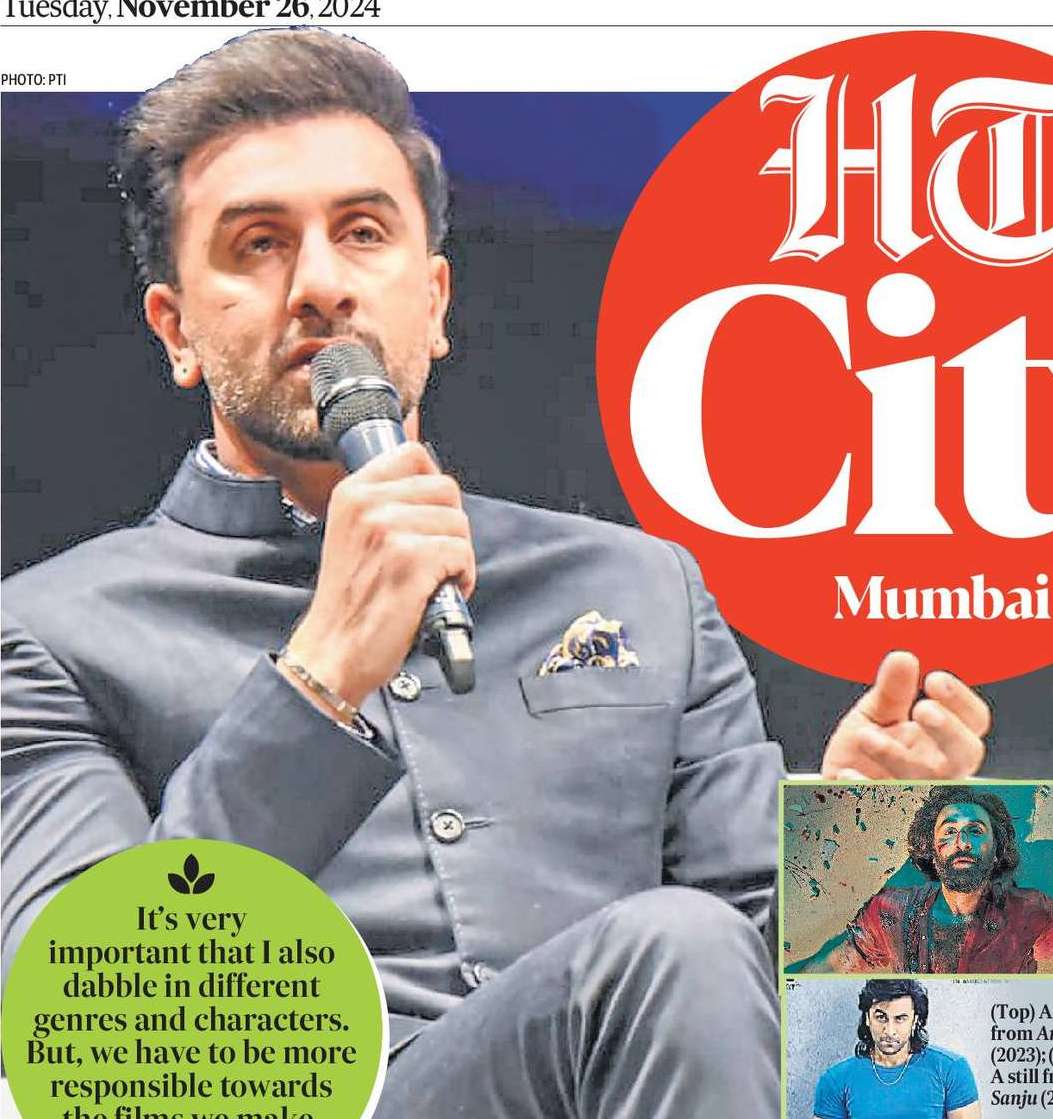
Niharika Lal (BOMBAY TIMES; November 26, 2024)
Ranbir Kapoor recently took the stage at the ongoing International Film Festival of India (IFFI) in Goa for a discussion celebrating the work of Raj Kapoor. “He was this big man with blue eyes,” the actor said as he began reminiscing about his grandfather. Ranbir confessed that it was only after he began understanding cinema that he fully grasped Raj Kapoor’s contribution to Indian cinema.
Sharing that 10 of Raj Kapoor’s films are being restored, Ranbir said that some of them will be screened at a film festival next month. “Raj Kapoor was Raj Kapoor because he didn’t follow any model. I think that if you want to carry any legacy forward, you have to approach it in a very individualistic way,” he told the audience.
‘I would love to have a take on Shree 420’
When asked which of Raj Kapoor’s films he would like to remake as a director, Ranbir said, “I would have directed every film in a different way, but all of them would have been atrocious. I don’t believe in remakes; I think every film is made to the best of its capabilities and should not be touched, especially Raj Kapoor’s. But I would love to have a take on Shree 420 – it is my favourite film.”
‘RAJ KAPOOR WAS CONSTANTLY IN TOUCH WITH THE COMMON MAN, THE MASSES’
In response to a question, Ranbir said, “Honestly, I want to say this – I’m a bigger fan of Raj Kapoor as a director than as an actor.” Raj Kapoor, the filmmaker, always explored different themes at different stages of his life.
Talking about his oeuvre, Ranbir shared, “If you look at his early films, Awara was based on casteism, in Shree 420, he spoke about greed.” Ranbir spoke about how in the later years of his career, Raj Kapoor made powerful films grounded in Indian moral values, tackling societal issues in a commercial and really entertaining way.
“Raj Kapoor had the courage to make a film with newcomers – a 50-year-old man making a film (Bobby) for the youth. It means that he really kept up with the times. He wasn’t stuck in a cocoon. He was not high up in an ivory tower. He was constantly in touch with the common man, the masses, and the kind of stories people would like to see,” Ranbir said.
The National Film Development Corporation of India (NFDC), National Film Archives of India (NFAI), and Film Heritage Foundation (FHF) and Kunal Kapoor have started restoring 10 films of Raj Kapoor. Ranbir said, “We are going to organize the Raj Kapoor Film Festival from December 13 to 15 all over India. We will show the restored version of 10 of Raj Kapoor’s films.”
-----------------------------------
Which film of his would Ranbir have wanted to be directed by Raj Kapoor?
Yeh Jawaani Hai Deewani (2013)
Which Raj Kapoor film would he like to direct?
Shree 420 (1955)
For which of his films did he take inspiration from Raj Kapoor?
Barfi! (2012)
-----------------------------------
Actor Ranbir Kapoor, who took the brunt of criticism for portraying toxic characters in his recent projects, opened up about leaning towards more responsible storytelling at a recent event
HINDUSTAN TIMES (November 26, 2024)
Actor Ranbir Kapoor’s films Sanju (2018) and, more recently, Animal (2023), have been at the end of fierce criticism for glorifying violence and toxic masculinity. Addressing the same on Sunday, the actor shared his take on the widespread debate at the 55th International Film Festival of India (IFFI) in Goa.
Prompted by an attendee, who asked him about “responsible storytelling” in context with Animal and Sanju, the actor responded, “I completely agree with your opinion. As an actor, it is our responsibility to bring movies which bring a positive change to the society.”
However, the 42-year-old maintained that doing diverse roles is important to him. “Having said that, I’m an actor, it’s very important that I also dabble in different genres and characters, and play varied roles. But what you are saying is absolutely correct. We have to be more responsible towards the kind of films we make.”
Earlier this year, in Nikhil Kamath’s podcast People by WTF, Ranbir had responded to the criticism that Animal had received, stating, “Social media played havoc. They needed something to talk about, so they really went to town claiming it was a misogynistic film.”
On a separate note, Ranbir also touched upon his dream of creating a biopic on his grandfather, late filmmaker-actor Raj Kapoor’s life, calling it a “challenging yet worthwhile endeavour.” Revealing his take on a biopic, the actor said at the event, “A biopic is not just about celebrating someone’s success but honestly portraying their struggles, relationships and low points. I’ve spoken to (filmmaker) Sanjay Leela Bhansali about it, but it’s a tough project. I’m not sure if my family would agree to show that side of his life.” htc
Ranbir reveals Alia didn’t know about Kishore Kumar
Speaking at IFFI, Ranbir disclosed that his wife, actor Alia Bhatt didn’t know about the legendary playback singer, musician and actor Kishore Kumar. “The first time I met Alia, she asked me, ‘Who is Kishore Kumar?’ [But] it’s just the circle of life. People forget [old artistes] and then new artistes come in. So, I think it’s very important to remember our roots.”
The video, which has now gone viral, has been dubbed as ‘Ranbir’s revenge’ by social media users, as a response to Bhatt’s earlier interview where she had claimed that Ranbir asked her to “wipe off” her lipstick. One social media user shared, “He took the revenge for ‘wipe it off’”, while another said, “Are these two in a competition: who can embarrass the other more... (sic).”
Raj Kapoor’s Awara to premiere at TIFF
8:23 PM

Niharika Lal (BOMBAY TIMES; August 28, 2024)
The restored version of Raj Kapoor’s 1951 film Awara will be screened at the Toronto International Film Festival (TIFF) in the classics section. The film was restored in 4K by the National Film Development Corporation – National Film Archive of India (NFDC-NFAI) under the National Film Heritage Mission.
NFDC sources tell us, “In 2018, Randhir, Rishi, and Rajiv Kapoor shared film materials, including several of Raj Kapoor’s classics with the NFAI. Among this invaluable collection was a 35mm dupe negative of Awara, which has now been selected for scanning after careful visual comparison with several 35mm release prints from the NFDC-NFAI collection.”
They add, “The colour grading for the restoration is being supervised by Kunal Kapoor, who has previously worked extensively on the restoration of films produced by Shashi Kapoor.” Awara was nominated for the Grand Prize at the Cannes Film Festival in 1953.
‘The 100th anniversary of Raj Kapoor’s birth’
TIFF said in a statement, “This screening commemorates the 100th anniversary of director Raj Kapoor’s birth in 1924... This recently restored classic threads messages of socialist reform among its musical numbers and Charlie Chaplin homages, and is often considered to be the greatest film by the greatest showman of Indian cinema,” TIFF said in a statement.
Shailendra's 100th birth anniversary: As a Dalit, he had a first-hand experience of misery and caste discrimination-Sheoraj Singh
8:36 AM

Shailendra (left) and music director Roshan. The two collaborated for the songs in films like Soorat Aur Seerat (1966). (Below) The song Awara hoon from the film Awara was a worldwide hit
Avijit Ghosh (THE TIMES OF INDIA; August 30, 2023)
For decades, Awara Hoon (film: Awara, 1951) was a passport to warmth for any Indian visiting the USSR, Turkey, Egypt, China and parts of Africa. The best-selling track even finds mention in dissident Soviet writer Aleksandr Solzhenitsyn’s novel, Cancer Ward (1966). And Mera Joota Hai Japani (film: Shree 420, 1955) makes appearances in films as diverse as Mississippi Masala (1991) and Deadpool (2016). The lyrics of Shailendra, whose birth centenary falls today, could remarkably create the universal from the local and the personal.
Shailendra’s life was his poetry’s wellspring. His roots lay in Dhuspur village near Bihar’s Arrah town. But he was born in Rawalpindi (now in Pakistan), where his father worked as a contractor. When his father fell ill, the family fell on hard times and shifted to Mathura where they would subsist on “a meal a day and a beedi at night,” says the preface of Andar Ki Aag (2013), a book on his previously unpublished poems.
The experience finds expression in the slum dweller song of Shree 420, ‘Bhookh ne hai bade pyaar se pala’. (hunger raised me with love). Only someone who had experienced hunger could dream of roti (bread) as he does in Ujala (1959): ‘Chulha hai thanda bada aur pet mein aag hai/Garma garam roti kitna hasi khwab hai’ (The hearth is cold and my stomach rages with hunger/To dream of bread is so beautiful).
The book also talks about Shailendra’s real name (Shankardas Rao), his Dalit background and the caste slurs he faced playing hockey (‘Ab yeh log bhi khel khelenge’ (Now even these people will play the game) making him give up the sport.
Writer Sheoraj Singh “Bechain” says that during the Progressive Artistes era in the 1940s, many writers wrote on the oppressed. “But as a Dalit, Shailendra had a first-hand experience of misery and caste discrimination. Distress isn’t just economic but also social and cultural,” says Bechain, a Dalit, and author of the acclaimed biography, ‘Mera Bachpan Mere Kandhon Par’.
Shailendra left Mathura for Bombay where he worked in the railways and became part of the Left-cultural forum, IPTA. The story of Raj Kapoor being impressed by his poem ‘Jalta Hai Punjab’, asking him to write in his films, Shailendra’s initial reluctance, and then later writing the last two songs of ‘Barsaat’ (1949) because he needed the money has been written before. In time, he would become a regular in films of Kapoor and Bimal Roy; his lyrics seamlessly fitting into their socially-conscious narratives.
A running thread in Shailendra’s celluloid verse is his empathy with the disadvantaged. “Staying within the matrix of the film’s script and the character’s needs, he commented on society and politics of the times. And he spoke up for the last human who’s uncared for by the government, the society and everyone else,” says radio personality Yunus Khan, who is writing a book analysing Shailendra’s poetry.
Lyricist Raj Shekhar (Tanu Weds Manu) adds to the view saying while many lyricists wrote emphatically about the marginalised, one can see a distance between the writer and those being written about. “But when you listen to Shailendra, you feel that distance has been dissolved. He seems to be one of them. And that’s because he is writing from lived-in experience,” he says.
In times when poets were often prisoners of pompous words that evaded ordinary people, Shailendra was accessible even to the rural illiterate. And yet as the late songwriter Dev Kohli once said, “Like the dohas (couplet) that Kabir wrote, he could encapsulate a world in a few words.”
‘Sajan Re Jhoot Mat Molo Khuda Ke Paas Jaana Hai’ (film: ‘Teesri Kasam’, 1966) is simple yet profound. ‘Aa Chalke Tujhe Main Lele Chaloon’ (film: ‘Door Gagan Ki Chhaon Mein’, 1964) imagines a world without discord (‘Jahan Bair Na Ho’) and hope much like John Lennon’s ‘Imagine’ (1971). That he could also write, ‘Chahe Koi Mujhe Junglee Kahein’ (film: ‘Junglee’, 1961) or the fun tracks of ‘Half-Ticket’ (1962) is a tribute to his versatility.
Shailendra produced ‘Teesri Kasam’. The Basu Bhattacharya-directed film, now hailed as a classic, flopped then. The poet passed away the same year. But even today much of his poetry remains quotable and relevant, none more than the line from ‘Jis Desh Mein Ganga Behti Hai’ (1960): ‘Mil jul ke raho aur pyaar karo, ek cheez yahi jo rehti hai’ (Stay together in harmony, love each other, this is all that lives in the end). As Bechain says, “His poetry rises above caste and religion, and seeks to establish a bond between humans.”
---------------------------------------
Indrajeet Singh (THE TIMES OF INDIA; August 30, 2023)
Released in India in 1951, ‘Awara’ was first shown in Russia in September, 1954. The film was dubbed in Russian but the songs remained in Hindi. The title song became an anthem of Indian culture and friendship for Russians. Tagore, Premchand, Kabir are also very popular in translation. But Shailendra’s songs were embraced by Russians in their original form. I have lived in Moscow for six years and a witness to the immense popularity of Raj Kapoor and Shailendra.
I was told by a Russian scholar of Hindi, E Chelishev, in 2003 that he had edited a collection of poems, ‘Poets of India,’ in Russian way back in 1958. The collection also included two poems by Shailendra: ‘Janmabhoomi’ and ‘15 August.’
When Shailendra visited Moscow in March 1962, he was very happy to learn that two of his poems had been translated into Russian. Shailendra was fond of the great Russian poet Pushkin. There was a similarity between the two. Both were great poets of love and revolution. Both died at a relatively young age. Raj Kapoor used to address Shailendra as Pushkin.
The author’s monograph, Bharatiya Sahitya ke Nirmata: Shailendra, will be out Saturday
---------------------------------------
Avijit Ghosh (THE TIMES OF INDIA; August 30, 2023)
Shailendra also performed cameos in a few films such as ‘Boot Polish’ (1954) and ‘Musafir’ (1957). In ‘Boot Polish’, he lip syncs a folk song he wrote, ‘Chali kaun se desh’ (singers: Talat Mehmood and Asha Bhonsle, music: Shankar-Jaikishan). Indeed, he was a master at writing songs flavoured with folk.
Sahitya Akademi recipient poet Anamika says that Shailendra was especially sensitive to soundscapes and was all ears for the chitchat on the footpaths and the folksongs floating in the villages of Bihar, Punjab and Maharashtra. “This is what gives his lyrics an epical dimension and makes him a popular writer of chorus,” she says.
Anamika also points out Shailendra’s sensitivity to “the push and joy of women’s language especially in the folkloric mode and the subversive quality of their humour which hoots out and titillates in the same go”. ‘Paan khaye saiyan hamaar, (film: Teesri Kasam) is a case in point.
Shailendra’s some other note worthy folk songs include ‘Ho daiya re daiya chadh gayo papi bichhua’ (film: ‘Madhumati’, 1957) and ‘Lali lali doliya pe laali re dulhaniya’ (film: Teesri Kasam). He also wrote the songs of the first Bhojpuri film, ‘Ganga Maiya Tohe Piyari Chadhaibo’, 1962), including the classic, ‘Sonwa ke pinjra mein’ (singer: Mohd Rafi, composer: Chitragupt).

We will see one of the most elusive original release versions of the Awara poster-Neville Tuli
8:18 AM
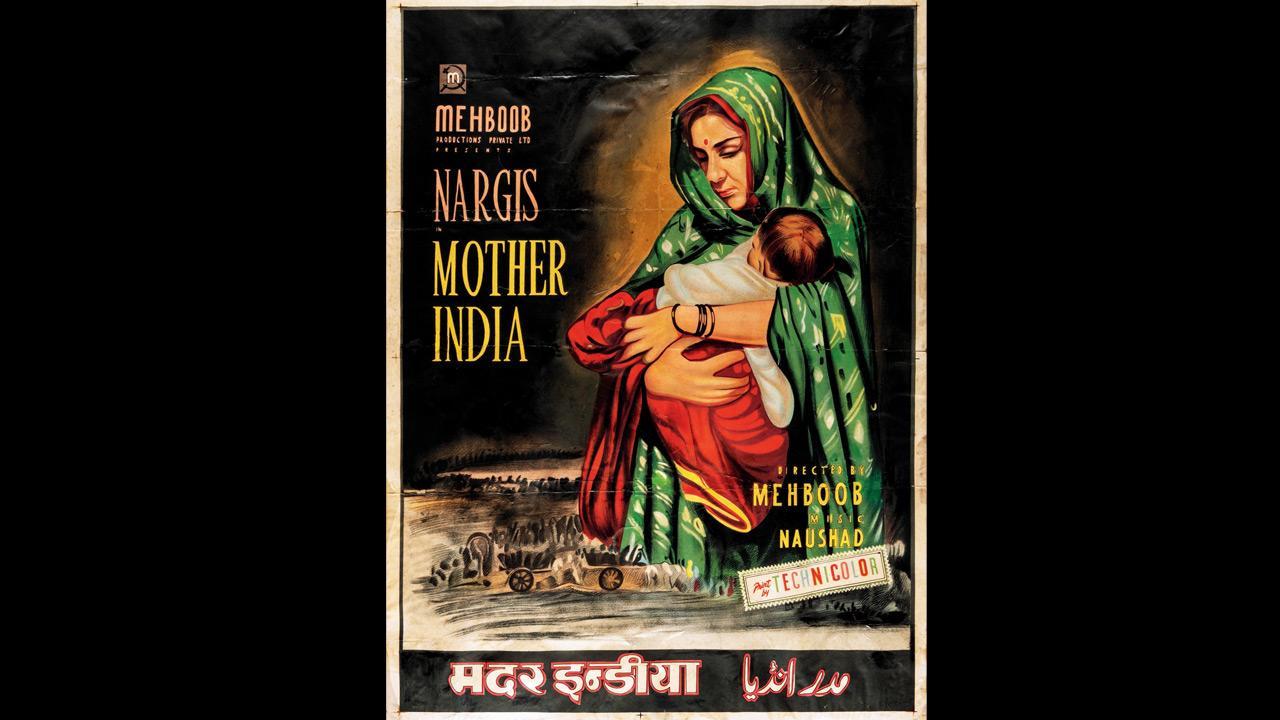
One of the last few countries to keep the film poster art alive is reason enough, says the team behind an upcoming auction, to see original cinema memorabilia as investment
Heena Khandelwal (MID-DAY; April 3, 2022)
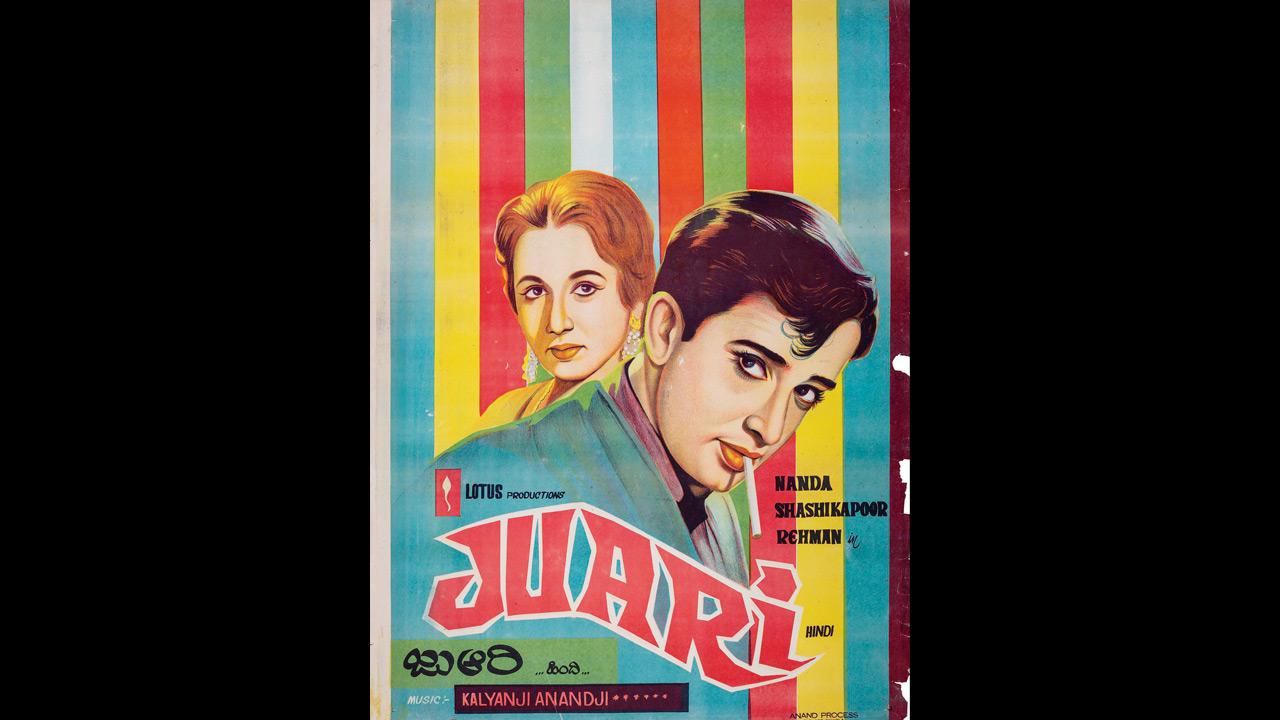
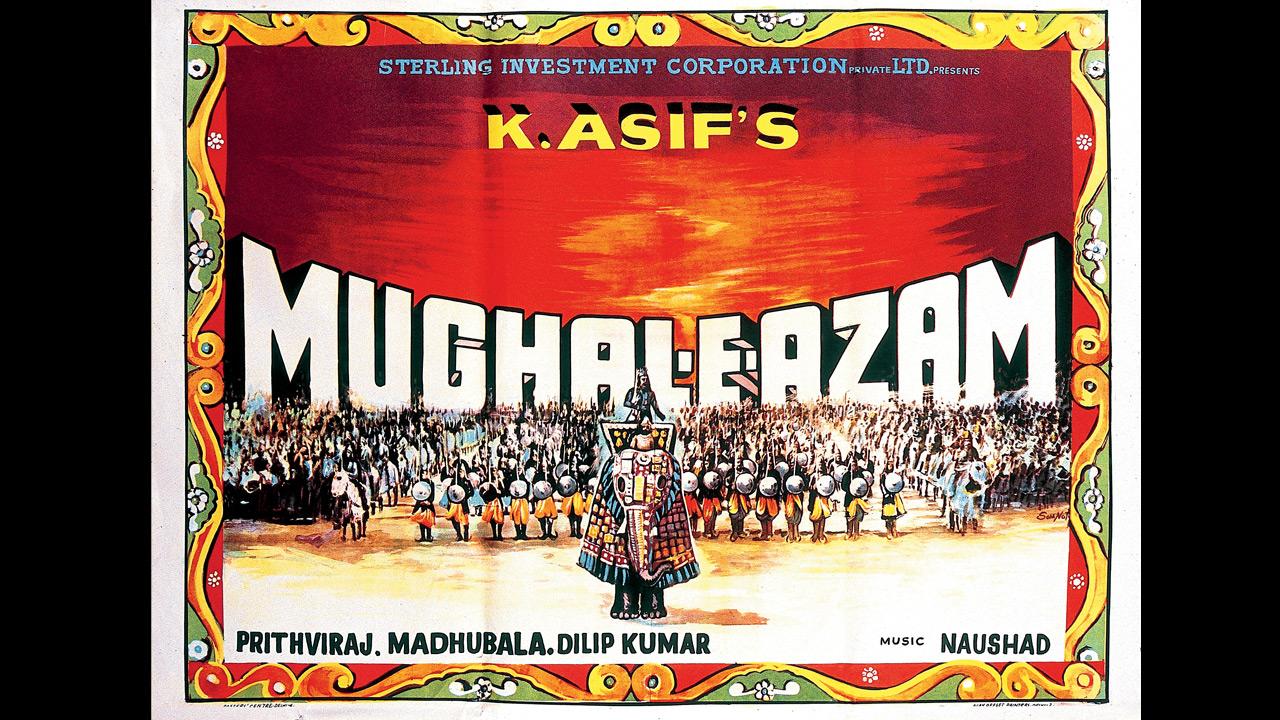
After their inaugural auction featuring paintings by leading modern artists F N Souza, M F Husain and V S Gaitonde, among others, online auction house deRivaz & Ives has returned with a focus on cinema. The first auction, scheduled for April 8 and 9, will see over 100 first-release original posters of films like Mother India (1957), Mughal-E-Azam (1960) and Yaarana (1981).
Neville Tuli, founder of Osian’s, chief mentor at deRivas & Ives, says that many of the original posters, like that of Tarana (1951) by S M Pandit—a painter from Karnataka who designed film publicity material for Raj Kapoor and others—are still not available on the Internet. “We still have minimal interest in preserving cinematic heritage. Posters, especially the hand-painted ones, represent a fragility. It is a dead art, which has come back to India in a way; we are one of the last few countries to keep it alive.”
The auction will specifically highlight designers and artists who are not well-known for their work as poster artists, including legendary filmmaker Satyajit Ray. Works of poster designers like D R Bhosale (Main Nashe Mein Hoon, 1959), Pamart Studios (Haqeeqat, 1964 and Khamoshi, 1969), Diwakar Karkare (Sholay, 1975 and Jaane Bhi Do Yaaro, 1973) and C Mohan (Khatta Meetha, 1978) will be up for the sale. “We will see one of the most elusive original release versions of the Awara poster; the imagery seen until now has been of re-release posters,” shares Tuli, adding that there will also be a focus on the first family of Indian cinema, the Kapoors. “Their cinematic journey will be highlighted through their poster art. Three unique versions of Shashi Kapoor’s Juari [1968] will be seen for the first time.”
The aim, he shares, is to establish new world record prices for Indian film memorabilia and get the film fraternity more involved in cinema-related art. While actors like Shah Rukh Khan, Aamir Khan, Anupam Kher and Dia Mirza bid and won art pieces during the Osian’s 2002 auction, the hope is now to widen this group by reaching out to the younger generation of talent. Tuli says, “Once the film fraternity comes on board, the rest of the public will follow.”
WHEN: April 8-9
WHERE: derivaz-ives.com
I was hesitant about screening Disco Dancer in Russia but Smita Patil convinced me-B Subhash
8:28 AM

Sonam Joshi (THE TIMES OF INDIA; March 29, 2022)
The year was 1983. Film director Babbar Subhash’s ‘Disco Dancer’ had just been invited for the Moscow film festival by a Mumbai-based agency Sovex Fort. “I was hesitant because it was a modern film with modern music and mostly dark films such as ‘Do Bigha Zamin’ have been successful in Russia but Smita Patil convinced me otherwise,” Subhash recalls.
By the time the movie screening ended, over 3,000 people in the auditorium were clapping and dancing along to the title track. “It was one of the best days of my life,” he says. ‘Disco Dancer’ went on to sell 120 million tickets in the Soviet Union, and even WhatsApp’s Ukrainian cofounder Jan Koum recalls watching the film as many as 20 times as a kid in Kyiv.
With Hollywood movies banned in the USSR during the Cold War, the Soviet government began promoting Indian movies from the 1950s onwards. The first big hit was Raj Kapoor’s ‘Awara’ selling 64 million tickets followed by ‘Shree 420’. Then came movies such as ‘Dhool Ka Phool’, ‘Love In Simla’, ‘Bobby’, ‘Barood’, ‘Seeta Aur Geeta’, ‘Muqaddar Ka Sikandar’.
Dr Sudha Rajagopalan, senior lecturer in East European Studies at the University of Amsterdam, estimates that 210 Indian films were screened in Soviet theatres between 1954 and 1991, around 190 of which were mainstream Hindi films from Bombay. “Indian popular films often surpassed both domestic and other foreign cinema in viewer turnout,” she writes in her book.
Elena Doroshenko, a Moscow-based journalist and linguist who has watched the old hits as well as the relatively newer ‘Kal Ho Naa Ho’ and ‘Paheli’, says they struck an emotional chord with Russians. “The films spoke the same emotional language — even though we were different, we understood the emotions and passions,” she says.
The success of Hindi films in the USSR also led to joint productions such as ‘Alibaba Aur 40 Chor’ and ‘Sohni Mahiwal’. However, this changed after the fall of the Soviet Union in 1991. “There was a flood of various films from the West and we wanted to imitate that lifestyle,” Doroshenko says. “Indian films were still on TV — it’s not that they were forgotten but they stopped being a sensation.”
Dancer Svetlana Tulasi, who was born to an Indian dad and Russian mom and raised in Moscow, recalls watching Bollywood movies on cassette tapes, then cable TV, then DVDs and eventually on the internet. She shot to fame a few years ago with her viral Bollywood-Kathak fusion dances at Russia's Got Talent and Ukraine's Got Talent.
On YouTube, there are Russian fan channels devoted to Mithun Chakraborty, and dance performances set to the song ‘Jimmy Jimmy’. There are even a couple of restaurants by that name in Vladivostok and the Georgian capital of Tbilisi.
The Georgian ‘Jimmy Jimmy’ was inaugurated in 2019 by none other than Raj Kapoor’s son Rajeev Kapoor. “When we visited Georgia for the first time, we were surprised to see that taxi drivers were playing ‘Jimmy Jimmy’ and ‘Mera Joota hai Japani’,” says owner Shubham Joshi whose customer base includes both locals as well as Indian students.
Unique collection of foreign posters tells the global story of Indian cinema
8:19 AM

Curator Jahan Bakshi, who scours the globe for local reincarnations of movie posters, has found gems like Awara in German and Raju Ban Gaya Gentleman in manga style
Mohua Das (THE TIMES OF INDIA; February 4, 2021)

When Jahan Bakshi, a movie art curator in Mumbai, stumbled upon old Czech and British quad posters for Satyajit Ray films with neo-futurist fonts and colourful surrealism, he knew he was onto something special. His curiosity led him down a rabbit hole — of familiar yet outlandish — doppelgangers of Indian movie visuals from across the globe that revealed a fascinating yet undocumented history of how different countries reimagined Indian films.
“Looking for foreign posters of Indian films started as research for an article but soon became an obsession. It was a revelation to see what Indian films look like when seen through a foreign prism,” says Bakshi who has unearthed around 150-odd foreign origin Indian posters and acquired around 50 physical copies from places spanning Russia, Latvia, Bulgaria and East Europe to France, Germany, the UK, US, Japan, China, Thailand and Egypt. “They’re unique both aesthetically and conceptually... like watching an act of translation via a poster image. It was also eyeopening to see just how much Indian cinema had travelled globally in the past.”

Recast, often dramatically, to resonate in the local market, these foreign posters blend local language, sexual allure, religion, violence and intellectualism. If some are reminiscent of the myths and legends of that land — for instance, the Russian poster for 1990 action thriller Khoon Bhari Maang borders on a folktale with the magnified head of an alligator occupying centrestage against an intense pink background and the Hungarian reincarnation of Benegal’s Nishant has little dragons wrapped around Azmi’s face — many are visual time capsules indicative of the prevailing politics and censorship in the country.

More recently, Chinese posters for Andhadhun — a massive success collecting over $35 million at the box office in China — took on a darker shade with black and white overtones and a braille piano in the foreground as opposed to the popping colours and quirky vibe of the Indian version.
“Interesting patterns emerge from posters of other countries, too. The US posters tend to be text heavy with emphasis on captions and pull-quotes. Posters from Europe and Central Asia are surprisingly flamboyant, eccentric and at times exoticize Indian-ness. Japanese posters are bizarrely unpredictable varying from subtle to whimsical, gonzo to pulpy,” observes Bakshi who scours popular poster sites like New York’s Posteritati Gallery to obscure ones in Germany, Czech Republic and Japan in his rescue mission though the pandemic did delay some of his packages.
But he is fortunate to have found an ally — the Academy of Motion Picture Arts and Sciences. The 30-year-old who had started ‘Posterphilia’ — a hobby project of posting his favourite movie posters on social media two years ago — drew the attention of Anne Coco, the head of graphic arts collections at the Oscars library, last September. “She approached me, asking if I could help build their collection of Indian film posters which was quite scant,” recounts Bakshi, who over the past few months of sourcing Indian film posters for the Academy, pitched the idea of “also” exploring their foreign counterparts.
“Since then I’ve helped them acquire a bunch of Ray, Raj Kapoor and V Shantaram posters of foreign origin and hope we can build it up further,” he says with his fingers crossed. “Old movie posters are cultural artefacts and I want to reclaim this aspect of Indian film history,” he signs off.
R K Studios fire: A legacy gutted, and the Kapoors are mourning
8:10 AM

Raj Kapoor's iconic Mera Naam Joker mask, and costumes worn by all R K banner heroines from Nargis to Aishwarya among the memorabilia lost in Saturday's fire at R K Studios, says Rishi Kapoor
Meena Iyer (MUMBAI MIRROR; September 18, 2017)

Just the memory of the calamity brought a lump to Rishi's throat. “I still cannot believe it. I'm partially in denial even now. I spent several hours looking around the studio and as the embers fell, I felt distressed and helpless. Yet, here I am at home and I'm still thinking that perhaps it was just a bad dream,“ Rishi told Mumbai Mirror. His son Ranbir, who heard about the incident in London, is rushing back.
Rishi was not in a position to comment on the exact cause of the fire because everything he heard was “conjecture“. While the police and the Fire Brigade officials have begun the process of a panchnama to ascertain the exact cause, it is said that on Friday, a reality show, Super Dancer 2, was shot on the floor till the early hours of Saturday. Post pack-up, the lights on the set and in the makeup rooms were switched off.
Rishi recalled some of the films that were shot in the studio, on the very stage that has now been gutted: Awara, Shree 420, Jis Desh Mein Ganga Behti Hai, Mera Naam Joker, Satyam Shivam Sundaram, Ram Teri Ganga Maili, Dharam Karam, Prem Rog, to Rishi's own directorial film, Aa Ab Laut Chalen in 1999... “My own journey at the R K Studio started at the age of two when I shot with my elder siblings, Randhir and Ritu, for the song 'Pyaar Hua Iqraar Hua' from Shree 420. I kept crying because I had to walk through heavy rain and Nargisji bribed me with a Cadbury chocolate, promising to give it to me if I did what my father asked me to do. That aside, can you now imagine, how devastated I was when I saw the fire destroy everything around me? I am 65 now. It's a place I have been frequenting for 63 years. So have my siblings. It is an equally big blow for Randhir and Rajeev,“ Rishi said.
He said it was all the more heart breaking for the matriarch, Krishna Raj Kapoor, who has been a gracious host at countless events at the studio. “My mother is devastated. She keeps indifferent health and we asked her not to come to the studio because the fire was quite bad. There was smoke bellowing all around,“ he said.
When asked about the losses, Rishi said “everything was gone“, including the famous joker mask Raj Kapoor wore in Mera Naam Joker. “There were costumes from every RK film, from Awara to Chalen. Most of the stuff was kept neatly in trunks and some of it was even labelled. The costumes worn by every RK heroine, from Nargis to Aishwarya Rai Bachchan, is lost. The jewellery worn by Padmini in Jis Desh Mein Ganga Behti Hai was also stored here with a lot of love. There were spears, sabres, artefacts, furniture and other regalia used for the various shoots. The Mera Naam Joker mask and clothes... Dabboo and I couldn't believe what hit us. This is probably why they say that one should never put all eggs in one basket. But for us, this was our father's legacy, and it was a treasure trove.“
R K Studio had seen several tragedies. In 1970 when Mera Naam Joker flopped, Raj Kapoor had to mortgage the studio. Then, towards the end of his life, the Kapoor patriarch sold two stages of RK Studios for a paltry sum. But even after Raj Kapoor's death, his sons never contemplated selling any part of the property. “We hung on to our father's legacy,“ Rishi said. “Today I feel a sense of deep bereavement because we lost all of this.“ Echoing Randhir Kapoor's statement that the family may come to terms with the financial loss but not with the emotional loss, Rishi said, “My father didn't buy a home for his family until Bobby's success. He put all his earnings into the studio because cinema was his religion.“
 It is said that back in 1951, Raj Kapoor had constructed just four
walls on Stage One, which didn't even have a proper roof because he used
natural light to shoot. “My brothers and I can build the four walls
again and even add a roof. But how can we compensate the loss of the
precious memorabilia? That will never come back. Countless films,
besides those made under our home banner, have been shot at R K Studio. It
has also been the venue for our Holi and Ganpati celebrations. The loss
is not just ours as a family, it is a loss for the entire film
fraternity,“ said Rishi.
He recalls that RK came into being in the year of Awara. “My father shot the famous dream sequence here. At that time there were just four walls and no roof. The entire dream sequence was shot after sundown because Chembur got electricity only in the nights in the 1950s. During the day, my father toiled for other filmmakers as an actor...and then at night he put his earnings into his own film,“ he said.

Ranbir Kapoor gets emotional on the TV show Super Dancer
8:47 AM

Natasha Coutinho (MUMBAI MIRROR; October 14, 2016)
Ranbir Kapoor may have visited RK Studio — founded by his late grandfather Raj Kapoor — countless times, but the latest one, to promote his upcoming film Ae Dil Hai Mushkil on the kids dance reality show, Super Dancer, was special.
A source from the set told Mirror that two contestants, Ditya and Asis, performed on Raj Kapoor’s “Mera Joota Hai Japani” song from the film Awara. “It was an emotional moment for Ranbir as he revealed that the song had been shot in the studio on the same stage. He thanked everyone for recreating the unforgettable moment, admitting that it made him feel the way those who’d seen his grandfather perform must have felt... speechless,” added the source
At another point in the show, a physically challenged former contestant dropped by to meet RK Jr. who joined him and director Anurag Basu, one of the judges on the show, for a little jig on Barfi’s title track.
Raj Kapoor's classic Awara set for a theatrical reboot
8:21 AM

MUMBAI MIRROR (October 14, 2016)
Raj Kapoor's 1951 classic,
Awara is set, for a theatrical reboot after the signing of an agreement
in Shanghai on Thursday which was a part of a Memorandum of
Understanding (MoU) between the Indian Council of Cultural Relations,
(ICCR) and China Shanghai International Arts Festival (CSIAF).
Awara is the most popular Indian movie in the last six-and-a-half decades among generations of Chinese who sing the title track, “Awara Hoon“ as “Awaala Hu“ as the letter 'R' doesn't exist in Mandarin.
The agreement aimed at recreating the film's magic, coincided with the visit of Amarendra Khatua, Director General of the ICCR, to Shanghai to participate in the 18th China Shanghai International Arts Festival which com menced on Wednesday. The film version of the Awara will be co financed by ICCR and CSIAF.
Martin Scorsese's team heads to Pune to help restore a string of Indian celluloid classics
1:46 PM

Sanyukta Iyer (MUMBAI MIRROR; February 27, 2016)
Twenty six years ago, Hollywood filmmaker Martin Scorsese established The Film Foundation (TFF) along with contemporaries Woody Allen, Robert Altman, Francis Ford Coppola, Clint Eastwood, Stanley Kubrick, George Lucas, Sydney Pollack, Robert Redford, and Steven Spielberg to address the urgent need for film preservation. Now, members from the organisation are set to arrive in India to help restore a string of Indian celluloid classics in a 10-day project at the National Film Archives of India (NFAI) in Pune, which will conclude on March 6.
While David Walsh, Head of the International Federation of Film Archives (FIAF) Technical Commission, has organized lectures and workshops on preservation, the project will also include screenings of restored classics. Thelma Ross from the Museum of Modern Art, New York will conduct documentation and cataloguing sessions. Several Bollywood personalities have extended support to the initiative. Naseeruddin Shah inaugurate a special restoration and preservation workshop alongside filmmaker and archivist, Shivendra Singh Dungarpur, and Viacom 18's Sudhanshu Vats. "I'm proud to have 50 of my films on the archive list. I can't thank PK Nair saab (film archivist on whose life Dungarpur's 2012 documentary, Celluloid Man, was based) enough for inspiring a generation of youngsters," the actor said the launch. Amitabh Bachchan shared on the social media, "An initiative by Film Heritage Foundation to save our films... Misplace the mobile, disconnect the internet, switch off set top box."
Richard Wright, former archive preservation specialist in the BBC Research and Development department in London, and Paolo Cherchi, senior curator at George Eastman Museum's Moving Image Department in Rochester, will conduct sessions on new preservation technology.
Films that figure on the restoration list include PC Barua's 1935 screen adaptation of Devdas, Raj Kapoor's 1951 hit Awara, Khwaja Ahmad Abbas's Dharti Ke Lal, V Shantaram's 1934 costume drama, Amrit Manthan, SS Vasan's Chandralekha, Homi Wadia's Diamond Queen and Prabhat Film Company's 1936 Marathi biopic, Sant Tukaram.
"The language of cinema is universal and, in a time of great divisions, conflicts and transformations, it is crucial to preserve and share our cultural patrimonies and to ensure that it speaks to future generations around the world," Martin Scorsese told Mirror.
"We need to preserve our films not just for the joy of entertainment, but for safeguarding the ideas that help us learn about our cultural heritage. The movement has to grow and it will when everyone comes together for it. Let's join hands together to save India's cinematic legacy," he asserted, adding, "It's a unique opportunity for us to be transporting to India."

How Nehruvian view of social change shaped Indian Cinema-Shyam Benegal
10:09 AM

As told to Mithila Phadke (THE TIMES OF INDIA; November 9, 2014)
I remember the first time I saw Nehru. It was soon after the police action that liberated Hyderabad from
Nizam's rule. I must have been about 12 at the time. A friend of
mine and I were walking towards a disused golf course close to my home
where we often played cricket. It was early in the morning. Two horsemen
came cantering along on their horses. One was General J N Chaudhuri who
was the Military Governor of Hyderabad at the time and the second was
Jawaharlal Nehru. He looked like a bronze god. The second time I saw him
was several years later at an Inter University Youth Festival in New
Delhi. He gave an extraordinarily inspirational speech which in fact
changed the course of my life.
 The early years of Independent
India were times of great optimism. Nehru was the great hero, with his
film star good looks and his charming manner. Also, he was an extremely
inspiring leader, particularly for young people. Nehru in his youth was
greatly inspired by the Russian Revolution. He travelled to the Soviet
Union with his father in the late 1920s and was most impressed with the
idea of the social engineering that he saw being attempted there. He was
all for creating a new society but
not necessarily by altogether dismantling the earlier economic and
social structures. He substituted the ideal of socialist society with the
term socialist pattern of the society which was described as a mixed
economy with space for both private and public sector. He wanted a
self-reliant India rather than attempting to make it self
sufficient.
Many mainstream filmmakers were impacted by the optimism of the early Nehruvian years. The films of Khwaja Ahmed Abbas ('Jagte Raho', 'Awara') and others such as B R Chopra ('Naya Daur') were critical of the present but were extremely optimistic of the future. Their films were essentially Nehruvian in concept.
Another important development in the Nehruvian era were the creation of the three cultural academies - Sangeet Natak Akademi, Lalit Kala Akademi and the Sahitya Akademi. The Film and Television Institute was founded during Nehru's tenure. The FTII was designed to train filmmakers who would create films that would reflect changes taking place in Indian society rather than turn out escapist fantasies which were the staple of mainstream cinema.
The impact of Nehruvian thinking was felt most significantly in Bengali, Malayalam, Kannada and Oriya cinema before it was felt in Hindi films. These films were clubbed together by the press and described as parallel cinema.
Most of the early graduates of the FTII, began to make films that were far more original and reflected social and aesthetic attitudes and views very much their own rather than being influenced by popular mainstream cinema of the time. Among the notable filmmakers, who made their mark were Adoor Gopalakrishnan and Aravindan in Kerala, Girish Karnad in Karanataka, Nirad Mahapatra in Orissa among others. As far as Hindi Cinema was concerned, there were filmmakers like M S Sathyu and myself.
Hindsight criticism of Nehru has become fairly fashionable today. Nehru's contribution according to me was a foundational one and contributed hugely in making India an independent minded democratic country. What Nehru did was help open up minds to different kinds of thinking and to possibilities whose significance can never be underestimated.
My film 'Ankur' was essentially about social change. So was 'Manthan' while 'Bhumika' was about the liberation of women from the oppression they suffered in the traditional patriarchal society of our country. 'Kondura' was about breaking free of traditional superstitions that held society in thrall.
These were all influenced either directly or obliquely by Nehruvian views on social change - the idea that one cannot develop society and move forward without actively helping to make far reaching social changes.
These views are as relevant today as they were yesterday.
The early years of Independent
India were times of great optimism. Nehru was the great hero, with his
film star good looks and his charming manner. Also, he was an extremely
inspiring leader, particularly for young people. Nehru in his youth was
greatly inspired by the Russian Revolution. He travelled to the Soviet
Union with his father in the late 1920s and was most impressed with the
idea of the social engineering that he saw being attempted there. He was
all for creating a new society but
not necessarily by altogether dismantling the earlier economic and
social structures. He substituted the ideal of socialist society with the
term socialist pattern of the society which was described as a mixed
economy with space for both private and public sector. He wanted a
self-reliant India rather than attempting to make it self
sufficient.Many mainstream filmmakers were impacted by the optimism of the early Nehruvian years. The films of Khwaja Ahmed Abbas ('Jagte Raho', 'Awara') and others such as B R Chopra ('Naya Daur') were critical of the present but were extremely optimistic of the future. Their films were essentially Nehruvian in concept.
Another important development in the Nehruvian era were the creation of the three cultural academies - Sangeet Natak Akademi, Lalit Kala Akademi and the Sahitya Akademi. The Film and Television Institute was founded during Nehru's tenure. The FTII was designed to train filmmakers who would create films that would reflect changes taking place in Indian society rather than turn out escapist fantasies which were the staple of mainstream cinema.
The impact of Nehruvian thinking was felt most significantly in Bengali, Malayalam, Kannada and Oriya cinema before it was felt in Hindi films. These films were clubbed together by the press and described as parallel cinema.
Most of the early graduates of the FTII, began to make films that were far more original and reflected social and aesthetic attitudes and views very much their own rather than being influenced by popular mainstream cinema of the time. Among the notable filmmakers, who made their mark were Adoor Gopalakrishnan and Aravindan in Kerala, Girish Karnad in Karanataka, Nirad Mahapatra in Orissa among others. As far as Hindi Cinema was concerned, there were filmmakers like M S Sathyu and myself.
Hindsight criticism of Nehru has become fairly fashionable today. Nehru's contribution according to me was a foundational one and contributed hugely in making India an independent minded democratic country. What Nehru did was help open up minds to different kinds of thinking and to possibilities whose significance can never be underestimated.
My film 'Ankur' was essentially about social change. So was 'Manthan' while 'Bhumika' was about the liberation of women from the oppression they suffered in the traditional patriarchal society of our country. 'Kondura' was about breaking free of traditional superstitions that held society in thrall.
These were all influenced either directly or obliquely by Nehruvian views on social change - the idea that one cannot develop society and move forward without actively helping to make far reaching social changes.
These views are as relevant today as they were yesterday.
Subscribe to:
Posts (Atom)