Showing posts with label A R Rahman. Show all posts
Showing posts with label A R Rahman. Show all posts
We were hoping Asha Bhosle would live another eight years and reach a hundred-A R Rahman
2:14 PM

In a conversation around Asha Forever, his tribute to Asha Bhosle, A R Rahman reflects on grief, legacy, and why India must celebrate its artistes while they are still alive
Niharika Lal (BOMBAY TIMES; June 22, 2026)
When Lata Mangeshkar passed away, A R Rahman was devastated. Her death also brought another thought into focus: one of India’s last living legends, Asha Bhosle, was ageing and, too often, the country waits until its icons are gone before celebrating them. Here was an artiste whose career stretched across eight decades, who had sung Indian classical, semi-classical and pop, who had helped define every era of modern Indian film music, and who, even in her ’90s, was singing.
That realisation led to Asha Forever, a collaboration between Rahman and Bhosle – a tribute to her life, work and legacy. The project brought together Rahman, students from Trinity Laban Conservatoire of Music and Dance in London, and Asha Bhosle, who listened to the young musicians over video calls.
“Everything happened beautifully,” Rahman recalls. But the song’s journey took an unexpected turn. It was delayed by logistical hurdles and pending approvals. Rahman assumed there would be time.
Rahman says, “We were hoping she would live another eight years and reach a hundred.” Asha Bhosle passed away before the song could be completed. “I was pretty shaken. I was constantly following her health. Last year she had a serious issue, but she survived. She became okay. She was walking. She was joking. I thought she had a few more years,” recalls Rahman.
Unable to immediately return to the project, he put it aside. Months later, on World Music Day on June 21, Rahman chose to release the first glimpse of Asha Forever.
‘I DECIDED TO MAKE A SONG WITH HER TO CELEBRATE HER LEGACY’
For Rahman, the song is also an attempt to change the way India remembers its artists. Rahman shares, “Asha ji – we all know what a legend she is. But in India, we celebrate people only after they’re gone, not when they’re alive. In the West, you see great artistes being celebrated. Everybody comes together and shows appreciation. Here, we give someone a lifetime achievement award and move on. So I thought, why don’t we do something more? She was alive last year and still singing beautifully. I decided to make a song with her to celebrate her legacy and everything she had achieved in life.”
He adds, “We recorded the song last year. Even though she wasn’t keeping well, she came to the studio. We shot the video too. Everything was in place, but unfortunately it got delayed. We were hoping she would live another eight years and reach a hundred. Sadly, that didn’t happen.”
‘I’M A HUGE FAN OF BOTH SISTERS – LATA JI AND ASHA JI’
When asked what he thinks the legacy of someone as legendary as Asha Bhosle, Rahman says, “The proof of the pudding is when people come on stage and sing, or when they give interviews and talk. All of that is artistry, not just hearing somebody on a music streaming app. Then people know who’s the real deal, and who’s been produced, or made into an artiste. In this case, I’m a huge fan of both the sisters – Lata Mangeshkar and Asha Bhosle – and, in fact, all three, Hridaynath Mangeshkar, too. Through this song, we are not only celebrating Asha ji, but the entire family. We adore people like them – who are relentless, who form a very strong foundation. They’re embedded in the veins of India, in the motion. Both sisters have such strong personalities that they don’t overlap. They were not in competition with each other, and that’s fantastic.”
Grief has to be beautified in music: Rahman
Can music help cope with grief? For Rahman, “Grief is part of the true self.” He explains, “If somebody has empathy, they have love. And if they have love, they have empathy. Music is all about that. Every chord, every melodic counterpoint – if it doesn’t affect you, if it doesn’t stir a feeling within you, it’s not music at all. I come from both the old school and the new school, so for me, all of that becomes notes — notes through which to express something.”
“And grief is not...” he pauses. “Grief has to be beautified in music. It has to be coloured in a way that people can experience that grief and still find beauty in it. You know, like ghazals are. It’s beautiful.”
----------------------------------------
‘An artiste’s true legacy is not just the songs’
There is often much discussion about an artiste’s legacy after they pass away. For Rahman, that legacy is far beyond the songs. “For me, it’s not just the songs. It’s the way they’ve handled life, the way they’ve navigated musical complexities, the way they’ve remained relentless in pursuing excellence.”
Discussing Asha Bhosle’s attention to detail and her commitment to excellence, Rahman says that even when she was unwell last year, she never compromised.
“Even then, she would say, ‘Use the right voice, okay? Use the right takes.’ She was very, very particular about it. She’d say, ‘I know you’ll do it, but I still have to tell you.’ She cared deeply about how she sounded. All of that is part of the legacy. The whole 360 degrees of who they are.”
A R Rahman and I have been working on Taal 2 for a year-Subhash Ghai
9:38 AM

Renuka Vyavahare (BOMBAY TIMES; June 11, 2026)
Subhash Ghai’s 1999 hit Taal starring Aishwarya Rai Bachchan, Akshaye Khanna and Anil Kapoor became iconic for its music and storytelling. The veteran filmmaker is keen on making a new instalment of the movie. He tells us, “It won’t be a sequel really, as the story will be different, set in contemporary times with new faces, but the essence of Taal will be there – a divine musical with its own narrative.”
‘RAHMAN IS EQUALLY EXCITED ABOUT THE SEQUEL’
Ghai revealed that he is looking for a director to helm the project, while he will script and produce the film. “I am 81. Mentally, I am sharp, but physically, I have become slow. So I am looking for a director who can make the film for me. Rahman and I have been working on the script of Taal 2 for a year. He is equally excited about the sequel.”
He further explains, “When I say script, it’s not just what is written on paper – I also mean visualizing the sound and music of the film. I wrote the script, but I would say even Taal (1999) was written by Rahman and me. I used to discuss every situation and character with him. I had told him that the film’s narrative would depend on the music he produced. We had Anand Bakshi ji, so we didn’t have to worry about the lyrics. We want to make a film that is one or two steps ahead of Taal in terms of storytelling and music.”
‘Casting young talent has always been my priority’
Ghai plans to bring in young talent to headline the film. He shares, “I remember watching Aishwarya in Iruvar (1997) and deciding to cast her in Taal. The film came after Khalnayak (1993) and Pardes (1997), which were hits. I had successful films behind me, while Aishwarya had won the Miss World title, but her films had not worked at the time. My decision to cast her was criticized. But look at what she achieved. So, casting young talent has always been my priority.”
The filmmaker believes that the art of staying relevant in today’s times is not a challenge because human emotions remain constant. “Morals and nobility will always stay. Emotions that stem from jealousy and ego remain unchanged. Technology has made our lives easier. How you narrate the story is the challenge,” he says.
When I saw Lagaan's first cut, I realized what a masterpiece it was-Javed Akhtar
9:36 AM

Twenty-five years later, Aamir Khan, Ashutosh Gowariker, Javed Akhtar & AR Rahman reflect on the journey of making the Oscar-nominated classic Lagaan
Debarati S Sen (BOMBAY TIMES; May 28, 2026)
Twenty-five years after Lagaan: Once Upon a Time In India changed the landscape of Hindi cinema, its creators came together at Mumbai’s Mehboob Studios on Monday evening for a nostalgic conversation about the film.
The panel discussion, moderated by Meiyang Chang, featured actor-producer Aamir Khan, director Ashutosh Gowariker, lyricist Javed Akhtar and composer A R Rahman, who reflected on the enormous risks, doubts and creative ambition behind the film.
Released in 2001, Lagaan, a period sports drama set in a drought-stricken village under British rule, earned an Academy Award nomination for Best Foreign Language Film, introducing Indian mainstream cinema to a global audience.
FROM DOUBT TO A CULT CLASSIC
Opening the evening, Aamir admitted that no one involved with the film imagined its legacy would endure for decades. “We never thought people would remember this film for 25 years. At that time, we didn’t even know whether the film would work or whether audiences would like it. It feels exciting that something we made so many years ago is still relevant.”
Calling the gathering the first official event marking the film’s silver jubilee, Aamir added that the team remains overwhelmed by the affection the film continues to receive.
A STORY BORN OUT OF FAILURE AND FAITH
For Ashutosh, Lagaan emerged during a difficult phase in his career. The filmmaker recalled that after two unsuccessful films, he wanted to create something entirely original and emotionally stirring.
He said the idea began with seven unlikely heroes, men burdened with differences and conflict who eventually unite for a common cause. As the screenplay evolved, so did his dream team. “Only Aamir was in my mind for the role,” Gowariker shared, adding, “Along with that, mere mind mein yeh zaroor tha ki iss film ka music A R Rahman ko karna chahiye aur lyrics Javed Akhtar ka hona chahiye, and the entire HOD list including Bhanu Athaiya ji for costumes.” But convincing Aamir proved difficult.
‘BAHUT BURI KAHANI HAI YAAR’
One of the evening’s most entertaining moments came when Aamir revisited his now-famous rejection of Lagaan. The actor revealed that when Gowariker first narrated the premise - villagers playing cricket against the British to avoid paying tax - he was convinced the story would fail.
“I told Ashu, ‘Bahut buri kahani hai yaar. This story does not make sense to me,’” Aamir recalled. Three months later, Gowariker returned with a completed script and requested a full narration of three-four hours. Aamir admitted he agreed to listen with “zero expectations”, believing he would reject the film once again. Instead, he found himself completely absorbed.
From the moment he started narrating, I was hooked,” Aamir said. “When the narration ended, I was gobsmacked. I had never heard such a brilliant script before.”
Even then, the actor hesitated. Producing the film himself felt like a terrifying prospect, especially after watching his father struggle as a producer in the industry. “Mujhe der saal laga before I said yes to Ashu for Lagaan,” he said.
ON SEEING THE FIRST CUT, I REALIZED IT WAS A MASTERPIECE: JAVED AKHTAR
Javed Akhtar confessed that he too believed the project was commercially risky, perhaps impossibly so for its time. He recalled feeling protective towards Aamir, whom he had known since childhood, having written Yaadon Ki Baaraat, one of the young actor’s earliest screen appearances. "Maine socha agar main nahi samjhunga toh inhe kaun samjhayega?" he said, with the wry warmth of a man recounting his own spectacular misjudgement.
“I felt this film was a perfect list of things that would never make a film work in those days. Uss zamane belief tha ki period films don’t work. Next was cricket ek film-friendly game nahi hai, after all Aamir’s Awwal Number had flopped. Heroes wearing dhoti – that wouldn't work in a 2000 film, box office nahi manega. Even my Gaabar Singh decades ago was seen wearing pants. And throughout the film, characters cricket seekh rahein hain. I was worried for them, ye kya film hai.”
He said Lagaan seemed to contain every element considered “unmarketable” in Hindi cinema then: a period setting, cricket as the central theme, heroes in dhotis, and a narrative built around learning a sport rather than conventional action or romance. “I called then both and bahut samjhaya ki yeh film na banaye. But, bahut khushi ki baat hai ki they did not listen to me and went ahead and made the film. And I decided ki main apna kaam imaandaari se karunga, picture jaisa bhi ho, gaane acche hone chahiye. When I saw the first cut, I realized what a masterpiece it was. I am very proud of this film.”
RAHMAN ON CREATING A TIMELESS SCORE
For A R Rahman, the challenge lay in ensuring the music matched the film’s epic emotional scale. The composer said he approached Lagaan with the intention of making its soundtrack timeless, which led him to collaborate with legendary singers Lata Mangeshkar and Asha Bhosle alongside Javed Akhtar’s lyrics. Rahman also shared a moving memory from the film’s background score sessions, explaining how he experimented with hybrid orchestration techniques because certain instruments were unavailable in India at the time.
Describing one recording session, he recalled seeing Aamir sitting silently in tears after hearing the music. “He asked me, ‘What have you done to my movie?’ - in a good way,” Rahman said with a smile. “That was the first time I saw the birth of a producer who was so emotionally invested in every aspect of the film.”
A R Rahman reacts as Tamasha's Agar Tum Saath Ho becomes most streamed Indian song
9:59 AM

With ‘Agar Tum Saath Ho’ becoming the most streamed Indian song since last week, A R Rahman recalls toiling through four scores to arrive at the ‘Tamasha’ track
Priyanka Sharma (MID-DAY; April 16, 2026)
Is it the power of the melody, two timeless voices, or the universal experience of heartbreak? What makes Agar Tum Saath Ho from Tamasha (2015) relevant over a decade after it first released? Since last week, the poignant ballad from Imtiaz Ali’s movie has claimed the top spot as the most streamed Indian song on Spotify. When mid-day reached out to its composer A R Rahman, he recalled that the song came to him after several attempts.
“It’s a song people can universally relate to because we all go through problems and need a shoulder to lean on. ‘Lean on me’ was the brief. We had to go through the process three times to get there. Once we got the song, we knew we had something special,” he told mid-day. The composer added that getting “iconic voices” like Alka Yagnik and Arijit Singh to sing the track added to its magic.
In Tamasha, Agar Tum Saath Ho comes at a critical point — after their break-up, as Deepika Padukone’s Tara tells Ranbir Kapoor’s Ved to confront his inner turmoil, he breaks down and walks away.
Interestingly, Ali had shot the emotional sequence on a different track. The musician recounted that the three initially created tracks felt out of sync. “Initially, I felt the melody was light-hearted. The second one was more classical. So, I felt we should do something, which is universal and simple. We finally got it right [the fourth time],” Rahman shared.
AI cannot give you the human experience-A R Rahman
9:19 AM

Even as he collaborates with OpenAI, musician AR Rahman asserts that AI can’t replicate the human experience and is only raising its demand
Mohar Basu (MID-DAY; March 23, 2026)
Artificial Intelligence (AI) may be flooding the internet with infinite songs and cloned voices, but musician AR Rahman is approaching it from the inside. In July 2025, the composer announced that he is joining forces with Sam Altman’s OpenAI to create Secret Mountain, a virtual global band driven by AI. Even as he explores the possibilities of the rapidly advancing technology, Rahman is clear about one aspect.
“Anything on social media could be AI — songs, voices, everything. But what it cannot give you is the human experience,” he told mid-day at a Yamaha event in Chennai on March 22.
Many artistes around the world are worried about the threats that AI poses and have taken measures to protect their creative identity. The musician, however, is confident that an artiste’s emotional depth will be their biggest advantage.
He elaborated, “When everything becomes mass-produced, you start losing that emotional depth. I think the value of human experience will only grow. People will seek authenticity again. Look how the demand for concerts and live performances is blowing up. That’s something you can’t fake. The key is to not lose that individuality.”
At the event, Rahman was signed on as the ambassador for the brand, whose ‘Made In India’ initiative supports the talents at the maestro’s school, KM Music Conservatory.
Opening up about his school, he shared, “When my father passed away in 1976, we would rent out his instruments to make ends meet. There was a time when I couldn’t afford instruments. Today, I try to give opportunities to others in a similar position. My idea is to build a creative hub in India because art is the only thing that can heal you.”
Missing the beat: MTV’s OG crew recalls their wildest years
10:58 AM

’90s kids remember when MTV was the boss of cool. Malaika hosted Loveline, Cyrus hosted Bakra. As MTV shuts down some of its channels globally, we’ve hit Rewind
Rachana Parekh (HINDUSTAN TIMES; February 27, 2026)
First, let’s get one thing out of the way. MTV is going nowhere. Last year, Paramount Global announced that in some countries, the channel will stop broadcasting by December 25. Millennials around the world dropped their TV remote in panic. Turns out, the company was referring only to sub-channels such as MTV 80s, MTV 90s, Club MTV and MTV Live. Regular MTV continues, in India too, though we’re not sure who’s really watching.
The channel has been playing here for 30 years. At its peak, MTV was that glorious spot that filled the years between Chitrahaar on Doordarshan and YouTube on the internet. How else were Indians to know that Michael Jackson was the monster all along in his Thriller video? Or that Milind Soman was going to pop out of the wooden box in Alisha Chinai’s Made In India? Or that it was two grandpas who were actually singing Macarena?
Right off, MTV was always more than music. For a generation coming into its own in the 1990s, it was a rebellious older sibling who spoke their language, played their anthems, understood their angst. Sure, MTV played rock, pop and hip-hop. But it also taught a generation how to speak, dress, joke, rebel and belong.
Mumbai writer Shubarna Mukherjee Shu, 43, remembers sitting in front of the living room TV in 1999, landline in hand, when MTV’s Most Wanted played the top songs of the moment. “My friends and I would be on a conference call, collectively praying,” for any song from the Backstreet Boys’ album Millennium to air. “When they finally played one, we’d scream-sing along on the phone. It made our day.”
This kind of magic didn’t happen by chance. Here’s how it all was all part of a grand design.
Forever young
MTV India announced itself with swagger. In January 1996, Slash from Guns N’ Roses flew to Bangalore to jam with Indus Creed at the channel’s launch. Months later, MTV partnered with Michael Jackson for the Mumbai stop on his HIStory World Tour. There was an 11-city roadshow, MTV Get It, making stops on college campuses and getting a sense of what young India was all about.
“The Indian music industry was not developed,” says Seher Bedi, who joined MTV in 1995 as a producer, one of the first employees at the channel. “We had singers and bands, but no music videos. Outside India, nobody knew these artists existed.”
The team started from scratch, shooting videos, packaging live gigs, creating sets. “In that first year, the buzz was insane,” Bedi recalls. “Audiences went crazy when we just showed up to record concerts.”
The graduating class of Indian pop — Alisha Chinai, Daler Mehndi, Lucky Ali, Shaan and Sagarika, KK, Sonu Nigam, Euphoria, Colonial Cousins, Indian Ocean and more — all built their fame on airplay on MTV, and rival Channel [V].
“A R Rahman wasn’t known outside the south then,” recalls Cyrus Broacha, who hosted shows on the channel until 2008. “We were shooting Maa Tujhe Salaam in the desert, and I told him, ‘Bring that bag from the corner.’ I had no idea he’d become this colossal figure. Back then, he was just a colleague.”
International music was funnelled into simplified segments: Unplugged for acoustic recordings; Alternative Nation for indie and alt genres; Headbangers Ball for noisy metal and rock; Select for viewers requests. And, in a move that left Millennials ever grateful, MTV flashed the song’s name, artist, album and often the video director, with every play. What a time to be alive!
“The channel’s high-energy aesthetic left its mark on advertising, film, comedy, graphic design — everything. Show business as we know it today wouldn’t exist without it,” says Alex Kuruvilla, who led MTV India between 1999 and 2006. They called viewers the MTV Generation – kids who chomped on burgers, dared to wear jeans with kurtas, got bored in three minutes (the average length of a song), mourned Kurt Cobain, rapped to Baba Sehgal and knew the difference between RHCP and RATM.
The OG influencers
India needed a little hand-holding to process these new sounds. Enter VJs (video jockeys), young super-confident Indians who dressed stylishly, had radical opinions and jabbered between the songs. It was immediately the coolest job in the country.
“Rahul Khanna was based in Singapore then, so Tara Deshpande and I were technically the first local VJs,” Broacha says. In 1997, Malaika Arora joined to host Club MTV and Loveline. The same year, MTV launched its nationwide VJ Hunt, and discovered Maria Goretti and Nikhil Chinapa.
“I almost didn’t go,” recalls Goretti, who was a model then, and got asked to audition in the last week of the hunt. “I thought maybe they just needed more people on stage. My sister pushed me. I won. It changed my life.”
Chinapa, an architecture student, had been hosting radio shows and live events for pocket money in Bangalore. He participated on a whim. “Anything that popped up, I’d try,” he says. He moved to Mumbai, started off with hosting Select, eventually leaving to set up the Submerge and Sunburn music festivals and shape the channel VH1 Supersonic.
The job looked like fun, but it was relentless: VJs shot links, hosted on-ground events, visited colleges, met brand partners and distributors, attended parties. The pay was modest; the real currency was access — to artists, to ideas, to a rapidly globalising world.
“I don’t think any of us realized how much impact we were having,” says Shenaz Treasury, who hosted MTV Most Wanted and MTV Chillout and moved on to MTV Asia. “It hit me later, when people in Singapore would recognize me on the street and tell me how MTV shaped their style, humour, even their slang, that MTV was bigger than any one show.”
Beyond the music
In 1998-99, the channel went mainstream, including Hindi music in its programming. “While the brand’s DNA was global, everything else – the IPs, programming, the shows, the marketing was hyper local,” says Kuruvilla. “MTV took pride in its local successes.”
It’s most enduring hit: Bakra, in which Broacha essentially pranked unsuspecting folks on camera. No one was exempt – not even movie stars and cricketers. The MTV generation was fearlessly laughing at itself, at others, at life. It spawned 13 competitors within six months and ran for over a decade.
Broacha recalls feedback from an unexpected fan: “Someone called my landline and said, ‘Bal Thackeray speaking,’ He spoke clearly, in English, and said, ‘I just wanted to tell you I love this show. I stop all our meetings at 3.30 to watch it. Keep up the good work’.”
The channel took Indian music to the world. In 1999, Bedi was sent to New York to cover the MTV Video Music Awards, where A R Rahman won the International Viewer’s Choice: MTV India for Dil Se Re, the title track from Mani Ratnam’s Dil Se. “We shot with him across the NYC talking about his favourite places and music,” she recalls. “Later, we took Colonial Cousins to MTV London for the first Unplugged.”
Mini Mathur, VJ between 1999 and 2003, recalls interviewing Richard Gere at an Aids concert, stepping in last-minute to interview Deep Purple, and hosting Aamir Khan alongside the cast of Lagaan.
“The actors were nervous – it was their first big interaction with cameras. I moved easily between English and Hindi, and Aamir looked at me with respect.”
Goretti recalls being part of Gaana Masti, which parodied popular music. “Cyrus and I spoofed an Urmila Matondkar song. We also did Koi Mil Gaya: Mini was Rani Mukerji, Cyrus was Shah Rukh, and I was Kajol. Mad stuff!”
YouTube launched in 2005, Spotify launched worldwide in 2008 (and in India in 2019). Music videos, MTV’s lifeblood, were now free and on-demand. So, it pivoted to reality shows. It was a new MTV generation, one that dreamed of making it to Roadies and Splitsvilla, who understood the power of their own stories and voice.
“When people auditioned, they’d talk openly about trauma – facing abuse for being gay, skinny, fat, identity,” says Chinapa. “We encouraged young people to speak.”
We no longer need VJs, handholding or a chance to speak. We’re doing it all ourselves, editing, adding filters and clapping back at trolls. But MTV’s spirit – Indian yet international, irreverent but honest – it will take more than a channel shutdown to stamp that out.
When music isn't just about the note but about 'notes', too
9:38 AM

Music is emerging as a valuable asset class with singers and composers launching their own labels to make more in royalty payments
Rajesh N Naidu (THE ECONOMIC TIMES; February 27, 2026)
Mumbai: In a shift mirroring a long-established trend in Western markets, a growing number of Indian composers and singers are launching their own music labels, signalling that music is increasingly being viewed as an asset class by both artists and investors, executives at independent labels, music licensing platforms and industry analysts said.
Most recently, Tamil composer Anirudh Ravichander launched Albuquerque Records, his own music label.
Over the past six to seven years, at least eight prominent artists have set up similar ventures, including Salim Merchant, A R Rahman, Badshah, Armaan Malik, Sanjay Leela Bhansali and Arijit Singh. The move reflects a broader push by artists to retain control over intellectual property and capture a larger share of long-term revenue streams.
“Over the past four to five years, India’s music industry ecosystem has become fairer and more transparent. Singers and composers have realized that music has genuinely become a very valuable asset class which they can monetize in different ways,” explained Gaurav Dagaonkar, co-founder and CEO of Hoopr, a leading platform for music licensing.
A favourable revenue structure involved in functioning as a label is a key reason why artists are launching their own labels.
“It is a great time to be an independent artist. Today, seven out of the top ten songs on audio streaming platform Spotify are non-film songs, which shows the growing importance of independent artists in the music ecosystem. By launching a label, an artist gets the share of labels in royalties. They also own perpetual rights to their creations. This is a much better deal for them,” said Shivansh Jindal, CEO, Merchant Records, a label launched by music composer duo Salim-Sulaiman.
Apart from streaming, publishing, licensing platforms, YouTube and other digital avenues, music labels earn revenues from royalties (from audio streamers as well). The revenue structure of royalty payment is as follows: 50% goes to labels, and the remaining 50% of royalty revenues is equally shared by composers and lyricists. Singers earn revenues from payments either by composers or labels and from concerts. So, when composers or singers launch their own labels, they earn 50% of the royalties earned by labels, in addition to their own share of earnings.
Increasingly, labels fetch attractive valuations in the long run, music licensing players said.
“Today, private equity investors and HNIs are interested in music assets. They want to now invest in intellectual property. And music is good for long-term monetization," shared a CEO of a leading platform for music licensing. "Also, labels, when acquired by private equity investors, can generate 10 to 25 times returns on investments. Emerging labels are good candidates for acquisition by large labels as well,” he added.
“Beyond the acquisition of music IPs, these strategic investors have realized that music assets provide almost consistent revenues from various digital avenues available in the music ecosystem. One must also bear in mind investing in labels can be a way of portfolio diversification for these investors,” he explained.
In launching one’s own label, artists gain creative freedom under their own labels. “A label frees artists from the constraints of film music. They can create music the way they want to. Independent artists also nurture new talent through their labels. So, in a way, they give back to the industry what they have rightfully earned through their labels,” said Aditya Kalia, an independent music business professional.
The Journey to Launching Music Labels:
- On average, singers generally earn between 2 lakhs to 10 lakhs a song
- Singers earn from concerts—a strong revenue source.
- Royalty Revenue Structure: 50%--labels, 25%--composers, 25%--lyricists
- In launching labels, composers gain more than singers as their share goes up to 75% in royalties.
- Singers gain 50% of royalties in launching labels apart from perpetual rights to creations
- Globally, more composers than singers launch labels.
- Film Music fraught with uncertainty as stories do not demand songs and films flop
- Young artists reinvest money earned from concerts and digital avenues to launch labels
A R Rahman talks about lack of work in Bollywood; musicians, producers dive into the Indian music industry
9:48 AM
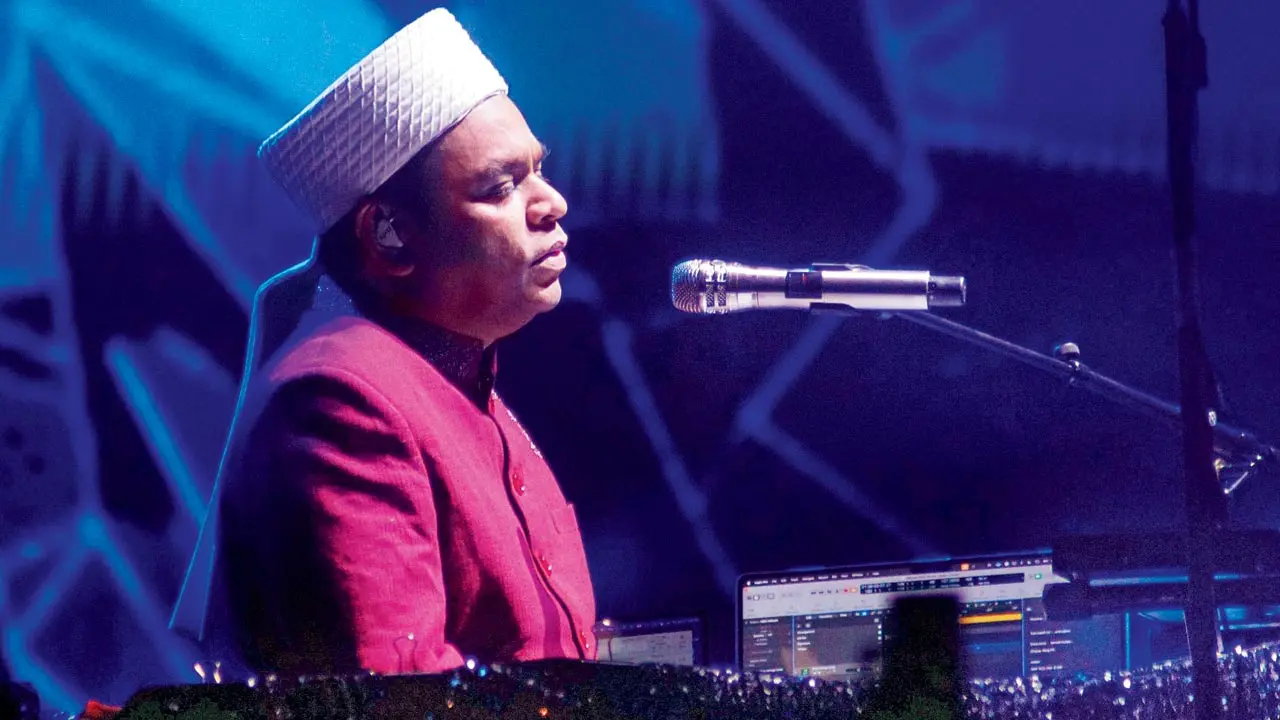
If the legendary A R Rahman is lamenting the lack of work in Bollywood, what chance do others have? Or is his dissatisfaction something that lesser-known musicians have been feeling for a while? Here’s what it takes to be in the music industry in 2026
Tanisha Banerjee (MID-DAY; January 25, 2026)
In a recent BBC interview, A R Rahman said, “Past eight years maybe I have felt that people who are not creative hold the power now. Might have been a communal thing also. Not in my face but I can hear Chinese whispers. That they booked you and the other music company funded the movie and got their own five composers.”
The reaction to his observation was instant and intense. This was not a young composer struggling to find a foothold, nor a mid-career artiste navigating irrelevance. This was Rahman — an Oscar winner, whose music has shaped the emotional memory of Indian cinema for over three decades — articulating a sense of scarcity. If someone of his stature felt the slowdown, what does that say about Bollywood’s music ecosystem?
The moment made us revisit the questions the industry has been circling for years. Is Bollywood music shrinking, or simply reorganizing itself in ways that no longer sustain most musicians? According to the latest IPRS report, film music still leads streams in India, but its share has fallen from around 80 per cent to about 63 per cent of total music consumption over the last few years — a clear sign that listeners are exploring non-film and independent music more than before. So what does “making it” even mean for a Hindi musician in 2026?
Singer, producer, and independent musician Sona Mohapatra believes the question itself needs reframing. Known for carving a career outside film music through projects like Tarasha, The Lal Pari Mastani Show, and most recently Sona 24K, which debuted to a full house at Mumbai’s NMACC Grand Theatre, Mohapatra has spent over a decade building audiences beyond Bollywood.
“I’d like to gently reframe the premise of the conversation. I don’t quite see this moment as one where musicians are trying to ‘break into’ Bollywood anymore. The ecosystem has shifted,” she says.
What is often read as exclusion, Mohapatra argues, is actually the result of a structural issue. “The film industry increasingly operates on tight timelines, formulaic briefs, and shrinking creative risk within the mainstream film music system.”
For her, the story isn’t about younger artistes replacing older ones, or social-media-friendly music displacing layered compositions. “I think it’s about Bollywood no longer being the centre of gravity. Music doesn’t need films the way it once did.”
She points instead to packed concert venues, relentless touring schedules, and artistes collaborating across regions and genres without waiting for film validation. “Artistes today can be relevant, successful, and globally visible without waiting for a film to validate them,” she says, adding that calling symphonic or layered music outdated “is missing the point.”
In Rahman’s situation, Mohapatra says, “I don’t agree that A R Rahman is being sidelined. He’s still scoring some of the biggest Hindi film projects. Chhaava (2025) went to him over cultural fits like Ajay-Atul, and he’s scoring Ramayana (slated to release in 2026), not Ram Sampath. This is not what marginalization looks like.”
For those working within film music, the shift is less philosophical and more physical. A Mumbai-based sound engineer and music producer, Krish Agashe [name changed], describes the Indian film industry, “Bollywood functions in very different ways,” he says, “People work here for a week without sleeping or anything. To get on that network, you have to get it in your mind that you are not a 9 to 5 person here. There are no time zones. There are no timelines.”
For newcomers, the entry barrier is paradoxically high and deeply unstable. “Even if you are a good musician, you are supposed to have a lot of knowledge and a lot of experience to even get hired,” he explains. The hours are punishing, pay is often modest, and visibility becomes as important as skill. “You have to be famous. The average pay scale in India is very less for music.”
Seen through this lens, Rahman’s remarks points less to exclusion, and more to an industry obsessed with momentum. Agashe says, “But it’s not like Rahman is not doing work. It’s not like Bollywood has boycotted him.” What Rahman articulated, he believes, is a loss of creative control. In a crowded, deadline-driven industry, patience for complex, time-intensive music is often the first casualty.
If the problem feels structural, Anand Iyer forces the conversation into economics. A former music producer and sound designer who worked on Gangs Of Wasseypur (2012) which won the National Film Award for Best Audiography in 2013, Iyer has exited the music industry altogether. He is now the founder and creative director of flippit.media, an AI-led content and performance marketing agency.
“After the COVID [pandemic] and Instagram, the content industry went through a major shift,” he says. “Audiences moved toward short-form, high-volume digital content. That naturally changed how much they spend on music and long-format productions.”
As budgets shrank, so did the perceived value of original music. In his view, this collapse hit everyone — Rahman included — but much later. “There isn’t the same value for music that existed before COVID as the market has now reached efficiency,” he says. “Now Mr Rahman is a little sore about the fact that he is not getting work. But nobody has work these days. And obviously, he’s more expensive.”
He frames this not as “targeting”, but timing. “It was interesting to hear Mr Rahman speak about this now, because many in the industry have been experiencing this transition and have been feeling it for a while.”
In 2024 — as per a 2025 Digital Music News research — the Indian music market’s total digital revenues dropped around 11 per cent, even as paid subscriptions grew from roughly 8 million to 10.5 million. That illustrates how monetization has become harder even while streaming remains dominant. According to Iyer, Rahman isn’t an outlier. He is simply encountering the economic reality that has already pushed many musicians out.
Composer and producer Ankur Tewari offers a recalibration rather than a rebuttal. “There are multiple ways that a director would look at who they want to work with,” he says. The idea that Bollywood music is now a young person’s game doesn’t hold for him. “I don’t believe that younger people make younger sounds or older people make older sounds. Whoever feels correct for the project — you look at the work, the budget, the availability.”
What has changed, he argues, is not struggle, but terrain. “Earlier, there was nowhere you could be seen. Now there is so much stuff, that you get lost in the noise. The circumstances have changed, but the struggles remain the same.” Tewari resists nostalgia. Rahman himself, he notes, struggled for years before landing his first major film. So did composers like Pritam and the trio Shankar-Ehsaan-Loy. “Somebody took a punt on them.”
Technology, he says, has simply widened the funnel. “It’s much easier to record music now. It’s more democratic. There’s a lot more music being created. However, the amount of music being created is not directly proportional to the amount of good talent.” In other words, saturation isn’t new. It’s just more visible now.
Varun Parikh, founder of Bay Owl Studios, a premier commercial recording and post-production facility, has watched this shift play out at close range. For him, the erosion seems contractual. “There have been times where I’ve gone completely out of my way for clients, doing work I wasn’t hired to do just to meet deadlines,” he says. “But that gets taken for granted. The moment you set boundaries, it becomes a problem.”
He also acknowledges the new reality of music as test content. “I’ve seen artistes pay for a 60-second song just to see if it goes viral. They spend good money on getting that 60-second song with a catchy hook out there. It’s almost like a tester and if it goes viral, then maybe they can sell it further or make it into a proper song. We live in a world of quick and easy gratification where everybody wants that instant dopamine hit,” he observes.
To understand how these pressures play out at the entry level, music producer Deep Gulati [name changed] describes a system that rewards recognition over suitability. “One of the obvious challenges is social media following,” he says.
“Sometimes the talent might not be appropriate for the job, but because someone has better clout, they get it. Either you have a network or a social media crowd.” Alongside clout, comes role creep. “Earlier, you were hired as a specialist. Now people are expected to know ten other things,” he says, tying this to shrinking budgets, “People are expected to do much more than just their specialty.”
That same risk logic explains why even respected composers can be priced out. “The budgets that Rahman has, not all films can afford it,” Gulati says. With trade reports showing big films failing, “projects are very risky right now”.
Smaller films simply cannot absorb that cost, “even though he might be the best choice”. “I know a couple of my friends who have walked out of a film or have done that film, but they have not publicized it at all, because ideologically, they don’t want to associate with the film for whatever reason. And if you disagree, it might be held against you,” he mentions, pointing to his anonymity.
For newcomers, the illusion collapses quickly because of the pressures of networking, branding, social media presence, and brutal work hours. “You are expected to pull in crazy amounts of hours at work that people are not really used to. People are fed the idea that it’s glamorous, but it’s actually an extreme level of hard work,” adds Gulati.
Rahman, then, is not a victim of a hostile industry so much as a late mirror to a reality many musicians have already absorbed. As Iyer puts it bluntly, “I don’t think this reflects anger or division but how strongly technology and consumption patterns have shifted. I think he’s just getting old and angry now. It’s misplaced frustration in my opinion.”
What Rahman is feeling now, Iyer argues, is what his team felt earlier when budgets collapsed and copyright value dropped. “People were surprised when I pivoted out of music, but it was a strategic choice. I’d encourage young people today to study where the market and technology are heading, and then learn their craft in a way that fits those realities. Art still matters, but it has to align with how the industry is evolving,” he says.
Agashe’s description of Bollywood as a “superhuman network” fills in the human cost behind that shift. “You have to know a lot of people in the industry to make a mark. You have to be famous. Hit makers are what Bollywood needs. And it’s all about creators being able to deliver that,” he states. Fame becomes currency because pay isn’t. “It’s about relevance, about delivering in the present era.”
Rang De Basanti has turned 20 years younger instead of 20 years older-Rakeysh Omprakash Mehra
10:54 AM

Natasha Coutinho (HINDUSTAN TIMES; January 26, 2026)
As Rang De Basanti completes 20 years today, the film’s music, composed by A R Rahman, continues to resonate across generations. From Luka Chuppi, voiced by the late Lata Mangeshkar, to Masti Ki Paathshala, the soundtrack remains as popular as ever.
Reflecting on the milestone, filmmaker Rakeysh Omprakash Mehra, who directed the film, says, “I believe the film has turned 20 years younger instead of 20 years older.”
Recounting memories from the making of the film, the 62-year-old says, “Just when we were to shoot the film I had a severe case of jaundice and was hospitalized but we started rehearsals since I had everyone’s dates locked. So I believe blessings come in disguise,” he says.
Mehra adds that much of the film’s music was conceptualized early on: “We had the film recorded like a radio program before we started shooting. I took that recording to A R Rahman in Chennai. He sat on his piano and started making the track based on the recording. The process with A R is, we talk a lot about the film, the characters and the reason I’m making a film. We enjoy meals together, go from drives and music just happens”
Sharing trivia about Luka Chuppi, Mehra reveals it was never part of the original plan: “The film was complete and we were doing the background music. When A R saw the scene he just stopped and composed that song.”
Playing down the recent controversy around Rahman’s remarks about his reduced workload, Mehra focused instead on the timelessness of the composer’s music, saying, “I love his music, good work is timeless. When you listen to songs by composer-duo Shankar-Jaikishan, singer Mohd Rafi and lyrisict Gulzar, you savour it. We are blessed that AR has given us such beautiful music.”
Mithoon comes out in support of A R Rahman amid 'communal' remark controversy: "He has every right"
3:13 PM

Priyanka Sharma (MID-DAY; January 23, 2026)
A R Rahman may be a man of few words, but he understands the power of them. Over the past week, the Oscar-winning musician has been at the receiving end of relentless backlash for his comments in an interview with BBC Asian Network.
During the interview, when asked about prejudice in the Hindi film industry, he said, “People who are not creative have the power now to decide things. And this might have been a communal thing also, but not in my face.” Since then, the musician — easily one of the brightest talents in the Indian music industry — has been trolled and termed “anti-national” for his communal bias remark.
Weighing in on the controversy, his colleague and Bollywood composer Mithoon has come out in Rahman’s support. “I have grown up looking up to Rahman sir. He was the man who threw every textbook rule out of the window, yet created a powerful impact in our industry,” Mithoon told mid-day, of the composer who, over a three-decade-plus career, has given hits like Roja (1992), Rangeela (1995), Guru (2007), and Rockstar (2011).
In 2009, he became the first Indian to win the Golden Globe Award for Best Original Score for Slumdog Millionaire (2008), following it up with two wins at the Academy Awards for the same movie.
Mithoon firmly stated that the Mozart of Madras is entitled to his opinion. He shared, “It’s been over three decades, and the country continues to love him. He has every right to say what he felt. All I can say, as his contemporary, is that this country will continue to love him. There can be no other A R Rahman.”
Rahman’s remarks were met with such vitriol that he had to issue a clarification. Calling India “my inspiration and my home”, he said, “I understand that intentions can sometimes be misunderstood. But my purpose has always been to uplift, honour, and serve through music. I have never wished to cause pain.”
When we asked Mithoon if he had experienced power shifts in the industry, he replied, “I haven’t experienced anything like this [but] this must be happening in every field. For instance, copywriters feel their bosses don’t understand what they are doing or directors feel that producers don’t understand. Ultimately, our job is to engage the audience with our art.”
A R Rahman reacts to debate around his BBC interview: "India is my teacher and my home"
9:09 AM

BOMBAY TIMES (January 19, 2026)
Oscar-winning composer A R Rahman issued a video statement on Sunday, expressing gratitude for his Indian identity. The statement comes in response to the debate that followed his recent interview with BBC Asian.
“Indian music has always been my way of connecting, celebrating and honouring our culture. India is my inspiration, my teacher and my home. I understand the intentions can sometimes be misunderstood, but my purpose has always been to uplift, honour and serve through music. I’ve never wished to cause pain, and I hope my sincerity is felt. I feel blessed to be Indian, which enables (me) to create a space which always allows freedom of expression, and celebrates multi-cultural voices,” Rahman said in the video.
Rahman added that being Indian has enabled him to create artistic spaces that encourage freedom of expression and celebrate multicultural voices. In the video, he also spoke about nurturing Zhaala, his new raga-based music ensemble unveiled at the WAVES Summit last year. He spoke of his efforts to support young Naga musicians and discussed his work on the upcoming Ramayana project alongside international composer Hans Zimmer.
Rahman shared that each journey strengthened his purpose, adding, “I remain grateful to this nation and committed to music that honours the past, celebrates the present and inspires the future. Jai Hind, and Jai Ho.”
Background
Rahman’s statement comes days after his interview with BBC Asian Network , during which he noted that less work has been coming to him due to a power shift within the Hindi film industry in recent years.
He said in the interview, “I’m not in search of work. I want work to come to me; the sincerity of my work to earn things. I feel it’s a jinx when I go on in search of things... People who are not creative have the power now to decide things and this might have been a communal thing also but not in my face. It comes to me as Chinese whispers that they booked you but the music company went ahead and hired their five composers. I said, ‘Oh that’s great, rest for me, I can chill out with my family.” The reference to a communal angle has led to a lot of debate within the film industry and outside.
Responding to a question about working on the soundtrack for Ramayana (along with Hans Zimmer) as a Muslim man, Rahman said, “I studied in a Brahmin school. Every year, there was Ramayana and Mahabharat. So, I know the story. And the story is about how virtuous a person is, higher ideals. I value all the good things,” adding, “It is from India to the world. With Hans Zimmer, who is Jewish, I am Muslim and Ramayana is Hindu.”
----------------------------------
HINDUSTAN TIMES (January 19, 2026)
Days after receiving backlash over ‘communally divisive’ remarks, Oscar-winning music composer AR Rahman has broken his silence.
In a video posted on Instagram on Sunday, the 59-year-old described India as “my inspiration, my teacher and my home”. He added, “I understand that intentions can sometimes be misunderstood. But my purpose has always been to uplift, honour and serve through music. I have never wished to cause pain, and I hope my sincerity is felt.”
Rahman also cited his work with ensembles such as Jhalaa, Rooh-e-Noor, collaborations with young Naga musicians, mentoring the Sunshine Orchestra, creating Secret Mountain, India’s first multicultural virtual band, and scoring the Ramayana as examples of his efforts to celebrate diverse voices.
He ended his statement with, “I remain grateful to this nation and committed to music that honours the past,” and footage of a stadium full of people singing along to his song Maa Tujhe Salaam/Vande Mataram.
This comes after Rahman’s comments in an interview with the BBC Asian Network, where he was asked about feeling prejudice in Bollywood as a Tamil composer. He had said, “The past eight years, maybe, because a power shift has happened, and people who are not creative have the power now. It might be a communal thing also… but it is not in my face.” He had also criticized Chhaava (2025) for cashing in on ‘divisiveness’.
Celebs react to A R Rahman's 'communal bias' remark
3:05 PM

A R Rahman hints at losing work in Bollywood due to bias. Industry veterans reject the claim, praising his talent and success
HINDUSTAN TIMES (January 18, 2026)
Oscar winner A R Rahman is considered one of the best Indian musicians. His work has garnered global acclaim. So when he says he lost out on work in India due to communal bias, people are bound to notice.
In a recent BBC interview, when asked if he faced any prejudice in the Indian industry when he started out in the 1990s, Rahman indicated that he has felt communal undercurrents lately. However, his industry colleagues have rejected Rahman’s doubts. HTC
JAVED AKHTAR, LYRICIST
Javed Akhtar told IANS, “I have never felt this way. I meet people here in Mumbai. They have great respect for him. Rahman is such a big man. Even a small producer is afraid to go to him. But I don’t there is any communal element in this. Why don’t you see him? He will definitely come.”
ANUP JALOTA, MUSICIAN
Singer Anup Jalota has also dismissed Rahman’s remarks that the latter is getting less work because of communal bias against him. “This is absolutely not true,” Jalota said adding that the amount of work that Rahman has done in 5 years is what others do in 25 years. “What more can be said… He has done a lot of work and delivered excellent projects,” said Jalota.
SHAAN, SINGER
Shaan told IANS, “I have been singing for many years and am not getting much work, but I don’t dwell on it. I don’t think there’s any communal angle. In music, what matters is doing good work and making good music, not worrying about such things.”
A R Rahman, Composer
“Maybe I never knew, or it was concealed by God, but I didn’t feel it. In the past eight years, maybe, because the power shift has happened… People who are not creative have the power now to decide things, and this might have been a communal thing also, but not in my face. It comes to me as Chinese whispers that they booked you, but the music company went ahead and hired their five composers. I said, ‘Oh, that’s great, rest for me, I can chill out with my family.”
A R Rahman steps into acting with Prabhudheva’s next; to play a filmmaker
9:32 AM

Roopa Radhakrishnan (BOMBAY TIMES; December 31, 2025)
Even though A R Rahman has made brief appearances in films, the Academy Award winner is all set to take up his first acting role in the Prabhudheva-starrer upcoming comedy, Moonwalk. Interestingly, he will be playing a film director named A R Rahman.
The film’s director, Manoj Nirmala Sreedharan, tells us, “When I pitched the idea to him, AR sir was game for the new experience. I told him the movie will be fun, and he said, ‘Let’s do it.’ He is extremely busy, but still took time away from all his projects and did this film.”
He adds, “Prabhu sir and Rahman sir are collaborating after so many years. So, there is so much excitement even for the two of them. It was that excitement that Rahman sir liked more than anything else.”
‘The entire set was happy to see him act’
Sharing the experience of having Rahman as an actor on the set, Manoj says, “Prabhudheva sir, who is a director himself, was laughing watching Rahman sir perform. He enjoyed how natural Rahman sir’s acting was. Actually, the entire set was happy to see him act. We could see he was having fun, and I also think that has translated on screen.”
You wouldn’t get 12 cinematographers to shoot your film. So, why do you get 12 composers?-Shor Police
9:55 AM

Clinton Cerejo and Bianca Gomes
Having composed for ‘Baramulla’, music band Shor Police questions Bollywood’s norm of roping in many musicians for a project and overlooking the background score
Priyanka Sharma (MID-DAY; November 24, 2025)
What started with a song turned into a full-fledged score for the movie. While Clinton Cerejo and Bianca Gomes, who form the band Shor Police, weren’t sure they had the time to go beyond composing the songs for Baramulla, the outpouring of love over the last 15 days has validated their decision. In a chat with mid-day, the duo talks about creating the soundscape of the Netflix horror film. Excerpts from the interview.
Take me back to when Baramulla came your way.
Gomes: Initially, we were called on board to only compose one song. After we saw the film, we were asked to do the score. Since it was a tight timeline, we were apprehensive. But the film was so beautifully shot that we were happy to adjust our schedules and meet the deadline.
What was director Aditya Suhas Jambhale’s brief?
Cerejo: Aditya was one of the most open directors we came across. He had a temp [temporary] score, but he was eager to hear what we have. That’s rare because often directors get so used to the temp score that they find it difficult to disconnect from it. [For them] nothing you do will match up to that score, because they’ve lived with it for so long.
Gomes: He wanted the music to sound new. In horror films, you have the same kind of music and the audience is led in a certain way. So, it’s easy to go down that same path. But Aditya wanted the music to be a reflection of the landscape. We’ve used instruments like the rabab.
Background score has been overlooked so much that if a musician’s name is attached to a project, it’s believed they only composed the songs. What’s your take?
Cerejo: When you think of movies, you think of the songs associated with them. Nobody used to talk about a film’s background score. As a result, even if composers got to do the background score, they’d feel it’s not worth spending their time. Composers like Shankar-Ehsaan-Loy and A R [Rahman] do both. In Bollywood, when you say that someone is a film composer, you’re most likely referring to the one who has composed the songs. In Hollywood, film composers are those who do the background score. Here, the score has been largely ignored not just by the public, but also by the industry. [People] don’t want to be score composers because they don’t get the respect they deserve.
The issue is also the [concept] of multiple composers in a film. You wouldn’t get 12 cinematographers to shoot your film. So, why do you get 12 composers?
Whenever I see two musicians together, I think, ‘How do they manage to be in tune with each other?’ Do you two fight?
Gomes: Oh, a lot!
Cerejo: One of us will walk out of the studio, mostly me (laughs).
Gomes: Musicians in a band are always having creative differences. So you can imagine how many differences there will be when two people are in charge of writing a song. But when you team up with someone, you have to make room for their opinions. I give Clinton credit for that because it takes a lot of openness from someone, who is more experienced, to say, ‘We are a team.’ If you can’t leave your ego at the door, you’ll have a problem.
I made Rangeela because of Urmila Matondkar-Ram Gopal Varma
8:40 AM

Renuka Vyavahare (BOMBAY TIMES; September 11, 2025)
Thirty years after its release, Ram Gopal Varma’s iconic Rangeela still enchants the audience with its blend of sweetness, sensuality and cinematic magic. The film has been restored in 4K and will be rereleased in India theatrically on October 10. We caught up with RGV to discuss his celebrated film, featuring Mili (Urmila Matondkar), Munna (Aamir Khan) and Raj Kamal (Jackie Shroff). Excerpts:
Rangeela was a sleeper hit. Did no one expect it to succeed the way it did?
Around that time, Aamir’s films hadn’t worked. Urmila’s films also didn’t work. I am from the South, so no one really knew what to expect from this film. In fact, even the music was a new form. Rangeela’s songs didn’t sound like the hit film songs of that time. Whenever something new comes, people tend to get disoriented, but by the time the release came close, the music caught on.
Munna’s “AC idhar ghuma, kanda kaatke la” dialogue is remembered even today, among other special moments from the movie. Three decades later, what do you think gives Rangeela its lasting appeal?
Huge credit to writers Neeraj Vora and Sanjay Chhel. What really makes a film last is how unforgettable its characters are, because no matter how much time goes by, human emotions remain the same. With Munna (Aamir Khan), Mili (Urmila Matondkar) and Kamal (Jackie Shroff) still etched in our minds, the passage of time doesn’t matter anymore. The story of Rangeela will find appeal today or 30 years before it was made.
What inspired you to make Rangeela?
Cinematically, I would say my inspiration was the 1960s Hollywood musical, The Sound Of Music. Although it’s not the same story, Rangeela is also a love story where there’s no conflict at all. There is no antagonist either. Everyone is nice – Mili, Munna and Kamal. There’s not a single bad person, but the situation creates the conflict. I love the aspect that Rangeela is a sad kind of a story where your heart goes out to Aamir, but at the same time, you can’t really hate the other person either.
You have made some memorable films with Urmila. Do you consider her your muse?
When you’re working together for a long time, and especially when a film becomes so successful, you tend to make the next film with the same actor.
Urmila can give versatile expressions, which I realized after seeing her in the song Hai Rama. That’s the reason I cast her in such a wide variety of films – a horror film like Bhoot, the gangster film Satya and a caper like Daud. I made Rangeela because of her. Why I wanted to make Rangeela was because I felt inspired seeing a song of hers in my Telugu film (Drohi with Nagarjuna). The origin of Rangeela stemmed from my desire to showcase Urmila’s sensuality and her beauty. She had never worn such revealing clothes in the films she had done before that, but I told her, if you feel beautiful about your body, you shouldn’t be conscious. That bindaas attitude, the fact that she’s not aware of herself, and the fact that she’s not intending to create an effect on somebody else created a wild, animal-like, exotic feeling in the audience. The most memorable aspect of Rangeela was to look at Urmila through the camera.
On roping A R Rahman for Rangeela’s music
When I heard the songs of Roja, I was blown away. The kind of new sound, packaging and production that Rahman created was something no one had ever heard. It was inspiring for me to capture that visually. When the music is generic, everyone from the choreographer to the actor comes up with a predictable output, but because it was so unpredictable that no one had a choice but to reinvent themselves.
I was pushed into directing Fiza after plans with Ram Gopal Varma fell through-Khalid Mohamed
9:31 AM
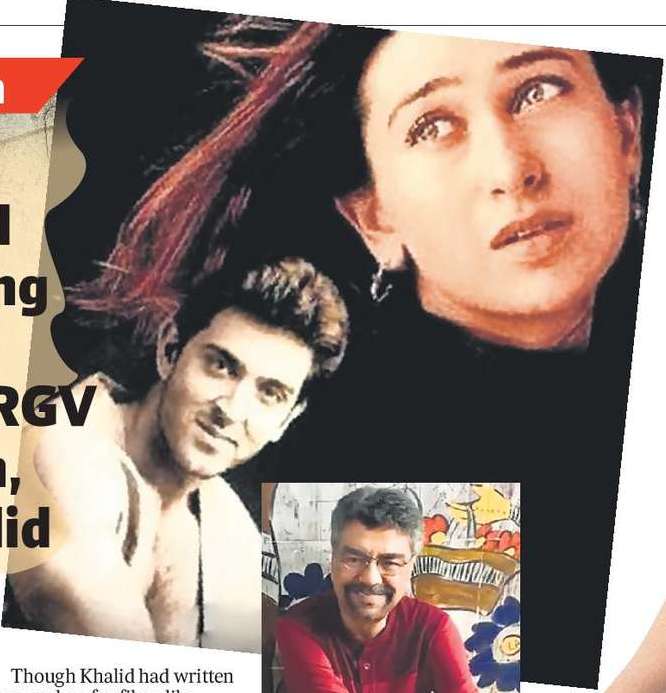
S Farah Rizvi (HINDUSTAN TIMES; September 8, 2025)
Fiza, released in 2000, celebrates its 25th anniversary today. On this milestone, the film’s writer-director, Khalid Mohamed, shares, “These 25 years seem like yesterday. Looking back, there’s a sense of self-fulfilment and pride.” He calls actors Karisma Kapoor a “dream to work with” and Hrithik Roshan the “most immersive” actor.
Khalid says he wasn’t meant to helm the film originally but was “pushed into directing” after filmmaker Ram Gopal Varma, the first choice, didn’t work out. It was cinematographer Santosh Sivan who stepped in with a suggestion: “Why don’t you direct it yourself?” Later, Karisma also joined Santosh in encouraging Khalid.
Though Khalid had written screenplays for films like Mammo (1994), Sardari Begum (1996), and Zubeidaa (2001), directing had its own challenges: “Of course, there were some tough days, like when we didn’t have enough resources to show a large room.”
Funding was also major concern until a new producer came on board. “The film had been started with loans derived from friends by co-producer Pradeep Guha and myself,” Khalid explains.
Sharing how the music became a huge asset to the film, he muses, “I lucked out.” Anu Malik “was in his element”, and A R Rahman composed Piya Haji Ali for free. Gulzar’s lyrics for Aaja Mahiya also “worked wonders for the song,” Khalid adds.
Shabana Raza Bajpayee: My goal was to get more scenes
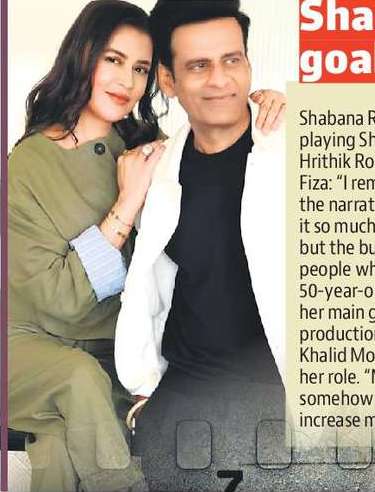
Shabana Raza Bajpayee recalls playing Shehnaz Sulaiman, Hrithik Roshan’s love interest in Fiza: “I remember when I got the narration of the story. I liked it so much, not just its canvas but the bunch of talented people who were involved .”
The 50-year-old actor reveals that her main goal during production was to get director Khalid Mohamed to broaden her role. “My only aim was to somehow persuade Khalid to increase my scenes, as I loved the story so much and, like any other aspiring actor, I wanted to be there in more frames,” Shabana explains, adding, “No one could deter him even a bit from the original plot.”
She also reflects on working with her husband, actor Manoj Bajpayee, who played Murad Khan. “Manoj had a small but memorable role,” she says, adding, “Every character was an anchor to the story in their own way; that’s what makes the film more special.”
I'm far from done. There's so much to learn, so little time, says Asha Bhosle on her 92nd birthday
9:23 AM

Asha Bhosle with a young A R Rahman
Renuka Vyavahare (BOMBAY TIMES; September 8, 2025)
Beginning her musical journey at the tender age of 10, Padma Vibhushan Asha Bhosle has built an illustrious career spanning over eight decades. A force to reckon with, she is celebrated for her immense talent, versatility, and, above all, her remarkable ability to adapt and evolve with the times. A Guinness World Record holder for being the most recorded artist in music history, Asha Bhosle's enduring legacy is not just rooted in her distinct voice or range—but in the indomitable spirit that continues to define her and her longevity. As she turns 92, she opens her heart, reminiscing about a legendary journey and the timeless landmarks along the way in a heartfelt exclusive with Bombay Times.
'Quite contrary to my public image, I am reclusive'
I am 92-years-old and I take this opportunity to thank all my well-wishers who have supported me in my long journey. Had it not been for your love, I wouldn’t have made it this far. Every time I hear your applause, it pushes me to go further and test uncharted territories in this vast ocean of music and art. Quite contrary to my public image, I am reclusive at heart. I am shy to discuss my achievements because I have so much more to learn in so little time.
'Cinema’s popularity brought an end to the golden era of theatre'
Prior to the advent of cinema (silent cinema then talkies), the only public entertainment platform was theatre. My wonderful actor, singer, composer and writer father, Master Dinanath Mangeshkar owned his own travelling theatre company. I, along with my four siblings (Lata Mangeshkar, Usha Mangeshkar, Meena Khadikar and Hridaynath Mangeshkar) travelled with the theatre company all over India where my father performed these grand musicals to a rapt audience. Therefore, I grew up in an atmosphere of music and the performing arts. It was great that Dadasaheb Phalke laid the foundation of cinema in India but as cinema rose to prominence over the years, our theatre company sadly folded. Soon after, my father passed away in 1942 at the height of The Quit India Movement.
'Looking back: How my journey began'
In 1943, World War II was raging in Europe and that’s when I recorded my first Marathi song at the age of 10. Around this time the Battle for Stalingrad in Russia was in full swing. My first record label read ‘British India’. World War Two era was one of rationing and hardships and we often slept on empty stomachs. I remember attending a political rally at Shivaji Park in Mumbai where I first saw Mahatma Gandhi and I was very impressed by his speech and other leaders such as Jawaharlal Nehru, Sardar Patel and Abdul Ghaffar Khan. The partition of India in 1947 was a painful experience for many Indians, but we managed to live through that as well.
‘Sometimes I recorded as many as seven songs a day’
When I moved to Mumbai, (then Bombay), the British had left it in pristine shape. It was a grand city, and I was in awe of it. I loved travelling on trams, trains and buses hopping from one studio to the next. Working in the emerging music industry (termed Bollywood today) was full of new experiences. As people heard me sing, more work came my way. Sometimes I recorded as many as 7 songs a day. Years later, I was informed that I had got a mention in the Guinness World Records as the most recorded artist (around 11,000 songs). Honestly, I did not work to break any records.
‘My husband Rahul Dev Burman was the finest musical genius of our times’
Music evolves every decade or so. According to me, the first music composer who brought a new exciting western sound to Hindi cinema was C Ramchandra. He experimented with Rock and Roll and took a leaf out from Bill Haley and Elvis Presley’s style of music. Suddenly, that was a rage, and I adapted to this western style to keep up with the times. Then came OP Nayyar with his rustic Punjab folk music sound which went through the roof. I adapted to this style as well and remained relevant. Post O P Nayyar, came the finest musical genius of our times; my late husband Rahul Dev Burman (a prince by birth from the royal family of Tripura, but an Emperor by his deeds). RDB’s revolutionary style of compositions, sound, technique are admired even today. R D Burman passed away in 1994 and a year later in 1995, another musical genius A R Rahman unleashed a fresh new brilliant sound on an unsuspecting audience through Rangeela. When I sang Rangeela Re and Tanha Tanha Yahan Pe Jeena for him, I was 62 years old! I thank ARR for bringing the best out of an elderly person.
'Dekhi Zamane Ki Yaari, Bichhde Sabhi Bari Bari'
I take this opportunity to remember the wonderful singers that I have worked with…my older sister Bharat Ratna Lata Mangeshkar, Padma Shri Mohammed Rafi, Shri Kishore Kumar, Shri Manna Dey, Shri Mukesh, Shri Hemant Kumar, Smt Geeta Dutt, Smt Shamshad Begum and the list goes on. I shared a great rapport with them, not only as colleagues but also as close friends. I recall one common factor between all these great artists - they were all simple human beings without a nasty bone in their system. Unfortunately, most of my close friends and colleagues have passed away and I mourn their loss, a void that can never be filled. On this note, I recall Rafi Saab’s famous song; composed by the late Sachin Dev Burman and penned by the late Kaifi Azmi Sahab…Dekhi Zamane Ki Yaari, Bichhde Sabhi Bari Bari…!
'I am not done yet'
Since my name is Asha (hope), I would like to conclude by saying, I am not done yet. On 12th Sep ‘25, a song sung by me with a very popular British Band shall be launched. I am happy to say that whenever musical boundaries were being broken, I remained the common thread for experimentation by all these great composers of extraordinary calibre. I’m proud to see the growth of my granddaughter Zanai, who is a music composer, writer, singer, classical dancer and an actor. As Mr. AR Rahman recently remarked; that my family (Mangeshkar / Bhosle / Burman) has done nothing but music for 4 generations. He went on to add that this family knows nothing other than music. I take that as a compliment.
For us, it’s a matter of pride if Pardesiya even gets compared to A R Rahman's work - Sachin-Jigar
10:41 PM
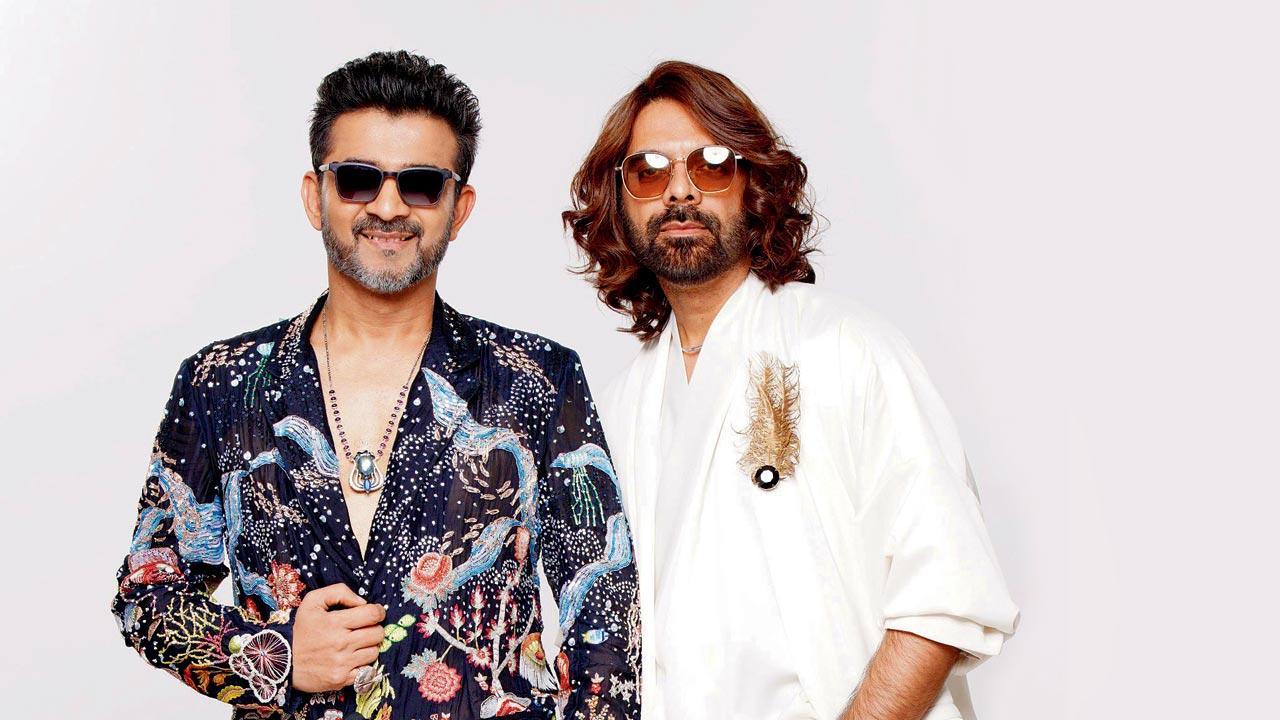
As listeners say that ‘Pardesiya’ is influenced by AR Rahman’s music, Param Sundari composers Sachin-Jigar reflect on how the album is their tribute to the maestro. They also share that they are proud that their work is being compared to A R Rahman's
Mohar Basu (MID-DAY; August 25, 2025)
Few composer duos in Hindi cinema today straddle madness and melody as deftly as Sachin–Jigar. Over the past decade, they’ve swung between quirky tracks like Kamariya, romantic numbers like Mileya Mileya, and chartbusters like Aaj Ki Raat. Ahead of their latest outing, Param Sundari, the duo talks about their mindset, music, and their tribute to the master. Excerpts from the interview.
What’s the secret of a long-term collaborative equation?
Sachin: It is destiny. We never sat in business meetings to plan this partnership — it just happened. I first met Jigar to share some workload, and there’s no way two people living so far apart could’ve just decided to become a jodi. It feels like something beyond us put us together. Let me give you a recent anecdote: I needed Jigar not just as my business partner but as family, and he came through for me. That’s when I realised I admire him beyond music. He’s five years younger but has this politeness, manners, and ability to communicate that I really look up to. He’s also the rebel in our duo, the one who pushes.
Jigar: The common thread between all of us is that we’re mad but sane enough to know that we’re mad! Otherwise, who decides to make a song “Baba Ji Ki Booti”? And when we did that track, everyone sang — Raj, DK, Anand, Kunal, me. Whoever was in the room. None of us was in it for stability. I think it’s that madness that connects us and keeps us together.
Last year was stupendous for you, with Aaj Ki Raat becoming 2024’s most-streamed song. When you start a new project after such a success, what is your mindset?
Sachin: Jigar doesn’t sleep — and he doesn’t let anyone else sleep either! (laughs) For him, the moment a song works, that gate is closed. He won’t allow us to repeat ourselves in the same way. That forces us to think differently, and that’s why we’ve managed to stay versatile. For me, that success gave me a certain ease. I’ve lived through the struggle of not finding popularity, so to be on the other side feels nice. But we were never in the game for just hits or flops. We came here to make good music, and even after success, that hasn’t changed.
Our mantra is never to define a “Sachin–Jigar sound.” We don’t want people to say, this is exactly what they always do. We move on, leave that sound behind, and try something new. If others want to pick it up, great. If not, no problem. That’s why after Stree 2, we thought, okay, we’ve done the madness in Stree, we’ve done dance numbers, now how do we break out again? That’s how Param Sundari happened. It’s become an unplanned pattern with us — one big dance number, then one big love song, then something unexpected.
Jigar : We’re also conscious of not getting typecast as “the commercial dance anthem guys.” So if we’ve just done a massive dance track, next time we’ll want to balance it with a love song or something soulful.
When the Param Sundari teaser dropped, it went viral, with Sonu Nigam’s voice everywhere on social media. How did that feel?
Sachin: A day before Jigar and I flew to Dubai for the Param Sundari music session, Dinesh Vijan called us to his office and told us this is a once-in-a-lifetime opportunity. Instantly, [A R] Rahman sir started playing in my head. Roja [1992] changed my life forever — if I’m a composer today, it’s because of those five years of listening to him. So working on Param Sundari felt like living a dream.
Jigar: South Indian music has also inspired us a lot because it stays rooted in its culture. Even in the most commercial films, you’ll hear classical influences. I trained in classical singing for 10–12 years, and often had to “unlearn” some of it to compose for cinema. But “Param Sundari” brought everything we wanted together, it felt like a dream we didn't want to wake up from. As for Sonu Nigam: growing up, albums like Yaad, Deewana, Jaan were my everyday listening. First it was a dream to see him live, then to hear him sing songs we produced. The first track we ever programmed was sung by Sonu Nigam. That was already a big moment.
But as composers, we never got to record him again. We always kept it inside us. One day, we have to make a tune worthy of his voice. I was such a huge fan, I would literally pray to him before going to school! (laughs) So when we composed Param Sundari, we both knew deep down: this is it. We didn’t even say it out loud to each other, but we knew this was the song for Sonu Nigam.
We called him, he heard it, came to the studio, and recorded it in half an hour. It was magical. For us, it’s the greatest tribute — to have the man who inspired us be part of our music. Recently, he called and told us how much love he’s receiving for the song. To hear that from your idol — that’s the biggest moment of the year.
With the first track going viral, the flip side is that the rest of the album has to match up. Do you worry about how people will receive a song?
Jigar: Definitely the latter. That’s not our job. Once we put our music out, it belongs to the audience. As fellow creators, we may form opinions, but as listeners, people have the right to completely own or dismiss what we make.
We learned early in our careers to detach ourselves from the fate of a song. It hurts when a track you love doesn’t do well, but once you release it, it’s no longer yours. You’ve shot the arrow, and it’s out in the world. What feels “good” to me might not land with someone else, and that’s okay. So yes, we’ve made peace with it. Especially today, when there’s such great indie music and such strong new artists coming through, we’re not greedy. We just try to give our best and then leave it to the universe.
Has it happened that you expected a song to be a big hit and it didn’t catch on?
Jigar: Many times! One example is Happy Ending [2014]. The album actually caught on months later. At release, it didn’t get the traction we hoped for, though we felt it was a true coming-of-age album in terms of sound and concept. The first song, Jee Phaad Ke, generated noise, but the other tracks didn’t bloom immediately. And because once a producer sees one song breaking through, he’ll naturally invest all his energy and money into pushing that one, the rest often get sidelined. We always believed the album would find its way — and it did, but very late. There are other examples too. A beautiful song like Pinjra Tod Ke in Simran, or Hoor in Hindi Medium with Atif Aslam. We thought they’d immediately catch on. They didn’t at first, but later people came back to them, and now they even request us to perform them on shows.
Sachin: It’s a part of the game. That’s why having the first song of an album break through is actually a huge victory. Because imagine if you’re waiting until the fourth track for something to click — by then the producer may lose hope, and the entire album can collapse.
Jigar: For us, every film’s music carries big stakes. Actors want to be seen in a good light, producers are investing heavily, directors have worked hard. If the first song doesn’t land, there’s panic. And in those moments, you have to put art aside and think practically: we have to make this work. When the first track works, it also gives us the liberty to experiment with the rest of the album. For example, because Stree worked, we could make Stree 2 completely different — even put a ghazal on a beat. That was a risk, and it only happened because the first one clicked. So yes, we’ve learned that “first song tracking” is the safer and better place to be in, even if the others don’t explode in the same way.
Dinesh Vijan, Amitabh Bhattacharya and the two of you almost function like a unit. And every time this unit comes together, it delivers. What makes it work?
Sachin: Dinesh is extremely critical of his own work, and Amitabh Bhai is the same. He’ll come back after six days to change just one word in the last line of an antara, or fight with us about a line even before a shoot mix is delivered. That level of self-criticism keeps the bar high.
The truth is, at the end of the day, no matter how many aspirations or ideas we all come in with, there’s only one song to be made. That perspective keeps us grounded. We keep checking each other.
Dinesh loves to experiment — he’ll come to us with a reference, or say, “Here’s this Afro-inspired song, can we make it a love track?” He’s always hustling, always infusing new ideas. Jigar, as I’ve said, is the rebel — he refuses to repeat himself, and he shares a bond with Dinesh that goes beyond work, which makes them almost like brothers.
Jigar: For me, I try to stay objective, to keep perspective when things get too passionate. And Amitabh Bhai has this magical ability to bring in a word or phrase that sparks a whole song. Among the four of us, someone always has the starting point.
Because this unit has delivered before, we have the courage to keep pushing further — to take one more risk, one more step. The balance of being able to check each other and push each other is what keeps us both grounded and moving forward.
Also, we’ve been through failures together — films that didn’t work, songs that vanished without a trace. That’s why now, even if something doesn’t work, it doesn’t shake the association. Our bond isn’t dependent on hits. It’s dependent on whether we’ve fulfilled each other’s creative soul. If between the four of us, we’ve inspired and satisfied each other creatively, then that’s success, no matter how far the song travels.
On social media, people are calling Param Sundari’s music derivative and influenced by A R Rahman. Do you worry about that?
Sachin: Never. From the beginning, this song came from a place of pure art, dedication, and a tribute to the master. For us, it’s a matter of pride if one of our songs even gets compared to his work. I look up to Rahman sir not just for his work, but for the person he is. On the inlay card of his first independent album [Vande Mataram], he wrote: ‘Hope to become the song of an independent India.’ That’s the man we’re paying homage to.
Jigar: When people say Param Sundari feels familiar, for us, familiarity isn’t bad. Familiarity can make you feel at home, and once you’re there, you can surprise the listener with new things hidden inside.
Asha Bhosle's granddaughter Zanai Bhosle on working with A R Rahman: "I learnt from my grandmother to be individualistic"
9:35 AM

Asha Bhosle’s granddaughter Zanai, who is part of AR Rahman’s The Wonderment Tour, on how her association with the legends is enriching her as a singer
Mohar Basu (MID-DAY; August 4, 2025)
Music has a way of binding generations together. Singer Zanai Bhosle understands that now more than ever. The singer has joined A R Rahman, as he takes his The Wonderment Tour across the US. She is collaborating with the maestro, with whom her grandmother Asha Bhosle had teamed up three decades ago for the iconic album, Rangeela (1995).
“When I found out about the possibility [of working with Rahman], I was out of words. At the same time, I felt a huge responsibility because Rahman sir has crafted such beautiful melodies and my grandmother has delivered such perfection in her songs. I didn’t want to fall short,” starts Zanai, 23. What gave her confidence was Bhosle and Rahman’s faith in her. “They both said that I should sing in my own style.”
She performed at The Wonderment Tour’s opening concert at the D Y Patil Stadium in Navi Mumbai on May 3. “That day was a life-changer. Both songs I sang were well-received by the audience and I had a huge sense of relief, happiness, and accomplishment.”
Since then, Zanai has been rehearsing relentlessly with Rahman’s group. Having worked closely with the composer, she says about him what everyone does — that his creations are “magic”. Every musician evolves over time, and so has Rahman.
When we ask how he is different as a collaborator, compared to what she heard about him from her grandmother, she says, “There can be no one like Rahman sir. Anyone who is around him will automatically be inspired to be a better musician. Every minute you learn something new.”
An equally strong influence on Zanai is her grandmother. “The one thing I learnt from my grandmother is to be individualistic. She says, ‘Sing like yourself and do what you think is right.’”
Subscribe to:
Posts (Atom)