A R Rahman talks about lack of work in Bollywood; musicians, producers dive into the Indian music industry
9:48 AM
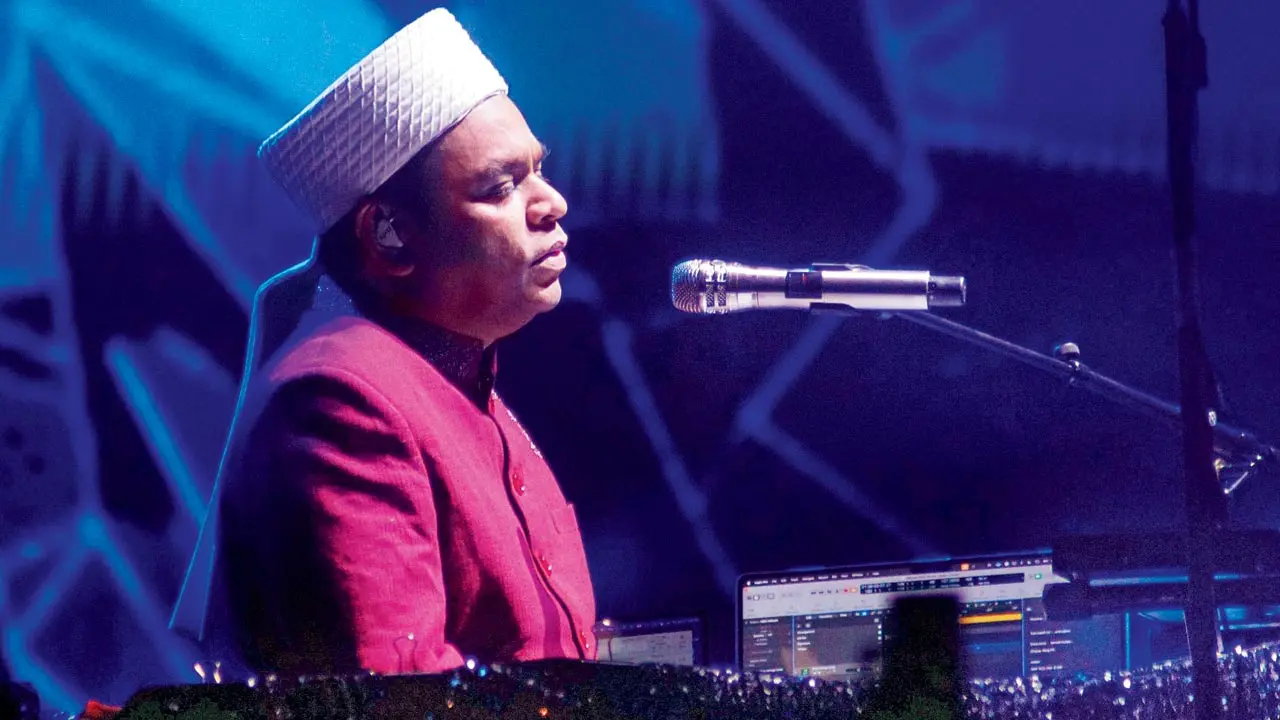
If the legendary A R Rahman is lamenting the lack of work in Bollywood, what chance do others have? Or is his dissatisfaction something that lesser-known musicians have been feeling for a while? Here’s what it takes to be in the music industry in 2026
Tanisha Banerjee (MID-DAY; January 25, 2026)
In a recent BBC interview, A R Rahman said, “Past eight years maybe I have felt that people who are not creative hold the power now. Might have been a communal thing also. Not in my face but I can hear Chinese whispers. That they booked you and the other music company funded the movie and got their own five composers.”
The reaction to his observation was instant and intense. This was not a young composer struggling to find a foothold, nor a mid-career artiste navigating irrelevance. This was Rahman — an Oscar winner, whose music has shaped the emotional memory of Indian cinema for over three decades — articulating a sense of scarcity. If someone of his stature felt the slowdown, what does that say about Bollywood’s music ecosystem?
The moment made us revisit the questions the industry has been circling for years. Is Bollywood music shrinking, or simply reorganizing itself in ways that no longer sustain most musicians? According to the latest IPRS report, film music still leads streams in India, but its share has fallen from around 80 per cent to about 63 per cent of total music consumption over the last few years — a clear sign that listeners are exploring non-film and independent music more than before. So what does “making it” even mean for a Hindi musician in 2026?
Singer, producer, and independent musician Sona Mohapatra believes the question itself needs reframing. Known for carving a career outside film music through projects like Tarasha, The Lal Pari Mastani Show, and most recently Sona 24K, which debuted to a full house at Mumbai’s NMACC Grand Theatre, Mohapatra has spent over a decade building audiences beyond Bollywood.
“I’d like to gently reframe the premise of the conversation. I don’t quite see this moment as one where musicians are trying to ‘break into’ Bollywood anymore. The ecosystem has shifted,” she says.
What is often read as exclusion, Mohapatra argues, is actually the result of a structural issue. “The film industry increasingly operates on tight timelines, formulaic briefs, and shrinking creative risk within the mainstream film music system.”
For her, the story isn’t about younger artistes replacing older ones, or social-media-friendly music displacing layered compositions. “I think it’s about Bollywood no longer being the centre of gravity. Music doesn’t need films the way it once did.”
She points instead to packed concert venues, relentless touring schedules, and artistes collaborating across regions and genres without waiting for film validation. “Artistes today can be relevant, successful, and globally visible without waiting for a film to validate them,” she says, adding that calling symphonic or layered music outdated “is missing the point.”
In Rahman’s situation, Mohapatra says, “I don’t agree that A R Rahman is being sidelined. He’s still scoring some of the biggest Hindi film projects. Chhaava (2025) went to him over cultural fits like Ajay-Atul, and he’s scoring Ramayana (slated to release in 2026), not Ram Sampath. This is not what marginalization looks like.”
For those working within film music, the shift is less philosophical and more physical. A Mumbai-based sound engineer and music producer, Krish Agashe [name changed], describes the Indian film industry, “Bollywood functions in very different ways,” he says, “People work here for a week without sleeping or anything. To get on that network, you have to get it in your mind that you are not a 9 to 5 person here. There are no time zones. There are no timelines.”
For newcomers, the entry barrier is paradoxically high and deeply unstable. “Even if you are a good musician, you are supposed to have a lot of knowledge and a lot of experience to even get hired,” he explains. The hours are punishing, pay is often modest, and visibility becomes as important as skill. “You have to be famous. The average pay scale in India is very less for music.”
Seen through this lens, Rahman’s remarks points less to exclusion, and more to an industry obsessed with momentum. Agashe says, “But it’s not like Rahman is not doing work. It’s not like Bollywood has boycotted him.” What Rahman articulated, he believes, is a loss of creative control. In a crowded, deadline-driven industry, patience for complex, time-intensive music is often the first casualty.
If the problem feels structural, Anand Iyer forces the conversation into economics. A former music producer and sound designer who worked on Gangs Of Wasseypur (2012) which won the National Film Award for Best Audiography in 2013, Iyer has exited the music industry altogether. He is now the founder and creative director of flippit.media, an AI-led content and performance marketing agency.
“After the COVID [pandemic] and Instagram, the content industry went through a major shift,” he says. “Audiences moved toward short-form, high-volume digital content. That naturally changed how much they spend on music and long-format productions.”
As budgets shrank, so did the perceived value of original music. In his view, this collapse hit everyone — Rahman included — but much later. “There isn’t the same value for music that existed before COVID as the market has now reached efficiency,” he says. “Now Mr Rahman is a little sore about the fact that he is not getting work. But nobody has work these days. And obviously, he’s more expensive.”
He frames this not as “targeting”, but timing. “It was interesting to hear Mr Rahman speak about this now, because many in the industry have been experiencing this transition and have been feeling it for a while.”
In 2024 — as per a 2025 Digital Music News research — the Indian music market’s total digital revenues dropped around 11 per cent, even as paid subscriptions grew from roughly 8 million to 10.5 million. That illustrates how monetization has become harder even while streaming remains dominant. According to Iyer, Rahman isn’t an outlier. He is simply encountering the economic reality that has already pushed many musicians out.
Composer and producer Ankur Tewari offers a recalibration rather than a rebuttal. “There are multiple ways that a director would look at who they want to work with,” he says. The idea that Bollywood music is now a young person’s game doesn’t hold for him. “I don’t believe that younger people make younger sounds or older people make older sounds. Whoever feels correct for the project — you look at the work, the budget, the availability.”
What has changed, he argues, is not struggle, but terrain. “Earlier, there was nowhere you could be seen. Now there is so much stuff, that you get lost in the noise. The circumstances have changed, but the struggles remain the same.” Tewari resists nostalgia. Rahman himself, he notes, struggled for years before landing his first major film. So did composers like Pritam and the trio Shankar-Ehsaan-Loy. “Somebody took a punt on them.”
Technology, he says, has simply widened the funnel. “It’s much easier to record music now. It’s more democratic. There’s a lot more music being created. However, the amount of music being created is not directly proportional to the amount of good talent.” In other words, saturation isn’t new. It’s just more visible now.
Varun Parikh, founder of Bay Owl Studios, a premier commercial recording and post-production facility, has watched this shift play out at close range. For him, the erosion seems contractual. “There have been times where I’ve gone completely out of my way for clients, doing work I wasn’t hired to do just to meet deadlines,” he says. “But that gets taken for granted. The moment you set boundaries, it becomes a problem.”
He also acknowledges the new reality of music as test content. “I’ve seen artistes pay for a 60-second song just to see if it goes viral. They spend good money on getting that 60-second song with a catchy hook out there. It’s almost like a tester and if it goes viral, then maybe they can sell it further or make it into a proper song. We live in a world of quick and easy gratification where everybody wants that instant dopamine hit,” he observes.
To understand how these pressures play out at the entry level, music producer Deep Gulati [name changed] describes a system that rewards recognition over suitability. “One of the obvious challenges is social media following,” he says.
“Sometimes the talent might not be appropriate for the job, but because someone has better clout, they get it. Either you have a network or a social media crowd.” Alongside clout, comes role creep. “Earlier, you were hired as a specialist. Now people are expected to know ten other things,” he says, tying this to shrinking budgets, “People are expected to do much more than just their specialty.”
That same risk logic explains why even respected composers can be priced out. “The budgets that Rahman has, not all films can afford it,” Gulati says. With trade reports showing big films failing, “projects are very risky right now”.
Smaller films simply cannot absorb that cost, “even though he might be the best choice”. “I know a couple of my friends who have walked out of a film or have done that film, but they have not publicized it at all, because ideologically, they don’t want to associate with the film for whatever reason. And if you disagree, it might be held against you,” he mentions, pointing to his anonymity.
For newcomers, the illusion collapses quickly because of the pressures of networking, branding, social media presence, and brutal work hours. “You are expected to pull in crazy amounts of hours at work that people are not really used to. People are fed the idea that it’s glamorous, but it’s actually an extreme level of hard work,” adds Gulati.
Rahman, then, is not a victim of a hostile industry so much as a late mirror to a reality many musicians have already absorbed. As Iyer puts it bluntly, “I don’t think this reflects anger or division but how strongly technology and consumption patterns have shifted. I think he’s just getting old and angry now. It’s misplaced frustration in my opinion.”
What Rahman is feeling now, Iyer argues, is what his team felt earlier when budgets collapsed and copyright value dropped. “People were surprised when I pivoted out of music, but it was a strategic choice. I’d encourage young people today to study where the market and technology are heading, and then learn their craft in a way that fits those realities. Art still matters, but it has to align with how the industry is evolving,” he says.
Agashe’s description of Bollywood as a “superhuman network” fills in the human cost behind that shift. “You have to know a lot of people in the industry to make a mark. You have to be famous. Hit makers are what Bollywood needs. And it’s all about creators being able to deliver that,” he states. Fame becomes currency because pay isn’t. “It’s about relevance, about delivering in the present era.”

Subscribe to:
Post Comments (Atom)
Post a Comment