Showing posts with label 1942: A Love Story. Show all posts
Showing posts with label 1942: A Love Story. Show all posts
Javed Akhtar calls Western influence on Indian music an ‘embarrassment’
10:53 AM

Vishakha Pandit (HINDUSTAN TIMES; August 22, 2026)
With 1942: A Love Story returning to theatres this week, its music also got a new audience. As lyricist Javed Akhtar, who wrote songs such as Ek Ladki Ko Dekha and Kuchh Na Kaho, relives those melodies, he also contrasts it with the current state of music in Indian films and the influence of West in it. He says the influence has created an “embarrassment” around the traditional role of songs in Indian storytelling. “Ab jo log Western cinema se expose hue hain, unke andar ek embarrassment hai. Nayi generation sawal karti hai ki ye gaane ka kya chakkar hai?” he says.
Akhtar, however, argues that songs should not be dismissed simply because they are unrealistic. “Film mein gaane hero ga raha hai, party mein khade ho kar gaa raha hai, toh badi fake baat hai. Fake toh kya hai? Art ne theka liya real hone ka?” he says.
For him, a song’s worth lies in what it adds to the experience. “Wo interesting ho, seductive ho, aur koi achhi value aapko de raha ho, sense of beauty de raha hai, that is also a good value,” he says.
The 81-year-old also sees contemporary film music as increasingly divided between two extremes. “Ek toh jin mein double meaning ho, aur doosre jin mein koi meaning nahin. Toh beech mein ek meaning ka gaana nahin bachta,” he says.
Akhtar believes the problem is not the presence of songs in films, but their weakening connection with the narrative and characters. He also believes the current state of film music cannot simply be blamed on writers or composers. “Ab unhone jo kiya hai, woh ek bahut hi bada compromise hai. Ab ke gaane background mein hote hain, jinka aam taur se foreground se koi vaasta bhi nahin hota hai. Gaane toh achhe tab honge, jab unn mein koi narrative ka participation ho, character ka representation ho,” he says.
There is also an ongoing debate around the lyrics and visual treatment of contemporary songs. Recently, Guru Randhawa’s Fine Shyt faced criticism over its portrayal of women and alleged misogynistic undertones, while Badshah’s Tateeree drew backlash over its explicit lyrics and visuals. Akhtar’s comments come amid this wider conversation around the responsibility of artists and the place of meaning and context in popular music.
“Don’t blame the writer or the music director; they are very talented people. What they have done is a huge compromise.”
There was never any other choice for 1942: A Love Story but R D Burman-Vidhu Vinod Chopra
3:07 PM

Renuka Vyavahare (BOMBAY TIMES; August 17, 2026)
Set against India’s freedom struggle, Vidhu Vinod Chopra’s 1942: A Love Story returns to the big screen on August 21, 32 years after its release. The film’s tender romance, timeless storytelling and R.D. Burman and Javed Akhtar’s iconic soundtrack have transcended generations. Ahead of the re-release, director Vidhu Vinod Chopra and lead actors Anil Kapoor, Manisha Koirala and Jackie Shroff spoke exclusively to Bombay Times about the film’s enduring appeal. Niharika Bijli, Lead Strategist at PVR INOX, said, “We are delighted to re-release 1942: A Love Story, a film that remains one of the defining musical and cinematic landmarks in Indian cinema.” Excerpts:
1942 was a love story set against India’s freedom struggle. Has the concept and exploration of freedom changed in cinema over the years?
Vidhu: To me, the idea of a period romance, with the softness and simplicity of that time was appealing. There is a dialogue in the film, ‘Saare desh mein aag lagi hai, aur tumko pyaar ki suji hai!’ The response is, “Agar saari duniya pyaar kare toh duniya jale hi kyon?’. I deeply believe in the philosophy of love and the choice of choosing love over hatred. Freedom is a theme that our films have returned to time and again. What I do miss is some of the earliest interpretations, how Haqeeqat (1964), captured the imagination of our country. How some of Dilip Kumar’s films like Naya Daur, Ganga Jumna explored not just freedom, but caste divide. Of course, the concept of freedom is different for this generation of Indians, as it should be for someone who hasn’t witnessed our struggle for it. We have explored this in so many of our titles like 3 idiots, Ek Ladki Ko Dekha Toh and even 12th Fail. Each of these films depict what freedom meant to the young generation of that time.
Manisha Koirala and Anil Kapoor’s unique pairing and chemistry made history. How challenging was the casting process?
Vidhu: I auditioned countless actors for Naren (Anil) and Rajjo (Manisha), but none of them convinced me. Eventually, I met Anil and shared my dilemma with him. He was hesitant at first and said, “If you give me six months to prepare for the character, I’ll do it.” I told him to take as much time as he needed. Manisha’s audition, too, stayed with me. Her transformation from the first half of the film to the second was incredible. Ultimately, it was the sincerity of Anil and Manisha that made them the perfect choice.
Manisha: Anil had already done so much wonderful work, and as a young actor, I learnt a lot simply by observing him. He came to the set with immense energy every single day. He is spontaneous, generous and always completely present in a scene. We rehearsed, chatted and laughed between takes, and gradually developed an ease that translated beautifully on screen. Looking back, I feel very fortunate that people still remember our pairing with so much affection. That is perhaps the greatest compliment an actor can receive.
Anil, what took you longer to say yes to 1942: A Love Story? What were your apprehensions?
Anil: I wasn’t keen to do the film initially because I had never played such a young romantic lead before. At that stage in my life, I was already a father of three, so mentally, it took some convincing. I kept asking myself, “Can I really pull this off?” In the mid-’90s, Shah Rukh was coming into his own, Aamir was already established, and Bobby Deol was entering the scene. I even asked Vidhu, “Why don’t you cast Aamir or Bobby?” But Vinod’s late elder brother, Veer ji, was convinced that I should do the film. I think he was the one who pushed me to say yes. And, of course, R D Burman’s music drew me in. I remember thinking, yaar, yeh music jo hai, yeh gaane aur koi nahi gaa sakta, main hi gaaunga (smiles). Once I said yes, though, there was no looking back. I committed to the film completely. I lost a lot of weight, cut my hair and transformed myself physically, but the real work was internal. I wanted to be as truthful as possible. That’s something Vinod demanded from all of us—absolute honesty. As an actor, that process was demanding, but also incredibly rewarding.
Manisha, you became the epitome of natural beauty and simplicity at the time. Has your understanding of beauty changed over the years?
Manisha: When I look back at this film, I see a younger version of myself with a lot of affection. At that age, beauty was largely about the external, you worried about your hair, costumes and whether the camera loved you. (Laughs.) Life has been a great teacher. Today, I feel beauty has more to do with how you carry your experiences, compassion, courage and even your scars. Time has softened my idea of beauty. I also think cinema has slowly become kinder; there is more space now for people to be themselves rather than fit into a mould.
Vidhu: Even before I cast her, Manisha had stopped shaping her eyebrows, keeping them natural, as was the norm in the 1940s. It was a small detail, but it showed how sincerely she approached the role. All her auditions were also without makeup, which spoke volumes about her commitment as an actor. Almost 80 per cent of her screen time in the film is makeup-free.
Jackie Shroff: Manisha, I would describe as ethereal beauty. I’ve worked with her in several films, and she has always possessed a rare, almost otherworldly quality.
The film’s soundtrack composed by the legendary R D Burman and lyrics penned by Javed Akhtar, is regarded as one of the greatest in Hindi cinema. Take us through its musical journey.
Vidhu: There was never any other choice for me but Pancham da. I didn’t care about his track record in the decade before the film. I had worked with him on Parinda and had always loved his music. But when we began work on 1942, he wasn’t the same person I had known. The industry and time had not been kind to him. I remember the first tune he composed for Kuch Na Kaho sounded like any other Bollywood dance number. I told him, “If this is the kind of music you want to make for me, then we should part ways.” He asked me for a week. When I went back a week later, he played the revised song on his harmonium and hummed the melody. My eyes were closed, and my hands just automatically went up in a ‘waah’. From there on, it was a dream. He was a true artist and I am so grateful that we got to work on this soundtrack together. This album remains a personal favourite of mine.
Anil Kapoor: R D Burman, Javed Saab... what they created was extraordinary. Music is the soul of 1942: A Love Story. Those songs have become timeless, and they continue to introduce the film to every new generation.
What, according to you, defines the enduring legacy of 1942: A Love Story? What makes it relevant even today?
Vidhu: Cinema should inspire, provoke and make you feel seen. With 1942, we wanted to tell a simple love story against the backdrop of one of the most historically significant moments in India’s freedom struggle — the Quit India Movement. I wanted to explore how ordinary people participated in such a monumental movement. There must have been countless untold stories like this, and I wanted to bring some of them to light. Stories like these hadn’t been told in this way before. But I think the film’s greatest legacy will always be its music. We never imagined, while making the film, that 32 years later, its songs would still be such a vital part of popular culture.
Anil: I don’t believe nostalgia alone keeps a film alive. Emotional truth does. Vidhu Vinod Chopra created a world where love felt pure, dignified and deeply emotional, and I was fortunate to be a part of it. What I’ve always admired about him is that he never treats only the lead actor as important. As a director, the final call is always his, but he listens to you. Sanjay Leela Bhansali brought his vision to the songs, Binod Pradhan was behind the camera, Renu Saluja edited the film, and Nitin Desai created that incredible world. Every department was filled with exceptional talent, and that collective brilliance is a big part of what made the film special.
Jackie Shroff: I wasn’t taken seriously as an actor until Vidhu Vinod Chopra cast me in Parinda, which won me acting awards. I had played police roles many times in my career, but he cast me as a patriot-revolutionary in 1942 and then as a terrorist in Mission Kashmir. He never put me in a box. He may seem rigid, but he is actually quite flexible when he believes in something. Anil is like a brother, so it was a treat to work with him and Manisha ji.
12th Fail was me saying, ‘Let’s be honest’-Vidhu Vinod Chopra
8:34 AM

Niharika Lal (BOMBAY TIMES; November 27, 2025)
Vidhu Vinod Chopra watched the restored version of 1942: A Love Story with veteran screenwriter Kamna Chandra at IFFI, who has also written films like Chandni, and said, “Pehli baar 1942: A Love Story maine aisi dekhi hai jaisa maine socha tha. Uss waqt colour correction hota nahi tha.”
A day later, during a session titled Unscripted - The Art and Emotion of Filmmaking, Vidhu Vinod Chopra spoke about his films, struggles and with his long time collaborator Abhijat Joshi.
'I can't make 1942: A Love Story anymore'
When Abhijat Joshi asked him how his filmmaking style has changed over the last five decades, he said that 1942: A Love Story he can’t make the film now.
He said, “I saw it yesterday for the first time in 8K resolution in the theatre here. But that’s a movie I can’t make anymore. I made it then because I was in love with the woman I married, and that love shows in the movie. For an artist, the right thing is to represent what he’s going through in his work. So my films reflect what I see and feel (at that point) in life. Every film reflects who I am at that point. I was angry when I made Parinda. You can see that violence in the movie. Today I’m calmer.”
He added, “So that film was made at that time because that is who I was. And 12th Fail… when I see the level of corruption in our system, it was a reaction to that. Because, you know, I am personally sick and tired of the level of corruption. I’m sure everybody is trying to make sure that it calms down a bit. But 12th Fail was my attempt at saying, ‘Let’s be honest for a change’. I told Abhijat when I made the film - even if I can convert 1% population, 1% bureaucracy, 1% political system to work honestly instead of dishonestly, I would have succeeded. I react to times. An artist is not independent of the times he lives in. I’m a reflection of society. What I see, my cinema says that, and it says it in that particular style. You cannot impose the Parinda style on 12th Fail or 1942.”
When someone from the audience said she doesn’t understand when people ask her to think commercially about a story, he responded, “How to make the film commercially - even I don’t understand what that means. Meri jo dharmpatni hai, woh jaanti hai cinema ke baare mein. Unhone kaha - ‘Vinod, tu theatre mein mat laga 12th Fail. Teri aur Vikrant ki film dekhne koi nahi jayega.’ Saat mahine tak film theatre mein thi.”
Sharing an incident about how an OTT platform refused to buy 12th Fail, he said, “One of them said - ‘aise log toh ab hain hi nahi.’ Maine kaha - ‘ek toh tumhare saamne hai, main toh hoon.’”
Giving parting advice to the FTII students who were sharing their difficulties, he recited a line from a song in 1942, “Ye safar bahut hai kathin magar… na udaas ho mere humsafar.”
'I couldn't change Parinda climax because what I was saying in the film was that violence begets violence'
“When Parinda was to be released, all the distributors got together and brought 11 lakhs in cash. They said, ‘We will give you 11 lakhs,’ at a time when I didn’t have money to eat dinner. And they said, ‘Please don’t kill Anil and Madhuri; kill Jackie Shroff. And we will give you 11 lakhs.’ And I said, I can’t do that, because what I’m saying in the film is that violence begets violence. So I cannot change that.”
'It moves me how hard we worked. That is the joy of life'
“There’s a shot - when Manisha is running - kyun naye lag rahe hain ye dharti gagan. When you see this shot, you will see that she is running on a mountaintop, and there are birds on top. Those birds are not digital. There were no birds on that mountain. And I wanted birds. I said, I want the sky full of birds. They said birds don’t come that high. Sanjay Leela Bhansali was my assistant on that film. I said, I need birds. Those guys went at night and spread breadcrumbs on that mountaintop. Because of those breadcrumbs, the birds came. When I saw the birds yesterday, I said, ‘My God. Birds.’ That’s the level of pursuit of excellence. And those birds give me so much joy, 35 years later. It moves me how hard we worked. That is the joy of life.”
--------------------------------------------------------
"If I say I have 20 crore now, tomorrow I’ll have 200 crore and I will make a film - what joy is there in that? Beyond your basic needs, money is the same. It’s the same cup of tea I’m drinking that I drank 35 years back. The point is - if the pursuit of excellence drives you then there is joy."
--------------------------------------------------------
“The joy comes from honesty, in whatever you’re doing - whether you’re a filmmaker, a writer, a politician, a bureaucrat. The joy comes from honestly pursuing whatever you’re pursuing. So I would request all of you- it’s difficult, but it’s a very happy path. Take it.”
Gautam Chintamani on why 1994 was the magical year for Indian cinema
4:52 PM

As told to Niharika Lal (BOMBAY TIMES; December 21, 2024)
What is the first thing that comes to mind when one thinks of the cinema of the year 1994? While you think of 1994’s cinematic legacy, and oh, what a year indeed, ironically, one of the first things that comes to mind is a line from HW Longfellow’s poem, A Psalm of Life – ‘Art is long, and Time is fleeting.’ Think about it – the gap between Hum Aapke Hain Koun..! and today is more than Sholay and Hum Aapke Hain Koun..! One of the reasons that 1994 remains a watershed moment in cinema has to do with the fact that until HAHK, for almost two decades, no other film came close to dethroning the curry-western Sholay that redefined the term ‘box-office success.’
Seen against the releases of 1975, many of 1994’s releases might not have stood the test as well as the former, but with a cult classic such as Andaz Apna Apna, one of the best biopics in the form of Bandit Queen, R D Burman’s swansong 1942: A Love Story, and one of the last paring of the two brightest sparks of parallel cinema, Naseeruddin Shah-Om Puri in Droh Kaal, there is a certain charm nonetheless in the year’s films. It was also the year that Amitabh Bachchan returned briefly to the big screen in Insaniyat after a self-imposed three-year exile.
With Krantiveer, popular Hindi cinema got yet another version of the leading man in Nana Patekar, who combined the Salim-Javedesque angry young man with every man of Basu Chatterjee and Shyam Benegal-Govind Nihalani. With a bevvy of hits between them both — Akshay Kumar (Main Khiladi Tu Anari, Mohra and Yeh Dillagi), and Ajay Devgan, who was yet to lose the ‘a’ in his surname, (Dilwale, Suhaag, Vijaypath) joined the Khans as top box-offices draws and Govinda continued with ‘a-hit-a-year’ delivery scheme in the form of Raja Babu. The year also resonated with the conspicuous absence of Divya Bharti, who had died a year earlier. The success of Mohra, Vijaypath and Laadla, three films that originally featured Divya Bharti, only showed how a promising career was cut short due to her accidental death.
The coincidence of 1994 being equally momentous for Hollywood – with Pulp Fiction, Forrest Gump, and The Shawshank Redemption releasing the same year – often overshadows a more profound truth about Hindi cinema’s paradigm shift. Besides the three standout features, 1994 in a single calendar year witnessed the release of Ace Ventura: Pet Detective, Reality Bites, Four Weddings and a Funeral, The Hudsucker Proxy, The Crow, Little Buddha, Speed, Wolf, True Lies, The Mask, Air Heads, Clear and Present Danger, Natural Born Killers, Quiz Show, Blue Sky, Ed Wood, The River Wild and Bullets Over Broadway. The year’s biggest box office success was Disney’s The Lion King, the last of the great traditional animation films, and even the foreign language film segment was peppered with what are now considered seminal classics.
One of the things that stood out in the films of 1994 was the way they brought a huge segment of viewers lost to video and cable back to the cinemas. With a strong emphasis on ‘family viewing’, Sooraj Barjatya withheld the video release for the first six months after HAHK released and used state-of-the-art technology to keep a check on piracy. Additionally, Rajshri Productions handpicked theatres across the country that had met certain quality standards vis-à-vis sanitation, projection or sound etc. for exhibiting the film. The year’s biggest hit eventually ended up being Hindi cinema’s biggest hit, and Hum Aapke Hain Koun..! continued to hold that distinction till 3 Idiots (2009).
The very next year Dilwale Dulhania Le Jayenge created a divide between not just style or the kind of actors and technicians who worked at either ends, but also a mindset.
Hindi cinema is at another crossroads as we mark thirty years since 1994. What can one say when re-releasing a film from the 1990s generated more enthusiasm than some of the new releases? Ultimately, 1994’s greatest legacy might be how it prepared Hindi cinema for future disruptions. Challenging established norms of distribution, content, and audience engagement created a template for adaptation that continues to serve the industry well.
As we navigate the brave new world of multi-platform content delivery and changing viewer preferences, the lessons of 1994 remain surprisingly relevant. After all, as a 1994 release Andaz Apna Apna taught us – sometimes the best way to predict the future is to invent it.
--------------------------------------------------
The film that gave us iconic lines like Aila! Ooima! and mark idhar hai, has stood the test of time by ‘standing out even today.’ Talking about its timelessness, Amod Sinha, assistant director of Andaz Apna Apna has said, “The film features the most hilarious and iconic fight sequence between Salman Khan and Shakti Kapoor, which was not rehearsed at all. It was a spontaneous decision by the actors. People still remember that scene and talk about it.”
Tiger Shroff comes to the rescue of bed-ridden focus puller
8:02 AM
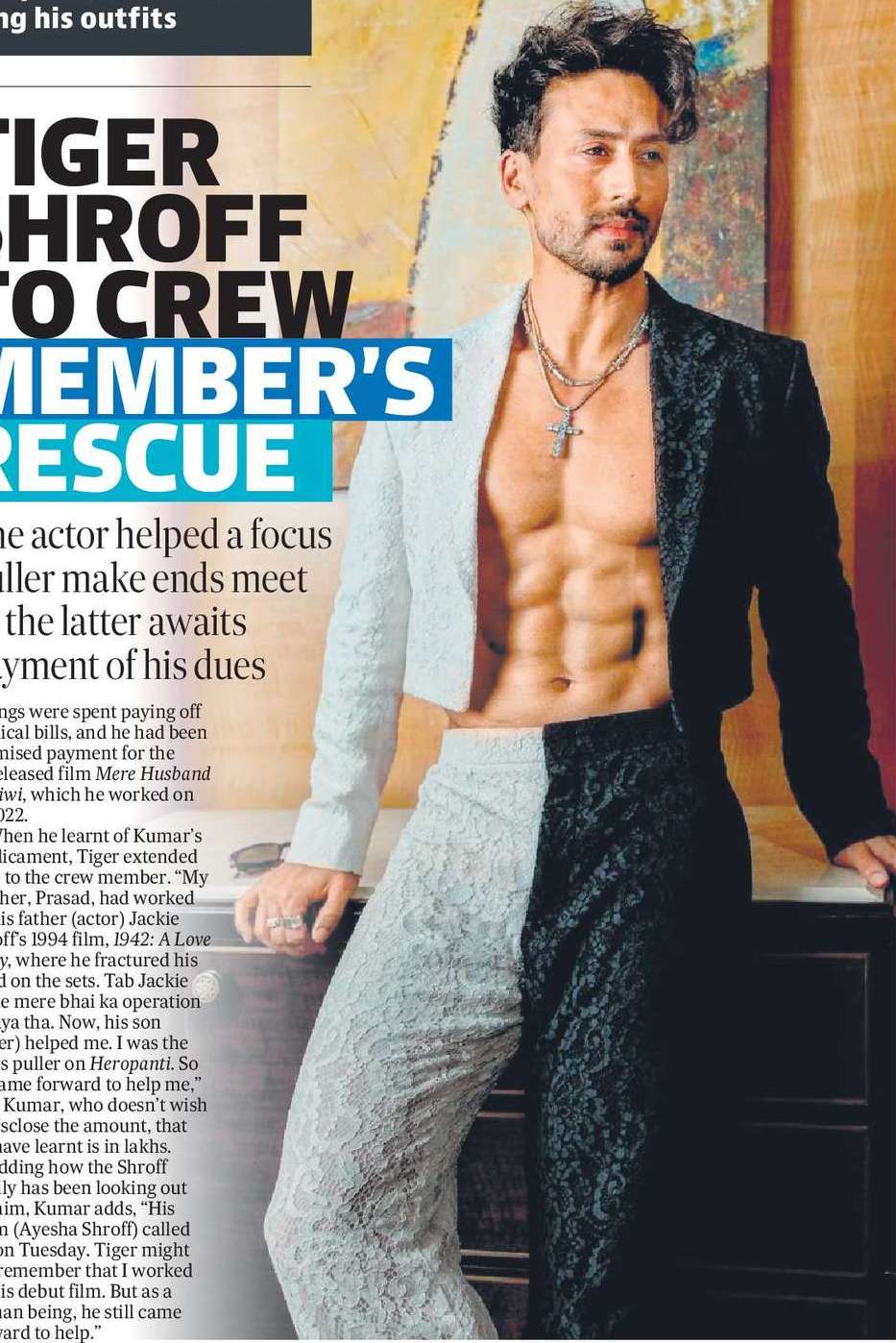
Rishabh Suri (HINDUSTAN TIMES; July 4, 2024)
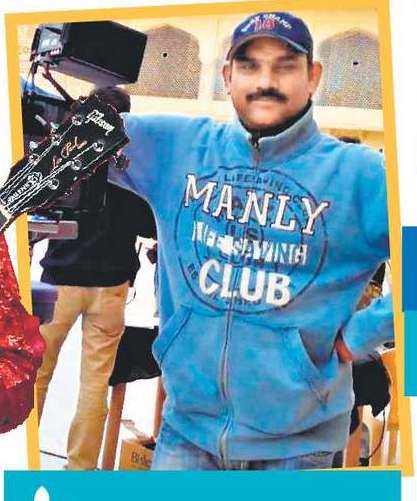
Film producer Vashu Bhagnani’s Pooja Entertainment has been under the scanner for non-payment of fees to its cast and crew, who have worked on three projects, including Bade Miyan Chote Miyan. Amid all this, Ravi Kumar, a 45-year-old focus puller who was struggling to make ends meet due to non-payment, has received aid from actor Tiger Shroff. Kumar met with an accident last year, which left him bedridden for eight months.
“[After the accident] I’ve been taking up light work. But I’m not getting much work,” he says, adding that his savings were spent paying off medical bills, and he had been promised payment for the unreleased film Mere Husband Ki Biwi, which he worked on in 2022.
When he learnt of Kumar’s predicament, Tiger extended help to the crew member. “My brother, Prasad, had worked on his father (actor) Jackie Shroff’s 1994 film, 1942: A Love Story, where he fractured his hand on the sets. Tab Jackie sir ne mere bhai ka operation karaya tha. Now, his son (Tiger) helped me. I was the focus puller on Heropanti. So he came forward to help me,” says Kumar, who doesn’t wish to disclose the amount, that we have learnt is in lakhs.
Adding how the Shroff family has been looking out for him, Kumar adds, “His mum (Ayesha Shroff) called me on Tuesday. Tiger might not remember that I worked on his debut film. But as a human being, he still came forward to help.”
Whatever we had prepared for was scrapped by Sanjay Leela Bhansali on the day of Heeramandi's shoot-Sonakshi Sinha
7:58 AM
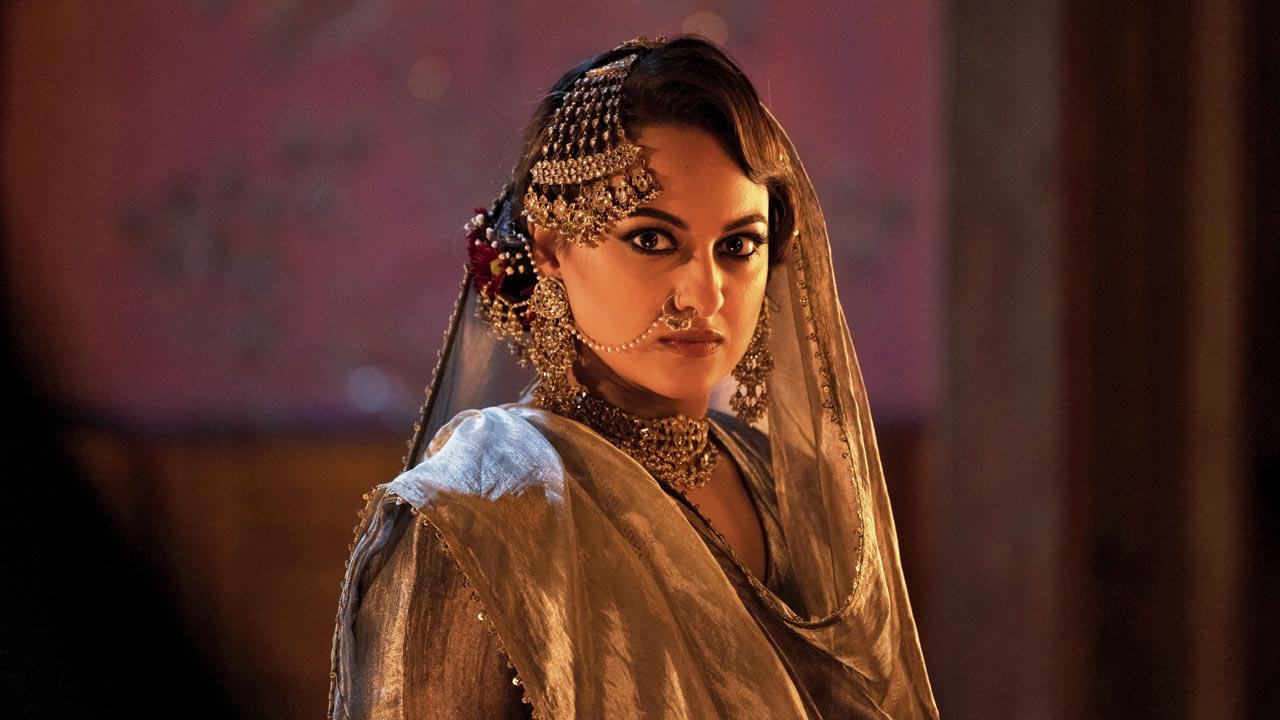
Sonakashi Sinha and Manisha Koirala discuss being sadistic, angry courtesans in Sanjay Leela Bhansali’s Heeramandi, confess that they questioned playing unhinged characters, and why they succumbed to the lure of the best roles of their life
Mohar Basu (MID-DAY; April 29, 2024)
When we join Manisha Koirala and Sonakshi Sinha on a fashion shoot, they are sharing a laugh at something somebody said. Koirala bids adieu to Sinha as she leaves for the online launch of her song Tilasmi Bahein.
It’s an hour before Sinha returns, ready to speak of her role in next week’s Netflix release, Heeramandi: The Diamond Bazaar. A period piece on Lahore’s most powerful women, the series centres around these two warring courtesans. But behind the scenes, they are fixing each other’s hair and tiaras. Where is the war we ask? That’s for the screen, they tell us.
Bhansali fashioned his series around a concept by journalist-writer Moin Beg, who has lived with the story for 15 years. Historically, Heeramandi was a bastion of the classical arts patronised by the tawaifs under Mughal rule but devolved into a centre of prostitution when the British consolidated their rule in undivided India. Through eight episodes, the story hurtles through turbulent times, weaving a narrative of love, betrayal, loss, and power.
Koirala, Bhansali’s first heroine (Khamoshi, 1996), is working with him after 28 years. “The first time Sanjay and I met was on the sets of 1942: A Love Story; he was working on the film’s songs. I was in the midst of filming the beautiful [song] Pyaar hua chupke se, and we instantly became friends. He wanted some feedback on his own script. I loved it and I am glad that I got to be his heroine. Now, I get to play Mallikajaan.”
The queen bee of Heeramandi, Koirala’s character decides what happens in the haveli and the neighbourhood, and unabashedly uses her charm to control the Nawabs. “I won’t lie,” she makes an honest admission, “I don’t think I connect with Mallikajaan. She is dark, complex, layered and extremely controlling. She is insecure, power-hungry and traumatized. But as an actor, when you step into a role like this, you must channelise every bit of your art. I had to know her from a place of empathy and ask questions about what makes her who she is. What does her trauma feel like to her? She is an emotionally intelligent woman. There is a certain grammar to how she conducts herself. Her body language is also a product of this world and her experiences.”
Koirala says she broke down her character’s conscious and subconscious mind. Because acting is more than just learning your lines and cracking the body language, she had to make sure she emoted with her eyes. “I don’t know if Heeramandi ever had a Mallikajaan. I have never met a person like her.”
As Fareedan, Sinha is Mallikajaan’s nemesis. The hatred that their characters harbour for the other is both, fearsome and valid. It is not easy to figure who is right and not. Sinha describes her character as angry.
“What defines Fareedan is her rage. Life hasn’t been pretty or pleasant. Her anger stems from the unfairness life has meted to her. I have never played someone who is constantly seething and undoing the wrong done to her. She is borderline sadistic, but also a good person. I was careful not to let Fareedan enter my life beyond the director’s, action!”
Both actors admit that their big challenge was that the story is set in a milieu and country that’s unfamiliar. Koirala shares that the research was cumbersome. “It was exhaustive. It started with reading the script multiple times. I had to request Sanjay to get me a diction coach since I have laborious dialogues. Sanjay’s research, Beg’s perspective and detailing—it all added a lot [of value]. At the end of the day, it is Sanjay’s call. He knows what he wants so when I would perform, he guides me. Ye nukhta zyada mat bolo, ye kam tha.”
Sinha agrees. “All my preparation came from listening to Sanjay sir talk about Fareedan. He is passionate about even the darkest of characters. He spoke to me about Fareedan like he knows her, narrated what has transpired in her life, her trauma. I am an observer and so these conversations permeated into my subconscious. I took it all in.”
Then there were books. Zahid Akasi’s detailed title, Heera Mandi (2005) includes a plethora of details about the neighbourhood and its genesis. During the Mughal era, it stood near a towering brick wall, 30 feet tall, encircling purana or old Lahore; safeguarding the city. Thirteen gates punctuated the ramparts, facilitating entry into the city. Positioned in the northwest corner of the old city, Heera Mandi was entered through Taksaali Gate. Named after Maharaja Heera Singh, son of Maharaja Dehan Singh, a prominent minister in Maharaja Ranjit Singh’s administration, the red light area earned a fitting moniker.
During emperor Aurangzeb’s reign, the construction of the Badshahi Masjid in the vicinity led to the area being referred to as Shahi Mohalla, or royal neighbourhood. The courtesans were not only skilled in classical dance like kathak and music but also well-versed in poetry, literature, and the arts. Koirala says that learning dance and music are the frills of any performance. The real drill is to capture the soul of the character.
“Dialogues don’t always do it for you. There are times when a character has no lines [in a scene], but is able to leave a mark. We all work hard to understand.”
Zahid traces the roots of numerous popular singers to this locality, including Madam Noor Jehan, Farida Khanum, Naseem Begum, Tasawar Khanum, Nahid Begum, and Surayya Khanum. The music for the series has been making waves since the launch, especially that surrounding the kathak pieces. Which is why Sinha’s performance in Tilasmi Bahein is unexpected, and filmed as a single shot. Sinha tells us it was all done impromptu, like most good things.
“Whatever we had prepared for was scrapped by Sanjay sir on the day of shoot. Four days were kept aside for the song, but when we reached the set, he decided that he didn’t want what was earlier planned. Instead, he said, ‘What if we do it in one shot?’ I had zero time to prepare. So, whatever he was saying, I was following in real time. I had to learn the lyrics right then...it was daunting. There was no running away from this. I shed all my inhibitions and became Fareedan. I almost forgot Sonakshi. It was unreal once the shoot was over. Sanjay sir gave me a standing ovation. It was the happiest moment for me as actor. He is not easy to please.”
Actors can mature, and so, directors can change too. Has Bhansali changed as filmmaker in 30 years? “Sanjay was always a beautiful director. Khamoshi was poetic, sensitive. It spoke about the insecurities of a deaf and mute couple. Their child sings beautifully and they want to exert their control over her. Sanjay has become a filmmaker who envisions larger-than-life stories. He has become better with time, and even more of a perfectionist. There is a reason why he is a genius.”
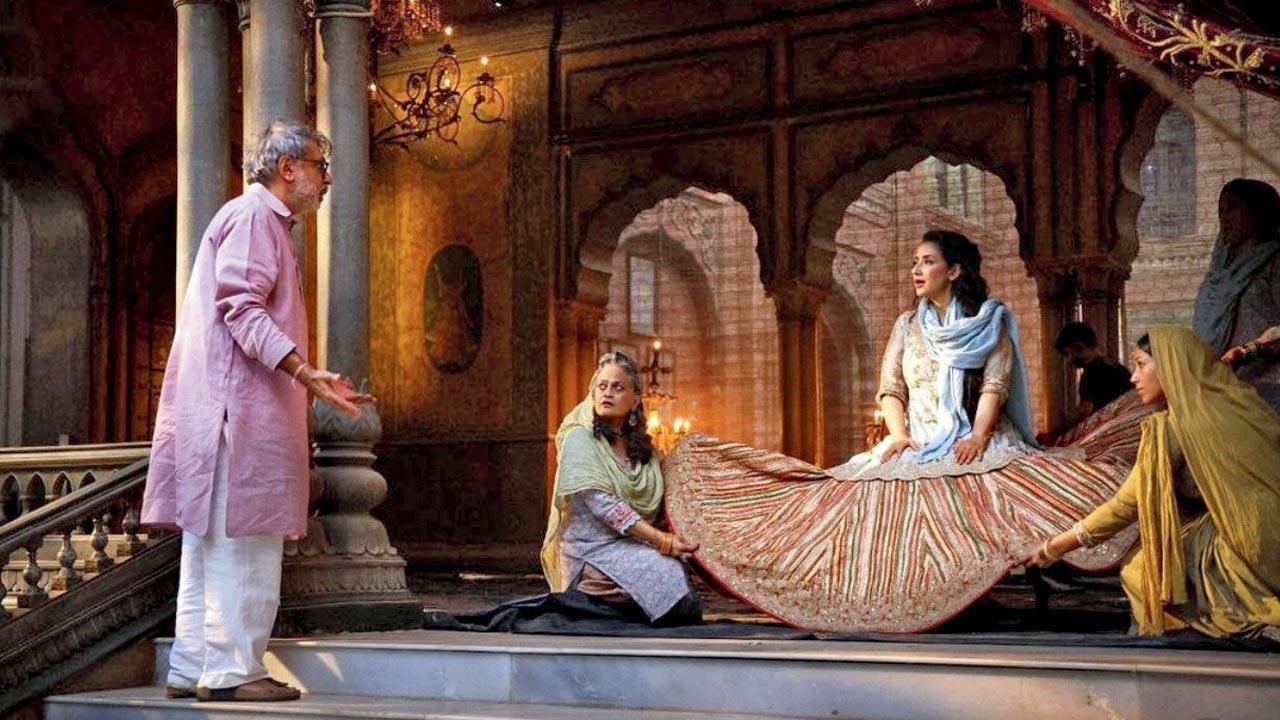
I miss good lyrics-Kavita Krishnamurti
8:29 AM

Soumya Vajpayee (HINDUSTAN TIMES; January 24, 2022)
Singer Kavita Krishnamurti has recorded over 50,000 songs in 46 languages in her five-decade-long career. Reminiscing about the phase she enjoyed the most, the singer says, “I’ve had the privilege of working with many composers, singers and lyricists. Every moment has been a part of my learning process. The songs I recorded in the mid-90s for films such as 1942: A Love Story (1994), Khamoshi: The Musical (1996) and Bombay (1995) were extra special.”
But as we go on to talk about the Hindi film music of today, the veteran has mixed views. “Some of the songs are splendid, I like the innovative approach and fusion style. But, there are quite a few that are not my taste. I miss good lyrics,” says Krishnamurti.
Ask her how the pandemic has been for her, and the Dola Re Dola (Devdas; 2002) and Mera Piya Ghar Aaya (Yaraana; 1995) singer says, “I enjoyed working on some projects with my husband, Dr L Subramaniam, at home, including songs like Vasudhaiva Kutumbakam and Vande Mataram.”
She was recently honoured with the Mohammed Rafi Award and holds it close to her heart: “I was delighted to receive the award. Rafi saab was one of the most iconic playback singers. My experience of recording two lines with him for a film called Ladies Tailor (1981) is a memory I’ll always treasure.”
She will be celebrating her 64th birthday tomorrow (January 25), “It will be a quiet one at home, with family,” she says, quipping, “I am young as long as I can sing or enjoy music.”
Films like Ek Ladki Ko Dekha Toh Aisa Laga have longer impact than the money earned over a weekend-Anil Kapoor
8:30 AM

Asserting that Ek Ladki Ko Dekha Toh Aisa Laga can change the way love stories are depicted, Anil Kapoor is thrilled that the film's screenplay is chosen for Oscars library
Mohar Basu (MID-DAY; February 9, 2019)
 In the week since it has released, Ek Ladki Ko Dekha Toh Aisa Laga has been widely appreciated for bringing a same-sex love story into the mainstream. In another well-deserved honour, the Academy of Motion Picture Arts & Sciences has requested for a copy of the screenplay of the Sonam K Ahuja and Anil Kapoor starrer to include in the Core Collection at The Margaret Herrick Library. Source materials - including scripts, production records and photographs - in the Core Collection are available for study for filmmakers, writers and students of cinema.
"The story was so powerful and its message, so important that we, as artistes, had to support it," smiles Kapoor, elated at the development. The drama sees Ahuja play a closeted homosexual struggling to come out to her father - essayed by Kapoor.
The senior actor adds that in triggering a much-needed conversation, the film goes beyond the myopic, commerce-driven approach to cinema. "When I did 1942: A Love Story (1994), people questioned why I was doing the movie. Back then too, I knew that films are for posterity. Ek Ladki is a film with long legs. Such movies have an impact that lasts longer than the money earned over a weekend."
The wisdom he accumulated over his 40-year-long run in the movies prompted him to greenlight the script, regardless of its box office outcome. "It will stay with people for the concept and the social change it triggered. I hadn't done anything like this before. I knew it will prove its merit."
15 Years of Munna Bhai MBBS: How Sunil Dutt gave a jadoo ki jhappi despite frozen shoulder
8:20 AM

Roshmila Bhattacharya (MUMBAI MIRROR; December 22, 2018)
 Fifteen years ago, I slipped into a preview theatre after the lights dimmed to watch a film with a weird title, Munna Bhai MBBS, by a first-time director called Rajkumar Hirani which was to open in the theatres on December 19. A print had been rushed across to be screened for the jury of our upcoming film awards. Since this was the last big release of 2003, they did not want to wait till it was officially released to finalise their list of nominees. Few believed then that the Sanjay Dutt-Arshad Warsi comedy stood a chance of making the cut. But going by the rules, it had to be watched.
Since I was on jury duty that evening, I decided I might as well catch the film rather than sit outside twiddling my thumbs. But I had planned to make a quiet getaway after the interval. Less than fifteen minutes into it, I was hooked by the golden-hearted goon who though well past the school-going age, lumbers into the classroom to pursue his father’s dream of becoming a doctor, believing a jadoo ki jhappi is the cure to all ills. By the time the end credits rolled, I knew a director had been born and Sanju reborn. That year, this little big film swept most of the awards, including the 2004 National Film Awards for Best Popular Film on its way to becoming a jubilee hit and acquiring a cult status.
 Today it is hard to imagine anyone but Sanju playing Munna, but the film had initially been planned with Shah Rukh Khan who had even started working out because the character while not a bad guy was a big guy. Producer Vidhu Vinod Chopra in an interview to me had spoken about how he had been trying out different moustaches and giving inputs to the scripts, including the Michael Jackson takeoff in the title track, for which he finds a mention in the credits, when a back injury during a show in Lucknow put him out of action. Realising he couldn’t train anymore, SRK stepped out, and Sanjay Dutt who was already in the film, playing Zaheer, the cancer patient whose death jolts Munna (eventually played by Jimmy Sheirgill), stepped into his shoes since he already had ready-made muscles and was the right age.
The one big change this shuffle in the cast brought in was that Vinod was able to convince Sanju’s dad, Sunil Dutt, to play the role in reel life too and give him a jadoo ki jhappi. The latter turned out to be a painful exercise because Dutt saab was nursing a frozen shoulder and couldn’t raise his left hand. Raju was ready to push the shoot to another day, but the late veteran who kept rotating his shoulder, refused to give up. He finally managed to give his son a hug which came straight from the heart, much like Munna’s jhappis in the script.
When I quizzed Vinod on the genesis of the idea, that industry A-listers, including Sanju and Shah Rukh have embraced over the years, he remembered how Raju had cut some promos of his 1942: A Love Story. “I hated them and screamed at him. Three days later, Raju was back with fresh promos which were so wonderful that I spontaneously gave him a hug and the memory stayed with him. There’s nothing like a good hug!” he asserted. I agreed.
Munna Bhai MBBS came at a time when producers were wary of showing their film even to distributors before release. Vinod and Raju however had trial shows for different audiences, from kids to auto drivers, weeks before the film opened. The first test group was doctors. They loved it and Vinod heaved a sigh of relief, but not just because they were walking the tightrope with the subject. He confided that just like Munna, his own father had wanted him to become a doctor. He was really upset when his brilliant son opted for the movies instead, his brother Veer, putting him through the Film and Television Institute of India.
Vidhu’s first student short, Murder At Monkey Hill, bagged him the National Award for Best Short Experimental Film while his documentary on destitute children, An Encounter with Faces, was nominated for the Oscars. “My elder brother, Ramanand Sagar, would say, ‘Takt ya takiya, you never know which way the scales will tilt.’ My father was convinced it would be takiya for me,” he laughed, happy that though he did not become Dr Chopra, like Munna he brought to life the age-old idiom,‘laughter is the best medicine’.
One is also reminded of Dr Asthana’s laughter therapy in the film. Like Nana Patekar, whom he spotted on stage and cast in Parinda, Vinod discovered Boman Irani, who played the cantankerous dean of the medical college Munna enrols in, in a play. Boman was introduced to theatre by Shaimak Davar at 35. He was 44 when he made his Bollywood debut. But then, as Munna proved with his bhaigiri, age is but a number. Boman today, with Sanju, Raju and Vinod are looking ahead to Munna Bhai 3.
I think someone went and filled Aamir Khan's ears-Anil Kapoor
9:11 AM

The indefatigable Anil Kapoor talks about his endless energy, refusing Chandni because he had to sit in a wheelchair, feeling gutted that he didn't do more endorsements and, of course, the Mr. India sequel!
Mayank Shekhar (MID-DAY; August 10, 2018)
Suzie, we're told, is a popular, heavily priced cocaine doing the rounds of Juhu - the effects of which include indefatigable energy levels that last you for every second that you're up and still snorting. The high seems natural. The party never stops, and life seems positive, and happy, and fun, all the time. Which is pretty much the state that has defined the public profile of actor-superstar Anil Kapoor, 61, for decades that he's entertained millions at a stretch. And continues to. What keeps him going? He hasn't tried Suzie, he tells us. Well, just for fun, we checked:
Have you ever done drugs?
I've had hash - ganja. Nahi, charas bolte hain. This was when I was in college, just finished school. Once I had hash, a few times, actually. I've had grass [ganja/marijuana] also. That's it.
But those are [usually] downers. You're on a constant upper!
To be honest, because they were downers, I didn't like them - they made me feel low, sleepy. I said I don't need this.
Were you much of a drinker though?
I've had beers, and [other] drinks; but never done anything excessive.
I'm only trying to get at what drives you (and if there's an external substance that we could recommend to readers!).
This is the way I naturally am. It's just the profession, the whole entertainment business, or show-business - cameras, films, ADs, working with the director, writers, actors, actresses, producers; interacting with media, doing different roles… Everything surrounding me makes me feel positive, gives me energy. It's exciting, pulsating, also edgy - because you're not sure what's going to happen. You're insecure. You do your best; feel it's not the best. But people say it is! I'm just so happy that I don't do a 9-to-5 desk-job.
Which you never have.
Never. I can sit down for half-hour, or an hour; not longer. I have to be standing, walking, running; or sleeping, so that I'm fresh again!
And you've been working like this for 40 years?
I think so. I [recently] called up my producer-director Umesh Mehra to ask, "When did we start the film [Humare Tumhare]?" It released in 1979. Think we would have started [shoot] two years before. So, if I started my acting career in '77, it's been 40 years [plus]. He [Mehra] is also trying to find out exactly which date we started. The film had Sanjeev Kumar, Rakhee. There were 10-12 children in it. I was one of them.
Was that the one where you played the young Shashi Kapoor?
No, that was in 1973 [for the shelved film Tu Payal Mein Sangeet]. I was in the seventh standard. That was the first time I faced the camera, but only as a child actor. By Humare Tumhare, I had done my acting course. And then I did [M S] Sathyu's Kahan Kahan Se Guzar Gaya [1981], [Lekh Tandon's] Ek Baar Kaho [1980]...
A lot of people don't know that you were also the lead in Mani Ratnam's directorial debut.
Pallavi Anu Pallavi [1983; in Kannada], yes, his first film. Balu Mahendra was the cameraman, the visuals were stunning. I was in Bangalore recently, and people still remember the film. Ilaiyaraaja's music in it had become very popular.
All of this before Woh 7 Din (where you first got majorly noticed)
Yes, I started working on Woh 7 Din in 1982. I was not getting any work in Mumbai as an actor - besides bit roles. I thought I was cut out for bigger things. So I said, let me start helping out my brother [Boney] with production in Chennai. He was taking over dad's work in Hum Paanch. Being the eldest, he was looking after finance, while I did all the odd jobs. I would also stand-in for actors while the scenes were being set up. Bapu saab was the director. I would show him how good I could give a shot. He would observe. That's when he offered me the Telugu film [Vamsa Vruksham]. And then he directed my first [Hindi] film [as lead], Woh 7 Din, with the script written by K Bhagyaraj.

Your early stories are actually all about astounding persistence. You could stand around [hoping to get noticed] for hours (at a stretch).
Yes, I've stood behind the camera on Subhash Ghai's sets a lot, hoping, "Abhi dekhega shayad," and that as soon as his [Ghai's] eyes meet [mine], I'll go, and meet him. Then I'd get to know that he's at Holiday Inn. So I would stand in the lobby. Then I'd think, "Why lobby? Let me just go up." So then I would be there in the corridor. I wouldn't have the guts to go and chat with him though. I've sat around at Rajshri Productions office [in Prabhadevi] a lot. It was very tough to meet the Barjatyas, so I became friendly with the production guys - Mr Gupta, Mr Zaki... Suddenly Gupta tells me Zaki wants to make a film. I say, why not cast me? Before I could meet the Barjatyas, the production guy was making a film called Prerna with me, which got stuck. But, I was the leading man. Likewise, while I was trying to meet Subhash Ghai, one of his assistants, Kukoo Khanna, Usha Khanna's brother, pointed me towards a small film. So I sat in David Dhawan's Vespa, went over, and signed up for a film called Rachna, which ran for one-day, one-show, in the theatre!
Did you have a Plan B?
After about four or five years, I did think of a Plan B, but, in films - like writing scripts, or doing anything else to be in the films.
Well, you are from a film family; if I'm not mistaken your father was an AD on Mughal-e-Azam. He also managed Geeta Dutt's work, thereafter Shammi Kapoor's.
He was a very honest, decent, introverted kind of good man - not one of those pushy, aggressive, filmy ones. And he once clearly told me that he cannot do anything for me. I never expected him to either. From that day, I felt, instinctively, it's time for me to go out into the battlefield, and fight.
If the battlefield means sitting around hoping for someone to notice you, it would get quite tiring, right?
It was exhausting, frustrating. I looked and felt my worst in those days - sitting with friends having rum.
Could you channel that eventually in your work; a film like Awaargi [1990], for instance?
Yes, [Mahesh Bhatt's] Awaargi, and even before that, [Subhash Ghai's] Mashaal. Then there was [Bhatt's] Thikana, where I play an alcoholic. This is when Mahesh Bhatt was trying to find himself; it was a pleasure and fun working with him. Both Awaargi and Thikana turned out to be disasters though.
But you basically ended up with a 40-plus years' career, without a sabbatical. Ever thought of taking one?
I did, once. I spoke to Amit ji [Amitabh Bachchan], while we were shooting for Armaan [2003]. He had taken a break for five years. His advice was: Whatever you do, keep on working.
Also, since you began in the '80s, which was all about over-the-top performances, that you cracked, to decades later, when the kind of films being made are vastly different, you would've had to constantly reinvent yourself too?
When I started my career, they used to tell me I'm an English actor. First they used to say, "Zara loud bol. Underline it. Punch de usko. Punch de!" I'd be like, 'What punch are you talking about? I'm just being myself, real. But the sound-recordist would tell me it doesn't work. That I had to start pitching - so you're not speaking, or making conversation. You're talking at them [the audience]. But, obviously, working with good directors, films becoming successful, you get the confidence. Initially, I was not that comfortable, to be honest with you.
You were not always the 'jhakaas' guy?
No, I was not. In fact at the time [of the release of Yudh, 1985], 'jhakaas' didn't become that popular. The film was an average success. They said that I was the best thing in it, and wished there was more of me. The film was more about Jackie [Shroff's character]. That 'jhakaas'; and my character stood out. People were talking about it. But I didn't take it seriously enough to cash in on it.

Would you say that 'jhakaas' image was more a Subhash Ghai creation; with a Ram-Lakhan [1989]: One two ka four, four to ka one stuff?
No, I did Tezaab [1988], before Ram Lakhan. And of course, I had done [Yash Chopra's] Mashaal [written by Javed Akhtar], where there was realism, and a star-quality [to the character] - a combination that you notice in Salim-Javed scripts. The foundation got laid in Mashaal [1984].
If we go back to your entire body of work, a lot of people would say Mr India was a perfect 10. Would you agree?
I feel the first half of Mr India was much more organic, human, beautiful. In the second half, I felt, there were certain portions that seemed really forced. You could say we did this to make it massy. The casting of the children, the scenes were picture-perfect, yes. The same was the case with Ram Lakhan. The first half was brilliant.
Lamhe [1991]?
Well, Lamhe, people liked the second half better. The first half, I found to be unnecessarily slow. A film must hold you from the beginning to the end. People say climax theek nahi tha. I feel it was ahead of its time. And Sridevi was magnificent in both Mr India and Lamhe. She was beyond perfect in Mr India. Or, for that matter, even Judaai, if you've see her in the film, she is exceptional.
Speaking of Sridevi, the tragedy earlier this year was heartbreaking. How did you deal with it?
It is one of the most unfortunate things to have ever happened. Every night, my wife and I talk about her. There's not a single day when we don't miss her. [Pause]
Going back to Lamhe, while it didn't do well in India, it actually opened up a whole diaspora market for Bollywood, isn't it?
Both [Yash Chopra's] Lamhe and [Vidhu Vinod Chopra's] 1942: A Love Story [1994] were game-changers [for me]. I signed both the films simultaneously. I'd had an accident, and was bedridden, nursing my leg, for two-and-half months. It was a turning point in my life. I was running fast, but going nowhere. I just wanted films, one after other - doing films that I didn't care much for.
You've spoken about how you've done a few films like an Andaaz or say Mr Azaad purely for the signing amount.
No, not the signing amount; for the whole thing - advance mein. But the past is past. Why should I say now, why I did them? But 1942 and Lamhe were the kind of exciting films that were not being made [back then]. Yash ji wanted to do something post-Chandni, since it was a success.
And I hear you'd said no to Chandni. Why?
I had said no to Chandni, because I didn't want to sit in a wheelchair.
It would be hard to contain you in a wheelchair!
I was just not in a frame of mind to sit in a wheelchair through an entire film. I was, in fact, one of the first people to call Yash ji and tell him, "Picture hit hai!" He couldn't believe it. I had done two films [Mashaal, Vijay] with him, and both hadn't done well.
So post-accident, you became more conscious of the scripts you'd pick up?
Conscious, yes; but I also started getting offered more films of the sort that I wanted to do. Certain films I did for the kitchen, family, children…
Do you have a clear distinction between a film for kitchen, and craft?
I do.
So when you do a Race 3, for instance...
There are other reasons as well. I have to like my role. And who is producing it, acting in it.
Going back to what makes you special, besides being around for 40 years; you're also a rare Bollywood superstar with a moustache. No?
No, there was Raj Kapoor, Charlie Chaplin, and Shatrughan Sinha.
Exactly, that's it. Did Manmohan Desai ever say that a man with a moustache can never be a hero?
I read it in an interview. He called me up after Eeshwar [1989], and said, "I thought you'd never become a star. You are just an actor." He said he wanted me to do his films. He had said Jackie Shroff is a star, and I am just an actor.

You've had a lot of such stuff thrown at you, isn't it?
I was lambasted, even when there was no social media. But I've always looked at the marathon, the longer run. I didn't go for the 100 metre dash. Well, I did in the '80s, and then I came back. Because the 100 metre dash is too tiring and exhausting. I knew I'd burn myself out.
And was doing television, with 24, probably a marathon thing to do?
Yes, it gave me a role away from the cinemas. And it wasn't the role of a reality-show judge. It gave me creative satisfaction, to work on a great story.
Did you also see LA as a longer-run thing to do? How serious were you about pursuing that as a career option?
Yes, it was a longer run thing: [looking at] legacy, learning, education, meeting different people, creative people, business minds. I was reliving my struggling days. I used to actually go, and audition. I auditioned for David O Russell, Sacha Baron [Cohen], for fun. Whenever I audition, I don't get selected. Everything I did happened without audition! We are not cut out for auditions. It is also an art. We have to work towards it.
How serious are you still about pursuing Hollywood though?
I am at a certain age and time, as far as family is concerned, when I can't pursue it aggressively. If it comes, good; but I can't move base. If I get an offer for which I have to leave for a year, obviously I will have to say no. It has to be on my terms and conditions.
Well, there's so much for you to do here. Could you be the Dev Anand of this generation?
No one can be him. I am so glad I could meet him. I still see his songs, and they make me so happy.
(Speaking of which], you are a singer yourself; even cut an album [with Salma Agha that many people may not know about).
It was horrible. People like to see, and not hear us sing. I used to do ghazals, nazms. So, I sang in Chameli Ki Shaadi [1986]. And then that album [Welcome; 1989]. After which, I decided, 35 years back, that I won't ever sing!
The new lot in showbiz, in fact, juggles multiple things, while they also act in movies. Their main income might well come from endorsements. Why did you never do ads through most of your career?
Raj Kapoor, Dilip Kumar, Amitabh Bachchan never did ads. We were brought up [with the thought] ki, "Main actor hoon. Salesman nahin". This is until my children grew up, and Sonam started doing ads. The standard of ads also got better. But by that time, I had already missed out on the best ones. Now I feel terrible about it!
Audience: It's clear that you are getting younger by the day. Can you share some thoughts on fitness with us?
It's all about intake, and outtake; and also workouts. To give you an example: 1,000 calories a day is, say, your intake. So you should work out for six days a week, to make sure you maintain a balance. There shouldn't be far more calorie intake than what you have really burnt out. If you want to indulge on a particular day, you should see to it that for the next two to three days, you balance it out. Don't let loose, and say that for the next three months, I'm just going to keep eating. Then it becomes difficult to bounce back. Also, you can do different kinds of exercises, depending on what makes you happy. Keep changing it. If you find any exercise boring, don't do it. Find something that you can have fun with. And I don't feel that's difficult.
At which point of time in your career did you particularly start focusing on your health, fitness?
I think it was during 1942 A Love Story. I didn't want to do the film as usual.
Is saying no your instant response to an offer?
Yes. I told Vidhu [Vinod Chopra]: "Tu pagal ho gaya hai kya? You are making me a romantic hero. I am a father of three kids! Aamir ko le le tu." I told him I'll call Aamir. But he said, "Aamir phone pe hi nahi aa raha hai." [Laughs]. So then I suggested he should take Bobby Deol, since he was coming up. He met Bobby as well. Then Vidhu's brother, Vir Chopra, made me hear all the songs, and I really loved them. There is a scene in the film, inspired from Romeo and Juliet, where we [the hero and the heroine] are in a balcony. I was working with Manisha Koirala, who was, I guess, 20 years younger to me. And I had done all 'tapori' and 'mawaali' roles until then. Suddenly I was playing this [suave] character. That is the time I started paying attention to fitness. And after that, I didn't stop.
Audience: Anil sir, last year Boney Kapoor announced that he wants to make the sequel to Mr India. Has it ever been discussed with you?
It's a tough film to make. Obviously we have discussed it. But being the kind of people we are, it has to be something really special. So whenever it has to happen, it will. Boney and I are really positive people.
She called you Anil sir, do you like being called sir at all?
You can call me anything. Kuch bhi bolo yaar. I never react.
Another unique thing to mention: You actually don't have a popular nickname, unlike most of your contemporaries who've been around for decades -Amitabh Bachchan is Big B, Shahenshah; Shah Rukh Khan is Badshah, King Khan; Salman Khan is Sallu; Sanjay Dutt is Sanju, or Baba, Jackie Shroff is Jaggu Dada...
Find a nickname for me. It's never too late. Never give up. Main bhi ek nickname launga. Let's have a poll! A lot of people call me AK, including my staff, manager, and many friends. At least Rhea doesn't refer to me as dad. For a daughter to call [the father by his initials] isn't common. But there are too many AKs in the industry.
Audience: Parinda [1989] had some stalwart performers like Nana Patekar, Jackie Shroff and Anupam Kher. Did you feel the need to come up with the best performance, or do anything different for the film?
I was doing five films at that point in time. I was at my busiest, running from one film to another - Parinda, Ram Lakhan, Tezaab, Eeshwar…. Obviously I was trying to do my best in every film. But how much can you do? Everybody else was doing less work back then, and I was doing the maximum, just running from one studio to the other.
I think she wants to know if you're an insecure actor.
I had to be competitive. You have to be, and why should you not? I feel a person who isn't competitive, can't be in the business. And whoever says that they aren't, is lying.
As a result of which there is far more politics in show business? Would that be correct to say?
I try to stay away from it as much as possible. Ignorance is bliss - pataa hi nahi kya ho raha hai. Especially my wife, she doesn't know anything; so that's great fun. When she comes home, people call up to say, "Your husband has signed a film," and then she asks me, "Baby you have signed this film?" [Laughs].

It has to be said that even at the peak years of gossip press in the '80s, '90s, we heard absolutely nothing that was gossipy about you, unless there was, and we've forgotten, which is even better. But there is one incident that relates to Filmfare Awards, 1993. The Best Actor needed to be given out. Dimple Kapadia went up on stage. She refused to open the envelope, almost as a signal to the audience that this is possibly rigged. She announced your name for Beta. Aamir Khan has never attended a Bollywood award show ever since. Take us through that moment?
Let me be very honest. If you see my interviews from back then, when people asked me who will win Best Actor, I had always said Aamir Khan for Jo Jeeta Wohi Sikandar, because it was really a different kind of film, out-of-the-box, and I could make out that everyone had worked really hard. I saw the film at Gaiety, and loved it. And then the Filmfare Awards happened, where I won Best Actor award, and I was surprised. I won it, because it was the biggest box-office success of that time. If you look back, it had earned more than any film that year. So there was something special about that performance. I didn't respect that performance myself, but everybody else did. I was also riding so high that everyone wanted me to lose. I also found out from Dimple that it [me getting the award] was taken for granted. It is not that she had anything [else] in mind [while not opening the envelope]. Usne aise hi bol diya. Then I found out from an insider regarding the [Filmfare] poll that was taken, and why there was so much controversy. I was really innocent, and frankly, Beta aur Jo Jeeta Wohi Sikandar ka koi comparision nahi tha, in terms of vote shares. And I think the jury might have taken a decision to give Anil Kapoor the award. They had no axe to grind with anyone, and they didn't do me a favour either. They never gave me an award for Ram Lakhan, or Eeshwar, when I was nominated for both [in the same year]. They had given it to Jackie Shroff [for Parinda]. They said the poll had got divided between the two films. These, I guess, are just excuses. You can't take awards seriously. It's naseeb [destiny], also luck. And do you think I would have time to do all this for an award? Mil gaya toh mil gaya; nahi mila toh nahi mila. Among all my friends and colleagues I know, I don't see anybody taking awards so seriously.
Was there bad blood between you and Aamir after that though?
I think someone went and filled his ears. Kisi ne purposely nahi kiya tha.
Did you guys speak to each other?
About this? We have never spoken. We are great friends, and this is too small a thing.
Also, I guess it happened in 1993...
No, even if it happened in 2018, I don't think it would matter. There are so many bigger things in life that you do for a film, or a performance. With Dil Dhadakne Do [2015], for instance, I heard that the film had not even reached Delhi for the National Awards. I was quite surprised. I met a few jury members who said we haven't seen the film. I called up these people [the producers], and they said that they have sent the film to Delhi. So, sometimes, the films don't even reach. It's all luck. Sometimes you get an award, when you don't expect it. But it's not as serious as you think. Some people got upset, but that was the age and the time. I won Best Actor for Tezaab and Bachchan saab didn't get it for Hum or Shehenshah, you think I deserved it? No. But it's okay.
He was also in contention in 1993 for Khuda Gawah.
Yes, and if you see the craft, and compare both our roles, then in a way, you can say his performance was better. So it doesn't mean anything. Sometimes koi actor ki film bahut zyada chal rahi hai, uska craze zyada hai, kisi ka kum hai. For Pukar, I won the National Award, but I didn't win any other awards. They gave it to Hrithik Roshan [for Kaho Naa... Pyar Hai]. Can you compare those performances? I was not even nominated! It depends on your phase of life, and career. Sometimes they feel we should reward smaller films, rather than commercial films. I think this is all over the world, and not in India alone.
Well, at the Oscars, you're supposed to [openly] lobby...
Exactly, the whole structure is like that. But we don't have it. I wish we had that structure with members voting, there would be healthy lobbying. You are only making people aware, asking them to please come and watch our film.
To end on a more positive note, we're absolutely certain you'll be around for at least 40 more years in showbiz. Is there something that still remains an ambition for you?
Everything: As an actor, producer, businessman, father, husband, citizen of this country, and being a global citizen - if there's anything I can do to contribute, something that nobody has done before, and something special; why not?
Will you ever take a break?
I don't know. You never know what happens next. Life is too short. So many of my colleagues are unfortunately… Kuch bhi ho sakta hai na aaj? Kal kya hona hai kisko malum? This year has been especially very tragic, and upsetting. So I feel I should have fun, and enjoy myself, and do as much work - be nice to people, don't fight; compromise, thoda adjust kar lo. You never know what is going to happen.

Sridevi’s sudden demise interrupted the process-Shelly Chopra Dhar
8:45 AM

Shelly Chopra Dhar on her directorial debut which borrows its title from her brother’s 1942 A Love Story and brings Anil and Sonam Kapoor together on screen for the first time
Natasha Coutinho (MUMBAI MIRROR; August 1, 2018)
Shelly Chopra Dhar wrapped up her directorial debut, the family-drama Ek Ladki Ko Dekha Toh Aisa Laga, on Sunday with its last schedule in Mumbai. The film, produced by Fox Star Studios, Vidhu Vinod Chopra and Rajkumar Hirani, had taken off in January this year and was shot predominantly in Punjab. It brings Anil Kapoor and daughter Sonam on screen together for the first time. Excerpts from an interview:
 What was it like watching Anil and Sonam Kapoor work together on screen and off it?
All my characters have an arch of their own so the task was evenly divided and worked out well for them given that both Anil and Sonam are stars. The script satisfied them both individually. (Smiles) I’m lucky they are both very professional so it worked out well for me too.
The film also brings back the hit jodi of the ’90s, Anil and Juhi Chawla.
Yes, and their chemistry is amazing. I have always enjoyed Juhi’s performances, she can get away with saying anything because she’s so innocent and we tapped that quality for this role of a simple woman who is a romantic. (Laughs) As they say, ‘philosophy is in simplicity’.
Talking of romantics, the intense Rajkummar Rao is reportedly playing a lover boy?
Raj is an amazing actor and brought his individuality to the part. Yes, the romance bit was different for him which gives him a new graph to play with.
You have borrowed your title from the iconic song of your brother Vidhu Vinod Chopra’s film, 1942—A Love Story. How did the idea come about? Are you recreating the song for your film?
I love the song and after we got Anil on board it fit in perfectly because it connects a whole lifetime. R D (Burman, who composed the song) was outstanding and I wanted to bring it back to the new generation. The idea is to prolong its life.
What are your memories of 1942: A Love Story and does Sonam remind you of the ethereally beautiful Manisha Koirala?
Manisha’s natural beauty and simplicity as portrayed by Vinod (Chopra) has stayed with me all these years. She had just one release before 1942 but the way Vinod showed her on screen, she didn’t look like the same person. I have tried to follow that ‘beauty in simplicity’ mantra with Sonam in my film too.
How did the last day of shoot go?
When you are going through the process, you don’t realise the weight you are carrying till it is done. It only hits you when the weight drops because your body has got used to lugging it around. It will take me two-three days to realise that the milestone has been completed. We had initially planned to shoot the climax in Punjab too and were into the last 15 days of shoot, hoping for a wrap on March 12, when Sridevi’s sudden demise affected our process. I had to shift the climax to July since all my actors had taken time off from their busy schedules to complete the film in one shot. That didn’t happen and we finally got combination dates in July but because the monsoon has set in, we couldn’t go back and wrapped it up in Mumbai.
Did you do anything special on the last day?
We stayed back on the set after packup and partied. For the next few hours, it was only food and drinks. That’s all the time we had to celebrate because now I have to get into post production and I am working 10 hours a day on my edit.
Anil Kapoor's '90s song returns in his first film with daughter Sonam, Ek Ladki Ko Dekha To Aisa Laga
7:57 AM

Shelly Chopra Dhar on the melody and working with the Kapoors, Juhi Chawla and Rajkummar Rao
Avinash Lohana (MUMBAI MIRROR; February 16, 2018)
Late last month, Vidhu Vinod Chopra’s sister Shelly Chopra Dhar kicked off work on her directorial debut, Ek Ladki Ko Dekha To Aisa Laga, in Patiala with Anil Kapoor and TV actress Madhu Malti while Sonam, Rajkummar Rao and Juhi Chawla joined in a few days later. Mirror has now learnt that Dhar is also recreating the memorable song from her brother’s 1994 fi lm 1942: A Love Story that is now her film’s title.
“Yes, we are recreating the original and we want to replicate its iconic status. It’s hard to beat the original so I will be happy if we are at par with it. However, we’ll have to wait and see who sings the new version and for whom in the film,” Dhar confirmed to Mirror while speaking from Chandigarh during a lunch break after canning a shot with Juhi and Raj.
In the film, Juhi plays a vivacious, upbeat character and is reuniting with Anil 11 years since they shared screen space in Nikkhil Advani’s romantic drama anthology, Salaam-e-Ishq. “It was lovely to see two friends come together after a long time. They are in such great shape. On set, they refuse to call each other by their real names, resorting to their characters instead,” laughed Dhar, adding that she is also kicked about having the real life father-daughter jodi of Anil and Sonam in her film.
“On their first day together, I gave the clap and called it a historical shot as it was the first time we had two big stars who are also father and daughter. Anil is a typical dad who asks us to take Sonam’s shots first; I find it endearing. We have been shooting at night and it gets nippy at times, so Sonam is constantly checking up on her father,” Dhar added.
The film also marks Anil’s second collaboration with Raj after Fanne Khan. “Raj and AK always have a common joke between them as they have recently worked on another film.”
Dhar has finished filming 40 percent of the film and will be canning the rest in Chandigarh. There has been no time to unwind as the team is on a tight schedule. “We wanted to go bowling recently but ended up eating at a Chinese place as we have been eating a lot of Punjabi and Indian food here and were craving for a change,” Dhar laughed as she proceeded to partake of a lunch comprising makke di roti and sarson da saag.
Late last month, Vidhu Vinod Chopra’s sister Shelly Chopra Dhar kicked off work on her directorial debut, Ek Ladki Ko Dekha To Aisa Laga, in Patiala with Anil Kapoor and TV actress Madhu Malti while Sonam, Rajkummar Rao and Juhi Chawla joined in a few days later. Mirror has now learnt that Dhar is also recreating the memorable song from her brother’s 1994 fi lm 1942: A Love Story that is now her film’s title.
“Yes, we are recreating the original and we want to replicate its iconic status. It’s hard to beat the original so I will be happy if we are at par with it. However, we’ll have to wait and see who sings the new version and for whom in the film,” Dhar confirmed to Mirror while speaking from Chandigarh during a lunch break after canning a shot with Juhi and Raj.
In the film, Juhi plays a vivacious, upbeat character and is reuniting with Anil 11 years since they shared screen space in Nikkhil Advani’s romantic drama anthology, Salaam-e-Ishq. “It was lovely to see two friends come together after a long time. They are in such great shape. On set, they refuse to call each other by their real names, resorting to their characters instead,” laughed Dhar, adding that she is also kicked about having the real life father-daughter jodi of Anil and Sonam in her film.
“On their first day together, I gave the clap and called it a historical shot as it was the first time we had two big stars who are also father and daughter. Anil is a typical dad who asks us to take Sonam’s shots first; I find it endearing. We have been shooting at night and it gets nippy at times, so Sonam is constantly checking up on her father,” Dhar added.
The film also marks Anil’s second collaboration with Raj after Fanne Khan. “Raj and AK always have a common joke between them as they have recently worked on another film.”
Dhar has finished filming 40 percent of the film and will be canning the rest in Chandigarh. There has been no time to unwind as the team is on a tight schedule. “We wanted to go bowling recently but ended up eating at a Chinese place as we have been eating a lot of Punjabi and Indian food here and were craving for a change,” Dhar laughed as she proceeded to partake of a lunch comprising makke di roti and sarson da saag.
I wish the lyrics of the songs nowadays were more meaningful-Kavita Krishnamurthy
8:20 AM

Soumya Vajpayee Tiwari (MID-DAY; January 9, 2018)
Bollywood has missed her voice over the past few years. But Kavita Krishnamurthy’s stance is simple — she’ll step inside a recording studio for a song that’s worth her while.
Counted among the most successful playback voices in the Hindi film industry, she hasn’t lent her voice to a commercial Bollywood project since 2011 (her last song was Tum Ko from Rockstar). “I don’t refuse to sing for Hindi films, but I haven’t got any good songs in a while. Whatever I have sung in the past few years haven’t been great either. After recording so many songs, there is no point in singing just because you have to, professionally,” the veteran tells mid-day.
Old is gold
Be it expressing the innocence of first love in 'Pyar Hua Chupke Se' or the playful flirtation in 'Aankhon Ki Gustakhiyan', the singer has been the voice behind many musical gems in the '90s. She rues that the songs today lack magic. "I treasure the songs from 'Devdas' (2002), 'Hum Dil De Chuke Sanam' (1999), 'Khamoshi: The Musical' (1996) and '1942: A Love Story' (1994). I doubt something like that will ever come my way. I'm longing for an excellent piece to be offered, something I can work hard for."
Ask her what makes her miss the tracks that were churned out in the past, and the singer discerningly says, “Some of the songs that are made these days are interesting. But I wish the lyrics were more meaningful. I don’t like over-programmed tracks. Sometimes, I feel they [the composers] use the auto-tuner too much.”
Young guns
While the music industry leaves a lot to be desired with regard to penning lyrics, she agrees that it does boast of bright talents when it comes to singing. “The brightest stars right now are Shreya Ghoshal, Sunidhi Chauhan and Arijit Singh. They have stood out within a short span of time.”
Music and me
With over a 40-year-long career behind her, the Padma Shri recipient continues her longstanding romance with music even today. Last year, she toured the UK with husband, violinist L Subramaniam, performing with the London Symphony Orchestra (LSO). “Recording with the LSO at London’s Barbican Centre in November was extraordinary. I sang with the orchestra, and it was an original piece written specifically for my voice. That has never happened to any Bollywood singer before,” says Krishnamurthy.
For now, she is focussing on her new multi-artiste album. “It features Pandit Jasraj, Shaan, Sonu Nigam, Hariharan, Lucky Ali and Suresh Wadkar,” she says.
I thought I was too old for a love story 24 years ago-Anil Kapoor
8:12 AM

Reveals Anil Kapoor who eventually accepted Vinod Chopra’s pre-Partition film in the ’90s after being floored by ‘Ek Ladki Ko Dekha Toh Aisa Laga’
Roshmila Bhattacharya (MUMBAI MIRROR; October 14, 2017)
Mirror (September 23) was the first to report that Anil Kapoor and daughter Sonam have been roped in for Shelly Chopra’s directorial debut. On Thursday, Shelly announced that the film’s title, Ek Ladki Ko Dekha To Aisa Laga, has been borrowed from brother Vidhu Vinod Chopra’s 1994 directorial 1942: A Love Story, featuring Anil, Manisha Koirala and Jackie Shroff. Anil will be reuniting with Vinod with whom he also did Parinda in 1989, who is producing the film along with Rajkumar Hirani, after almost 25 years. The actor reveals that it was the song earlier that had convinced him to give the nod to the pre-Partition love story.
“It’s hard to believe but 23 years ago, I had not wanted to do 1942 because I felt I was too old to do a love story. Even though both Vinod and his brother Veer were convinced that I could pull off the role, I recommended Bobby Deol who was on the verge of being launched for the role, along with Aamir Khan,” reminisces Anil talking to Mirror from Dubai.
The Chopra brothers then came up with a masterstroke by convincing him to listen to R D Burman’s songs, which had already been recorded. They played 'Kuch Na Kaho' and 'Ek Ladki Ko Dekha To Aaisa Laga' for Anil and he was wowed. “I couldn’t let anybody else sing those beautiful songs. I told them, ‘Yeh picture main karunga’, convinced that when I am dead and gone, I will definitely be remembered through these songs if not my work,” the actor says.
This is the first time he will be working with Sonam and Anil confides that his daughter had never wanted to work with him. “It’s the script, somewhere it resonated with both of us. Vinod with whom I have stayed in touch, has come to me with all his scripts, from Mission Kashmir to the present one, and screens the films for me well before the release. He spoke to me about this film. Raju approached Sonam when she was shooting with him recently,” says Anil, raving about how his daughter has come into her own as an actress. “She is spontaneous, instinctive and very modern in her approach to work. That’s why there is a freshness in her work, it’s very today and connects with the audience who no longer want to see actors on screen but something real and natural.”
He starts shooting for the film early next year and refuses to divulge any details, unwilling to even confirm if it’s a father-daughter story. Will it complete a hattrick for Vinod and him?
“I can only hope,” says Anil, who returns to the shoot of Atul Manjrekar’s musical-drama, Fanney Khan, which also features Aishwarya Bachchan and Rajkummar Rao.
I have no regrets over bad decisions I've taken-Manisha Koirala
7:55 AM

Deebashree Mohanty (BOMBAY TIMES; July 9, 2017)
How does it feel to be back in front of the camera, a place you ruled for years before you were forced to take a break?
I would like to believe that I ruled the camera before I was forced to take a break (laughs). That apart, I love being back! There is nothing more satiating than to be able to do what you love doing. I have other interests as well, but the camera gets the best out of me. But let me tell you, I wasn't born to be a natural in front of the camera. It was all thanks to my mentors that I did what I did.
Please elaborate...
My mother was very keen that I get the part in '1942: A Love Story', but on my first take, Vidhu Vinod Chopra said I was a shitty actress and I couldn't do justice to the role. I was hurt, dejected, but I took it up as a challenge. I rehearsed till late at night and the second take was way better. On another day, I remember director Shekhar Kapur beating it down my head: “Manisha, flirt with the camera!“ Unfortunately, I didn't understand what he meant then. Now, I have come a long way.
So, you are not signing a lot of scripts these days?
I am being very choosy. There are some scripts that are not demanding enough for me to take up, others are a bit too challenging for me physically. In any case, I have decided to dedicate a lot of time to nature movies will happen here and there.
'1942: A Love Story', 'Bombay', 'Dil Se' you have been a part of movies around socio-political issues. Was that a conscious decision or did it just happen?
You will be surprised that I had also briefly contemplated turning down 'Bombay' because I feared playing a mother and being typecast. Cinematographer Ashok Mehta told me, 'pagal ho kya? Do you even know whom you are saying no to?' It's all thanks to such people and my mentors that I could play those parts. I wish I were offered such roles now like those I was offered 20 years ago.
Let's talk about your battle (with cancer)...
There's nothing left to talk about. I don't want to glorify my sickness and use it as a stepping stone for anything. It's a thing of the past and I don't want to dwell on it. It's painful to even think about those times... let's leave it at that.
You are writing a book documenting your struggle and life thereon...
I am still contemplating. I have learnt a lot from my sickness and I want to share some of those feelings with people who are bat tling similar problems. I want to tell them that nothing is unbeatable!
Could you share some of these learnings that you are talking about?
I spent a lot of lonely days, restricted to my hospital bed in NYC. There was a lot of time to dig deep, introspect. I realised that I was arrogant and ignorant about a lot of things in life. I was very complacent and had taken life for granted. Earlier, I would think of dieting only to lose weight and look pretty. Now, I realise the importance of overall nutrition; how a balanced diet is of utmost importance. I have also learnt that life should be enjoyed to the fullest. Take as many breaks as possible to rejuvenate in the right manner.
You used to call yourself a rebel...
I was one because I didn't wish to follow any trend blindly. Being a rebel gave me a sense of freedom, and I don't want to lose that ever. With age, I have become matured enough to understand that there is no point in wasting time just rebelling.
Do you regret having been complacent about life?
I don't regret anything neither my mistakes, nor my decisions. Yes, some things haven't worked my way, but I have moved on from everything. My stint with cancer has taught me to forgive, for get and quickly move on.
What are your plans for the moment?
The hills beckon. I plan to take a break for a about 3 to 4 months. Then, I will concentrate on a few scripts before leaving for Nepal to spend time with family.
You've often said your family is your first love...
My parents and my brother have stood by me in the worst of times. They have made me realise that there is no bond like the family bond. I am a very family-oriented person; that's why I want a daughter of my own. I plan to adopt one from Nepal by the end of this year. It will be five years since I became cancer-free. That would relax me a little. My doctors say in my type of cancer, it takes six to seven years to be out of the woods. But I don't have the patience to wait any longer.
Subscribe to:
Posts (Atom)