Inlaks aka the Bombay dream goes in for redevelopment
10:23 AM
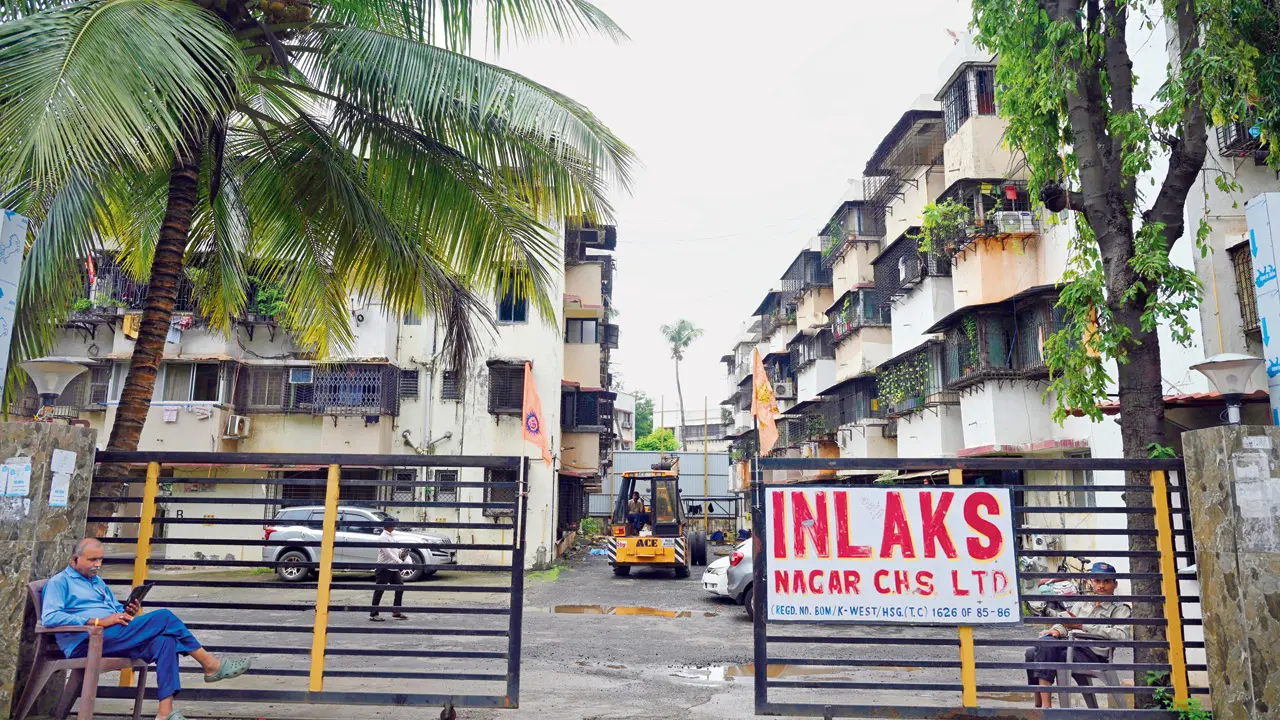
This Versova society welcomed actors, screenwriters, and anyone with a Bollywood dream with open arms, including Sanya Malhotra and Rajkummar Rao. As it heads for redevelopment, many ask: Where will aspirants find solace now?
Mohar Basu (MID-DAY; August 23, 2026)
If you have lived in Andheri West and worked in the film industry, chances are you couldn’t have missed Inlaks, the soon-to-be-torn-down society that has been a rite of passage into Bombay’s film world. There is a long-running joke that all roads in Versova lead to Inlaks — sometimes for an unforgettable night of partying with friends, sometimes to huddle around a laptop and write your first film, and more often than not because it was one of the last housing societies in this supposedly progressive city that didn’t interrogate you before handing you a key: Which religion do you belong to? Are you married? What do you do for a living? And, the most humiliating of all, “Movies mein ho? Toh phir ghar kyun denge?”
My entry into Inlaks was after an unfortunate sabbatical I took from mid-day to pursue my Bollywood dreams. I landed up in the office of screenwriters Raghav Raj Kakker and Kashyap Kapoor in 2023 after a decade of avoiding the mystical, magical land that has been the starting point of hopes for many. NDAs forbid me from telling more of what we made and what eventually happened (or didn’t happen to it), but it sure did one thing: It brought me back to life through a really dark phase of my own career. So when I decided to write this piece, I went back to meet them where I began, at that very office.
The glorious 2010s
In 2011, when Kakker first came to Inlaks, Versova was still a very different place. “This used to be such a deep end of the city, that literally a dust bowl was flying here,” he remembers, “This wasn’t even a paved road, it was a rough road.”
Over the years, the society became known as a kind of unofficial film-school extension, a place where people who had come to Bombay to work in films could find a home, often before they had found a career. The society itself had a different purpose when it came up. Kakker recalls that Inlaks was created as low-cost accommodation for members of the Sindhi community through the Amil Panchayat.
Over time, however, it acquired another identity, one that would become almost inseparable from Mumbai’s film industry. Directors, cinematographers, art directors, actors, casting directors, and acting trainers lived there or regularly hung around. “They used to call it a mini FTII,” he says, “Rajkummar [Rao] bought an Audi and the joke was that it was a car worth more than a house. So, I would see Rajkummar chilling outside. A lot of directors, DPs, art directors from FTII would hang out here. When casting directors were not even a legitimate profession, casting director and acting trainer Prashant Singh used to hang out here. Actors Aakash Dahiya and Chandan Roy Sanyal used to hang out here.”
What mattered, though, was not simply the number of film people living in one place. It was the fact that everyone was at a different point in the same journey. “There was a sense of community. Outside Inlaks and inside Inlaks, there are a lot of people like me who are in different degrees of success. Some are just starting out, some are about to start, some have already started. And the common factor was this space.”
The feeling, he remembers, was simple — you could walk outside, bump into somebody who has just made it and think, “tomorrow it will be my turn”. That became part of Inlaks’s mythology. Kakker remembers the building going into a small frenzy at the famous chai tapri outside over the belief that Aamir Khan had visited during the shoot of Dangal (2016) because Sanya Malhotra was apparently living there. “I don’t even know if it’s true or not,” he says.
There was a piece of folklore about Inlaks that Kakker remembers clearly. “If you come to the industry and don’t live in Inlaks, you haven’t come to the industry.”
The reason the joke stuck was because the society had a reputation for making room for people who might not have found it elsewhere. “Bachelors used to get houses. Four boys used to get houses. Minorities used to get houses. Industry people used to get houses.” That was crucial for people entering an industry built around irregular work. Actors don’t necessarily have salaries.
Writers didn’t necessarily have salaries. A person could have talent, ambition and a promising audition, and still not have the paperwork or income that made a conventional landlord comfortable. Inlaks had room for that person.
The tea stall outside
For casting director Aakash Dahiya, who worked with Mukesh Chhabra in their early years, the film industry didn’t just exist inside Inlaks. It existed at the tea stall outside.
Dahiya lived there from 2008 for four to five years. He and Chhabra were working together on casting, and the tea shop became their adda, a place where actors, casting people and other film industry aspirants would meet. They would find out from one another where auditions were happening, who had gone for which audition, and who was looking for whom. It was an informal network before the industry had the kind of digital networks it has today. The tea stall was where information travelled.
He tells us, “It was an informal network, you found out about work simply by being around. For four-five years while I was there, so much of my life happened there. Mukesh and I were doing casting. We would sit there, meet people, find out who had gone for which audition, where the next one was happening, who was looking for whom. That was how you found work, through people. Even industry seniors lived there — so you had Raj, Vinod, Vineet Kumar Singh, Manoj bhai and so many others around you. And personally, I did D-Day while I was living there, Delhi Crime season one was made while I was there. My first car was there. I fell in love there, I had a breakup there. So when you tell me Inlaks is going away, it doesn’t feel like you’re just taking down a building. We have seen a life there.”
The loneliness antidote
Actor Ashish Verma, known for his roles in Sui Dhaaga, Article 15, Haseen Dillruba, Atrangi Re, Teri Baaton Mein Aisa Uljha Jiya and Tere Ishk Mein, as well as shows including InMates and Court Kacheri, came to Inlaks in 2012, during his transition from FTII to Bombay. He moved through D Block, C Block and A Block over roughly two years. The society was known to be friendly towards artistes and freelancers, and people were willing to accommodate unconventional living arrangements, including living in with his then partner, now wife Ronjini Chakraborty.
His own early years there were modest. He remembers 10-by-10 rooms, two-room arrangements and sharing the space with filmmaker Avinash Arun.
“I kind of graduated through the years. At that point, they would allow you to live there, even if you were in a live-in relationship. When I got here from FTII to Bombay, Inlaks became a very natural transition for us. Divyenndu was there, Deepak Nambiar was there, Rajkummar was there. There were so many of us. The beautiful thing about that FTII gang is that we have seen each other growing. We have seen each other at every stage. Today we might all be busy, we might not meet for months, but nobody has really changed. You meet again and you start from exactly where you left off.”
“I remember Divyenndu around the time of Chashme Baddoor, when he had just started shooting. Avinash was a DOP then, and he was working on a script on the side, which he kept coming back to. That eventually became Killa. You were literally watching people’s careers take shape around you,” he says.
For Verma, Inlaks was also a mohalla. It was almost like a hostel, where every night there would be people around. “Mumbai can be very lonely, and the film industry can be brutal because actors are rejected every single day. Here, you would come home and there would be 10-15 people around you. It became this mini-hostel, this community of people who were all trying to figure their lives out together. And that is something I think you don’t easily recreate.”
But his reaction is far more pragmatic. He says, “I am a strong believer in evolution, so I don’t want to say that nothing should change. Geography changes, cities change, and something more beautiful can come out of it. A few of my friends have gone on to buy houses and move ahead in life. But when you see Inlaks going into redevelopment, you also realize that a very particular kind of space is disappearing, the space that allowed all of us to be young, broke, and uncertain and still be in Bombay, still be close to the industry.”
A 300-square-ft sanctuary
For screenwriter Kashyap Kapoor, the Juhu boy who was introduced to this world by his writing partner Kakker, Inlaks became their first workplace. The duo, whose credits include Inmates, Class, Faraaz and The Buckingham Murders, have their office there.
For Kapoor, the significance of that office was not simply that it was inexpensive. “Inlaks in that sense is a safe space and a sanctuary,”
Kapoor says, “It gave us the dignity of an office from a coffee shop. If you get a sense of space, irrespective of whatever that space is, suddenly it’s yours and you are more responsible to your work. There is a respect for space. People come and work there. There is that energy.”
From that small room, however, their stories travelled. “We have been able to write stories of Bangladesh, the UK, North India, South India, Manipur. And I think that is one of the highlights of this place — that we could still be in Bombay and be cut off enough to say stories of the world. We all spent years in this room together creating something that we were really proud of, irrespective of whether it got made or not.”
Kapoor remembers the first big cheque they received at the office. “We were literally one light, two chairs, and one table and arrives this big cheque and it felt like we have made it. It is also so serendipitous; the first show we wrote at this office (an eight-part series for a leading platform) went on floors last week. It will be our last delivery from this space too. It makes me also feel that this is a place where a lot of dreams come true for a lot of people, including us. So, no matter how hard it gets, the only way to make it here is to stay at it and someday, many years from the day you wrote something, it will be out there for the world to watch it.”
The professional high, however, was accompanied by the very ordinary realities of the building. After returning from London following The Buckingham Murders, they came back to Inlaks and
the monsoon arrived. “We came back and it started raining and our roof started falling on our heads, quite literally. We spent a day mopping the ceilings and the walls, laughing about the irony called life.”
That Midas touch
Artiste manager Amandeep Khubber remembers another Inlaks entirely. She left her home earlier this month after an eviction notice was sent to those renting apartments. Her memory of the place is not of the crowds outside, but of looking out from her window.
During lockdown, there was a small ground below her house. She spent much of her day at the window. She began noticing the birds. There were different kinds every day. There was a pair of hummingbirds that she would sit and watch. There were monkeys too.
She lived in the same house from 2017 to 2021 and eventually it became her office. “I didn’t necessarily move to Inlaks because I wanted my immediate social circle to be there, but if I look at my career, I grew 100 per cent while I was living in that house. I took a sabbatical in 2023, and when I went independent in 2024, I really saw the shift. I registered my own company and suddenly actors started approaching me for representation. Manoj and Seema-ji, Suvinder Vicky, Vijayant sir, these are some of the people I associate with that phase of my life. Mehoob Brar was also working on Operation Safed Sagar (the newest hit show on the streamer) while he was there.”
“I sometimes joke that Inlaks had a Midas touch. I don’t know what it was about that place, but people seemed to grow there. I could work from there, live there and have this very quiet space while my career was changing completely. That’s what I will miss most — not just the building, but what that house represented for me.”
‘Where will the artiste live?’
That is what Kapoor finds hardest to reconcile with the redevelopment. “This was the last bastion of those who are starting out,” he says. “The artiste who used to come, who needed a house in his budget, who wanted to live in Versova… Because now where will the people live?”
He points to the old Shah Rukh Khan story, the outsider who arrived in Bombay and became its biggest star. “There is always a growing conversation about how artistes are not getting a place in Mumbai. The classic Shah Rukh Khan story, that he came from far and became the king? That story can never be made again because we are not leaving a place for him.”
For people who grew up around Inlaks, that is what makes its redevelopment sting. The building is changing at exactly the moment when the city around it has become increasingly difficult for the people who once made it. For some perspective and wisdom, we reached out to a filmmaker-actor whose Inlaks story of living there for decades, is apparently put down into a script and is parked with a streamer.
She and husband moved to Mumbai in 1994, where they built a life together in this very society. She told us, “Well, life moves on. As for artistes, they are a resilient bunch; they will find their way...”
Perhaps she is right. Because, right now, the set of Ram Gopal Varma’s Daya Nayak biopic is parked right next to the crumbling building. Its leading man is Harshvardhan Rane, who left home at 16, struggled for eight years before landing his first acting gig. It took him 26 years to give the biggest hit of his career last year. Well, dreamers do find their way.
Broker Speak
Real-estate broker Mohit Sharma says the numbers around Inlaks tell a very different story from the era remembered by its former residents. “Today, a 1-BHK in and around Inlaks and Yari Road can command roughly Rs 45,000 to Rs 55,000 a month, depending on the building, condition and furnishing. In the society, till last year, rent was in a similar range. You can find lower or higher quotes, but the old idea of getting a decent 1-BHK in this part of Versova for the kind of rent artistes once paid is simply not realistic anymore.”
Recent 2026 listings around Yari Road and Inlaks show 1-BHKs at about Rs 53,000, with numbers going up to Rs 1 lakh for 2-BHK homes.

Subscribe to:
Post Comments (Atom)
Post a Comment