Showing posts with label Vyjayanthimala. Show all posts
Showing posts with label Vyjayanthimala. Show all posts
When they grow up, I want my grandchildren to visit the museum and look at these photos of my films-Waheeda Rehman
2:52 PM

The saree she wore to her first premiere, albums documenting her journey in cinema – Waheeda Rehman has donated all of this and more to Film Heritage Foundation for preservation. While handing over the priceless memorabilia, the veteran star says, “Achanak yeh (photos) dekhte hue laga uss time kaise films banti thi...”
Niharika Lal (BOMBAY TIMES; March 14, 2024)
Last year, when the Film Heritage Foundation (FHF) organised a screening of the restored print of Guide, Waheeda Rehman wondered, “But will people come to watch a film that was made 60 years ago?” To her utter surprise, not only was the screening a houseful one, the audience watched the entire film in rapt attention. Six months later, the veteran actress invited FHF archivists to her home to donate some of her precious memories, tracing her journey in cinema, so that the foundation could preserve them for posterity.
Among the items she handed over to the foundation was the saree she wore to her first film, CID’s (1956) premiere, some trophies, and photo albums documenting all the behind-the-scenes action from her memorable films like Kaagaz Ke Phool (1959), Chaudhvin Ka Chand (1960) and Bees Saal Baad (1962).
‘I hope this inspires others from the film frat to donate materials for preservation’
Speaking to us about Waheeda Rehman’s priceless donations, Shivendra Singh Dungarpur, Founder and Director of the Film Heritage Foundation, said, “It was a very emotional moment for me when she donated her precious personal memorabilia to the Film Heritage Foundation and entrusted us with its care and preservation for posterity. I am so proud that she chose us as her memory keepers. I hope that it will inspire others from the film fraternity to recognise the importance of our film heritage and donate their material to be preserved for posterity.”
60 years have passed, but I’ve kept the albums safe: Waheeda Rehman
When we met the veteran actress at her sea-facing abode in Mumbai, she was in a nostalgic frame of mind. Sifting through a stack of albums, Waheeda Rehman shares, “Maine mehsoos kiya ke jab hum personal photographs rakhte hain, woh kharab ho jati hain phir bada afsos hota hai. Maine socha FHF photos safely rahenge museum mein. Apne se lagaav aur obsession hota hai toh rakh lete hain magar uski dekh-bhaal nahi kar paate hain, aata bhi nahi hai. We don’t know how to preserve pictures. But now these photos will be safe. People who love films may like to visit and look at these albums sometime. When they grow up, I want my grandchildren to visit the museum and look at these photos of my films.”
As for how she acquired these photos, she said, “I used to request directors to give me working stills – the behind-the-scenes shots. I wanted them to share the shots in which the director is directing. Main kehti thi ‘woh sab leke dijiye aap’. There are so many albums. Sixty years have passed, but I have kept them safe. Sometimes, when I get into the mood, I clean the albums and dust them off.”
‘MUJHE PHOTOGRAPHY KA BAHUT SHAUQ HAI’
Waheeda Rehman has always been interested in photography. She shares she likes taking photos of birds, animals, landscapes, and people. About her safari sojourns, the actress says, “Mujhe photography ka bahut shauq hai. Our group is made up of like-minded people who love photography. Most of them are professional photographers. I have been going on these trips for 10 years now. I capture a lot of candid moments. I have visited almost all jungle safari destinations in India – only Gir is left. I have also travelled abroad for safari trips. One of my favourite places is Namibia – it was so beautiful, with sand dunes touching the Mediterranean Sea and waves”
‘I was always particular about what I’d wear’
Waheeda Rehman says, “It’s great to look glamorous, depending upon the character and situation. But just to reveal (your skin) for no reason, I don’t like it. People who do it, if they are comfortable and like it, it’s fine. But personally, I don’t like it. In Amrapali (1966), what Vyjayanthimala was wearing, that’s what people used to wear 2,500 years back. There used to be no top per se – it was all covered with pearls. I was always shy and particular about what I would wear and how I would wear it. There is a scene in Kala Bazar (1960) where Dev (Anand) goes to get flowers for me, and he slips of a cliff and I take out my saree and use it as a rope to save him when no one hears me calling for help. Maine Vijay Anand ko kaha, ‘Yeh toh main nahi karungi. Woh bhi outdoor mein!’ Toh woh bole, ‘Yahan maqsad figure dikhane ka nahi hai, yahan kisi ki jaan bachane ka hai.’ Mera kehne ka matlab hai ki jo marzi costume pehen lijiye – bikini pehen lijiye, swimming costume pehen lijiye magar dikhane ke liye matt peheniye.”
And how did directors during that era react to her views on costumes for her characters? She says, “With time, as I spent more years in the industry and became a top heroine, I managed to convince the directors, and they used to say, ‘Yes, you have a point.’”
‘Meri apni film maine kabhi theatre mein jakar nahi dekhi’
Last year, during the 100 years of Dev Anand celebration, Waheeda Rehman attended the screening of Guide. She said, “Tajjub bhi hota hai ki itni purani filmein log itni dilchaspi ke saath chupchaap dhyaan se dekhte hain; toh lagta hai kahin kuch achha hi kiya hai. What I really liked was that all those people in the cinema hall were silently watching the film. Kabhi beech mein gaane aate thay toh maine bahut saari taaliyaan bhi suni. Mujhe achha laga.”
However, the actress shares she has seen a few of her films in theatres. She adds, “Meri apni film maine kabhi theatre mein jakar nahi dekhi. Abhi bahut barson ke baad main Guide ki screening mein gayi thi aur meri beti Kashvi bhi mere saath thi to maine kaha usko, ‘Beta, aapko nahi dekhne ka dil karta hai toh aap keh do, hum chale jayenge. She was like, ‘What are you talking?’” (Laughs).
‘There are so many female directors, it’s wonderful’
“I really like it when women directors approach me. Two girls once came looking for me for the film Skater Girl (2021). It was a small role. I thought both these girls are struggling, and it’s not a big contribution, so I should do it. Now, there are so many female directors, which is wonderful. I feel sometimes, the sensitivity with which a female director perceives a scene, that’s something only a female director can do. Like in English Vinglish, the way her husband talks to her – it’s not mean, but jaise biwi ko jhadak diya – woh sab auratein zyada behtar samajh paati hain. Aaj kal kaafi achhe directors hain jaise Gauri Shinde. I also like Farah Khan’s films – in commercial cinema, the masala Manmohan Desai type films she makes. Commercial success toh bahut zaroori hai. Then there’s Zoya Akhtar and Kiran Rao.”
Dilip Kumar never raised his voice, but his silence was unbearable-Saira Banu
8:18 AM

On their 57th wedding anniversary, Saira Banu takes us through the pages of her love story with legendary actor Dilip Kumar
Renuka Vyavahare (BOMBAY TIMES; October 11, 2023)
It's a classic real-life story of an eternal romance. Saira Banu and Dilip Kumar tied the knot on October 11, 1966, and 57 years later, she is as much in love with him as she was when they started out as a couple. India’s most eligible bachelor at the time, he initially maintained a respectful distance on and off the screen given their massive (20-year) age difference before eventually falling for her enchanting beauty, innocence, and devotion for him. Unlike today’s high-profile destination weddings, the legend of Indian cinema, Dilip Kumar, married a young Saira Banu in a homely ceremony in Mumbai. “So many gatecrashed our wedding that we ran out of food,” chuckles the actress. On her wedding anniversary, she looks back at her real-life fairytale. Excerpts…
Your life has been no less than a fairytale. Dilip Kumar was the heartthrob of our nation when you married him. What did that feel like?
I wanted two things in life. I wanted to marry the man of my dreams and I wanted to be a film star like my mother Naseem Banu. Both my dreams were fulfilled. I couldn’t have asked for more. My mother wanted me to study further and become a lawyer, as she couldn’t do that. She never wanted me to be an actor, but I wanted to be like her. As far as Dilip sahib is concerned, I was obsessed with him as a teenager ever since I saw his film ‘Aan’ (1952) in London. I studied there at the time. I fancied men like James Dean, Rock Hudson and Elvis Presley. I had their photos on my wall. Calling Dilip sahib a crush would be wrong. I was head over heels in love with him. I was smitten to the point that I envied Vyjayanthimala because one of the promotional stills of Madhumati (1958) had Dilip sahib almost kissing her forehead. That pose was way too intimate and bold for those times. I remember taking a pair of scissors and cutting her out from that photo (laughs). I became a fan of hers later. I call her akka (elder sister) and she calls me an angel. We got closer over the years. She was pleasantly amused when I recounted this incident to her.
How did this teen idol worship translate into a romantic relationship?
Our families knew each other and had common interests like music. His younger sister was close to my mother so we would often have these get-togethers. I returned from London and met him for the first time at a dinner party hosted by the legendary filmmaker Mehboob Khan (known for ‘Mother India’) and his wife, who I fondly called Akhtar aunty. He was dressed in a plain white shirt and trousers. He was so simple and humble despite the fame. There was this luminous aura around him. A girl like me, who was shy and introverted, would retire to my room as soon as someone knocked on our door, something changed. As soon as I saw him, I went up to him and blurted, “Aap mere saath kaam kijiye.” He had seen me as a little girl, so showing me his grey strands, he replied with a smile, “Kya tumne mere grey baal dekhe hai?” I told him they make him look distinguished. At the dinner table he added, “I eat like a pig.” He refused to work with me even after Junglee (1961) became a hit, as he was conscious of the age gap. The part played by Mumtaz in Ram Aur Shyam (1967) was initially offered to me, but he said she is too young to work with me. I kept saying, “I am big enough to work with you.” That’s when he realized I was serious about him.
When did he propose marriage?
The day was August 23, 1966, and it changed my life. My mother had invited him for my birthday at our new Pali Hill residence. He was shooting in Chennai for Ram Aur Shyam and flew all the way back just for my birthday. ‘You have grown into a beautiful girl,’ he said that evening. I was dying to hear those words for years! The man was finally attracted to me. For the next few days, he travelled from Madras to Bombay every other night and had dinner with me. At the end of 10-11 days, he said, ‘I am constantly flying in and out. Will you consider one thing? Will you marry me?’ Thrilled but a bit surprised, I asked, ‘How many girls have you said this to!’ He was the most eligible bachelor of that time, and I had barely acted in films for four years. When he approached my grandmother and asked for my hand, I knew he was serious. The media and public were equally puzzled, I guess.
Unlike today’s high-profile Bollywood weddings, yours was a simple ceremony at home. In hindsight, did you want it to be an elaborate affair?
Not at all. It’s a real-life Cinderella story. It felt like sharing a throne. I got Dilip Kumar! I would have married him in rags if need be. Uss Zamane mein tailor hua karte the. My bridal outfit was simply stitched. No fancy jewellery either as we planned the wedding in 3 days. Security was not so high as it is today so there were gatecrashers. We ran out of food on our wedding day, so people had to go fetch more.
What made him so special beyond the great actor that he was?
Ours was a great love story. We would exchange notes through the air hostesses when he would be obliged to go sit with someone else for some time. I wrote to him that I missed him and wanted him back beside me. If he was away for a week, I would leave 7 notes under his folded shirts in the bag so he could wake up to that each day. He was a gracious man who never spoke ill of anyone including the ones who wronged him. He wasn’t judgmental and always spoke the truth. He encouraged me to see the good in people. The age gap didn’t matter because I learnt so much from him. We loved sports… Tennis, Golf, football. He was extremely fit.
He was linked to some beautiful women including Madhubala. How did you deal with that aspect of his life that tends to follow immense stardom?
I never gave credence to these girlfriend theories. I was the wife. He never spoke about his past girlfriends. I never asked either. Unki merese shaadi ho gayi. Mujhe duniya mil gayi. I didn’t care about the linkup stories as the media can be irresponsible. I was also linked to a dashing cricketer, who was the Indian captain. I won’t take names, but I had never seen the guy in my life. The first time we saw him was at Wimbledon.
A marriage as eternal as yours is rare and precious in today’s world of hookup culture and dating apps. What would you tell those who are sceptical about believing in ‘happily ever after’?
I hope your generation gets to see what he was like as a person. I made my Instagram debut for this purpose. Koi bhi shaadi ya relationship mein, ‘Sabar aur adab’ (patience and respect) ki bohot zaroorat hai. If sahib and I had an argument, it wouldn’t last for more than ten minutes. You must communicate. He was the one who never raised his voice but his silence was unbearable. I, with my own choice, would be the first to apologize. He wasn’t the man who had ego or would throw his weight around. To me, marriage is a perfect union based on love, faith and immense unspoken understanding. If you make a mistake, you should have no shame in saying sorry.

Lata Mangeshkar: A singer who captivated millions over seven decades
8:25 AM

Ambarish Mishra (THE TIMES OF INDIA; February 7, 2022)
Lata Mangeshkar was groomed in the art of playback singing—diction, pronunciation, voice modulation and breath control—by Master Ghulam Haider, Anil Biswas and Naushad Ali. She went on to team up with composers as varied as C. Ramchandra, Shankar-Jaikishan, S D Burman, R D Burman and A R Rahman, and found favour even with purists like Madan Mohan, Roshan, Khayyam, Sajjad Hussain, Jaidev, Vasant Desai, Salil Chowdhary, and Hridayanath whose creations were steeped in Indian ragas.
The appeal partly lay in her incredible vocal range—it extended beyond three octaves, allowing collaborators to experiment with form and content. Anil Biswas would say she inspired them to work on innovative musical phrases. “Hindi cinema was looking for a pan-Indian voice to suit female leads of varying extracts—Vyjayanthimala and Hema Malini came from south, Sharmila Tagore and Raakhee from Bengal, while Nutan was a Maharashtrian. Mangeshkar answered the need,” said film chronicler Veerchand Dharamsey.
Pointing out that her 1947 debut coincided with Partition, Prakash Joshi, a musicophile with a collection of 4,000 Lata songs, said her songs helped heal the wounds of communal frenzy. “‘Hawa mein udta jaaye’ (from Barsaat) was enough to put a smile on India’s lips, replacing horror with hope,” he said.
Born in Indore on September 28, 1929, to Deenanath and Shevanti Mangeshkar, she was trained in classical music by her father, an actor-singer from Goa, who owned a drama company. Eldest among five siblings, her passion for singing was evident as early as age four.
Master Deenanath’s death in 1945 altered her life’s course. She joined Prafulla Pictures, a film company helmed by producer-actor Master Vinayak Karnataki and became the family’s sole breadwinner at 14. Hindi film composer Ghulam Haider, a Lahore migrant, was quick to spot her potential. When producer S. Mukherjee, whose ‘Shaheed’ was on the floors, rejected the thin voice which, he said, wouldn’t suit the female lead, an angry Haider stormed out of Mukherjee’s Filmistan studio in Goregaon with Lata in tow, but not before warning the movie moghul that his protegee would become a superstar.
“That afternoon Master-ji and I trekked to Goregaon railway station. Master-ji said he would find me an opening in Bombay Talkies. The platform was deserted. We sat on a wooden seat. Tapping lightly on his 555 cigarette tin, he taught me a song,” Mangeshkar told TOI in a 1998 interview. ‘Dil mera tora,’ from ‘Majboor’ brought instant success, and was followed by ‘Aayega aanewala’ from Mahal (1949). As the 78 rpm record sleeve of Mahal didn’t carry her name, radio stations were flooded with calls from admirers eager to know the singer’s identity. Between 1947 and 1951, her popularity soared. This phase coincided with singing star Noorjahan’s migration to Pakistan and the gradual fading away of Suraiya.
A moment of glory came when she was invited to a midnight congregation at Shivaji Park on May 1, 1960 to mark the formation of the state of Maharashtra with a Marathi prayer song. Three years later, her voice rang out at a rally in Delhi to raise funds for families of soldiers who died in the Indo-China war. Jawaharlal Nehru fought back tears as he heard ‘Ae mere watan ke logon.’ After the event he met her and said, ‘Beti, aaj tumne mujhe rula diya” (You brought tears to my eyes today).’
Mangeshkar reigned in the 1970s-’80s despite drastic changes in taste. Languorousilting tunes gave way to heavy orchestration and fast beats. She was quick to adapt, crooning for composers half her age (Rajesh Roshan, Bhappie Lahiri, Jatin Lalit, Raam Laxman), as also with GenNext singers S. P. Balasubramaniam, Sonu Nigam, Suresh Wadkar.
Though she cut down on assignments, her ‘Dil deewana bin sajna ke’ from Maine Pyaar Kiya set the mood for the vibrant 1990s. She took Youngistan by storm with ‘Tu mere saamne’ (Darr), ‘Gori hai kalaiyaan ‘ (Aaj Ka Arjun), ‘Yaara sili sili’ (Lekin), ‘Didi tera dewar (Hum Aapke Hain Kaun), ‘Chhai chhappa chhai’ (Hu Tu Tu). Dilwale Dulhania Le Jayenge became a cult, post-globalisation film, reviving romance with frothy numbers like ‘Mere, khwabon mein jo aaye’, ‘Mehndi laga ke rakhna’ (the Lata-Udit Narayan duet is played at wedding receptions even today) and ‘Tujhe dekha toh yeh’ (with Kumar Sanu). ‘Luka chuppi’, a moving piece, from Rang De Basanti, is considered her swan song, a sort of grand finale to an epic life.
There can be no one like Dilip Kumar-Vyjayantimala
8:14 AM

Renuka Vyavahare (BOMBAY TIMES; July 8, 2021)

Talking to Bombay Times, the legendary actress remembered the doyen of Indian cinema, who passed away in Mumbai yesterday at 98. Unable to control her tears as she spoke over the phone from Chennai, she said, “I am absolutely shattered. I have no words. I feel honoured that I got to work with a legend like him, my most favourite actor and wonderful costar. We made several successful films together. As Saira ji always tells me, ‘Akka, you and saab made the best films.’ As actors, we understood each other. While it’s a great loss for the film industry, it’s a personal loss for me. I knew him and Saira ji so well. Whenever I came to Mumbai, I would go to their house and chat for hours. Over the years, my angel as I call her, Saira ji took over the role of a mother to him and she dedicated her life for his care. I admire her with all my heart. As soon as I can move around, I will go and see her.”
Dilip Kumar’s method acting and dedication to his craft was widely admired. Vyjayantimala shared, “I was in awe of him when I came to Mumbai. He was a superstar and a rage across the country. I was then just a dancing queen or a dancing star as they called me. I became an overnight success right after my first Hindi film Bahar (1951) because of my dance.”
Vyjayantimala said, “No one talked about my acting or referred to me as an actress until I worked with him in Devdas. That was my first film with Dilip saab and it transformed me as an actor. It paved the way for me. How to understand a character is what I learnt from him. Though he was a superstar and I was a relatively new actor, he didn’t treat me like one. He was helpful, polite, courteous and a thorough gentleman. If I made a mistake, he would help me rectify it without making a noise. I was a South Indian girl who had to speak Bhojpuri in Ganga Jumna and it was tough for me. He recorded the lines to show me where to stress and how to get the tone right.”
Stories of ego clashes between the two had surfaced and the veteran actress clarified, “That was all rubbish. I was in awe of him, and he was extremely helpful. There was no question of any ego clashes. He was multitalented. On shoot, he would hum various raags, spoke several languages and was socially aware. We did eight films together and each was equally beautiful. Films like Madhumati, Naya Daur, Ganga Jumna and Sunghursh (1968).”
Raj Kapoor, Dev Anand and Dilip Kumar, the remarkable trio of Hindi cinema is no more. While the actress nodded in affirmative on the sentiment, she added, “They all were great no doubt, but there can be no one like Dilip Kumar. I would never put anyone along with him. He was a unique, standout performer. He will continue to live in my memory forever.”

Dilip Kumar always used his voice effectively, modulating it to the situation-Vyjayanthimala
8:09 AM

Priya Menon (THE TIMES OF INDIA; July 8, 2021)
Vyjayanthimala Bali, who was cast opposite the thespian in four of his landmark films – Devdas, Madhumati, Naya Daur and Ganga Jumna – says working with him was an education and an experience that forged a lifelong association.
“When Bimal da asked me to play Chandramukhi (for Devdas), I was in awe because I would be acting with the Tragedy King. But he made it very comfortable,” says Vyjayanthimala, who at 86 continues to pursue her passion for Bharatanatyam.
The first scene she enacted with him was simple enough. “The line was ‘Aur mat piyo Devdas’ (Don’t drink anymore, Devdas). I had to say it when Devdas walked in drunk. The camera was to capture Devdas and then follow him and turn its focus on me when I spoke that line with an expression of anguish and helplessness.”
She thought it would be easy. “As the technicians announced readiness to shoot and Bimal da looked at me to know if I was ready, I realised Dilip sahab was not on the sets. An assistant told me he was taking brisk rounds of the studio to get that tired, weary look and he had instructed them to start the camera when he would stagger in with beads of real sweat on his brow and a look of exhaustion.”
Vyjayanthimala says that was the precise moment when she began to panic. “Here was an actor who took so much trouble to endow realism and here was me who had not done any preparation and was all set to face the camera. When it started and I saw the incredible perfection of Dilip sahab’s performance, all I could do was helplessly speak the line: ‘Aur mat piyo, Devdas’. The helpless look on my face was what Bimal da wanted.”
In ‘Madhumati’, he hears a voice and goes in search. A girl’s face emerges from the fog and he asks: “Who are you?” She replies, “Madhumati.” The scene was brilliant in the way it was conceived and performed, recalls Vyjayanthimala. “Dilip sahab always used his voice effectively, modulating it to the situation and the best moments in ‘Madhumati’ showed how well he used the texture of his soft voice to enhance the suspense and mystery.”
For him, she says, it was all about timing. “He said interaction is more important than action, ie, the way you react to the other character. And that the timing of any gesture – even a nod of the head – matters. I was able to do it because my Bharatanatyam foundation helped me emote and have quick reflexes,” she says.
Vyjayanthimala left the industry, but continued to share a bond with Saira Banu. She remembers the time when she met them in 2017. “I went to Mumbai with my son Suchindra to receive an award. Saira sent a car, and I visited Dilip sahab. He had attendants around him and Saira tried to coax him awake, saying, “See who has come, Dhanno (Vyjayanthimala’s character in ‘Ganga Jamuna’) has come. He opened his eyes, it was just a flicker. Saira asked me how he looked, and I said he looks as good as he did in ‘Madhumati’. I met them again in 2019 but he was very quiet.”
(Includes excerpts from Dilip Kumar: The Substance and The Shadow by Udaya Tara Nayar)
Saroj Khan ji thought a film on her would be too scandalous-Terence Lewis
8:17 AM

Saroj Khan and Madhuri Dixit during one of their many collaborations
Choreographer Terence Lewis is contemplating a biopic on the late dance director; now has scripted another journey for the screen
Akash Bhatnagar (MUMBAI MIRROR; July 28, 2020)
 Sony TV’s talent hunt show, India’s Best Dancer, has got back into action after a forced break. Choreographer Terence Lewis was the first to agree to resume work in the midst of the ongoing Coronavirus pandemic, even convincing fellow judges, choreographer Geeta Kapur and actress Malaika Arora, to join him. “I have to admit that we have all become more efficient in the present scenario; we’re working in the Akshay Kumar-style,” he chuckles.
In a recent episode, which paid a tribute to Bollywood legends, Terence followed the tradition of the late dance director Saroj Khan, rewarding Rs 101 to contestant Rutuja Junnarkar and retraced his association with the dance legend. “In 2007, I did a show called Dance Dance which had Saroj ji, Vaibhavi Merchant and me as the judges and Geeta as a backstage choreographer. It wasn’t appreciated much, but we forged a connection and I went on to appear on her show, Nachle Ve,” he informs.
One day, after she was done with her work, Saroj ji saw Terence dancing and stopped to observe. She didn’t know much about contemporary dance styles and was impressed. After the act, she showered him with compliments. They went on to speak about her journey and how she became the woman everyone was intimidated by. “She was motherly to me, but I was still terrified because Saroj Khan was an institution in herself,” he admits. Unknown to her, Terence had also watched Sarojji during Lagaan and was amazed by the dignity and grace she brought to charttoppers like “Dhak Dhak Karne Laga” and “Choli Ke Peechhe Kya Hai”. “She could even make actors like Sunny Deol, Ajay Devgn and Anil Kapoor dance and it’s thanks to her that choreographers came to be noticed in the film industry and their work appreciated by the audience,” he applauds.
Terence recalls that when he told Saroj ji that he didn’t want to do films and had found his calling in TV, she quipped tongue-in-cheek, “Tu bach gaya.” For him, she was the Broadway legend, Bob Fosse, of Bollywood. “I wished to make a film on her journey, but she was not excited. She told me it would be too scandalous,” he recounts, revealing that at 14, pregnant with her son, Raju, Saroj ji was made to teach Vyjayanthimala some dance steps for a film song. “The same day, she delivered. She lost her daughter and went through so much, but it’s a tribute to her grit that a child artiste Nirmala Devi went on to become Saroj Khan, an alpha figure in a male-dominated industry, thanks to whom award shows began to honour choreographers. I hope someone makes the film someday.”
On his part, Terence has written another script in the last three years. It is the journey of a fictional choreographer and he hopes to make it in the next two years.
Saroj Khan asserted that a woman choreographer could be big boss in Bollywood, says Khalid Mohamed
8:35 AM

Khalid Mohamed (MUMBAI MIRROR; July 4, 2020)
Those defiant eyes, ever-ready smile, a crown of hennaed hair and typhoonish dance moves despite her stocky frame—you couldn’t believe this was the same woman who was just sitting on a studio chair. She would describe every step, every smile, twirl of the hair, hip movement and gyration—commonly known as jhatkas matkas—which were stamped with the fabled Saroj Khan style.
She was the dial-a-superhit diva for over nearly four decades with a repertoire of 2000 songs. A one-woman-brand, she broom swept the path for female choreographers to be boss in the traditionally male-controlled Bollywood hierarchy. Fiercely competitive, she would scoff at sharing her numero uno status with the upcoming Farah Khan. In return, Farah and more of her ilk would accept her put-downers, acknowledging her as their guru to date.
The 71-year-old legend passed away after a cardiac arrest in a suburban hospital on Friday. Fondly called Masterji, she had been ailing for the last 10 years, would be bed-ridden at times, and had shifted from a roomy Bandra ground floor home to a cramped apartment in Oshiwara.
“Jab tak hai jaan main zaroor nachungi aur nachvaungi. Once a filmi always a filmi,” she had once laughed self-deprecatingly. Could she define ‘filmi’, I had asked, to which she had snapped, “Commercial, what the people like! You’re educated, why ask such a silly question?”
Right. Now that Bollywood dances are largely reduced to an assemblage of montage shots and elaborate set pieces are a rarity, Saroj Khan had sought to re-invent herself by appearing on the jury of TV reality shows (Nach Baliye, for one) and if she was approached to guide her favourite Madhuri Dixit, her reservations and advancing age evaporated. Her last hurrah with the heroine was for “Tabaah Ho Gayee” (Kalank).
Given to frankspeak, she had also spoken about the ‘casting couch’ in Bollywood. Following backlash, she had uncharacteristically withdrawn her all-true statement.
Without her, it would be facile to even think of such iconic B-Town numbers as “Ek Do Teen”, “Tamma Tamma Loge”, “Humko Aajkal Hai Intezar”, “Hawaa Hawaaii”, “Dhak Dhak Karne Laga”, “Dola Re Dola”, “Choli Ke Peechhe Kya Hai” and “Main Teri Dushman” to cite just a palmful. She caught the hook of the music, created signature steps, synchronised the vast back-up of chorus artistes, avoided cutaways to the minimum and showcased the prime dancer. It was almost as if they were merely following her instructions, to which she’d chortle, “Nahin bhai, see without Madhuri or Sridevi, these dances would be like food without namak.”
She was aware that she had to better the dances of the 1950s performed by Cuckoo and Helen. “They were superb, never displaying a shred of vulgarity,” she’d maintain. “I try to make my heroine as good as them or, if I may say so, sexy without being undignified.”
As for the charge that she did derive inspiration from say, the Madonna videos, the rage on MTV in the 1980s, she’d riposte, “May I ask you to buy a new pair of spectacles? Mine is a fusion of the purely Indian—Kathak mostly—with the western elements because that’s the demand of the moment.” In the same breath, she’d admit that she would okay variations of the outfits in the Michael Jackson videos: “No one’s better than him in the world among male entertainers. And there has been no one better than Vyjayanthimala and Madhuri Dixit in our cinema.”
If an upcoming male star had two left feet, she’d lose her cool, which I witnessed at the New York filming of Rishi Kapoor’s Aa Ab Laut Chalen. Plus, whether overseas or in Mumbai, she’d insist on punctual breaks for lunch, but extend the shoot into late nights if necessary. As she did during the five-day picturisation of the tandav “Mere Watan” for Fiza, with Hrithik Roshan. “Omigawd, this boy’s fantastic. He’s born to dance,” she’d exclaim, but only when he wasn’t within earshot. “Never flatter an artiste,” was her credo. “Or they develop swollen heads.”
Not surprisingly, whether it was Hrithik or Karisma Kapoor (for the number “Nachoon Naachoon”), like all their peers, they would touch her feet for blessings.
That there is a latent director in most choreographers was evident in Saroj Khan as well. For want of regular work—despite winning three National and eight Filmfare Awards she had started choreographing for Bhojpuri B-graders and was planning to direct a musical opus star-lighting Priyanka Chopra. However, Ms Chopra backed out at the last minute. But for a few sarcastic jibes, Masterji chose not to fan the fire. Neither did she ever wish to direct again.
Born Nirmala Nagpal, her parents had moved to Mumbai after the Partition. She was cajoled to become a child actor in Nazarana with Shyama. Next, she became a chorus dancer, assistant dance director before going solo with the Sadhana-starrer Geeta Mera Naam. Her marriage to dance director B Mohanlal was short-lived, who was already, in secret, a father of four children. Next, she married Sardar Roshan Khan, explaining the change of her maiden name. She is survived by her husband, a son and two daughters.
Back in 1990, ace photographer Dayanita Singh had seen Masterji at work, she was doing three shifts a day. “I was amazed how graceful and light-footed she was,” Singh had remarked. “It was the first time when the sexy moves—earlier associated with Hindi cinema’s vamps—were being done by the heroines.”
Just by narrowing those defiant eyes, Saroj Khan could compel the camera’s heart to go dhak-dhak.
Remembering Krishna Raj Kapoor, Bollywood's Lady in White: A tribute by Khalid Mohamed
9:16 AM

KRISHNA RAJ KAPOOR (1931 - 2018)
Krishna Raj Kapoor was a model star wife for whom the hearth and home mattered above all
Khalid Mohamed (MUMBAI MIRROR; October 2, 2018)
She was married to a showman, but any kind of attention embarrassed her. She was particularly adept at deflecting conversations that harked back to the good and bad old days. Instead, she’d want to know how you’d been doing, why you’d lost weight, and whether you had managed to make another trip to the Nantes film festival in France.
Krishna Raj Kapoor, who passed away following a cardiac arrest at the age of 87 on Monday morning, followed the cardinal rule of speaking only when spoken to. She was aware she could be glorified as a woman of forbearance. She was aware she could be extolled as a woman who remained rock firm against a shoal of calumnies. She didn’t need that. Her silence spoke volumes.
The only time I heard her murmur a sentence of regret, was when she couldn’t retrieve the hundreds of stills clicked by a photographer assigned to cover the studio shoots of the R.K. banner films. “Pata nahin,” she had smiled wanly, “he doesn’t wish to part with them or even make copies.”
Her eyes, though, would disclose a certain tenderness, touched by a hint of melancholia. Her self-discipline in serving as a binding force to India’s greatest showman, Raj Kapoor, must have taken a toll. If he exuded flamboyance, she radiated restraint. You could call it a classic case of opposites attract -- and despite hiccups -- be together till the last breath.
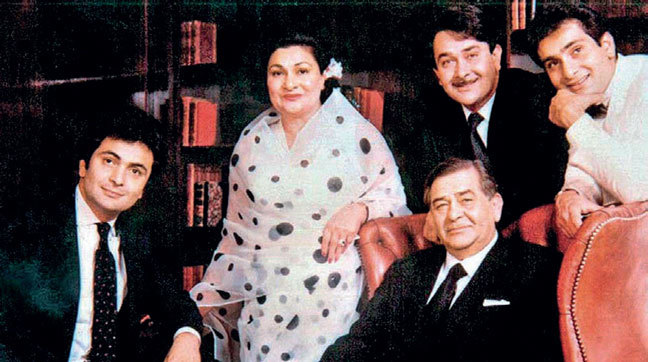
The couple with their sons Randhir, Rishi and Rajiv
Indeed, she became a role model for film star wives, inwardly conscious that it’s ultimately the hearth and home which matter. Subservient she could never be. She was an equal and at points, even the superior one, a status which can now be accorded to her unflinchingly. During her lifetime, she would have been offended by any form of panegyric.
The story of the Rewa born girl is the stuff that love stories are made of. At the age of 16, the daughter of police inspector general Raisaheb Kartar Nath Malhotra, married the upcoming actor Raj Kapoor who was 22 then. The blue-eyed dreamer had seen her play a tanpura on visiting the home of her brother actor Premnath.
Inspector general Malhotra was the maternal cousin of R.K.’s father Prithviraj Kapoor. So, they were distantly related. What is colloquially known as ‘an arranged love marriage’ was fixed. Rewinding to the wedding ceremony, the late thespian Ashok Kumar, would often chuckle, “Krishna peeked at me from under her ghunghat and told Raj, ‘Oh he’s so handsome!’ He didn’t quite like that and must have sworn that he would become much more famous than me. Which he did.”
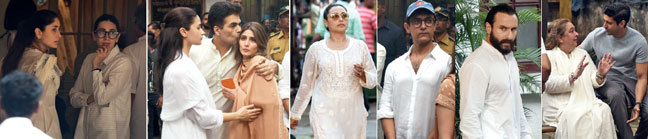
Sisters
Kareena and Karisma rushed to RK cottage with parents Randhir and
Babita in the morning; Karan Johar consoled Riddhima Kapoor-Sahni; Rani
Mukerji, Aamir Khan and Saif Ali Khan were among the visitors who turned
up to pay respects; Farhan Akhtar was seen with Rima Jain; PICS: RAJU
SHELAR
Accustomed to a large family – she had 11 siblings including Rajendra Nath and Narendra Nath who went on to become actors – the bride segued into the patriarchal Prithviraj Kapoor family which had anchored itself in a Matunga neighbourhood.
Raj Kapoor’s career was on the ascent, simultaneously as an actor, producer and director. Her family helped him with a financial loan to build the R.K. Studio in Chembur. “Dad and my grandfather weren’t flush with money those days,” son Rishi Kapoor has recalled, adding, “Relatively, my mother’s family was well-off.”
Raj Kapoor’s spiralling popularity was accompanied by his legendary romance with Nargis. The passion play between the creator and his muse was no secret. The on-screen chemistry, evidenced notably in Barsaat, Awara and Shree 420, was so palpable that the pair became socially acceptable off-screen even in the corsetted 1950s.
Krishna Raj Kapoor didn’t recoil or threaten the showman with ultimatums. Mother to five children — Randhir, Ritu, Rishi, Rajiv and Rima — her winning card was tolerance.
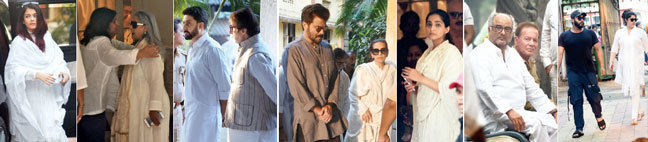
The
Bachchans — Aishwarya Rai, Jaya, Abhishek and Amitabh — arrived for the
last rites; Anil and Sunita Kapoor were among the early visitors, while
their daughter Sonam was also present; Boney Kapoor stayed close to
Salim Khan through the evening, as Arjun Kapoor turned up with sister
Anshula
Tolerance, in such a context, may sound regressive. For a mother, however, tolerance was the unalloyed strength and priority. Within and outside the film industry, polygamy was rampant. Suffice it to say she had to withstand it, an option which is exercised to this day and millennium by Bollywood’s first wives’ club — till it comes to a breaking point.
Raj Kapoor and Nargis parted ways without any demands on the wife’s part. The actress left the banner on her own volition to act in Mehboob Khan’s Mother India. Presumably, the showman was becoming far too possessive, she wanted to strike out.
The breaking point for Krishna Raj Kapoor came with the Raj Kapoor-Vyjayanthimala affair in the course of filming on the overseas locations for Sangam. Whispers about the liaison reached a crescendo point. With her children, Krishna moved out of the R.K. Cottage in Chembur to a suite at the then-Natraj Hotel on Marine Drive. No acrimonious statements, no arguments. Enough was enough.
Inevitably, the Vyjayanthimala chapter came to an end. The R.K children were back where they belonged: home. Other R.K. heroines, Padmini and Zeenat Aman, were linked with Raj Kapoor, transiently. It was the wife who became the irreplaceable Lady in White, an imagery associated with the showman who often showcased his heroines in spotless white costumes.
Krishna Raj Kapoor’s style was timelessly elegant. She would be seen most often in understated embroidered white and pastel shaded organza, chiffon and georgette ensembles. A string of pearls would be supplemented on festive occasions with diamonds. Right till advanced age prevented hours-long, traffic-clogged car rides, she would travel from Chembur to Kemp’s Corner in South Mumbai to get her hair coiffed by Ray George Stevenson of the six-decades-old Raechelle salon.
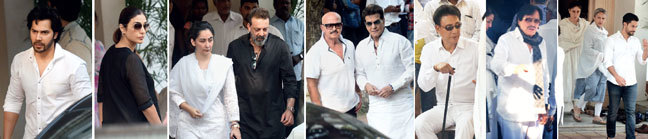
Varun
Dhawan, Tabu, Maanayata and Sanjay Dutt, Rakesh Roshan, Jeetendra,
Danny Denzongpa, Sanjay Khan dropped by to pay their respects; Kareena,
seen here with mother-in-law Sharmila Tagore and actor Kunal Kemmu
She allowed herself a few pleasures, like hosting a game of cards regularly at the R.K. Cottage. Her circle of friends included her sister Uma Chopra (wife of Prem Chopra), Shukla Kumar (wife of Rajendra Kumar), Salma Khan (wife of Salim Khan), Nirmal Kapoor (mother of Anil Kapoor) and Munni Dhawan.
Unlike quite a few star wives she didn’t interfere with R.K.’s creative process, keeping out of story, music and edit sessions, but ensuring that the bar and kitchen were kept open for the filmmaker’s collaborators around the clock.
Above all, the paramount joy in her life was to see her sons and grandchildren evolve in their careers. For instance, she had jetted off to Lake Placid in the U.S. to wait every evening for Rishi Kapoor to return to the unit hotel from the shoot of Aa Ab Laut Chalen. She’d ask, “Hope it all went off smoothly?” and if the first-time director wouldn’t answer, she’d say calmly, “Don’t worry, tomorrow all will go well.” This, in fact, was her credo.
Grandchildren Ranbir and Riddhima adored her. Although she had to travel in a wheelchair, she was at the centre of the celebrations of Neetu Singh Kapoor’s 60th birthday in Paris earlier this year.
You can detect the same look in the eyes, be it in the photographs of her as a young woman, as a resilient widow when Raj Kapoor passed away 30 years ago, or as a loving grandmother on Instagram.
The movies, star wives, relationships and tolerance levels have kept altering dramatically over time. That look of tenderness — with a hint of melancholia — in Krishna Raj Kapoor’s eyes never did.
Dev Anand & Vijay Anand thought of Ashok Kumar for Jewel Thief as they wanted an actor with 'clean image'
8:07 AM

Roshmila Bhattacharya (MUMBAI MIRROR; December 7, 2017)
 He was always racing against time. In September 2011, when I dropped in
at his office, Dev Anand, who’d just turned 88, told me in his
inimitable style, “The mind never grows old but always urges you to
surge ahead.” He was all charged about Chargesheet, his banner
Navketan’s 37th release, and was planning to return to Nepal for a
sequel to Hare Rama Hare Krishna. But his plans of romancing life and
cinema came to an abrupt halt two months later when, on December 3,
death tiptoed into his hotel room in London and snatched him away while
he was asleep.
Six years later, I still can’t imagine Dev saab lying peacefully somewhere, but I can see him sprinting down Churchgate station to catch a local. He’d missed a train in the ‘40s, but the mad dash had caught the eye of Shahid Latif sitting in another train. Latif was directing Ziddi based on his wife Ismat Chughtai’s short story and suggested Dev who’d just wrapped up three films with Prabhat, drop by the Bombay Talkies studio to meet the “boss”, Ashok Kumar. To his delight, his idol not only offered him the Ziddi role supposedly written with him in mind, but also took a shine to him and would sometimes drop him home in his two-seater MG.
Ziddi was a surprise hit and made the struggling actor an overnight star. Dev saab bought himself a Hillman Minx and drove it down to the studio to show it off to Ashok Kumar. To his surprise, though the boss’s car was in the parking lot, the studio was shut. “It was January 30, 1948, and Mahatma Gandhi had been assassinated. The country was in mourning,” reminisces his close associate Mohan Churiwala.
Almost two decades later, he repaid his debt to Ashok Kumar by casting him in a role contrary to his established image in a spy thriller based on a K A Narayan story revolving around a ‘jewel thief’ whose identity is unmasked only towards the end. “Both Dev saab and Goldie saab (director-brother Vijay Anand) were looking for an actor with a ‘clean’ image to enhance the suspense, which is why they thought of Ashok Kumar. But when Goldie saab met Dadamoni who had just recovered from a heart surgery, he was far from excited about playing a baddie even though the film revolved around him. Goldie saab assured him that he wouldn’t be required to do any action and the schedule would be planned around him so he could report late, break for lunch at 1 pm, enjoy a siesta before shooting again till 5 pm. It was only then that he gave his nod,” informs Churiwala. On the first day, Goldie made his priorities clear by announcing lunch break half an hour before schedule, minutes after Vyjayanthimala had pulled into the studio fashionably late, because he did not want to inconvenience an ailing Dadamoni. His concern paid off. Jewel Thief was one of Ashok Kumar’s most memorable acts and with puckish humour, Goldie saab threw his audience a clue by not clubbing him with the other actors in the ‘cast’ category, but putting him at the top of the credits which read ‘Ashok Kumar in Dev Anand’s Jewel Thief’. Few got the hint.
Churiwala recalls a dialogue from the film’s climax in which Ashok Kumar lauds Dev Anand’s character, Vinay/Prince Amar, who he’d believed to be dead, saying, “Tum acting bahut achcha kar lete ho,” to which Dev saab responds, “Badhiya badhiya actor ki sohbat mein rekhar thodi bahut acting to insaan seekh hi jaata hai.” His reply was a tribute to the master actor from whom he had picked up his craft. “Dev saab idolised Dadamoni to whom he owed his big break and regretted he hadn’t responded to his last call, a couple of days before his demise (December 10, 2001) requesting him to drop by. A busy Dev saab thought he had time and lived to rue his decision,” sighs Churiwala.
Today, both the legends are gone but their Jewel Thief which opened on October 27, 1967, remains unforgettable even after 50 years. One still remembers Dadamoni’s ‘invisible’ baddie and its hero who despite his mental torment, was the picture of sartorial elegance in checkered shirts, corduroy suits and the trademark Jewel Thief cap. “The cap he picked up in Copenhagen, the rest of his wardrobe in London. To the end Dev saab was a style icon, making sure even his handkerchief was one of its kind, like Dadamoni and him,” Churiwala concludes.
Aamir Khan to be conferred with 75th Master Dinanath Mangeshkar Awards
7:59 AM

MID-DAY (April 21, 2017)
Aamir Khan will be conferred with the 75th Master Dinanath Mangeshkar Awards at a function in Mumbai on April 24. The superstar will be honoured with the Vishesh Puraskar for his last year’s blockbuster Dangal. The sports drama was inspired by wrestling coach Mahavir Phogat (played by Aamir).
1983 World Cup-winning Indian captain Kapil Dev will also be awarded for his outstanding ontribution to Indian cricket. The list of awardees includes yesteryear actress Vyjayanthimala Bali, who will be honoured with Master Dinanath Vishesh Puraskar for her achievement in Hindi cinema.
Rishi Kapoor reveals dad Raj Kapoor's affairs but mum about his own?
7:57 AM

The actor hasn’t addressed his own link-ups in his biography
DNA (January 24, 2017)
Rishi Kapoor makes some telling points in his pointedly blunt autobiography Khullam Khulla: Rishi Kapoor Uncensored. The title comes from an Asha Bhosle-Kishore Kumar number in a Rishi Kapoor-Neetu starrer Khel Khel Mein (which incidentally was directed by Raveena Tandon’s father Ravi Tandon). It is meant to reflect the bindaas no-holds-barred mood and tone of the confessional biography.
A fair affair?
However there are points in the narrative where the candour gets conditional and selective. While Rishi speaks about his father Raj Kapoor’s extra-marital relationships with Nargis and Vyjayanthimala (the latter denied any relationship beyond the professional in her memoir, and Rishi had responded by openly calling her a liar), there is not a word about his own link-ups, rumoured or real.
The living vs the dead
Says an industrywallah who has been very candid in his biography, “Are we to presume that the only woman Rishi Kapoor has ever been involved with is his wife Neetu Singh? If not, are we to presume that Rishi didn’t want to hurt any living person with his confessions? Is it all right to be candid about the relationships of the dead and not all right to speak honestly about relationships with people who are living?”
Dad (Raj Kapoor) loved his booze and leading ladies-Rishi Kapoor
7:52 AM

MID-DAY (January 17, 2017)
Veteran actor Rishi Kapoor has opened up about the colourful life of his father, filmmaker Raj Kapoor in his soon-to-be released autobiography, saying he loved his cinema, booze, and his leading ladies. Rishi, in his book titled Khullam Khulla: Rishi Kapoor Uncensored, narrates his father’s affairs with co-actors and his passion for films. It also captures the evolution of his relationship with the superstar.
Rishi begins the book talking about his father’s affair with yesteryears’ actor Nargis Dutt, who together, continue to be widely acknowledged as the most iconic pair on screen. He writes, “My father, Raj Kapoor, was twenty-eight years old and had already been hailed as the ‘showman of Hindi cinema’ four years before. He was also a man in love at the time, unfortunately, with someone other than my mother. His girlfriend was the leading lady of some of his biggest hits of the time, including Aag (1948), Barsaat (1949) and Awara (1951).”
Rishi further writes that Nargis was Raj Kapoor’s “in-house heroine” and was understandably immortalised in the RK Studios emblem. The 64-year-old actor further highlighted the relationship his father shared with co-star Vyjayanthimala, who in the past had denied having an affair with the actor. Rishi also reveals his father’s fascination for a particular brand of whisky, which he refused to share.
Vyjayanthimala to sing solo for the first time
7:33 AM

Renuka Vyavahare (BOMBAY TIMES; January 11, 2016)
Veteran actress
Vyjayanthimala, 79, who is based in Chennai, has taken to classical
singing and later this month, will sing solo for the first time at a
cultural event. She talks to Bombay Times about treading a different
path, her contemporaries and how her life has changed over the years.
On singing solo for the first time
It's a new beginning for me. I have never sang solo before. I used to sing with my group at cultural festivals before, but I drifted away from music. I also had the fortune of being trained by DK Pattammal for a while, who was the doyen of Carnatic music. I'll be singing after a very long time, later this month in Chennai. The songs will be classical and a form of an offering for my guru. I won't sing for commercial reasons. My teachers are hoping that I don't scream (laughs)!
Not fascinated by cinema anymore
I got married to my husband (Chamanlal Bali) in 1968 and gave up films 47 years ago. I've never looked back as I wasn't tempted to act anymore. Today, I have nothing to do with cinema. Even when I was acting, I didn't allow it to come close to my classical dancing. There are so many different things to do in life. I was always inclined to traditional dance forms and sports more. I love playing golf today, thanks to my husband. I used to play tennis and badminton. I've won prizes for horse-riding. I am learning even at this age. There's nothing that one cannot do.“
On passion for dancing
Classical dance has been sacred to me. I bring forward old forgotten temple dance forms for today's audience. I've never performed on my film songs on stage. They are two different mediums. I wonder how some do it. I've planned to do a special performance in mid February, proceeds of which will go to the rehabilitation causes post the Chennai floods. My heart is grieving. The city suffered a lot, I was stuck in Bangalore at that time. Saira (Banu) is like a dear sister to me. She calls me akka. She was worried for me. I called her back and told her that I was fine. The people of Chennai have been strong.
On dance in films today
I don't watch films much but of what I see, the kind of dance you see in them today, is different from what we used to do. Changes are bound to happen but some are undesirable.
On Asha Parekh reportedly lobbying for Padma Bhushan
I heard about it. Asha is a very nice girl. I find the news a bit suspicious. The minister should not have disclosed it. She felt that she deserved it. Having said that, one shouldn't ask for an award. I have never used 'Padma Shri' before my name, was not keen on getting the Padma Bhushan either. By the grace of God, I've people's love and appreciation. That means much more.
On Sadhana
I didn't know her too well as she came much later. As an actress, she was very talented and spontaneous.
A look at the stalking heroes of Bollywood over the years
8:09 AM

Right now, the world can't stop talking about the Indian male psyche. Bollywood tells you that a Raanjhanaa or Tere Naam is extreme, but what about dudes who grew up on the standard `stalker' template of filmi romance?
Aarushi Nigam (BOMBAY TIMES; March 19, 2015)
 Given how the Indian male
psyche is pretty much a global star currently thanks to things
like the BBC documentary and the German professor refusing an Indian
student, we decided to dissect the one that personifies the discourse
- the Stalker. He never goes out of the news. In fact, just a month ago, a
particularly juicy one was hogging the headlines because his stalking
of two women in Australia was pardoned by a judge since Bollywood taught
him that it was 'romantic'. His defence argued that he was fed on a
diet of filmi heroes doggedly pursuing women which eventually caused
them to relent, and that it was “quite normal behaviour“ for Indian men
to “obsessively target women“. He did not realise his conduct was
criminal, and the judge probably dismissed him as a desi bumpkin.
 So, the act of pursuing a woman till she gets fed up and falls in love
has been stamped as 'Indian culture'. Our movie-worship is a well-known
fact, and maybe that judge thought we're all too dim to know better. But
we do know better. That's why 'should Bollywood take responsibility for
glorifying stalking' is a debate that takes no time to kick off when
there's a high-profile incident. Stalker-staples like Darr, Anjaam, Tere
Naam and Raanjhanaa are cited as examples of Bollywood's stalker
obsession, even as others rush to their defence as being portrayals of
the extreme, and of course no one will actually abduct kill harass because
someone made a film. Because no films should then be made about bank
robberies, murders, etc, too, and conversely, why don't people then
get 'inspired' to do all the good stuff shown in films?
 Yes, we're
not so stupid (hopefully), and no, movies can't be blamed for all our
ills. Particularly the aforementioned kind, because these films clearly
recognise the protagonist's behaviour as deranged at best and villainous
at worst. None of their stories ends well. Maybe they're not the
problem. What if the problem was the 'normal' kind of
protagonist, the non-deranged, non-I-will-kill-anyone-who-comes-near-you
kind? The perfectly sweet heartthrob of millions?
NOT DERANGED LOVER, BUT REGULAR FILMI SWEETHEART THE PROBLEM?
Bollywood's formula of romance is so simple, there's been no need to change it in half a century. Boy sees girl, decides she's the one (who needs to ask?), and then on, does whatever is in his power to have the epiphany appear to her too. Follow. Sing and dance. Besiege existence. Embarrass in public, be a drama queen. Gently (or not) threaten with suicide. And whatever else is the truth of the universe, `no' does not mean 'no'. And soon, Cupid strikes her too, because love rewards the dude who tries the hardest or borderline harasses you, not the guy who respects your decision and leaves you alone.
 WOOING OR HARASSING?
Girls walking in a huff, boy strolls behind, singing, dancing, or, if he's Shammi Kapoor, just being Shammi Kapoor. She looks back, pouts, and turns around with a flounce. You could dress them up in decade-appropriate clothing and replace Rafi with Kumar Sanu, but the template of the 'wooing song' remains unbroken. Hindi film romance has survived on the serenade, the shadowing of a lady as you open your soul to her in song while she appears to not give a s**t. That's essentially what Shammi Kapoor did in his hits show up everywhere and shake it, and not let the lady shake you off, whether it was Kashmir or Paris.
Shammi fans might be bunching up their fists, but hear us out. Yes, serenading is not the same as stalking, and which heart wouldn't melt at the sweet, sweet persistence of those blue eyes? (That's another problem that needs to be addressed, that nice girls have to do some itrana before saying yes). But the moral is clear persist, and you shall have it. The lyrics of many classics sound from mild besharmi to a full-blown creep-fest when removed from the angelic faces they were coming from. Maana janaab ne pukaara nahin, kya mera saath bhi gawaara nahin yes, I'm uninvited, but can't you put up with me? Aaja aaja, main hoon pyar tera, Allah Allah, inkaar teraaa, ho oh come my sweet, your refusal is a mere technicality . Badan pe sitaare lapete hue....zara paas aao, toh chain aa jaaye. Ugh. Imagine that from a roadside perve.
FIRST NO, THEN YES
 Give chase. If the words didn't say it, the
videos did. Raj Kapoor's insistent 'bol Radha bol sangam hoga ki nahi'
finally gets a tired Vyjayanthimala to say 'yes! Now leave me alone'.
Shammi Kapoor's brand was to chase the angry heroine across expensive
locales to 'akele akele kahaan jaa rahe ho', being told off by a piqued 'ja, ja!' at his attempts at 'pyar ka sabak sikhlane', but in the end
hanging from all those helicopters and ski lifts paid off because the 'ja ja!' turned into a 'haan haan'.
The 'naa mein haan' philosophy basically screwed up generation after generation's comprehension of the whole battle of the sexes thing. 'Tera peechha naa main chhodunga soniye' is a very twisted declaration of eternal love, but we suspect no woman was offended because they were all in love with Dharmendra at the time. 'Koi haseena jab rooth jaati hai toh aur bhi haseen ho jaati hai', 'Hum toh tere aashik hain sadiyon purane, chahe tu maane, chahe na maane' here, bullying someone into having feelings for you was the height of romantic. In other places, it would get you arrested (Dharmendra gave a subtle nod to that possibility when he sang 'bhej de chahe jail mein, tera peechha na...').
 THANK GOD, THE 90s ARE OVER
And with Rafi, Sultanpuri and Co passing on the baton, it got pretty bad in the 80s and 90s. The 'jaan-e-tamanna' and 'janaab' gave way to 'laal dupatte wali'. The loving gaze and five-foot distance between girl and prancing guy was replaced by pretty semi-mauling stuff pulling her dupatta, spinning her around, dropping her to the ground, hauling, pushing, and basically lots of manhandling. The (embarrassing) 90s college capers were one big lesson in treating women like inanimate objects to win their affection ('khud ko kya samajhti hai, kitna akadti hai', 'khambe jaisi khadi hai', to the erudite 'a aa eee, o, o, oh. Mera dil na todo').
In Deewana, Shah Rukh Khan grabs weeping widow Divya Bharti at very possible 'intense' moment and forcibly colours her on Holi. Raja Babu has Govinda camp outside Karisma's house for seven days. The 80s-90s how-to-get-a-girl formula was sorted stand outside her house, stalk her as she walks to college. While at it, sing a song about how arrogant she is for saying no. After all, kab tak roothegi cheekhegi chillaegi? Ek din haseena maan jaaegi.
 THE NOUGHTIES GOT BETTER, TILL ALL THOSE REMAKES!
The noughties got a little better because the real-life dating game finally showed up on screen, but with our 90sSouth remake obsession, the hero's back to being a semi-lech and the heroines are back to it being their thing. So Shahid Kapoor wants to do gandi baat with Sonakshi Sinha, while in Mat Maari, as she rains abuses like 'kutta' on him, bizarrely , they're only leading him on (next time you tell a guy to FO, maybe that's why he was smiling), and even more bizarrely, his resolve becomes a turn-on for her. Chulbul Pandey thinks it's perfectly all right to tell a girl to 'pyar se le lo warna thappad se bhi de sakte hain', while Phata Poster warns ki 'tera peechha karoon toh rokne ka nai'.
A smoking scene comes with a dozen warnings, but 50 years of selling a singular idea of romance have so embedded this, we don't even realize it's dangerous. It's a prototype, one that countless Janardans like Ranbir Kapoor try to use a la Rockstar.
Bollywood, time to give the girls a say.

Dev Anand picked up his signature cap from Copenhagen
7:55 AM

Roshmilla Bhattacharya (MUMBAI MIRROR; January 21, 2014)
 The
take-off point for Navketan’s spy thriller Jewel Thief was a man whose
presence is felt and yet he is invisible. RK Narayan’s intriguing story
and its suave villain unmasked in the last reel, had Vijay Anand hooked.
He toyed with the idea of casting Raaj Kumar in the role, then felt
that with Jaani the mastery would be lost and instead settled on Ashok
Kumar. The actor was game but having just undergone a heart surgery was
clear that he would not agree to any fights as they could prove fatal.
Goldie reassured him that this was an “intellectual” villain who used
his brains.
Ashok Kumar then chalked out his schedule. He would arrive at 11 am and pack-up at 5 pm. In between he needed an hour-long lunch break. The director agreed to all the demands. On the first day of the shoot, both Dev and Goldie were waiting on the sets at11 am sharp. Only Vyjayanthimala was missing and despite repeated reminders, she turned up close to 1 pm. Goldie announced a lunch break, informing her that they had an ailing actor on the sets and everyone had to come on time.
Their professional equation started on the wrong foot and it didn’t help that Dr Chamanlal Bali whom she married the following year, was often listening in when Goldie explained a scene to Vyjanthimala. Even more upsetting was that she refused to rehearse the song Hothon pe aisi baat, driving straight to the sets on the day of the shoot.
Goldie called for “pack-up” and told her she could spend the day practising with choreographer B Sohanlal’s assistant Saroj Khan. She drove away after 15 minutes and eventually learnt the difficult steps on the sets. Being an excellent dancer, she carried off the song without too many retakes. But Goldie was disappointed by Vyjanthimala’s starry airs.
“He had another problem when Dev saab, impressed with the song and the lavish set at Mehboob Studio, suddenly announced that he wanted to be a part of the song too. Goldie tried to reason with him, pointing out that it didn’t have a male playback and he didn’t know classical dance. But Dev saab was adamant. So finally, he put a damroo around his neck and made him croon O Shalu,” recalls Mohan Churiwala, a close associate of the Anands, adding that this was the first time a round trolley was used.
Rula ke gaya sapna mera, was picturised on Dev Anand, rowing down a lake created at Mehboob Studio. This was the only song written by Shailendra. “But after the debacle of his debut production, Teesri Kasam, he couldn't deliver and Majrooh Sultanipuri replaced him as the lyricist,” says Churiwala.
The songs are unforgettable as is Dev Anand’s jaunty signature cap. Says Churiwala , "He picked it up in Copenhagen and the film was the jewel in his crown.”
Subscribe to:
Posts (Atom)