Showing posts with label Vivah. Show all posts
Showing posts with label Vivah. Show all posts
Prem Ratan Dhan Payo did well but when I look at it now, I don’t like to see the climax-Sooraj Barjatya
3:07 PM

One of Bollywood’s top blockbuster directors, Rajshri bossman, Sooraj Barjatya, 61, dives deep into his film journey as he switches into web-series with Bada Naam Karenge
Mayank Shekhar (MID-DAY; March 22, 2025)
Before I sit down with Sooraj Barjatya, 61 — the director rightly deemed the father of the great Indian family drama, ever since the blockbuster success of his Hum Aapke Hain Koun..! (HAHK, 1994) — I entertain an unusual thought in my head.
For decades, the gentle, reticent Sooraj has maintained a stoic, quiet public image. What if the actual man behind those conservative movies, dipped in shudh desi ghee, espousing love for mamaji, chachiji, samdhan, devar, is actually a wayward chiller, himself—given to slasher flicks at home, for his private pastime!
I playfully poke him with these fantasies, for this profile—asking him what he does for fun. He’s sweetly measured, as usual. For his hobby, he says, “I am right now into Puranas, reading the Gita, [Tulsidas’s] Ramcharitmanas; that’s my time for fun, when I am actually by myself.”
With Sooraj, what you see is what you get. There is no fakeness. We can see that. In fact, back circa 2001, he recalls, he had once gone over to Fire ‘n’ Ice, a popular nightclub in Mumbai’s Lower Parel. Director Farah Khan spotted him there. She instantly called up Karan Johar, wholly shocked: “Look, who’s here!”
Sooraj was with his wife, Vineeta. They retreated to a nightclub corner, where another partygoer simply asked him to please leave, bellowing: “Yeh [jagah] hum paapi logon ke liye hai [This place is for sinners],” Sooraj laughs.
The filmmaker was actually at a discotheque, in a sense, researching for his forthcoming film then, Main Prem Ki Diwani Hoon (MPKDH, 2003).
Which he wished to make, feeling the need to reflect something more trendy/hip. This is soon after Hum Saath Saath Hain (1999), an adaptation of the Ramayan, set in an Indian joint family.
Sooraj was in his “early thirties”, looking for a reset. He sacked his traditional music composer, Raam Laxman; brought onboard Anu Malik. For the lead cast, he had Hrithik Roshan, Abhishek Bachchan, Kareena Kapoor, instantly ready for the roster.
He says, “I feel so guilty towards all of them. Because they gave me everything. But while making that film, I realized, I am not there. This is not me. I was asking others, if they’d like what I’m making!”
A big feedback came to him from Bollywood’s resident pop-philosopher, actor Govinda. Sooraj says, “Govinda Ji sweetly met me [after MPKDH] to say that hits, flops come to everyone. That’s not the point.
“But, he told me, everyone has a purpose—ghode ka apna kaam hota hai, sheep ka apna kaam hota hai, sabka apna kaam hota hai. These words of wisdom stayed with me so much, that I then made Vivah [2006]. From that film onwards, I stopped wanting to be someone else. Then I can go to a night club to observe, and that’s good enough—but not try and become that person. It’s a liberating thought.”
MPKDH bombed in the theatres. Vivah had a “silver-jubilee [25-week] run in 125 cinemas, across the country.” Perhaps the last such film. To the point that the term ‘silver jubilee’ itself may be lost on the present generation of filmgoers.
But that’s how family films work—Sooraj, who’s also the bossman of Rajshri Pictures, the fountainhead of desi family entertainers, for over 75-plus years, explains its footfall math.
For one, he confesses, his core audience are women. They’re the ones who bring the family into theatres, in the first place. Sooraj says he’s deeply conscious of their tastes—even literally.
For instance, “Observe the food in our films. I make it a point that they’re carefully shot like advertising. In Maine Pyar Kiya [MPK, 1989], when Laxmikant Berde has to carry a tokri of puris, we kept reshooting it, because the puris had to be properly full-blown, on every take.”
Secondly, Sooraj distinguishes the mainstream family film, from a massy actioner. The latter gets the excited audiences right from Day One, for the first dib.
For example, “One would go to see a Dhoom 2, first. Which is what happened at Jaipur’s Raj Mandir theatre, where it replaced Vivah. But after eight weeks [once the audiences had seen Dhoom 2], Vivah was back for a 35-week run. People keep telling [others, about a family entertainer], and people coming, slowly, slowly...”
That’s the Rajshri experience. Sooraj recalls, “I’m going back to 1969. Two films released that year. One was Jigri Dost and the other, Jeene Ki Raah, from LV Prasad Ji’s banner. Both were with Jeetu Ji [Jeetendra], who was a big star. Jigri Dost had a house-full, whereas Jeene Ki Raah barely had collections in its fourth week.”
“L V Prasad Ji called up my grandfather [Tarachand Barjatya] to ask, ‘Where did I go wrong?’ He calmed him down, ‘You did no wrong. That’s Jigri Dost, and people will watch it first; it’s glamorous. Yours is Jeene Ki Raah, that audiences will visit, aaram se [in due course of time].’ That’s exactly what happened.”
The analogy Sooraj uses sort of settles the debate: “One is the new McDonald’s [in your neighbourhood]. But then, you have to come down to Maharaja Bhog [eventually].”
This is the theatrical thumb-rule, from those who’ve known them better. I suspect the same theory might apply to content on OTT platforms as well.
Wherein a new, flashy movie/show on a streamer catches full-on attention as the talking point on the first weekend. As if it’ll disappear after. Only, that sustainable content stays to be discovered, or rediscovered, forever.
Consider the Gen Z/Young Adult family (romantic) drama, Bada Naam Karenge (BNK), on SonyLIV. That’s the web series that Sooraj has turned show-runner with.
It bears the Rajshri stamp, like nothing you’ve watched on a streamer so far—large network of families, a sense of innocence among the young, flavour of small towns Ratlam, Ujjain, Indore…
Shailesh Kapoor, from the content tracking agency Ormax, I noticed, called the series a potential “game-changer” for the home-viewing ecosystem. I can see why. For years, the Rajshris weren’t entertained in the OTT scene; as Sooraj recalls, “They were looking for something edgier.”
BNK is a family series, quite separate from the over-the-top, overlong, swish-pan saas-bahu serials of Star Plus, that dominated Indian TV, 2000 onwards. It’s about subtle, real, young love, in the times of Corona.
What I was struck by is its unpretentious simplicity. It’s possible that you haven’t seen the series. It’s more possible that families will chance upon it at some point, while the word spreads.
The show features two lovely, debuting lead actors, Ayesha Kaduskar, Ritik Ghanshani—part of families that are loving, but conservative. And as it happens with the latter, extra-possessive of their young.
Their transgression is that they once lived together in a big city, out of a circumstance, given COVID-19. Their graver transgression, to me, for a Rajshri product, is they even drink at a party together!
Sooraj laughs, “Well, there is only one party-scene. And even there, I kept telling [director] Palash [Vaswani], if we can set it during Holi, and therefore thandai being passed around.”
It’s a world that Sooraj knows, because he spent a lot of time at his maternal grandparents’ home in Agra, growing up. Also, he says, his own Mumbai home mirrors that same joint family set-up/culture, including the youngest generations.
In the sense, more particularly, of the Marwari community, that the protagonists of BNK belong to. As does Sooraj.
Who, I find to be a fascinating lot—originally from a 50-odd kilometre radius in Rajasthan; spread across the country, broadening their business empires locally, retaining their filial and commercial connections globally.
Sooraj argues, “[Marwaris] are an amalgamation of the entire Bharat. We love to have a lot of money. But there are very few of us in the film business. Because we want to be safe. Before we invest anything, we must know how much we are going to get back. This is very difficult in this profession. Especially, creativity doesn’t come first to us. We know how to make money, out of money. But I think [Barjatyas] had to be here. And we had to tell some stories.”
Before there was fake news, there were quiz masters, who made up facts for questions at inter-school/college competitions. And since Internet hadn’t deepened enough to verify the supposedly right answer, we just won/lost points, from our guesses, and moved on.
One such question asked to my team, I remember, was the visual of a female actor in a song, perhaps from Janwar (1965), ‘Tum se accha kaun hai’.
Question: Who’s the actor, and what’s her relevance to Bollywood history? Answer: Rajshree, V Shantaram’s daughter, on whom Rajshri Pictures is named. This was during college/school. Although I won’t find that phony quiz-master again, it’s taken me years to prove this as fake fact/news.
Sooraj tells me Rajshri Productions is named after his paternal aunt, Rajshri Saraogi (nee Barjatya), who was born the same year the film company was founded by his grandfather, Tarachand. That date being August 15, 1947—making Rajshri exactly as old as independent India!
The company was founded in Kolkata, which is where young Tarachand moved to, from “Kuchaman, a small estate in Rajasthan.”
The only thing Tarachand ever wanted, Sooraj says, was to earn well for his mother: “She came from a poor background, she couldn’t eat well in her sasural. And he wanted to provide for her. That ambition drew him to Calcutta.”
Tarachand found a job as a manager in a Bengali film company, Chamaria Pictures, where he performed rather well. Except, as his family grew, he wished to expand, and go his own.
The company allowed him to pursue his side-gigs, alongside. Which is how Tarachand started a small arm, distributing films for Central Provinces-Berar, a tiny province of British India. But what films could he start with?
Sooraj says, “My grandfather would get tears in his eyes, when he’d tell me about Gemini Pictures, and Shri S S Vasan, in Madras.”
Basically, Vasan/Gemini Pictures had made a huge blockbuster, Chandralekha (1948). Tarachand urged them to dub it in Hindi. Vasan was unsure—who would watch a non-star cast pic across India?
Tarachand persuaded him nonetheless, including shooting portions of the film, with actors originally mouthing some lines in Hindi. Once done, Vasan offered “all India distribution rights of Chandralekha” to Tarachand.
It’s something the young entrepreneur couldn’t believe. “Chandralekha was the Baahubali of its times, or what Pushpa would be today,” Sooraj recalls. Such is how Rajshri entered the big league, subsequently setting up distribution offices across North India.
Similarly acquiring films from the South, for nation-wide releases, with Hindi dubs. Essentially, what’s now called the pan-India release.
And then, of course, they combined it with distributing popular Hindi titles, having established a deep trade-network.
Rajshri entered film production, only in the early 1960s. That’s the business Sooraj’s father, Raj Kumar Barjatya, oversaw. Their breakthrough was Dosti (1964), starring two unknown male leads, Sudhir Kumar, Sushil Kumar, with a phenomenal soundtrack, that continues to resonate.
Sooraj says, “Dosti took everyone by surprise. People first said, who would watch? It’s a black and white film. Langde andhe ki picture hai [it’s about a blind and lame man]. But my grandfather was spiritually inclined, and he was convinced.”
Throughout his career, Tarachand would visit The Mother at her ashram in Pondicherry with his film ideas. She had decreed that he only make films that “elevate the consciousness of humans/society.”
Dosti was one of them. He never looked back after. Sooraj remembers, “As a child, I’d be on story sessions with my grandfather, listening to all the top commercial pictures, and he’d say, ‘It’s a superhit film, but of no use to us.’ I used to wonder, if it’s super-hit, why is it of no use to us? So, then, he took me over to our company emblem, that is [Goddess] Saraswati. And he told me, ‘Jo yahan banega usmein Saraswati ka vaas hona zaroori hai [Saraswati must reside in whatever gets made here]’.”
The script of Rajshri mainly drew from Indian literature. The directors were relatively lesser known. Also, since, as Sooraj puts it, the celebrated ones would want to produce their own films.
But, more importantly, as he says, the lead actors in those films couldn’t be the popular hero-heroines of the times. The subjects were such. The superstars could simply not slip in.
He says, “For example, if you see Uphaar [1971]. There’s a crazy girl. Now, you can’t just put any star in there. You need someone without a screen image. Or a film like Geet Gaata Chal [1975], about a teenager. How can you put ‘Shah Rukh Khan’ in a teenage role? It has to be a newcomer. Those were the subjects we picked.”
For instance, Amitabh Bachchan did star in a Rajshri film, Saudagar (1973). But this is right before Zanjeer (1973). Which made his ‘angry young man’ stardom too big to fit into a Barjatya vehicle.
It took Bachchan almost 50 years to feature again in a Rajshri production, aged 79, with Uunchai (2022), directed by Sooraj; about friends, who are family.
What Rajshri mastered was essentially “the non-star film” that, in turn, gave debutants breaks into an industry that has perennially faced the insider-outsider divide.
As Sooraj says, “I can go on listing the breaks from Rajshri: first film of Sanjay Khan, Jaya Bachchan Ji, Rakhee Ji… We can go down to Mithun [Chakraborty] Da’s first commercial picture; Raj Babbar Ji’s first film was signed with us. Naseeruddin [Shah] sir’s first commercial film…”
It’s astounding alright. What’s equally astounding about Rajshri that I had heard, years ago, is they’ve had a rather precise rule-book of sorts, detailing stuff you can/can’t do in a Rajshri film. This is besides that the whole family should be able to watch the film together.
For instance, Commandment #1: You can’t have a villain in a Rajshri film. The ‘circumstance’ is the villain! Commandment #2: There should be no action. And if there is a required action sequence, the number of punches cannot exceed 14!
Not 13, not 15; 14, to be sure. No, wait, is this really true? Guess what, Sooraj says, “Yes, it is,” and asks me how I know. Actually, I have no clue how I know!
Sooraj smiles, “My grandfather and father’s point was that since the villain is a must—it’s best if it can be a circumstance. We don’t need to have too much of violence, hence.
“HAHK: Bhabhi (Renuka Shahane) dies. That’s all there is to it. She slips. It’s a circumstance. MPK: Currency notes get destroyed by water. Poor boy, so that is a circumstance. Now, Uunchai: The heroes want to climb up [a mountain]. There, age is the circumstance [for an antagonist]. As for 14 punches in an action sequence—that was told to me while making MPK, because I was a young man, and the action director can go on, with a fight sequence [if you don’t put a cap to it]. So, 14 punches. That’s it.”
And it’s not that the rules have always been followed, though. Sooraj admits, “Whenever we have deviated, it hasn’t quite gone down well.”
I bring up his last film with Salman Khan, Prem Ratan Dhan Payo (2015), for instance. He says, “Salman and I can see through each other. The first draft [of Prem Ratan] that I took to him, he said, why are we complicating things; go for simple. Yet, I put some action into it, because I wanted to [serve his audience]. I tried to play it safe. I should have just made a straight emotional affair. The film did well. But when I look at it now, I don’t like to see the climax.”
While Rajshri has been around since 1947, Sooraj was the first member from his family firm to actually direct films. His late father, Raj—better known as Raj Babu in film-industry circles—he says, “had modelled himself on Irving Thalberg of MGM Studios.”
But he had the eye/ear for great stories. And what Raj Babu left behind for Sooraj is actually a detailed file, with plot-points from movies he’s liked—whether from Rajshri or other productions.
Knowing his son’s natural inclinations as director, Raj Babu felt the file would serve as the North Star for subjects to pick. One of the notings, for instance, is where Uunchai came from.
I never got a chance to interact with Raj Babu. I do remember observing him once, from a distance, at a talk by Hollywood’s top screenwriting guru, Syd Field. Everybody was listening. I noticed Raj Babu, sitting down like a student, taking copious notes, instead. Which is ironic, only for the fact that if Syd Field, a stickler for the three-act screenplay structure, ever watched Raj Babu’s idea for Sooraj, HAHK—he could still flip in his grave. Now, that’s a film, without a conflict, up until its final 30 minutes, that defied all logic of screenwriting.
Sooraj says, “The [HAHK] structure originally belongs to [Rajshri’s] Nadiya Ke Paar [1982]. We owe it to K P Mishra’s novel, Kohbar Ki Shart. Which was a textbook in Agra University. My father had read the book. And if you relate the novel to HAHK, Madhuri [Dixit’s character] gets married to Mohnish [Bahl’s character]. What follows is a massive drought in the village, where everyone dies. That’s the third act. My father didn’t like that [final] part of the story.”
So, technically, HAHK was without a third act. Hardly ever has a film been loved more. Madhuri Dixit was its superstar. Incidentally, she had also debuted in a Rajshri production, Abodh (1984), where Sooraj was an assistant.
Back then, Sooraj was given the charge of counting Madhuri’s bangles on the sets of Abodh. Which is when his mother had come to visit.
She was dead against him turning into a director, which she felt was a financially unsafe pursuit. She would’ve liked him to own/run studio-floors instead.
Back home, she admonished Sooraj, “Is this what you’re going to do in life—count bangles?” Sooraj’s dad, with a filmmaking bone of his own, fully betted on his son.
This was at a time when Rajshri were at their financial lowest. Mad actioners had taken over Indian screens. Middle-class audience stayed in to watch films on video players, that made for a more comfortable home entertainment. It was a novelty.
The 1980s, being no different from 2025, with the cycle repeating. And people hitting theatres, only for spectacle as cinema, and bingeing on OTT platforms, at home, for everything else. It’s a phase, of course.
That said, Raj Babu and Sooraj could see the revival of musicals with Saturday Night Fever and Grease, and the like, in Hollywood. That’s the genre Sooraj picked for his first film, a young romance, while he’d only just turned 20.
MPK became a sensation. It revived Rajshri. A condition that Sooraj’s mother had laid before him turning director was that he must get married first.
Which is what he did at 21. HAHK followed. I wonder if he put all that he saw at his own wedding into HAHK! Sooraj says, “That, and so many other family weddings I had been to.”
HAHK is packed with songs and anecdotes, as in kissa, as against story, or kahaani. The beauty of the film is, of course, the space it accords the ensemble cast.
You have Salman [back from MPK] standing in a corner of scenes, while the samdhi, samdhan, mama, chacha, etc, take centre-stage! And this can only happen, because the new superstar had already trusted the director Sooraj’s conviction once.
They first met, because a model, Shabana Dutt, who had also tested for a role in MPK, didn’t land the part, but recommended Salman.
Sooraj recalls, “Salman thought he’d be given dhoti and bansuri for his role, because those are the films Rajshri used to make. He heard the script slouched on his seat, and straightened up only once he heard the ‘Kabootar jaa’ segment. But his auditions didn’t go well. His voice had no throw.”
Choreographer Farah Khan, Salman’s friend, came over to help him with the dance auditions. That bombed too. It’s just that once Sooraj got him to pose to the Rishi Kapoor romantic song ‘Oh hansini’, he could see a debutant heartthrob.
Only, that Salman was already appearing as a second-lead in a mid-tier film [Biwi Ho To Aisi]. Newcomer lead was a must. All this while, Salman kept sending Sooraj pictures of his friends he could cast instead.
Even when Sooraj went over to an ad shoot to finally express regret to Salman for MPK, the actor continued to introduce blokes on the set that he should have for the film!
Sooraj says he was floored by the “genuineness of a human being, first.” It had to be Salman. The rest is history.
Which, I realize, actually goes back to one more generation! Sooraj says, “Salim [Khan] Saab [Salman’s father] tells me he owes his move to Bombay, also to Rajshri Productions. He lived in Indore. That’s where the wedding of my tauji/uncle [Kamal Kumar Barjatya] was being held. Salim Saab said he was a ‘struggler’ then. He knew there would be lots of film dignitaries at the wedding. So, he came to see [having gate-crashed]. There, he met producer, Mr. K Amarnath, who told him, ‘Hero banega? Aaja Bombay!”
And he came to Bombay.
I kept thinking, ‘Why did I do Padmaavat?’ I had no perspective-Shahid Kapoor
8:23 AM
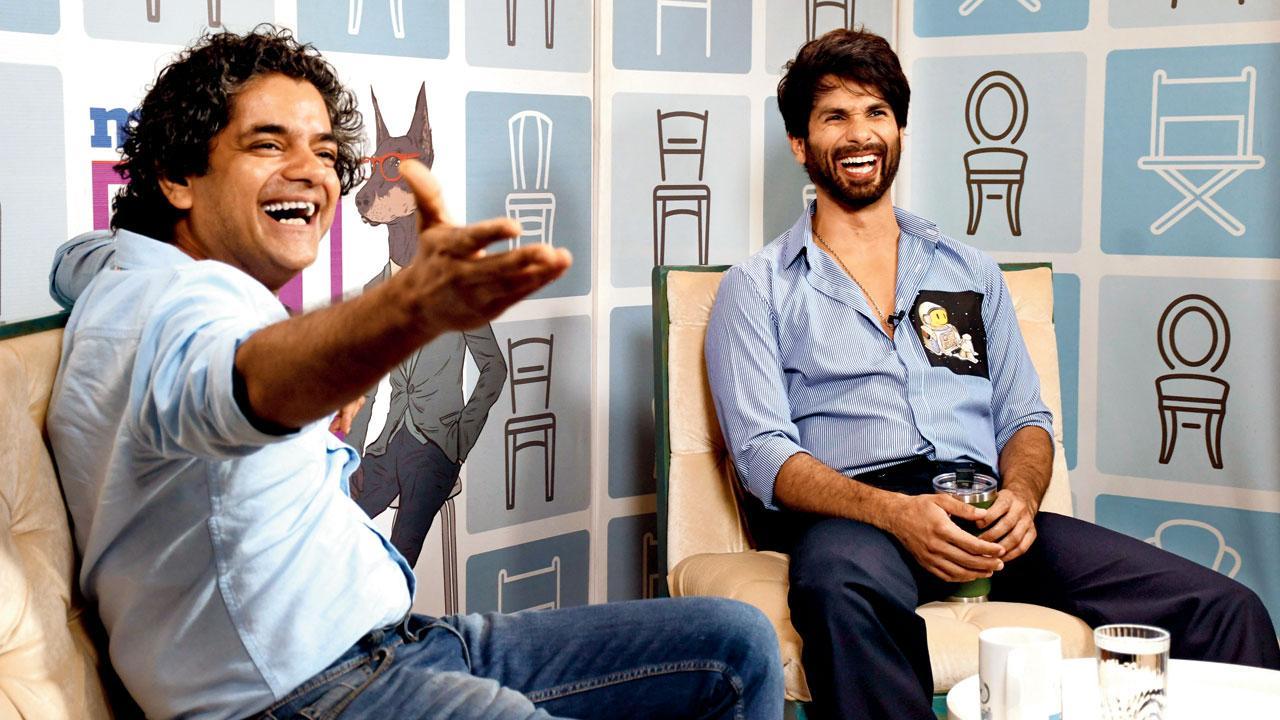
Ishq Vishk to Jab We Met, Kaminey to Kabir Singh—Shahid Kapoor on his 20 years of Bollywood
Mayank Shekhar (MID-DAY; July 8, 2023)
It was around when he was about six or seven, Shahid Kapoor recalls, his father Pankaj Kapur took him out to New Delhi’s popular food joint, Nirula’s, for a meal. Unbeknownst to what would hit them, the two were suddenly surrounded by “a hundred people, who’d picked up gajar [carrots], and were charging at them on their restaurant table—almost like zombies, going, Hehehe…. Gajar khaiye, gajar, hehehe…”
“Par mein bete ke saath pizza kha raha hoon [But I’m having pizza with my son],” Pankaj Kapur shot back. But no avail. The public was, of course, responding to Pankaj Kapur’s iconic role of Detective Karamchand, and his love for gajar, in the 1980s, on Doordarshan.
Father-son had to eventually rush out of Nirula’s. Shahid told his dad, who was visiting him from Bombay then, to never take him out again! “By virtue of distance, the interaction between him and me was anyway limited.”
Shahid’s parents had separated/divorced, when he was quite young. He was then growing up in Delhi, with his mother, Neelima Azeem, and his maternal grandparents, who were both journalists with the Russian publication, Sputnik.
Sasha, that’s the “ghar ka naam” his grandparents gave him—and that his tribe of fans, self-named Shanatics, call Shahid by—is also a common Russian name, he points out.
It was only when he turned 10, that Shahid also moved to Bombay to be with his mom, a trained classical/Kathak dancer, who was looking at a career in acting.
Shahid himself was one of the top dancers at Shiamak Davar’s dance academy—moving up from the back rows, at dance performances, to the front row, and eventually becoming a trainer at the institute, “which is how it works at Shiamak’s school; you have to prove yourself, every step of the way.”
In fact, if you notice closely, you can find Shahid dancing in the group in Subhash Ghai’s Taal (1999), even Yash Chopra’s Dil Toh Paagal Hai (1997). On stage, he was ecstatic to be “moving right behind Aishwarya Rai, Salman Khan, at popular award shows.” By 16, Shahid says, he was already earning enough to manage without pocket money from home, “even help out with the household income.”
A picture, from a trivia night, we show Shahid, is of him with actor Ayesha Takia. They’re both such lovely children, posing with coffee mugs to the TV screen. Shahid and Ayesha were the OG: “I’m a Complan boy, she’s a Complan girl!”
He laughs, “Ayesha was a really big [child] star at the time. We had to wait for her to turn up on the set, while I got my solo shots done!” But these were “one-off appearances on screen, because I was a cute kid, and someone or the other saw and cast me.” His mom was clear she didn’t want him to get full-time with commercial/advertising work still.
Cut to: 2003. Which is when I first met Shahid, seated quietly at the reception area of the mid-day newspaper office, in Lower Parel. A publicist had called to check if I might be free to say hi to a young kid he’d brought along. I was a young recruit/intern type at that office myself.
Having stepped out for a minute as a favour to the publicist, you could see other people quizzically wondering who this boy in their midst was. They had seen him somewhere, just not sure where.
“Back then, before there was social media, it used to take years for you to reach out to people. Now, it can happen in weeks and months,” Shahid recalls. The exact date for that first meet-up is not hard to figure. Shahid says his debut film, as lead, the teenage romcom, Ken Ghosh’s Ishq Vishk, released on May 9, 2003.
On that Friday, he’d excitedly gone over to Bombay’s Sterling cinema to watch himself on the big screen for the first time: “Between noon, and when the film finished, while I had just been around doing nothing, the people’s perception of me had totally changed. Barricades were put up. I was too young, at 23—which from an exposure point of view, is very different from how 23-year-olds are, now. And I thought, oh, wow, is this what stardom is?”
That ‘media round’ must’ve taken place a couple of days after. Which is almost exactly 20 years since, that we’re recording the episode of Sit with Hitlist, at the mid-day office again (this time in Bandra East).
Only that Shahid is full of confident banter that’s hard to reproduce in text—he’s a major Bollywood star (with over 50 releases to his credit). Having been through a “turbulent journey, of ups and downs”, and indeed a cracker, eclectic career—over those two decades.
Starting out as the ‘chocolate boy’ romantic lead (Ishq Vishk to Jab We Met), graduating to a more action/masala hero (Bloody Daddy, his last release), and even layered parts, whether on the big screen (Kaminey to Kabir Singh), or OTT platforms/series (Farzi).
Even at the beginning of his stint, young Shahid never introduced himself as son of the great Pankaj Kapur. We might have seen him differently. It was a conscious, self-respecting call he had taken—of making it on his own.
For four years, Shahid remembers, between age 18 and 22, he’d simply been incessantly screen-testing for parts: “I like the word ‘struggler’, they use [only] for aspiring actors. It’s true. It’s a life full of rejections. Four years means about 1,200 days—and I would have easily given about 200 auditions.”
None of those films apparently made anybody’s career, so he’s glad for it. One of which, Shahid says, he rejected himself—N Chandra’s Style (2001), because he was clear, even at that age, that he would debut only as the solo-lead.
It’s another matter, he says, that once Ishq Vishk did well, commercially—he was considered too young for producers to cast opposite existing, established female leads: “They’d rattle out names of three-four popular, female stars, and say, ‘You’ll look like a kid with them! Where’s your ‘mardaangi’ [manliness]? There was no work for my age-bracket, and for the way I looked.”
Also, he submits, there was a perception in Bollywood at the time, that a star was born, at best, only once every half a decade: “And Hrithik [Roshan] had already become huge [with Kaho Naa... Pyaar Hai] in 2000. Vivek Oberoi quickly followed [with Company] in 2002. So, apparently [by law of averages], I didn’t stand a chance!”
Of course, all these rules are assumptive. They fail in the face of public choice, which is impossible to predict. Another such rule I point out to Shahid is how, when it comes to a loyal female following—the credibility built from a particular film cements it so much for a male lead sometimes, it can easily lead last them a lifetime.
Take Ryan Gosling, for instance. Take The Notebook (2004) out of his filmography. And he wouldn’t garner half the female fans that’s stuck around him since. Likewise, with Shah Rukh Khan, and Dilwale Dulhania Le Jayenge (1995). The connect is irreversible. The persona sustains. I wonder if it’s the same relationship with the female demographic that Shahid attained with Imtiaz Ali’s Jab We Met (2007), first. He says, “I know Jab We Met gets a lot of credit [as it should]. But let’s not forget Vivah [2006]. It was a small-budget film—by the legendary [producers] Barjatyas’ standards.”
“Their [more expensive film, with modern sensibilities] Main Prem Ki Diwani Hoon had just failed. Sooraj [Barjatya] and his father [Raj Kumar Barjatya] were planning to do a movie, with new actors, to test their original, traditional lower middle-class audiences/sensitivities. Vivaah is the last Indian movie to do a ‘silver jubilee’ (25-week run in theatres),” Shahid claims.
Audiences like me, of course, remember him more for Vishal Bhardwaj’s Kaminey (2009)—decidedly from the dark side of the moon, which was as diametrically a U-turn for his onscreen image.
We wonder how different could it be to be on a Barjatya set, over Bhardwaj’s: “Chalk and cheese. Vishal doesn’t like anything sweet. He’d keep asking me to go ‘kamina’. Sooraj would want me to throw way all city [slicker] influences, and be sweet. It’s schizophrenic [to be on both sets]!”
As for Imtiaz Ali, Shahid recalls, “He was a new director, when he came to me. The first thing that struck me was how good-looking he was, himself, [lost] in his dreamy thoughts. Then the fact that he narrated out of a bound script, which wasn’t common. Back then, you heard a 30 to 40-minute narration that the director would then develop, if you said yes [to it].
“The script had ‘Geet’ written on it. I asked him, ‘What does this mean?’ He said that’s the heroine’s name. I told him, ‘The next time you go to a hero—don’t go with a script with the heroine’s name on it!’
The next time, he came to me with the same script, he had ‘The Train’ written on it,” Shahid laughs.
Eventually they settled on Jab We Met, because big daddy Pankaj Kapur came up with the title over dinner: “I was telling him about how I want an English-Hindi mixed title, and what the story was about.
He said, call it Jab We Met.” Which was one of the titles entered into a public poll held by a newspaper. “The other was Bhatinda Express. The third one I don’t recall. People picked Jab We Met!”
As for his female following—evidenced from the fact that this conversation itself is being recorded with an all-women audience—Shahid attributes much to his more recent, by far the biggest hit of his career, Sandeep Reddy Vanga’s Kabir Singh (2019), as well.
The film was a scene-by-scene remake of Arjun Reddy in Telugu, by the same director. So Shahid knew exactly what he was walking into—the part of a drug-addled abusive boyfriend, that remains his most controversial yet. So much so that it’s been four years, and he feels the need to defend it still.
He says, “There were so many people refusing to accept that people are liking the film. I was like, ‘Arey bhai, logon ko acchi lag rahi hai, tum log baithe ho apni [high] chair mein—suggesting, how dare you like the film? Well, accept it.”
He’s also willing to engage on the criticism. Which is perhaps not that people were refusing to acknowledge the commercial numbers/footfalls. But that the film was about the sort of character, who may exist in real life, surely. But who was instead being lauded as a hero of sorts. That was the issue that some people may have had with arguably a misogynist subject.
Shahid disagrees, “Well, Kabir slaps the girl [Kiara Advani]. She slaps him back. But when he slaps her, it is so shocking that it stays with you, and it disturbs you, right? Everything that happens to him after in his life, is a downward spiral. Until the last moment when somehow, the girl agrees to be with him! He is a complete mess. A very cinematic character. It is like Taxi Driver, or Scarface.”
The deranged Travis Bickle (Robert De Niro) in Taxi Driver ultimately kills himself, though. “Kabir Singh is actually about how everyone should get a second chance. In love, who hasn’t messed up? And if you see it, right from the promo—at no point is it being said that he is a great guy.”
“I’m nothing like him. But as an actor, it’s my job to play different characters. You don’t have to like him. You should like my performance. He’s not the hero. He’s the protagonist.”
Which can be said of Shahid’s equally messed up, Punjabi hip-hop star, Tommy Singh, from Abhishek Chaubey’s Udta Punjab (2016). What did he find in common between both the characters?
“Nothing, besides that they are both Singhs,” Shahid laughs. “There is a scene [in Udta Punjab], where Tommy says that he’s never done anything for anyone else. And that he must [for Alia Bhatt’s character]. He’s been completely self-centred. Which is how he’s different from Kabir, who gives it all [for his love]. And she’s nice enough to have him back. Love stories must end with a note of hope.”
The other thing common between Tommy and Kabir is, of course, that they are both substance abusers, isn’t it? “Yes.” Played by an actor, who’s a sworn vegan, and teetotaler! It’s something you don’t associate with movie-stars still. “You can call me boring, I don’t mind,” Shahid smiles.
The other thing unusual for a movie star is getting into an arranged marriage, which is what Shahid made as a life-decision, when he married young Mira Rajput, in 2015.
“Well, if you’d asked me then, I’d have said arranged marriages don’t make sense to me, either. But it happened [organically].” He says they met through family: “We were part of the same spiritual group that I was obviously aware of. She was all of 20 years old. I was 34. I was a little embarrassed [about that].
“But I was really looking for someone who could understand both aspects of my life—the spiritual side, and that I’m an actor [a public figure]. She was genuinely interested in figuring me out as a person. And you can tell, when these things are real. She was not affected [by my profession].”
The first time they got on the phone, Shahid remembers, they spoke for seven hours straight. He knew he’d found the one. He feels the same way about her family, that he treats as his own: “They’re very classy, and sorted people.”
During the two years of the pandemic, Shahid says, he stayed over with his in-laws’ throughout, in a place called Dera, in Punjab: “We had reached there, just three days before the lockdown got announced.”
A few years back, Shahid had recounted to us a trigger point on this aspect of his life. He’d been single for a while. He was returning home, alone, having had won the Filmfare Award for Vishal Bhardwaj’s Haider (2014).
That big night, he slept with his statuette. Acknowledging a thing amiss, that he must do something about: “I felt the need for a companion. But even then, I didn’t know I’d find a perfect life-partner. It’s tough.”
Up until then, you could describe Shahid as ‘seriously monogamous’: “I had always been that guy in my 20s—in long, settled relationships.” The other aspect that early success in showbiz thankfully affords the young is a rich, rockstar life, when you’re merely in the 20s. Sports stars are similarly privileged. I’m sure that must’ve been a legit high, before he decided to proverbially settle down.
“It’s a stupid high,” Shahid explains. “So, I’d go and buy myself a fancy sports car, and then I would feel like, ‘Why did I do this? Now, I am broke, again!’ You’re a little stupid in your 20s—making stupid choices, and then you blame other things. When I look back, I’m like, ‘Okay, I should have made better choices, I would have been more comfortable, yar!’”
Which is to say, “I also didn’t have time for anything—too busy holding on to my position [professionally], working on the set 240 days of the year; let alone promoting my films thereafter.”
How about dating the hottest women in Bollywood, though—surely that’s a great perk of being a star into only life’s second decade, when most others are busy moving up from the low rank/station, attempting a half-decent living!
Shahid isn’t particularly impressed/nostalgic by that reminiscence: “See, at the end of the day, you are dating good-looking women. But you are also considered desirable, and good-looking, right?
“So, it is not something that you are getting three levels above your own league! I mean, there were enough women interested in me as well, right?” Spoken truly with that feisty swag of a 20-something!
Looks apart, going by talent from pedigree alone—as a star performer, doubtlessly, Shahid has picked up his dancing skills from the mother, and acting prowess from the father. He’s quick to point out here,
“I was more happy about getting my hair from my mom, and acting chops from dad! I was like, ‘Dad, I don’t want your hair!’
“He was semi-bald at 30, and he used to keep messing with me saying, ‘I’m an actor, I can play all kinds of characters. Abhi toh tu hero ban gaya hai, agar tere baal udd gaye toh tujhe kaam hi nahi milega [You’ve become a star. Now if you lose your hair, you’ll get no work!].’ He used to mess with me, dude!”
Much as the father and son couldn’t have had a more separate career graph, from the looks of it, Shahid did indeed imbibe the ambition of gaining respect as an actor from Pankaj Kapur. It’s part of his natural training.
“I’d seen all my father’s film, growing up—whether that be Rui Ka Bojh [1997] or Ek Doctor Ki Maut [1990]. Jaane Bhi Do Yaaro [1983] is, of course, one of my favourite films ever.”
The two collaborated most ambitiously as actor-director, in fact. Wherein Pankaj Kapur debuted as filmmaker with Mausam (2011), starring Shahid in the lead. They’d produced the film as well—charting a story as wide in scale as The Gone with the Wind, no less.
This was around the time, Shahid says, that he’d himself gone through a makeover, in terms of how he’d go about his career goals.
“I was done with walking into a set, being given dialogues to perform right there, and carrying on. I wanted to approach films with a sense of commitment, and had chosen to work in one project a year.” Which is the time and energy he spent on Mausam, along with his father, who spent over year and half on it.
“But we realized, that’s not how everyone else works. And so, while the film was in production, others had moved on. We were finding it hard to match dates [with cast/crew]. Even when I saw the film’s final cut, I knew this was not going to land [well]. It wasn’t the film that my father had envisioned.” Mausam bombed at the box-office, causing a career setback for Shahid, to start with.
One of the things, it appears, that Shahid regrets about stardom is the sort of time it takes to finally get a hang of the system: “By the time you know exactly what’s going on, you’ve already lost eight to 10 years. When you come from a [mainstream] film family, on the other hand, you’ve experienced much, up, close and personal, already.” That’s the advantage, he says, his half-brother, young Ishaan Khatter, has.
Having grown up under the wings of Shahid: “He’s watched me and my choices closely, and always had an opinion on it. For instance, he wouldn’t like me in a [Dil Bole] Hadippa, but totally love me in Kaminey. As an elder brother, you sort of become the guy riding the motorcycle, with him on the back seat!”
Having seen all his films, it would be fair to suggest some of Shahid’s early script-sense could be befuddling, at best. For instance, I point out, what could have made him sign up for a pic like Paathshala (2010), that I remember wondering the same, even while watching it: “That was a friend who asked me to give him seven days of my life, and he badly needed it.” All choices have a reason.
Consider Prabhu Dheva’s R… Rajkumar (2013), and Rajkumar Santoshi’s Phata Poster Nikhla Hero (2013), that Shahid hit the screens with, soon after Mausam hadn’t worked, theatrically.
“That was [me seeking] commercial success. If you’re not successful, you actually have no power to make any choices. So, you just have to get successful, first. It’s simple. R… Rajkumar, in fact, did well. And Phata Poster did not.”
From a film industry POV, he looks at movies very differently, Shahid concedes. Namely, you need films of all palette to march on as an industry: “What I don’t get is people who can only make dosas saying, that those who eat burgers, are no good. That’s not how it works. I stay away from such people.”
And it’s not that commercial success, or massive footfalls, is the only criterion, surely. Soon after the release of Sanjay Leela Bhansali’s blockbuster, Padmaavat (2018), there were news reports suggesting Shahid wasn’t pleased with his own presence in the pic, along with Deepika Padukone and Ranveer Singh, who evidently stole the show. Was there any merit to these assertions?
He candidly admits, “It’s true. Everyone was lovely in that film. And I don’t want to get into details. But I kept thinking, ‘Why did I do this film?’ I had no perspective. And I don’t want to blame anybody.”
Which also relates to insecurities that come naturally with an actor’s mercurial job? To take another example of published reports, there was one about how Shahid didn’t get along with co-star Kangana Ranaut, during the making of Vishal Bhardwaj’s Rangoon (2017). True?
“Not true. I got along fine with Kangana. She’s a fine actor.” Long pause. Okay, that is a long pause. “What do I say? You’re not asking me anything else. You’re talking about insecurities, looking in from the outside into an actor’s life. But it may not be [those] insecurities. There are so many things that can be there, if first of all, there is a problem!”
Which is fair. And being a star, as against a professional actor alone, inevitably involves media scrutiny—as part of the job, even if an occupational hazard, on occasion. Surely, over two decades of being right at the centre of Bombay showbiz, has come with its own potholes.
The one story I remember concerning Shahid, and in fact mid-day—shortly after we met first at the newspaper’s office reception—were a series of paparazzi pictures that the tabloid had published in 2004, starring Shahid and his girlfriend then, taken at a Juhu nightclub, Rain.
Those pictures were clicked by a bunch of kids randomly hanging around in the nightclub, with a digital camera. There were no feature-phones with cameras at the time.
Those juvenile delinquents arrived at the mid-day office, demanding Rs 500 for the set of blurry but innocuous images/video of Shahid, kissing, in love, evidently. Unmindful of possible minders around.
I wonder what that did to Shahid, once those pictures appeared, in what became a big, salacious, tabloid story. Which was hardly a big deal though, if you look at it objectively, rather than voyeuristically.
“Of course, it was a big deal. Let’s be honest—putting out pictures like that would get you a lot of eyeballs. That’s the honest truth of it. It’s okay. You know, we all take it with a pinch of salt. But what was your question, again?”
The question was, what did he feel about it, when that happened, then? I don’t think he’s spoken about it in all these years.
“Oh, I was destroyed at the time. I was just 24 years old, a kid. I felt my privacy had been invaded, and I could do nothing to protect it. I was a mess. At that age, especially—because you don’t even know your own feelings. You are figuring out how to be with a girl you are dating. And in the middle of all that, this happens…”
What’s changed with stardom and the media landscape since, of course, is that practically everyone is with a smart phone, making videos, pictures, selfies in public. Shahid, 42, reasons, “Now, you are aware that [a paparazzi snap] like that is 100 percent going to happen. At that time, we were caught off guard by it.
“So, that is like an informed devil, as opposed to an uninformed-devil scenario, then. You at least know, ‘Yeh toh hone wala hi hai. Also, ab toh meri shaadi ho gayi hai, bacche ho gaye hain (Now, I’m married with kids). Nobody is interested in those things about me. They have other 24-year-olds to focus on.”
I had tears in my eyes when M F Husain gifted me his paintbrush-Amrita Rao
8:17 AM

The actress says that she is among the only three people in the world to possess his paintbrush
Onkar Kulkarni (BOMBAY TIMES; September 18, 2021)
On internationally-acclaimed painter M F Husain’s 106th birth anniversary yesterday, Amrita Rao revisited a special memory of the artist that is close to her heart. The duo shared a special bond. Husain considered Amrita his muse and even painted her live, inspired by her role as Poonam in Vivah (2006), which also featured Shahid Kapoor.
On his birth anniversary, Amrita revealed that she received a gift from the painter that she considers her prized possession. “Husain sahab had invited my mother and me to Dubai as his guests as he wanted to paint me live. On the last day of our visit, he confessed to my mom that he was initially hesitant to meet me in person, as he was apprehensive that if the ‘real’ Amrita is not true to her on-screen persona in Vivah, then he would be disillusioned. However, on the last day, he told me, ‘You have surpassed my expectations. You are far more beautiful as a person in real life than I expected.’ Then, he presented me with his signature brush. He said, ‘Remember, only three people in the world own it.’ And then he started walking away briskly. We had to catch pace with him, nevertheless, he was far ahead of our times,” says Amrita.
The entire episode left the actress teary-eyed. She shares, “I recall the first time I met Husain sahab, he had come to receive us at the Dubai airport. I noticed him walking barefoot holding a long black paintbrush, which he used as his walking stick. I thought it was such a unique style statement. On the last day, when he gave me that brush as a parting gift along with such a lovely compliment, I was so moved that I had tears in my eyes.”
A big fan of his artwork, Amrita is planning to create a corner dedicated to M F Husain in her house where she can put the paintbrush on display. “Along with the brush and his paintings, I shall also frame his handwritten letters in memory of my most colourful brush with the maestro,” she says.
Amrita confesses to being a bigger fan of Husain as a person than his paintings. “I am a bigger fan of him as the person I know more than his marvellous paintings. There was a happy, excited child in Husain sahab, which he never let go of. His passion for art and cinema continues to inspire me,” she signs off.
I could relate to the darkness-Samir Soni
8:09 AM

Kavita Awaasthi (HINDUSTAN TIMES; June 24, 2020)
Actor Sushant Singh Rajput’s sudden death affected people in showbiz in many ways. Some spoke about nepotism while others discussed mental health. Actor Samir Soni was disturbed, too, and made a shocking admission in an Instagram post. “It could have very easily been me,” he wrote.
Explaining his post, Soni, 51, says, “I understand the pressures of showbiz, which is why I wrote that. This business is unpredictable... It can get frustrating if after working non-stop, you have no work for months. One hit makes you famous, but give a few flops and people might forget you.”
The writer-director cites examples in the industry such as late actor Rajesh Khanna and actor Kumar Gaurav — both had major highs and lows in their careers. “In a low phase, sometimes one can’t see light beyond the darkness. You wait for that one phone call which can change your career. I have been there and so I could relate to the darkness. One has to be very strong mentally to survive in this business. It is not just about talent... It is a business at the end of it all,” he says, adding, “I’d tell young actors to act because you enjoy it, but be prepared for the long wait between projects. too. Even now, due to Coronavirus, a number of films will suffer and so will the careers of many actors, filmmakers and technicians.”
Soni debuted with Rajkumar Santoshi’s China Gate (1998) but his career didn’t pan out as expected. “When I was launched in a huge film, I was told I had a bright future, but once the film flopped, I didn’t get any work. My first marriage, too, fell apart... It happened so fast, I didn’t have time to react. I’d get panic attacks. For almost a year, I’d stay at home in bed... I was in counselling for two years,” he shares. Later, he thought Baghban (2003), which was a super hit, would translate into a lot of work, but it didn’t. “I didn’t get any film for three months, but this time I was stronger... I am glad I decided to transition into TV and saw success in Jassi Jaisi Koi Nahin. I did a number of films including Vivah (2006), Fashion (2008) and many TV shows such as Parichay, and web shows including Puncch Beat, too. I am happy with my career and life,” adds Soni.
To see Kabir Singh become one of the top 10 grossers of all time is a relief-Shahid Kapoor
8:31 AM

Shahid Kapoor says Kabir Singh’s stupendous success helped reinforce the actor’s belief in himself
Prashant Singh (HINDUSTAN TIMES; December 12, 2019)
Several Hindi films have hit bull’s eye at the box office this year. But of these, the Shahid Kapoor-starrer Kabir Singh surely shines bright as one of the biggest money spinners of 2019. And the actor is aware of the impact his big hit has had on him — as an actor and otherwise, too.
“Usually, an actor’s film does ₹70 crore and then ₹100 crore, then ₹140 crore and ₹170 crore, and finally ₹200-crore plus. But my solo films never went above ₹70 crore and now, it’s straight at ₹280 crore (smiles). That jump is so big, it gives you clarity that yeh maine nahi kiya hai, yeh ho gaya hai,” he explains.
Shahid, set to start work on his next, Jersey, a remake of the Telugu sports drama of the same name, feels that he just has to be “aware of my responsibility now”.
“At the same time, I feel I have had a certain work process which got me here. So, there’s no need to change it. If I got here by doing the work I believe in, I should continue the same way. Otherwise, what tends to happen is you start overthinking (on scoring such a big hit) and ‘Ab main kya karoon’. But I’m like, ‘Kucch nahi karna hai, bas kaam karna hai’,” he says.
The Haider (2014) actor also feels a “sense of relief” that he reached out to the masses with his last release. “To see Kabir Singh become one of the top 10 grossers of all time is a relief because I always believed that I had the potential in me to be able to talk to a very wide audience as an actor. However, it never happened. Some films did well and some didn’t, and they were always in a certain kind of range,” he admits.
Yet, reflecting on some of his previous hits, Shahid feels a few of them did appeal to a large audience. “I think many years back, Vivah (2006) and Jab We Met (2007) had reached a very wide audience. Then, I did Padmaavat (2018) which went wide but that film wasn’t focused or centered around me. But Kabir Singh is where I felt that everything was on my shoulders as I could feel that this film was all about me. When such a film gets that kind of love, it definitely makes you feel different,” the actor says.
Interestingly, right before Kabir Singh came along, Shahid says he had certain thoughts about resetting his goals and processes. “See, I have been doing this (acting) for 15 years and there’s a part of you that starts to feel, ‘Am I overestimating my own self?’ or ‘Am I thinking that I can be something which I’m probably not meant to be?’ Or ‘Should I change my plans and goals, bring it a bit down and be a little more realistic?’ Those thoughts had crossed my mind,” he adds.
I was never the kind of person who tests relationships with different people-Amrita Rao
8:06 AM

Rachana Dubey (BOMBAY TIMES; February 13, 2019)
 Little did Amrita Rao know that co-hosting a show with a radio jockey would change her life. It was in 2010 that she met RJ Anmol, who anchored a retro-based Bollywood show on radio. With time, they became friends and gradually, their relationship took a serious turn. He proposed to her — first on air and then, in his car near Juhu beach. The actress had always wanted her first relationship to last forever, and her wish was granted, when, after dating for about six years, the couple got married in May 2016. For the first time, Amrita, who recently returned to the big screen with Thackeray, decided to take BT through her romantic journey. Excerpts:
As an artiste, you never allowed people into your private space. Be it your relationship or your marriage, you have never spoken about where and how it all began...
I am a huge retro fan, and I had proposed that Anmol and I do a Kishore Kumar show together. That’s when we first met and soon, we realised that we had a common love for old songs. It wasn’t love at first sight for us, but that evening, the first chord was struck. Gradually, we became friends. His positive aura attracted me, but I didn’t realise it for a very long time. We shared a rare comfort with each other. Both of us loved exploring the old-world charm of Mumbai, going on drives and walking in the quaint bylanes near Flora Fountain.
It’s said that marriage changes the course of a relationship. From being a girlfriend to being a wife, the transition must have been drastic...
Luckily, our temperament and likes are very similar. We are naturally compatible, so nothing has changed between us. It started off with us being friends and that is intact even today. When we started living with each other, he had told me that it would be different, and we have to ensure that we never become disrespectful of each other or take each other for granted. Once a mirror is cracked, you can’t mend it, and we didn’t want that. That’s what worked in our favour; we’re always on the same page. We’ve also never let our professional and personal lives cross paths. Keeping them apart makes it all peaceful and happy.
Must say, an actress falling in love with an RJ is indeed an interesting story, and he even proposed to you on air. Pretty much a scene out of a movie, isn’t it?
Yes, he did. He first texted me, saying that I shouldn’t miss the next track on his show. It was my favourite song — Gum hai kisike pyaar mein (Rampur Ka Lakshman) — following which he proposed. I was shocked and when I called him back, we both laughed over it. But deep down, he had expressed what he felt, in the most bold and beautiful manner. In my head, even at that time, he was still my friend who I loved hanging out with. Eventually, he proposed to me again, near Juhu beach. This time, he said, ‘I think we must give this a chance, maybe you are not recognising things.’ I told him, ‘This is the first time I getting into any relationship and it will be serious from this point onwards.’ We’ve never looked back after that. He’s the first and the only man I committed to in a relationship. I had always wished for it to be this way, because I was not the kind of person who would try and test relationships with different people. For me, it was always going to be one relationship for eternity. We spent a lot of time getting to know each other and our families. Gradually, it all came together. My parents loved him in the first 10 minutes of meeting him. His mother once told me, ‘Beta, when we saw Vivah, I had told Anmol, bahu ho to aisi ho. I had never thought ki bahu wohi hogi.’ And then, about six years later, we got married.
Like most Indian couples, are you also facing questions about expanding your family?
Not yet because so far, a lot of people didn’t even know that I was married. Now, the questions may start popping. I have never done something because of any pressure. Anmol is very fond of kids and wants to have a kid, too. We haven’t really made any plans in that direction, yet.
You decided to step out of limelight when you were doing well, professionally. Was there ever a point when you felt that you could have steered the course of your career differently?
Nope! Things are perfect the way they are. Yes, I could have done a lot of films had I compromised on my comfort. I was never comfortable getting intimate on screen or kissing. I could have pinched myself and done it, but I chose to sit back and say ‘no’. Marrying someone not from the industry really helped. We successfully kept everything away from public glare and there couldn’t have been a better time for us to take the plunge. Working in this industry has a lot of pressures, especially for outsiders. Second chances are rare and people pull you down at the first opportunity. I thank God that I have someone, who gives me a new perspective on everything and absorb only the positives in every circumstance.

It is the right time for actors to explore-Amrita Rao
8:02 AM

Hiren Kotwani (DNA; January 5, 2019)
Amrita Rao, who was last seen on the big screen in Satyagraha (2013) and made her television debut with Meri Awaaz Hi Pehchaan Hai (2016), has stayed away from the limelight for quite some time. But when we tell her that she seems to have disappeared after tying the knot with radio jockey Anmol two-and-a-half years ago, she insists she has very much been around. The petite actress informs us that she has started her YouTube channel recently to share her experience in the industry over the years. On the movies front, she will next be seen as Meenatai in Thackeray, the biopic on the late Shiv Sena supremo Balasaheb Thackeray. A quick Q and A with Amrita...
What have you been up to all this time?
Quite a lot (smiles). I’ve been doing a little bit of cooking. I’m also learning Konkani. I organise things well, so I’ve been using my managerial skills to take care of the house. Over the last year, I’ve also enjoyed making videos in which I share trivia about my films. Most of them have been popular on television and are fondly watched. So I started my channel on YouTube where I share little-known things like how I was cast in Main Hoon Na (2004), shooting a one-take song like Chale Jaise Hawayein, my first meeting with Sooraj ji (Barjatya), my most difficult scenes and how I prepared for them, to name some. And of course, working on Thackeray was exciting.
Even your new film comes after a considerable break.
Thackeray came after Meri Awaaz Hi Pehchaan Hai, my debut on TV. It was a fantastic series and required a lot of technique because when you act in a television serial, it’s like doing four films at a time. It’s not a two-hour thing, every day we were churning material for half-hour episodes. It had a lot of emotion, drama and really tested my acting skills. Moreover, I was in the company of actors like Deepti Naval, Pallavi Joshi, Zarina Wahab and Rituraj Singh. It was a lovely and enriching experience.
What prompted you to take up Thackeray?
It’s a huge compliment to be approached for Meenatai Thackeray’s role when you’re the only choice because of the image you have. I have earned the image for myself. I also got the opportunity to work with Nawazuddin Siddiqui, who is a brilliant actor. There were many firsts for me while working on this film. I cherished every day of the shoot, since the time we began in February last year. Acting in this movie has been truly a unique experience.
Aren’t you worried about being typecast in character roles after this?
I’ve been approached for ethnic roles and I’m okay with that. The characters that I have played have resonated with the audience. Most of my films have repeat value, my characters are remembered and audiences watch the movies on satellite television again and again. Vivah (2006) often plays during the weekends and when I travel for events or appearances, it’s overwhelming to hear people say they’ve watched it over 20 times. You feel blessed to have a film that has become your larger identity. Not every actor is blessed with a movie like that.
Have you signed up any other project?
I will reveal in good time. After acting for years, now it’s interesting to explore new-age content. The scripts are changing and the audiences’expectations have also increased. Today, it’s more about scripts and content. That what makes it the right moment for actors to explore themselves.
Shahid Kapoor on his over decade-long career, from Ishq Vishk to Rangoon
8:52 AM

Actor traces milestones in over a decade-long career and roles that are identified with him now
Roshmila Bhattacharya (MUMBAI MIRROR; February 16, 2017)
RANGOON (2017)
In the last two-three years, I’ve been able to reinvent a new silhouette for myself in almost every film which is a fortunate place for an actor to be in. Rangoon is my third association with Vishal Bhardwaj, probably the most relevant filmmaker in my career who has given me opportunities, again and again, to showcase myself. And Nawab Malik is as unique a character as Haider or Guddu and Charlie in Kaminey.
There’s something about men in uniform that draws you. They are always soft-spoken and courteous despite what they do. You can feel their nobleness, discipline and heroism irrespective of the times they live in. What makes Nawab Malik distinctive is that he is with the British Indian army in the 1940s, a complex time when India was on the verge of independence and patriotism at its peak. How Nawab Malik, a patriot, lives with these dual realities given his feeling towards his country and its freedom made the dynamics of this character exciting for me and the conflict a cinematic experience for viewers.
The other exciting thing was that as an actor it gave me the opportunity to engage with the heartland of the country. During Haider, I’d stayed in Kashmir, shot in the interiors, met locals, felt the energy of the place and savoured the flavour of the state. That was true for Udta Punjab too, which was filmed in Punjab. With Rangoon, I discovered Arunachal Pradesh in 20-25 days. We filmed at railway stations and in jungles on the Indo-China border. We also drove for fivehours from Guwahati in Assam to shoot at a waterfall and stayed in places where there were no proper roads, electricity and telephone lines. That is a strong association I’ll always have with Rangoon, apart from getting to play a fresh and completely original character.
UDTA PUNJAB (2016)
Tommy was the most obnoxious character I’ve played — a drug addict on an ego trip, a spoilt brat who took his success for granted and behaved badly with women. On paper he was a much hated guy but my director’s (Abhishek Chaubey) brief was that in five minutes people should love him and that was the challenge.
I modelled him on the kid you sometimes see lying on the floor in a kids’ shop, throwing a tantrum for something they want. Your first thought is: What a terribly behaved child. And then you tell yourself he’s just a kid, he doesn’t know better, and you forgive him. That’s how I wanted viewers to see Tommy — a spoilt, lost kid who gave me the freedom to be obnoxious. It was liberating and enjoyable at times.

HAIDER (2014)
I remember shooting the scene where Haider is standing by the grave of his father at a wildlife sanctuary in Kashmir. Since he has believed all this while that his father is alive, he breaks down when confronted with the reality that he is no more.
We did the shot in a single take, the cameras placed far away from the action. By the time Vishal sir called “Cut” I was so into the shot that for that moment it had become real to me and I was overwhelmed. When I opened my eyes, Vishal sir was holding me in his arms. For me, Haider is that moment.

KAMINEY (2009)
Kaminey is impossible to forget because someone or the other, usually at traffic signals, will randomly start talking to me in the ‘Pha’ language, “Abe phaale, pha ko pha bolta hai. Pha ko ‘pha’ nahin bolega to kya ‘la’ bolega.”
It was the first double role of my career and scary because every actor worries about pulling it off. It came in the first six-seven years of my career so I couldn’t say I was prepared or experienced enough. I’m glad I got it right and my first double role wasn’t rejected though I could have done better.
When we started, everybody thought Guddu was closer to my natural personality so we focussed on the rugged bad boy Charlie who was very different from my familiar image of the sweet boy next door. We shot the first 20 days with me as Charlie and when we finally got on the sets for Guddu, Vishal sir and I looked at each other and asked, “How do we play him?” Guddu evolved on the set as we didn’t have time to prep for him.
Stammering is something actors often get wrong and I didn’t want Guddu to be seen as a funny guy who stammers. Stammering is a speech defect which comes from a lack of confidence. That Guddu turned out as hero whose speech defect was presented with sensitivity and dignity was our victory.
Will there be a Kaminey 2? I doubt it. I’d be surprised if Vishal sir makes a sequel. I don’t even know if I’d want to play the characters again after so many years.

JAB WE MET (2007)
It was my most under-rated performance. I feel for Aditya Kaushik, both in the movie and after its release, because he didn’t get the recognition he deserved. Instinctively, I knew that 10 years later people would get this guy but at that time, to make Jab We Met work, one character had to anchor the story so the other one could jump around.
In an actor’s journey, you get to play the clown often. Nine out of ten films you are offered, you will be playing to the gallery. Seldom do you get to play a character that is silent, complex, layered. But I had a great time doing the film. Imtiaz Ali was still new. Who was to know that he would turn out to be the brilliant filmmaker he is today. I feel privileged to have worked with him so early in his career in a film that turned out to be so memorable, so liked and so relevant. The best thing about it is that wherever I go people talk to me about Jab We Met and say that, “Yaar jab bhi we are in a bad mood or low, we play this film and we feel so happy.”
That is the magic of Imtiaz. He was able to make people happy with something that wasn’t an inyour-face laugh riot but a simple story with a good heart. Whatever Imtiaz was feeling at that time, he made people feel it… And they are still feeling it!

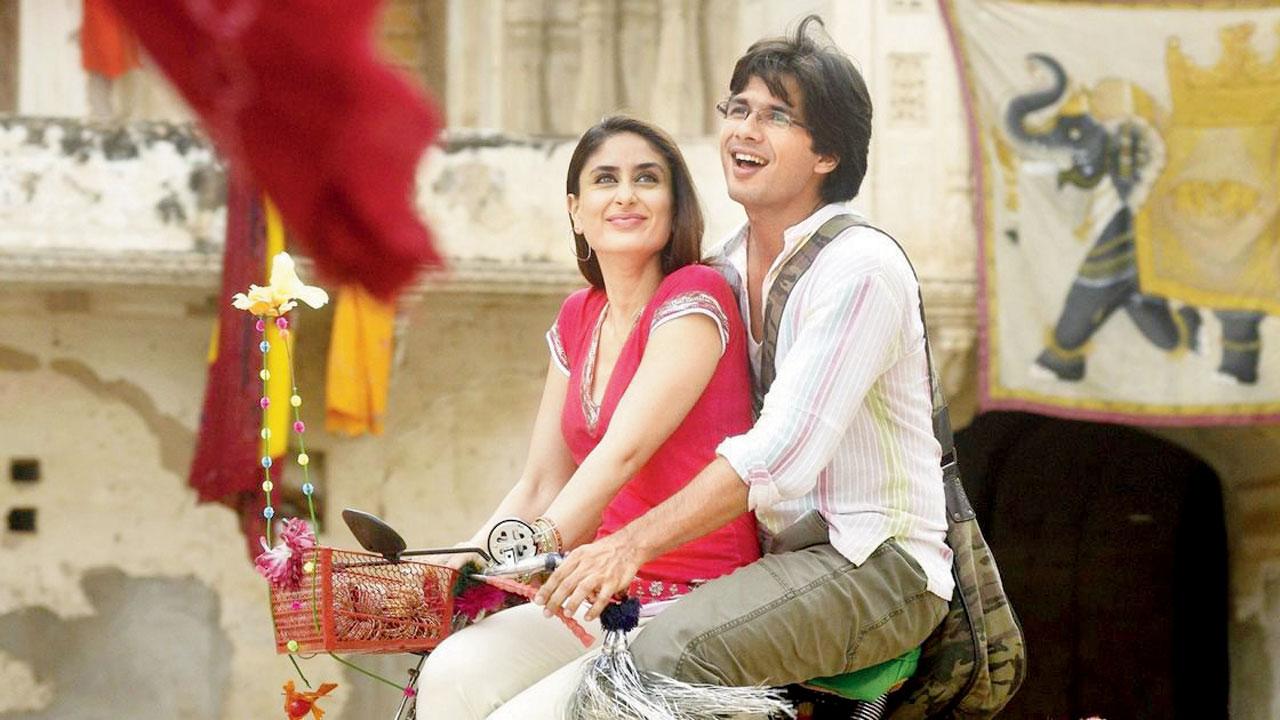
VIVAH (2006)
Vivah, I must confess, was a world I had never experienced. So, to play Prem, I simply imitated Sooraj ji (director Sooraj Barjatya). It’s ironic today that I have had an arranged marriage but at that time I had no idea what such a match was all about, where a girl and a boy just talked over tea and ‘paani’ was referred to as ‘jal’. I give 200 per cent credit to Sooraj ji for the way he moulded me, got me in the right emotional space for the character. He helped me find and stay in the sur. I was really soft-spoken and nice during those couple of months which was good for those around me.
I remember flying to Delhi for the last leg of promotions. A day before the release, I was sitting with Sooraj ji whose previous film, Main Prem Ki Deewani Hoon, hadn’t done well, and he told me, “Shahid, tomorrow I will tell you if this film will work or if it has been rejected too.” The next day he came to my room, post launch, “Don’t worry Shahid, now I will talk to you in 10 weeks, the film has been accepted.” I was stunned because those days the maximum a film would run was five weeks. But Sooraj ji was right. This one completed a silver jubilee! He has a loyal audience and he made a film for those people.
I bumped into him after my own vivah at a recording studio. He smiled and said, “Finally, you have settled down!”

ISHQ VISHK (2003)
I was selected for my debut film after several rounds of auditions and rejections over three-four months. Finally, when I got to meet the director, Ken Ghosh, he was sitting at a computer and laughing at the screen. Turned out, he was looking at a video of a baby chimpanzee sticking his finger in his butt, smelling it, and swooning. He was watching it on a loop. It made me wonder, “Is this the guy who will introduce me to the world as an actor? My ‘mai baap’? for the next one year.” I was petrified!
On the first day of the film’s release, Amrita (Rao), Ken and I visited a theatre in town. It was before the advent of social media, and since we were newcomers, no one knew us and simply smiled politely as we walked in. But after the show got over, we had to be shunted to a room and barricaded to avoid the fan frenzy. I went from being a normal person to a star in a matter of three hours. That’s the magic of cinema.
Shahid Kapoor-Amrita Rao were like bewildered kids; didn't understand the dialogue-Sooraj Barjatya
7:55 AM

Roshmila Bhattacharya (MUMBAI MIRROR; November 10, 2015)
Disappointed after Main Prem Ki Diwani Hoon, his Hrithik Roshan-Kareena Kapoor-Abhishek Bachchan love triangle, failed to strike a chord with the audience, Sooraj Barjatya turned to his father for a subject for his next film. "He had always chosen my subjects for me. Main Prem Ki Diwani Hoon was the only time I picked the subject myself and it didn't work," the filmmaker says candidly.
Rajkumar Barjatya handed him a newspaper cutting he'd had with him for 20 years, saying, "I'm giving you a subject that only you can make." It was a story of a man from Meerut who had married his burnt bride-to-be on her hospital bed with the nurses as the delighted baraatis.
Two films made earlier by none other than the legendary Raj Kapoor, Aag and Satyam Shivam Sundaram, both revolving around burnt brides, had not fared well and Sooraj remembers that there was a huge debate about whether they should go ahead with the 'taboo' topic. Eventually, they decided to risk it and started Vivah, around a young couple, Prem and Poonam, who agree to an arranged match. But two days before the wedding, a fire breaks out in Poonam's home. She runs out in time but dashes back into the flames after realising that her cousin, Rajni, is trapped inside. She is badly burnt and everyone believes the wedding will be called off. But Prem turns up at the hospital with doctors from Delhi and marries Poonam informally before the surgery. A month-and-a-half later, they return home to take the pheras and start their life together.
For Sooraj, the biggest challenge was the suhaag raat in the climax. His writers had conceived a regular, happily-ever-after end but he didn't feel it was right and chatted up a doctor-friend, a burn specialist who was a consultant on the project. "He told me how they counselled hero husbands, telling them that they would have to live with pus-filled blisters, scars and the stench of burnt flesh for a long time before they healed. It was also pointed out that the girl's self confidence was at its lowest. I rewrote the climax. Prem's line to Poonam, "We won't need a nurse anymore," could have gone against the film. We took a chance, for me Vivah wasn't about aag but how this couple zindagi ke aag ko saath mein jhelte hain. Fortunately, it worked for us," reminisces a relieved Sooraj.
The fire during the shoot was for real, with Alok Nath, Amrita Rao and the other actors along with the many technicians and Sooraj himself rushing around, trying to avoid the flames. "We had fire brigades waiting outside. Luckily, there were no injuries and in the post-production, the flames were enhanced through special effects," he says.
He recalls how, on Amrita's insistence, they had visited burn wards at Sion Hospital and a few others. "It's one thing to write a script and another to see it for real. Amrita would clutch my hand tightly as we did the rounds and learnt that this was the only ward where the girl would be screaming inside in agony, and sometimes, there was no one from either her maika or sasural waiting outside."
The director had himself gone through an arranged marriage at the age of 22 with Vineeta, a girl from a business family in Gwalior, so he instantly connected with the story. But, he remembers that for his hero, Shahid Kapoor, and leading lady, Amrita, who had not grown up on this kind of cinema, it was an alien world.
"They were like bewildered kids who didn't even understand the dialogue they were speaking and certain plot points in the screenplay. There was a scene when Prem comes to see the girl and her uncle keeps talking to him for a long time. Shahid asked me why we couldn't hurry up and introduce him to the girl," laughs Sooraj, adding that for that scene Shahid had turned up in jeans and couldn't understand why he had to change out of them. "He also threw a fit about the pagdi. When I told him he couldn't get married without one, he promised he wouldn't wear a padgi when he got married for real. I reminded him of that recently."
The film released on November 10, 2006, and was one of the biggest hits of the year.
Films with better second weekend numbers since 2000
4:44 PM

Box Office India Trade Network
DUM LAGA KE HAISHA joined an elite list of films that have recorded a better second weekend than first weekend. Since 2000 there have been 9 films and they are as follows.
Kya Kehna (2000)
Gadar (2001)
Raaz (2002)
Vivah (2006)
Bheja Fry (2007)
Jab We Met (2007)
Band Baaja Baraat (2010)
Queen (2014)
Dum Laga Ke Haisha (2015)
Shah Rukh Khan, Salman, Aamir are Brahma, Vishnu, Mahesh of film industry-Amrita Rao
8:00 AM

Anju Maskeri (THE TIMES OF INDIA; September 26, 2014)
Why do we see so little of you?
I am tagged as a very choosy actress, but the fact is that I'm just a little careful. I want to be a part of films that I feel proud of and not just the song and dance kinds. If you look at any actress' career graph, there'll be just those one or two films that you remember the actress for. For me it was Vivah.
You mostly have a girl-next-door image. Is there a wild side to you?
The girl-next-door image is something I've earned because of the roles I have played. But I would love to do a role that would break that image. For instance, I'd love to play a negative role and that might just shock my audience.
We've heard you have a couple of women-centric films in your kitty. Tell us about it.
I think it's a great time for actresses. It's refreshing when heroines call the shots in a man's industry. Vivah was one such film although people may have different opinions on it. After Vivah there were a string of films like Fashion, Vidya Balan's films, then Queen and Mardaani. It's a revolution of sorts for women right now. Today I feel more confident doing women centric films and I'll start work on them by the end of this year.
Among the male stars you have worked with, who are you most comfortable with on screen?
I had the good fortune of working with Mr Amitabh Bachchan recently. And I think working with Big B was the most comfortable and easy experience because behind all that aura is a very simple person.
Do you feel the pressure with so many newcomers?
Of course. I live in a time when the career span of actors is getting shorter, but I would not say this is new. The demand for new faces is a new trend that has hit cinema. And I don't know how long it'll exist.
What's the secret behind your lean, toned body?
The secret is that I die Eating not Dieting. I'm just blessed with good parental genes.
Do you have a dream role?
I've always been a retro fan. Everything about the golden era fascinates me. I would like to recreate that era. That feel is something that is missing in today's glamsham.
You've only worked with one Khan (SRK) till now. What about the other Khans?
I've always been a fan of Aamir Khan. I think he's the kind of actor, any actor should desire to be. I have admired Salman Khan for the swashbuckling style that just comes to him. He's very stylish and is a trendsetter. SRK is someone who is self made. He puts his mind to his imaging and branding. They are like the Brahma, Vishnu, Mahesh of the film industry.
Your role in Vivah was MF Husain's muse. Tell us about your relationship with him.
On the September 17, 2014, if MF Husain was alive, he would have been 99 years old. I remember the last conversation I had with him very vividly. There was a certain reverberation in his 'Hello' and then he would burst into this child like chuckle. He was very passionate about cinema although he was a painter. He would discuss films and would ask me about the films I watch. When I last spoke to him he was excited about touching 100 years according to the lunar calendar. I still can't believe that he's no more.
Any message for your follo'ers?
In today's time everybody wants you to be competitive. There is a lot of pressure. In the wrestle to be a successful person, everyone has become negative and this is something that bothers me. In today's times for people to become more positive has become a bigger challenge than become successful. Being positive is the only way you'll be happier.
Subscribe to:
Posts (Atom)