Showing posts with label Twinkle Khanna interview. Show all posts
Showing posts with label Twinkle Khanna interview. Show all posts
Akshay Kumar's biggest contribution to my writing is 'saying 'Mat karna'-Twinkle Khanna
10:50 PM

Medha Shri Dahiya (HINDUSTAN TIMES; April 23, 2026)
Self-aware, sharp and gently irreverent, she moves between insight and humour without missing a beat. This World Book Day, author-filmmaker Twinkle Khanna, known for writing Mrs Funnybones (2015), The Legend Of Lakshmi Prasad (2016), Pyjamas Are Forgiving (2018), and Welcome To Paradise (2023), offers a glimpse into the perceptive lens through which she sees the world.
You are known to put your views bluntly. If your next book offended everyone a little, would you consider that success?
I have a feeling that it will offend quite a few people, but my job is not to go around offending people. My job is to make people reflect on the things that are visible. But our own conditioning blinds us to those factors. It might make people uncomfortable and they might call it offensive... (But) I think about how I will unravel the layers of conditioning, not just around them but also around me because I also find my way through life as I write.
What is the most uncomfortable truth you’ve written that made people squirm or has made you rethink your stance?
Once in an interview in the United Kingdom, I said sanitary pads were taxed and Viagra was tax-free because policies were made by 65-year-old men. I was really talking about UK because in India, Viagra was also taxed. When I came back to India, a few politicians did not come for the premiere of Pad Man (2018 film produced by Khanna) because they felt it was targeting them because, unfortunately, they were also 65.
You were an actor and now you are a celebrated author. What have the books given you that cinema didn’t?
I don’t think either of them have given me anything. It is what I was able to give that medium, and books have always been my life and actually so has cinema. Both of them have very important places in my life. So much of what I write has been because of the experiences that I also had as a young actor, whether it was seeing the basic inequalities between men and women, which I only realised much later in life.
I feel that my skill set is more suited to the world of books because, I love the poetry, words, and I love language. It comes a little bit from, perhaps, my father (late veteran actor Rajesh Khanna), because I have a distinct memory when I was very young and I said, ‘Will you pick me up from school?’ And he said, ‘Are you a pickup? I will fetch you from school.’ That kind of just set my parameters of what language can do.
And I grew up in a family of readers. My sister (Rinkle Khanna) reads more than I do.
My late uncle read science fiction extensively, and science fiction has shaped my entire perception of life. So when people talk about religion or ideology or borders or race, I’m thinking in my head, I live in a galaxy where there are tentacled creatures who are breathing methane... These little diversities don’t seem to matter.
Speaking of family, does your husband, actor Akshay Kumar, give suggestions?
This morning, I was discussing the topics I plan to touch upon in my next column, and he told me, ‘Mat karna... do not get into this issue’. Mat kar is basically his only and biggest contribution to my writing career (laughs).
You write about things, but what’s the most bizarre thing that you’ve read about yourself?
The most bizarre thing that I read was that I had some eye operation. I don’t know why it was on some Wikipedia page for the longest time, and I’ve never had an eye operation. Bizarre.
If Twinkle Khanna the author could meet Twinkle Khanna the 20-year-old what would she say to her?
I would say it all works out in the end! Just keep doing what you’re doing and finish the book you started when you were 18. I’m 52, and that one book I haven’t been able to finish yet.
Are you planning to finish it?
I’ve tried three times in my life, I’m just unable to write that particular book. Maybe it’s too close to home, so my emotions get in the way of transferring that onto the page.
Any books you’d give 20-year-old Twinkle to read?
Oh! She was reading much more than I do now.
Will you come back to acting?
I don’t think I will. The camera actually has always terrified me. I am not really happy in the spotlight. It gives me a bit of a sunstroke, let’s put it that way.
Give us a reading list or books you recommend.
I would say, Fredrik Backman’s A Man Called Ove is a book that I love. Arundhati Roy’s The God of Small Things is something that I have read several times and I continue to read it . Kiran Desai’s The Loneliness of Sonia and Sunny; Haruki Murakami’s Men Without Women; Octavia E Butler writes fantastic feminist science fiction; anything by Ursula Le Guin; short stories by Jhumpa Lahiri... F Scott Fitzgerald, PG Wodehouse... My god! I mean I am standing in front of my bookshelf, so tell me when to stop!
Education is wasted on the young because they take it for granted-Twinkle Khanna
2:12 PM

Onkar Kulkarni (BOMBAY TIMES; January 15, 2025)
In 2022, Twinkle Khanna embarked on an exciting new chapter of her life when she went back to being a student in her 50s. Accompanied by her daughter Nitara, the former actor-turned-author moved to the UK to pursue a Masters program in fiction writing at the Goldsmiths, University of London. After completing her degree last year, Twinkle returned to Mumbai.
When asked whether her back-to-classroom experience helped her understand her kids better, she replied, “No, it didn’t! I think education is wasted on the young because they take it for granted. They complain about homework and assignments, while I look forward to every assignment I get. At this stage in life, I’m eager to learn, but it’s just a task for them. So, we weren’t really on the same page.”
‘It’s amazing to be surrounded by like-minded people’
Reflecting on her experience as a student, speaking to us at the the Crossword Book Awards 2024, Twinkle said, “When I was a child, I was very studious. My sister and I were both driven, and I actually enjoyed studying. Math and science were my best subjects, not English. I’ve always loved learning. Going back to school was a life-changing experience for me. It wasn’t just about the lessons I learned at the university, but also about what I learned about life while being a student. It was like living a parallel life. I was there in London for two years. You can’t choose the life you want to live, but you can choose the compromise you want to make. Just because I’ve finished my Masters, doesn’t mean I’ll stop learning. I keep taking courses, like philosophy or short online ones, because I feel there’s so much more to know. It’s amazing to be surrounded by like-minded people, and I never thought I’d have a college gang at 50, but here I am.”
‘Aarav likes some books I read, but my daughter enjoys reading more’
When it comes to encouraging her children, Nitara and Aarav, to read and write in today’s digital age, Twinkle believes in leading by example.
“Kids pick up habits from their parents. You can’t just tell them to read. With my daughter, we read a book together. She reads 10 pages, I read 10 pages, and we leave notes for each other in the margins. I might underline a metaphor and ask her if she noticed it, and she does the same for me. As for Aarav, he’s 22 now, so my job as a parent is mostly done,” she said, adding, “Aarav likes some of the books I read, but I think my daughter enjoys reading more.”
‘Humour is about looking at the intrinsic truth, but from a slanted perspective’
Twinkle has been writing for over 10 years now and has gained popularity with her satirical columns. When asked if writing with wit and humour can be tricky, she replied, “I guess humour is basically about looking at the intrinsic truth but from a slanted perspective. That’s how I see life. I try to lighten the mood, even in tough situations, and that’s how I want to portray the world. Is it difficult? No. Once I’ve done my research, made notes and thought of a few one-liners, putting the piece together isn’t hard. It might take me four-five hours, but the hard part is thinking of ideas. That usually happens when I’m walking my dog or when I am in the shower. Sometimes, I have to jump out and quickly put it down before it evaporates with the steam.”
‘AI lacks memory and emotion’
In a world where AI is increasingly used to generate creative content, Twinkle admitted feeling nervous. She shared, “Right now, it makes me uneasy because I worry that anything I feed into AI could be replicated in my style, and I don’t want that. However, I believe that in the future, we’ll have to embrace AI in a way that helps us become more prolific. AI lacks memory and emotion. It might have an image library, but it doesn’t have the emotional connection that I do. That’s why I believe humans can never be replaced by AI.”
As a woman, you have to be selfish about your time-Twinkle Khanna
8:25 AM
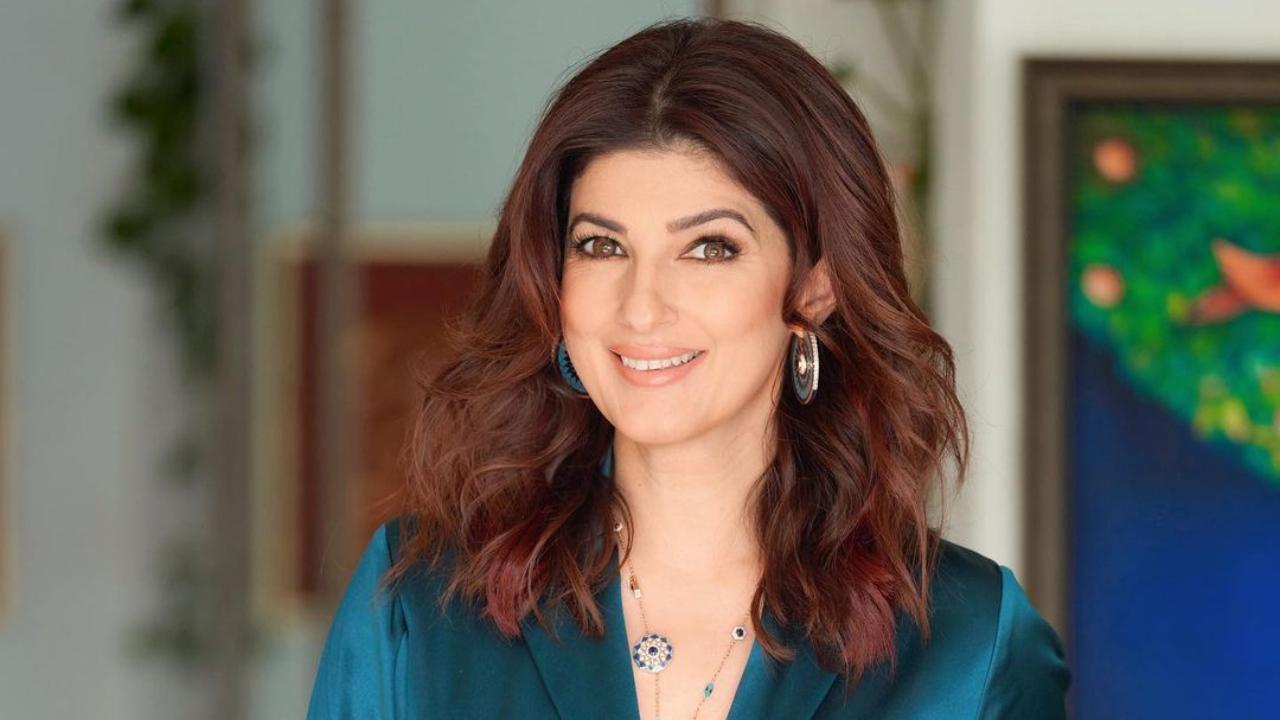
Anna Fernandes (BOMBAY TIMES; September 14, 2024)
“Today, things are changing from what they used to be. Instead of breaking glass ceilings, women are now building their own structures, where they don’t have to break anything. And that’s a great thing to see,” said Twinkle Khanna, during a recent discussion in the city. The actress-author was responding to a question on how women writers can shape narratives that would impact future generations.
“I believe we must work collectively to make any difference that will impact future generations. We have to make an impact through not just writing, but through policy as well,” she added. Excerpts from the discussion.
‘If you’re not connecting with your readers, you might as well be writing a diary’
As a writer, it’s like having a conversation with your audience. You need to grab their attention with a strong opening and keep them engaged with a compelling idea. If you’re not connecting with your readers, you might as well be writing a diary.
‘When you’re a writer, you never run out of firsts’
I think that’s the beauty of being a writer. At this point in our lives, we’ve run out of firsts. You know the first kiss, the first dream, the first everything. But through writing, we can relive all that as if it’s our first, and I think that is wonderful.
‘As a woman, you have to be selfish about your time’
It gets difficult when you are a mother or when you are a wife. For example, I try to carve out time to myself in the morning. If I wake up at 5 am, I can have that time to myself. Post 7 am, I have to ensure my kids get to school. It’s all about discipline, finding what works for you, and being selfish about your time. Even if someone asks you to find their socks at 6 am, you should be able to tell them, ‘I’m sorry, this is my time’. Being a writer, therefore, can be a lonely process. I’ve found that for female writers, a little space from our partners can sometimes be a good thing. Unlike male writers who may benefit from their partner’s support, we often need to prove ourselves on our own.
‘Boredom & curiosity drive me as a writer’
As a writer, I believe two constants remain as I evolve: I am perpetually bored and incredibly curious. These qualities drive me to observe people, wonder about their lives. Whether I’m on a train or simply walking, I find myself watching others instead of looking at my device. That’s my form of discipline. I have the discipline to be bored in today’s world. It’s boredom and curiosity that keep me going.
Every right can be misused and we’re seeing that happen-Twinkle Khanna
8:34 AM

Navneet Vyasan (HINDUSTAN TIMES; September 26, 2020)
They say humour is the best weapon one can possess, and author Twinkle Khanna certainly puts it to good use, almost always. The author who spent the lockdown cooking with her son (Aarav Kumar), is someone who “who looks for silver linings in every situation”.
In the past few months, it has been impossible to ignore the cacophony concerning various issues and the rampant fake news circulating on social media. “It is frustrating to see the amount of misinformation that makes the rounds, but freedom of speech must be absolute, sadly,” she says.
The author adds that the sacred line of how far is too for, remains different for everyone. “There is a line to be drawn and that line is defined by, and different for, each individual. That’s what makes it a nuanced debate. Every right can be misused and I think we are seeing that happening all around us,” she says.
The author admits that she’s often landed in trouble for her outspokenness, but adds that she can’t help it. “There is a part of me that is compelled to stand up for the things I think are valuable to us collectively,” she says adding that using satire as a means to critique gives her “a little more room”.
On the work front, she’s been busy penning blogs for her website Tweak India, which recently completed one year. “If I am not working on a column or a book, I start sinking,” she says. On the clamour surrounding the nepotism debate, she says, “I do have thoughts on this, but I would prefer to write a long piece. A two-line answer will only further muddy the water.”
Writers can’t be skewed because of fear-Twinkle Khanna
8:22 AM

Twinkle Khanna says the author in her, with all its quirky humour, will always show resilience in the face of fear irrespective of who she’s up against
Navneet Vyasan (HINDUSTAN TIMES; February 13, 2020)
"I read across genres, a lot of it as purely research into structure, style and narrative. Alice Munro, Rohinton Mistry are some of my heroes," says author Twinkle Khanna. And why not, her humour, that has made her a bestselling author, can be found across genres irrespective of the theme. Mistry, whose novels are laden with realism, and Nobel Prize-winner Munro, who revolutionised short stories, have inspired generations. Khanna, who penned Mrs Funnybones, The Legend Of Lakshmi Prasad and, most recently, Pyjamas Are Forgiving, has slowly but steadily built a strong fan base.
When did your inclination towards reading begin?
My mother (Dimple Kapadia) claims that I could read by the time I was three, which seems hard to believe but I use this apocryphal tale around my childhood to tease my sister mercilessly because apparently she was all of five when she started reading. Today, I think she reads even more than me, though we prefer different genres. I honestly don’t remember a specific time when I discovered the joy of books so to speak, but my boarding school friends claim that I would even skip meals because I was reading. Considering I was the roundest girl in my class, I find it unlikely, though I suppose I do have hazy memories of eating with one hand, while holding my book with another and invariably dropping some food on the pages. Yes, I am one of those sinners, who folds down corners, drops things and writes in the margins. My relationship with books is probably like my relationship with God, I am grateful to have both in my life but my devotion is strictly devoid of any rituals. After all, Saraswati does not come to visit you if you worship books, she drops in occasionally when you turn the pages.
Who were your favourite authors growing up? And who do you enjoy reading now?
I have always read a lot of science fiction, Asimov, Philip K Dick, and I used to read a lot of horror as well — all the Stephen Kings and Dean Koontzs I could find. Now, I have stopped reading about demons but am sticking to my beloved aliens. I read a lot of contemporary sci-fi authors now, N K Jemisin, and Paolo Bacigalupi along with the masters like Atwood and Gaiman. Science fiction is my version of the calorie laden dessert. But I have a tendency of sounding like a boring fart when it comes to talking about the authors I love.
Granted, that we’ve had numerous Booker and Pulitzer Prize winners, what do you make of the fanfare reading had when you were young compared to now?
In the history of mankind, there has never been a time like this with so many things competing for an individual’s attention. We also don’t allow ourselves to be bored anymore. Taking out the time to read, to be still in a world that is always whirling may be more challenging but I don’t think books are anywhere close to being extinct because there really is no replacement for a medium where you are building worlds completely within your head. Like Douglas Adams once told Gaiman ‘Books are sharks. There were sharks before there were dinosaurs, and the reason sharks are still in the ocean is that nothing is better at being a shark than a shark’.
Sharing the stage with Sudha Murthy must have been quite an experience...
Mrs Murthy is someone I admire the most for her sheer lack of pretentiousness. I do know her on a personal level but got to know her further when I interviewed her for my website, and her books are exactly like her — honest and relatable.
What do you make of your contemporaries like Madhuri Vijay?
I have been meaning to get my hands on her book, The Far Field, as I have heard so much about it but I haven’t had a chance yet. I did read Milk Teeth by Amrita Mahale, Meena Kandasamy’s When I Hit You, Eating Wasps by Anita Nair, and they all made it to multiple lists of book recommendations that I jot down regularly for my readers. Contrary to popular belief, I think it’s a wonderful time to be a writer today, only because the best work is never created in a stable environment but always in the midst of uncertainty.
An author’s words might just offend someone. Does that make him/her turn towards self-censorship? Is it an unfortunate solution?
I have been writing for over eight years now and in the last few years, I feel that you can sense an increasing amount of pressure, especially when you write about politics. Each creative person is an individual and has the agency to decide to succumb, temporarily or permanently. Or, even to be subversive or not to adapt at all. I don’t see a demarcation between filmmakers and writers as much as I see it as individual decisions. Personally, I feel that with the platform that I have been given, I do have the responsibility to present a narrative that does not transform or get skewed because of fear.
I tell my editors they must give me a deadline, and must be harsh with me-Twinkle Khanna
7:51 AM

Mirror reader Aniruddha Mahale speaks to Twinkle Khanna about humour writing
As told to Labonita Ghosh (MUMBAI MIRROR; October 27, 2019)
I’m currently working on a book, and I’m already many months behind my deadline. I was supposed to have finished by March; it’s October, and I’m still not done. So one of the things I wanted to ask Twinkle Khanna, who has written quite a few books herself, was how to discipline yourself to work towards a deadline. Especially when you have another life.
The other thing that I wanted to ask her was, of course, about humour writing. More specifically, how can you be taken seriously when you are a humour writer? There is a preconceived notion that humour is easy: It’s not the kind of writing that Arundhati Roy or Jhumpa Lahiri does; there’re no Rumi-like ponderations. But I wanted to ask Twinkle how humour can also be serious at the same time. I believe it’s a school of thought that needs to stand out in the country. And she does it so well.
When we arrive at Twinkle’s office, she walks in wearing a T-shirt that says (portentously?), ‘Nothing is free in life except bad advice’. When I tell her that I’m way behind on my writing schedule, and that may be because of a writer’s block, she ploughs into me. “There’s no such thing as a writer’s block,” she says, with a smile but with a ‘no-nonsense’ air about her. “You have to find ways of tackling what could be a stagnant phase. Deadlines are very important. Being a columnist is the biggest [sort of] discipline. Whether you have an idea or you don’t, you just have to deliver.”
Then she adds: “I’m the opposite of you. I tell my editors they must give me a deadline, and must be harsh with me. The more space you have, the more you’ll meander.” When I tell her that I sometimes feel like meander is my middle name, she hits me with a Neil Gaiman’s writing advice. “He once said that there are three ways you can continue to find work. First, if you are a genius. Second, if you’re competent enough but always deliver your work on time. And third, if you’re likeable,” Twinkle says. “You must be at least two of these three things to be successful.”
What I found impressive about Twinkle is that she’s well read and very well informed. During the course of our conversation, we discussed — among other things — the writing processes of well-known authors. Twinkle seemed to know quite a bit about many of them. She knew how Japanese writer Haruki Murakami spends his days when he’s in the middle of writing. She mentioned a TED talk by Elizabeth Gilbert on why creative people kill themselves when they can’t live up to the pressure of producing a second masterpiece. Then we discussed Margaret Atwood, a writer we both admire. “I’m extremely jealous of the way she writes,” Twinkle says. “There’s such a beautiful rhythm to her sentence construction. I’ve studied it very carefully, and once, I even tried to write a paragraph in her style. But it didn’t work.” Most writers like to stay in their boxes. I liked that as a writer, Twinkle not only steps outside of hers, but she also likes to peep into others’ boxes, and learn from them.
The conversation with her gave me some invaluable insight. For instance, you can’t mimic someone else’s sense of humour; it must be your own. You can’t tell someone else’s joke and expect to get the same laughs. She made me realise that you must find your own voice, and use it to your advantage. I also liked that her responses to my questions were not stereotypical. When I tell people I’m stuck with my writing, they usually respond with a sympathetic, ‘it happens’, or ‘it’s okay, you’ll get past it’. But Twinkle told me, without sugarcoating it, that I need to get over myself, and get on with it. I’ve been following the new platform she’s launched called Tweak, and quite like some of the things I’ve read.
Twinkle self-deprecating sense of humour is also fun. When I asked who she was inspired by, she named Jhumpa Lahiri, Rohinton Mistry, and sci-fi writer Ken Liu. And then added: “I should change my name to [something weighty like] Arundhati if I want to get an award. ‘Twinkle’ isn’t going to get me the Pulitzer!”
I think I need to lead a messier life-Twinkle Khanna
8:15 AM

Actor, columnist and author Twinkle Khanna on writing habits and what makes her happy
Nona Walia (TIMES LIFE; October 13, 2019)
What makes you kick off your humorous side?
I think hanging out with my family — the Kapadias — has an odd perspective on most things. So when we are all together, the one-liners really add up.
Did you always have a sharp sense of humour?
Now, people call it humour and wit; I pretty much said the same things earlier and they just thought I was weird.
When did storytelling start fascinating you?
I loved reading as a child and even today, with three books under my belt and five years of writing columns, I think of myself as a reader more than a writer. It was in boarding school that I first began writing morbid poems. My mom gave me a special file; it was made of black felt and had an orange ribbon that held it together. I hope I find it in an old carton somewhere. She claims my first poem was about mangoes, but I believe it was about maggots. That being said I don’t believe you sit and think about weaving stories with a difference, they are all a part of what you see in life and how you process those experiences.
What was the transition from being an actor to a writer like?
Let’s just say I truly value the fact that I can work in my pyjamas and I don’t have to worry about my false eyelashes falling into the mandatory cup of hot coffee lurking around me.
What are the things that irritate you?
I tend to speak very fast, and sometimes, it is frustrating that I have to slow down so other people can truly understand what I’m saying. Aside from that, I can take all the roaches, mosquitoes, trolls and other pesky creatures in my stride.
Is the pen mightier than the sword?
The pen is mightier than the sword... till it hits a brick wall. I am at that point, and now I am just hoping to leave some graffiti behind.
What is your idea of feminism?
Equal opportunities both socially and professionally – that’s all feminism means to me. I also believe that once you have achieved it you must use the privilege to alleviate a little of the burden that other women carry.
With Tweak (digital platform that talks to women about every aspect of their lives), are you trying to create a judgment-free world?
Yes, but in an irreverent manner, without any pedantic aspects. It aspires to become a go-to platform for obtaining knowledge as well as being heard. I think my first poem was about maggots
Life lessons from your mother that you’d want your daughter to learn…
How to tweak a swishy head of hair.
How do you push yourself out of your comfort zone?
The most recent one would be doing an aerial obstacle course with my family.
The things that you fussed about when younger, but let go easily now?
I don’t fret over my weight anymore.
What inspires you?
Books, books and more books.
Does fame change things?
It gives you both a platform and a responsibility. There is a balance right there if you look at it closely.
Spirituality to you is…
I think God lives in my garden, or at least, I feel as peaceful there as I do in places that are meant to be holy.
When do you prefer to write? Do you often have a writer’s block?
I prefer early mornings, and the best way to get over a writer’s block is to either have a real guillotine hanging over your neck or its modern counterpart – a deadline.
How do you use social media?
I use Twitter as a medium of getting news from different sources almost instantaneously, and that’s the platform I use the most.
How do you handle trolls?
I ignore them now.
How have you incorporated wellness into your daily way of living?
I have clean eating habits. I walk a lot, do some yoga and read. Seems to work well enough, though sometimes, I think I need to lead a messier life.
How does one remain softhearted and compassionate in a tough world?
I don’t know if anyone has the answer to this one. Empathy is an ingrained trait that is inculcated as a child.

You don't have to take life so seriously-Twinkle Khanna
8:18 AM

Set to launch a content platform, Twinkle Khanna talks about writing for women and telling them not to take life seriously
Dalreen Ramos (MID-DAY; September 22, 2019)
It's easy to talk about Twinkle Khanna's new venture by describing what waiting by her office, part of her home, feels like. There's the clanking of cutlery and hashtags being thrown around like confetti by women in the adjacent room. Even if, in the middle of all this raging energy, you didn't guess that Khanna is about to launch a digital media company, she emerges from the chatter with a t-shirt, yoga pants and a coffee mug. But there isn't a hint of exhaustion on her face. "You're early," she says. I tell her I took the Met Department's advice about the expected thunderstorms and fled home. She laughs it off saying, "but it is better to be early than late."
Either the weather is a good conversation starter or Khanna is terribly good at oozing ease into a conversation with a warm welcome. And in many ways, her demeanour embodies what Tweak India, her digital platform that launches on September 30 aims to be—a bilingual, judgement-free space for women to engage in dialogue on any subject.
Edited excerpts from the interview.
There doesn't seem to be an end to the professions you carve for yourself. You're a film producer, author and columnist among many other things. Would you call yourself a workaholic?
Yeah. It's a bit of problem but that is where I'm happiest. I'm someone who wakes up enthusiastic about work. I'm there probably 15 minutes before anyone else—also because I live very close to the office, unlike others who have to trudge through this flooded city. More than anything else, it's the only way of life I've known. I was 15 when I had my first summer job. Work gives me a sense of security. That, I think is invaluable.
So, did Tweak emanate from this grand vision?
It started with a very simple notion. When I started writing I realised that there were so many other women who were navigating similar things despite us having very diverse financial or social backgrounds. I also felt that there wasn't anyone who wasn't talking down to them or in a pedantic, boring manner.
The reason people resonated with my work was because I was filling that gap in some way; I was giving them some ideas to think about to challenge their circumstances at this given point in time, say menstruation for instance. Now, while I was doing that, I was challenging my own pre-set ideas. Even I would hesitate entering a temple during my periods. If I'm an educated woman, who has written a book about this, done so much research and I am still telling myself that is alright to go, then what about everybody else? The easiest way to tackle this gap would be to do videos, like an Oprah, and I got a lot of offers to do those. But that entails being in front of the camera and I have no interest. I'm also not someone who wants to dress up every day. I've done the bit where you're crying and your eyelashes are coming off and I don't ever want to be in that place. I had the idea [for Tweak] for about 5-6 years and we started working 18 months ago.
What does starting a content platform entail?
On a regular day, it could be numerous things: looking at what kind of stories we are going to write, having a huddled meeting where everybody comes up with ideas, and maybe skimming across the pieces that we are going to upload—luckily I read diagonally. I didn't even know what a CMS was. To navigate that now is challenging but I've always had an enthusiasm for learning. My husband keeps saying that I have a seven-year itch, as people do with their marital relationships, but this is work-wise; I need to do something that I haven't done before.
But there are women-centric platforms that already exist. Weren't you overwhelmed about entering a new space?
There isn't a single one that I can see which covers everything from parenting to food to opinion and tells you how to make your life easier. There are platforms that are telling you how to make your life more complicated. We are also trying to tell you that you don't have to take life so seriously—if you do not use a particular face scrub it's not like you're going to die. But if you want some ideas to challenge the way you're thinking, you have some fodder for thought here... There's also nobody focusing on working women: from asking your boss for a raise to toxic workplaces and guidelines from other women in flourishing careers.
There's a lot of buzz on social media about the contributors [ranging from Malala Yousafzai to Sudha Murty]. How did you go about curation?
We have a three-pronged content generator: an in-house team, freelancers and experts in every field. So it isn't going to be just our opinion. It's going to be text, audio, video and physical events.
How much of your writing will we get to see?
I will be writing four pieces a month. I also have a video series where I'll be interviewing people. I'm going to be overseeing the rest. We have a great team of like-minded people—about 11 of us.
Now, although the platform will maintain your tone of writing, it will also be nonpartisan. But what relevance does that perspective hold when one could say the personal is political?
There is a judgement-free space where you can debate and discuss. When it comes to the personal being political, I think educated people who are aware of the world are political creatures. Your politics can come in various ways—not only in actual politics about parties but in how you choose to live your life. For instance, if you choose to recycle or compost or not is political. So, all of that will come through.
And your workforce comprises primarily women?
Yes. Didn't you hear the chatter! I'll be accused of misandry in that way. We do have one gentleman who right now is feeling very out of place.
Akshay Kumar has told me to never act again-Twinkle Khanna
8:06 AM

Deepali Singh (DNA; September 11, 2018)
We’ve reached 15 minutes early for a chat with Twinkle Khanna at her beach-facing residence. The lady in question arrives right on time and with just a minor digression into topics like black coffee putting her to sleep — an idiosyncrasy she blames on her being born upside down — we dive straight into a chat about her third book and first novel, Pyjamas Are Forgiving. After all, there’s a particular brand of humour the actor-turned-author has come to be associated with — there’s wordplay, some self-deprecation, irreverence and a pinch of political incorrectness — that has made her one of the most loved ‘no-filter’ writers today. Clad in a striped blue pantsuit, Mrs Funnybones (as she is popularly known) sits down for a no-holds-barred chat. Excerpts...
Did the title strike you first or the story?
As usual, I was writing something else. Then in the middle of it, somebody asked me to be a part of an anthology of short stories and I told them that I would let them know when I had an idea in mind. After a month, I had to call back and say, ‘Sorry, I have a feeling this is going to be my first novel and thank you for pushing me on that path’. Their idea was to have something to do with clothing. I had this story in my head for a while. I had been to a stringent ayurvedic retreat, like in the story, and it has stayed with me.
So, there was no planned move from short stories to novel?
No. In fact, Salaam Noni Appa was supposed to be a big novel. I tried it thrice but instead, it became a short story and this was a short story that became a novel. So, I guess it comes to being born upside down (laughs). Whatever we plan, we end up doing it in a different way.
What seems like a light-hearted read actually talks about some relevant issues like consent and self-worth... That’s something we find in your columns as well...
I guess that’s the way I write. For instance, I wanted to write an adventurous dystopian India sort of novel, but I couldn’t find the scope of any humour in it. So, I abandoned it. Maybe one day, I will write a book which has no jokes, but I think it won’t hold my interest.
You have dedicated this novel to your mother, Dimple Kapadia. Somewhere in the novel, the protagonist says, ‘I still find it hard to figure when my mother is serious and when she is just trying to mess with my head.’ Does that apply to your mom, too?
Completely! So, whether it’s my columns or books, I seem to be writing about women who are not interested in finding a man. They are trying to live life on their own terms as well as dealing with the constant chafing between who a woman is and who she’s meant to be. I think it all comes from growing up with a mother who lived life on her own terms. We never had conversations about feminism or equality in our house, but it was only when I was about 35, that I realised what I have always taken for granted, is something most women don’t have. I never felt I was less than a man, in fact I always felt I was superior and we have to just bear with these creatures. Putting a man on a pedestal had never even occurred to me. That’s why I think not only this book but most of what I write should be dedicated to my mother because it comes from being raised in a particular manner. She did it with a lot of irreverence. There were never any complaints. She just shrugs off her burdens and I think I’ve learnt to do the same from her.
Do you get your brand of humour also from her?
Completely! She is more eccentric than me! You would not believe some of the things she tells me, they are bizarre! So yes, I have inherited my humour from her and her side of the family.
When you have to speak in public, do people expect you to be funny?
Yes, they do. When I walk on stage, they say things like, ‘Now, she’s here to make you laugh for the next one hour’ and I’m like ‘Somebody kill me right now!’ Actually, it’s one of my fantasies to be a stand-up comic. I practise in the mirror. But my husband (Akshay Kumar) has told me two things, to never go back to acting and not to ever do stand-up comedy, because I’m terrible at both! (laughs). But once you get onto that platform you know what’s expected of you and inhabiting that persona is not very difficult for me. Saying things which make people laugh is not such a difficult thing because I’m telling them the truth. It’s just from a person and in a way they don’t expect, so they find it funny. Also, I’m giving them a perspective which apparently most women don’t seem to hold. They would probably expect a man to say things in this politically incorrect way. I’m sure I will find one day that I’ve nothing funny to say and it will be a disaster, but so far it’s been fine.
Have the man of the house and the prodigal son read your novel?
No, they haven’t read it yet, but they know the story in detail. Both of them are my sounding boards. I had a couple of alternative ends. My husband wanted the more dramatic end but my son liked this one. There was an ending which was much darker and my editor Chiki Sarkar and I kept arguing about it. When I started writing, this is the one that made most sense.
Have you planned ahead for the next book?
I’m the person who wants to start writing a book the day I finish one. I don’t like having that empty space in my head; it bothers me. I don’t know what to do with myself. Suddenly, I have so much time and I’m not used to having time. I have ideas, but of course, I’ll abandon them and start writing something else (smiles).
I shamelessly eavesdrop on people-Twinkle Khanna
8:41 AM

With her latest, Twinkle Khanna has explored every genre of writing, from columns to nonfiction to (now) a dark novel set in an ashram
Labonita Ghosh (MUMBAI MIRROR; September 9, 2018)
If books were allowed long titles instead of (mostly) short and snappy ones, Twinkle Khanna’s latest would be a winner. While Pyjamas are Forgiving is intriguing enough, the kicker — which doesn’t make the cover — lies in the second part of the phrase: jeans know how to hold a grudge.
That phrase came to Khanna like many of her column ideas (she writes the hugely popular Mrs Funnybones for the Times of India ) — unbidden, fully-formed and at an inopportune moment. “One Diwali, I was trying on my jeans. But they just wouldn’t fit,” says Khanna. “That’s when this line came to me. I even tweeted about it. And then someone tweeted back, with: ‘lungis are even more forgiving than pyjamas’.” So Khanna gave them both starring roles in her novel, a slightly dark tale about love, sex and paths retrodden, set in a fictional ashram, where the attire worn by the visitors is pristine-white kurta-pyjamas.
If you’re not careful while bantering with her, you might find yourself in Khanna’s next book. “I shamelessly eavesdrop on people,” says the writer. Khanna’s funnybone, it turns out, comes from having a quirky, not-quite-level view of the world. How else could you write a whole column about a pothole called Guddu? Or make up bizarre (but sweet) stories for your five-year-old that involve a pig and a little girl whose leg has been bitten off by a shark? “It’s a peculiar gaze, one that comes from not taking yourself too seriously,” says Khanna. “When I was growing up, humour was my defence against being of a different size and a different sort. I was the fattest girl in my class, and that fat girl still lives inside my head.”
Khanna, who is a science fiction buff and hopes to write one once she’s mustered enough courage, says her sounding boards constitute seven people from her inner circle of family and friends. “I don’t have first readers, I have first listeners to whom I narrate whole stories,” says Khanna. “And they’re a captive audience. I catch them on planes and in buses when the seat belt is holding them captive, and narrate whatever I want.”
The one part of her life Khanna doesn’t plan to revisit anytime soon, is that of producer. When the story of Arunachalam Muruganantham was adapted for screen as Pad Man, starring husband Akshay Kumar, Twinkle was tagged as producer for the hit film. “I’m not a producer. It’s not one of my ambitions. In fact, I have no interest in staying involved with the film world,” says Khanna. “If I have a compelling story to tell, I will. If I don’t, I won’t.”
It helps that she has no ego. “Some writers are very protective of their words, but I can step back and let go quite easily,” says Khanna, who slashed 11,000 “superfluous” ones from her current novel. “I don’t know if I’ve found my groove [with fiction], but writing makes me feel more rooted to the world,” she says. “I’ve always been someone who would prefer to sit in a corner and read than go to parties or social occasions.” For now, though, Khanna’s just happy to let that weird, crazy fat girl in her head, run wild.
Aarav keeps replaying a clip from Jaan, where I am kissing around a man's nipple-Twinkle Khanna
9:49 PM

In an exclusive chat held at the mid-day office, writer and social-media sensation Mrs Funnybones Twinkle Khanna shines a light on fame and films, as she turns producer with the Akshay Kumar starrer 'Pad Man'
Mayank Shekhar (MID-DAY; February 4, 2018)
You mentioned you haven't given an interview as a producer before. To ease you in therefore, how about we start with what I'm sure you've been asked all your life: Twinkle, are you really named after the nursery rhyme?
The apocryphal tales from my childhood would suggest that I was named (Twinkle) because it rhymed with sprinkle and sparkle. Luckily, I wasn't named Wrinkle.
What's wrong with Wrinkle?
Well, Wrinkle would just be slightly worse than Twinkle. At least, here you're shining, there you're sagging. Having said that, for very long, I didn't like my name. I fought against it. But as with everything else, my perspective (on this) was influenced as much by literature as life. I read Jhumpa Lahiri's Interpreter Of Maladies, which has a short-story about a girl with a fancy Bengali name, who insists on introducing herself to everyone as Twinkle - her 'pet name'. everyone is baffled by this, including her husband. And she's a popular, cool girl, who still insists on going by Twinkle. So I thought - if she's okay with it, I can pull it off as well!
Was there a connection between Twinkle (in that short story), and you? Did you ever meet or ask Jhumpa Lahiri?
Well I think there was a paragraph in there about an actress from Bombay, by the name of Dimple (Twinkle's mother). I guess she did kinda...
Oh, so there was a reference.
I don't know if it was completely directed at me. But it certainly did change my perspective!
The other name you're equally well-known by is Mrs Funnybones.
I seem to have a penchant for really funny names.
That would obviously be because you have a
funny bone. Also, I hear, the name comes from you being accident-prone,
you've managed to break a lot of bones.
I've broken both my legs, arms, collarbone. I've limped for most of my life, which strangely enough I stopped after 40, so some things do get better with age. Mrs Funnybones was a handle I had essentially made to anonymously troll people on Twitter. But the day I decided to (officially) join (Twitter), Twinkle Khanna was already taken. And I didn't want to be 'TheOneAndOnlyTwinkleKhanna' (God that sounds really bad), or 'TheReal...' Since I already had MrsFunnyBones, I went with it. When I did join, one of the politicians had been slapped. My first tweet was, "What a slap Sirji." My family immediately said that I should get off this platform. This is not for me!
I've broken both my legs, arms, collarbone. I've limped for most of my life, which strangely enough I stopped after 40, so some things do get better with age. Mrs Funnybones was a handle I had essentially made to anonymously troll people on Twitter. But the day I decided to (officially) join (Twitter), Twinkle Khanna was already taken. And I didn't want to be 'TheOneAndOnlyTwinkleKhanna' (God that sounds really bad), or 'TheReal...' Since I already had MrsFunnyBones, I went with it. When I did join, one of the politicians had been slapped. My first tweet was, "What a slap Sirji." My family immediately said that I should get off this platform. This is not for me!
Now when you call yourself Mrs Funnybones, and write columns that are inherently funny, is there too much pressure to be funny at all times?
Now the good thing about hiding behind the persona of Mrs Funnybones - I mean that's not really me, it's a projection - is that I'm not supposed to be amiable, I'm just supposed to be myself. And cracking lame jokes comes easier to me than minding my P's and Q's, so I'm alright there. I used to feel the pressure in the beginning, but then realised that I just have to be myself, and really, how wrong can you go with that?
You've said before that since you were fat while growing up, humour became your natural defense mechanism. Is that cliche about fat people being funny really true?
It's not about fat people - it's about odd people being funny, while finding a way to fit in, making fun of others, before others can attack you. I mean, how non-conventional could I be? I was in a position where people would be nice to me, because of who my parents were. And they were also mean to me for the same reason. I had an odd name. I was the fattest girl, which is great, because I could sit on everyone in class, and beat them up. And I feel lucky to have been an oddball, forced to develop other skills. Because if I was really the prom queen, what would I be doing right now? Staring at my position - in my 40s, with the thing I banked on (beauty) depleting?
Going back to pressures of humour, I know stand-up comedians in particular, who are headaches to hang out with - they just keep thinking of repartees, comebacks, puns, during conversations. It's impossible to talk to them in a social setting!
Well, unfortunately, that describes me as well. And I do try really hard not to (fall into the trap), so I do my yoga to tell myself, "It's alright. I don't have to have the last, punch line!"
The other thing about humour is its decline that one senses in general. Would you agree?
You're telling me about it? (laughs). I definitely think so. But I'm divided on this (issue). There are certain things (we were used to) that I feel weren't politically correct -culturally, discriminatory, racist. And we're not okay with that anymore. But our funniest jokes used to be about other people. The other side of me feels sad, because we're losing that too. Or I'm losing opportunities!
There's also the element of an exponentially growing number of holy cows that you simply can't make fun of anymore. Or is that just a social-media thing?
My (Twitter) bio says that nothing is sacred, except laughter. And why do Hindu boys worship their mothers? Because their religion tells them to worship the cow! Clearly I'm the wrong person to talk to about holy cows.
Did you get trolled for it?
No!
Since you write opinion, that's the other thing happening, where every perspective is presently being boxed, while individuals are being conveniently reduced/diminished to labels: Bhakts, Libtards, and so on. Do you notice that?
I also see that if you write something 'Left-Liberal', as you'd call it, you get trolled majorly. I have a formula. Once I was writing a column about building a nation of tyranny on corpses of soldiers, and I began with saying that ornithologists can see a distinction between birds. I didn't get trolled, because most people didn't understand what ornithologist means, and they left it alone (laughs).
Politically, socially, your husband (Akshay Kumar) holds a totally separate world-view from yours. Is that fair to say?
I'd say our social, political ideologies, sense of humour, are very different. What's interesting is that after the first few years, we gave up trying to change each other. What we did instead was start to learn from each other. Luckily all his strengths are my weaknesses, and vice versa. What would I learn if we were more like each other anyway? I really believe two peas in a pod died of inertia. And we are not like that. So we continue to grow. Marriages essentially fail, when you try to clone the other person to become like you, it's not possible.
But he's protective of your public opinions, censoring your columns, we hear, cautioning you against going too far?
We're two different brains. Mine is a washing machine, whirling, chaotic. His thoughts are neatly folded in the closet of his mind. I need his stability to hem me in. He needs me to push him out of his comfort zone.

Why does it feel like we're reading a perfectly-worded column of yours?
What can I say, I'm smart, you don't get to meet too many of those (laughs). So in a certain situation, he's only trying to protect me from the fact that there'd be people throwing stones at our house. And I appreciate that. Because I could, sometimes, get into a lot of trouble on my own.
Well you do represent 'soft power' - having grown up in the limelight - which inevitably make for soft-targets. What's the worst sort of targeting you've faced for your opinions? Have they percolated offline?
Well I had an elderly lady accost me at a hospital once, while I was waiting for my mother-in-law's test reports, and she kept asking me what I had against Yogi Adityanath. And she was a really old lady, and I kept telling her this was not the right time, and she just went on regardless.
Given excessively famous parents (Rajesh Khanna, Dimple), I'm sure you've been used to this sort of intrusion all your life, no?
I had no choice over where I was born. But being married to a movie-star was my choice. Still it (intrusion) is not something I'm comfortable with. I prefer sitting behind my desk - that's my life. When I'm pushed out there, of course, I have, with time, developed the abilities to deal with it too.
One of the challenges of your life, you've said before, was to be normal. What did you mean by that?
I've had a turbulent life, first of all. I went from living in (my father's) mansion, going to school in a convertible, to shifting into my grandmother's house, where my sister and I would sleep on mattresses on the floor. I would go everywhere in rickshaws that I absolutely loved. My friends had nicknamed me 'Rickshaw Rani' for some reason. (This carried on) until I got the signing amount for my first movie, and I put a down-payment for my car - a white esteem, which was a big thing. I could have borrowed my mother's car. But we were raised in a certain way, seeing my mom working - raising not just me, but my sibling, and my grandparents. I realised early on that I needed to be financially independent. So I don't know if I've had that semblance of a normal life, if you know what I mean.
I read a lovely column of yours (it also had Akshay's story in it) about taking suburban trains, and was quite surprised that you did take the locals growing up.
How else would I commute? As I said, I had a convertible until I was 10, and then it vanished. But more than that, it was about a work ethic, and a mindset. I went to boarding school, the most defining time of my life, where I turned from a complacent child, who came last in a class of 37, to always being in the top three. Which is true for children in general - it's the circumstances that propel them to go either way, not just their abilities. So the misfortunes, that I thought were devastating, turned out to be assets.
Looking at the post 3 Idiots phase, where so much premium is put on 'passion', there must be kids who probably want to become engineers or doctors, but their parents will probably force them to become poets! That's a joke. But this actually happened to you; you'd scored 97 in math...
Yeah, I wanted to be a chartered accountant. But my mom didn't even pay attention (to that). The thought was just thrown out of the window. I had applied for my (CA) entrance exam, during my second year in commerce. And I used to keep getting these (film) offers. There was Time Machine, which Shekhar Kapur was making, that I said no to, and many others that kept coming.
So it was clear to your mom that you would be in the movies?
She told me that this is the time (that I can pursue movies). I can always do other things later. And it worked out. And like I said, I really wanted to get financially independent quickly, and this was a good way.
Here's something that you do in all your interviews: you totally downplay your acting career, as if it never happened, or say that you sucked at it. You've had 17 lead-actor credits against your name, that's a lot!
Were you writing reviews at that time?
No.
Otherwise, I would've asked if you've ever written a good review about me!
Well your last film, Love Ke Liye Kuch Bhi Karega (2001), was good. Shah Rukh Khan, for instance, is known as Baadshah (1999) for the film where you were the heroine...
What's the point of all these things? I don't even like my children watching my movies. And my son is such an a**. He keeps replaying a clip from the film Jaan (1996), where I am kissing around a man's nipple. He made a collage out of this for one of my birthdays. It's sick [laughs]. I don't think my family has been supportive of what you think has been a great career!
But you were pretty much in the thick of things back in that decade.
All I wanted to do was get back home. On sets, I would read books. There were times when I'd be sitting, and knitting, and my spot-boy would tell me, 'Aap mat aisa kariye. Sab log Auntyji bolenge.' So you had to live up to an image, and I wasn't that person.
If you felt like the 'outsider', you'd actually have the best observations to make. So much of writing is reminiscence, isn't it? Still, you've never written about showbiz/movies.
I couldn't really see people as clearly as I can now. Though, of course, you couldn't miss some people who were in a kaleidoscope of colours. I had a (male) co-actor who cancelled shoot, and he called me the next day to say that he was really sick, because he had a problem with his uterus [laughs]. I didn't really feel like saying anything after that.
What's the craziest story that you remember from a set?
This uterus story was really funny. And he (the same actor) always had strange medical issues. Once we were shooting in Switzerland, and after pack-up he said that his ear was numb, and the doctor was pleased that he got himself checked up in time - otherwise his brain would have dislocated! And I was like, this really can't be happening. So I have all these weird stories but somewhere, somehow, I don't enjoy writing about them.
Have things changed a lot in the movies since?
Well, I haven't produced any films, except Pad Man.
Are you going to disown Tees Maar Khan? You're credited as a producer there too, among a couple of other films.
My husband just put my name, because I was lucky for him [laughs]. I haven't done anything in Tees Maar Khan. Pad Man is the only movie I have produced. Well, the movie business has completely changed so far as women, and women's roles, are concerned. even the way women are treated has changed drastically.
Were women in the movies treated as dim-witted back then?
Yes, most of us were. Which is why you are surprised that I come up with these quotes!
Which brings me to a point about intelligence, and acting. How intrinsically linked do you think the two are? Do you really need to be an intelligent person to be a good actor?
It depends on how you define intelligence. If you are looking at somebody who is emotionally intelligent, then yes, they would be good at acting. But someone who is well-read might not be a good actor. I don't think intelligence has anything to do with your abilities. The ability of an actor is to feel emotions, and enact them. I didn't have that.
I've met actors who seem totally clueless and blank about the world they live in, and yet they shine on screen when they have to portray complex characters. Do you think it just comes naturally?
I think being able to act, as a quality, is as inbuilt as being able to write, sing or dance. You can't cultivate it. You are born with it. As for (some) actors you meet who seem blank-even now when I do a few commercials for brands, on the sets, there's just a whole bunch of people only talking about the current styles, all day. So you can't blame people for not being vocal (on stuff about the world), because their entire day is either spent in performing, or investing in the way they look. Where is the time to invest in their brains?
What did you do to not be in that bubble?
I was never in the bubble, that's the whole point. By the end of it, I started doing my own hair and make-up, because I got bored, just sitting, and looking myself in the mirror. I never felt that I would fit in.
Clearly you fit in quite well now as a bestselling author; and a first-time producer.
Yes (laughs). We keep telling kids that they have to be good at sports, or look a certain way. But it's your flaws, which make you unique, and that pay off in the end. By the time you're 10, your personality and attributes get completely defined. And if you play on those attributes, and strengths, those are things that really hold you as an adult, and (drive you towards) success.
Audience questions:
I'm told you literally had to chase Arunachalam Muruganantham around to get rights for the story of Pad Man? [Mohar Basu]
Yes, for some reason he couldn't just pick up the phone. When we finally met, he told me a lot of people were chasing him too. He mentioned Abhay Deol, Akshaye Khanna, who wasn't Akshaye Khanna, it was actually me. But I knew I really wanted to write the story and that it needed to get out there to every household. So I just chased him relentlessly for, I think, seven to eight months. I could have had another baby in that time [laughs].
Do you see television and web streaming platforms as the future of cinema? [Amit Karn]
For me, it (the future) is in immersive, virtual reality, where we're completely immersed in an environment, within a scenario. That's where we are heading. There is pollution, traffic. We're not going to be able to leave our houses very soon. So where are we going to be? Living in cubicles, pretending (through headsets/glasses) that we are living in a much wider world.

Akshay Kumar isn’t scared of me at all; he values my opinion-Twinkle Khanna
8:17 AM

Meena Iyer (DNA; February 4, 2018)
Twinkle Khanna is a celebrated author and columnist, who needs no introduction. Known for her wit and candour, the lady with a sharp pen and sharper imagination, is gearing up for the release of her maiden offering, Pad Man, under her banner Mrs Funnybones Movies. Over to the producer…
Pad Man deals with the sensitive topic of menstruation. Is this an indication of how you are going to choose subjects for your future offerings?
I do not think being a producer is part of my career plan or trajectory. So, if you ask me whether I’ll make another movie again, my answer is—it will only depend on if I find a compelling enough story to tell. But it is not the other way around that I want to produce and that’s why I’ll go looking for these stories.
I chanced upon the story of Arunachalam Muruganantham when I had already written 10 chapters for my second book. I did a lot of research and even before meeting him, I started penning his story, which began with him on a cycle right in the middle of the road, exactly the way it is in the book — The Legend of Lakshmi Prasad. At that point, I sent it to my editor Chiki Sarkar and I said, ‘I know you are going to be livid because we are mid-way through the book, but I want to drop it and write this story’. So, we started and within a month-and-a-half, I felt it was a very important tale. I realised this was something that would help elevate a little of the burden that we carry.
Burden?
Yes, the way we hide our sanitary pads in our purses. One pops out and someone jokes or passes a remark and we feel embarrassed. It happened to me once when I was going through a security check. I dropped my bag and all my sanitary pads fell out. I was so embarrassed. I was a lot younger, but such things kept happening over a period of time. This constant, ‘Don’t go to temples when you are menstruating’, etc are things that have stayed in my mind. I remember when I was in boarding school there were two girls named Jaya and Bharati, who said, ‘We do not like going home for the holidays.’ When I asked them why, they explained that when they had their periods, they were made to stay in a room outside the house. Their food was served on a separate plate and they were basically ostracised for those three to four days.
Contrary to what they went through, I grew up in a household where this wasn’t a taboo subject at all. We dealt with it in a matter-of-fact way. I thought a lot about these contrasts. As time went along, these thoughts stayed. I had done a column on menstruation and when I read about Muruganantham, I felt it needed to reach across India, especially to households where people have never spoken about this subject. You know that even women in modern society or progressive homes rarely talk about their periods to their spouses, except for saying something like, ‘My stomach is hurting today.’ Even if you’re running out of sanitary pads, only if you are really desperate, will you tell your husband to get it from the pharmacy. Otherwise, you do it yourself. There is a shame, an embarrassment about a biological function. And I thought, why should there be? Due to my own experiences (where I had felt awkward), I decided that no woman should be embarrassed about it. And that’s how this whole thing started.
Coming back to the original question, being a producer is therefore not a part of your trajectory, is that right?
No, that’s not the way I’m looking at it. I repeat myself. If I have a compelling enough story to tell, I will tell it. But I’ll not go looking for stories, just to be able to produce films.
You were pampered in your very first film outing because you got Akshay Kumar to act in it…
(Smiles) When I spoke to Akshay, we wanted to make a smaller film with lesser-known actors. I didn’t set out to make this big commercial movie. However, once we discussed it, both of us realised that documentaries are made on such topics. There is art-house cinema on subjects like these but who watches it? If we wanted our message to penetrate across India, then there were only two mediums — cricket and cinema.
And cinema of this scale?
Yes, cinema of this scale. Again, when you look at someone like Akshay, who has a huge fan base and whom men look up to, if he is portrayed holding a sanitary pad in his hand, that breaks taboos faster. At least half my work is done as there is an instant connect. Men, who’ve never talked about such things with their wives, are now having discussions about how Pad Man is a film about menstruation. ‘Should we go to watch it or not? How is the trailer? You know he (Akshay) is wearing a sanitary pad in that pink underwear.’ These conversations, which were earlier unheard of, are now happening in the country.
Which brings us to your choice of director. Was R Balki the first name on your list?
Rahul Nanda, the publicity designer, was coming over to show Akshay some poster. Akshay asked me to share my idea with him. So, I spoke to Rahul, who was very enthusiastic and suggested Balki’s name along with those of two other directors. The minute he said Balki, Akshay and I felt that he was the right choice to direct Pad Man.
We neither spoke nor met anyone else. In fact, that same week, Balki came home and within the first 10 minutes of our meeting, he was on board. It was so organic. I do not know if things will ever fall into place as easily as it did in this case.
Are you familiar with Balki’s work?
Yes, I am. I’ve watched Cheeni Kum (2007) and Paa (2009). And I liked both these movies immensely. I remember seeing Paa almost a decade ago and I was really impressed because the film dealt with progeria, a subject that no one had touched earlier. Cheeni Kum, which came before Paa, was fascinating, too. I needed someone who could make Pad Man aesthetically. So, it was a no-brainer that we would go ahead with Balki.
When Akshay has a screening of any of his typical masala movies, he is hesitant to call you for it. Do you berate his choices sometimes? Is your husband scared of you?
(Laughs) No, he isn’t scared of me at all. I think he values my opinion. For a long time, I’ve been urging him to take a leap into the kind of cinema that would have another layer beyond just commercial films. I think, now he is happy to call me for screenings of those movies that have a social message or go beyond just being a blockbuster.
Incidentally, just the other day, my son Aarav was writing a play for school and he had two diametrically opposite ideas. I said, ‘Beta, please don’t write a masala comedy, but something along the lines of Airlift.’ But, it’s more of a joke. I’m not the Principal of The Prime Beach (the building where they reside) School. Everyone around is free to do whatever they choose to. But Akshay is prouder of the cinema that I approve of.
Are you choosy about the movies you watch?
I watch a lot of English movies and few Hindi ones. I prefer sci-fi and horror, those are the genres that I enjoy. As I’m getting older, even my tastes are changing. Probably the things that I would enjoy watching, reading and doing are all evolving. Times are changing, so it’s important to stay relevant and not get bound by what we think is cool. The society is expanding, so even our mindset should broaden.
Tell us about your third book.
I’m halfway through it but right now as I mull over it, I feel I’m doing three somersaults in the air. I don’t know whether I’ll land on my backside or my head (laughs). So, I’ll finish and then talk about it.
Can you be tempted to act again?
The only way you can tempt me is if I get Alzheimer’s and forget my whole identity. Then you can con me into coming in front of the camera. I wasn’t playing to my strengths when I was an actress. Even then I preferred reading a book. So, it wasn’t fair to continue. There is a wall that I live behind. And writing lets me penetrate it.
For me, to experience emotions and enact them, I would have to drop that guard. And I’m trying to climb that wall and look over it now at this age, but I don’t think it’s ever going to fall. I was born in this fishbowl, so I’ve had to keep a guard. I think it’s very difficult if your defences are high to even experience emotions, so then how can I enact them?
And before we sign off who is your favourite actor?
As far as Akshay is concerned, my judgement is biased because it comes with a lot of emotions. So, I’ll leave him out of this. Among the rest, I would say Aamir Khan.
I think political correctness is taking over genuine human emotions-Twinkle Khanna
8:15 AM

Madhureeta Mukherjee (BOMBAY TIMES; January 30, 2018)
Her pen is mighty, yet mirthful and her razor-sharp wit can slice and dice her words with ease. In a world of political correctness, she takes her chances with words, being playful, yet polite. Of course, also the fact that she’s an industry insider makes you guffaw in delight at her guts. Being in front of the camera was never one of her favourite things, so over a decade ago, she bowed out of her acting career, and years later, Twinkle Khanna flourished as an interior designer, and found her true calling as a columnist and author. While her hubby, Akshay Kumar’s filmi career is on a high, she steps into new territory as a producer with Padman, directed by R Balki. In a chat with Bombay Times, she talks about pads, parenting and pushing boundaries in the creative space. Read on...
Apparently, there were many people who were keen to make a film on Arunachalam Muruganantham’s incredible life, but he didn’t grant the rights to anyone, until he met you. How did you manage to impress him?
I was writing a column for The Times of India when I read his story and thought it was a unique perspective on menstruation. In India, we think that being proficient in English is being intelligent. But here was this man, whose intelligence wasn’t constrained or bound by his language skills or by formal education. That really struck me. From an uneducated man, he became an innovator because he saw that there was a need for it. I started calling him and chasing him, and for some odd reason he just wouldn’t answer my calls. Then I started emailing him and sending him text messages. When I set my mind on something, I am like this rhinoceros, I charge ahead without looking left or right.
I made it a policy to call Muruganantham every day, irrespective of where I was. Later on, I realised that he prefers messages and emails, as he finds it easier to comprehend. Finally, when I called him from England, he answered my call; I am guessing he thought that I was some foreign journalist. Soon after that, we met and he was open to the idea of a book, though he was reluctant to the idea of a movie. Perhaps, he felt he wouldn’t be portrayed well and would be shown in some item song in the movie. My intention was clear, I told him that I don’t know if I will make another movie, as this is not a career path that I have chosen, but this is a compelling story and I wanted to make it.
Apart from the fact that it’s based on menstruation, the film breaks many grounds; the lead role is being essayed by a man. This, in a country where most men don’t openly talk about menstruation...
Yes, that’s the idea. The conversation has started. Irrespective of how many people are going to watch the film, I want them to be aware of what we are doing. I am seeing that men, who would have never spoken about these things earlier, are doing it now. The other day, at a press conference I was asked, ‘What are you hoping to achieve with this film?’ I said, exactly this. The fact that you have started talking about it is what I am trying to do. Women are always talking about women’s issues, but are the men listening? Unfortunately, I don’t think that the men are listening. I thought that if we show an actor who is idolised by so many men holding a sanitary pad, a lot of taboos will be broken right there.
Was Akshay your first choice for the role? When you spoke to him about it, was he apprehensive at all?
At first, I was thinking of making the film with a smaller budget. Our cinema is divided between commercial and alternative cinema, so I thought I will probably make something in the latter space. Honestly, a documentary reaches only limited people and some film festivals. The point here is not to just educate the educated, but to also educate the uneducated. That can be done in two ways in our country, through cricket and cinema. I don’t know any cricketer, and they have their own pads, so I thought that making a movie was the right way to go ahead. I don’t think Akshay hesitated even for a moment. We didn’t even have a discussion about him wearing a sanitary pad in the film; maybe we talked about whether the underwear should be a pink-coloured one. I had written the first two-three chapters (of the story) before meeting Muruganantham, and I had spoken to Akshay about the story at that point. So, he had a fair idea about where the story was going.
Your sense of humour serves as a great writing tool, especially when you want to make politically-incorrect views palatable. Like they say, many a true word is spoken in jest...
Yes, it is the only way you can get away with saying so much more. Laughter and orgasms are two uncontrollable physical human expressions. If you can make someone laugh at something, it means you have gotten inside their brain. Hopefully, I have a penchant for cracking lame jokes, so that makes my work easy. There could be some people who don’t get the humour, but that’s okay, everyone does not have to understand everything.
Do you openly talk to your kids about various subjects, some that might be taboo or sensitive, too?
Akshay thinks I am excessively open with my kids while talking about all kinds of things. As I am growing older, I am realising that you can’t control things. You can’t control anyone, whether it is your kids, mother or husband. The only person you have any control over, that too barely, is yourself. The mind also has its own tricks to play. So, I keep channels open with my kids and crack jokes with them, as I think that it is an effective way of starting conversations. In our house, we don’t consider any subject as taboo. I crack jokes on everything from sex to drugs. Akshay and I have spoken to our kids about everything — homosexuality, alcohol, drugs and sex. Recently, I was talking to my son (Aarav) and telling him that in our country, it is illegal for people below 18 years of age to have sex. I explained to him that if a 17-year-old boy and girl have sex, the boy can be accused of rape and go to jail. He told me that it is not fair if it is consensual. So, whether it’s about consent or feminism, we have conversations about it. Nowadays, even in schools, kids are being gender-educated and they have such discussions with their teachers too, which is a great move.
Does Akshay ever censor what you write?
Yes, sometimes he censors what I want to write, and sometimes I listen to him. I talk to him about all my writing. I narrate my stories to him; I don’t think he has read any of my books, as he doesn’t like reading. He is the stabilising factor in my life and I think that’s why we work so well together. Marriage is teamwork; it’s like playing tennis doubles against the world, where you constantly lob these balls. So, when two people are different, one’s weakness is the other’s strength. What Akshay needs from me is to push him harder to step out of his comfort zone. For seven years, I pushed him to do different kinds of cinema, and at that point of time, he would tell me that this is what he needed to do. Then slowly, by his own evolution he started doing what we are seeing today and that is remarkable. You have to be relevant with the times and grow; you cannot do what you were doing ten years ago. Well, one thing that we have in common is that we both have a very strong work ethic, though we come from very different backgrounds. I think when both of us were very young we realised that if we didn’t work every day of our lives, we were not going to get anywhere. In fact, we laugh about it and say that if we both were thrown in a gutter, even then we would survive. That’s what we are and I am hoping this is something that our kids inherit from us.
It’s surprising you are saying this, given the privileged background you come from...
Life didn’t let me take it for granted. There was a big upheaval in my life when I was very young, and it was the best thing that ever happened to me; otherwise, I would have been a complacent child who ranked 35th in a class of 36 students, and sat and ate ice cream. But because of that upheaval, I went to boarding school and that’s when I realised that the only person you can rely on is yourself. It was something that changed the trajectory of my life.
Lately, there has been a general feeling amongst creative people that their freedom of expression is being attacked. Do you feel stifled as a writer? Being a public figure and the wife of a movie star, does it make it tougher?
I have been writing for five years and in the last two years, I definitely feel that even online you can sense a threat, where people want to rape you, kill you and do all sorts of things. I think that nowadays being politically correct seems important to most people, rather than genuinely going out there and doing something, achieving something or saying something. I think political correctness is taking over genuine human emotions. Yes, now I have to be more careful while writing and there is probably a lot more that I would want to say. For instance, a few days ago I was talking to Akshay about writing something on how certain things should be legalised in our country. He told me that for God’s sake don’t do it. He disagrees with me, but I will find my way to write it (laughs!).
So if you weren’t writing, what would you do?
Well, before I started writing seriously, I was doing interior designing. So that has always been there. I am always looking at doing interesting things. In our family, all of us can paint, knit, crochet and we are all voracious readers. In fact, when I was an actress, I would crochet on the set. Back then, there were no cell phones, so I would either be reading or knitting during breaks. My spot boy would tell me not to do it out in the open, but instead in the make-up van, as he feared that people would say, ‘Aap aunty type ho’.

Trouble seems to have become my middle name-Twinkle Khanna
8:51 AM

Twinkle Khanna on her online woes, a second innings in films, and why the film fraternity shouldn't be seen as a single unit in the wake of controversies
Sanyukta Iyer (MUMBAI MIRROR; December 1, 2017)
Twinkle Khanna's online witticisms sound even better in person. Appearing on a panel recently about overcoming failures with the punchline, "Haar ko harao", she shows us how to work a crowd, as she traces her "idiosyncratic upbringing". "When I went to her (mother Dimple Kapadia) as a plump nerd and said, 'I've scored 97 in math', she said, 'well, it matches your weight," she says, and the crowd chuckles.
Then, she gives them a peek at her signature irreverence. "Hrithik (Roshan, her neighbour) once said that he beat his genes, adding, 'have you seen my father dance?' I said that I beat my genes too. Have you seen my mother act?" she says.
In the interview that follows, the 42-year-old actress-turned-columnist and bestselling author also offers up a glimpse into her carefully-worded candour as she tackles controversies, her foray into film production, and bringing up her kids, Aarav and Nitara, with actor-husband Akshay Kumar.
Leading stars, filmmakers and even you have chosen to maintain a stoic silence on the Padmavati and S Durga controversy.
You are putting a horde of people in one category but we are all different. Some people are diplomatic, others are outspoken even within the film industry. You can't put them all under one bracket and ask them to change. Why should anybody try to be someone else? What will that prove to the world? Also, if you scroll through my timeline you will see that I have made two rather strong comments about Padmavati. (Twinkle's tweet from November 19 reads: And as far as #Padmavati is concerned I wish it is the biggest hit ever as that would be the befitting rejoinder to all these loony threats!)
But you always speak your mind, even if it gets you in trouble on Twitter...
Trouble seems to have become my middle name. My problem is that I always voice my opinions vociferously. Sometimes, I may be right, sometimes wrong. When I feel it's the latter, I examine the scenario. I always try to find things to learn, whether it is from criticism or financial failure. I ask myself, 'is there something more I need to be aware of'.
Do you enjoy being a social media celebrity?
I enjoy Twitter because you get different viewpoints on certain news and quickly. My attention span is short so it suits me. I think it's important to constantly adapt to the times.
Do you worry about the implications of your stardom, lineage and your husband's celebrity status on your kids? Is there a certain way they are expected to behave in the public eye?
My husband and I really try to protect our children in the fishbowl that we live in. We are rather particular about it. But beyond that, the world has changed. Every generation thinks that theirs was the ideal situation. But our children live in the world of Instagram and Snapchat and I think they are more equipped to handle it than we are.
What about sex-education, gender equality and alcohol? Is everything up for discussion at the dinner table?
I make jokes about everything. When a friend's daughter came to me and said that she didn't want to go swimming because she was afraid of getting a tan, I told her, "daag achhe hain" and that I wanted to be green because my favourite vegetable is broccoli. Humour always works better than a lecture. I make jokes about sex, alcohol, failure... with the hope that at a crucial point, when my children need to talk to somebody about these things, they will come to me.
My son plays a few sports, and I recently received a letter from a member of our society, which read, "Madam, please check, your son is banging his balls against my car." I tell him things like these and we laugh about them. Nothing is wrapped in cotton, nothing is sacred. I'd rather have my son or daughter have a glass of wine with me than stop them from drinking. They are going to drink with their friends anyway. This way, at least there's always an open door.
Was turning producer with R Balki's Akshay Kumar-starrer Pad Man, a meticulously planned move?
This is not something I thought of or planned. I wrote the story of Arunachalam Muruganantham for my second book, The Legend of Lakshmi Prasad, and I felt that this was an important story that should reach as many households as possible. Unfortunately, we are a world of viewers, not readers, and in order for that to happen I had to do something - like make a movie out of it. That's how the conversation started. That was my straight philosophy as far as Padman goes.
Are you worried about not making it as a successful producer?
Every human being wants to succeed. It is a survival instinct. All I tell myself is that I have prepared to the best of my abilities, and what happens, happens. My story, Salaam Noni Appa, was recently adapted into a play. I have to do my job and my job is to write. Whatever else happens is an organic output. If I start writing things based on whether it will be made into a movie or a series, then I will be doing myself and my readers a disservice.
I like living in my cave with my cubs and scribbling on the walls-Twinkle Khanna
8:03 AM

Lasyapriya Sundaram (BOMBAY TIMES; November 3, 2017)
While she often jokes about the
lukewarm response that her
career as an actress garnered
with tongue firmly in cheek, Twinkle
Khanna sure has the talent to elicit a
chuckle and more as a writer. As the
play Salaam Noni Appa, adapted from
the short story of the same name,
penned by her tours the country, BT
caught up with Mrs Funnybones who
talked about ageism and sexism directed
at older women and how she wants to
steer clear of the arc-lights, in her characteristic
style. Excerpts…
The story of Salaam Noni Appa is about a 68-year-old lady who falls in love. Our patriarchal mindset does not see women post a certain age as living-breathing individuals. Was the short story an attempt to debunk that thought process? Do you agree that the patriarchal mindset also doesn’t give women the liberty to live their lives, irrespective of their age, in the manner in which they want to?
Salaam Noni Appa was as much about ageism as it was about sexism. We look at older people, through the cobweb of wrinkles and folds that time bequeaths them, without truly being able to see that underneath, within their minds they are just like us, their hearts as sprightly as ours and of course, older women are judged even more harshly than older men. There are stereotypes and limitations that society sets — an elderly woman should play a certain role, bring laddoos for her grandchildren, but she cannot be someone’s lover. Her shopping trolley should never have push-up bras, but must only consist of discounted detergent and cough syrup almost past its expiry date, just the way she is assumed to be.
Apparently, you began writing the short story at 18, then revisited it and it eventually became part of your anthology. Did you always know that the narrative would lend itself to a play?
Noni Appa was never meant to be the protagonist, she was part of a bigger tableau. But each time I visited this story, rewrote it again and again, she and her sister Binni were the two characters that seemed to truly shine.
During the launch of your book, you had said that, “Anybody who doesn’t believe in feminism is an idiot.” Do you think effective communication about gender-inequality is possible when it’s done with a dash of humour, without taking away from the seriousness of the issue?
I think any sort of communication, irrespective of its form, whether it is a book, a painting or a film, in order to pass on its inherent message, it must have the ability to hold the viewer’s attention. If I give my children a sermon, often they behave like I am a television on mute — they can see my mouth moving up and down, but seem unable to hear a word of what I am saying. But if I make them laugh at something, even at themselves, my message reaches them loud and clear. I try and follow the same principle when I am writing.
While Salaam Noni Appa, the first short story from your work of fiction, The Legend of Lakshmi Prasad, has been adapted as a play and another short story, The Sanitary Man of Sacred Land will see itself play out in Pad Man, are the other two short stories in the anthology also going to be made into a film or a play?
I did not plan any of this. Nor have I tried to tie up any more collaborations in the near future. But like I have said before — life is, but, a play of chance in the game of choice, which pretty much sums up how I got here in the first place.
Do you plan to ever act in a play which will be based on a story written by you?
Never! I like living in my cave with my cubs and scribbling on the walls intermittently. This spot in the bright sunlight business tends to give me a bit of a heat stroke to be honest.
Subscribe to:
Posts (Atom)