Showing posts with label The Kashmir Files. Show all posts
Showing posts with label The Kashmir Files. Show all posts
"A revolutionary act to watch it": Satluj, the India’s censors do not want you to see
3:37 PM

Hannah Ellis-Petersen in Delhi (THE GUARDIAN; July 18, 2026)
For as long as he has been a film-maker, there is one story Honey Trehan has wanted to tell above all.
Growing up in the Indian state of Punjab, Trehan saw firsthand the devastation wrought by police who carried out tens of thousands of killings and illegal cremations in the 1990s, as they cracked down on a separatist insurgency. To those in Punjab, the period remains one of the darkest in India’s modern history. Jaswant Singh Khalra, the activist who exposed the crimes and was murdered in the process, is a national hero.
By 2022, Trehan’s movie about Khalra and the crimes of Punjab police was completed under the title Ghallughara – a reference to a historical massacre of Sikhs – but the film would never reach Indian cinemas.
For more than three years, India’s film censorship board, which must approve all cinematic releases, blocked the film from release. When it was finally launched straight to a streaming platform last week, under a new title, Satluj, it was taken down within 48 hours and banned on government orders as a threat to national security.
Trehan describes the ordeal of trying to get Satluj released as “dystopian” and decries “undemocratic censorship” and alleged political interference under the Narendra Modi government re-shaping India’s film industries. He claims Indian cinema has been widely co-opted as a propaganda arm for the government’s rightwing, religious nationalist agenda, where there is “only room for one kind of story to be told”, particularly in mainstream Hindi films.
“It is clear to me that there is no creative freedom in India today,” says Trehan. “When you see the level of censorship happening, films getting blocked by the film board and banned from release, it makes you question: does democracy exist in this country any more?”
Even today, discussions of Punjab’s separatist movement – which raged in the 1980s and 1990s, fighting for an independent Sikh homeland called Khalistan, before it was crushed by the state – remain highly sensitive for the Modi government.
A ministry of information committee backed the ban on Satluj on the grounds that it lacked “balance” and had “whitewashed” the acts of Punjabi separatist militants, with the potential to incite national security issues.
“Show Muslims in a bad light and your film will get a standing ovation in the parliament,” says Trehan. “But if you dare to try and tell an uncomfortable part of our history, suddenly you are a criminal and a threat to national security.”
Trehan is not the first Indian film-maker to fall foul of India’s Central Board of Film Certification (CBFC) in recent years. The body is legally mandated to be independent, but it has faced growing accusations by those in the industry of pushing an agenda aligned with the Hindu nationalist politics of the Modi government. The CBFC has not responded to the allegation and was not available for comment.
“From what I’ve experienced, the film board is hand in glove with the government,” says Trehan. “They are being used as a backdoor entry to control the narrative of the film industry.”
Film-makers have complained of an opaque process in which films that make any reference to government oppression, certain religions, police brutality or caste violence are blocked by censors or face demands to make impossible cuts. Filmmakers have even been told to cut images of meat in films, to avoid offending Hindus.
There is no official figure for the number of films that have languished due to censor demands. One recent example was Santosh, which debuted at Cannes to acclaim but was blocked by the CBFC for its negative portrayal of police. Writers and directors privately acknowledge that self-censorship has become a norm in the industry in order to ensure their movies get a cinema release, and not lose huge sums in profits.
Meanwhile, Bollywood films with an alleged pro-government slant such as The Kashmir Files and The Kerala Story, which some have accused of telling a highly distorted version of historical events – and of fuelling Islamophobia and Hindu-Muslim division – have sailed past the board and been backed with government tax breaks and promotion.
Anna M M Vetticad, an Indian film journalist who has written about censorship, said that the treatment of Satluj encapsulated what many film-makers now have to endure.
She described a culture where film-makers were reprimanded by the censor board for realistic portrayals of social oppression or for simply “showing India in a bad light”.
“The goal is to create an atmosphere of fear and encourage self-censorship among those who have not boarded the rightwing bandwagon,” says Vetticad. “The effect on Indian cinema is potentially devastating.”
Trehan says few in the industry are willing to be as vocal as him, fearing retribution. “I know many other filmmakers who have faced similar issues but we lack unity as an industry. Most people are too worried about speaking out, especially because there is often a lot of money and careers at stake. If you criticize, suddenly a police case could be filed against you.”
In total, CBFC demanded 127 cuts to Trehan’s film, some of which appeared impossible for him to execute. As well as changing the name, the censors wanted the removal of all mention of Punjab police, the killings, government, the crematoriums where the bodies were illegally burned, the name of a former prime minister, the dates the events took place, images of the Indian flag and any scenes that showed the police in a “bad light”. They even requested the removal of Khalra’s name and a scene showing his murder inside a police station – an incident of historical record.
Trehan was particularly concerned by an insistence that he change the name of Trilokpuri – a real area in Delhi where Sikhs were massacred in the 1980s – to the invented name of “Khanpuri”, which is a name associated with Muslims. “This incident had nothing to do with Muslims, so why change to this name?” says Trehan. “You could clearly see them trying to insert their Hindu-Muslim political agenda into each and every film.”
The censors also questioned whether the film was really based on true events, prompting Trehan to hand them a file of more than 1,800 pages of research, including witness statements and court testimony.
Trehan says that “afterwards one of the people on the board said to me: ‘To my surprise, it’s a true story. But Mr Trehan, I want to ask you one thing. Who speaks the truth so loudly in today’s time?’”
As Trehan continued to be stonewalled by the CBFC, he eventually opted for a digital-only release earlier this month which does not require censor approval. He never thought the government would go as far as immediately banning the film, describing the effect as “chilling”.
He says that far from provoking a “law and order situation” in Punjab, Satluj has in fact brought communities in the state together. Since it was banned, guerilla screenings have been held across Punjab and surrounding states in village squares, gurdwaras, schools, community halls and fields, sometimes with thousands turning out. “It’s become a revolutionary act to watch it,” says Trehan.
At an event this month in remembrance of Khalra’s 1995 disappearance, people gathered on the banks of the Sutlej River in Punjab – where police are believed to have dumped his body and many others – and families of victims protested against the banning of the film.
Ranjit Singh, 38, was three years old when his father was tortured to death by police. “This film is, for me, an archive of him – of the injustices he bore on his body,” says Singh. “It may be the only archive that all this happened. I cried for days after watching it.”
Anuj Behal contributed reporting from Punjab
Why Main Vaapas Aaunga is not a 12th Fail
3:28 PM

Box Office India Trade Network
MAIN VAAPAS AAUNGA has seen a good run at the box office without really breaking out to more areas outside NCR, Punjab, Mumbai city and Bangalore. NCR and Punjab is down to the regional flavor and other two do well with gentry films. The film is going to end up with similar business to 12TH FAIL (2023) but that film was a HIT and MAIN VAAPAS AAUNGA will not be. These films are basically down to budgets as they never reach much of the audience.
Its actually pretty weird that the writers and media raves and even the industry sees them as the better films but in real world around you, not many have seen or even know about them. This is why these films can be commercial HITS (budget to box office) but never HITS for the public. For commercial hit, it comes down to the budget and the budget of MAIN VAAPAS AAUNGA is three times of 12TH FAIL which is the problem. The budget of the film is more than a SATYAPREM KI KATHA and almost as much as TERI BAATON MEIN AISA ULJHA JIYA and will not do as much business as these films. No doubt even non theatrical will be less than these but that does not come into the equation for theatrical success.
MAIN VAAPAS AAUNGA has done extremely well to get this 47 crore nett mark so far from a 1 crore nett start and this would have looked phenomenal before the pandemic. But post pandemic, we have seen MAHAVATAR NARSIMHA and THE KASHMIR FILES and compared to them, this trend is nothing. Basically due to the budget, the film needed to start at 2-3 crore nett and then find this appreciation from the areas where it has been liked.
Post the pandemic, there have been three of these much raved about films (12TH FAIL, LAAPATAA LADIES, MAIN VAAPAS AAUNGA) and within the industry, you sort of understand now why they are talked about so much as films are watched in a different way from a regular watcher. But its 2026 and you would think the rest, be it media or social media, will be more reflective of the wider society but that's not the case.
For the record 12TH FAIL was a HIT, LAAPATAA LADIES was a FLOP and MAIN VAAPAS AAUNGA may turn out to be AVERAGE.
The fact that you said Assi and Dhurandhar in the same breath is good enough-Anubhav Sinha
3:01 PM

As Assi drops online, filmmaker Anubhav Sinha gets candid about its box office reception, making unpopular choices, and why he believes films like The Kerala Story and The Kashmir Files have a right to exist
Priyanka Sharma (MID-DAY; May 3, 2026)
Stationed at a city hotel, filmmaker Anubhav Sinha is busy recording long media interactions about his latest film, Assi. If one didn’t know better, the director’s enthusiasm would give the impression the film is about to release. But the Taapsee Pannu-starrer released two months ago, and began its streaming run last week. For Sinha, though, it feels like a re-release.
“The film dropped on Zee5 on Thursday night (April 17). Friday was a little quiet. So, I thought maybe OTT release is like this. But, Friday night onwards, it became viral — whether it was Instagram Reels or Whatsapps or DMs from filmmakers, friends, bichhde hue dost Mathura aur Jaipur se. So, for me, it’s feeling like a re-release,” he smiles.
Still, two months is a long time for a maker to observe the reactions that a film received during its theatrical run, agrees Sinha. “Largely, things that are said about the film are in appreciation. There are a slim percentage of people who find Kumud’s [Mishra] character, Kartik, to be an outsider to the story. But that’s all that I have heard as a critique. The other observation is that the film is very disturbing, which it was intended to be,” he says.
It feels the right time to register a feedback that one felt while watching the movie that works both as an investigation and an introspection centred around the rape of a school teacher (played by Kani Kusruti) in the capital. The feminist intent notwithstanding, the execution in parts feel preachy, we share with Sinha. The director replies, “I respect this observation and if I looked at the film from that viewpoint and it’s not absolutely unfounded.”
Sinha, consistently, has been among the voices in the industry who remain open to dialogue and dissent. So, we ask him how he views Pannu’s widely-discussed Instagram post, before Assi’s release, where she appealed to the audience to be louder in their support for films that aren’t cut from the cloth of mainstream. “You deserve good cinema only when you value it,” reads a sentence from her post. Doesn’t it put an unfair amount of responsibility on the audience, which is an outsider to the rooms that decide what gets made in the industry?
“The responsibility of the audience is directly proportional to the expectation of the audience. So, Tapsee is probably coming from a place where she very regularly hears that good cinema is not made. Even though, I don’t agree much with this because how do I assume my cinema is good? People will decide that. But Tapsee was probably trying to talk about real cinema, real stories. So, if the audience has expectations and demands from cinema, then it becomes your responsibility as well [to support it] because making such films is an unpopular choice. People have no idea what it takes to get these films off the ground,” he says.
But another argument arises that the audience merely reacts to the visual assets of a film or to a star, if it’s a star-fronted feature. If a filmmaker fails to ignite excitement among the viewers, the onus shouldn’t fall on them to still pay to watch a film, howsoever well-intentioned it is. Sinha agrees that the responsibility lies more on the industry to churn out diverse stories on a regular basis, even if it fails at times, in an attempt to reach out to the audience and eventually condition it to give a chance to “unpopular films”.
How does one restore the balance that an Assi and Lapataa Ladies can co-exist with a Dhurandhar and a Pathaan [2023]? “Yes, the balance has become very lopsided. But the fact that you said Assi and Dhurandhar in the same breath is good enough. Around 13 lakh people went to see Assi in the theatres. If I draw an analogy, 40–50 thousand people sit in a stadium to watch a match. Now, three crore people went to Dhurandhar, but its stakes and ambition were different. Assi’s ambition was not that three crore people should go to see me,” he argues.
But Sinha is a producer as well and the commercial ambition of Assi will have a number attached to it. “It should have done much better than what it did for it to fall into that [success] category. But that’s one of the later metrics that I look at. In the real world, it seems that the math of a film is very urgent. But it takes a backseat, not only for the filmmaker but for the whole team, including the stars and the studio. Years later, it doesn’t matter how much money did Satya [1998], Chandni [1989] or Lamhe [1991] make. On an urgent basis, Lamhe was a flop. But today, it is a hit.”
What remain urgent are Sinha’s stories. So, we mention our recent conversation with filmmaker Mahesh Bhatt, who said that stories on screen are being weaponised to push people away from each other.
“As an audience, you can choose one story over the other but all of them have the right to exist. The Kerala Story [2023] has a right to exist, and so does The Kashmir Files [2022],” Sinha says.
So, where does an artiste’s responsibility lie? “Artistes will make their own choices and then history will place them on shelves. It’s not my job to place another artiste on a shelf or myself on another shelf. We are making films, and today there is a knee-jerk response. Twenty years later, when a smart girl writes a massive article about what happened in this era in India, we will all be judged much later. If you are fortunate, you will be judged, otherwise you will most likely be ignored by history.”
Reet Padda deletes Instagram handle after calling Dhurandhar ‘propaganda’
10:09 AM

HINDUSTAN TIMES (March 30, 2026)
Actor Aneet Padda’s sister Reet Padda has gone off social media after facing backlash over her remarks on Dhurandhar The Revenge. Screenshots of her Instagram responses, in which she called the film “propaganda”, went viral, drawing sharp reactions from fans.
In her posts, Reet wrote, “For Dhurandhar, it literally serves as a government-friendly narrative… Call it propaganda? Yep. Deny it? Not a chance.” She also took aim at The Kashmir Files (2022), adding, “Take a sliver of truth, sprinkle in some absurdly inflated numbers, and suddenly you’ve got a full-blown narrative against a community.”
Following the row, Reet first made her account private. It now appears to have been deleted, with her profile no longer accessible. Her LinkedIn account has also been taken down.
Dhurandhar The Revenge marching towards beating Dangal to become India’s highest grosser
9:20 AM

With Dhurandhar 2 raking in Rs 440 cr over the opening weekend, trade says the film may beat Dangal to become Indian cinema’s highest grosser
Priyanka Sharma (MID-DAY; March 23, 2026)
Expectedly, ‘Dhurandhar The Revenge’ has taken the box office by storm. By the evening of March 22, the Ranveer Singh-starrer collected about Rs 440 crore, including its paid previews, in the domestic market. The film’s run is far from done. According to trade analyst Taran Adarsh, director Aditya Dhar’s action drama could cross the Rs. 1000 crore mark in domestic collections.
“Like the first part, ‘Dhurandhar 2’ has come like a tsunami. I am confident it will cross Rs 1000 crore in the domestic market. Many theatres are facing capacity issues where there are more people to watch the film [than shows]. The demand will spill over to Monday,” Adarsh told mid-day.
Given its unstoppable run, trade is buzzing with speculation that the movie could beat the worldwide collection of Aamir Khan’s ‘Dangal’ (2016) to become the biggest grosser of Indian cinema. “It cannot be ruled out right now,” said Adarsh.
However, sections of the audience have criticized the movie’s propagandist nature. Some also felt that it ran too long at three-hour-55-minutes.
About the polarizing reactions, exhibitor and trade analyst Akshaye Rathi said, “Whether it’s ‘Dhurandhar’, ‘Animal’ [2023], or ‘The Kashmir Files’ [2022], they wouldn’t have done that kind of business had those polarizing opinions not come into play. The more [the opinions are] polarized, the more it creates a debate and generates curiosity among people to see what the hype is all about.”
What we need right now is for all politicians to shut up for five years-Vivek Agnihotri
3:33 PM
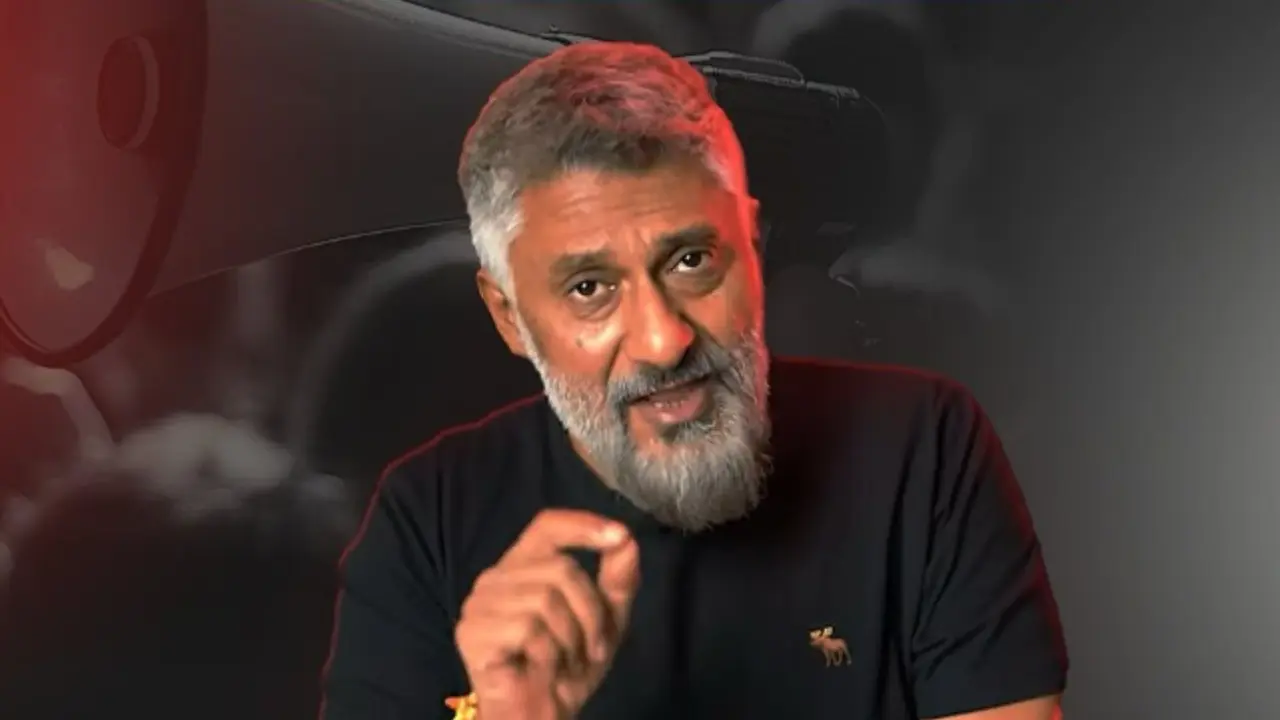
Chandrima Pal (BOMBAY TIMES; September 4, 2025)
Vivek Ranjan Agnihotri likes to make all the right—pun intended—moves. Ahead of the release of The Bengal Files, the third instalment of his Files series, he picks a Bengali-themed restaurant in suburban Mumbai for an interview, tells us that he likes Kishore Kumar’s Bengali songs and settles down for a Bengali meal with shukto and fish paturi . Excerpts from the conversation.
Let us imagine you had zero opposition to The Bengal Files, which releases in theatres tomorrow. That you had no political outfit, entity or individual to name and blame in your interviews. How would you promote your film?
I would have felt suffocated. I would have failed. My idea was to pick up taboo subjects, and in my mind the problem was that even after 78 years of Independence, we are still fighting with the same problems that led to the Partition. Unless you acknowledge there is a problem there can be no healing, no solutions. The purpose, the whole objective of my movies is to start a conversation. Since the trailer has launched, everybody is writing about Direct Action Day or Gandhi’s role, they are dissecting the film. Many Bengali Hindus are now admitting that their parents or grandparents had spoken about Direct Action Day and the Partition trauma. This, I believe, marks the beginning of healing from a generational wound.
No other place has sacrificed as much as Bengal: it was the cradle of the Renaissance, the wellspring of nationalism in all its shades—Congress, communist, centrist—with both Vande Mataram and Jana Gana Mana emerging from here. Bengal gave India its cultural crown, from cuisine and poetry to cinema, the Bengal School of Art shaped by Abanindranath Tagore. For me, Bengal is India’s lighthouse. My purpose was to shock people into realising how much we’ve lost.
How can you connect Bengal’s loss of cultural and intellectual capital directly to the Hindu– Muslim conflict at the heart of your storytelling? Isn’t it too much of an oversimplification?
That’s a very deep question. Which other state in the world has been divided three times? Without Direct Action Day or the Noakhali genocide, there would not have been Partition. Gandhi himself spent seven months in Noakhali, yet afterwards Bengalis were told not to speak of their pain—silenced by political forces that wanted to take India on a different path.
Later, communist ideology took deep root in Bengal, but it viewed everything only through oppressor versus oppressed. That western lens does not fit India, where the so-called majority was ruled and persecuted by minorities for 1,200 years—our literature, music, architecture, everything was distorted. That is why, I argue, Bengal’s decline cannot be seen separately from communal fault lines.
Films have been made on the Holocaust, Hiroshima, slavery— always with a core of humanism, empathy. Many feel your films don’t address that.
First, let’s be clear—which lot of people? Viewers? Critics? I am very research-oriented. And why should I force closure when history itself has none? Lal Bahadur Shastri’s death has no closure. Kashmir still has no closure—people were killed in Pahalgam just recently. But this film does have closure. What I believe should be done, that’s the closure.
Suppose this film triggers unrest. Would your role as a filmmaker end with reopening certain chapters in history?
Look at The Kashmir Files. People warned it would cause unrest. Nothing happened. Instead, I received thousands of emails from Kashmiri Pandits saying the film began their healing process. I can guarantee Bengali Hindus will say the same after this film; they already are, across screenings in the US.
Both communities suffered losses. Isn’t everyone part of the healing process?
Of course. Healing belongs to everyone. But not everyone had the luxury of moving on. Many were forced. Did we really move on? Germany and Poland confronted their past—they outlawed Nazi glorification, built museums, preserved Auschwitz.
Should India simply say “move on”? Or acknowledge that we have a genuine Hindu–Muslim faultline—Partition, Bombay blasts, Pahalgam killings, constant election rhetoric. If America could confront slavery through films, articles, debate, why are we in India told to stay silent about our own history?
Some of the cast members of your film — Saswata Chatterjee and Sourav Das — are facing backlash for being part of the film.
What backlash? Sourav and I had lunch recently. He never distanced himself. A journalist twisted his words, and he immediately asked, “Show me my tweet, quote me if I said that.” Same with Saswata. He never disowned the film.
Saswata did say he wasn’t told the full context.
That’s media manipulation. Do you think an actor of his calibre would sign without reading the script? He has to say things to survive in Bengal. I even spoke to his family—they shrugged it off. Look, he speaks Bengali throughout, eats paturi maach, plays a Murshidabad MLA. He knew what he was doing. After Nana Patekar in Parinda, we have not had such a cold-hearted villain in our cinema.
You say there will be closure at the end of the movie. What kind of closure?
Cinematic closure. But let’s be real—I cannot close the Hindu– Muslim conflict in Bengal or India. Who am I?
You often say you listen to your audience, pick stories that people want told. There are so many other stories that need to be told.
Honestly, what India needs right now is silence. All politicians should shut up for five years. Dalit leaders, Brahmin leaders, Muslim leaders, TV anchors— everyone. Just shut down the noise. And focus only on eradicating corruption. Solve that and 90% of India’s problems vanish.
Do you have political ambitions?
I’d rather die than join politics. But yes, I understand politics deeply. My father was a freedom fighter, I’ve debated politics since childhood. That’s why I can say what I say; most filmmakers can’t.
Many filmmakers, despite festival acclaim and dealing with socially relevant issues, can’t get theatrical releases. You always manage to make controversial films and take them to your audiences. What’s your secret?
Conviction. A filmmaker must guard their work like a mother rabbit protecting her babies from vultures. Most filmmakers lack that instinct. I don’t. I fight till the end.
But is it right to say they do not have the conviction to fight for their creative freedom?
Look, if you make a film on caste, someone’s offended. On women’s persecution, men are offended. On Muslims, Hindus are offended. Everyone is offended. But cinema cannot be hostage to sentiment. Honestly, I do not understand Muslim trauma or pain. Maybe if I am born as a Muslim in my next life, I would. But I still have the right to tell stories drawn from history and testimony.
And when films like Santosh don’t make it to audiences?
Then I fight for them. I don’t know why they don’t come to me, I would be happy to fight for them. Even my ideological enemies, I defend their freedom of speech. I fought for comedians like Kunal Kamra and Samay Raina.
Would you speak up for Umar Khalid?
He’s in jail, it’s sub judice, so I won’t comment.
Gopal Mukherjee aka Gopal Patha is a complex character. North Kolkata always remembered him as one of those powerful, street-cred strongmen—like Fata Keshto.
Yes, yes. They were the fiercest. Part of the akharas, too.
Utpal Dutt wrote in Towards a Revolutionary Theatre that after Direct Action Day, leaders used people like Gopal Patha to settle political scores—a muscleman on hire. He ran a family meat business, he ate meat, he spoke Bengali, he was no saint. You have said that after this film, kids will see him as a hero. Given the ideology to which you are aligned, are you okay with glorifying a figure like that?
Why? Bengalis eat meat. What’s wrong with that? Hindus in Kerala eat beef, Kashmiri Pandits ate meat too. India is not a vegetarian country; 73% of Indians eat non-veg. To reduce Gopal to food habits or language is just superficial politics. I believe in total freedom of food, speech, lifestyle.
----------------------------------
‘I hate disclaimers. They assume audiences are stupid’
Trailers don’t need disclaimers. The film will have one, because the law demands it. I hate disclaimers. They assume audiences are stupid. Does a painting carry a disclaimer? Cinema is art. My disclaimer will be the usual: “based on true incidents, survivor accounts, historical texts… intention not to hurt anyone.” Plus the silly statutory warnings—smoking kills, animals unharmed, etc. But because Jinnah was a chain-smoker, I was forced to add two extra minutes of anti-smoking ads.
----------------------------------
‘I am a storyteller, not a social scientist’
I am nobody to find answers. I am not the Prime Minister, not a social scientist. I am a storyteller. My job is to observe and narrate, not to prescribe solutions. People expect too much from filmmakers. Journalists often ask me — why don’t you rehabilitate Kashmiri Pandits? I tell them, I am not a politician. It’s like asking Satyajit Ray after Pather Panchali to eradicate poverty. That’s not how art works.
Everything in India today is political, whether you like it or not-Pallavi Joshi
5:35 PM
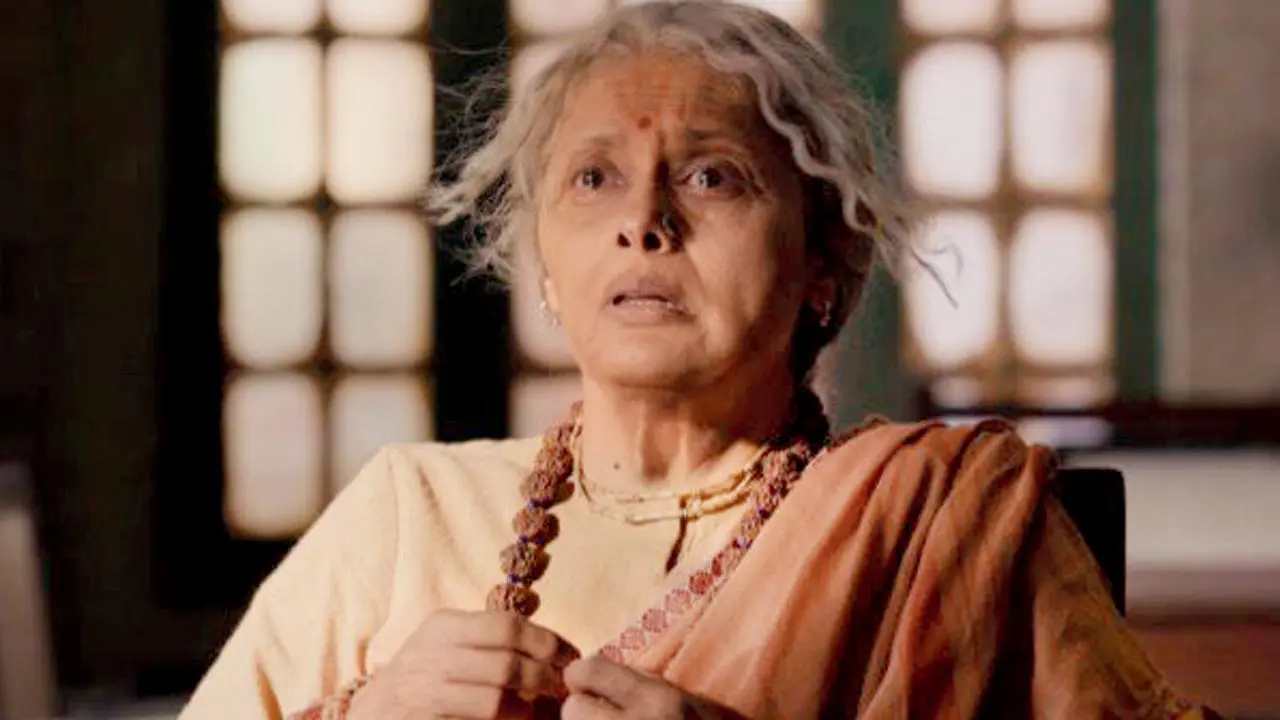
Chandrima Pal (BOMBAY TIMES; September 1, 2025)
Pallavi Joshi will appear in a pivotal role as Ma Bharati in Vivek Agnihotri’s upcoming film The Bengal Files, which releases in theatres on September 5. We caught up with the actress at her Mumbai apartment in the thick of a promotional blitz, dressed in a sari with bold typography about justice, courage and equality. Excerpts from the conversation:
What is it like to be part of the Files trilogy, that is always in the eye of a storm?
On a very artistic level, knowing what the content is, knowing what we have been trying to say through the Files films, it is an extremely proud moment for me right now to know that we have successfully completed the trilogy.
But I don’t understand this – nowhere in the world this kind of pushback happens when you try to show a slice of history. I understand that we live in very unique times, where the entire world is outraging. So maybe, we live in outrageous times and thanks to social media, everything is amplified.
What kind of response do you get, especially from the people whose stories you say you are trying to tell?
The one big takeaway from this trilogy is that they are feeling heard and acknowledged. For so long, they were invisible people whose pain never found representation. We all have a right to know what happened to our families. The past. After The Kashmir Files, I remember Kashmiri Pandits coming up to me, holding my hands and crying, saying, “Thank you for finally telling our truth.” Even now, Bengalis, especially those who have family histories tied to the Partition, are reaching out to us with similar emotions. That’s why we do this work.
How do you respond to the criticism that all your films are political?
I think everything in India today is political — whether you like it or not. The tragedy is that even history has become politicized. But what we are doing is storytelling. We’re taking documented events, survivor testimonies, and real experiences, and putting them into a cinematic form. If that is labelled political, then so be it. But our intention is very clear. We want to tell the truth of people who were silenced.
Had I been an insider, mujhe sar aankhon par baitha liya hota-Darshan Kumaar
9:42 AM
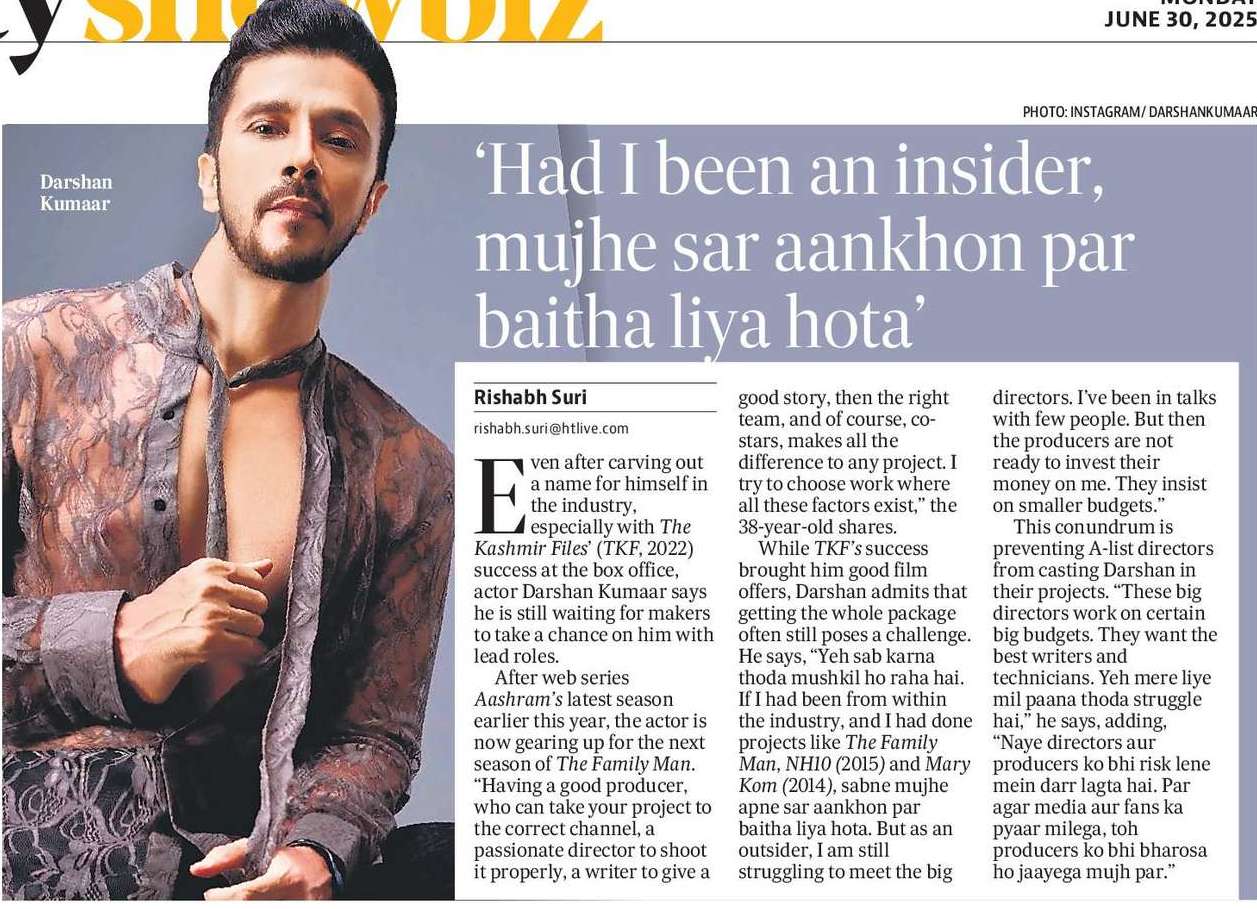
Rishabh Suri (HINDUSTAN TIMES; June 30, 2025)
Even after carving out a name for himself in the industry, especially with The Kashmir Files’ (TKF, 2022) success at the box office, actor Darshan Kumaar says he is still waiting for makers to take a chance on him with lead roles.
After web series Aashram’s latest season earlier this year, the actor is now gearing up for the next season of The Family Man.
“Having a good producer, who can take your project to the correct channel, a passionate director to shoot it properly, a writer to give a good story, then the right team, and of course, co-stars, makes all the difference to any project. I try to choose work where all these factors exist,” the 38-year-old shares.
While TKF’s success brought him good film offers, Darshan admits that getting the whole package often still poses a challenge.
He says, “Yeh sab karna thoda mushkil ho raha hai. If I had been from within the industry, and I had done projects like The Family Man, NH10 (2015) and Mary Kom (2014), sabne mujhe apne sar aankhon par baitha liya hota. But as an outsider, I am still struggling to meet the big directors. I’ve been in talks with few people. But then the producers are not ready to invest their money on me. They insist on smaller budgets.”
This conundrum is preventing A-list directors from casting Darshan in their projects. “These big directors work on certain big budgets. They want the best writers and technicians. Yeh mere liye mil paana thoda struggle hai,” he says, adding, “Naye directors aur producers ko bhi risk lene mein darr lagta hai. Par agar media aur fans ka pyaar milega, toh producers ko bhi bharosa ho jaayega mujh par.”
Top ten footfalls post pandemic; Pushpa 2 - The Rule rules
3:49 PM

Box Office India Trade Network
PUSHPA 2 - THE RULE in Hindi will finish its run with roughly 4 crore footfalls which has only been seen twice this century with GADAR 2 and BAAHUBALI 2: THE CONLCUSION and these two went over 5 crore. No other film has crossed the 4 crore mark with DANGAL being the best at 3.7 crore while before GADAR, it was RAJA HINDUSTANI in 1996 to hit 4 crore.
There are many films to hit 4, 5 and even 6 crore in the older days when cinema had less competition from other entertainment and also was the only option to watch films though population was also only half of what it is now which more than compensates. Basically the films held wide appeal in those days. PUSHPA 2 - THE RULE joins an elite group of around 15-20 films in history to get 4 crore footfalls.
This is a huge target that PUSHPA 2 - THE RULE has set as post pandemic, 4 crore seemed like an impossible target due to the dwindling audience coming to the theatres. There are four South films dubbed into Hindi in the list and are probably more to come in the next few years especially if sequels of liked films are released. A realistic target for most of the big Hindi films will be 3 crore as GADAR 2 also looks a one off as that sort of single screen business can be written off for most films.
The box office number of GADAR 2 could have been higher with better multiplex pricing and footfalls could have been a little higher as well if it was not released in a crowded period. But as mentioned before, this is probably a one off and its 3 crore which is the biggest original Hindi films but that is also more than good enough as its around 600 crore nett business this year for the film released as a blockbuster film.
The top ten footfalls post pandemic are as follows. The original Hindi films are in bold.
1. Pushpa 2 - The Rule - 4 crore
2. Gadar 2 - 3.4 crore
3. Stree 2 - 3.2 crore
4. Jawan - 3.1 crore
5. Pathaan - 2.8 crore
6. Animal - 2.7 crore
7. KGF - Chapter 2 - 2.55 crore
8. RRR - 1.70 crore
9. The Kashmir Files - 1.55 crore
10. Kalki 2898 AD - 1.50 crore
Filmmakers versus critics: How ‘Animal’ brought out the claws
8:44 AM

Unkind reviews are not new, even ‘Sholay’ was skewered. But, are critics harsher now or directors more thin-skinned? A look at how film criticism is changing in the digital age
Mohua Das (THE TIMES OF INDIA; January 14, 2024)
Seventeen years ago, this reporter’s foray into journalism had kicked off with an unexpected curveball. The editor across the table didn’t expect a discussion on current affairs or social justice.
Instead, the initiation hinged on a simple question, “What were the last two films you watched, and can you review them?” He wasn’t scouting for a film writer, and neither did I become one. For him, this seemingly whimsical examination was a litmus test of sense and sensibility, social observations and cultural understanding that became a silent judge of journalistic acumen.
Fast forward to the present, and the once-revered art of film analysis is under siege, caught in the crossfire of social media opinions, paid reviews and a chilling shift in filmmaker-critic dynamic. While differences in opinion between the two are a tale as old as the movies, disagreements now quickly erupt in nasty trolling, often fuelled by the filmmakers themselves.
A telling example is when a film critic with a movie portal recently criticized Sandeep Reddy Vanga’s latest film ‘Animal’ for its portrayal of toxic masculinity, unwarranted violence and not being entertaining enough. The film team retaliated with box-office numbers and used its official account to tag her on social media and unleash vitriolic fans after her.
This wasn’t an isolated incident. Earlier, filmmaker Vivek Agnihotri had labelled another veteran film critic as “the Shoorpanakha of Bollywood” openly accusing her of “sabotaging” his movie ‘The Kashmir Files’.
“This is not a great time to be a critic,” says Pratim D Gupta, a filmmaker with over a decade-long background as a film critic, wistfully recalling the days of Khalid Mohamed, the late Rashid Irani, and other veteran critics, now a dwindling tribe. “Back then reviews weren’t just verdicts. People read them for the quality and fun in the writing. That practice of analyzing or even strongly criticizing a film has become obsolete.”
Why? The culprit, Gupta argues, is: “A surge of influencers, trade analysts, and online film critics who have eclipsed the value of well-founded film critique with their quick takes.”
This, says Gupta, has also led to the birth of an unspoken culture — the “rate card”, with money dictating the tone of reviews. “Suddenly a lot of self-appointed film critics, with inflated follower counts, are passing judgement. And film PRs go to town splashing their 4 or 5 star ratings and one-liners on their posters,” says Gupta.
But don’t filmmakers like Vanga have a point about critics getting it wrong? Gupta points out that box-office triumph was being equated with cinematic excellence.
“In the case of ‘Animal’, the critic was talking about the merit of the film while the filmmaker countered with how much money it has made. These are two vastly different yard sticks. But today, box office success is equated with a good film and a ‘Pathaan’ or ‘Jawan’ are looked upon as the best films of the year when they’re actually just the biggest blockbusters. That line today has become very blurred.”
“Big box-office numbers don’t necessarily mean a great piece of filmmaking,” agrees film writer Aseem Chhabra, who has been reviewing movies for over two decades. Weighing in on the broader implications of aggression, he adds: “Filmmakers can be insecure and vicious, even if they make a lot of money. What’s getting dangerous is the targeting of critics with methods eerily similar to how political fanatics attack dissenters.”
Chhabra also concedes that “good criticism doesn’t mean dissing.” He admits having given poor reviews to some popular films, including director Karan Johar’s, in the past. However, a handful of critics cannot significantly impact a film’s success, says Chhabra, pointing to box office successes like the films of Rohit Shetty, Sandeep Reddy Vanga, and Vivek Agnihotri which were loved by audiences despite being panned.
One of the most famous examples is ‘Sholay’ which, in 1975, was dubbed ‘average’ by a newspaper critic who felt it lacked “high intelligence, art and purpose”. He was proved wrong and how!
Filmmaker Anurag Kashyap, who has weathered harsh criticism for films like ‘Bombay Velvet’ and continues to endure trolling on social media, dwells on the need for “discerning critics” and “champions of cinema” amidst all the “noise in the name of film criticism and good writing on cinema getting drowned in the tsunami of mediocrity.” The filmmaker says, “It’s hard to find the discerning voices amongst them… Gone are the days when I as a filmmaker waited for a particular film critic to write about my film to know his or her opinion on the film.”
This disillusionment, however, hasn’t translated to indifference. Kashyap advocates for constructive criticism, the kind that dissects the work, not the artist. “In the times of social media everyone has a voice, and we can’t ignore it. What is offensive to some is the truth or fact to others. It applies to both sides of the fence. We need to stop the moral posturing and outraging over what offends us,” says Kashyap.
Instead, he emphasizes the importance of taking criticism in stride and recognizing that every film has its share of lovers and haters. “And that will always be the case. We need to just do our thing to the best of our ability. You never know what works and what doesn’t.”
Vanga’s visceral ‘Animal’ finds resonance with him. “It doesn’t offend me,” he clarifies, “It provokes me, outrages me, it’s also impacted me. And I will fight for Vanga’s right to make his film and tell his stories his way.” This, for him, is the power of cinema, and ‘Animal’, despite its flaws, he sees as a game changer. “With all the trashing and criticism and also celebration of it, you cannot ignore the impact it has had on filmmaking and filmmakers — good, bad or ugly.”
Filmmaker Vasan Bala, on the other hand, views the critic-filmmaker relation ship through a historical lens. The “love-hate relationship” is nothing new, he maintains, citing past spats. “A search on the internet will throw up several examples from the past 15 years. It’s never been a simple disagreement. Ridley Scott just fired back at French critics who disliked ‘Napoleon’. Todd Phillips has publicly pushed back on criticism of gun violence in his film ‘Joker’ as far-right extremism.”
While Bala urges critics to “fully express themselves and stay true to their feelings,” he encapsulates a filmmaker’s post-release emotional odyssey. “A filmmaker is not really left with much after the release. Emotionally it’s like ‘you are on your own, good luck’ kind of a state.”
The relationship between reviewers and filmmakers has dipped to such an extent that legal action is being taken. The Kerala police recently registered a complaint filed by Malayalam director Ubani E against online film reviewers and social media platforms accusing them of intentionally posting negative reviews to extort and damage reputation. This came around the same time that a gag order was imposed on social media influencers and film-reviewing vloggers to not publish any reviews for at least seven days after a film is released.
Both Kashyap and Bala see this as a temporary blip that cannot silence genuine critique. Gupta voices his apprehensions. “You already censor films. Now if reviews get regulated by a state body, too, it’s going to be a darker day for film criticism,” he says.
Chhabra echoes similar concerns. “Taking someone to court over a critique, unless it’s pure malice without basis, is a terrible sign for our culture. It sets a dangerous precedent.” He calls film criticism a “two-way street”, where critics and filmmakers should respect each other and the art form.
“Some critics suffer from an inflated sense of expertise, while some filmmakers dismiss critics entirely. Free speech is crucial but it comes with responsibility,” he concedes. “No crossing lines into maliciousness or gossip just to settle scores. As long as your arguments are solid and truthful, no case should stand.”
But Chhabra is also firm. “Look, a review is a review. My job isn’t to worry about box-office numbers or bankrupt producers. It’s to tell the truth as I see it, without flinching and worrying that ‘bechara, film flop ho jayegi’.”
Name one director who is not a propaganda filmmaker-Vivek Agnihotri
8:20 AM

Agnihotri says he made The Vaccine War so that people, down the line, know how India created its own vaccine
Hiren Kotwani (MID-DAY; September 26, 2023)
Over a year after The Kashmir Files (2022), Vivek Ranjan Agnihotri is ready with The Vaccine War. With the film, the director wants people to celebrate India’s achievement of making its own vaccine to combat the Coronavirus.
“It’s also a story about our women scientists, and the shift in the narrative from ‘India can’t do it’ to ‘India can do it’. I made it [so] that 30 years later, people know what happened during its making,” he says.
Through the Anupam Kher, Pallavi Joshi, Raima Sen and Nana Patekar-starrer, the director also offers his take on the “politics” that, he says, surrounded the vaccine’s creation.
“At that time, people were trying to create doubts about our own vaccine. Akhilesh Yadav [initially] said he won’t take the ‘BJP [Bharatiya Janata Party] vaccine,’” says the director, whose The Kashmir Files won two National Awards last month.
Last year, the movie sparked controversy at the International Film Festival of India when Israeli filmmaker and jury head Nadav Lapid described it as “a propaganda and vulgar movie”.
Tell him that he is labelled a propaganda filmmaker, and Agnihotri retaliates, saying, “Name one director who is not a propaganda filmmaker. Everyone is propagating a certain idea or ideology. Like, some [director] says there is nothing but love. Is that true?”
He adds that the label attached to him makes it tough for him to get financial backing. “The Vaccine War is a solo production, made with our own resources.”
I would’ve loved to win for acting; The Kashmir Files is one of my finest performances-Anupam Kher
9:00 AM
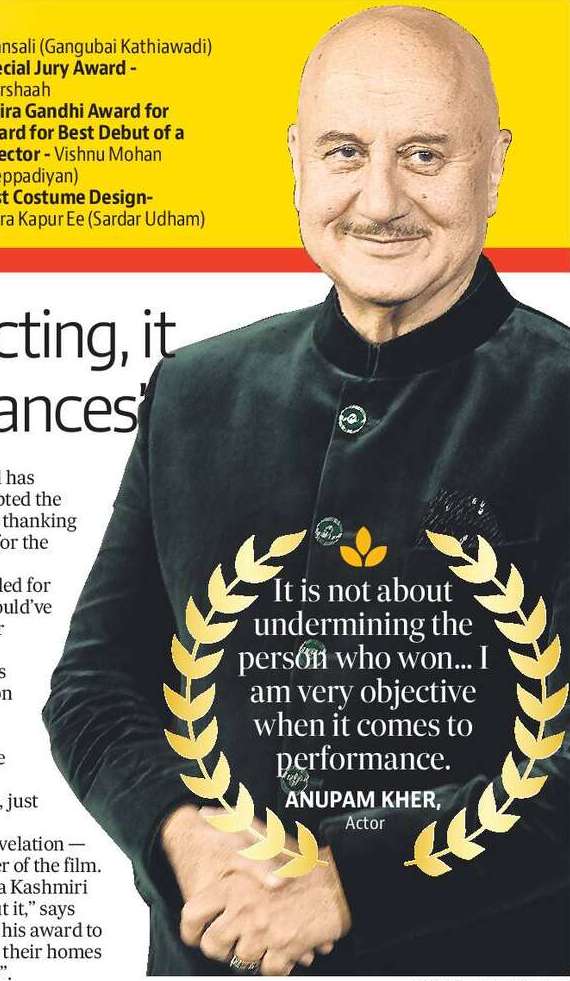
Syeda Eba Fatima (HINDUSTAN TIMES; August 26, 2023)
Anupam Kher-starrer The Kashmir Files (2022)bagged the Nargis Dutt Award for Best Feature Film on National Integration. The actor says while the team anticipated a National Film Award, having done their “best work”, they never “expected to win in this category”. “The award has answered every person who doubted the intention of this film,” he tells us, thanking the jury headed by Ketan Mehta for the honour.
But, one wish remains unfulfilled for Kher — winning Best Actor. “I would’ve loved to win a National Award for acting, this is one of my finest performances,” he continues, “It’s not about undermining the person who won. Be it Allu Arjun (Best Actor) or Pankaj Tripathi (Best Supporting Actor), all of them are very talented and deserve the recognition... It’s not a complaint, just an observation.”
The actor goes on to make a revelation — that he was an executive producer of the film. “I wanted that because I am also a Kashmiri Pandit. But, we never talked about it,” says Kher, who would like to dedicate his award to all those “who lost their lives, left their homes and for whom the film was made”.

This National Award is an answer to those criticizing The Kashmir Files-Pallavi Joshi
8:59 AM
Navya Kharbanda (HINDUSTAN TIMES; August 26, 2023)
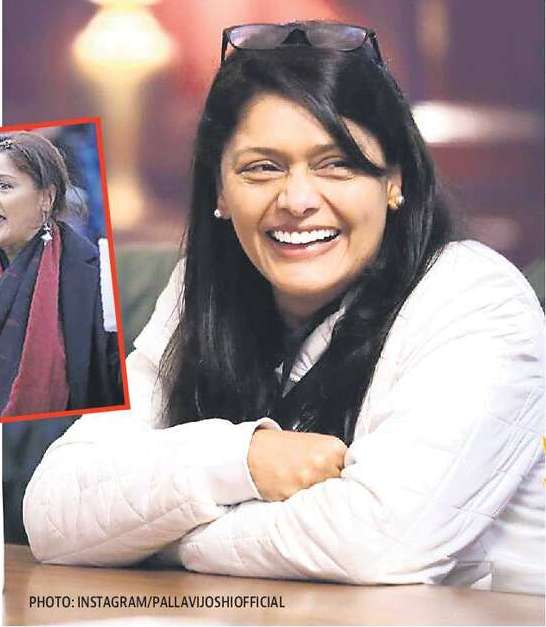
Pallavi Joshi was fast asleep when the 69th National Film Awards were being announced, naming her as Best Supporting Actress for The Kashmir Files (2022).
“I was asleep, it was 6 am here in Chicago. I started getting calls and that’s when I got to know,” she tells us, adding, “For the longest time, it didn’t sink in that I got the award. We are on a tour to promote our upcoming film The Vaccine War, so what better way to celebrate this.”
The film also won the Nargis Dutt Award for Best Feature Film on National Integration, calling for double the celebration. “Hearing that our film won in the category of national integration was the icing on the cake. What we wanted to say through the movie, I think, got underlined and recognized. So, it’s a great feeling. I am very thankful to the jury. I would like to dedicate this award to the entire persecuted community all over the world,” says Joshi.
The Kashmir Files was not free of controversy upon its release. But, despite the backlash, the film won several hearts. “Not many people disliked it; otherwise, the film wouldn’t have been a blockbuster. But yes, it (National Award) is an answer to those criticizing the film. It also brought great jubilation among the Kashmiri Pandit community. I am feeling great; let them (those opposing the film) feel whatever they have to feel now. I have done my job by spreading the message,” she signs off.
I’m happy that The Kashmir Files has got validation now-Vivek Agnihotri
8:57 AM
Navya Kharbanda (HINDUSTAN TIMES; August 26, 2023)
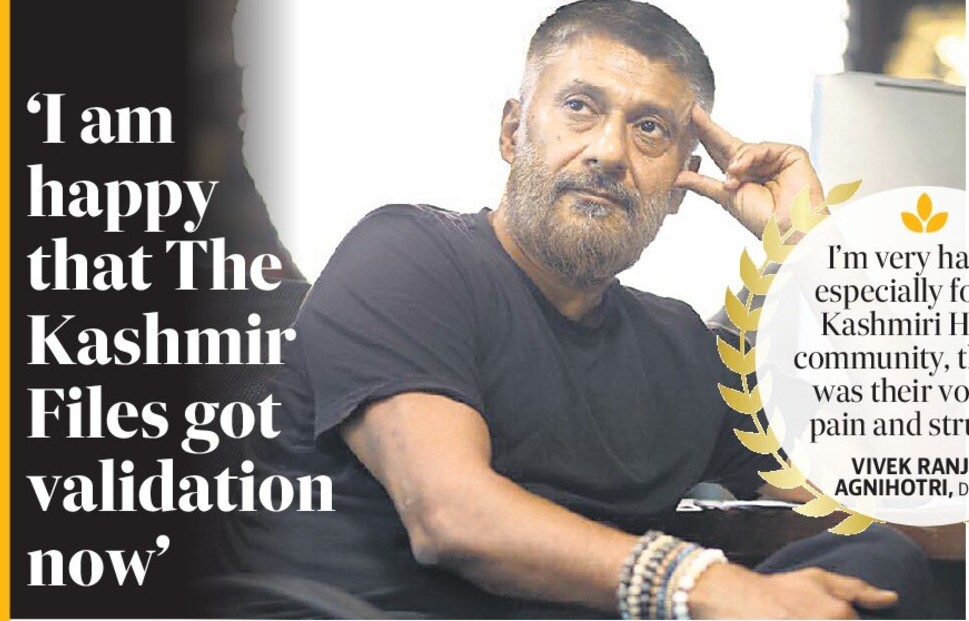
In a momentous turn of events, filmmaker Vivek Ranjan Agnihotri’s The Kashmir Files, won the National Award for Best Feature Film on National Integration. Elated about the news, the director, who is in the US, tells us, “It was very early in the morning [here] and my phone kept buzzing — that’s how I got to know! I’m very happy, especially for the Kashmiri Hindu community, because the film was their voice of pain and struggle. I was just the medium. We made our film honestly and presented it in front of the world. I’m happy that it has got validation now.”
The 49-year-old anticipates a potential surge in negative attention — similar to what he faced, from some factions, during its release — despite the honour. “Do you think that the trolls won’t hate or attack me anymore? The backlash [might] increase after the National award, because we stand vindicated,” says the filmmaker, who’s gearing up for the release of his next, The Vaccine War.
Brushing off detractors as naysayers, Agnihotri states, “Some 8-10 voices mean nothing to me. There were more people who loved the film and some trolls with a different political inclination.”
The filmmaker whose wife, actor Pallavi Joshi also bagged a National Award for The Kashmir Files in the Best Supporting Actress category, believes that this accolade will serve as an inspiration to other filmmakers to delve into real subjects and produce meaningful cinematic narratives. “Getting the most prestigious recognition will definitely encourage many other filmmakers to make films on such real subjects,” he wraps up.
RRR wins 6 National Awards, Gangubai Kathiawadi 5; Allu Arjun wins Best Actor award
8:45 AM

THE TIMES OF INDIA (August 25, 2023)
New Delhi: ‘The Kashmir Files’, Vivek Agnihotri’s controversial film on the exodus of Kashmiri Pandits from the Valley, bagged the Nargis Dutt Award for best feature film on national integration at the 69th National Film Awards announced Thursday. Pallavi Joshi won best supporting actress for the film.
The National Awards for 2021, announced by filmmaker Ketan Mehta, declared Nikhil Mahajan best director for Marathi film ‘Godavari’.
The Indira Gandhi Award for best debut film went to ‘Meppadiyan’ in Malayalam while the prize for best film on social issues went to Assamese ‘Anunaad-the Resonance’. Telugu blockbuster ‘RRR’, which won six awards, saw M M Keeravani share the best music direction award with Devi Sri Prasad for ‘Pushpa’.
Asked about films releasing theatrically in 2022 winning the awards for 2021, Neerja Sekhar, I&B additional secretary, said, “As per regulations, the eligible films were certified and released from 1st January 2021 to December 31, 2021.”
--------------------------------------------------------
THE TIMES OF INDIA (August 25, 2023)
New Delhi: Hindi feature film ‘Rocketry: The Nambi Effect’ was adjudged best feature film in the National Awards 2021 announced on Thursday.
Allu Arjun, Alia Bhatt and Kriti Sanon won top acting honours for their roles in ‘Pushpa: The Rise (Part I)’, ‘Gangubai Kathiawadi’ and ‘Mimi’ respectively. Pankaj Tripathi won the award for best supporting actor for ‘Mimi’. Shoojit Sircar’s biopic ‘Sardar Udham’ won the award for best Hindi film as well as honours for best cinematography, audiography (re-recording final mixing), production design and costume design.
‘RRR’, directed by S S Rajamouli, won six awards including best popular film providing wholesome entertainment, best male playback singer to Kalabhairava, special effects, action director and choreography.
Sanjay Leela Bhansali’s biopic ‘Gangubai Kathiawadi’ was a close second with five awards. While Alia Bhatt won best actress, Bhansali won the award for best editing and screenplay writer (adapted), both jointly with Utkarshini Vashishtha.
Shreya Ghoshal won the best female playback award for her song ‘Mayava Chaayavaa’ for the film ‘Iravin Ninzhal’. The best original screenplay award, meanwhile, went to Malayalam film ‘Nayattu’ and its writer Shahi Kabir.
--------------------------------------------------------
MID-DAY (August 24, 2023)
Feature Film Awards:
Special mention: Kadaisi Vivasayi - Late Shri Nallandi, Jhilli - Aranya Gupta & Bithan Biswas, Home - Indrans, Anu: Eyes On The Sunshine - Jahanara Begum
Best Feature Film in each language:
Mishing: Boomba Rise
Assamese: Anur (Eyes On The Sunshine)
Bengali: Kalkokkho-House Of Time
Hindi: Sardar Udham
Gujarati: Chhello Show
Kannada: 777 Charlie
Maithili: Samanantar (The Parallel)
Marathi: Ekda Kay Zala
Malayalam: Home
Meiteilion: Eikhoigi Yum (Our Home)
Odia: Pratikshya (The Wait)
Tamil: Kadaisi Vivasayi (The Last Farmer)
Telugu: Uppena (Wave)
Technical Awards:
Best Action Direction: King Soloman for RRR (Telugu)
Best Choreography: Prem Rakshith for RRR
Best Special Effects: V Srinivas Mohan for RRR
Special Jury Awards: Shershaah director Vishnu Vardhan
Best Lyrics: Chandrabose for 'Konda Polam' song from Dham Dham Dham
Best Music Direction: Devi Sri Prasad for 'Pushpa' and M M Keeravani for 'RRR'
Best makeup artist: Preetisheel Singh D'Souza For 'Gangubai Kathiawadi'
Best Costume Award: Veera Kapur Ee for Sardar Udham
Best Production Designer: Dmitrii Malich & Mansi Dhruv Mehta for Sardar Udham
Best Editing: Sanjay Leela Bhansali for Gangubai Kathiawadi
Best Audiography: Chavittu, Jhilli and Sardar Udham
Best Screenplay: Shahi Kabir for Nayattu (original) and Sanjay Leela Bhansali for Gangubai Kathiawadi (Adapted)
Best Dialogue Writer: Utkarshini Vashishtha and Prakash Kapadia for Gangubai Kathiawadi
Best Cinematography: Avik Mukhopadhayay for Sardar Udham
Best Female Playback Singer: Shreya Ghoshal for Maayava Chaayavaa from Iravin Nizhal
Best Male Playback Singer: Kaala Bhairava for Komuram Bheemudo for RRR
Best Child Artist: Bhavin Rabari (Chelloo Show)
Best Supporting Actress: Pallavi Joshi for The Kashmir Files
Best Supporting Actor: Pankaj Tripathi for Mimi
Best Actress: Kriti Sanon for Mimi and Alia Bhatt for Gangubai Kathiawadi
Best Actor: Allu Arjun for Pushpa
Best Direction: Nikhil Mahajan for Godavari
Best Feature Film: Rocketry: The Nambi Effect
NON-FEATURE FILM CATEGORY:
Best Non-Feature Film: Ek Tha Gaon (Garhwali & Hindi)
Best Director: Bakual Matiyani for Smile Please (Hindi)
Best Film on Family Values: Chand Saanse (Hindi)
Best Cinematographer: Bittu Rawat for Pataal Tee (Bhotiya)
Best Investigative Film: Looking For Challan (English)
Best Educational Film: Sirpigalin Sipangal (Tamil)
Best Film on Social Issues: Mithu Di (English), Three Two One (Marathi & Hindi)
Best Environmental Films: Munnam Valavu (Malayalam)
Best Book on Cinema: Music by Laxmikant Pyarelal: The Incredibly Melodious Journey by Rajiv Vijayakar
Best Film Critic: Purushothama Charyulu
Best Film Critic (Special Mention): Subramanya Bandoor
I respect Prabhas who is a mega mega star doing mega mega budget films-Vivek Agnihotri
8:49 AM
HINDUSTAN TIMES (July 29, 2023)
Director Vivek Ranjan Agnihotri refuted news that he allegedly said he is ‘already winning’ the box-office battle against actor Prabhas, as their films The Vaccine War and Salaar: Part 1 – Ceasefire, respectively, will clash on September 28.
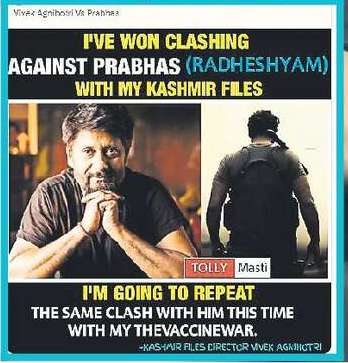
He tweeted: “Who is spreading such fake news attributing fake quotes to me? I respect Prabhas who is a mega mega star doing mega mega budget films. We make non-starrer, small budget, people’s films. There is no comparison between us. Pl spare me (sic).”
He retweeted the image with the quote attributed to him that read, “I’ve won clashing against Prabhas (Radhe Shyam) with my Kashmir Files. I’m going to repeat the same clash with him this time with my VaccineWar (sic).” Both the films had released on March 11, 2022, with The Kashmir Files emerging as a blockbuster, while Radhe Shyam didn’t get a good response.
Propaganda movies such as The Kashmir Files and The Kerala Story are made tax free in India today-Amol Palekar
9:37 AM
Abhijeet Patil (THE TIMES OF INDIA; June 27, 2023)
Kolhapur: Veteran actor Amol Palekar said here on Monday that earlier goons used to harass people, but now the government and politicians support masked mobs that run amok in the country He said, “Work of terrorizing minorities is going on for the last few decades.”
Palekar was speaking at the Samajik Salokha Parishad organised in Kolhapur by Left parties and progressive outfits on the birth anniversary of king and social reformer of the early twentieth century Shahu Maharaj.
Palekar said dictatorship is the result of masked mobs supporting one person. “The web of such a mob of blind followers has surrounded us all. However, we have remained inactive and unawares.”
He further said that people who did not beat ‘thalis’ during the lockdown were named urban naxals and traitors. “It is easy to control a society with homogenous characters,” he added.
A saffronised Hindu India is ‘their’ quintessential goal, he said. “Virtual threats by troll army is a reality today. Social media is a form of symbolic violence that creates structures and prevents collective discourse. Moreover, propaganda movies such as ‘The Kashmir Files’ and ‘The Kerala Story’ are made tax-free in India today.”
He spoke about Olympian women wrestlers who, he said, would not have had to protest for so long demanding action against MP Brij Bhushan Sharan Singh accused of sexual harassment if Shahu Maharaj had been alive.
He said that Shahu Maharaj had passed orders to punish those who commit crime against women. “He fought orthodox ideology.”
Palekar said that even though the murders of Govind Pansare, MM Kalburgi, Gauri Lankesh and Narendra Dabholkar killed individuals, the attempt was to finish their thoughts.
A list of 12 Indian films that crossed the 300 crore mark worldwide post pandemic
8:23 AM

Box Office India Trade Network
The pandemic has been over for more than one and a half years and we have seen just five Hindi films cross the 300 crore mark worldwide. Two of these are THE KASHMIR FILES and THE KERALA STORY which have have not done the business due to the films being cinema but other reasons.
The have been seven films reaching the 300 crore mark from the South which is actually a benchmark for most of the films for South barring the likes of RRR and KGF - CHAPTER 2 which have a wider market due to the scale and branding be it director for the former or the franchise for the latter. For Hindi cinema the benchmark should actually be 500 crore now which only PATHAAN has crossed and by leaps and bounds.
Tamil cinema has got a big boost in overseas business due to heavy migration from Sri Lanka and Tamil Nadu over the past few years. The numbers of big films from the Tamil film industry in the overseas market are really pushing this industry in terms of worldwide numbers. Tamil cinema had a 300 crore miss by a small margin with VARISU which hit 208 crore (GBOC) in India and 85 crore Overseas for a worldwide total of 293 crore. Hindi cinema also had a very near miss with SOORYAVANSHI which got 299 crore as India contributed 237 crore (GBOC) and Overseas was 62 crore.
The total of 12 films have crossed the 300 crore worldwide mark across India post the pandemic. The difference is that many Hindi films crossed 300 crore before the pandemic and only five have managed post the pandemic. While in South seven have reached post pandemic when before the pandemic there was only ENTHIRAN, KABALI, BAAHUBALI: THE BEGINNING, BAAHUBALI 2: THE CONCLUSION and 2.0.
The films to have crossed 300 crore post pandemic worldwide from different industries is below.
Hindi Cinema
The Kashmir Files
Brahmastra
Drishyam 2
Pathaan
The Kerala Story (Expected)
Telugu Cinema
Pushpa: The Rise - Part 01
RRR
Tamil Cinema
Vikram
Ponniyin Selvan - Part 1
Ponniyin Selvan - Part 2
Kannada Cinema
KGF - Chapter 2
Kantara
West Bengal CM Mamata Banerjee bans The Kerala Story for ‘peace, harmony’; dubs film defamatory to state
8:38 AM

Priyanka Dasgupta (THE TIMES OF INDIA; May 9, 2023)
Kolkata: A day after theatres in Tamil Nadu stopped screening ‘The Kerala Story’ as a “precautionary measure”, the Bengal government on Monday banned the controversial film in a bid to maintain “peace and harmony”. Chief minister Mamata Banerjee dubbed it a “distorted story” and accused the BJP of “defaming the people of Kerala with their narrative”.
Union I&B minister Anurag Thakur said Mamata was doing “injustice to the sisters and daughters of Bengal by banning the film”. The film’s producer, Vipul Amrutlal Shah, said he will “explore legal avenues if the state government doesn’t listen to us”.
The clampdown came even as the film was running across 94 halls in the state—some to packed houses—and the theatre-owners said there had been no trouble so far.
“The scenes depicted in this movie can be dangerous to the law and order and apprehending this, screening of this movie is banned in Kolkata and all districts. The state took this decision to maintain law and order,” a Bengal government release said.
------------------------------------------------------
Kolkata : Even as West Bengal banned the screening of ‘The Kerala Story’ in the state, CM Mamata Banerjee slammed the film and said, “A few days ago, (some) stars, funded by BJP, came to Bengal. They came with some distorted stories, concocted stories, (and) they are preparing a film, Bengal Files.”
The CM further added: “Earlier they had prepared The Kashmir Files to condemn Kashmiris. What is the fault of the people? Now they defame the people in Kerala and the state.”
The Trinamool chief insinuated that Kerala’s governing CPM was not doing enough against the film. “I am talking about people in Kerala. I am not talking about CPM because they are working with BJP. And that BJP is showing The Kerala Story. Instead of me, it was their (CPM’s) duty to criticize it.”
“She should say whether she is standing with those who promote terrorist ideology or is against it,” Union I&B minister Anurag Thakur said about the Sudipto Sen-directed film centred on so-called “love jihad”. (With Agency inputs)
-----------------------------------------------------------
BJP slams Didi
BJP on Monday slammed West Bengal CM Mamata Banerjee’s decision to ban “The Kerala Story” as “unfortunate” and said it raised serious questions on civil liberties and freedom of expression. The party said the movie is a “real account of victims, who have endured the horrors of demographic invasion and have been used as cannon fodder” for the Islamic State.
Fenil's Bollywood Talk # 776
10:09 PM

WILL THE MARVEL FILM AND VIPUL SHAH’S NEXT BRING CHEER THIS FRIDAY?
Kisi Ka Bhai Kisi Ki Jaan, which was released two weeks back, dropped rapidly in the second week. It crossed the Rs. 100 crore mark today, that is, on its thirteenth day of release and this is not a good sign at all. Meanwhile, the month of May doesn’t have a significant Hindi release. Only small and mid-sized films will try their luck and it remains to be seen if any of them manage to surprise.
The big release tomorrow is Guardians Of The Galaxy Vol. 3. It is a part of the Marvel Cinematic Universe. At one point, this franchise was huge but off late, the brand has taken a beating as their recent films didn’t impress audiences much. Guardians Of The Galaxy’s characters, meanwhile, are not as popular as Spider-Man or Thor. Hence, due to these two factors, it’s next to impossible for the third part to get an opening in double digits.
Marvel’s Black Panther: Wakanda Forever collected Rs. 11.75 crores on its first day while Ant-Man And The Wasp: Quantumania, the last Marvel film to release, opened at Rs. 8.50 crores. As per the advance trends, Guardians Of The Galaxy Vol. 3 should open between Rs. 7 and 8.50 crores. Thankfully, the reports are very positive and this can help the film put up a healthy lifetime. Ant-Man And The Wasp: Quantumania had not even managed to cross the Rs. 50 crores mark. The aim for Guardians Of The Galaxy Vol. 3 should be to do a half-century at least at the box office.
Speaking of Hindi releases, the biggest this week is The Kerala Story. Starring Adah Sharma, it is produced by Vipul Shah. The film is dubbed as 'The Kashmir Files of 2023'. It tells the story of a group of women who are fooled, made to convert to Islam and then join ISIS.
As expected, with a subject like this, a section of society are themselves promoting the film. It has also resulted in decent advances. The Kashmir Files saw record block bookings in its first two weeks. It is expected that The Kerala Story will also get similar kinds of mass bookings, which will lead to a healthy lifetime. The Kashmir Files went on another level as it opened at Rs. 3.36 crores and then collected a mind-boggling Rs. 246.91 crores in its lifetime.
The Kerala Story is expected to open at around Rs. 2-3 crores and it also could be higher, if the block bookings start from tomorrow. It seems unlikely if it can collect more than Rs. 200 crores like The Kashmir Files. Nevertheless, if word of mouth is positive, it can do well. Since the costs are limited, even if it has a lifetime of Rs. 30 or 40 crores, it’ll prove to be a profitable venture.
The Kerala Story, however, faces some challenges. In the case of The Kashmir Files, the makers had solid proof to claim that what they have shown in the film is authentic. With The Kerala Story, the makers made a blunder as they claimed that nearly 32,000 women from Kerala have gone missing and joined extremist forces. It led to a lot of brouhaha with many even offering cash rewards to anyone who can prove this claim. The makers then had to tweak the trailer and remove the claim of 32,000 women. This led to the perception that the makers haven’t done their research well and are deliberately maligning a state that is perceived to be progressive.
Nevertheless, The Kerala Story can still attract audiences but the craze won’t be the same as The Kashmir Files.
Lastly, Afwaah also releases tomorrow. Directed by Sudhir Mishra, it stars Nawazuddin Siddiqui and Bhumi Pednekar and tells an important tale. However, the awareness is negligible. Many are not even aware that there’s a film by this name. It is produced by Anubhav Sinha whose last film Bheed opened poorly at Rs. 45 lakhs. This one might open on the same lines and maybe, it can have a lower opening as well.
Kisi Ka Bhai Kisi Ki Jaan, which was released two weeks back, dropped rapidly in the second week. It crossed the Rs. 100 crore mark today, that is, on its thirteenth day of release and this is not a good sign at all. Meanwhile, the month of May doesn’t have a significant Hindi release. Only small and mid-sized films will try their luck and it remains to be seen if any of them manage to surprise.
The big release tomorrow is Guardians Of The Galaxy Vol. 3. It is a part of the Marvel Cinematic Universe. At one point, this franchise was huge but off late, the brand has taken a beating as their recent films didn’t impress audiences much. Guardians Of The Galaxy’s characters, meanwhile, are not as popular as Spider-Man or Thor. Hence, due to these two factors, it’s next to impossible for the third part to get an opening in double digits.
Marvel’s Black Panther: Wakanda Forever collected Rs. 11.75 crores on its first day while Ant-Man And The Wasp: Quantumania, the last Marvel film to release, opened at Rs. 8.50 crores. As per the advance trends, Guardians Of The Galaxy Vol. 3 should open between Rs. 7 and 8.50 crores. Thankfully, the reports are very positive and this can help the film put up a healthy lifetime. Ant-Man And The Wasp: Quantumania had not even managed to cross the Rs. 50 crores mark. The aim for Guardians Of The Galaxy Vol. 3 should be to do a half-century at least at the box office.
Speaking of Hindi releases, the biggest this week is The Kerala Story. Starring Adah Sharma, it is produced by Vipul Shah. The film is dubbed as 'The Kashmir Files of 2023'. It tells the story of a group of women who are fooled, made to convert to Islam and then join ISIS.
As expected, with a subject like this, a section of society are themselves promoting the film. It has also resulted in decent advances. The Kashmir Files saw record block bookings in its first two weeks. It is expected that The Kerala Story will also get similar kinds of mass bookings, which will lead to a healthy lifetime. The Kashmir Files went on another level as it opened at Rs. 3.36 crores and then collected a mind-boggling Rs. 246.91 crores in its lifetime.
The Kerala Story is expected to open at around Rs. 2-3 crores and it also could be higher, if the block bookings start from tomorrow. It seems unlikely if it can collect more than Rs. 200 crores like The Kashmir Files. Nevertheless, if word of mouth is positive, it can do well. Since the costs are limited, even if it has a lifetime of Rs. 30 or 40 crores, it’ll prove to be a profitable venture.
The Kerala Story, however, faces some challenges. In the case of The Kashmir Files, the makers had solid proof to claim that what they have shown in the film is authentic. With The Kerala Story, the makers made a blunder as they claimed that nearly 32,000 women from Kerala have gone missing and joined extremist forces. It led to a lot of brouhaha with many even offering cash rewards to anyone who can prove this claim. The makers then had to tweak the trailer and remove the claim of 32,000 women. This led to the perception that the makers haven’t done their research well and are deliberately maligning a state that is perceived to be progressive.
Nevertheless, The Kerala Story can still attract audiences but the craze won’t be the same as The Kashmir Files.
Lastly, Afwaah also releases tomorrow. Directed by Sudhir Mishra, it stars Nawazuddin Siddiqui and Bhumi Pednekar and tells an important tale. However, the awareness is negligible. Many are not even aware that there’s a film by this name. It is produced by Anubhav Sinha whose last film Bheed opened poorly at Rs. 45 lakhs. This one might open on the same lines and maybe, it can have a lower opening as well.
Subscribe to:
Posts (Atom)