Showing posts with label Tarla. Show all posts

Sometimes nudity, foul language are needed sometimes-Huma Qureshi

‘SOMETIMES
NUDITY, FOUL
LANGUAGE
ARE NEEDED’

Actor Huma Qureshi believes bold content may be necessary for narrative impact, but she cautions against gratuitous depictions
Rishabh Suri (HINDUSTAN TIMES; April 20, 2024)

Huma Qureshi has experimented with a variety of genres in both film and OTT platforms. She’s appeared in a lot of films lately, including the dark comedy Monica O My Darling (2022), the suspenseful thriller Mithya, the biographical drama Tarla (2023), and the politically charged series Maharani, whose third season debuted last month and for which the actor has been receiving plaudits. However, amid the plethora of options available to viewers today, Qureshi acknowledges the challenge of standing out.

When we ask about the difficulty of making a project distinguish itself in the competitive OTT landscape, the 37-year-old responds, “That’s a very marketing related question. I don’t think it comes from a place of honesty. You make a good film or series when you are just trying to make it with the right intention. It will travel. You don’t think about marketing and then make a project around it.”

SELF-CENSORSHIP
Despite the creative freedom afforded by OTT platforms, Qureshi acknowledges the responsibility to self-censor content. “I feel OTT has often been blamed for showing too much nudity and foul language. I feel some of it is needed in the script sometimes, for shock value. Sometimes it is zabardasti. Dikhane ki zaroorat nahin hai,” she reasons.

Queen’s journey
Her portrayal of Rani Bharti in Maharani has particularly resonated with audiences, evident from the show’s success and the renewal for multiple seasons. Qureshi describes Rani’s journey as a classic “hero’s journey”,  highlighting her evolution from naivety to courage amid political turmoil. “She is somebody who was naive in the beginning, she doesn’t know anything about politics, and she is thrust into a position of peers along the way. She meets people and realizes her husband is a bad guy. How she finds inner morality and courage is what has evolved over the different seasons. I am amazed to see the response and respect the show has received,” says the actor.  

‘TARLA WAS SCARY’
Reflecting on her role in the direct to OTT biopic, portraying the late cooking legend Tarla Dalal, Qureshi admits it was her most challenging yet rewarding experience. Mastering the “dialect and portraying the iconic figure with authenticity” were paramount for her, as she “aimed to avoid caricaturing the character”. “I am a hard-core North Indian; Gujarati and Marathi sounds are alien to me. I had to work hard to get the dialect right. ” she ends.

Why is there pressure on women to always look 19?-Huma Qureshi

Huma Qureshi: Monica is James Bond in a red dress

Renuka Vyavahare (BOMBAY TIMES; September 3, 2023)

Monica O My Darling, Maharani, Double XL and Tarla – Huma Qureshi’s film choices are anything but predictable. The actress tells us that she is unafraid of experimenting and out of the box is what she wants to be with every role that she plays. In a conversation with us, she talks about this and much more. Excerpts…

‘The notion of what works and what doesn’t has changed’
I am enjoying the work I am doing and taking each day as it comes. The film industry has opened up because of OTT platforms. People are consuming more content and are open to newer ideas. Female-centric stories are doing well. The notion of what works and what doesn’t has changed.

‘Playing myself in movies would be boring’
People asked me why would you do a Tarla after doing a role like Monica? The truth is, I want to challenge myself as an artiste. My biggest high is that no one can say that I can do only a certain kind of role. I have a skill set as an actor that I want to explore to the fullest. I want to experiment with different genres. I loved recreating what Helen ma’am or Parveen Babi did back in the day in Monica O My Darling. I loved watching Tarla Dalal’s old videos and observing her mannerisms, style of talking, and cooking. Playing myself in movies would be boring. I live with myself all the time anyway.

‘I didn’t want to wear a fat suit to play an overweight person’
When the trailer of Double XL came out, people asked me if that was my real arm (in the scene where I am seen with cricketer Shikhar Dhawan). I was told by people, ‘Yeh kya pagalpan hai? What have you done to yourself and how much weight have you put on!’ I told them this was a story where if I didn’t put on 20 kilos, it wouldn’t look real. Just wearing a fat suit or padded clothes wouldn’t be honest. I didn’t want girls to look at me and say, ‘They are actresses, what do they know about being fat-shamed or feeling insecure about their looks? What do they know about being overweight?’ I decided to go the whole hog. That’s the only way the film could have touched people. Mazaa useeka hai. I get inspired when I see actors who transform themselves for roles. After working for 10 years, I don’t want my audience to feel fatigued when they look at my face. It’s good when people don’t know what to expect from you.

‘I want filmmakers to write out-of-the-box roles for me’
I am a non-controversial person, who loves to focus on her work. I just speak my truth as any person should. If that makes a statement, so be it. I am not trying to be sensational. I remember being asked, ‘Why would you do a Tarla at this point in your career when you are at your prime?’ That’s when I said, why is there pressure on women to always look 19! I am at a stage in my life where I can play someone in her 20s, 30s, 40s and even 50s if need be. I want filmmakers to look at me and feel that ‘Let me write something for her’… crazy or out of the box.

‘I am not interested in playing safe parts’
I don’t want to be remembered as just a pretty face. I want to be known for my body of work. I feel happy when someone says, ‘Look at the wide range of characters she has played.’ That’s all I have got. My next films are completely different and clutter-breaking. If I am afraid of experimenting and I stick to playing safe parts, then I am not doing justice to my own dream. As a little girl, I loved dressing up and playing different roles. This is to honour that little girl.

We have Allu Arjun going de-glam in Pushpa, but such remarks are not made about him-Huma Qureshi

Huma Qureshi: Chatter about vanity is more around female actors

Shunning glamour to play a middle-aged home-chef in Tarla, Huma says industry and media pressure heroines to always look beautiful
Priyanka Sharma (MID-DAY; August 7, 2023)

In nine months, Huma Qureshi has embodied three women—a plus-sized woman who won’t be bogged down by society’s beauty standards in Double XL (2022), a seductress in Monica O My Darling (2022), and a homemaker who becomes a celebrated cookbook author in Tarla. That she did justice to each part only speaks about her versatility.

“People are saying that I’ve played the character in Tarla without vanity and with courage. These diverse choices have been conscious,” begins Qureshi.

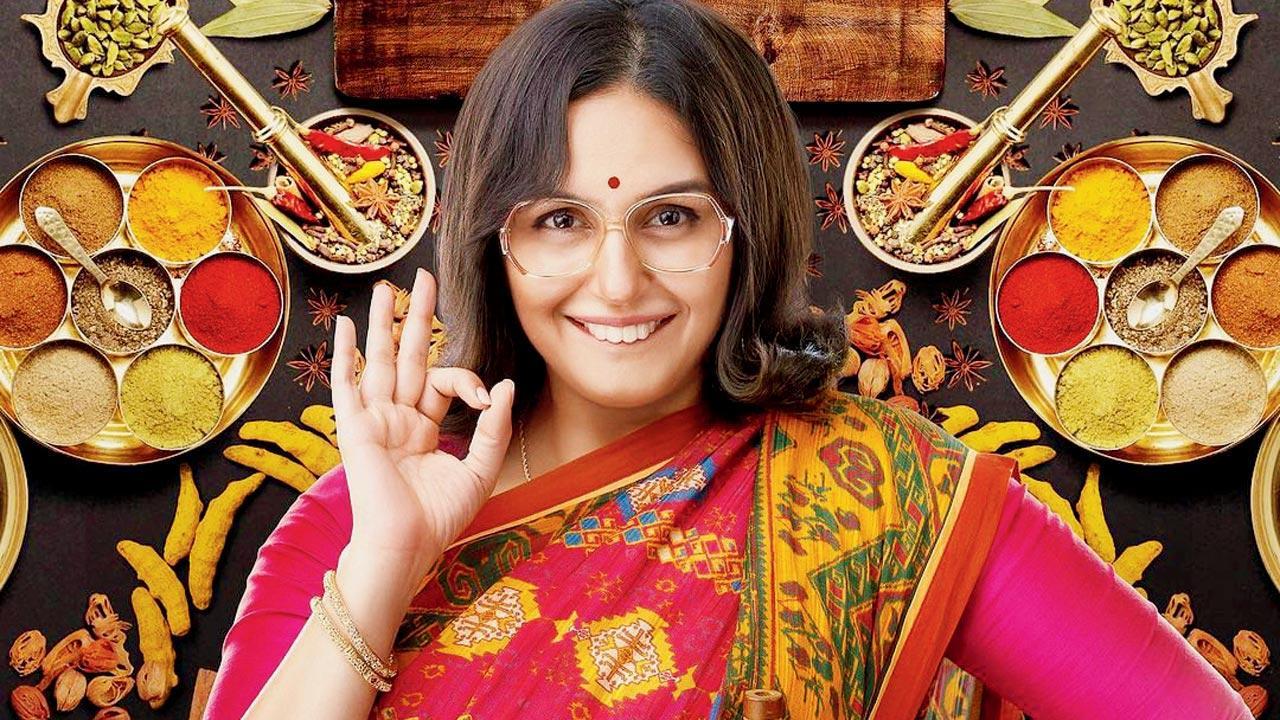
To let go of vanity is certainly not easy for an actor. But Qureshi had no qualms playing a middle-aged woman in Tarla, sporting prosthetic teeth and oversized glasses. She admits that there is constant chatter about one’s looks. “Had I allowed my vanity or fear to get in the way, it would’ve reflected on screen. The chatter about vanity is more around female actors. In a recent interview, I was told, ‘You are playing the kind of characters in your prime, which actresses play after their comeback.’ The lens through which journalists [view actors] also needs to change. We have Allu Arjun going de-glam in Pushpa: The Rise - Part 01, but such remarks are not made about him. So, why are female actors asked such questions?”

The inherent sexism plagues the industry as much as the media, states Qureshi. She believes it’s important to fight the mindset and normalize heroines playing characters that belong to different ages and backgrounds.

“I am pretty vain, I love fashion, and my Instagram handle is testimony to it. But it would be limiting if I’m only known for that. Why is it important for a woman to always look glamorous? Everyone talks about the age of the characters you play, but I am at an interesting stage where I can play someone older and younger. Also, actresses who have taken such risks have enjoyed longevity, as opposed to those who want to pretend they are 19 throughout their career. I don’t blame the women, I blame the expectation of always looking beautiful.”

A shift is required to move away from such ageist ways. She highlights it further, saying, “Zeenat Aman-ji and Rekha-ji are looking stunning on magazine covers. But where are parts being offered to them?”

Is web now Bollywood's safety blanket?

WEB NOW BOLLYWOOD’S
SAFETY BLANKET?
A number of star-led projects these days are headed directly to digital platforms, ditching theatrical release. We decode
Sugandha Rawal (HINDUSTAN TIMES; July 29, 2023)

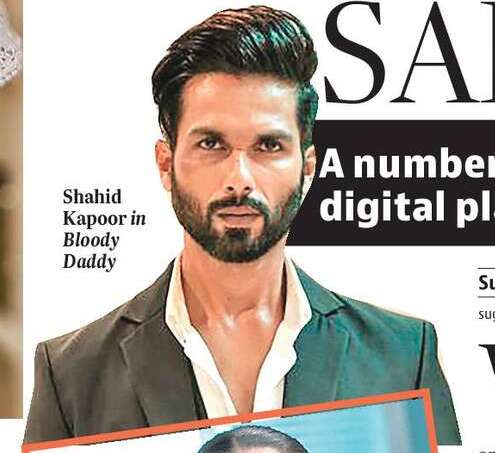
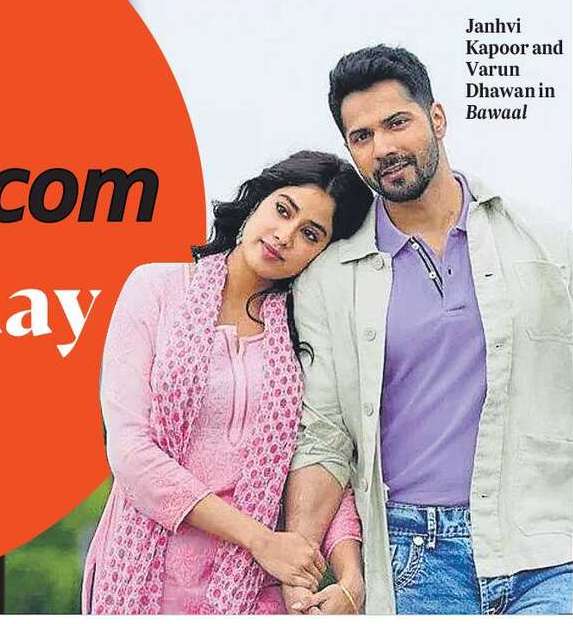
What’s common among Shahid Kapoor-starrer Bloody Daddy, Varun Dhawan and Janhvi Kapoor-starrer Bawaal and Blind, featuring Sonam Kapoor Ahuja? Its makers ditched a big screen release and took the direct-to-OTT route. Amid the supposed resurgence of the box office, looks like makers consider the web a safer bet to release films.

The box-office performance of Indian films has marginally dipped, though Hindi movies have shown improvement, according to Ormax Media’s bi-annual report. Could this be a reason for the increase in the number of web-first releases?

Trade expert Atul Mohan says, “Makers feel going to OTT is a safer bet and streaming platforms also want big names, to get subscribers. When makers sense a film will not work, they strike a deal with a streaming platform and also save money on marketing. If the budget of a film is Rs. 65 crore, they usually spend Rs. 10-15 crore on promotions.”

FROM THE STREAMER’S MOUTH
According to Manish Kalra, chief business officer at ZEE5 India, the trend has a lot to do with the creative freedom the web offers: “From Salman Khan’s Radhe (2021) to recent hits Sirf Ek Bandaa Kaafi Hai (starring Manoj Bajpayee) and Tarla (featuring Huma Qureshi and Sharib Hashmi), the [web] space provides creators a platform to connect with the audience, map preferences and bring stories with more compelling narratives.”

NOT A ONE-SIZE-FITS-ALL CONCEPT
Trade expert Taran Adarsh feels what’s meant for the big screen should head there: “For instance, in the case of Zara Hatke Zara Bachke, a lot of people said it is meant for OTT and that it will not make even Rs. 10 crore at the box office. But, it has made close to Rs. 90 crore, all because the producer took a big risk and released it in theatres. Makers should never underestimate the power of good cinema.”
---------------------------------------------
Whoever has put in money [in a film] should benefit, irrespective of the medium of release. I’d want all my films to be released on the big screen, but I understand the commercial aspect. So, as long as it is benefiting everybody and reaches viewers, I don’t mind where they (his films) release.
- Sharib Hashmi, actor

Producers are looking at the OTT space as a safer bet over the big screen. And that is fine. As long as a film is released somewhere... Kahin na aaye, usse better kahin toh release ho!
- Anees Bazmee, director


WEB NOW BOLLYWOOD’S
SAFETY BLANKET?

Even after doing Jab Tak Hai Jaan and Filmistaan, I wasn’t getting the kind of work I had expected-Sharib Hashmi

Sharib Hashmi: Was told I’m not the right fit for a hero

Sharib, who is winning praise for Tarla, thrilled to play the male lead after a 15-year run in industry
Priyanka Sharma (MID-DAY; July 24, 2023)

Tarla will always hold pride of place in Sharib Hashmi’s filmography. The actor, who plays the male lead in the biopic on famous home-chef and cookbook author Tarla Dalal, has waited for the past 15 years to headline a mainstream film.

“When you play the lead role opposite a mainstream heroine, people look at you differently,” he smiles. Essaying the role of the quiet Nalin Dalal—who puts his ambition on hold to support his wife Tarla, essayed by Huma Qureshi—came easy to the actor. “When I began working on the character, I realised he is an extension of me,” shares Hashmi.

From starring alongside Shah Rukh Khan in Jab Tak Hai Jaan (2012) in the early years of his career to now leading the ZEE5 film, Hashmi has had a long journey, complete with highs and lows. The Family Man became a game-changer for him, as he starred as an undercover agent alongside Manoj Bajpayee. 

Reflecting on his long run, the actor says, “I was told that I am not the right fit for a hero. But more than that, what hurt me was that even after doing Jab Tak Hai Jaan and Filmistaan [2012], I wasn’t getting the kind of work I had expected. Some good films would get off the ground, but eventually get shelved. Then came a time when I would be told to pick whatever was coming my way. People would say, ‘Do this, it’s important to be seen, and there is good money.’”

Now, his plate is full with projects that he believes in— from The Diplomat with John Abraham, to a Sony LIV web series. He adds, “Hopefully, I will be back on the set of The Family Man 3 soon.”

In the beginning, I was always referred to as Nitesh Tiwari’s wife-Ashwiny Iyer Tiwari

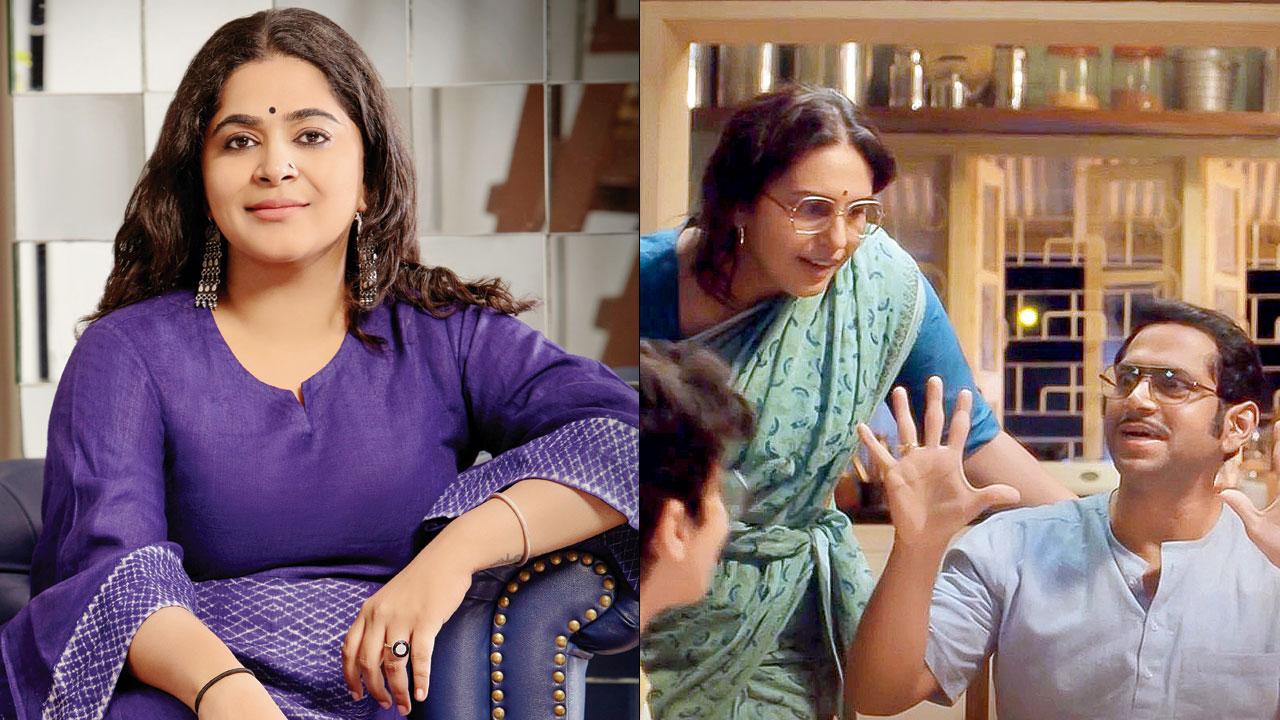
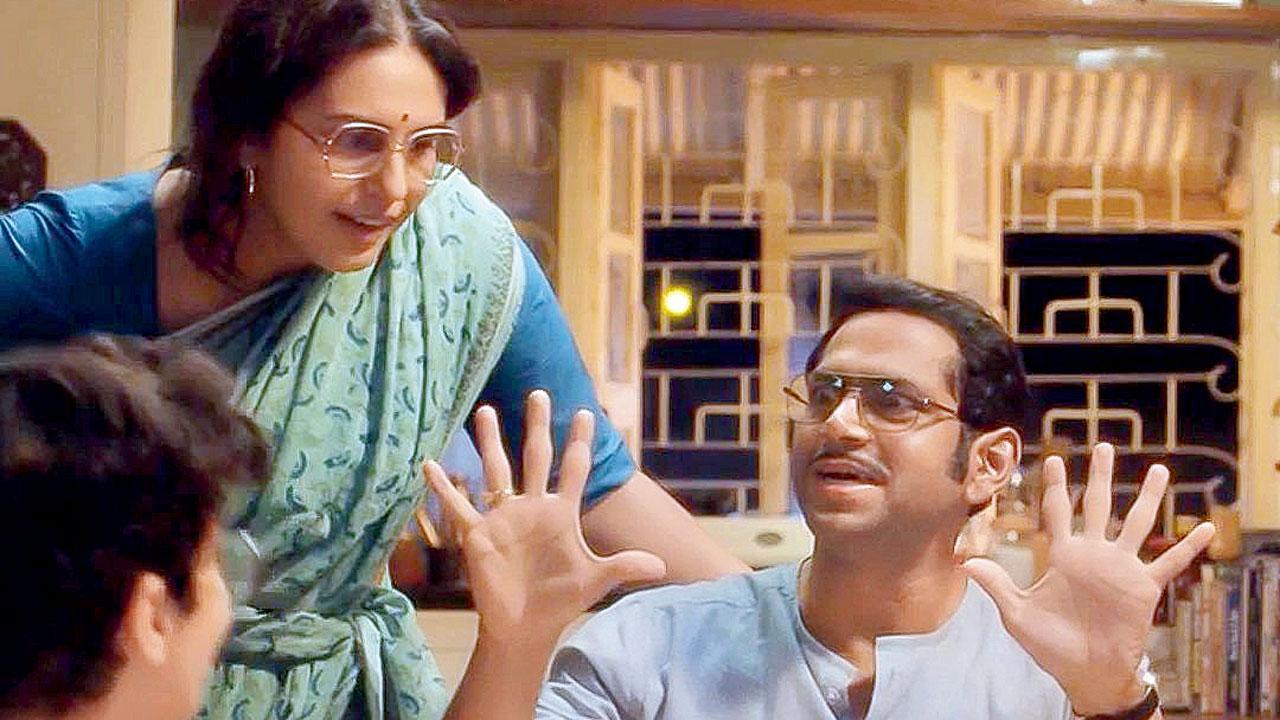
(From left) Ashwiny Iyer Tiwari; a still from Tarla

Pushing for gender equality with her movies Bawaal and Tarla, filmmaker Ashwiny on how she faced casual sexism in the early years of her career
Priyanka Sharma (MID-DAY; July 22, 2023)

At first glance, the worlds of Bawaal and Tarla have nothing in common. One is about a small-town teacher who accepts his vulnerabilities, the other about a Mumbai homemaker who realises her strengths and becomes a famous home-chef and cookbook author. But to producer Ashwiny Iyer Tiwari, they are bound by a common thread. “Our stories evoke empathy, inspiration and aspiration in the audience,” she reflects.

Yesterday, Varun Dhawan and Janhvi Kapoor’s Bawaal dropped on Amazon Prime Video. Telling a story of self-discovery, Nitesh Tiwari’s directorial venture is introspective, and poles apart from the larger-than-life entertainers that most filmmakers are churning out. To Iyer, it is an attempt to create hunger for different stories in the audience.

“While discussing Bawaal, Nitesh said, ‘Until we give something new to the audiences, how will they know whether they want it or not?’ As storytellers, it’s important to tell such stories. For instance, the essence of Tarla comes from how, during the lockdown, all of us watched homemakers’ videos in which they shared wonderful recipes.”

Based on the life of famous home-chef Tarla Dalal, the eponymous biopic premièred earlier this month. The Huma Qureshi-starrer holds a special meaning for Iyer for its ability to make women across ages feel seen.

“The story of Tarla is from ages ago, but it’s resonating with the younger audience [because] they have seen their mothers go through the same [experiences]. Huma has breathed life into the film. Sharib [Hashmi] was so happy that he called and said, ‘Thank you for choosing me to headline a film,’” recounts Iyer.

Even as her work, as a director and a producer, continues to subvert gender roles, Iyer says she faced casual sexism at the beginning of her career. She says it took some time for the media to treat her professional identity separate from that of her filmmaker-husband.

“In the beginning, I was always referred to as Nitesh Tiwari’s wife. Nitesh would feel bad about it. He would say, ‘You are an equal director. What is this all about?’ But then, there was one article that referred to Nitesh as Ashwiny Iyer Tiwari’s husband. I felt a sense of happiness because change had taken place. Now, it has become a blind spot; it doesn’t matter that we are married,” smiles the director, who is currently writing a film based on Devika Rani and Himanshu Rai’s love story.

Huma used to have a long ‘farmaish’ of kebabs and tangdis that she wanted to share with friends at school-Saleem Quereshi

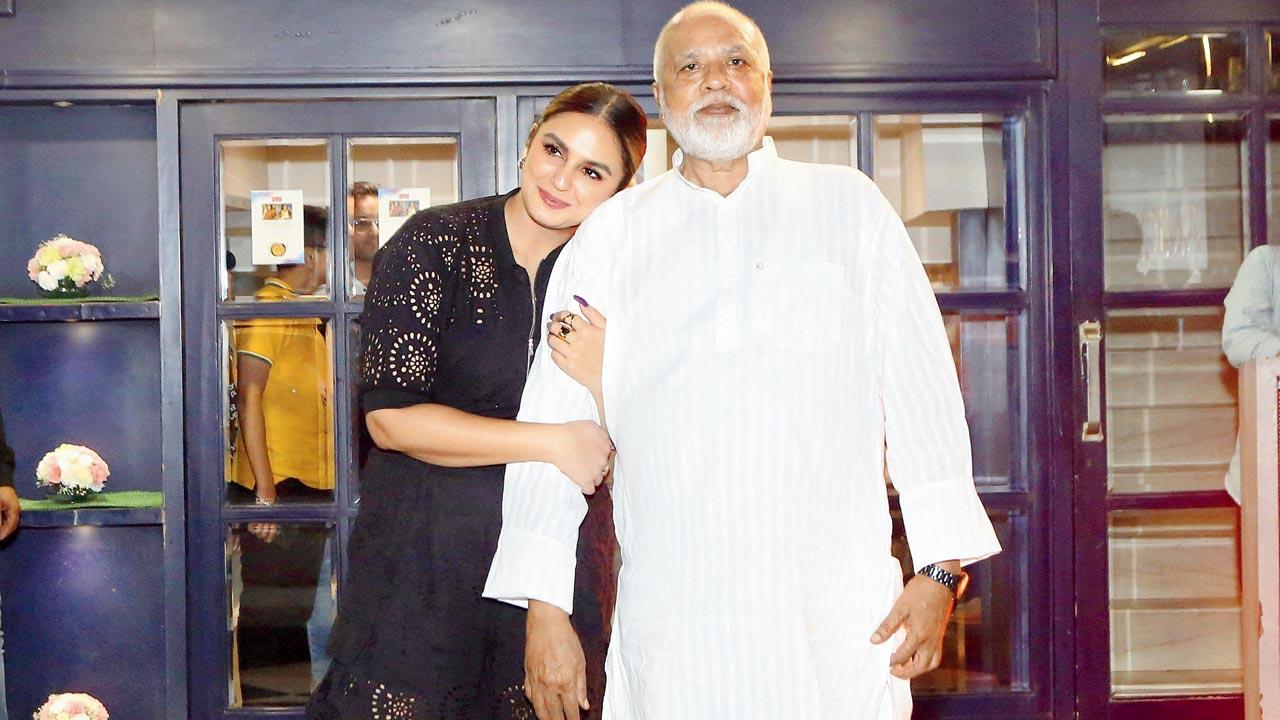
Huma and her father Saleem in front of his restaurant Saleem’s, New Delhi

Heartwarming meals, and the love for feeding, is the common strains running through all the members of the Qureshi family. In a freewheeling chat, Huma Qureshi, who plays Tarla Dalal in her new film, and her restauranter father Saleem share the secret ingredients of success
Nasrin Modak Siddiqi (MID-DAY; July 9, 2023)

What is it with actress Huma Qureshi and food, we wonder. At an Italian restaurant in the Ashhti Ghat of Varanasi, there was a dish called Huma Qureshi special, named after the actress after she shot there for Gangs Of Wasseypur. Her movie, Double XL, addressed stress-eating as a subject. She acted in the food-centric Luv Shuv Tey Chicken Khurana, and the last time this writer met actress Huma Qureshi, along with her brother Saqib Saleem, it was to chat about iftar. It would then not come as a surprise that her father has been running Delhi’s famous Saleem’s restaurant for almost 50 years ago. Now, she also plays the lead in Tarla, a film about the journey of the legendary Tarla Dalal from a home chef to a cookbook author and culinary star, which released last Friday. 

“Food and I are inseparable. In our family, food and feeding is very important. We love to host friends and family and many of them come over, just to have a good meal. My father was passionate about food, and my mother got hooked on it when they got married,” says Huma.

Ask her about her first, favourite food memory and she says, “It’s always been around Eid when people would just come over to eat”.

“No, no, that’s not right,” her father, Saleem Qureshi interrupts. “She has forgotten, but I haven’t, that every day, and mind you, every single day, she used to have a long ‘farmaish’ [wishlist] of kebabs and tangdis that she wanted to share with friends at school. I’d gladly have it made for her according to each of her friend’s spice preferences. Daily ke toh inke nakhre hote the bhai [It was a daily drama],” he laughs.

“Tangdi is still my favourite, though nutritionists insist on having chicken breast, I do prefer the leg piece and treat myself to it occasionally,” she laughs.

Many from Kailash Colony, South Delhi, have seen Saleem’s transform from a butcher’s shop to one of the city’s most successful restaurants. We are told their kebabs and tikkas are to die for. But coming from a family of raw meat traders and butchers, it wasn’t easy for Saleem to convince his family to start a restaurant. 

“We were a bunch of friends who loved eating good food. Chicken tandoori and mutton burra were my favourites. We would meet every evening, cook food and have deep discussions on the preparation and methods of different dishes. We had access to the best meat and other ingredients and would test what we could make today with which part of the meat—from kormas to niharis to kebabs—we experimented every day. That’s where the idea for the restaurant was born”.

But, in his  family, this was considered blasphemy. “My father was so upset that I would be serving food to people and washing their dishes. For 15 days, no one spoke to me. I had to get my mother to intervene and convince the elders to allow me to follow my passion. Today, almost 80 per cent of our extended family is in the food business. The younger generation is grateful that I paved the way. I am humbled, but honestly, all I did was just follow my heart,” he smiles.

Huma, who isn’t interested in cooking, only eating, says that her father and Tarla Dalal followed their passion around the same time and it took them places. “She was passionate about vegetarian food, he loves non-veg and yet, food is such a unifying factor, bringing people together. At this age too, my father is willing to learn. When he saw the batata mussalam in the Tarla trailer, he looked up the recipe, put his mind to it and came up with a dish. It’s now being served at the restaurant and is gaining popularity among non-veg lovers too. Potato in a creamy, buttery gravy—what’s not to like, right?”

Huma has never needed to promote her father’s restaurant as it already has a loyal following. So, what’s the recipe for Saleem’s success, we ask?

“For a good non-veg dish, bade log yeh kehke gaye hai ki gosht kam se kam badshah hona chaiye, bananae wala kam se kam wazeer hona chaiye and masalae gulam hai [it is said that the meat should be at least the king, the cook should be at least the minister and spices are mere servants, acting on the instructions],” he tells us, adding, “For 25 years, I have survived on just four hours of sleep, ensuring that everything is perfect, always. In our business, we have no days off and to run a successful one, you must have the good intention to feed—niyat mein taqawat honi chaiye—otherwise, even if you use the best ingredients, you’ll not be able to make a memorable dish.” 

Huma’s mother couldn’t cook when she got married. “At one time, she added water to bhindi and look at her now, she’s left everyone—including me—behind with her culinary prowess.” Ask the father-daughter about their diets, Huma says she loves nihari, mutton seekh and chicken korma.

Saleem says, “Huma ke ajeeb ajeeb healthy diets hote hai [she follows many weird and healthy diets], I love my non-veg for three meals. Breakfast is nihari and khameeri roti; lunch and dinner is hari mirch ka kheema or kadhai gosht or korma. In veg, (if I ever have it), it is navratan korma, paneer kadhai and dal makhni, which you must try for sure,” he adds, inviting us to his dastarkhwan in Delhi. 

And can we expect a branch of Saleem’s in Mumbai? “Inshallah, soon,” he signs off!

I fell on Tarla's director's feet and said, ‘Bhai, don’t look elsewhere’-Sharib Hashmi

Sharib Hashmi, the everyman hero

Sharib Hashmi, who plays Huma’s husband in Tarla, thrilled to be cast as the male lead
Priyanka Sharma (MID-DAY; July 8, 2023)

Even before director Piyush Gupta finished narrating the script of Tarla, Sharib Hashmi knew his answer. The actor was, in fact, scared that the debutant director might approach someone else if he took time to say yes. He laughs, “I fell on his feet and said, ‘Bhai, don’t look elsewhere.’”

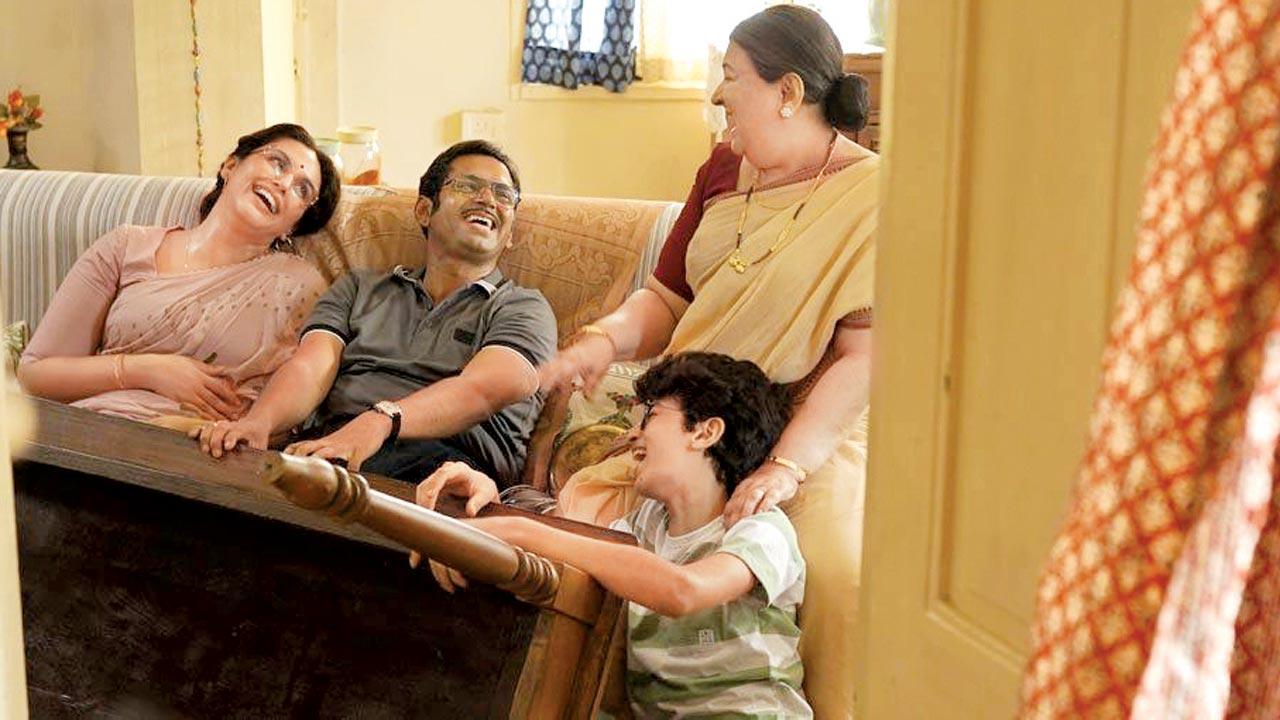
In renowned home-chef and cookbook author Tarla Dalal’s biopic, led by Huma Qureshi, Hashmi plays the protagonist’s husband Nalin Dalal. Essaying a real-life personality comes with its challenges, but he says the ZEE5 film’s screenplay made his job easier. Couple that with his middle-class background, and the role fit him like a glove.

“I belong to a middle-class family, so I could relate to Nalin. I am also a family man. So, I put my personal experiences into playing him. If I weren’t a father in real life, I might not have understood Nalin as well,” he says.

The experience became richer thanks to his co-star Qureshi. Taken by her generosity as a co-actor, Hashmi says, “Huma is a fantastic actor. There were times when she went out of her way to accommodate me. If I wanted to do a scene a certain way, she would never say no. There were so many night shoots, but Huma never said, ‘This is Sharib’s close-up. I am not needed.’”

Their pairing may be unconventional by industry standards, but is receiving positive response from the audience. Thrilled to play the male lead, he says, “I have played a lead earlier too, in Filmistaan [2012]. But the day Tarla’s trailer dropped online, my best friend called and said, ‘Arey, tu toh hero ban gaya!’”

(Crisp) Movie Review: TARLA by FENIL SETA


Tarla, which has released today on Zee5, is the biopic of the legendary Tarla Dalal. Not many know about her journey and hence, this film scores on that front. Writers Piyush Gupta and Gautam Ved have peppered the film with some very funny and heartwarming scenes. Debutant director Piyush Gupta has packed in a lot in 126 minutes and he moves from one episode to another quickly and smoothly. He was a part of Dangal's writing team and Tarla is also backed by Nitesh Tiwari, the director of the Aamir Khan-starrer. The Dangal flavour is very much there and it gives a nice touch. This is especially in the song 'Papa Why' which gives a déjà vu of the song ‘Hanikarak Bapu’ in Dangal. Some aspects don't work as intended, however. Huma Qureshi, however, is brilliant and doesn't go overboard. Sharib Hashmi yet again delivers a commendable performance. From the supporting cast, Rajeev Pandey (Makrand; Nalin’s colleague), Amarjeet Singh (Gafur bhai), Bharti Achrekar (Jayshree) and Veenah Nair (Renuka) leave a huge mark. Akshat Dixit (Mahipal; Haryanvi chef) is quite funny. All in all, Tarla is a heartwarming entertainer and will surely leave a good taste.

My rating - **** out of 5!

Fenil's Bollywood Talk # 785

THREE WOMEN-CENTRIC FILMS TO TRY THEIR LUCK THIS FRIDAY

The month of July is here and it’ll be dominated by three major Hollywood films which will be released in the second and third weeks of July. Tomorrow, meanwhile, three Hindi films will be released, all of which are female-centric. My analysis:

NEEYAT: It stars Vidya Balan in the lead along with Ram Kapoor, Rahul Bose, Neeraj Kabi, Niki Walia, Amrita Puri, Shahana Goswami, Dipannita Sharma Atwal, Shashank Arora, Prajakta Koli and Danesh Razvi. This marks Vidya’s first film in cinemas after nearly four years. It is directed by Anu Menon of Shakuntala Devi and Four More Shots Please fame. The film is a murder mystery and from the trailer, it gave a déjà vu of the Hollywood film, Knives Out. The actors, during promotions, have assured that it’s not the case and that both films are as different as chalk and cheese. The awareness is very limited and hence, the opening will be poor, around Rs. 1 crore. If word of mouth is positive, the collections can double or go even more on Saturday.

BLIND: It stars Sonam Kapoor and this is also her first film in nearly 4 years. It will release directly on Jio Cinema and has Sujoy Ghosh as one of the producers. It is a remake of the 2011 Korean film of the same name and is about a blind cop in search of a serial killer. The trailer is intriguing. But the buzz is hardly there. The promotions are non-existent. There were reports that Sonam is disheartened with the way it’s being released directly on an OTT platform. Nevertheless, Blind can find an audience if reports are positive since Jio Cinema is available for free.

TARLA: It is the biopic of chef and cookbook author Tarla Dalal. Huma Qureshi plays the lead role and she’s joined by Sharib Hashmi. It marks the directorial debut of Piyush Gupta, who wrote Dangal and Chhichhore. Nitesh Tiwari, who made these two films, is also one of the producers. It’ll release on Zee5 and can grab attention due to its theme and light-hearted feel.

Another release this week is 72 Hoorain. The film is in the news more for the controversy. The makers have tried their best to arouse curiosity, with the hope that it turns out to be the next The Kerala Story. But looking at the hype and ticket sales, it doesn’t seem that it’ll manage to have good innings.

The Hollywood release this week is Insidious: The Red Door. It is the fifth and final part of the Insidious series. The franchise is not big in India. The last part, Insidious: The Last Key had collected around Rs. 11 crores in India. This one might collect in a similar range. In fact, it can open better than Neeyat.

Interestingly, Insidious: The Red Door had paid previews yesterday, that too at 11:55 pm and the occupancy was encouraging. It has a full-fledged release today. The makers decided to come earlier and not on Friday since next week, Mission Impossible: Dead Reckoning - Part One, will have a mid-week release, on Wednesday, July 12.

There is a generation of women that started their lives again in middle age. That needs to be celebrated-Huma Qureshi

Huma Qureshi: Many women restarted their lives in middle age

Playing Tarla Dalal in eponymous biopic, Huma says film celebrates women who chased their dreams after years of being bound by family duties
Priyanka Sharma (MID-DAY; June 30, 2023)

To Huma Qureshi, the essence of Tarla can be perfectly captured in one line—“You can cook, but you don’t have to be confined to the kitchen”. It’s this liberating thought that stayed with the actor as she stepped into the shoes of the late Tarla Dalal, renowned chef and cookbook author. A thought that deserves its moment on the screen, because it not only celebrates women who defy ageist norms to chase their dreams, but also propels others to not lose views of their goals.

“It’s important to tell this story because this is what has happened to our mothers and grandmothers. They were pushed into getting married and having children. When their kids went to college, they suddenly realised, ‘Now, nobody needs me.’ I have seen my mom and aunts [feel this]. Some of them opened salons, others tried their hand at jewellery business,” recounts Qureshi.

In chronicling Dalal’s journey from a homemaker to India’s favourite cookbook author, Piyush Gupta’s directorial venture shows how it’s never too late to pick up the reins of your life. “There is a generation of women that started their lives again in middle age. That needs to be celebrated,” she emphasizes.

The ZEE5 film, also starring Sharib Hashmi, is centred on a 30-something protagonist. Qureshi feels it’s a refreshing change in Hindi cinema that is largely populated by young characters. “Through pop culture, we have [pushed] this young adult obsession where it seems by the time you are 30, you have no value. It’s so unhealthy. What about the rest of your life? Today, an 18-year-old is giving skincare tutorials! Turn 50 and then let’s see what you know about skincare,” she laughs.

Ageism is a manifestation of sexism that women battle regularly across fields. Who knows that better than women in the movie industry? Qureshi is appalled at how female actors are considered dispensable.

“Actresses are made to feel relevant only if they are pretty and hot. We are not papaya that will get stale and have no value. We are artistes who will become better as we age. That’s the story we need to put out. You have to be taken seriously, and you should take yourself seriously.”

To extract Huma out and make her Tarla is not easy. We neutralised the Delhi-ness in her, says diction coach Hetal Varia

Speak like Tarla before you cook like her

Dialect coach breaks down how she helped Huma perfect Tarla Dalal’s diction, with its Marathi essence, for the chef’s biopic
Mohar Basu (MID-DAY; August 9, 2022)

Huma Qureshi describes Tarla as a “delicious film.” The actor, who wrapped up the biopic on home-chef and cookbook author Tarla Dalal in June, believes it is an emotional story of a woman who “cooked her way out of the chaar diwari of her kitchen.” Becoming the famed home-chef for Piyush Gupta’s directorial venture, however, wasn’t easy.

Delhi-born Qureshi admits it was difficult to adopt the peculiar accent of her subject. “I grew up in a hardcore Punjabi neighbourhood. I can do any accent [prevalent] north of the Aravallis. But on this film, I had to learn from scratch. My diction coach Hetal Varia and I worked for months to make sure we don’t do a caricature. Tarla was a Gujarati woman who married and moved to Napean Sea Road, so her way of talking was unique.”

Varia, who previously served as a dialect coach on 'A Suitable Boy' (2020), says cracking Dalal’s diction required focusing on two areas. The first was the learning of a mechanical dialect to sound as close to her as possible. “We didn’t want to do mimicry of any sort and sound emotionally connected. The technique of the dialect can be taught but it needs to be adapted to the creativity of the actor. From day one, Huma brought to the table her understanding of who Tarla is. We started with basics like the connection between speech and body, how the body was involved in speech, how she would breathe while talking. Very quickly, we went into how she responds to things and how that seeped into the speech.

The next part was vocabulary building for the film. Varia explains, “We all know Tarla as a Gujarati. We know theoretically that she was born and brought up in Pune. Even now Pune speaks chaste Marathi. So back in the day, it was even more before. One day the director (Piyush Gupta), Huma and I were watching a video by Tarla. I was wondering why there is no Gujarati-twang in her and that’s when it struck me. I realised her Gujarati musicality is missing. Maybe her family spoke Gujarati at home, but there is a blend of Maharashtrian essence. It was a breakthrough for us, so we could design a border beyond which the diction would sound hammy. We wanted the blend of performance and dialect to be effortless. We designed a dialect to recreate what Tarla was like to suit the story.”

In the course of the film, the protagonist’s speech evolves in keeping with different stages of her life. After Dalal married into a south Bombay family, Varia says there was a noticeable shift in her accent. “Every human changes their way of speaking as they go along in life. She moved into South Bombay, her husband was from America. Her English is accented. Tarla’s speech evolved into more layers. We tried to maintain her sparkle and twinkle, which was crucial to who Tarla was."

Varia gives full marks to the lead actor for her prep and eagerness to learn. “To say extract Huma out and make her Tarla is not easy. We neutralised the Delhi-ness in her. For instance, words like khali, khamosh, lifafa we kept on the side. The good thing about Huma is that she picks up very fast. We worked seamlessly and we were ready to change with each other. She was very open to learning, and harped on scene improvisation even on set. She surrendered to the process. I would get very academic sometimes and she would ask me to send a recording. But I was adamant I wouldn’t send because she had to sound like herself and not like me. I like to know where the actor is naturally and not impose what I have designed. The whole fun of our work is to explore a character together. I feed off my actor's strengths and adapt to their voice and breathwork."

Before kicking off Tarla's shoot, Huma Qureshi wears dentures for long hours to get used to buck teeth

Teething troubles for Huma
Mohar Basu (MID-DAY; May 3, 2022)

In March, mid-day was the first to report that Huma Qureshi was gearing up to play celebrated chef-cookbook author Tarla Dalal in a biopic (Huma finds the perfect recipe for success, March 29). Over a month on, the actor has begun shooting for the Ronnie Screwvala, Nitesh and Ashwiny Iyer Tiwari production. While the script and her personal research helped her familiarize with the late home chef’s rise to success, looking the part proved to be an uphill task.

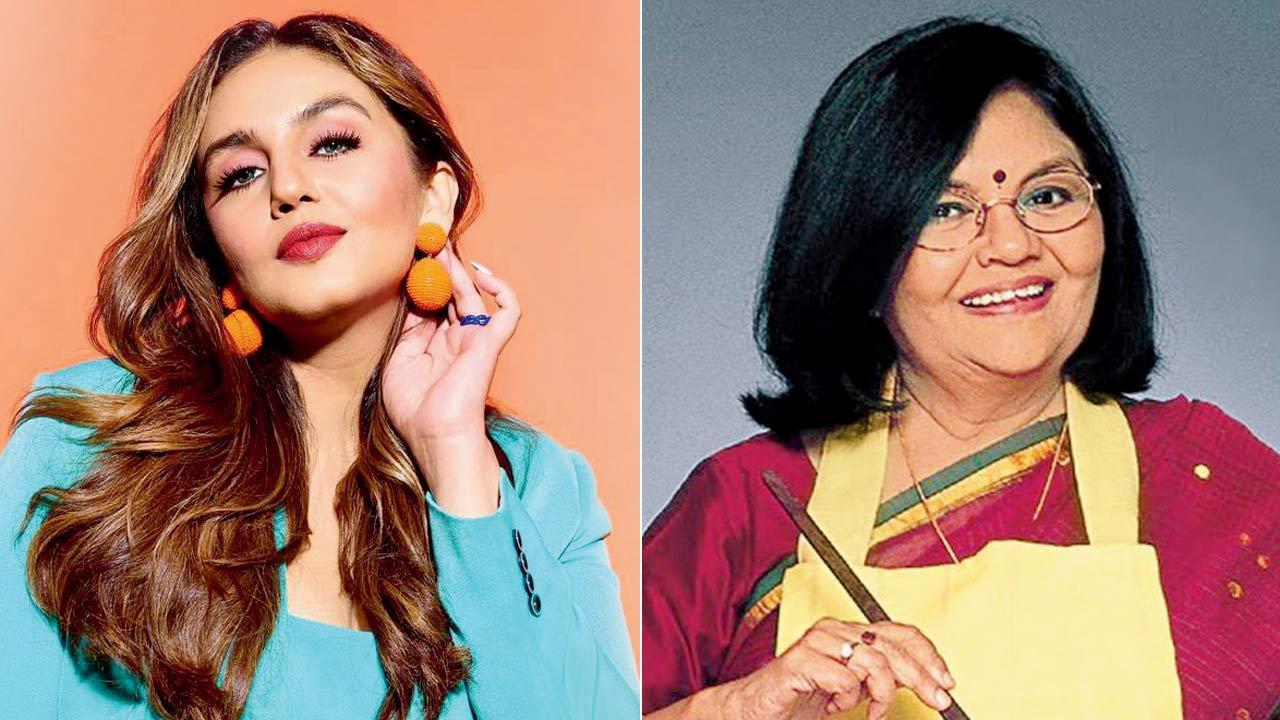
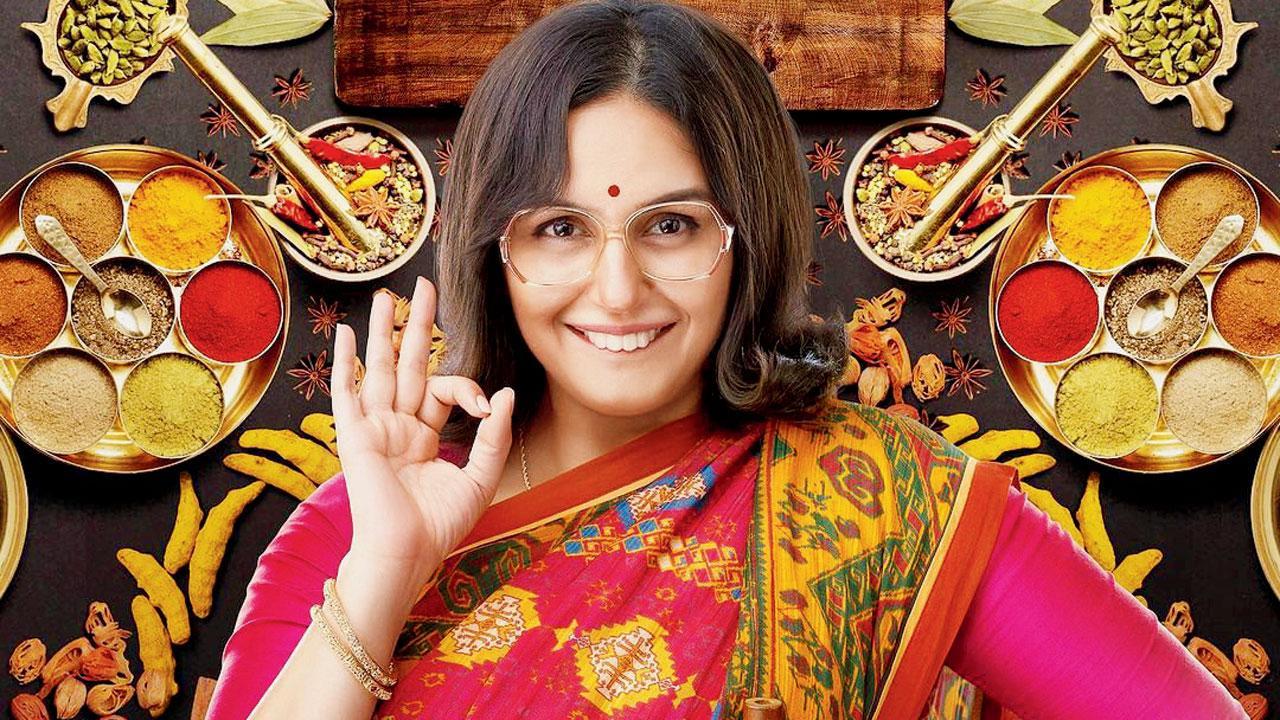
With her tall frame, Qureshi’s physicality is nothing like Dalal’s. A source reveals, “Since Dalal had top-of-mind recall value among millions of Indian women, looking the part was key. Huma did multiple look tests, with director Piyush Gupta, to finally crack the avatar that sees her sporting glasses and buck teeth. Before the film went on floors about two weeks ago, the actor would wear the dentures for long hours to make sure she was comfortable with them. She knew that the camera would capture even the slightest hint of effort or discomfort. So, she used to wear them throughout the day, and practised speaking with them on.”

As part of her prep, Qureshi also devoured hours of footage, thus picking up on the cookbook author’s accent, pitch and mannerisms.