Showing posts with label Tandav. Show all posts
Showing posts with label Tandav. Show all posts
OTT rules come into focus after outrage over IC 814: The Kandahar Hijack
8:33 AM
Javed Farooqui (THE ECONOMIC TIMES; September 17, 2024)
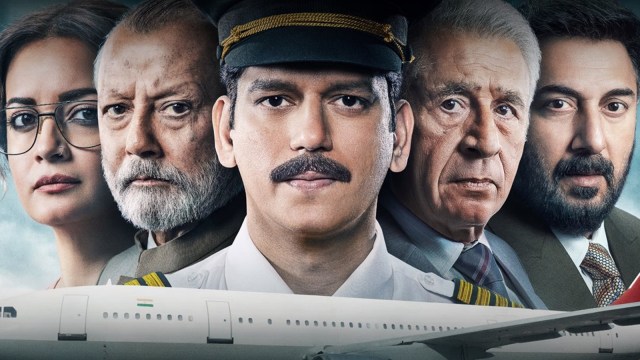
The controversy over Netflix’s ‘IC 814: The Kandahar Hijack’ series has reignited the debate over having tighter content regulation for over-the-top (OTT) platforms in the Ministry of Information and Broadcasting (MIB), people privy to the development told ET.
The series, based on the hijack of an Indian Airlines flight in 1999, faced social media outrage for inaccuracies including changing the names of the hijackers.
Netflix India agreed to include an updated disclaimer on the real and code names of the hijackers, Ibrahim Akhtar, Shahid Akhtar Sayeed, Sunny Ahmed Qazi, Zahoor Mistry and Shakir.
The key concern that the MIB has about the web series is that it claims to be a work of fiction while promoting it as a true story, people cited above said. Further, the platform has put up a disclaimer only in India and not in other international territories.
“If foreign streaming platforms continue to behave like this, the MIB will be compelled to come out with a tighter content regulation for OTT platforms, which could extend to pre-certification of content also,” a government official said on condition of anonymity.
Both the MIB and Netflix declined to comment.
OTT insiders expressed concern over tighter content regulation.
“This reaction can have a chilling effect on the industry… (It is) likely to curtail free speech and the ability for anyone to tell a story of any authenticity,” said an OTT expert who requested not to be identified.
Legal experts argued that the issue over the names of characters is specific to India and hence the updated disclaimer is only applicable there.
A petition seeking withdrawal of the series was also filed in the Delhi High Court for assigning Hindu names such as Bhola and Shankar to the hijackers. The petition was withdrawn later.
Unlike TV broadcasting, which has to adhere to program code under the Cable Television Networks Regulation Act 1995, there is no content regulation for OTT.
The government was planning to bring OTT under the regulatory framework through the Broadcast Bill, which has been put on the backburner following opposition from media organizations and independent content creators.
Currently, the OTT platforms have to follow a three-tier grievance redressal mechanism under the IT Rules 2021. The three-tier mechanism includes self-regulation by publishers, publishers having a self-regulatory body, and oversight mechanism by the government.
In the case of IC-814, the MIB acted with restraint despite mounting public pressure, the official quoted above said. “The government could have asked Netflix to either edit the show or take down the content under Section 69 of the IT Act. However, it didn’t take any adverse steps,” the official said.
In the past, the ministry has received complaints from social and religious organizations against multiple OTT shows including Grahan (Disney+ Hotstar), Bombay Begums (Netflix), and Tandav (Amazon Prime Video).
In some cases, the streaming platforms had agreed to remove scenes that were deemed controversial. Tandav is a case in point.
Experts said the IC-814 controversy underscores the challenge of balancing creative freedom and responsible content creation on OTT platforms in India.
Every time Shah Rukh Khan and I meet, he repeats, we have to do a film together-Vishal Bhardwaj
9:02 AM
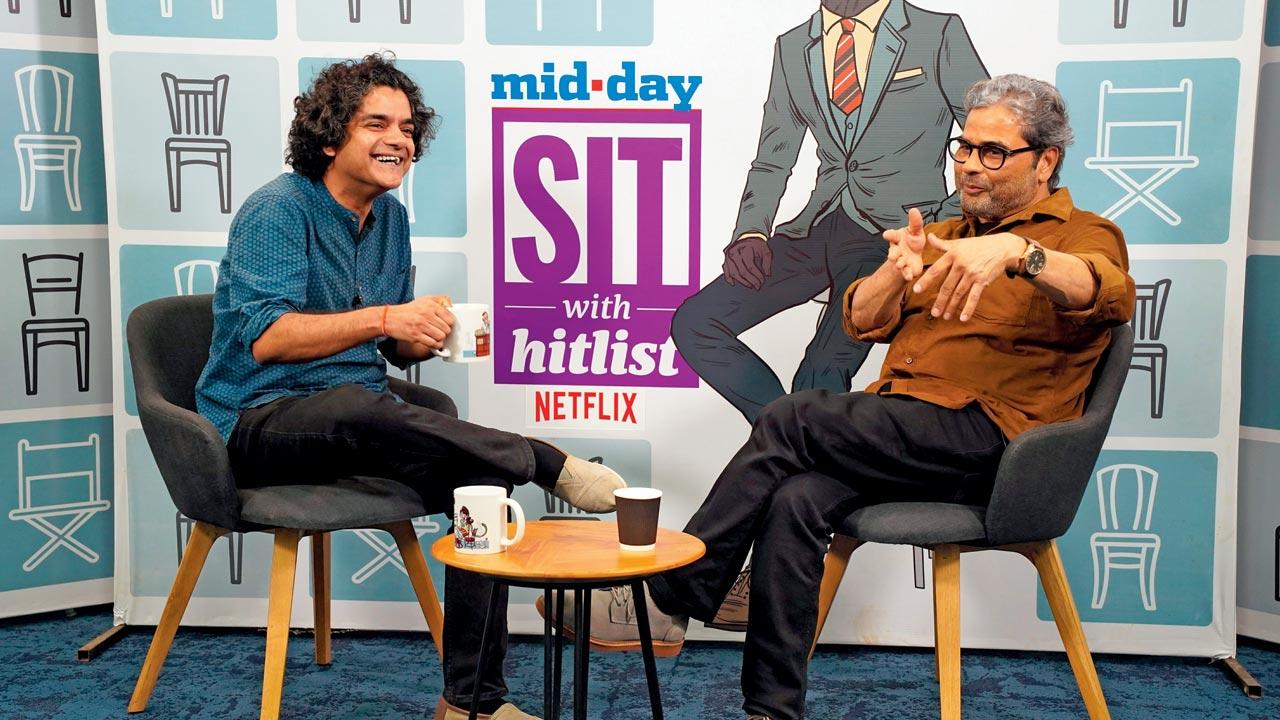
One of India’s greatest filmmaking talents ever, polymath Bhardwaj, opens up on the man behind the movies
Mayank Shekhar (MID-DAY; December 16, 2023)
Gulzar-Vishal Bhardwaj's musical combo is top of the charts’ stuff. But Vishal’s first mentor, from the world of poetry was, in fact Dr Bashir Badr, whom he calls the “greatest poet of the century, an asset to [his hometown] Meerut,” who had to flee Meerut, however, because of the riots in 1984.
Bashir Sahab had heard rumours of a likely attack on his house in Shastri Nagar. His home was indeed burnt down by a raging mob later.
In the rush that he fled for Bhopal, Bashir Sahab left behind his diary, with all his poetry, written over the past year. When he briefly revisited Meerut, he asked for two people—one, Mr Bhandari, who was 70 years old, and the other, Vishal, who was 19 then.
He asked both if they remembered the ghazals and his poetry from the destroyed diary. Bashir Sahab had gone into depression. Between the old man, Bhandari, and teenager, Vishal, they recalled all of the great poet’s works to him, word for word as he penned them back again: “This is how Bashir Sahab got out of depression.”
Vishal used to spend every evening, listening to Bashir Sahab’s words of the day. With poetry, he says he has a photographic memory: “At one point, I could recite the entire book of Gulzar.”
This Bashir Badr story I’d heard before, over drinks, with his former associates once. As is with such nights, I’d forgotten most of it the next morning.
Including details of the tragic events preceding Vishal’s father Ram Bhardwaj’s demise—which he recounted in detail, before a live audience, during this conversation. Only, a few weeks later, he sent in a word if that anecdote could be omitted. It’s about father and son. Too sensitive. We left it at that.
Earlier, he would cry, recalling the incident to do with his father’s death. But he says, “I found my catharsis in that scene in Haider [2014], when Shahid [Kapoor] returns to his home that’s burnt down, and he’s holding a cricket bat.”
The other story about Vishal that I have stored in my hazy memory, hanging with his former colleagues, is about how, as a kid in Meerut, he was caught in a crossfire, and he saw a dead gangster, right in front of him.
“Oh, those are actually two separate incidences,” Vishal says. “There was Tyagi Hostel in Meerut, where all these gangsters used to live. There was a wall, with a hole, between my school and the hostel. That’s the short-cut route we took to get to school. This is where the [chief] gangster used to live in the warden’s house. The warden used to live in the hostel!”
“On my way, I would see him lay out and dry his bullets, guns, grenade, in the sun. The gangster was very fond of me and other kids. He would offer us to hold his gun, tease us with pulling the trigger.”
“Once, during school exams, we heard gunshots fired. We went over to the gangster’s courtyard after. And he was lying dead, right there, with fresh blood, killed by cops, in a gang war! That’s the first time I saw a dead body. I was in Class VII, so must’ve been 12 or something.”
The other incident has to do with Hindu-Muslim riots, which Vishal says was common enough in Meerut: “But even then, the level of enmity [that we see now] didn’t exist.”
Vishal’s house was next to a Muslim family’s: “They had a large bungalow. The father was a learned gentleman. He had three daughters. My landlord was a police sub-inspector, with 10 children. Those kids decided ki hum Muslim kama lete hain, meaning score/kill Muslim people [during the riots]. That’s how it worked. I even heard them plan on going after one of the daughters.”
“There was word from the police station that these boys had an hour [to do whatever they liked]—kama lo toh kama lo. That’s before the police would charge in. This is also how it worked. I knew about these boys’ plans. They had bought country-made pistols. They intended to enter the house, and blast the gas cylinder.”
“The Muslim man inside had a Donali [double-barrelled gun] that he shot in the air. During what ensued, I got caught in the crossfire, and found my way out of it, into another house. My family got worried, because I had gone missing.”
This is when Vishal naturally pauses in the chat: “That’s the psyche of a mob. I have seen it. You ask an individual to kill another? They won’t. You get 50 people to do the same, without taking on guilt and moral responsibility? They will. This is why incidences like lynching and mob behaviour pain me. The support comes from the system.”
As with many great artistes, you only have to dig into Vishal’s past to figure what informs his life as a filmmaker and public figure too. Although pretty much all of his films, as a director, have been based on works of literature.
It might be fair to say, that’s only on paper. Consider his last feature, Khufiya (2023, on Netflix). It’s adapted from Amar Bhushan’s novel, An Escape To Nowhere.
I first read the book in 2013, basis a recommendation in Swapan Dasgupta’s column in The Times of India. Page for page, the film barely reflects the original text, which was more a survey of bureaucrats, fighting over foreign postings. Which is probably what R&AW really is, on a daily basis, anyway. Rather than Salman/SRK like James Bond agency, banging it in the killing fields.
Vishal says, “The book is a cold account of a surveillance operation. The detailing is so good. [Author] Amar Bhushan-ji was once the counter-espionage chief himself. Now, such a book is not even possible. Because the government has placed a ban. No officer can write such a book anymore.”
What about the leap of faith that he takes thereon from the book—surely, he had R&AW agents/officers vet the script, in case it seems too far-fetched? The original research, Vishal says, came from “seven to eight years spent”, working on a film based on the IC 814 hijacking (of 1999).
“I met Mr Ajit Doval [currently India’s national security adviser] several times. He had then retired [as the Intelligence Bureau chief]. Doval Sahab is a fascinating man, and a great storyteller! I also interacted extensively with ex-R&AW chiefs, Mr [A S] Dulat, Mr [C D] Sahay… Along with Mr [Vivek] Katju, the foreign secretary—these were the gentlemen chiefly negotiating with the hijackers. In any case, they really tell you what they want to. They might make you believe they’re answering your questions. But they’re not. It’s their point of view.”
Vishal’s film on the IC 814 hijack subsequently got shelved: “After the Tandav episode, Amazon Prime Video got paranoid. They pulled the plug on the project. They said they don’t want to touch anything political. The film actually had nothing to do with politics. The whole country was humiliated in that episode. It had nothing to do with a party. Now, Anubhav Sinha is making a series on it for Netflix.”
During the IC 814 homework, Vishal also met the IPS officer Arun Kumar, who was associated with the incident. In 2008, Arun became the first investigating officer from the CBI on the Aarushi-Hemraj Noida double-murder case (still unsolved, by the way).
Hence, Meghna Gulzar’s Talvar (2015), which Vishal produced and scripted, with precious/incisive details from Arun who, in turn, inspired late Irrfan’s character in the film.
Tabu, Vishal’s other muse, plays the lead in Khufiya, while the spy-thriller follows this R&AW sleuth’s story of love and loss with her Bangladeshi handler. None of which, of course, exists in the novel that the film is based on.
Citing his Shakespearean adaptations (Maqbool, Haider), to works of Ruskin Bond (The Blue Umbrella, Susanna’s Seven Husbands), Vishal says he’s essentially keen on the basic plot: “I have to know the drama I’m creating—and find a three-act structure, voice, characters, and my own politics and social environment in it.”
To illustrate this best, no better example than to go back to the aforementioned Tyagi Hostel, along with Meerut’s Kachehri Road, full of gangsters, Anand Shukla, Rampal Tyagi, et al. All of whom treated Vishal as their “blue-eyed boy.” Because he could sing and play cricket well. Watch them placed together in Omkara (2006), i.e. Othello. Shakespeare feels like an excuse.
One of the gangsters Vishal knew there was Langda Rathee, who got onscreen as Langda Tyagi. And that’s Saif Ali Khan, in what was easily the greatest casting-against-type for the decade. Vishal thanks Aamir Khan for this unusual choice.
Around the time, Aamir and him were zeroing in on a script, Mr Mehta & Mrs Singh, to work together: “Aamir was seeing the film a certain way. When we were close to the shoot of Mr Mehta & Mrs Singh, he was uncomfortable about how I was seeing the film. We are both headstrong people. We parted ways. But he’s great fun to spend time with, and during our chats, I told him about Langda Tyagi, the character I was writing.”
Aamir was fascinated by the world (of Omkara), and Langda Tyagi’s language, in particular, and wished to be considered for the part. He got busy with his next (Rang De Basanti).
Vishal was too eager to hit the set, rather than wait for Aamir, which would take long. But he realised, “Aamir is intelligent, and commercial. If this role can excite him, I’m sure it should excite another star.” Hence, Saif 2.0 (post Dil Chahta Hai).
There’s been was a similar hit-and-miss between Vishal and Shah Rukh Khan. They were to adapt Chetan Bhagat’s 2 States together (later filmed by Abhishek Varman on Arjun Kapoor, Alia Bhatt). What happened there?
Vishal says, “We had differences over the setting. I wanted to set the film in a bank like ICICI, and not in a college, or elsewhere, that Shah Rukh would’ve preferred. We felt the pain, though. I recently wished him for Jawan. Every time we meet, he repeats, we have to do a film together.”
While his sensibilities are innately artistic, it’s evidently clear, Vishal has throughout aimed for a spot in the mainstream, and achieved it, in his own right. He emphasizes, “Maqbool [2004] opened the doors for me!”
----------------------------------------------------
An apt way to introduce Vishal, as we did in this conversation, is as one of India’s greatest filmmaking talents, ever. There have been few polymaths with that many hyphenated top-end talents, within desi filmmaking—director, producer, music composer, singer, lyricist, writer of screenplays, and dialogues (often separate in Hindi cinema, because most don’t hold an equal command over language).
Vishal writes dialogues in pen on A4 sheets. But gets confused with his own handwriting later. One thing he misses his former associate Abhishek Chaubey (Ishqiya, Udta Punjab) for is deciphering what he’s written. Now, he has to figure it out himself. The instructions on the screenplay he keys directly into the computer.
The greatest polymath of all in Bombay was probably Kishore Kumar who, Vishal tells me, he shares his birthday with (August 4)!
But much before all of the above, Vishal was an “all-rounder” cricketer once—batter, and right-arm spinner—with an eye on international cricket. Former Test player Gursharan Singh spotted him in a match in Meerut, and suggested he move to Delhi. Which is the reason he did.
“I couldn’t have made it to the Indian team from UP. It was too big a state then [Uttarakhand hadn’t been bifurcated]. The facilities weren’t up to the mark. And the UP team barely made it up the chain in the Ranji Trophy. So, I would have never got noticed.”
In Delhi, he played with the likes of Manoj Prabhakar, Maninder Singh, Sunil Walson, Tilak Raj (who Ravi Shastri hit for six sixes), Chetan Sharma… Speaking of the latter, did Vishal whack Chetan out of the park, ever? “Yeah, I did.” That’s one thing he has in common with Javed Miandad!
Reminiscing those times is a lot like, as Vishal quotes Ghalib: “Yun hota toh kya hota!” Dealing in ‘counter-factuals’: “I came to Delhi. Right before the match, I broke my thumb. Couldn’t play the whole year. Next year, my father died. If cricket hadn’t left me, though—how would I have been in music, or the movies then? This world has no retirement age!”
“Since then, I’ve learnt that if something unlucky happens to me—a greater reward awaits. I feel bad, of course, when something happens. But I don’t get disappointed.” From an early age, Vishal used to dabble in musical instruments lying around. Music was internal to his home.
Although with a day-job, Vishal’s father Ram—“everyone called him Ram Sahab”—was a lyricist in Bollywood. He would often visit Bombay, from Meerut, with family.
This is when Vishal spent time with film/music folk in Bollywood. On one such evening, his dad mentioned to his friends about how Vishal, “around 18 then”, had composed a short tune over his father’s lyrics.
His dad’s friends were hugely impressed. They got composer Usha Khanna on the phone to hear it. Usha loved it enough to include it in the final composition.
“That someone like Usha-ji took my tune to expand into a whole song gave me my first validation. That validation gave me confidence.” The song, Khuda Dosti Ko Nazar Na Lage, is from the film, Yaar Kasam (1985). At 19, Vishal recorded his first composition. Asha Bhosle was on the microphone.
After college in Delhi, he moved to Bombay with a job at a music label to pursue music, professionally. Vishal also had a brother, Rajeev, seven years elder to him, in Bombay—struggling to make it in films as a producer: “He had no money. But he wanted to produce movies. How do you?”
Rajeev passed away early. Decades later, Vishal became a formidable producer in Bollywood. I wonder if he feels, in some ways, it’s the story of two siblings coming full circle? He just wishes his brother was around to see it.
Filmmaking itself was an invisible milestone in his head, he says. “I had no intentions. I had seen nothing. Manmohan Desai to Blue Lagoon [for the sex scenes] was the range of my film knowledge!”
It was during the making of Maachis (1996) that he was composing music for, Vishal recalls, “Gulzar Sahab told me, I’ll become a director in five years. He actually pushed me into it. I used to ask him too many questions during the filming, editing…” The children’s film Makdee (2002) marked Vishal’s directorial debut.
Given he was a musician first, isn’t it strange that he’s never attempted a proper musical in films? He reasons, “In my earlier movies like Omkara, Maqbool, I did have actors lip-sync to songs. Because I also wanted to retain my power as a composer. With time, the purity of cinema took over. How do you then justify lip-syncing? The background score is the director’s voice. Anyway, India has a long tradition of cinema and music. Even if I do a musical, it would have to be on a subject that is totally non-musical.”
By the looks of it, his current obsession may be mystery/thrillers. After Khufiya on Netflix, his series Charlie Chopra & The Mystery Of Solang Valley, based on Agatha Christie’s The Sittaford Mystery, dropped on Sony LIV. Which, he says, happened primarily because of the pandemic.
“The world was under lockdown. I was convinced we were in it for five to 10 years, or perhaps forever. How does one survive creatively for that long? Many years ago, I had been offered Agatha Christie’s entire library of Hercule Poirot and Miss Marple titles to adapt. Well, this is what we could do, I thought—shooting in constrained settings [during a pandemic]. I got back to the person, who had connected with me back then.”
What does he find in common between films and music, I ask Vishal. He says, “That they both work on the three-act structure, inspired from life, of course—bachpan, jawani, budhapa [childhood, youth, old age].
“Also, like with films, we don’t know what works in music. It cannot be calculatedly recreated, even though there are really seven notes.”
How about films and cricket—what does he find similar between the two: “Captainship. That you take along a team, especially when things aren’t going right. And they seldom do.
“Also, to accept defeat gracefully, and learn from the defeat.” Are there instances from his films that he’s learnt from, in terms of failure?
“It would be on the technical aspects. Take Rangoon [2017]. The release date was set. But we were not getting the VFX for the final scene right. I should have put my foot down. Held the release, like Sanjay Leela Bhansali does. I was making a Rs 70 crore film in a Rs. 35 crore budget. I had become overconfident from all that we had managed to achieve, even on the VFX front, coming from Haider.”
----------------------------------------------------
There is genuine integrity/sincerity that Vishal exudes during conversations, and in general too, as his former peers/associates always testify, when his name crops up.
At a recent concert in Mumbai with singer-wife Rekha Bhardwaj, their first time together—they met at Delhi’s Hindu College in the ’80s—she called him a “genius”. Which was one way to put it, as we watched Vishal go from soft ghazals to unexpectedly banging it with the vocals to Kaminey’s Dhan Te Nan on stage!
But along with the ‘shayrana’ mellow, there is also a hardcore side to his personality, I reckon. For instance, I point to him a tweet I came across long ago, where he made a political statement. A troll in the comments section taunted him, asking who did he thinks he was?
Normally, people ignore response, when none is merited. Scrolling down the screen, I noticed Vishal, 58, tell the troll: “Tera baap hoon [I’m your pop].”
He laughs, but declaims, in all seriousness: “There is a gangster in me. Maybe in retirement, the poet is taking over. But the spirit is there—against injustice, or if things aren’t going my way.” Consider this untold story of Maqbool (2004), his breakout film, that is on its 20th year.
One of the things I noticed about Maqbool, seeing it after long, is how little Bombay there is, in terms of live location, in a film about the Bombay underworld. Which can also be said for Mani Ratnam’s Nayakan (1987), upon re-watch.
Some of this is deliberate, Vishal says: “By 2002-03, the Bombay underworld scene had shifted to terrorism. We actually wanted to show a more old-world mafia with Maqbool.” He had knocked on every door to fund the film. Including the possible cast—for instance, Kamal Haasan was the original choice for the title role.
IDBI Bank had launched a scheme to finance films then. Vishal applied there as well. Producer Manmohan Shetty was on its script consultation committee. As was producer Bobby Bedi.
Manmohan had him over for a drink, simply to tell Vishal that he had saved his ass: “You have actors like Naseer, Om Puri, Pankaj Kapur… How would you’ve ever recovered a Rs 2.86 crore loan? I did you a favour, by rejecting it.”
Bobby, however, showed interest in the script, to come on board, with the funds. That’s how Maqbool kickstarted. How does one arrive at the old-world look?
Vishal says, “I had seen a haveli in Bhopal, which is exactly where we needed to shoot [Don Abbaji’s world]. So, 25 days in Bombay, 25 days in Bhopal. That was the shoot.”
“Only, that once we got to the Bhopal leg, Bobby said there was no budget for it. And that there is a mansion at the Films’ Division office [on Pedder Road in Mumbai]—it’s colloquially called the ‘Films Division haveli’—where we could shoot. I said I won’t. He said he won’t make the film then. I said, let’s not make the movie!”
It was a Friday evening, Vishal remembers. He got home, made himself a few stiff drinks, and switched off his phone for the next two days. Bobby came knocking at his door on Monday, asking why he’d gone incommunicado?
“I told him, what’s the point of meeting? My fees for the film, including music composition, direction, script, was Rs 30 lakh. Bobby suggested that the Bhopal shoot would cost Rs 60 lakh. And that he was willing to put in Rs. 30 lakh, and I could put in my Rs 30 lakh.
“I just said—if you had told me earlier, I wouldn’t have drunk so much on Friday! Even to this day, while I was the producer, I didn’t make a single penny from Maqbool. But how does it matter? Look at all that I earned!”
Broadcasting Services Regulation Bill 2023: OTT players fear curtailment of creative freedom
8:13 AM
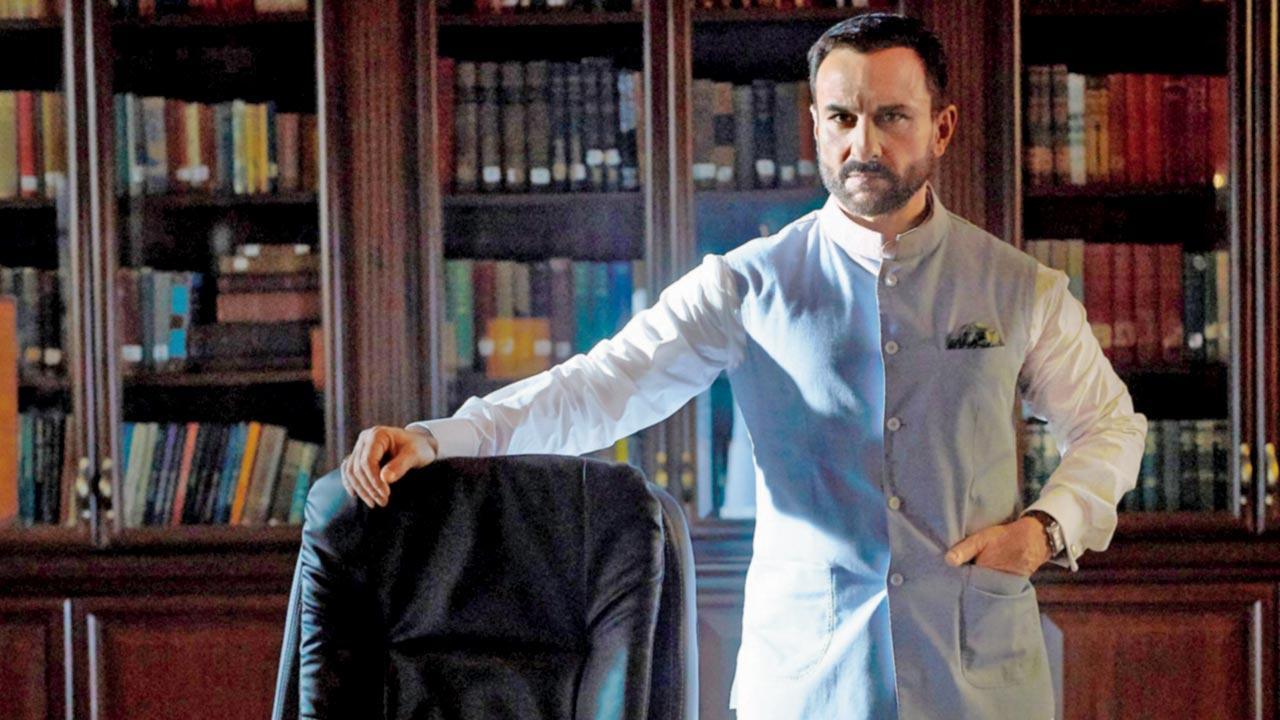
The I&B Ministry had introduced the Information Technology Rules after the Tandav fiasco in 2021
Weeks after I&B Ministry floats Broadcasting Services Regulation Bill 2023, OTT players wary of proposed advisory council that will regulate content; fear curtailment of creative freedom
Mohar Basu (MID-DAY; December 7, 2023)
In the past few years, the broadcasting industry underwent a sea change due to the advent of direct-to-home (DTH), Internet protocol television (IPTV) and most significantly, over-the-top entertainment (OTT). Consequently, the Ministry of Information and Broadcasting (MIB) emphasized that regulatory measures should evolve in tandem with these changes.
Last month, the MIB presented the Broadcasting Services Regulation Bill 2023. By replacing the Cable Television Networks Regulation Act of 1995, it wants to bring diverse broadcasting services—including OTT and digital news platforms—under a single regulatory framework. The MIB contends that it will help establish a comprehensive legal structure for the entire broadcasting sector.
One of the important features of the bill is the proposal of establishing a Broadcast Advisory Council. This will be over and above the Content Evaluation Committee, the self-regulation committee that each platform had to put into place from 2021, as per the Information Technology Rules. The proposal has evoked paranoia in some sectors of the OTT industry.
A top executive at Sony LIV, on condition of anonymity tells mid-day, “The industry had pre-empted this because self-censorship has been the internal diktat for the past two years. Every show in development goes through three rounds of Standards & Practices [legal passes]. But [if the bill goes through], the committees will only become stronger and the leash on creative hands will be tighter.”
The proposed council will have one independent person with not less than 25 years of experience in media, entertainment, broadcasting and other such relevant fields, appointed as chairperson.
Joining the chairperson will be five officers nominated by the Central Government, representing the MIB, Ministry of Women and Child Development, Ministry of Home Affairs, Ministry of External Affairs, and Ministry of Social Justice and Empowerment. In addition, five independent persons nominated by the Central Government, with experience in the fields of media, entertainment, broadcasting, child rights, disability rights, rights of women, human rights, and law, will be roped in as members.
The move is being viewed by many in the industry as a means to curtail creative freedom on streamers. A filmmaker, known for his spirited and political movies, says, “It might get tougher to tell a lot of political stories, but that’s the challenge. Most of us are taking a cue from Iranian filmmakers. Stories of the democracy’s flaws won’t entirely stop. We just have to hide the messaging better, bank on comedy a little more, and do everything within the legal gambit.”
The bill not only confers the government significant censorship and regulatory powers, but also has penalties and contraventions for the broadcasters and digital platforms. For the first contravention, the broadcaster will be fined up to Rs. 20,000, and for the subsequent contravention, up to Rs. 1,00,000. The clauses within the bill empower the government to restrict the broadcasting of channels or programmes for reasons linked to “safeguarding India’s sovereignty, integrity, or security, maintaining amicable relations with other nations, and upholding standards of decency and morality.”
The MIB, which floated the bill on November 10, has invited feedback from the stakeholders and public within 30 days of its release. Commenting on this, a Jio Cinema executive says there will be pushback.
“One must remember, there is ample room for negotiation. One has to stop assuming that the government is trying to put its stooges in the committees and councils. [The council] will be a good mix because the industry is a money-churner represented by a diverse group of people with different ideologies.”
While some are concerned whether this will lead to banning of shows or movies by the government, a senior filmmaker dismisses the notion. “The fears are often from the OTT platform’s side, with Tandav [2021] having been made into an example. Now, the shows that aren’t seeing the light of day are only because platform heads don’t want to ruffle feathers. The OTT market will boom in the next five years, TV-plus will soon be a thing. At such a time, let’s make the money and gain some power before sharpening our pencils to tell the fiery stories.”
The Bill, at a glance
- Unified legal framework for the entire broadcasting sector
- It proposes to introduce the Broadcast Advisory Council, over and above the Content Evaluation Committee that assesses content compliance with Program and Advertisement Codes . It has prescribed advisory measures, warnings, censure, penalties or financial fines, applicable to operators and broadcasters. While the option for imprisonment and/or fines persists, it is reserved for exceptionally severe offenses
- Implementation of accessibility measures for individuals with disabilities
My clean shaven look has taken fans back to my Raaz days-Dino Morea
9:24 AM

Onkar Kulkarni (BOMBAY TIMES; September 5, 2023)
His bearded look grabbed a lot of attention and was perfect for some of the roles Dino Morea was seen in recently. “The decision to go clean-shaven again was because I hadn’t seen my face for three years,” he says as he sported the look in multiple projects back-to-back. He explains, “I had the beard for three years. I did Hostages, Tandav, and then The Empire with a longer beard. People saw me in this new look, liked it and so work kept coming in. It became my signature look.”
So, wasn’t it tough to come to a decision to go clean-shaven? “It wasn’t a hard decision. See, the look created a buzz because nobody really saw me in that avatar, especially the one from The Empire where my character looked menacing and dangerous. Even after The Empire, I continued to sport the beard because I did three films… one Telugu, Malayalam and a Hindi film (with the beard). I feel fine now in the new look. It takes a day or two to get used to it. These are beard stories. To shave or not to shave is a bit of a decision. It is a man's decision. Men also have these problems you see.”
His current look, he says, has taken his fans back to his earlier days. He shares, “It took them back to my Raaz, Pyaar Mein Kabhi Kabhi, Fight Club – Members Only days where I was always clean-shaven. Filmmakers have already seen me in a different light (in my bearded look). They have seen me perform. So, interesting stuff is coming my way, a lot in the negative space. Now when they see that I am clean-shaven again I don’t know if that changes, but a clean-shaven guy can also be menacing.”
If there’s one thing that changes Dino wishes is that he gets approached to play a romantic lead. He signs off saying, “I do miss playing the romantic lead. I want to do a really beautiful romantic film. I can’t wait to be a part of a lovely love story again.”
Bipasha Basu and I decided not to do any more films together as people would get bored-Dino Morea
8:23 AM
Onkar Kulkarni (BOMBAY TIMES; July 5, 2023)
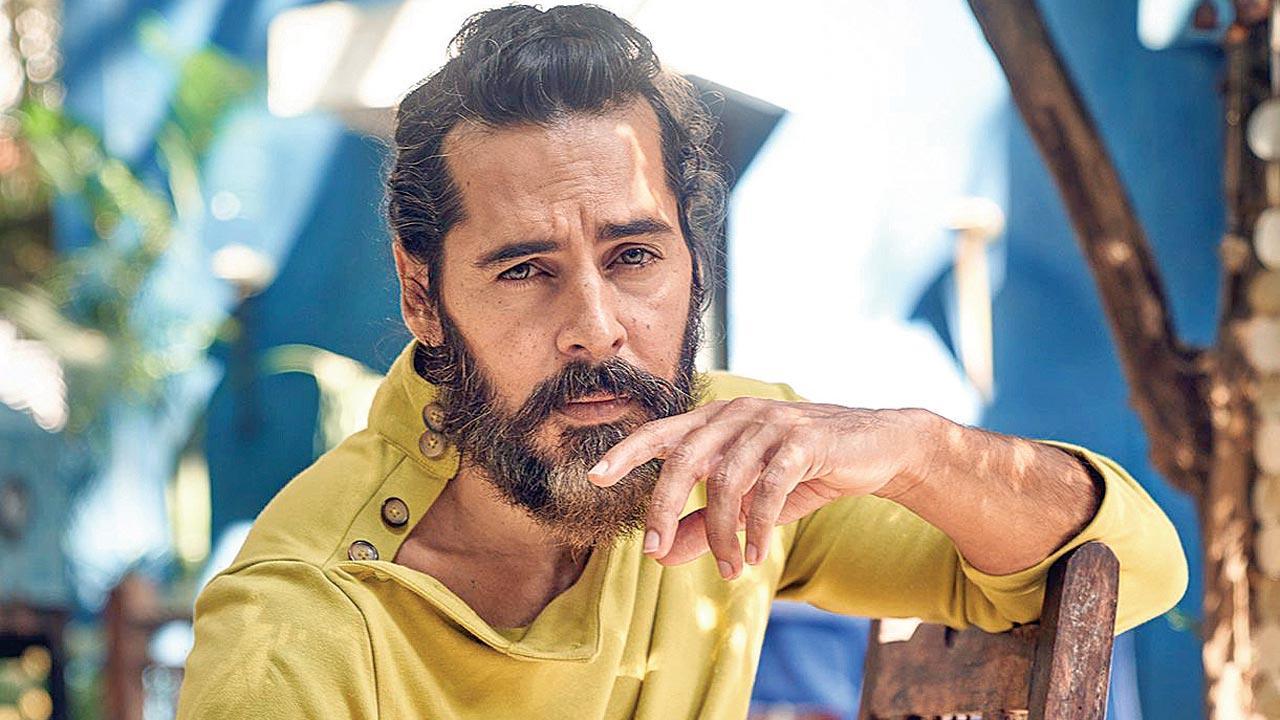
Dino Morea has been in the industry for over two decades and has seen his share of ups and downs. After a break and some self-introspection, the actor came back in the news with OTT shows like Tandav and The Empire. Dino, who is all pepped now, tells BT, “If I am still being offered work and getting acknowledged for it, I guess it means I have done something right.” Excerpts:
‘My career started with a bang, then it slipped and hit rock bottom’
Talking about his Bollywood journey, he says, “At one point, I was doing the same thing repeatedly. There was a time when filmmakers were casting Bipasha (Basu) and me in films, as we were looked upon as a hit jodi. I think we did around five films together. Then both of us consciously decided not to do any more films together because, ultimately, people would get bored. Then I did some ‘guy films’ like Plan and Fight Club – Members Only. My career started with a bang, then it slipped and hit rock bottom. There are times when you are tempted to pick up a small role because the money offered is huge, but you have to stand by your decision. Today, my driving force is nothing but good roles.”
He adds, “Sustaining in this industry is tough. If you are not from the film industry, you often think you are being guided correctly by people who are from here, but later you realize that everyone is only looking out for themselves. The film industry taught me a lot. It opened my eyes in so many ways. When your stocks are low, people will not give you movies and that’s the time you have to work on yourself and hope that something comes your way and grab it before somebody else does.”
‘I am dying to do a big theatrical film, something that could be hugely successful like Raaz’
At one point, the actor started turning down offers, elaborating on that phase of his life, the Tandav actor says, “I had started doing smaller roles with the hope that one day I will get a bigger role in a big film. Then one day, I decided that I should start declining projects that had nothing for me to offer. I was worried about whether I will get work in films again. Because, as they say, out of sight is out of mind. There are times when you are tempted to pick up a small role because the money offered is huge, but you have to stand by your decision. Today, my driving force is nothing but good roles. Fortunately, the OTT space opened, offers started coming in, and people are appreciating my work. I am all pepped up now. Give me a great role and I will smash it. Today, I am dying to do a really big Hindi theatrical film… something that becomes hugely successful, commercially, like Raaz.”
‘They always love to see a bad boy on screen’
In recent times, Dino has particularly enjoyed essaying characters with grey shades, like he did in his Telugu debut Agent earlier this year. He shares, “Gone are the days of being heroes or villains, today, it is all about playing characters. Every film is about characters and if you play your character well, then people will love it. It doesn’t matter whether you are playing an antagonist or a protagonist, it is about what you are adding to the story. As a villain, you can bring a certain madness to the screen. The audience loves to see a bad boy on screen.”
Self-regulation of OTT platforms has been successful, say panellists at FICCI Frames
8:17 AM

Niharika Lal (BOMBAY TIMES; May 9, 2023)
From “overdose of kissing” to “excessive alcohol consumption” to content hurting sentiments, OTT platforms have been subjected to various complaints and FIRs in the past. From Sacred Games, Tandav, Mirzapur to A Suitable Boy, many complaints have been filed against makers of shows. There is a constant controversy vs creative freedom tussle on OTT. During a discussion titled ‘Digital Media: taking stock of self-regulation’ at FICCI Frames 2023 in Mumbai, the panellists – which also included Vikram Sahay, Joint Secretary, I&B – spoke about how self-regulation of content on OTT platforms has changed the scenario for the better.
‘ONLY 13 COMPLAINTS HAVE COME TO THE SECOND TIER IN THE LAST 22 MONTHS’
Producer Madhu Bhojwani, who is a member of grievance redressal board, shared her experience of being on the board for two years and said, “I think in 2021, when this document titled Code of Ethics was circulated, it was read with a lot of trepidation. But I think the community (of creators) has taken it very well. When the IMAI (Internet and Mobile Association of India) approached me to join the Council I was very happy because I had the privilege of learning what are the grievances and complaints that are coming forward.”
Talking about complaints, she said, “It’s been two years since and over these last 22 months, only 13 complaints have come to the second tier. On the advice of the ministry, there have been two reviews that have happened on certain platforms. I think pre-2021, the amount of litigation and discord that was prevalent and willy-nilly cases were being filed and creators were taken to the court. At that time there was a lot of concern among creators, but post 2021, once this regulatory framework has come into place, the first tier has become an interesting filter. This is such a robust framework that complaints are being addressed at the first level. What doesn’t get rectified at the first level as a filter comes to us (second level).”
‘IF CITIZENS HAVE A GRIEVANCE, THEY HAVE A FORUM TO GO TO’
Vikram Sahay, Joint Secretary, I&B said that when the self-regulatory structure started, they were not clear about what to do because the OTT space is different. He added, “We were grappling with ideas from abroad and we had various options. Some people said films coming to OTT should be pre-certified. We also had a Singapore model where they have digital media authority and then we had an e-commission model from Australia. We looked at all those options and we said, ‘No, the government has a lot of trust and faith in the creators of films and web series.’ With that faith we embarked upon the concept of co-regulation with a strong citizen-centric framework of grievance redressal. So that if citizens have a grievance they have a forum to go to. We have been working on a co-regulatory model.”
A THREE-LEVEL GRIEVANCE REDRESSAL SYSTEM
Currently, there’s a three-level grievance redressal mechanism in place for OTT content, where platforms are required to have a Grievance Redressal Officer and self-regulatory bodies, while the I&B ministry has an inter-departmental committee for hearing grievances. Majority of the OTT platforms are either registered with IAMAI-DPCGC (Internet and Mobile Association of India – Digital Publisher Content Grievances Council) or DMCRC (Digital Media Content Regulatory Council).
Like many of us, I tried to give the impression of being busy on social media, but the truth was that I hadn’t worked-Shonali Nagrani
8:47 AM

The actress talks about her separation from her husband and the separation from her husband and the difficult phase she went through difficult phase she went through after her marriage went kaput
Neha Maheshwri (BOMBAY TIMES; April 25, 2023)
The last few years have been challenging for Shonali Nagrani. She struggled to bounce back after her marriage with Shiraz Bhattacharya, a photographer and cinematographer, hit choppy waters. They tied the knot in February 2013 and went their separate ways in early 2019 owing to irrevocable differences. However, instead of surrendering to her fate, Shonali has managed to pick up the pieces of her life and bounce back. In an exclusive chat, the actress says, “My husband and I parted ways in February 2019 and the divorce proceedings are going on.”
Shonali says, “I was emotionally destroyed at one point, and didn’t have the energy to invest in work, family or myself. I hated myself and my self-esteem hit rock bottom. I didn’t realize when I bid adieu to the old Shonali, who loved to giggle and laugh. But soon, I felt I had a choice to feel like a victim and stay bitter or to focus on picking up the pieces. I chose to heal and turn my adversity into a blessing. I used it as a stepping stone towards personal growth and self-discovery.”
Shonali, who has hosted several shows including an Indian cricket league, says, “After getting married, I didn’t work for five years, which made it difficult for me to restart my career. Like many of us, I tried to give the impression of being busy on social media, but the truth was that I hadn’t worked. At one point, I was so shattered that I considered leaving Mumbai and showbiz to move to Goa.”
But destiny had a better plan and just around that time, she got a call from a casting company and soon bagged a role in the web show Tandav. “It felt like a miraculous turn of events,” says Shonali, adding, “I didn’t even have to audition for the role and before I knew it, I was sitting in the producer’s office signing the agreement. That project truly saved me from giving up on the industry and the city.”
However, soon after she got her first project after a long break, Coronavirus struck, and work slowed down again. She says, “It forced me to put my plans on hold, as everyone was confined to their homes. However, this unexpected break turned out to be a blessing in disguise, as it compelled me to confront and work through my past traumas and self-doubt. I isolated myself and refused to face the world until I had healed. Meditation, yoga and a nutritious diet proved to be immensely helpful.”
Shonali is currently shooting for the second season of the web series Sunflower. She says, “I must admit that our industry is beautiful and it just keeps giving you work. All youhave to do is be positive.”
The actress admits that the renewed perspective on life has also changed her approach towards her craft. She says, “Most actors doubt themselves while approaching a scene. That second-guessing has left my system, because I think I have got rid of the fears, doubts, and self-hate. The tough period also taught me not to take life and myself so seriously. You should be able to laugh at yourself and laugh in the face of adversity. From that perspective, my marriage was my biggest teacher.”
On the personal front, does she miss having a companion? “I have been single for the past four years and I am loving every bit of it. Of course, I do (miss having a companion), but it’s momentary. It passes like everything else. I probably have developed trust issues, but I am yet to put them to the test,” she signs off.
Legal budget for films and OTT up by 100-200%
8:18 AM

From ‘hurt sentiments’ to defamation, with makers being dragged to court over endless lists of complaints, up to 10% of a film’s budget is now spent on legal counsel
Niharika Lal (BOMBAY TIMES; February 28, 2023)
“OTT ki aaj ki date mein himmat nahi hai, Tandav ke baad sab dar gaye hain,” Anurag Kashyap said recently while responding to a query on Sacred Games Season 3. At least three criminal cases were filed against Tandav’s cast and crew, citing disruption of religious harmony. Tandav isn’t the only one. In recent years, series such as Mirzapur and Trial By Fire or films like Gangubai Kathiawadi and Samrat Prithviraj were also dragged to court over complaints.
Lawyers who have represented these films and series say that until a decade ago, film litigation was mostly limited to international studios claiming copyright infringement, but now – from defamation to ‘hurt sentiments’ – almost every other film is being dragged to court over an endless list of complaints. An expert legal team has now become crucial for a film/web series and their legal budgets have also gone up. We spoke to a few lawyers to understand this scenario.
‘LEGAL TEAMS ARE CRUCIAL BECAUSE MAKERS CAN’T AFFORD A PROHIBITION ORDER’
Ruby Singh Ahuja, senior partner, Karanjawala & Co, who was involved in litigation related to Jolly LLB, Tandav and Mirzapur, says, “Filmmaking involves huge expenditure and no filmmaker can afford a prohibition order on the telecast of the film, especially in today’s day and age when the shelf life of a film is relatively short.”
“To avoid unnecessary litigation it is common not only for in-house legal teams to review the script, but also for production houses to take advice from external counsel, especially when it comes to issues of defamation or infringement of copyright,” she adds.
‘LEGAL EXPENSES COULD BE ANYWHERE BETWEEN 1-12 LAKH’
Meghana Chandorkar, partner, TMT Law Practice, says, “Depending on the film’s budget and other factors, the portion that is attributed to the legal team on board could be anywhere between 3-10% of the film’s budget. Roughly, legal team budgets have increased by 100-200% over the years.”
Pritika Kumar, founder, Cornellia Chambers, adds, “The legal budget of a film depends on the overall budget of the production and the studio involved and can range from 1 lakh to 12 lakh or more.”
‘THE BIGGER THE FILM OR THE STARS INVOLVED, THE HIGHER THE CHANCES OF LITIGATION’
Chandrima Mitra, partner, Media and Entertainment Practice, DSK Legal, says, “Film litigation has almost become a means of publicity. The bigger the film or the stars involved, the higher the chances of claims and litigation. Unfortunately, for many, it’s like getting their five minutes of fame. Besides, it’s easy to send notice to anyone. The instances of frivolous litigations have increased significantly over the years and most of these litigations get filed in the last two weeks before the release of the film.”
‘BOLDER CONTENT MEANS MORE LEGAL EXPENSE FOR FILMMAKERS’
Pritika Kumar, founder, Cornellia Chambers, says, “Earlier, cases were usually filed for copyright infringement, especially by foreign studios where Hollywood movies were being remade in India without acquiring their rights. Now, with the advent of OTT, content has become bolder and so there has been a rise in litigation against movies for hurting cultural and religious sentiments. Filmmakers are also filing more cases because they are starting to understand the value of their intellectual property and the consequences of its exploitation.”
WHAT’S THE ROLE OF LEGAL TEAMS IN FILMS?
Meghana Chandorkar shares that legal teams are involved in the process from the stages of ideation to until the final cut of the film is ready. “The legal team reviews the concept, story, character descriptions, dialogues and the entire script as far as possible to assess the originality or identify and assist with the acquisition of all required third-party rights. They also carry out a risk analysis of the script,” she adds.
“After the script is cleared, the legal team is also consulted during the production process, with queries pertaining to the use of third-party content, music, clearances, use of brands and names, depiction of emblems, and revision of dialogues, script deviations and changes, etc. The legal team also watches the edited film to highlight issues, non-compliances, censorship violations, etc,” Meghana further says.
‘VETTING SCRIPTS ALLOWS ONE TO GAUGE THE LEGAL RISKS INVOLVED’
“Vetting scripts and content has become a crucial function of legal teams. Most big studios and OTT platforms have in-house teams to carry out this function, while some engage external legal counsel for this work. Vetting allows one to gauge the likely legal risks involved and the legal and creative teams work together to create solutions to reduce the legal risks while also maintaining the authenticity of the production,” says Pritika Kumar.
THE MOST COMMON CASES OF FILM LITIGATION ARE:
- Religious sentiments being hurt
- Distortion of facts
- Obscenity
- Portrayal of people (religious leaders, historical figures, etc in a negative light)
- Language which is offensive to specific communities or castes
- Defamation
- Violation of privacy and publicity

I think we should all be doing web shows-Saif Ali Khan
7:59 AM

Actor Saif Ali Khan says he is fortunate to be living in times of OTT
Juhi Chakraborty (HINDUSTAN TIMES; November 12, 2021)
Saif Ali Khan is one of the first mainstream actors, who made the bold move to dabble into the world of OTT back in 2018 with Sacred Games. He also went on to star in another web series, Tandav, and his film Bhoot Police saw a direct-to-OTT release recently.
“Traditionally, the small screen has been less glamorous than the big screen but these guys (OTT players and makers) spent money to make the small screen bigger than what’s happening on the big screen. It is an incredibly revolutionary thought,” points out Khan. “It [Sacred Games] was nominated at the International Emmys! When does that happen for me? Never!” he chuckles.
Back then, the concept of OTT platforms was still in a nascent stage in the country. Talking about what pushed him to take the plunge, the 51-year-old reveals, “I think, it was the first time for me to get something first in life.”
He explains, “It is not really my thing to try and be a pioneer in any way. But in a way it [decision to embrace OTT] proved lucky. It is fairly logical [to assume] that if a big OTT was to come to India and there’s a production house that likes to experiment, then one of the names that would come up [in terms of casting] would be mine, because I have been on the edge of looking for something like that [before anyone else].”
The actor says that he is happy to see that everyone is now interested in the web medium. “I see (actor) Ajay Devgn also doing something on the web and I feel so good [to know about it]. I think we should all be doing web shows.”
And ask the Jawaani Jaaneman (2020) actor his thoughts on the OTT vs theatre debate, he shares that the debate is redundant given that there is no competition between the two. “They are entirely different things. We are very lucky as audiences as well as actors that there is a platform like the OTT. For an economy to thrive, you need different competitive ideas. I don’t think OTT and cinema are competitive, necessarily. They can work well together,” ends Khan.
Ranveer Singh pulled off Padmaavat's character with such finesse. The comparison is a compliment-Dino Morea
8:06 AM
Dino Morea hopes his menacing act of Shaybani Khan in The Empire will kick off a new phase in his career
Mohar Basu (MID-DAY; August 27, 2021)
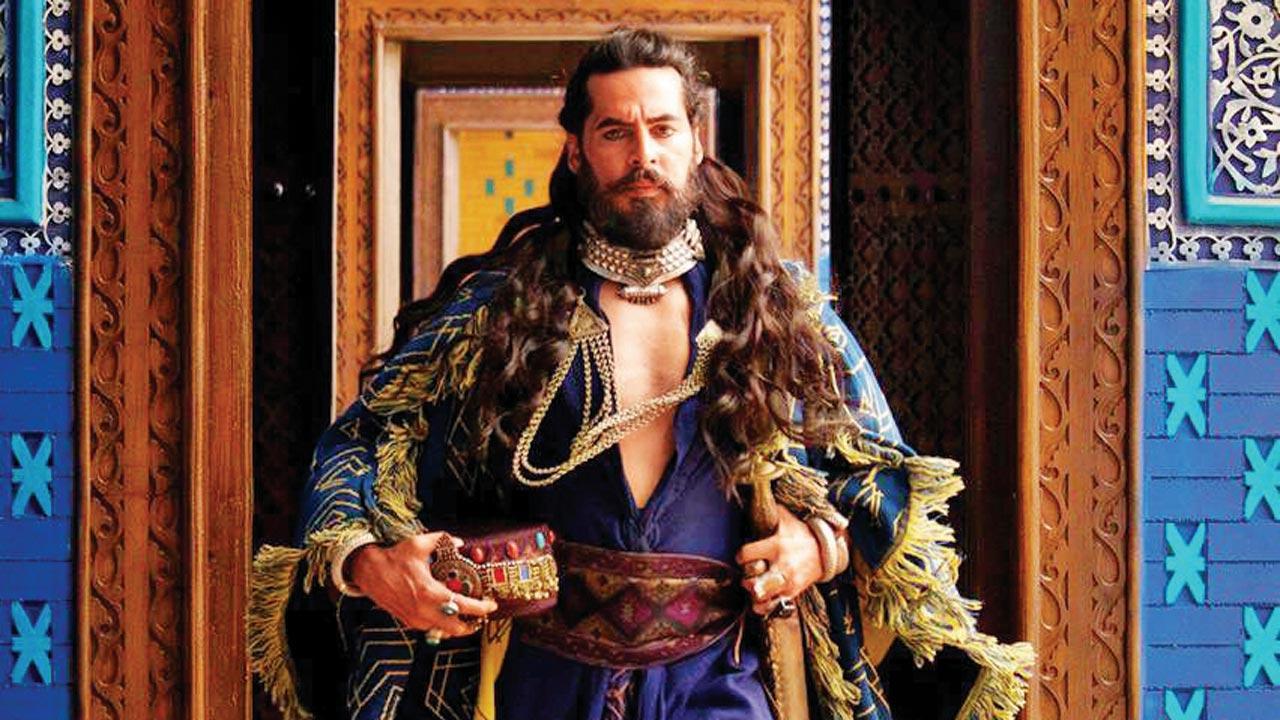
"Finally, it feels like good days are here,” begins Dino Morea, who considers The Empire a new lease of life that he has been awaiting for a decade. The actor plays Shaybani Khan, the nemesis to Kunal Kapoor’s Babur, in the Disney+ Hotstar offering. Morea, who likens the character to a ferocious panther, says he prepped hard to slip into the part, giving him kohl-lined eyes and a ruthless air. “Shaybani has animalistic traits. He is cunning and agile. When I read the episodes, I knew it was an opportunity of a lifetime. I worked extensively to imbibe the stealthiness of the part. He is a guy whose next move can’t be predicted; I gave him a madness of his own,” he says.
The character’s fierceness has reminded many of Ranveer Singh’s portrayal of Alauddin Khilji in Padmaavat (2018). “At least I am compared to the very best. Ranveer pulled off that character with such finesse. The comparison is a compliment,” laughs Morea.
After foraying into films with Pyaar Mein Kabhi Kabhi (1999), the actor was typecast as the chocolate boy and featured in several forgettable movies. He hopes The Empire will be the beginning of a new innings. “There have been far too many disillusioning years where I kept saying no to everything coming my way. The wait can make you insecure. People around would keep saying that out of sight is out of mind in this industry. I could’ve been disillusioned, but I decided to stay afloat.”
In his bid to find content that he believes in, Morea turned producer. His second production Helmet will drop on ZEE5 next week. The actor-producer is flush with optimism as he says, “Tandav and Mentalhood were the warm-up for this big break in The Empire. There is a sense of maturity that has come to my acting. I have worked on myself and am picking my roles with caution. I love the compliments on my looks, but I refuse to just be an eye candy. The constant endeavour is to deliver performances that prove my mettle as an actor.”
Aaj kal birthday, phone aur social media pe chala jaata hai-Sunil Grover
8:06 AM

Kavita Awaasthi (HINDUSTAN TIMES; August 3, 2021)
“Aaj kal birthday, phone aur social media pe chala jaata hai,” shares Sunil Grover, who turns 44 today. He adds mentally, he is just 27! The actor, who has no plans of ‘celebrating’ the day, says, “Some people, who you have worked with, point out that ‘I posted a wish for you and you didn’t reply’. The expectation is fine. But I like celebrating the birthdays of others as I feel shy cutting my birthday cake. When I was younger, I looked forward to gifts and my mum’s gulab jamun cake. I’d plan for it a month in advance. Now, I wait for her to send me one.”
On the work front, after his recent web series Sunflower, Grover is preparing for a film in September and another project that starts in November. He admits after his recent projects including Tandav, he is “enjoying acting”. The Bharat (2019) actor says, “It is fun to act and I am getting the kind of work I want. Producers want to start shooting but the pandemic has upset plans. Everyone is scared and can’t decide when to start. Standing costs have increased, so everyone is wary. Things will take time.”
Grover, who established himself as a comic actor on television, says he doesn’t differentiate between mediums. “TV, OTT and films are all part of entertainment. I am here because of TV and I get offers for it. If I get something suitable, I will do it,” he explains.
With people turning to digital platforms for fresh content, Grover is glad that talent is getting opportunities. He adds, “There is so much consumption of content be it on OTT or even social media. I guess, the more, the merrier. On the other hand, due to too many options, survive wohi karega, jo log dekhenge. So, by default, the bar is raised each time for you to perform and create something.”
I think censorship on OTT will help the makers-Sohum Shah
8:11 AM
Ahead of Maharani’s release, Sohum says government’s regulations for streaming platforms to benefit makers
Uma Ramasubramanian (MID-DAY; May 25, 2021)
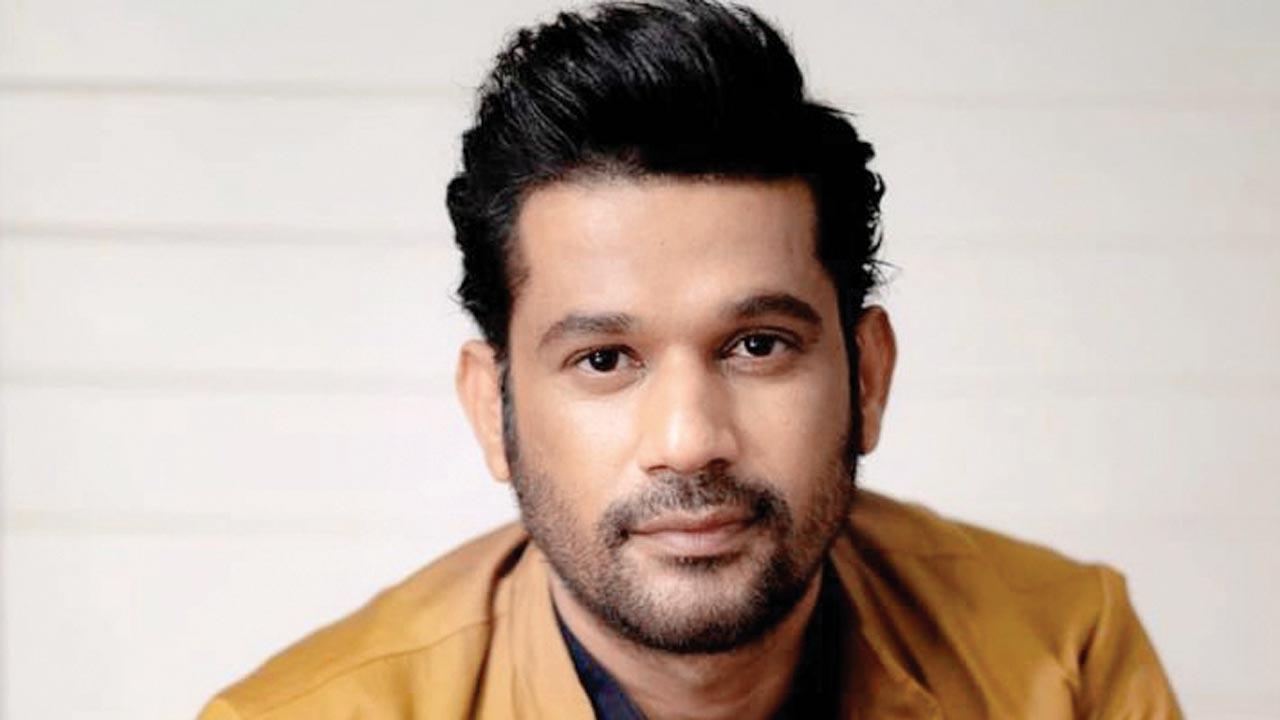
If the trailer of Maharani is anything to go by, the Huma Qureshi-starrer appears to be inspired by the 1997 appointment of Rabri Devi as the Bihar chief minister. After then-chief minister Lalu Prasad Yadav had to resign from the post due to his alleged involvement in the fodder scam, many believed he retained control of the state by making his wife the ceremonial head. Sohum Shah, who plays a chief minister adopting a similar strategy in the Sony LIV original, however, insists that the show is a work of fiction.
“I play a Bihari politician, but not any real person in particular. When I was given the narration, I realised the script and my character were powerful. My character has his own political agenda [in making his wife the chief minister]. He has shades of grey, but instead of judging him from a distance, I read more about the character and understood his thought process,” says the actor.
Set in the murky world of politics, the Subhash Kapoor-created series also underlines the caste divide in India. “Casteism exists in our country, which shouldn’t be the case. There should be equality, and the show touches on these aspects.”
After the release of Tandav sparked a huge controversy earlier this year, content creators are walking on eggshells whenever developing a political thriller. The episode led to the Information & Broadcasting Ministry calling for age-based classification of content and a three-tier regulatory mechanism. Shah backs the move, believing that it’s in the best interest of makers. “I think censorship will help [the makers]. Otherwise, anybody files a case against OTT platforms, knowing that they are vulnerable. Like films, OTT offerings too need a [regulatory] committee.”
The roles being offered and the response for my work, make me feel like I have started afresh-Sunil Grover
8:04 AM

Kavita Awaasthi (HINDUSTAN TIMES; March 31, 2021)
Sunil Grover is still basking in the compliments for his performance in the web show, Taandav. The actor says he feels fortunate to receive so much love. “It felt good as it came after a while. It was a big deal that people acknowledged my efforts in another kind of setup. Due to my comic background, to be seen and accepted in a different role was a chance for me and thankfully, it paid off,” he says.
Does he think the role is a game changer for him? “Time will tell if people think of me differently. But the acceptance gives me immense confidence,” he states.
With the bouquets came brickbats too, as the show was also embroiled in a controversy regarding a scene which was later edited. Grover admits it’s a free world and everyone has an opinion. He wishes the whole show had remained wholesome and the focus had remained just on the show than the controversy, but it was “bitter sweet”.
Grover rose to popularity with comedy shows on TV, especially Comedy Nights With Kapil and The Kapil Sharma Show. But since 2017, he seems to be focusing on other acting avenues, which are far removed from his comic image on the tube with movies Pataakha (2018), Bharat (2019) and now Taandav.
He shares that it is not a deliberate attempt. “I am getting new kinds of roles and they are exciting. It’s not that I am not choosing comic roles. All I am focusing on is choosing the best from offers,” says the actor, who will be seen in a web show, Sunflower next.
“I have done comedy for most of my career and sure, I miss it too. I do perform at events, etc so I get my fill,” says Grover, adding, he is enjoying this phase and his craft.
“The roles being offered and the response for my work, make me feel like I have started afresh. I feel like a newcomer. The toughest part is choosing good scripts, then wondering if you can do justice to it and deliver. It is quite taxing to get into character,” he concludes.
New OTT rules have no teeth, says Supreme Court
8:24 AM
This picture has been used for representational purpose
Court says rules have no provision of prosecution; grants protection from arrest to Amazon Prime Video’s India head in FIRs lodged against Tandav series
MID-DAY (March 6, 2021)
The Supreme Court on Friday said the Centre’s new guidelines on regulating over-the-top (OTT) platforms like Netflix and Amazon Prime have “no teeth” as there is no provision for taking appropriate action against digital platforms showing inappropriate content.
“We have received the rules you (government) have filed. These rules don’t have any teeth. There is no provision for prosecution. They are just guidelines,” the court added. The apex court also granted protection from arrest to Amazon Prime Video’s India head Aparna Purohit in FIRs lodged over web series Tandav.
A bench comprising justices Ashok Bhushan and R S Reddy observed that a law has to be framed to put in place a mechanism to control OTT platforms instead of mere guidelines.
Solicitor General Tushar Mehta, appearing for the Centre, said the government can come up with a better draft of the rules for the consideration of court within two weeks and the new rules were brought as a balance between “no-censorship and internal self-regulation”.
The top court had on Thursday observed that some OTT platforms at times show pornographic contents and there should be a mechanism to screen such programmes. It had asked the Centre to place its guidelines on regulating social media.
Mehta had said he would be placing on records the Information Technology (Guidelines for intermediaries and Digital Media Ethics Code) Rules, 2021.
The bench also issued notice to the Uttar Pradesh government on Purohit’s plea for anticipatory bail in FIRs on Tandav series. It said Purohit’s protection from arrest will be subject to her cooperating with the investigation and appearing before the police as and when summoned. The SC also directed Purohit to make Centre as a party to her plea.
Tandav is a nine-episode political thriller starring Bollywood A-listers Saif Ali Khan, Dimple Kapadia and Mohd Zeeshan Ayyub. Purohit has been accused of inappropriate depiction of Uttar Pradesh police personnel, Hindu deities and an adverse portrayal of a character playing the prime minister in the web series.
-----------------------
TIMES VIEW:
The Supreme Court, while very wisely dismissing a petition some years ago to ban a film on grounds of nudity and vulgarity, said, “If you don’t like, then don’t watch it… These are matters of art and entertainment and let them remain so.” Instead of championing the cause of greater freedom — and that includes artistic and creative freedom — it now wants government to censor OTT platforms. That’s a dangerous road to take, especially in an environment that has turned increasingly intolerant on many fronts — political, socio-religious, cultural. Also, the court is missing a fundamental difference between OTT and publicly-screened cinema, even broadcast television. OTT, by its very technology, is narrow-cast, and to try and dictate what people can or cannot stream online amounts to invasion of privacy. There are laws governing certain forms of pornography — notably child pornography — and they must be stringently enforced. Beyond that, it’s moral policing. Worse, to give any government licence to arbitrate on such definitionally amorphous concepts as taste and morality is liberty-limiting.
OTT guidelines doesn’t solve the problem of people taking offence-Priyanka Khimani
8:06 AM
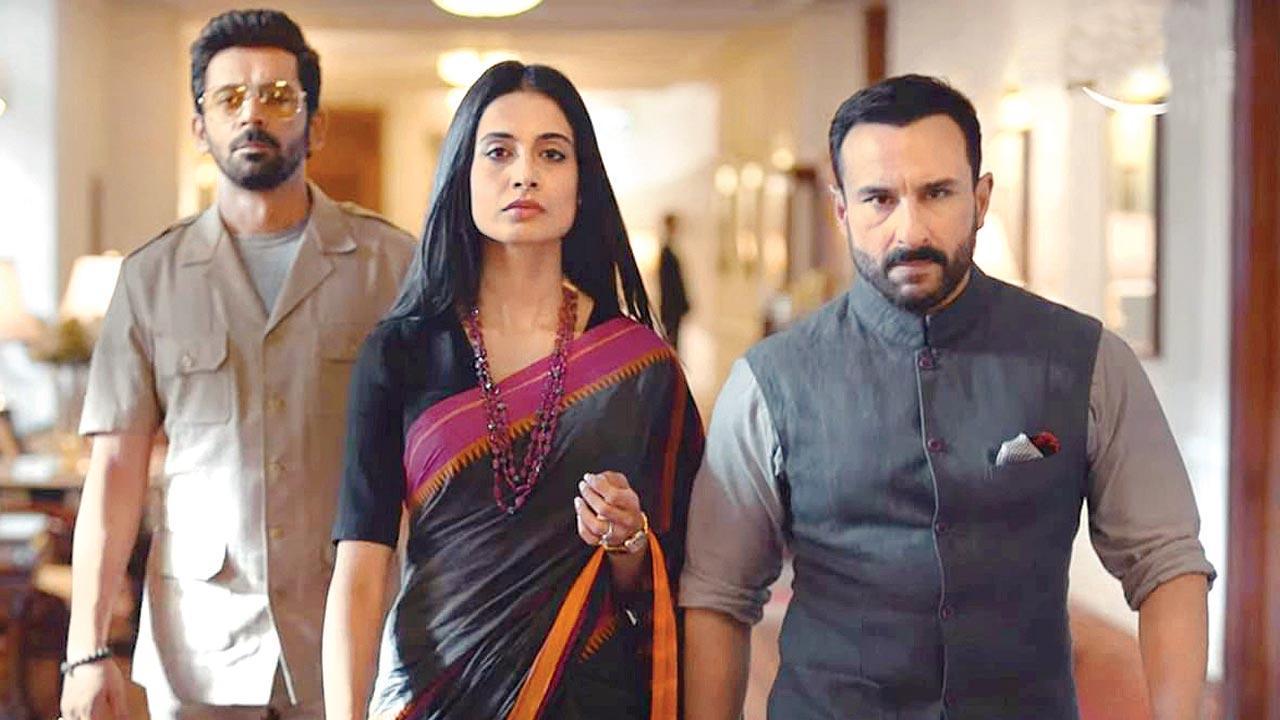
Entertainment lawyer says onus on creators to toe the line of caution as I&B Ministry introduces three-tier checks for OTT content, calls for classification of stories basis age
Mohar Basu (MID-DAY; February 26, 2021)
Barely a month after Amazon Prime Video’s Tandav faced the furore of people and had to undergo snipping of ‘contentious’ scenes, the Information and Broadcasting Ministry, on Thursday, released a set of guidelines, titled Information Technology (Guidelines for Intermediaries and Digital Media Ethics Code) Rules 2021. The move, viewed by many as a means to curtail the creative freedom of video-streaming platforms, comes three months after the government had first announced that OTT players will come under the ambit of the I&B Ministry.
According to the new rules, video-streaming platforms will have to follow a three-tier regulatory mechanism for compliance of ‘Code of Ethics’: self-regulation, regulation by the self-regulating bodies of the platform that will be headed by a retired Supreme Court Judge or high court judge, and finally, oversight mechanism by the central government. The last step will involve the I&B Ministry forming an inter-departmental committee for addressing grievances.
OTT platforms are expected to put a grievance redressal mechanism in place, where any grievance moved by users will have to be registered within 24 hours and disposed of in 15 days. Complaints against the dignity of users, particularly women, have to be addressed within 24 hours.
Reputed entertainment lawyer Priyanka Khimani notes that the guidelines are painted in broad strokes, without solving the issue at hand. “It doesn’t solve the problem of people taking offence against stories. ‘Ethnically objectionable’, ‘threatening the integrity of the country’ – these are broad terms [that have been used]. It puts the onus on creators and storytellers to toe the line of caution.”
She adds that the ability to tell stories with abandon might be curtailed. “Now, there is a sense of over caution, wanting to check and re-check. Lawyers are brought in at a nascent stage to vet concepts and stories. While checking if something is offensive or sexist or racist is an evolved way of telling stories, people are quick to react and judge without [understanding] the context. A lot of this offence-taking is needless sensationalism. If you take away the ability to reflect and comment on the state of affairs, what survives in a democracy?”
Another important feature of the guidelines was that OTT platforms will have to classify their content according to different age groups: U, U/A(7+), 13+, 16+ and A. The streaming giants will also have to employ parental locks. “The parameters of classification have been carefully elucidated,” adds Khimani.
At the press conference, I&B Minister Prakash Javadekar noted that OTT platforms were repeatedly asked to form self-regulation rules, but to no avail. “After the first meeting with OTT platforms, they didn’t come up with anything. Post the second meeting, and after waiting for six months, we decided to have an institutional mechanism. We have CBFC for films, and programme code (BCCC) for television. The same programme code [for television] will be followed for OTT platforms. We are not bringing censorship to films on OTT.”
OTT will lose its charm if brought under censorship-Manoj Bajpayee
8:28 AM
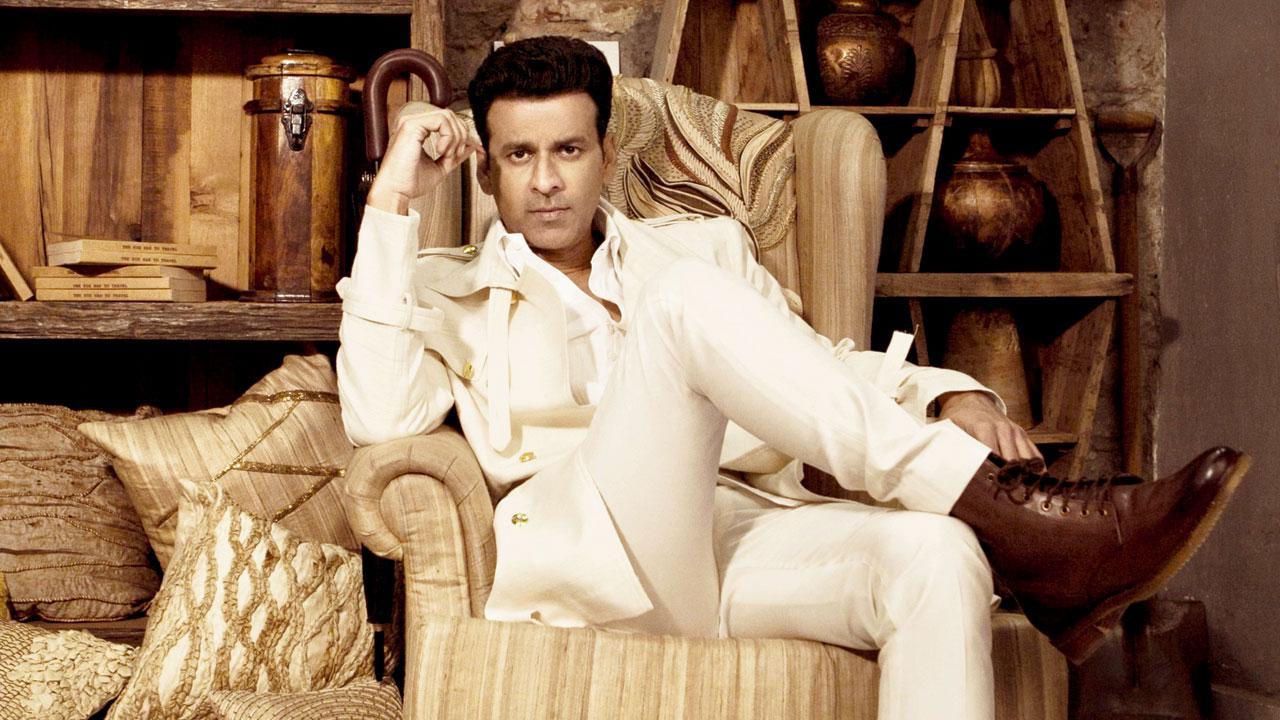
With The Family Man 2 deferred in the wake of Tandav controversy, Manoj Bajpayee bats for freedom of expression in digital entertainment
Mohar Basu (MID-DAY; February 15, 2021)
In his 26-year career, Manoj Bajpayee hadn’t attempted a whodunit until Silence came his way. What makes the Zee5 film all the more special is that it marks his first collaboration with a woman director.
“Aban Deohans and I have been friends since the early 2000s when her cinematographer husband Kiran Deohans worked with me on Aks [2001]. A year ago, when she narrated Silence to me, I wanted to do it because I had never dabbled in the genre before. It’s the first time I have received a script that lives up to all the elements of the genre,” says the actor, describing his collaboration with the writer-director as "enthralling".
"Not only did I work with Abaan, but Kiran was also around a lot. As a husband, he decided not to go behind the camera but instead look at the production work. His presence was a great contribution on set that enhanced the film. Abaan's daughter Tania was the Chief AD on the project. She is a talented and enterprising kid. It was set bustling with young people and I got to learn from fresh minds. I was so overwhelmed with the experience that when the film ended, I missed them and their energy so much - ambition and warmth," he adds.
In his usual candour, he jokes that there was another reason why he loved being on the film’s set. “Kiran’s set has the best food, so I was the happiest about that.”
Meanwhile, the fate of Bajpayee’s other digital offering, The Family Man 2, hangs in the balance. The suits at Amazon Prime Video decided to defer the release of the much-loved series after the streaming giant came under fire for their January offering, Tandav. “All of us were a little disappointed with the postponement. In this situation, Amazon has taken a decision for the good of the product that we are all very proud of. We want the show to be treated well, marketed well before it starts streaming. The show will come in Summers and that starts anytime right about now. We simply have to weather through the winter. I can’t wait to start the promotions all over again. In my opinion, this season is bigger and will deliver an unforgettable experience and I am curious to see the reactions of the audience.”
In an earlier interview to mid-day, Bajpayee had expressed optimism about video-streaming platforms coming under the ambit of the Information & Broadcasting Ministry. The recent incident where the Tandav makers had to tender an apology and remove the contentious scenes is being viewed as only the beginning of a systematic clampdown against OTT platforms. Does he feel disheartened by the turn of events? “I would only pray that there is no censorship. I am morally opposed to banning and censorship in any form. As a citizen of the country, I want creative people to have the freedom to express their opinions in the manner in which they wish to. At the same time, I would hope that they do so responsibly. OTT will lose its charm if it comes under Censorship. At this point, that’s the fear looming over every creative person. I want OTT space to be liberating in its basic nature. I want filmmakers to keep flying and soaring with ideas, creating fresh experiences with each outing."
How come people are getting so easily hurt on anything and everything?-Bidita Bag
8:14 AM

Bidita Bag talks about why she doesn’t support censorship on OTT platforms, wonders why people are so sensitive about everything
Juhi Chakraborty (HINDUSTAN TIMES; February 5, 2021)
The debate over censorship on OTT has reached a new height after makers of the web show Tandav agreed to censor out scenes which have allegedly hurt religious sentiments. Actor Bidita Bag, who has done a considerable amount of work on digital medium, says she’s not in favour of censorship of any form on OTTs. “I don’t think there’s anything wrong with it if one wants to watch something. An adult should have the choice to watch what they want to. Censorship nahin honi chahiye. Things are getting so difficult,” Bag, 29, says.
The actor finds it odd that people have become so sensitive, and adds, “I don’t know what is wrong with people and how their sentiments are getting hurt so much. How come they are getting so easily hurt on anything and everything? These are very difficult times, we need to select our priorities... Why can we concentrate and talk about real issues?”
As an actor and a creative person, Bag finds censorship of any kind to be a damper. “Censorship is there at every level when you become an actor. The first kind happens with the budget. Whatever your vision is, it’ll be constrained by the budget. Then we create something extraordinary, and censor people tell us to remove this and that. This is not fair for filmmakers and actors. Creativity gets killed at every level,” she explains.
However, Bag, who has done films such as Babumoshai Bandookbaaz (2017), The Sholay Girl (2019) and stars in the upcoming film, Fauji Calling, says the audience as well as makers have to step back and rethink. “Think what you make and be responsible. That’s all that we can do. Even the audience should ensure that they only support projects with good intent,” she concludes.
I stuck around even when it got hard and when I had no work-Sarah Jane Dias
8:16 AM

Playing a prominent role in Tandav, Sarah-Jane Dias reflects on how she bounced back in the game with web offerings
Letty Mariam Abraham (MID-DAY; February 2, 2021)
After floundering in Hindi cinema initially, Sarah-Jane Dias found her rhythm as she chose projects that spoke to her — be it the brave Angry Indian Goddesses (2015) or the mainstream Inside Edge. With Amazon Prime Video’s Tandav, the actor has added a bold political drama to her resume. In a candid chat with mid-day, Dias discusses playing a character far removed from her real-life persona, and all that went into getting it right.
Edited excerpts from the interview.
What was your reaction when Tandav was offered to you?
I was asked to audition for the show. At the time, all I knew was that Ali Abbas Zafar was directing it. I had no idea Saif Ali Khan would be a part of it. Ayesha Pratap Singh [her character] is phenomenal and strong; I love her interaction with Samar. I was excited about the series because of Ali. He is thorough with his work.
Do you keenly follow politics?
I keep abreast of everything that is going on, but I don’t dive deep into politics.
What about Ayesha’s character captivated you?
Ayesha knows that her place is right next to Samar, and she enjoys it. She wants to be a loving and loyal wife, and wants to make sure that her husband’s ambition is realised. She will do anything to make it happen. If her actions are perceived as competitive or calculative, then so be it. Ayesha is my polar opposite. She is reserved whereas I am outspoken. She is poised, secretive, dressed in sarees all the time while I am animated, trust easily, and rarely wear sarees.
How did you prep for this character?
I have learned some interesting tools over the years, and am diligent when it comes to preparing. I went through the episodes, and ensured that I have a timeline for my character so that I know what is happening before and after. The script was so perfectly written that my character’s traits could be imbibed just by reading it. Once the hair, make-up and wardrobe came into place, I felt more like the character. In terms of the preparation, one conversation with Ali was enough. I then did my own homework and developed the part the way I wanted to.
Any scene that felt empowering as an actor?
It was a scene that they included in the trailer — I say, “Congratulations, Mr Prime Minister” to my husband. The reason [the scene stands out] is because of the context behind it. I am a part of the political party, but I handle its social life.
With the show having grabbed eyeballs, do you think this role will affect your future prospects?
The series has shown a different side of me, which might surprise some people. I hope it brings more weight to my craft and proves that I am a strong actor.
Has your 18-year journey in the industry been fulfilling?
One of my good friends, Arunoday Singh, once said, “It is the ones that stick around, that really make it.” It’s one of the most poignant things any co-actor has ever told me. I stuck around even when it got hard and when I had no work. At times, I had too much work — I was doing everything from fashion shows to music [videos] and films. There was a time when I was holding the Miss India crown and doing endorsements for beauty products. I have also been busy with indie films.
Government to soon issue guidelines for shows on OTT platforms-Prakash Javadekar
8:34 AM
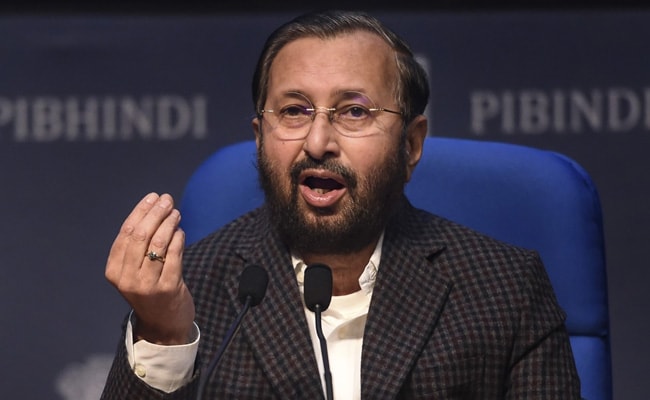
Swati Mathur (THE TIMES OF INDIA; February 1, 2021)
New Delhi: Union information and broadcasting minister Prakash Javadekar said on Sunday his ministry will soon issue guidelines to regulate content on over-the-top (OTT) streaming platforms like Netflix and Amazon Prime, in light of an increasing number of complaints against OTT content the ministry has received.
“We have received a lot of complaints against some serials available on OTT platforms. Films and serials released on OTT platforms and digital newspapers do not come under the purview of the Press Council Act, Cable Television Networks (Regulation) Act or Censor Board. We will come up with some guidelines on it soon,” Javadekar said.
The minister’s comments follow the recent controversy triggered by ‘Tandav’, the Amazon Prime web series that had to be censored despite its makers tendering an unconditional apology following multiple FIRs filed for hurting religious and caste sentiments.
Another web series – Mirzapur – was also pulled up by the Supreme Court for ‘maligning’ the image of the UP district by the same name.
The growing number of instances of online content on social media and OTT platforms running foul of public sentiments prompted the Indian government to examine regulatory mechanisms for OTT in other countries and draw from international best practices to tailor its own regulatory framework.
An internal government note TOI accessed also batted in favour of regulation, stressing the need to “streamline” the process through which websites and OTT platforms are set up in order to rein in “fly by night operators”.
Among other things, the government note considered following Australia’s example of asking Google and Facebook to share advertising revenues on news websites with newspaper publishers.
Tandav row: Writers decide to self-regulate; stay away from politically and religiously sensitive references
8:29 AM

After multiple FIRs and extreme pushback to political drama Tandav, lawyers are likely to vet web show scripts at inception. What does that mean for streaming regulation, and where does this leave the writer?
Aastha Atray Banan (MID-DAY; January 31, 2021)
A director like Hansal Mehta knows how to deal with, and digest censorship. His 2017 film Omerta told the story of Ahmed Omar Saeed Sheikh, a British terrorist of Pakistani origin, who was behind the 1994 kidnapping of tourists in India. In 1999, he was released and found himself safely in Afghanistan backed by the Taliban in exchange for the release of Indian passengers aboard an Indian Airlines hijacked flight. When the film went to the Censor Board, two scenes proved contentious: Omar relieving himself as the national anthem played, and the protagonist having violent sex preceding a terror operation. “I had expected that it would be problematic, but you [the filmmaker] can try. My argument was that it’s the character who is disregarding the national anthem, not me!” Mehta argues.
His argument would certainly not hold true today.
The last few weeks have been defining for freedom of expression for the entertainment industry in India. After Saif Ali Khan-headlined political drama Tandav, directed by top Bollywood maker Ali Abbas Zafar, premiered on Amazon Prime Video, dissenting voices said Hindu religion had been disrespected through scenes in the first episode. The first was a stage play where college students playing Shiva and Narada wonder how they can improve the former’s social media popularity, while another was seen as a casteist slur where Tigmanshu Dhulia, who plays Prime Minister Devki Nandan Singh mocks a Dalit politician. After the trolling, BJP MLA Ram Kadam filed a complaint at Ghatkopar police station on January 20, and an FIR was registered in Mumbai. On January 18, a FIR was filed against the director, producer and the writer of the web series, along with Amazon Prime Video’s India head of original content at the Hazratganj police station of Lucknow. Another one at Greater Noida, then Jabalpur, followed by a complaint in Patiala House, New Delhi. Even the Confederation of All India Traders wrote a letter to Prakash Javadekar, Union Information Broadcasting Minister, on January 19, asking to stop the streaming. Zafar apologised unconditionally, and the makers responded by deleting the scenes. Last week, the Supreme Court declined to grant interim protection to Zafar, actor Mohd Zeeshan Ayyub and others facing multiple FIRs, and remarked that an actor “cannot take up a role without reading the script”.
For Mehta, the brouhaha is unreasonable, because “Tandav is just a pot boiler”. But he suggests we don’t let despair take over.
“I get that people are depressed with what’s unfolding, but I also believe that this government is business conscious. The OTT ecosystem rakes in a lot of business. Perhaps we should keep away from religious and political content for a while.”
Mehta’s suggestion may be prudent but this means the end, or at least partial suspension, of freedom of expression that defined web shows in India. Last November, the government brought video streaming over-the-top (OTT) platforms under the I&B Ministry’s ambit instead of the Ministry of Electronics and Information Technology. While the government has demanded a list of what constitutes prohibited content and more muscle to the complaints mechanism, the industry had responded with what’s called an Implementation Toolkit. Following the scale of this recent protest, it could very well mean that makers and writers self-regulate, choosing to stay away from politically and religiously sensitive references.
It’s then the first officers of creation—the writers—who have the most rewiring to do, whether it’s with their beliefs or process. Mayank Tewari, writer of the critically acclaimed political satire Newton, and behind the dialogues for Ragini MMS, is currently working for a Netflix show. “Let’s see how things pan out. It’s curtailment for sure. Can we now show a policeman or judge as corrupt? I don’t know. The good part is that once the content is made, you can have a problem with it, but it will find its audience anyway, even if through WhatsApp. That’s the beauty of living in these times.”
But he also admits that because making a show or film takes a whole lot of money, energy and time, the investment is huge. “No one wants their time and money to go down the drain. So we will be told, ‘you are an entertainer, not an activist’. And when writers start second guessing, it’s not good. The trouble is that today anything can cause a problem — if you look at Kalidas’s poetry, it’s erotica about Shiva and Parvati. If we reference that, even that will cause a problem. We are a nation addicted to outrage, and anything can offend,” he says, adding that platforms and creators are now looking for legal backing, with lawyers likely to vet the script.
For Atika Chohan, who wrote Meghna Gulzar’s Chhapaak, which got into trouble as lead actress Deepika Padukone, visited JNU in her personal capacity to show solidarity with the anti-CAA protesters, auto editing creative thoughts is a reality. The idea of having legal vet a series is making writers doubt their ability and scope. “I read somewhere this crazy word called ‘cinema jihad’. Didn’t writers have enough of a struggle to put up while pitching their stories, that we now have to make sure no one gets offended. India is not an exciting place to be, the creative possibilities are shrinking,” says Chohan.
So, what’s the solution? Resourceful thinking. “History has taught us that in times like these, creatives find ways to say what they want—tiered narratives, metaphors, layers. In Iran, when creators were censored, they still told stories of social divide, but by using children as protagonists. Maybe, we need to do that, but right now I am angst ridden and worried.”
Sidharth Jain is the founder of the Story Ink, a platform that seeks film or dramatisation rights to books written by Indian authors. He says he isn’t surprised b the developments because in India, some things we don’t talk about. He is currently working on a book deal that concerns a fiction title. “And yet [after the Tandav episode], I told the writer, let’s go over it all over again. Fighting legal battles is expensive. Writers and creators can’t be expected to seek legal help in early stages [of creation]. For now, it’s best to stick to finding family comedies, where everyone is happy.”
Some argue that even in the absence of a censor body, the freedom to approach a court of law exists and can be used to stifle expression. Mihir Desai, senior advocate, Bombay High Court, explains that anyone can set criminal law in motion, and it’s harsh. Multiple complaints can be made against a single party across locations, complicating the matter. The police, of course, has the power to review the complaint and judge if an FIR should be registered. “Usually, complaints seem to get converted into FIRs in states where a particular ideology has political backing, and so the consequences are harsh.”
The irony lies in the fact, says a writer who didn’t wish to be identified for the story because he is pursuing a legal suit, that OTT platforms want cutting edge stories. But when the environment isn’t conducive, they have no choice but to take note. For an international player like Netflix, this means having to ascribe to multiple rulebooks, a different one for every market. An article published in The Hollywood Reporter in 2019 said: Until very recently, Netflix has always taken a “move fast and break things” approach typical of Silicon Valley startups, with most criticism of its shows either ignored or dismissed.”
After having a presence in over 190 countries, not anymore. In the past, the platform has got into trouble for smoking scenes in Stranger Things, for depiction of Palestinian terrorists in Fauda, and for kissing scenes in their Arabic original Jinn. Amazon Prime Video, which had admitted to self- censorship as early as in 2016, had said: “Amazon is a responsible company and we are here to entertain the Indian customer with award-winning content from the US along with blockbusters from Indian and regional makers. We will keep Indian cultural sensitivities in mind while offering this content to customers.”
Rangita Pritish Nandy, who created the racy Four More Shots Please!, for Amazon Prime, says nobody really starts out with the idea of offending. “The arts are a reflection of the times we live in, always have been. What we, as creators and producers, bring to cinema and streaming, finds its seeds in the world around us. I don’t really see that changing. What may change is the way we choose to say it. Blatant calling out will stop and intelligent profiling and writing will be celebrated. Streaming has shrunk the world. When the world is your audience, it makes you brave.”
Vishal Watwani, writer and producer for Helllo Jee, a show about phone conversations between call centre employees and men who need to be “entertained”, for ALT Balaji, says while we cannot expect to be free to say anything we like, censorship in India seems more about appeasing the powerful than reviewing content in the interest of audience good. He echoes the words of the senior counsel representing Amazon Video Prime in the Tandav case. Senior advocate Mukul Rohatgi, authorised counsel for Amazon India, had told mid-day last week, “People are entitled to make a political satire. If you don’t need to watch it, don’t; no one is forcing individuals to watch the collection. According to me, these circumstances are not about hurting individuals’s non-secular sentiments, however of individuals looking for publicity.”
Sumeet Vyas, who played dodgy politician Yudi in last year’s show Dark 7 White on ALT Balaji, says he is reminded of George Orwell’s 1984. “Whatever you say, think, write, or perform will be monitored. It’s not just harmful for actors, but for society. My argument is simple—if you think what actors perform has a negative impact on society, then what about all the stories [we perform] where good wins over evil? Then credit us and us alone also for all the good that has happened in this country.”
Subscribe to:
Posts (Atom)