Showing posts with label Soumitra Chatterjee. Show all posts
Showing posts with label Soumitra Chatterjee. Show all posts
Wes Anderson was curious to know what Satyajit Ray was like-Sharmila Tagore
8:20 AM
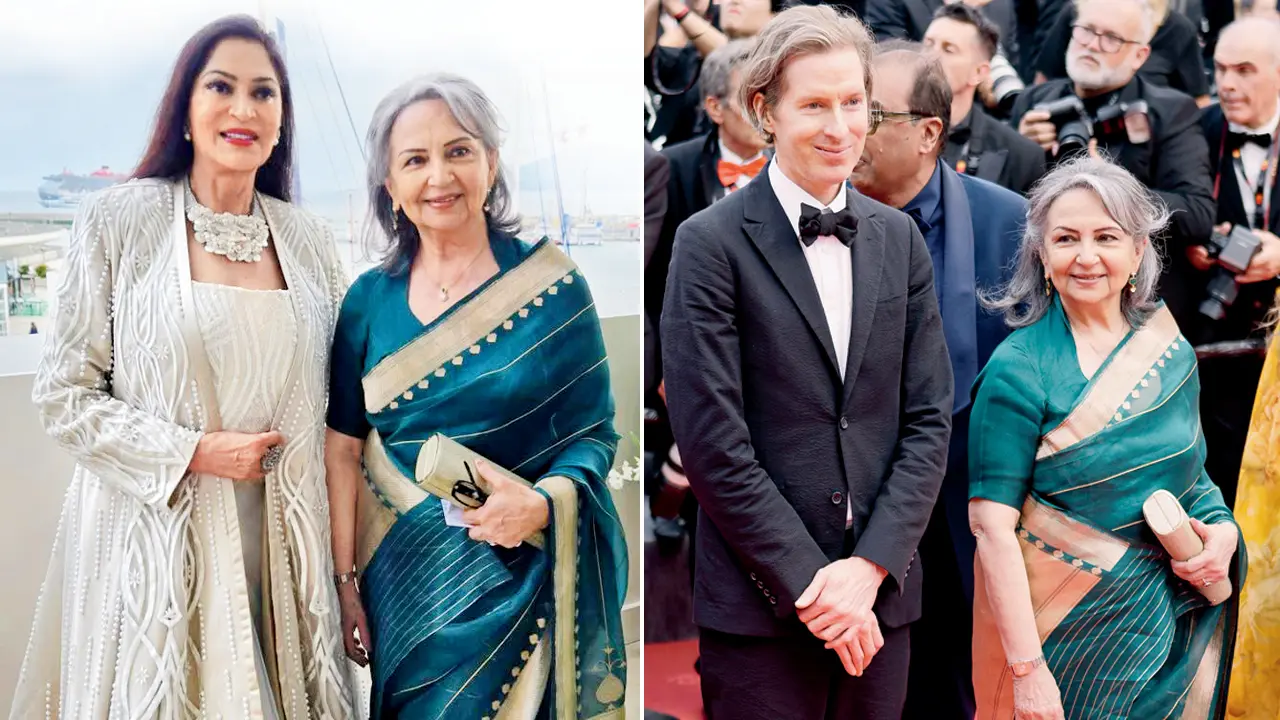
(From left) Co-stars Simi Garewal and Sharmila Tagore ahead of Aranyer Din Ratri’s screening; (right) (From left) Wes Anderson with Sharmila Tagore at Cannes. Pics/Getty Images, AFP, Wikimedia Commons, Instagram
Sharmila Tagore talks all things Cannes — from the standing ovation for Aranyer Din Ratri, to discussing Satyajit Ray movies with noted filmmaker Wes Anderson
Upala KBR (MID-DAY; May 24, 2025)
The thunderous applause, the standing ovation, and the pride she felt to be at the receiving end of it all. It’s a precious memory that Sharmila Tagore will keep close to her heart for a long time. “There was a standing ovation for a few minutes. People just clapped and clapped and clapped. We were getting tired of standing,” laughs Tagore, who returned only a few days ago from the special screening of Aranyer Din Ratri (1970) at the 78th Cannes Film Festival.
On May 20, a restored 4K version of late Satyajit Ray’s masterpiece was screened as part of the Cannes Classics section. Tagore and Simi Garewal, who had featured in the gem alongside late Soumitra Chatterjee, attended the event with noted American filmmaker Wes Anderson. Mention Anderson, who led Aranyer Din Ratri’s restoration and presented it at the film gala, and Tagore heaps praise on him.
“He was so respectful about Satyajit Ray, interested in and well-informed about his films. He was curious to know what Soumitra and Ray were like. I felt silly because I was not as well-informed [about his latest movies] as he was about ours. I have seen The Grand Budapest Hotel [2014], but not Asteroid City [2023], or I would have asked him about it.”
The veteran actor is no stranger to the Cannes Film Festival. After all, her 1960 movie Devi, directed by Ray, was in contention for the Palme d’Or at the 1962 edition of the prestigious film gala; in 2009, she was part of the festival’s jury. She is not surprised that this time too, it is Ray’s creation that has taken her back to the French Riviera.
Remembering the auteur who launched her in the movies, she says, “Sometime in the 1980s, I had interviewed Manik da [Ray] for Eyewitness [TV show]. When I asked him his favourite movies, he mentioned the Apu Trilogy, Charulata [1964], and Aranyer Din Ratri. Aranyer… was his first foray into contemporary cinema after his period films.”
It’s a privilege to have worked with Ray. Tagore knows she is among those fortunate few who had the privilege many times over. How was the legend at work? It’s a question, we’re sure, many asked her.
“I remember the scene in Aranyer… where my character shares that her mother had died in a forest. Before filming, Manik da came very close to me and read out that scene once. So, I did whatever he told me to do. As a director, he would read out the scene and then leave it to the actor to perform. If there was something he didn’t like in your performance, he would come very close to you and say, ‘Can you do it differently, please?’ We always got a lot of confidence seeing him behind the camera, looking at us. We knew he wouldn’t let us perform badly.”
Talking about Ray without mentioning Chatterjee is almost impossible. Tagore, who starred alongside the late Bengali actor in several films, must have missed him in Cannes. “Yes, and Rabi da [Rabi Ghosh, actor] too! I miss Soumitra continuously. He was one of my dearest friends, and he was not just a good actor; he could sing, write, and paint. He was truly a Renaissance man.”
With Cannes behind her, Tagore now hopes that Aranyer Din Ratri’s restored version is released in India. In fact, the veteran actor urges that the classics of Indian cinema be restored.
“If films are not restored, they will disappear. By restoring them, the new generation can see these films. I will request Shivendra Singh Dungarpur to make sure that Aranyer… is released in theatres across India.”
Many people don’t know that Amitabh Bachchan’s role in Anand was initially offered to Soumitra Chatterjee-Suman Ghosh
8:23 AM
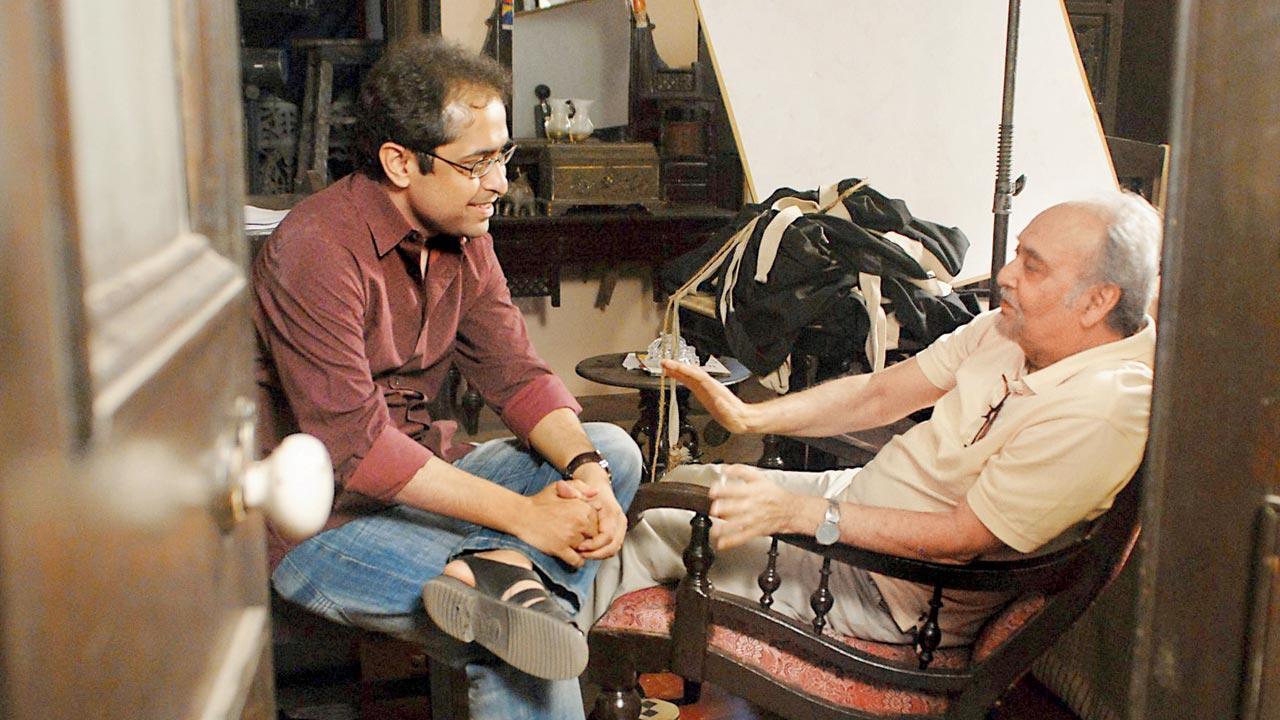
A filmmaker recollects experiences of working with acclaimed Bengali actor Soumitra Chatterjee in a book that aims to introduce him to a wider audience familiar only with his work with Satyajit Ray
Sucheta Chakraborty (MID-DAY; January 9, 2022)
In November 2020, in the days following actor, poet, playwright, painter and singer Soumitra Chatterjee’s passing, filmmaker and professor of Economics Suman Ghosh remembers being mired in sadness. Around this time, Shantanu Ray Chaudhuri, editor-in-chief at Om Books International, who had previously written on the themes of memory, ageing and death in Ghosh’s films with Soumitra Chatterjee, proposed the idea of a book on the director’s personal and artistic relationship with Chatterjee. While initially hesitant, given that the book would be a daunting one, not least because it would be his first, Ghosh realised that this would offer the cathartic release he needed at the time.
“Rather than lament his passing, I thought why not share my experiences with people and help them get an intimate glimpse of the man,” says the director. Soumitra Chatterjee: A Film-Maker Remembers, which released last week to commemorate the actor’s birthday this month, traces Ghosh’s observations and interactions through five films over 15 years with “the last of Bengal’s Renaissance men”.
Ghosh writes about being in awe of Chatterjee’s stature as he watched the actor during shoots at a time when he was still a PhD student at Cornell, eager to venture into filmmaking. “I never expected to form a personal relationship with him. He had achieved so much in life, why would he be interested in giving a hundred per cent in a film with a debutant filmmaker like me?” wondered Ghosh who cast Chatterjee in Podokkhep (Footsteps; 2006) about a retired man and his bond with a little girl in a film inspired by F Scott Fitzgerald’s story The Curious Case Of Benjamin Button about a man aging in reverse.
While the sharpness of his craft was expected, what surprised Ghosh about the thespian was his hunger to work with younger directors and with newer mediums and formats right till the end. There was also, he recalls, a child-like curiosity in him for the mysteries of life, a quality he says he has observed in other greats like Amartya Sen, the subject of an early documentary. He remembers how the last conversation he had with the actor was a few months before his passing when the actor, a well-known workaholic, was forced to sit at home during the pandemic.
“He was reading a book on the young Galileo, and discovering how his father who was a musician impacted him,” he shares. “I marvelled at this man who in spite of a pandemic ravaging the world and making people mentally and physically sick could still hold on to his sense of wonder.”
Everything from cricket and Garry Sobers to Satyajit Ray, the Masai tribes of Africa and the new Bengali literature and cinema interested him, he says, their conversations on these myriad subjects a generous source of nourishment for the director. “… It was as if he wanted to perpetually soak in the delirium of life and be bathed in all its beauty. His mind was like a blank canvas, ready to be painted with colours,” writes Ghosh in the book, pointing to how this receptiveness also informed his work as an actor.
In one of the book’s many interludes, Ghosh writes fondly about Chatterjee’s visit to his home and his mother’s trepidation over the lunch being served even as she grappled with the fact that the man she had watched growing up in such classics as Charulata and Apur Sansar would be in her home. Among other memories of the artiste Ghosh holds dear are those of his Rabindra Sangeet sessions with cinematographer Barun Mukherjee in between shots.
“Many people don’t know that Amitabh Bachchan’s role in Anand was initially offered to him by Hrishikesh Mukherjee and that Shashi Kapoor wanted to cast him in Junoon,” says Ghosh, when we ask him about how he thinks his book will add to the rich legacy the actor has left behind. While Chatterjee remained loyal to Bengal’s cinema, Ghosh believes that film lovers nationally didn’t get to appreciate his talent adequately.
Even directors like Shoojit Sircar and Anurag Basu tried to get him to act in Hindi films and lament that they could not take his talent outside Bengal which he deserved, he says. “He was probably more famous internationally than in India apart from Bengal, and the national audience too only knows him through Satyajit Ray’s films,” he says, his book offering a list of some of his favourite films not directed by Ray featuring the actor.
He was a popular star, he points out, delivering superhits as well as artistically refined films even in his 80s. “The book is a way to provide a glimpse of this person to a national readership so that they are inclined to follow up on his work,” says Ghosh. “That’s why I wrote it in English.”
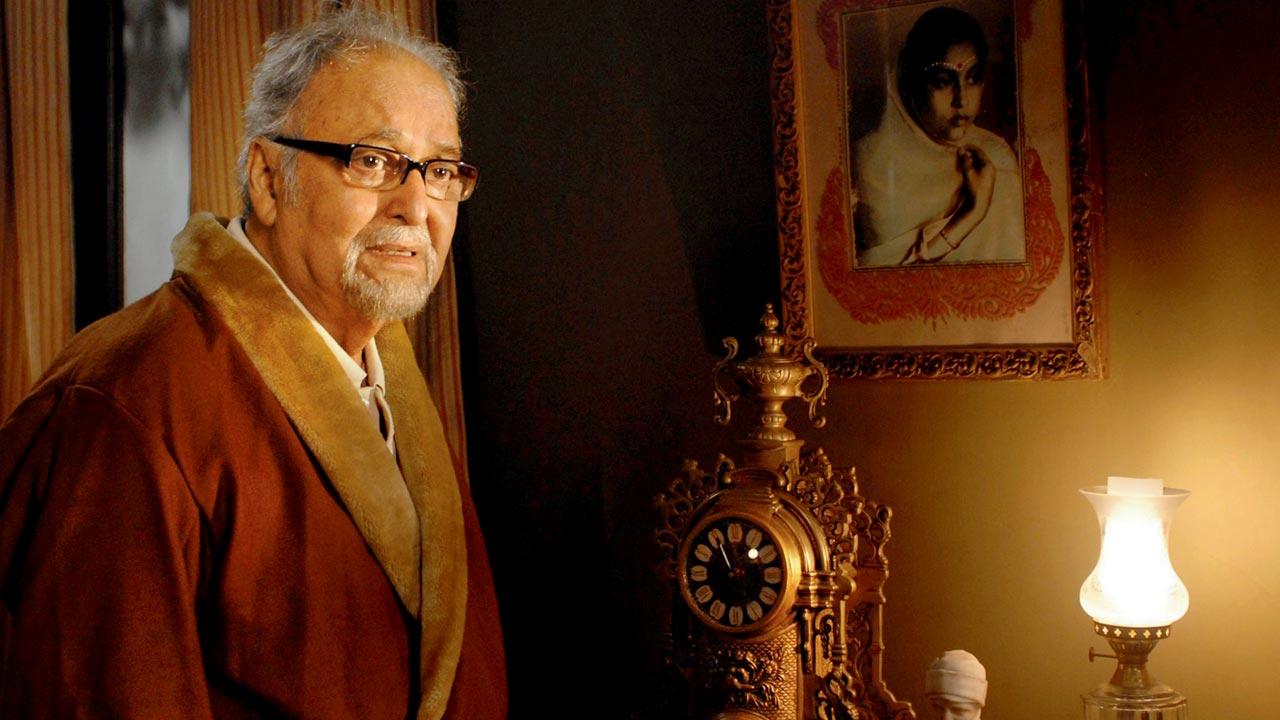
Soumitra Chatterjee was known for his evening addas after shoots-Sharmila Tagore
8:11 AM

Sharmila Tagore remembers the Bengali screen stalwart as they both started their glorious journey in world cinema with Apur Sansar
Sharmila Tagore (MID-DAY; November 16, 2020)
I still vividly remember my first meeting with Soumitra during the shoot of Apur Sansar (1959). Since it was our first film, he asked me whether I was nervous, and I — a school girl then — retorted confidently, "Not in the least!" That was the ice-breaker. I believe Apur Sansar depicted young romance tenderly. In a scene, my character [Aparna] gets so involved while watching a mythological film that she bursts into tears. Soumitra's character [Apu] stops laughing on seeing how the scene has affected his wife. Manikda [Satyajit Ray] beautifully depicted the understanding between a husband and wife through that simple scene.
We went on to do many films together, and it was a joy to work with Soumitra every time. He was encouraging, and I learned so much from him. Every moment spent with him was an opportunity to learn. He was well-read, and didn't restrict himself to movies — he wrote and recited poetry, wrote plays and acted in them. A true artiste, he found joy in expressing himself through different creative forms. He was an inspiring figure as he had a positive mindset and refrained from being judgmental. He made the most of what life had to offer.
Soumitra wasn't a star like his contemporaries; he kept the actor in him alive. What I truly admired about him was that he would constantly work towards improving his skill. He was known for his addas in the evenings after the shoots. When we were filming Abar Aranye [2003] in north Bengal, we would gather every evening and listen to Soumitra and Subhendu Chatterjee as they discussed myriad topics. It was such a joy to hear somebody so well-read and erudite. I wish I had recorded those conversations!
As told to Upala KBR
Rituparna Sengupta and Satyajit Ray's son remember Soumitra Chatterjee, say that he fervently celebrated the Bengali culture
8:09 AM

Mentor Satyajit Ray's son Sandip, and frequent collaborator Rituparna Sengupta remember Soumitra Chatterjee, who passed away yesterday
Upala KBR (MID-DAY; November 16, 2020)
Rituparna Sengupta hits the nail on the head when she says Soumitra Chatterjee's presence has become a "habit". "His legacy must be celebrated because he gave his all to the film industry. While we will mourn his death, we will celebrate [his life]," says the actor who collaborated with the veteran actor on multiple occasions.
Yet another victim of Coronavirus, Chatterjee breathed his last yesterday at the age of 85, following his battle against the virus. The Dadasaheb Phalke recipient thespian's death was confirmed by a bulletin from Kolkata's Belle Vue Hospital, where he had been undergoing treatment. "We declare with heavy heart that Shri Soumitra Chattopadhyay breathed his last at 12.15 pm at Belle Vue Clinic today [November 15]. We pay our homage to his soul," read the hospital statement.
Mentored by auteur Satyajit Ray, the thespian will go down in history as a prominent part of the Bengali film industry. "Kaku always gave a lot of inputs, and my father gave him the liberty to do so, because he liked them. He would consistently think about his roles and mannerisms," says Ray's son, Sandip Ray, adding that following the writer-director's demise, Chatterjee would pay him a visit on his birthday.
"Kaku's favourite role was that of the priest Gangacharan in Ashani Sanket, and Apu from Apur Sanskar. I have a fondness for Aranyer Din Ratri and Charulata. He would become one with the character. He would write notes all over the script, and did his homework meticulously. Apart from being a poet, and a theatre personality, he also started painting, later on. He had an exceptional memory, and was gifted and learned. At the same time, he was gentle, and affectionate."
Apart from being part of 14 films of Ray, Chatterjee also worked with other greats — Mrinal Sen, Tapan Sinha and Tarun Majumdar. He made his presence felt on the stage too, as actor, playwright and director.
Stand-outs in his theatre career include his rendition of Shakespeare's King Lear in Suman Mukhopadhyay's play that earned him accolades, both nationally and globally. He also wrote over 15 plays and directed more than 30 stage productions.
Sengupta remembers him as someone who was versed with the English language, but fiercely celebrated the Bengali culture. "His world revolved around the Bengali culture, and he would read, write, and perform [plays] in the language. He was an ocean of knowledge and was versed with poems, including the works of Rabindranath Tagore and Jibanananda Das."
With inputs from agencies

Soumitra Chatterjee, Kolkata’s legendary actor and Satyajit Ray’s screen alter ego, never succumbed to the best of Bollywood offers
8:06 AM

Take one: Soumitra Chatterjee and Sharmila Tagore in Apur Sansar
Khalid Mohamed (MUMBAI MIRROR; November 16, 2020)

They would be regulars at the Nandan complex, breaking for cigarettes in between shows. But none of us had the guts to approach either—least of all I, who was in awe of the tall and imposing master director and the equally formidable actor. Ray would look infallibly gloomy while Chatterjee would lighten up the scene with his playful gaze and what we used to call his ‘chameli’ smiles. Clearly, here were the yin and yang of unquestionably the best of Indian cinema.
That abiding smile—as well as those playful eyes—will always be the trademarks of yesterday’s dreamy-eyed actor who debuted as the emotionally-ravaged novelist of Ray’s Apur Sansar (1959), the concluding edition of the seminal Apu trilogy.

His grandson, actor Ronodeep Bose, had suffered a grave head injury in a motorbike accident at a bend of New Alipore, just a few months ago. Fortunately, the 26-year-old had come out of a coma, and was on the mend. I apologised for the intrusion, and that ray of smile reappeared as he said, “I hope this old man still has something interesting to say about cinema. I’m more inclined towards dabbling in painting and writing poetry nowadays. Acting… how should I say it?... has become clockwork. I just act for friends I can’t say no to.”
Soumitra—the name means a friend, alluding to Lord Rama’s brother Lakshmanwas an indefatigable film and stage actor, who had constantly underscored his lifelong debt to Ray. Theirs was a collaboration encompassing 14 feature films—including the widely-adored detective adventures Sonar Kella (1971) and Joi Baba Felunath (1979)—and two documentaries. Although he was saluted with a Padma Bhushan and a Dadasaheb Phalke Award, he told me that he had mixed feelings about such honours. “I did feel extremely humiliated,” he recounted, “on being given a Special Jury National Award for Goutam Ghose’s Dekha (2001) and conveyed my no-thank-you politely. Juries should give special awards to their friends and relatives, not actors.”
He could be acerbic, outspoken and yet realistic. In the course of our interview I brought up Uttam Kumar, who commanded the vote of the masses, while Chatterjee was the mandarins’ choice, the arthouse darling. To that his spontaneous response was that Uttam Kumar had a charismatic screen presence, a patented style. In the 1960s, he pointed out that Uttam, Raj Kapoor and Dilip Kumar were all fine actors… but Dilip Kumar was the strongest of them all. “As for myself, that’s for you guys to tell me,” he had shrugged. “All I can say is that I was a risk-taker. The way I looked, the wardrobe I was given, all those frills never mattered to me.”
Unlike most Bengali actors, Soumitra Chatterjee, who passed away yesterday at age 85, didn’t ever think of going Bollywood. It wasn’t because he wasn’t fluent in Hindi. It was because he didn’t wish to play “second fiddle”. Three of the projects he had rejected were Raj Kapoor’s Sangam (1964), the Dilip Kumar-toplined Aadmi (1968) and Shyam Benegal’s Kalyug (1981). Those roles eventually went to Rajendra Kumar, Manoj Kumar and Raj Babbar respectively.
Our conversation on a welter of topics had stretched on for three hours. At the end of which he wore his spectacles and asked, “Haven’t I seen you somewhere before?” It was at the film festivals in Kolkata, I said, we fans always wanted to come up to him and ask for an autograph. To that he had laughed and signed my note-pad with the line, “Better late than never.” At that moment I once again turned into a college boy and requested, “May I have a selfie too, sir?” And that smile flashed once again, and always will for us.
-----------------
ON SATYAJIT RAY…
Was I in awe of Satyajit Ray? No that would be a wrong word. He was like an elder brother. He was a teetotaller because of his Brahmo-Samaj upbringing. He wouldn’t eat mangoes because of their strong odour. But if I or any other unit members helped ourselves to a drink, he had no objections. When I switched from cigarettes to a pipe, he would instruct me on how to hold it and which tobacco to use. In today’s parlance, he was ‘cool’.
Do you know I was paid Rs 3,000 for Apur Sansar? Believe it or not, at that time it was the highest fee paid in Kolkata to a newcomer.
I would say Charulata is Ray’s best film. It was perfect… the vibrancy and the justice done to Rabindranath Tagore’s story remains outstanding to this day and age.
-----------------
ALWAYS THE FIGHTER
Whenever I feel depressed, I feel I’m going down, down, down, I remember the three words, “Fight, Kony, fight” from one of my favourite films in the last decade. In Saroj Dev’s Kony, I played a swimming coach to a physically disadvantaged girl who kept shouting at her, “Fight, Kony, fight”.
It hasn’t always been a beautiful life. Whether good or bad, my life has been interesting. No, no, interesting is a vague word. Instead, I’d go with the proverbial belief: Don’t take yourself too seriously or you’ll never come out alive.
* Excerpts from Khalid Mohamed’s interview in Pritish Nandy’s book Peerless Minds
Why playing Feluda, cast in the mould of Satyajit Ray, was a challenge for Soumitra Chatterjee
7:59 AM

Prithvijit Mitra (THE TIMES OF INDIA; November 16, 2020)
Years after “Sonar Kella” — the first Feluda adventure filmed by Satyajit Ray — was released, Soumitra Chatterjee recalled a conversation between him and the master filmmaker which gave him a peek into the director’s mind.
In the course of that interaction, which had taken place on a train during a journey to shoot outdoor, Chatterjee realised that Ray had created Feluda with some of his own traits — no-nonsense, suave and intuitive with a razor-sharp mind. It was therefore, a huge responsibility to portray Feluda on screen, Chatterjee had said, since it was akin to playing Ray himself.
If Feluda gave Bengali readers a home-grown Sherlock Holmes, it was Chatterjee who brought him alive on screen. Chatterjee looked as convincing outwitting criminals with his “magajastra” (brainpower) as he did when he pulled out his colt revolver to fire at them. Like Feluda, Soumitra could switch from being intelligent to aggressive.
The change in demeanour was marvellously portrayed by Chatterjee in numerous scenes but it was perhaps most evident in a particular sequence in “Joy Baba Felunath”, says Ujjal Chakraborty, a Ray scholar.
In the scene where Feluda, with Topshe and Lalmohan Babu, visits Maganlal Meghraj’s house in Benaras, Chatterjee begins on a polite note but at the end of an unpleasant exchange, he acts sternly with his adversary and vows revenge. “Even as he talks tough, Chatterjee’s body language and dialogue delivery never cross the limits of decency. That’s how Ray had conceived Feluda — an intellectual, middle-class sleuth who could be tough without getting physical or offensive,” Chakraborty says.
For Bengalis growing up in the 70s and 80s, Chatterjee remains Feluda. “Sonar Kella was released in 1974, a decade after the first Feluda story was written. By then, an entire generation had got used to the sketches which portrayed a leaner Feluda with a bonier face. Chatterjee had a more round face but his hooked nose, arched eyebrows and the subtle creases on his face gave him a thinking, intellectual look. It reflected his thoughtful, poetic nature that had made Ray cast him in the role,” Chakraborty said.
Debutant Soumitra Chatterjee who found ‘half of himself’ in Apu grew into Satyajit Ray’s ‘favourite actor’
7:57 AM

Satyajit Ray with Soumitra during the shooting of ‘Joi Baba Felunath’ in Varanasi. It was released in 1979
Priyanka Dasgupta (THE TIMES OF INDIA; November 16, 2020)
The camera slowly zooms in on a letter — it’s a recommendation that says Apu is a “sensitive, conscientious and diligent” person. It then pans to Apu’s face: a young man with sharp features and a beatific smile that lights up a classic black-and-white frame. This was Satyajit Ray’s introduction of the debutant Soumitra Chatterjee in Apur Sansar.
He was the hero everyone wanted to adore — a sensitive, intelligent young man with the spirit of a wanderer who yearns to discover a compassionate world, gets bruised repeatedly and loses his way when he reproaches his son for having caused his wife’s death. What he never forsakes is the purity of his soul.
Chatterjee had told Ray’s biographer Marie Seton in Portrait Of A Director that he found “half of himself” in Apu. The cinematic masterpiece wasn’t just a teaser for love and loss in matrimony. Chatterjee had said “plenty of young men” who watched his debut opposite Sharmila Tagore came to him and said they would like to get married. His conviction breathed life into this shot and achingly poignant tale. Apur Sansar influenced the thought process of generations and redefined Indian cinema. It also changed the trajectory of Chatterjee’s own life. “Playing Apu gave me a chance to grow into 'Ray’s favourite actor'. That epithet itself is something any actor would covet, I also got a lifetime friend in my co-star, Sharmila Tagore,” he said.
One day, Chatterjee had gone to watch the shooting of the Chhabi Biswas starrer Jalsaghar. As he was about to leave, Ray said: “Let me introduce you to Chhabi Biswas. You haven’t met him, have you?” In his customary baritone, he said: “Chhabida, this is Soumitra Chattopadhyay. He is playing Apu in my next film, Apur Sansar.” That was how Chatterjee learnt he had bagged the role that would define him.
After reading the screenplay, Chatterjee tried to innovate with the time-lapse portions, which is the gap between shots. Adopting the Stanislavskian method, he would imagine what Apu would do and write that down. Sometimes, he would include autobiographical elements. This was his way of getting under the skin of Apu’s character. While he had the courage to share these with Ray, the master inspired him to think further.
The result showed when Apur Sansar released on May 1, 1959. It went on to win the National Award for Best Feature Film that year. As per Seton, Chatterjee felt his portrayal of Apu to be the “image of the contemporary Indian man in the process of becoming modern”.As per director Goutam Ghose, this film also stood out for the discoveries of such great performances by the lead actors.
Soumitra Chatterjee (1935-2020): Apu Bids Adieu To Sansar
7:55 AM

Priyanka Dasgupta (THE TIMES OF INDIA; November 16, 2020)
Thespian Soumitra Chatterjee forged a fecund collaboration with master director Satyajit Ray. Their alliance spanned 14 films — Apur Sansar, Charulata and Ashani Sanket, to name just three — and drew favourable comparisons with two outstanding creative partnerships in world cinema: Akira Kurosawa/Toshiro Mifune in Japanese and Federico Fellini/Marcello Mastroianni in Italian. For millions of kids and young adults, Chatterjee’s name was also synonymous with Ray’s Feluda, the razor-sharp detective he brought alive on celluloid.
The versatile actor’s work straddled a cache of genres and spanned over six decades. Co-star Sharmila Tagore once described him as a “banyan tree” that grew and continued to reinvent. His “Samapti” co-star Aparna Sen called him “forever contemporary”. Director Buddhadeb Dasgupta could compare him only to the great Balraj Sahni.
Chatterjee got introduced to acting at an early age, taking part in children’s plays at his ancestral home. His parents would use aluminium foil from cigarette packets to make his crown when he played the prince. He would often end up getting on-the-spot prizes from neighbours! This recognition, Chatterjee would recall, first stirred the actor in him. There were roadblocks, though. He faced rejection during a screen test for a devotional film and concluded that he wasn’t photogenic! Few know that he worked as a radio announcer and an LIC agent. Thankfully, he managed to get only one client in a year!
Had he managed to get more, Indian cinema would have lost out on some stellar performances — from the Charminar-smoking Feluda in “Sonar Kella” and “Joi Baba Felunath” to the grim taxi driver Narsingh in “Abhijan” or the effervescent Amal in “Charulata”. Chatterjee himself would choose “Apur Sansar” as his favourite Ray film since it reflected “the wisdom of innocence”.
His dramatic range was remarkable, as showcased in Tapan Sinha’s “Khudita Pasan” or in “Jhinder Bondi”, where he was cast as the swashbuckling horse-riding villain. In Asit Sen’s films, Chatterjee played “the kind of heroes that middle class Bengalis related to”. Then there were classics like “Teen Bhubaner Pare”, “Baksho Bodol” and “Akash Kusum”, among others.
“I feel that since I did these kinds of roles, people started taking my name in the same breath as Uttam Kumar. It’s because of this that Bengalis even tried to create a sort of Mohun Bagan-East Bengal kind of rivalry between us,” Chatterjee had said.
Like good wine, Chatterjee kept getting headier with age. Just when he was shifting to character roles, Saroj Dey’s sports drama “Kony” happened in the 80s. The film’s catchphrase, “Fight-Koni-Fight”, motivated generations of moviebuffs. Tapan Sinha’s “Wheel Chair (1994)”, Goutam Ghose’s “Dekha (2001)” and Atanu Ghosh’s “Mayurakshi (2017)” – he kept offering something fresh in every decade. But despite a rich body of work, top awards eluded Chatterjee. His only National Award for Best Actor came with Podokkhep (2008), nearly five decades after his 1959 debut.
What added to his charisma was his serious pursuit of theatre, love for literature, interest in arts and politics, and his undying love for Tagore and Bengali. Under no circumstances did he want to give up all these pursuits and shift to Mumbai to act in Hindi films. He feared that doing so would need him to give up “the rhythm” of his life – something he didn’t wish to.
Theatre gave him satisfaction. That’s where he could create “a complete artistic substance” with an admirable body of work adapting non-Bengali plays into the local context. A disciple of the legendary Sisir Bhaduri, his work on stage included “Rajkumar”, “Naamjiban”, “Neelkantha” and “Raja Lear”, among others. Such was his commitment and professionalism that while acting in the autobiographical “Tritiyo Anko, Otoeb,” Chatterjee continued performing on stage even after receiving the news of his mother’s demise.
Towards the end, a degree of stoicism was reflected in his work. Perhaps, it came from his philosophy about death not being “an assassin but a friend” who comes to relieve one from pain. Soumitra Chatterjee has left behind a treasure trove rich enough to be a true representative of Bengali culture.
-----------------------
Clash of the Titans
Prithvijit Mitra (THE TIMES OF INDIA; November 16, 2020)


Soumitra Chatterjee, Satyajit Ray’s Apu and Feluda, dies of post-Covid complications
7:51 AM

Prithvijit Mitra (THE TIMES OF INDIA; November 16, 2020)
Kolkata: Adios Apu. Farewell Feluda. Goodbye Renaissance Man.
Virtuoso actor Soumitra Chatterjee, who delivered a cache of unforgettable performances in auteur Satyajit Ray’s classics such as Apur Sansar, Ashani Sanket and Joi Baba Felunath, passed away on Sunday. He was 85.
“He was admitted to Belle Vue on October 6 and was suffering from Coronavirus-induced encephalopathy that had been affecting his consciousness and led to a multi-organ failure,” said the hospital.
A multi-spectrum artist, he was also a theatre personality, poet, essayist and painter. He was a recipient of the Dadasaheb Phalke award.
PM Narendra Modi termed his death “a colossal loss to the world of cinema, cultural life of West Bengal and India”, and said, “Anguished by his demise...”
Soumitra Chatterjee, Harshvardhan Rane test positive for Coronavirus
8:03 AM

BOMBAY TIMES (October 7, 2020)
Veteran Bengali actor Soumitra Chatterjee, who is known for films like Apur Sansar, Charulata and Parineeta, has tested positive for Coronavirus. His daughter Poulami Basu said, “He is stable now. He had a low grade temperature for two days. We admitted him to a private hospital on Tuesday after his positive report a day earlier. Right now, his temperature is normal.”
Harshvardhan Rane, who has been seen in films such as Sanam Teri Kasam and Paltan, also revealed on social media yesterday that he tested COVID positive. “I had a fever and stomach ache, and went to a hospital to get an opinion. They said it’s mostly viral fever and performed a routine COVID test to rule it out. My Aarogya Setu App now says I’m COVID positive! Okay then, guess it’s 10 days of isolation from here on (sic),” he wrote.
-----------------------
Jayatri Nag (MUMBAI MIRROR; October 7, 2020)
Dadasaheb Phalke awardee Soumitra Chatterjee has tested positive for Covid-19. The 85-year-old Bengali film actor was admitted to a private hospital in Central Kolkata on Tuesday at around 11 am. He is reported to be stable. A medical board has been formed for his treatment as the octogenarian suffers from Chronic Obstructive Pulmonary Disease (COPD) and diabetes and had been admitted to the hospital due to pneumonia in 2019.
Chatterjee had completed a series in the last week of September and was currently shooting for his biopic.
“He had low-grade fever for the last two days and tested positive on Monday after which he was admitted to the hospital. His condition is stable,” a family member reiterated.
Chatterjee is the first Indian film personality to be conferred with Legion of Honour, France’s highest civilian award, in 2018. He was also honoured with the Padma Bhushan and the Sangeet Natak Akademi Tagore Ratna. He received the Dadasaheb Phalke Award, India’s top film honour, in 2012, and bagged three National Awards for films like Antardhan, Dekha and Padokkhep.
Starting with his debut film, Apur Sansar, in 1959, he went on to do 14 films with mentor Satyajit Ray, including Devi, Teen Kanya, Charulata, Ghare Baire, Sonar Kella, Joi Baba Felunath and Ganashatru. He reigned as Bengal’s matinee idol for several years and later distinguished himself in character roles.

I used to see many Hindi films, but I was never keen on doing one-Soumitra Chatterjee
7:57 AM

On a visit to Mumbai, the legendary Soumitra Chatterjee, spoke about his experiences of working with Satyajit Ray, friendship with Shashi Kapoor and why he stayed away from Hindi movies
Sreeparna Sengupta (BOMBAY TIMES; April 24, 2019)
 For Soumitra Chatterjee, whose prolific career spanning over six decades, saw him as the most enduring face of Oscar winning master filmmaker, Satyajit Ray’s movies, it is his immense work in field of theatre, that has found him in the city of Mumbai time and again. However, Hindi movies have never been a lure for this legendary Indian actor.
Recently, a captive audience at the packed Nehru Center auditorium, soaked in the aura of the 86-year-old thespian at a cultural programme, organised by South Mumbai’s oldest Tagore music school. Later, over a more relaxed one-on-one conversation, he lets on, “Poetry has been very dear to me from an early age. That’s a legacy of my parents. It was my father who gave me the idea of doing poetry recitals. And my mother unconsciously sowed the plant for the love of poetry that I have.”
The actor’s love for theatre also developed at a very young age, much before the arc lights took over. In fact, it was theatre and the common love for world cinema that saw a friendship develop between late actor Shashi Kapoor and him, “Shashi was also into theatre from the very beginning. And although he had to bend and mend his ways for the Hindi film industry, he was always aware of what was happening in theatre and cinema around the world. Later, as a producer, Shashi produced some remarkable films.”
When probed on a black-and-white photograph of the two dapper actors in their hey days, which he had shared on social media, he says, “That was taken in Berlinale. We had become friends since the time we did films like, Charulata and Shakespeare Wallah. Both the films were shown in Berlin in 1965. So, the photograph that you are referring to was taken then. And as far as I remember, it was shot by none other than Satyajit Ray. Both of us were very young at that time and Shashi was the ever-handsome, charming and witty person,” adds the actor, who was no less a heartthrob of Bengali cinema then. Incidentally, both their films won top awards at the Berlin film festival, that year.
 ‘Balraj Sahni is the best that Indian cinema has seen’
Given his association with the Hindi film industry, ask him why he has never been seen in a Hindi film, like some of his contemporaries — Suchitra Sen, Sharmila Tagore and Uttam Kumar, he says, “Frankly, I was not keen on doing Hindi films. For the single reason, that the kind of films I started liking were those of filmmakers like Vittorio De Sica, Federico Fellini or other new-age filmmakers that opened windows for the kind of films that I wanted to do. Although from an early age, I used to see many Hindi films. And actors like Dilip Kumar Saab and also, Raj Kapoor to an extent, were favourites of mine. But the more I think about an sub-conscious influence on me, only one name comes to my mind — Balraj Sahni. He is the best that Indian cinema has seen and I still adore him as my idol.”
‘I don’t know why Satyajit Ray liked me’
Introduced to cinema lovers the world over as Apu of Apur Sansar on May 1, 1959, he has vivid memories of his first day at shoot with Satyajit Ray (it was his 27th death anniversary on April 23). Reflecting on his first meeting with the maestro, he says, “I was initially taken for an interview with Mr. Ray when he was looking for someone to play Apu for the second part of the Apu trilogy. But I was too grown up and tall for the adolescent Apu. And I wasn’t selected. But much later, after I had been working with him for two-three years, I came to know that he had made up his mind to make the third part of the trilogy, after he saw me. Over time, as we collaborated more, we developed a rapport and he started giving me a lot of freedom into the way I wanted to do a role. It was exciting to shoot with him.” Pausing to reflect, his voice trails off with a shy questioning laugh, “...And I don’t know why he liked me.”
‘Ray used to draw sketches of the make-up and look before actually going into the shoot’
When the conversation steers to Charulata, his voice swells with pride, “That was a great film. Satyajit Ray always felt that was his most perfect film. In fact, as a student of Bengali Honours, I knew the original story, Noshto Nir extremely well. It was one of the greatest stories written by Tagore. Ray used to draw sketches of the make-up and look before actually going into the shoot. He did that for Charulata as well and sent me a table piano, long before the shooting started. I would practice on it as it was necessary to do that for shooting a song in the film,
‘Every conversation with Ray was a learning’
Chatterjee’s collaboration with Ray spanned across 14 films, including masterpieces like Aranyer Din Ratri, Devi, Ghare Baire, Ashani Sanket among others, showcasing the actor as one of the most versatile in Indian cinema.
“Every conversation with Ray was a learning. He was my mentor, a kind of teacher, but unobtrusively so. He always behaved like a friend, more like an elder friend. And even today he has remained an inspiration,” signs off the legend, who has worked with filmmakers like Mrinal Sen, Tapan Sinha, Goutam Ghose, Rituparno Ghosh. His most recent works include films like Shonar Pahar, Mayurakshi, Basu Poribar in which he was cast with Aparna Sen after 19 long years.
Soumitra Chatterjee was like a young friend-Radhika Apte
7:34 AM

Roshmila Bhattacharya (MUMBAI MIRROR; July 20, 2015)
 Sujoy Ghosh's 14-minute
short, Ahalya, premieres today on YouTube. It
reinterprets the legend of Ahalya who, according to Hindu mythology, was
seduced by the King of Gods, Indra, cursed by her husband, Gautama
Maharishi, for infidelity and liberated from his curse by Ram. Sujoy's
kahaani revolves around the twisted relationships between three
mysterious characters played by Radhika Apte, Tota Roy Choudhury and Bengal's
evergreen matinee idol, Soumitra Chatterjee. It was shot over three
days in Kolkata.
Sujoy Ghosh's 14-minute
short, Ahalya, premieres today on YouTube. It
reinterprets the legend of Ahalya who, according to Hindu mythology, was
seduced by the King of Gods, Indra, cursed by her husband, Gautama
Maharishi, for infidelity and liberated from his curse by Ram. Sujoy's
kahaani revolves around the twisted relationships between three
mysterious characters played by Radhika Apte, Tota Roy Choudhury and Bengal's
evergreen matinee idol, Soumitra Chatterjee. It was shot over three
days in Kolkata.Radhika had worked with the legendary actor earlier in a Bengali film, Rupkatha Noy. She admits she was too nervous then, focused on getting her lines in Bengali right, to enjoy the experience of working with the Dadasaheb Phalke awardee she recalls watching at a Satyajit Ray film fest during college. “I have fuzzy memories of Ghare-Baire and Aparajito. Sujoy told me that he was once Bengal's most eligible bachelor. Even at 80, Soumitrada is so handsome and charming, with a childlike energy and a smile which reaches his eyes,“ says Radhika, unwilling to talk about the shoot because it may give away the 'surprise' in the plot.
She, however, admits this time she was more at ease with the veteran actor whose cheery greeting on the first day boosted her confidence. “He was like a young friend. I hope we get a chance to do a third film and complete a hattrick,“ she signs off with a smile.
Benchmarking Byomkesh Bakshy, by Qaushik Mukherjee aka Q
9:40 AM

Byomkesh Bakshi solved many a sordid crime in 1940s Calcutta. Now, says filmmaker Q, it's time to reinvent the underrated sleuth
Qaushik Mukherjee aka Q (THE TIMES OF INDIA; February 8, 2015)
 As the Feluda wave slowly faded with Satyajit Ray's death, there was a quick search for other options available in Bengal. And before you could say Bakshi, Byomkesh was out of the lockers, freshly unpacked and powdered and ready for some sleuthing action. Many directors tried him out, each pushing their own agenda, but somehow they couldn't create a new benchmark — find a thrilling new way of looking at the Bengali detective, push some digital, dynamic energy into a character that has absolutely nothing in common with life today.
It was Ray, not the creator, Sharadindu Bandyopadhyay, but the image maker, who should be credited for the proliferation of the Byomkesh Bakshi myth. Ray made Chiriakhana featuring Byomkesh with Uttam Kumar in the lead in 1967 — the ultimate Bengali imager working with the ultimate Bengali screen icon. Byomkesh was benchmarked. And, as any self respecting Bengali knows, benchmarking is everything. And Ray is the benchmark. Alright!
And for both Sharadindu and Ray, the benchmark was Conan Doyle. The Holmesian techniques thrilled them — the minute eye for detail, the uneasy relationship between the criminal and crime buster, the oddly homoerotic bonding of the detective and his assistant. But above all, it was the culture of the intelligent mind, always trying to find the crimes that were elevated, sublime, calling for the application of a brilliant mind to figure out riddles and clues. Sherlock had laid down the rules. And the post-colonial Bengali gentry were ready to play.
Ray had also begun to work on Feluda, who was to be the reigning king of Bengali sleuths. Feluda was born in 1965, just before Ray made Chiriakhana. Though he made just two Feluda films, Ray had written a number of super hit stories with the strapping young detective solving crimes around the country, juxtaposing his travels and a filmic vision with an existing classic structure. He cast Soumitra Chatterjee as the detective in the Feluda films, defining a look and feel that would be sacredly carried forward for decades. Byomkesh was practically forgotten during this time. Because Feluda was more modern, more with the times.
Because there was something else happening here. The readers had changed with the times. Calcutta wasn't the same as the 40s. Cleansed and gentrified, its language and culture sanitized by Tagorean principles, basking in the newly found middle class calm, Calcutta was no longer the den of grimy crimes that could be dramatized in fictional potboilers. Detectives were a thing of the past. So when Feluda came, he was specifically targeted at teenagers. As any follower of crime fiction knows, an overwhelming majority of crimes that need private detection happen to crimes of passion. However, the pressures of the marketplace, and the success of Feluda among kids, made sure that the most important Bengali detective never dealt with anything that had women involved. In fact, women are practically invisible in Feluda stories.
Byomkesh was older, from another time. The country wasn't free yet, and it was a cauldron of chaos. Calcutta was teeming with all sorts of people, a hothouse of dirty deeds and politics and passion. It was a metropolis, a blindingly beautiful city with its colonial architecture and tendencies. The millions of refugees post partition hadn't yet flooded the city. It was a trading centre, a political hub, with an active underground buzzing with hustlers from all over the place. Byomkesh was at home in this city, walking into the nooks and cranny, his dhoti never coming in the way between him and the criminal. He was a 'Satyanyeshi', a seeker of truth, at a time when truth meant for something finite, but the boundaries were already fading. Through his stories, that thrilled readers of all ages and segments, Byomkesh tried to make sense of the great shifts in social morality of the times.
Sharadindu was also a lover of cinema, and had also worked as a screenplay writer for Hindi films. The cinematic nuances in his work made his fiction pieces prime material for films. Filmmakers used many of his works over the years. But Byomkesh remained, in the public memory, as the first of his kind. He was an adventurer, before the times when the Bengali decided to keep to his drawing room and conduct all affairs of the world from that safe canopy. Byomkesh was fearless and manipulative, a believer in alchemy and astrology, unravelling problems with logic, and often with mysticism, creating a deadly combination of oriental and occidental methods. This was a throwback to the creator's love for alternate realities. Sharadindu was a follower of eastern mysticism and astrology.
He has often written about his fascination with the world of the dead, and often these references popped up in Byomkesh stories. With his beautiful and witty wife Satyabati, his friend and partner Ajeet, and his decidedly Bengali ways, Byomkesh was a full character, living his life as a truthseeker without any qualms.
Sharadindu had once told a friend that he has done an astrological chart for Byomkesh. According to his calculations, Byomkesh would be a successful detective alright but would never be able to make a lot of money or be a huge star. The writer was obviously being cheeky and self critical, but Byomkesh has actually always remained second best in the Bengali world of detection. Though the heat of his stories and the complexity of the world he inhabits lend themselves to soaring heights of adventure and thrill, we still haven't found the way to show this on-screen.
Qaushiq Mukherjee goes by the name Q
Soumitra Chatterjee to make his Bollywood debut with Durga Rani Singh
10:14 AM

Roshmilla Bhattacharya (MUMBAI MIRROR; June 28, 2014)
It seems Sujoy Ghosh has managed to do what Raj Kapoor and Hrishikesh Mukherjee couldn't. He has got the grand old man of Bengali film industry to finally sign a Hindi film.
Soumitra Chatterjee was to Satyajit Ray what Toshiro Mifune was to Akira Kurosawa and Marcello Mastroianni was to Federico Fellini. The Oscar winning director collaborated with Chatterjee in 14 out of his 34 films. And today, even at 79, the actor can make hearts race with his distinguished good looks and his recitation of Tagore's verses when not flexing his acting chops.
In a career spanning almost half a century, the Padma Bhushan awardee has received many offers from top filmmakers in Bollywood, several from Hrishikesh Mukherjee, but he could not be persuaded to leave Bengal for Bombay. He is believed to have even turned down Raj Kapoor who had apparently approached him for Sangam. However, the Dadasaheb Phalke Awardee has finally accepted his first Hindi film, Sujoy Ghosh's upcoming, Durga Rani Singh.
A source said: "Soumitra's character is central to the plot. For Sujoy it's a huge casting coup."
Subscribe to:
Posts (Atom)