Showing posts with label Sidharth Jain. Show all posts
Showing posts with label Sidharth Jain. Show all posts
Bollywood armed its heroines, yet producers invest far less in women-led films
4:41 PM

Bollywood armed its heroines, promoted them to spies and handed them leading roles. Yet producers invest far less in women-led films, even though numbers suggest they are often the better bet
Anindita Paul (MUMBAI MIRROR; September 6, 2026)
For years, the question of women in commercial cinema was simply whether they were there. Today, women headline action films, lead spy missions and carry franchises. The change is visible. But visibility can be deceptive. A woman can be at the centre of the frame without being at the centre of the story. Alpha, the first female-led film in YRF’s spy universe, puts Alia Bhatt and Sharvari in a world historically dominated by male agents. Yet questions remain about whether the sexualization's of its female stars belongs to an older visual grammar. Toxic, directed by Geetu Mohandas and featuring five prominent actresses alongside Yash, was positioned as a film with a female gaze, but questions have also been raised about whether its female characters have stories independent of its male protagonist.
The female gaze is ultimately about point of view: whether a character has an interior life, and whether her choices carry narrative weight.
Where the money goes
Data journalist Surbhi Bhatia’s analysis of Bollywood from 2000-2022 found that female-led films received less than a fifth of the capital and resources invested in the top films in any year. Yet these films can be highly profitable, often delivering returns comparable to, or better than, those of male-led films. Bhatia illustrates the disparity through the returns on investment of women-led films. Lipstick Under My Burkha, made for around Rs 6 crore, generated approximately Rs 25 crore, a return of more than four times its investment. Raazi, starring Alia Bhatt as a spy, was made for around Rs 40 crore and generated Rs 195 crore worldwide, returning 4.8 times its investment. By comparison, a male-led film made for Rs 250 crore and earning Rs 500 crore delivers a 2x return.
The issue, she argues, is “not that women-led films perform badly, but that producers are less willing to assume the risk of producing, distributing and promoting them at scale.”
Bhatia will discuss these findings during her talk Kuch Kuch Data Hai: Bollywood, Visualized today at Woodside Inn, Bandra, as part of a Pint of View Lecture. Her research also shows that roughly one-third of working characters in paid occupations in films are women. They are more likely to be doctors, teachers, journalists, dancers, actors and models, while police officers, military personnel, politicians and criminals remain more likely to be male. Characters associated with power, danger or institutional authority are still more often written as men.
Aditi Govitrikar, actor, sees a similar gap between discussions and opportunities. “The conversation is happening, but whether it will translate into work or not remains to be seen,” she says, pointing to Delhi Crime, The Great Indian Murder and Made In Heaven as rare examples of women-centred storytelling.
Who controls the story?
That gap becomes more complicated once a film moves from the idea on the page to the finished product. Sidharth Jain, founder and producer at The Story Ink, explains, “Commercial filmmaking is inherently a collaborative process. Writers, filmmakers, producers, actors, studios and marketing teams all enter the equation, along with the pressure of the box office.”
With larger budgets and more stakeholders, an original idea is not necessarily discarded, Jain explains, but can gradually become something different from what the filmmaker first set out to make. Creative control can therefore be as consequential as casting.
A female lead, or even a woman directing the film, does not automatically determine the perspective through which her character is understood. That point of view has to survive from script to screen.
Arati Kadav, director of Mrs., takes the argument back to the writing itself. “We don’t depict women as whole people,” she says. Creators need to “step in the shoes of their characters” and “live those stories with the fullness they deserve”. Even smaller female characters, she argues, should have “a strong point of view, a proper backstory and some duality, rather than becoming too one-tone”.
Jain adds, “My biggest problem is that we don’t have a large pool of good screenwriting.” A filmmaker may have the right intent, but without the craft to communicate it, the idea, he says, can get lost in execution.
A shift, but a slow one
Revati Mahurkar, who has worked across Indian and international music videos including Qatal, Mascara and Tevar, believes that sensuality and self-expression can coexist beautifully when women have a say in how they are presented—from performance and costumes to the images that make the final cut. “I think women having agency in how they are presented changes the entire perception of their presence on the screen,” she says.
“It’s what moves us away from objectification towards having an active role in picturizing and presenting the content, whether a song or a film.” Mahurkar also feels that respect for women in the industry may be growing, but “entertainment only reflects what is happening in the real world around us.”
Jain, too, sees the industry moving beyond its traditionally male-star-driven model, in which “the heroine is just there for three songs”, towards a greater emphasis on story and content.
He sees it most clearly among younger writers, who are “more self-aware, more responsible” about how women are written. But he is wary of treating this as a complete transformation.
“It’s a generational shift,” he says, one that will happen slowly, as filmmakers and audiences continue to shape and respond to each other.
Change on the cards
Films such as Kabir Singh and Animal are reminders that stories built around male desire and violence still have considerable commercial currency. But their success does not cancel the growth of female-led cinema; it only exposes the marketplace in which those films must compete. Counting more heroines, too, tells us little about how much narrative power women have acquired.
Representation cannot, after all, be measured by counting women on screen. A heroine may have substantial dialogue, fight scenes and even a plot of her own while the film continues to view her chiefly through male desire. The real measure is whether she has an inner life, consequential choices and ambitions that do not exist merely to advance a man’s story. Bollywood may be changing the stories it is willing to tell, but the more difficult shift lies in who gets to shape them, and whose perspective is allowed to endure from the first draft to the final frame.
Film companies, streamers go by the book to avoid legal hassles
10:45 PM

Push writers to turn their non-fiction story ideas into books ahead of developing them into films or web series
Rajesh N Naidu (THE ECONOMIC TIMES; January 1, 2026)
A new trend is emerging in India’s entertainment industry: reverse engineering content.
Increasingly, streaming platforms and film producers are asking writers who approach them with non-fiction script ideas to first write and publish a book, before deciding whether to turn it into a web series or film. Since writing a book on a non-fiction subject would often need extensive research, this approach helps makers avoid future legal disputes and controversies over content and intellectual property ownership, said writers, producers and IP agencies.
“Instead of waiting for a bestseller, producers and IP agencies are encouraging writers to develop books as screen-ready IP from day one,” said writer Anirudhya Mitra. “The book becomes a development tool and not the finished product.”
When Mitra pitched a script idea on the assassination of Rajiv Gandhi to Applause Entertainment in 2021, the production house asked him to write a book first. Publisher Harper Collins India came on board and published the book, ‘Ninety Days: The True Story of the Hunt for Rajiv Gandhi's Assassins’ the following year. A web series titled ‘The Hunt: The Rajiv Gandhi Assassination Case’ was subsequently made and aired on Sony LIV in 2025.
Alisha Kay’s Devgarh Royals trilogy and Srishti Chaudhary’s Lallan Sweets are among other examples where ideas pitched as scripts have been published first as books. These are currently being adapted into visual content.
“The rationale behind asking writers to convert script pitches into books is legal cushioning. A writer's due diligence and research about a subject save makers from unforeseen legal hassles or controversies,” said Sidharth Jain, founder of IP agency The Story Ink.
Publishers are keen on participating in this exercise, as a web series or film provides their books publicity.
There is also a great deal of audience interest in non-fiction ideas, which shows that platforms and producers are catering to an already existing demand.
Platforms asking writers to write books based on their pitches is nothing but catering to this demand, said scriptwriter Jaidev Hemmady.
Publishing a book first helps limit legal liabilities in case of any litigation and helps in creating awareness about these ideas, he said.
“Also, streamers are not that comfortable with toying with or considering original fiction ideas given the uncertainty of their reception among audiences," added Hemmady.
Even cinematically, this approach is beneficial as it gives makers an idea of what is filmable. “So, it can be a good testing ground for web series or films,” said veteran filmmaker Vipul Amrutlal Shah.
Producers say this approach could gradually become a trend.
“As we seek more rooted Indian content, it is likely that we will see more book to screen adaptations from Indian literary material going forward,” said Sunir Kheterpal, producer, Athena E&M.
Blockbuster films from the South release across India simultaneously; experts talk about why this is a good thing
8:48 AM
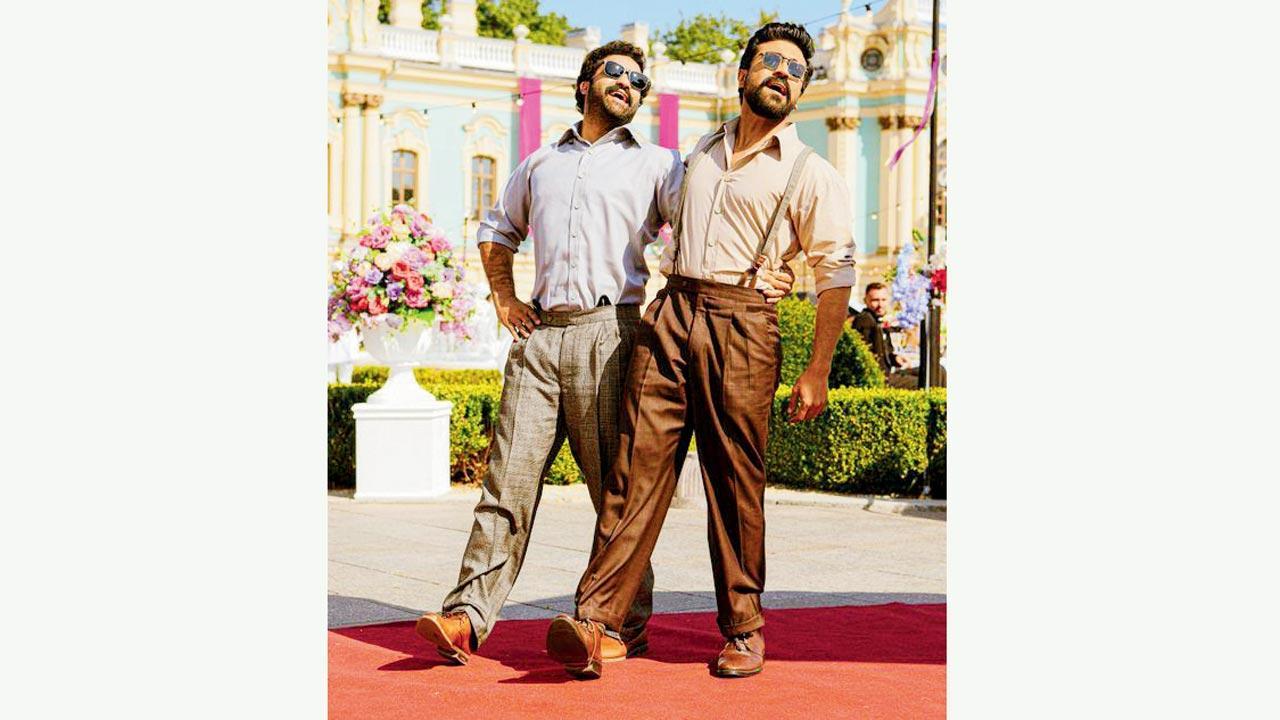
Heena Khandelwal (MID-DAY; July 31, 2022)
The concept of a pan-India film release isn’t new, say most film trade analysts and exhibitors. Mani Ratnam did it with 'Roja' (1992) and 'Bombay' (1995)—both Tamil films dubbed into Hindi and received well in North India. 'Hum', did it even earlier, in 1991. The movie starred superstars from both ends of the country—Amitabh Bachchan and Rajinikanth—and became one of the highest grossers of the year. Then 'Baahubali', both 'The Beginning' (2015) and 'The Conclusion' (2017), changed the game.
“It was a huge success,” says film trade analyst Komal Nahta. “Even today, 'Baahubali' is the highest-grossing Hindi film even though it is a dubbed one. No original Hindi film has been able to outdo it. Every South Indian producer wants to get on this bandwagon because the costing is minimal. You just have to record Hindi songs and dub the dialogues; nobody is spending Rs. 5 crores on promotions in the Hindi market. And if the film clicks, it is a huge profit margin.”
Calling 'Baahubali' a wake-up call for South Indian filmmakers, film trade expert and exhibitor Vishek Chauhan notes that the problem was that they assumed the market was saturated. It was further maxed out by increasing ticket prices to compensate the stars’ fee, which Chauhan says, is “huge, almost at par with Bollywood”.
“But Baahubali’s success showed them a huge market,” he says, “Plus, Bollywood had stopped catering to the masses for a few years, and was looking only at the niche and elite market. This allowed South Indian films a backdoor entry. YouTube and Satellite TV is full of dubbed South Indian films, which has made actors from the South—Allu Arjun, Ram Charan, Vijay Sethupathi, and others—a household name in the North. With 'Baahubali', they uncovered their clout and muscle at the box office and flexed it with both the instalments of 'KGF' [2018 and 2022], Saaho [2019] and 'RRR' [2022]. 'Pushpa: The Rise' [2021] was like a bolt from the blue. Even Vikrant Rona’s opening is surprisingly good.”
Film exhibitor Akshaye Rathi agrees: “It was an absolute misconception that people weren’t looking for mass entertainment. A huge chunk of the audience doesn’t have too many avenues for outdoor recreation. While a certain section can go to a nice restaurant or to watch a play, for the audience at large, cinema is the only leisure activity with friends and family. In tier 2 and tier 3 cities, the prevalent recreational activity is going to movies. This section is about 75-80 per cent of India’s population. Filmmakers have been depriving them of an appealing genre of entertainment. And, now that we are giving it to them, they are lapping it up in big numbers. We have seen that with 'Sooryavanshi' [2021], 'Pushpa', 'KGF', 'RRR', and even 'Bhool Bhulaiyaa 2'.”
To him, it makes economic sense for a filmmaker to look at the whole country as the market, considering India has fewer screens per million (between 8 to 10 screens, against USA’s 124).
“If we further divide deployment of content on the basis of language, we limit the potential of our business,” Rathi says “OTT has enabled access to so much diverse content so suddenly that the audience is familiar with content made in any state. That’s why crossing this bridge has become easier.”
What does this mean for Bollywood? Stop taking the audience for granted, echoes everyone. “Going to a theatre is an expensive affair in terms of money and time, so the audience wants value for money,” notes Chauhan, adding that post the pandemic, only films that appeal universally do well in theatres.
“COVID-19 changed the market entirely—a shift that would have taken place over a decade, happened in two years. The audience is not shy to explore a different genre, hero, language, or market. OTT has made the film business a level-playing field. Even in Hollywood, only big hero films do well theatrically; others are coming to OTT.”
“This [South Indian films releasing across India] helps us up the bar for storytelling and technology. 'Baahubali', 'KGF', 'RRR', are all technologically extraordinary. I hope the upcoming films—'Brahmastra', 'Pathaan' and 'Tiger 3'—do well, considering they have similar grandeur and ambition. In a way, it made us realise that commercial cinema remains intact,” says film director and writer Milap Zaveri, adding, “At some point, commercial cinema was looked down upon by critics and elite people in cities like Mumbai. So films were made keeping critics in mind and high end multiplexes. Somewhere along the way, we stopped catering to the masses. Every commercial film may not work, but one failure shouldn’t stop us from doing it again. Even in the South, after RRR, Ram Charan released Acharya [2022], which didn’t do well; but that doesn’t stop the others because that’s the base of their industry. This pan-India release phenomenon is a wake-up call. Post pandemic, if people invest time and money in a film, they expect a spectacle. Even Hollywood is ruling the roost with the Marvel series.”
Interestingly, the OTT space remains unfazed, says Sidharth Jain, former creative head for Hotstar and founder of The Story Ink, the largest book-to-screen adaptation platform. “Bollywood is making the classic mistake of copying content from the South again,” he says. “Instead, they should understand that the audience wants to watch compelling stories, and that films that do well don’t follow a trend. OTT has always offered a buffet, so there is no threat to one particular kind of content. But yes, they are commissioning more series for the Southern market.”
Tandav row: Writers decide to self-regulate; stay away from politically and religiously sensitive references
8:29 AM

After multiple FIRs and extreme pushback to political drama Tandav, lawyers are likely to vet web show scripts at inception. What does that mean for streaming regulation, and where does this leave the writer?
Aastha Atray Banan (MID-DAY; January 31, 2021)
A director like Hansal Mehta knows how to deal with, and digest censorship. His 2017 film Omerta told the story of Ahmed Omar Saeed Sheikh, a British terrorist of Pakistani origin, who was behind the 1994 kidnapping of tourists in India. In 1999, he was released and found himself safely in Afghanistan backed by the Taliban in exchange for the release of Indian passengers aboard an Indian Airlines hijacked flight. When the film went to the Censor Board, two scenes proved contentious: Omar relieving himself as the national anthem played, and the protagonist having violent sex preceding a terror operation. “I had expected that it would be problematic, but you [the filmmaker] can try. My argument was that it’s the character who is disregarding the national anthem, not me!” Mehta argues.
His argument would certainly not hold true today.
The last few weeks have been defining for freedom of expression for the entertainment industry in India. After Saif Ali Khan-headlined political drama Tandav, directed by top Bollywood maker Ali Abbas Zafar, premiered on Amazon Prime Video, dissenting voices said Hindu religion had been disrespected through scenes in the first episode. The first was a stage play where college students playing Shiva and Narada wonder how they can improve the former’s social media popularity, while another was seen as a casteist slur where Tigmanshu Dhulia, who plays Prime Minister Devki Nandan Singh mocks a Dalit politician. After the trolling, BJP MLA Ram Kadam filed a complaint at Ghatkopar police station on January 20, and an FIR was registered in Mumbai. On January 18, a FIR was filed against the director, producer and the writer of the web series, along with Amazon Prime Video’s India head of original content at the Hazratganj police station of Lucknow. Another one at Greater Noida, then Jabalpur, followed by a complaint in Patiala House, New Delhi. Even the Confederation of All India Traders wrote a letter to Prakash Javadekar, Union Information Broadcasting Minister, on January 19, asking to stop the streaming. Zafar apologised unconditionally, and the makers responded by deleting the scenes. Last week, the Supreme Court declined to grant interim protection to Zafar, actor Mohd Zeeshan Ayyub and others facing multiple FIRs, and remarked that an actor “cannot take up a role without reading the script”.
For Mehta, the brouhaha is unreasonable, because “Tandav is just a pot boiler”. But he suggests we don’t let despair take over.
“I get that people are depressed with what’s unfolding, but I also believe that this government is business conscious. The OTT ecosystem rakes in a lot of business. Perhaps we should keep away from religious and political content for a while.”
Mehta’s suggestion may be prudent but this means the end, or at least partial suspension, of freedom of expression that defined web shows in India. Last November, the government brought video streaming over-the-top (OTT) platforms under the I&B Ministry’s ambit instead of the Ministry of Electronics and Information Technology. While the government has demanded a list of what constitutes prohibited content and more muscle to the complaints mechanism, the industry had responded with what’s called an Implementation Toolkit. Following the scale of this recent protest, it could very well mean that makers and writers self-regulate, choosing to stay away from politically and religiously sensitive references.
It’s then the first officers of creation—the writers—who have the most rewiring to do, whether it’s with their beliefs or process. Mayank Tewari, writer of the critically acclaimed political satire Newton, and behind the dialogues for Ragini MMS, is currently working for a Netflix show. “Let’s see how things pan out. It’s curtailment for sure. Can we now show a policeman or judge as corrupt? I don’t know. The good part is that once the content is made, you can have a problem with it, but it will find its audience anyway, even if through WhatsApp. That’s the beauty of living in these times.”
But he also admits that because making a show or film takes a whole lot of money, energy and time, the investment is huge. “No one wants their time and money to go down the drain. So we will be told, ‘you are an entertainer, not an activist’. And when writers start second guessing, it’s not good. The trouble is that today anything can cause a problem — if you look at Kalidas’s poetry, it’s erotica about Shiva and Parvati. If we reference that, even that will cause a problem. We are a nation addicted to outrage, and anything can offend,” he says, adding that platforms and creators are now looking for legal backing, with lawyers likely to vet the script.
For Atika Chohan, who wrote Meghna Gulzar’s Chhapaak, which got into trouble as lead actress Deepika Padukone, visited JNU in her personal capacity to show solidarity with the anti-CAA protesters, auto editing creative thoughts is a reality. The idea of having legal vet a series is making writers doubt their ability and scope. “I read somewhere this crazy word called ‘cinema jihad’. Didn’t writers have enough of a struggle to put up while pitching their stories, that we now have to make sure no one gets offended. India is not an exciting place to be, the creative possibilities are shrinking,” says Chohan.
So, what’s the solution? Resourceful thinking. “History has taught us that in times like these, creatives find ways to say what they want—tiered narratives, metaphors, layers. In Iran, when creators were censored, they still told stories of social divide, but by using children as protagonists. Maybe, we need to do that, but right now I am angst ridden and worried.”
Sidharth Jain is the founder of the Story Ink, a platform that seeks film or dramatisation rights to books written by Indian authors. He says he isn’t surprised b the developments because in India, some things we don’t talk about. He is currently working on a book deal that concerns a fiction title. “And yet [after the Tandav episode], I told the writer, let’s go over it all over again. Fighting legal battles is expensive. Writers and creators can’t be expected to seek legal help in early stages [of creation]. For now, it’s best to stick to finding family comedies, where everyone is happy.”
Some argue that even in the absence of a censor body, the freedom to approach a court of law exists and can be used to stifle expression. Mihir Desai, senior advocate, Bombay High Court, explains that anyone can set criminal law in motion, and it’s harsh. Multiple complaints can be made against a single party across locations, complicating the matter. The police, of course, has the power to review the complaint and judge if an FIR should be registered. “Usually, complaints seem to get converted into FIRs in states where a particular ideology has political backing, and so the consequences are harsh.”
The irony lies in the fact, says a writer who didn’t wish to be identified for the story because he is pursuing a legal suit, that OTT platforms want cutting edge stories. But when the environment isn’t conducive, they have no choice but to take note. For an international player like Netflix, this means having to ascribe to multiple rulebooks, a different one for every market. An article published in The Hollywood Reporter in 2019 said: Until very recently, Netflix has always taken a “move fast and break things” approach typical of Silicon Valley startups, with most criticism of its shows either ignored or dismissed.”
After having a presence in over 190 countries, not anymore. In the past, the platform has got into trouble for smoking scenes in Stranger Things, for depiction of Palestinian terrorists in Fauda, and for kissing scenes in their Arabic original Jinn. Amazon Prime Video, which had admitted to self- censorship as early as in 2016, had said: “Amazon is a responsible company and we are here to entertain the Indian customer with award-winning content from the US along with blockbusters from Indian and regional makers. We will keep Indian cultural sensitivities in mind while offering this content to customers.”
Rangita Pritish Nandy, who created the racy Four More Shots Please!, for Amazon Prime, says nobody really starts out with the idea of offending. “The arts are a reflection of the times we live in, always have been. What we, as creators and producers, bring to cinema and streaming, finds its seeds in the world around us. I don’t really see that changing. What may change is the way we choose to say it. Blatant calling out will stop and intelligent profiling and writing will be celebrated. Streaming has shrunk the world. When the world is your audience, it makes you brave.”
Vishal Watwani, writer and producer for Helllo Jee, a show about phone conversations between call centre employees and men who need to be “entertained”, for ALT Balaji, says while we cannot expect to be free to say anything we like, censorship in India seems more about appeasing the powerful than reviewing content in the interest of audience good. He echoes the words of the senior counsel representing Amazon Video Prime in the Tandav case. Senior advocate Mukul Rohatgi, authorised counsel for Amazon India, had told mid-day last week, “People are entitled to make a political satire. If you don’t need to watch it, don’t; no one is forcing individuals to watch the collection. According to me, these circumstances are not about hurting individuals’s non-secular sentiments, however of individuals looking for publicity.”
Sumeet Vyas, who played dodgy politician Yudi in last year’s show Dark 7 White on ALT Balaji, says he is reminded of George Orwell’s 1984. “Whatever you say, think, write, or perform will be monitored. It’s not just harmful for actors, but for society. My argument is simple—if you think what actors perform has a negative impact on society, then what about all the stories [we perform] where good wins over evil? Then credit us and us alone also for all the good that has happened in this country.”
Subscribe to:
Posts (Atom)