Showing posts with label Shilpa Rao interview. Show all posts
Showing posts with label Shilpa Rao interview. Show all posts
There have been times when I’ve felt overlooked-Shilpa Rao
10:58 PM

Debarati S Sen (BOMBAY TIMES; January 3, 2026)
From Chaleya and Besharam Rang to Kaavaalaa and Tere Hawale, Shilpa Rao’s voice has ruled playlists across genres. In this candid chat with Bombay Times, she opens up about the grind behind the glamour, gender bias in the industry, and what success truly means to her.
When people see you winning awards and belting out hit songs, they often overlook the grind that leads up to it. What’s the part of your journey that often goes unnoticed?
Honestly, our lives are often like a report card; you only get to see the highlights, the hits, the high points. I wouldn’t call it a grind, but for example, at one point, I was attending award functions, receiving recognition, and then heading straight back to the studio to record more songs. And yet, eight of my songs didn’t make it. Even in 2025, two songs I worked on didn’t pan out. People only see the songs that do well and top the charts, and of course, that's amazing, but there's a lot that happens behind the scenes. Since 2005, what I've come to value is the time spent in the studio; that moment when you find the exact right zone for a song and it just clicks. That’s real success for me. It’s what keeps pulling me back to music. And as long as I get to do that, every single day, I’ll keep going, no matter what.
It’s often said that female voices don’t get equal space in the industry. Have you faced gender bias or felt the pressure to fit in?
There were years when female voices and female-led songs were few and far between. We were often asked to sing just a line or two, or maybe a chorus line. That was the reality. But I have to give credit to every female artiste who stood her ground and made those few lines count. Even if it was just two lines, I’d sing them as if it was the whole song. That’s the beauty of it. It’s not about quantity but about making an impact with what you have. Even though female artistes had less work, every time we stepped into the studio, we gave our best. Take Bulleya, for example. My antara comes in the second half of the song. Yet, Pritam gave me the space to express myself fully. I had to be unique, different.
While actors often enjoy the spotlight, singers tend to stay in the background. Have you ever felt overlooked because of that?
Yes, there have been times when I’ve felt overlooked or not fully seen. I think that happens to everyone in this field at some point. But here’s the thing: whether people see me more or less doesn’t matter. What truly matters to me is that they love my voice. If you can hear me and recognize my voice, that means everything to me, even beyond awards. My friends often joke that when my songs are played at a party, no one knows it’s me. They say I should wear a T-shirt that says - I look like Shilpa Rao (laughs).”
My father S Venkat Rao tore down my Leonardo DiCaprio posters because I hadn’t practised-Shilpa Rao
9:13 AM

Shilpa Rao, the first musician appearing on The Bombay Film Story, recounts how her father once tore down posters of Led Zeppelin and Leonardo DiCaprio as she didn't practised for a week
Mayank Shekhar (MID-DAY; December 29, 2025)
Navigating two names and many worlds, Shilpa Rao has existed in a state of contradiction — classically trained yet instinctively contemporary, intensely disciplined yet emotionally fluid, present everywhere in popular memory and almost invisible as a personality. Her voice has travelled further than her face, from the haunting minimalism of Tose Naina in Anwar (2007) to Chaleya from Jawan (2023). Sitting down for mid-day’s The Bombay Film Story, the National Award-winning singer speaks about choosing music as a way of life rather than hobby. Excerpts from the interview.
You were born Apeksha Rao. So how did Apeksha become Shilpa?
Shilpa Rao: I was actually born Shilpa. That’s what everyone at home always called me. Apeksha came later, when I went to school and had to fill out official forms. So, that became the name on my school records and 10th standard certificate. But when I got my passport made, everything officially became Shilpa Rao again. Apeksha literally means expectation. It felt heavy. I’ve always been someone who prefers being in the background, doing things at my own pace, and not carrying the burden of expectations. Shilpa felt lighter.
You hail from Jamshedpur. That city has produced Imtiaz Ali, R Madhavan, Priyanka Chopra, and Abhishek Chaubey. What’s it about that city?
Rao: Jamshedpur is a unique place. It’s a Tata township, and most people there are professionals — engineers, doctors, teachers. The only flex parents have is education. That creates an environment where ideas matter. You have XLRI [Xavier School of Management], Loyola School, film clubs, and theatre culture. We grew up watching classical maestros like Parween Sultanaji and Ustad Bismillah Khan sahib. There were no phones, no distractions, just conversations. That’s what shaped us.
Was music internal or external to your home?
Rao: It was my first education before the alphabet. My brother Anurag is the better musician; he’s a jazz pianist. He knew what he wanted at three years old. I didn’t want to do anything! But music became my safety blanket. My father always said, ‘There are two lives — one with art and music, and one without. Always choose the one with art.’ Even if you don’t make a career out of it, it enriches your life. Music becomes a friend.
Your father S Venkat Rao trained you. Was he a taskmaster?
Rao: He could be strict. Once he tore down posters of Led Zeppelin and Leonardo DiCaprio in my room because I hadn’t practiced for a week. He said, ‘The point is you didn’t even realize you hadn’t practiced.’ What truly made him happy wasn’t success or awards, but my desire to learn. He believed music isn’t a hobby. Once I had said music is my hobby, and he was furious. His thinking was that anything that would deter me from pursuing my music should not exist in my life.
Your father isn’t a professional musician, yet he trained you deeply.
Rao: He is an engineer, he also has an MA in music. He heard Ustad Amir Khan live in 1972, and it transformed him. He believed in being an educated musician.
At 13, you met Hariharan. That was your first Bombay film story, wasn’t it?
Rao: Yes, we were visiting Mumbai on a holiday. My mother got his landline number through a friend and called him. It was my birthday, and he invited us home. No industry connection — just kindness. I sang a ghazal he had composed in Raag Durga, written by Bashir Badr. He corrected me line by line, teaching me the ebb and flow of the ghazal right there. For a 13-year-old, it was magical. At that time, my stand changed. That meeting made me start taking [my music] seriously.
Winning a National Award for a song starring Shah Rukh Khan is a beautiful feeling-Shilpa Rao
8:55 AM

Kanksha Vasavada (BOMBAY TIMES; October 18, 2025)
For Shilpa Rao, this year’s Diwali feels extra special, as she won the National Award (Best Female Playback Singer) for Chaleya (Jawan) at the 71st National Film Awards. She says, “I am glad that I will be at home this Diwali and get to celebrate with my family and friends. We will gorge on festive food and spend time together, which we don’t get to do often due to my hectic schedules.”
The singer, who was in Ahmedabad recently for an event, talks about celebrating Diwali in an environmentally friendly manner, life after winning the National Award, and more.
'Diwali should be celebrated without harming the environment’
Shilpa believes in celebrating the festival “without causing harm to the environment and people around us.” She shares, “Diwali is a festival of lights and happiness. We should celebrate it consciously, without harming the environment through pollution and smoke, which adversely impacts babies and people having breathing issues. Also, in many parts of north India, winter settles in during this time, so the smog is very harmful for everyone. We should celebrate the festival with better practices, and without harming anything.”
‘The National Award is for everyone who’s been part of my journey’
Shilpa, who has sung blockbusters like Khuda Jaane, Ghungroo and Besharam Rang, shares, “This National Award is not just my award; it is for everyone who has been part of my journey for years. It feels special because it reflects the mutual appreciation from the jury, audience, critics and the fraternity for me and the song.”
Does she feel the pressure of expectations after this win? She says, “Hard work will always be non-negotiable for me, and I will never take things for granted. My approach will remain the same — making every song different while being myself. I am also looking for songs that challenge me and make me leave my comfort zone. I want to do something I have never done before. Nothing changes when it comes to my efforts, hard work and approach for my upcoming songs.”
She adds, "All my songs featuring Shah Rukh Khan have gained immense popularity, and winning a National Award for a song starring him is a beautiful feeling. He has always been appreciative of everyone and is a true team player. He is always an inspiration."
Nowadays, women are influencing music industry, unlike in the past-Shilpa Rao
2:48 PM

Roopa Radhakrishnan (BOMBAY TIMES; February 7, 2025)
“As an artiste, it’s beautiful to see the audience connect with your music. Everything we create is for them, and when they sing and vibe along with us, it feels like everything has come full circle,” shares Shilpa Rao, who has kicked off 2025 with Edho Pesathaane, a melody she has sung with actor Siddharth for the movie Bun Butter Jam.
Interestingly, the song marks actor Vijay Sethupathi’s debut as a lyricist! In an interaction with us, the Kaavaalaa singer shares how women are influencing the music industry these days, why she wants to keep pushing boundaries and her preference for in-person recordings over virtual ones. Excerpts:
‘THINGS ARE SLOWLY BUT SURELY CHANGING FOR FEMALE SINGERS’
As a female artiste, one of the most important changes I have noticed is the greater exposure and opportunity for women in this field. When I started out, there were fewer places where women’s voices were given importance. I’ve noticed a change towards the breakdown of stereotypes over time. Things are slowly but surely changing for female singers. I hope we continue to move towards a space where stories and narratives are created that are fair and beneficial for all genders. These days, women are leading, creating, and influencing the music industry in ways that were uncommon in the past.
‘Vijay Sethupathi and Siddharth are incredible; I admire their work’
I didn’t get the chance to meet both Vijay Sethupathi and Siddharth while working on this particular song, but I’ve met them earlier, and those were memorable experiences. They are very knowledgeable, and our conversations covered topics like music, art, acting, and even food. We talked about how art has the power to bring people together emotionally, and they shared their thoughts on storytelling and how every form of art ultimately aims to connect with the audience. They are incredible artistes whose work I admire.
‘I CHOOSE TO SING A SONG IF I CONNECT WITH THE TUNE’
My process for choosing a song is very simple. I listen to the tune, and if I connect with it, I decide to go ahead. That’s exactly what happened with Edho Pesathaane. I will never forget the experience of recording it. Composer Nivas K Prasanna and I discussed the feelings expressed in Vijay Sethupathi’s lyrics, as it was more important to feel every word and allow that passion to resonate in my voice.
‘I WANT TO KEEP PUSHING BOUNDARIES WHILE STAYING TRUE TO MY ROOTS’
My current aspiration is to continue evolving as an artiste and explore new musical landscapes. I want to collaborate with diverse talents, experiment with different genres, and create music that deeply connects with listeners. Beyond that, I want to contribute to the growth of the music community by supporting emerging artistes and sharing what I’ve learnt over the years with them. I want to keep pushing boundaries while staying true to my roots, ensuring my music continues to inspire and resonate with people across generations.
‘IN-PERSON RECORDINGS PROVIDE A DYNAMIC ENVIRONMENT’
There is a huge difference between virtual and in-person recordings. I prefer recording in the studio with the composer and the music team. These recordings provide a dynamic environment as everyone, be it the engineer, producer, or composer, participates and exchanges ideas in real time. It encourages a more natural flow of creation. You can start experimenting, adjust your emotions, and work together to figure out what suits the song best.
We go out on stage because it's supposed to be one unit, us and the audience-Shilpa Rao
7:55 AM
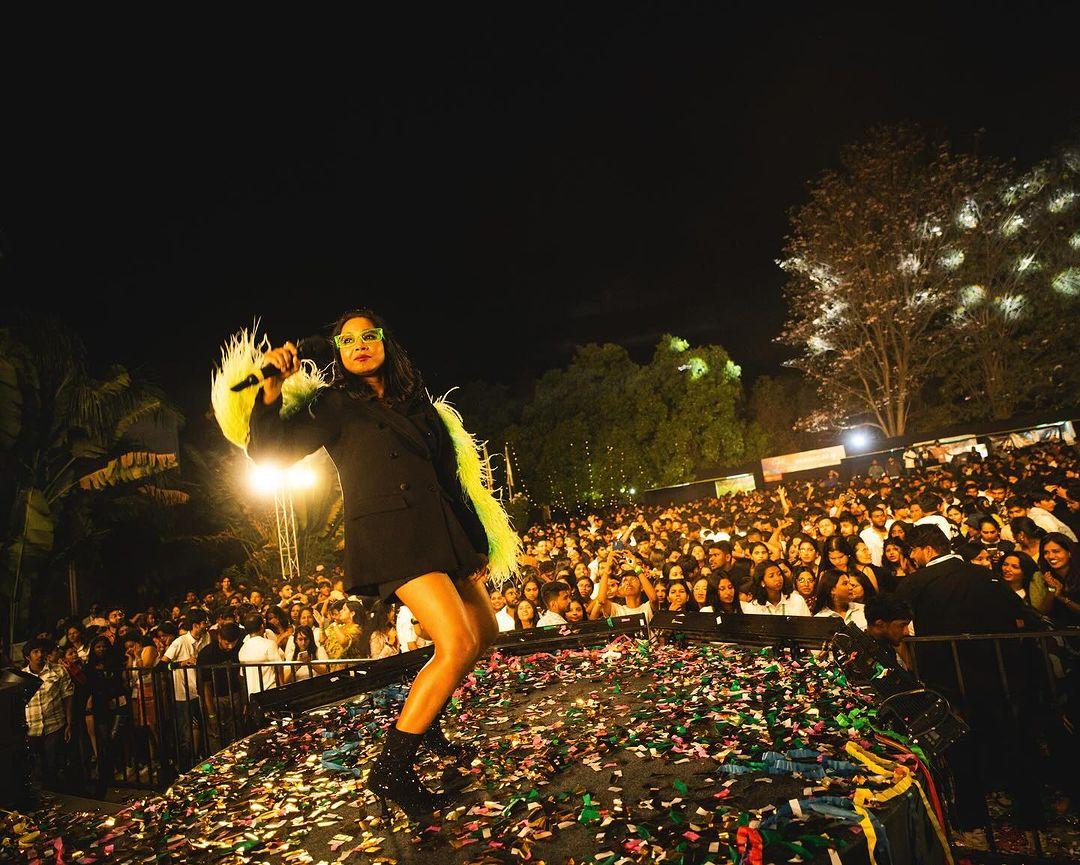
Devika V Menon (BOMBAY TIMES; December 13, 2024)
Ahead of her power-packed performance in Bengaluru, singer Shilpa Rao caught up with Bangalore Times for a quick chat. The singer, who has delivered back-to-back hits with songs like Chuttamelle, Kaavala, and Chaleya, speaks to us about the rise in Indie music, her growth as an artiste, and more.
'Thank God Indie music is growing. If not now, then when?'
Indie music represents everything that we are. It is extremely powerful. It's not just pop, it's not just a music video, either. You're talking about different genres that are coming from India. That's more of a representation of who we are as Indians. Everything diverse. And that's what I feel, that if there's music coming from all over the world, that same intensity is coming only from India because we have that much. So I think this is a great time to do this and it's just going to get better.
'We come on stage to mingle with the crowd'
It's important to mingle with the crowd during a concert. Otherwise, they can just sit in the comfort of their home and watch us on their TVs or mobile phones. We go out on stage because it's supposed to be one unit, us and the audience. There should not be a barrier. We want a connection with them. For that, we go through intense preparation. It's a lot of phone calls, meetings, zoom calls, band rehearsals, light rehearsals, outfit trials, and more. It's unending.
'As an artiste, I am still growing'
I have always been of the understanding that growth cannot be measured. It's better to dive in and figure for yourself how much can you swim and how long can you swim. And we keep learning from every stage concert what to do, what not to do, what not to do more actually. All of us like to have an open-minded discussion about what can we do and what can we do to make it better. So I think that's a very open forum. I have my entire team who know we can put out a better experience for the audience. So I think we're still growing.
'No one has really figured out the formula to success'
I believe that you figure things out when you're at that point. You don't need to overthink about producing a hit because you cross the bridge when you're there. So when I'm on the mic, I try and stop thinking and just go with what my instinct says, because you can do a lot of homework in terms of technique and trying new things which you've never done before. But then when it comes to recording, I think the lesser you think is better. So yeah, I haven't figured out the formula to success, and I don't think anyone really has.
'There are no yardsticks to measure how better one artiste is, over another'
Look at sports, for example. It's not always about rivalry, It's always about getting out there and winning. But again, there is so much nuance in it, and that only comes out when they are talking off-court about each other. And there's so much heart that goes into doing what you do. So being in a competitive sport, if you don't have that kind of rivalry, imagine music. How can you say someone is the best? It's impossible. There are no yardsticks for measure. For example, the number one tennis player won't go to the court and say, 'I'm number one, so I'm going to win this.' No, every day is different. Every match, every set is different. If that is so specific, you can imagine music is even more specific. So I don't think of rivalry. But, one thing that's constantly on my mind is, what can I do better and new that I've not done yet?
'I am not a big fan of this instant world; people need to understand the virtue of patience'
I think social media is bad in the sense that obviously life is not instant and if it is instant, then it passes by instantly, too. Starting with brewing your coffee which takes its own time to brew. You can't rush it. Sure, you could make a dal on the kadhai and also pressure cook it, but there'll be a huge difference between the both. And to even understand that difference, you need patience. Like, it's a very beautiful quote that nature doesn't rush, but still, everything happens and every task is completed. So we need to have that same thought, be it our relationships with our family, siblings, or friends. There's no instant absolution for anything. You have to fight the fight. You have to forgive each other. You have to embrace each other's good and bad as they do for you.
Autotune is just a symptom, not the main problem-Shilpa Rao
8:07 AM

Shilpa Rao with husband Ritesh Krishnan in Lucknow
Iti Shree Misra (BOMBAY TIMES; November 26, 2024)
Since she sang her first playback song Tose Naina Lage Re in the film Anwar in 2007, Shilpa Rao has captivated music afficianados. Be it Khuda Jane from the Ranbir Kapoor-Deepika Padukone starrer Bachna Ae Haseeno, or Tere Hawale from Laal Singh Chaddha, Chaleya from the SRK starrer Jawan and Besharam Rang from Pathaan, Shilpa’s unusual voice has garnered much love and appreciation from her fans across.
Her love for Urdu poetry and ghazals is well-known and the singer has been a very successful independent artiste as well. In Lucknow recently, the singer shared thoughts on Lucknow, which also happens to be her sasural, to changes in the music industry, and more...
What are your thoughts on Lucknow? Please share some memories associated with the city.
My first memory of Lucknow is from when my dad used to visit the city for work here. He would always bring back beautiful chikankari sarees or suits for my mom. Later, when I started visiting Lucknow for my concerts, I fell in love with the food and the language. There’s a charm and beauty in Lucknow that is truly special.
Your performance of Paar Chanaa De at a global music platform showcased music’s power to unite cultures. What does that experience mean to you?
Art, in any form—whether it’s music, painting, dance, or poetry—brings people closer. That’s what I felt while working on the music platform. Music has the unique ability to cross borders and connect people, and that’s what made the experience so meaningful to me.
How do you see the Indian and Pakistani music industries promoting artistic exchange?
We listen to Pakistani compositions and songs, and they listen to our music. This exchange of music and culture has always existed and will continue, driven by a never-ending love for art and tradition.
How has the music industry changed since you started?
The industry evolves every six months. There are constant changes, phases, and trends. It’s important to keep evolving and growing with the times to stay relevant in this ever-changing industry. There was a time when female voices were scarce in the industry. Now, there are many female-driven albums, songs, and even films. This is a beautiful change to witness.
Do you think the abundance of auto-tune and tuning tools has diluted the musical process, making it harder to spot genuine talent?
Autotune is just a symptom, not the main problem. The real issue is that people aren’t taking the time to learn music properly. They’re not understanding the art and skill behind it. If people learn music well, the whole system will improve. So, the real problem is not learning music.
What’s the most surreal moment you’ve experienced in your career?
Every time I see people reacting to my songs, it feels surreal. That feeling never gets old, and it’s always magical to see how music touches lives.
As a successful female artist, what changes do you hope to see in the music industry regarding representation and opportunities for women?
It’s about creating equal opportunities for all genders. I want to see more independent, unique, and authentic voices coming forward. The more diverse voices we have, the richer our industry will be.
For the longest time, people said that I couldn’t sing-Shilpa Rao
8:18 AM

Debarati S Sen (BOMBAY TIMES; August 31, 2024)
Shilpa Rao first sang for the Hindi film music industry over 17 years ago and since then, has had hits like Khuda Jaane, Kalank, Subhanallah, Bulleya, Ghungroo, Tere Hawaale, Chaleya and Besharam Rang among others to her credit.
In a conversation with us, this Grammy-nominated singer talks about creating a space for herself in the music industry despite her voice being termed unconventional at the beginning of her career. Excerpts:
Initially, your voice was termed unconventional. Did you face challenges to get a break in the music industry because of that?
Throughout my childhood, people said I couldn’t sing, and I believed them. Back then, I was learning to sing because I liked music. I never thought I’d be a musician. I wasn’t very goal-oriented, in that sense. Even now, I am learning music because it brings me happiness. Also, today, I don’t think much about what people say. I just believe in working hard. People can say whatever they want, but we must filter out the comments that are not relevant. If someone like Rashid Khan sahab would say something to me, I would listen and see value in it, but not from everyone. It's important to use your own mind, pick things that you're passionate about, work hard on that and listen to people who are wiser than you. Like, if Pritam tells me something, I will think hard.
How did you manage to find your voice even after facing criticism at a young age?
I think it helped me when people said I couldn’t sing (laughs). On a serious note, my parents instilled in me the idea of having my own voice and opinions, which shielded me from being too affected by others’ opinions. My dad always believed in learning music because it enriches your life, and I still hold onto that outlook. My voice was nurtured by my parents, who were big fans of artistes like Begum Akhtar, Prabha Atre ji, and Parween Sultana ji. I was fortunate to have seen some of them perform live as a child. Listening to Farida Khanum was also common in our house. My parents instilled in me the idea of having my own voice and opinions, which shielded me from being too affected by others' opinions on my singing abilities. My dad always believed in learning music because it enriches your life, and I still hold onto that outlook. Attaching happiness, love and good energy to my songs translates to the audience, and that’s important to me.
You’ve sung numerous popular Bollywood songs in the past few years. What’s your process when it comes to singing?
For me, it’s about approaching each studio session as if it were my first. Every recording is a fresh opportunity to connect with music, like a child in a chocolate factory exploring new flavours. For instance, when I was first told about Kaavaalaa (Jailer, 2023), I wondered why Anirudh (composer Anirudh Ravichander) chose me for it, as it was unlike anything I had sung before. However, trusting the composer and director’s vision is crucial. With Besharam Rang (Pathaan, 2022), Siddharth Anand was confident about me singing it. That meant a lot to me. People have told me how much they have loved the song. Sometimes, it’s not just about singing for a movie, it’s also about the emotional attachment people form with the song. So, having faith in what you do is essential.
During recording sessions, is your input as a singer considered?
Yes, always. Artistes who have been in the industry for a long time, whether it’s Pritam, Vishal-Shekhar or Mithoon, are always open to inputs from singers. They’re willing to listen to ideas and suggestions because they understand that it can only enhance the work. I enjoy collaborating with new people as witnessing their spontaneity and energy in the studio is amazing. There’s a unique dynamic that emerges when you bounce off ideas and energy, and often, something magical happens when they listen to your input.
You'd said earlier ‘Kalank’ took three months to complete. Which other song has been challenging for you?
Every song requires dedication and hard work. But if I had to pick, Mudhi Mudhi Ittefaq Se (Paa, 2009) was particularly challenging. I worked with Ilaiyaraaja Sir for that song, and he is known for his discipline and perfection. Impressing him wasn’t easy. Gustakh Dil (English Vinglish, 2012) was also tough because it conveyed complex emotions. Bulleya (Ae Dil Hai Mushkil, 2016), too, posed its own challenges, depicting a unique relationship dynamic.
And are there any songs that you breezed through?
I’d say "Manmarziyan" was definitely one of those songs. It felt tailor-made for me, and Amitabh (Bhattacharya) and I wrapped it up in just 30 minutes. It's quite rare for things to come together so seamlessly like that. Initially, it wasn't even called Manmarziyan, but as soon as I sang the first line, Amitabh immediately named it. Another quick recording was Chaleya. We finished the recording in just 20 minutes because we were both (composer Anirudh Ravichander) present, making decisions swiftly and bouncing off each other's energies. It really does make a difference when you have multiple perspectives in the room, including the composer, lyricist, and sometimes the director. When you're alone, it's challenging to navigate all those possibilities.
In an industry where most songs are male dominated, Tere Hawaale from Laal Singh Chaddha was one of those rare ones where male and female voices were given equal weightage. How did this song come about? How involved were you all?
Tere Hawaale is an ideal duet. The film is not just about one character; it's about the parallel lives of Laal Singh and Rupa, intersecting and drifting apart. The song reflects this journey, where they finally acknowledge their need to be together. It took a lot of time to perfect. We started working on it before COVID in 2019 and experimented with different ways of singing the two lines, and then the final recordings were done. Aamir Khan sir felt that the last part should be from Rupa’s (Kareena Kapoor Khan’s character in the film) perspective to conclude the song properly. It was truly a collaborative effort.
Deepika Padukone makes sure to own my voice on screen-Shilpa Rao
7:53 AM

Sundas Jawed (CALCUTTA TIMES; February 12, 2023)
She is the voice behind several chart-topping numbers, but still believes in introspection while making decisions. That is what makes the Tose Naina Laage, Khuda Jaane and Besharam Rang fame singer a music sensation in Bollywood and beyond. After taking the Kolkata audience on a melodious trip on Friday, Shilpa Rao spoke to CT about the mantra behind her flexibility, benefits of training early, her formula for success with Deepika Padukone and more. Excerpts:
You have been praised for the versatility of your musical style and for adapting to the needs of a song. What is the creative process behind this flexibility?
More than the creative process, you need to be open-minded towards different genres. It’s very important to listen to all kinds of music without preconceived notions while connecting with it. Once you start doing that, it starts showing in your own music and that helps you develop varied styles.
Your songs for Deepika Padukone seem to be a sure-shot formula for success. What is the secret chemistry behind this?
It is very simple. We do the work together. I do half the work in the studios, she expresses it on screen. She makes sure to own my voice on screen. We share each other’s work. It is a two-way process.
The diverse kinds of movies being made now have created room for singers with more distinctive voices and timbre. Do you agree, or can singers still be typecast in playback singing?
The journey is entirely independent of each other. I think no one should compare anyone with anyone else. We need to focus on what we want to do and what makes us happy. To do this, one needs to introspect daily. Everyone should have their own path, their own voices because there is always room for new things.
Popular songs like Besharam Rang acquire a life of their own when content creators make it their own. Sometimes they work really well, sometimes not so much, and the original singer, composer and choreographer do not have control over it anymore. Does it get bothersome at any point?
Yes, no one has control over it. Once we release a song, it belongs to the audience. It’s all on you. We are just in control when we are working on the song. When I am in the studio, I have that song with me and I have the pleasure to live that song and have a great time. That is my time to have fun with the song. I have my party in the studio and nobody can take it away from me. Once it releases, it belongs to everyone else.
Having worked with almost all music directors, who do you think has been a mentor and who is the most fun to work with?
Everyone has been a mentor and a fun friend. I am happy that I have been able to befriend so many people on this journey – be it Pritam or Vishal-Shekhar. We have created a space where it is fun to be around each other and share our thoughts and music advice.
You were in Kolkata for a singing reality show. Do you think there is a pressure to get stage-ready too early and less emphasis on the training? Or is it that learning to be a performer and starting early helps?
Training never ends; one keeps learning. I don’t see it as completely good or bad. Some take to it very nicely but for some it becomes an auto-pilot thing and later they lose that thrill of going on stage. It could be either case but learning from an early age is very advantageous. The sooner you start going to a school teacher, a guru to learn, the better. And when to get into the performance zone should be advised by the teacher or guru. They know it best.
What is it like to perform for an audience in Kolkata?
It is amazing. There is a different charm and energy here. These people are so artistically inclined. It comes from the soil. They all have a soft corner for the nuances of art – be it music, dance, films or other artworks.
I remember hugging KK for two minutes straight. I didn’t know that would be our last meeting-Shilpa Rao
7:48 AM

Soumya Vajpayee (HINDUSTAN TIMES; June 3, 2022)
Like most members of the music fraternity, singer Shilpa Rao is devastated by the sudden death of singer KK. Rao met him around 10 days ago and cannot come to terms with the fact that he’s no more. “We met at a concert and I remember hugging him for two minutes straight. I didn’t know that would be our last meeting,” says the singer, who collaborated with KK for songs such as Khuda Jaane from Bachna Ae Haseeno (2008), Koi Jaane Na from Hijack (2008), Oya Oya from Horn Ok Pleassss (2009) and Apna Bombay Talkies from Bombay Talkies (2013).
Talking about the bond she shared with the late singer, the 38-year-old says, “I believe a bond with a fellow musician is inseparable because their music lives on in our hearts forever. I was fortunate that I had the opportunity of opening his concerts. Watching him perform live was always a learning experience for me. The first time I met him after recording Khuda Jaane, we performed it live together. Even when I was new in the industry, he really supported me. He was a really supportive and caring person.”
Ask Rao if she felt he was unwell when they met recently and she says he looked fine. “I was just so happy to bump into him that we didn’t really catch up on other things,” says the singer, who considers Khuda Jaane her most memorable association with KK: “From recording the song in the studio to performing live with KK, it was a great experience for me. Khuda Jaane would have been incomplete without him.”
As a musician, Rao learnt several things from the Pal singer. “He always said, ‘Let your music do all the work, you don’t need to do anything apart from that (focussing on music). Always stay the same person you are and make sure your behaviour doesn’t change with time. Whether someone is new or established, treat everyone with the same kind of respect.’ I would hold on to these learnings forever,” ends Rao.
Fame, if it comes quickly, goes away quickly too-Shilpa Rao
8:16 AM

Rishabh Suri (HINDUSTAN TIMES; April 9, 2022)
Shilpa Rao, who is noted for her popular songs Bulleya (Ae Dil Hai Mushkil, 2016) and Manmarziyaan (Lootera, 2013), says she started her career with advertisement jingles rather than film songs for a reason.
“The first time I came to Mumbai, there were two people I knew— Hariharan ji (singer), who was my guru, of course, and Shankar Mahadevan ji (singer-composer). I loved what he (Mahadevan) told me when I met him: ‘Do one thing; just go and sing jingles for three years. Go to the recording mic, see what it feels like to record, learn that process’. Afterwards, he gave me my first song in Salaam-E-Ishq (2007),” she recalls.
The 37-year-old goes on to say that no good comes out of tags such as ‘overnight sensations’. “Fame, if it comes quickly, goes away quickly too. Life doesn’t come to you overnight, maybe once, due to beginner’s luck. You relish the process because, after working for a certain amount of time, it becomes like a job. The whole point is to enjoy,” Rao says.
She adds, “He (Mahadevan) got me on the path of doing things from the foundation instead of doing an overnight song and becoming an ‘overnight sensation’. The process of learning was not just to make me see it but to apply it for the rest of my life.”
The Grammy was never on my list, but when I was nominated I was extremely happy-Shilpa Rao
8:24 AM

Debarati S Sen (BOMBAY TIMES; January 1, 2022)
Bollywood singer Shilpa Rao’s collaboration with composer-sitarist Anoushka Shankar last year, on the album Love Letters, got her a nomination in the ‘Best Global Music Album’ category for the 63rd Grammy Awards last year. The singer who has given chartbusters like Ghungroo (War), Meherbaan (Bang Bang!), Khuda Jaane (Bachna Ae Haseeno), Ishq Shava (Jab Tak Hai Jaan) among others, recently received the Grammy certificate.
She says, “For somebody who never felt since childhood that she would achieve anything, this was huge. Of course, the Grammy was never on my list, but when I was nominated, I was extremely happy and excited. ”
Shilpa believes it’s persistence that can take an individual a long way. “I think more than talent and hard work, persistence is the key because one has to work hard and never give up even when things do not go your way.”
Shilpa says that she has never looked at her songs as filmi or non-filmi. “Every recording is important to me because I am very emotionally invested in my songs,” she says.
Has the perception of people in the Hindi film music industry changed in any way because she has now got an international recognition? “Well, I have to say that everybody here was quite excited and happy. They were congratulating me from everywhere. Be it Sunidhi Chauhan, Shaan, Vishal Dadlani, Shekhar Ravjiani, Shankar Mahadevan, Pritam...everyone. This means a lot to me because I have worked with them, they are my friends and are a part of my life. We congratulate each other whenever we do things and that means so much to us. When I like a song by another musician, I pick up the phone and congratulate him or her. When people around you are happy to see your progress...that’s a very beautiful way of working,” she ends.

(L-R) Ayanna Witter-Johnson (cellist), Shilpa Rao and Anoushka Shankar
The pandemic taught me that I have enough money to say no to money-Shilpa Rao
8:05 AM

Abhimanyu Mishra (BOMBAY TIMES; February 20, 2021)

‘MY ONLY AIM BEHIND COMING INTO THE MUSIC INDUSTRY WAS TO CREATE GOOD MUSIC’
When I came into the music industry, my only aim was to create good music. I never thought that I would become a popular singer someday or people would know me. I wanted to sing and create good songs and that is what I believe in doing even now. That’s how the Grammy nomination has come our way. We never set out to make an award-winning album, we just wanted to collaborate and make music that we believed in. And it has yielded results. When I came to know about the nomination, I first went online to confirm whether the news was true and after that, I celebrated it.
‘CLASSICAL FORMS OF MUSIC HAVE FEW TAKERS BECAUSE IT NEEDS TIME AND PATIENCE’
The legends of Indian classical music and other genres like ghazals dedicated their entire lives to reach that pinnacle. It requires a lifetime of riyaaz and undiluted dedication. Our current musical scenario in India doesn’t encourage that kind of musical upbringing. The music industry that creates stars and money has little space or patience to promote that kind of talent, and the classical genres don’t give you fame and money. So, it’s hardly surprising that there are few takers for that kind of music.
‘I DON’T SEE MYSELF CREATING MUSIC FOR QUICK CONSUMPTION’
There is an entire industry that only thrives on creating music for quick consumption and that’s where the money is, but I can’t be a part of it. My friends tell me that I haven’t made the kind of money that I should have after being in this industry for so long. But I am happy this way. And 2020 has made that belief even stronger-that you don’t need that kind of money and ‘things’ to be happy. After surviving the pandemic, I can say that I have enough money to say ‘no’ to money.
‘MARRIAGE HASN’T CHANGED ANYTHING IN MY LIFE, HOPE IT STAYS THAT WAY’
Ritesh Krishnan and I were friends for a long time before we got married, so there is nothing that we didn’t know about each other. We were clear that we wouldn’t want to change anything after we tie the knot. Things have remained the same till now and I hope it stays that way in the future too.
I am not a big fan of weddings. I have not seen a single wedding ceremony in my life-Shilpa Rao
8:09 AM

Shilpa Rao says she is looking forward to a fun ride with her husband, Ritesh
Nikita Deb (HINDUSTAN TIMES; January 30, 2021)
Singer Shilpa Rao is happy to be starting a new chapter of her life. She got married to her long-time partner Ritesh Krishnan’s on January 27, and the wedding was a small ceremony.
Enjoying this new phase of her life to its fullest, Rao says, “Thankfully, both of us are not very ritualistic and we cherish what’s in front of us. Even growing up, in my family we always had a more open heart and mind about the things in front of us. It’s a good feeling to celebrate each day as it is. I am frankly not a big fan of weddings. I have not seen a single wedding ceremony in my life. I have been to my friends’ weddings and have always missed the ceremony. I always feel that it’s just the start of something and the tough part comes later. It’s not so much the wedding itself that you have to focus on. It’s the later days that you have to focus on... that’s the tough part. We will try to take it as each day comes.”
The Khuda Jaane (Bachna Ae Haseeno; 2008) singer has known her now husband for more than three years.
“We have known each other pretty well for the past three years. We have travelled together a lot and that’s the best way to know someone. I feel that yes, we are together, but if there is a side of him that wants to be alone and be by himself for a while, that’s very necessary. You have to not forget yourself in the marriage. No one should lose themselves in the relationship. The trick is to let the other person be themselves and I am hoping this will be a fun ride,” she says.
Even though the wedding is done now, a honeymoon is not in the picture anytime soon, reveals Rao.
“My vacation is going straight to the shoot since I have just started a music show. I think once I am finished in May, we can step out then but right now it’s back to back work,” she says.
Singer Shilpa Rao ties the knot with photographer Ritesh Krishnan
8:11 AM

Debarati Sen (BOMBAY TIMES; January 28, 2021)

Speaking exclusively to Bombay Times, Shilpa says, “Our parents are senior citizens and therefore we chose to do a simple registered wedding at home. We kept it simple, decorated the house with flowers and my brother’s wife did my mehendi. We formally registered the wedding at around 5pm, and all my friends and family members from across the world joined in on a video call to see the ceremony.”
Shilpa has always been private about her personal life, and not many knew about her relationship with Ritesh. Sharing details about how they met, she tells us, “We met three years ago on (music composer) Pritam’s USA tour. Ritesh seemed to be an affectionate person, and we started hanging out together. On the first day that I met him, I felt that he was a chilled out guy, which was very attractive for me. We started travelling together in 2018, and did many shows across India.”
Ask her about how Ritesh proposed to her and she elaborates, “In October 2019, we were at a monastery at the top of the mountains in Ladakh. Ritesh said, ‘Let’s get married’ and I said, ‘Yeah’. That was really a beautiful place to have this conversation. So, it wasn’t slipping a ring on my finger kind of a proposal or going down on one knee, but it was just being one with the world.”
Ritesh was apparently a fan of Shilpa’s earthy voice long before he had met her. She shares, “His friends told me that he was crazy about my song Manmarziyan from Lootera. He used to play it at every party on repeat mode. That is sort of our song now.”
Shilpa and Ritesh have a common passion for travelling, but they haven’t been doing much of that in the past one year. “We keep looking at our passports and feel sad sometimes. On February 2, I’ll start the shoot of Indian Pro Music League (IPML), which goes on till May, and post that we will probably travel in June.”
The singer, who is “really excited about the show”, says, “On the show, I am in the company of contemporary musicians who I have worked with and been inspired by. When I’d discussed the wedding with my IPML family, they were kicked about it. They were probably more happy and excited than I was, and once we start the shoot, we will have a party on the set. So, I am looking forward to that.”
It’ll be great if we win a Grammy, and even if we don’t, we will keep doing what we do-Shilpa Rao
8:13 AM

Nikita Deb (HINDUSTAN TIMES; November 28, 2020)
Singer Shilpa Rao has added yet another feather to her cap. Anoushka Shankar’s album Love Letters which has been nominated for the Best Global Music Album for this year’s Grammy Awards, also features a track by Rao. And she is absolutely thrilled with this development.
“We have been waiting for this day since quite a while. It has been a long journey for me as well as for the song. It is surreal. I have been trying to pin down one emotion but I don’t know what exactly I am feeling. It has added another thought in my heart that I cannot make any more excuses now. I just have to work harder,” she says.
Rao, whose track, Those Words, was part of Shankar’s album, is happy that Indian music is being recognised globally. “I’ve been learning Indian music since I was a kid and I have no qualms in saying that Indian music is one of the most progressive kinds of music in the world. It’s high time our own youth owns it, listens to it with pride and propagates it. Our youth is still not owning it entirely and they don’t find it cool. When you are born into a family, you inherit the entire legacy by virtue of birth. In the same way, when you are born as an Indian, you inherit the culture, the goodness and all the great things by virtue of being born in India. Sadly, we have not celebrated our music as much as we should have. But I am still hopeful. And with this news, maybe one young kid somewhere will look at our music differently,” adds Rao.
The awards will be announced on January 21, and the singer says that the nomination in itself is an achievement.
“It will be great if we win, and even if we don’t, we will keep doing what we do. Even if my song doesn’t work, it doesn’t throw me off from sitting and doing my riyaaz. I still do it. Failure is inevitable and if you are not facing failure, you are not doing something right. You need to pi** off people, you need to not agree with at least some people because that means you have a unique idea that represents you, and that is what artistes do. Doing something that works is an easy way out but being yourself is the most difficult thing in this world,” signs off Rao.

My work was recognised, but I wasn’t-Shilpa Rao
8:27 AM

Nikita Deb (HINDUSTAN TIMES; July 9, 2020)
Singer Shilpa Rao can be termed as one of the most successful singers in Bollywood right now. So, when conversations around mental health of people in showbiz caught fire recently, it came as a shock when she revealed what a tough time she went through in 2013, mentally. The singer says that in developing countries like India, the common man is always more concerned about the “basic necessities” and hence, one’s mental health always takes a backseat.
“I know for a fact that a lot of my friends, who are not from the music industry, face mental health problems. This is common among people across the world, and it is not a career specific problem. All of us are going through it. A lot of us have our ways and means to deal with it, but some don’t,” says Rao, while adding that in 2013, after the release of her hit song Manmarziyan in Lootera, she reached a point where she could see a “dead end”.
“I was doing a lot of work, and it was getting the kind of recognition that it deserved from the audiences, but I wasn’t achieving the stature that I should have. It used to really hurt when a lot of cover singers who have gained popularity singing my songs, were more popular than me. After Manmarziyaan, I completely went into a shell, and I gave up,” adds Rao.
The singer, who is known to not be very visible in the media, says that at that point, she started going to only recording studios and live gigs because that’s where “she would thrive”. “I was raised in an environment where I knew I had to sing well and that’s how I function, not by marketing or publicity. I’m a little old school but that hasn’t changed even now. I still feel nervous going for a recording,” she says.
Hence, Rao believes that it is important for everyone to see a therapist. “We all have friends and well wishers but when we have a therapist, we have a person who we know will be there whenever we need to talk. If you have a fever, you won’t consult your friends right? And to be brutally honest, when you cut your finger, the bruise is visible, but the emotional trauma that people go through leaves deeper cuts which cannot be seen,” says Rao, who adds that she healed herself by travelling a lot.
“In 2013, I started to travel a lot because I never spoke to anybody about my issues. I met a lot of new people, who had nothing to do with my profession, and with whom, I just had conversations. It changed my outlook towards life. However, even though travelling helped me, it may not necessarily help others,” she concludes.
Today, female singers and their songs are disappearing from the scene-Shilpa Rao
8:16 AM

Nikita Deb (HINDUSTAN TIMES; June 23, 2020)
The Bollywood music industry has always boasted of beautiful female voices in the form of legends such as Lata Mangeshkar, Asha Bhosle, Kavita Krishnamurthy, and many others. But lately, a lot of industry insiders and music lovers have pointed out the lack of female singers and songs for them in Bollywood.
Singer Shilpa Rao, who got a breakthrough with her unique voice in Bachana Ae Haseeno’s (2008) Khuda Jaane, says that she really “misses a good female album” in the industry today. “There is a situation today, where female singers and songs by female artistes are just disappearing from the scene. We have very beautiful female driven films, and I think, we need more female driven albums, too. Everyone keeps asking me why they don’t hear more songs from me in the mainstream, but this question can only be answered by the makers of the songs and albums,” says Rao, adding that this is a change that would be very welcome “because we have such great voices”.
Rao, who has been focusing more on her independent music career for a couple of years now, says that all her contemporary female singers are busy doing their own thing. “All the female singers are obviously making their own independent singles, like I have been singing ghazals for the last three-four years for no major return or anything, but just to satisfy myself and because it has been my upbringing. I am making a few singles as well, which are in the pipeline, and should be out this year. Neha Bhasin is doing her folk music, Shalmali [Kholgade] is doing her RnB music, so everyone is making their own stuff, and doing their own thing. But when people ask us where are the female voices, that’s not a question we can answer,” says Rao.
The Tose Naina Lage (Anwar; 207) singer adds that she is not asking for this change from a gender perspective, but from the point of view of talent capacity. “If you feel that yes, this female vocalist is doing justice to this film where the lead is a female, we should have a female voice sing for that film. When there is a conception of a film where the lead is a female, I would want to hear a female voice representing her attitude and personality and focus, so that is something that I would love to see. That is something that I am missing from the entire music scene. That is one change I would love to see. I just want to hear more beautiful voices irrespective of gender,” says Rao, clarifying that the problem doesn’t exist in the independent music scene where singers like Asees Kaur and Neha Kakkar are actively bringing out new singles.
We need more original singers and composers-Shilpa Rao
8:32 AM

Singer Shilpa Rao says that today, the only way forward for the music industry is to ‘come up with new songs’
Nikita Deb (HINDUSTAN TIMES; February 9, 2020)
 It’s been well over a decade since Shilpa Rao made a name for herself in the music industry with the superhit track, Khuda Jaane (Bachna Ae Haseeno; 2008). And since then, she has surely come a long way. Now, she has shifted her unwavering focus towards independent music. And so, for her latest single, she has teamed up with globally popular musician, Anoushka Shankar, for one of the songs in the latter’s new EP, Love Letters. The song titled Those Words marks Shilpa’s first-time association with Anoushka. In an interview, Shilpa talks about the song, how it came about, the state of music in India today, and more. Excerpts:
How was the experience of collaborating with Anoushka Shankar?
I feel the song is like a person on its own. Anoushka and I had met for lunch last year, and we were just talking about music and what both of us were doing with the art, and somehow, that led to us talking about collaborating and that’s how it happened. I feel, the one common thing between us is that we do not want to work on e-mail, and so we did this in person. I was supposed to go to London, UK, for a concert, and I went a little early and sat down with her. We both worked out the song — word by word — and then we took it to the studio. We wanted to work on it in person rather that me simply recording it here and sending it to her. This way, it was so much more engaging and inspiring because you get to work with everybody in same room. I loved that.
When did you meet Anoushka for the first time?
Anoushka and I met many years back at a music festival where I was performing with Karsh Kale. She was also slated to perform there, and we met because of Karsh. Then we met again, two years back, when I was in London for a break. We just thought of catching up for lunch and there we spoke about various things. Anoushka shared with me a bunch of her tunes and I played some of mine to her. And she said, ‘we should work, we should collaborate’, and last year, she sent me this song. I heard it, and it was beautiful and that’s how we thought of adding vocals to this song. It was very inspiring for me to do this song. More than an external journey, it was an internal one for me. That was the first time I recorded a song in London, and it was at the Guild Hall which is a music school.
Do you think such collaborations help Indian music reach out to a global audience?
I think a lot of collaborations should happen that way because it’s a very healthy way of working. I know we have a lot of technology. And because of that, it is possible for us to not be in the same room to interact. But it’s so much sweeter when you are there, in the same room, while collaborating. These kind of collaborations are very important because the whole point of it is that everyone who is working on that song brings their own personality into it, and when we do that, it just multiples and creates a beautiful concoction. Original music and collaborations like these will improve the current state of music. We need more original composers, writers and singers. I think we need people to come up with new songs and that is the only way forward.
For a singer, inspiration feeds off music and lyrics-Shilpa Rao
7:44 AM

Debarati Sen (BOMBAY TIMES; October 7, 2016)
Shipla Rao's latest release
Bulleya from Ae Dil Hai Mushkil is already climbing charts. Though a
high-energy track, it is inherently Sufi and soulful in its nature - which is one of the primary reasons for its widespread appeal. Shilpa's
sombre, full-throated, yet expressive voice has a distinct charm and
what makes her stand apart is that she modulates and experiments with
her vocal texture to belt out numbers that make it to not just the
charts, but also people's hearts. Her earlier releases include Meherbaan
from Bang Bang, Subhanallah from Yeh Jawaani Hai Deewani, Khuda Jaane
from Bachna Ae Haseeno, Malang from Dhoom 3, Mudi Mudi Ittefaq Se from
Paa and Ishq Shaava from Jab Tak Hai Jaan. In a quick chat, the singer
talks to us about Bulleya and more...
How did Bulleya happen?
Bulleya is Pritam's USP - the way he has composed it. He asked me to come and try out the lines and we did the song. Amitabh has written some beautiful lyrics and definitely, my inspiration comes from that and he way Pritam has put a tune to them. The combination of Amitabh-Pritam is fabulous and that's how Bulleya came together.
Your last Bollywood song was in 2014. What took you so long to come back?
Meherbaan for Bang Bang was my last. We keep doing songs, it's just that the release dates are not in our hands - sometimes a song releases in a month and sometimes, a year later. What is important is the newness that you bring to a song. And that is what I always try and do, so that the audiences have a new perspective and a fresh sound from me each and every time.
You don't have a conventional playback singer's voice. Has that worked for you? Or do you think, over the years, you have lost out on some songs because of that?
As far as Bollywood singing is concerned, I don't think this exists anymore, because each singer has his own way of singing. And I think every composer is actually welcoming that. I have been really fortunate that every composer I have worked with, has let me be myself and has let me express the song in my own way.
There are too many talented and young singers in the industry. Does that affect you?
I think it's a great thing. Film music is diverse these days and to cater to that I think you need a variety of singers bringing their own ideas and uniqueness into a song. What each singer can do is unique. Somebody else could do a similar thing, but in their own manner. So, I think it's a great time for musicians, lyricists, composers and singers these days. And each one has a unique way of expressing himself or herself.
What do you have to say about the kind of lyrics that are being written these days?
Well, every form of art is actually a reflection of the society, so, as the society keeps changing, our music, films, lyrics and art work also keeps changing accordingly. And, I think every time has its own highs and lows. I guess it also holds true for music. Some great work has come out this year and I really hope every composer is trying to put out his best work. It's always a pleasure to hear something great from people like Pritam, Vishal-Shekhar, Mithoon. I really hope music keeps reflecting our times.
How important are music and lyrics for a singer? Do these affect your work too?
Music and lyrics both are very important for a singer, because that's where our inspiration feeds off. So, when I go to sing a song the lyrics and the tune, actually inspire me to express myself in a certain manner. When I work with a composer or with a lyricist, it is really important for me to feel connected with the song and to feel inspired by it.
Malang itself means surrender, so that’s what I did-Shilpa Rao
7:52 AM

Shilpa Rao, who sang Malang from Dhoom:3,on going with the flow
Akshata Shetty (BOMBAY TIMES; January 10, 2014)
Songstress Shilpa Rao showcases the perfect combination of soul and style in her singing. Here, she speaks to us about giving her songs the emotion desired and her live audience the vibe they would enjoy. In a freewheeling chat, she shares her stories about getting into music, working with Pritam and how she’s thankful to her dad for giving her music to grow up on. Excerpts from the interview…
For a singer, his/her voice is their identity. How do you define your voice’s character, considering you have a distinct style of singing? All credit goes to my father. He taught me music and most importantly how to choose good music to listen to. My music influences and training have actually shaped my voice and style of singing. Artistes like Sade, Sting, Eddie Vedder, Mehdi Hassan saheb and Amir Khan saheb have been constant influences for me. I have attempted diverse genres and have always tried to put out something new for audiences with every song.
From Khuda Jaane (Bachna Ae Haseeno) to Malang (Dhoom:3),how has your journey been so far? Any turning point in between that may have inspired you? The journey has been bittersweet. I have taken each day and every project as if it were my first. I am fortunate to have worked with the best people in the music fraternity and have learned tremendously from each one of them.
The year 2013, had Manmarziyan (Lootera) and Malang. Talk about both the tracks and how was it working with Amit Trivedi and Pritam. Both these tracks are diverse from each other and that made them even more challenging and fun to work on. Manmarziyan is a song that I had to hold close and sing with all my heart and soul. It’s one of my favourites I’ve sung till now. Working with Amit and Amitabh feels like home, we’re friends and have very similar tastes in music so we work with ease and understanding. Malang on the other hand had to be sung with no holding back. It’s a high energy track and the word Malang itself means surrender, so that’s what I did. I didn’t think, and just went with the flow of the music and lyrics. Pritam was chilled out and trusting which made my job so much easier.
What about the song appealed to you? The song has an energy by itself from the word go. It had a rhythm and a swing that one can trip on. It has an interesting blend of energy with soul and this combination was so attractive for me that I just sang the song with total surrender.
Since Malang was an uptempo number, was it a challenge? Actually, it was perfect. I’ve always wanted to do different genres of songs. Malang is unique and sets itself apart because of the blend of high energy and a Sufi touch. The pace and tempo of the song made it fun to record.
What is it about film music that keeps you going? Our music and films are fast changing, ranging across many genres, experimenting with sound design and taking challenges with musical styles. In short, we are tending to lean towards global music and this is what is keeping me going. I love the fact that I can experiment and try something new with each song I sing.
Recording in a studio or experimenting with live bands, what do you prefer and why? I am greedy; I want to do both. Creating something new in the studio from nothing is a superb high; simultaneously performing live with my band is another brilliant high. Recently I did a five-city tour with my band and had a superb experience. Songs like Tose Naina, Manmarziyan, and many folk songs I grew up with, I tried to perform in a new and different avatar; they were well received by audiences everywhere. I strive to do both and hope the audiences remember me as a good recording and performing artiste.
Artistes and composers you look up to and would like to work with in the future? Filmmaker Vishal Bhardwaj is someone I look up to and simply adore. His work is inspiring; I would love to sing a song for him someday. I would also like to work with director Imtiaz Ali, we not only hail from the same city but have gone to the same school too!
What’s next? I’m really looking forward to 2014. There is Gulaab Gang and Bang Bang that will be out. Here’s hoping that the audiences will like my work in these films.
Subscribe to:
Posts (Atom)