Showing posts with label Shibasish Sarkar. Show all posts
Showing posts with label Shibasish Sarkar. Show all posts
As Salman Khan, Ranveer Singh, Rohit Shetty receive threat calls, film bodies unite to discuss urgent safety measures
10:06 AM

Mohar Basu (MID-DAY; February 16, 2026)
Leading film industry bodies met in Mumbai on Saturday (February 14) to chart urgent action following recent threat calls and extortion attempts targeting members of the Hindi film fraternity.
Representatives of the Producers Guild of India, Indian Motion Picture Producers’ Association (IMPPA), Indian Film and Television Producers Council (IFTPC), Western India Film Producers’ Association (WIFPA), and the Federation of Western India Cine Employees (FWICE) convened at the IMPPA office in Andheri at noon. Those present included Guild members Nitin Tej Ahuja and Shibasish Sarkar, along with FWICE president Birendra Nath Tiwari and senior representatives from other bodies. IFTPC president Ratan Jain could not attend but extended his support to whatever decision was taken.
The meeting follows threats targeting actors Salman Khan and Ranveer Singh, and filmmaker Rohit Shetty, among others. “This is no longer about isolated incidents. There is a palpable sense of fear. When leading actors and directors receive threats, the anxiety trickles down to every unit member, from spot boys to assistant directors. This is how Sikandar (2024) was shot following threats on Salman Khan and in the past year, the fear has only escalated,” a source told mid-day.
The bodies resolved to draft a joint letter to Maharashtra Chief Minister Devendra Fadnavis seeking immediate intervention.
“We will collectively urge the state to ensure protection not just for high-profile celebrities, but for entire film units. Shoots involve hundreds of daily wage workers. Their safety cannot be compromised,” an insider told mid-day.
The source added, “If there is disruption due to fear or extortion, it directly impacts livelihoods of workers on set. These are regular people trying to make an honest earning. Films will be impacted because fear will drive people out of the industry.”
Investor interest wanes as Bollywood loses the plot
8:57 AM

Bollywood’s traditional biz model lacks scalability of startups; partial exit of Disney, Viacom adds to the woes: Experts
Rajesh N Naidu & Javed Farooqui (THE ECONOMIC TIMES; December 2, 2025)
Box-office volatility, high star fees, shrinking streaming budgets, a string of big-ticket failures, rapid artificial intelligence disruption, and shifting audience tastes have stalled consolidation among film production houses, even a year after the Adar Poonawalla-Dharma Productions deal worth Rs. 1,000 crore, producers and analysts told ET.
The 50% stake sale to Poonawalla signalled the mounting financial pressure on producers as big-budget releases struggled to recover costs. Excel Entertainment, Sanjay Leela Bhansali Films, and Abundantia Entertainment are among the companies reported to be in early stake-sale talks.
“After the Dharma deal, investors have realized that the Hindi film industry, despite its iconic brands, is a highly volatile and high-variance business,” said Karmic Films co-founder and director Suniel Wadhwa. “The valuation was a premium bet on legacy, not on predictable cashflows.”
“When marquee studios show fluctuating profitability, it impacts flow of capital. Investors today are prioritizing stability, repeatability, and data-driven scalability, none of which Bollywood’s traditional model is guaranteeing,” added Wadhwa.
Executives said weak investor confidence stems from the industry’s inability to exhibit scale and returns, a mood worsened by the partial exits of global studios like Disney and Viacom from India.
“Indian M&E industry needs to work on showcasing and creating awareness,” said Reliance Entertainment CEO Shibasish Sarkar. “The sector is still fragmented, so more consolidation is needed so that mid-size companies can reach a certain scale to attract capital. India also needs to create awareness to recognize IP as a real asset class, strengthen incentives and expand copyright terms.”
Ahan Shetty’s action drama rolls in October
9:12 AM

Akash Bhatnagar (HINDUSTAN TIMES; June 8, 2025)
After signing on a love story with director Shaad Ali, actor Ahan Shetty has locked his next project as well — and it’s set to be an action-packed affair.
A source close to the development of the project tells us that the 29-year-old, who made his acting debut with Tadap (2021), will be seen in an action-drama next. “Ahan has signed an actioner which will be directed by renowned Bengali director Birsa Dasgupta, and is being produced by Shibasish Sarkar and Ribhu Dasgupta,” the source tells us, adding that the leading lady is currently being finalised, with an official announcement expected soon.
The yet-untitled film will go on floors this October, adds the source. Meanwhile, Ahan also has Border 2 in the pipeline, which will release next year. For Birsa, this collaboration will mark his directorial debut in Hindi films, although he has earlier directed Hindi web series such as Mafia (2020), Black Widows (2020) and The Magic Of Shiri (2024).
Industry insiders talk about block booking and why it is so rampant
11:09 PM

Rishabh Suri (HINDUSTAN TIMES; February 13, 2025)
The terms ‘block bookings and ‘corporate bookings’ have created a lot of buzz recently. It began when trade analyst Komal Nahta accused the makers of actors Akshay Kumar and Veer Pahariya’s recent film Sky Force of resorting to booking out theatres in order to paint a rosy picture in the film’s box-office report.
Things took a turn after the same accusation was levelled against Vicky Kaushal and Rashmika Mandanna’s upcoming Chhaava, which is bankrolled by the same producers — Maddock Films. In light of these allegations, insiders worry that the industry’s credibility is at stake, considering anyone can manufacture numbers to favour their films.
‘An old practice’
According to trade analyst Taran Adarsh, big names in the film industry were fudging the numbers even in the 1970s and ’80s: “In those days, block bookings was called ‘feeding’. A top actor I spoke to would buy tickets at certain cinemas for houseful boards to create a certain perception. Films wouldn’t release simultaneously then — a film might premiere in Delhi today, Mumbai after a week and so on. But public sab jaanti hai.”
However, exhibitors do not complain since tickets are technically being sold. He adds, “Aaj kal toh bade level pe ho raha hai yeh sab. Exhibitors are happy, ab chaahe producer khud khareed raha hai ticket, ya actor, ya studio.”
So, is it all fake?
Also accused of using this tactic were the makers of Ram Charan and Kiara Advani-starrer Game Changer. The makers claimed that it grossed Rs. 186 crore worldwide on premiere day. But according to number crunchers Sacnilk and Box Office India, the actual worldwide gross was Rs. 80 crore.
With the growing buzz, filmmakers have begun adding their two cents to the debate. Recently, filmmaker Kunal Kohli called block bookings “rubbish”. In an interview with YouTuber Aleena Gandhi, Kohli said, “Matlab we make the film, we release the film and then we only buy tickets to watch the film? The reason you are doing [this] is ego, to pamper a star and not show him the reality, or to pamper that director, that producer.”
Shibasish Sarkar, the president of Producers Guild of India, asserts that this is fraud against the masses: “I think ultimately what is happening is bringing the credibility of the industry down. The only logic here is to create a perception about the demand.”
Tracking the numbers
As for fake numbers, Sarkar notes, “In developed markets worldwide, there are systems like Rentrak (to track the numbers). In India, unfortunately, that has not happened. While this isn’t new, things are happening on a scary proportion. So, even if you get a system to bust fake numbers, how would you see who is fraudulently booking the tickets in bulk? You cannot install CCTV cameras inside every theatre.”
We reached out to Dinesh Vijan, founder of Maddock Films, but received no response by the time of going to press.
After the makers of several tentpole films were accused of ‘block booking’, we ask industry insiders about the practice and why it is so rampant
What is corporate and block booking?
Trade expert Atul Mohan explains, “If an actor endorses 20 brands, they ask one brand to, for example, purchase 10,000 tickets for their latest film. In return, they waive off some fees, or shoot an ad for free. This means 10,000 tickets are legitimately being sold, even if the theatres turn out to be ultimately empty. Then there’s block booking, where a producer, actor, or studio pay for multiple seats out of their own pockets. In both cases, when you open booking apps, you see theatres are filling fast. That creates a positive perception around the film.”
Maharashtra land for free for storytellers; Filmmakers rejoice
8:12 AM

Industry welcomes the state government’s announcement to allow shoots on government land free of cost
Vinay MR Mishra (BOMBAY TIMES; March 29, 2024)
Last week, the state government, in a government resolution (GR), announced that films, documentaries and advertisements can be shot on government land free of cost. The decision, which has been applauded by filmmakers, was made to send a positive message that the state is conducive to film production.
Reacting to this news, filmmaker Siddharth Roy Kapur said, “This not only fosters creativity but also underscores the state’s commitment to supporting the entertainment industry. Simplifying the process through a single-window clearance system further enhances efficiency, making Maharashtra an even more attractive destination for filmmakers.”
‘We hope booking these venues for filming will become a quick process’
The GR mentions that producers will have to go through a single-window clearance system. They will be charged Rs. 40,000 for advertisements, Rs. 1 lakh for TV serials and Rs. 2.5 lakh for films.
Shibasish Sarkar, President, Producers Guild of India, says that with this move, hopefully, the process will now be more efficient. “It’s a welcome move and we hope that booking these venues for filming will become a quick and efficient process under the single-window permission mechanism. Also, with a fixed security deposit, it helps us to get a go ahead to shoot on their live locations without paying multiple other costs and without confining us to shoot on limited sets.”
Simplifying what the process will now entail, producer J D Majethia explains, “All permissions like fire, road, BMC or anything required for the shoot, will be given to the producer through one window. Producers will not have to go to four different authorities for the same. They will apply at one window, and the government-appointed person will grant permission for it.”
‘Audience will get to see more of Mumbai’s heritage sites’
Talking about the tangible impact of the GR, Cine & TV artistes association (CINTAA) secretary Amit Behl shares, “We will be able to see more heritage sites and monuments, airports and railways which are owned by the government. The audience has missed seeing this and now they can have access to it.”
‘It can be the beginning of a new era for Marathi cinema’
This will possibly also be a game-changer for the Marathi film industry as well. “It is a monumental boost for the Marathi film industry. With our budgets often tighter than Bollywood or South Indian cinema, this support allows us to allocate funds more strategically, enhancing crucial aspects of our productions. Moreover, it empowers us to plan locations meticulously, enriching storytelling possibilities. This initiative can be the beginning of a new era for Marathi cinema, fostering creativity and resourcefulness while amplifying our cultural impact,” says Akshay Bardapurkar who is known for films like Chandramukhi, Tamasha Live, AB Ani CD.
‘It will boost tourism in Maharashtra’
Actor-producer Adinath Kothare, whose production house helms several popular TV shows, adds, “There are budget constraints with Marathi shows and films. Thus, live locations become a luxury. This will encourage filmmakers to shoot in prime areas. It will boost tourism in Maharashtra. Most shows will exploit popular parts of Maharashtra that will help them generate revenue.”
Moviegoers burst crackers during Tiger 3's screening; exhibitors and trade experts express concern
8:41 AM

After firecrackers were burst in a Maharashtra movie theatre during a screening of Tiger 3, endangering both life and property, we speak to exhibitors and experts
Rishabh Suri (HINDUSTAN TIMES; November 14, 2023)
On Sunday, a show of the latest of 2023’s big-ticket theatrical offerings, Tiger 3, saw fans setting off literal fireworks to celebrate the actor’s entry sequence, in a theatre in Malegaon, Maharashtra. The scary visuals in the video being circulated online show audience members running for cover in a situation that could have easily turned disastrous.
“It’s highly deplorable. Strict action should be taken against those responsible,” says Shibasish Sarkar, President of the Producers Guild of India. Pranav Garg, exhibitor and managing director, Maya Palace Multiplex, Muzaffarnagar (UP), shares, “The theatre in this video must have been a single-screen cinema with no guards. It is the responsibility of the licensee, or the cinema owner, for the life and safety of the viewers. How can firecrackers be allowed inside? This is very wrong.”
A similar incident had taken place in 2021 during a screening of Khan’s film Antim: The Final Truth, which the actor had condemned in a statement. The latest incident has left exhibitors, too, worried. Akshaye Rathi tells us, “I love to see people have a good time in theatres, but it’s important that we take cognizance of the fact that something like this both damages property and endangers lives.”
Fans had got cakes, garlands and firecrackers at our property, too, but we only allowed them to burst them in a 100% fireproof area in the parking lot, with no vehicles around.
- Pranav Garg, Exhibitor
I am against even dancing inside the theatres. This rowdy behaviour must be checked, not only by authorities but also condemned by the stars. Otherwise, in the long term, the audience will stop coming to theatres.
- Vivek Agnihotri, Filmmaker

Box office attains Rs. 390 crores, the highest recorded weekend collection in last 100 years
8:32 AM

This weekend registered the highest recorded collection in the history of Indian cinema in the last 100 years - Rs. 390 crores!
Syeda Eba Fatima (HINDUSTAN TIMES; August 15, 2023)
The Indian film industry is basking in a triumphant resurgence, as the weekend of August 11–13 witnessed an unprecedented accomplishment. With the simultaneous release of four films — Hindi offerings Gadar 2 and OMG 2, Tamil spectacle Jailer and Telugu sensation Bhola Shankar — the box office attained an extraordinary collection of Rs. 390 crore, the highest recorded weekend collection in the past century.
This spectacle also united more than 2.10 crore moviegoers, solidifying itself as the most attended weekend in the last decade.
The Producers Guild of India and Multiplex Association of India also issued a statement and announced this weekend as the busiest single weekend post-re-opening. Talking to us exclusively, Producers Guild of India president, Shibasish Sarkar, says, “It’s a good sign that people are willing to come back to cinema.”
Among all other records, this weekend also shattered the notion that only major studio releases or films featuring the Khans can create box-office magic. Sunny Deol was returning to the big screen after a while, and Akshay Kumar had a string of films that didn’t hit the box office in the recent past.
Trade expert Atul Mohan notes that “all these are mass entertainers, and their record-breaking numbers prove what Indian audiences want”.
Director Anees Bazmee says, “For a long time, the industry focussed on making films for niche audience. But ek achchi film woh hai jo har tarah ki audience ko pasand aaye.” Producer Ramesh Taurani adds that makers “shouldn’t look at clashes as threats”.
Film industry is thrilled at the Centre’s move to curb piracy
9:44 AM

With proposed amendments to the Cinematograph Act, 1952, the film industry is thrilled at the Centre’s move to curb piracy
Rishabh Suri (HINDUSTAN TIMES; April 21, 2023)
In what will come as a big relief for the film industry, the Union Cabinet approved amendments to the Cinematograph Act, 1952, on Wednesday. This has been aimed at curbing the menace of film piracy and comprehensively addressing the issues relating to film certification. Union Minister for Information & Broadcasting and Youth Affairs & Sports, Anurag Singh Thakur, said the bill would be introduced in the upcoming session of Parliament and added that it is aimed at ensuring that the films do not suffer due to piracy, as the menace causes heavy losses to the industry.
In simple words, the Cinematograph (Amendment) Bill 2023 will entail that the unauthorised recording and exhibition of films in movie theatres is now an offence. Also, now the government can block websites where unauthorized copies of films are transmitted.
A MUCH-NEEDED MOVE
Central Board of Film Certification member Vani Tripathi Tikoo tells us, “This was long overdue. I have been constantly saying that the Act is not just crying out for an amendment but that the character of the content has also changed. In fact, film piracy should be a criminal, non-cognizable offence. You must realise that cartel industries across the world, whether it’s drugs or mafia, in so many countries, have been connected to film piracy.”
HAPPY WALLETS
The amendment has been welcomed by makers, especially producers, as it’s their money at stake when a film is made. Producer Boney Kapoor, whose 2022 Tamil film Valimai was leaked by pirates on websites immediately after the release, calls it “a much-needed, positive step”. Shibasish Sarkar, president, Producers Guild of India, says: “This will help to curb the menace of film piracy and introduce age-based categories for certification for uniform categorization of films across all platforms.”
Prominent lawyer Hitesh Jain, who was instrumental in representing the interests of the entertainment industry, says, “This is a pathbreaking development. These amendments will make the system very process-oriented. Also, age-based categorization in the UA certification is a very progressive step.”
WHAT’S MORE:
The censorship certificates issued by the CBFC will now last forever instead of requiring renewal every 10 years. Film certification will be further divided, and the U/A certification of films has been divided into UA 7+, UA 13+ and UA 16+, which are only recommendatory (guardians get to take the call).
Bollywood stares at big losses amid Covid-19 surge
8:32 AM

Experts on how the box-office collection has nosedived and why things continue to look bleak
Sugandha Rawal (HINDUSTAN TIMES; January 17, 2022)
From film releases to shoot plans — the surge in Coronavirus cases has forced Bollywood to press the pause button on multiple things, again. The entertainment industry is now staring at mounting financial losses, running in hundreds of crores. “Every quarter, at least Rs. 1,000 crore is being lost in terms of box-office revenue. Typically, in a year, more than Rs. 4,000 crore comes from the box office. We are losing money every month,” says trade expert Joginder Tuteja.
“In terms of box-office numbers, we are looking at over Rs. 1,500 crore losses in the first quarter itself. Due to the crisis, the festive weekends of the first month of the year are lost,” says producer and trade expert Girish Johar.
Actor Shahid Kapoor’s Jersey was the first film to get delayed due to the rise in the number of Covid-19 cases in December, 2021. Since then, films like RRR, Radhe Shyam and Prithviraj have been pushed. Outdoor schedules of films such as Merry Christmas, Pathan, Tiger 3, Liger and Rocky Aur Rani Ki Prem Kahani, have also been affected.
Shibasish Sarkar, producer and former CEO, Reliance Entertainment, says, “Back in 2019, we used to look at business worth hundreds of crores, but those numbers have lost relevance now. The numbers have nosedived in the last two years. So, we try to look at it from a period basis, and the first quarter has gone. We have to hope that things start rolling from April.”
The restrictions in Mumbai and across most parts of India are hurting the production as well as distribution of the film business. “Most films which were currently shooting have had to cancel and postpone their schedules, resulting in cost escalation. It’s going to be a herculean task for these films to deliver in the given timelines,” rues producer Amar Butala, who is backing the film, Mission Majnu.
Director Anees Bazmee shares, “We have seen huge losses till now aur agar aise chalega, toh aur (losses) honge. It’s been happening continuously, bahut zyada bada setback hai.”
Jehil Thakkar, leader at media and entertainment, Deloitte India, mentions, “There’s a big loss in terms of working capital cash flows. Also, the major outdoor schedules are cancelled, and they are the high cost ones. The loss would be hundreds of crores. But nobody has an exact figure.”
Image: Shailendra Singh directs Michael Douglas and Catherine Zeta-Jones in Unplugged In Mumbai
8:13 AM

BOMBAY TIMES (December 13, 2021)
Michael Douglas and Catherine Zeta-Jones are among Hollywood’s most popular couples. Audiences around the world will soon witness raw and real emotions, excitement and celebration as Michael and Catherine come together for Shailendra Singh’s Unplugged In Mumbai.
Director Shailendra Singh says, “There was so much joy in reuniting with Michael and Catherine right here in India, that I knew I had to share the story with the world. My mantra behind ‘unplugged cinema’ is — no expectations, no limitations. If there’s a story, I will tell it in whatever way possible. I am blessed to present a facet of this beautiful couple, which most people never get to see.”
Shailendra’s brand of ‘unplugged cinema’ is a way of telling captivating stories in an unstructured and creative manner. Kache Din, his first unplugged cinema that featured Deepak Dobriyal, Yashpal Sharma and Tina Singh, won 30 awards on the international film festival circuit. After the release of Diversion, Shailendra released Sergei, featuring Sergei Polunin, who is counted among the best ballet dancers in the world. Beyond the film, as seen in their many online interactions, the two creative minds have also become close friends.
Sergei Polunin says, “Shailendra is the ultimate storyteller. He can take the smallest emotional moment and fill the screen with it. He can take the most personal experience and make it universal. It was an intense creative experience to make ‘unplugged cinema’ with him and I look forward to working with him again.”
Now, the filmmaker presents Unplugged In Mumbai, featuring Michael, Catherine and Shailendra himself. Michael and Shailendra were introduced to each other in India, to collaborate on the former’s sequel to Romancing The Stone. The film was never made, but they formed a strong bond and have been friends for over 14 years. Unplugged In Mumbai is a moving portrayal of a lasting friendship with a twist — when Catherine meets Michael’s “fabulous, crazy Indian creator” — Shailendra for the first time.
The joy and gratitude expressed by this trio as they immerse themselves in the magic of India, especially the artistic brilliance of Mumbai, is sure to inspire heartfelt pride in Indians around the globe. Viewers will witness this epic adventure and get a glimpse of the warmth of Indian hospitality through the eyes of the Hollywood couple.
Michael says, “Catherine and I feel a deep connection to India and this visit to see Shailendra was incredibly inspiring. I’ve always been amazed at his energy and ability to bring any story to life. Shailendra has captured our adventure in the most incredible way.”
Unplugged In Mumbai is directed by Shailendra, written by Nicole Sottung and edited by Arun Kumar Aravind. The film gives us a peek behind the curtain of an intense friendship, showcasing the power of relationships, love and celebration. In this unique film, audiences around the globe will see these stars open, honest and unfiltered.
Catherine says, “Shailendra has such excitement and pride for his country. He’s a great guy. He’s not only a very caring, philanthropic and successful businessman, but also just successful in life. He’s a really great human being.”
Using ‘unplugged cinema’ to tell cinematic stories in an unconventional way without any borders or restrictions, Shailendra’s mantra behind it all is — ‘No expectations, no limitations’. After decades of experience in the entertainment and sports industries, Shailendra has built lasting relationships with many renowned personalities. He hopes to feature them in his ‘unplugged cinema’ and plans to approach Kapil Dev, Nana Patekar, Sourav Ganguly, Mithoon and Sushmita Sen soon.
Storytelling is not new to Shailendra. In his three decades at the helm of Percept Ltd and beyond, every start-up he launched (23 in 23 years), every advertising campaign he sold to a corporate, every Bollywood talent or athlete he signed on for representation, was all based on a good story. Since its inception in 2007, every Sunburn Festival has told a creative story to people under the age of 25. He also penned down his stories in a book titled F?@k Knows.
Before the pandemic, Reliance Entertainment and Shailendra announced film projects that they would be working on together, including the life story of M S Bitta. Unplugged In Mumbai is marketed and distributed by Reliance Entertainment.
Shibasish Sarkar says, “Shailendra has always brought a unique perspective in any creative endeavour he has pursued. We value his constant pursuit of pushing the limits and breaking down barriers in order to tell the best story possible.”
With a runtime of 60-minutes, Unplugged In Mumbai is slated to release internationally in January 2022. According to the wishes of Michael Douglas, Catherine Zeta-Jones and Shailendra Singh, the proceeds of the film will be donated to Magic Bus to support the education of lesser-privileged children.

Sooryavanshi's success proves big screens will have takers despite OTT boom
8:09 AM

With Sooryavanshi raking in Rs 77 crore over the weekend, makers and trade say film’s success proves big screens will have takers despite OTT boom
Mohar Basu, Uma Ramasubramanian (MID-DAY; November 9, 2021)
Over the past 19 months as OTT platforms gained prominence in India, the popular notion was that they may sound the death knell for theatres. All it took was a weekend and a big-budget Hindi film to dispel the idea. After a long wait, it was a glorious Diwali for Bollywood as Akshay Kumar’s Sooryavanshi amassed Rs 77.08 crore over the opening weekend. The figures are all the more encouraging when taken into account that Maharashtra theatres are operating at 50 per cent occupancy.
Shibasish Sarkar, chairman and CEO of IMAC, and former CEO, Reliance Entertainment, which produced the film, says this is the industry’s collective success. “Holding off the film’s release was a tough call. Every day posed a new challenge and a different uncertainty. This wasn’t a case of simple math where all we had to figure was whether the film would make profit or not. There was always a worry whether theatres would be functional and safe for people to visit. In the case of Sooryavanshi, the producers, actors, and director [Rohit Shetty] watched the film many times over, and believed that the movie would draw the audience back to [halls],” states Sarkar.
He adds that Sooryavanshi’s opening proves that the audience will head to the cinemas if promised a spectacular offering. “Some films are experienced best when a hall full of people are hooting and clapping. Other movies can be experienced on a television screen. These two mediums will continue to co-exist.”
The festive cheer isn’t restricted to Kumar’s cop caper. Chloe Zhao’s superhero film Eternals earned Rs 22.80 crore in India, while Rajinikanth’s Annaatthe stands at a worldwide total of Rs 146.53 crore. Trade analyst Taran Adarsh says, “The charm of the big screen can never fade. Collectively all films have done well. The fear that people won’t return to the movies has been dispelled.”
Manoj Desai, chief executive director of Gaiety-Galaxy, is jubilant that the cinema shutdown has been followed by such an overwhelming opening. “Ever since Sooryavanshi was released, all my shows have been housefull [at 50 per cent seating]. [Going forward], all the big films should be released back-to-back to keep the shows going.”
All of Bollywood is sitting in Mumbai, so it feels like we are being victimized-Anand Pandit
8:25 AM
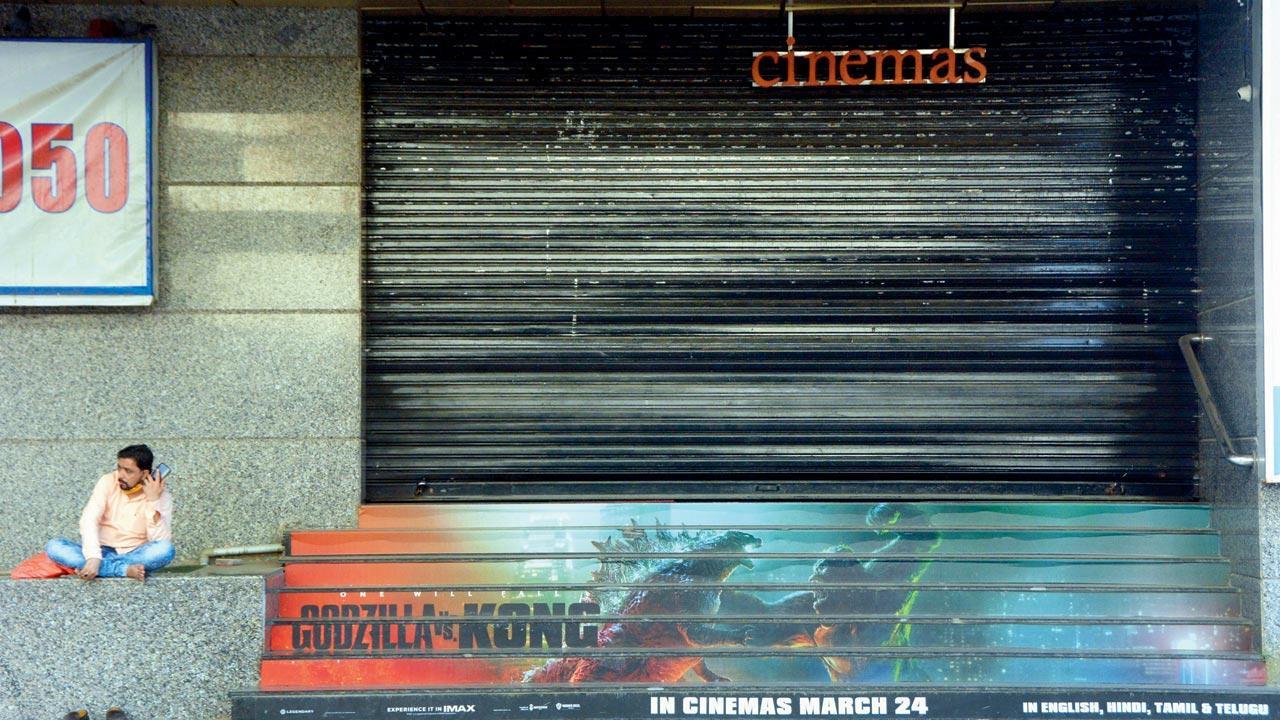
PVR ECX, a multiplex at Citi Mall, Andheri West, has remained shut since the first week of April 2021. Theatres across Maharashtra have been kept out of the state government’s unlock plans, until further orders. Pic/Satej Shinde
With Bellbottom and Chehre makers taking leap of faith to release their films in theatres despite 50 per cent occupancy cap and Maharashtra lockdown, industry says it may be time to show pluck. As one maker puts it, after all, we make movies for theatres. They survive, we survive
Jane Borges (MID-DAY; August 29, 2021)
In December 2020, over two months after the Centre had given its nod for movie theatres to reopen, theatres in Andhra Pradesh and Telangana were still relying heavily on Hollywood productions like Christopher Nolan’s Tenet to revive from the losses the industry had suffered due to the extended Coronavirus lockdown. A surprise Christmas Day release, Solo Brathuke So Better, a romantic comedy starring Sai Dharam Tej, nephew of film actor-politician Chiranjeevi, proved to be a glimmer of hope.
Hyderabad-based Balgovind Raj Tadla, partner at two single screen cinemas, Sudarshan and Devi, says the crowd’s reaction almost felt like a “revenge-response to COVID-19”. “The movie garnered a lot of media attention,” he recalls.
It also set the stage for three big January 2021 releases, Red, Krack and the Telugu-dubbed Tamil film Master that had superstar Vijay in the lead. All three did phenomenally well with Krack leading the race. But it was Uppena, another romantic drama, which stole the show, collecting over Rs. 150 crore when it released in theatres in Telugu-speaking regions in February, followed closely by Jathi Ratnalu.
Tadla, who is also joint secretary of the Telangana State Film Chamber of Commerce, says this is when film producers and exhibitors predicted an upward swing. But, the second wave that swept the country soon after, came as a huge blow. “At this point, only 10 per cent of the big ticket films had been released. The rest were still waiting it out. [Actor] Pawan Kalyan’s Vakeel Saab was going to be the next big release. It hit theatres on April 9, but despite someone like Pawan in the lead, people didn’t turn up at the theatres.”
Another dry spell due to the more devastating second wave, put theatres out of business again, before cinema halls started opening up by end of July. “I would say that we are still in the first 20 minutes of the film. We are yet to get into the story. It will take another 20 days for us to see where this goes. It should pick up, unless of course, COVID haunts us again.”
The confidence the film industry in the South has shown right from the beginning of the unlock phase has been unparalleled, considering its more popular sibling, Bollywood, has been holding its cards close to its chest, daring only a few odd releases since March 2020. This changed last week, when Akshay Kumar’s spy thriller Bellbottom released in theatres across India. The film hit the screens on August 19 and at the end of the first weekend, it had made around Rs. 15 crore gross in India. It became the first superstar-backed Bollywood film to be released in the pandemic. According to news reports, the movie will release on OTT in September.
Amitabh Bachchan and Emraan Hashmi’s Chehre, which released last Friday, is the next big ticket film to have hit the screens. What makes these new releases significant is that, in a first, they won’t be screened in Maharashtra due to Coronavirus pandemic restrictions, which is home to the heart of Bollywood, and contributes a lion’s share of the box office revenue.
Film exhibitor Vishek Chauhan, who is based out of Bihar’s Purnea, where he runs Roopbani, the oldest single-screen theatre in the district, says releasing Bellbottom, in such a climate, was “a very gutsy move” by the makers, producers and Akshay Kumar, as well. “Maharashtra is more than 25 per cent of Bollywood’s market. So, effectively they were left with just 75 per cent of the market to begin with. Out of this, Kerala, Tamil Nadu and Assam theatres are still shut. That means the producers lost another five per cent. Add the 50 per cent occupancy cap, and curfew and other restrictions in some select cities and districts, and that left them with just 25 to 30 per cent [of their targeted audience],” says Chauhan, adding, “One might say that they didn’t make enough at the box office. But, for us that Rs 13-15 crore was pure gold. It has helped get the audiences back, and is now enabling cinemas to plan ahead.”
Though Bellbottom producer Jackky Bhagnani was unavailable for comment, Chehre producer Anand Pandit reiterates why production houses need to show more chutzpah. The film, directed by Rumy Jafry, was originally slated for release in July 2020. With cases peaking in March this year, it was pushed to August. “The narrative, storyline, and cast [of the film] lent themselves to the big screen. Watching it on the iPad or smart phone wouldn’t have justified the experience that we were trying to create for our viewers. I didn’t want to throw away such a film for Rs. 5-10 crore more [on OTT],” explains Pandit.
He says that filmmakers and producers shouldn’t forget that it’s the theatre industry that made Bollywood what it is today. “They have been by our side for the last 70-odd years. At one point, theatre was the only avenue to release films. Today, because of the pandemic, there are over 10 lakh people, connected to the business, struggling to keep afloat. Many have even lost their livelihoods. I think, those who can, should come out and extend their support by releasing their films in theatres.”
Not all risks are worth taking. Director Sanjay Gupta says he learnt it the hard way. Gupta’s Mumbai Saga featuring an ensemble cast of John Abraham, Emraan Hashmi, Kajal Aggarwal, and Prateik Babbar, made it to the big screen on March 19 this year. “We announced the release just a month prior, in February. At the time, the cases were down, and the second wave was nowhere around the corner. We were confident about our film, and also the fact that people would return to the theatres. Looking back, I think we were probably over-confident about the public’s mood,” he says.
When the film released, the second wave had just about begun. “We hadn’t expected COVID-19 cases to rise exponentially. A lot of theatres had opened just to screen our film. It was too late for us to back out by then.”
Having said that, Gupta feels that some measures need to be taken to ensure that the theatre chain survives. “Ultimately, we make movies for theatres. And if they survive, we survive. Most cinema halls have been shut for over a year-and-a-half. At some point, we need to resume. That’s the sentiment with which we had gone ahead. Unfortunately, it didn’t work out, and we suffered.”
According to box office numbers available on bollywoodhungama.com, the movie, which had a production budget of Rs 50 crore, made a gross of Rs 19.68 crore in India and Rs 2.61 crore overseas; its worldwide gross collection was estimated at Rs 22.29 crore. The movie later released on Amazon Prime.
Chauhan says now that most theatres are open, they’d need movies to keep the business going. Post Chehre, there will be a long gap. Kangana Ranaut’s Tamil political drama Thalaivii, based on the life of J Jayalalithaa, will arrive in theatres only on September 10. Bollywood is yet to make further announcements of any new releases. A few odd Hollywood films can help theatres tide through the lean phase, but what after that, asks Chahaun.
Sony Pictures Films India has announced its Hollywood line-up, with Don’t Breathe 2 releasing on September 17, and Spider-Man: No Way Home on December 17. There are a slew of Bollywood films that are ready, but a decision on their release hasn’t been taken for now.
Vivek Krishnani, managing director, Sony Pictures Films India, says that in the last few years the entire “content fabric” has changed. “There are only certain kinds of films, which drive people to the theatres. And this kind of content has to tick off certain boxes. First, it has to have mass appeal. Next, it has to be good enough for people to leave their houses, get into their cars, go to the cinema, find parking, and buy tickets. During the pandemic, we’ve noticed that people have started evaluating their own approach of going to the cinema, and that’s probably because of the kind of exposure they have had to diverse content on OTT. If they are going to be taking the effort to come to a movie theatre, they need to be rewarded for that effort with content that is different and exciting enough, and which they cannot get on the smaller screen. This [consumer behaviour] has forced us to rethink our own creative strategies,” he says, while discussing what parameters they consider, when choosing which film goes for OTT, and which film should wait it out for the big screen.
He alludes to the record turnout that the Tamil film Master saw, when it released on January 13. “People went into the cinema in a big way. Our release Godzilla vs. Kong also had a humongous box office earning, despite releasing in March. What we have seen is that when theatres are open, and the right content comes along, there is but a natural tendency for people to go into cinemas and consume this content. It’s held true in the past, and I don’t see why it won’t in the future.”
Krishnani, however, isn’t sure about the hybrid model, which is being widely discussed ever since Salman Khan’s Radhe released simultaneously across multiple platforms, including theatres outside of India, and via pay-per-view. The film’s collection in India till July 13 was at Rs 1.85 lakh, as it was released on the big screen only in three cinemas, that too in the state of Tripura, bollywoodhungama.com reported.
“A hybrid model is where the movie runs in theatres and is also being offered as a premium video on demand (VOD). The VOD usually comes at a very expensive price point. This model hasn’t been embraced in India yet. And I think, the jury is already out on what it does to the theatrical revenue. Another issue is that in India, we aren’t used to paying for a one-time watch; we’d rather opt for subscriptions.”
There’s also the issue of piracy, which Krishnani, admits has spiralled with the OTT boom, thus, bringing about newer challenges for content creators. Delaying Hollywood releases in India doesn’t make sense for a similar reason, as most films have already released globally, and pirated content then becomes available online.
“The truth is that there has been a sharp increase in content consumption [during the pandemic], and that’s because accessibility has increased. Though [OTT] subscriptions have grown, it is but obvious that there’s an audience that’s not paying for this. We do not have metrics to prove this, but this is something we have been able to infer,” says Krishnani.
Sony Pictures Films India is waiting to release Major, a Telugu and Hindi co-production, which is based on the life of Major Sandeep Unnikrishnan, who was martyred in the 26/11 attack at the Taj Mahal Palace Hotel. “It’s a cinematic experience, because of the story, visuals, and the emotions it draws. I think it is important for stories like this one to be seen in a theatre.”
What’s then, holding back producers and filmmakers from releasing these films?
Shibasish Sarkar, Group CEO, Reliance Entertainment, says that the opening of theatres in Maharashtra will be key to deciding the future of big releases. “The situation is still quite uncertain. While theatres in a majority of the states have opened up, it’s not the case with Maharashtra, which is 25-30 per cent of our market [depending on the film]. At least for pan-India, Hindi films, it is quite a challenge to go ahead and release a film, without Maharashtra. So, while I think we will see a few-odd [Hindi] releases in the coming months, a majority of them are going to wait it out for Mumbai and the rest of Maharashtra to open.”
The release of Kabir Khan’s biographical sports film '83, starring Ranveer Singh in the lead, which has been co-distributed by Reliance Entertainment, has been postponed thrice already. “It was first set to release on April 10, 2020, then we had planned a December Christmas release last year, before pushing it to June 4 of this year. Right now, we are clear that we won’t make any announcement, until and unless there is a semblance of normalcy,” he says, adding, “When I say normalcy, the basic expectation would be that Maharashtra opens up. Only if that happens, can we even have a discussion. Otherwise, there will be no point in doing this exercise all over again. For us, it doesn’t make sense, creatively or business-wise, to ignore 30 per cent of our market.” Director Rohit Shetty’s Sooryavanshi, starring Akshay Kumar, is also hanging in the balance for the same reason.
Pandit feels that by keeping theatres in Maharashtra shut, the state government is depriving “cinema owners the opportunity to revive their businesses”. “All of Bollywood is sitting in Mumbai, so it feels like we are being victimized. The [state] should, [on the contrary] be supporting the industry,” says Pandit.
Tadla, whose theatres in Hyderabad have been open for nearly a month now, however, has seen a worrying trend of late. Bell Bottom got a luke warm response in his city. “Suddenly, it feels like the audience has lost the habit of movie-watching. I think the second wave was damaging, and that has made people more cautious and wary. We [cinema-owners] are obviously concerned. There was a time, when, even if a movie wasn’t good, it would run for about four weeks at least.”
The digital boom, he feels, has made the audience less tolerant. Today, the fate of a film is sealed is one weekend.
Vidyut Jammwal's first film under his production titled IB 71; to be directed by Sankalp Reddy
8:04 AM

Three months after launching his studio, Vidyut Jammwal unites with National Award-winning director Reddy to roll out espionage thriller IB 71
Mohar Basu (MID-DAY; July 19, 2021)
In April, Vidyut Jammwal launched his production house, Action Hero Films, with the idea of bringing high-concept stories to the screen. Almost three months on, the actor-producer has zeroed in on the banner’s first film — IB 71. The espionage thriller will be helmed by Sankalp Reddy, whose Ghazi (2017) won the National Award for best feature film in Telugu.
The movie, which sees Jammwal as an Indian Intelligence officer, recounts how the Intelligence Bureau played a crucial role and gave the Indian Army a tactical advantage during one of its wars against Pakistan. The first-time producer is unwilling to reveal too many details, only saying that as soon as he read the script, he instinctively knew that the heroics of the unsung heroes had to be captured on celluloid for posterity. “Some of the most interesting episodes in Indian history have inspired IB 71. With this film, my stable pursues the endeavour to unravel a riveting story envisaged by gifted writers. I have full faith in Sankalp’s vision as a filmmaker,” says the actor-producer, adding that the director will bring the required sensitivity to the storytelling.
Jammwal has joined forces with Reliance Entertainment and T-Series for the venture.
With Ghazi, Reddy had highlighted the mysterious sinking of PNS Ghazi during the 1971 India-Pakistan war. This time around, he will revisit another chapter of history, underlining how some victories are won, not on the battlefield, but off it, with clever manoeuvres. “The film depicts what goes on before a triumph. A different kind of heroism is at play here. I connected with these themes when the story was narrated to me,” says the director. Shibasish Sarkar, group CEO, Reliance Entertainment, adds, “The significance of this part of Indian history has inspired us to produce this [film].”
The thriller, written by Aditya Shastri and with screenplay by Storyhouse Films, will go on floors by the year-end.
"There can be a pause, but not a full stop": Experts are confident audiences will be back to cinemas
8:26 AM

We ask experts about the future of theatres, if the audience remains afraid and hesitant
Juhi Chakraborty (HINDUSTAN TIMES; June 23, 2021)
This year started on a good note for theatres with many films beelining for releases. While some managed to enjoy a theatrical run, the second wave of Coronavirus again put an unfortunate pause for others. According to the recent Ormax Cinematix Sentiment Track, Indian audience’s sentiment towards returning to cinemas in the near future continues to get more conservative. So what does it mean for cinemas?
While noting that the hesitation among people to visit any place of public gathering with strangers, and not just theatres, is a genuine concern, Siddharth Anand Kumar, vice president - Films and Events at Saregama India Ltd, adds, “If you go through the study, you’d notice that people who have visited theatres since the 2020 lockdown has risen sharply since December. This clearly shows that whenever there’s a semblance of normality, people won’t hesitate to catch their favourite actors and stories on the big screen.”
Exhibitor Akshaye Rathi feels that this is a reaction to the death and losses amid the pandemic. “That puts a layer of fear on your mind,” he says.
Old Habits Die Hard
Many industry experts believe that cinema watching is part of our culture, and won’t die easily. “Yes, there’s fear but we will get over this and come back stronger. The 70mm screen effect is different,” says Manoj Desai, executive director of G7 and Maratha Mandir.
Rathi adds, “With cases dipping, cinemas will regain momentum. With people sitting at home, there’s a lot of frustration, and a demand for change of scene. Habits formed over 30- 40 years can’t be changed now. There can be a pause, but not a full stop.”
A big Ticket release is the way forward
Kumar, too, is hopeful, especially once a sizeable chunk of population is vaccinated. “Big screen entertainment is here to stay, especially with mass entertainers like Sooryavanshi and ’83 choosing to wait and release in theatres when situation is conducive,” he adds.
Even Rathi says, “We saw earlier this year that when a film like Master came in theatres in the south region, it did unprecedented numbers. One big ticket movie will be compelling enough to get people back to cinemas.”
Global trend is reassuring
Hollywood film A Quiet Place Part II, which released on May 28, has generated approximately $222.6 million revenue to date. And many in India feel it is a stamp on the fact that the big screen magic can never go away. “In many countries where the disease is under control and vaccination, the audience has returned to outdoor habits,” shares Shibasish Sarkar, Group CEO of Reliance Entertainment.
Trade analyst Taran Adarsh concludes that the charm of the big screen will be revived in the coming months: “Look at Australia and US box office. It’s being revived everywhere.”
Radhe's first day numbers: Is per-per-view the new box office?
8:14 AM

Experts wonder if revealing viewership numbers of an OTT release is the way ahead for filmmakers
Rishabh Suri (HINDUSTAN TIMES; May 26, 2021)
Content is king and number game doesn’t matter — that was the perception about OTT space until Salman Khan’s Radhe: Your Most Wanted Bhai released the approximate figures. According to the makers of Radhe, 4.2 million viewers watched the film on pay-per-view on the first day of its hybrid release. Does this mean direct-to-OTT or hybrid releases might start releasing the revenue from online releases, making them new box-office numbers?
Trade analyst Taran Adarsh says the makers should release actual revenue instead of viewers. “When a film releases, instead of mentioning how many people viewed it, it would be great if people share the revenue,” he says.
Director Anurag Basu, whose Ludo released on web last year, says: “Filmmakers should keep that aside, and see how, over a period of time, people respond to the film.”
DIFFERENT SUBSCRIPTION MODELS
Radhe was a rare example of a big film releasing in the pay-per-view model. Shibasish Sarkar, CEO, Reliance Entertainment, explains the different OTT models. “Whether people will start talking about numbers or not, is in the future. Worldwide, OTT platforms don’t give out numbers, they are subscription-based platforms. What happened in Radhe’s case was Zee acquired the content, and at the same time, it released it on their own platform,” he says, calling that a Transactional Video On Demand (TVOD), where viewers had to pay ₹249 for viewing on a single account. “So, if films go the TVOD way, people may start talking about transactional numbers,” he adds.
NO WAY TO VERIFY
Trade expert Atul Mohan says that when it was about box-office numbers, there was freedom to verify and cross check. He elaborates, “We had teams across India for box-office collections; they would tell us by talking to theatre owners and on the basis of rapport we shared with producers.”
But in web, one is at liberty. “If Amazon says a film was viewed by 50 million, nobody can challenge that. There’s no way to cross check. Though I’m not challenging what Zee has said for Radhe,” Mohan states.
PEOPLE GET SWAYED
Explaining how views don’t mean collections, director Hansal Mehta says, “If you divide the 4.2 million figure to one fourth — which is a million people — it’d come out to be around 10 lakh people and ₹25 crore. Is that a good opening figure for a Salman Khan film?”. He adds, “So, the number game isn’t applicable, as the product is available to stream for a much longer time online.”
However, he admits people will be swayed by numbers. “To some extent, blind bhakts will be swayed by anything. I’ve believed that collections of a film is between the producers and makers. For the audience, it’s only about entertainment,” he concludes.
Bollywood production houses try for mass vaccines; no luck
8:08 AM

The film industry has realised that only through rigorous and planned vaccination drives can it hope to get back on its feet again
Sugandha Rawal (HINDUSTAN TIMES; May 14, 2021)
After the second round of lockdown, getting back to work in Bollywood might require more than just a negative report, with the industry looking at widespread vaccination drive to restart activities. Though the Maharashtra government has temporarily suspended vaccination for 18-44 group, there are many production houses that are looking at procuring vaccines in bulk for their staff.
This comes after several actors, including Madhuri Dixit Nene, Anil Kapoor, Farhan Akhtar, Radhika Madan and Riteish Deshmukh, got their vaccine shot.
Actor Tamannaah Bhatia feels it’ll not only enable the industry to churn out content, but also support daily wagers. “From an industry perspective, it’ll help them get back on their feet and keep economic activity going. I hope the government, in due course of time, will address this,” says the actor.
According to Shibasish Sarkar, CEO, Reliance Entertainment, it is “impossible” to think about getting back to work without vaccination. “There’s no permanent solution to it, unless you can get your team vaccinated,” he says.
As vaccination drive picks up, some from industry have started to put out appeals to the Maharashtra government, urging them to let them get industry members inoculated.
While the Indian Motion Picture Producers’ Association (IMPPA) has written to Chief Minister Uddhav Thackeray to set up a vaccination centre for its members, Federation of Western India Cine Employees (FWICE) also has requested the state government to provide vaccines for its artists and workers. Yash Raj Films (YRF) head Aditya Chopra has requested the CM to allow the company to purchase 30,000 vaccines. One stop vaccine centre is important, too, points out J D Majethia, Chairman, TV division of IFTPC. “We’ve written to the government to make a centre in Film City,” he says.
Nitin Tej Ahuja, CEO of Producers Guild of India says, “We’ve been in talks with government departments and private bodies to facilitate mass vaccination camps for film fraternity.”
No ‘shortage’ of roadblocks
Though vaccination might seem as a potential way out, many point that the scarcity of the life saving drug is making it a tough path.
“Today, availability of vaccines is the biggest challenge. We’ve been talking directly with the manufacturers, hospitals and even laboratories, to get access to it. We haven’t been able to get it, but we’re trying to see if we can get a certain level of quantum, which can cover our staff,” Sarkar says.
To this, Birendra Nath Tiwari, President of Federation of Western Indian Cine Employees, adds, “The shortage is the biggest problem abhi. Ussi wajah se kafi aur log bhi ruke hue hain. We hope to get clarity on getting stock till May end. In fact, I might ask Salman Khan to also pitch for vaccination.”
That said, lyricist Javed Akhtar stresses that vaccination doesn’t mean letting go of other safety precautions.
“It can become safer to work when everybody is vaccinated. But even after the jab, there's no guarantee that nothing will happen to you, so one has to be careful,” he cautions.

What lies ahead in 2021: Bollywood stares at release backlog, stale factor and revenue loss
8:24 AM

Juhi Chakraborty (HINDUSTAN TIMES; April 19, 2021)
The Coronavirus pandemic related woes don’t seem to end for the film industry as once again it has led to curfews, restrictions, shutdown of cinemas and shoots. Obviously, there’s no clarity on the film releases, even those which are already delayed by a year.
“We don’t know how long the situation of curfews and partial lockdowns will continue. We don’t even know if there will be full-blown lockdown. So everything is now on the back-burner,” shares Shibasish Sarkar, Group CEO of Reliance Entertainment, which has films such as Sooryavanshi and ’83.
Noting how the plans for every filmmaker have gone for a toss, Sarkar adds, “This is exactly where we were last year at this time. Bollywood is a ₹18,000 crore industry, and that was until 2019. Last year, the business was wiped off by two third percentage. This year, too, there’s no scope for improvement.”
The backlog is a big worry for many, as there’s a massive amount of uncertainty attached to when things will finally resume normalcy. Filmmaker Anand Pandit, who delayed the release of his film Chehre, says, “I understand the backlog will put a major damper; it’s a very tough time for the film industry, but films are least of people’s concerns right now.”
Siddharth Anand Kumar, Vice President, TV & Films, Saregama feels that everyone was getting lulled into a sense of complacency thinking we were going to come back to normal. “Producers who can hold in terms of holding on to their revenue will hold, like we have seen huge films like Sooryavanshi and ’83 hold on for a long time. We had Zombivli releasing on April 30, which is a Marathi film which we pushed it because it has to be watched in theatres,” Kumar explains.
And all this delay means that some of the films have been ready for a year or more, but haven’t made their way to theatres, which is causing the fear that the content is getting stale and might end up looking dated upon its release.
However, Pandit doesn’t see that as a risk. “A film looks dated only when it takes a long time to make a film, like five or seven years. Then the technology, the dialogues and fashion becomes a bit obsolete. But otherwise it doesn’t.”
And now with the prolonged delays, is there still the same level of excitement among the audiences?
Trade expert Komal Nahta, says. “Please don’t be mistaken that the audiences don’t care anymore about theatrical films. They’re worried about their safety, but once they feel safe, cinemas will thrive. People are saying that they are getting to watch films on OTT, so they don’t care but they are wrong. Cinema viewing in theatres is an age old habit. How can that be replaced?”
Big films that are/were set for a release between April-June
- Sooryavanshi
- Radhe: Your Most Wanted Bhai
- Satyameva Jayate 2
- Bellbottom
- ’83
- Jhund
- Shamshera
- Bunty Aur Babli 2
- Thalaivi

Second wave of Covid-19 pushes shoots out of Mumbai as films pile up for release
8:18 AM

The show goes on as film and TV shoots move to new locations for completion
Rishabh Suri (HINDUSTAN TIMES; April 19, 2021)
The Hindi entertainment industry primarily operates out of Maharashtra, but now, everything has come to a standstill as all kinds of shoots have been suspended till April 30.
What’s keeping hopes alive, though, is work carrying on in other states across India. The team of Mohit Suri’s Ek Villain returns, including Arjun Kapoor and Tara Sutaria, has jetted off to Goa. Varun Dhawan and Kriti Sanon starrer Bhediya has had its team stationed in Arunachal Pradesh for over a month now.
Bhushan Kumar, co-producer of Ek Villain returns, tells us, “The sudden surge in Coronavirus cases is worrisome. We stand by the decision to not shoot in Mumbai, but to meet the shoot deadlines, we’ve found the perfect location in Goa, and we’re abiding by the protocols.”
A source tells us Adipurush was being shot in Mumbai, until the shutdown. “It was anyway a shoot against the green screen, so there wasn’t any hassle,” we’re told.
Last year where when the pandemic hit, filmmaker Milap Zaveri, too, had changed the location of his film, Satyameva Jayate 2, from Mumbai to Lucknow. “We support the lockdown and are standing united in helping the state and nation overcome this crisis, but the show must go on. Many livelihoods are at stake.”
Reliance Entertainment has four projects in various stages of production on floors, but all shoots have had to be stalled. Shibasish Sarkar, Group CEO, tells us: “If there’s a producer or director who has done it (shifted location), depending upon the story, it’s a good option in this situation. But the cases are increasing. I’m not sure how long it will be possible to manage.”
Trade analyst Taran Adarsh says a lot depends on the story when it comes to shifting to a different shoot location. “The location is decided by the script. The scare is everywhere, not just Mumbai,” he says.
Several TV shows have shifted their shoot locations to various other cities. Sasural Simar Ka 2, which goes on air next week, recently shot in Agra and plan to shoot more from there only.
Producer of Chhoti Sardaarni, Ram Singh decided to shift the shoot from Mumbai to Delhi, “It is not an overall lockdown in India. It is not tough to shift the location, you have to just create a bio bubble.”
Pooja Banerjee, who stars in Kumkum Bhagya, says their shoot has been shifted to Goa. “The public has to stay at home, and wants their shows, and we are trying to fulfil that,” she says.
TV shows and their new shoot locations
- Kundali Bhagya - Goa
- Kumkum Bhagya - Goa
- Kyun Rishton Mein Katti Batti - Surat, Gujarat
- Imlie - Hyderabad’s Ramoji Film City
- Mehndi Hai Rachne Waali - Hyderabad’s Ramoji Film City
- Shaurya Aur Anokhi Ki Kahani - Goa
- Saath Nibhana Saathiya - Gujarat
- Ghum Hai Kisikey Pyaar Mein - Delhi or Hyderabad
- Anupamaa - Goa or Rajkot
- Teri Meri Ikk Jindari - Jaipur
- Hamariwali Good News - Haryana
- Choti Sardaarni - Outskirts of Delhi
- RadhaKrishn - Umbergaon
- Pratigya - Ramoji or Goa
- Prem Bandhan - Silvassa in Dadra and Nagar Haveli
- Yeh Hai Chahatein - Goa

I am confident that Sooryavanshi will bring in pre Covid times type of numbers-Shibasish Sarkar
8:40 AM

As Sooryavanshi books April 30 window for release, the producer says undeterred by the ongoing 50 per cent theatre occupancy norm in Maharashtra
Uma Ramasubramanian (MID-DAY; March 15, 2021)
On Sunday, the makers of Sooryavanshi announced that the Akshay Kumar-starrer will hit the marquee on April 30, thus ending its year-long wait. Some may argue that the situation is far from ideal for a big-ticket release. Though the Centre allowed theatres to operate at 100 per cent occupancy from February 1 — a move that was implemented in Gujarat and Tamil Nadu, among other states — cinemas in Maharashtra have been running at 50 per cent seating capacity as they await the green signal from the state government.
But the makers of the cop caper are confident of its box-office performance. Shibasish Sarkar, CEO, Reliance Entertainment group, says, “Regardless of the theatre capacity in different states, I am confident that Sooryavanshi will [bring in] the kind of numbers that it would have done in the pre-Coronavirus times. The state government determines theatre occupancy depending on the situation of the state.”
As cases are on the rise in Maharashtra, he knows that safety is the need of the hour. “We, along with the exhibitors, will request the government to increase the occupancy only if the situation improves. But we’ll be happy even if the film arrives amid the [restriction].”
Many films have taken the step to bring audiences back to theatres
9:12 AM

Rishabh Suri (HINDUSTAN TIMES; February 21, 2021)
Amitabh Bachchan has just announced Jhund’s release date as June 18. Ayushmann Khurrana’s Chandigarh Kare Aashiqui is set for July 9. Akshay Kumar’s Prithviraj, Atrangi Re, and other big-budget films all recently confirmed their release dates, proving that Bollywood is ready to emerge from the shadow cast by the pandemic.
Producer Bhushan Kumar, who has announced release dates of five films — Satyameva Jayate 2, Chandigarh Kare Aashiqui, Atrangi Re, Jhund and Luv Ranjan’s untitled next — says, “With producers and theatre owners supporting each other, many of us have decided to release our films in theatres. We, as a studio, and my partner producers, definitely feel it is important to release big films to get our audiences to theatres and support the industry. We will announce a few other films in the coming days.”
The trade is happy with the developments. Trade analyst Joginder Tuteja says it was time, as the South film industry has shown how releasing in theatres is safe. “When big films come, smaller and medium-budget films follow. This will have a domino effect, you can expect at least 24 films to be announced in the next week,” he says.
Pointing out why Hindi films didn’t do so sooner, he adds, “In the South, they have to take care of their region. Pan-India this takes time. They have to see whether states have opened theatres or not, as they release on more than 4,000 screens. Regional films get a 1,000 and are done, so we can’t blame Bollywood.”
Shibasish Sarkar, Reliance Entertainment, which is behind Sooryavanshi and ’83, says, “All big stars have announced their films, it basically means producers are getting the confidence that if we release films, audiences will come to theatres.”

THEATRES’ TAKE
Devang Sampat, Cinepolis India, says theatres are ready to welcome patrons with this barrage of releases. “It was always a matter of who will take the first step, and after seeing what happened in the South, where big-budget films like Master, and even small budget films did well. The latter was not expected, and the numbers were encouraging,” he says.
Echoing similar sentiments is Rajender Jyala, INOX Leisure, who says, “We are ready and complying with all standard operating procedures given by the central and state governments. Today, barring Maharashtra, Rajasthan, Jharkhand and Kerala, all states are operating at 100% capacity. We are happy and excited for 2021 now.”

COMING UP IN 2021
Roohi: March 11
Sandeep Aur Pinky Faraar: March 19
Sooryavanshi: April 2
Bunty Aur Babli 2: April 23
Bellbottom: May 28
’83: June 4
Jhund: June 18
Shamshera: June 25
Shershaah: July 2
Chandigarh Kare Aashiqui: July 9
Atrangi Re: August 6
Jayeshbhai Jordaar: August 27
Prithviraj: November 5
Subscribe to:
Posts (Atom)