Showing posts with label Shashi Kapoor. Show all posts
Showing posts with label Shashi Kapoor. Show all posts
Raj Kapoor’s ancestral Haveli in Peshawar partially collapses after heavy rains, earthquake
8:31 AM

The century-old Kapoor Haveli, once owned by (right) Raj Kapoor, was home to his father Prithviraj Kapoor, the first in the family to enter films. Photos: x
HINDUSTAN TIMES (April 6, 2026)
The historic Kapoor Haveli in Peshawar, Pakistan, once owned by the late actor Raj Kapoor, has sustained significant damage following heavy rains and an earthquake on Friday night.
Continuous rainfall had already weakened the structure, and late-night tremors on Friday further destabilized the building. Shakeel Waheedullah, secretary of the Heritage Council in KPK province, confirmed the damage, saying, “A section of the haveli’s wall caved in after the quake.”
The century-old Kapoor Haveli was once home to late actor Prithviraj Kapoor, the first member of the Kapoor family to enter the film industry. Built by his father, Dewan Basheswarnath Kapoor, between 1918 and 1922, it remains a significant cultural site and was declared a national heritage site by the Pakistan government in 2016.
Over the years, the estate has been visited by several members of the Kapoor family. Prithviraj’s sons, late actors Shashi Kapoor and Shammi Kapoor spent time there before Partition, while Raj’s sons, late actor Rishi Kapoor and actor Randhir Kapoor, visited in the 1990s and urged the Pakistan government to undertake its restoration.
Singer-actor Sulakshana Pandit passes away at 71
9:36 AM

Avijit Ghosh (THE TIMES OF INDIA; November 7, 2025)
Sulakshana Pandit, who sparked to prominence as a singer-actor in the 1970s and whose promising career was cut short by a string of unfortunate events, passed away following a heart attack at Mumbai's Nanavati Hospital on Thursday. She was 71.
Sulakshana Pandit was only 13 when first noticed in 'Saat samundar paar se' (film: Taqdeer, 1967), a duet she sang with the peerless Lata Mangeshkar. Another memorable track, 'Beqarar dil tu gaaye ja (film: Door Ka Rahi)' with Kishore Kumar further underlined her precocious talent.
But in the mid-seventies, producers also noticed her leading lady looks. Over the next decade or so, Sulakshna became a prominent singing star in Hindi cinema. During this period, she was paired opposite top heroes of the time - Sanjeev Kumar (Uljhan, Waqt Ki Deewar), Rishi Kapoor (Raaja), Jeetendra (Sankoch, Apnapan, Dharam Kanta), Rajesh Khanna (Bundalbaaz), Vinod Khanna (Hera Pheri) and Shashi Kapoor (Phansi), among others.
Singing was her core competence though. In some films she acted in, Sulakshana rendered a song or two. But in a field dominated by established singers, it wasn't easy to make major headway. However, Sulakshana showcased her capabilities with her soaring rendition, 'Tu hi sagar hai tu hi kinara' (film: Sankalp, music director: Khayyam). The composition maximized the inherent sweetness of her voice and displayed her mastery over the high notes. It also earned her the Filmfare award for the best female singer. 'Bandhi re kahe preet' (film: Sankoch), which was also filmed on her, and 'Khali pyaala ujla darpan' (film: Sparsh), a masterclass melody by the minimalist composer Kanu Roy, are some of her other classics. Sulakshna came from a family of musicians. Jatin-Lalit, the composer duo, are her brothers. Her actor-singer sister, Vijeta, played the female lead in the superhit, Love Story.
Another producer could not have taken the pressure of Thug Life-Kamal Haasan
8:22 AM
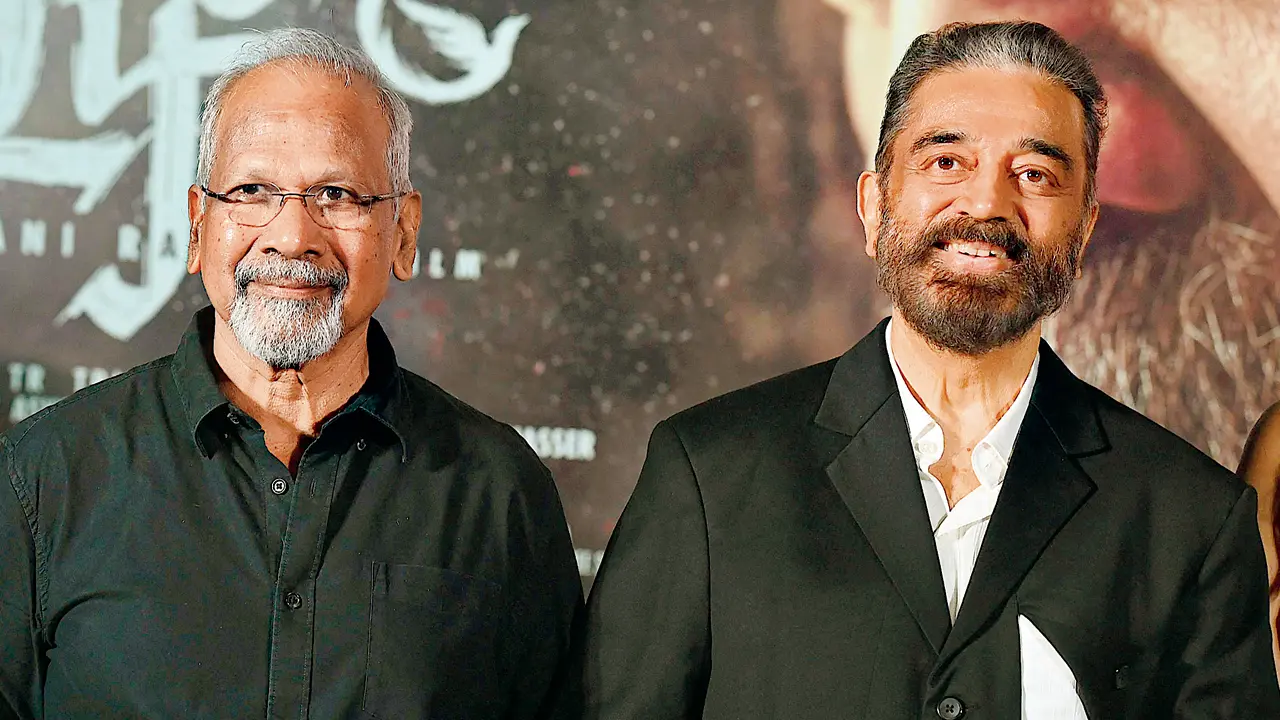
Reuniting with Mani Ratnam after 38 years for Thug Life, Kamal Haasan on how they don’t care for stardom and would rather use their money to realise their cinematic vision
Priyanka Sharma (MID-DAY; May 24, 2025)
What took you more than 30 years to reunite with Mani Ratnam? - This question has made a frequent appearance since Kamal Haasan kicked off the promotions for his next, Thug Life. When we express our curiosity, the superstar smiles before saying, “I’m almost tempted to request all of you not to ask that question because I can only say sorry, it’s our fault. We should have done it earlier.”
In 1987, the two gave Indian cinema the much-loved Nayakan. Thirty-eight years later, as the actor reunites with one of his favourite filmmakers for the gangster action drama, he reveals that an encore was always on their mind.
“Sometimes, we were thinking too big, and at other times, we would think something small and then [shoot it down] believing that these are the days of big films. Sometimes, I’d come up with an idea, and Mani would already be working on something else, and vice versa. But we were gently, subconsciously, and from a distance, inspiring each other,” grins the actor.
That decades-long inspiration has resulted in Thug Life, which also stars Silambarasan T R, Trisha Krishnan, Abhirami, Ali Fazal, and Sanya Malhotra. How was it working together considering they both have come a long way from Nayakan? Haasan is an even bigger star today, and Ratnam, one of the greatest filmmakers in the country. Did the actor try to impress his director this time?
“I can’t impress the director; the character can. He booked Kamal Haasan not because of the stardom. Left to us, I think we are both overpaid. But then if we let that go, they [the industry] won’t respect us. So, we will take our cut.”
This time around, their collaboration has also taken a different turn. Haasan not only leads the June 5 release, but has also co-written and co-produced it with Ratnam. And he firmly believes that nobody else could’ve done justice to the film as far as production is concerned.
The superstar states, “[We are the kind] who will put our money into the film. Suppose all that we have shot is destroyed, we won’t panic. We will go ahead, put our own money, and do it [again]. Another producer could not have taken the pressure of Thug Life. We made some difficult decisions.”
Production and direction were a natural graduation for the actor. It all stems from his endless love for movies and deep respect for the craft. His passion is evident as he says, “I never walk out of a film because that would [mean] insulting my peers. We’ve made stupid films. When I say that, I don’t include Mani’s films in it. But I have, because I needed finance for my own productions.”
That is a career lesson Haasan learnt from late actor and filmmaker Shashi Kapoor. “He would be singing a song on top of an elephant in Shaan [1980], and the same elephant would be beside him in Junoon [1978]. I had asked him, ‘Can I also [juggle mainstream and parallel cinema]?’ He said, ‘Sure. It’s pragmatism. Don’t mistake it for valour.’ Some of the great Italian directors did commercial films, made money out of them, and [used that] to make films that would live on.”
Wise career lessons, unmatched talent, and a progressive worldview have come together to shape Haasan’s enviable filmography that spans over six decades and different branches of filmmaking. Through his films, he has positioned himself as an artiste who often mirrors society’s fractured reality. In Nayakan, he showed the perils of violence. But today, how does he view Indian storytelling’s penchant for violence and the audience’s love for it? He points to a chapter in history to make his case.
“You know, after the Second World War, America kept making musicals; they didn’t want any violence. Now we’ve had enough peace. Now, the time of violence has begun, and that’s reflecting on screen. Earlier, the angry young man was only angry; now he will become violent if his voice is not heard. At least, a soapbox oratory should be allowed in front of the Red Fort. Listening to [the common man’s] voice is what great leaders have always done. After Partition, look at the kind of films we made — Naya Daur [1957] and Waqt [1965]. Even now, cinema is reflecting society, and [the violent films imply] that society has become violent. If you want proof, watch any television channel.”
I do feel that I might have to work twice as hard to be seen-Ali Fazal
8:07 AM
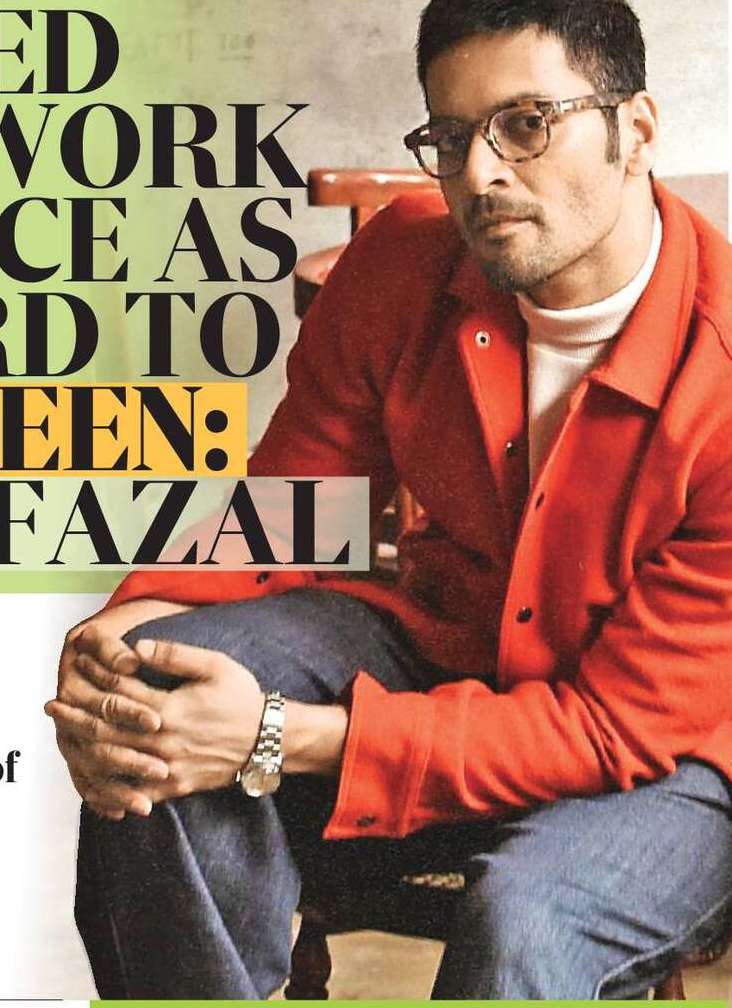
Being an outsider, the actor says he has to go out of his way to promote his international films in India
Rishabh Suri (HINDUSTAN TIMES; July 1, 2023)
From playing the lead opposite actor Judi Dench in Victoria & Abdul (2017) to starring in the Fast & Furious franchise, actor Ali Fazal has made a mark for himself in international cinema. Recently, after his appearance in the Gerard Butler-starrer Kandahar, Fazal’s wife, actor Richa Chadha, penned an appreciation post for his performance and said, “Do I think he would be celebrated more if he was not an outsider? Absolutely!”
Ask if he echoes the sentiment and Fazal says, “Yes, sometimes I do feel that I might have to work twice as hard to be seen here [in India]. When I have to promote my international projects here, I have to go out of my way and hope that someone supports me. The last time I experienced this was while promoting Death On The Nile (2022).”
The 36-year-old admits that not being noticed enough as an outsider “used to affect” him, but not anymore. He adds, “At the time of Victoria & Abdul, I had no money to spend on PR, as it was expensive. I was at the mercy of the film studio. We’d not had an Indian actor play the lead role in a Hollywood film in a long time, so it was definitely a big deal. Last time, it was (late actor) Shashi Kapoor sahab in Shakespeare Wallah (1965). But since I couldn’t afford a PR, it acted as a reminder for me. Tab mujhe laga, agar mere paas paisa hota, toh I would have killed it [by doing proper PR for myself].”
The actor says he doesn’t believe in asking for favours. “We all have pride. So, I will never say, ‘Sir, ek tweet kar do’. I respect people who reach out and appreciate my work. Thankfully, there are some good people in the industry,” he ends.
Amitabh Bachchan, Shashi Kapoor, Sharmila Tagore were original choices for Basu Chatterji's Rajnigandha
9:57 AM
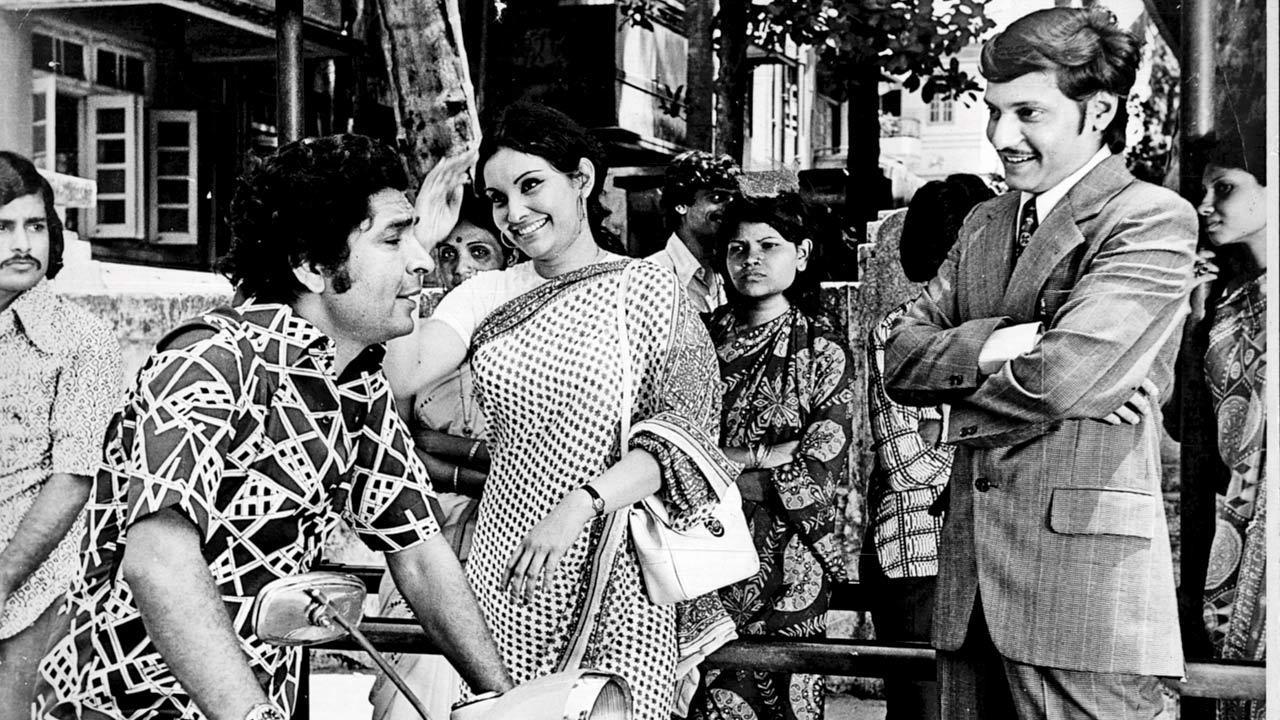
Rajnigandha’s lead pair Amol Palekar and Vidya Sinha, who play Sanjay and Deepa, were later seen in Chatterji’s 1976 film
It was Shashi Kapoor and a host of other big stars, who Basu Chatterji first had in mind for the lead pair of his 1974 film Rajnigandha. A new biography of the late filmmaker discusses how the ‘simple-looking’ Amol Palekar made the cut
MID-DAY (March 26, 2023)
Like most small-towners, Basu was an early riser. Post Piya Ka Ghar, he would be at work by 7 am. By 8.30 am, the ceiling fans would be switched off in the rooms where the others would be sleeping. It was their wake-up call. Those who woke up early would find Basu in his chair, sometimes on the floor, writing his screenplays. Except for the days when he had a morning shoot. This was the time when Basu cut down his professional assignments for Blitz. The script of Rajnigandha happened during the early morning sessions when Piya Ka Ghar was in the making.
The first actor Basu had in mind for the role of Sanjay was Amitabh Bachchan. He was yet to become the Alpha Male then. History could have been very different had Basu stuck to his original choice. Shashi Kapoor was offered the role of Naveen. Suave, slick, with leadership qualities that extended beyond the college campus to wield influence in college selection panels, he was, as defined by Sulagna Biswas, the original LinkedIn Man.
Sharmila Tagore was Basu’s first choice as Deepa. Independent, but not a renegade. Observant, sentimental, committed, steadfast and yet ambivalent. The plan fell through. Shashi Kapoor was fine with playing Naveen, subject to the condition that the film was sold to distributors at the existing rate for a Shashi Kapoor film, something Basu was not comfortable with. Sharmila was out of the contention too, but the reason is not known. Maybe Basu wanted fresher faces.
Meanwhile, Basu flew to Calcutta and offered Aparna Sen the role of Deepa. Aparna, who probably had not seen Sara Aakash, felt that the story of Deepa was ordinary. Her refusal prompted Basu to pitch it to Mallika Sarabhai. She was referred by Yogesh. Both Yogesh and Mallika were working in Sonal (1973) then. Basu met Mallika in Ahmedabad and the dates for a few shoots were fixed. However, Mallika was planning to do her MBA and later walked out of the film. In the meantime, Piya Ka Ghar was released in Calcutta. News of its critical acclaim reached the cognoscenti. Aparna Sen, being one of them, had a change of mind and wrote to Basu expressing a desire to play Deepa.
A few days after Basu acknowledged the mail, Aparna came down to Bombay to complete her part of the shoot of Tapan Sinha’s Sagina (1974). Basu met her, and when the discussion boiled down to money, Sen said she was fine receiving in kind as a small film-maker like Basu would find it difficult to compensate her at the market rate. The contract with Suresh Jindal had been finalised by then.
Said Basu: “I discussed the possibility of giving Aparna Sen a Fiat car. It would have cost us around Rs. 32,000. But things began to get topsy-turvy when she refused to work with the Naveen I had in mind—Samit Bhanja, who I had seen in Guddi (1971) and liked. While the producer and I were fine with the monetary arrangements, we started to become skeptical of starry tantrums. This is when we consciously took the decision of taking all new faces.”
The search for rookies thus commenced. Basu, for a short time, had also mulled trying out Rakesh Pandey, but he was preoccupied, as told to the author. “Basu-da wanted me to do Rajnigandha. At the time, I was doing a film with Mohan Segal called Intezar (1973). The set was at Rooptara Studios. Basu-da came down to the set, and said, ‘I am doing a film called Rajnigandha. It is about a girl and two boys. It will take 20 days to shoot.’ I said, okay, when do you want to start? He said next week. I said, ‘Basu-da, I am doing this film, and it will take at least 15–20 days here on this set. I can manage three to four days at the most if you shoot in Bombay.’ He said, ‘No no, the producer might run away.’”
-----------------------------------------------
In addition to his National Award-winning screenplay for Shyam Benegal’s Bhumika (1977), theatre veteran Satyadev Dubey—who people would recall as the weekly waged stevedore who confronts the goons only to be run over by a truck in Deewar (1975)—made one extremely significant contribution to Hindi cinema: Amol Palekar.
Dubey had directed the Hindi play Aadhe Adhure, starring Amol, who was acting in Marathi plays at the time. Basu loved his acting, and Amol was Basu’s original choice for Piya Ka Ghar (1972), but producer Tarachand Barjatya’s son Raj Kumar Barjatya, who was there at the theatre with Basu, opined that Amol was too simple-looking for a hero. Suresh Jindal, however, had no issues in accepting Amol, a postgraduate of JJ School of Arts, Bombay, as the Sanjay of his film.
Basu was happy with the onboarding, about which he told the author: “Amol was then working with Bank of India. He was a part-time actor. I was fond of Marathi theatre and had seen Amol in a few plays. He used to come to film shows arranged by Film Forum as well. Raja Thakur, the maker of Mumbai Cha Jawai (1970) had also put in a word. Amol had played a small role in his film Bajiravacha Beta (1971). After he was rejected by Raj, I proposed his name to Suresh Jindal.”
Amol had talked about his first business meeting with Basu with author Balaji Vittal: “There used to be a café named Samovar inside the Jahangir Art Gallery. I met Basu-da and producer Suresh Jindal there. Mr Jindal did not talk during this meeting. But the interesting part was that Basu-da did not talk much either. He narrated the story of the film like this. ‘Amol, kya hai, ek ladka hai, mano tum. Aur ek ladki hai. Nayi ladki hai, Vidya Sinha hai uska naam. Usse miloge tum. Toh, ye dono hai . . . aur . . . yaar ye tum padh lo na [Amol, there’s a boy. You. And a girl, a new actress called Vidya Sinha. You will meet her . . . you two . . . oh, why don’t you read it for yourself].’
Basu-da handed me Mannu Bhandari’s story. Following my acceptance to do his film, he gave me the script as well. After reading that, I kept wondering how someone who was so ill at ease narrating a story could write a screenplay in so much detail. Even the dialogues were there. He was extremely eloquent in the cinematic language. Once you understood that, communication becomes easy.”
Excerpted with permission from Basu Chatterji And Middle-of-the-Road Cinema by Anirudha Bhattacharjee; Vintage, Penguin Random House
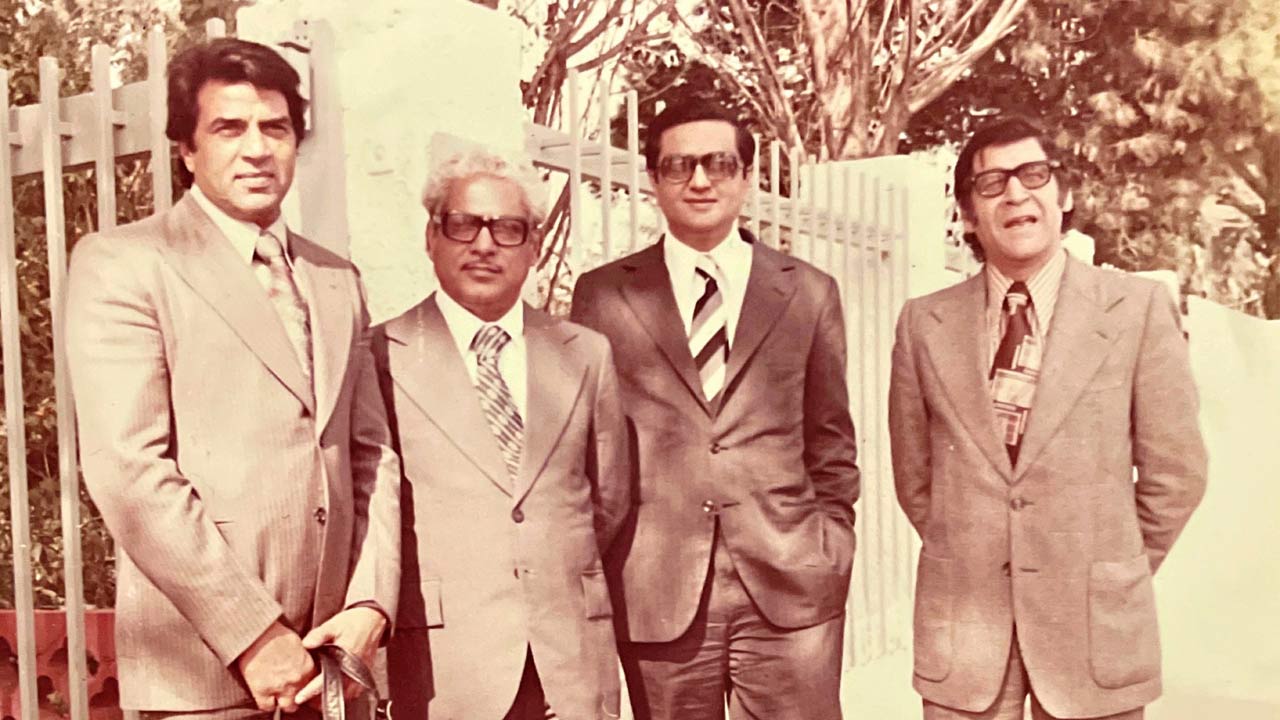
Chatterji and Dharmendra at the Cairo Film Festival. Pics courtesy/Rupali Guha
We will see one of the most elusive original release versions of the Awara poster-Neville Tuli
8:18 AM
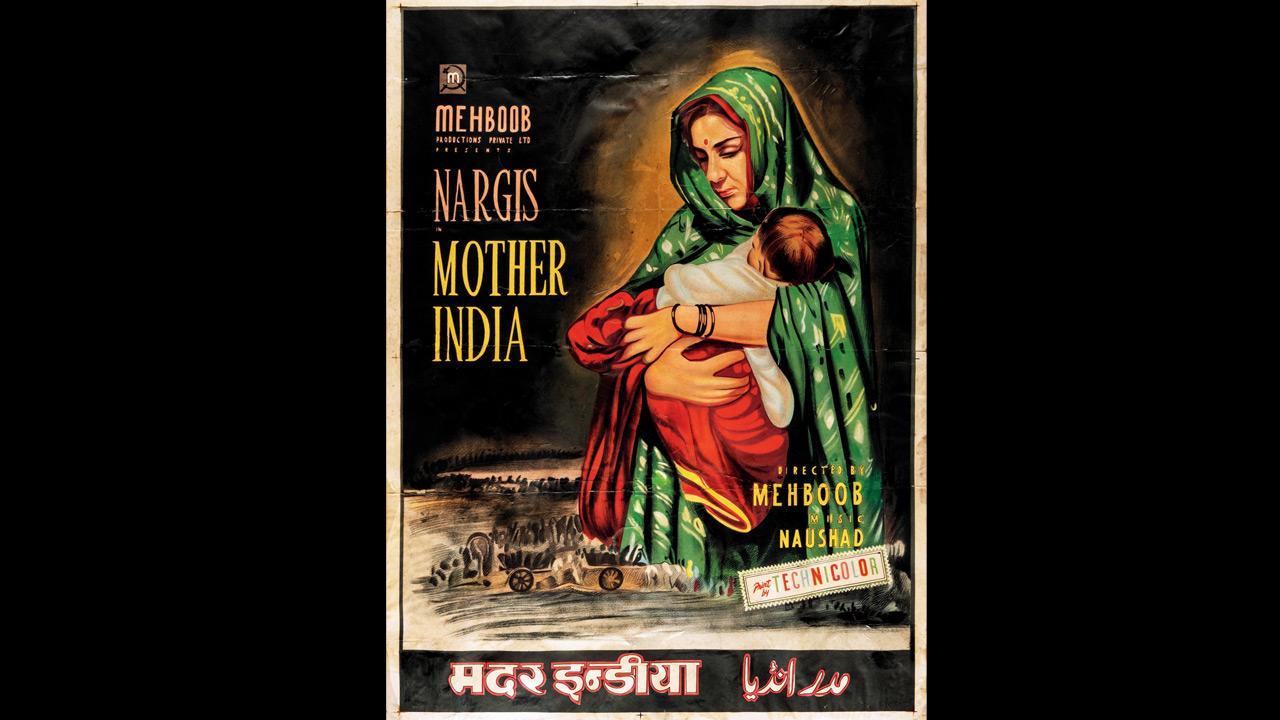
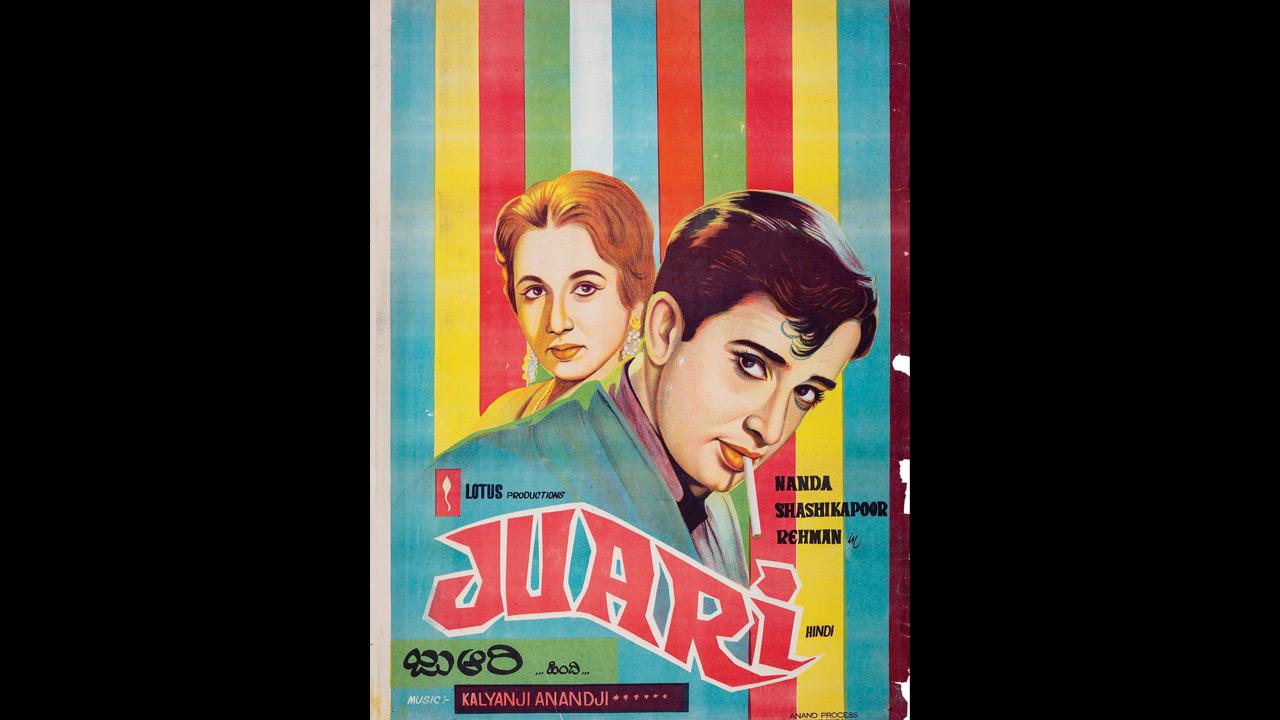
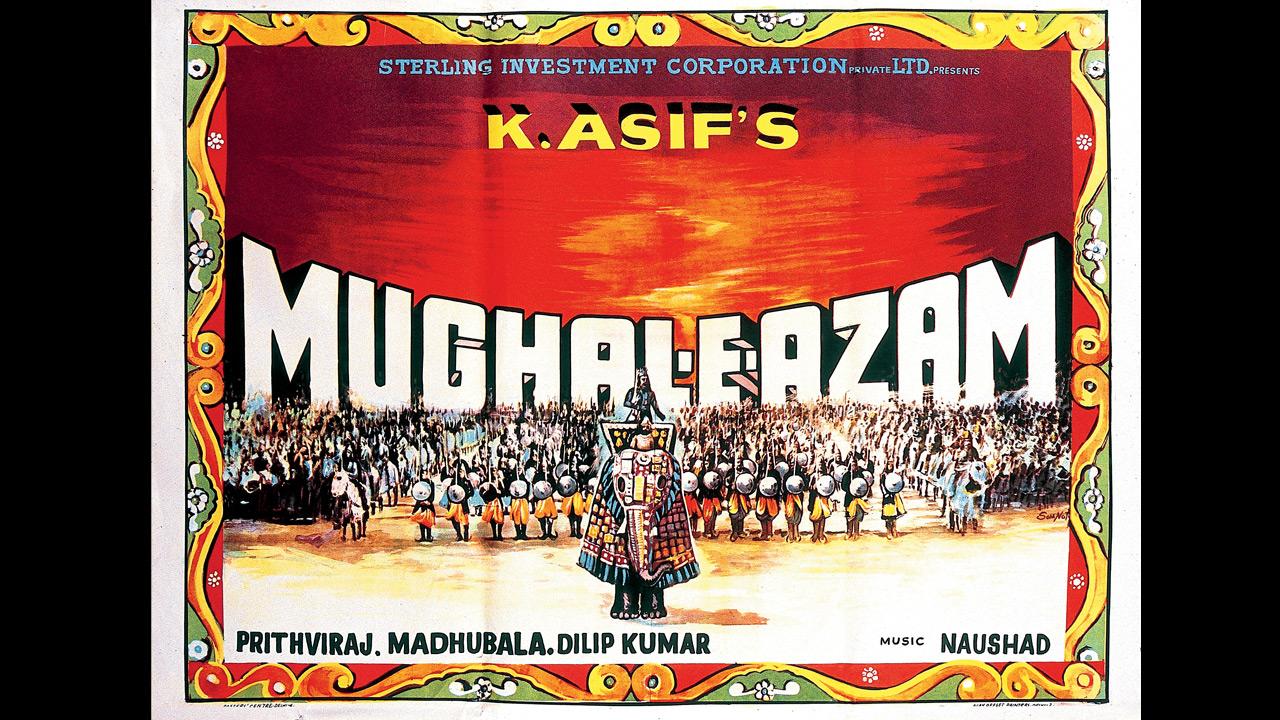
One of the last few countries to keep the film poster art alive is reason enough, says the team behind an upcoming auction, to see original cinema memorabilia as investment
Heena Khandelwal (MID-DAY; April 3, 2022)
After their inaugural auction featuring paintings by leading modern artists F N Souza, M F Husain and V S Gaitonde, among others, online auction house deRivaz & Ives has returned with a focus on cinema. The first auction, scheduled for April 8 and 9, will see over 100 first-release original posters of films like Mother India (1957), Mughal-E-Azam (1960) and Yaarana (1981).
Neville Tuli, founder of Osian’s, chief mentor at deRivas & Ives, says that many of the original posters, like that of Tarana (1951) by S M Pandit—a painter from Karnataka who designed film publicity material for Raj Kapoor and others—are still not available on the Internet. “We still have minimal interest in preserving cinematic heritage. Posters, especially the hand-painted ones, represent a fragility. It is a dead art, which has come back to India in a way; we are one of the last few countries to keep it alive.”
The auction will specifically highlight designers and artists who are not well-known for their work as poster artists, including legendary filmmaker Satyajit Ray. Works of poster designers like D R Bhosale (Main Nashe Mein Hoon, 1959), Pamart Studios (Haqeeqat, 1964 and Khamoshi, 1969), Diwakar Karkare (Sholay, 1975 and Jaane Bhi Do Yaaro, 1973) and C Mohan (Khatta Meetha, 1978) will be up for the sale. “We will see one of the most elusive original release versions of the Awara poster; the imagery seen until now has been of re-release posters,” shares Tuli, adding that there will also be a focus on the first family of Indian cinema, the Kapoors. “Their cinematic journey will be highlighted through their poster art. Three unique versions of Shashi Kapoor’s Juari [1968] will be seen for the first time.”
The aim, he shares, is to establish new world record prices for Indian film memorabilia and get the film fraternity more involved in cinema-related art. While actors like Shah Rukh Khan, Aamir Khan, Anupam Kher and Dia Mirza bid and won art pieces during the Osian’s 2002 auction, the hope is now to widen this group by reaching out to the younger generation of talent. Tuli says, “Once the film fraternity comes on board, the rest of the public will follow.”
WHEN: April 8-9
WHERE: derivaz-ives.com
I can’t explain how much it hurts to not be able to speak to Rishi every day-Randhir Kapoor
7:54 AM

Today marks one year since the death of one of Indian cinema’s most loved actors, Rishi Kapoor. His brother, Randhir Kapoor recently spoke to us about how difficult it has been to move on without his brother-buddy and that life can never be the same without him
Rachana Dubey (BOMBAY TIMES; April 30, 2021)

(Cuts in…) Can you believe it? Dekhte hi dekhte, ek saal ho gaya. In a matter of 10 months, I lost both my buddies, my brothers Rishi and Rajiv. It’s been the most painful year for my family and me. It’s been an extremely sad year for Raj Kapoor’s clan. I loved my brothers dearly. Rajiv and Rishi left us one after the other, and life has not been the same without them ever since. We’re a close-knit family and we spent most of our time with each other when we were not at work. We loved being around one another and our camaraderie was something else. We’d meet for drinks, meals and sometimes, just to talk to each other and relive old memories. Life is dotted with happy and sad moments, but the last 10 months have been a terrible jolt. Life can never be the same without Rishi and Rajiv. I loved them dearly, and I will always miss both of them.
They say time is a healer. How are you coping?
I am not feeling healed. Time is not healing me in any manner. Just when we were slowly coming to terms with Rishi’s passing away, my youngest sibling Rajiv left us. I feel lonely without them. They were not just my brothers, they were my confidants and my closest friends. We grew up together; our parents brought us up in such a way that we grew up to become each other’s pals, secret-keepers and what-have-you. We were each other’s strength and shoulders to lean on. I don’t have them here anymore.
Yes, time will heal us but I definitely feel a vacuum. In Rishi’s case, Neetu, Ranbir and Riddhima have felt a greater sense of loss. Rishi’s absence must be hurting them so much more, every single day. I am slowly coming to terms with his absence, too, but it will take a long time for it to settle in.

We had such great times together. That void of the brother-buddy can never be filled up. For the world, he was a great actor, who left behind scores of wonderful movies to enjoy and love. For us, he’s left loads of happy memories of the times we’ve laughed, hung out, eaten and chatted with abandon. Of course, I can go back and I do go back and watch all his films and that’s how I end up seeing him virtually, every day.
The connection we shared ran really deep. Rishi was a great friend to have - reliable and honest. My sister Rima and I feel his absence all the time. We’re left alone now — out of five siblings, it’s just she and I now. In the last three years, we lost our mom, our R K Studios and millions of invaluable memorabilia, our brothers, our sister and Shashi uncle. It’s all happened too soon. Today, when I watch Pyaar hua ikraar hua from Shree 420, I see my siblings in it and it pains me that memories of that movie have been lost forever. What you see in that song is what we’ve lived by — my siblings and I grew up to respect our elders and be extremely protective of one another.
For us, Christmas was always at Shashi uncle’s house, Holi was at Chembur and Diwali would be at one of our homes. All that is somewhat dwindling now. It doesn’t feel the same anymore, especially without my brothers. There’s hardly anyone there now from that generation of people in the family to which my brothers and I belonged. In this one year, my kids have supported me a lot, ensuring that I don’t feel lonely, but nothing can fill the void that my brothers have left behind. I miss that sibling bonding.
I saw them going in front of my eyes and it pains me to think of those days and times when I had to bid farewell to them. Emotional jolt! Time will heal me, I am sure. But, I can never get Rishi or Rajiv out of my mind. I am hoping that I will come to terms with their absence. The show will go on.
What runs through your mind when you watch their films now?
I almost feel like calling them up and telling them what I feel, and then I realise, it’s not going to happen. There’s not one day when Rishi and I didn’t speak to each other in all these years. There’s been a silence for the last one year. It’s beyond words to explain how much it hurts to not be able to speak to Rishi and share my thoughts with him. The lunch and dinner times, our drinking windows in the day, the time when we would hang out together...there’s not one moment in the day when I don’t miss Rishi and Rajiv. Rishi was so happy about his second innings in cinema with all those lovely roles. He was very pleased with the work that he was getting, all these different characters. He would say ‘Dabs, I can’t imagine myself in some of these roles but yeh directors aur writers toh kamaal kar rahe hain.’ He had loved a whole lot of scripts that came to him even as he came close to his last days. Who knew this would be it? He just could not be there to relish his success in the second innings, which he worked so hard for.
Like you said the show must go on, will you sit back and watch one of your favourite Rishi Kapoor films today?
I will be thinking of Rishi, like every other day, and it’s not a conscious thing. It happens on its own. We were emotionally close to each other. Life will go on, it moves us on. My father (Raj Kapoor) believed that the show must go on and it will. He’s left plenty of great films behind, unko dekh kar yaad karunga apne bhai ko. My brother was such a charming man, a good husband and a loving father. His children made him so happy. C’est la vie... I hope Chintu is happy where he is now.

Indian cinema isn’t only about Bollywood-Ali Fazal
7:53 AM

Kavita Awaasthi (HINDUSTAN TIMES; November 23, 2020)
Having forayed into Hollywood, actor Ali Fazal says he is thankful to Indian actors such as Om Puri and Irrfan, who have worked in the West for decades to earn a respectable place for brown actors. After making a name in Bollywood, trying to build a career from scratch in a new industry can be daunting.
The Mirzapur actor adds, “Choices don’t come to you on a platter no matter which industry you belong to. And when it’s an industry that’s not familiar with you, your body of work and judging your abilities from their own set notions is an even tougher feat. For decades, master filmmakers and actors have systematically worked towards depicting the real India on screen.” After his Hollywood debut Victoria & Abdul (2017), he is awaiting the release of Death On The Nile and is looking forward to shooting for Code Name Johnny Walker.
“Indian cinema is not only about Bollywood and that’s a barrier that’s been hard to break. I am so indebted to the incredible work of Irrfan bhai, Om Puri saab, Saeed Jaffrey and Shashi Kapoor who have strived to secure better roles and created better opportunities for us. Lead roles have been possible for me because of their contribution and bravery,” he signs off.
Stop sensationalising Sushant Singh Rajput’s death. You can’t blame anyone, not the film industry-Raveena Tandon
9:07 AM

Monika Rawal Kukreja (HINDUSTAN TIMES; July 7, 2020)
Even after three weeks since Sushant Singh Rajput’s death, conspiracy theories and assumptions refuse to die down. Angered by this rumour-mongering and blame game, actor Raveena Tandon urges, “Stop sensationalising it now. You can’t blame anyone, not the film industry. This is just becoming a witch hunt, a lynch mob, which is wrong. People have to think rationally. It’s doing a great disservice to the poor boy who’s gone.”
Tandon, 45, reveals she was appalled to read a WhatsApp forward doing the rounds that, “Karan Johar intentionally made a bad film for Sushant, so he could ruin his career. Why would a producer pay an actor crores of rupees, sign him in his movie and then invest so much time and mechanism to intentionally sabotage his own film? Such absurd allegations!”
However, Tandon doesn’t deny the existence of “camps and mean girl gang” in the film industry, which she had also tweeted about recently.
“There are good people and there are bad people. And there are bad people who do plan your failure; I’ve been through it. They are the ones who want to see you down and removed from films. It’s literally like classroom politics. They play dirty games,” she says, adding, “But people like this are there in every industry. We’re in a high profile, glamorous job and the competition is cut-throat, so it gets highlighted.”
Tandon gives her own example of being removed from a film overnight. “I was doing fittings with the film’s designer for an outfit for the evening mahurat party. At 4pm, I get a call that I’ve been dumped from the movie and I’ve to return the signing amount because the hero’s girlfriend didn’t like me,” she reveals, quoting an interview of late actor Shashi Kapoor that helped her. “He had said, ‘Main party par gaya, and there I realised the hero is someone else. They didn’t even inform me’. So, what happened with all these false claims of nepotism? Even the greatest filmmaker Raj Kapoor’s family wasn’t spared by politics.”
Mention how Rajput always feared being thrown out of Bollywood if his films didn’t work, Tandon says that’s a reality with every actor. “Even the topmost stars or topmost producer, director’s brothers or sons have that fear. If that wasn’t the case, all star kids would have been superstars today, but there are many who have been thrown out of Bollywood. So, when Sushant appealed to the public to come and see his films, nobody knew that it was said with so much charged emotion. Maybe he was emotionally very fragile always,” says Tandon, who still can’t fathom “what drove such a young, handsome, talented, successful boy to take this drastic step”.
Rishi Kapoor was an effortless actor, a true gentleman-Poonam Dhillon
8:27 AM

Shreya Mukherjee (HINDUSTAN TIMES; May 2, 2020)

Dhillon met him two months earlier. “Chintu had recovered and was so grateful to have beaten such a horrible disease. It’s going to be very difficult to accept that he is gone. I knew him since I was 18. We have been friends and I was close to his family. I had worked with him, Dabboo (Randhir Kapoor), Shammi Kapoor uncle, Shashi ji (Shashi Kapoor),” she adds.
Dhillon and Kapoor had collaborated in films such as Yeh Vaada Raha (1982), Tawaif (1985), Zamana (1985), Ek Chadar Maili Si (1986), Dosti Dushmani (1986), Amiri Garibi (1990), Yeh Hai Jalwa (2002), among others. And they wanted to work together again. “The other day I joked saying, ‘Aaj kal baat toh karte ho par kaam kab karenge?’ and he said, ‘Haan yaar, chal ek saath ek film karte hai’,” she says.
The actor says Kapoor “looked fit” when she last met him. “He was an unassuming, effortless actor. He never needed any prep. His performance wasn’t theatrical or dramatic, he was a natural actor. That’s what I loved about him,” she adds. Dhillon shared a “fun and warm” relationship with Kapoor and they would often joke with each other. “I learnt a lot from him. He was a good man. He would never misbehave with anyone. He expressed what he felt, which at times would sound wrong, but that’s that,” she recalls.
Calling him one of the “finest actors of our times”, she says it’s a “huge loss” for everyone. “It’s sad that on his last day, there was a restriction to pay our last tribute to this true gentleman,” she concludes.
Revealed: Shashi Kapoor, Manoj Kumar and a story of friendship
8:18 AM

Manoj Kumar and Shashi Kapoor at Purab Aur Pashchim premiere
Roshmila Bhattacharya (MUMBAI MIRROR; March 20, 2020)
Their friendship dated back to their struggling days. Even though Shashi Kapoor was the son of Prithviraj Kapoor and the younger brother of Raj and Shammi, he was determined to make it on his own. He found kindred souls in Manoj Kumar and Dharmendra, who were also chasing the celluloid dream. The trio would often land up at auditions together, hoping one of them would go home smiling. Such was the camaraderie that once, when Manoj saab ran into Shashi saab at cousin Lekhraj Bhakri’s office in Ranjit Studio, where he had dropped by on the invitation of top filmmakers Kuldeep Sehgal and Lekhraj ji, Shashi saab assured him that he wasn’t there to take away his work.
Such generosity of spirit might seem implausible today, but those were simpler times and the actor-filmmaker has fond memories of them sitting on a road roller outside Tardeo’s Central Studio where they were both shooting, weaving rainbows. “I told Shashi that if I ever made a film, I’d take him as the actor and he promised me the same,” reminisces Manoj saab.
He kept his word and approached his friend for his 1967 directorial, Upkar. “I met Shashi at Kalyanji’s (one-half of music director-duo Kalyanji-Anandji) to offer him the role of my younger brother Puran in the film. He accepted without even asking about the story or his character. He never did, such was his trust in me,” Manoj saab recounts.
However, in retrospect, Manoj saab realised that he might be betraying his friend’s trust, as Puran goes against his war-veteran brother Bharat and even his own country and the actor-filmmaker feared these shades of grey might tarnish his friend’s image of a romantic hero. “So, we met at Kalyanji’s place again where I told Shashi this role was not for him as it could cause damage. Again, without questions, he nodded, ‘As you say.’ I took it to Prem Chopra with whom I’d done Shaheed earlier and it was a turning point in his career. Shashi attended the film’s premiere. He and Jennifer (Kendal) were also there for the premiere of Purab Aur Paschim,” he narrates.
A few years later, Manoj saab went back to his friend with the 1974 social, Roti Kapda Aur Makaan. Once again, Shashi saab unquestioningly accepted the role of Mohan Babu, a rich businessman whose act of sacrifice in the end makes him a bigger hero than any quintessential lover boy. “When I tried to discuss money with him, knowing I was on a tight budget, Shashi told me, 'Jo mujhe chahiye woh tum nahin de sakte, so why don’t you just keep paying me in instalments. When you stop paying me, I’ll know that’s it'. That was Shashi Kapoor!” exults Mr Bharat, remembering fondly how during a two-month schedule in Titwala, every morning, he would leave his bungalow in Juhu, pick up Amitabh Bachchan on the way, and head for the location. Around the same time, Shashi saab would drive from his home in SoBo. “Every day, his car would overtake mine on Thane bridge, and he’d reach the set before us. Shashi was a stickler for punctuality and this quickly became a friendly race between us.”
He goes on to relate that his friend even cut short his Christmas and New Year vacation in Goa with Jennifer and his kids, to shoot for the film’s climax. “That was an annual ritual with him. It was the one time in the year when he was strictly off duty. But that one year, Shashi returned from Goa and brought in the new year working with me,” Manoj saab shares.
After he completed the film, as was a ritual with him, he wanted to take the cans of film to Haji Malang’s shrine for Baba’s blessings. But having injured his back, he knew it would be impossible to trek three miles up the hill. “When I told Shashi this, he offered to take the cans to the shrine for me. What’s more, he even hauled up the cans of Kranti. Both films were superhits, Shashi was a true friend,” says the gratified actor-producer.
During Roti Kapda Aur Makaan, Manoj saab had gone to meet his friend at Filmalaya Studio, and as he drove through the gates, he was surprised to find the usually gentlemanly Shashi Kapoor speaking in a loud, irritable voice. On enquiring, he learnt that the actor who was filming N N Sippy’s 1974 caper, Chor Machaye Shor, there was not happy with the song they were to shoot. “Bogus hai yeh gaana,” he groused, and insisted Manoj saab listen to it. Reluctant and embarrassed, Manoj saab had them rewind the Ravindra Jain’s composition for him. “As soon as the last notes died away, I told Shashi, ‘Yaar, gaana superhit hai!’ Immediately, he turned to the director (Ashok Roy) and said, ‘Since my friend likes it, let’s shoot.’”
“Le Jayenge, Le Jayenge Dilwale Dulhaniya Le Jayenge’ was one of Shashi Kapoor’s biggest chartbusters and the film was the second biggest grosser of the year. The title of Shah Rukh and Kajol’s evergreen love story, Dilwale Dulhania Le Jayenge, also has its genesis in this song.
In later years, the two dosts would meet at the hospital, when Shashi saab came for dialysis and Manoj saab for physiotherapy for his ailing back. “Then, one late evening, around 10.30 pm, I got a call. ‘O Bhagat Singh, tune maar dala.’ It was Shashi and he was watching Shaheed,” he flashbacks. “That was our last conversation. He is gone today… But his talent and his memories live on,” he says. Shashi saab would have turned 82 on March 18.
Girish Karnad was a suitable mind for all seasons: Khalid Mohamed pens a tribute
8:02 AM

Writer, actor, humanist, Girish Karnad never minced words while championing the idea of inclusive India
Khalid Mohamed (MUMBAI MIRROR; June 11, 2019)
In creased camel-colour corduroy trousers, a baggy maroon shirt, dangling a cigarette Humphrey Bogart-style from his lips, and propped against a wall of the Shanmukhananda Hall – the Filmfare Awards ceremony used to be conducted there – he could have been construed as a misfit in the star-freckled crowd.
That was his USP though, prompting a senior female colleague to gasp, “He’s so dishy among all the suits here.”
Girish Karnad, who passed away at the age of 81, wore his ruddy-complexioned, movie star good looks, lightly. If he acted in a stockpile of Bollywood films – the offbeat as well as the onbeat, he would declaim, “It’s only for the money,” and trill an aria of the Abba chartbuster, “Money, money, money…must be funny...in the rich man’s world.”
Self-deprecating and yet fiercely individualistic, he was the flexible savant who understood that popular cinema was a route to audiences of varied tastes. In fact, his contribution towards the aesthetic and commercial cinema would come up equal on any given scale of justice.
Of course, cinema was just one medium which the actor-playwright-scriptwriter-director-novelist-translator-documentarist gravitated towards inexorably. Gravitas at one end of the spectrum, and the hyper-fantasticated on the other, were the realms he pursued presciently.
Unarguably though, Karnad will be revered far more, and correctly so, for his pioneering theatre work, and for being a frontrunner during the 1960s in the renaissance of Kannada literary movement.
His instincts were eclectic, accounting for his collaborations most notably with Shyam Benegal and theatre stalwart B V Karanth. In the course of a conversation, he was at pains to emphasise that he had no issues with the avant-garde cinema of Mani Kaul and Kumar Shahani, adding that the films of the so-called ‘medium-wavewallas’ would also go on to become milestones. He was spot-on.
Seeing no divide between the extremist cerebral and the accessibly humane, indeed here was a beautiful mind who defined intellectualism. Intellectual, did I say? Unfortunately, it’s a gratuitously-reviled and lost quality, what with ‘libtards’, ‘fetishists’ and ‘elitists’ being the en vogue argot today. For Karnad, intellectual is the perfect fit.
Honoured with the Padma Bhushan and the Sangeet Natak Akademi and Jnanpith Awards, his childhood years were his formative phase. Because of social taboos, his widowed mother Krishnabai Mankikar had to wait five years before her marriage to Dr Raghunath Karnad. Born in Matheran, his growing up years were spent in Sirsi and Dharwad. Subsequently he graduated from the Karnatak Arts College, was selected as a Rhodes scholar and mastered in philosophy, politics and economics from Oxford University.
Back home, initially he worked at the Oxford University Press. At the age of 23, he wrote his first play Yayati followed over time by other pathbreakers such as Tughlaq, Hayavadana, Naga-Mandala and Taledanda . Influenced by the traditional Yakshagana theatre form, his plays are regarded as allegories drawn from mythology, history and the epics. For instance, Tughlaq, while focusing on the 14th century’s controversial Delhi Sultan Muhammad Bin Tughlaq, was clearly a take on the lost ideals of the Nehruvian era.
Girish Karand was a rationalist; his every word was modulated, rooted in personal experience and study. Still he wasn’t entirely satisfied, frequently dismissing some of his works as not quite up to mark. Neither would he mince his words while expressing his concern against religious fundamentalism and bigotry. A staunch secularist and feminist till the last, even while his health deteriorated, he wouldn’t lose an opportunity to critique the ruling government. Death threats couldn’t arrest his verbal bullets.
Political correctness was not his forte. Breaking protocol at a literary festival in Mumbai, circa 2012, he downsized V S Naipaul “who has no idea of how Muslims contributed to Indian history”, besides lambasting the Nobel laureate for his reported visit to the BJP office on the heels of the Babri mosque demolition. Not the sort to buckle under the backlash, he stated that the Bengaluru International Airport should be named after Tipu Sultan and not after Kempe Gowda, the 16th century ruler of the Vijayanagar empire. Agree with him or not, he could go on record to say that Rabindranath Tagore’s plays were “unbearable”.
Catalysed by the rising incidence of intolerance, Karnad’s activism had intensified towards his end years, soldiering on even while wearing a nose cannula to facilitate breathing, both at rallies and for his on-screen appearances.
On another note, for a video interview for a documentary on Shyam Benegal he had made it clear that his statements should not be censored. They weren’t. He clarified that the script of Manthan was extensively rewritten by him although the National Award for the Best Screenplay was presented to Vijay Tendulkar. Amrish Puri, he felt was grossly miscast as the abductor of Smita Patil in Bhumika, and the script of Kalyug had to be refashioned to be in sync with the approaching corporate ethos of “all’s fair in deceit and business”.
Benegal, on his part, had pointed out that it was Karnad, who during his brief tenure as the director of the Film and Television Institute of India, Pune (1974-75), had first noticed the potential of Naseeruddin Shah. “Girish had recommended Naseer for Manthan,” the filmmaker had recalled. “He had warned me that he was a pain in the neck on the campus but that he was a brilliant actor.”
As an actor, Karnad had no delusions of grandeur although he excelled as a guilt-ridden Brahmin in Samskara. As a timid schoolteacher in Nishant, however, he appeared to be ill-at-ease. A demanding scene requiring an outburst had to be abbreviated. As the male lead, he was gallant and honest enough to play second fiddle to the heroines, be it Smita Patil Nutan (Meri Jung), Hema Malini (Ratnadeep), Shabana Azmi (Swami) or Smita Patil (Umbartha). The transition to character roles – as a kindly father, cricket coach, inspector, or the RAW officer in Ek Tha Tiger and Tiger Zinda Hai – was so much water off a duck’s back, his fluency in Hindi and understated dialogue delivery pitch aiding him consistently.
While Vamsa Vriksha and Godhuli helmed by him have stayed in the memory files, his attempt to direct the period pageant Utsav, hasn’t. “I think Girish feels so guilty that it didn’t do well,” the film’s actor-producer Shashi Kapoor would laugh, “that he has never met me again or sent me a Christmas card! I’d love to hear from him and his wife some time.”
Karnad and his wife Saraswathy moved from their Bandra seafront apartment to Bengalaru, where they were cut off from the Bollywood bustle. His was a late marriage at the age of 42. ‘Saras’ as he called her is as gregarious and socially-concerned as him. Of their children Radha and Raghu, the latter is a journalist.
To return to the evening at the Filmfare Awards, Karnad was soon joined by Dev Anand and Tina Munim. To their Professor Higgins and Eliza Doolittle he was playing Colonel Hugh Pickering in Man Pasand, an adaptation of My Fair Lady. Crushing his cigarette under his sandal’s sole, he had said, “I hope Dev saab doesn’t scold me for not wearing a suit.”
He didn’t need to. After all, Girish Karnad was a suitable mind for all seasons.

His was a late marriage at the age of 42. ‘Saras’ as he called her is as gregarious and socially-concerned as him; Catalysed by the rising incidence of intolerance, Karnad’s activism had intensified towards his end years; Shyam Benegal had pointed out that it was Karnad who had first noticed the potential of Naseeruddin Shah
I used to see many Hindi films, but I was never keen on doing one-Soumitra Chatterjee
7:57 AM

On a visit to Mumbai, the legendary Soumitra Chatterjee, spoke about his experiences of working with Satyajit Ray, friendship with Shashi Kapoor and why he stayed away from Hindi movies
Sreeparna Sengupta (BOMBAY TIMES; April 24, 2019)
 For Soumitra Chatterjee, whose prolific career spanning over six decades, saw him as the most enduring face of Oscar winning master filmmaker, Satyajit Ray’s movies, it is his immense work in field of theatre, that has found him in the city of Mumbai time and again. However, Hindi movies have never been a lure for this legendary Indian actor.
Recently, a captive audience at the packed Nehru Center auditorium, soaked in the aura of the 86-year-old thespian at a cultural programme, organised by South Mumbai’s oldest Tagore music school. Later, over a more relaxed one-on-one conversation, he lets on, “Poetry has been very dear to me from an early age. That’s a legacy of my parents. It was my father who gave me the idea of doing poetry recitals. And my mother unconsciously sowed the plant for the love of poetry that I have.”
The actor’s love for theatre also developed at a very young age, much before the arc lights took over. In fact, it was theatre and the common love for world cinema that saw a friendship develop between late actor Shashi Kapoor and him, “Shashi was also into theatre from the very beginning. And although he had to bend and mend his ways for the Hindi film industry, he was always aware of what was happening in theatre and cinema around the world. Later, as a producer, Shashi produced some remarkable films.”
When probed on a black-and-white photograph of the two dapper actors in their hey days, which he had shared on social media, he says, “That was taken in Berlinale. We had become friends since the time we did films like, Charulata and Shakespeare Wallah. Both the films were shown in Berlin in 1965. So, the photograph that you are referring to was taken then. And as far as I remember, it was shot by none other than Satyajit Ray. Both of us were very young at that time and Shashi was the ever-handsome, charming and witty person,” adds the actor, who was no less a heartthrob of Bengali cinema then. Incidentally, both their films won top awards at the Berlin film festival, that year.
 ‘Balraj Sahni is the best that Indian cinema has seen’
Given his association with the Hindi film industry, ask him why he has never been seen in a Hindi film, like some of his contemporaries — Suchitra Sen, Sharmila Tagore and Uttam Kumar, he says, “Frankly, I was not keen on doing Hindi films. For the single reason, that the kind of films I started liking were those of filmmakers like Vittorio De Sica, Federico Fellini or other new-age filmmakers that opened windows for the kind of films that I wanted to do. Although from an early age, I used to see many Hindi films. And actors like Dilip Kumar Saab and also, Raj Kapoor to an extent, were favourites of mine. But the more I think about an sub-conscious influence on me, only one name comes to my mind — Balraj Sahni. He is the best that Indian cinema has seen and I still adore him as my idol.”
‘I don’t know why Satyajit Ray liked me’
Introduced to cinema lovers the world over as Apu of Apur Sansar on May 1, 1959, he has vivid memories of his first day at shoot with Satyajit Ray (it was his 27th death anniversary on April 23). Reflecting on his first meeting with the maestro, he says, “I was initially taken for an interview with Mr. Ray when he was looking for someone to play Apu for the second part of the Apu trilogy. But I was too grown up and tall for the adolescent Apu. And I wasn’t selected. But much later, after I had been working with him for two-three years, I came to know that he had made up his mind to make the third part of the trilogy, after he saw me. Over time, as we collaborated more, we developed a rapport and he started giving me a lot of freedom into the way I wanted to do a role. It was exciting to shoot with him.” Pausing to reflect, his voice trails off with a shy questioning laugh, “...And I don’t know why he liked me.”
‘Ray used to draw sketches of the make-up and look before actually going into the shoot’
When the conversation steers to Charulata, his voice swells with pride, “That was a great film. Satyajit Ray always felt that was his most perfect film. In fact, as a student of Bengali Honours, I knew the original story, Noshto Nir extremely well. It was one of the greatest stories written by Tagore. Ray used to draw sketches of the make-up and look before actually going into the shoot. He did that for Charulata as well and sent me a table piano, long before the shooting started. I would practice on it as it was necessary to do that for shooting a song in the film,
‘Every conversation with Ray was a learning’
Chatterjee’s collaboration with Ray spanned across 14 films, including masterpieces like Aranyer Din Ratri, Devi, Ghare Baire, Ashani Sanket among others, showcasing the actor as one of the most versatile in Indian cinema.
“Every conversation with Ray was a learning. He was my mentor, a kind of teacher, but unobtrusively so. He always behaved like a friend, more like an elder friend. And even today he has remained an inspiration,” signs off the legend, who has worked with filmmakers like Mrinal Sen, Tapan Sinha, Goutam Ghose, Rituparno Ghosh. His most recent works include films like Shonar Pahar, Mayurakshi, Basu Poribar in which he was cast with Aparna Sen after 19 long years.
Canteen staffpersons in film studios talk about breaking bread with Salman Khan, Hrithik Roshan, Deepika Padukone
3:45 PM

Prakash Shetty of MP Canteen; Vitthal Shetty, seen here with sons Ashok and Sudhir, has been managing the Filmistaan Canteen since 1962
Tales from privately-owned canteens in studios that have stood the test of time and trends
Kunal Guha (MUMBAI MIRROR; December 21, 2018)
Prakash Shetty was only 12 when he took over from his ailing father to manage MP Canteen, nestled inside Mehboob Studios. A regular patron from his early days of managing the canteen was a geriatric who would resign to a corner of the modest eatery and consume endless cups of chai while scanning through a script. Noticing that the senior was always absorbed in reading, Prakash ensured that he wasn’t bothered and would instruct his waiters to refill his tea at regular intervals. “It was only when I watched Saaransh that I recognised the ‘old man’ from my canteen. He was actually a young Anupam Kher in makeup,” chuckles the 49-year-old manager. “His makeup and body language were so immaculate, I actually thought he was an old man.”
Prakash’s establishment is among a handful of privately-owned canteens that have survived the test of time and trends. While some folded up organically when studios shrunk in size (Filmalaya Studios), others went out of business when studios turned into commercial spaces (Natraj Studios). But running to capacity post-lunch hour, M P Canteen seems barely threatened by extinction.
Sitting at a table that overlooks the wall where a majestic portrait of the studio’s founder Mehboob Khan hangs, he reflects on better times. “Earlier, the entire film crew would eat here. But now, everyone gets a caterer to lay out a spread next to the film set,” sighs the manager, who has also been catering for shoots for the last 20 years. “If people get meals for free, why would they come here and pay for them?” he asks.
Prakash’s loyal patrons who still order in while shooting at the studio, include actors Hrithik Roshan, Deepika Padukone, Sanjay Dutt and Salman Khan. A big draw for most happens to be the canteen’s famed misal pav which is prepared using the same mixture of freshly-ground spices for 45 years by the canteen’s cook Krishna Shetty. “Abhishek (Bachchan) loves our misal fry served with toasted pav. Once he even got his friends, including Boman Irani, to try it,” he beams. The Khan brothers, Salman, Arbaaz and Sohail, prefer the other much-revered dish, egg bhurji with pav, while Hrithik Roshan loves feasting on his eight-slice bread omelette. “Hrithik loves our bread omelette so much that he used to parcel a couple of servings for home,” remembers Prakash, adding he hasn’t come by in a while.
While it’s difficult picturing Bollywood stars sharing modest meals with the rest of the crew today, some canteens served as social equalisers. Vitthal Shetty, 85, who has been managing the Filmistan Canteen since 1962, remembers Jackie Shroff, Shakti Kapoor and Shashi Kapoor getting off their cars and strolling right into the kitchen to help themselves to whatever was being cooked — rice, dal fry, fish fry or even idli-dosa. Shashi was his most demanding patron at the time and each time the actor was to shoot at the studio, Vitthal had to source a dish that wasn’t on the menu. “He loved his clear chicken soup and we always ensured he got a bowl by the end of the day,” says the veteran, who shifted to Mumbai at the age of 35 from his native Manchakal in the Udupi district of Karnataka.
Today, he is succeeded by his sons, Ashok (57) and Sudhir (47), but having helmed the canteen for 56 years, has kept himself abreast with the turns in the film industry. “Back then, Manoj Kumar, Dev Anand, Raj Kapoor and many big stars would just roam around the studio between takes and often drop in for a cup of tea. No one had bodyguards, and no one would bother them either. But now, all actors get off their cars and rush into their vanity vans,” says Vitthal, adding that some like Amitabh Bachchan and Sridevi would send for their meals to be picked up to have in their makeup room. “If Sridevi was shooting in the studio, we knew we had to make our special Mangalorean fish curry which she loved the most.” Bangda fry was another speciality. It was such a hot-seller that they “would make the dish 365 days in a year”.
Another canteen manager who has been in the business for 42 years is V P Ali, who has manned the canteen at Kamalistan Studios since 1974. Ali struggles to get by today as the sharp drop in the number of shootings at the studio have taken a toll on his business. But in his heydays, he cracked 22 eggs at a go to whip up a generous serving of bhurji-pav for Salman. “Jeetendra loved kanda bhajiya while Suneil Shetty relished our dal fry. But business slowed down in the mid-90s.”
Ali remembers films like Razia Sultan, Desh Premi, Inteqam, Khuda Gawah which were shot at the studio when he was a one-man show — the cook and the cashier. “At the time, the studio was abutting a jungle and there was nothing available nearby. So, I had to build a stock of essentials as running out of ingredients would leave me in the lurch,” he says.
Despite their intrinsic relationship with films, most canteen managers admit having little interest in cinema. The only time Vitthal Shetty walked into a shoot was when Pakeezah resumed shooting after a 12-year-gap. Even Prakash Shetty rarely left the cashier’s counter, but he did drop in to watch the filming of a song featuring his favourite actress Madhuri Dixit. “I don’t remember the film, but the set was a mandir. Madhuri nailed the song in a single take,” he smiles.

I didn’t want to be a big star for a few years and then fade away-Anil Kapoor
7:55 AM

Flexcia Dsouza (BOMBAY TIMES; November 30, 2018)
Grooving to Goan beats on the red carpet, crooning to Hindi songs at the session — the evergreen, ever-popular Anil Kapoor showed at International Film Festival of India (IFFI) on Tuesday that age is just a number.
Speaking his heart out at a masterclass moderated by his younger daughter Rhea, a Bollywood producer and fashion stylist, Anil spoke about how he was delusional about his looks when he was trying to get a break but was sure about his career choices from the beginning. And this, before he took the microphone to sing Mohd Rafi’s Mujhe Mat Roko, Kishore Kumar’s Zindagi Ki Yahi Reet Hai and Kaante Nahin Kat Te from his superhit 1987 film, Mr India!
THE JUNIOR SHASHI KAPOOR!
“From the time I came to my senses, I knew I wanted to be an actor. I had a friend in Class V or VI, whose father asked me whether I’d want to play a role of the young Shashi Kapoor, and I quickly replied — 100%. There was an audition and I went to the studio in Dadar, Mumbai, without taking my parents’ permission. I was selected for the role of the junior Shashi Kapoor. Since that day, I have constantly dreamt, worked on myself, worked on my craft and worked on being a people’s person. I’m still learning and understanding,” said Anil. As for his confidence, he thanks his sense of delusion about himself, since he was the skinny, hairy guy in Bollywood at a time when the industry was full of tall and handsome actors.
Rhea is the only one among his three children who is not an actor. “Because I was Anil Kapoor’s daughter, everyone thought ye toh heroine banegi. When I went to film and theatre school, I didn’t know what I wanted to do. But now that I am 30, I know what it feels like to actually want something. Back then I didn’t know. I remember meeting Ayan Mukerji and he said, ‘Come and work on my film’. The first day on the sets, and I knew I will never become an actor. I knew in my heart that I wanted to be in films, but not as an actor, and then production just happened. A lot of people don’t have that kind of access. I know how lucky I am to be Anil Kapoor’s daughter,” she says.
Anil also spoke about how Sonam came back from Singapore after university and joined Sanjay Leela Bhansali as she wanted to be a director. “But Bhansali saw the actress in her and he felt she had that kind of persona. I inherently knew that she had a certain spark which made her an actress. I didn’t want to say it because I didn’t want to push her. I wanted her to find it by herself. For me, it was fine that she does whatever makes her happy,” he added.
‘ACTING IS LIKE AN OCEAN’
The one thing that cinema has taught Anil is that there are no shortcuts. “Acting is like an ocean. We all need tools — our tools are physicality, intelligence, senses and how do you sharpen it? You have to constantly work on that. It can be music, dancing, miming. When I started out, I decided to learn singing. I could mouth-sing my songs. I am convinced that if you are a trained actor today, it becomes very easy for the director to mould you. You should try to do whatever that helps you. These days physicality and the looks are given too much importance and this may restrict you from learning the craft better. Focusing too much on looks may lead to stagnation. You have to travel, read, observe, take a break and do whatever helps you become a better actor. It’s an ongoing learning process. There is a shelf life in films and sports. But you should try to increase your shelf life as much as you can. You can do that by keeping yourself fit – mentally, physically and emotionally,” he said.
Rhea points out how she is bombarded with ‘gross’ messages by girls on social media, which includes questions like — How is your dad so hot? How does your dad look so good at this age? How is he so sexy? “When I became an actor, everyone thought I was good, but I didn’t have the looks. But now, everything is changing. I worked towards my physicality, because I needed the strength and energy to portray all characters. And in the process of building my stamina to work in front of the camera, I started looking after myself and started working out. I’ve always wanted to be in a marathon, I was never in for a 100 metre race. I didn’t want to be a big star for five-six years and then fade away. I’ve been in this business for 38 years now and I’ve worked hard throughout,” he said.

Tributes to Shashi Kapoor, Vinod Khanna & Sridevi at IFFI 2018
8:33 AM

Lasyapriya Sundaram (BOMBAY TIMES; November 6, 2018)
 The 49th International Film Festival of India (IFFI) will honour three stalwarts from the Hindi film industry. Tributes will be paid to Dadasaheb Phalke Award winners, Shashi Kapoor and Vinod Khanna and National Award-winning actress Sridevi.
A retrospective of Vinod Khanna’s films will be part of the festival this year. The line-up of movies include his critically-acclaimed film Achanak (1973), in which he played the role of a military officer who turns fugitive, the mystery drama Lekin (1991), where he played a government employee who travels to Rajasthan to make a list of items of an abandoned haveli, and the blockbuster Amar Akbar Anthony (1977) in which he essayed the role of a policeman. Khanna’s wife Kavita and sons Rahul and Akshaye are expected to be present at the festival to kick-off the retrospective of films.
Meanwhile, homage will be paid to the late superstar of Hindi cinema, Sridevi. The actress breathed her last in late February this year and also received her first National Award posthumously in May for her role in Mom. Her husband Boney Kapoor will be present on November 21 at IFFI when the actress will be honoured. Boney says, “She deserved this honour and I am grateful to the Government of India and the International Film Festival of India for recognising her contribution to Indian cinema.” The presence of her daughters Janhvi and Khushi is yet to be confirmed.
Tribute will also be paid to late actor Shashi Kapoor, who passed away in December last year, for his contribution to cinema. His son Kunal Kapoor is expected to be there for the same.

Family and friends mark 40 years of Prithvi theatre and Prithviraj Kapoor’s 112th birth anniversary
8:04 AM

Avinash Lohana (MUMBAI MIRROR; November 5, 2018)
 It was a double celebration for the Kapoor clan on Saturday when Prithvi
Theatre turned 40 alongside Prithviraj Kapoor’s 112th birth
anniversary. The late patriarch’s grandsons, Randhir and Kunal, and
great-grandson Ranbir, joined thespians and theatre loyalists — Rajit Kapur, Lillete Dubey, Lara Dutta, Shyam Benegal, Ila Arun, Divya Dutta, Gulshan Devaiah and Tinu Anand, among others — to mark the occasion.
It was a double celebration for the Kapoor clan on Saturday when Prithvi
Theatre turned 40 alongside Prithviraj Kapoor’s 112th birth
anniversary. The late patriarch’s grandsons, Randhir and Kunal, and
great-grandson Ranbir, joined thespians and theatre loyalists — Rajit Kapur, Lillete Dubey, Lara Dutta, Shyam Benegal, Ila Arun, Divya Dutta, Gulshan Devaiah and Tinu Anand, among others — to mark the occasion.
The festival kicked off at Opera House with the staging of Prithviraj’s play Deewar, which had first premiered at the venue in 1945. “I am proud that the theatre re-enacted my grandfather’s play. It was a nostalgic moment for the family and festival regulars. Shashi Kapoor and (his late actress-wife) Jennifer had established the theatre and it’s going strong with (their son) Kunal,” Randhir told Mirror.
 Rajit, a long-time associate of the theatre, informed that Deewar,
which revolves around Partition, was co-written by Prithviraj and its
new version is directed by Sunil Shanbag.
“My father once told me that he had watched the original play as a
child in Punjab. Now, it’s commendable that members of the Kapoor family
make it a point to attend the opening night of the festival every
year,” the actor-filmmaker added.
Rajit, a long-time associate of the theatre, informed that Deewar,
which revolves around Partition, was co-written by Prithviraj and its
new version is directed by Sunil Shanbag.
“My father once told me that he had watched the original play as a
child in Punjab. Now, it’s commendable that members of the Kapoor family
make it a point to attend the opening night of the festival every
year,” the actor-filmmaker added.
Rajit, who was recently seen in the Junglee Pictures production Raazi, traced his association with Prithvi theatre back to his college days. “As students, just being at the theatre was a privilege. We volunteered there just so we could watch some plays. I was in the third year of college during my first ever performance, Night of January 16. It was magical,” he signed off.
Shashi Kapoor’s passion for meaningful cinema made him stand out-Simi Garewal
8:00 AM

Actress and celebrated talk show host Simi Garewal will pay a special tribute to the late Shashi Kapoor at an upcoming film festival in Melbourne
Renuka Vyavahare (BOMBAY TIMES; July 25, 2018)
Shashi Kapoor’s Siddhartha (1972) will be screened at the Melbourne film festival this year, to commemorate the late actor’s immense contribution to Indian cinema. Directed by Conrad Rooks, the film, which is based on Hermann Hesse’s book by the same name, traces the journey of Siddhartha, who engages in the quest for a meaningful life. Simi Garewal, who was Shashi Kapoor’s co-star in the film, will host the screening as a special commemoration for the late actor, following which she will also engage in a special Q&A session with the audience, who would be flying down from across the world.
Speaking to Bombay Times, Simi said, “Shashi was my friend, my co star. I will talk about him at the festival before our film’s screening. His personality had so many facets. He was a perfect co-star, a gentleman and a dear friend. He knew how to conduct himself, be it here or abroad. He never gave a chance to anybody to question his words or behaviour, ever. Shashi’s passion for meaningful cinema also made him stand out. As an actor and a producer, he was ready to put his money on films like Vijeta (1982) and 36 Chowringhee Lane (1981), which may not have been considered to be commercially viable per se.”

My inspiration is Shashi Kapoor, one of the finest producers that we have ever seen-Nikhil Dwivedi
8:03 AM

Lasyapriya Sundaram (BOMBAY TIMES; May 28, 2018)
Nikhil Dwivedi made his debut in Bollywood as a leading man with director Eeshwar Nivas’ drama, My Name Is Anthony Gonsalves (2008). Post that, he featured in films like Raavan (2010), Shor In The City (2011), Hate Story (2012) and Tamanchey (2012). The actor admits that his films didn’t rake in the moolah at the box office. But his passion for cinema made him want to still be part of the movie industry. Now, he has changed gears and has plunged headlong into production. Veere Di Wedding, the female buddy film starring Kareena Kapoor Khan, Sonam Kapoor Ahuja, Swara Bhasker and Shikha Talsania, marks his debut as a co-producer.
Ask him if a background in management studies prompted his decision and he says, “That wasn’t the real reason. From the age of four, I knew that I had to grow up and be an actor. Since, childhood, I have been passionate about cinema. I came here to be an actor but my films didn’t do too well. After my initial films didn’t sell tickets at the box office, the kind of films I was being offered weren’t encouraging. I didn’t have the aesthetics to be part of the films that were being offered to me. Tickets prices have gone up and when you get to see Shah Rukh Khan, Salman Khan and Hrithik Roshan at that price, I would have had to make a huge effort to convince people that they should watch Nikhil Dwivedi in a film and pay that kind of money. The only way I could have done that was if the content was good enough. When I wasn’t being offered films with good content, I knew it was going to be difficult as an actor. Even then, I wanted to be a part of cinema. Despite that, being a producer was not a conscious choice. It happened to me by default. In the past, the producers who invested in my films didn’t have the experience to put a film together. I used to turn into a non-paid executive producer on my films. On my last film, I was even working out Richa Chadha’s dates. I realised that I could put a film together in a limited budget because my films were made on low budgets. That’s how I turned to production.”
Quiz him why he decided to bet his money on Veere Di Wedding and Nikhil admits, “It is important to have belief and back creative people. I have been in that situation where I wanted to be part of good films and I didn’t have producers backing me. The team of Veere Di Wedding intended to make a good film and they had invested in a script. According to me, lack of money shouldn’t be a deterrent when people want to make good cinema. I would like to put my money where I can smell good cinema. My inspiration is someone like Shashi Kapoor. I think he was one of the finest producers that we have ever seen. I would not like to lose money, but I would like to make films like he did.”
I will raise a toast to Shashi Kapoor on his 80th birthday-Rishi Kapoor
8:07 AM

Meena Iyer (DNA; March 12, 2018)
A while ago, Rishi Kapoor, who is usually averse to photo shoots, surprised lensman Vickky Idnaani by accompanying him to one of Mumbai’s busiest streets and posing for him in a bright red car. The photographer, who hadn’t seen this facet of the actor, was delighted to capture the senior star in a different light!
Cut to the present...
RK is all set to leave for London to perform his one-act play Khullam Khulla. After finalising the details of his trip with his team, he takes a short break from his packing for an informal chat about his late uncle, Shashi Kapoor, who would have turned 80 on March 18, working with Amitabh Bachchan after a gap of 27 years and why he is indebted to Paresh Rawal.
I didn’t wish Shashi uncle personally last year…
Rishi exclaims, “I do not recall wishing Shashi uncle personally on his birthday last year. I must have put up something on my social media, I’m not sure. However, in our earlier years, I would usually wish him over the phone because he was travelling across the globe, shooting for one film or the other. He was a superstar and a very busy one at that. This birthday would have been an extra special one for him because he would have turned 80. It would have been a big moment for the family.
In the last three years, he was suffering a lot. He had to go for dialysis thrice a week. And, I hated seeing him suffer. We visited him during Christmas, but that was a family tradition. The entire khandaan was there. So, it wasn’t as if he and I had any especially-allocated time together. I cannot remember too many of Shashi uncle’s birthdays, except his 50th. My father threw a huge bash on March 18, 1988. Papa passed away the same year on June 2, and the party was perhaps one of the most momentous things he did before he fell ill.
My dad loved Shashi uncle a lot and was very protective about him. He loved Shammi uncle and Umi aunty, his two other siblings, as well. There was a 14-year age gap between Shashi uncle and my dad. So, papa almost thought of him as another son. He also played the young Raj Kapoor in Awara (1951) and went on to do movies with him later in life. Shashi uncle distributed Bobby (1973) for us because my father was in dire straits after Mera Naam Joker (1970). We needed someone to bail us out. In that sense, Shashi uncle played an important role in my life. Besides working with him in Kabhi Kabhie (1976), I acted in his directorial debut Ajooba (1991). So, there are many milestones with him. I may not be able to recall everything. Cheers to him on his 80th. I will raise a toast to him. I am sure he is up there with Jennifer aunty, his other siblings (Raj and Shammi) and my grandparents. Shashi uncle’s death brought the curtains down on an entire generation. And, his passing away has left us ‘poorer’ in that sense.
Teaming up with Big B after more than two decades
Amitabh Bachchan is senior to me in terms of age as well as star status. But both of us attained superstardom in the same year, 1973 — he with Zanjeer and me with Bobby. Of course, our first film together was Kabhi Kabhie and thereafter, we acted in three movies for Manmohan Desai — Amar Akbar Anthony (1977), Naseeb (1981) and Coolie (1983). Then we did Ajooba for Shashi uncle.
Now, 102 Not Out is our sixth film after a gap of 27 years. In those days, I have played Amitji’s younger brother, his friend and he has even essayed the role of my stepfather-in-law in Kabhi Kabhie. Now again, we are playing father and son where he is 102 and I am 75 years of age.102 Not Out is super special. Our bonding wasn’t exactly about fun and games as it’s a highly emotional movie. The story is extraordinarily touching. I can’t give away too much, but the subject deals with some important facets of the relationship between an aged father and his son.
Speaking of which, it is said once you have ridden a cycle, even if you haven’t attempted it for a while, the moment you get back on it, you find the balance. It’s the same for my equation with Amitji.
The moment Amitji and I connected after 27 years, we had found the rhythm following the first shot. It was as if we just left the other day and got connected in a jiffy. It was as easy as that. Amitji is so perfect. He is very well-rehearsed and knows his lines. I am very weak at this. Sometimes, I don’t bother to learn my dialogues because I fear that I might stagnate. But I feel it is important to know your lines.
Amitji knows how to switch from one role to the other. I haven’t worked with him for long, but I observed how he understands the rhythm and slowly gets into the skin of his character. Between takes, we spoke only when it was needed as Amitji is a man of few words and so am I. We shot the entire film at one place in a single long schedule. The set was close to his house.
Paresh gave me the go-ahead for the film
I’m indebted to Paresh Rawal for letting me play this role. Initially, this film was offered to him, but Amitji and his dates weren’t matching. He was in Ali Abbas Zafar's Tiger Zinda Hai (2017) and was filming Rajkumar Hirani’s Sanjay Dutt biopic. Amitji gave his dates all of a sudden because one of his films got deferred. The producers assumed they wouldn’t be able to get Paresh, so they approached me. I told them, ‘I will do it only on one condition. I need a clearance (NOC) from Paresh.’
Paresh gave me the go ahead. But I feel if the producers had worked around things a bit, then they might have been able to get Amitabh and him together.
Both characters have the same amount of footage in the film, so it was imperative to match their dates. I told Paresh that he was the best choice for the role. However, he didn’t want to do the film as he was hurt by what the producers had done. I won’t say that he gifted me the role, but circumstances willed it in such a way that I got the opportunity to work with Amitji after 27 years.
I have sung for the first time
Incidentally, I have sung a song for 102 Not Out, for the first time. Imagine, I have made my singing debut with Mr Amitabh Bachchan. I must have some guts (laughs). The track will be used for our promotional activity but won’t feature in the film. Amitji has sung, composed and even arranged the number. He’s incredible!
One-act play
I’m performing my one-act play Khullam Khulla at Leicester and in London. We will also be touring America in July.
I want to take three weeks off
I have been working my butt off. There are four films that are ready for release — Mulk, Rajma Chawal, 102 Not Out and Jhootha Kahin Ka. Most of the work on these films is done, except some dubbing and patchwork. And, I feel I’ve earned a vacation. My wife Neetu will be with me on the trip and I’m happy for it.
No one has offered Neetu and me a film lately
I would love to work with Neetu. However, after Love Aaj Kal (2009), Do Dooni Chaar (2010), a guest appearance in Jab Tak Hai Jaan (2012) and Besharam (2013), there hasn’t been a concrete offer. Let’s see what the future holds.
Subscribe to:
Posts (Atom)