Showing posts with label Shabana Azmi. Show all posts
Showing posts with label Shabana Azmi. Show all posts
Whether Bollywood should support an issue is an individual and personal matter-Vishal Bhardwaj
5:09 PM

Debarati S Sen (BOMBAY TIMES; October 4, 2026)
By 4 pm on Gandhi Jayanti, Mumbai’s Shivaji Park had become a cross-section of the city, with college students alongside senior citizens, Gen Z protesters alongside activists and families, and cultural veterans joining CJP’s protest seeking the CEC’s resignation. Among them were Bollywood names, including Shabana Azmi, Naseeruddin Shah, Vishal Bhardwaj, Rekha Bhardwaj, Hansal Mehta, Vishal Dadlani, Shashank Arora and activist Tushar Gandhi.
For some, showing up was simply about lending their support. “I don’t know whether anything has happened to anyone. I have come here only to extend my support,” said Vishal Bhardwaj, stressing that turning up was a personal choice.
“Whether Bollywood should also support this issue is an individual and personal matter. I am a part of Bollywood, but other people may feel that bigger stars should come forward. It is an individual choice. If someone feels that what is happening is wrong, they have come out in support. If they don’t feel that way, they may choose not to.”
Shabana Azmi at the protest:
This is a question of our democracy. It is a question of our rights. It is a question of our voice. We have been told since childhood to cast our votes, claim our rights, and raise our voices. But when our fundamental right is snatched away or manipulated, what is a person supposed to do? Naturally, they will protest, and this ‘people’s power’ is unstoppable now
Sometimes you had to sing the same jingle in 14 different languages-Kavita Krishnamurti
4:48 PM
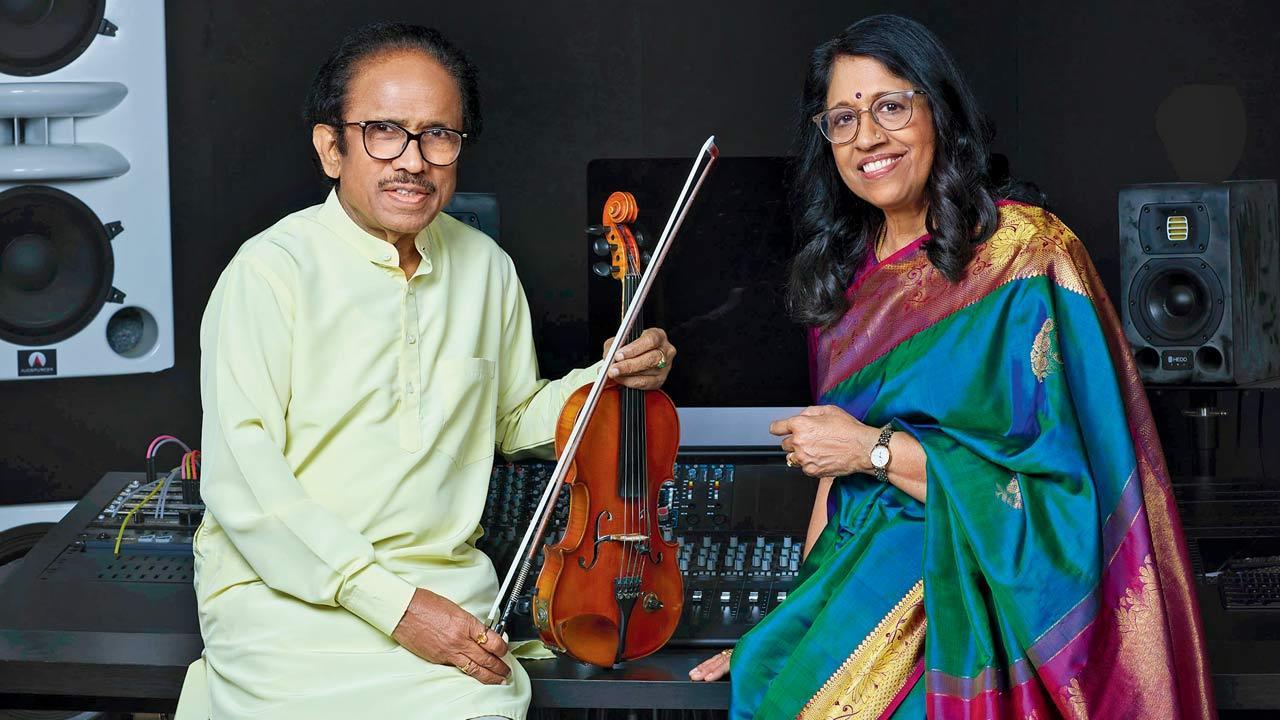
Violinist L Subramaniam with wife Kavita Krishnamurti. Pic/Jatin Kampani
Fresh from singing Sanskrit shlokas with a Kazakh choir, Kavita Krishnamurti looks back on the jingles, studios and songs that shaped five decades of music
Soumya Vajpayee (MUMBAI MIRROR; August 4, 2026)
“We sang Sanskrit shlokas with a Kazakh choir. That was really special,” says Kavita Krishnamurti, still sounding delighted by the memory. “They wanted me to sing a couple of film songs too, and they enjoyed those. Their own dancers even performed to my husband’s violin concerto.”
The performance came during the Lakshminarayana Global Music Festival, founded by violinist L Subramaniam in memory of his father. Invited by the Astana Symphony Philharmonic, the couple spent 10 days performing in Aktobe, Kostanay, Kokshetau and Astana, presenting everything from Indian classical compositions to Hindi film music.
One of the highlights was Navagraha Symphony, built around the nine planets. “We did five planets on Sanskrit shlokas, and their choir sang the Sanskrit with me,” she says. “It became a beautiful musical exchange.”
Away from the concert hall, Kazakhstan left an equally deep impression. “They have wonderful folk music, with dombras and beautiful percussion instruments. Their music feels close to nature. It reminds you of mountains and rivers. We hope to collaborate with the orchestra again.”
Bombay, jingles and a masterclass in speed
“It has been almost 54 years since I entered the profession,” says the singer, whose first film recordings date back to the early 1970s. Yet before Bollywood came the world of advertising, where she became one of India’s most recognizable jingle voices.
“The post-college years, when I was singing jingles, were among the happiest of my life. We worked very hard, but everyone felt like family.”
That phase, she believes, shaped her more than any award ever could.
“Sometimes you had to sing the same jingle in 14 different languages. The writers would stand around you, everyone watching the clock, and you had to switch instantly from one language to another.”
The pace taught discipline. “You learnt how to hit the very first word, how to emphasize the product name and still keep the emotion. It became an excellent training ground for film songs.”
The Nirma jingle remains the one audiences mention most often, although another composition still surprises her. “People also remember a literacy campaign song, Poorab se surya ugaa..., composed by Ashok Patki. Many tell me they still remember it.”
The songs chose her
Krishnamurti’s catalogue spans romantic ballads, classical pieces, qawwalis and dance numbers, but she insists it was never part of a career plan.
“I didn’t choose to be versatile,” she says. “Initially, romantic songs didn’t come my way. Then Hawa Hawai happened and suddenly I was offered many energetic songs. Later came Saudagar and romantic music.”
Working with hundreds of composers, she says, naturally expanded her range. “Every music director expected something different. Singing in different styles and different pitches probably made me versatile.”
What music has gained and lost
The biggest change, she believes, lies in the recording studio. “We used to record live with 100 or even 120 musicians. Those six or seven minutes had to be perfect because there was very little that could be corrected later.”
Digital recording has made music technically flawless, she says, but something else has faded. “I feel the emotional approach was much stronger then. I also miss the meaningful lyrics and the way actors performed songs through lip-sync. When Madhuri Dixit, Sridevi or Shabana Azmi appeared on screen, the songs acquired another life.”
Although Mumbai remains home, Krishnamurti believes the city’s aspiring singers can no longer depend solely on Bollywood. “There are so many talented singers today, but only a few can break into films. I pray independent music becomes much bigger in India, because then artists can build careers through their own music.”
She stops short of offering advice to younger singers. Instead, she wishes they had the opportunities her generation enjoyed. “I only wish there were composers like R D Burman, Laxmikant-Pyarelal, O P Nayyar or Naushad creating those kinds of songs for them.”
If her music continues to thrive on streaming platforms and social media, she sees it as proof that melody has a longer life than technology. “Good melody, good lyrics and good singing cannot disappear from people’s hearts.”
More than five decades after she first stepped into a recording studio, Krishnamurti is still finding new audiences, whether in Mumbai or halfway across the world with a Kazakh choir singing Sanskrit. For a singer whose career began in Bombay’s jingle studios, it is a reminder that music has always travelled farther than language.
Jugal Hansraj reunites with Masoom director Shekhar Kapur for Masoom: The Next Generation
10:07 AM

Akash Bhatnagar (HINDUSTAN TIMES; August 9, 2026)
Filmmaker Shekhar Kapur is reviving his 1983 classic, Masoom, for the new audience in a new way, with Masoom: The Next Generation. Veteran actors Naseeruddin Shah and Shabana Azmi have already been confirmed to be reprising their roles from the original film, and now HT City has exclusively learnt that another original cast member has come on board — Jugal Hansraj, who played Rahul, Naseeruddin Shah's onscreen son.
Jugal Hansraj made his acting debut as a child actor with Masoom alongside actor Urmila Matondkar. He played the innocent Rahul, whose entry into a typical family changes its dynamics forever. More than four decades after the film's release, Hansraj is now reuniting with his first director, Shekhar Kapur, as well as Shah and Azmi.
Speaking about the reunion, Kapur tells us, “There is something profoundly beautiful about coming home, not to a place, but to a story that has stayed alive in people's hearts for decades. Jugal was just a young boy when we made Masoom, and today, welcoming him back as an accomplished actor is both emotional and deeply fulfilling. Reuniting him with Naseer and Shabana is a reminder that some relationships transcend cinema. As we begin this new chapter, I hope audiences experience the same honesty, tenderness, and emotional truth that made Masoom so enduring.”
Hansraj resonates with the sentiment as he shares that he felt so happy when Kapur called him to offer the new film.
“Masoom has been a part of my life, my identity, for as long as I can remember. Even after all these years, I’m still that ‘Masoom boy.’ It’s been more than 40 years since the film was released, but people still remember the film with so much affection. I constantly get stopped by people even here in New York, and I’m told with a warm smile that their kids or grandkids listen to ‘lakdi ki kathi’. They meet me like I’m a member of their own family. I’m glad that I can be a part of this special family again. It’s like life coming full circle,” he shares with us.
Masoom: The Next Generation is a spiritual sequel to Masoom and will explore changing family dynamics, identity, and relationships across generations. Apart from the three actors, the film will also feature an ensemble cast including Manoj Bajpayee, Nithya Menen, and Kapur's daughter, Kaveri Kapur. Composer A R Rahman has come on board to compose the music and co-produce the project.
Shabana Azmi hospitalized with H1N1; to miss promotions of Batwara 1947, Awarapan 2
11:26 PM

Upala KBR (MID-DAY; August 8, 2026)
August’s first two weeks would have seen Shabana Azmi at her busiest with her two releases, Batwara 1947 and Awarapan 2. Unfortunately, her ill-health has deterred her from being part of the movies’ promotions. The senior actor has been hospitalised since July 30 after being diagnosed with H1N1 swine flu and chronic bronchitis.
On returning to Mumbai from Delhi where she had participated in the students’ protests and the July 20 Chalo Sansad march, Azmi was running a high fever and soon diagnosed with H1N1 swine flu. Despite being unwell, the veteran actor made an appearance at the July 28 trailer launch of Rajkumar Santoshi’s directorial venture, featuring Sunny Deol and Preity Zinta.
A source said, “Shabana should be discharged within two-three days, but for now, no visitors are allowed because it’s still contagious. On the work front, she is thrilled that the pre-release screenings of Batwara 1947 have been full of praise, particularly for Sunny and her performances. She is hopeful that the human drama will connect with the audience.”
Speaking to mid-day from the hospital, Azmi said that her weak lungs have lengthened the recovery process.
She added, “I am feeling better and optimistic that Batwara 1947 and Awarapan 2 have generated so much interest. I am grateful that senior actors are given such diverse characters to play, as we saw in the case of Naseeruddin Shah in Main Vaapas Aaunga and Made in India: A Titan Story.”
Dissent and dialogue are not acts of disrespect; they are essential to a healthy society-Shabana Azmi
4:55 PM

Renuka Vyavahare (BOMBAY TIMES; July 25, 2026)
Shabana Azmi is cut from a different cloth. At 75, while much of the film industry remained silent or issued carefully worded, "neutral" statements, she chose to travel to Jantar Mantar in solidarity with the student movement led by the CJP, demanding accountability from the education minister and those in power. The students remain resolute, vowing to continue their nationwide agitation until their demands are met. Back from Delhi, Azmi spoke to Bombay Times while recovering from an asthma attack triggered by tear gas during the protest. In a candid conversation, she reflects on why she felt compelled to stand with the students, what she witnessed on the ground, and why she believes silence is no longer an option. Excerpts…
At 75, you travelled all the way to Delhi to stand with the students, age and health issues not withstanding. What compelled you to take that decision?
The sheer injustice of it. Students of our country are peacefully demanding a dialogue for educational reforms. They seek an overhauling of the educational system and accountability for the several lapses in key entrance exams over the years leading to despair to the point of suicide. Why can’t you listen to them? We need to build their hope, not crush their spirit. The prolonged hunger strike by the students and Sonam Wangchuk whose deteriorating health we were all witness to deeply concerned me. Can you imagine the pain of their parents who made huge personal sacrifices to assure a better future for their children?
What was that particular moment that made you feel, "Enough is enough"?
The complete indifference of the ruling party to initiate a dialogue. Sonam Wangchuk is a respected scientist and environmentalist whose work on climate change is applauded across the world. Yet, attempts were made to discredit him through canards and insinuations. The students, too, were branded anti-national and accused of being stooges of "foreign powers." That was the tipping point for me.
You've often been labelled 'anti-national' for speaking out, yet you've never stopped raising your voice. What gives you the courage to continue despite the personal attacks?
These are attempts to obfuscate the real issue and replace dialogue. And we take pride in being the world’s largest democracy?
India has witnessed many protests over the years, but this movement seems to have united people across generations and, for many, broken the collective fear of speaking up. Why do you think it has resonated so deeply with people across the country?
Because we all know that the youth are the future of our country. Increasingly, young couples are choosing not to have children because they cannot guarantee them a secure or hopeful future. That should worry all of us. I remember a university student saying during a debate many years ago, "Humko azaadi aadhi raat ko mili thi, aur savera aaj tak nahin hua." ("We got Independence at midnight, but dawn has still not arrived.") Those words stayed with me. In fact, I used that line to open my maiden speech in the Rajya Sabha. Atal Bihari Vajpayee ji appreciated it, you can verify it in the records. He did not treat it as a personal insult or an attack on his government. It resonated with him because he understood the larger sentiment behind it and responded like a true statesman. They were leaders of a different mettle. It saddens me to see how far we've drifted from that spirit today, where every criticism is viewed through the lens of hostility instead of being seen as an opportunity for dialogue and introspection.
Many believe we as a nation are conditioned from childhood to equate obedience with respect, whether at home, in school or at work. The people who don't question authority are often rewarded. Do you think this culture of silence and unquestioning compliance has become one of our biggest societal challenges?
I don't think it can be generalized like that. I would leave that to experts in the field. Speaking for myself, I was raised until the age of nine in Red Flag Hall, the commune of the Communist Party of India (CPI) in Mumbai. It was a remarkable space where discussions on social justice, women's empowerment and India's composite culture were part of everyday life. Progressive writers, poets, artists and political thinkers came together there, and our parents believed that art should be an instrument of social change. My brother Baba and I absorbed these values almost by osmosis. We were encouraged to ask questions, voice our opinions and speak up whenever we felt strongly about something, even if it meant disagreeing with others. That environment taught us that dissent and dialogue are not acts of disrespect; they are essential to a healthy society.
The day of the Parliament march shocked the nation. Videos showed unarmed students, including young women, being beaten, while later claims suggested the crowd had turned violent. You were in the middle of it. What did you witness firsthand, and what would you want the nation to know about what really happened?
Prakash Raj and I had been helped into a police truck by the protesters. I had to lie down for a while to catch my breath after one of the activists rushed to pull me up because the police had entered the area, triggering a stampede. Looking through the truck's grills, I narrowly escaped being hit by a large stone that was hurled towards it. Soon after, the tear gas and lathi charge began. The police were furious because they claimed that a shoe had been thrown at one of their colleagues. Now, who can verify that? It is their word against the students. What is beyond dispute, however, is that there is a clear protocol the police are mandated to follow while dispersing a gathering they deem "unlawful." It is fair to assume that those protocols were not strictly followed. I personally witnessed young boys and girls, many of them barely out of their teens, badly injured and bleeding because of the lathi charge. When I sat down in the mud with the protesters, I saw students who had themselves been injured rushing to shield and protect me instead of tending to their own wounds. One young man told me, "Ek lathi khaane ke baad lathi ka darr nikal jaata hai." ("Once you've been hit by a baton, the fear of it disappears.") A 15-year-old boy said, "Had I not joined this protest, I would never have been able to look myself in the mirror." My respect and salaam to these young people. Their courage, compassion and conviction showed us the way.
Many people are now unfollowing celebrities and actors who chose to remain silent, arguing that silence in the face of injustice amounts to complicity. It seems people are rethinking who they want to look up to and consider role models. Even the formulaic statements now trickling in, many feel they sound pre-planned and follow a familiar template rather than expressing genuine conviction. All this has only added to the public's frustration. What's your take on this?
Every artist has to make that decision for themselves. I don’t think it’s fair to judge people for speaking out, and I don’t think it’s fair to judge those who choose not to. Everyone weighs the consequences differently. What is important is that we don’t lose sight of the real issue. The conversation should remain focused on the concerns raised by the students and on how those concerns are addressed, rather than on whether individual celebrities have commented. Artists can amplify conversations, but they are not a substitute for institutions or democratic processes. Lasting educational reform and the protection of democratic rights come through public engagement, civic participation and accountable governance. It is encouraging that many members of the film industry have chosen to speak this time. The issues affecting young people because they are our future and we are all stake holders.
Shabana Azmi on what happened at Chalo Sansad march in Delhi: "Tear gas and lathi charge were unwarranted"
4:37 PM

Niharika Lal (BOMBAY TIMES; July 22, 2026)
Five days before she reached Jantar Mantar, Shabana Azmi and Javed Akhtar had written to PM Modi as concerned citizens and former nominated members of the Rajya Sabha, urging him to begin a dialogue with Sonam Wangchuk and the students. The letter was emailed, faxed and personally delivered, and an acknowledgement promised a response within two days.
When no reply came, Azmi decided to join the protest herself. “We waited two days, then three, then four. On the fifth day, I decided I would come here,” she said at Jantar Mantar on Monday.
Azmi maintained that her presence was never about herself. Standing in solidarity with the students, she said her presence was meant to draw attention to the young people who had shown the courage to raise their voices.
She also rejected claims that the students were being used for political ends. Speaking to a news channel, she said, “It was a sea of young people. I have never seen such a scene in my life… I have never been involved with any political party. I have never been a member of any political party. On record, I’m telling you, nor do I intend to be. I have never been a member of any political party because I have always believed that joining a political party means the party’s truth becomes your truth, which could be a one-sided truth. When I was in Parliament, we (she and Javed Akhtar) were Presidential nominees. We were with no party.”
‘MAIN HAMESHA NAHI BOLTI HOON. JAB MUJHE KOI CHEEZ ANDAR SE JHINJHORTI HAI TAB BOLTI HOON’
About the protesters, Shabana Azmi told reporters at Jantar Mantar, “They are saying violence kiya, jo bilkul sachh nahi hai. Ek tarfa jo sach bata rahe hain woh nainsaafi ho rahi hai yahan.”
When asked how she responds to being repeatedly labelled anti-national, she said, “Iss baat ko dil se nahi lagana chahiye. Mujhe kitni baar anti-national kaha gaya hai.”
At 75, Azmi said she sees speaking out not as activism but as a moral compulsion. “Main hamesha nahi bolti hoon. Jab paani hadd se guzar jata hai, jab mujhe koi cheez andar se jhinjhorti hai tab bolti hoon... ab meri 75 saal umar ho gayi hai, main bahut kuch dekh chhuki hoon.”
She added that she understands the resolve required for a hunger strike because she has experienced it herself. In May 1986, she joined filmmaker Anand Patwardhan and activist Gurubai Bhaskar Hamza in a five-day hunger strike demanding rehabilitation for slum dwellers displaced from Colaba in Mumbai. The protest was successful.
Throughout the protest, Azmi posted several videos from Jantar Mantar and recited a verse by her father, Kaifi Azmi: “Koi toh sood chukaye, koi toh zimma le, uss inqalab ka jo aaj tak udhaar sa hai.”
-----------------------------------
Upala KBR (MID-DAY; July 22, 2026)
When you express solidarity with others, you come back strengthened. That’s something Shabana Azmi always believed in. And the veteran actor experienced it over the past three days as she joined the ongoing protests — led by Abhijeet Dipke’s Cockroach Janta Party (CJP) — at Jantar Mantar in New Delhi, demanding education reforms and the resignation of Union Education Minister Dharmendra Pradhan over the NEET paper leak.
Since July 19, Azmi has been at Jantar Mantar, even joining thousands of youth in the Chalo Sansad march on July 20. Talking to mid-day from New Delhi, she said, “These young people have been pushed to the wall, and they have chosen to resist with courage and dignity.”
The actor criticized the police that resorted to lathi charge and tear gas even as the students protested peacefully on Monday. According to Dipke, over 150 protesters were undergoing treatment in hospital due to the violence.
Expressing her disapproval over the police’s handling of the situation, Azmi said, “What impressed me most was that despite their pain, their anger, and the provocation, the students remained determined to protest peacefully. The tear gas and lathi charge were completely unwarranted and condemnable. Who treats young students this way when all they are asking for is dialogue?”
A dialogue with the students, in fact, is what Azmi and her husband, noted writer and lyricist Javed Akhtar — both former members of the Rajya Sabha — sought from Prime Minister Narendra Modi. Azmi revealed that they wrote a letter to the PM, urging him to understand the students’ concerns.
“We received an acknowledgement, saying that we would get a reply within two days. When four days passed without any response, I decided to go to Delhi in support of the students. We are constantly told that our youth are our greatest strength. Then why were their voices not even being heard? When I went to Jantar Mantar, I saw hope and strength. We often dismiss Gen Z as careless or disengaged. I think the failure is ours. We have failed to provide them with the leadership that inspires trust. Yet today they are inspiring us, even to the extent of risking their own lives for what they believe is right,” said Azmi, referring to the protesters’ hunger strike.
The actor’s participation has been criticized by some sections, who claimed her presence was giving a political colour as she is seen as aligned with Left-wing politics. “I have never been a member of any political party,” she asserted, before adding that a patriot must hold those in power accountable for the betterment of the country.
“Democracy is strengthened by questioning, not weakened by it. I’ve been called many things over the years. Both Javed and I are criticized with equal intensity by Hindu and Muslim fundamentalists, which says something about our refusal to belong to any ideological camp. The real question is not what people call me. The real question is whether young citizens asking for dialogue deserve to be heard.”
Hearing their concerns and acting on them is the need of the hour, Azmi insisted. For her, the students are the “real story”. “Throughout history, young people have been the harbingers of change. They are our greatest investment. Let us nurture them, undertake the educational reforms they have been demanding, overhaul a system that too often fails them, and give every young Indian an equal opportunity to realize their potential.”
Shabana Azmi on Batwara 1947 and Awarapan 2 clash: "Box office is in nobody's control"
11:02 AM

Upala KBR (MID-DAY; July 7, 2026)
It’s an unusual situation for an actor. Come August 14, Shabana Azmi will have two of her films — Batwara 1947, also starring Sunny Deol and Preity Zinta, and Awarapan 2, led by Emraan Hashmi — clashing at the box office. Does that make the senior actor apprehensive about their box office fate?
“The box office is in nobody’s control,” said Azmi, matter-of-factly, before adding that she views it as an exciting coincidence. “What’s exciting is to be given the opportunity to do diametrically different roles. I am grateful for that. I don’t remember if it has happened to me earlier. I remember there was a time when I got four out of five nominations for a prestigious award!”
Besides Azmi and the release date, Batwara 1947 and Awarapan 2 have almost nothing in common. While director Rajkumar Santoshi’s film is a Partition story, Nitin Kakkar’s directorial venture is an action drama. Many feel the audience prefers certain genres like action in the post-pandemic market, but Azmi is having none of that.
“I think we lose our nerve all too quickly. One film does well at the box office, and we rush to make only that kind of film! Instead of producing movies that lie in the cans, the government should create smaller theatres to facilitate a distribution network that guarantees release,” she stated.
So, which of the two does she think will leave a mark? She exclaimed, “That’s like asking me to choose between my children! I hope both [films] are impactful.”
Batwara 1947 is produced by Aamir Khan. While the superstar has a reputation of being creatively involved, the senior actor said, “He came on the sets only once as he trusted the director’s vision completely.”
I learned comedy by watching Akshay Kumar, Johnny Lever, Arshad Warsi-Disha Patani
9:26 AM

Natasha Coutinho (HINDUSTAN TIMES; July 3, 2026)
Disha Patani may be basking in the success of Welcome To The Jungle, but the actor says the film gave her a newfound appreciation for comedy — a genre she now believes is among the toughest to master. “Making people laugh is much harder than it looks. The challenge is to make it look effortless and natural,” says Disha, adding, “I’ve also learned a lot just by watching actors on set — Akshay (Kumar) sir, Johnny (Lever) sir and Arshad (Warsi). Observing them really helped me understand comedy as a genre better.”
“It’s not every day that you get to be part of a film with such a huge ensemble cast and so many talented people coming together. I love comedy, and the scale of this film was something that really excited me,” says Disha, adding, “As an actor, I don’t think you focus on competing or proving yourself. You focus on your character, do your best, and trust that if you’re sincere, your work will connect with the audience.”
The success comes at a time when the actor, who made her Bollywood debut with M S Dhoni - The Untold Story (2016) and has since featured in films such as Malang (2020), Ek Villain Returns (2022), Yodha (2024) and Kalki 2898 AD (2024), continues to balance commercial entertainers with action-driven roles.
Despite her strong social media presence and glamorous public image, Disha says she remains deeply introverted. “It hasn’t always been easy, and there have been a lot of challenges along the way, but every experience has taught me something valuable. Being an introvert, it’s not always easy to put yourself out there, but I think that’s part of the process. Looking back, I think the journey has made me stronger, more resilient and more appreciative of every opportunity.”
Asked about the kinds of roles she feels closest to, Disha says she naturally gravitates towards understated characters rather than larger-than-life personas.
“The more quiet, simple and emotionally grounded characters are probably closest to who I am in real life. I’m actually quite reserved and prefer letting my work speak for itself,” she says.
In Welcome To The Jungle, Disha Patani got to be a part of the recreation of Uncha Lamba Kad. The original song from the 2007 film Welcome featured actors Akshay Kumar and Katrina Kaif. Calling the song “iconic”, Patani insists that she was ready for comparisons with Kaif. “Comparisons are inevitable, but our intention was to celebrate a much-loved iconic song and present it in a fresh avatar,” she says.
Next up, Patani will be seen in Awarapan 2 alongside actors Emraan Hashmi and Shabana Azmi, and she calls it a privilege to be associated with the much-loved franchise. “The music of Awarapan (2007) has stayed with audiences, and to be part of a film that carries so much emotion and nostalgia is a privilege. I’ve always admired Shabana ma’am. Her dedication and command over her craft are inspiring. Even Emraan has such a strong understanding of cinema,” she says.
Ask her what is on her radar for future projects, and the actor says that she is keen to explore darker territory on screen. “I’d love to do a psychological thriller or an intense character-driven drama, or even action dramas,” she ends.
In spite of her towering talent as an actor, Vijaya Mehta was a poor narrator of jokes-Shabana Azmi
9:05 AM

Upala KBR (MID-DAY; July 2, 2026)
It’s almost impossible to condense Vijaya Mehta’s illustrious career and her rich personality into a few words. Many of the theatre doyen’s colleagues used the term “trailblazer” to describe her, following her demise on June 30 after battling a prolonged illness. But to Shabana Azmi, Mehta will always be that director who had a unique way of making her actors feel relaxed.
“In spite of her towering talent as an actor, she was a poor narrator of jokes. She inevitably messed up the punch line,” Azmi told mid-day, remembering her Pestonjee (1988) director. “Her son Deven would wring his hands in despair, but she would carry on undaunted, till she confessed, ‘Arre, mee main line visrun geli!’ It was her way of making her intimidated actors relax.”
Before Mehta began her screen journey with Shyam Benegal’s Kalyug in 1981, she had carved her space in theatre. One of the most active participants of the Marathi experimental theatre in the 1960s, she co-founded the theatre group, Rangayan, with Vijay Tendulkar, Shriram Lagoo, and Arvind Deshpande. In films too, she shone bright — be it as an actor in Govind Nihalani’s Party (1984) or a director of the acclaimed Rao Saheb (1985).
An admirer of Mehta’s works, Azmi would always ask the filmmaker to sign her for one of her movies. Her wish was fulfilled with Pestonjee. “I pestered her to cast me in her [plays] or films. Finally she succumbed to the pressure and gave me Jeru in Pestonjee, a role unlike any other that I had done,” marvelled Azmi.
I have come this far is as I have the luxury of time and the freedom because I’m single-Jamie Lever
3:08 PM

Set to perform in the city this week, comedienne-actor Jamie Lever gets candid about her comedy style and the privileges of being Johnny Lever’s daughter
Priyanka Sharma (MID-DAY; May 17, 2026)
This is that time in Jamie Lever’s comedy calendar when she’s revising her act, tweaking jokes, adding something and subtracting what doesn’t work. The last-minute changes are on, as the comedienne gears up for The Jamie Lever Show in the city in less than a week. Giving her company in her pursuit is her uncle and mentor, Jimmy Moses. “I spent three months working on the script. My uncle has been with me throughout. As they say, comedy is a serious business,” she begins.
Lever shares she consciously approaches even a dancing reel on Instagram with the same sincerity. “A lot of young girls are looking up to me. I get messages like, ‘Didi, I’m inspired by you. We want to be multifaceted like you.’ So, I want to ace every performance, whether I am with Salman Khan on Bigg Boss or I am making a small reel,” she explains.
Naturally, there are consequences, or compromises as Lever, one of the busiest comediennes in the country, puts it. “I compromise a lot in my personal life. I’ve reached an age where one should have kids. There are these thoughts like ‘I’ve come so far, but I don’t have a lot of things that my friends have.’ But I give priority to comedy,” she says. “The only way I have come this far is because I have the luxury of time and the freedom because I’m single.”
If today her goal is to inspire younger women, the 20-something Lever had a far more personal one. “When I began, my fight was just to prove myself, to prove that I deserve to be here. My dad also said, ‘Tu thodi na paise ke liye kaam kar rahi hai. But if you want to be in this field, you have to prove yourself.’”
She recalls how protective he had been as a father, and how it surprised her that when the time came, he took a step back and let her take the stage. “He was shocked when I shared my wish to be a comedienne. I remember I was in the UK, doing a Masters in Marketing. I had a job. So, he had no idea. I also used to think that I might not get the permission to do it, and that I didn’t have what it takes to be a comic.”
“Since childhood, he has been very protective. He had a lot of rules: no sleepovers or trips, no coming home late. From there, to letting me be in this field and lending me his support the way he did was a big shift. When I decided that I was going to work in this field, my mother was surprised by how my dad’s heart just changed. He let me go out of his protective arms. My mother says that he changed as a human. He told me, ‘I could see some talent in you and I don’t want to be the one to stop that.’”
Today, of course, the father-daughter duo performs on stage, another anomaly in a society where despite several female star kids, the expectation remains that the male child will continue his father’s legacy. “Growing up I didn’t even have any examples of a comedian’s daughter making it in comedy,” she says. It was around 2012 that Lever began her career, performing at The Comedy Store, Mumbai. She made her television debut on the 2013 season of Comedy Circus, titled Comedy Circus Ke Mahabali.
While her father let her out from under his wings, his surname went with her, and Lever confesses it has brought immense privilege. “When I started my journey, I automatically had a fan following, which I did not have to work for. And that happens with star kids,” she says.
Being her father’s daughter also means easy acceptance from within the industry. Over the last few years, Lever has risen to popularity mimicking several Bollywood celebrities like Farah Khan, Kareena Kapoor Khan, Sonam Kapoor and the late Asha Bhosle.
“I get a lot of support from the industry because everybody feels ‘Yeh toh apne Johnny bhai ki beti hai’. In fact, so many people tell me to mimic them. Once, Usha Uthup ji called me, saying, ‘You have mimicked Asha [Bhosle], do me too.’ Javed Akhtar called me to his house and asked me to perform for him and Shabana ji,” she shares. But the comedienne is mindful that impersonations don’t turn into insults.
“I have always been clear that I can’t disrespect my father’s colleagues or his fans. Just imagine if I were to do below-the-belt comedy, it would be so disturbing for his fans,” she says, adding, “My dad always told me, ‘Don’t take advantage of this privilege’.”
During Covid, Asha Bhosle and I became very close because we were stuck in Lonavala and Khandala-Shabana Azmi
4:11 PM

Shabana Azmi on the artistry, fearlessness and charm of Asha Bhosle
Debarati S Sen (MUMBAI MIRROR; April 21, 2026)
For Shabana Azmi, the voice of late Asha Bhosle has always been more than music — it is a feeling, a memory and a lifelong companion. Her tribute reflects not just admiration for an extraordinary artiste, but deep affection for someone who became family over the years.
A VOICE THAT DEFINED GENERATIONS
For Azmi, Asha Bhosle is far more than a celebrated playback singer - she is an irreplaceable artistic force. “Asha ji has been my most favourite singer of all times. Unki aawaz mein jo ras hai jo shararat hai — it’s unmatched,” she says, capturing the essence of a voice that brought emotion, playfulness, and depth to every song.
Over the years, the legendary singer lent her voice to several songs picturised on Azmi, elevating her performances on screen. Memorable collaborations include Phir Se Aaiyo Badra Bidesi from Namkeen and Ambar Ki Ek Paak Surahi from Kadambari, where Asha’s evocative singing perfectly complemented Azmi’s nuanced acting. In Sameera (1981), Bhosle sang multiple tracks, including Zindagi Hum Tere Haal Par and Jaane Na Doongi, further strengthening their artistic association.
MEMORIES BEYOND MUSIC
While their professional collaborations were significant, it is the personal moments that Azmi cherishes most. “During Covid we became very close because we were stuck in Khandala and she with family were in Lonavala,” she recalls. “She would cook the most delicious meals for us and between Javed and her we would be regaled with hilarious anecdotes from the industry and cheeky humour,” she says.
These shared experiences reveal another side of the legendary singer — one marked by warmth, wit, and generosity. “Her memory is phenomenal and she could be very candid,” Azmi adds, evoking evenings filled with laughter, storytelling, and companionship.
FEARLESSNESS AND A SPIRIT OF REINVENTION
What stands out most for Azmi is not just Bhosle’s voice, but her fearless approach to life and music. “What I admire most is her gumption, her fearlessness and her desire to take risks and push her own parameters,” she says.
This spirit of constant reinvention has defined Bhosle’s remarkable career, allowing her to experiment across genres and remain relevant across decades — qualities that Azmi deeply admires. “Her voice will remain immortal but what I will cherish are the memories she has left behind for us,” she says.
We had a thriving indie cinema movement, that space has disappeared today-Richa Chadha
11:20 PM

Neha Maheshwri (BOMBAY TIMES; April 10, 2026)
At a time when the lines between mainstream and independent cinema continue to blur, casting choices have become a key point of debate within the industry. Actress-producer Richa Chadha has weighed in on the conversation, questioning the growing tendency of independent films casting commercial faces even when they can’t guarantee box office or add meaningful value on the festival circuit.
Highlighting what she sees as a contradiction in the way indie projects are being mounted today, the actress says, “If an actor isn’t opening a film theatrically on a Friday and doesn’t add any real weight at festivals, then what exactly is the advantage of casting them in an independent film?”
Richa, who backed the Indian- French co-production Girls Will Be Girls which premiered at the 2024 Sundance Film Festival, also points to the economic reality behind such decisions.
She says, “I am not suggesting anything, but with trained actors, you are at least assured that performance quality will be maintained. There is a commerce behind indie films too. Some stories don’t need big faces to pull crowds. It is more economical to sign on an actor who brings credibility without creating a huge hole in the budget. Without taking away from any actor’s ability or worth, if indie films are to truly survive in 2026, we have to understand that audiences want quality stories with credible actors, and filmmakers do not want to put a strain on the budget.”
Drawing from the past, she adds, “In the 1980s, we had a thriving indie cinema movement, and actors like Farooq Sheikh, Amol Palekar and Shabana Azmi were stars in their own right. That space has disappeared today. If the industry continues to wait for a nod from a handful of top male actors, on whose already tired and busy shoulders films are mounted, all the best to you. There won’t be enough output.”
The fact that I share such a cordial bond with Honey Irani goes to her more than me-Javed Akhtar
4:46 PM

Amina Ashraf (BOMBAY TIMES; February 28, 2026)
The Urdu Academy in Lucknow was housefull as writers, professors, theatre practitioners, historians, veterans and cultural figures gathered to welcome literary stalwart Javed Akhtar on the occasion commemorating theatre doyen Shankar Dayal Tewari’s 105th birth anniversary. At the event, the free-wheeling conversation on art, literature, society and cinema naturally opened with Lucknow, as Javed Akhtar spoke about the pride he feels in having spent his early formative years in the city.
Lucknow’s influence, he said, has never faded. “From etiquette to morality, everything I am, comes from here, and even today, that influence remains. Main jab Lucknow aata hoon, toh ehsaas hota hai logon ke manners, taur-tareeqa, baat-cheet mein ki aaj bhi kitna Awadh baaki hai. You see people who left Lucknow 25 years ago, settled elsewhere, still hold pride that they are from this city. They know that if you’re from Lucknow, you have to carry yourself in a certain language and demeanour.”
Drawing a vivid metaphor, he compared his relationship with the city to a fish and water. “It’s like a fish living in water. As long as it’s there, it doesn’t realise the value of water. But when the fish goes out and then comes back, only then does it truly understand what water means. That’s Lucknow for me,” he said.
Lucknow’s distinctive Language, too, became part of the discussion. “It is interesting that people of Lucknow traditionally do not use main; they use hum. People who are not from Lucknow find it a symbol of arrogance. The reason was never pride. Hum speaks of promoting a neutral gender. It is almost vulgar to say, “main jaa rahi hoon or main jaa raha hoon that’s a crude way to talk.”
An alumnus of Colvin Taluqdars College, Akhtar credited the school with shaping his ambition and taste. Recalling an anecdote when he got taunted for asking for expensive shoes, “Children today are born and brought up with sensitivity; it was not the case during our childhood,” he said.
“Today’s parents talk about childcare and understand sensitivity, abhi toh sheeshe ke bachche hain. Hamare zamaane mein jab chaaha peet diya, jab chaaha kuch keh diya. Ya toh mujhe meri aukaat ke hisaab ka school milta, par mujhe Colvin bhej diya. I was around eight years old and wanted the expensive shoes my classmates wore. Rona dhona macha kar, mujhe vo joote dila diye gaye the. Later, I was taunted so much for it that it is still etched fresh in my mind, ‘Bhai, inke toh ameer shauq hain. 19 rupaye ka joota pehente hain, jo ki school fees se zyada ke hain. 17 rupaye school fees aur 15 rupaye inki tuition fee hai’. So altogether I was an expensive child of the family,’’ he laughs.
‘Poets were discussed as important people in my home’
Javed, who spent days struggling on the roads of Mumbai before finding his footing, reflected on his journey from Jaadu to Javed Akhtar. Asked whether he inherited literature or struggle from his father, the veteran lyricist-poet Jaanisar Akhtar, he expressed, “A child, while growing up, never receives lectures on upbringing. However, the environment involuntarily affects him. Through the osmosis process, he somehow absorbs the air of the atmosphere he lives in.”
That atmosphere, he said, was steeped in literature. “The kind of home I grew up in, there used to be detailed discussions of poets and literature on a day-to-day basis. Poets were discussed like important people. Ghar mein kitaabon ki baat hoti thi. Kaafi literary magazines toh free mein aa jaati thi because of Majaaz Lakhnawi, the famous poet and writer. He was my maternal uncle. ”
‘Honey is one of my three best friends today’
Reflecting on his personal life, Javed Akhtar spoke with usual candour about his marriage to ex-wife Honey Irani and his relationship with actress Shabana Azmi. “I have been fortunate in these matters. Honey is an exceptionally good person. It’s okay if our thoughts, value system, thinking and aesthetic had big gaps. However, fundamentally, a person who might share a different personality from you can also be an amazing person. The fact that I share such a cordial bond with Honey goes to her more than me. Both of us have been very civilized right from the beginning,’’ he said.
Their priority, he said, was always the children. “We made sure nothing touched them, that the father isn’t saying one thing and the mother another. Both of us were sensitive that things should not go sour. There is no parting which is not painful, but it’s the job of civilized people to minimize that. If you ask me who my three best friends are today, Honey would definitely be one of them. In this whole scenario, there was also a great deal of grace, large-heartedness and maturity from Shabana too. She never resented these matters. In fact, she was always helping and cooperating with Honey, which resulted in no collateral damage to the kids. Now they are very good friends. I think all the parties have behaved extremely maturely and civilized, which is rare.”
‘Lucknow shaped my personality’
Asked about growing up in the city of Nawabs, the legendary lyricist-screenwriter held forth on his Awadhi roots, expressing, “Once I was having a debate with someone on language, and he said but weren’t you born in Gwalior? Yes, I was, but I stayed there for only a few months. I came to Lucknow as a child and left when I was 12. Psychologists say that by the age of eight, your personality is already shaped. So if there’s anything good or bad in my personality, Lucknow is responsible for it,” said Akhtar.
‘We are no longer ready to accept our hurt’
Shifting to contemporary cinema, when asked how present-day storytelling can reflect the anger of today’s youth, Javed Akhtar said that while aggression continues to exist, society has grown increasingly uncomfortable acknowledging emotional vulnerability. “We all have a lot of aggression. However, society has developed a morality where people do not want to accept that they are hurt.”
Drawing a comparison with Hindi cinema of earlier decades, Akhtar pointed out how emotional expression has significantly changed. “In an average Hindi film of the 1950s and 1960s, you would find at least two sad songs. Today, you hardly see that. We are no longer ready to accept our hurt and our defeat. For us, everything appears hunky-dory. In such a pretentious world, if a middle-class individual grows up, how will he express his anger? He develops a complex about showing sadness,” he said.
Shabana Azmi reveals USA v Raj is all about Dr Rajendra Bothra’s long legal battle against healthcare fraud
10:03 AM

Shabana Azmi in the film; Kabir Bedi plays Dr Rajendra Bothra; Dr Rajendra Bothra Pics/AFP, X, Instagram
Starring in ‘USA v Raj’, Shabana Azmi says the movie chronicles Dr Rajendra Bothra’s three-year-plus legal battle in America after being accused of healthcare fraud
Upala KBR (MID-DAY; February 3, 2026)
When Shabana Azmi described the story of her next, USA v Raj, as “fab”, it naturally caught our attention. Directed by famed cinematographer Ravi K Chandran, the Indo-British co-production tells the story of Dr Rajendra Bothra, a celebrated surgeon in the US who was accused of fraud and faced 54 federal charges at age 79, before being cleared by a unanimous jury verdict in June 2022. While Kabir Bedi plays the protagonist, Azmi essays the role of his wife Pammi Bothra, and Emily Shah, their daughter Sonia.
“Dr Bothra was advised by all lawyers to plead guilty. His attorneys told him if he didn’t do so, he would die in prison. He said, ‘So be it. It’s the question of my honour, my family’s honour and that of the country I come from.’ The odds of a possible win were only 0.3 per cent, but he fought back. He spent three-and-a-half years in jail! Then he was acquitted on every single charge,” shared Azmi, when we got on a call with her.
USA v Raj went on floors in London in October 2025. With a chunk of the legal drama completed, the director is now planning the last leg in India and aiming for a summer 2026 release. The movie chronicles how in 2018, at a time when the US was witnessing a significant increase in opioid use and addiction, the surgeon was accused of further fuelling it.
To Azmi, the film depicts not only Bothra’s integrity, but also the determination of Pammi, who didn’t let her health complications shake her as she stood by her husband during the legal battle. “His wife and their daughter Sonia took on the responsibility to set him free,” marvelled the senior actor. She added that during the two-month shoot, the husband-wife duo would be on the set every day. “I got along very well with Pammi.”
The actor has a busy line-up in 2026. Besides USA v Raj, she will be seen in Awarapan 2 and more. “I am also doing a film produced by Mukesh Chhabra. There are three more projects in the pipeline.”
I joke that Javed Akhtar and I have a good marriage because we meet so rarely-Shabana Azmi
9:31 AM

Shabana Azmi, who teamed up with her husband Javed Akhtar for an ad recently, discusses the screenwriter’s ease on screen and how they gave their own spin to the lines
Upala KBR (MID-DAY; January 15, 2026)
Forty-one years into their marriage, Shabana Azmi and Javed Akhtar continue to do new things together. The duo recently shot a commercial for a jewellery brand, their first together. It was the campaign’s theme of soulmates that did the trick for Azmi. “I have a soft corner for the word. I truly believe Javed is my soulmate,” she smiles.
For decades, we’ve seen the actor light up the screen with her presence and talent. But seeing the veteran screenwriter share the frame with her and hold his own was a delight.
Mention this to Azmi, and she says, “We’ve had an overwhelming response, [with many] saying it’s so natural. That’s because we made up our own lines despite being given the content! Javed is getting many acting offers now because he is so effortless in front of the camera.”
In a world that tries to find romance in the maze of dating apps and situationships, breadcrumbing and benching, Azmi and Akhtar’s enduring love story is one for the books. What’s the secret?
Similarities and differences are the key, notes the actor. “Javed and I are each other’s best friend. We come from identical backgrounds and share a common worldview. Our interests are similar, except for sports, about which I don’t have a clue,” she laughs.
Their dissimilarities are plenty as well. Azmi shares, “He doesn’t move from his seat, which drives me mad. He complains that I am always moving around the house and incapable of sitting still! I joke that we have a good marriage because we meet so rarely. Both of us are busy travelling in opposite directions. The fact is Javed is wise and reliable. I trust him implicitly, and I hope he feels the same way about me.”
Shabana Azmi’s tips for a successful marriage:
- Have a life outside your marriage. Independence is the glue that binds husbands and wives.
- Javed and I have a magic wand, which are the words ‘Drop it!’ When we are in the middle of an argument that threatens to become nasty, we use it. We raise [the subject] again weeks later when we are calm.
Awarapan 2 is my first time collaborating with Emraan Hashmi, whom I’ve seen as a child-Shabana Azmi
9:48 AM

Veteran actor Shabana Azmi, set to play the antagonist in ‘Awarapan 2’, says she is now “ready to do any part that suits my fancy”
Upala KBR (MID-DAY; December 21, 2025)
Working for over five decades in cinema, what role has veteran actor Shabana Azmi not done? Yet she never loses her childlike enthusiasm when she gets to explore a new role — be it comedy, drama, or the villain. This year, in particular, she has dabbled in everything — from Dabba Cartel to the Hollywood series Halo, from resuming her inter-city theatrical tour for the play Broken Images to shooting for an Indo-American production.
Now, Azmi has joined director and writer Nitin Kakkar’s Awarapan 2, headlined by Emraan Hashmi and Disha Patani. The shooting of the Vishesh Bhatt film, co-written by Bilal Siddiqui, began in September in Singapore. The team shot for a month before the makers called for a break.
The sequel to the 2007 film Awarapan, will see the return of gangster Shivam Malik (Hashmi) after his ‘almost’ death at the end of the first instalment. Azmi will play Hashmi’s adversary, heightening the conflict and emotional narrative between the characters in the sequel. “[My character] comes at a pivotal turning point in the story,” shares Azmi, marking this as her first film with Vishesh Films.
While she has worked with Mahesh Bhatt in Arth (1982), it feels nostalgic for the senior actor to shoot with Hashmi. Azmi recollects working with his grandmother Purnima Devi in Fakira (1976).
“It’s my first time collaborating with Emraan, whom I’ve seen as a child. I shot for a day in Mumbai with him. I will shoot for the remaining scenes, which will be done abroad, as soon as I wrap up the film I’m presently shooting in London. I am yet to film with Disha Patani,” she smiles.
After playing grey characters in Dabba Cartel and Nikkhil Advani’s series The Empire, does Azmi prefer negative roles to more layered characters?
She says, “I’m at a stage where I’m ready to do any part that suits my fancy. My roles are not about screen time today, but more about creating an impact.”
Ali Fazal on working with Sunny Deol, Preity Zinta in Lahore 1947: "Each day felt like a lesson"
8:58 AM

Mohar Basu (MID-DAY; December 2, 2025)
For Ali Fazal, the past two months were all about two cities and two different stories. Since October, the actor was filming the last leg of Rajkumar Santoshi’s Lahore 1947 in Mumbai and Punjab, juggling it with the Varanasi schedule of Mirzapur: The Film. Last week, he wrapped up his portions in the Sunny Deol, Preity Zinta, and Shabana Azmi-led period drama that is set against the backdrop of India’s partition.
Reflecting on being part of the Aamir Khan production, Fazal said that the experience surpassed his expectations.
“Working under Rajkumar Santoshi sir’s direction has been a masterclass, and sharing screen space with powerhouses like Sunny sir, Preity ma’am, and Shabana ji has been an honour. Each day on set felt like a lesson in humility and dedication to the craft,” he said.
What made the project all the more special is knowing that it told an important story.
The actor added, “Lahore 1947 is rooted in our history, but carries emotions that are timeless and speaks to everyone. This story reminds us of the resilience of the human spirit.”
Dharmendra dies at 89: Timeline to the legend's stardom journey
10:13 AM

Dharmendra, whose range is the stuff of legend, passes away following month-long illness
Mohar Basu (MID-DAY; November 25, 2025)
Bollywood legend Dharmendra, 89, passed away at his Mumbai residence on Monday, November 24, following a month-long illness. His eldest son, Sunny Deol, conducted the last rites at the Pawan Hans crematorium in Vile Parle at 1:30 pm, with members of the Deol family by his side. Joining them were Amitabh Bachchan, Shah Rukh Khan, Salman Khan, Aamir Khan, Akshay Kumar, Anil Kapoor, Shabana Azmi, Abhishek Bachchan, and Agastya Nanda, among others.
The actor's health had been cause for concern since he was admitted to Breach Candy Hospital, where he was undergoing treatment for breathing difficulties, on October 31. Well-placed sources informed mid-day that it was initially described as a precautionary, routine age-related health check-up, but when his respiratory problems persisted, it indicated serious distress to his lungs. On November 1, he had been placed in the Intensive Care Unit (ICU) for closer monitoring.
On November 10, Dharmendra’s condition had deteriorated further, which is when he was put on ventilator support in the ICU. However, speculative news reports on his health led to immediate pushback from his family, who claimed he was “stable and improving.”
In the early hours of November 12, Dharmendra was discharged from the hospital. His treating physician, Dr Pratit Samdani, confirmed to the media that the family had decided to continue his recovery at home. He said, “Dharmendra-ji was discharged around 7:30 am. He will be treated at home, as the family has decided to give him treatment at home.”
On the same day, the family also issued a public appeal, requesting privacy amid swirling media speculation. They said, “Mr Dharmendra has been discharged from the hospital and will continue his recovery at home. We kindly request the media and the public to refrain from any further speculation and to respect his and the family’s privacy during this time. We appreciate everyone’s love, prayers, and good wishes for his continued recovery, good health, and long life. Please respect him because he loves you.”
According to sources close to the family, Dharmendra’s health was still fragile after leaving the hospital, with regular checkups continuing at his Juhu residence, even while prep for his 90th birthday was underway.
On the closing night of the Jagran Film Festival, collaborator and filmmaker Anil Sharma told the press, “He is doing much better than before. Please pray for him. God willing, we will celebrate his birthday on December 8, with much fanfare.” Unfortunately, this was not to be.
Dharmendra is survived by his wives, Prakash Kaur and Hema Malini, and children: Sunny Deol, Bobby Deol, Vijeta Deol, Ajeeta Deol, Ahana Deol, and Esha Deol. Dharmendra’s family said that his final days were spent surrounded by loved ones as he battled his health issues quietly.
A unique performer
Dharmendra became the template of a leading man for a whole generation. He was able to bring warmth and toughness, which rewired how heroes were portrayed in Hindi cinema through the ’60s, ’70s, and ’80s. He effortlessly transitioned from being an action hero to a romantic lead, showing why versatility is essential to stardom.
In pop culture, Dharmendra turned into a larger-than-life figure. The “He-Man of Bollywood” label stuck partly because he embodied the classic strong-but-soft archetype. But his movies reflected his range. Sholay is the obvious crown jewel, where his chemistry with Amitabh Bachchan helped define buddy-action films. But it’s the comedies like Chupke Chupke that made him a household name. Films like Phool Aur Patthar, Dharamveer, Dreamgirl, Blackmail, Anupama, Bandini, Satyakam, and Seeta Aur Geeta showed the world how he could switch between genres effortlessly — going from small dramas to blockbuster action fare to grand romance, even supporting parts in strong films, all for a good movie in his repertoire.
His last film is the upcoming war drama Ikkis, based on the life of Param Vir Chakra awardee Arun Khetarpal. Helmed by Sriram Raghavan, it is set to release on December 25.
I know that I am better than ChatGPT-Shekhar Kapur
10:09 AM

Niharika Lal (BOMBAY TIMES; November 25, 2025)
Throughout the course of this year, several actors have secured protection for their personality rights from AI-generated impersonation. But when Shekhar Kapur consulted his lawyer about claiming rights over a dialogue from one of his films, the outcome was different. “I wanted to copyright the dialogue ‘Mogambo khush hua’ (from Mr India ), but I was told that the court would have granted protection of this dialogue to Amrish Puri. It’s the actor’s copyright,” he told the audience during a session at the ongoing International Film Festival of India (IFFI) in Goa.
The IFFI Director, who is making an AI-driven film titled Warlord , spoke about celebrity personality rights and what AI can and cannot do during a conversation with Berlin International Film Festival chief Tricia Tuttle at the festival. Excerpts:
‘PLAGIARISM, WITH OR WITHOUT AI, COMES FROM CREATIVE LAZINESS’
Discussing the possibilities and the limits of AI, Kapur explained that he can tell when a script has been written by it. He recalled his cook using ChatGPT to write a script for Mr India 2, saying, “He came to me with so much enthusiasm. I genuinely didn’t know what to appreciate first – the meal he had cooked or the script he had written.”
When an audience member pointed out that it was possible to generate the script only because the original exists, Shekhar responded that influence is natural. “It took me ten years to write this script, and it takes ten days to do it with AI tools,” he said, adding, “I know that I am better than ChatGPT.”
During the audience interaction, questions around plagiarism and ethics came up. Kapur said, “AI is not magic. It’s not chaos. It’s changed. But real storytelling is unpredictable. AI cannot predict the future; it can only imitate the past. Plagiarism, with or without AI, comes from creative laziness. Emotional storytelling will always reveal the human behind the work.”
‘Close-up works so well, AI can’t do that yet’
While working on a film that uses AI, Kapur also described the limitations he has encountered. He emphasized that the energy of collaboration and the presence of great actors are irreplaceable. “It’s unpredictable – the unpredictability of the moment actually happens when everybody is working together. There’s an electric atmosphere that is created between, say, me and my DOP Rand, and Cate Blanchett (on the set of Elizabeth). I don’t think AI, yet, can do what Cate Blanchett can do.”
He added, “If you have Cate Blanchett or Shabana Azmi, there are variations of expressions and emotions that they bring (which are captured in a close-up). There is an interesting thing that we are looking at right now – the close-up. That’s where AI has a problem, because we don’t even scientifically understand how the pupil works. So when a great actor comes on screen, with amazing eyes – be it Cate or Shabana or Brad Pitt – something happens. A connection is formed quite subconsciously between the actor and the audience. And that’s why the close-up works so well. AI can’t do that yet.”
Deepika Padukone should get whatever she wants-Shalini Pandey
10:34 AM

Akash Bhatnagar (HINDUSTAN TIMES; October 13, 2025)
Eight years since debuting in Arjun Reddy (2017), actor Shalini Pandey has worked with big names across the Telugu, Tamil and Hindi industries. She recently returned to Tamil cinema after six years in Idly Kadai opposite Dhanush. But the 31-year-old maintains that women in the field still have a long way to go.
“Abhi hum bahut dur hain (to demand) for things like equal pay. I’m glad that women in power, like (veteran actor) Shabana Azmi have been fighting for the needs and rights of women. They have helped my generation, and now it’s my duty to ask for things that I deserve. We may not get it every time, but I will still keep fighting and set a precedent for women,” the actor shares.
Shalini also weighs in on actor Deepika Padukone being ousted from two projects in the southern film industries: “Deepika has always spoken about what she wanted, even when it comes to mental health. Kudos to her for setting a precedent for us to be okay about advocating for mental health. She is incredible, so she should get whatever she wants.”
Subscribe to:
Posts (Atom)