Showing posts with label Sameer. Show all posts
Showing posts with label Sameer. Show all posts
World Music Day: IPRS and ISAMRA musicians talk about their long struggle for copyright and royalties
4:44 PM

On World Music Day today, musicians, who are part of copyright and licensing societies in India like the IPRS and ISAMRA, talk about their long struggle for copyright and royalties, and how its bearing fruit
Soumya Vajpayee (HINDUSTAN TIMES; June 21, 2024)
The lack of copyright compliance remains a hot topic in Indian music industry. On World Music Day today, artistes who are a part of copyright and licensing societies in India, such as the Indian Performing Right Society Limited (IPRS) and Indian Singers’ and Musicians’ Rights Association (ISAMRA), talk to HT City about the ongoing struggle.
It’s unlikely for a music aficionado in India to not know about the issue surrounding the distribution of royalties for music creators and not just music labels and producers, which started in the 1960s. With music societies like the Indian Performing Right Society (IPRS) and the Indian Singers and Musicians Rights Association (ISAMRA) spearheading the mission, the industry has come a long way.
On World Music Day today, musicians Sonu Nigam, Shaan, Sameer Anjaan and ISAMRA Founder-CEO Sanjay Tandon, in an exclusive sit-down with HT City, delve into the topic of music copyright and how these societies — which are of the musicians, for the musicians and by the musicians — safeguard the democracy of music in India by ensuring justice for all the stakeholders, including composers, singers and lyricists.
Sanjay Tandon (Founder, Director and CEO of ISAMRA)
Unfortunately, in India, copyright is the least talked-about subject. If you compare the music of India to the scene in the US, UK and Europe, it’s suffering because these places have a proper copyright structure in place. In the initial years, more than the money, establishing the principle that you have a right is the greatest challenge. Also, while a lot was being done to safeguard the rights of composers and songwriters, singers were not really thought about. So, I decided to spearhead that mission.
Sameer Anjaan (Lyricist and Board of Director at the IPRS)
I had returned from London in 2002 after a meeting with PPL (UK’s music licensing company) and Nadeem (one half of the composer duo Nadeem-Shravan) told me how important it was to preserve my rights as a lyricist. He said, ‘Future digital hai aur agar humare rights humare paas nahin honge, toh humein kuch nahin milne wala’. So, I met Sanjay (Tandon) and sought his support for the IPRS. We wanted to take the matter to the government. We were lucky that Javed (Akhtar; lyricist and Chairman of the IPRS) sahab became a part of this mission.
‘Javed sahab nahin hote toh kuch bhi nahin hota’
Sameer Anjaan says, “Javed Akhtar sahab felt so strongly for the rights of the fraternity that he decided to spearhead the mission and since he was a Member of Parliament, it worked in our favour. He had a meeting with all music labels so that we could mutually sort things rather than going to court. But they weren’t ready. In fact, some music companies said, ‘Hum royalty nahin, aapko bheek de rahe hain’. Javed sahab was told, ‘Aap jo gaane likh rahein hain, chup chaap likhiye, warna woh kaam bhi aapko milna band ho jayega’. Uske baad, Javed sahab ne kaha, ’Ab baat meri zidd pe aa gayi hai’. He did research for three years about copyright from across the world, made a file and took a delegation to meet the government. It symbolised our unity as a fraternity, and both the ruling party and the opposition supported us. That’s when the Copyright Act was amended.”
‘Lata ji was always with us’
Sanjay Tandon says, “In August 1991, Lata ji and I attended a conference in Delhi and a minister in his speech said that singers are mere vocal instruments. That hit us hard. She was so upset that she wanted to walk away. Post that, I told her, ‘The mistake is ours. Bina roye to bachche ko maa doodh bhi nahin deti... Kya humne as a music community kabhi apna haq maanga?’ She asked me to promise her that alongside fighting for composer and lyricist rights, I would also fight for the royalties for singers. Lata ji, Sonu ji, Alka (Yagnik; singer) ji and Kavita (Krishnamurti; singer) ji fought for the rights of the singers since the beginning and Lata ji would accompany us to all the meetings. Her contribution to our mission was unparalleled.”
Shaan (Singer and Board of Director at ISAMRA)
A lot of our contemporaries who joined us in the mission were not hopeful of a result. Kitni baar humari himmat bhi toot jaati thi. Kaafi singers ne yeh assume kar rakha tha that if they joined us, they wouldn’t get work. They were so fearful of getting on the wrong side of the music companies. But ab sab cheezein sahi direction mein hain aur woh singers jo pehle shak karte the ab dekh sakte hain ki sabke ghar mein cheques aa rahe hain. It’s great that all music companies are now with us and we work in tandem.
Sonu Nigam (Singer and Board of Advisor at ISAMRA)
Jab se main iss industry mein aaya hoon, main nirantar ismein laga raha (fighting for musician rights and royalties). A lot of singers became part of the mission and quit after a while. But some of us, who were at the peak of our careers, were perseverant to not give up. We wanted to fight for the rights of our fraternity and we also lost work because of that. I am glad that we have come a long way and our efforts are bearing fruit. Achcha lagta hai jab humari meetings hoti hain. Saari music companies aur hum log pyaar se milte hain, achcha khaana khate hain and we discuss the way forward. Mere baare mein jo bhi negativity unmein (music labels) thi, ab sab theek ho gaya hai, so I am busy again (laughs).
Fact check
- Earlier, songs belonged to composers, lyricists and the music labels. Singers were neither considered owners of the copyright, nor were entitled to any royalty. In 2012, this anomaly was fixed with a landmark amendment to the Copyright Act, 1957, which recognised ‘Performer’s Rights’ of the singer of a commercially recorded song for 50 years from the beginning of the calendar year in which the performance is made.
- Until March 2024, the IPRS claims to have distributed Rs. 500 crore among the artistes. “And this is still the tip of the iceberg,” says Anjaan.
- The royalties start ticking from the day a song is released, and is credited to the artiste after almost a year.
- The IPRS distributed its first royalty, Rs. 14,000, for the song Aayega Aanewala (Mahal; 1949) in 2013.
- The ISAMRA distributed its first royalty, Rs. 51,000, for the song Lag Jaa Gale (Woh Kaun Thi; 1964), says Tandon.
Ilaiyaraaja’s legal battle over music rights; musicians react
7:45 AM
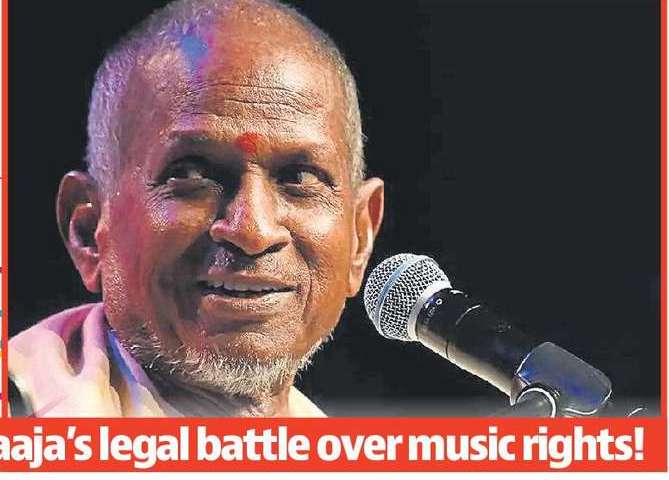
As Ilaiyaraaja’s battle for the rights to his 4,500 songs ends, musicians agree with the court’s decision
Rishabh Suri (HINDUSTAN TIMES; May 2, 2024)
Tamil musician Ilaiyaraaja’s legal battle with Echo Recording Company, that bought the rights to his compositions, has sparked the question — who owns a song? Is it the film producer who pays the music composer, lyricist and singer, the music director who composes a song or the lyricist who writes it? According to the Copyright Act 1957, the producer is the first owner.
On April 24, the Madras High Court came to the conclusion that the musician cannot claim the sole rights to his discography that includes over 4,500 songs, because lyrics are an integral part of a song too. The two-judge bench stated that the 80-year-old only has a right on the melody.
When we speak to composers and lyricists from the Indian music industry, they agree with the court’s decision, stating that a song is a collaborative effort and cannot belong to just one artiste.
SWANAND KIRKIRE, LYRICIST:
I don’t have a take on the case. I also can’t comment on who gives the companies the copyright in this case. I share a good rapport with Ilaiyaraaja. The intellectual property remains with the creator and the producer uses it for their film. What the court has done is reiterating the Copyright Act and stated that everyone needs to follow the law.
UTTAM SINGH, COMPOSER:
I feel everyone involved in creating a song is indispensable. A music director makes the tune for the lyrics that is written by the lyricist and the singers get to sing it. When an award is given, three people are always talked about — the composer, the lyricist and the singer. I feel a song is made by these three together and it’s hard to decide who has more stake in a song.
SAMEER ANJAAN, LYRICIST:
India has a Copyright Act and everything has been written very clearly so that there is no misunderstanding between the author, composer or producer. The rights belong to the producer. If somebody is claiming they have got 100% rights, I don’t think this is the right approach. It’s okay if Ilaiyaraaja is ready to fight, but you have to follow the law. You can’t not obey the law of the land. I always stand by the court’s decision.
EHSAAN NOORANI, COMPOSER:
When you are working on a movie, you’ve been hired to do the music for it. You can, as the composer and lyricist, claim royalties. Unless there is documentation to show your own rights, a producer automatically sells the rights of the song to record companies. So, unfortunately, the complete ownership of a song is not possible when doing a film contract. Whether in India, or the US, it’s the same.
NO STOPPING FOR ILAIYARAAJA
Now, Ilaiyaraaja has sent a legal notice to Sun Pictures, the producers of Rajinikanth-starrer Coolie, over unauthorized use of his song, according to a report by India Today. The notice states that a segment from the song Vaa Vaa Pakkam Vaa from the 1983 Tamil film Thanga Magan has been used without his permission.
Is Bollywood killing off the lip-synced song?
8:27 AM

Natasha Coutinho (BOMBAY TIMES; February 2, 2024)
When it was time to shoot for Tum Kya Mile and What Jhumka? in Rocky Aur Rani Kii Prem Kahaani, Alia Bhatt was in a bit of a fix. She simply wasn’t confident that she could lip-sync her way through the numbers. “I was very nervous, going to shoot a full proper lip-synced song after Ishq Wala Love (Student of the Year, 2012). So, Karan (Johar) told me why you don’t call Shah Rukh Khan, he will give you some tips. I called him and told him no one does lip-syncing better than you,” Alia admitted at the film's press conference.
Shah Rukh, of course, is a veteran of lip-syncing, having delivered a hit with Zinda Banda in Jawan last year, a song for which he lip-synced in three languages. But as Hindi cinema becomes realistic, and songs are either not included or become a part of the background score of films, will the art of lip-syncing die out? We spoke to singers, lyricists and composers to find out.
OUR WEDDINGS AND FESTIVALS REVOLVE AROUND HINDI SONGS: ARSHAD WARSI
Indians love lip-synced songs; it’s in our DNA. Our weddings and festivals revolve around Hindi movie songs, which are sung by fabulous singers and lip synced by great actors. The audience loves imitating these songs. However, it’s fine that some movies don’t have songs; if it’s realistic, there’s no point forcing it. It’s also expensive to shoot songs, and thus filmmakers shy away from it. My favourites from my own films, would be my first song Aankh Maare (Tere Mere Sapne), sung by Kumar Sanu da, and everybody loved it.
FILM SCHOOLS SHOULD TEACH HOW TO SHOOT SONGS AND USE THEM IN FILMS: SHANTANU MOITRA
Film schools should make the shooting of songs and their use in Hindi cinema an essential part of the curriculum. We are following western trends and have stopped using songs, but each time a song is used sensibly, it takes the narrative forward. In 3 Idiots, which I scored for, Behti Hawa Sa Tha Woh was not lip synced, but Zoobi Doobi was. Initially, I had done a couple of songs for Sardar Udham, but Shoojit (Sircar) and I felt that the human voice was disturbing the silence, which is an important tool in the film.
A HINDI COMMERCIAL ENTERTAINER REQUIRES LIP-SYNCED SONGS: SAJID ALI KHAN (Sajid-Wajid)
Lip syncing is a special skill, and it takes actors like Shammi Kapoor to make it believable. Filmmakers are emulating Hollywood and focusing on picturization and graphics, but a Hindi commercial entertainer still requires lip-synced songs. Music is a part of Indian culture, and I don’t think that will ever change.
WHEN HAWA HAWAII RELEASED, PEOPLE THOUGHT IT WAS SRIDEVI SINGING: KAVITA KRISHNAMURTI
I belong to that lucky generation (1980s-90s) when songs and their filming were important. Almost every song – happy, sad, philosophical or spiritual – was lip-synced. I started off by dubbing Lata ji’s (Mangeshkar) songs, after which Lata ji would sing the final version for Rekha ji or Jaya Prada ji, heroines who excelled at lip syncing. I started singing my own songs for actresses like Padmini Kolhapure, Shabana Azmi and Sridevi. When Hawa Hawaii (Mr India) released, people thought it was Sridevi singing. A lot of credit goes to the actors, who excelled at lip movements, which is an art in itself.
I'M TOLD TO COMPLETE THE SONG IN TWO AND HALF MINUTES: SAMEER ANJAAN
Directors like Subhash Ghai would give 50% credit for their success to a film's songs. There was a time when there were at least six-eight songs in a film. I used to write two-three antaras for songs that were five-six minutes long. But nowadays I’m asked to complete a song in two and a half minutes, since people apparently don’t have patience. Many directors shoot the visuals first and then approach us for a song. This eliminates the chance of a lip-synced song. We need one big musical that can change this entire trend.
BESHARAM RANG WOULDN’T HAVE WORKED AS A BACKGROUND SCORE: KAUSAR MUNIR
I hope and believe that lip-synced songs will never completely disappear from the Indian film narrative, as it's beautifully exclusive to our films. Lip-syncing is also important to viewers. If you see the films that featured superstars and did well in 2023, all of them had at least one lip-synced song. For instance, Besharam Rang (Pathaan) would never have worked as a background score, it needed that dance, drama and the lip-synced visuals.
SONGS HAVE A GLORIOUS HISTORY IN BOLLYWOOD
- The 1932 release Indersabha had over 70 songs, a record that's tough to beat
- Salman Khan and Madhuri Dixit's hit -Hum Aapke Hai Koun...! (1994) had 14 songs
- Shah Rukh Khan is a master of lip-syncing. Two films starring him - Devdas (2002) and Mohabbatein (2000) both had 10 songs
- Amitabh Bachchan could effortlessly switch from his angry young man image and mouth the lyrics of a song. His Silsila had 12 songs

World Music Day: "It's not film music vs independent music anymore," say Sonu Nigam, Salim-Sulaiman, Sameer
8:30 AM
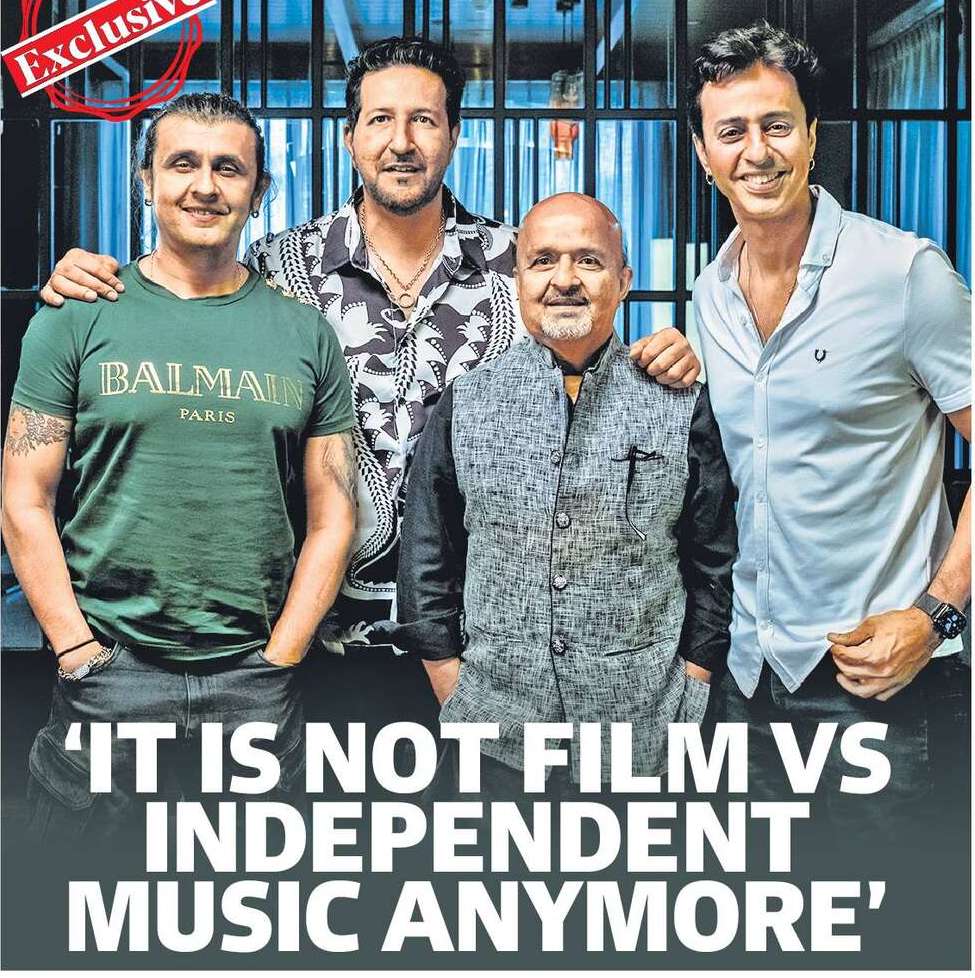
Sonu Nigam, Salim-Sulaiman and Sameer on the blurring lines between film and indie music
Soumya Vajpayee (HINDUSTAN TIMES; June 21, 2023)
What do singer Sonu Nigam, composer duo Salim-Sulaiman and lyricist Sameer Anjaan have in common? They have all been releasing independent music frequently for the last three years. But did they put their Bollywood projects on the backburner to satisfy their creative indie side? No! In an exclusive chat with us on World Music Day today, the musicians echo a common sentiment, “It’s not Bollywood vs independent music anymore”.
The last three years have seen a sudden rise in the number of indie songs thriving. Ask why and Sulaiman Merchant says, “During the lockdown, there was no film music releasing. So, all indie artistes were sitting at home and releasing music. When film music started releasing again, both forms of music started coexisting and now there’s a beautiful ecosystem.”
Salim Merchant adds, “Today, the treatment of songs is such that you cannot make out the difference between film and non-film projects. When you go on any music streaming platform, you search for a singer or composer or song; you don’t search for an actor. So, that’s been a blessing for indie artistes.”
However, he feels there’s a “downside” to the rising popularity of indie music too: “Independent music has also started sounding like film music. The makers are trying to be safer and more commercial.”
Sonu feels that the “lines between film and non-film music have blurred, given the top-notch production quality”. He adds that while film songs are synonymous to actors, a single becomes a singer’s identity.
He explains: “When we were working on my ’90s single Bijuria, I requested Saroj (Khan; late choreographer) ji to make me dance like Govinda (actor). Now, when I perform the song at gigs, people look forward to my iconic step and not something an actor performed.”
While he’s done a lot of indie songs in the past, Sameer, too, has started penning more singles of late: “Unlike earlier, when there would be at least 5-6 musical hits in a year, now there are barely one or two. Today, makers don’t even narrate the story to lyricists. So, people like us had to take to independent music to satisfy our creative souls.”
But, Salim stresses that “cinema is in our blood, so the charm of films will always be there”. Sharing how, as composers, their music-making process is similar for film and indie projects, he says, “For a single, Ruk Ja, which we did with Sonu, I created a cinematic situation in my mind while making it, something that’s done for film songs.”
25 Years of Ghulam: Aamir Khan would come for every music sitting-Sameer
10:00 AM
Soumya Vajpayee (HINDUSTAN TIMES; June 19, 2023)
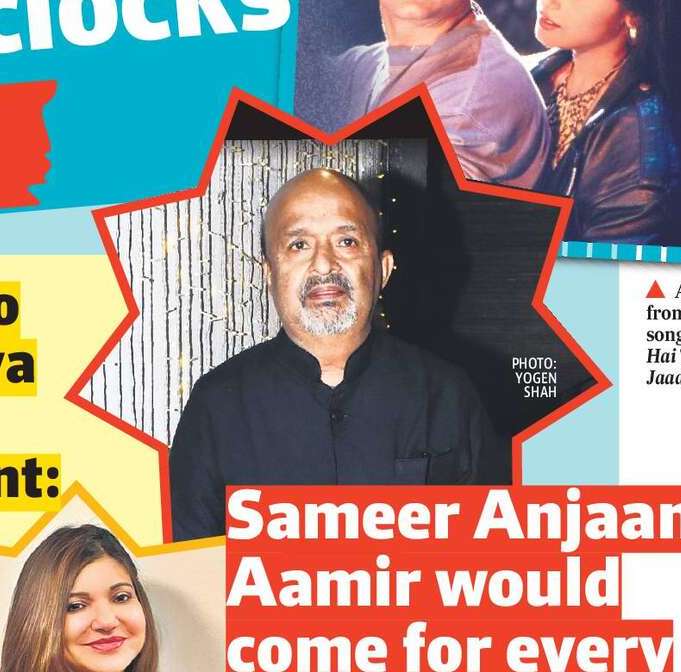
The songs from Ghulam are special for lyricist Sameer Anjaan. “The romantic touch in the numbers made the soundtrack evergreen,” he says, adding that lead actor Aamir Khan was “really involved in the music of the film”.
He shares, “Aamir would come for every sitting. It was not to interfere, but to enjoy the music and the process behind it. He is a music lover and likes to understand how songs are made.”
Talking about penning Jaadu Hai Tera Hi Jaadu, the lyricist shares, “Jaadu is a common word, so the makers of the film were reluctant to use it in a song. They asked me to think of something else, but I felt it worked for the track. When the song became a hit, every maker would asked me to include ‘jaadu’ in some way or another in their songs. Makers have a tendency of going with tried-and-tested formula.”
No composer or lyricist mentioned on Animal's poster; Sameer angry
4:49 PM
Rishabh Suri (HINDUSTAN TIMES; June 15, 2023)
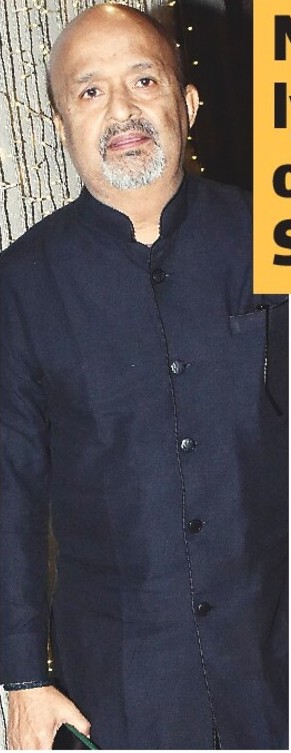
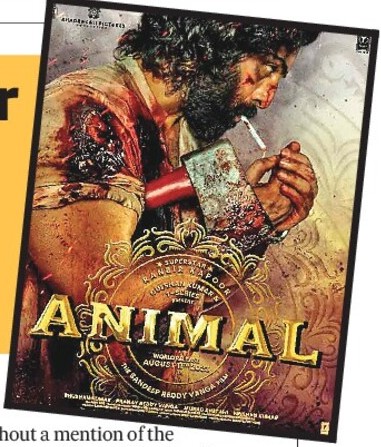
Lyricist Sameer Anjaan is miffed with the makers of Animal. The reason? None of the Ranbir Kapoor starrer’s posters released so far carry the name of either the music composer or the lyricist.
The Rowdy Rathore (2012) and Dhoom 3 (2013) lyricist, who tweeted about it recently, says, “I don’t know why the [makers] don’t think it’s important to mention the composer and lyricist’s names. Even the sound recordist’s name is there on the poster! How can you do this?” says Anjaan, adding that he feels “there is a huge nexus” behind the practice.
Recently, the film’s pre-teaser, featuring a fight scene set to a Punjabi song (Dang Khadke), was launched — without a mention of the composer (Manan Bhardwaj) or writer (Bhupinder Babbal).
Anjaan, who first expressed his disappointment on Twitter, shares: “I don’t know why the lyricist and composer of the film are not fighting. I remember Nadeem-Shravan (music composers) and me putting it in our agreements that no poster will be released without our name on it.”
The 65-year-old attributes a fall in the quality of music to this practice. He now plans to call for a meeting of musicians to take this up in a bigger way. “I am going to tell all leading composers and writers to raise their voice otherwise they will not get their due credit,” he wraps up.
Bombay High Court rules in favour of musicians as it upholds 2012 Copyright Act
8:19 AM
Lyricists, composers heave a sigh of relief as High Court upholds 2012 Copyright Act; rules in favour of musicians by directing FM Radios to pay royalties for their work
Sonia Lulla (MID-DAY; May 8, 2023)
It’s been a long-awaited win for music composers and lyricists in India who, despite the existence of the Copyright (Amendment) Act, 2012, had to fight for royalties for their work. Days after the Bombay High Court granted the rights of The Indian Performing Right Society Limited (IPRS), a music copyright society in India registered under the Copyright Act, 1957, against private FM radio broadcasters, lyricists and composers have heaved a sigh of relief.
“It shouldn’t have taken so many years, but now that we are here, we are very happy,” says songwriter Sameer Anjaan, also part of the IPRS board of directors.
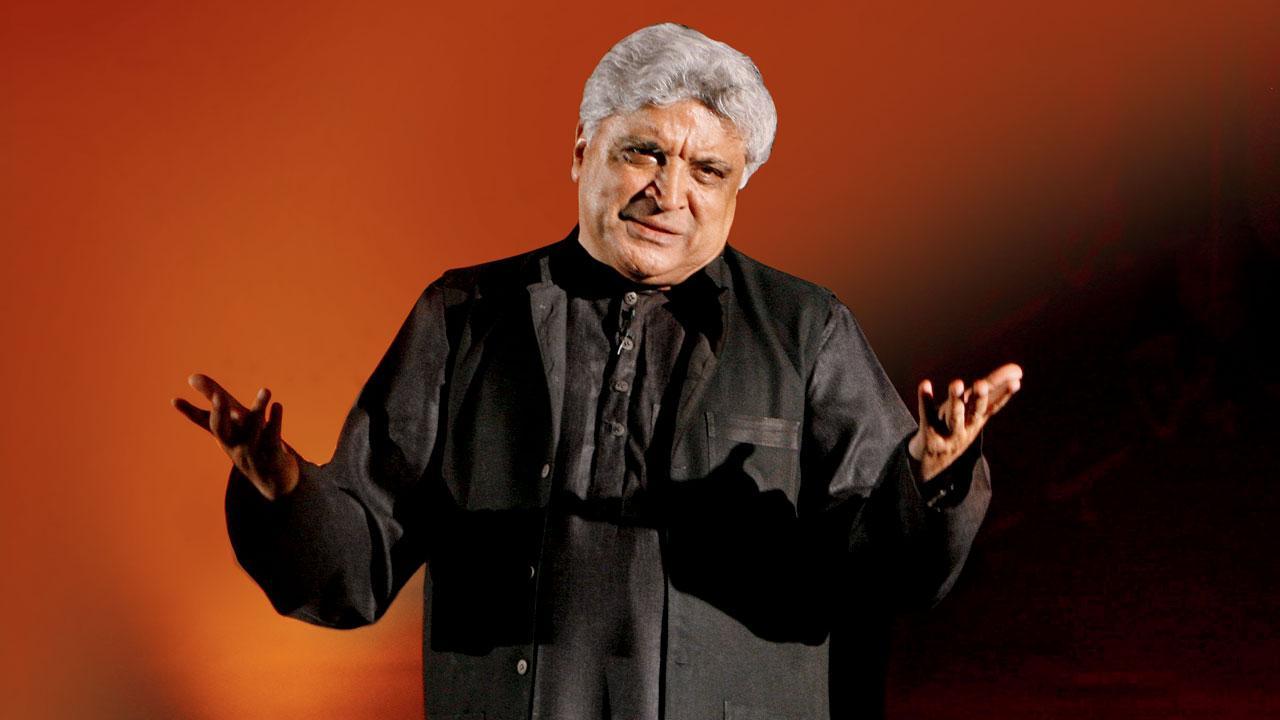
Anjaan, who along with legendary songwriter and IPRS chairperson Javed Akhtar fought the case for more than five years, says through this win, they have tried to secure the future of the upcoming generation of musicians.
“Sometimes, it feels odd that despite the [existence] of the 2012 Copyright Act, this litigation existed. Now, the next breed of musicians can secure their future, even if they have a few songs to their credit,” he says.
Lyricist screenwriter Mayur Puri, another member on the board of directors, says the arduous fight has been a result of musicians and lyricists standing their ground despite running the risk of offending corporates.
“Whether it’s Javed saab, me, or anyone who has raised this cause, we have done so at a cost to our careers. We cannot repay Javed saab for what he has done. This is an important milestone. I know the opposition we have faced over the years,” he says, quick to add that dealing with individuals who continue to hesitate to give artistes their due, will be the bigger fight.
“People think royalty is something extra that they need to pay for, but this is a basic right. I’m happy, but I’m also scared, because I know they’ll come for us again.”
Composer Vishal Dadlani seconds his opinion and says there is the need to treat royalty as a right instead of a favour. “This judgment means that finally the work that a creator of music does will provide for him or her for as long as it is relevant or being consumed. This should, in fact, have been a basic right that any creator enjoyed. It’s sad that it has taken this long to happen, but it’s wonderful that it finally has. For years, we have been treated as intruders when we’ve claimed authorship of the work we have done,” he says.
Dadlani’s friend and colleague Salim Merchant adds that the development is significant when one considers the market size of FM radio. “It generates big revenue, but composers weren’t able to get their share.” Lyricist Shellee urges people to share a thought for lyricists who “don’t even do concerts, unlike other artistes”. “This is a revenue [stream that they can avail].”
Lyricist-singer Swanand Kirkire gives a shout-out to those artistes whose work is still celebrated, even as they continue to struggle with their finances. “This is their money, but they couldn’t access it to make a living. In times of emergency, like during the pandemic, this could have been the money they could have used. Finally, they will be benefited even if one of their songs is played on the radio.
Lyricist Raj Shekhar highlights the dichotomy that existed until now — while an artiste’s music may brighten a person’s day, the person who created that piece of art would be living hand-to-mouth. “At this moment, I remember Javed saab’s lyrics from the song Mitwa — ‘Sach aur sahas hai jiske mann mei, ant mei jeet usi ki hai’.”
The case
While the The Copyright (Amendment) Act, 2012 aimed to establish a framework to share revenue with artistes, it was subsequently challenged by corporates. The IPRS has fought the case for a decade to enable composers and lyricists to earn royalty for their work.
If I am here, why aren’t you asking me to write these extra lines, asks Sameer on Bhool Bhulaiyaa 2 title song
8:23 AM
Irked by the fact that his songs are often toyed with, original Bhool Bhulaiyaa lyricist Sameer says change must be effected
Sonia Lulla (MID-DAY; May 9, 2022)
The voices of dissent against the trend of rehashing old ditties in Bollywood seem to grow louder, with Sameer Anjaan joining musicians like A R Rahman and Vishal-Shekhar in criticizing those toying with their work. Anjaan, who penned the lyrics of the much-acclaimed title track of Bhool Bhulaiyaa (2007), must now share credits with Mandy Gill, who has worked on the upcoming second edition. What’s unusual is that Anjaan was kept in the dark about the making of the new track, starring Kartik Aaryan.
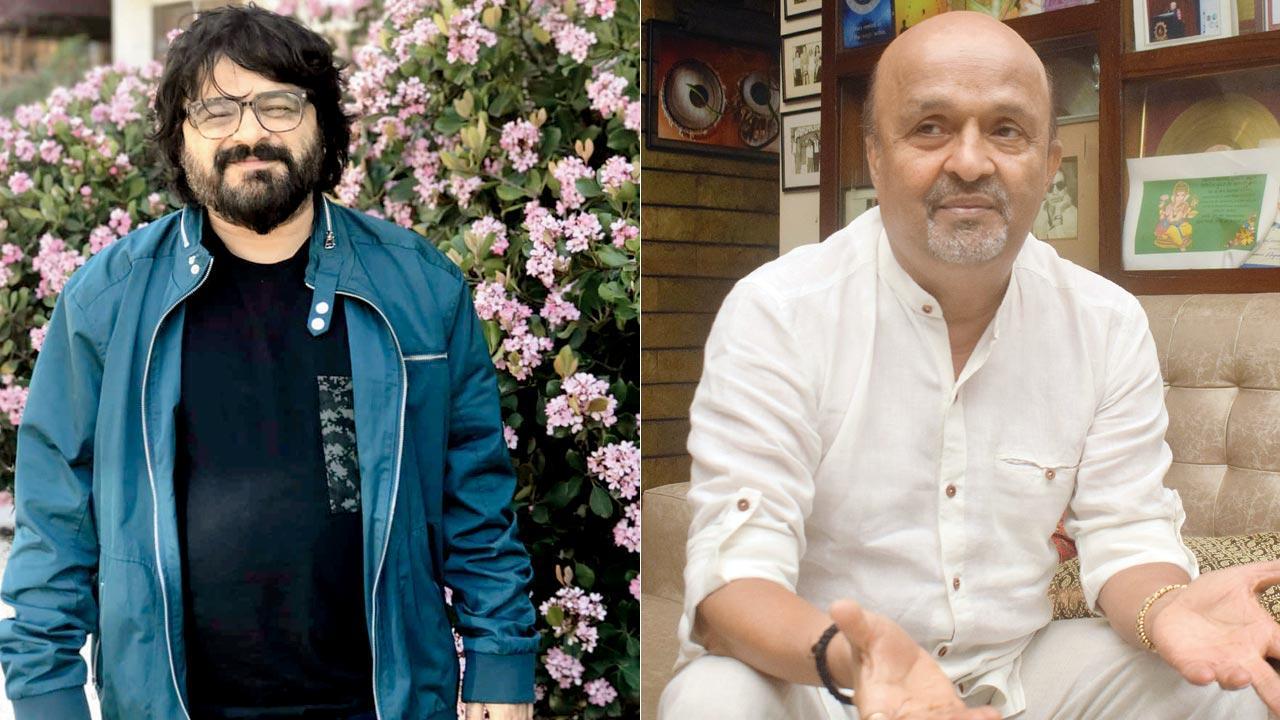
“I didn’t work on this version, and I am very upset. If the [original] writer is still working [in the industry], why are they appointing another writer and attaching [their name] with the song? They will simply add some lines without changing [too much]. Why should another artiste be [credited]? The worst part is that the person who has written only one to two lines more in the new version will get 50 per cent of the royalty. That’s unjustified,” says the writer, who collaborated with Pritam on the original track. While the credit for the recreated version of Bhool Bhulaiyaa 2 has been given to Tanishk Bagchi, Pritam has been attributed for composing select sections.
Anjaan, who heard the recreated version only when it was released, points out that label owners exploit loopholes in the copyright agreement to benefit from the artistes’ talent. “They had to give me the credit because if they did not, I could sue them. Initially, they did not do that, but started the practice after we objected. This whole thing needs to stop. Most of my songs, like Ankhiyon Se Goli Maare, and Dilbar Dilbar, have been recreated. [Several artistes in the industry] now plan to take some action.”
Asserting that a new lyricist cannot decipher the structure that the original lyricist followed when working on the song, Anjaan fails to comprehend the reason behind the makers’ decision to appoint someone else when he is still active in the industry. “If I am here, why aren’t you asking me to write these extra lines? If you change the lyrics, the concept is lost. They [new lyricists] don’t understand the song in totality. The original was a massive hit.”
Freedom of creativity khatam ho gayi hai. Ek gaane pe teen lyricist kaam karte hain-Sameer
8:34 AM

Soumya Vajpayee (HINDUSTAN TIMES; February 25, 2022)
Veteran lyricist Sameer Anjaan has been in the film industry for almost four decades, and has seen it go through several changes. On the lyric writing scenario for films now, he says, “The people in the industry are talented, but they are not getting the right kind of work. Freedom of creativity khatam ho gayi hai. Ek gaane pe teen lyricist kaam karte hain.”
Anjaan is upset that the process of music-making has changed entirely, causing deterioration of the quality. “Things that were important don’t even exist anymore. Earlier, everyone — makers, composer, lyricist and singers — would sit together to decide the music for a film. The process is not disciplined anymore. Dimag se kaam ho raha hai, dil se nahin. Producers are only looking for hit songs. Since one song is recorded by 20 singers, no one likes to give their 100%,” he says, adding, “The music of Pushpa: The Rise - Part 01 (2021) was not extraordinary. But it worked, as it showcased the kind of effort that was invested by everyone working together.”
Anjaan has been keeping low as far as writing music for films goes. But that doesn’t mean he doesn’t have work. “Mujhe achha kaam karne ka mauka nahin mil raha. If I get a full soundtrack to work on and the music doesn’t do well, main apna pen chhor doonga. Since I don’t like to work on half or one track, I’m working on independent projects. I enjoy the independence singles give. I’m releasing independent music to tell people that I’m still around,” says the lyricist, who celebrated his 63rd birthday yesterday, by indulging in charity.
Kavita Krishnamurti and Sameer remember Bappi Lahiri
8:20 AM

As told to Soumya Vajpayee (HINDUSTAN TIMES; February 17, 2022)
It’s extremely sad that another great musician has gone. Bappi da had so much music left in him. I have great respect for him. He was like a brother to me for many years. I got the opportunity to sing a lot of songs for him like Tu Pagal Premi Awara, Lal Dupatte Wali, and my Bengali hit, Aami Kolkata Roshogulla. He was so flexible and gave us diverse songs.
He loved his work and treated all of us like his family. Whenever I went to his place, he’d offer me Bengali sweets as I loved them. His family was always affectionate. My heart goes out to them. May his soul rest in peace. These last two years have taken so many amazing musicians from us. I’m sure even the Gods are enjoying their music.
Kavita Krishnamurti, singer
---------------------
Bappi da was like family to me. I’d accompany my dad (Anjaan, late lyricist) for the sittings. Whenever he saw me, he’d remember my father. I’ve had so many associations with him over the years. In fact, he called me a month ago for a project called Pyaar Mein Thoda Twist. But I think he fell ill. I didn’t hear from him after that.
He was an intelligent and multifaceted composer. Once, director Prakash Mehra asked Bappi da to call his mother, who was a classical singer, to compose a song for Namak Halaal. She was nervous as she was not a composer. Bappi da told her he’ll give her a phrase and she can compose it like a bandish. That’s how the original tune of Pag Ghungroo Baandh was made.
He made a mark when many composers were ruling the industry. He was synonymous to disco and the genre will always be associated with him. It’s truly a huge loss to the music industry and I’ll always miss him.
Sameer Anjaan, lyricist

Shilpa Shetty remakes Chura Ke Dil Mera; sparks debate among fans
8:18 AM

The recreation of this iconic track from the 1994 film Main Khiladi Tu Anari has die hard fans questioning why is there even a need for such endeavours
Rishabh Suri (HINDUSTAN TIMES; July 7, 2021)
Remaking old classics is a trend which refuses to die down. And the latest to join the list is Chura Ke Dil Mera, which featured in the 1994 Akshay Kumar-starrer Main Khiladi Tu Anari. Filmed on Kumar and Shilpa Shetty Kundra, the song has been a favourite for decades, and has now been recreated by the original composer, Anu Malik for Hungama 2.
Taking over the vocals are Benny Dayal and Malik’s daughter Anmol. Fans, however, are not pleased with it.
Ever since the song dropped on Tuesday, social media has been abuzz with people missing the original singers Kumar Sanu and Alka Yagnik.
“#ChuraKeDilMera is one of my fav 90s songs... STOP ruining 90s classics... nothing can bring the old charm back... (sic),” wrote a Twitter user. “They Couldn’t Match the 1% of the Original Song... don’t spoil the old songs please” wrote another.
Many liked Kundra’s avatar, but missed Kumar. Meezaan, actor Jaaved Jaffery’s son, has stepped in his shoes.
When we reached out to Sanu and Yagnik to know their take, the former tells us, “Mujhe naya wala sunke bauhaut achha laga. I didn’t know it was being recreated.” Yagnik, too, says she did not know about this new version coming out. “It sounds cute, very different from the original,” she adds.
People who have been in the music world for long are not too pleased with this trend. Lyricist Sameer, who has seen a lot of his songs such as Ankhiyon Se Goli Maare and Dilbar be recreated, says, “The question is not about recreation, it is about not destroying the originality. Try not to disturb the basic structure. If there is a song Lata Mangeshkar ji has sung, and you take a new singer (for recreation); what are you doing? You will ruin the song.”
Singer Abhijeet adds that he liked Anmol’s voice, but is not in favour of old songs being touched. “The original music director recreated it. I won’t say this is a good attempt, but gaali mile ya tareef, it is for the original composer. In this song, the male voice dominates, that has been changed. I didn’t like it. Logon ke dimaag mein original baitha hua hai,” he asserts.

Lyricists fight for credit on apps, streaming platforms
8:41 AM

Songwriters, long given short shrift in Bollywood, are now up in arms for recognition and royalties
Rishabh Suri (HINDUSTAN TIMES; July 26, 2020)
After nepotism and favouritism, another debate seems to be in the making in Bollywood. Recently, songwriter-singer Swanand Kirkire tweeted, “OTT pe lyricists ka naam na hona sirf credit ka na hona nahin hain balki Lyrics Writer ke Wajood ko na maanana hai”.
Last year, the Indian Performing Rights Society (IPRS) filed an FIR against a production house seeking around ₹100 crore in royalties due to composers and writers since 2012. Danish Javed, of the Screen Writer’s Association, says, “If lyricists get their name on a publishing platform, as a member of the IPRS, they get part of the royalty,” he says. We got in touch with some prominent lyricists on this.

SWANAND KIRKIRE (3 Idiots, Barfi!, Lage Raho Munnabhai)
Music companies and big labels put songs on YouTube, and don’t give proper credits. They don’t get back when we point out. Some platform did get back recently saying ‘thanks for bringing to our notice’. They didn’t even say it was a mistake. Apps don’t credit the lyricists anywhere in their algorithm. You can’t search a song by a lyricist’s name. You can search the music director’s name. I can search for songs I’ve sung as I am a singer too. I get a detailed history what’s happening with my song, how many are streaming it, which state or country they belong to, but lyricists have no way to find that out.

SHELLEE (Shahid, Manmarziyaan, Jawaani Jaaneman)
I wrote a song in 2014, Beparwah, for Shahid. Why is my name missing on YouTube? People comment ‘soulful lyrics’ but my name is missing! There’s a rule: if the name is missing, the royalties from the song won’t come to you, be it YouTube or music apps. Music apps have a different algorithm. If we are given credits, we’ll start getting royalty. But what about the royalties of the past? We don’t do gigs or concerts like singers. We get paid peanuts once, and nothing after that. Even if the spelling of your name is wrong, you won’t get royalty. IPRS controls the domestic royalties, we need more transparency in it too.

VARUN GROVER (Gangs of Wasseypur, Fan, Udta Punjab)
I have been talking about it for years now. Many official channels on YouTube, and music company channels of Eros, Sa Re Ga Ma, Shemaroo, Ultra, don’t credit lyricists or give wrong credit. We have a list of these song credits. Gulzar, Javed Akhtar, Shailendra, these legends have credits missing on YouTube channels. Apps pick data from music companies who provide them their libraries. In their library itself, they don’t have the lyricist’s name! Some apps work on the American mode, where they think composer is the songwriter. They don’t even have space for lyric credits in their software. You can’t search if you want to.
SAMEER ANJAAN (Aashiqui, Kuch Kuch Hota Hai, Dhoom 3)
The Screen Writer’s Association is taking a big step because I think people do this knowingly. They have a huge nexus and intention behind not keeping the writer or composer’s name, because then royalties will not go to the right place. But now we are trying our level best to make them (apps) aware. Then we will take legal action.
Also, about last year’s hit Dilbar Dilbar (Satyameva Jayate), a leading publication said, ‘Music by Tanishk Bagchi, lyrics by Shabbir Ahmed’, when the original song was by Nadeem-Shravan, and lyrics by me. Shabbir wrote one line in the beginning, rest of the song was original.

From Boston to Bombay: Bappi Lahiri, Bappa, Shaan, Sameer, Anuradha to create the song, Saath Do
8:08 AM

(From left) Bappi Lahiri, Shaan, Anuradha Palakurthi and Bappa Lahiri
Mumbai-based Bappi Lahiri, Bappa, Shaan join Boston singer Anuradha to create a song for Corona warriors
Upala KBR (MID-DAY; May 12, 2020)
Bappi Lahiri has joined the ever-growing list of artistes coming together to pay tribute to Corona warriors. The veteran composer and son Bappa have roped in Shaan, lyricist Sameer Anjaan and Boston-based singer Anuradha Palakurthi to create the song, Saath do.
Bappa, who is stationed in Los Angeles, says he wanted to compose a number that highlighted the theme of unity even as we are staying in self-isolation amidst the Coronavirus crisis. A quick phone call to Anjaan and several brainstorming sessions later, the duo gave shape to the song. "My father, who is presenting the song, wanted me to do the vocals after he heard my composition. But, I wanted Shaan and Anuradha to render it," says Bappa.
Over the next few days, Shaan and Palakurthi, separated by continents but united through the endeavour, recorded their portions at their home studios. "Despite being stationed in different countries, we have all come together for the track. Now, I will request celebrities to feature in the video," adds Bappa of the song that will drop online later this week.
Film industry members would snap, ‘Bakwaas hai’ when they heard the No Entry title-Anees Bazmee
8:33 AM

Roshmila Bhattacharya (MUMBAI MIRROR; August 31, 2019)
 When Anees Bazmee approached Boney Kapoor with a story of three men and their sexual peccadilloes, which he had written and wanted to direct, the producer was game and they quickly decided that Anil Kapoor was apt for Kishan, the newspaper editor with a suspicious wife. “I had written films like Laadla and Deeewana Mastana featuring Anil, and knew he had great comic timing,” Anees reasons, saying they then approached Saif Ali Khan for the role of Shekhar, Kishan’s employee whom he treats like a younger brother. “Saif wanted to play Kishan but since Boney ji and I were convinced Anil was the best choice, we took Shekhar’s role to Fardeen.”
Salman Khan was Prem, though the director is quick to point out that his Prem unlike Sooraj Barjatya’s shareef, seedha family man, was a charming womaniser whose extra-marital affairs sparks off this comedy of errors and terrors. “Salman bhai had allotted only a day for the climax, but when I told him I needed three, he immediately agreed to stay back in Phuket,” Aneees reminisces. The climax was one of the film’s USPs, with the trio going over the edge of a cliff and hanging on to a tree for dear life, as a snake slithers by. “After we shot there, it became a popular tourist attraction and came to be known as the ‘No Entry Spot’ till the Tsunami washed it away.”
Anees surprises you with the revelation that after wrapping up the film, he had to wait for more than a year to release it. He had started writing his script with the title No Entry because, he reasoned, for a married man to court a woman other than his wife is like entering a ‘no entry’ zone. However, to his surprise, most members of his frat disliked it intensely and he was surprised by the almost violent reactions.
“People would snap, ‘Bakwaas hai’, and for a while I flirted with other, titles like Pati Patni Aur Woh, but eventually decided to stick to No Entry,” narrates the writer-director, who was later rewarded when it heard the audience raving, “Bahut achcha title hai”, encouraging him to experiment with Welcome, Ready and Singh Is Kinng.
But before that Anees almost despaired of his film seeing the light of the day. In fact, two days before the its release on August 26, 2005, he was suddenly told that it had been pushed again. “We finally opened without any advance booking and when I heard that there were very few people outside Chandan theeatre in Juhu, I resigned myself to the fact that two years of hard work had gone down the drain and went to sleep. I was woken up by the same well-wishers calling me a few hours later to say that the film was playing to a full house. In fact, business was better in the second week, with blackmarketeers doing brisk business. Even 14 years later, No Entry hasn’t gone into vanwas,” he exults.
Interestingly, despite its risqué subject and an escort, Bobby, at the centre of the plot, the film is seen as a family entertainer. Anees however reveals, tongue-in-cheek, that he knows of many husbands who have managed to distract their better halves from seeing the entire film, afraid that “unki sab pol khul jayegi”.
Prod him on Bipasha Basu’s Bobby who drives the men crazy when she enters the “Ishq Di Galli” and Anees informs that when the actress heard that this song was to be filmed on her, she begged him for 15-20 days to shed the weight she had put on during a holiday in the US. She turned up a fortnight later, looking gorgeous and her sexy moves still makes pulses race.
“Boney ji had wanted to shoot the song on a lavishly-mounted set in Mumbai, had allotted a Rs 3 crore budget only for it. Anu Malik (composer), Sameer (lyricist) and I had cracked while on our way to Lonavala. It was so catchy I immediately knew we had a chartbuster,” reminisces Anees. They eventually shot it in a real club in Bangkok, located opposite their hotel. Raju Sundaram who choreographed mostly for films down South, was cajoled into directing it and Anu’s opening beat became No Entry’s signature tune, used in the background at significant points in the narrative.
In the years since, talk of a sequel has come up several times. Anees admits that two years ago, he locked a story which can take the franchise forward. “We juggled five stories before settling on this one which took six months to finish. Now, I am waiting for Salman bhai and Boney ji to greenlight the project. Bahut khusboorat picture banegi,” he promises.
After nine years, Hard Kaur and Sameer Anjaan fight over Party Abhi Baaki Hai lyrics
7:59 AM

Tanvi Trivedi (BOMBAY TIMES; May 31, 2019)

We spoke to Hard Kaur, who is currently in the UK, and she said, “It is rare to find a rapper who will sing songs penned by another person. Most rappers pen their lyrics and sing their own songs. I got an opportunity to sing two songs in F.A.L.T.U in 2010. At that point, music composer duo Sachin-Jigar asked me to write the song and sing it. They promised me to give another opportunity soon in the future and requested me to let go of the credit for it. In a few days, Sachin-Jigar visited me and offered me to use a line for the song. They said, ‘We are giving you one line Party abhi baaki hai… and the rest you pen on your own.’ I then penned the song and also sang it. Now, after nine years, when I heard Sameer taking credit for the song, talking about getting inspired by his children and how they asked him to write something new, I was shocked. How can he do that by just taking his children’s names? Has he ever gone out and checked out in discotheques what songs youngsters like to listen to? Has he ever picked up a CD and listened to rap numbers? And he is claiming that the full song is his on national TV?”
When we contacted Sameer Anjaan, he said, “The song is mine. I don’t want to argue on this anymore.”
Composers Sachin-Jigar react to Hard Kaur’s claim
Composer duo Sachin-Jigar, however, say that it was a collaborative effort. In an exclusive statement to BT, they said, “This happened nine years ago, when we had just started our journey in Bollywood. It was a privilege to work with a rapper like Hard Kaur, and we wanted to work with her on our future projects, too. She is exceptionally talented and when we were working on the song, all of us, including Sameer ji, would jam together. There were some lines that were contributed by all of us in the process and there is no denying the fact that Hard Kaur contributed to the song in a big way. We both believe that the song was a collaborative effort and the best lines were picked and that’s how the song was finally completed.”
Reacting to Sachin-Jigar's statement, Hard Kaur said, “Apart from one line, no one had given any input for the song. It is not really a team effort when I have written it alone.”

Why are they scared of a two-hour film?-Sandip Ssingh
8:41 AM

Asks Modi biopic producer, who fought controversies and court cases in the last 20 days before it was stalled by the EC; argues there were no objections to Lalu Prasad’s autobiography
Natasha Coutinho (MUMBAI MIRROR; April 12, 2019)
 With the Election Commission on Wednesday staying the release of PM Narendra Modi till after the Lok Sabha elections, arguing that it could disturb the level-playing field, your plans for your ambitious project have been hit for a six. How much do you stand to lose?
We had a premiere planned at PVR, Juhu, to which over 1,500 guests had been invited, along with a media screening, when the news of the EC’s decision reached us. We cancelled Thursday’s screenings and the media went crazy. My team and I were with our lawyers till 10pm. We read the EC notice repeatedly, with my lawyers wondering what to do. We eventually decided to follow the law, like I always have.
My losses as a producer started the day my release was moved forward by a week from April 5 to April 11. Tell me, the release of which other film has been pushed twice? We fought legal battles in the Bombay, Delhi and Madhya Pradesh High Courts and were cleared for release. The Supreme Court dismissed a plea seeking a stay on the film. Then came the EC notice, a day before the release, and stopped us in the tracks. My distributors are being questioned by exhibitors who were going to release PM Narendrea Modi with a lot of prints, in India and overseas.
Will you need to do some reshooting now depending on the poll verdict? Will the word ‘chowkidar’ which was added in the film’s poster after Modi announced it as a Twitter campaign in March, stay?
Nobody has said we are releasing the film after the elections. No dates have been announced by us or anyone else. Nobody has the authority to decide the release date of our film. We are still trying to understand why we are in this situation. We only request that our film be allowed to release because a lot of money is invested in it.
But why coincide the release with the elections and invite questions on your motive for making the film?
Even before a film rolls, the Khans, Salman, Shah Rukh and Aamir, announce a date, whether it’s Christmas, Diwali, Holi or Independence Day, and no one questions them. They are stars and need their films to do well. As a producer, I thought April 5 was a good date for better box-office collections. Elections come once in five years, festivals every year. People should understand that an individual producer is risking crores on this project.
Was it meant to be a propaganda film for BJP and Modi?
I don’t know why people think this film was a part of BJP’s election campaign. It is not. If that were the case, every party would be making films and would stop doing rallies. Senior leaders should be confident of the work they have done, only that can influence voters and not a film. Why are they scared of a two-hour film?
Apart from allegedly violating the Model Code of Conduct during the polls, why else has the film invited so much criticism?
Nobody is talking of Lalu Prasad Yadav’s just-released autobiography, From Gapalganj To Raisana, when his party, Rashtriya Janta Dal, has an alliance with the Congress. Why is everybody only attacking a film on Modi? Are they scared of him? Vivek (Oberoi, lead actor), Omung Kumar (director) and I have been a part of this industry since the last two decades, yet no one has come forward to support us. Everybody says the industry is one big happy family. Where are these people now?
How did you manage to complete the film and get it censored in record time?
We were struggling for a censor certificate and got it on April 9, just two days before the release. It was a smooth 38-day schedule but the last 20 days have been a nightmare. There were so many controversies, then strong opposition from DMK, NCP, Mamta Banerjee, Omar Abdullah, Prashant Bhushan with all of them wanting the film banned. There were allegations that we belong to BJP and the party has funded the film. I hope after this people realise this is not a propaganda film. We have been running from pillar to post for justice.
Why did you cast Vivek Oberoi as Modi? He hasn’t played a lead role in a while...
He is one of the finest actors we have and has delivered hits in Hindi, Malayalam, Telugu and Tamil over 18 years. He was in Saathiya and Company in the same year and was a superstar. And even though destiny didn’t side with him, he continues to be a perfectionist. He allotted a year for this film which is why we could make it in 38 days. He had a call time of 7am and since prosthetics would take him seven hours, he would start his make-up at 2am and was never late. Till the time he took the make-up off, he could only sip water and juices through a straw. Vivek was my spotboy, actor, director and writer.
Writer?
Yes, he’s worked on the screenplay and dialogue with my writers Aniruddh Chawla and Harsh Limbachiyaa.
Veteran lyricists Javed Akhtar and Sameer were upset to find their names in the film’s poster when they haven’t officially written any of the songs. Were their names included to give credibility to the project? Why weren’t they informed about being given credit for “Suno Gaur Se Duniya Walon” from the film Dus and “Ishwar Allah” from 1947: Earth?
One shouldn’t react immediately to anything, we all belong to the same industry. “Ishwar Allah” from 1947: Earth and the Dus song were penned by them and since both are legendary lyricists, we gave them credit as is the norm.

Javed Akhtar and Gulzar tell people to vote without fear or favour, in the upcoming elections
8:31 AM

Poet-lyricists Javed Akhtar and Gulzar speak in one voice, exhorting people to vote without fear or favour, in the upcoming elections
Khalid Mohamed (MUMBAI MIRROR; March 31, 2019)
 Javed Akhtar and Gulzar, two of the most revered poet-lyricists of India, have sounded a clarion call to the nation to push for freedom of expression “at a time of darkness and uncertainty” facing the country on the cusp of the elections next month.
In separate interviews with Mirror, they have exhorted the electorate to vote with a conscience, without fear or favour. Poets and writers, they emphasise, articulate the mood of the people. “Our poems, in effect, serve as slogans,” Akhtar states. “But slogans cannot spark revolutions. I’m not pompous enough to believe that my words amount to anything more than a purposeful incentive.”
Gulzar notes, “One has to say what one must without any dilution. And I will say that the killings of the eminent thinkers Govind Pansare and MM Kalburgi, and of journalist Gauri Lankesh, have been lamentable.”
The current debate on writers versus realpolitik commenced on March 16 in New Delhi, where Akhtar recited an unpublished ghazal at the 53rd edition of the Shankar-Shad mushaira. This year, breaking from tradition, Pakistani poets were not invited to the mushaira, in the wake of tension between the two countries. A couplet from Akhtar’s ghazal asserted, Jo baat kehte darte hain sab, tu woh baat likh/Itni andheri thi na kabhi pehle raat likh (To speak of the thing which everyone fears, of that you must write/The night was never so dark before, you must write) To express his solidarity with Akhtar, Gulzar wrote a ghazal, a part of which said: Tum ne bhi khoon-e-dil mein dubboii hain ungliyan/ Humne qalam ki pehle bhi jhankar suni hai (You too have dipped your fingers in your heart’s blood/ We have heard the clangor of the pen earlier too). Buoyed by the support, Akhtar exults that it was a wonderful gesture from Gulzar. There is no one-upmanship or competition among lyricists, he remarks. Instead, contrary to popular opinion, there is an unspoken unity.
Akhtar recently found himself in a Kafkaesque situation. The credits of an upcoming biopic PM Narendra Modi, scheduled for release on April 5, listed his name prominently as one of the six lyricists. When this was pointed out to the writer with a WhatsApp message, he immediately contradicted the news with a tweet. “Usually writers have to fight for an inclusion on the credit titles. But here I was credited for a film which I haven’t even worked on,” he laughs.
Maintaining his cool about the recent incident during the interview at his Juhu apartment, Akhtar elaborates, “The producer [Sandeep Ssingh] acquired the rights of the song Ishwar Allah written for Deepa Mehta’s 1947: Earth. Now, as everyone knows, whenever earlier songs are re-used, the names of the film, composer and writer are mentioned in the end credits. And that’s it. In any case, it is up to me whether I want to be associated with a biopic, be it of the Prime Minister, Rani of Jhansi or Milkha Singh. If I want to keep a distance from a film of any nature, that’s my prerogative.”
Gulzar concurs that the poster credit was unfair: “Ethically or otherwise, the producer has to acquire the permission of the writer who may or may not agree with the theme of the project. A lyric is not a toothpaste tube which can be bought in a market.”
According to lyricist Sameer, his name was also included in the credits of PM Narendra Modi without his consent for the song Suno Gaur Se Duniyawallon from Dus. He further comments, “As far I know, the mukhada of the original song has been retained but the antaras have been changed. So, it’s a ‘recreation’ of sorts. I have no clue what can be done about this; whatever decision is taken, will have be a collective one.”
 Prasoon Joshi, ad guru and chairman of the government’s Central Board of Film Certification, also features among the songwriters for the biopic. So far Joshi, as well as the film’s director Omung Kumar and leading man Vivek Oberoi, have maintained a pin-drop silence. Vis-à-vis Joshi, neither Akhtar nor Gulzar have any issues, describing him as a colleague and friend whose political views do not necessarily have to align with theirs.
Eminent playwright, script and story writer Javed Siddiqui is angered by “the mud thrown on Javed Akhtar’s face”. On noticing Akhtar’s name in the credit titles of the PM biopic, Siddiqui says he was appalled. When the news was contradicted, there was a sense of relief and regret. It’s sad, he contends, that politics has descended to “such a crude level”.
“Did they think they could get away with this?” Siddiqui asks. On being counter-questioned about why he was ascribing political motives to film’s producer, he bristles, “What do you mean? Do you think any producer would have the guts to indulge in such false propaganda without the tacit consent of the powers-that-be?”
As for other contemporary progressive writers — be it in the realm of poetry or prose — there have been no indications about an official, collective protest so far.
Akhtar states pragmatically, “Once the Progressive Writers’ Movement [formed in 1936] encompassed several Indian languages. There was a galaxy of writers in the pre-and post-Independence era who would meet regularly, almost like a commune, and recite their works. But ultimately one is alone. Five writers can’t write a joint piece of poetry or prose. Undoubtedly, like-minded writers should meet more often, but life is too hectic, too fast-paced nowadays. As long as a group of writers are committed to liberalism and share the same world view, that should suffice for the time being.”
Gulzar underlines the fact that the Progressive Writers’ Movement was immeasurably impactful in advancing the cause of social justice, gender equality and secular values. To date, the influence of the movement and its legendary writers, has persisted. Yet this Millennium’s conditions are bound to be different. There is a heightened fear of authoritarianism. In the event, it’s the writer’s responsibility, once again, to strike a wake-up call.
Siddiqui suggests that writers of liberal views should organise roundtable conferences regularly, and communicate their views to the people through the press and the plethora of social media platforms.
Poets and novelists may not have chosen to come together formally in a movement. But the consensus among Mumbai’s phalanx of writers today is that dissent and truthspeak — even while operating from the entertainment-centric Bollywood — have been advanced successfully through the decades.
Viewing that in a broader perspective, the two poet-lyricists agree that the Indian social structure is essentially moderate. Extremism of the far-Left or of the far-Right in overall governance, is bound be rejected. “I’m not a pessimist,” Akhtar avers. “I am hopeful that there will be a rational outcome [to this election]. A totally Right-wing government is fraught with hazards. As for those who are dedicated to the Leftist ideology, I admire their compassion for the underprivileged and their respect for secularism, but I’m afraid even Communist China has outgrown its economic policy.”
Consistently, Akhtar has been viciously trolled, and has even received death threats. Has he ever feared for his life? To that, his riposte is: “I may have been under threat from the fundamentalists — both Hindu and Muslim. I had to move around with bodyguards on two occasions. Still, I’ll be worried the day that either of the fanatic groups stops criticising me.”
Gulzar reasons that his personal ideological values are reflected in his stories, film scripts and poems, in a voice which syncs with his personality. He says, “I’ve never been an activist, I’ve never raised my fist in the air at a public rally. So where does one share one’s writings with one’s colleagues and peers? To a degree one can, at literary festivals, and this may not necessarily be while speaking from the dais. I’ve shared some of the best inspired and rousing writings in recent years with other poets after the festival’s formal sessions are over.”
Cautioning that tolerance is key today, Gulzar maintains, “One has to express oneself with dignity; let’s not raise the volume to a deafening blast. Unfortunately, unparliamentary language is being used far too frequently during the course of debates today. Why? Obviously because so many politicians become power-drunk and start behaving like zamindars. This form of feudalism must end.”
Even from the solitude of his booklined home-cum-office in Bandra, Gulzar feels that poetry, as a form of protest along the lines of Chile’s Pablo Neruda, can certainly reflect reality. “I may spend hours on end at my desk,” he concedes, “but I’m not locked in an almirah. I’m in touch with the people of today. The Millennials are a transparent and honest generation. They’re direct, and speak one-to-one.”
Akhtar points out that he was nominated to the Rajya Sabha (from 2010 to 2016) by the President. But he wouldn’t join any party to become a Member of Parliament again. “There’s no possibility of going back,” he insists. “I have cherished close friendships with several leaders of every party. Indeed, many of them were of tremendous help in getting the Copyright Bill passed. At this point, any allegations about me trying to canvas for a seat of power, in any capacity, are not only unfounded but foolish.”
To wrap, the writer offers a pertinent thought: Kabhi toh raat ko tum raat keh do/ Yeh kaam itna bhi ab mushkil nahin hai/ Bahut aasan hai pehchan iski/ Agar dukhta nahin, toh dil nahin hai (At least call the night by its name at times/ It is not so difficult/ It is very simple to recognise/And if you don’t feel deeply hurt, my friend, then yours cannot be a heart).
When requested to pen a few impromptu lines, Gulzar writes without a pause: Ghurub hota hua suraj dikhayee de raha hai/ Hazaron bulb roshan karke koi/ Andhere ko chhupana chahta hai/Ki aankhen raat ko pehchan na paaye (During the fading rays of the sunset/Amidst thousands of light bulbs, somebody seeks to hide the approaching darkness/ So that the eyes do not recognise the night).

IIFA awards won't have songs reeking of sexism, courtesy petition by a CA student
8:37 AM

After Mumbai-based youngster files online petition opposing Bollywood’s misogynistic songs, IIFA promises to support her campaign in the upcoming awards edition
Sonil Dedhia (MID-DAY; January 26, 2019)
Bollywood has been plagued with songs that reek of sexism, for long. But now, things may be headed for a change. Chandana Hiran, a Mumbai-based chartered accountancy student, has filed a petition with change.org opposing the misogynistic songs that are regularly churned out by the industry. She has also requested International Indian Film Academy (IIFA) to publicly condemn the objectification of women in Hindi film songs at its 2019 awards show — a move that has met with a positive response from the IIFA team.
Hiran says the idea to condemn the act publicly stemmed from a personal experience — recently, in a case of eve-teasing, several boys sang Kaddu Katega Toh Sab Mein Batega (R... Rajkumar, 2013) as she stepped out of the college, the innuendo of the song not lost on anybody. “I would often see kids in my family dance to these vulgar songs. I don’t want any child to be taught that it is okay to equate women to objects like Afghan Jalebi, Tandoori Murgi or Zandu Balm.”
Ask her why she approached IIFA to champion the cause, and she reasons, “The entire film fraternity attends this show, and millions tune in, making it the best gender-sensitive platform to send out a powerful message.”
Andre Timmins, director, Wizcraft International, producer and creator of IIFA, recently tweeted to the youngster assuring that appropriate action will be taken in the regard.
When we reached out to IIFA, the organisers said, “IIFA stands against any injustice or mistreatment, regardless of gender and hence, we replied positively to this campaign. Injustice against women is a major problem in the world. IIFA, as a platform, is trying to help make a difference to such causes.”
Lyricist Sameer, who has penned songs including Aa Re Pritam Pyaare (Rowdy Rathore) and Sarkailo Khatiya (Raja Babu), said, “Many times, artists are under pressure from makers to produce a certain type of song. I have immense respect for women and have never intentionally written anything which objectifies them. The onus also lies on the directors, in terms of how they shoot a song.”

Kaddu Katega from R...Rajkumar prompted Hiran to start petition
I want to be that ‘stop button’ for Kailash Kher and Anu Malik-Sona Mohapatra
8:27 AM

Singer Sona Mohapatra had recently called out music composer Anu Malik as a sexual predator. In a detailed interview with BT, she talks about her ordeal and also highlights why it was important for her to speak up. Excerpts...
Lasyapriya Sundaram (BOMBAY TIMES; October 22, 2018)
 Over the past few days, the #MeToo campaign has gained momentum in India. You were the first to call out music director Anu Malik of sexual harassment...
I chose to be the first to ‘bell the cat’ so that the many others, who he has done much worse to, get the courage to speak up. At the time that I shared my experiences with him, I did so knowing very well that many people and quarters will trivialise it, and they did. I was trolled and people said being called ‘maal’, being called at unearthly hours and being subjected to one-sided and unwanted conversations are not instances of sexual harassment. It is a terrible reflection of the world we live in when others, specifically men, decide as to what constitutes harassment in the first place. That they also legislate on our behalf is another matter. Anu Malik, in fact, denied meeting me ever. But I exposed that lie by presenting the timeline of our meetings and facts, subsequently. The point is, I shared my experiences, because it was my story to share and it is not in my place to share other gory stories that are an open secret in the industry. That would be conjecture, speculation and gossip. When people think that I have a right to speak up only when I’m raped or something equally serious happens to me, I will say, ‘You are the reason why serial predators get away’. That he didn’t do worse with me doesn’t indicate anything. I say this to the naysayers, ‘You are the ones who normalise this abhorrent behaviour and system’. Anu Malik’s behaviour with me was sexual harassment. There are no doubts about it. I blocked his number and chose not to work with the likes of him. I was lucky to find fewer, but good allies in the industry. But that doesn’t mean everyone can and that is not their fault. My speaking up about my experience with him gave the courage to another woman, singer Shweta Pandit, who was harassed as a minor by him, to speak up. Many more are writing in with their own personal horror stories to both of us. Most are scared to come out in the open for fear of being shamed or losing work, but I’m more than willing to do it if this empowers others and helps cleanse a system. As I read somewhere, #MeToo is only the beginning of an equal rights movement that is aiming to press a giant reset of the norms across a spectrum of systemic inequal, dehumanising and violent behaviour that women have been subjected to for times immemorial. This is across all workplaces, and not only in the entertainment industry. This needs to change. This change will not only benefit us women, but the whole country. Currently, India is second to only Saudi Arabia in terms of percentage of women in the organised urban workforce and these numbers have been shrinking over the last decade. This isn’t good for India. Women are 50 % of the population and our participation in all walks of life plays a big role in the country’s progress.
When he denied meeting you, you alleged that he had harassed singer Suman Sridhar as well. However, she says no such thing ever happened...
The movement is called #MeToo for a reason. If and when someone feels comfortable enough to share their story, it’s the right time to talk about it. If she wants to deny it, she might have reasons for that, too. Basically, it’s her prerogative. My partner at OmGrown Music (composer and husband Ram Sampath) and I both have a clear memory of this case and we stand by our story. Again, it did happen to us, it isn’t hearsay. Suman not only called us several times about this to ask for advice, but also met us to discuss it. This was after the release, Luv Ka The End (2011). At one point, Suman mentioned being paranoid about picking up the phone because he was calling her from unknown numbers. She was an upcoming singer in the industry and didn’t want to miss any other singing opportunity by missing a call, but she was being harassed by him. We did the best we could to help her, but lost touch with her eventually. She also had some issue with the song (Muskanein Jhoothi Hain by Ram) that she sang for the film Talaash (2012), after it was released by Excel Entertainment some years later. I was the EP on the film’s soundtrack. She was demanding singing royalty and residuals, which we couldn’t secure for her because forget about a singer, getting the same for composers and writers is impossible to start with in India. The last I remember is telling her that things in our industry don’t work like they do in the US as yet, her home base. She was very upset with me. We lost touch after that.
 After you, Shweta Pandit has now alleged that she was harassed by Anu Malik...
I stand by Shweta Pandit. It takes a lot of guts and integrity to come out and share a deeply traumatic experience, which has no benefit other than being personally cathartic. Those who accuse her of doing it for publicity and saying sick things like — ‘What’s wrong with just a kiss?’ etc. do not have any idea of personal and professional ethics or boundaries. Also, India needs to note that Shweta was a minor and she was 14 years old. That this man judges a reality show year after year, surrounded by vulnerable youngsters and their parents, scares me to no end.
Lyricist Sameer says that Anu Malik didn’t harass Shweta...
He’s entitled to his opinion, but I believe Shweta and stand by her. We all know the industry to be a ‘boys’ club’ and while I’ve met Sameer saab in the past and thought him to be a gentle and kind man, I am not shocked that he would stand up for his colleague of many years, Anu Malik. I guess there is much more to gain if the boys and men stick together and keep the lopsided power structure intact. I do ask him ‘why’, though. After all the success, money and fame, why would you try and dilute this story, Sameer saab? What does Shweta have to gain except for stress and negativity by finally gathering the courage to tell her story? Also, his account with detailed quotes of what he said during the recording, which took place 17 years ago, at a time when he was the busiest lyricist, sounds wrong to me. How can you remember such exact details Sameer saab, I ask? It is different for a child experiencing trauma, because it is not a date or incident one would forget. I know many more women will be coming up with their horrifying accounts and I am sure Sameer saab is unlikely to claim to have been present everywhere to protect Anu Malik.
You have called out Kailash Kher, too...
Calling out someone for their grossly inappropriate behaviour isn’t easy or desirable. I’m not against men, just against predators. They’re an entirely different species. They are men in power who are drunk on that power and use it to abuse vulnerable women and sometimes get so addicted to it that they forget when to press the stop or pause button. I want to be that ‘stop button’ for Kailash Kher and Anu Malik. Even if two go down, it will benefit all of us. We have seen this exploitative behaviour across all strata and it’s just simply wrong to let things be. We have told countless women, who have suffered at the hands of these predators, to shut up, bear with it and carry on. This is inhuman and untenable. If we want an equal society, we must deal with this head on. Kailash’s behaviour with me is just an indication of what he is capable of. Having known me and Ram for years, having gotten his first commercial break with my partner Ram, knowing how aggressive and strong I am, he had no fear and made passes at me, touched me inappropriately in public and called me to his hotel room, despite me avoiding his phone calls during a stressful concert day. Many women have spoken up after I called him out, seven of them in the public domain, including a journalist, and I am sure many more will in the coming days, too. I shudder to think what a person might do to someone more vulnerable than me and this is the only reason I shared my story at this point of time: To give strength to others.
Will calling out perpetrators on social media deter them?
Outing perpetrators is not easy. One can only share one’s own experience. But when there’s a groundswell of accusations against a particular person, as in the case of M J Akbar, Suhel Seth, Sajid Khan, Anu Malik, Kailash Kher and many others in the workspaces, it becomes obvious that the person has a pathological problem. The process of naming and shaming is already yielding positive results in corporate India and it is commendable that the response has been swift, so it has served its purpose. I do believe that this is only the tip of the iceberg.
While I stand for the movement unequivocally, I also ask for due diligence on all our parts. We are not here for a ‘witch hunt’ and cannot become the monster we despise. I have strongly stood in my support of writer Varun Grover because of the shady manner in which he was accused. No facts, contradictory statements and just on hearsay. That kind of thing is unacceptable, but thankfully, Varun has the grace and maturity to understand the bigger cause. He isn’t pressing charges and staying quiet for now. He doesn’t want to dilute a truly important movement where there is more truth than not. I would fight for his good name with just as much conviction as I fight for the #TimesUp #MeToo movement. So, we are all in this together. All the good men and women of India, not just the women. A happier sex-pest free society will benefit all of us.
Do you think after outing them on social media, the survivors should take legal action?
Legal action requires patience, an iron will and deep pockets. Not every survivor will have the stomach for a fight that’s arduous. We must give even the accused a chance to clear their name if the accusations are patently false or malicious, so legal action is an option. I have personally always believed in the system, fought and even won in court and set a precedent. I don’t know how many can do the same though. Cannot blame them either. It isn’t that easy. We all have a life to lead and livelihood to earn. To all the good men out there, I request you to stop being bystanders. We need your voices to speak and stand up for the right thing. This is as much your fight as ours.
BT reached out to both Anu Malik and Kailash Kher for their response to the allegations, but we didn’t receive any clarifications till the time of going to press. Earlier when both Anu and Kailash were ousted on Twitter, they had denied the allegations.
No man from the music industry stood up for me-Shweta Pandit
8:42 AM

Nayandeep Rakshit (DNA; October 21, 2018)
In the last four weeks, after the Tanushree Dutta-Nana Patekar case gained momentum, several women from different sectors called out alleged perpetrators, who they have accused of sexual harassment at the workplace. Among the many women, who have spoken out as part of the #MeToo Movement, were singers Sona Mohapatra and Shweta Pandit, who made allegations of inappropriate behaviour against Anu Malik.
Later, more women, who chose to remain anonymous, made similar charges against the 57-year-old singer-composer, who is currently judging the 10th season of Indian Idol. Those from the music industry haven’t commented on this matter. Ask Shweta what action does she expects to be taken, and she says, “I don’t know what internal discussions have taken place among the channel officials. But even if people working with him take a stand, it will make a lot of difference. Sona called out the other judges of Indian Idol (Vishal Dadlani and Neha Kakkar) to stop engaging with Anu Malik. There are so many more girls out there, who probably don’t have the courage to speak up, but I hope they do someday. There are five women, who have accused him, so it can’t be baseless. It’s not just me screaming from the rooftops. His fellow judges should step down because it will send out a strong message. If someone like me, who comes from a gharana of music, is treated this way, one can imagine what must be happening to newer singers,” she says.
Shweta adds, “Even back then, when it happened, I was shocked because I was the one suffering. Our mentality is to blame and question the woman when things like these happen.” She feels that this also brings out the underlying hypocrisy that exists within the music industry. “Surprisingly, people from the film industry have reached out to me, but no man from the music industry stood up for me,” she says. “Like me, Sona, too, is a victim of harassment. Chinmayee (Sripaada) is also actively involved with the movement. It’s very eerie and shows what kind of music industry we work in. It’s shameful. I’m not asking anyone to fight for me, but even when you look at Bollywood, in some cases, even the family of the accused has tweeted in solidarity with the victims. I’ve been here for 20 years and these are the kind of people I’m working with. It’s sad and shocking for me.”
Lyricist Sameer Anjaan has called her accusations ‘baseless’. Shweta says, “There are several mistakes in what he’s written. Why am I fighting this battle? Am I not fighting for their daughters’ future as well? Both, Anu and Sameer, have two daughters each, so this fight is also to ensure that they don’t face such harassment at the workplace.”
Does she plan to lodge a formal police complaint? “I’m in Italy right now and I will be in London after this, for concerts. Once I’m back in India, I will meet the women who are supporting other girls in the #MeToo Movement. That’s when I will know what the situation is like and what my next move should be. Right now, a lot of cases have been coming out. I have to understand the case better because I was a minor when this incident happened,” she concludes.
Subscribe to:
Posts (Atom)