Showing posts with label Salim-Javed. Show all posts
Showing posts with label Salim-Javed. Show all posts
I don’t believe that cinema is dead, it’s alive and thriving-Ramesh Sippy
8:59 AM

Eshna Bhattacharya (BOMBAY TIMES; November 15, 2025)
When Ramesh Sippy took the stage at the 31st Kolkata International Film Festival for the Satyajit Ray Memorial Lecture, the packed hall was transported back to the dusty plains of Ramgarh, where Sholay first came alive. Fifty years since its release, the filmmaker’s words still carried the same spark of storytelling that defined one of Indian cinema’s greatest epics.
Sholay: From two lines to timeless legend
Ramesh Sippy recalled, “Sholay started as a two-line idea, maybe four, about an army officer and two mischievous ex-soldiers, later changed to police officers because army permissions would have slowed filming.”
He praised Salim-Javed, saying, “I told Javed sahib only about Gabbar - impulsive, heady, smiling one moment and exploding the next. From his first narration, I knew he’d captured exactly what I wanted. That scene in the ninth reel gave us the immortal line, ‘Kitne aadmi the?’”
On unseen technical challenges, Sippy explained, “The Thakur family massacre sequence took 23 days because weather kept changing; clouds appeared after days of perfect sunlight. The lamp-lighting scene with Amitabh and Jaya took 15–20 nights - we rehearsed in the afternoon and shot at dusk, often capturing just one take per day. There were no post-production fixes; every shot demanded meticulous planning, patience, and teamwork. Even a bike-with-sidecar shot was nailed in the first take after careful preparation.”
On casting, he said, “Dharmendra debated Thakur, Gabbar, and finally Veeru. Hema Malini’s speed and energy made Basanti unforgettable, while even small roles like Asrani’s jailor or Sachin’s priest’s son were built with perspective.”
Concluding on the film’s legacy, he reflected, “Every frame, every contribution - from Salim-Javed to technicians like M S Shinde and Mangesh Desai, to artisans like Aziz Bhai - mattered. That’s why Sholay endures, fifty years later, delighting audiences worldwide.”
Cinema, change, and the art of balance
For Sippy, the core of filmmaking lies in balance - between art and commerce, between dream and discipline. “The combination of art and commerce, to me, is true cinema,” he said. “Markets change, but the fundamentals remain. Filmmakers, producers, financiers -all adapt, but what lasts is sincerity.”
He dismissed the idea that cinema is losing its relevance. “Don’t believe for a moment that cinema is dead,” Sippy said. “It’s alive and thriving. Every genuine hit proves how audiences still come back to fill the halls. Multiplexes may be smaller than single-screen theatres, but they deliver what matters - great sound, beautiful projection, and that same old magic.”
Sippy’s message to young filmmakers was clear: “Follow your dreams, trust your instincts, and give the world good, powerful, entertaining cinema. The audience always knows what’s genuine - and they reward sincerity and passion. That’s the real legacy.”
He also spoke about the role of women in cinema, the rise of new voices, and how technology has transformed storytelling. “Whether you learn in film school or by observation, what matters is the urge to create,” he said. “Any time is a good time for cinema.”
Bengal, and a hope of a future bridge
The filmmaker grew nostalgic as he reflected on Bengal’s influence on his work. “To have someone like Satyajit Ray admire Sholay is an honour I’ll always hold close,” he said.
“Ray’s storytelling taught generations of filmmakers to aim higher.” He acknowledged the imprint of Bengali cinema on his own philosophy, adding, “I learned so much from Bengali cinema and from filmmakers everywhere: the ideal is always to combine art and commerce, making films that connect with audiences on all levels.”
Expressing a desire to return to Kolkata, he said, “Kolkata breathes cinema. I think I would be quite happy to look at some kind of proposal, a project bridging Bombay and Bengal. If we find the right film, the right subject that appeals to both audiences, and in general, to everyone, I’ll be very happy and willing to do it. If the opportunity arises, I’d love to make something that bridges Bombay and Bengal, a story that speaks to everyone.”
------------------------------------------------------
“My father was in films, but my first visit to a set was when I was just seven years old. I walked through those huge wires and all the equipment on set. It was dangerous, I realize now, but at the time, as a kid, I didn’t think about that. I was simply fascinated by the entire atmosphere.” - Ramesh Sippy
------------------------------------------------------
“Don’t think that cinema is dead. It is very much alive, and when a hit comes along, you realize the audience never left - they always come back. Whenever there’s a good film, they will return” - Ramesh Sippy
------------------------------------------------------
“Satyajit Ray was a great admirer of Sholay. He once told me it was one of the most well-crafted films in Indian cinema he had ever seen.” - Goutam Ghose
Ramesh Sippy on why he never made Sholay 2: "Some films should remain untouched"
9:38 AM
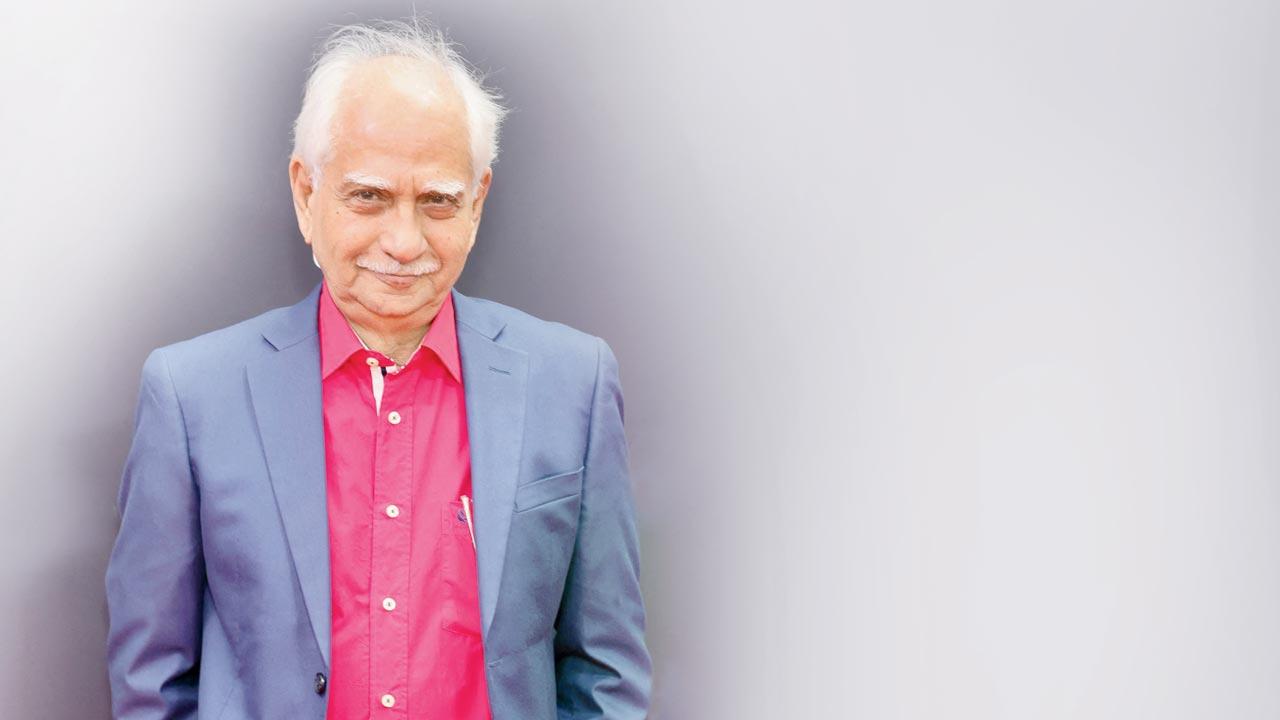
Komal RJ Panchal (MID-DAY; October 15, 2025)
For Ramesh Sippy, 2025 has been a significant year. The veteran filmmaker’s masterpiece Sholay completed 50 years of its release in August. Over decades, Sippy has carried the tag of the Sholay director. It’s something he wears with pride, but doesn’t let it weigh him down.
“I never felt any pressure to outdo Sholay. Every film must have its own identity. I don’t chase success; I chase inspiration,” he begins, when we, after over two months of chasing the filmmaker, sit down for a chat with him.
Inspiration has struck him again. The filmmaker, whose last directorial venture Shimla Mirchi released in 2020, is going back to the director’s chair.
“I’m developing a new project. It’s in its early stages. I’ve always believed in being completely sure of an idea before moving forward. Once I’m certain, you’ll hear an announcement,” he says, refusing to divulge any further details. While the buzz is that the project is an action film, he stays tight-lipped, only saying, “I am currently shaping it with writers.”
Sippy is understandably more forthcoming as we turn the lens on his 1975 classic starring Sanjeev Kumar, Amitabh Bachchan, Dharmendra, Jaya Bachchan, Hema Malini, and Amjad Khan. To mark the 50-year milestone, the movie’s restored version was screened at the Toronto International Film Festival. Many domestic film festivals too hosted special screenings. The response continues to move Sippy deeply.
“It’s overwhelming. When we made the film, we had no idea what it would become. I recently watched Sholay in Toronto with a full house, and the audience reacted exactly as Indian viewers did back in 1975. That was truly heart-warming.”
Very few Hindi films have managed to be as enduring as the classic. Ask Sippy the secret to the movie’s longevity and he points to its honesty.
“We kept it simple — drama where it was needed, humour and warmth where it belonged. Salim-Javed wrote a superb script, and the actors performed with sincerity. Add to that R D Burman’s unforgettable music, and everything just clicked.”
In today’s cinematic landscape, a film like Sholay would have spawned sequels and spin-offs. But Sippy never considered taking that route. “The culture of sequels didn’t exist back then, but more importantly, Sholay is fine as it is. After 50 years, the audiences react the same way. Why change something that continues to work perfectly? Some films should remain untouched.”
Sholay was like a big and successful startup idea of those days-Rohan Sippy
8:38 AM

Rajesh Naidu (THE ECONOMIC TIMES; September 8, 2025)
Poet and cultural scholar A K Ramanujan in his essay Three Hundred Ramayanas observes: “In India and in Southeast Asia, no one ever reads the Ramayana or the Mahabharata for the first time. The stories are there, 'always already.'” It would not be an unpardonable exaggeration if one uses this insight in the case of one of the greatest films of Hindi cinema: Sholay.
One does not watch Sholay for the first time. One hears, reads, laughs and celebrates Sholay for almost anything—causes, agendas, sarcasm, personal communication and pure entertainment. It is a force which unites the elite with the mainstream and creates cliques even among people who do not share a deep bond. It has created a language of its own in which people speak to communicate the intimate, the profound, the routine and the mundane with absolute precision without losing the context. So, Sholay is a national cinematic language which has remained alive since its release. And it will remain the national cinematic language till the time Hindi cinema is alive.
Recently, Sholay completed fifty years of its release. ET’s Rajesh N Naidu caught up with Rohan Sippy, an accomplished filmmaker himself and son of Sholay’s director Ramesh Sippy, to know his thoughts about the film. Rohan Sippy has directed critically-acclaimed and commercially well-accepted films such as Bluffmaster! and Dum Maaro Dum and web series such as The Office, Sandwiched Forever and Criminal Justice: A Family Matter. He also shared his views about his own works and the current situation of the Hindi film industry. Here are the edited excerpts:
The world is celebrating fifty years of the release of Sholay. What are your thoughts when you look back at the film?
I think it is marvellous how almost everything fell into place for the film. One must consider the time in which the film was made. They were working at a time of political emergency. People were paying income tax, which was as high as 97%. Then, there was entertainment tax which was as high as 177%. This means that doing the movie business itself was challenging and required a daredevil spirit. In this backdrop, there is a director and an able producer who have an ambition to make a film which is larger-than-life than any film made before it.
One can have writers who are at the peak of their powers. One can have a competent producer who had a unique vision, courage and conviction to go into unchartered territory. Yet, one can go wrong and fail. But they all succeeded. This is the most startling part of the story.
One must bear in mind that a lot of technical work of Sholay was done overseas. Technicians were flown to London. Then, there is such a huge cast. It is unimaginable to pull off such a film even today.
It is just the passion to do something special which is palpable in Sholay. They found the right collaborators. They were able to ride out so many challenges on so many different levels. In today’s parlance, going by the sheer confidence and daredevil attitude of the director, Sholay can be considered a Start-up Idea which paid off. A one-in-a-million idea which succeeded. But I don't think one could predict or foresee the kind of success which the film earned over the years. I think this is the case with most great films. A director may have vision, confidence and conviction. But no director can claim to know the recipe of success of a film.
You are closer to the film’s creator than any viewer by the virtue of being his son. There might be stages of your understanding Sholay. You have watched Sholay as a teenager. Then, as a young adolescent. Subsequently, as a well-established filmmaker. As a filmmaker, what have been your key learnings from Sholay?
I first saw Sholay when I was about four years old. It was a magical and overpowering experience. The experience lingered in me for a long time. As a teenager I studied abroad. I showed it to my friends. They also liked it. It has cut across geographies and generations including my daughter and her friends. For me, it is a mystery beyond a point. It has become part of India’s popular mythology. It is like one of our epics.
There are so many lessons within Sholay. Over the years, the film has evolved into a Bible in filmmaking. One comes back to the film for a solution to a writing problem in a script. There are lessons about how to create a world, build characters and focus on certain specific aspects of a scene.
I will give you an example. You look at the introduction of Gabbar Singh in the film. You can study the shot taking one by one and understand how the character is unfolding. There is so much unpredictability in the presentation of Gabbar Singh. You look at where the camera is placed when Gabbar is laughing or where the camera cuts suddenly when Gabbar is in an aggressive mood. Also, the whole drama that unfolds when his gun comes out. The amount of thought which has been poured into these scenes is so awe-inspiring that one does not ever absorb these thoughts in the scene in the first viewing itself. Even the scene where Jaya Bhaduri’s character returns the keys to Jay and Veeru. It is so specific and adds so much emotional depth to the film’s narrative.
Importantly, Sholay’s sound design is another special thing in the film. Many a time, one is tempted to watch the film only for its sound design. You listen to the background sound when Sachin’s dead body is brought back to the village. It is a lesson in bettering your screenplay through an effective sound design.
So, everything from performance to staging scenes to editing them and then, sound design, Sholay has lessons in almost every department of filmmaking.
What are the lessons in filmmaking you have learnt from your father especially in the context of Sholay?
I don't think I have had a sit-down discussion with my father about Sholay. The last thing I want to do is be the millionth person asking him about Sholay. But we discussed a lot about the writing process. From these discussions life lessons would emerge. Lessons about how to take on challenges and keep pushing even when there are a lot of things pushing you back. I learnt that one needs to have conviction in one’s vision and an uncompromising attitude in the pursuit of excellence even when there are easy ways to do things. But the biggest lesson I learnt from the discussions I had with my father is clarity of thought. One needs to have clarity of vision and then pursue it doggedly.
Another thing which I learnt from him is the ambition to be different and not go down a path that either everyone else is going down or something that you have gone down before. You look at his body of work. He has worked in multiple genres. From a love story like Andaz to an out-and-out comedy film like Seeta Aur Geeta to an action adventure like Sholay to a James Bond-kind film Shaan and then again returning to a different kind of love story with Sagar. He also did a different kind of drama version of Mother India in an urban setting through the film Shakti.
This ambition to go out and expand one’s own cinematic language has been a big thing for me. I have followed this in my own way. Apart from Criminal Justice, I did a sitcom like Sandwiched Forever which I shot in a five-camera set up. It was a new learning experience for me.
What was the actual premise with which Ramesh Sippy started Sholay?
My father loved Westerns. He grew up watching them. He also liked horses. Even my grandfather owned racehorses and enjoyed that part of that passion as well. So, my father always thought about this idea of making a film which is close to a western. He always thought: Why cannot we make a film like a western in India? So, I think that was the kernel of the idea of Sholay. Then, I think the discussion with Salim sahab and Javed sahab started. Subsequently, the core story of the film emerged. Then, they bounced the story off with my grandfather. My grandfather instinctively saw potential in the story.
I think at that time there were two films. One was Majboor, a complete script. And the other was this idea of an outdoor western kind of film which will be Sholay. Then this story kept growing big day by day organically. They realized that they would have to fill a big canvas. So, they kept on working because they instinctively knew it was a good idea. I think this is the process by which they end up making the film.
The film’s screenplay was written in sixteen days and in another sixteen days the film’s dialogues were written. So, in a month’s time they had pretty much something very close to the shooting draft and maybe a few scenes here and there were fleshed out later.
There are certain scenes in Sholay which may not be directly connected to the main plot. In that sense, the film's screenplay does not seem tight and a bit scattered. Yet, they are so entertaining that audiences do not realize that they are not adding much to the main plot. What are your thoughts about it?
Those scenes reflect the power of a director who is at the peak of his powers. He was such a daredevil director. He knew that he was taking a little liberty. But he was confident that he will be able to pull it off. It could have been a tighter screenplay. But then the impact would not have been the same. These imperfections and slight diversions make Sholay what it is. These scenes give the film its soul.
Also, there are certain dialogues in Sholay which provide just information. According to you, what elements made these dialogues so iconic?
I think those dialogues are like the cherry on the top of a cake. They sound like a distinct cymbal clash in a beautiful 100-piece orchestra. This is the impact of these dialogues. Everything else is working in a perfect concert. These dialogues make the film memorable. A viewer who comes out of the cinema knows these dialogues. For instance, think about the dialogue: Purey Pachaas Hazaar. It works because there is a lilt to it. In that scene, there is threat, fear and the crescendo of the scene is the dialogue. There is an emotional impact on the audience. I think it was the first time a separate Long Playing (LP) record of dialogues of a film was released. This shows the extent to which the audiences connected with the film. This took the film’s acceptance to another level.
Directing a multi-starrer film could be a challenging thing. There is always a concern about stars not receiving proper footage. According to you, did Ramesh Sippy face any such challenges?
I think my father had earned a reputation as a young, incredibly talented and visionary director before he embarked on the journey of making Sholay. He had delivered two hit films. A lot of actors wanted to work with him. He had developed relationships with big and talented actors such as Sanjeev Kumar ji, Dharmendra ji and Hema Malini ji by this time.
Mr. Bachchan was not in the successful phase of his career. But my father loved him as an actor. My father knew that because he is not at that successful phase it would be easier to handle him than someone who might be at the peak of their power. Then, Jaya ji came on board as she also liked the overall story. There was a certain way in which actors worked that time. They would not just focus on their roles. They would focus on two important things. First: whether they want to be part of a story. And the other is: whether the story of a film was worth telling. This is how actors worked that time. So, it was not a difficult task to bring together these big actors. Also, one needs to bear in mind that the story needed these big stars given its scale. The casting of the film can be summed up as the right person emerging at the right time.
I am sure you have watched films such as Seven Samurai, The Magnificent Seven and similar films which spawned the western genre. How do you assess Sholay when you compare the film with these great western or samurai films?
I think inspiration is always there. One is inspired by others. The great Japanese director Akira Kurosawa was inspired by pulp western books. Then, he in turn inspired American filmmakers. Subsequently, American filmmakers inspired us and others. So, there develops a tribe of storytellers. I think this tribe of storytelling tradition goes back to William Shakespeare. So many of Shakespeare’s stories have geneses or roots in other stories and events. Then, you go back to oral traditions. One picks up from there also. But it is not an easy thing to do.
In Hindi, there is a saying which goes: Nakal Ke Liye Bhi Akal Chahiye (One must possess skills to borrow things and create well and convince others of the originality of one’s creation). One can give the same material to ten people. Nine of these ten people may fail to figure out as to how to use it. But the tenth person will copy certain things from the same material, change some things and present it in such a way that the material would look original. Most of us are like that only. A large part of our learning a language or what constitutes culture is achieved by copying each other only.
So, I think it is not that important whether westerns inspired the people behind Sholay. The world of films is a stream which keeps giving and taking things from one storyteller to another. I think the important thing is the relevance of a story and its ability to connect with audiences. That is the heart of filmmaking.
A lot of acclaimed directors made their great films when they were quite young. Francis Ford Coppola made The Godfather when he was just 32. In fact, Orson Welles who made Citizen Kane at 26, once said ‘ignorance’ in filmmaking was the key thing which worked in his favour. Ramesh Sippy was 28 when he made Sholay. Do you think when a talented director is young enough the ability to do out-of-the-box things is quite high in comparison with a seasoned director who may be set in his or her ways of filmmaking?
Yes, I agree. The spirit of a film reflects the people associated with it. When directors are talented and young, they are not straightjacketed in their worldview. Whether you call it ignorance or confidence, the cowboy mentality that I can do it is always there. This also worked in the case of Sholay. My father and Salim-Javed were like a bunch of cowboys. Even the actors in the film had swagger. The way these people interacted with each other and conducted their lives off screen made them so interesting. It is reflected in the film. One does not see such kind of people today. That is why one does not see that spirit in today’s films.
Which is your favourite character in the film?
I think there are so many memorable characters in the film. People even remember a small character like Samba who had very few dialogues. But I connect the most with Mr Bachchan’s character. One wants to be like the character. He is the coolest thing in the film. It is the most memorable and entertaining character in the film. I like his wit, the way he did his action and the whole emotional arc of the character. The character is very relatable to me.
It is a great tragedy that Sholay did not get many awards. It got the Filmfare Award for Editing only. Do you think it deserved awards in other important departments of filmmaking, especially direction?
It is bizarre to me how a small group of people make a subjective call. In hindsight, it looks ridiculous how such a big film got only one award especially when one considers the fact that the film has stood the test of time. Even after fifty years of its release, we are talking and discussing the film. It shows that the film was quite ahead of its time. It proves Wittgenstein's ruler theory which says a lot about the ruler than the thing which the ruler measures.
As a filmmaker, today when you look at Sholay, do you want to add, edit or delete anything in the film?
If I can go back in time, then I would like to release the uncensored version of the film. There is so much poetry in the way the uncensored version of the film ends. It deals with the idea of revenge in such an interesting manner. It makes the characters realize the futility and hollowness of revenge. In the uncensored version, after killing Gabbar, Thakur goes to Veeru, consoles him and says to him: ‘You lost your best friend. I killed Gabbar. I don’t know whether I have gained anything?’ I think if they had released this uncensored version, then the audiences would have loved the film even more. This is the original version of the film. This idea was used very well at the end of director Shriram Raghavan’s film Badlapur.
Do you think a web series based on Sholay exploring in detail the past of its key characters can be made?
I think it will be fun to look at the film in a web series form. The central mythology of the film could be fun to play around. Yes, a long form storytelling based on the characters of the film will be an interesting thing to explore. One can dig deeper and create more out of the key characters.
Now, let us talk about your work. In its recent research by media and entertainment research firm Ormax Media, Criminal Justice emerged as one of the highly watched original web series. You have directed the last three seasons of the web series. What elements in the series convinced you to be a part of this series?
I had previously worked with Applause Entertainment on some episodes of the Indian version of series The Office. I have long-standing relationships with Sameer Nair and Deepak Segal (producers of Criminal Justice series). In fact, Deepak was the editor of one of my grandfather’s films, Pathar Ke Phool. When I was approached to direct one of the seasons of Criminal Justice, it felt like a natural fit. The first two seasons were produced in the UK. The UK version introduces a new female lawyer character while here we chose to continue with the character Madhav Mishra. It made sense narratively.
Directing a series has been a different experience compared to films. Films typically require more holistic involvement from directors early on. But for a series much of the writing is done before a director's involvement. It is often shaped through discussions with a platform and then a shooting draft is finalized. Our input is focused and more contained compared to the broad scope a film director usually has in films.
One practice that has become a tradition across our projects is conducting table readings with all the actors and key crew members. This process allows everyone to hear the script aloud, which is valuable because television work is oral and visual rather than purely written like a book. Table readings clarify many aspects and generate new ideas. They offer actors insight into their characters' emotional journeys, especially because shooting is fragmented over long periods. I found this collaborative approach particularly effective.
Criminal Justice appealed to me partly because I have not explored the legal genre before. It presented an exciting challenge and an opportunity to discover new creative rules for me. I have directed three seasons. I have seen how the show has evolved into its own format centred on the character Madhav Mishra. The character Madhav Mishra anchors the narrative much like classic legal drama characters.
It has been a rewarding experience to revisit the series multiple times. Each season introduces fresh cases, which helps prevent the show from becoming stale. This mix of familiar characters and engaging new investigations keeps the series relevant to audiences. Overall, the whole journey has been quite gratifying for me.
Are you working on a new film?
I am working on a script. I have been approached by producers for a couple of scripts. But till something is locked, it is impossible to talk about it. But I am trying something in a lighter space.
What is your assessment of the present state of the Hindi film industry?
These are the times of correction. One of the hallmarks of Hindi cinema used to be strong films featuring newcomers. Over the past several years, however, we seem to have moved away from that tradition. I am glad that Yash Raj has embraced it again, and I can already see the benefits. Hopefully, this approach will encourage many more filmmakers to follow suit. It shouldn’t be limited to a single genre either—the larger idea is to back projects with younger actors. After all, the audience largely remains young though we often forget that we have grown older.
Of course, this does not mean films must exclusively feature young actors. But it is important to invite them in and give them space. Saiyaara has done that very effectively, and I hope it sparks fresh excitement among producers and in the market to support such ventures. What is really needed now is new ways of thinking about how to make this happen. If this succeeds, then I hope to see many more such films by the end of the year.
Lastly, what are the challenges in the Hindi film industry? Do you think there is a lack of passion, funding or absence of directors in the right sense of the expression?
I think the expression that sums up the present situation in the Hindi film industry is: Skin in the game. In the earlier time, you had to have skin in the game. A producer was liable. He would put his own cash and credibility on the line. So, in a sense, the risks got evened out. It is not that they weren't failures. A director also realized the risks a producer was taking. A producer knew that he would lose home or office if things go wrong.
Think about the time when Rajshri Productions’ Hum Aapke Hain Koun..! was released. At that time, only mass films were working. But they put everything at stake. They decided that they will not sell the film. They decided to release the film in 36 screens. It was a huge risk. If the film did not work, then they would have incurred losses. They were liable for everything. But it worked. Then, there are instances when producers made mistakes too many times and they knew they were not going to survive.
And this system of having a personal stake worked not just on producers’ level. It worked across the value chain of filmmaking: sub-distributor, distributor, sub-exhibitor and exhibitor. This is how the filmmaking system effectively ran. Today, among other things, this system must sustain for better scope and future of films.
In recent years, the biggest shift which has happened is the people who are authorizing films. They don't have a personal stake or skin in the game in the entire enterprise of filmmaking. They are working for a large studio. And that responsibility which producers and other entities in the value chain of filmmaking shouldered is diffused. So, in that sense, things have changed.
50 Years of Sholay: How just another dacoit tale went on to become a fable
9:13 AM

Sholay was initially declared a flop and panned by critics. Now, the all-time blockbuster — celebrating its 50th birthday on Aug 15 — is regarded as the ‘best’ and ‘greatest’ film in polls. An exploration of how director Ramesh Sippy’s film lives in our heads through its dialogues and characters
Avijit Ghosh (THE TIMES OF INDIA; August 10, 2025)
Avijit Ghosh (THE TIMES OF INDIA; August 10, 2025)
It was a warm but amiable night in Bologna. By the time the open-air screening started at the north Italian town’s sprawling Piazza Maggiore, it was already 10 pm. Yet, at least 2,000 cinephiles, mostly Italians, had turned up. This was Sholay’s restored, uncut version — an intimidating three hours and 24 minutes in length — at the Il Cinema Ritrovato festival. “But the audience was glued, watching in pin-drop silence. When the film ended at 1.30 am, the cheering was incredible. Sholay is timeless,” says Shivendra Singh Dungarpur, whose Film Heritage Foundation has restored the film.
If the viewers’ reaction in Italy in June reaffirmed Sholay’s enduring appeal across countries and generations, an X post made by Iran’s Consulate General in Mumbai in July revealed the film’s abiding impact. “Many Iranians still associate #Bollywood with this epic,” it said, adding that a newspaper in Iran had published a full-pager commemorating the movie’s 50 years.
There’s something about Sholay. Even the biggest blockbusters eventually recede from memory. With director Ramesh Sippy’s multi-starrer, the obverse seems to be true. Sholay never left us. The movie breathes in our lives through its dialogues, which have become like proverbs, and lives in our heads through its characters. When anyone says, ‘Basanti’, we know who. In India, there’s only one Basanti. As filmmaker Mahesh Bhatt says, “Nations are not built by borders. They are held together by stories. Sholay has transcended cinema. It is one of the stories that holds India together.”
The film talks to different generations in different ways. For old-timers, Sholay is inseparable from their youth, a living memory of life as it used to be. For their progeny, and their progeny, it is a family fable they have imbibed like food, and consequently discovered on TV, internet or OTT. “Some films refuse to fade because they don’t just entertain us, they actually become us,” says Bhatt. The film is a connector.
How Gabbar got embossed in our lives
The marketing men of Polydor, a record company with the film’s rights, were critical to the tattooing of Sholay into our collective consciousness. In her award-winning book, journalist Anupama Chopra writes how Polydor executives, worried at the lukewarm sales of the music album, noticed the audience being captivated by Salim-Javed’s dialogues. Within a month, a 58-minute long-playing record was released. It turned out to be a stroke of marketing genius. A TOI article noted in 1976, “the earthy outpourings of the Sholay film track” has sold “phenomenally well”. Sholay was the first film that India heard as much as it saw.
Seventies India was an audio world. This was a time when the middle-class lined up to buy rationed sugar. For most, television was just a photograph shown to nursery kids to teach the letter, ‘T’. Even record players were restricted to a thin socio-economic band. India was primarily a radio country. Paan shop transistors would tune in to Radio Ceylon or Vividh Bharati through the day.
Against this backdrop, Sholay’s dialogues blared for months at homes, in shops, markets and fairs in Inner India’s small towns, kasbahs and mofussils. By repetition of listening, even pre-teens could recall every dialogue, just like multiplication sums. Some remembered the film by heart.
The first time this reporter saw the film at a theatre, the experience was mixed. A guy sitting in the row behind would pre-empt every dialogue. He stopped only after someone told him that all of us could do the same and there was no need to show off.
This was also the first film where the most popular dialogues were delivered by the bad guy, Gabbar, played superlatively by Amjad Khan, and not the hero. “The dialogues reached a transcendental level. They are proverbial, aphoristic, dramatic. And they are fundamental to an Indian imagination in a filmy sense,” says social scientist Shiv Viswanathan.
The dialogues became unforgettable because the characters were unforgettable. “Sholay is an archetypical memory. Every character from Gabbar to Basanti to Raheem chacha, is archetypical. They all create a culture, a memory and possibility of new imitations,” he says.
Even the smallest of characters haven’t been forgotten. “Keshto Mukherjee’s cameo of a barber named Hariram is still remembered,” says film director Anil Sharma.
Stories, real and apocryphal
Mac Mohan acted in over 300 movies. In Sholay, his presence was reduced to sitting with a gun on a faraway rock. He got to say just three words, “Poorey pachaas hazaar”. But Sambha, his character’s name, became his lifelong identity. Just like Viju Khote, the recipient of Gabbar’s simple but scary one-liner, “Tera kya hoga, Kaalia?”.
In a 2015 interview, Khote told this reporter that the temperamental horse he rode threw him off at least six times. His remuneration for the aches and bruises was just Rs. 2,500. Fortunately, he did not break any bones.
Real or apocryphal, there is another story, wherein a groom refused to take the sacred vows unless the film’s dialogues were played. The missing record was brought and played. The wedding was solemnized.
For a film that has turned into lore, it is hard to believe that Sholay was dismissed as a flop in the early days of its release. In his autobiography, And Then One Day, actor Naseeruddin Shah writes about watching Sholay, running in its second week, at a “half-empty” theatre in Andheri, Bombay. Shah also writes that the blame for the failure was pinned on newbie Amjad.
Sharma, director of the megahit, Gadar, recalls coming home after watching the movie and being told by a film industry client of his father, an astrologer, “‘Sun rahe hain film flop ho gayi. Log Sholay ko Chholey (chickpeas) bol rahe hain.’ I had liked the film and told them so. But they were dismissive and said, you are too young to know about the film business. We got into a row.”
Sharma also loved the film’s impressive stereophonic sound. “When the coin was tossed and tinkled after falling on the ground, people would start looking for it beneath their seats,” he remembers.
Critics admitted to Sholay’s technological excellence but roundly panned the movie. The Illustrated Weekly of India (now defunct), a sister publication of The Times of India, said in its review: “There is nothing in the script of Salim-Javed to make this ‘the greatest story ever told’, it is just another dacoit tale on the lines of Mujhe Jeene Do, Gunga Jumna, Mera Gaon Mera Desh.”
The Statesman (New Delhi edition) said: “For nearly four hours, this film assaults one’s senses psychologically, emotionally and at the end almost physically.” Sunday Standard called it “a shaggy dog Western, sporadically funny, ludicrously heroic, monstrously violent and sprawled in loose limbed abandon”. Most reviews, barring Weekly, also ignored Amjad’s performance. The film received just one Filmfare award — for M S Shinde’s editing.
But over the decades, the film has been reappraised. In a classic case of overcompensation, Sholay was declared ‘The Best Film of 50 Years’ by Filmfare in 2005. In 2002, a British Film Institute poll hailed it as the ‘greatest’ Indian film ever made. The good times continue. “The movie is set for gala screenings at festivals in Toronto, London and New York in the coming months,” says Dungarpur.
But the critical re-evaluation aside, Sholay has become more than a movie, it has become a myth. Sharma sums it up, “Sholay now belongs to the public, not to the maker. The film has ruled over people’s hearts for 50 years. It will continue to do so for another 50 years.”
----------------------------------------
‘Fingerprint of Emergency etched in Sholay’s ending’
Sholay was released during the repressive Emergency, which lasted 21 months. Filmmaker Mahesh Bhatt says that in a symbolic sense, “Thakur, whose hands are chopped off, represented the common person’s ‘wounded conscience’. Like the people, he is ‘hungry for justice’ and helpless.” Bhatt was also shooting with Sanjeev Kumar, who memorably played ‘Thakur’, for Vishwasghaat (1977) at the same time. It is well known that Sholay’s ending, where Gabbar is arrested by cops, was forced upon the filmmaker by the censors. In the original ending, now brought back in the latest restored version, the villain meets a gory death.
“With that imposed ending, the fingerprint of those draconian times is etched on the enduring commercial classic, a reminder of the time of repression we lived in,” says Bhatt.
— Avijit Ghosh

Chandra Barot deserved far more credit for Don-Javed Akhtar
10:25 AM

Renuka Vyavahare (BOMBAY TIMES; July 21, 2025)
Veteran director Chandra Barot, 86, best known for making the 1978 cult classic Don, passed away in Mumbai. The filmmaker was battling pulmonary fibrosis for the past seven years. Barot’s directorial debut Don was written by Salim-Javed (Salim Khan and Javed Akhtar). The film, which featured Amitabh Bachchan in a dual role, also starred Zeenat Aman, Pran and Helen. The film, which continues to be a landmark in Hindi cinema, was remade by Farhan Akhtar in 2006 with Shah Rukh Khan in the lead. Barot began his career in the Hindi film industry as an assistant director with actor-filmmaker Manoj Kumar.
Remembering Chandra Barot, Javed Akhtar told Bombay Times, “I remember meeting him around 12-15 years ago at an event. It was a fleeting meet and we promised to meet each other soon which sadly never happened. I will always remember him as the most gentle, easy-going man with a great sense of humour. He had no ego hassles and was extremely humble. Working with him and cinematographer Nariman A Irani on Don, was a great experience.”
‘Don was perhaps one of Amitabh Bachchan’s first solo hits’
The 1978 action-thriller went on to become a massive hit, cementing Big B and Salim Javed’s domination and stardom. However, Barot largely stayed out of the limelight. The acclaimed screen writer and lyricist explained, “It’s strange how the industry operates. Don was immensely successful. I remember he was planning to work with Vinod Khanna after that. There was a big announcement, but the film didn’t take off. He was also in talks with Dilip Kumar. I don’t know what happened there. I am not sure if this is the right time to say this, but he deserved far more credit for Don than he received. It was perhaps one of Amitabh’s first solo hits. Most of his previous hits were multistarrers.”
‘Don didn’t mull over melodrama’
Speaking about what made Don a cult classic, Javed saab added, “Don was the first caper of Hindi cinema. It was one of its kind. Like other films of those times, Don didn’t mull over melodrama, had no emotional backstory or rely on histrionics. I remember Chintu (Rishi Kapoor) saying in his classic tongue in cheek way, ‘The whole film looks like a trailer!’ What he meant was the film had that ‘on the move’ tempo and it was all Barot’s vision. He invented that style and that to me was most unique. It was a well-made film.”
‘I will always be loyal to my Don’
Don was remade by Javed saab’s son Farhan years later, but he says in all honesty, “I will always be loyal to my Don. Don for me is the 1978 original, a film written by Salim-Javed. The films made later by Farhan are definitely successful and well-made, but I will stay loyal to my film.”
50 years later, Sholay to return to cinemas in restored version
9:36 AM
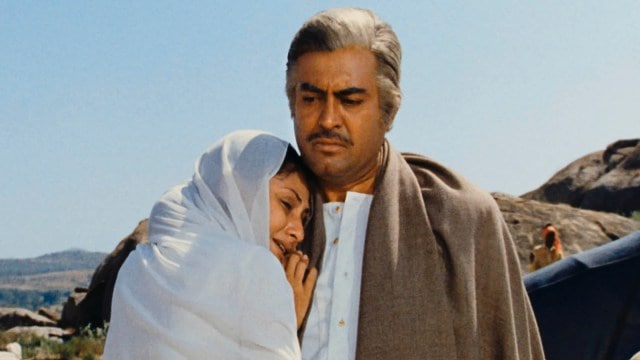
Niharika Lal (BOMBAY TIMES; June 23, 2025)
This August, Sholay will turn 50. And the celebration has already begun - thousands of miles away from Ramgarh - in a theatre where Fellini once ruled. Next week, Italy is hosting the world premiere of the newly restored, uncut version of Ramesh Sippy’s iconic film at II Cinema Ritrovato Festival.
When it was first released in 1975, Sholay turned into a phenomenon - running for over five years in some theatres. While Dharmendra calls it “duniya ka aathwan ajuba,” Amitabh Bachchan says, “At the time, I had no idea it would be a watershed for Indian cinema.”
Now, five decades later, the film is returning to theatres in a restored version. As it prepares for its comeback on Indian screens this August, we take a look at how the restoration came to life.
Shooting for Sholay was an unforgettable experience: Amitabh Bachchan
Reminiscing the film, Amitabh Bachchan says, “Some things in life remain permanently etched in your mind. Sholay is one such film. Shooting for the film was an unforgettable experience, but at the time I had no idea that it would be a watershed for Indian cinema. Its dramatic change in fortunes from being declared an unsuccessful venture, to its record-breaking box office run was an emotional rollercoaster for all of us.I hope that even 50 years later, the film will capture the imagination of new audiences across the world.”
Can’t wait for Sholay to begin its new lease of life: Shehzad Sippy
Talking about the restoration, Producer Shehzad Sippy, shares, "It has taken us three years, but we were able to find the original ending and some deleted scenes that the world will see for the first time at the grand premiere at the Il Cinema Ritrovato Festival in Bologna. I can’t wait for ‘Sholay’ to begin its new lease of life.”
‘This world premiere in Italy is a recognition of Sholay's place in global cinematic history’
“Sholay is often described as the greatest Indian film ever made,” says Shivendra Singh Dungarpur, Director, Film Heritage Foundation. As he talks about the restoration, he says, “I know every frame and every dialogue of the film by heart. Sholay was a masterpiece of passion that generations of Indians have loved and seen time and time again. Despite the fact that we could not use the original camera negative and that not a single 70mm print survives, we have left no stone unturned to ensure that this historic film has been beautifully restored. The Il Cinema Ritrovato Festival is renowned for its dedication to showcasing restored and classic films. This world premiere marks not just a celebration of a film, but a recognition of its enduring power and its place in global cinematic history."
I am thrilled to hear that the film is being restored: Dharmendra
I am thrilled to hear that the film is being restored and I am sure it will have the same success as it had 50 years ago. Who can forget the dialogues of Salim-Javed and the direction of Ramesh Sippy? So many scenes have gone down in the history of Indian cinema.
The restoration over three years
- In 2022, Shehzad Sippy began discussions with the Film Heritage Foundation (FHF) to restore Sholay
- Original 35mm camera and sound negatives were found in a Mumbai warehouse. Additional film elements were located at Iron Mountain in the UK, with support from the British Film Institute (BFI)
- Reels from Mumbai and London were sent to L’Immagine Ritrovata in Bologna for restoration. The original camera negative was too damaged to use. The team worked with interpositives from both cities
- A colour reversal intermediate found in London included the original ending and two deleted scenes
- The FHF also sourced the original Arri 2C camera used to shoot the film. With no surviving 70mm prints, veteran cinematographer Kamlakar Rao, who had worked alongside Sholay's DOP Dwarka Divecha, was consulted
- The final restored version combines two inter-positives and two colour reversal intermediates, bringing back the director’s original vision, including the lost scenes and original ending
Did You Know?
The original ending and previously deleted scenes that were not part of the widely distributed theatrical cut of Sholay. They have been included in the restored version.
After talking about breakfast, Javed Akhtar said, ‘Achcha, abhi aapko shot mil gaya mere rone ka’-Namrata Rao
3:20 PM
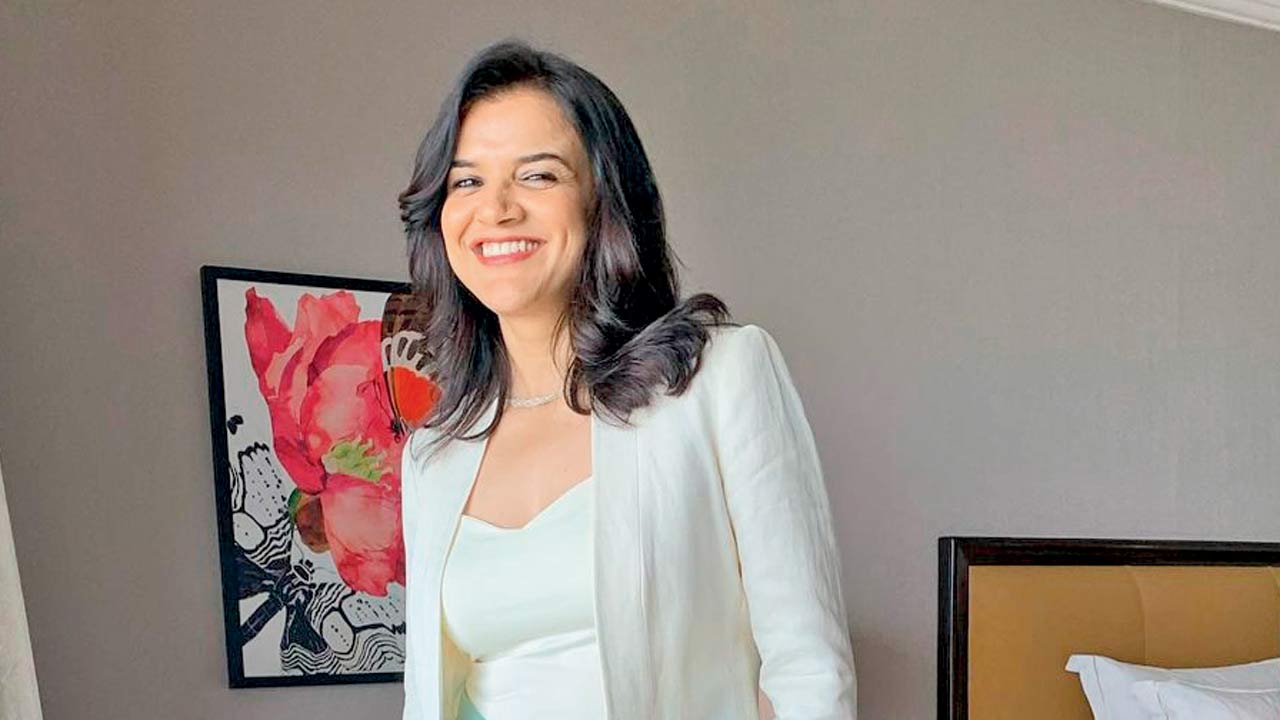
Angry Young Men director on how the docu series taps into the ‘cool’ side of Salim-Javed; says industry stalwarts have yet to pen their last promised script
Mohar Basu (MID-DAY; August 23, 2024)
Everyone has a favourite Salim-Javed film. Even Namrata Rao, the director of Angry Young Men, a docu-series that tells the story of Bollywood’s most successful screenwriter duo, Salim Khan and Javed Akhtar. She says, “Deewaar [1975] would be my favourite film, but I also love Shakti [1982].” It certainly is hard to pick, considering the duo delivered 22 blockbusters.
Together, the two writers shaped a glorious chapter of Hindi cinema. Rao, one of the industry’s most successful editors, has turned director to bring that era alive again. She worked on the Prime Video offering for three years. It all started when Zoya Akhtar, with whom she had worked on Lust Stories (2018) and Gully Boy’s (2019) songs, shared Angry Young Men’s idea with her.
“I was editing Lust Stories [2018] with Zoya. She told me then [that she had this idea]. I was very taken even then. In December 2020, she asked me if I wanted to direct it.”
The stalwarts collaborated for more than 15 years, giving us gems in Sholay (1975), Don (1978), Trishul (1978) and many more. When making a documentary that charts their career, how does one even start to make sense of such vast material?
“With a chart of their chronology,” replies Rao. “First, the anecdotes of their lives in the public domain were sought out—what was their process, the interesting things they did together and how they parted. But when we started interviewing them, the story changed. What was interesting was to tap into their personality. They are cool guys, they are badass. They dreamt big and made it happen. Like Javed saab says, ‘I didn’t think this wouldn’t happen; I always thought this could go in my biography.’ I found it beautiful how they have aged, from their young photos to the last photoshoot.”
Anyone who has seen the documentary will agree that it is true to its two subjects. The fact that it’s not a piece of glorification comes from them.
“They symbolize the wisdom about success and failure, and what it means as you age! They know storytelling better than any of us. So, they have the ability to offer what I would want. I remember when we shot the scene where Javed saab chokes up about his breakfast; he then makes light of it within minutes, saying, ‘Achcha, abhi aapko shot mil gaya mere rone ka.’ I was taken aback when Salim sir spoke about his mother because I got an insight into the vulnerabilities of this rough and tough man. They own their lives, their failures and successes, and even that they fu**ed up! I discussed a lot about Sholay [1975] with them—how they showed that a widow could be remarried, but didn’t give her a happy ending. They said, ‘You can’t push the envelope all at the same time. You first bring in the idea and then you normalize it. The story of Sholay required a tragedy to make it as big!’”
After 80-plus interviews—ranging from Amitabh Bachchan to Karan Johar, from Salman Khan to Farhan and Zoya Akhtar—Rao had 800 hours of footage. But she remained loyal to the storytelling over her favourite films. The only criticism is that Angry Young Men doesn’t have much for those who know them already.
“At the end of the day, the story represents them. As they got candid, I realized their mantra is: bolo yaar, aage dekha jaayega. That rubbed off on me. I’ve never seen their kind of confidence in anyone. That you can believe in something and stand by it, whether it goes your way or not, is what I loved about their story.”
We end the interview with two important questions. First, why did she not show them together?
“That was always the idea. We started in the pandemic when movement was limited. It wasn’t easy to shoot two people of that age. Then we fell into a pattern. I enjoyed catching them in their space. The last thing we shot was the photos when they went to Shivaji Park to inaugurate Diwali lighting. We shot at Raj Thackeray’s house!”
And is the last script of Salim-Javed happening any time soon? “Everyone at the première had that question. I can tell you they aren’t acting on it. But they are angry young men who do what they want to; maybe just as unexpectedly, they will get back someday!”
Vivek Agnihotri calls out those taking ‘public humiliation’ from stars
3:59 PM
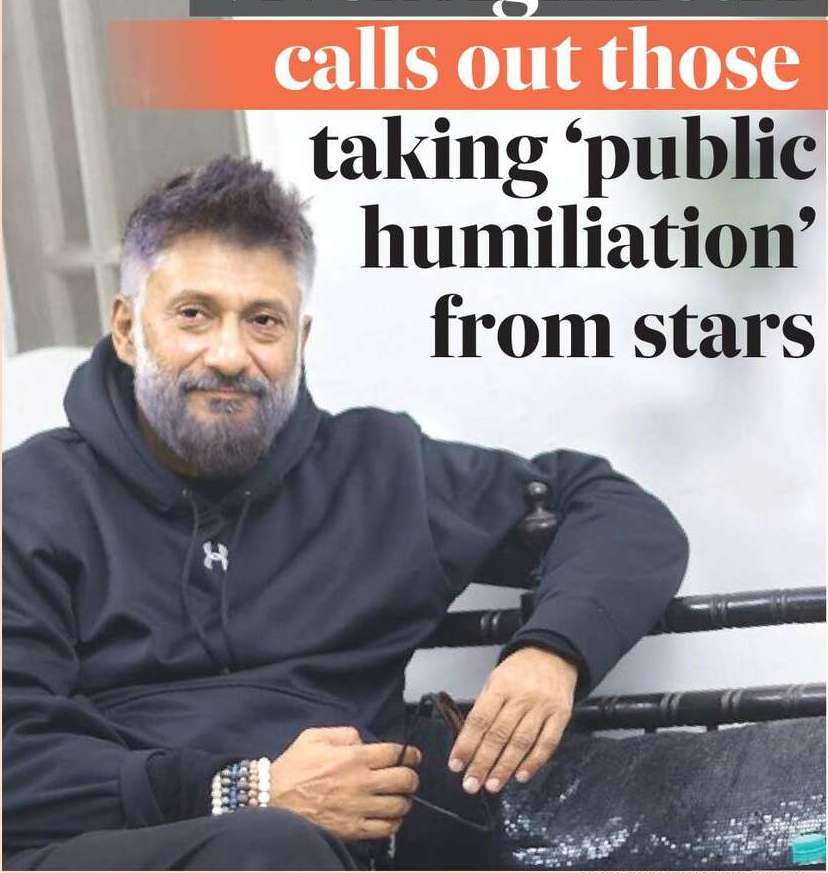
Navya Kharbanda (HINDUSTAN TIMES; May 5, 2023)
Director Vivek Ranjan Agnihotri recently lashed out at film award shows for using actors’ pictures while nominating directors for films. The director, in a tweet, “politely refused to be part of these unethical and anti-cinema awards”.
Agnihotri feels that often, directors and writers lose out on recognition and public adulation to stars despite putting their heart and soul into films. “These awards are not at all a basis to recognize or define my work. In fact, these awards celebrate mediocrity and incompetence. They just call different artistes to attract the audience and these awards have got nothing to do with merit,” Agnihotri says.
Continuing his point about the use of actors’ faces instead of those of directors, he adds: “If filmmakers who are institutions in themselves have to be subordinate to a star, then it’s unfair. I’m surprised why no writer and director ever objected to it.”
The Kashmir Files (2022) director is disappointed with filmmakers who he feels fail to take a stand and readily get dictated terms to. He says, “Some people are dying to go everywhere with stars. When directors themselves are ready to become slaves to stars, take public humiliation [from the latter] with a smile, then how will you have any respect?”
This is an issue that has always lingered in his mind, and Agnihotri shares, “I once read in a newspaper that Salim-Javed (screenwriters Salim Khan and Javed Akhtar) would refuse to do films if their name was not featured alongside the stars of the film. Before that, in Bollywood, the writer’s name was always absent.”
The 49-year-old says he’s also fighting on behalf of all unsung professionals and specialists in the business, from costume designers and editors to VFX artistes. “All the technical awards (at award shows) are done before the show begins, so that nobody gets to see the so-called [non-glamorous] side of the film industry. I’m fighting for all these people,” he asserts.
Bollywood hasn’t paid much attention to its writers after Salim-Javed, says Prakash Kapadia
8:29 AM

Soumya Vajpayee (HINDUSTAN TIMES; April 17, 2022)
He’s been the dialogue and screenplay writer for films such as Devdas (2002), Black (2005), Saawariya (2007), Bajirao Mastani (2015), Padmaavat (2018) and Tanhaji: The Unsung Warrior (2020), among others. But Prakash Kapadia feels that despite all the recognition he’s received for his work over the years, there’s a lot that needs to change in the Hindi film industry as far as the valuation of writers is concerned.
“I think the industry needs to trust its writers more by giving them the respect, credit and remuneration they deserve,” says Kapadia. He adds, “Nowadays, when a lyricist or music director composes a song, they get royalties each time the track is played, but what about the writer? There is a saying in the film industry, ‘Jo dikhta hai, woh bikta hai’, but I want to ask, ‘Jo likhta hai, woh kahan dikhta hai?’ A writer gives the entire story, screenplay and dialogues even before a movie starts. Big buildings look good, but they stand because of their strong foundations. Movies look beautiful, but they work because of their content.”
Having worked extensively with filmmaker Sanjay Leela Bhansali, with Gangubai Kathiawadi being his latest work as a dialogue writer, Kapadia enjoys associating with the filmmaker. “It is always an intellectual pleasure to work with a director who knows his work and understands the pain of a writer. Like me, he (Bhansali) also always wants to put his best foot forward, so we play devil’s advocate for each other. That’s how we deliver our best work,” he shares.
A satisfied man, Kapadia feels that when the audience laps up his work, it’s a win for him: “I count each film I’ve written as my credit. My films should reach the audience and that is my achievement. If my film, its director, actor or producer wins an award, I am a part of it (the win), too. Bollywood hasn’t paid much attention to its writers after Salim-Javed, but I hope I scenario changes for the better.”
When I was writing for TV, the idea was not to have the same conversation-Varun Badola
9:49 PM
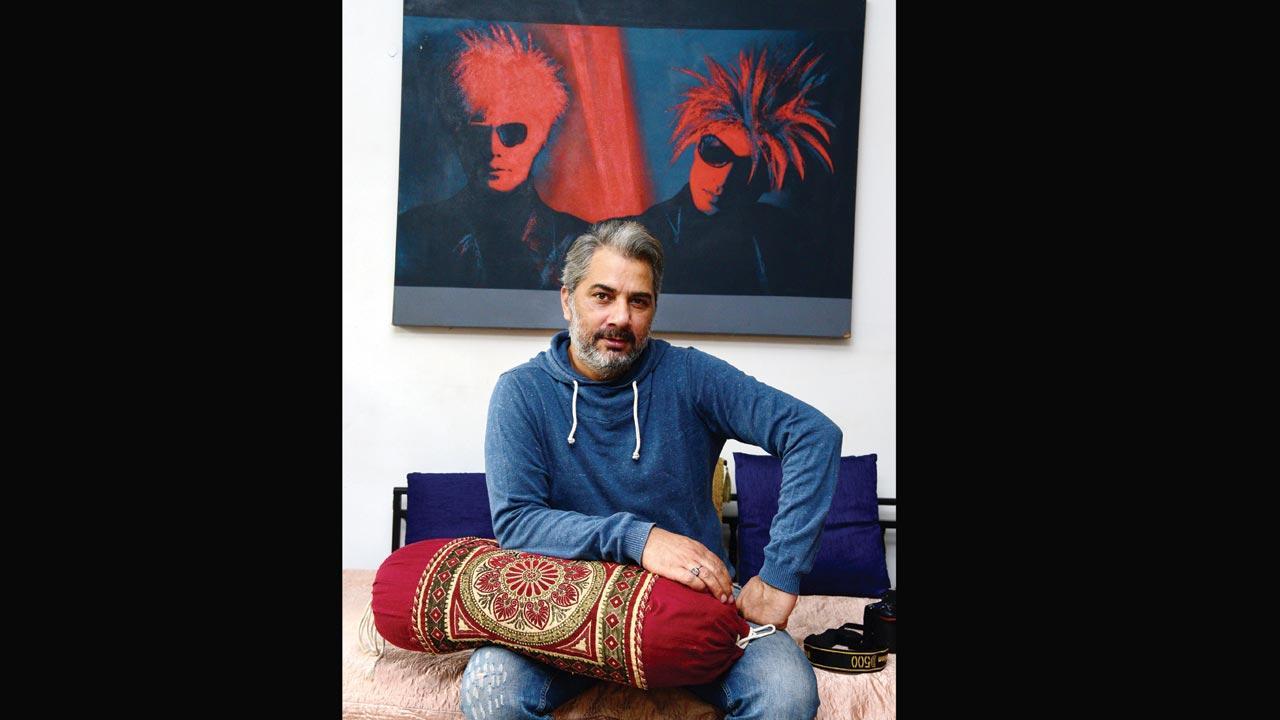
Actor Varun Badola who turned dialogue writer for the recent web show, Yeh Kaali Kaali Ankhein, speaks of disassociation, willing suspension of disbelief and enjoying his simultaneous careers equally
Sucheta Chakraborty (MID-DAY; January 23, 2022)
“The way Goldie [director, writer and producer Sidharth Sengupta] and I work is that he sends me an open file with the screenplay; I just push the space bar, create space for myself and start writing dialogues,” says actor Varun Badola, known for his work in television serials like Astitva...Ek Prem Kahani, Koshish - Ek Asha and Des Mein Nikla Hoga Chand. Badola admits that he writes primarily for friends like Sengupta and hints at the organic nature of this working partnership. Besides being a well-known face in the Indian television circuit, Badola is also an accomplished dialogue writer, having worked for prominent web shows including ALT Balaji’s Apharan and Undekhi on Sony Liv.
Assisting Tigmanshu Dhulia in Haasil and Charas when he was only 22, and functioning as his additional dialogue writer helped him learn the ropes, shares Badola, now 48. It was an experience he put to good use when he was roped in to write episodes and scenes for Astitva, Koshish and Ek Chabi Hai Pados Mein later. It was his work on the latter which Sengupta came in to direct, that he believes got him the Apaharan job in 2017, a show which Badola believes holds some of his best work.
The two writing processes, however, have been starkly different. In television, Badola explains, one could be writing the same situation five times over. “When I was writing for TV, the idea was not to have the same conversation, the same words, but to think of something new which was difficult, because one needs to have more ideas.”
The writing for web shows on the other hand, needs to be taut and precise, he says. So, does he prefer one format over the other? “I have never written for personal satisfaction or achievement,” he responds. “It’s something to do with the way we’ve been brought up. The idea is to get the job done. Writing a good scene is just about that sometimes.”
Among writers he has admired over the years, the Salim-Javed pair still stands out, as the actor-writer recalls a scene from Don where the character’s release from jail is accomplished in less than 20 seconds. “Because they have already established that Don is so [influential], there is no need for explanations about security lapses, for instance,” he points out. “Bas story aage bhagao”. “If anyone has used willing suspension of disbelief to its fullest, it has to be them.”
At the same time, in spite of Hindi cinema’s dependence on such stellar writers, Badola is quick to point out how this creative sect in our country still does not get the credit or respect it deserves. Badola himself however refrains from writing screenplays and stories as those would take up too much time and prevent him from dedicating his energy to acting. “I don’t want to give up on acting as I love the craft. The idea [ultimately] is to have fun [with both].”
The years have taught him to make the conversations he writes, more precise although he hasn’t consciously thought of growth in spite of having practised the craft for so many years. “The charm of writing a dialogue and of doing something new would be completely lost then,” he notes. At the same time, there is no strategising involved. “When I write a scene, I still write everything that comes to my mind and then we decide what stays and what goes,” he says.
For a creative individual whose simultaneous careers have frequently collided—he has spoken lines he had himself written in shows like Astitva—Badola hasn’t found one art to outweigh the other. “I am in love with the whole process,” he declares. There is also a need to disassociate oneself from one’s writing, he points out, because as an actor he may have visualised a scene differently from how another actor chooses to play it. “If everybody is acting to your whims and fancies, then perhaps all the actors will start looking the same,” he observes. “[The point is to] never get too emotional about your creation.”
Salim-Javed documentary is about how they created the brand of star writers that the industry could never replicate-Farhan Akhtar
8:10 AM
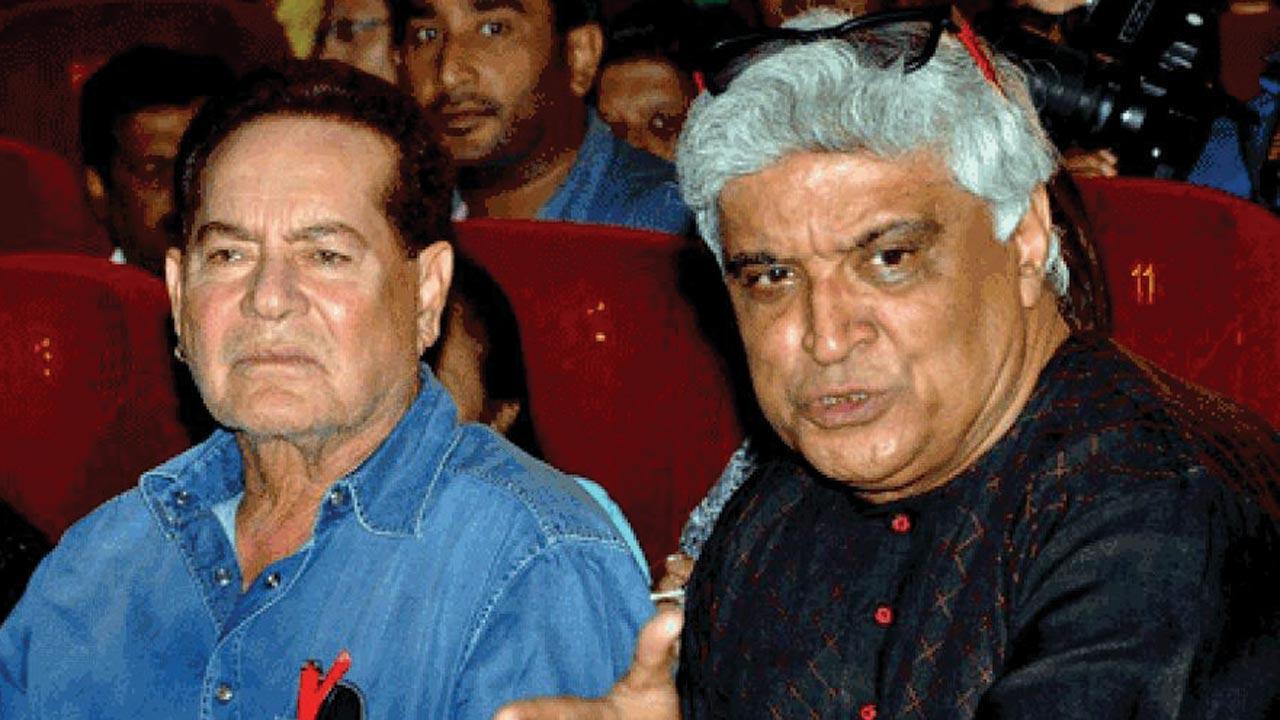
Farhan Akhtar, who is backing Salim-Javed documentary with sister Zoya Akhtar and Salman Khan, says project will decode the magic behind the duo who revolutionised ’70s Hindi cinema
Uma Ramasubramanian (MID-DAY; July 21, 2021)
With the OTT boom taking the industry to a phase where writers are ruling the roost again, it may be the perfect time to celebrate Hindi cinema’s most prolific writer duo — Salim-Javed. Last month, Salman Khan, Farhan and Zoya Akhtar announced that they are joining forces to produce Angry Young Men, a documentary on the life and times of their writer-fathers Salim Khan and Javed Akhtar. How did the ‘angry, young man’ come into being? Did they harbour any doubt about Sholay’s (1975) ending? The documentary — directed by Namrata Rao, who has previously served as editor on Kahaani (2012) and Oye Lucky Lucky Oye! (2008), among others — will offer rare insights as it traces the golden period of the two writers until they parted ways in 1982.
Farhan, who has inherited his father’s cinematic vision and love for the written word, says the makers were brought together by their common vision — to understand the phenomenon that was Salim-Javed. “The narrative is about two people who came to the film industry from different backgrounds, how they got together and created this unbelievable brand of star writers that the film industry has never been able to replicate after they decided not to work together. It talks about what made them an incredible force in [Hindi cinema],” he says.
What started off as an individual project for the senior Khan developed into an elaborate affair with Farhan and Zoya coming on board. In the documentary, the formidable duo will deep-dive into their ground-breaking films such as Zanjeer (1973) and Deewara (1975). It will also study their deep friendship that was based on their love for writing and dialoguebaazi. In a recent interview, Arbaaz Khan — one of the producers on the project — was quoted saying, “Documenting their lives and careers would be a wonderful thing. It will be for posterity, not just for our family, but for film lovers.”
Utpal Dutt was a natural in front of the camera, a riot in the climax of Gol Maal-Bindiya Goswami
8:03 AM

Roshmila Bhattacharya (MUMBAI MIRROR; April 24, 2020)
 It’s been 41 years since Hrishikesh Mukherjee’s comedy of errors, Gol Maal, opened, on April 20, 1979, but for its leading lady, Bindiya Goswami, it seems like only yesterday. She can almost see herself as a 17-year-old, her co-star Amol Palekar standing across from her, giving her cues, and Dada sitting close by, instructing her on the emotions he wants her to express, while playing chess with one of his assistants. “He called me Bindi and would glance up occasionally to check if I was doing it right, then, go back to the chess board. He was very chilled out even though his knee was giving him a lot of trouble and he shot the film sitting down. I don’t know film kab khatam ho gayi, with absolutely no stress or pressure,” she marvels.
Bindiya goes on to recount that the filmmaker was very particular about two scenes featuring her, one in which she is trying to convince her father, Utpal Dutt, to let her marry the man she loves. And the other? “When Amol tells me, towards the end, that he will use a makeshift rope of bedsheets to get out of my bedroom. Nodding, I tell him, ‘Suno toh, I will wait for you in the car’, then, go up to the built-in wardrobe and return to him anxiously a couple of times with more ‘suno toh’, telling him to take care, before his exasperated expression has me scurrying out of the room,” she shares, saying Hrishida actually enacted these scenes for her.
Her favourite scene is her introduction, where, draped in a sari, a mangalsutra around her neck and a red bindi dotting her forehead, she is pleading with her lover not to desert her, reminding him that she has left everyone for him and is now carrying his baby. The last bit has her eavesdropping bua, Shubha Khote, dashing off with the news of her badnaami and Utpal Dutt turning up all agitated, only to learn she had been rehearsing for a college play. “That scene was so me that it came out very spontaneously,” admits Bindiya.
She remembers Amol as a quiet man whose measured speech was lightened up with with tongue-in-cheek quips. They have grown close over the years and Bindiya remembers visiting him in Pune for his 70th birthday, to which his wife Sandhya had invited all his school friends and leading ladies.
She has equally fond memories of Utpal Dutt, with whom she also worked in Basu Chatterjee’s Prem Vivah , which released in the same year, and later in Hamari Bahu Alka, husband J P Dutta’s favourite film. “Utpal Dutt was a natural in front of the camera, a riot in the climax where he chases after Amol and me, in a pair of pyjamas and vest, with his hair standing on end, through the bylanes of Juhu. The trio were masters of the craft, with Dada as one of the Gods of Hindi cinema. I got lucky landing this film with them as a teenager,” Bindiya exults.
Interestingly, script-writer Salim Khan landed up at the shoot one day, asking Hrishida if he could borrow Bindiya for half an hour. “I had bought Salim saab’s Mercedes and he knew my mother, sister and me well, and had also seen my movies. My mother and I accompanied him to Ramesh Sippy’s office that day. I later learnt that he had recommended me highly to him, and in 10 minutes, I landed Shaan,” she narrates, admitting that the action-thriller, one of the most talked-about films of that time, featuring Sunil Dutt, Raakhee, Amitabh Bachchan, Shatrughan Sinha, Shashi Kapoor and Parveen Babi, with Kulbhushan Kharbanada as the bald villain, was a huge break. “The film was written by Salim-Javed. They spoke to me about Shakti too, but eventually Smita (Patil) did that film.”
Gol Maal was shot in Hrishida’s own bungalow in Bandra and producer N C Sippy’s bungalow in Juhu. “I felt at home there as it was called Bindiya, named after his daughter. Now, the Bachchans live there and Bindiya bungalow is known as Jalsa,” she reveals.
Four decades have passed… Hrishikesh Mukherjee has passed away. Bindiya retired from films in 1986 and even Amol is an artist today, but Gol Maal remains evergreen. “There have been four Golmaals since, the title track has been borrowed for a sitcom, yet, the original remains pure gold. It’s a hit with every generation, including my own daughters (Nidhi and Siddhi). Even though I didn’t work very long, thanks to Khatta Meetha and my biggest hit, Gol Maal, people still remember me. It’s nice to know you left a mark and remain in people’s hearts,” Bindiya signs off.
I can’t say I got Zeenat Aman Satyam Shivam Sundaram-Manoj Kumar
7:27 AM

Roshmila Bhattacharya (MUMBAI MIRROR; November 22, 2019)
 I don’t claim to know her well. The only thing I remember from our one meeting at a suburban hotel when I had tagged along with my editor, was of her firing the waiter when he brought the tea because the milk was cold. By then, she had moved out of the spotlight, but Zeenat Aman was still every inch the diva.
The actress, who turned 68 on November 19, will be seen next in Ashutosh Gowariker’s period drama, Panipat, and still remains an enigma. To understand her better, I turned to Manoj Kumar saab because a plaintive Mukesh-Lata Mangeshkar duet from his film, Roti Kapda Aur Makaan, “Main Na Bhoolunga”, still resonates with me.
She played Sheetal, who’s in love with his character Bharat, but marries her rich employer, Shashi Kapoor, for the life of luxury he offers her. “It was a different role for her, with its saris and shades of grey. But right from day one, Zeenat was determined to perform better than what people were expecting from her,” shares the writer-producer-director-actor of the highest grossing Hindi film of 1974.
Interestingly, while he was scripting, Manoj Kumar saab had Sharmila Tagore in mind for the role. His publicist friend Gopal Pandey, whom he had narrated the script to, had narrated some scenes to Sharmila whose work he was handling. So,when he approached her, she told him she wanted to play the deglam Tulsi, the construction worker Bharat is drawn to after Sheetal ditches him. He left her apartment without committing and soon after, left for Delhi with his family. There, while at his farm, he wrote a four-page story about a father and son, which he made as Shor, with Nanda and Jaya Bachchan, in 1972. Roti Kapda Aur Makaan came along two years later, with Zeenat as Sheetal and Moushumi Chatterjee as Tulsi.
He recalls that for the film’s climax, he had taken four days from his artistes. “It eventually took 14 days to wrap, but Zeenat, who was a busy actress then, quietly juggled schedules and dates, giving me the time I needed. She had to hold back her tears and following instructions, impressed with her performance,” he raves.
 During the shooting of the film, he ran into Raj Kapoor at composer Laxmikant’s music room. When asked him, “How’s the girl?” he praised Zeenat, saying she was hard-working and determined to do good work. “Wonderful!” Raj ji exulted. Five years later, she was his Roopa in Satyam Shivam Sundaram. “I can’t say I got her the film,” Manoj Kumar saab shrugs.
However, there is one other film that he can claim to have got Zeenat. Nariman Irani, the cinematographer of Shor and Roti Kapda Aur Makaan, had suffered a financial setback and came to him for help. “I told him to get Salim Khan and Javed Akhtar to write a script for him. He could produce the film with my assistant Chandra Barot as the director. I spoke to Amitabh (Bachchan) and Zeenat who were working in my film and they agreed to act in it,” shares the veteran actor-filmmaker.
The film was Don. After watching a trial show, he suggested they incorporate two songs. “They added one, but even Amitabh agrees 'Khaike Paan Banaraswala' was my suggestion. The film was a blockbuster,” he says.
Zeenat also owes her make-up man to Manoj Kumar saab, who, after watching the first day’s rush print, instructed his make-up man, Krishna Dada, to do her make-up, before reshooting the scenes. “Zeenat liked her look so much she asked me if she could keep Krishna dada. She was shooting four shifts a day and I knew I would lose him. But I let him go, knowing he’d make good money with her and she would gain from his expertise,” he smiles, adding fondly, “Zeenat was a dedicated actress, I wish her all the best.”
Three generations of Jaaferi family - Jagdeep, Jaaved, Meezaan - speak up on entertaining audiences
8:19 AM

Three generations of the Jaaferis on what it takes to keep audiences entertained
Kunal Guha (MUMBAI MIRROR; June 9, 2019)
All of 80 years, veteran comedian Jagdeep has an elephant’s memory. Precisely half-a-century ago, he escorted his son to the premiere of his film Anmol Moti (1969) — the first Indian film to feature an underwater fight sequence —in which his character wrestles with an octopus. When the creature eliminates his character in the scene, his son Jaaved Jaaferi, barely six then, was reduced to a howling mess. “He felt his father was no more,” says Jagdeep, whose film career spans over 70 years. Ahead of his grandson, Meezaan’s debut in Sanjay Leela Bhansali’s Malaal, three generations of the Jaaferi clan collect at the patriarch’s Versova home to mull over their shared legacy.
Most know Jaaved as an accomplished actor, host and voiceover talent, the one who introduced Indian audiences to freestyle dance. But ask Jagdeep about his son’s earliest achievements and he returns to the filming of Wardat (starring Mithun Chakraborty) in Kashmir. At an after-shoot party, Javed, then just 15, beat the film’s baddie Shakti Kapoor in a dance battle. “Woh bola ‘kiske saath mukabla kara rahe ho?’” the veteran actor recalls. Looking back at the incident that occurred four decades ago, Jaaved, credits his youthful exuberance for the win. “I was in Class 10 then, and could dance for an hour non-stop.” He remembers being introduced to freestyle dancing on the streets of New York in 1983, while on a family vacation. “We came across street performers ‘body popping’ and ‘moon-walking’, and we were so mesmerised by their moves, we watched them for a whole hour, I remember.” On his return, Jaaved worked on mastering those moves, and, it proved a game changer at college fests — he topped the All India Dance Competition the following year.
Jaaved remembers accompanying brother Naved Jafri to nightclubs — “only during the day” — to put his skills to test. “We would brave muggy Mumbai afternoons to frequent a place near the airport called Take Off (later dubbed Go Bananas) every Sunday, dressed in shimmery outfits,” says Jaaved, who also remembers that his parents didn’t entirely approve of those ‘nightclub visits’. “Before disco became a thing, nightclubs had a negative connotation, because films depicted them as dens for sharab, jua and cabaret,” says Jaaved.
On becoming a parent, Jaaved says, he allowed Meezaan more room to keep up with his social calendar. “By my time, no one went out dancing though. Most of my friends would just go out for a drink,” says Meezaan, who played basketball for Maharashtra. He also attended New York Film School before dropping out to assist Sanjay Leela Bhansali in Padmaavat, an experience he describes as “a learning experience that no film school can possibly deliver”.
“I was well-versed with the industry and my parents prepared me for every job that comes being on the sets. I was told, ‘Even if someone says ‘chai laao’, you have to do it,’” says Meezaan, who will be making his debut in Bhansali’s forthcoming production. Javed was delighted and apprehensive about Meezaan’s decision. “I wanted him to complete the course. But then, Sanjay [Bhansali] convinced me that he would groom him,” says the concerned father.
While Meezaan’s entry into Bollywood seems meticulously planned, Jaaved’s was left more to chance. In his final year at RD National College, when he was the secretary of the drama club — and would hold a crowd with his immaculate impressions — he learnt about a casting call. “Subhash Ghai’s wife had seen me dance at college fests. So when he [Ghai] was looking for someone to play a suave villain, who could dance — something that was unheard of then — I decided to give it a shot,” he says about his debut film Meri Jung (1985), when he created quite a stir with his slick moves in the number Bol Baby Bol.
“Jaaved ke dance ne disco ko maar diya,” says Jagdeep proudly, who, for his part, got a head start as a child actor in films such as Afsana (1951) and Do Bigha Zamin (1953). His modest beginnings carved his socialist outlook — something he shared with filmmakers who he worked with at the time — K Asif, Guru Dutt, V Shantaram and Bimal Roy. “When Aar Paar became a hit, people asked Guru Dutt to throw a party at Taj Mahal hotel, but he refused. He said ‘I won’t host a party at a place where my workers will feel uncomfortable’. Eventually, the celebrations took place at a film studio,” he says, remembering the stupendous success of the 1954 noir comedy.
Jagdeep, who played a minor in that film, remembers how resourceful Dutt could be when it came to ironing out production niggles. “A mob of 500 had assembled in the garage where the song Sun Sun Sun Sun Zaalima was being shot,” Jagdeep recalls. “The crowd was making it impossible to get the desired shot. The ruckus even ticked off the garage owner who demanded that the shoot be wrapped up soon,” says Jagdeep. It didn’t help that the film’s female lead Shyama, a huge star then, was willing to shoot for only three hours. “So, Dutt asked cinematographer V K Murthy to set up his camera inside the car and experiment with angles and close-shots to ensure the crowd didn’t spill into the frame,” says Jagdeep. The end result was a number that was lauded for its avant-garde picturisation. “Necessity is truly the master of invention,” says Jaaved.
An enterprising maverick himself, Jaaved reinvented his career in TV after his son Meezaan was born in 1995. “When I moved to TV, people said only flop film actors turn to the small screen, but I was confident that I was connecting with the youth,” says the actor-turned-VJ, who engineered a new coolth with his ‘Hinglish’ speak. “They were saying ‘Yo’, but I flipped it, and started ‘Oye’.” Straddling music and film-based shows, Jaaved soon became the highest-paid actor on TV. “I was making a lakh per episode then,” says the actor known for his exceptional impersonations of virtually every Hindi film actor, as well as his original avatars, such as ‘Abdul Cutpiece’ and ‘Irani Boxer’. Like his son, Jagdeep, too, was known for his masterful impressions. “I would encounter these colourful characters while travelling by train and bus, and at Irani hotels, and adapt them in my onscreen avatars,” says the Jagdeep, whose iconic turn as Soorma Bhopali in the 1975 blockbuster Sholay turned him into an overnight sensation.
But Jagdeep modestly shifts the praise to Salim-Javed’s writing. “Javed would actually demonstrate the Bhopali twang, I only had to copy it,” says Jagdeep, crediting the writers for detailing the nuances of the quirky character. The character itself, he says, was borrowed from a theatre production the writer duo worked on 15 years prior to Sholay.
Today, as Meezaan enters the industry his father and grandpa have made a mark in, Javed feels his journey will be different. “When I got into films, the hero had a mould — he flaunted the same hairstyle for 10 years, and was different from the character actors. But today, the hero alters himself based on the character.”
He trusts his son will wear the Jaaferi name like a badge of honour. “When I came into the industry, I was known as Jagdeep’s son, and I am still proud of that tag. My father was a comedian, and I was introduced as a stylish actor who could dance. But then, you have to make it on your own.”
The Jaaferis will, no doubt, be keenly watching, like the rest of us, to see how Meezaan shapes his own identity.
After Salim-Javed, how many writers does the general public know of?-Nagesh Kukunoor
7:48 AM

Having helmed City Of Dreams, Nagesh Kukunoor on how Indian shows need to take giant strides to match global content
Letty Mariam Abraham (MID-DAY; May 7, 2019)
There's no mincing words when it comes to Nagesh Kukunoor. During our 25-minute chat, he displays his forthrightness as he argues that a film director is not necessarily the best choice to helm a web series. Or that Mumbai can hardly be a filmmaker's muse. Close on the heels of his show City Of Dreams dropping online, we catch up with Kukunoor to talk about films, web series and everything in between. Edited Excerpts From The Interview:
After a false start with The Test Case, you are ready for your web debut.
I have been wanting to tackle this format for about 15 years. I have been a huge fan of the original HBO shows before Netflix and Amazon took over. When OTT exploded in India, I attempted directing with The Test Case; that was not a satisfactory process. Thankfully, I re-connected with Sameer Nair [co-producer] for this show. It took me from August to October 2017 to finish [writing] it. Post that, I alternated between scripting with Rohit Banawlikar, directing alternate episodes, editing and producing. I wanted to explore every aspect of this format instead of sitting with a random credit of showrunner, which is the new catchphrase now.
What was your vision for City Of Dreams?
In my career so far, I have not written a single story based in Mumbai, or shot here. Visually, it is an unappealing city. The only kind of story that Mumbai lends itself well to is the gritty stuff, which is what everyone, including myself, has been doing. Rohit came up with the idea of writing something that is set in this city. It's a political drama that deals with different strata of society.
Is there a reason behind casting Marathi actors for a Hindi show?
The show is about a Marathi political family in Mumbai. The initial idea was to rope in Hindi actors. But as the discussions progressed, I felt that [Marathi actors] would lend authenticity [by way of] their pronunciation or occasional use of a Marathi phrase. For instance, there is a Muslim cop called Wasim Khan, played by Eijaz Khan. So when he does Salaam waalekum, it is perfect. Hats off to Applause [Entertainment, producer] for supporting me on this decision! Now, I want to trade all my
actors for Marathi artistes - they are disciplined and come to the set prepared.
Compared to international series, where do you think Indian shows lack?
We aren't doing well [in comparison to the West] and it stems from the writing. I don't think the calibre of directors in this country is any less than anywhere else. But we are hampered by the fact that the writing on offer is mediocre to terrible. [So, as a director] there is only so much you can do on set. Sacred Games stands out in that regard.
Do you think writers in India get their due?
They are truly the ignored lot; they have been treated like second-and-third-rate citizens in television. Thankfully, Netflix and Amazon are shelling out enough money for scriptwriters. But there has never been a pool of good writers in India. After Salim-Javed, how many writers does the general public know of? We need to get more writers and need to pay them more. I see that thought gaining ground slowly.
Kanika Dhillon convinces Mental Hai Kya team to list her name with director, producer in credit roll
7:41 AM

Mohar Basu (MID-DAY; May 3, 2019)
Finding herself among the select few writers who have their names credited among the top brass of filmmakers in the credit roll and posters of a film, Kanika Dhillon has Mental Hai Kya producer Ekta Kapoor to thank for the development.
Dhillon, who has films like Manmarziyaan and Kedarnath (2018) to her credit, reiterates the importance of film writers when stating that they shouldn’t be a “faceless cog in the creative process” of film-making.
“[Writers] pen the story, characters, emotions and the film itself. [We] are as much accountable for the success or failure of a film, and that’s how it should be. Ekta has always been among the producers who strongly believe in content creators. We had a series of discussions that spoke about the importance of writers, and how they must be given their dues, be it in terms of time, money or credit. I initiated the conversation, and [she] was willing to do it. It is one thing to pay lip-service, and another to show that you believe in what you say,” says Dhillon, wife to Mental Hai Kya director Prakash Kovelamudi.
Finding a spot on the film’s poster implies that there is more pressure on the writer to then deliver, she suggests. Even as the value that a strong screenplay holds is making itself evident at the box- office, Dhillon doesn’t believe we’re retracing the era where writers were the front when selling a film. “I don’t think it is easy to achieve what [Salim-Javed] have,” she says when we ask her of the prominence that the veteran writers held in their prime. “Their writing was capable of creating stars in a star-driven industry. A writer of this generation can only aspire to achieve what they have. But, we are collectively happy to set a precedent.”
While she credits Kapoor for the “firm and welcome step”, she adds that a number of film producers are also warming up to the notion of giving writers more importance. “Being a faceless name in a dark room should be a choice that the writer must make, not a condition that is set upon them.”
The industry had stopped giving me work-Javed Akhtar
7:42 AM

Javed Akhtar talks about receiving flak from the fraternity for supporting the Copyright Bill, mediocre scriptwriters, and his upcoming film Namaste England
Sonil Dedhia (MID-DAY; September 30, 2018)
After working for almost every day of your life (since the 1970s), you seem to have slowed down. Is it a conscious decision?
I didn't opt for retirement. The industry had stopped giving me work for a while. During the fight to pass the Copyright Amendment Bill [which ensured that writers, lyricists, singers, scriptwriters get an equal financial share in their work and not just the producer], I received support from the music fraternity, but was removed from the most popular writer's list [laughs]. Several filmmakers withdrew from me and I was not being offered films. Thankfully, things have changed in the last few months because I believe, producers and music companies have reconciled with the idea that the law has changed, and no one is going to be at the losing end. Composers and lyricists will get a better royalty, something that they truly deserve.
Being a veteran in this industry, did you expect to receive flak from the fraternity?
I had decided to speak up and if I had to pay a price for it, I was fine. It was my choice and I still stand by it. Even if people don't want to work with me in future, I am not going to hold grudges against them. I was guided by conscience and principles. It was great when the government and opposition unanimously passed this bill.
You have spent more than four decades in the industry. How do you look back at your career?
I have seen the highs and the lows. Both are important. Overall, it has been a satisfying journey. My only regret is my lack of discipline. Had I had that I could have achieved a lot more. But I haven't given up. I'm in competition with myself, but when I look at the mediocrity around me, I feel poignant. I am not saying that there are no good lyric writers, but I believe the charm is lost. Apart from a handful lyricists, nobody understands poetry.
Is that an observation over the remixes we've seen lately?
That is one of the pressing concerns. It is creative vandalism and bankruptcy. I don't understand the need to remix classic songs. Why is there a lack of self-confidence? Lyricists should be confident enough to give hit songs. Why do they feel the need to borrow? Besides that, these songs by Lata Mangeshkar, Mohammed Rafi, Kishore Kumar are our cultural heritage and must be preserved, rather than adding rap to it. Some things need to be respected the way they are.
Do you feel mediocrity has seeped into script-writing as well?
The script is the core of any successful project, but that concept seems lost. Films these days are made on magnanimous budgets, but only one per cent is spent on the script. You may shoot in foreign locales, add special effects and get the best actors on board, but without a good script, everything falls flat. Unfortunately, scriptwriters are paid peanuts. Everyone seems to be in a rush to announce their release dates. Writers need to be paid well and be given ample time to work on the material. When Pandit Mukhram Sharma [before our time] or we [Salim-Javed] wrote scripts, we commanded a position that compelled producers to pay the price we quoted. I wonder if writers today would be allowed to be that powerful or be given that position. Precisely why, I am not sure if we'll ever have another Salim-Javed. At the same time, it's interesting to see the variety of stories offered today, which was not available back in the day. Things are better in that aspect.
Do you feel the restriction on freedom of expression by some fringe groups force filmmakers to compromise on their work?
We have seen many unconstitutional powers in society take a stand and get away with it often. It is undemocratic and sad that the freedom of speech is lost. It's a law and order problem. I believe it is the responsibility of the government that the dignity of a prestigious body like the Censor Board needs to be preserved. Indian film industry is a huge organisation which generates a lot of revenue and employment, but the government tends to be cynical about our problems. There is a lot of callousness, carelessness, and jealousy involved, which needs to be looked into.
What stops you from writing a script?
Sheer laziness. My songs are doing well and writing them comes easy to me, which also gets me the appreciation and a lot of money [laughs], but I miss writing scripts. I have written a couple of scripts and am waiting to find the right people who would be passionate enough to make it.
It's been a while since your son [Farhan Akhtar] directed a film.
My guess is as good as anybody, but I feel he is finding pleasure in working as an actor or going on stage and performing for now. Direction is a serious job and there have been many times that he has toyed with the idea of getting back to direction, but I don't know what happened of it. He hasn't closed the doors to direction for sure.
Coming up next
Javed Akhtar, who had earlier written songs for Vipul Shah's Namastey London, is also penning the lyrics for the Arjun Kapoor-Parineeti Chopra-starrer Namaste England. "Vipul is an easy-going director and a dear friend. When filmmakers know what they want from a song and scene, it becomes easy to write, that's why I love working with Vipul. I also enjoyed working in tandem with Manan Shah [music composer]. He is young, talented and has a bright future."

Subscribe to:
Posts (Atom)