Showing posts with label Sachin-Jigar. Show all posts
Showing posts with label Sachin-Jigar. Show all posts
I feel composers ko aur thodi si freedom milni chahiye-Kumar Sanu
11:12 PM

Debarati S Sen (MUMBAI MIRROR; August 8, 2026)
Nearly three decades after Aankhon Se Tune Kya Keh Diya from the Aamir Khan starrer Ghulam, became one of Bollywood's most-loved romantic melodies, the iconic track has found a new life now with Aankhon Se Tune 2.0 (in the film Bhai Tera Star Hai). Bringing together the original voices of Kumar Sanu and Alka Yagnik with Palak Muchhal and Dev Negi, the recreated version introduces the classic to a new generation while retaining its nostalgic charm.
Aankhon Se Tune Kya Keh Diya has been recreated after nearly three decades. What was your reaction when you heard Aankhon Se Tune 2.0?
I originally sang this song with Alka ji, and hearing the recreated version after so many years has given me immense joy. It reminded me of the time when we first recorded it. The song became very popular back then, and seeing the recreated version connect with today's audience honestly makes my heart full. When we recorded the original, we never imagined that the song would stay with people for so long and come back in a new form years later. I have always been very fond of this song, and hearing it again brought back many memories of that time. I am happy that the song is reaching today's listeners as well, and I hope they give the new version the same love and affection that they have given the original over the years.
Your songs continue to be recreated for a new generation, often with electronic beats and altered arrangements. Do you believe these recreations help preserve the legacy of the originals, or do they dilute the emotion and craftsmanship that made those songs timeless?
Ye depend karta hai ki kaun bana raha hai. There are some composers jo original song ke soul ko intact rakh ke usme new elements add karke banate hai. Some composers retain the soul of the original while adding fresh elements to make it appealing for today's listeners. When that's done with sincerity, these recreated versions help the songs reach a new generation. I'm happy to see that happening because it gives classic hits a new life and makes people rediscover and fall in love with them all over again.
There is growing criticism that Bollywood relies too heavily on remakes because it has run out of original musical ideas. As one of the defining voices of the 1990s, do you think the industry today is taking the easy route instead of investing in fresh melodies and new composers?
I definitely feel new composers ko chance milna chahiye to create the kind of music they want. Aaj kal production houses ka pressure bahut rehta hai, aur purane gaanon ko recreate karna ek easy way hota hai sure-shot hit ka. That's because those classics had strong compositions, meaningful lyrics and soulful singing that stay with people for years.
Having said that, it's not true that original music isn't being made anymore. We have immensely talented composers like Mithoon, Amaal Mallik, Sachin-Jigar and Shashwat Sachdev, who have already proved they can create excellent original music. Bas unhe aur creative freedom milni chahiye. If they're trusted to experiment and express themselves, we'll hear many more memorable original songs.
If a filmmaker wanted to recreate one of your iconic songs today, what would make you say yes? Do you think original singers and composers should have a greater say in how a classic is reimagined?
The first thing is that the rights to most of these songs are owned by the music labels. So, anyone who wants to recreate them only needs permission from the label. Unfortunately, as singers, we don't really have much of a say in that process. What I would always request is that the soul of the original song should remain intact. You can certainly add new elements and give it a contemporary sound, but don't lose the emotion that made the song a hit in the first place. Audiences get upset only when their favourite songs are spoiled. Composers should remember that these classics are deeply connected to people's hearts, so they deserve to be recreated with great care and respect.
How cop goof-up let Sachin Sanghvi secure bail easily
9:53 AM

Court says police failed to provide Sanghvi with written grounds of arrest, as mandated by Supreme Court
Anamika Gharat (MUMBAI MIRROR; October 28, 2025)
Due to the investigating officer’s negligence and lethargic conduct, a Metropolitan Magistrate Court in Mumbai ordered the immediate release of music director Sachin Sanghvi of the popular composer duo Sachin-Jigar, terming his arrest “illegal and invalid.” The court found that the Santacruz Police failed to provide Sanghvi with written grounds of arrest, as expressly mandated by the Supreme Court, thereby rendering the arrest procedurally defective.
The police had detained Sanghvi in connection with a non-cognisable complaint filed by a 29-year-old singer, who accused him of establishing physical relations under the false promise of marriage and later coercing her into terminating a pregnancy.
According to the complaint, the woman alleged that she came into contact with Sanghvi through Instagram, where he offered her a music project. She claimed that he later developed a personal relationship with her, promising marriage after divorcing his wife, and had physical relations on multiple occasions in Mumbai, Budapest and Dubai between April 2024 and July 2025.
The police recorded her statement and registered an NCR, but before any legal opinion was sought to convert it into an FIR, the police took Sanghvi into custody and produced him before the court on October 23. On the same date, police informed his family about the arrest, although they failed to mention details of the case to the accused.
During the hearing, PSI Prakash Rathod, the investigating officer, was present along with the accused, who told the court that he had “no complaint of ill-treatment”. Police sought seven days of police custody, stating that “the offence is serious in nature and requires detailed investigation”.
However, the defence counsel for Sanghvi argued that the arrest itself was illegal as the police had not informed the accused of the grounds of arrest in writing, relying on the SC’s judgment in Vihan Kumar vs State of Haryana (2022). The magistrate perused the case diary, remand papers, and notice issued under Section 47(1)(2) of the Code of Criminal Procedure (CrPC).
The court observed that while the notice mentioned the crime number, section, and name of the informant, it did not specify the actual grounds of arrest. On inquiry, the investigating officer admitted that the grounds of arrest were communicated orally and not in writing. The magistrate noted that even the station diary entry failed to mention any written communication of grounds, thereby confirming the procedural lapse.
“In view of the judgment of the Hon’ble Supreme Court in Vihan Kumar vs State of Haryana and another, it is necessary that the grounds of arrest shall be communicated to the accused in writing,” the magistrate said in the order.
“The remand papers and station diary clearly show that this requirement was not fulfilled. Therefore, it is evident that the grounds of arrest were not communicated to the accused in writing by the investigating officer. Hence, the arrest is not legal and valid as per the guidelines of the Hon’ble Supreme Court.”
The magistrate further observed that while the investigating officer meticulously prepared the complainant’s written statement with signatures and section details, the same diligence was not applied to safeguarding the accused’s procedural rights. Accordingly, the court rejected the police’s plea for custody and directed Sanghvi’s immediate release.
“We had issued a 35A notice to the accused clearly mentioning his role and the grounds of the case. After obtaining his signature, we made the corresponding entry in the station diary and submitted all relevant documents to the court. However, the court’s decision came as a shocking outcome. We have now sent another notice directing him to cooperate with the investigation, and if he fails to respond, we will seek police custody once again through the court,” an officer from Vile Parle police station said.
Sachin Sanghvi arrested for sexual assault in Mumbai; granted bail
8:34 AM

V Narayan (THE TIMES OF INDIA; October 25, 2025)
Mumbai: Santacruz police Thursday arrested music composer Sachin Sanghvi (45) after a 29-year-old singer he befriended on Instagram filed a complaint accusing him of sexual assault by employing deceitful means, outraging her modesty, & giving her abortion pills without her knowledge when she became pregnant. The Bollywood musician has secured bail.
Sanghavi is known for hit songs in films such as Stree 2, Bhediya, Zara Hatke Zara Bachke and the latest Diwali release Thamma.
The arrest was made following a complaint filed by a 29-year-old city singer, whom Sanghavi befriended on Instagram in Feb 2024. He was produced before the court and later granted bail.
The case was registered on Wednesday against Sanghavi by the Vile Parle police and subsequently transferred to the Santacruz police station. "Sanghavi was booked under the BNS sections 69, 74, and causing miscarriage without woman's consent," said DCP (Zone IX) Dikshit Gedam.
Sanghavi's lawyer, Aditya Mithe, told TOI, "The allegations in the FIR against my client are absolutely baseless and unsubstantiated. There are absolutely no merits to the case. My client's detention by the police was illegal and that is the reason why he was released on bail immediately. We intend to defend all allegations fully and unequivocally."
In the FIR, the singer stated, "I met Sanghavi via Instagram, where he praised my voice and offered opportunities. We exchanged numbers and began discussing work. He invited me to his Santacruz West studio where we met regularly in 2024. He claimed to have a troubled marriage, promising to divorce his wife and marry me, but later avoided my questions about marriage."
My unconventional voice became my biggest strength-Madhubanti Bagchi
10:23 AM

Following up her smash hit ‘Aaj Ki Raat’ with the latest song from ‘Thamma’, Madhubanti Bagchi on breaking into the industry with an unusual voice and dance numbers
Priyanka Sharma (MID-DAY; October 13, 2025)
When Tamannaah Bhatia dazzled in Aaj Ki Raat from Stree 2 (2024), it promised a resurgence of special dance numbers. The popular song also guaranteed something else — the breakthrough of a unique voice, Madhubanti Bagchi. Even though she had been singing Hindi film songs since 2019, it took Sachin-Jigar’s composition to mark her arrival. Now that she has reunited with the composers for Tum Mere Na Huye, a dance song in Thamma, mid-day speaks to her about new fame, fear of typecasting, and the challenge of having an unusual voice. Excerpts from the interview.
Tum Mere Na Huye marks another collaboration with composers Sachin-Jigar. What was their brief for the song?
They wanted the song to be intimate yet cinematic, something that would not just complement the narrative of Thamma, but also stand strong as an individual piece of music. Sachin-Jigar added their signature depth to the composition, ensuring that every note had its own space to breathe. For me, the challenge and joy were to bring that vision alive vocally.
Your collaboration with them is turning out to be solid — first Aaj Ki Raat, now the Thamma song.
Working with Sachin-Jigar has always been a creatively fulfilling experience. Aaj Ki Raat gave us a chance to explore a high-energy, dynamic sound. With the Thamma track, we ventured into a space that is far more emotional. That contrast speaks volumes about their versatility. What I admire most is how they bring out the best in every singer. They know exactly how to guide you, yet give you the freedom to interpret and make the song your own. With them, it never feels transactional, it feels like a true collaboration.
You’ve emerged as one of the most sought-after voices in Hindi cinema. How validating has it been to experience this rise?
It feels gratifying and quite humbling. Every singer dreams of their voice reaching millions, but when filmmakers and composers of such calibre trust you repeatedly, it becomes the highest form of validation. What excites me most is the diversity. I’ve lent my voice to some of the most popular leading ladies of today. To adapt my singing to bring alive their emotions on screen has been a challenge as well as a joy.
Your rise is also special because your voice is unconventional for Hindi playback. Was it difficult to get the big break?
It’s true that my voice is different from the usual palette in Hindi playback. Breaking in wasn’t instant, there were moments of doubt. But I always focused on staying true to my sound rather than fitting into a mould. What helped was finding the right collaborators — composers like Sachin-Jigar, Pritam da, and Amit Trivedi, and filmmakers like Sanjay Leela Bhansali, who were willing to experiment and give my voice space to tell the story authentically. Once that alignment happened, things started clicking. In the end, I feel fortunate that what initially seemed unconventional became my biggest strength.
Having voiced dance numbers one after another, do you fear getting typecast?
I’ve had several dance numbers, but each one has its own personality. At the same time, I actively seek out projects that challenge me vocally. I have sung in Heeramandi [2024] and Coke Studio. Rather than fearing typecasting, I focus on growth and experimentation.
Your singing influences in Hindi cinema?
Begum Akhtar for her depth and mastery in ghazals, Lata Mangeshkar and Asha Bhosle for their range and timeless appeal and Arijit Singh for redefining contemporary playback with his emotive singing.
For us, it’s a matter of pride if Pardesiya even gets compared to A R Rahman's work - Sachin-Jigar
10:41 PM

As listeners say that ‘Pardesiya’ is influenced by AR Rahman’s music, Param Sundari composers Sachin-Jigar reflect on how the album is their tribute to the maestro. They also share that they are proud that their work is being compared to A R Rahman's
Mohar Basu (MID-DAY; August 25, 2025)
Few composer duos in Hindi cinema today straddle madness and melody as deftly as Sachin–Jigar. Over the past decade, they’ve swung between quirky tracks like Kamariya, romantic numbers like Mileya Mileya, and chartbusters like Aaj Ki Raat. Ahead of their latest outing, Param Sundari, the duo talks about their mindset, music, and their tribute to the master. Excerpts from the interview.
What’s the secret of a long-term collaborative equation?
Sachin: It is destiny. We never sat in business meetings to plan this partnership — it just happened. I first met Jigar to share some workload, and there’s no way two people living so far apart could’ve just decided to become a jodi. It feels like something beyond us put us together. Let me give you a recent anecdote: I needed Jigar not just as my business partner but as family, and he came through for me. That’s when I realised I admire him beyond music. He’s five years younger but has this politeness, manners, and ability to communicate that I really look up to. He’s also the rebel in our duo, the one who pushes.
Jigar: The common thread between all of us is that we’re mad but sane enough to know that we’re mad! Otherwise, who decides to make a song “Baba Ji Ki Booti”? And when we did that track, everyone sang — Raj, DK, Anand, Kunal, me. Whoever was in the room. None of us was in it for stability. I think it’s that madness that connects us and keeps us together.
Last year was stupendous for you, with Aaj Ki Raat becoming 2024’s most-streamed song. When you start a new project after such a success, what is your mindset?
Sachin: Jigar doesn’t sleep — and he doesn’t let anyone else sleep either! (laughs) For him, the moment a song works, that gate is closed. He won’t allow us to repeat ourselves in the same way. That forces us to think differently, and that’s why we’ve managed to stay versatile. For me, that success gave me a certain ease. I’ve lived through the struggle of not finding popularity, so to be on the other side feels nice. But we were never in the game for just hits or flops. We came here to make good music, and even after success, that hasn’t changed.
Our mantra is never to define a “Sachin–Jigar sound.” We don’t want people to say, this is exactly what they always do. We move on, leave that sound behind, and try something new. If others want to pick it up, great. If not, no problem. That’s why after Stree 2, we thought, okay, we’ve done the madness in Stree, we’ve done dance numbers, now how do we break out again? That’s how Param Sundari happened. It’s become an unplanned pattern with us — one big dance number, then one big love song, then something unexpected.
Jigar : We’re also conscious of not getting typecast as “the commercial dance anthem guys.” So if we’ve just done a massive dance track, next time we’ll want to balance it with a love song or something soulful.
When the Param Sundari teaser dropped, it went viral, with Sonu Nigam’s voice everywhere on social media. How did that feel?
Sachin: A day before Jigar and I flew to Dubai for the Param Sundari music session, Dinesh Vijan called us to his office and told us this is a once-in-a-lifetime opportunity. Instantly, [A R] Rahman sir started playing in my head. Roja [1992] changed my life forever — if I’m a composer today, it’s because of those five years of listening to him. So working on Param Sundari felt like living a dream.
Jigar: South Indian music has also inspired us a lot because it stays rooted in its culture. Even in the most commercial films, you’ll hear classical influences. I trained in classical singing for 10–12 years, and often had to “unlearn” some of it to compose for cinema. But “Param Sundari” brought everything we wanted together, it felt like a dream we didn't want to wake up from. As for Sonu Nigam: growing up, albums like Yaad, Deewana, Jaan were my everyday listening. First it was a dream to see him live, then to hear him sing songs we produced. The first track we ever programmed was sung by Sonu Nigam. That was already a big moment.
But as composers, we never got to record him again. We always kept it inside us. One day, we have to make a tune worthy of his voice. I was such a huge fan, I would literally pray to him before going to school! (laughs) So when we composed Param Sundari, we both knew deep down: this is it. We didn’t even say it out loud to each other, but we knew this was the song for Sonu Nigam.
We called him, he heard it, came to the studio, and recorded it in half an hour. It was magical. For us, it’s the greatest tribute — to have the man who inspired us be part of our music. Recently, he called and told us how much love he’s receiving for the song. To hear that from your idol — that’s the biggest moment of the year.
With the first track going viral, the flip side is that the rest of the album has to match up. Do you worry about how people will receive a song?
Jigar: Definitely the latter. That’s not our job. Once we put our music out, it belongs to the audience. As fellow creators, we may form opinions, but as listeners, people have the right to completely own or dismiss what we make.
We learned early in our careers to detach ourselves from the fate of a song. It hurts when a track you love doesn’t do well, but once you release it, it’s no longer yours. You’ve shot the arrow, and it’s out in the world. What feels “good” to me might not land with someone else, and that’s okay. So yes, we’ve made peace with it. Especially today, when there’s such great indie music and such strong new artists coming through, we’re not greedy. We just try to give our best and then leave it to the universe.
Has it happened that you expected a song to be a big hit and it didn’t catch on?
Jigar: Many times! One example is Happy Ending [2014]. The album actually caught on months later. At release, it didn’t get the traction we hoped for, though we felt it was a true coming-of-age album in terms of sound and concept. The first song, Jee Phaad Ke, generated noise, but the other tracks didn’t bloom immediately. And because once a producer sees one song breaking through, he’ll naturally invest all his energy and money into pushing that one, the rest often get sidelined. We always believed the album would find its way — and it did, but very late. There are other examples too. A beautiful song like Pinjra Tod Ke in Simran, or Hoor in Hindi Medium with Atif Aslam. We thought they’d immediately catch on. They didn’t at first, but later people came back to them, and now they even request us to perform them on shows.
Sachin: It’s a part of the game. That’s why having the first song of an album break through is actually a huge victory. Because imagine if you’re waiting until the fourth track for something to click — by then the producer may lose hope, and the entire album can collapse.
Jigar: For us, every film’s music carries big stakes. Actors want to be seen in a good light, producers are investing heavily, directors have worked hard. If the first song doesn’t land, there’s panic. And in those moments, you have to put art aside and think practically: we have to make this work. When the first track works, it also gives us the liberty to experiment with the rest of the album. For example, because Stree worked, we could make Stree 2 completely different — even put a ghazal on a beat. That was a risk, and it only happened because the first one clicked. So yes, we’ve learned that “first song tracking” is the safer and better place to be in, even if the others don’t explode in the same way.
Dinesh Vijan, Amitabh Bhattacharya and the two of you almost function like a unit. And every time this unit comes together, it delivers. What makes it work?
Sachin: Dinesh is extremely critical of his own work, and Amitabh Bhai is the same. He’ll come back after six days to change just one word in the last line of an antara, or fight with us about a line even before a shoot mix is delivered. That level of self-criticism keeps the bar high.
The truth is, at the end of the day, no matter how many aspirations or ideas we all come in with, there’s only one song to be made. That perspective keeps us grounded. We keep checking each other.
Dinesh loves to experiment — he’ll come to us with a reference, or say, “Here’s this Afro-inspired song, can we make it a love track?” He’s always hustling, always infusing new ideas. Jigar, as I’ve said, is the rebel — he refuses to repeat himself, and he shares a bond with Dinesh that goes beyond work, which makes them almost like brothers.
Jigar: For me, I try to stay objective, to keep perspective when things get too passionate. And Amitabh Bhai has this magical ability to bring in a word or phrase that sparks a whole song. Among the four of us, someone always has the starting point.
Because this unit has delivered before, we have the courage to keep pushing further — to take one more risk, one more step. The balance of being able to check each other and push each other is what keeps us both grounded and moving forward.
Also, we’ve been through failures together — films that didn’t work, songs that vanished without a trace. That’s why now, even if something doesn’t work, it doesn’t shake the association. Our bond isn’t dependent on hits. It’s dependent on whether we’ve fulfilled each other’s creative soul. If between the four of us, we’ve inspired and satisfied each other creatively, then that’s success, no matter how far the song travels.
On social media, people are calling Param Sundari’s music derivative and influenced by A R Rahman. Do you worry about that?
Sachin: Never. From the beginning, this song came from a place of pure art, dedication, and a tribute to the master. For us, it’s a matter of pride if one of our songs even gets compared to his work. I look up to Rahman sir not just for his work, but for the person he is. On the inlay card of his first independent album [Vande Mataram], he wrote: ‘Hope to become the song of an independent India.’ That’s the man we’re paying homage to.
Jigar: When people say Param Sundari feels familiar, for us, familiarity isn’t bad. Familiarity can make you feel at home, and once you’re there, you can surprise the listener with new things hidden inside.
I will no longer make recreations-Tanishk Bagchi
8:37 AM

Tanishk Bagchi knows that his claim to fame may have been the work he has done in reviving old classics for this generation, but hopes his work as Sky Force’s composer will change his trajectory
Sonia Lulla (MID-DAY; January 13, 2025)
Often referred to as the king of recreations, Tanishk Bagchi is certain that the album of Akshay Kumar’s Sky Force will compel filmmakers to see him in a new light. While fans have celebrated his original hits, including Raataan Lambiyan and Bolna, the songs have often been dissociated with his name given the spate of rehashed numbers he has served music aficionados.
But Dinesh Vijan’s Sky Force, he says, is set to put his best work on display. “Imagine an album that has Raataan Lambiyan, Ve Mahi, Bolna, and Badri Ki Dulhania, all in one album,” he says of the film that has five songs crafted by him. In this interview, he reveals how he charted his career to facilitate this transition. Edited excerpts of the interview.
What was the discussion you had with the makers with regards to the music of this album?
I used to create a lot of songs for Dinesh sir, but it would be one song in the entire soundtrack. I’ve also done a lot of recreations. Dino [Vijan] had praised my skills as a composer. Nobody understood that I have the potential [to helm] a solo film. Dinesh sir told me about this film that he was working on, and told me to make the entire soundtrack. That is where we began. He spoke to me about the situations the songs were to be placed in, but left the work to me. He didn’t share any references and allowed me to decide the genres.
Because this is a patriotic film, we’ve tried to retain honesty in the emotions. I can’t take references from other tracks. I’m proud of this album because these are the songs that I’ve always wanted to make. I knew that if I ever got an entire film to work on, I could design the soundscape as I desired. When I’d see [composers like] Sachin-Jigar, Vishal Dadlani, or Pritam, I’d always wonder why I couldn’t get an entire soundtrack [like they do], and was only entrusted with promotional numbers. That was, in a sense, a struggle for me. So, this film marks a new journey. I have been known as the person who did recreations, so this breaks the barrier for me. All the songs are original, and have been composed by me. The credit goes to Dinesh sir.
Were there any active steps you took to make this transition?
It began with saying no to a lot of [offers]. I turned down offers to back recreations. The last remix I did was for Bhool Bhulaiyaa 3, and I did that only because I had worked on the second part as well. Even then, I tried to treat that number like an original song and added a new sound. I no longer wish to do any recreations. As much as I can, I will decline those offers. I’ve done what I had to do; I’ve established a trend. Now, I want to focus on my original music.
Is there a genre of music you’ve employed here that you feel you have dominance over?
When I compose, my music reflects a lot of the emotions that I encounter. Because I belong to Bengal, I’ve been inspired by folk melodies. I always wanted them to be reflected in my music. For Sky Force, I put all my skills to use, including using all the genres I know. Everything was scattered, but I created this package that brought it all together. This album includes one of the best tracks I believe I have ever composed. There’s another romantic song that, I am certain, will be liked by people. There’s also a number that adds emotional depth to the situation is was made for. Imagine having an album that has songs like Raataan Lambiyan, Ve Mahi, Bolna, and Badri Ki Dulhania and Aankh Marey, all in one album. I think, this is that.
"I don’t know if people even know that Sachin-Jigar are two people"
8:45 AM
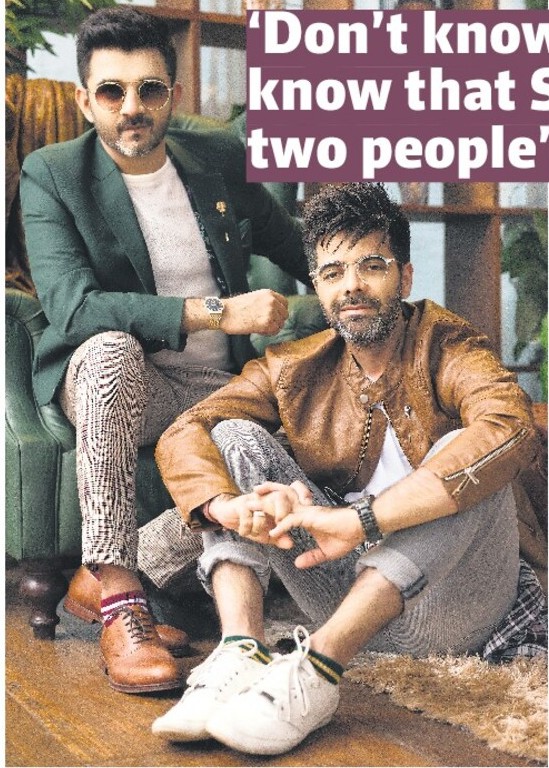
Syeda Eba Fatima (HINDUSTAN TIMES; August 31, 2023)
Sachin Sanghvi, one half of the composer duo Sachin-Jigar, laments that no one besides playback singers get enough recognition for their work. “If you are a singer-songwriter or composer in Canada who has worked for 30 films or someone who has delivered about 100 songs, every Tom Dick and Harry would know you for your work. But that doesn’t happen in India,” the Tere Vaaste (Zara Hatke Zara Bachke) and Apna Bana Le (Bhediya, 2022) hitmaker tells us
He adds, “I don’t know if, even after such great landmarks, the general awareness about composers is there. I don’t think people even know if Sachin-Jigar are two people.”
This isn’t just the case for composers, adds Sanghvi. “A lot of technicians do not get any sort of recognition. It’s very thankless to be an editor or the background music composer of a film,” says the composer, who has been a music arranger in the past. He feels it’s necessary to talk about it for a change to begin because it’s high time they get their due. He explains, “Songs of so many films that don’t perform well at the box office become chartbusters. So, why shouldn’t the composers, lyricists and technicians get the recognition for it?”
Never before were we asked to release a project’s background score, say Sachin-Jigar
7:37 AM
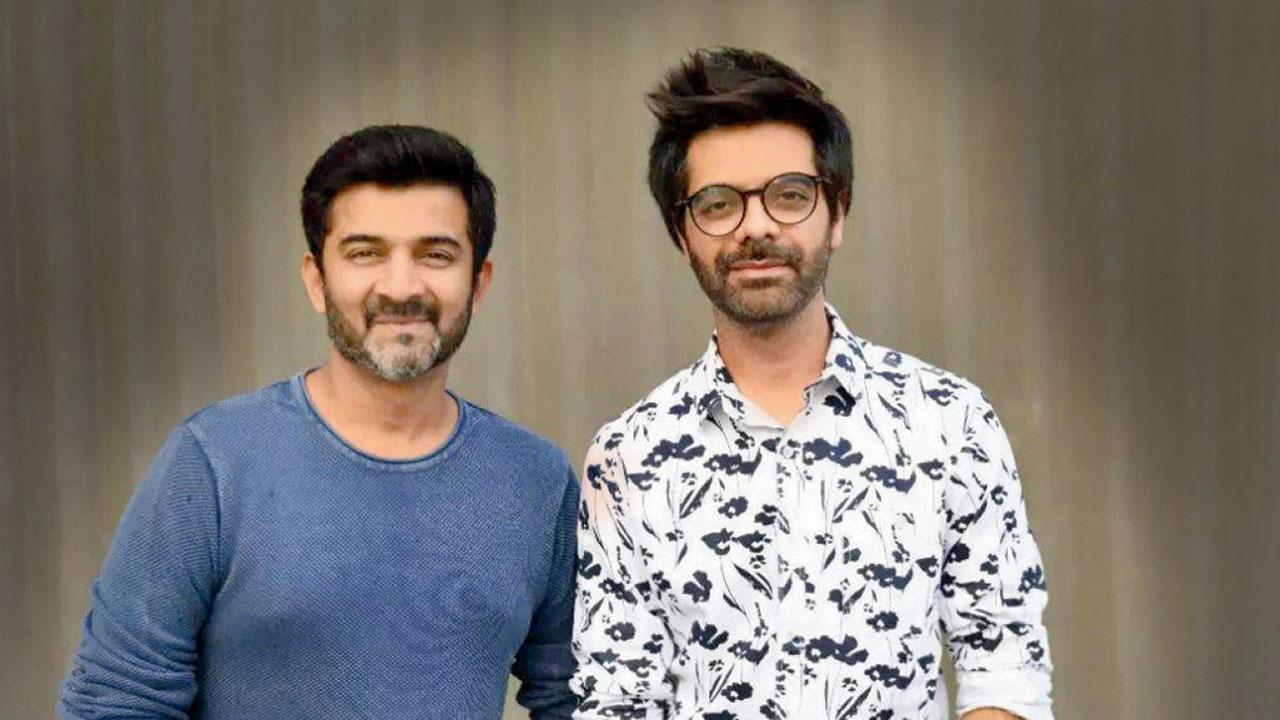
Roping in a bunch of young musicians for Jee Karda, composer duo Sachin-Jigar says new artistes helped them break norms while composing music for Tamannaah Bhatia-starrer
Sonia Lulla (MID-DAY; July 3, 2023)
Given that the narratives of the seven protagonists that front the recently-released Amazon Prime offering, Jee Karda, are distinctly diverse, composer duo Sachin-Jigar’s decision to join hands with musicians with contrasting sensibilities could be considered a rather clever move. In this interview, they discuss what prompted their decision to rope in the young crop of musicians, and how the OTT boom has given an impetus to discussion around the score.
Edited excerpts from the interview.
Jee Karda is in stark contrast to some of your recent works. What about this one drew you to it?
Sachin: The distinguishable aspect about this one is that its songs and dances [can be looked at as] commercial independent numbers. It’s a light-hearted and feel-good show that will have an emotional connect with everyone, at one or another level. For the music, we collaborated with many young independent artistes, like Rashmeet Kaur, I P Singh, who became famous for Jeda Nasha, and also Varun Jain, who sang Tere Vaaste for us in Zara Hatke Zara Bachke. We didn’t approach any lyricist during the process. We joined hands with people who could write their own lyrics, and decided to be involved with them. There is a gamut of songs in this offering. There’s a shaadi song, a break-up number, and a sangeet offering. There is also rap, which was rendered by Mellow. They were all essential to capture the emotions between the friends.
It would be expected that composers working on the entire soundtrack would present numbers with familiar undertones instead of those that have no resemblance to one another. How did you bring these varied composers on the same page?
Jigar: Usually, songs have a defined format. But, these numbers do not. They begin with a verse, move on to a rap section, and then the chorus follows before the end. To explain this to someone who is seasoned, and to attempt to break this format [would not have been easy]. We needed a fresh perspective, which was offered by these artistes. These musicians are open to experimenting and do not follow tradition. Also, there is a process to every song. An ask can be specific — like, creating the first song, which is expected to draw the audience. Each song has a requirement that is to be fulfilled. [But], the audience is not always looking for commercial [numbers]. We don’t want to put our weight on [an artiste]. When permissible, the artiste should be allowed to be artistic; we want them to express themselves.
But, it doesn’t end there. When it comes to making a song, you can gauge when the belly is not full. A song will tell you that it may be ready, but it is still struggling. That’s where we step in and decide the way ahead. We are directors’ boys. That’s also why we love working with Dinu [Dinesh Vijan, producer]. He is open to experimenting. With web shows, composers are given some freedom because we can do things that we cannot while working on a film score. [Unlike in films], here, we can cater to a specific kind of audience.
Has the discussion on the making of a background score changed after the pandemic?
Sachin: Yes. Because of the OTT [boom], music composition has increased. Never before were we asked to release a project’s background score. But, we were asked to do so for Saas Bahu Aur Flamingo. That speaks volumes about this shift.
Sachin-Jigar overwhelmed with Zara Hatke Zara Bachke music success, but say "social media not a landmark for us"
8:49 AM
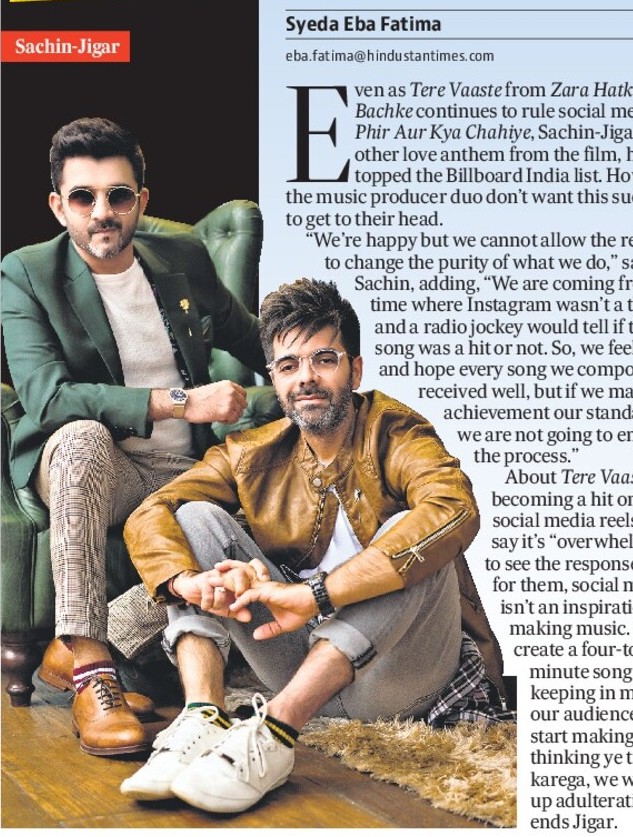
Syeda Eba Fatima (HINDUSTAN TIMES; June 26, 2023)
Even as Tere Vaaste from Zara Hatke Zara Bachke continues to rule social media, Phir Aur Kya Chahiye, Sachin-Jigar’s other love anthem from the film, has topped the Billboard India list. However, the music producer duo don’t want this success to get to their head.
“We’re happy but we cannot allow the results to change the purity of what we do,” says Sachin, adding, “We are coming from a time where Instagram wasn’t a thing and a radio jockey would tell if the song was a hit or not. So, we feel happy and hope every song we compose is received well, but if we make this achievement our standard, we are not going to enjoy the process.”
About Tere Vaaste becoming a hit on social media reels, they say it’s “overwhelming” to see the response but for them, social media isn’t an inspiration for making music. “We create a four-to-five-minute song keeping in mind our audience. If we start making music thinking ye trend karega, we will end up adulterating it,” ends Jigar.
----------------------------------------------------
Abigail Banerji (HINDUSTAN TIMES; June 26, 2023)
With over 3 million reels and way more than 100 million views, Tere Vaaste from Zara Hatke Zara Bachke has surely caught on online. And despite “not being social media savvy”, writer Amitabh Bhattacharya is over the moon. “I am glad that people listened and connected with the lyrics,” he says. The 46-year-old, who never anticipated it to go through the roof in this way, says, “One can never be sure. Every song has its destiny, which lies in the hands of the listeners.”
Bhattacharya shares what went on in his mind while writing the Sachin-Jigar track that features vocals by Varun Jain and Shadab and Altamash Faridi: “I wanted to write a song for romantics who are sincere and ready to walk that extra mile for their beloved, yet are lazy. If you hear the lyrics in the chorus and the antara, you will realize that he is ready to do the work for his lover only if she isn’t convinced by his logic of not going to actually get the stars and moon for her.”

Arijit Singh is a blessing from God; he is today’s Kishore Kumar, say Sachin-Jigar
8:33 AM

Composer duo Sachin-Jigar discuss how folk offering Ada sai became the crux of Saas Bahu Aur Flamingo, a series based on a drug cartel
Sonia Lulla (MID-DAY; June 5, 2023)
As music journalists who consume cinematic pieces with intention, rarely are we so moved by the background score of a series that we feel compelled to research about the composers and request for an interview. More often than not, however, such moments lead us to musician duo Sachin-Jigar, whose deftly crafted musical motifs brought Homi Adajania’s recently released web series, Saas Bahu Aur Flamingo, to life.
“We went to Gujarat and recorded folk artistes, and instruments like the jodia pawa, which is a double flute, and the banjo, which is also called the bulbul tarang. We needed those flavours in the background score,” says Sachin of the Dimple Kapadia-fronted series that follows a group of fierce women who run a covert drug cartel.
“We got these raw sounds from there. We allowed the artistes to perform like they would [in their natural setting]. We recorded each instrument individually, returned to Mumbai and then thought about how we wanted to layer them,” he says, crediting Adajania for giving them the freedom to chart the series’ auditory course.
Inarguably the musical crux of the show, the folk offering, Ada Sai, emerges to be a special track for the duo. “To be able to adapt something so free-willing and pious into this series is special. The show, [based on drugs], and discussing family legacy, has many layers. Within this, for a song as innocent as this one to find its space is wonderful. Also, the song in itself has a journey of its own — from the first episode to the last one, you can see how it evolves. We hope that people can fall in love with the story so deeply that they eventually begin to think of the score, and say that they liked the music behind a particular scene,” says Jigar.
Meanwhile, their collaboration with Arijit Singh has been the latest attraction across streaming platforms, with aficionados dubbing the Zara Hatke Zara Bachke track, Phir Aur Kya Chahiye, a musical masterpiece.
“Arijit is a boon for every composer. A voice for a song is like an actor for a film — it is what most people are drawn to. Arijit is a blessing from God. It’s natural for him to comprehend the vibe of a song. If you tell him to do something, the way in which his voice obeys his mind is amazing. We have recorded with all playback singers. Each one is unique, but he is today’s Kishore Kumar. He can sing any song in any style. He’s a composer, and arranger, and has [a grasp] on many instruments.”

Whenever Bollywood has failed to offer good music, indie music has come to the rescue-Priya Saraiya
8:31 AM

Kanksha Vasavada (BOMBAY TIMES; March 4, 2023)
Singer-lyricist Priya Saraiya, who has lent her voice to Gulabi and Sun Saathiya, is creating awareness about the rights to royalty of composers and lyricists as a committee member of the Indian Performing Rights Society Ltd (IPRS). In a conversation with us, Priya talks about balancing Bollywood and Gujarati music and more. Excerpts:
‘ARTISTES CAN CLAIM THEIR ROYALTY NOW’
Priya strongly believes that music creators deserve due recognition for their work. On why bodies like IPRS are the need of the hour, she says, “The amount of music created and consumed now has increased many manifolds over the last few years. Now is the time when music creators across industries realize that they can claim the rights for their music, and earn royalty by reaching out to bodies like IPRS.”
‘WHENEVER B’WOOD HAS FAILED TO DELIVER GOOD SONGS, INDIE MUSIC HAS FILLED THE GAP’
An artiste sitting in the remotest part of the country can become an overnight sensation by simply uploading their music or a video on social media. On being asked how this has helped youngsters, Priya says, “There are so many talented musicians who did not get a platform earlier. Social media has bridged the gap now, especially for small town musicians. Earlier, doing playback in Bollywood was a dream for youngsters – now they can live it.”
Indie music’s comeback has changed the way we consume music. Priya says, “I grew up listening to songs from the ’80s and ’90s. Whenever Bollywood has failed to offer good music, indie music has come to the rescue. The ’90s was not an era of Bollywood music, that’s when Lucky Ali, Palash Sen, Shaan and Kailash Kher released singles and audiences loved the music.”
‘LANGUAGE IS NOT A BARRIER FOR GEN Z, THIS AMPLIFIES THE REACH OF A SONG’
While her Bollywood songs may have more recall value, Priya is no stranger to the Gujarati music industry. Ask her about how Gujarati music has evolved over the years, and Priya tells us, “There was a time when nothing was working for the Gujarati industry, neither the films, nor the music. I remember when the music of Bey Yaar, and the single Laadki, had released together; that was the moment when the audience knew they wanted good movies and good songs. The best thing is that, language is not a barrier for this generation, which naturally amplifies the reach of any song.”
‘SACHIN AND I SHARE A GOOD RAPPORT’
We ask Priya about her equation with her musician-husband Jigar Saraiya and his partner Sachin Sanghvi, as a fellow artiste. She says, “Jigar and I often discuss music at home. Sometimes when he is confused, I help him. And he chips in when I have a musician’s block. As for sharing constructive and honest feedback with them, yes, I am very frank with them. Why won’t I be? Ultimately, we share that kind of rapport and I can comment on their music. I only want the best for the two of them. Sachin and I share a devar-bhabhi relationship, we are family, so being honest with him isn’t too difficult.”
‘THE SHELF LIFE OF A SONG DEPENDS ON HOW LONG IT STAYS ON YOUR PLAYLIST’
In a day and age where the success of a song is based on the number of views or hits it garners online, Priya feels that a good song will always find its audience. “Audiences are not fools. If a song is genuinely good, if people really like and enjoy it, it will get real views. If not, the song might have several million views, but they won’t matter after a point of time. The shelf life of a song depends on how long it stays on your playlist.”
Come Fall In Love changed our sensibilities; We got 60 standing ovations-Vishal Dadlani
8:23 PM

Having rendered Sachin-Jigar’s composition Paisa Hain Toh for Farzi, Vishal on reigning in his music sensibilities as composer to serve the song
Sonia Lulla (MID-DAY; January 23, 2023)
There are some matters that Vishal Dadlani won’t talk about, like the Pathaan track, Besharam Rang, which emerged to be among the best performing songs of 2022, but was mired in controversy with fans stating that it resembled a bunch of old numbers. Then, there are matters on which he pours his heart out, like his work on the recently concluded Dilwale Dulhania Le Jayenge musical, Come Fall In Love, an international production that offered Dadlani, along with his long-time collaborator Sheykhar Ravjiani, a once-in-a-lifetime opportunity.
Considering the fact that musical adaptations of Bollywood films are a rarity, we are eager to know what transpired behind the scenes as the cult classic found a theatrical adaptation in San Deigo. Stating that the project “changed our sensibilities”, Dadlani says, “Dilwale is the fabric for modern pop culture. We worked with Nell Benjamin, who is a multi-Tony Award-winning [composer], and we learnt a lot about approaching music [from a place of] joy. [We were told to] let the lyrics speak to us, and by the end of each page, we [usually] had the song [conceived]. We got 60 standing ovations, and our crowd comprised both American viewers, and individuals who had flown from Mumbai to see it,” he relives the experience, as though it occurred yesterday.
Given that it marks the amalgamation of story-telling techniques and live music, a musical, Dadlani says, is a powerful medium to express emotions. “Sheykhar and I usually get to head on [tours], but we never get to perform the same set on the same stage, over and over again. This experience provided that. We had people coming back to watch it [twice over]. It was challenging, but was one of the best experiences of our lives.”
Dadlani’s recent work is an upcoming track from Amazon Prime’s Farzi, and one that brings him under the familiar wings of composer duo Sachin-Jigar. “They are friends. When they call me for a song, I don’t even ask them about it, I simply show up. By now, they know my range, texture, and the things that I like to do [as a singer],” says Dadlani, who rendered Paisa Hai Toh, along with Mellow D for Shahid Kapoor’s project.
We would assume that his success as a composer would influence his renditions while working for other composers, in the capacity of a singer. But Dadlani disagrees. He adheres to one principle — “I come in knowing nothing,” he says.
“I only bring my heart. I treat each song as an opportunity to learn something. When a composer calls me, he/she is giving me a chance to improve myself as a musician. You have to put your faith in the composer, because the composer chooses your voice as the instrument for the song.”
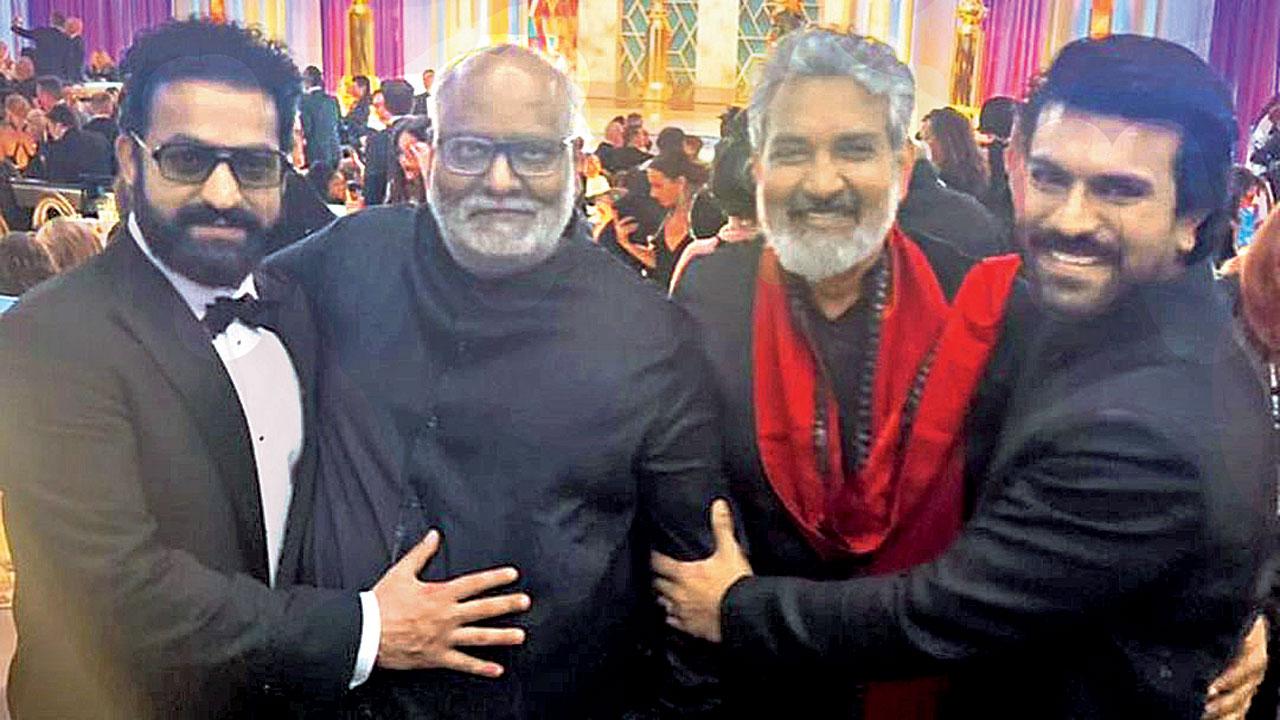
A man with a golden heart has won the Golden Globe, says Daler Mehndi on M M Keeravaani winning the Golden Globe
8:31 AM

Indian musicians weigh in on what sent M M Keeravaani’s composition Naatu naatu right to the top of coveted international film awards
Sonia Lulla (MID-DAY; January 12, 2023)
It wasn’t too long ago that foreign-film viewers would poke fun at Indian cinema’s song-and-dance routine. Slowly and surely, it caught their interest, and eventually won them over. M M Keeravaani’s win at the 80th Golden Globe Awards yesterday represented just that—a celebration of a song that was all things Indian. RRR’s Naatu Naatu, which was adjudged the best original song, has an upbeat traditional score and a choreography that’s as desi as it can get. Indian musicians say it is this rare combination that has been admired by the West.
Composer Sachin Sanghvi of Sachin-Jigar fame believes it is Keeravaani’s catchy beat, coupled with filmmaker S S Rajamouli’s vision, which made the song stand out. “Naatu Naatu is catchy and infectious. The world hasn’t seen this sort of energetic and crazy dance; it is a rarity for them. It is the song’s energy that has appealed to people, worldwide,” he reasons.
With this win, the RRR composer left behind American mammoths like Rihanna, Taylor Swift and Lady Gaga, who were vying for the gong. International portal Variety referred to the development as the win of ‘the underdog’. On home turf, though, Keeravaani is far from an underdog. His musician friend Sivamani is glad that the world has “finally recognized such a great composer”. “He is the king of melody.
Even his funk, rock music will have melody. This song is such an enjoyable watch. The choreography that sees the leading men compete, is a treat.” Singer-musician Daler Mehndi seconds his opinion. “Keeravaani’s music can be ethnic, folk, and classical, all at once. A man with a golden heart has won the Golden Globe.”
Keeravaani may have brought home the trophy, but no one would dismiss the role of choreographer Prem Rakshit in making the number — featuring Ram Charan and Jr NTR — the phenomenon it is. At a time when OTT viewers have the option of skipping a song, Naatu Naatu is one that they will watch a second time over. “Would a song be as impactful if a person simply stood at a place and sang it,” asks Lesle Lewis, making a case for the place of choreography in cinema.
“My dad [P L Raj] was among the biggest choreographers of his time, and has worked in films like Sholay and Sargam. It is the song-and-dance [routine] that the international audience consumes. Also, we have now incorporated elements from the West into our work. So, while this is novel for the international audience, it is not entirely alien to them. Indian music has been striking a chord after Jai Ho [Slumdog Millionaire].”
Everything was becoming too popcorn. Producers said remixing a hit song is less risky, say Sachin-Jigar
8:21 AM

Capping a horror trilogy with Bhediya, Sachin-Jigar on creating music that suits the genre, but can be consumed in ordinary settings as well
Sonia Lulla (MID-DAY; November 14, 2022)
With Bhediya, Sachin Sanghvi and Jigar Saraiya wrap up the final part of Dinesh Vijan’s horror trilogy. Asserting that their equation with Vijan is among the healthiest that composers can share with producers, Saraiya says, “We understand each other to the point that we can decipher why he would ask for a song, even if we don’t feel the need for it in a film.”
While working on each film, the duo has walked the thin line between catering to the genre of horror, and creating songs that can be consumed in ordinary settings. “If you hear the Stree [title] song, you’ll see that the lyrics [address a girl], but you’ll also understand that it is about the protagonist. We always think about delivering something that you can dance to, and can have on your playlist even on a happy day. We don’t think of it as a horror [soundtrack] alone. Similarly, we haven’t addressed the soundtrack of Bhediya as something that should cater to the creature alone. We think of viability in music.”
They intersperse the conversation with discussions on the “exciting” opportunity of creating music, should characters of the three films interact. We ask them if conversations of such an overlap are underway, and they respond with a simple, “Well, yes, and no.”
Showing complete disregard for the music industry’s tendency to latch onto frivolous commercial numbers under the pretext of promoting a film, Sachin-Jigar have instead focussed on consistently delivering musical albums with definite character. The duo points to films like Taal when establishing that a soundtrack’s longevity depends on the attention paid to each number of the album, an aspect that they have tried to address in every project.
Sanghvi admits that while he is seeing a reversal in the trend now, the industry’s “faith” in the traditional music-making process had depleted. “The belief in the process of sitting with the director, producer, lyricists and composers, and subsequently working on the songs, had depleted. During those interactions, there are discussions on songs — one may suggest that something about a track works, and something doesn’t. These are [productive] processes within a team. The producer needs to believe that the composers will deliver songs of all genres — romance, dance, and everything else — that is needed for the making of a comprehensive album. Everything was becoming too popcorn, and centred around the initial impact. Producers said remixing a hit song is less risky. Since it is already a hit, reworking it would be a wise idea. And this mentality was impacting originality. But, things are changing again. A large part of this shift is owing to the changes that have come about in the lockdown and the OTT [boom]. Producers are not depending on weekend collections alone, because they can build [an audience] on the web too. Some of the risk [is mitigated].”
Gujarati movie Chaal Jeevi Laiye’s successful run continues in theatres
8:46 AM

BOMBAY TIMES (April 7, 2022)
Chaal Jeevi Laiye, which released in 2019 and took Gujarati cinema to greater heights by breaking many records, continues its successful run in theatres. The team of Coconut Motion Pictures tried their level best to put up a good film. Apart from the impressive production value, relatable story, good music and excellent cinematography, the makers say that the audience’s love has ensured this dream run in theatres.
Producer Rashmin Majithia says, “While we tried our best to make a good film, it’s our audience that runs the film. We are thrilled and grateful to receive such love and warmth even in the fourth year. It will inspire us to keep working hard.”
The makers say that the film has created history by becoming one of the longest running Gujarati films, and that it had more than 100 shows even on the 1000th day. The film has managed to touch people’s hearts and has been appreciated in India as well as abroad.
Rashmin Majithia adds, “After completing 1000 days in theatres and now entering the fourth year, we feel that all those sleepless nights were worth it. The Gujarati film industry needed a film like this to show its potential to the world.” This film has lifted the spirits of the Gujarati film industry and helped it stand out on a global level.
Now, Coconut Motion Pictures is all set to make and acquire more old and new Gujarati films to preserve the cultural heritage and maintain the legacy of the industry. Their next big creation is the upcoming multi-starrer movie Kehvatlal Parivar. Releasing on May 6, 2022, it promises to infuse fresh energy into the Gujarati film industry and upgrade the level of filmmaking.
This family comedy drama has a very impressive star cast. It stars Siddharth Randeria, Supriya Pathak, Sanjay Goradia, Vandana Pathak, Bhavya Gandhi and Shraddha Dangar. The film is directed by Vipul Mehta, with music by Sachin-Jigar. There is a lot of anticipation around it and the audience is looking forward to the film. Until then, people can listen to the song Utho Utho from the film, which has been appreciated widely.
Omicron scare: Covid-19 forces artistes to call off live gigs, again
8:20 AM

Debarati S Sen and Riya Sharma (BOMBAY TIMES; January 9, 2022)
In light of the rapid spread of the Omicron variant, the unprecedented increase in the number of Coronavirus positive cases in Mumbai, and the curbs set up by Maharashtra government to curtail its spread, most concerts, private gigs and stage events in the city stand cancelled or postponed.
Live performances that had picked up quite well in the last quarter of 2021, have all quieted down to a large extent under the current circumstances in Mumbai, despite it being the season for live music shows, concerts, events, college festivals and wedding gigs. The Maharashtra government has banned large gatherings and also put restrictions on the number of people that can attend events. That apart, in the last few days, Mumbai’s singer-musician community has had multiple Covid-positive cases including Sonu Nigam, Vishal Dadlani, Shankar Mahadevan and others. While musicians agree that the situation is tough, they urge fans to mask up and stay safe, and also talk about how this current phase will impact the music industry, once again.
ABOUT 80% OF THE EVENTS HAVE BEEN POSTPONED; IT’S DIFFICULT FOR MUSICIANS AND PEOPLE INVOLVED IN THE BUSINESS: RAHUL VAIDYA
“About 80% of the events have been postponed. It is extremely saddening for the people who work in the live entertainment industry, especially those who survive on daily wages. It’s also very difficult for musicians. I have already started getting messages from people who are worried about what’s going to happen, but I am positive that this won’t last for very long,” says Rahul Vaidya.
WAS IMPORTANT TO CANCEL OUR UK TOUR FOR THE SAFETY OF OUR FANS: JUBIN NAUTIYAL
Jubin Nautiyal, who cancelled his December 2021 UK tour, shares, “It’s just unfortunate that we are once again facing this situation, but postponing the concerts was a conscious decision taken for the safety of my fans. A couple of shows in India have been cancelled too.”
Jubin adds that it is important to follow the guidelines that are being issued. “One thing we have learnt recently is to work from anywhere. Last time we were not as prepared, but now, with many of us fully vaccinated, we all have to be responsible and follow whatever guidelines are being issued by our government and health experts. That is the only way to keep moving ahead,” he says.

UNPREDICTABLE IS THE NEW NORMAL AND WE MUST ADAPT TO THAT: SHALMALI KHOLGADE
Shalmali Kholgade says, “I just got back from a holiday, ready to begin working again, but it looks like I will have to wait. Although I would have loved to get back to it, several of my shows are either cancelled or postponed. Unpredictable is the new normal and we must adapt to that as well, just like we’ve adapted to other things in the past. I’ve decided to focus my energies on completing my album.”

IT’S GOING TO BE DIFFICULT FOR ARTISTES WHO DEPEND ON LIVE CONCERTS FOR THEIR LIVELIHOOD: KAVITA KRISHNAMURTI
Kavita Krishnamurti shares, “All my engagements have been cancelled. Though concerts were beginning to start a couple of months ago, the pace was still slow compared to the pre-COVID scenario. It’s going to be very difficult for artistes who depend on live gigs for their livelihood. The situation is really bad now and I do hope that some organisations raise money for these artistes through online events and fundraisers.”

THERE’S LOSS OF WORK DUE TO THE PANDEMIC AGAIN, BUT WE HAVE TO BE PATIENT: ARKO PRAVO MUKHERJEE
Arko says, “I’ve just arrived in LA from Chicago after a music video shoot and judging a singing competition. My recording has been cancelled as my music producer and family tested positive. So, I understand the loss of work due to this pandemic again. But we have to be patient. A couple of years of difficulty will be forgotten in the long run, but we can’t afford to be ‘penny wise pound foolish’ by ignoring the health scare.”

THESE MONTHS ARE CRUCIAL BECAUSE THERE ARE A LOT OF THINGS HAPPENING: SALIM MERCHANT
“Just as we began to go back to normalcy, events started to get cancelled. But, this is something that we have to live with now. Musicians and performers have to work out a way to live and we have to work out an alternate way of life. The performance industry has really suffered in the last two years and it’s about to suffer some more now. These two to three months are crucial for us because there are a lot of weddings, concerts, college festivals that usually happen. The earnings of musicians, performers, people in the events industry, stage artistes are affected. Having said that, I’m still performing at some events and I feel grateful about that. These are small private gatherings and weddings in smaller cities,” the musician shares.

IF THIS PHASE LASTS FOR TOO LONG, IT WILL SEVERELY IMPACT THOSE WHO DEPEND ENTIRELY ON LIVE GIGS: AKRITI KAKAR
Akriti Kakar says three of her gigs have been cancelled in January itself. “Just when we felt that things were getting better, with artistes travelling extensively, and weddings and concerts returning, this new variant came in to walk all over us again. I hope this phase passes soon and we can resume our work again. If it does not, then it will severely impact those who depend solely on live gigs, just like in the first and second wave,” she shares.

SINCE THE LAST WEEK THINGS HAVE GONE QUIET: NIKHITA GANDHI
She says, “It was exciting to start travelling again for concerts. Things were picking up in November 2021 and it felt incredible to be on the road. But, things have gone quiet again and almost everyone I know seems to be catching the new variant. I find myself feeling low quite often and it's counterproductive. There’s a lot of studio work to do from home, but the heart is hurting from all of this, making it hard to make music.”

IT’S DEPRESSING AND SCARY, BUT HEALTH IS A PRIORITY: MAHALAKSHMI IYER
“It’s heartbreaking to see that just when we were all gearing up for a good season, events are getting cancelled or postponed. It’s both depressing and scary. But yes, health is a priority, so let’s hope we get through this quickly. Everyone please mask up and stay safe,” the singer urged.
WE ARE HOPING THE COVID SITUATION IMPROVES BY APRIL-MAY: SACHIN-JIGAR
Composer duo Sachin-Jigar shares that they have cancelled many of their gigs keeping the current situation in mind. “The whole live entertainment industry will take a hit because of this situation. January to March was slated to be the peak shaadi season, but we are hoping the situation improves by April-May. The last two years have been terrible. We know a lot of musicians who left Mumbai and went back to their hometowns for alternative means of income.”

Artistes can’t depend on Bollywood for a chance anymore, feel Sachin-Jigar
8:15 AM

Juhi Chakraborty (HINDUSTAN TIMES; December 30, 2021)
In the last two years, the music industry was heavily impacted due to the pandemic, but it also made artistes realise that they needed to be self-sufficient. Composer Sachin Sanghvi of the musical duo Sachin-Jigar, who suffered from Coronavirus himself, shares how it gave him time to re-evaluate.
“It has been a good time for artistes to understand that they cannot depend on films or a chance from Bollywood anymore. Everybody has to find their own sunshine. We are living in such times that every artiste has a chance to become as popular as a film star,” he explains.
The pandemic opened them up to new ways of making music. The duo came up with the entire album of Chandigarh Kare Aashiqui in the lockdown. Jigar Saraiya adds, “We both have always made music in studio, but the pandemic brought out a new side of making music at home. All the songs were made online, and we were recording and sharing them with Abhishek Kapoor (director) simultaneously.”
Looking back at 2021, the duo agrees that it has been a fulfilling year, as they were able to cater to the masses as well as the critics through their music. “With Roohi, Shiddat and Bhoot Police, we were pretty massy with what we did. But with Chandigarh Kare Aashiqui, we struck a balance between the masses and critics,” Saraiya tells us.
As for 2022, the has a jam-packed calendar, composing music for Dasvi and Bhediya along with two web shows and four Gujarati films.
Nadiyon Paar absorbs the elements that made the original so special, say Sachin-Jigar
8:21 AM

Composers Sachin-Jigar revisit Shamur’s 2004 chartbuster Let the music play for Roohi’s latest track, Nadiyon Paar
Mohar Basu (MID-DAY; March 3, 2021)
After shaking a leg with Rajkummar Rao and Varun Sharma in Panghat, Janhvi Kapoor is ready with the second track of Roohi. The makers of the horror-comedy shared the first look of Nadiyon paar, which sees Kapoor look ravishing in a golden outfit and smokey eyes as she grooves to the foot-tapping number. The song is a reimagination of Shamur’s famous English track, Let The Music Play that had topped the music charts upon its release in 2004 and was a staple at every nightclub. Producer Dinesh Vijan, who is known to have a keen ear for music, was certain that the song should be revisited with a desi twist.
Composers Sachin-Jigar, who have reworked the ditty, admit they were thrilled about lending their own spin to the dance number. The composer duo say, “Let The Music Play is a cult tune, and the opportunity to present this song to a new generation was irresistible. Nadiyon Paar absorbs the elements that made the original so special. We’ve sprinkled a bit of Roohi’s magic to bring that tadka.”
Sachin-Jigar also joined Shamur, Rashmeet Kaur and IP Singh behind the mic for the reprised version.
Check out Janhvi Kapoor's unique, dual avatar in Roohi's song, Panghat
8:57 AM

Roohi director on how the song, Panghat, sees Kapoor as a glamorous bride as well as a witch
Mohar Basu (MID-DAY; February 22, 2021)
While making Roohi, director Hardik Mehta was certain about incorporating a song that encapsulated the film’s theme. The horror comedy sees Janhvi Kapoor play the protagonist who is possessed by a ghost. Unaware of her predicament, Rajkummar Rao and Varun Sharma’s characters abduct her, leading to hilarious results.
Sharing the first look of Panghat that drops today, the director says that the track depicts the duality of Kapoor’s character. “Panghat shows Roohi in two avatars — the beautiful bride, and the glamorous witch. Vijay Ganguly has choreographed it in a way that we see Roohi having fun with Raj and Varun’s characters in the song,” says Mehta, adding that the leading lady will “take everyone by surprise” in the dance number.
The song, composed by Sachin-Jigar and penned by Amitabh Bhattacharya, was shot at a city studio over two days last October. The music composer duo reveal that for the track, they were given a concise brief by the makers — the score had to be foot-tapping while retaining an air of eeriness that the film offers. The musician duo say, “Once in a while, you’re required to get a combination [of elements] for a song — quirky, catchy and modern yet familiar. That is Panghat for us.”
Current trends like Punjabi pop, remixes or TikTok doesn’t uproot me as an artist-Rekha Bhardwaj
7:59 AM

To take her guru’s legacy forward, Rekha Bhardwaj has contributed to a new edition of a landmark book by him
Urmi Chanda (MUMBAI MIRROR; March 16, 2020)
Bongaa: ‘Unmusical’; idiotically out of tune and unaware of it.

You’re a classical singer, but also part of the Hindi film music industry where there is little appreciation for classical music at present. Why did you feel the need to revive this book now, when the roost is ruled by remixes, Punjabi pop and TikTok stars?
My roots are in classical music, and just because the current trends include Punjabi pop, remixes or TikTok, it doesn’t uproot me as an artist. And contrary to what it may seem, a lot of young people continue to take up classical music as a profession, it is a popular performance category in music reality shows too. Also, it’s not like the entire Hindi film music industry has forgotten its classical sensibilities. There are still music composers like Amit Trivedi, Shankar-Ehsaan-Loy, Pritam, Sachin-Jigar, who are making music that blends classical tunes with other elements, and I think it’s okay. Everyone has the right to express their musicality and choose the music that appeals to them. As for why now, I think the time is right. Many of the young generation of musicians I interact with seem genuinely interested in knowing more about classical music, but do not know where to start. This book is an excellent starting point for anyone curious about this art form. I feel fortunate to be able to utilise my position and bring the focus back on this important piece of work. As they say, there are only two ways of bringing light into the world — be a lamp or a mirror. I am just upholding a mirror to my Guruji’s luminosity.
In your foreword to the book, you warmly describe your relationship with Pandit Amarnath and the way it embodied the guru-shishya tradition. Have you had such a relationship with any of your students?
To be anything close to what my guru was like, takes immense patience and practice. As a performer and a busy artist, I’ve not really had the time or opportunity to take on any long-term students. I’m still learning myself. But as and when possible, I share my riyaaz with some of my peers and fellow artistes and those are always wonderful experiences. The guru-shishya tradition may not be as common today as it once was, but there still continue to be teachers and schools that uphold those values and teach their students the old way. For example, the respective schools of Pt Hariprasad Chaurasiya and Pt Jasraj, the Gandharva Mahavidyalaya in Delhi, and the Gundecha Brothers in Bhopal still teach in the old tradition.
Pt Amarnath’s decision to write this musicological dictionary in English can be said to be a ‘progressive’ step since this is a field where ‘linguistic purity’ is valued over Westernisms. What do you, as his student and an artist, think of that?
I’d just say, my Guru was very farsighted and decided to write this dictionary in English because he knew that would become the language of choice among the youth eventually. He wrote in an easy manner that would help musically even an elementary reader understand it easily. Remarkably though, he chose transcriptions over translations, when it came to describing technical terms. Instead of terms like ‘legato’ or ‘staccato’, he stuck to Hindi terminology that was best understood by practitioners of Hindustani Classical music. No matter what the current trends, this is a timeless piece of work and essential to any serious student and artist.
If you had to pass on one bit of your Guruji’s wisdom to the aspiring students of today, what would it be?
The most important piece of advice our Guruji gave us was “Listen to yourself.” It was meant to be both, musical and life advice, and practicing that sincerely would always ensure we picked the right path. Listening to oneself allows us to see our own weaknesses and strengths, understand the areas that need work, and to know what we truly are and want instead of being told that by society.
What is that one new term/phrase that you would add to this dictionary?
Frankly speaking, I would not dare to add anything to this dictionary, because that would be like sacrilege for me. I’m pretty orthodox in that sense; I take my responsibility of preserving my guru’s knowledge as it is very seriously. All I’ve done is added a very brief foreword and updated the book with some important profiles of musicians who were his contemporaries (he had written only of artists from the earlier generations). All we want is for this book to reach more people, translate it into other languages, and publish some more of his works in the hope that his art and wisdom remain immortal.
Subscribe to:
Posts (Atom)