Showing posts with label Sachin Pilgaonkar. Show all posts
Showing posts with label Sachin Pilgaonkar. Show all posts
50 Years of Sholay: How Amitabh Bachchan helped Sachin Pilgaonkar act ‘dead’
9:17 AM

Shooting for Sholay, ‘hold your breath’ acquired an entirely different meaning for Sachin. Why? Read on
As told to Mohua Das (THE TIMES OF INDIA; August 10, 2025)
It was my very first day on the Sholay set. I was thrilled. I knew it was a massive film. My first scene was supposed to be the one where my character Ahmed’s dead body is brought into the village on horseback. It’s a dramatic, emotional moment.
There were two shots. One wide shot from a distance as the horse enters, and a closer shot of my body on the horse’s back. I was 16 years old and couldn’t wait to begin. But to my surprise, both those shots were done using a body double. I was a little taken aback, even disappointed since I was so eager to do my first shot.
I remember asking Ramesh-ji (Sippy) about it, and he said something I have never forgotten: “Sachin, you are an actor. You have been acting for years. These shots are for a double. You are not supposed to do them.”
That’s when I suddenly felt important. Validated. Of course, the later shot where my body is picked up by Dharam-ji (Dharmendra) and Amit-ji (Amitabh Bachchan) had to be me. During that scene, Amit-ji whispered something to me that I always remember. He said, “Sachin, zara body loose rakhna… It will be easier for us to pick you up and put you down.”
It was a small but thoughtful advice. I understood that if I kept my body stiff, it would be harder for them. It was one of those little moments that taught me that even as a ‘dead body’, you need to act right.
Now, here’s the fun part. That scene involved big actors but none of us — Dharam-ji, Amit-ji, Hema-ji, or me — had any dialogue in it. And I obviously couldn’t speak because I was supposed to be dead! So all we could do was observe.
I was the youngest on set and very sincere. So every time my shot came, I would hold my breath. Nobody asked me to. I just did it on my own. And when Ramesh-ji would call “Cut!”, I would let out a huge breath — like a burst — and the whole set would erupt in laughter. Every single time.
The first one to laugh would always be Sanjeev Kumar. And then the rest of the cast and crew would join in. It became a bit of a ritual, everyone waiting for my dramatic exhale and the laughter growing after every shot!
Looking back, that was my first experience of Sholay… lying breathless, surrounded by legends, and still managing to make them laugh.
Not many people know this, but I refused to accept payment for my role in Sholay. My relationship with Ramesh-ji has always been that of a student and guru. Even now, on Guru Purnima, I message him to seek his blessings. That bond means more than money ever could.
So, instead of a fee, Ramesh-ji gifted me something special… my first-ever air conditioner. It was from a company called Fedders-Lloyd. Sleeping in AC was a luxury back then and from 1975 till today, I haven’t been able to sleep without an AC, a habit I owe to Sholay!
Sachin Pilgaonkar on 60 years in cinema: "I have reached the interval stage"
8:16 AM

Natasha Coutinho (BOMBAY TIMES; November 13, 2024)
Sachin Pilgaonkar (67) completes 60 years in films this year. The actor, director and producer started acting as a child at the age of five and went on to feature in over 65 films before starring in films like Sholay and Satte Pe Satta as a grown-up. The veteran actor says there’s much more to come and he has only reached the “interval stage” of his career.
‘I was the first child artiste to win the President’s Award’
Talking about his early days as a child artiste, Sachin fondly recalls, “I received the National Award for Best Child Artiste at the age of five (for Marathi film Ha Maza Marg Ekla), from the hands of Dr Sarvepalli Radhakrishnan the second president of India, in the presence of Pandit Jawaharlal Nehru. Back then, it was known as President’s Awards and the child artiste category did not exist, so I was the first to win it. My mother had stitched a sherwani with mojri for the event and as I was leaving after receiving my award, Pandit ji called me, made me sit on his lap, took the rose from his coat and placed it on my sherwani. My mother was keen that I have a 9 to 5 job, but this event changed her thought process. Eventually, I went on to work in more than 65 films as a child.”
‘I learnt self-love from Dev Anand’
Sachin cherishes the close association that he shared with Dev Anand. He says, “Dev Anand with whom I worked a lot, loved himself and would address himself by his name Dev, while explaining a scene. The first time it happened, I asked him, 'Who is playing Dev?' He looked at me for a few seconds before announcing he was referring to himself and I apologized. He told me that I reminded him of his younger brother Goldie, who he was very close to. I played his younger brother in his debut directorial Prem Pujari. Apart from working with Dev saab, I feel fortunate to have been part of cult films like Sholay, Satte Pe Satta, Nadiya Ke Paar, Geet Gaata Chal and more.”
‘As a director, I treat my actors the way I wanted to be treated on set as a young actor’
Talking about the life lessons that he has learnt in all these years, he says, “At 24, I became a director in Marathi cinema. Today, my actors receive their cheque from me (not my managers) even before they have taken off their makeup on the final day of shoot. The reason is, that’s how I wanted to be treated when I was younger, but it wouldn’t happen. I celebrate the birthdays of my crew - from the light man to the actors because no one celebrated my birthday on the sets."
‘Shriya was our lucky charm since day one’
“The day Shriya was born, I was shooting for my Marathi directorial Atmavishwas, in Mumbai’s Shivaji Park. The previous night the doctor informed us Supriya would have to deliver the baby the next evening because of some complications. Co-incidentally, the hospital was on the same street as my shooting location. I was arranging the shot in the afternoon when a friend informed me that I’ve become father to a baby girl and I rushed to the hospital. The same evening, we received the news that I had received the Maharashtra State Award for Best Director for Ashi Hi Banwa Banwi and Supriya had won the award for Best Actress for Maza Pati Karodpati. Today, Shriya has made her own space in the industry and I am proud of her. As a family, we are very tight and they have always been my pillar of strength.”
‘Meena Kumari introduced me to Urdu’
The actor, who shared screen space with Meena Kumari in the film Majhli Didi, says, “Meena aapa imbibed Urdu into my life and today, it is part of my system. Having command over a language gives you immense confidence, it changes your body language and approach to your work. I couldn’t speak English back then, but a friend helped me by conversing and that’s how I learnt the language. Today, I visit colleges to give lectures on career building, but I consider myself a student. My pseudonym is Shafaq, and I write and recite Urdu poetry, and have shared the stage with the likes of Wasim Barelvi and Javed Akhtar.”
Winning Nach Baliye with Surpiya at the age of 48
Supriya (Pilgaonkar) and I are total opposites, but I never tried to change her because I married her for what she is. We were approached for Nach Baliye (2005) because the channel needed a senior couple and they didn’t even know if we could dance. The intention was not to win. We would be happy even if we survived six episodes, but we ended up winning the show. Choreographer Saroj Khan, who was a judge on the show, used to say, “No matter what, the Shammi Kapoor within you will never leave your body.”
The day Shriya was born, Suprirya won best actress and I won award for best director-Sachin Pilgaonkar
8:01 AM

Natasha Coutinho (BOMBAY TIMES; June 15, 2024)
Shriya Pilgaonkar still remembers how her father, Sachin Pilgaonkar, would sit by her bed when she was a child and tell stories as she fell asleep. “Each night, it was a new story with different characters. Papa is an amazing storyteller, and I think that is where my love for stories and performing comes from,” says Sachin and Supriya Pilgaonkar’s daughter.
While both her parents are actors, she didn’t fully realize how well known they were till the time came for the school parent-teacher meetings. “Everyone would be excited to see them, and those moments made me realise the impact they had as actors on people’s lives. At other times, they were my hard-working parents, who were very involved in my life,” Shriya adds.
Sachin shares memories from Shriya's childhood
I met Supriya first, congratulated and thanked her for giving me a daughter. Then I went to see my little one with dimples on her cheek. Holding Shriya in my hands for the first time was the biggest joy of my life. On the morning of 25th April, Shriya was born and the same evening, there was an announcement on TV that Supriya won best actress and I won for best director for a Marathi film that year.
Once when Shriya was three years old, I came home after work and was just lying on my bed. Shriya looked at me and like a mother she asked me “Are you tired?” I said yeah. She started patting me like a mother, and I fell asleep, and that sleep was the soundest sleep I’ve ever had in my life.
Shriya on visiting Sachin's sets
Of course I have visited papa’s film sets. I have so many fun memories of visiting the sets of Tu Tu Main Main and seeing him in action as a director and mom as an actor. He would call me to do cameos and I would happily show up. He is an incredible teacher and there’s so much I have learnt from him.
Travel buddies
“Her mannerisms are like Supriya’s, but her personality is like mine,” says Sachin, adding that Shriya is a foodie just like him. The father-daughter duo bonds over their shared love of travel. “One of our most memorable trips was the family holiday we had in Maldives last year. Papa loves to swim, but not in the ocean. I wanted him to try snorkelling and though he was scared at first, he finally overcame his fear. Like me, he’s always up for a good adventure,” Shriya remembers.
-----------------------------------------------
Holding Shriya in my hands for the first time was the biggest joy of my life
We speak about work, but I don’t give advice unless she asks me for it. Now, we like to travel and just chill together, discussing film & music
– Sachin Pilgaonkar
-----------------------------------------------
Papa is a one man army
Papa is an incredible teacher. He is a one-man army & it’s amazing to see him work with so much passion
He lifts the energy of a room. One of his life lessons to me is that one should learn not just from their seniors but also from juniors
– Shriya Pilgaonkar
I can’t wait to go to Ayodhya, but I will go there jab Ram ji bulayenge-Sachin Pilgaonkar
8:07 AM

Kavita Awaasthi (HINDUSTAN TIMES; January 22, 2024)
Sachin Pilgaonkar is revisiting his past after 49 years. After lip syncing to Mangal Bhawan Amangal Haari in the film Geet Gaata Chal (1975) that he starred in, now the senior actor has re-rendered the song on the occasion of the Ram Temple inaugural today. Pilgaonkar, who has sung over 200 songs, debuted in the devotional space and lent his voice for Ramayan Ki Chaupaiyan Ram Siya Ram.
“It is a God-sent opportunity for me. Few chaupaiyans were picturized on me in my first lead role and people do relate them with me. That’s why the makers felt I’d be apt for this. Ek madhur bhaav hai inmein,” he says. While the original was sung by Jaspal Singh with music and lyrics by Ravindra Jain, this song has been composed by Deepak Pandit.
Looking forward to the ceremony in Ayodhya today, the 66-year-old actor and filmmaker says, “I can’t wait to go to Ayodhya, but I will go there jab Ram ji bulayenge. Nothing can happen without his wish. I am waiting for that call. For now, I am happy that I was able to connect with him through this song. I will be singing the song at home during the ceremony. Main aankhen band karke Ram ji ke darshan man mein kar loonga,” he ends.
Family member and friends of Junior Mehmood recount the man and legacy he leaves behind
8:08 AM
Family member and friends of the late Junior Mehmood recount the man behind the name, and the legacy he leaves behind
Gautam S Mengle (MID-DAY; December 17, 2023)
The year was 1981 and shooting for Shyam Ralhan’s Jeeo Aur Jeene Do was underway. The scene showed the legendary actor Pran as a dacoit who leaves the mountains of Chambal to come to Mumbai. Unfamiliar with the ways of the city, Pran’s character lies down on a pavement to rest for the night when the local goon’s sidekick shows up to demand hafta. The deadly dacoit responds by placing his leg on the collection bowl. The sidekick, not to be outdone, raises his fist and says, “Ae shaane, pair nikaal, haath jeb mein daal aur hafta nikaal.”
Placing of the leg on the bowl was not in the original script, and neither was the sidekick’s response. But Pran sahab, as he was known, was offended by the artiste’s improvisation, perceiving it as impudence. The shoot halted for over two hours, with the director having to intervene to soothe the veteran.
The actor who played the sidekick, too, was surprised. He had only responded the way his character would have. He was none other than Naeem Sayyed, better known as Junior Mehmood, who passed away on December 8 after a short battle with stomach cancer.
“I don’t know this specific story,” says his son Rafiq, “but it’s typical of Dad. I’ve grown up hearing stories about how, as soon as the camera started rolling, he would do something completely different than what was rehearsed. And not once did the scene have to be reshot. Directors always loved it when he pulled this on them.”
Over time, actors learned not to take it personally. By the time he passed away in 2013, Junior Mehmood had become ‘Mera Junior’ for Pran.
We meet Rafiq in the compound of the Dara House building in Khar. Rafiq and his younger brother Hasnain were both born in this house, which Junior Mehmood bought at the age of 12 in 1967. “Of course, the legal owner was our grandmother, but it was all Dad’s money. He was a star at the time and earning in lakhs,” Rafiq recalls.
Best remembered as the first child artiste to win a Filmfare award, Junior Mehmood’s legacy includes his unforgettable performance in Brahmachari, where he danced to a recorded version of Hum Kaale Hain Toh Kya Hua Dilwaale Hain, a song originally picturized on the actual Mehmood. He went on to give us a string of equally memorable performances in various films before moving on to TV serials.
The son of a locomotive pilot working with the Mumbai Port Trust, Junior Mehmood got his foot into the film industry at the age of ten, with Mohabbat Zindagi Hai that released in 1966, but he was only properly noticed during Suhaag Raat in 1968, when both Jeetendra and the original Mehmood appreciated him, and bestowed his lifelong sobriquet on him.
His last project was a Hyderabadi film named Majja Masti, which he directed this year and is yet to be released.
The loss is still fresh for the Sayyeds. The actor’s wife is observing the 130-day grief period of Iddah, and Rafiq has taken it upon himself to be the rock of the family. Just before we meet him, we see him talking to a gentleman. We stand at a distance out of respect but still overhear the words, “spoke to him only a few days ago”. Everyone seems shocked at the sudden loss. Nobody seems to have seen this coming.
It is only after the man leaves that we learn he was a lyricist, and that Junior Mehmood was collaborating with him for a project. Perhaps the reason why everyone is so shocked at his demise is the fact that he was fully energized till his final days.
“He performed at our building’s function in Diwali just a month ago!” says Inderpal Singh Kohli, who lives on the third floor of the same building. “He gave us a box of mithai with his own hands. My kids used to love him too. That’s just how Mehmood Uncle was, everyone’s favourite.”
Junior Mehmood was diagnosed only two months ago, and that too by accident. “He had been complaining of a constantly upset stomach for several days,” recalls Salam Kazi, who runs the YouTube channel India Asks. Kazi has been a family friend for 25 years.
“It got so bad that whenever we went out to eat, he’d first check if the place had a washroom, because he was unable to retain food in his system. I took him to a doctor, who prescribed a series of tests. When all the results were normal, we did a CT scan of his stomach. The doctor told us he had cancer,” Kazi recalls.
What followed was a series of tests at the Tata Memorial Hospital. As kindly as they could, the doctors told Kazi that chemotherapy would mean instant death, and that taking Junior Mehmood home was the best option. Since then, he had a nurse and a doctor tend to him, while he spent his days in the company of his family and close friends. Hundreds of well wishers came to see him, and Junior Mehmood recognized every one of them, and inquired after their well being.
“That is simply how sahab was. Every day, people would come to him for help, and not a single person would go back disappointed,” says Mangalaprasad Yadav, who has been working as a security guard at the Dara House since 1992. Yadav was at Junior Mehmood’s side during his constant visits to Tata Memorial.
Yadav recalls how Junior Mehmood would give him a Rs. 500 note to get him a pack of cigarettes and never ask for the change. Rafiq knows this too. “I asked Dad once and all he said was ‘uska ek din ka kharcha nikal jaega (he will have money to spend on a day’s essentials)’. I don’t recall Dad ever not thinking about someone else. He used to have a large amount of money in his bag, which he always carried. Whenever someone came for help, he would dip into the bag and give him whatever money came out, without counting.”
For Kazi, like countless others, it has been a personal loss. His phone has been ringing constantly. Everyone knew how close he was to Junior Mehmood, and he has been getting condolences from all over the country. He answers each call, thanks the caller and says the same thing: Dua kijiye unko jannat naseeb ho.
“I first met him on the set of a film around 25 years ago. I loved watching shoots. We got talking during the lunch break and he asked me where I live. When I said Wadala, he told me he too lived there till he shifted to Bandra,” Kazi tells us as we ride on his bike past Building Number 23 in Nadkarni Park, Junior Mehmood’s former residence. “I went back to the set to meet him and he not only recognized me but also put his arm around me like we were old friends.”
Kazi’s videos on social media alerted the world to Junior Mehmood’s plight. He posted it a week before the latter’s demise, and as a result, co-stars such as Jeetendra, Sachin Pilgaonkar and Johny Lever came rushing to meet Junior Mehmood. Also present throughout was comedian-actor Johny Lever, who arranged for Junior Mehmood’s check up at the Tata Memorial Hospital after hearing about his illness.
“I first saw him perform at a dance programme when we were both nine years old,” Lever tells mid-day on the phone. “We didn’t interact at the time, and the next time our paths crossed, Brahmachari had released and he was a big star. He was the chief guest at a dance audition in Bandra and I was too embarrassed to perform in front of him. I prayed to God that I should not be selected, and God answered my prayers.”
From then on, Lever never missed any of Junior Mehmood’s films and also tried to meet him several times, but there would always be a huge crowd outside his building. “This led to his father getting to know me!”
He says. “Then, in 1982, a cassette of one of my comedy performances was released and he sought me out because he loved it. Before we knew it, we were fast friends. We also performed together at live programmes and in films. Our kids have grown up playing with each other.”
Like many, Lever, too, can’t believe that the powerhouse of energy is gone. “We had a function in August to remember the original Mehmood, and Junior danced to and sang his songs. I’m not sure if he knew he was falling ill, but I believe he didn’t want his treatment to come in the way of his passion, and hence didn’t tell anyone,” Lever says.
“We never told him his diagnosis but I think he knew. Two days before his death, I asked him if he had any unfulfilled wishes. He said no, he just wanted to be remembered as a good man. I think even God will not deny this fact,” says Kazi.
He isn’t sure if he can say the same about many people who worked with Junior Mehmood, though.
“There are so many megastars who stay in the same city, who we have seen with Junior bhai in so many films. And none of them came to his funeral,” a pensive Kazi says. “They should have, right? I’m sure they could have, if they really wanted to.”
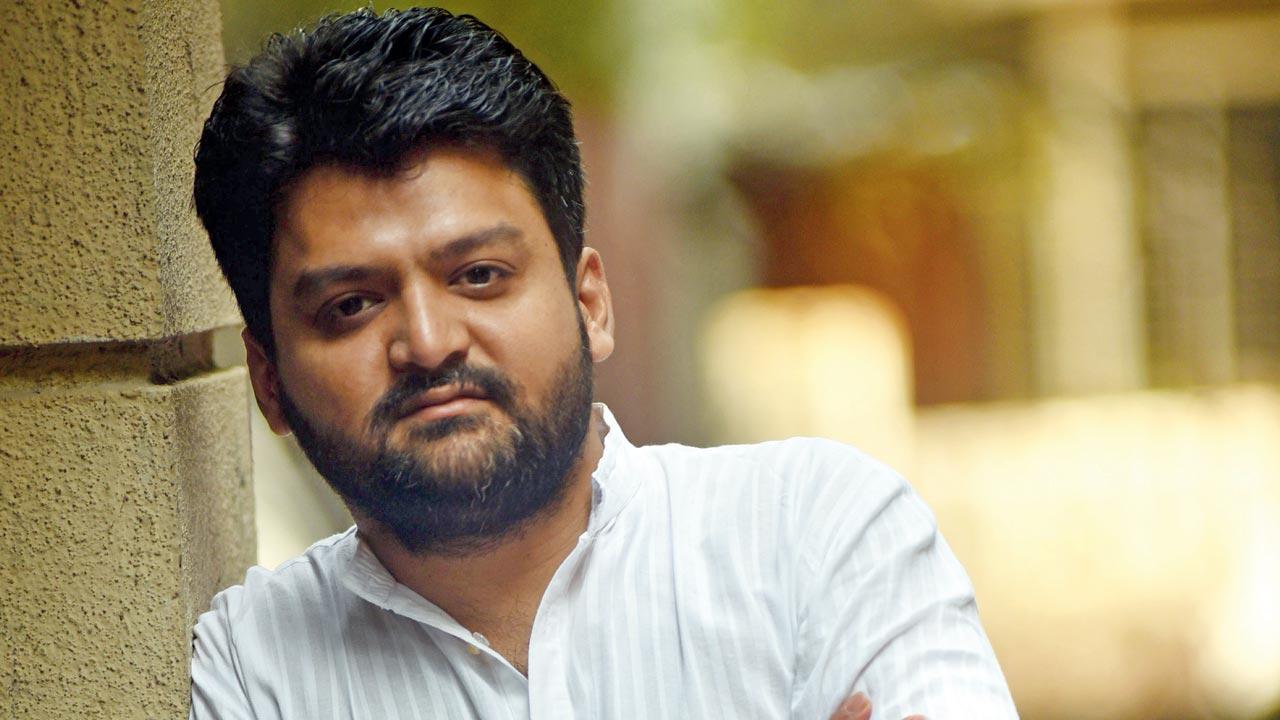
Junior Mehmood’s elder son Rafiq remembers his father who spared no effort to help the people around him, from old friends to rank strangers. Pic/Sameer Markande
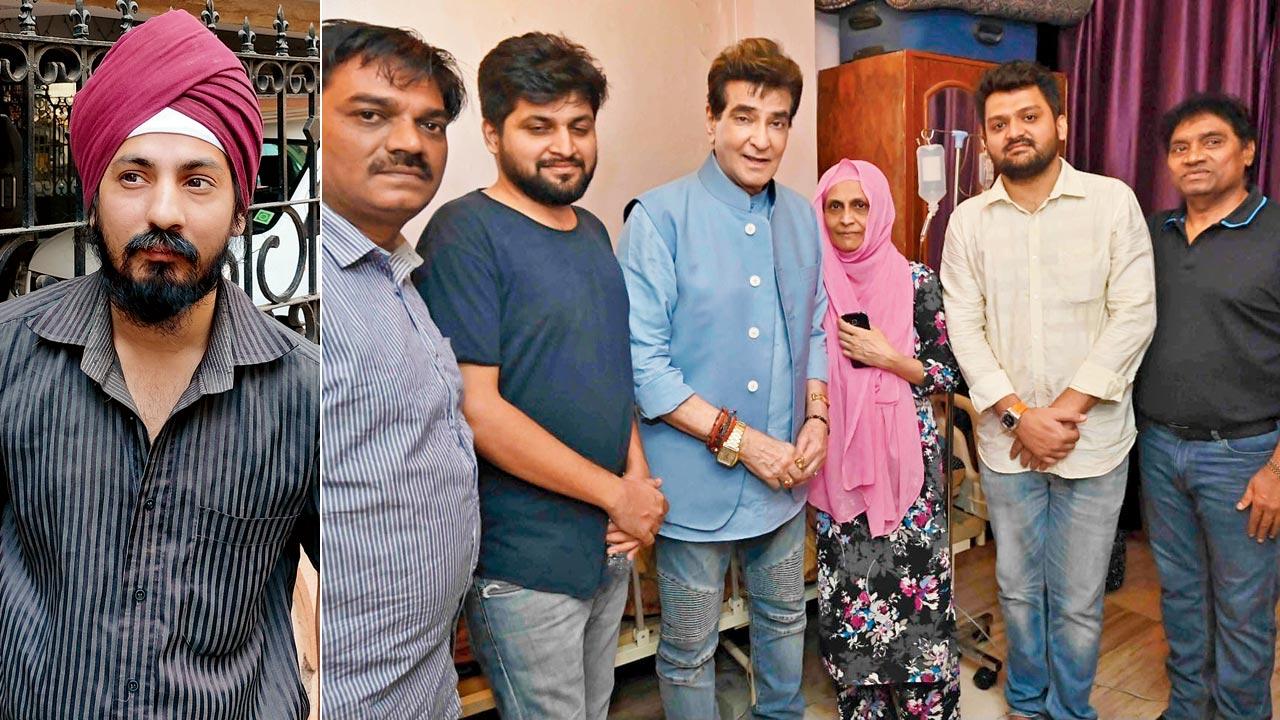
Neighbour Inderpal Singh Kohli recalls Junior Mehmood performing at the society’s Diwali function, and is still struggling to believe he is gone; (right) Stars like Jeetendra came rushing down to meet Junior Mehmood after learning about his failing health, while Johnny Lever, his old friend, was by his side throughout
Character actor Junior Mehmood passes away
2:35 PM

BOMBAY TIMES (December 9, 2023)
Character actor Junior Mehmood, known for his roles in films like Hare Rama Hare Krishna, Caravan, Haathi Mere Saathi and Mera Naam Joker, died on Friday following a battle with cancer, his son Hasnain said. The actor was 68.
Junior Mehmood, whose real name was Naeem Sayyed, began as a child artiste. He was given the name Junior Mehmood by late comedy icon Mehmood after they starred together in the 1968 film Suhaag Raat. He memorably recreated Mehmood’s song Hum Kaale Hain To Kya Hua from 1965’s Gumnaam for the Shammi Kapoor starrer Brahmachari in 1968.
Several people from the industry met him during his last days, including Johnny Lever, Sachin Pilgaonkar and Jeetendra. Jeetendra had shared screen space with the actor in several movies, including Suhaag Raat and Caravan.
------------------------------------
Jeetendra remembers his co-actor of films like Caravan, Parivar, Vishwas and Jeene Ki Raah
Upala KBR (MID-DAY; December 9, 2023)
Last afternoon, yesteryear actor Junior Mehmood, who was better known as Junior Mehmood, was laid to rest at the Santacruz burial ground. The actor, 67, passed away on Thursday night, after a battle with stomach cancer. Earlier this week, Jeetendra visited his co-actor of several films like Caravan, Parivar, Vishwas, Apna Bana Lo and Jeene Ki Raah, along with Johny Lever.
Talking about meeting his colleague who played his younger brother Monto in Caravan, Jeetendra said, “Johny Lever called me, saying that Jr Mehmood was suffering from stomach cancer and wanted to meet me. I don’t know why he wanted to see me, but I am happy that I could respect his wishes and meet him before he passed away.”
He was going on his routine Sunday trip to Mount Mary Church, when Lever reached out to him saying it was urgent. Jeetendra shared, “When I went to Jr Mehmood’s home, I was devastated to see the condition he was in. He could not recognize me or talk. He was in too much pain and was unable to even open his eyes. I got extremely emotional when I saw him like this, and his wife Lata too, broke down and started crying when she saw me.”
In the 1970s, films used to take two years to be made. “So, we’d spend a lot of time together on and off the sets.” Jeetendra also remembers meeting Lata when she worked in Sadaa Suhagan (1986) as a co-artiste. “She told me that she was marrying Jr Mehmood. I was happy to hear that and gave them my best wishes. At that time, she said that he looks like me, and I remember that,” he reminisced.

---------------------------------------------------
Rishabh Suri (HINDUSTAN TIMES; December 10, 2023)
Sachin Pilgaonkar wasn’t aware about his childhood friend, late actor Junior Mehmood suffering from stomach cancer. It was only a week ago that he got a call from actor Johnny Lever. Junior Mehmood passed away on December 8 at the age of 68.
“He did not share it with anybody, it was only a few weeks back that he was tested. They discovered cancer had spread all over his body. Doctors didn’t go ahead with chemotherapy as they felt his body would not be able to take it. Johny bhai called and told me. I started crying after that call,” recalls Pilgaonkar.
They started their careers as child actors together, and during the 1960s and 70s, Junior Mehmood rose to stardom in no time. “He used to own an imported car, the only child actor to have it at that time,” shares Pilgaonkar, adding, “We acted as kids in Brahmachari (1968), and I remember, as he had performed to the song Hum Kaale Hain (Gumnaam; 1965) for stage shows, he did so in front of the film’s makers too, and they wanted to include it in the film. He became a big star and one of the highest paid child actors.”
However, life happened to Junior Mehmood soon. He grew out of his cute child phase, and roles started drying up as an adult. Pilgaonkar reveals, “He was satisfied with the work he got as a child, but not as an adult. He would feel the difference when the work lessened.”
The veteran actor would fondly call Junior Mehmood, Nammo. The two shared a close bond, with the latter’s sisters’ paya and khichda being among his favourite dishes. “I will never call this a professional loss, it’s a personal loss,” he ends.


Meena Kumari told my parents to allow me to visit her home four days a week to learn Urdu-Sachin Pilgaonkar
8:52 AM

Mohammed Wajihuddin (THE TIMES OF INDIA; September 10, 2023)
You ring the doorbell and a maid ushers you into an aesthetically decorated room. A few minutes of surveying the antique furniture, sepiatoned photographs, awards and shields jostling for space on a pedestal later, you are greeted with warm ‘adaab’.
As soon as actor-director Sachin Pilgaonkar breezes in and occupies a small wooden chair, the smiling actor leaves you in no doubt that he is “in love with Urdu.” Known mostly by his screen name Sachin, he gets down to conversing in chaste Urdu. Words like “deeda-o-danishta” (intentionally), “khushgawar” (congenial), “jafa” (tyranny of the beloved) and “wafa” (trust) punctuate the conversation.
A pucca Maharashtrian whose mother tongue is Marathi, Sachin has just won the Mohsin-e-Urdu (Ambassador of Urdu) award from the citybased socio-cultural organisation Urdu Markaz for his “true love for Urdu.” “I have yet to come across a Maharashtrian whose mother tongue is Marathi but speaks Urdu so fluently. He is Urdu’s ambassador because he lives, speaks and bats for it,” explains Urdu Markaz’s director Zubair Azmi. Azmi adds that Byculla-based Burhani College too will be awarded the Mohsin-e-Urdu.
Before Independence, Urdu was spoken widely across north India, leaving a deep influence on films, literature and culture. Post-partition, it became synonymous with the minority community, a reminder of the event that divided the subcontinent. However, even today many legends in Hindi cinema, including Gulzar and Dharmendra continue to use Urdu extensively.
“A language has no religion. It is wrong to say Urdu is a language of Muslims alone. It belongs to India and has added to our literary and cultural heritage,” declares Sachin, who was all of 9 when he acted in Sharat Chandra Chattopadhyay-penned, Hrishikesh Mukherjee-directed ‘Majhli Didi’ (1967) with Meena Kumari and Dharmendra in the lead. Meena Kumari grew very fond of the boy; one day she asked him about the language he spoke at home. “Marathi,” replied the then child actor. The legendary Meena Kumari whom Sachin called “Meena Apa’’ while she addressed him as “Sachu Baba”, asked him to bring his parents to the sets.
“Meena Apa told my parents to allow me to visit her home four days a week to learn Urdu. She said she saw a bright future for me in the industry provided I learnt the nuances and diction of the language and spoke it well,” recalls Sachin.
Thus began his intense tutoring in Urdu from the actress whose original name was Mahjabeen Bano. Bollywood’s tragedy queen, she also wrote poetry with Naaz as her takhalus (pen name). Having worked in 65 films as child artiste, he graduated and went on to act and direct a number of Hindi, Marathi, Kannada and Bhojpuri films and television serials. If films like ‘Geet Gaata Chal’ (1975), ‘Balika Badhu’ (1976), ‘Ankhiyon Ke Jharokhon Se’ (1978), ‘Sholay’ (1975) and ‘Satte Pe Satta’ (1982) made him a household name, the serial ‘Tu Tu Main Main’ (2000) established him as a known face on the small screen.
How much has Urdu helped him as an actor? “Oh, I would have remained adhura (incomplete) if Urdu had not come into my life. Why only acting, I would not have been the confident person I am today if I had not learned how to speak this beautiful language,” says the boy who grew up in a 1BHK flat in Dadar. Sachin later moved to Juhu, and then to Lokhandwala.
“I also enjoyed going to Meena Apa’s big house at Janki Kutir in Juhu because she would send a big car to pick me up from Dadar. For one hour, Meena Apa played table tennis with me while another hour was devoted to Urdu.”
After her demise, says Sachin, he was fortunate to have been taught by veteran poet-lyricist Majrooh Sultanpuri, his neighbour in Juhu. Like other kids, Sachin addressed him as “Abba”. On one Eid, all the children lined up in Abba’s room to receive a 10-rupee note each as Eidi (gift). “Instead of money, he gave me a ghazal which he wrote in Devnagri before me,” he recalls. “It was my best award.”
Tu Tu Main Main was about showing love-hate relationship between two women in a very simple form-Supriya Pilgaonkar
9:19 AM

Sachin shares that the team celebrated Reema Lagoo’s birthday on the sets of Tu Tu Main Main, “just a week after we started shooting for the show”
With Tu Tu Main Main set to return to our screens, Sachin and Supriya Pilgaonkar tell us about the making of the original hit show and what made it special
Divya Kaushik (BOMBAY TIMES; June 27, 2023)
In an era when not every TV show was about scheming saas, kitchen politics or conniving bahus, there was Tu Tu Main Main – the ’90s show that defied the stereotypical notion of the saas-bahu relationship. A sitcom, all about the love-hate relationship between a mother-in-law and a daughter-in-law, that became popular among people of all age groups.
Wanted to work on a simple topic with the scope of becoming big: Sachin Pilgaonkar
Sachin Pilgaonkar made his foray into small screen with Tu Tu Main Main. Sachin says that the show will always be special to him because it marked his debut on TV. “I must confess that there was a time when I looked down upon TV as I was only doing films then. A common friend of mine, asked me once ‘why don’t you make a TV serial?’ I told him that I was not interested in doing TV and for months he pursued me. Then Supriya told me that TV was becoming big and she also mentioned that one of my gurus, Ramesh Sippy, also made a TV show (Buniyaad) after doing films and I should consider it. I agreed with her and decided to do a TV serial. I always thought that it would be better to work on some small, simple topic that has a scope of becoming big,” says Sachin, who decided to take forward the idea of saas-bahu after discussions with his writer Sajeev Kapoor.
On the title of Tu Tu Main Main
Sachin says, “I was already working with Sajeev on the title and he had titled it saas-bahu, which I didn’t like as it was too direct. I shared this idea with my co-producer to make something around saas-bahu. He loved it and by that time my writer came up with this title Tu Tu Main Main, which immediately clicked with me.”
The best thing about the show was that it didn’t complicate anything: Supriya Pilgaonkar
Supriya Pilgaonkar was a part of the show from the scripting stage. She says, “When we would read those things they would read bizarre, but doing (the scenes) on sets was so much fun, and when we watched it on screen it was hilarious. That was the best thing about the show, it didn’t complicate anything. It was all about showing this love-hate relationship between two women in a very simple form.”
ON CASTING REEMA LAGOO AND SUPRIYA PILGAONKAR
Reema Lagoo’s role was also offered to Farida Jalal and Aruna Irani. “Reema was my first choice, as she had only done serious roles till then. She was also my childhood friend and she told me that she wanted to do comedy only with me, as I have a very different sense of humour with a lot of emotional undercurrent. When we approached Farida ji, unfortunately she and her mother underestimated this idea. Aruna ji was too busy producing and directing, and then we approached Reema and she was happy to come on board. On June 16, we started shooting and on June 21 was her birthday, so we celebrated it on the set. These two women, who were not seen by the Indian audience so much – Reema was known for playing Salman Khan’s mother and Supriya was not known much outside Maharashtra – became a household name within a few days,” shares Sachin.

Screen Marathi films or pay up Rs. 10 lakhs, government tells Maharashtra theatres
8:25 AM
Rishabh Suri (HINDUSTAN TIMES; May 21, 2023)
Maharashtra’s cultural affairs minister Sudhir Mungantiwar announced that a fine of Rs. 10 lakh will be imposed on movie theatre owners if Marathi movies are not screened for at least four weeks in a year. According to artistes, this is a welcome move.
Shreyas Talpade is of the view that Marathi films should be given priority in the state. The Poshter Boyz (2014) actor says unlike Hindi films, where the opening weekend itself brings in Rs. 20-30 crore, Marathi films “don’t have much funds for promotions” and depend heavily on word of mouth. “This is why they need more time in theatres,” he reasons.
Chandramukhi (2022) actor Amruta Khanvilkar says, “Our audience consists of people who do 9 to 5 jobs. When they want to watch a film in a theatre [after work], they don’t find convenient timings. I think people are not coming to theatres because they don’t find the right shows. This is a welcome move.”
Theatre owners say the earlier rules were that at least 120 shows had to be screened. “It means a minimum four shows daily for a Marathi film. They have now made it more stringent. In our theatres, Marathi films play at prime time slots (between 12 pm to 9 pm). If the government wants to penalize someone who isn’t following it, that is fine,” says Rajender Singh Jyala, chief programming officer, PVR INOX Limited.
However, not everyone is happy about these new rules. Joginder Tuteja, trade analyst, says this decision “doesn’t make any sense”. “It’s like a quota system that exists in jobs, etc. You can reinforce this in the government sector, but when you do it in privately owned businesses, then what you are doing is restricting them from doing their business which I am not in favour of.”
Exhibitors, too, aren’t happy with this decision by the Maharashtra government. Akshaye Rathi feels it should only be about the films which the audience is keen to watch. “If people want to watch a film, why will theatres not showcase it and earn money? Sometimes Marathi films get lopsided heavy showcasing, and vice versa. I truly think if we want businesses to prosper, rather than penalizing theatres, the idea should be to incentivize a local industry. There are subsidies for the Marathi film industry anyway. The cinemas would feel the pinch especially in times where we are emerging from pandemic times,” he shares.
Sachin Pilgaonkar, actor-filmmaker:
Marathi films find it very difficult to find good shows in Maharashtra itself, which is the only place where those films release. The government is making the situation better [by imposing the fine].
Shreyas Talpade, actor:
What happens is, Marathi films pick up pace only in the second week; the first week goes in increasing word of mouth. If these films do a certain amount of business, prime time slots should be retained for Marathi films, too.

Shah Rukh Khan looked me and whispered, 'Mashallah, so beautiful'-Shriya Pilgaonkar
8:48 AM
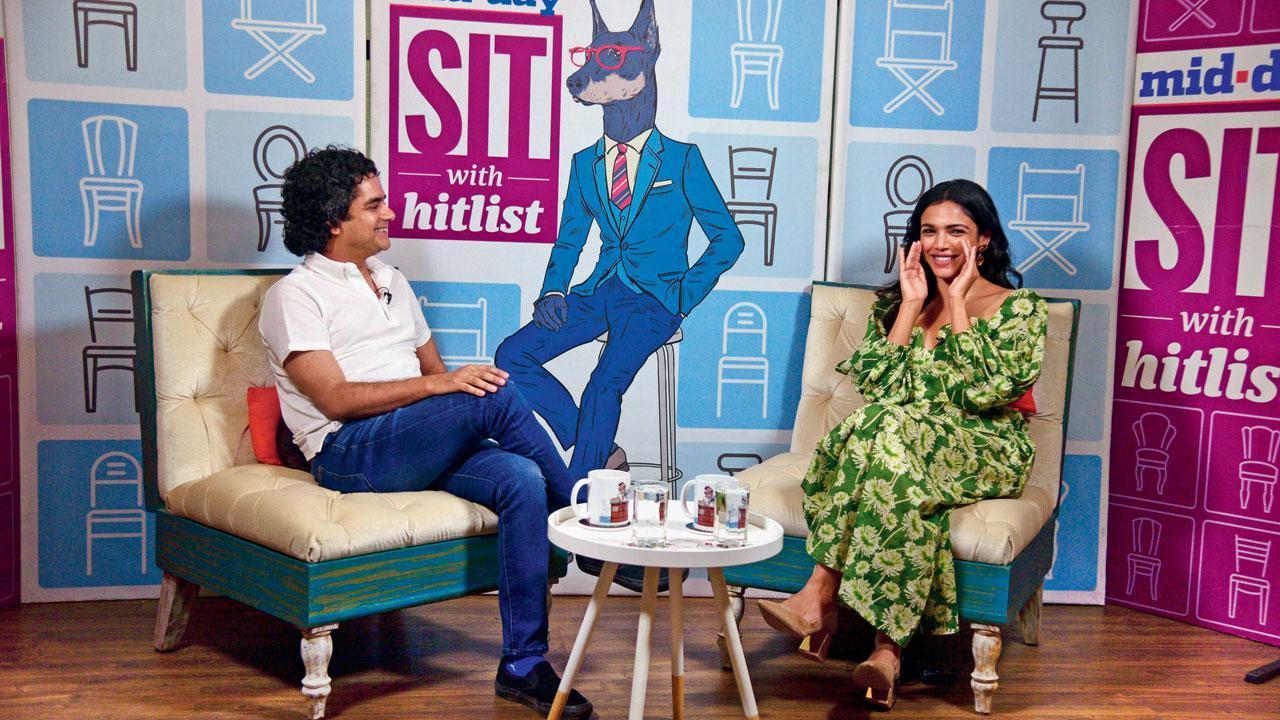
Shriya Pilgaonkar with mid-day’s entertainment editor Mayank Shekhar at the latest edition of Sit with Hitlist
Walking into Hitlist OTT Awards with two Best Actor: Series nominations, Shriya Pilgaonkar reflects on the shows that put her on the map
Mayank Shekhar (MID-DAY; February 18, 2023)
Serendipity, I suspect, plays the starring role in most lives. But it’s something we kept going back to, over an hour-long conversation with actor Shriya Pilgaonkar, 33, who’s legitimately an OTT star in her own right, and has been a film buff forever. Enough to bleed her eyes bingeing on five back-to-back films on the big screen at Mumbai’s MAMI festival.
One of which was The Artist (2011) — i.e. before the French tour de force became the toast at the Oscars, and indeed before Shriya was an actor herself.
There is a strange connect she felt with the film’s lead actor Jean Dujardin on the screen, which went beyond the fact that she obviously found him attractive. She told her mother about it later, and ‘journaled’ it at night — about being inexplicably drawn towards this man.
“Cut to,” Shriya says — as all readers of screenplays are prone to narrate their anecdotes — she had cracked an audition for a part, that turned out to be for a French production, set in India, starring Dujardin.
Likewise, before she took up acting as a profession, like many film aspirants, Shriya was assisting a director, Megha Ramaswamy, on a short film, being shot at the Yash Raj Films’ (YRF) studio, where Shah Rukh Khan was shooting as well. Ramaswamy, also Chak De! India director Shimit Amin’s wife, knew SRK, and introduced Shriya to the superstar.
The nation’s charmer number one, and the actor to have cornered all desi female hearts, looked at Shriya, whispered, “Mashallah, so beautiful!” At that moment, Shriya recalls, she died!
Cut to, 2015: There was a moment in Shriya’s life, when during the day, she was shooting with Dujardin, and at night, with SRK — for Maneesh Sharma’s YRF production, Fan (2016), her Bollywood debut.
How did the latter happen? With auditions over three months, where she was testing for multiple parts, and even sitting in for cues for other actors, hoping to be cast, at YRF. It was one such tape — that wasn’t hers, and so she was totally relaxed on the screen — that “Maneesh (director) and Adi Sir (Chopra, producer) saw,” and selected her.
“I like how all these stories happen late at night — I got a call from Shanoo Sharma (YRF’s casting director). I just went over to my parents’ room, told them I’ve been cast as Shah Rukh’s love-interest. And I just shut their door, without waiting for their reaction! Didn’t know what to say.”
The parents being Sachin, and Supriya Pilgaonkar. Both of whom are prominent, professional actors. She belongs to the third generation in the film industry. Shriya’s paternal grandfather, Sharad Pilgaonkar, who she never got to see, was a producer. That explains how Sachin himself started early as an actor in his father’s film — that paved his path as a career child-actor, Master Sachin, from thereon.
Sachin, 65, has been an actor for 60 years! Supriya debuted with the Marathi film Navri Mile Navriyala (1984), directed by Sachin. Shriya herself appeared as an infant in one of Sachin’s movies. She doesn’t remember which one: “He’s directed 21 films!”
Reversing movie history, if you may — since men played female parts on screen once — Shriya first spoke for the screen as a little boy, basically “kid with boy cut”, to say, “Aunty, mummy ne achaar mangaya hai!”
That was her cameo in the hit TV show, Tu Tu Main Main. Those of a certain vintage might instantly remember the sing-song way Tu Tu Main Main was said in the title sequence, after which director Sachin would yell, “Action”, before the episode started.
Shriya followed director Sachin’s instruction in her debut film, in Marathi, Ekulti Ek (2013), too — which fetched her Maharashtra government’s film award.
Given the self-sufficient family unit of filmies, one would assume Shriya as an actor is an obvious career move. And yet, when she’d taken up a part in a short play as a stage debut of sorts, her mother simply looked at the adult child, for where she was headed, and sighed: “How predictable.”
Until 14, Shriya was set to be a professional swimmer; her days centred on training for the sport that she was participating at the state-level: “The sportsperson’s is a tough life. Even in swimming, a difference in micro-seconds sets apart the winner from others. It consumes you.” She was training at Bandra’s Otters’ Club, and gave up on the sport, shortly after her coach passed away.
And it’s not like she had a Plan B, or any particular plan at all. As someone scoring high in class, she did what most over-achiever type kids do, in school, and later in college — everything. I learnt later that she was also the student-boss of Malhar, St Xavier’s College annual festival — it’s the kind of designation collegians, I notice, flaunt even on LinkedIn!
A big move she did make, Shriya admits, was actually the one that she did not — that is, to pursue her master’s at Columbia University, where she had secured admission. Columbia was her trying to postpone/evade the question about what she really wants to do next. Instead she enrolled in a film appreciation course at FTII, began acting in plays, directing short films, documentary, eventually auditioning for acting parts for movies.
That she is multi-talented could have a lot to do with her father Sachin. Best way to describe Sachin is as Rajshri Productions’ OG Prem. He was the lead in the super-hit Nadiya Ke Paar (1982), that got remade into Hum Aapke Hain Koun (1994), with Salman Khan.
Another way to describe Sachin is as a singer, writer, producer, director… Between her parents, Shriya rightly insists her father is the star — all about showmanship — while her mother is the ‘actor’, who can detach herself from her work as well.
What’s common between them is they can break a leg! For proof, the Pilgaonkar couple had famously won the maiden season of dance-reality show, Nach Baliye (2005), surprising many with their killer moves.
Which is also in common with the daughter, we learn. Shriya extensively trained in kathak, growing up — that, in fact, pretty much all Bollywood female actors do, at some point. As we speak, she’s finally put that talent to test in a “full dhamaal” song-and-dance routine, “for an unannounced film, produced by Emmay Entertainment.”
From her mother, Shriya says, she’s acquired ‘body-language’ as an important acting lesson. At some point in the conversation, she effectively shows us how her three well-known characters — lawyer Kashaf Quaze, from Guilty Minds (2022); journalist Radha Bhargava, from The Broken News (2022); sex-worker Madhubala, from Taaza Khabar (2023) — would sit, if they were in the same room.
And that’s self-awareness at the level of where the legs are placed, how the head moves, whether she is leaning-in (Kashaf), straight, and attentive (Radha), or totally carefree (Madhubala).
When she was offered the part of Sweety Gupta, on the other hand — a girl from the hardcore, Hindi heartland, namely Mirzapur, meaning Uttar Pradesh (UP) — an advice/warning she got was not to come across as the Maharashtrian girl that she is.
This is where her dad would’ve been the inspiration: “Unki zubaan bahut saaf hai (he has clear diction). One thing he told me is to always master the dialect, before you play any part.”
Sweety is as UP as they get. Shriya jokes people have come up to Sachin to suggest he couldn’t be Sweety Gupta ke papa. It’s this role of Guddu Bhaiya’s girlfriend in Mirzapur, she admits, that gave her “the taste of pan-India fame. Till today, there’s the Sweety-love everywhere I go, and I love that,” although her character died in the first season of Mirzapur (2018).
Guilty Minds, though, she reckons, is what brought her “critical appreciation” as an actor; she came into her own. There is some serendipity here too. In the sense that dad Sachin, all her life, she tells me, had wished to play a lawyer. It’s never happened. He’s drawn to law as a hobby as well — reads books, goes through minutiae of contracts, etc.
It’s Shriya who got to dive deep into the world in ways that Indian screen hasn’t before. In terms of movies, Chaitanya Tamhane’s Court (2015) was a masterpiece on India’s legal system. Shriya agrees. That apart, for long-form content, the realism and authenticity of Guilty Minds is refreshingly first-rate.
Much of it comes from the series creator, Shefali Bhushan, daughter of prominent jurist, ex law minister of India, Shanti Bhushan; sister of top lawyer and activist, Prashant Bhushan. Can’t get more insider than that!
The writing was such, Shriya recalls, that there is a scene in the show, where her character Kashaf, and her team, along with the opposing lawyers, are in a village, fighting against a power plant coming up, that will wreck lives of locals.
Somehow, while performing that (third episode’s) monologue, detailing the human cost of development, Shriya broke down on the shoulders of Sugandha Garg (co-actor), after the director called cut: “I felt something. Maybe the line between the actor and character broke.”
As an actor, she says, she actively practices an attachment-detachment relationship with her work, given that the outcome, in terms of success, is out of everyone’s hands. But it’s hard to pretend you don’t care, after all the effort that’s gone in.
Going back to her journal that night after Guilty Minds shoot, she wrote about what she had experienced doing the emotional scene. And that it doesn’t matter how the show is received, in terms of numbers of reviewers’ nods — this is something special that will stay, regardless.
The Broken News, likewise, enters the world of television journalism, with Shriya’s character at the centre of the newsroom, navigating nuances, if not serious dilemmas of this profession. The apprehension, Shriya confesses, about being typecast as this everyday/important professional, did cross her mind.
“Even my friends say which profession is left to play? But that’s not the point. Even among lawyers or journalists, there are different types.” To prep for her part of a reporter, she in fact spoke to (mainly former) journalists on how they’d respond to life’s choices, rather than intricacies of the newsroom itself.
Not be an ‘ageist’ about it — I’m an old man myself — but there is a rejuvenating aspect to hosting long chats with younger guests, as they delve into their early experiences. The memories are firstly fresh, rather than jaded from having gone through these same interviews/questions, over years. Shriya is one of the youngest to feature on the Sit with Hitlist series of conversations, before a live audience.
Also, you can probe — without, hopefully, coming across as a nosey uncle — on random fun stuff, like her favourite drunken story? Involved lots of wine, during the India-Pakistan match, at Melbourne Cricket Grounds — she had to keep drinking, because once India scored, you’re supposed to stay put in the same position, and repeat exactly what you were doing before!
Or how about check on important issues, like who’s she dating? Well, this chat took place on Feb 13. She said she didn’t have a date for Feb 14. So I’m guessing she’s single. Although she’ll be happy, she mentioned, if she somebody made a plan. If you search for this chat on YouTube, we’ve left her number there (of course, I’m kidding).
Most elementally though, the fact of a young star is you’re catching them on the curve. There’s so much to look ahead. I had looked up Shriya’s TEDx talk, from 2019, and already her professional life has transformed enough to render that talk premature. As would be this interview.
Considered the past year alone for Shriya — The Broken News on ZEE5, Guilty Minds on Amazon Prime Video, Taaza Khabar (2023) on Disney+ Hotstar — you can’t escape on her on OTT.
So much so that there’s stuff of hers on other platforms that I haven’t had the chance to catch: new season of The Gone Game on Voot, a show called Murder In Agonda on Amazon Mini? She’s the only actor to be nominated twice for Best Lead (Female) at the Hitlist OTT Awards.
The first time most Indians, including me, saw Shriya on screen was, of course, in Fan. I kept wondering where I’d met her before. It was at a party in Pune, when she wasn’t an actor, and she was pissed with movie critics, in general. I reasoned that film reviewing was indeed a low form of writing, because it often lacked empathy.
“At that time obviously I didn’t know I was going to be an actor, and that I’d have to change my opinion on critics,” Shriya laughs, pointing out that what had irked her after Fan were actually reviews that didn’t mention her at all.
Which is fair. Indifference is the opposite of love, not hate. While the film was a YRF production, starring SRK, it wasn’t exactly the proverbial launch vehicle, associated with star-kids. In this case, Sachin’s daughter.
Shriya says, “[There are star] children, who get papped, groomed, branded, for two years, before they come as movie stars [on screen]. I didn’t want to be on a magazine cover, even before I was an actor.” That’s also Instagram all right.
But the actual scene among screen talents has changed too dramatically to count on tested measures. And is it even about Bollywood anymore, as one supposes?
Look at the galazy of stars getting created in the OTT space, starting with Shriya, for instance. It’s a medium that isn’t ‘television’ enough for actors to surrender their identity to their character, that carries on playing itself, over hundreds of episodes!
Although exhibiting similar aesthetics, it isn’t exactly film, that is centred on the male lead, hustling over box-office returns. Let alone conversations on nepotism for debutants.
“Every role I’ve got is through passing an audition,” Shriya reveals, on the real serendipity surrounding her — right talent, at the right time. It’s like being an actor with a great voice, just when silent films have given way to talkies!
Cast your vote for the Hitlist OTT Awards
Shriya Pilgaonkar has been nominated in the Best Actor (Female): Series category for Guilty Minds and The Broken News.
The other nominees are:
- Amruta Subhash (Saas Bahu Achaar Pvt Ltd)
- Fatima Sana Shaikh (Modern Love Mumbai)
- Huma Qureshi (Maharani S02)
- Masaba Gupta (Masaba Masaba S02)
- Sakshi Tanwar (Mai: A Mother’s Rage)
- Shefali Shah (Delhi Crime S02)
There are 16 categories that the public can vote in. Log on to www.radiocity.in/hitlistott to cast your vote.
Voting lines close on February 22.
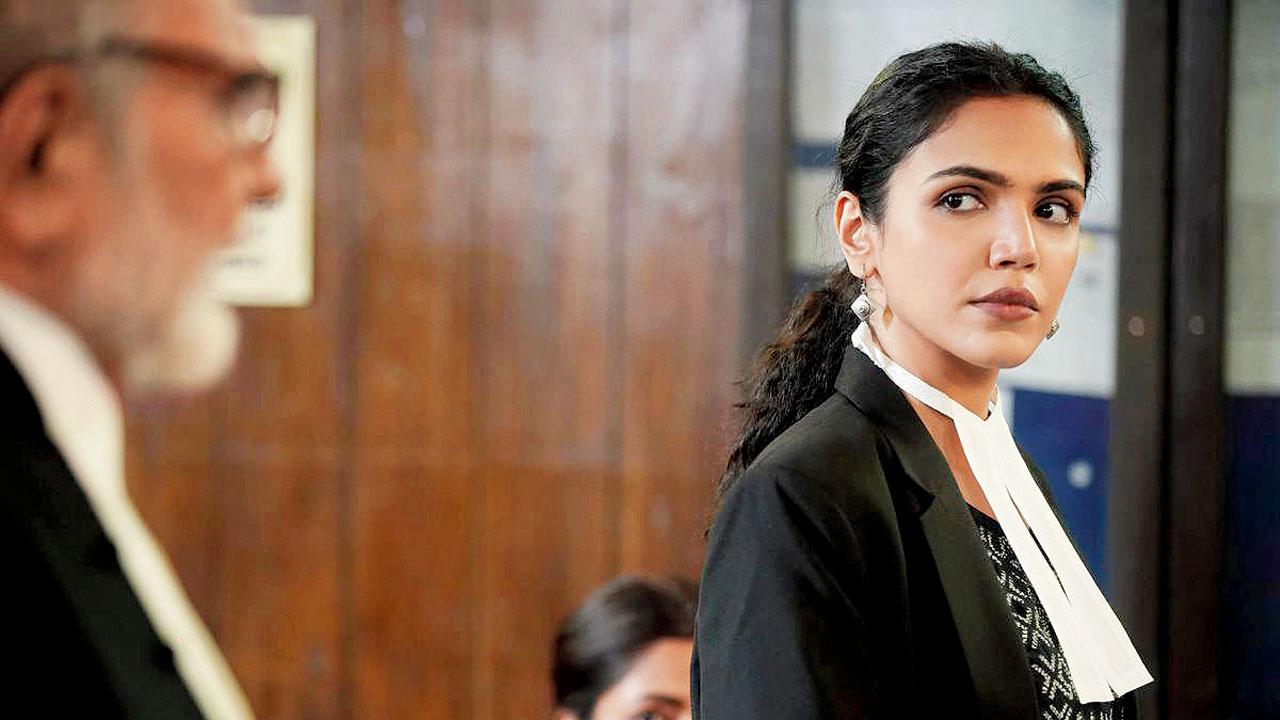
A still from Guilty Minds. Pics/Ashish Raje
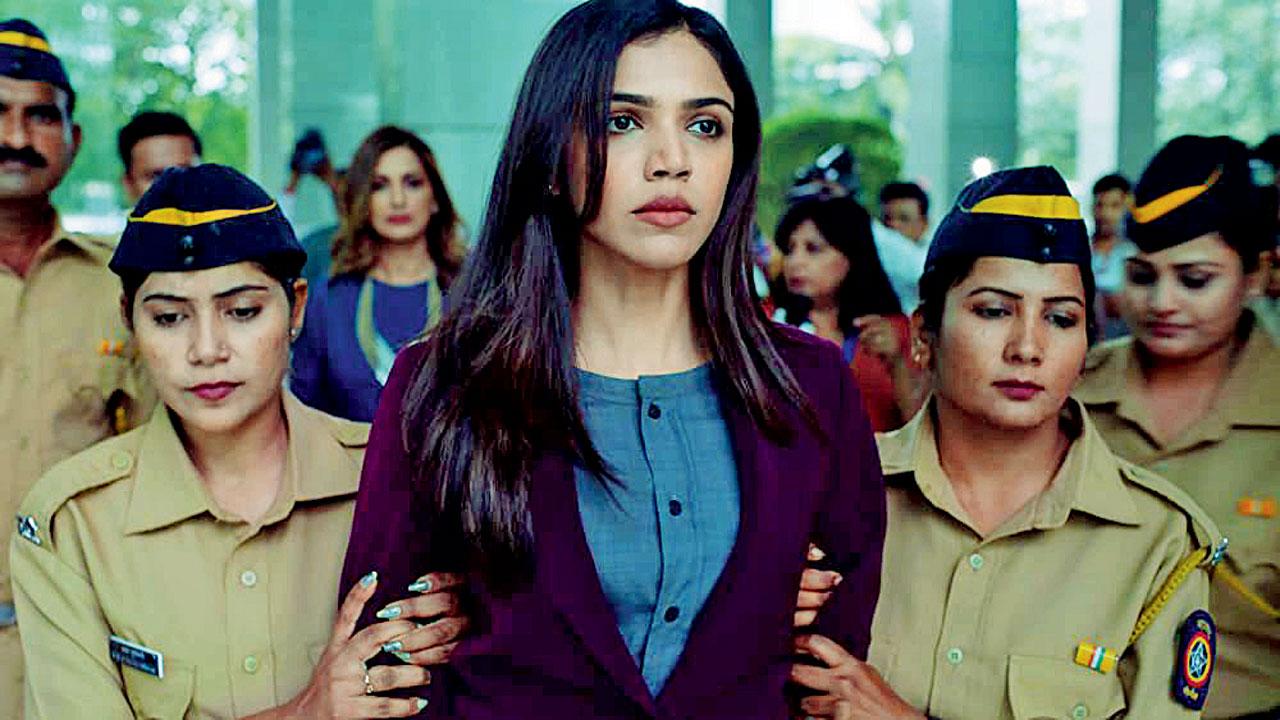
Shriya Pilgaonkar in The Broken News
There are needless abuses on OTT platforms-Sachin Pilgaonkar
8:29 AM

Sugandha Rawal (HINDUSTAN TIMES; August 13, 2021)
Actor Sachin Pilgaonkar is not only demanding for increased scrutiny on the content being churned out in the web space, but also wants stricter censorship to regulate the haywire going OTT space.
“The change that is coming in the OTT space is both good and bad. For instance, there’s no censor for the space, and due to its absence, there are some people who’re taking advantage of it,” the actor points, adding, “I’m not saying that everybody is doing it. But some are putting abuses unnecessarily. Jahan demand bhi nahi tab bhi gaaliyan dal rahe hai.”
Apart from the cuss words, Pilgaonkar, 63, feels sex scenes are also not being used judiciously, and a lot of time being incorporated only to grab eyeballs. “At some places, it’s the demand of the story but jahan zaroorat nahi hai, udhar bhi dhikha rahe hai,” says the actor.
He’s not willing to accept this change, and picks up a reference from his show, City of Dreams Season 2, to explain his point. “There was a scene, where my character was supposed to hurl an abuse as per the script, and when I said that, my director Nagesh Kukunoor asked me to skip it. Later, he confessed that it was sounding off. Jahan jiski zaroorat hai utna theek hai,” he stresses.
However, pointing at the silver lining, he says, “Good things are more in number than the bad things. In that way, we’re lucky and fortunate.”
We slept in the same room, the way we used to when Shriya was a little kid-Supriya Pilgaonkar
8:08 AM

In a chat with us, Sachin, Supriya and Shriya Pilgaonkar share their experiences of the last few months
Preeti Atulkar (BOMBAY TIMES; December 20, 2020)
For the Pilgaonkars — Sachin, Supriya and Shriya — 2020, in their own words, has been quite adventurous. They have also had their share of valuable learnings. In a recent chat with us, the three looked back and got candid about the Coronavirus lockdown phase, the concept of working from home and more. Excerpts:
I’M GRATEFUL TO HAVE A HOME AND BE SAFE: SHRIYA
“A major chunk of 2020 was spent at home, in each other’s company,” says Supriya and recalls, “I remember, in the peak summer, our room’s AC malfunctioned and Shriya had to share her room with us. We slept in the same room, the way we used to when she was a little kid.”
To this, Shriya adds that they had a great time and spending time together was thrilling for all of them. She elaborates, “I would often joke saying that we are all roommates. Dad would make yummy meals and we used to work out together. During the pandemic, we have seen the best and worst of humanity. In my case, there were days where I experienced anxiety and then there were times when I felt creatively engaged. Having said that, I’m grateful that we have a home and we are safe.”
Sachin too stresses on looking at the positive things and says, “I am a home-loving person and getting to spend time with family was a boon.”
Sachin adds, “The only thing I feel bad about in the current times is that some people still don’t realise the importance of following safety protocols and guidelines.”
I WAS BED-RIDDEN FOR ALMOST THREE MONTHS: SUPRIYA
Recalling the time when Supriya’s foot was fractured, Sachin adds, “She had taken our pet Jack for a walk when she tripped.” Supriya quips, “I was bedridden for almost three months because of that. But my husband really took care of the household chores and Shriya also managed various responsibilities. I was instructing them sitting in one place.” On her part, Shriya says that Jack was the happiest of them all because he was being pampered by all three of them. “He sure was the happiest Pilgaonkar in the household,” laughs Shriya.
WORK-FROM-HOME WILL BE RELEVANT EVEN AFTER THE PANDEMIC: SACHIN
Adapting to the new normal, the Pilgaonkars embraced WFH quite well. Shriya shares, “I did a virtual play called Lockdown Love, and aai even helped me behind the scenes. Also, I shot for a web series from home, which was conceptualized and directed via video calls. I didn’t want to bother my parents through the process, but they enjoyed it. In fact, they helped in various departments be it cinematography, art direction or camera set up, etc.”
Sachin has also been organising talk shows and mushairas online since some time. “I shot for a music video from home. We recreated an old song called Haan Pehli Baar, which was originally picturised on me. I think the concept of work-from-home has gained prominence because of the lockdown, but it will be relevant even in the post-pandemic times,” he says. With shoots and shows having resumed, the three are busy with their projects. Supriya, who will now begin shooting for a Hindi film, also has a Hindi show that will air soon. And Shriya will be seen in the tri-lingual Haathi Mere Saathi, alongside Rana Daggubati.

I have seen the guest list of filmi parties change every Friday-Sachin Pilgaonkar
8:25 AM

Rishabh Suri (HINDUSTAN TIMES; August 29, 2020)
Sachin Pilgaonkar has spent over five decades years in showbiz, having started right from the age of four as a National Award-winning child artiste. Naturally, the actor-director is privy to a lot of changes the industry has gone through over the years. “Change is the only permanent thing in this world, and in the industry, it has been for the better and worse; it can’t be one way. You are on a highway driving, is only your side of the road busy and not the other? It has to be both ways,” Pilgaonkar quips.
What does he make of the nepotism and outsider-insider debate? He says all this would be discussed before too, just not in the same terms. “We all had to go through this, including me, who is not a star’s son. That does not mean I lost confidence in what I am. I started off as a child actor, then became director and writer, too... I’m here to learn. The only difference is earlier I’d learn from my seniors; now I’m learning from my juniors,” he shares.
What hasn’t changed, however, is the fast pace of the industry, and how fates change every Friday. Pilgaonkar, who has been a part of both Hindi and Marathi cinema, says he has seen it all happen.
“I am a very observant guy. Every Friday, the guests at film industry’s parties would change. I’ve seen that with my own eyes. It’s not hidden from anybody in the industry. Everyone has a good and bad day, one has to be prepared for that... When we look at the world and see what is going on, it’s nobody’s fault... Even now (amid the pandemic) people who are dying, it’s not their fault. These things happen. We are human beings; we have to face it. Compared to all that, our industry’s so called calamities, mishap, flops, failures are too small,” says the 63-year-old.
There won’t be much of a birthday celebration-Shriya Pilgaonkar
8:16 AM

Kavita Awaasthi (HINDUSTAN TIMES; April 25, 2020)
Shriya Pilgaonkar turns a year older today, and this year, her prayer and wish is for “all of us all to overcome the Coronavirus pandemic”. “The last three birthdays have been on a set and I have been grateful to be working on my birthday. But this year, I am happy to be home with my family. The pandemic has made me realise that there are so many basic things which we take for granted. I am aware of the privileges that I have and I did my bit by donating. There won’t be much of a birthday celebration but dad [Sachin Pilgaonkar; actor] is going to cook a dish for me.”
Prior to the lockdown, the actor was constantly travelling and so the first week of staying home was about chilling, spending time with family, reading and watching content. “Doing chores at home takes up a lot of the day and now, there is even more gratitude towards all the help we have. I didn’t want a sense of lethargy to kick in so, I took a course on screenwriting,” she says.
As the pandemic has affected every industry, Pilgaonkar feels that today, people are trying to be creative in their own way. “I enjoyed performing a play online called Lockdown Lovers, produced by Roshan Abbas. We performed it live and that was an experience like no other. We are also working on another series. But I think, it will be a while before things get back to normal as priority today, is to be safe. So, we will have to pull through in these times,” she says.
The sound of her breath still haunts me-Mahesh Bhatt on Reema Lagoo
7:38 AM

Stage, TV, film actress Reema Lagoo succumbed to cardiac arrest in Mumbai
Roshmila Bhattacharya (MUMBAI MIRROR; May 19, 2017)
It’s past noon on Thursday. Mahesh Bhatt has just left Reema Lagoo’s residence after paying his last respects to the actress who close to midnight had called her relatives complaining of uneasiness and was rushed to a suburban hospital where she succumbed to a heart attack at around 3 am.
“She walked into the hospital herself. She had no history of heart diseases and was only suffering from a throat infection. This is such a shock!” exclaims the inconsolable filmmaker who’d first worked with her in the musical Aashiqui in which she played Rahul Roy’s mother who brings him up alone after her husband leaves them. She then went on to play mother to love child Ajay Devgn in Naajayaz. More recently, Bhatt convinced her to be a part of a daily soap, Naamkarann, on the assurance that the tone and tenor of her character, Dayawanti Mehta, would be set by him, and he’d oversee the project on a daily basis.
“Last August, I came out of retirement to direct her introduction scene in Naamkarann with the permission of the director. The sound of her breath in that scene still haunts me. She was the heartbeat of the show and the young writers marvelled at how she brought that something special to the screen. She was working 12 hours a day, how did this happen?” he wonders.
Shreyas Talpade is equally shocked having read her post on a whatsapp group at 12.30 am on Tuesday. He had worked with her in the ’90s, as an assistant director on the pilot of a TV series. “She didn’t treat me any differently when I became an actor, always enquiring about my family and inviting me home,” he shares.
Archana Puran Singh informs that Reema herself was extremely close to her own family and would ensure that she was back home in time for dinner so she could make the chapatis herself. The two had worked together in the madcap comedy, Shrimaan Shrimati, and Archana asserts that in real life Reema reflected the person she was on screen—warm, lovable and good-natured. She however confides that initially Reema wasn’t comfortable. “I told her to give it one episode and she’d love it. After we wrapped up the first episode, she admitted she’d never enjoyed herself as much. Despite her initial reservations she was effortlessly brilliant as Kokiji. It was tragic when Jatin Kanakia passed away, now Reema is gone,” she sobs.
Another sitcom which is unforgettable is Tu Tu Main Main which her childhood friend, Sachin Pilgaonkar, acted in and directed. It also featured his wife, Supriya, who played Reema’s daughter-in-law. “It became a real big thing and her contribution was immense. Tu Tu Main Main is one of the most memorable experiences of my life,” he says, too overwhelmed to continue.
Veteran actress Bharti Achrekar’s bond with her dated back to three decades even though they only worked together in one play, Lagnachi Bedhi. “Sadashiv Amrapukar, Suhas Joshi and Tanuja were all part of the cast. It was for a social cause and played all over Maharashtra. We were a part of a close circle in the Marathi industry,” she informs.
Juhi Chawla who had a few scenes with Reema in Aziz Mirza’s Yes Boss, remembers that she used to be so busy with theatre and her travels that whenever she had a break between shots, she’d snatch 40 winks and return, refreshed.
“I recently bumped into her at an awards function after a long time. When she learnt that I’m associated with certain social causes, she told me she’d love to do anything associated with children,” Juhi reminisces, adding that she loved watching her most in Sooraj Barjatya’s films.
Bhagyashree who worked with her in Sooraj’s directorial debut, Maine Pyar Kiya, recalls the scene featuring Salman Khan, Reema who played his mother at 31, and her together. In it the actress asks her, “Mere pagle Prem ki Suman banegi?” “It was one of the first scenes we shot together. There was so much love and tenderness in her voice that it actually made me cry. And yet I will remember her as a woman with a smile that made her eyes twinkle,” she maintains.
Kajol who shared the screen with her in Kuch Kuch Hota Hai, Pyaar To Hona Hi Tha and Yeh Dillagi, was one of the first to reach the Oshiwara crematorium even before the body arrived. She could not hold back her tears after paying her last respects and hurried away without speaking to anyone. But Farah Khan who choreographed the two in the song “Saajanji ghar aaye” in Kuch Kuch Hota Hai, insists that Reema always brought a happy, positive energy with her to the sets. “She was beautiful and joked that she was too young to play a mother. Today, I’ll say that she was too young to go. It’s really sad,” Farah says emotionally.
A few days before she passed away, Bhatt had shared with her a video from one of the many inspirational Ted Talks. It was about a plane crash survivor who, when faced with the prospect of imminent death, realises that everything can change in an instant, one shouldn’t have any regrets and postpone anything for the morrow. “I thought of all the people I wanted to meet, all the fences I wanted to mend and all the things I wanted to change,” he says. Reema responded, saying “This was beautiful, timely and so very relevant.”
Remembering their last exchange, Bhatt rues that he couldn’t make it to the Naamkarann sets. “We said goodbye over the phone with the promise to meet again. We keep thinking we have time but forget that none of us are sure there’s a tomorrow. That’s the essence of life,” he asserts. “The image of her lying there as I showered rose petals on her feet, so cold, silent and lifeless, and the memories of the warm woman so full of life, are two different streams that are impossible to reconcile.”
—With inputs from Natasha Coutinho
--------------------------------------------------------------------
Saif Ali Khan recalls screen mom
 I’m sad to hear about dear Reemaji who played my mother in Yeh Dillagi,
my first hit film in the ’90s. She was a wonderful actress and a lot of
fun on set. Akshay (Kumar) and I used to pass her love notes that we’d
written and pretend that Saeed Jaffrey saab was writing them. Her
reaction was amusing! She was so kind and patient with me. I can’t
believe she passed away at such a young age. Anything can happen at
anytime to any of us. My condolences to her family...
Saif and Reema also worked togther in Hum Saath Saath Hain and Kal Ho Na Ho
Members of Bollywood fraternity pay their last respects to Reema Lagoo
7:33 AM

Avinash Lohana (MUMBAI MIRROR; May 19, 2017)
It was a dark afternoon at
Oshiwara crematorium on Thursday even though the sun shone bright.
Friends and colleagues from the Hindi and Marathi film industries turned
up for Reema Lagoo's last rites. Sulabha Arya, Raj Zutshi and Kajol
were amongst the first to reach. Vinay Patkar, Mohan Joshi, Raza Murad,
Rakesh Bedi, Ramesh Bhatkar, Anang Desai, Ashoke Pandit, her co-stars
from her TV show, Naamkarann, Shruti Ulfat, Viraf Patel and Kunwar Amar,
were also present.
Rites began at 2.30 pm. Reema's ex-husband, Marathi actor Vivek Lagoo was supervising arrangements while their daughter, Mrunmayee, looked on teary-eyed. Filmmaker Swapna Waghmare Joshi spoke of their two-decade association.“She had acted in my earliest TV serial, Ahankaar. Now, I'm adapting the play Savita Damodar Paranjpe, which Reema immortalised, as a Marathi film. She had been an elder sister who guided and supported me and yet was a total brat,“ reminisces Swapna.
Sulbha Arya worked with Reema in Prem Granth and Kal Ho Na Ho, but since they were both stage artists, she knew her well. “She was one of the most popular mothers on screen. With her gone, all her kids must feel orphaned,“ she says.
----------------------
Rupsa Chakraborty (MID-DAY; May 19, 2017)
The film industry is yet to recover from the shock of actor Vinod Khanna’s demise last month, and there poured in another sad news. Last morning, veteran stage, film and television actor Reema Lagoo succumbed to a heart attack that she suffered post Wednesday midnight, say sources. She was rushed to Kokilaben Dhirubhai Ambani Hospital in Andheri.
Her son-in-law, Vinay Waikul said she was taken to the hospital after she complained of chest pain at around 1 am. “She was immediately rushed to the ICU, but she breathed her last at around 3.10 am,” said a doctor from the hospital. Waikul added that Lagoo “was perfectly fine and had no health issues”. Lagoo acted in several Marathi and Hindi films, besides doing a number of hit television shows.
She was born Gurinder Bhadbhade in 1958. Her mother, actress Mandakini Bhadbhade, was known for the hit Marathi drama, Lekure Udand Jhali. Lagoo realised her gift for acting as a student in Pune. She took it up professionally after finishing high school. She took the name Reema Lagoo after marrying Marathi actor Vivek Lagoo, who she separated from a few years later. She is survived by daughter Mrunmayee, also a theatre and film actress and director.
At her last rites yesterday, top names from Bollywood as well as Marathi cinema assembled at Shastri Nagar, Andheri to pay respects to their favourite ‘Maa’.
Sex Chat With Pappu And Papa gives sex education lesson with a fun twist
3:40 PM

In their new web series, Sex Chat With Pappu And Papa, Y Films is giving Indian audiences a sex education lesson with a fun twist
Aastha Atray Banan (MID-DAY; July 17, 2016)
"When Ashish Patil [head of Y Films] came and told us why he wanted to make a show about the embarrassing questions a child asks, he had a personal anecdote to narrate,” says Anand Tiwari, who plays Anand Watsa or Papa in Y Films’ Sex Chat With Pappu And Papa. He came home one day and found his son jumping on the bed saying f***, f***, f***… over and over again. His wife told him that their son had heard her saying it on the phone and had been parroting it ever since. “Kids today are so smart and have so many questions. This series will try and answer some of them sensitively and without making anyone cringe,” he says.
Sex Chat with Pappu And Papa, that debuts on Y Films’ YouTube channel on Tuesday, tells the tale of the Watsa family, where Tiwari as Papa and Kabir Sajid as Punit or Pappu are planning to give India a fun sex education chat. Shot in 10 days, the show of five episodes also stars Sachin Pilgaonkar as Vishwanath Watsa, who is daddu, and who also gets an education along the way. They talk about issues that all children have questions about — masturbation, the origin of babies, periods and homosexuality — in an easy and uncomplicated way.
“Why we cast Kabir, who is just seven years old, is because times have changed. Children as young as him are exposed to all that’s around them in a de-sensitised manner, so they need to know about all this,” says Tiwari. But Sajid, who you will have seen in advertisements and the Shahid-Alia starrer Shaandaar, had no clue what they were chatting about. “That’s because we didn’t want to disturb the acting process too much. When he watches it later, he will get it,” says Tiwari. Sajid says with a grin, “I didn’t understand anything. I just spoke the dialogue. But, how did he mouth the dialogues in such a believable way if he didn’t know head or tail of what they were talking about? “That’s because I am very serious about acting,” Sajid says matter-of-factly, and everyone cracks up.
His mother, Shireen, who is accompanying him, explains, “I am a biology professor and have taught at the university. You wouldn’t believe it, but most of the time college students don’t even know the basics of the reproductive system. So, when I read the script, I knew there was a need for such a show. I too have two sons, and I relate to this.”
Sajid may have not understood the lines he was spouting, but he has asked his mom some of the questions that the show hopes to tackle — like where do babies come from and what are sanitary napkins used for, which Shireen described tactfully as “adult diapers for ladies”. “So, we had a conversation where I told him what the show was about and that right now, all he needed to worry about was remembering the lines. That’s all,” says Shireen, who got a lot of calls from concerned parents who watched the trailer and were aghast that she had allowed her son to do the show. “I told them that as educated parents, we should be talking to our kids about sex and sexual habits."
At this point, Tiwari says, “That’s why the tagline of the show is ‘sharmane ki kya baat hai’. Ever since we released the trailer a few days ago, we have been inundated with comments such as ‘now we can just make our kids watch this!’” Tiwari shares that the show, though directed at the teenage and young adults, will help everyone. For example, in the episode that deals with homosexuality, we deal with the grandfather’s bias too and both Pappu and Daddu get a lesson in how homosexuality is not wrong at all.”
And, in the episode on masturbation, though the focus is on the male habit, they do admit that women do it, too. Tiwari laughs, “Of course, we do! It’s about each and every one of us.”

No 'Tu Tu Main Main' for the 'besties' Sachin, Supriya and Shriya Pilgaonkar
9:47 AM

There's no 'tu tu main main' at this actors' homestead. Instead it's dad, mom and daughter's fortress of support
Udita Jhunjhunwala (MUMBAI MIRROR; March 20, 2016)
Sachin and Supriya Pilgaonkar protectively flank their 26-year-old daughter Shriya on the couch in their Andheri home. Supriya has returned from the shoot of her daily soap Kuch Rang Pyar Ke Aise Bhi, while Shriya is ramping up for the release of her first Hindi film. It's the kind of banter you expect between friends — after all, Supriya was only 21 years old when she became a mother. She met her future husband, 11 years her senior, on the sets of her first film Navri Mile Navryala.
So what was it like growing up in a home with such accomplished parents? "I was aware, but it was not overwhelming. We are simple people essentially, so it was not a filmy household. I knew my parents were great at what they did and loved their work. I had been to film sets and there was always that conversation. But they were good parents — they were always there. They balanced their work and parenthood beautifully," says Shriya. "The only time I felt a little awkward was when Tu Tu Main Main was at its peak."
The next time her parents' professional commitment stressed Shriya out was in 2005, when Sachin and Supriya partnered up for Nach Baliye — and won! "Whenever Shriya, as a child, participated in any function or event, Supriya went along as her guardian. But during all the episodes of Nach Baliye, Shriya was there as our guardian," says actor-producer-director Sachin. Shriya adds, "I was stressed out of my mind. I had seen how hard they worked. And when they won, I had tears in my eyes. But they were tears of relief. I was so glad it was over!" Shriya made her big screen debut in 2013 in Ekulti Ek, a Marathi film directed by and co-starring her father. Watching Shriya on stage in a play entitled Freedom of Love, Sachin spotted a spark, and decided to pitch the idea of a father-daughter story to Shriya. "The first thing she said was, 'I would like to read the script'. Being our daughter, it was evident she would do such a thing. That was the only thing I did with her, and not for her."
She went on to act in the French film Un + Une and now makes her entry into Bollywood. Out in the professional world, Shriya doesn't reveal her antecedents unless asked and, like many hopeful girls, auditioned for for an upcoming film, unbeknownst to her parents. "I get stressed out when she goes for auditions," says mother Supriya. "As an actor, I didn't have to struggle much. I do the work that comes to me. Here she is going to ask for work and that too, through auditions."
The parents say they did not have an inkling that Shriya was attracted to acting nor did they encourage her to follow in their footsteps. "I always wanted to see what she wanted to do. She was a competitive swimmer — she represented Maharashtra state. She was doing well in her Sociology course at Xavier's College. She only started showing signs of becoming an actor after graduation," says Sachin. The Geet Gaata Chal and Nadiya Ke Paar actor admits that while he was surprised by her interest, he was also supportive. "Because I know she will do whatever she does with seriousness. She is not fickle, like her mother. In this way she is more like me."
Married for 30 years, Sachin and 'Super', as he refers to his wife, share a mutual respect as parents and professionals and bicker about typical issues: he leaves his things lying around; she puts them in different places and he cannot find them. "If she tells me one thing, I remember it for life; but even after 30 years, I have been unable to get her to change her habit of leaving the bedroom door open," says Sachin. Shriya listens to her parents' quibbles and mutters, "This is all so boring and predictable!" Supriya recalls a time when they were shooting for Tu Tu Main Main. "I like to pull his leg sometimes." Sachin interrupts, "One day, she told the unit that they should make a resolution to start shooting at 7 am and pack up by 2 pm. She made everyone sign that paper and sent it to me. She told the production manager not to tell me that she has done it. But she forgot that I can recognise her handwriting, because it's the same handwriting in which she used to write love letters to me."
Performance and the stage are in Shriya's genes. And while Supriya ensured that her only child stayed grounded, in reality Shriya's path was predestined. "I believe you understand whether you want to do something or not if you enjoy the hard work. When I was on stage I had the thought that this is where I am supposed to be." As a child Shriya often visited her parents on their sets. But as a swimmer she had short, cropped hair, a look she says her parents took advantage of. "They were so mean. Because I had short hair they made me play the neighbourhood boy Bittu on the show, who would ask for some achaar or something."
In a household with three busy working members, when do the Pilgaonkars find time for each other? "At any given point in time we are in touch with each other through our phones. Our WhatsApp family group is called 'Besties'," says Supriya. "Trekking in Himachal was one of our favourite trips together. Last year all three of us we went to America for the fall colours." Sachin adds, "When together, we share stories, poetry, we laugh a lot and Shriyu and I are serious foodies too."
Last year, Sachin reinvented himself in the role of classical singer Khansaheb Aftab Hussain Bareliwale in Katyar Kaljat Ghusali, a part that earned him much acclaim. The 58-year-old actor says, "After I became an adult hero, I was in a zone. Then suddenly in 2013 I get this film. I had to get out of one zone — of having a hero image — and went into a different zone to reinvent myself. One can get stuck in one's own mindset." Shriya was overwhelmed watching her father's transformation and found observing a fellow artiste's process exciting. "I feel ambitious enough to think that I can be as multi-talented as my father," she adds.
While her parents have never imposed their views on her, Shriya has learnt plenty through observing their demeanour. "From him, I have learnt the art of listening as an actor and the art of communicating as a director. I have learnt to respect everyone on set, from the spotboy to the producer. The only thing they have ever told me is do whatever you want do to with conviction, and have a good time."
Subscribe to:
Posts (Atom)