Showing posts with label Saajan Chale Sasural. Show all posts
Showing posts with label Saajan Chale Sasural. Show all posts
Satish Kaushik arranged for my wife to fly to Bhopal and organised a surprise birthday party for her-Rumy Jafry
9:23 AM
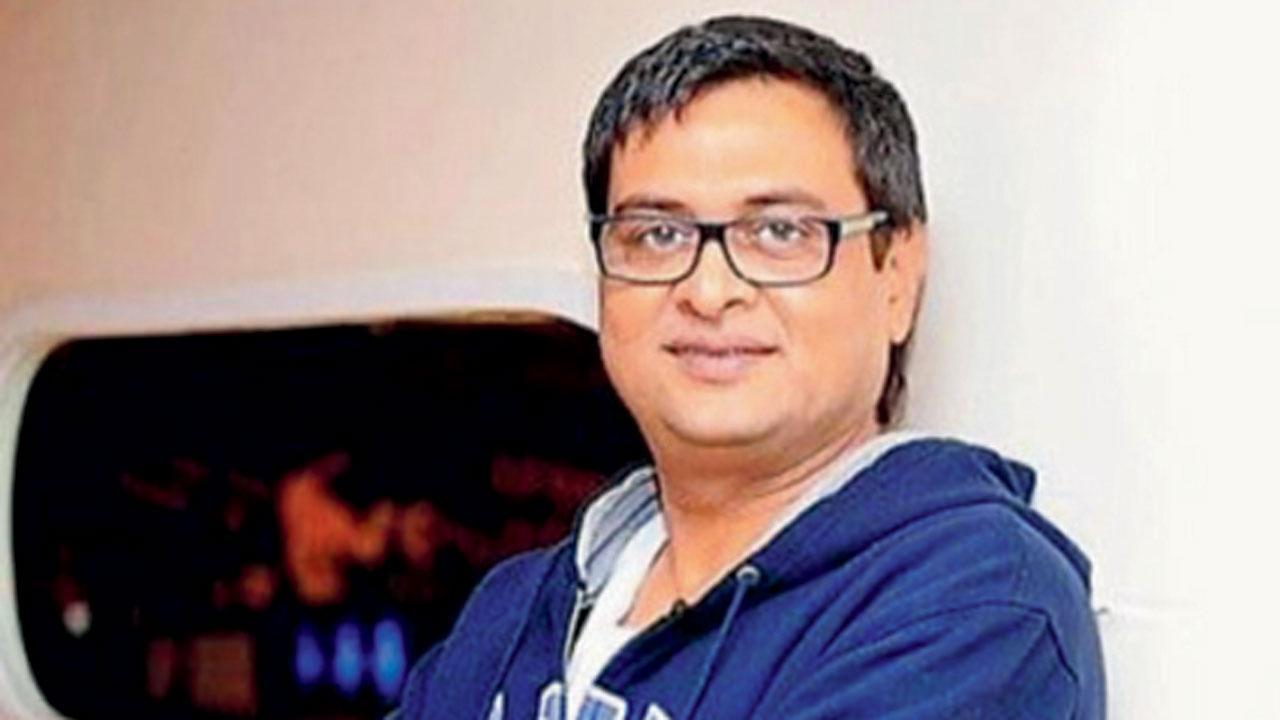
Bollywood scriptwriter and filmmaker Rumy Jafry recalls how he and Kaushik became close friends
As told to Hiren Kotwani (MID-DAY; March 10, 2023)
I was quite young then and wanted to see a film shoot. A common friend introduced me to Satish ji, through whom I got to visit the Versova set of Mr India. We became close friends after working together.
We collaborated on all his hit characters, like Mutthu Swamy (Saajan Chale Sasural) and Pappu Pager (Deewana Mastana). Even if you gave him two scenes, he would make them memorable. He would inspire you to do better work.
Over the years of working together on so many films, we became a family. Once, we were shooting in Bhopal, and I couldn’t rush back to Mumbai for my wife’s birthday. So, Satish ji arranged for her to fly to Bhopal and organised a surprise party for her. He also sang her a beautiful song.
Satish ji was such a lajawab person. He is one of those few people whose name brings a smile to the face. When you talk about him, you remember him fondly with a smile because he was such a positive person.
The world has lost its Calendar: Govinda remembers Satish Kaushik
8:27 AM
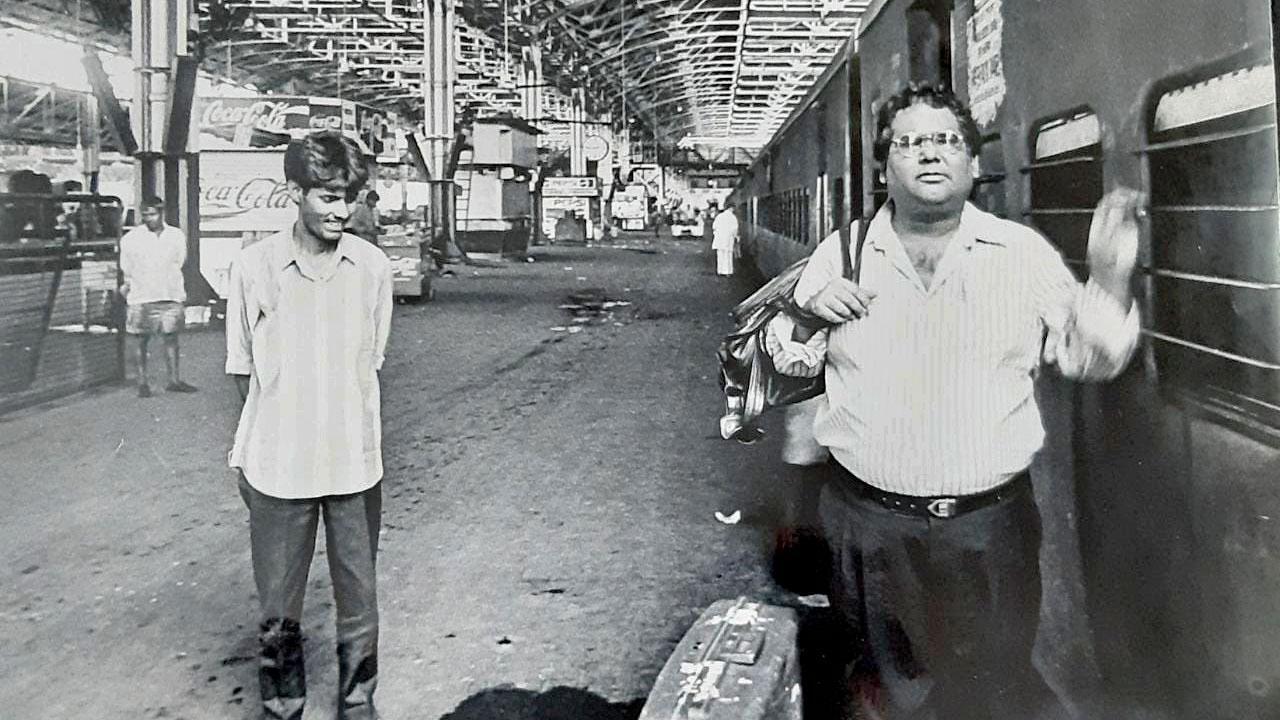
Satish Kaushik came to Bombay in August 1979 to become an actor. Pic/Twitter
Govinda, who starred with Kaushik in seven films, remembers him as the actor who matched Big B and him, punchline for punchline, in comedy
As told to Upala KBR (MID-DAY; March 10, 2023)
We did seven films together, and it’s astounding that each character he played is remembered even today. From my friend Happy bhaiyya in Pardesi Babu (1998) to the contract killer Pappu Pager in Deewana Mastana (1997), and tabla player Mutthuswamy in Saajan Chale Sasural (1996) — whatever roles he played, he displayed great comic timing.
The last movie we did together, Bade Miyan Chote Miyan (1998), had my favourite Satish Kaushik character. He played Sharafat Ali, a famous dealer in Chor Bazaar. Nobody can compete with Mr [Amitabh] Bachchan when it comes to acting. But, in Bade Miyan, Satish ji’s comic timing with Bachchan ji and me was so on point, it almost seemed as if he was toying with us. His performance [and the way he wrote] the role was unparalleled.
Besides being a powerful actor, he was a very good writer, and wrote all his roles. He never interfered in other actors’ parts. I remember during the shoot of Deewana Mastana (1997), he had written his own scenes and dialogues for Pappu Pager [his character], even before I had arrived on the set. When I joined them on the set, I said, ‘This will not do, I will also add my lines [to my character].’ He was surprised on seeing the dialogues I wrote.
Satish ji respected that I wasn’t just an ordinary actor, that I could go beyond acting to [elevate the scene with my dialogues]. There are very few actors like him, who have the power to make each role unforgettable.
Satish ji was also a director, and he wanted to focus more on direction in recent times. He had come to meet me, and asked what kind of [roles] I would like to play in his directorial ventures. Over the last few years, we lost touch, but our connection — that was born from the warmth and camaraderie that we shared on and off the sets — remained. I was heartbroken to hear about his passing away. I am still unable to process the fact that he is no more.
---------------------------------------------
The actor recounts the time he spent with Satish Kaushik, who starred with him in a string of hits in the ’90s like Saajan Chale Sasural and Deewana Mastana
Renuka Vyavahare (BOMBAY TIMES; March 11, 2023)
Actor and filmmaker Satish Kaushik passed on Thursday in Delhi. Kaushik, 66, who had essayed many memorable parts like Calendar in Mr India and Pappu Pager in Deewana Mastana, was known for his brilliant comic timing. In the ’90s, his pairing with Govinda worked its magic on the big screen in David Dhawan’s films like Swarg, Saajan Chale Sasural, Deewana Mastana, Bade Miyan Chote Miyan and Haseena Maan Jayegi.
Grieving the loss of his friend and fondly remembering his favourite co-star, Govinda said, “I have known him for the last 25 years. We worked together several times, and every film was a super hit. His comic timing and the efforts he took to write his lines were admirable. Even at a sad time like this, the characters he essayed bring a smile to your face. That was his achievement as an actor.”
The two actors had last shared screen space in Bade Miyan Chote Miyan. Govinda said, “The last film we did together was Bade Miyan Chote Miyan. He played a character called Sharafat Ali in it. He would come home to work on his lines. Even for Pappu Pager (Deewana Mastana), after I heard his lines, I said I need to rewrite mine. I introduced the ‘na’ after every line in Nagpada style. That was the way we worked. There was a healthy give and take. We complemented each other. Sabko saath leke chalnewala actor tha woh.”
On an emotional note, he shared, “Satish was extremely thoughtful and kind. He was passionate about his craft. He worked in several films for free. He played a character in Aunty No 1 and didn’t want to charge a penny. We had to convince him to take the money. Dildaar insaan tha. I pray for his family.”
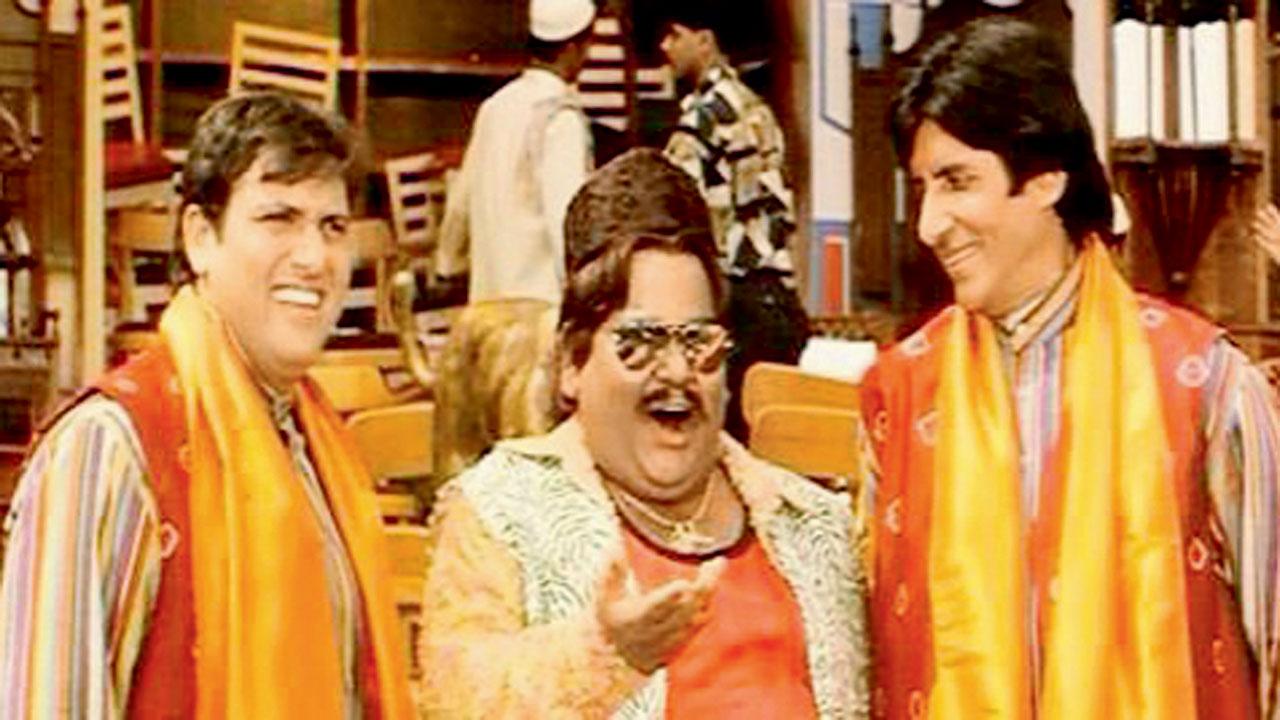
A still from Bade Miyan Chote Miyan
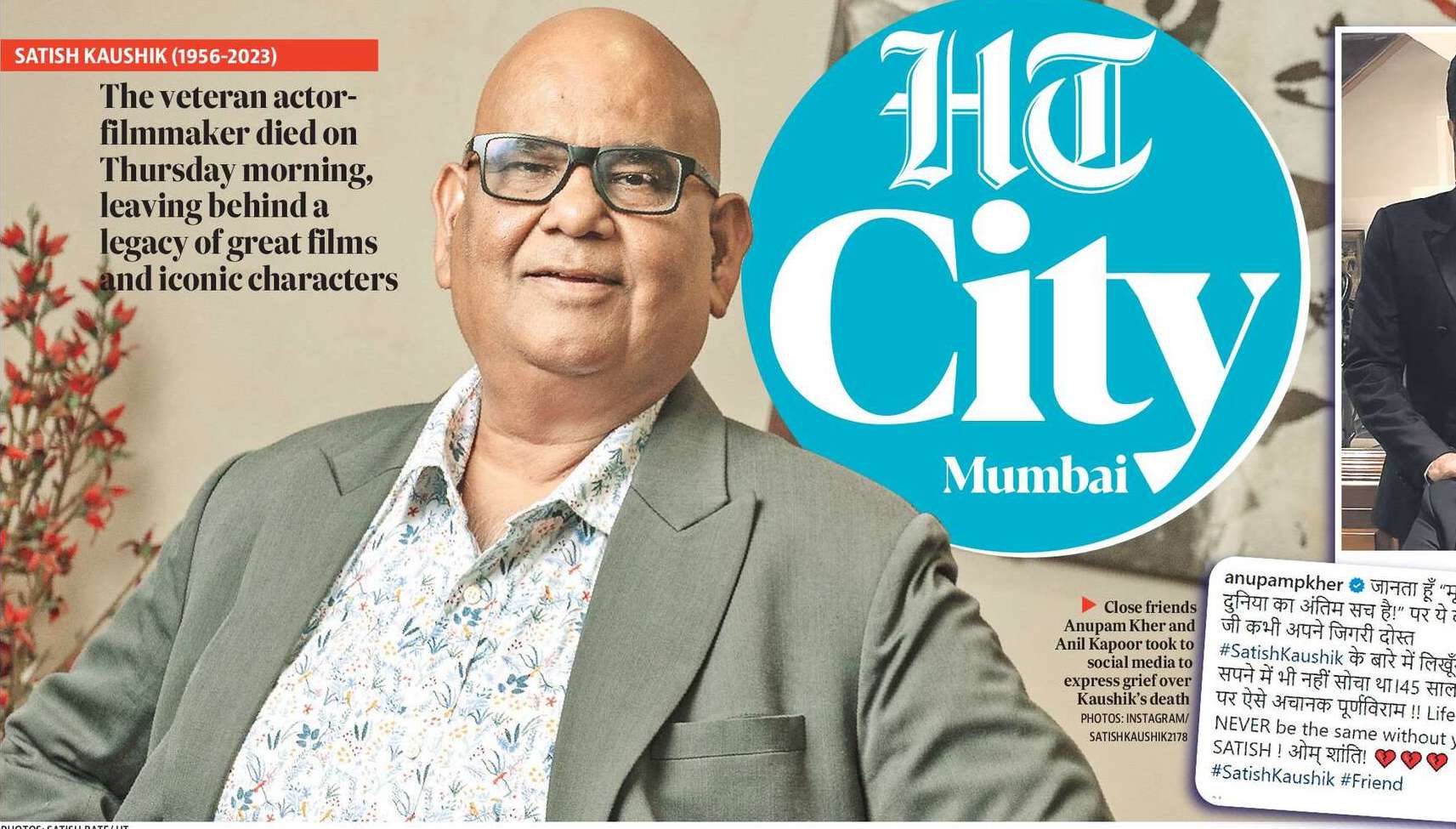
Satish Kaushik passes away, leaving behind a legacy of great films and iconic characters
8:21 AM
Avijit Ghosh (THE TIMES OF INDIA; March 10, 2023)
Actor-director Satish Kaushik, whose impeccable comic timing created the endearing onscreen character, Calendar in ‘Mr India’ (1987), and who earned accolades for his powerhouse performance of ‘Salesman Ramlal’, a Hindi adaptation of Arthur Miller’s play, Death Of A Salesman, passed away Thursday. He was 66.
The actor complained of breathlessness late Wednesday night and was taken to Fortis Hospital in Gurugram, his manager Santosh Rai told ANI. Sources told TOI he was brought to the hospital around 12:30 am and declared dead on arrival. Postmortem report mentioned “cardiac arrest” as the cause of death, ANI said.
Just on Tuesday, he had posted smiling photographs of himself celebrating Holi with writer Javed Akhtar and newly wed actor-couple Richa Chadha and Ali Fazal.
--------------------------------------
Director Sudhir Mishra, in his social media post, described actordirector Satish Kaushik as a “Brilliant actor. Brilliant mind. A sense of humour like very few others. A life well lived but there was still a lot ahead.” Watching the actor in the desert thriller 'Thar' (2022), where he played a weary but wise cop with aplomb, few would disagree.
Kaushik’s most remembered comic roles came in David Dhawan films whe re his uproarious exchanges with Govinda brought the house down. The contract killer Pappu Pager in ‘Deewana Mastana’; the garrulous Bhopali who sells stolen goods, and says “Kasam udaan jhalle ki” at the drop of a hat in ‘Bade Miya Chhote Miyan’; and the tabla player in ‘Saajan Chale Sasural’ - were all boisterously funny.
Saajan…fetched him his first full-fledged Filmfare Award for best actor in a comic role; he had shared the earlier one with Anupam Kher for Ram Lakhan. But it was Calendar, the genial cook who sang the parody ‘Mera naam hai Calendar, main chal a kitchen ke andar’ in the blockbuster ‘Mr India’ that prompts the fastest recall. Even today kids shouting “Calendar, khana lao” are uploaded on YouTube.
Kaushik also acted in ‘Jaane Bhi Do Yaaro’, co-writing the dialogues with Ranjit Kapoor. In a 2018 interview to TOI, Kaushik recalled how the writers were stuck for a suitable climax when he saw dozens of secondhand Amar Chitra Kathas based on characters from ‘Mahabharat’, ‘Ramayan’, the Mughal Empire, even English classics, in a pavement stall. “An idea instantly clicked in my mind – why not make a potpourri of all these tales?”, he recalled. Calls and sessions followed. The scene was written. A classic was born.
He wasn’t shy of playing negative characters. Most notably, the actor played an obnoxious husband in ‘Brick Lane’ (2007), a film based on Monica Ali's award-winning novel about a young Bangladeshi woman in 1980s' London.
But such roles were rare in films. Theatre gave him more cerebral parts. Kaushik played Ramlal, a local version of Willy Loman, the unsteady protagonist who vacillates between memories and imagination in Miller’s unforgettable play.
“I have seen many versions of the play. But whenever I think of Death Of A Salesman, Satish Kaushik’s performance is the first thing that comes to mind. He lived the character and made it his own,” said well known theatre director Arvind Gaur. The play was directed by noted theatre director Feroz Abbas Khan.
Kaushik was born in Mahendragarh (then in East Punjab, now in Haryana) and grew up in New Delhi’s bustling Karol Bagh. The actor later named his film production company after the locality. His father, according to film critic Mayank Shekhar, sold Harrison locks, a well-known brand in 1970s' north India. Kaushik went to Delhi’s Kirorimal College, where he took early steps in acting. Later he joined NSD. Kaushik retained his ties with his alma mater, and reports s ay he was keen to restore the college’s auditorium.
In Mumbai, Kaushik initially struggled to make an impact in commercial films. ‘Mr India’ changed that. Kaushik was also the associate director of the film, which was produced by Surinder and Boney Kapoor. As a director, he was to forge a long collaborative relationship with Boney, directing big-budget crime caper ‘Roop Ki Rani Choron Ka Raja’, and the young-love story ‘Prem’, where a very young Tabu and Sanjay Kapoor were lead actors. Both films flopped. But Kaushik, the director, wasn’t to be denied heady box-office success, courtesy Salman Khan’s ‘Tere Naam’ (2003), the remake of a Tamil film.
The actor’s death was widely mourned. PM Narendra Modi, Haryana CM Manohar Lal Khattar, UP CM Yogi Adityanath and Rajasthan CM Ashok Gehlot condoled his death. Those who worked with him in the film industry spoke of his humility, warmth and generosity of spirit. Among others, Nawazuddin Siddiqui, Salman Khan, Manoj Bajpayee, Raj Babbar, Anupam Kher and Kangana Ranaut (who directed him in the forthcoming, 'Emergency') offered their condolences. Actor Yashpal Sharma wrote how Kaushik wanted to promote Haryanvi cinema throughout the state.
'Mr India’s' director, Shekhar Kapur, said on Twitter, “Like a part of my life story is gone. A bit of me wrenched away. Leaving a huge gap. Thank God for your stories, our stories together Satish. They will keep you alive in my heart forever. ” His fans would hold a similar view.
(With inputs from Ipsita Pati, Gurugram)
--------------------------------------
The veteran actor-filmmaker died on Thursday morning, leaving behind a legacy of great films and iconic characters
HINDUSTAN TIMES (March 10, 2023)
Veteran actor, filmmaker and screenwriter, Satish Kaushik died at the age of 66 after suffering a heart attack in the wee hours of Thursday.
His close friend, actor Anupam Kher, shared the news on Twitter and later confirmed that Kaushik was at a friend’s place in Delhi when this happened. The actor complained of uneasiness and told his driver to take him to the hospital. On the way, he suffered a heart attack around 1am on Wednesday night. The cremation took place in Mumbai last evening.
An alumnus of the National School of Drama and the Film and Television Institute of India, Kaushik directed films such as Roop Ki Rani Choron Ka Raja (1993), Hum Aapke Dil Mein Rehte Hain (1999), Milenge Milenge, Mujhe Kucch Kehna Hai (both, 2001), Badhaai Ho Badhaai (2002), Tere Naam (2003) and Kaagaz (2021).
Among his best known acting roles, Kaushik, who was famous for his comic timing, has been a part of films including Jaane Bhi Do Yaaro (1983), Mr India (1987), Ram Lakhan (1989), Deewana Mastana (1997), Hadh Kar Di Aapne (2000), Udta Punjab (2016) and several others. He was last seen in the web film Chhatriwali and has acted in upcoming film such as Emergency and web show Pop Kaun. Kaushik is the producer for Kaagaz 2, shoot for which was wrapped in January 2023 and the release date is yet to be announced.
Kaushik, who would have turned 67 next month (April 13), is survived by his wife Shashi Kaushik and 10-year-old daughter, Vanshika.
Most men see me as a fellow man and not a woman refusing them-Tabu
8:11 AM

Priyanka Dasgupta (BOMBAY TIMES; November 24, 2018)
Fresh from the success of AndhaDhun, Tabu was in Kolkata as the special guest at the 24th Kolkata International Film Festival’s closing ceremony. During her stay in the city, she talked to us about Gulzar saab’s influence on her career, her equation with Irrfan and her current priorities:
After AndhaDhun,there have been talks about your portrayal of strong women characters. How do you portray dark characters effortlessly?
For me, every character takes the same amount of immersion. I don’t have any special approach for playing dark characters. That’s because I never looked at them as dark characters per se. For me, they were real people.
Simi in AndhaDhun is the cheating wife of a has-been star who is at once a seductress, an aspiring actor, a step-mother and an accomplice in a crime. Despite being the primary antagonist who is deeply flawed, it is difficult to hate her. So it is for Nimmi in Maqbool,Ghazala Meer in Haider and Anne Mathew in Golmaal Again. Do you consciously create empathy for grey characters?
I don’t think of people as out-and-out black or white. I don’t see people as good or bad, though some deserve to be seen as purely dark (laughs). I think it is easier for me to diminish the evil in people and be able to see the good. I never thought that these characters should get empathy from the audience. They live their lives and do what comes to them, according to the script. If people have empathy or hatred, then that’s their perception. That’s what I am bringing out in them.
Do you ever revisit your own films?
Rarely. I don’t think I can be my own audience as long as the film is not complete. I come from a generation that had no monitors on the sets. You had to go with the director’s conviction and be happy with it. I still work like that. But yes, there are a few scenes that speak to me. In AndhaDhun, there are many such scenes. Like, when I first go to Ayushmann Khurrana’s house to see if he is wearing a mask. Then, there is the ‘tu toh bohot bundle aurat hai’ scene. I also love the car scene in the climax. What I like about Sriram (Raghavan) is that nothing of his craft is manufactured. He is never trying to be dark and morose. He never manipulates a response. That is why people liked his AndhaDhun and I enjoyed acting in it, too. I also revisit the chinar scene from Haider. There are some really nicely written scenes in Maqbool — especially the Meri Jaan scene with Irrfan.
Haider and Golmaal Again are from two completely different spaces. Have you asked directors why they cast you in films from such diametrically opposite genres?
It’s the faith of the directors. They haven’t stereotyped me in their heads. Rohit Shetty must have believed that I can carry off Golmaal Again even after Haider and Drishyam. Gulzar saab came to me with Maachis when Ruk Ruk Ruk was on TV. I had asked him how he visualised me in such a role but he never replied. Both Sajan Chale Sasural and Maachis had released the same year (1996). Maqbool came to me after I did Biwi No. 1 in 2000. That was also the time I did Astitva and Chandni Bar.
Maqbool is one of the rare instances in Indian cinema where the leading lady was so dark and conniving. Yet, there was love and romance. I wonder what Vishal (Bhardwaj) saw in me that he felt I would be able to bring that layer. In Haider, which I did in 2014, my character had so much of internal silence. Physically, too, she was so different from the cop I played in Drishyam the next year.
With Indian cinema celebrating women whose beauty lies in their vulnerability, how did your portrayal of conniving women gain acceptance?
Acceptance isn’t in my hands. Acting isn’t a mechanical or technical job and I can’t dissect the process. On a lighter note, perhaps from a Vishal to a Rohit, everyone is seeing a planner and a manipulator in me (laughs out loud).
Irrfan had once described you as someone ‘deeply spiritual, who straddles many ends’…
It’s only after I read this interview of his that I realised how deeply and aptly he understands me. He always says that there is a comedian in me that very few know about. I am looking forward to having him back and doing a comedy with him.
You’ve refused more offers than you have accepted. Didn’t that hurt egos in a male dominated industry?
(Laughs) I think most men see me as a fellow man and not a woman refusing them. I have never done this gender-segregation in the workplace. How does gender matter if a person is doing right or wrong? I have worked from a young age and lived like a man.

I didn't understand what I was doing in Maachis. I couldn't understand anything-Tabu
8:16 AM

Known to be reticent, naturally shying away from public glare, one of India's finest film actors opens up on her sabbaticals, cinema, and the showbiz sense of humour
Mayank Shekhar (MID-DAY; January 31, 2018)
It's rather easy to hold a free-wheeling conversation with Tabu. Here's why. She's been around for over three decades, having done over 80 films, which would mean, a fair number of post-release rounds of press interviews across news/entertainment media. And yet, it's incredible how little we know about her. The mystique, aura, whether planned or not, remains. And we can actually begin the chat with the most basic query, on her name. Hence the first question, and similar ones that follow!
Excerpts from the conversation
You're Tabassum Fatima Hashmi, which is a beautiful name. How and why did you choose to call yourself Tabu in the first place?
It's my pet name.
Sure, but it's like Govinda calling himself Chi Chi on screen.
Tabu works though, you think? When I was working on my first film, as a child artiste [in Hum Naujawan, 1985], Dev [Anand] Saab thought Tabu was beautiful too, and that I should adopt it as my screen name, and that just never changed. Nobody had ever called me Tabassum, except for my teachers and school friends. And I came to Bombay right after school.
A common perception is that you started out as an outsider [from Hyderabad] to showbiz, Bombay. Goldie Anand's wife was your mom's friend. Shabana Azmi is your aunt [mum's first cousin]. You've worked with Dev Anand. Shekhar Kapur wished to cast you as a debuting lead [Shekhar himself is Dev Anand's nephew]. Clearly you're an insider!
That's right. I think the impression of me being an 'outsider' comes from the fact that I never intended to be in the movies. I showed up here by circumstance, accident, you can say. I went back to school after finishing my first film, and I never wanted to come back.
Were you holidaying in Bombay when you got your first part?
We used to come every summer for our holidays, because my mum's older brother, Ishaan Arya, was a DoP, he shot Garm Hava [1973], Bazaar [1982]. I grew up with his sons Sameer and Sagar, we were like siblings. My sister [Farah] and I were at Dev Saab's office, where he was taking a screen test, and because he thought she was so beautiful, he took her screen test as well. I did the movie. We forgot her screen test. She was 16.
And one day, we got a call from Yash Chopra. He told my mother about wanting to cast my sister [for the film Faasle, 1985], since Dev Saab had showed him her screen test. My mum didn't know who Yash Chopra was, she checked with my aunt [Shabana], everyone was really excited. This is how my sister and mom moved to Bombay, and I was too attached to Hyderabad and my school, so I stayed back with my aunt for three years. By then my sister had done a thousand films, and become a big star. And due to my sister, there was natural curiosity in the industry if I'd like to act in films too.
Shekhar [Kapur] Uncle saw me, said I had to debut in [his film] Prem, which I said no to. He insisted that I do just this one film, and that he would then send me abroad for further studies. Which never happened. In fact, I did the film, and he ran away [from the project].

That was a massive debut.
Yeah, it was huge.
Rather early in your career Gulzar called you a combination of Nutan, Meena Kumari and Nargis! Anyone would fall off their chair hearing that.
(Long pause) I don't know what to say, I try and see it from the outside, and then hope to do my job well.
And ideally stay from the traps of showbiz?
My life is [in the] showbiz, it isn't so separate from my work. Yet, regardless of my profession, I would still remain the same person — someone whose internal life, is distinct from the madness outside. And I've always been like this, through school, college. It takes me a long time to open up with people, media, work-associates… It's just a personality type. I don't have the bandwidth to be out there, be everything, to everyone.
You're more the 'board-game night with close friends' kinda person?
I do that. I essentially like being with people I can laugh a lot with. And people in the movies [unlike in many other professions] generally have a sense of humour. There's a common thread of jokes that exist in the film industry, with a very specific language.

Give us an example.
"'Cut to' usne aise bol diya." "Maine aise bola aur woh 'stop block' mein gayab ho gaya!" This is still '90s, but there are really specific terms. "Arrey yar, yeh toh bahut bada twist aa gaya teri kahani mein!" "Yar, kya 'game' kiya usne girlfriend ki life mein!" "Uski band baj gayi…"
What I find amazing is how film critics go gaga analyzing your performances, sub-text in your work, etc. But when you're asked about films that you loved doing, you say Saajan Chale Sasural [1996], Biwi No. 1 [1999], and in a recent interview you said Jaal: The Trap [2003]. Have not even seen Jaal: The Trap, what's this finest movie you've ever made?
(Laughs) Don't exaggerate, I didn't say Jaal: The Trap was the finest film ever! I think it was a great role for me to do, back in 2000, so early in my career, nobody had cast me like that. Mere role mein twist aa gaya! You just haven't seen the movie, and so you don't know. Didn't it look like I was having fun in Biwi No. 1?
In Saajan Chale Sasural, the audience had fun, I had fun, the producers made money, it was a fun experience! It was a treat to watch Govinda take a scene to other levels. On paper, it would look like, okay, this is what's going to happen, and it's funny. But you would never be able to imagine the flavour Govinda would bring to a scene, turning it into something so tasty. And that's his forté.
I know someone who hung out with you on the sets of Chandni Bar [2001]. What amazed him is that he'd be chatting with you, you'd go off, do an intense scene, and just come back to continue the chat. Does that switching on-off come naturally to you?
Gulzar Saab also used to say the same thing. Actually, I don't know, I've really not been able to decode the process of acting. I've tried. I still don't think I'd be able to articulate it [the process] into a few lines or paragraph. At all times, there have been too many factors determining what I was doing, or how I was doing it — the inspirations, people I was surrounded by, what kind of access I had regarding a role. I also don't think you can carry around what you've given in a shot, because there's a finish point with 'cut', and a beginning with 'action'. And I don't know what happens between the 'action' and 'cut'. It's just in front of the camera, after which the moment is over.

Do you rehearse for that moment though?
The lines and movement, of course, you have to rehearse. But I really don't know what'll happen in the 'take'. Even the director might give you different instructions in subsequent takes. I remember Ang [Lee] doing that [for Life Of Pi, 2012]. He would try the same shot with different interpretations to arrive at what he wants from a scene. For different actors, different kinds of briefs work. I don't know what kind of actor I am. Only someone who's observed me may be able to answer this. Also I've come to the conclusion that there is no right or wrong way of doing anything in life — as people as well, we're evolving. In action sequences, you obviously have to rehearse a lot. You can't just show up and slap someone. Otherwise, sometimes you just lose it when you rehearse a lot, and at other times, you can only get it right once you rehearse a lot.

Can you recall a character that you rehearsed extensively for?
You're taking my exam.
Okay, did you rehearse a lot for Ashima's role in The Namesake [2006]?
We just had one reading in New York. I got into the film just two weeks before the shoot's start, which took me by surprise, and I was so not prepared for it. To my advantage, I had already done a film in Bangla [Abar Aranye, 2003], with Gautam [Ghose] Da, which I had dubbed myself. I had a certain understanding of the culture, people, and place — that really helped a lot during The Namesake. I also had a lot of friends to refer to, especially since there was no dubbing involved. The dialect was Bengali accented English specific to someone, who's lived in New York from 1977-2005!
But The Namesake was an experience that changed a lot in me. There are milestones that you can look back on, and this film would be one of them. I was in America and didn't know anyone except Irrfan [Khan]. The entire unit was American — no one making any filmy jokes! I lived in an apartment in New York, and the first 10 days were devastating. It was cold, snowing, my sisters were in California and Chicago, and I would call them and cry, because I could not get my favourite brand of corn flakes in the supermarket. I would ask them: How come the tea doesn't taste like in California? This was my struggle.
Those are serious first world problems. We feel sorry for you.
No, I thought it would've been better if I could bring my team along. But once we started shoot, came into a routine, it turned out to be the most valuable experience of my life. I made friends. We worked five days a week. I also learnt the way America approaches cinema, acting, style of shooting, contracts. The Screen Actors' Guild [reps] would come and check on us. I still get residuals from The Namesake, almost twice or thrice a year, in dollars!
Every time we watch The Namesake on TV, something goes in your pocket.
Yes, you are paying me. That's the way it should be, and I really respect that.
What are the other milestones you can think of?
From the beginning? Then it has to be Maachis [1996], Astitva [2000], Hu Tu Tu [1999], Chandni Bar [2001], and The Namesake, because of geographical exploration. Then Life Of Pi, and Cheeni Kum [2007], in a very nice way.
You've said that of all the characters, the one in Cheeni Kum has been the closest to you. What do you mean by that?
That is one character that I can identify with, in the sense that I could be that person.
Means you could fall for Amitabh Bachchan?
Of course. That is why I did the movie! I could totally fall for somebody like that, but has to be exactly like him. I could totally understand my character's headspace, and I guess that's why R Balki wrote the film keeping me in mind. Coming back to milestones: Haider [2014], and Maqbool [2003], definitely.
The first milestone for you, one imagines, would be Maachis, and your association with Gulzar. The two of you share a fabulous relationship. How did you first meet?
I still don't know what made him [Gulzar] cast me in Maachis, and I still ask him that. At the time, my song, Ruk Ruk Ruk [from Vijaypath, 1994] and trailers of Pehla Pehla Pyar were on air — full-on dancing. But he still does not answer my question. It is now that I understand that the director, and the cinematographer, has a completely different perspective on an actor. They have an eye.
Vishal [Bhardwaj] has had the ability to see me in a very different light. I was caught off guard, when he approached me with Maqbool. It was like a drug to feel that someone looks at you like that. He could see the deep layers of madness, sexuality, lust. I felt completely bare with him. With Maqbool and Haider, I saw and met myself in so many different ways than I had ever known.
So Gulzar saw you in the promos of Pehla Pehla Pyar and called you up?
He called up Shabana aunty. I said, of course, I'd give anything to be a part of his film. He's made films like Mausam [1975] and Angoor [1982] in which his characters are so real, and still they are the leads. So I went to meet him at his house. I always narrate this incident, as it is the strongest memory that I have: So he had a cold, and he kept sniffing into his handkerchief, I went and sat. We both just sat for an hour. And I was thinking, "Kya bolenge yeh mujhe. Main kya jawaab doongi [What'll he say]." I was completely tongue-tied.
He's sitting across you, sniffing, and you are just sitting too. I'm sure he must be reading something.
I think he was writing something, and I kept waiting. After an hour, I said, "Achha Gulzar saab." And he was like, "Achha thik hai." It was his way of saying that you are doing the film. Two-three days later, he handed me the script, which was such an 'Oh My God' moment. It was the first time I was holding a script.
First time holding a script. What are you saying?
Yes, after Prem.
Vijaypath didn't have a script? They just told you, 'Aap madam udhar se ayenge, or Ruk Ruk Ruk karenge'?
Aise dance karne ka, aur romace karne ka. I was like, "Yay, very good. Feels nice to dress up. Ajay Devgn is my friend [Laughs]. Outdoor main mazaa karenge [will have fun]. Pehla Pehla Pyar was shot in Switzerland, so I was jumping with joy.
You're not making this up.
No, I was just too happy to be on sets. Chintu ji [Rishi Kapoor] would offer me chocolate. Later he would instruct, "Seedhe khade reh [stand straight]!" But then Gulzaar Saab happened. So he read the script to Chandrachur Singh, and me. I didn't understand what I was doing in the film. I couldn't understand anything.
Were you intimidated?
The subject was so heavy, and deeply political, which you would get now. You can figure what the film meant to him, and what it was saying. Gulzaar Saab was obviously there like a father-figure, and he made it feel like a picnic. Then of course, my relationship with Gulzar Saab impacted me the most in life. I found a home in him. He's somebody completely divorced from the craziness and predictability of the movie industry. He also encouraged me to write. He would give me blank notebooks, and after few months would ask me if the book was over.
What kind of writing?
Observations, encounters, experiences, and I would read to him. And he'd say, "Bohot achhe beta!" That meant everything to me.
In that sense, you'd say Maachis probably turned around how you perceived show-business in the first place. If we see your films before that, you really wanted to go to Switzerland, and have fun.
I still want to go to Switzerland. I think when you experience everything, you can enjoy everything. You can't do that if you are putting yourself out there for one kind of experience alone. It's going to exhaust you, and burn you out.
Is that why you take long sabbaticals?
This line is always thrown at me as an accusation. It's a good thing though. I recommend it.
Is there another sabbatical coming up?
No. There's so much time between films that I don't have to consciously take a sabbatical. Anyway, films are so spaced out these days — nobody does 10, five, or even two films at a time.
But you've done that. In 1996, if I'm not mistaken, you had eight releases.
Yes, [I was doing] three shifts a day. I once had four releases on the same day. It was crazy, but it was the way it was. Also, you're much younger and you have much more enthusiasm, and energy, to be everywhere, doing all that a young girl loves — wearing good clothes, romancing, acting.
What are the biggest changes you've seen in showbiz since the time you entered?
Social media. That's the biggest change.
Can't imagine you being active on social media.
I'm on Instagram. You don't have to engage, opine, listen, and it doesn't take up that much time. Another change is that everything, except the actual shoot, has become a project. It's not just about the film, or the product anymore. The quality of preparation you put in post-shoot, and everything else, has also come into focus. So you don't know where your actual energies are getting distributed.
Speaking of distributing energies, there was a time that you took a really long break to learn Spanish. Were you able to master it?
That was over 10 years ago, in 2004. I planned to finish everything in a year-and-half, and not work for a year — just not do movies for some time. But no, I've forgotten Spanish. [It's] Only when I go to California and order food in a restaurant that I get to practice it.
How many languages do you know?
Telugu. I can speak Marathi; little bit of Tamil, and Malayalam. And Bengali, fluently.
For people who love your work, and have only seen your Hindi movies — could you recommend some of your non-Hindi films [a retrospective if you may]?
Ninne Pelladata [1996, Telugu], Kandukondain Kandukondain [2000, Tamil], Iruvar [1997, Tamil], Kaalapani [1996, Malayalam], Rakkilipattu [2007, Malayalam], Andarivaadu [2005, Telugu], Abar Aranye [2003, Bengali].
Audience Questions:
Did you plan how you wish to chalk out your career — follow a serious film with a light-hearted one?
I don't think my generation of actors was the planning type. Because so much was happening, I was just doing what I wanted to do — sometimes because the money is good, or the role is great. I did Aamdani Atthani Kharcha Rupaiyaa [2001], for instance, especially because Raghavendra Rao was making it. That was my second film with him. I consider him my guru. My first film, Coolie No 1, was with him. I learnt stuff from him — that you should have your own house, own money. Be careful with your time. Always be punctual. Do your work, and not think about anything else. He's taught me so many things about conduct: Always walk properly, dress well, look nice, and beautiful. Sleep on time. Enjoy life. Also he packs up at 5.30 pm, and would take us on picnics in Singapore!
Now we know how you can be cajoled into signing up for a film. Picnic pe chalte hai, picture banayenge!
Shopping karenge. Mall mein jayenge.
I was thinking about Drishyam [2015]. There was such a brilliant shift in your character — you had to be tough, still looking for your missing son.
I must say Drishyam is one of the most difficult characters I have done in recent times. I knew it was difficult for me to crack, because of the conflict in her personalities. She had to be this person [strict cop], and yet the vulnerable mother. And there was a danger of her becoming completely dark and negative. Which of course was not required, because you also have to see the vulnerability. I don't think I've played somebody like her — so strong and correct. As an audience also you're conflicted between wanting to hate her, but also understanding the pain. I don't know how I did the role, but it was a journey.
-Transcribed by Mohar Basu, Sonil Dedhia and Sonia Lulla

Subscribe to:
Posts (Atom)