Showing posts with label Russia. Show all posts
Showing posts with label Russia. Show all posts
Boman Irani puts up gala to celebrate screenwriters; Aamir Khan, Karan Johar to attend the event
2:46 PM

Priyanka Sharma (MID-DAY; April 30, 2026)
During the 2020 lockdown, actor and director Boman Irani began Spiral Bound, an initiative that trained aspiring screenwriters. Six years on, it has grown into a nurturing hub for writers. The actor, who had announced a writing competition after conducting 870 sessions, is set to felicitate the winners at a special gala in Bandra on April 30.
Irani told mid-day that the idea of the competition was to instill confidence in the writers. He explained, “Many of them are afraid to share their work. They are unsure whether the writing is good or bad. So, I told them to just write, send it ahead, and come for the gala.”
Noted writer and lyricist Javed Akhtar will felicitate the winners. Other attendees include Aamir Khan, Anil Kapoor, Karan Johar, Sooraj Barjatya, and Anupam Kher.
Irani added, “I told the students that so many people are turning up to support writers. If we don’t support writers, we can’t complain that we are not getting [good] stories.” We got to support the writers, pay them well and give them a place on that stage. They set the ball rolling, and if you don't respect and encourage that, we have no right to complain,” he said
Top 10 among the applicants will be announced at the event, while the best three will be rewarded with a trip to Moscow.
Irani shared. “The Russian Film Confederation is sponsoring them a trip to Moscow. The trip will take place in June. And it’s not just about the trip, what matters is that they can turn around and say that their writing got them there, something that everyone say has no money and gratification. But there is a prize, a victory and gratification. And that’s what I'm proud of, because what it's doing is waking up people. Finally you get messages from people, saying, ‘I'm so glad you did this. Finally I'm not afraid to put pen on paper’,” he said, adding that Spiral Bound precisely aims to make writers more confident about their skills.
“No one is ever scolded or reprimanded in the class, even if they ask stupid questions. Ask the questions. Clarify your doubts. There's so much of learning. It's not just a community. It's not a support group. It's where serious, hardcore, high-level learning happens. I've been trained by Oscar-winning writer Alexander Dinelaris Jr, whose next is with Tom Cruise. He teaches me, I share. It’s as simple as that,” Irani said.
Apart from teaching, Irani also makes sure he helps students earn opportunities by recommending them to the right people in the industry.
“It has to be done, right? Otherwise what’s the point of all of this? We had a girl in our class in 2020. I have her a prompt to write a scene. She wrote the scene and it had four-five lines in it. But I told her to apply what we teach. Today, she is writing multiple web series. I'm not trying to be ‘Mr Nice Guy’. I have a great love for cinema and I'm looking forward to good movies. So, this is out of a very selfish reason.”
Siddharth Anand brings 10 Russian fighters to Mumbai for Shah Rukh Khan's King
8:33 AM

Sources say Shah Rukh Khan and filmmaker Siddharth Anand have flown down 10 Russian fighters for one of the biggest action set-pieces of ‘King’
Mohar Basu (MID-DAY; March 21, 2026)
There’s more action coming Shah Rukh Khan’s way as he gears up for the next leg of ‘King’. mid-day has learnt that filmmaker Siddharth Anand has flown in 10 Russian fighters for a key action set-piece that will be filmed at Golden Tobacco Studios in Vile Parle, Mumbai, next week.
According to sources close to the production, an elaborate set depicting an old and long abandoned mill has been constructed at the venue. Beginning March 23, it will be a week-long shoot of fight sequences featuring Khan. “It’s one of the most elaborate action stretches planned for the film. The stunts designed are gritty and realistic, and the stunt artistes have been prepping for the past few weeks.”
It’s not all kicks and punches though. The director will also film a special dance sequence, which insiders are touting to be a special highlight, next month.
The source added, “It’s designed as a big moment in the film — visually striking and mounted on a scale that complements the larger-than-life tone of ‘King’.”
The movie also stars Deepika Padukone, Rani Mukerji, and Suhana Khan.
There is influence of Russian literature in the modern Urdu novels-Javed Akhtar
9:36 AM
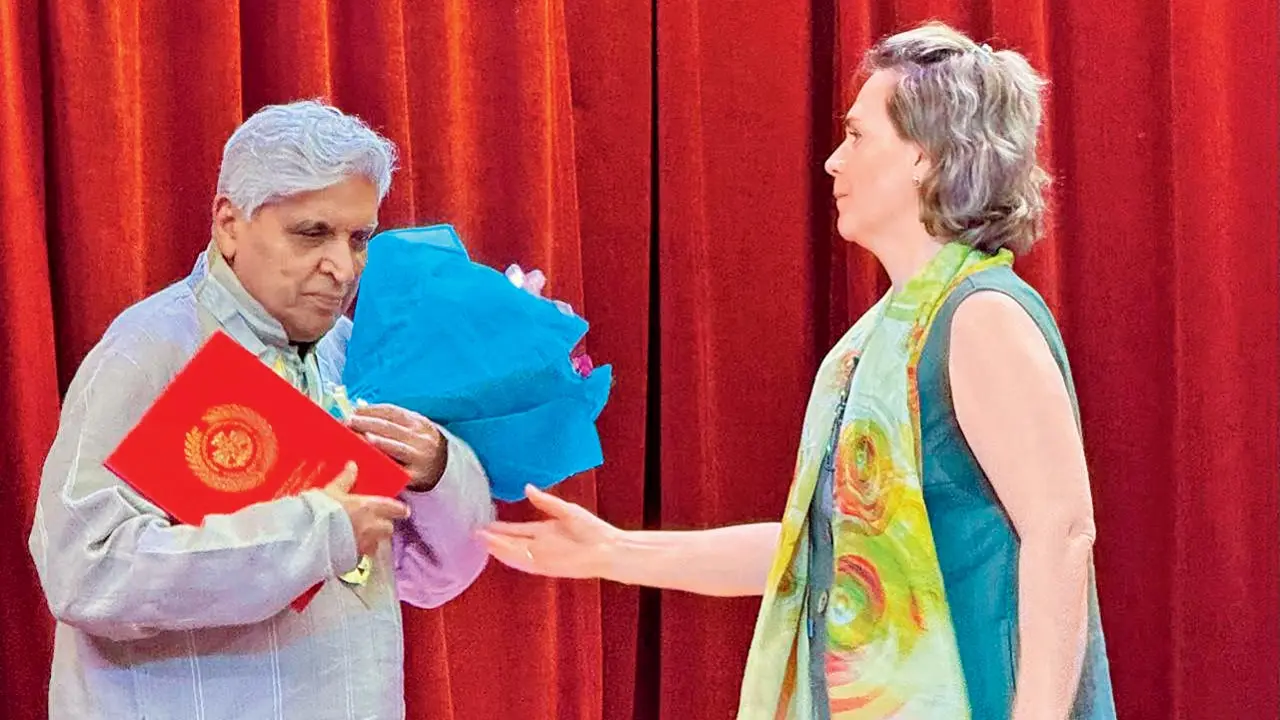
Niharika Lal (BOMBAY TIMES; June 8, 2025)
Javed Akhtar received the Dostoevsky Star Order – a literary award given to those promoting Russian literature and culture – in a ceremony held at the Russian House in Delhi on Friday. The ceremony coincided with Russian Language Day, celebrated annually on June 6, the birthday of the legendary Russian poet Alexander Pushkin.
Drawing a parallel across cultures, the lyricist added, “I believe that Pushkin was the Ghalib of Russia and Ghalib was the Pushkin of India.”
Akhtar, accompanied by Shabana Azmi, spoke about the importance of translation, comparing Pushkin to Ghalib.
‘IF THERE HADN’T BEEN TRANSLATIONS, I WOULDN’T HAVE READ BOOKS BY WRITERS LIKE BALZAC’
Talking about the power and paradox of language, Akhtar said, “It’s strange that languages were made for communication, and more often than not, languages become a barrier in communication. But in the barrier, there are windows of translation. I shudder to think that if there had not been any translations then I would not have been able to read (works of) so many great writers of Europe. I would not have read Balzac.”
Talking about India’s deep-rooted literary ties with Russia, the lyricist spoke about the Progressive Writers Movement that gained momentum in India in the 1930s.
He said, “There was a great writing movement in India in 1936, and it was greatly influenced by Russian literature. There is influence of Russian literature in the modern Urdu novels and Urdu short stories as well.”
------------------------------------
Honoured with the Dostoevsky Star Award last week, noted screenwriter and lyricist Javed Akhtar on how his thinking was influenced by Russian literature from a young age
Upala KBR (MID-DAY; June 9, 2025)
As a teenager, Javed Akhtar would devour Urdu translation of Russian literature, particularly Fyodor Dostoevsky’s works. Had someone told him then that he would be honoured with the Dostoevsky Star Award later in life, he wouldn’t have believed it. Last week, the noted screenwriter, poet and lyricist was felicitated with the award by the Russian House for promoting cultural dialogue and preserving literary heritage.
For Akhtar, 80, it’s a matter of pride to receive the Dostoevsky Star Award. “Dostoevsky is one of the most respected novelists and journalists. In our Khandala house, we have his portrait on the door of our study. I don’t think any Indian writer has received the Dostoevsky Star Award before. One of my books, where my poems have been translated by Ramdas Akella in the Russian language, was released at the function,” says the veteran writer.
Akhtar — who has shaped Indian cinema with movies like Zanjeer (1973), Sholay (1975), Mashaal (1984), and Lakshya (2004), among others — notes that Indian and Russian literature have been inspired by each other over centuries.
“The novel structure and short stories of Anton Chekhov, Maxim Gorky, or Dostoevsky inspired our writers. Similarly, Indian writers inspired them as some of our classics, including the Bhagavad Gita, were translated in Russian. At an impressionable age, I was introduced to Russian literature because they were translated in Urdu and English. My thinking and dramatic structure got influenced by them.”
The event, which took place on June 6 in Mumbai, was a bittersweet moment for Shabana Azmi, actor and Akhtar’s wife. She says, “I wish his father Jan Nisar Akhtar, and my father Kaifi Azmi were here to see him receive it.”
Donald Trump's 100 per cent tariff on foreign films could hurt Indian cinema, experts warn
8:52 AM

After US President Trump announces 100 per cent tariff on movies made outside the country, trade says move detrimental for Indian films as America is a key market
Mohar Basu, Komal RJ Panchal (MID-DAY; May 7, 2025)
On May 4, US President Donald Trump announced a 100 per cent tariff on movies produced outside the country, believing that the move would boost the number of films made in America. The result was chaos and confusion within Hollywood as well as film industries around the world, as Trump did not provide details on how the tariffs would be implemented. Even as the President softened his stance on May 5 and stated that a decision would be made only after he met with members of Hollywood, the news has sparked concern in the Indian film industry. After all, the US is a key overseas market that contributes significantly to the box-office revenue of major Hindi, Telugu, and Tamil films.
As mid-day reached out to producers and trade experts, they unanimously noted the ambiguity of the current situation as it is unclear whether the tariff would apply to payments made to acquire distribution rights of foreign films for their US release. There is also a lack of clarity whether tariffs would apply to movies on streamers as well.
Trade expert Ramesh Bala pointed out, “Many American films are shot in Canada, Europe, and elsewhere to lower production costs. If the tariff applies to any part of the film made outside US borders, then many Hollywood films would technically qualify as foreign.”
America, a crucial market
Bala agreed that the move, if implemented, would be detrimental for Indian films. “The US market is crucial for Indian theatrical releases, especially because of the sizeable South Asian diaspora,” he stated, pointing to blockbusters like RRR (2022) and Jawan (2023) that earned significantly from their US market.
“High price points due to tariffs will dissuade distributors, reduce the number of films reaching theatres, and ultimately limit consumer choice. Small or medium-budget movies will likely skip theatrical release in the US entirely, missing out on a potentially lucrative market. The governments of affected countries, including India, will need to step in and engage in dialogue with the US administration to either seek exemptions or negotiate a more balanced trade approach,” he stated.
Trade analyst Akshaye Rathi said it was too early to respond to Trump’s announcement “with assumptions”. He, however, said that this could serve as a trigger to fortify our own ecosystem. Citing the example of Russia, he said, “After the Ukraine conflict, Hollywood studios stopped releasing films in Russia, cutting off nearly 95 per cent of their box-office content overnight. The Russian government actively invested in its local film industry boosting both volume and quality. Within two-three years, they’ve managed to nearly return to pre-war box office numbers. The Indian film industry is still operating at a fraction of its potential.”
Don’t panic before the policy rollout
Housefull 5 will be one of the first big Bollywood releases in the wake of the announcement. With Akshay Kumar, Abhishek Bachchan and Riteish Deshmukh leading it, the laugh riot is targeted as much at the Indian audience as at the diaspora. Diljit Dosanjh’s Sardaar Ji 3, slated for June 27 release, too is aimed at the diaspora.
Bala assumed the films would go unscathed, reasoning, “The proposal is under consideration and is part of a broader USTR [United States Trade Representative] investigation. There is no final rollout date. This gives a buffer, but later films will have to review [their distribution plans].”
An executive from Jio Studios, who did not wish to be named, dialled down the fear with facts. “The US market contributes only around four per cent to the total box-office earnings of an average Indian film. So, the overall damage is limited. If the tariff doesn’t apply to OTT platforms, it might even benefit producers, as they can sell their films directly to streaming services.”
Supriya Yarlagadda, executive director, Annapurna Studios, which backed the Telugu film franchise, Goodachari, admitted that the policy will hurt not only Hindi films, but also their South counterpart. “US is a large distribution territory for various Indian language films. While the latest news is of concern, we will have to wait for the policy details to emerge before panicking,” she said.
A new territory to capture
A question on the mind of many is: Can China or Japan replace the US? Bala said a hard no. “China’s annual foreign film quota [around 10 titles under revenue-sharing rules] makes it an unreliable replacement for the US. Other regions like Australia and Southeast Asia are much smaller. The US remains the only overseas market with scale, infrastructure, and a sizeable diaspora audience.”
Awara then went on to become one of Mao Zedong’s favourite films-Swapnil Rai
8:29 AM

Diplomacy is not always about govts, or even intentional. Raj Kapoor’s ‘Awara’ enamored Mao Zedong, Big B was mobbed in Egypt, and SRK became a sensation in Germany. Swapnil Rai, a professor at the University of Michigan who has dived deep into this topic in her book ‘Networked Bollywood: How Star Power Globalized Hindi Cinema’, talks to Shruti Sonal about cinema as a potent tool for diplomacy
Shruti Sonal (THE TIMES OF INDIA; March 30, 2025)
Last month, a delegation from Indonesia surprised everyone by singing ‘Kuch Kuch Hota Hai’ at a banquet hosted by President Murmu. How influential is Bollywood as a tool for cultural diplomacy and have we used it well?
Since its inception, the mainstream Hindi film industry, or Bollywood, has had a very global value chain. Its films became popular in a lot of non-Anglophone regions, and that created soft power. However, that soft power remained very dissipated and stayed as a sort of undercurrent. It was never utilized in the way that it could have been by the Indian state or our embassies. Their programming was mostly focused on very traditional mediums like classical music, or classical dance. Even in terms of cinema, only parallel cinema was thought of as high culture. However, mainstream cinema has existed and circulated — especially with certain stars as its key drivers — outside of the nation state. This is quite different compared to countries such as China, that always wants to cultivate a kind of soft power through its English news channels like CGTN, or even the US through shows like Voice Of America. In the 1960s, for instance, a lot of American TV shows like Dallas were heavily subsidized and travelled around the world. India did not do any of that.
So then how did a film like Raj Kapoor’s Awara or Aamir Khan’s 3 Idiots become so popular in China?
Bollywood’s soft power has existed outside the confines of the nation-state. To understand its influence, it’s good to go back to archives. For instance, in 1952, India was sending a cultural delegation to China, being the first country to recognize Mao Zedong’s govt. Mao asked for mainstream films to be sent along so he could understand India and its culture through cinema. I found a few letters that were exchanged, showing how everybody was scrambling, and mulling over which films to send. Eventually, they picked ‘Awara’ and Marathi film ‘Amar Bhoopali’. Of course, ‘Awara’ then went on to become one of Mao’s favourite films.
Why was the influence of stars like Raj Kapoor so potent?
My theoretical framework is that these stars hold ‘switching power’. To put it simply, a star can be a switch, which connects a circuit and illuminates a connection that did not exist before, in this case, new global markets. Hindi cinema has been very unique in the way that it has evolved because stars have been so central to the industry as businessmen, right from Raj Kapoor’s RK Films to SRK’s Red Chillies Productions. These are more than production companies; they often act as vertically integrated large conglomerates that have a lot of influence. Even today, when Netflix comes to India, they first meet SRK and Aamir Khan to strike deals. By combining their business acumen with their emotional and market pull, these male megastars have helped cinema go global. Interestingly, Hollywood has always been based on conglomerate-led productions, and only now do we have productions led by stars like Brad Pitt and Reese Witherspoon. There’s almost a Bollywoodizing of Hollywood.
The Khans turn 60 this year and many have talked about whether this is the end of the superstar era. Do you agree?
These stars have established themselves so much within the business that they will continue to have that power. The question is what is going to happen with a new crop of actors? The industry is now different than before. A lot of intermediaries such as casting and talent agencies have come into play. The kind of power that the older stars could possess doesn’t exist anymore. But with the coming of streaming platforms, a lot of the hierarchies based around networks of families, friends and kinships that existed before are being recreated. It’s just a different kind of power and it’s not as expansive as it was before.
Why has this nature of cross-border influence mostly excluded female Bollywood stars?
It’s very interesting how female stars are perceived through a very gendered lens, not just in India but abroad as well. When ‘Awara’ became popular, Nargis also became a huge star, travelling to the Soviet Union as part of delegations. ‘Pardesi’, one of the first Indo-Soviet collaborative films, had her as the female lead with a Russian as the male star. But despite all that, she wasn’t received in the same way as Raj Kapoor. I cite a particular letter about how nobody bothered to even drop her off at the airport in Moscow. In contrast, in an interview I did with the late Shyam Benegal, he told me how when he was in the Soviet Union with Raj Kapoor, they travelled in a train coupe used for the tsars! Years later, there was Aishwarya Rai who had the global press gushing about her superlative beauty, her eyes, and the fact that she spoke English better than the Royals. But even then, she did not have the same kind of direct business power as the male stars. It’s only in moments of flux, when industry structures change, that women get to have momentary agency. When Priyanka Chopra went to Hollywood, things were in a state of flux with the coming of streaming and she found a talent manager in Anjula Acharia, who made her a crossover star. There was another moment of change in the ’90s with liberalization, which is when people like Juhi Chawla got into production with SRK.
We didn’t cast Sneha Ullal for her resemblance to Aishwarya Rai Bachchan, say Radhika Rao and Vinay Sapru
9:21 AM
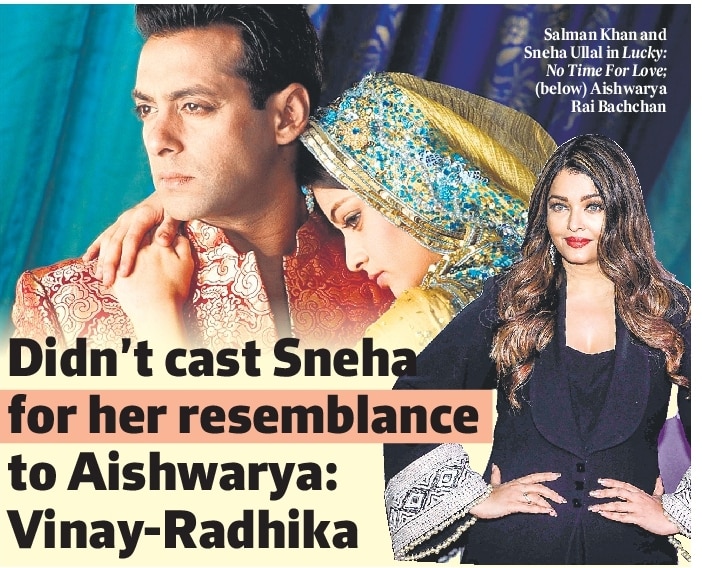
Rishabh Suri (HINDUSTAN TIMES; April 12, 2025)
It’s been 20 years since Lucky: No Time for Love hit the big screen. Helmed by filmmaker duo Radhika Rao and Vinay Sapru — who last directed Yaariyan 2 (2023) — the romantic drama saw newcomer Sneha Ullal debut opposite actor Salman Khan.
At the time, Sneha’s casting created considerable buzz owing to her resemblance to actor Aishwarya Rai Bachchan, who was previously in a relationship with Salman.
Probe the filmmakers about their decision to cast Sneha, who was last seen in the 2024 short film Bhranti, and they reply, “We were simply looking for a fresh face to play the title role. It was an extensive search, like we did for Mawra Hocane’s character in Sanam Teri Kasam (2016).”
They also reveal that it was Salman’s sister, Arpita Khan, who recommended Sneha. Addressing the actors’ resemblance, the duo tells us, “We didn’t cast Sneha because she looked like Aishwarya ma’am. But it was a goal to find someone like her, because she is the epitome of beauty.”
As for how Lucky came about, Vinay recalls, “We were directing songs when Radhika and I decided we should take the leap into feature films.” And they hit the ground running. “We had worked a lot with Asha Bhosle ji, so she graciously agreed to sing Lucky Lips,” he adds.
Talking about the shoot Radhika shares, “We shot with real soldiers and tanks belonging to the Russian Army. The locals didn’t speak English, so we had about 10 interpreters on set. We’d speak to them and then they would speak to the actors.”
She’s also all praise for the film’s leading man: “If there’s one person who’s consistently been an inspiration for us, it’s Salman. Whether you’re working with him or just spending time off set, you walk away having learnt something valuable.”
----------------------------------------------------------
The soundtrack (featuring singers such as Asha Bhosle and Sonu Nigam) was different and special. We had worked a lot with Asha ji, so she graciously agreed to sing Lucky Lips. We also got the chance to work with talented people such as Adnan Sami, who composed the music.
- Vinay Sapru, Director
I can’t even believe it’s been 20 years! I remember we shot with Russian Army soldiers and tanks. People would measure frozen ice so we could walk on it; it was mesmerizing. The locals didn’t speak English, so we had about 10 interpreters on set who’d speak to the actors.
- Radhika Rao, Director
100th birth anniversary of Raj Kapoor: The phenomenon of India’s first major global star
9:18 AM
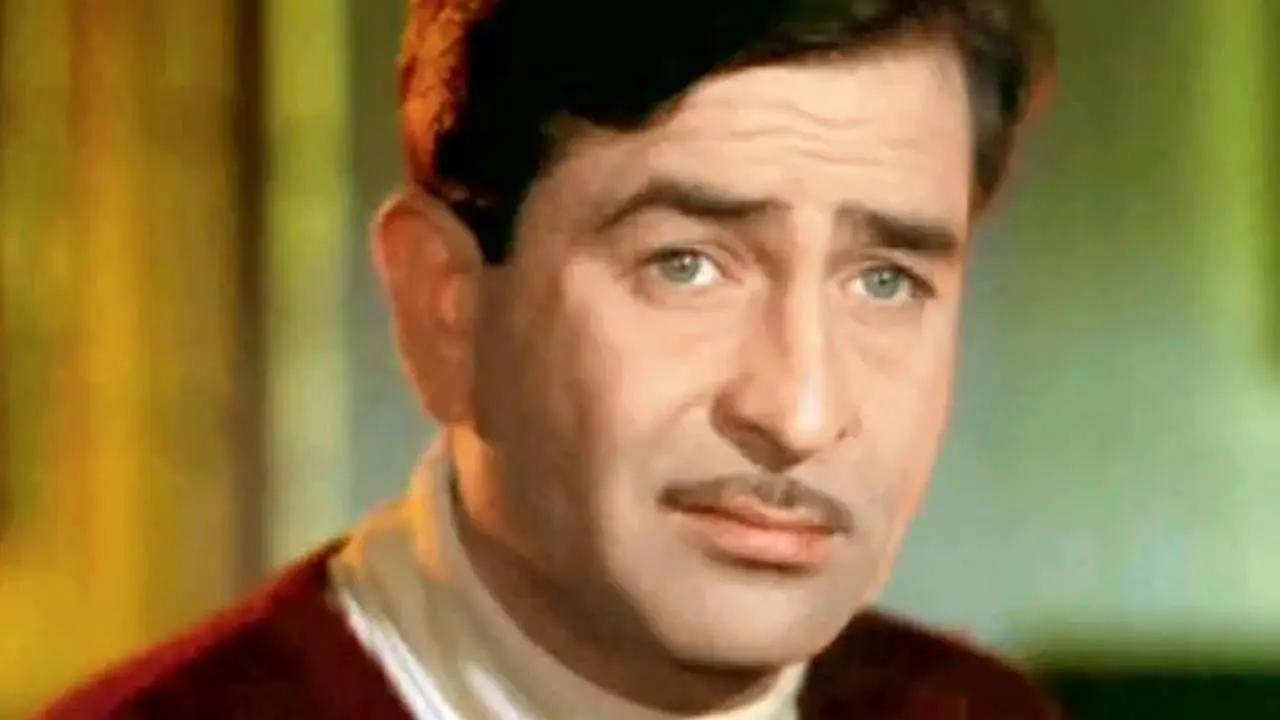
From USSR to North Africa and from South America to Iran, Raj Kapoor’s films swept the world in the 1950s and 1960s. On his 100th birth anniversary today, TOI rewinds to recreate the phenomenon of India’s first major global star
Avijit Ghosh (THE TIMES OF INDIA; December 14, 2024)
On arriving in Moscow in the summer of 1982, Raj Kapoor discovered that he’d left behind his visa papers. The actor-director was stopped by immigration. Frantic telephone calls were made. Nobody was sure what was to follow. But they need not have worried. A senior official soon arrived, embraced Kapoor, kissed him on both cheeks and warmly escorted him out.
“Is there anybody else in the whole wide world who could enter Soviet Russia without a valid visa? You should have seen that sight — it was a sight for the gods,” actor-director Sanjay Khan, who was also part of the film delegation, is quoted as saying in ‘Raj Kapoor: The Fabulous Showman’ by Bunny Reuben.
Another encounter of the fondest kind further underlines how Kapoor continued to command a hallowed place in the land of Tolstoy and Tarkovsky decades after the Awara craze swept the USSR like a forest fire in 1954.
In 1993, Russian president Boris Yeltsin told Kapoor’s daughter, Ritu Nanda, “I was in love with your father Raj Kapoor, and I remember him even today.” The anecdote is recounted in the book, ‘Raj Kapoor: The One And Only Showman’.
It wasn’t just the post-Stalin Soviet Union. In the 1950s, China, Iran, Turkey, Israel, Greece, North Africa and Eastern Europe were captivated by Kapoor’s movie and its title track. Slowly the film and its title song became an unofficial anthem, a cultural marker and a totem of national recognition.
It was also a diplomatic ice-breaker. TOI reported in 1994 that the then Chinese Premier Li Peng recalled Awara and its title track when he met India’s human resources minister Arjun Singh in Beijing. That hasn’t changed. “Every Chinese knows this movie,” goes a comment on YouTube. Awara anecdotes can fill a book.
As the nation today celebrates the 100th birth anniversary of India’s first actor-director who became a major global star in a pre-globalised era, what better time to re-appraise the magnitude of the impact that Kapoor’s movies have had across the world.
Inspiration For Turkish Poets
Awara has provided inspiration to much that is popular in Turkish culture: films like Genclik Hulyalari (1962) and Kader Bu (1976), songs and even novels, Turkey based academic and critic Ahmet Gurata told TOI. “A favourite of my mine,” Gurata said, “is a poem by Lale Muldur, which goes like this: ‘“Awaara hoon / Those kids who neither have a Barbie nor a Ken / They always wanted to be visited by Raj Kapoor one night / They would like him to enter their room and bring milk with gold-leaves... and baklava too / How many stories are embedded in the eyes of those shoeshine boys / Who have been paying the price for their genetic sins, / Did you know awaara hoon?”’
Muldur was born in 1956, a year after Awara was released in Turkey. The poem, taken from her ‘Book of Series’ (1991), is yet another testimony to how the gold hearted tramp continues to stir a generation’s imagination.
In his seminal article, ‘The Road to Vagrancy’, Gurata quotes a newspaper advertisement that says “the film was attended by 100,000 spectators during its first week and another 100,000 were unable to watch the film since it had sold out”. He also notes that Awara was voted as the best movie of 1955 by the readers of the popular daily Milliyet, beating Hollywood films such as Roman Holiday (1953) and Limelight (1952). “The film’s director and star Raj Kapoor ranked third on the list of best actors in the Milliyet survey,” he adds.
The title song was a top-selling record and even featured in official functions. “Several Turkish singers circulated it as a Turkish record in music markets. The song literally became part of folk culture when Turkish folklorist Ilhan Basgoz recorded a folk version in 1957,” Gurata writes.
‘Tramp’ Who Was Irresistible In Greece
Watching it under the title, ‘The Tramp Of Bombay’, Greeks too were besotted by the Nargis-Raj Kapoor pairing. Many Raj Kapoor films such as Shree 420, Aah, Anhonee, Paapi, Chori Chori, Pyaar, Amber, Sangam and Do Ustad made their way across over the next 10 years, film researchers from Greece say.
Indian films were not only shown in Athens, but also in villages at improvised open-air cinemas during summers. The songs were often rehashed with minor variations by Greek composers, creating a subgenre of such songs called Indo-Prepi.
Helen Abadzi and Manolis Tasoulas, who have extensively researched the influence of Hindi films in Greece, have identified at least 25 Greek songs whose melodies come from songs composed by Shankar Jaikishan for Raj Kapoor films.
“For instance, the song, ‘Ramaiya Vastavaiya’, from the film, ‘Shree 420’, became a Greek song titled, ‘When I kiss him and when he kisses me’, and was sung by Achilleas Koulaxizis and Filitsa in the Greek film drama, ‘Why was I born poor’,” Tasoulas told TOI.
Tasoulas also provides a fascinating anecdote that underlines the popularity of the Nargis-Raj Kapoor pairing. When in the early 1980s, Mehboob Khan’s film, ‘Aan’, was rescreened in Greece, the local advertisers wrote Raj Kapoor and Nargis as protagonists, instead of Dilip Kumar, Nadira and Nimmi, in the Greek posters. “Few understood the difference, because many years had passed since Kapoor’s films had been screened in Greece, and fans did not remember their faces as much as their names,” he says.
Sangam, Hindujas and Shah of Iran
‘Sangam’ (1964) floored Iran. Radhu Karmakar, who was Kapoor’s regular cinematographer, writes in his autobiography ‘The Painter of Lights’, that the film was a major hit, especially in South America and Iran, where it ran for over a year. Made approximately on a budget of Rs 1 crore, ‘Sangam’ earned over Rs 12 crore, including Rs 5 crore in foreign exchange, he estimates.
Karmakar remembers how the film’s success helped the Hindujas expand their business. The Hindujas, who distributed the film, invited Raj Kapoor and Vyjayanthimala for the golden jubilee celebrations in Iran and, in turn, got invited to a dinner reception hosted in Tehran by Iran’s ruling family. Karmakar says that the Hindujas “till then were film distributors and contractors, trying unsuccessfully to get bigtime business contracts... The Sangam golden jubilee reception opened the palace doors to the Hindujas and thereafter they moved into the big-time league with large arms contracts and business gains”.
“Everyone also knew the singing-dancing persona of Raj Kapoor in Bulgaria. His popularity was witnessed by many from my generation who grew up in the 1960s. This was mainly courtesy of Awara, which many people had seen more than once,” says Bulgaria-born Dina Iordanova, emeritus professor of global cinema at University of St Andrews, Scotland.
Secret of Kapoor’s Success
Kapoor, who produced and directed the film and played the male lead, was a prodigious 27-year-old when Awara was released in India in 1951. He created a Hindustani Chaplin — a survivor of class inequity and circumstance (Awara, Shree 420) — and the naive and sentimental underdog with a heart of gold who could stray but eventually return (Shree 420). These stories found a global echo, especially in places of limited cultural freedom. The sloshing of socialism and songs with a slice of the sensuous had an affirmative resonance for millions, converting RK Films into a premier banner. His name was synonymous with Indian cinema. As PM Narendra Modi said in his interaction with the Kapoor family on Wednesday, “He created India’s soft power before the term, soft power, was born.”
K A Abbas, who co-wrote the story with V P Sathe, remembered in his autobiography, ‘No Man Is An Island’, what a student told him during their 1954 USSR visit: “We are tired of the war, we went through it, and now must we relive it in every book we read, in every film or play that we see? Instead of war, we want to see love on the screen, we want to see carefree happiness, we want someone to make us laugh. That’s why we are crazy about Awara.”
Many young students bragged that they’d seen Awara 20-30 times. A young Russian interpreter noticed that a dialogue in the film was borrowed from Krishan Chander’s short story, ‘The Night of The Full Moon’. “No one had noticed it in India,” he wrote.
As Kapoor himself said once, “Awara was my little contribution to USSR-India friendship.”.
---------------------------------------------------------
When Kapoor met Chaplin
Ranjan Dasgupta (THE TIMES OF INDIA; December 14, 2024)
Raj Kapoor was a born serio-comedian whose face conveyed every emotion perfectly. According to Satyajit Ray, Kapoor was a better actor than a director. Mehboob Khan once confessed to Film India editor Baburao Patel that Raj Kapoor perfected his shots in fewer takes than Dilip Kumar.
Kapoor understood his limitations well. He modelled himself along the lines of Charles Chaplin. Kapoor always shared fond memories of his interaction with Chaplin at the latter’s residence in Montreux. Along with Dev and Chetan Anand, Nargis, Balraj Sahni, KA Abbas and Bimal Roy, Kapoor was part of the first Indian film delegation to visit Venice in 1953. Chaplin invited the delegation for a discussion.
During the interaction Kapoor spoke the most. He asked Chaplin how serio-comedy could be performed effortlessly. Chaplin was silent for a minute. Then looking into Kapoor’s eyes, he asked him to emote silently. Kapoor obliged the legend for three minutes. Chaplin was deeply moved by Kapoor’s performance and advised him to follow his own instincts. As they left, Kapoor kept waving to Chaplin with tears of joy in his eyes. Nargis simply told Kapoor to control his emotions, laughing her heart out.
The Kolkata-based writer interviewed Kapoor many times
After a long break, more Indian films being screened and shot in Russia
8:56 AM

Anumeha Chaturvedi (THE ECONOMIC TIMES; May 25, 2024)
Several generations of Russians grew up watching subtitled Indian films and were floored by Raj Kapoor, Mithun Chakraborty, Hema Malini and Shah Rukh Khan years ago. Now, after a gap of about three decades, industry players and authorities are working to reignite the old cultural affiliation through Indian films by increasing film shoots and screenings of Indian films in Russia.
Film production and distribution companies and government officials in Russia are looking to attract Indian filmmakers and films now that Hollywood films are absent in Russia following the Russia-Ukraine conflict.
Sarfaraz Alam Safu, who runs Kartina Entertainment, a line production company for Indian films in Russia and CIS countries, said Indian filmmakers are showing increasing interest and parts of some recent films including Sardar Udham, Pathaan, Tiger 3 and JugJugg Jeeyo were shot there.
“I am also working on a film, which is a biopic of Rakesh Sharma (the first Indian in space) to be shot here, which will be produced by Siddharth Roy Kapur,” Safu said. “Companies such as Dharma Productions, Excel Entertainment, Emmay Entertainment, Rohit Shetty Productions, and many more are in touch with us for several projects,” he added.
Local authorities are hoping to attract more Indian filmmakers this year through discounted production costs.
“We are now like the front office or supermarket of any services for filmmakers, as we are trying to cut their production expenses as much as possible by offering a low price to shoot here,” said Evgeny Kozlov, first deputy head of the office of the mayor and the government of Moscow. Upcoming Tamil action film ‘The Greatest Of All Time’ last month became the first foreign film to be shot as part of the ‘Moscow-City of Cinema’ programme that provides subsidies to filmmakers.
“I hope we will see several Bollywood projects from India being shot this year in Moscow,” Kozlov said. “We have started working deeply with Bollywood firms to invite Bollywood filmmakers to the Moscow cinema cluster. My colleagues from the Moscow Department of Culture who are responsible for attracting filmmakers are also trying to establish connections with Bollywood filmmakers.” Kozlov is also the chairman of the Moscow City Tourism Committee.
Meanwhile, more Indian films are being screened across Russia as Hollywood blockbusters, which have been mostly ruling Russian cinemas post the collapse of Soviet Union in the early 1990s, are no longer released in Russia.
Besides Moscow and Saint Petersburg, Indian films are being screened in over 40 locations in the country including Arkhangelsk, Belgorod, Kazan, Penza, Saratov, Tula, Ulyanovsk, and Cheboksary.
Mirzoyan Karen Rudolfovich, a general producer of Indian films in Russia, said he is hoping Indian films will capture about 20% of the Russian films market in the next four to five years, up from less than 5% now. “Hollywood made a lot of investments in popularizing their actors in Russia. That’s missing for Indian films,” said Rudolfovich, who has been working on Indian projects for the past eight years.
“We work with production houses such as Red Chillies and Dharma Productions, and our company purchases the rights of Indian films to screen them in Russia,” he said.
Abhishek Anand, a Russian language translator and interpreter who also acted in a recent Indian film shot in Russia, said the older generation of Russians have a totally different emotion for Indians as they were very fond of actors such as Raj Kapoor. “But films such as Pathaan, Pushpa, Bahubali and RRR have also done well here,” he said. “Pathaan was shot here and there is a Russian dialogue in the film that resonated very well with the audience here,” Anand added.
Motherhood is thankless and exhausting. We should normalize saying this-Gul Panag
10:16 AM

When people with small kids plan vacations, they book a direct flight to a destination that does not involve too much hectic sight-seeing. When Gul Panag takes a holiday with her six-year-old son, she drives an SUV to the mountains and sets up camp amidst pine trees. In 2022, the former Miss India, actor and adventure junkie undertook an eight-day cycling expedition to Ladakh. Nihal, then four, followed in a car as she peddled up the steep slopes. The actor, who uses the display name Tiger Kaur on WhatsApp, spoke to Neha Bhayana about her parenting mantras
Neha Bhayana (THE TIMES OF INDIA; March 10, 2023)
Nihal is six years old now. Does he still keep you on your toes?
Yes and no. I think some things get better as the child grows up and some things become challenging. I find that Nihal vocalises and articulates better now. He is also open to reasoning so much more than he was when he was a toddler. Toddlers tend to be very temperamental, and you don’t know why. In some ways, he does keep me on my toes but he is also very self-sufficient. That’s how I used to be as a kid too. I remember very clearly… I had my own ecosystem. While it was great to play with friends, if I was at some place where there were no friends, I was completely happy to entertain myself.
Most kids constantly need someone to keep them engaged. How did you encourage your son to be independent at an early stage?
I think part of it is nature and part of it is nurture. There is a certain disposition that comes as a result of what we inherit in our DNA. When I was just four or five years old, I lived at a farm in Punjab with my septuagenarian grandparents while my parents were in Russia. So, for two years, when I used to come home from school, there was no company because our farm was a kilometre away from the village. I used to just hang out with dogs, goats and chickens. I was always good at entertaining myself and I think that’s something that is either inherent in Nihal or he’s probably picked it up.
What do you and Nihal like to do when you are together?
I believe in quality over quantity when it comes to spending time with Nihal. There’s no point in me just sitting next to him and staring at my phone. So, the first rule is I leave my phone behind. I try to involve Nihal in whatever I am doing but I don’t perform for him. That’s how our parents brought us up. One doesn’t always have to make puzzles or play with Lego; he does that with my husband (pilot Rishi Attari). The thing we do together is what I am anyway doing as part of my chore list. I ask him if he would like to help me load the laundry or bathe the dogs or pack my bag. If he is busy playing, I may have to ask twice. He then stops what he is doing and comes and hangs out with me. We chat and do the chore together. He asks about the washing machine’s spin cycle or something else. I think that is a very valuable time because we are engaged and we are doing something productive. I also love travelling with him. We always reach the airport early. But when we are there, he is not sitting with me saying “mamma mamma”. He would be doing his own thing, looking at planes or something, within my range of vision. And, he can make a toy out of anything. We have a rule. We never take toys along when we travel.
Which is the opposite of what most parents do….
But then how is the child learning something new from the environment? Like last week when we were in Kazakhstan, he was using a tea bag as a plane and kept ‘flying’ it. On another trip, he took the hotel slippers, put his hand inside them and pretended he was flying a jet. He devises his own entertainment.
Most parents pack their children’s schedule with classes and play dates. What’s your take?
We’ve all made those mistakes. I think free play is really important. Nihal also reads a lot of books. He has been reading independently for some time now. We started reading to him when he was a year and a half, even if it didn’t make sense to him at that age, so books are a big part of his life. When we were at a café-cum-bookshop in Mumbai recently, Nihal went and found himself a book that was relevant to him. It was a collectible book on the story of Star Wars and he just read it the whole time. He has watched the Lego Star Wars which is a super funny and an interesting animated TV show based on the Star Wars universe.
What are your rules about the three big S’s — screens, sugar and sleep?
I am very militant. I have not introduced sugar in Nihal’s diet because we have banned sugar at home. It was a bit of a tough battle because I had friends and family who would point out that we all have had sugar as children. But my argument is that I have spent my life fighting an addiction to sugar. I have to eat one bite of brownie and then I can’t stop myself because it’s dopamine and it’s completely addictive. My husband and I are on the same page on this, and we have been very particular. From the time Nihal stopped formula milk, he was given plain milk with no additives. We carry small tetra packs while travelling, so I can easily give milk to him anywhere. If Nihal goes to a party and somebody offers him cake, he sometimes has a little or sometimes he does not, depending on his wish. We don’t keep sugar or sugary foods at home but we have left it up to him when he is out. In fact, some of my cousins would secretly feed him sweets. But he isn’t a kid who asks for sweets because he hasn’t developed a taste for it.
Screen time is limited to when we have a long flight or long car drive. When we are not travelling, the only screen he sees with us is the big screen at cinemas. Delhi has some lovely kids’ cinemas now. We try to watch a film with him at least once a month. But at home, we don’t watch TV, so he doesn’t either. I think ultimately kids will do what you do.
What about sleep?
Our goal is to sleep 11 hours. Nihal is in bed by 7.30 pm come what may and he wakes up at 6.30 am. On weekends and holidays, it may go up till 8.30 pm but never later than that. When someone tells me that their kid slept at 10 or 11, I am speechless. Sleep is so important for children. The growth hormone is released only in deep sleep. Unfortunately, Indian kids are among the most sleep deprived as per a research discussed in Kerry Bajaj's book 'Sleep, baby, sleep'. And, kids usually stay up late because they wait for their father to come home.
In fact, we are very strict about a fourth S too which is a seat belt. Nihal has never travelled without a car seat. I think most people don’t realize how dangerous it is for a small child to be in a car crash without a seat belt or a car seat. The highest fatality and risk of serious injury is to children who are not belted.
Are you a strict parent?
I don’t know if I’m strict, but I just feel that it’s important to be regimented. My mother was very particular. Even now, when she comes to stay with Nihal when I am travelling, his schedule runs like clockwork. The lights are out by 7.25 pm and he is up perfectly on time. He is so happy and chirpy when we leave for school.
Is there any parenting mantra that you follow?
I think the best way to teach our children is by being good role models. We are anyway by default the first role models of our children and we should aim to be the best possible ones in the which we conduct ourselves. I think my strongest habits, including my commitment to fitness, are the ones that I imbibed from my parents. My father wasn’t this overweight man sitting on a chair and asking me to go work out. He was a fit person who exercised every day. When I was around 15, he told me to exercise daily. When I resisted, he issued a parental diktat. Then it became a part of my life, just like it is part of my father’s life. He is 75 now and still cycles daily. Nihal also does what I do. He goes cycling and running with me. He has been cycling without training wheels since before his third birthday. He was with me (watching from a car) when I cycled to Ladakh two years ago.
I also consider it important to be level-headed all the time as children are very observant. I’m aware that he’s watching me at all times so I am conscious of how I react when I have been triggered by someone or something. I know that my son will do what I do, not what I tell him to do.
You are a sustainability advocate and have also co-founded a company that provides seamless charging for electric vehicles across India. These days most children come to school in their personal cars. Do you think schools should make carpools and buses mandatory?
Schools should certainly do that for three reasons. One, it is more affordable and more environment-friendly. Two, it is better for the neighbourhood because people who live near
schools can’t even go in and out of homes because of traffic jams during school pick and drop timings. Three, I think children become exposed to a certain elitism when they see somebody coming in a particular car. I have heard of instances where children going to fancy schools want to be dropped at a distance so that no one can see which car they are coming out of. So, apart from sustainability and traffic management, I think uniformity is extremely important or some will be more equal than others.
Indian parents tend to have this obsession with studies and marks. As a fitness enthusiast, do you think parents should prioritize sports too?
Fitness has indeed been a very big part of my life, but it was not that I only had to be a good athlete. Being in the top two percent in my class was non-negotiable at the same time. It’s not one thing or the other. And, I did manage. I changed 14 schools and I have never not been in the top three of my class, including college, master’s and law school (she obtained a law degree three years ago). So, the desire to excel has to be ingrained. One can’t be casual about grades and then complain when the child reaches Class 10. One has to ingrain a desire to excel and then hopefully everything will happen on its own. But the desire will not get ingrained automatically.
You openly spoke about having difficulty conceiving. Other celebrities too have not shied away from sharing that they had babies via in-vitro fertilisation, surrogacy or adoption. But the aam janta is still very reluctant to discuss fertility issues. They consider it a matter of shame..
Shame is typically associated with the fact that it is always considered the woman’s fault though scientific evidence tells us that the causes of infertility are equally divided between male and female issues. The shame often stems from the fact that at some point you are trying to cover up the infertility in the male. Fertility is a loaded gun against women. I have been very open about the fact that my son was an IVF child. Sometimes, couples suffer from unexplained infertility despite all tests being clear. These things can happen to anyone and for a variety of reasons so why be all secretive about it. I think we as a society spend too much time hiding things that are irrelevant in the big picture. Having a child is all that matters. Kaise hua, kya farak padta hai (how it happened, who cares).
Is Nihal also adventurous like you?
He goes camping. He does what we do. For him, it is not a choice. It is part of his life.
Describe motherhood in one word.
Overwhelming, thankless, exhausting and in small parts, rewarding every now and then.
What’s the most rewarding part?
When the child occasionally says “Mamma, you smell like roses” and “Mamma I love you” — he has been doing that a lot lately — that’s very rewarding. What’s also rewarding is getting to hang out with moms and discussing that we are all in it together; we are not alone. I wish more women would talk about how challenging motherhood is. It shouldn’t be this big lie that it is all going to be amazing and beautiful. It is very challenging. It is very overwhelming and it’s very exhausting and you constantly are plagued with feelings of inadequacy. Ultimately, we are all struggling.
Moms often hesitate to say they are struggling because they feel they will be judged and considered ‘bad mothers’….
Why? They shouldn’t. We should normalize saying that it is challenging; it is difficult and frustrating. This is why a support group of moms is super important. You need moms who tell you "we are dying as well" and then you feel less dead. I have a gang of mom friends. We meet every week. Three of us are working moms. Homemakers have unique challenges and so do working moms. We should normalize talking about the troubles we face.
Hi, ‘Barbie’: Russian theatres find ways to screen blockbusters amid sanctions
8:17 AM

THE TIMES OF INDIA (October 5, 2023)
As people in much of the world flocked to see Greta Gerwig’s blockbuster film “Barbie” this summer, viewers in Russia were left out. At least officially. Along with other studios, Warner Brothers, the producer of Barbie, stopped releasing movies in Russia shortly after Moscow launched its full-scale invasion of Ukraine in February 2022. But that has not stopped Russian viewers from watching Western films. Last year, Russian theaters were openly screening illegal copies of “The Batman” and “Turning Red.”
“Barbie” has been no different, with movie theaters employing a workaround to give audiences access to the Western films they want to watch. Russian cinemas in cities large and small are offering viewers tickets for short films or documentaries, but these come with screenings of the full effervescent, bubblegum-pink “Barbie” film that technically plays during the previews slot. At least 14 theaters in Moscow were openly offering such screenings on their websites on Wed nesday, with tickets about 400 to 500 rubles, or $4 to$5.
The screenings are just one example of how Russians have been forced to improvise after Moscow’s full-scale invasion of Ukraine. In the wake of the war, the West imposed a host of sanctions on Russia and companies fled the market. The Kremlin has also discouraged these screenings as Moscow seeks to paint an all-encompassing picture of an existential battle with the West.
Movies produced in the US made up around 70% of the Russian film market before the war, according to state media. Their exit has caused a crisis among Russian movie theaters, whose revenues dropped by 44% from 2021 to 2022, according to Russia’s Association of Theater Owners.
The association wrote on its website that it has made repeated pleas to government agencies to issue theaters distribution certificates that allow them to screen films like “Barbie” and “Oppenheimer” from “unfriendly countries” without the consent of the copyright owners. But the ministry of culture turned down the request, saying that the two films “do not meet the goals and objectives set by the head of state to pre serve and strengthen traditional Russian spiritual and moral values,” and that the Russian box office is “saturated” with domestic films anyway.
This year, the ministry of culture announced that it would provide financial support only to films focused on one or more of 17 approved themes, including “traditional values”; “heroism” of Russian soldiers in the war with Ukraine; and “the degradation of Europe.”
Some domestic films have successfully attracted large audiences.
Shailendra's 100th birth anniversary: As a Dalit, he had a first-hand experience of misery and caste discrimination-Sheoraj Singh
8:36 AM

Shailendra (left) and music director Roshan. The two collaborated for the songs in films like Soorat Aur Seerat (1966). (Below) The song Awara hoon from the film Awara was a worldwide hit
Avijit Ghosh (THE TIMES OF INDIA; August 30, 2023)
For decades, Awara Hoon (film: Awara, 1951) was a passport to warmth for any Indian visiting the USSR, Turkey, Egypt, China and parts of Africa. The best-selling track even finds mention in dissident Soviet writer Aleksandr Solzhenitsyn’s novel, Cancer Ward (1966). And Mera Joota Hai Japani (film: Shree 420, 1955) makes appearances in films as diverse as Mississippi Masala (1991) and Deadpool (2016). The lyrics of Shailendra, whose birth centenary falls today, could remarkably create the universal from the local and the personal.
Shailendra’s life was his poetry’s wellspring. His roots lay in Dhuspur village near Bihar’s Arrah town. But he was born in Rawalpindi (now in Pakistan), where his father worked as a contractor. When his father fell ill, the family fell on hard times and shifted to Mathura where they would subsist on “a meal a day and a beedi at night,” says the preface of Andar Ki Aag (2013), a book on his previously unpublished poems.
The experience finds expression in the slum dweller song of Shree 420, ‘Bhookh ne hai bade pyaar se pala’. (hunger raised me with love). Only someone who had experienced hunger could dream of roti (bread) as he does in Ujala (1959): ‘Chulha hai thanda bada aur pet mein aag hai/Garma garam roti kitna hasi khwab hai’ (The hearth is cold and my stomach rages with hunger/To dream of bread is so beautiful).
The book also talks about Shailendra’s real name (Shankardas Rao), his Dalit background and the caste slurs he faced playing hockey (‘Ab yeh log bhi khel khelenge’ (Now even these people will play the game) making him give up the sport.
Writer Sheoraj Singh “Bechain” says that during the Progressive Artistes era in the 1940s, many writers wrote on the oppressed. “But as a Dalit, Shailendra had a first-hand experience of misery and caste discrimination. Distress isn’t just economic but also social and cultural,” says Bechain, a Dalit, and author of the acclaimed biography, ‘Mera Bachpan Mere Kandhon Par’.
Shailendra left Mathura for Bombay where he worked in the railways and became part of the Left-cultural forum, IPTA. The story of Raj Kapoor being impressed by his poem ‘Jalta Hai Punjab’, asking him to write in his films, Shailendra’s initial reluctance, and then later writing the last two songs of ‘Barsaat’ (1949) because he needed the money has been written before. In time, he would become a regular in films of Kapoor and Bimal Roy; his lyrics seamlessly fitting into their socially-conscious narratives.
A running thread in Shailendra’s celluloid verse is his empathy with the disadvantaged. “Staying within the matrix of the film’s script and the character’s needs, he commented on society and politics of the times. And he spoke up for the last human who’s uncared for by the government, the society and everyone else,” says radio personality Yunus Khan, who is writing a book analysing Shailendra’s poetry.
Lyricist Raj Shekhar (Tanu Weds Manu) adds to the view saying while many lyricists wrote emphatically about the marginalised, one can see a distance between the writer and those being written about. “But when you listen to Shailendra, you feel that distance has been dissolved. He seems to be one of them. And that’s because he is writing from lived-in experience,” he says.
In times when poets were often prisoners of pompous words that evaded ordinary people, Shailendra was accessible even to the rural illiterate. And yet as the late songwriter Dev Kohli once said, “Like the dohas (couplet) that Kabir wrote, he could encapsulate a world in a few words.”
‘Sajan Re Jhoot Mat Molo Khuda Ke Paas Jaana Hai’ (film: ‘Teesri Kasam’, 1966) is simple yet profound. ‘Aa Chalke Tujhe Main Lele Chaloon’ (film: ‘Door Gagan Ki Chhaon Mein’, 1964) imagines a world without discord (‘Jahan Bair Na Ho’) and hope much like John Lennon’s ‘Imagine’ (1971). That he could also write, ‘Chahe Koi Mujhe Junglee Kahein’ (film: ‘Junglee’, 1961) or the fun tracks of ‘Half-Ticket’ (1962) is a tribute to his versatility.
Shailendra produced ‘Teesri Kasam’. The Basu Bhattacharya-directed film, now hailed as a classic, flopped then. The poet passed away the same year. But even today much of his poetry remains quotable and relevant, none more than the line from ‘Jis Desh Mein Ganga Behti Hai’ (1960): ‘Mil jul ke raho aur pyaar karo, ek cheez yahi jo rehti hai’ (Stay together in harmony, love each other, this is all that lives in the end). As Bechain says, “His poetry rises above caste and religion, and seeks to establish a bond between humans.”
---------------------------------------
Indrajeet Singh (THE TIMES OF INDIA; August 30, 2023)
Released in India in 1951, ‘Awara’ was first shown in Russia in September, 1954. The film was dubbed in Russian but the songs remained in Hindi. The title song became an anthem of Indian culture and friendship for Russians. Tagore, Premchand, Kabir are also very popular in translation. But Shailendra’s songs were embraced by Russians in their original form. I have lived in Moscow for six years and a witness to the immense popularity of Raj Kapoor and Shailendra.
I was told by a Russian scholar of Hindi, E Chelishev, in 2003 that he had edited a collection of poems, ‘Poets of India,’ in Russian way back in 1958. The collection also included two poems by Shailendra: ‘Janmabhoomi’ and ‘15 August.’
When Shailendra visited Moscow in March 1962, he was very happy to learn that two of his poems had been translated into Russian. Shailendra was fond of the great Russian poet Pushkin. There was a similarity between the two. Both were great poets of love and revolution. Both died at a relatively young age. Raj Kapoor used to address Shailendra as Pushkin.
The author’s monograph, Bharatiya Sahitya ke Nirmata: Shailendra, will be out Saturday
---------------------------------------
Avijit Ghosh (THE TIMES OF INDIA; August 30, 2023)
Shailendra also performed cameos in a few films such as ‘Boot Polish’ (1954) and ‘Musafir’ (1957). In ‘Boot Polish’, he lip syncs a folk song he wrote, ‘Chali kaun se desh’ (singers: Talat Mehmood and Asha Bhonsle, music: Shankar-Jaikishan). Indeed, he was a master at writing songs flavoured with folk.
Sahitya Akademi recipient poet Anamika says that Shailendra was especially sensitive to soundscapes and was all ears for the chitchat on the footpaths and the folksongs floating in the villages of Bihar, Punjab and Maharashtra. “This is what gives his lyrics an epical dimension and makes him a popular writer of chorus,” she says.
Anamika also points out Shailendra’s sensitivity to “the push and joy of women’s language especially in the folkloric mode and the subversive quality of their humour which hoots out and titillates in the same go”. ‘Paan khaye saiyan hamaar, (film: Teesri Kasam) is a case in point.
Shailendra’s some other note worthy folk songs include ‘Ho daiya re daiya chadh gayo papi bichhua’ (film: ‘Madhumati’, 1957) and ‘Lali lali doliya pe laali re dulhaniya’ (film: Teesri Kasam). He also wrote the songs of the first Bhojpuri film, ‘Ganga Maiya Tohe Piyari Chadhaibo’, 1962), including the classic, ‘Sonwa ke pinjra mein’ (singer: Mohd Rafi, composer: Chitragupt).

Mithun Chakraborty's Disco Dancer ready for a sequel
8:08 AM
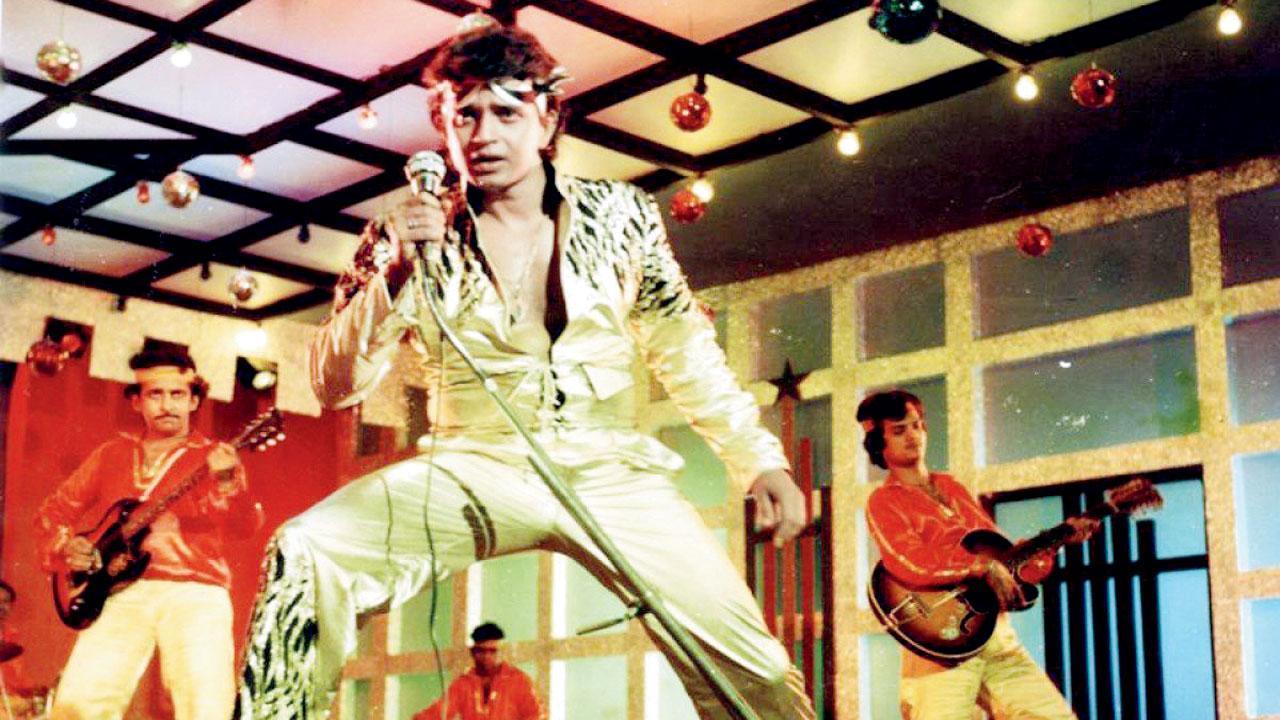
Disco Dancer director ready to roll sequel to Mithun’s 1982 smashing hit; senior actor likely to reprise his role of dancing star Jimmy
Upala KBR (MID-DAY; April 4, 2023)
Forty-one years is a long time between a film and its sequel. But considering the immense popularity that Mithun Chakraborty’s Disco Dancer (1982) enjoys, the veteran actor’s fans will only be too happy to get a follow-up movie. mid-day has learnt that B Subhash, who produced and directed the 1982 musical drama, is backing the sequel, the working title of which is Disco Dancer 2. Nitin Kumar Gupta, who directed Sayonee (2020) and Love In Ukraine, will helm the offering.
Disco Dancer, also starring Kim, revolved around Chakraborty’s street singer Jimmy who becomes a disco star. On its release, it became a smashing hit, thanks to the leading man’s smooth dance moves and Bappi Lahiri’s chartbusters, including Jimmy Jimmy Aaja Aaja, I Am A Disco Dancer, and Yaad Aa Raha Hai. The movie is also credited for ushering in disco music in Hindi cinema.
A trade source reveals, “The upcoming action-musical will pick up where the first movie left off, following the story of Jimmy and his son. It will be shot in various international locations, including Russia.”
The world of Disco Dancer is incomplete without Chakraborty. We hear that the makers are keen to rope in the senior actor for the second edition. “While Mithun has not been approached yet, he will most likely be seen in the pivotal role of Jimmy. Music plays a key role, and the makers have initiated talks with some international music directors,” says the source.
Subhash and Gupta are apparently in talks with K V Vijayendra Prasad — the writer of RRR [2022], Baahubali, and Bajrangi Bhaijaan [2015] — to serve as the writer-presenter.
Despite multiple attempts, Gupta remained unavailable for comment. Subhash, however, confirmed the news, stating, “I have given the sequel’s rights to Nitin, who is directing it. I will be a joint producer.”
When probed whether Chakraborty will be a part of the sequel, he stated, “The casting is underway. It’s too early to talk about it.”
Worldwide gross: The Chinese and Russian factor
8:42 AM
Box Office India Trade Network
PATHAAN emerged the highest grossing Hindi film in original format last week but there was a little debate within the industry as DANGAL had grossed more if you include the Far East and BAJRANGI BHAIJAAN is also ahead that way. But these numbers are all formats and basically when you do this, it just changes the history of Hindi cinema the way everyone knows it.
The overseas markets had this Russian factor for around forty years and the last decade saw the Chinese factor and both are very similar in almost everything. The difference being that Russia had far more Hindi films released though business could be extreme from crazy levels to practically nothing. Both markets generally have Hindi films on an outright basis as makers see it as extra money and give the film and then the distributor be it Russian or Chinese releases the film on his account. The cost gets higher if the film breaks out but so do the profits.
In Russia, the films was dubbed or subtitled and even cut to suit the needs of the market and it was a different case for different areas. If the film was dubbed, the songs were still left in original Hindi language and this was for all films though a song here there would be cut. It has been the same case in China though here reports are that songs are edited/cut especially if they don't take story forward.
The Russian story was a few prints released which meant very limited revenue but a film could break out into hundreds of prints with huge grosses (though not as high as these $50m, $75m, $100m numbers that go around). Its the same with China, there may be less releases but its about a break out. A difference with Russia is that in Russia, most major Hindi films managed a release
China, meanwhile, is still picky and distributors only pick films which they feel have a chance. PATHAAN will not be one them as it shows the INDIAN as a HERO and the Chinese will not take to that. The Russians were kinder that way as SEETA AUR GEETA, JUGNU, BAROOD and DISCO DANCER were huge but many historic blockbuster films like MOTHER INDIA, MUGHAL-E-AZAM, GANGA JUMNA, MERA GAON MERA DESH, MUQADDAR KA SIKANDAR and KRANTI were debacles there. Even the biggest of them all, SHOLAY, had only decent footfalls in Russia.
Simply put, PATHAAN has moved the benchmarks in Overseas to a different level but if you go by the Far East story then it has not as other films have already grossed more with their various formats. Just like HUM AAPKE HAIN KOUN and DILWALE DULHANIA LE JAYENGE opened up the overseas market in the 90's but if you go by the Russian factor then then many movies had already done higher business decades back.
The films that were released in Russia and then lately Far East are not the same films which were released in India that is why PATHAAN is the biggest Hindi worldwide grosser in its original format. Then taking all formats it can be said that DANGAL is bigger than PATHAAN worldwide, SECRET SUPERSTAR is bigger than SANJU, DISCO DANCER is bigger than KABHI KHUSHI KABHIE GHAM and MAMTA is bigger than MUGHAL-E-AZAM.
The original format of the film is most important and you cant mix up with other versions and then compare. Its like having a bag of Apples on one side and a bag of Apples and Oranges on the other but saying its the same thing. There will be people out there who do but then there are a lot of people who are a bit empty upstairs also.
When BAAHUBALI 2: THE CONCLUSION released and it was put above DANGAL on the site it was asked why it went above DANGAL as Hollywood does not do this but that is because there eventually for the top films, its a level playing field as most will will go to all the major markets. On a lighter note they also know that a edited/subtitled /dubbed LOLITA (1997) is not going to topple their greats be it GONE WITH THE WIND, TITANIC, AVATAR or ET. This is not to say the historic Hindi grossers in Russia and China are LOLITA's (This film is one of the biggest box office disasters in Hollywood if not the biggest).
Now, ENGLISH VINGLISH will release in China and it will do some business as otherwise the local distributor would not have taken it. But if it somehow, it goes on to do $100 million or more, it will NOT become bigger than PATHAAN as in original format you just cant compare the films.
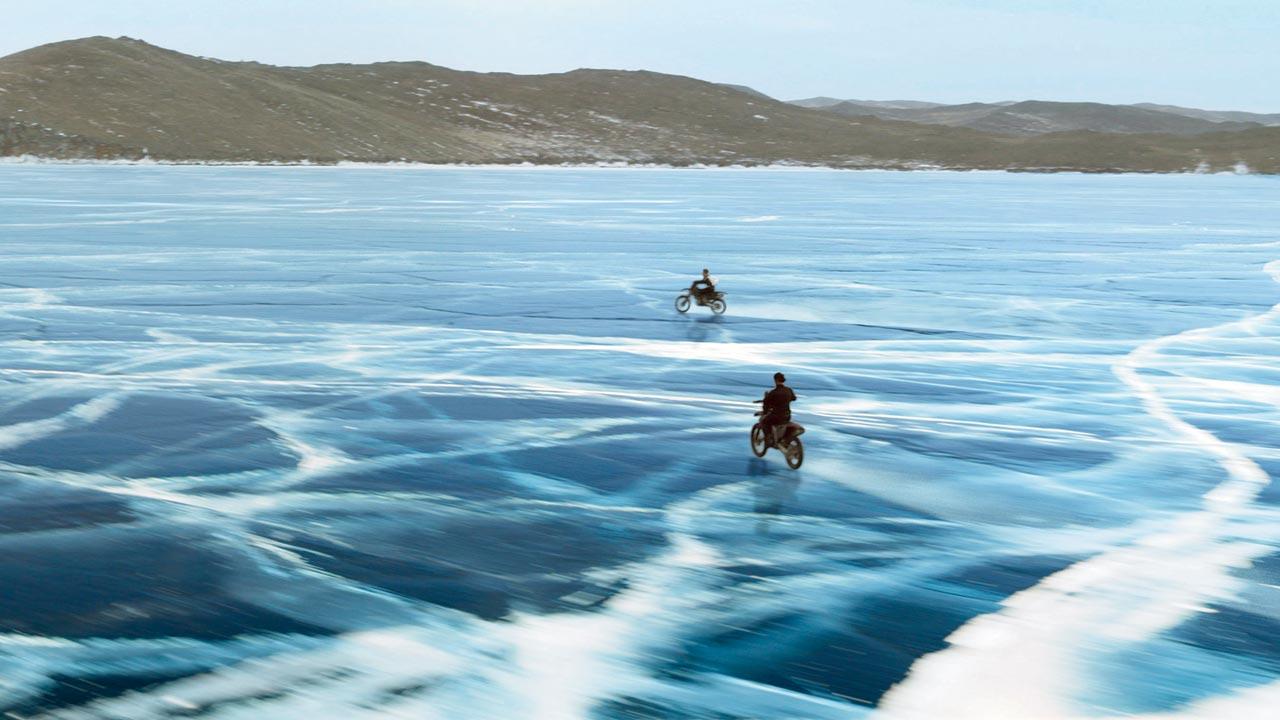
Pathaan director Siddharth Anand decodes Shah Rukh Khan, John Abraham's bike-chase scene in Siberian lake
8:42 AM
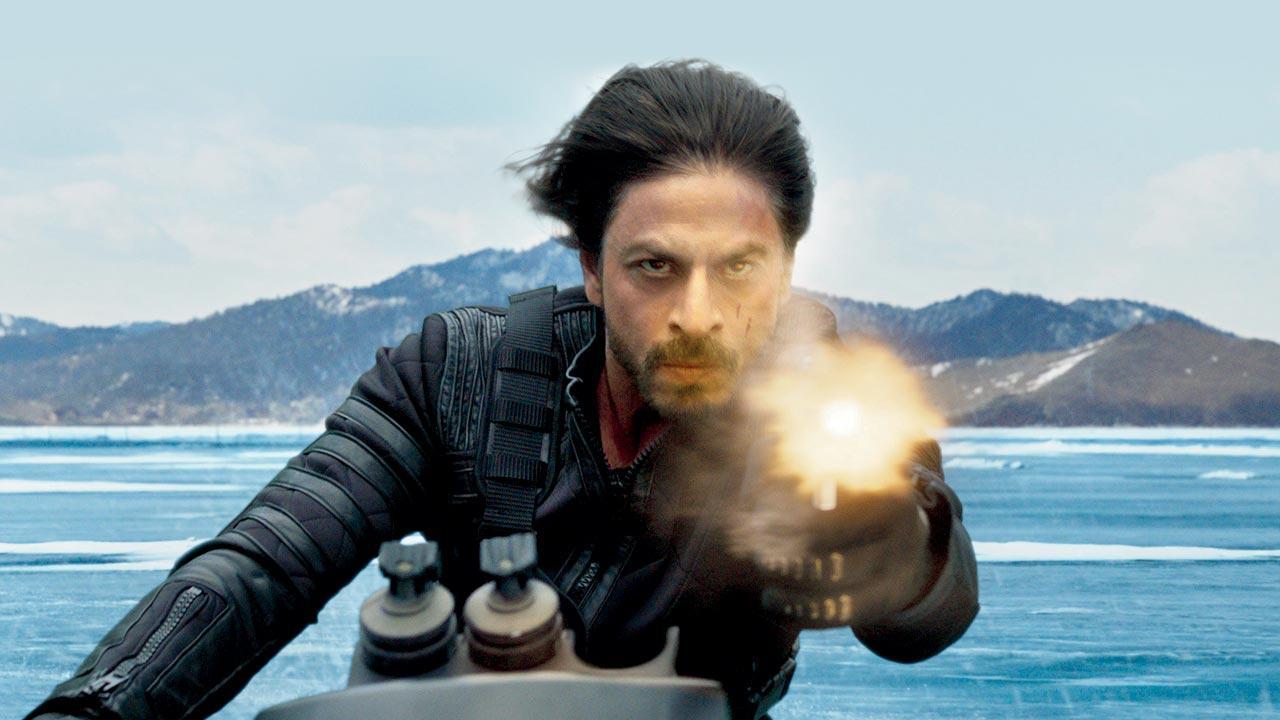
As Pathaan becomes first Indian movie to be shot in Lake Baikal, director decodes how Shah Rukh and John filmed bike-chase scene in Siberian lake
Upala KBR (MID-DAY; January 17, 2023)
Devoted fans, who have missed seeing Shah Rukh Khan on the big screen, will have their eyes fixed on the superstar when Pathaan plays in cinemas. But the picturesque locations in the film may just vie for their attention.
When envisioning the espionage thriller, also starring Deepika Padukone and John Abraham, director Siddharth Anand and producer Aditya Chopra knew that it had to be a visual spectacle. Staying true to their ambition, the makers have shot a critical action sequence in Lake Baikal in Russia, making Pathaan the first Indian movie to be filmed in the location.
Lake Baikal, situated in southern Siberia, is not only the world’s oldest lake, but also the deepest. It is known for its crystal-clear waters, as well as the rich flora and fauna. What makes the lake unique is that its rock-solid frozenness in the winter enables light vehicles to safely drive on the ice cover. It is this feature that made Anand, action designer Casey O’Neill and production designer Rajat Poddar choose the location.
“The scene comes at a critical juncture in the movie, and sees Shah Rukh in a bike-chase sequence with John. After Lake Baikal was suggested for the scene by Aditya, only Sid and Casey went for the recce. On seeing the lake, they felt it served as the perfect backdrop for the action set-piece. The sequence was shot in the winter of 2021. Keeping the safety measures in mind, only seven to eight Indian technicians were present on the day of the shoot, besides Shah Rukh, John and Siddharth. A local crew from Russia was also hired,” reveals a source.
Anand knows that the stakes are high for the thriller, since it marks Khan’s return to the silver screen after a four-year hiatus. The director says this knowledge prompted him to up the ante in terms of action. “Pathaan promises to deliver a visual spectacle to people. To shoot the high-risk bike-chase sequence on the frozen Lake Baikal, the equipment had to be shipped from Moscow, which is almost 2,000 kilometres away from where we were shooting. It was a huge task, which the production handled smoothly,” he recounts.
Our next show will be based in India, with a Delhi protagonist, say Fauda creators Lior Raz and Avi Issacharoff
8:09 AM

During their recent visit to India, Fauda creators Lior Raz and Avi Issacharoff spoke to us about the global impact of the series, as well as their next project – a spy thriller based in India
Niharika Lal (BOMBAY TIMES; December 9, 2022)
Following the success of their Israeli TV series Fauda, its creators Lior Raz and Avi Issacharoff are enjoying the immense love they are getting from fans – be it in Jakarta, Colombia or especially India. The duo, who recently visited India to attend a film festival, says they’re bowled over by people’s warmth. “When we landed here, at immigration, the officer looked at me, and said, ‘I saw Fauda three times’,” Lior, who also acted in the show, told us, adding, “Then I lost my baggage, and the officers helped me and they (all) knew who I was. It is so nice to know that people all over the world, and especially India, appreciate your work. It’s not easy, as sometimes you get mobbed and sometimes I try to hide myself. But when someone says they want to take a picture, for me, it’s just their way of expressing their love. ”
WE ARE COMING BACK TO MUMBAI SOON & HOPE TO FILM OUR NEW SHOW IN INDIA’
Avi told us, “We are working on a true story that follows an Indian guy and if everything falls in place, we will be filming in India. The lead character of the show is based in Delhi. The story starts here (in India) and it develops and goes to England and Russia. This is at an early stage. We want to shoot here and work and produce here. This is why we are coming back again soon to Mumbai to talk with Indian companies and producers.”‘
‘LIFE IN ISRAEL IS WEIRD. . . SOMETIMES REALITY IS WAY BIGGER THAN FICTION’
While dealing with such a sensitive topic, Fauda creators said that authenticity is crucial. Since they have both worked as undercover agents, how do they draw the line between what to reveal and what not to?
Avi said, “We both know what we shouldn’t expose. There is an ongoing dialogue between us about how far we can go without putting anyone in danger. We both were in a unit that was nothing like on show, which belongs to the Israel Defense Forces (IDF). And we both have been very careful with human life in what we do (pauses)...I have to say that reality brings all kinds of meanings and events that we could not really expect to happen and we could not imagine will happen. But it’s a very weird life in Israel and in the Middle East (in a way) that sometimes reality is way bigger than fiction.”
Lior added, “What is interesting is that because of the show, there is an increase in young people who want to be in those units. There are thousands more people who want to join these units. The number has doubled. People really want to be a part of that unit. This is a byproduct of what we are doing.”
‘FAUDA CHANGED HOW MANY ARABS VIEW ISRAEL’
Talking about the impact of Fauda across the world and in the Middle East, Lior said, “We were surprised that it was number 1 on the streaming platform in Lebanon and in the Top 10 all over the Arab world. There was an article about us in a newspaper in Egypt that stated that we have changed Arab people’s perspective on Israel. Until now, it was all about propaganda. But you see, as people, we are all good sometimes and we are bad sometimes. And not just other countries, but even in Israel, people feel compassion for those who are on the other side too. People who support Palestinians sometimes feel compassion for the Israeli side as well.”
‘WE DEFINITELY PLAN TO COME BACK TO INDIA AND EXPERIENCE IT MORE’
“The people who surrounded us here (in India) were so kind and polite. I was eating all the time here, everybody here wants us to eat a lot because they love us,” said Lior. “Fourteen years ago, I wanted to go on a spiritual trip, so I chose the south of India. With a good friend of mine, I started the trip on a motorcycle and we just travelled from Goa to Hampi to Kerala and we met so many interesting and loving people. It was the most spiritual moment of my life to be in India for a few weeks, just to travel and meet people. Now when I came to Goa this time again, I felt immediately at home. It was a great experience and I’d love to explore more,” added Lior, to which Avi agreed.
With Pathaan, our aim was to create a film that would raise the bar of action movies in India-Siddharth Anand
8:09 AM

Pathaan director on taking his cast across eight countries to film sequences for Khan’s return vehicle
Hiren Kotwani (MID-DAY; December 2, 2022)
With Pathaan marking Shah Rukh Khan’s first film in four years, director Siddharth Anand was keen to create an offering that befit his stardom. In a bid to make Pathaan a “visual spectacle”, Anand took his cast and crew, including Khan, Deepika Padukone, and John Abraham across eight countries for the shoot of the actioner.
“The selection of the right locations is always an important part of making a film, and it was more crucial for an actioner like this one. We wanted to create a spectacle for audiences; one that they have never seen before,” says Anand, whose previous offerings include dramas like War, Bang Bang, and Bachana Ae Haseeno.
Filming for Aditya Chopra’s production took place across Spain, UAE, Turkey, Russia and Siberia, Italy, France, and Afghanistan. “This was done to achieve a variation in the [settings]. A lot of planning went into deciding how we would go about filming.”
Pre-production for the film, which also releases in Tamil and Telugu, took nearly two years to complete. “Our aim was to create a film that would raise the bar of action movies in India. We have shot in remote and exquisite spaces so as to make the film both immersive and outlandish,” says the director of the January 25 release that was shot near Paris’s Eiffel Tower, and Siberia’s snow-clad mountains.
Why ‘Jimmy Jimmy’ evokes such a joyful universality
9:26 AM

Avijit Ghosh (THE TIMES OF INDIA; November 6, 2022)
Like vagabonds, songs are restless. They wander without any fixed address and travel to the unlikeliest of places. Sometimes they are also repurposed in innovative ways. ‘Jaan pehchan ho’ (film: Gumnam, 1965) plays in the background of a chic Eastern restaurant inhabited by magicians and dragons, as part of a Heineken ad released a decade ago. And it is serendipitous listening to the faint sounds of ‘Mera joota hai japani’ (film: ‘Shree 420’, 1955) in a taxi in the whipsmart Hollywood flick, ‘Deadpool’ (2016).
Songs have the ability to talk across generations and cultures. But even the most devoted of Indian film lovers wouldn’t have fathomed the way ‘Jimmy Jimmy’ from producer-director B Subhash’s musical hit, ‘Disco Dancer’ (1982), was recently recast in China. To those who missed the news, snatches of the song were put out on the social media network Douyin, the Chinese name for TikTok. In Mandarin “Jie mi, jie mi” translates into “Give me rice, give me rice”.
In the satirical, soft-protest video, two women and a young girl, in Indian dresses, lip sync to the jivy number holding empty bowls to illustrate how they are deprived of basic food items due to a Coronavirus lockdown. The fact that the artists opted for ‘Jimmy Jimmy’ underlines the song’s recall value in China and why it was used to make a political point.
Written by Anjaan and composed by Bappi Lahiri, the easily-accessible footstomper has gathered 92 million views, 450,000 likes and over 20,000 comments on YouTube. Many comments are from Azerbaijan, Kazakhstan, Estonia, Georgia and others countries which were once part of the erstwhile Soviet Union and with whom India has shared an abiding link through songs, most notably ‘Awara hoon’ (film: Awara, 1951). As Arsen posted from Armenia this year, “If your (sic) a 80’s kid from the USSR, then you know this movie and song. It’s tattooed in your brain.”
The remark reflects how the song is part of the larger popularity of ‘Disco Dancer’, whose super success abroad lent iconic status to Mithun Chakraborty in these countries. Interestingly, the film’s title track was the bigger hit in India. In the 1982 annual radio countdown show of ‘Binaca Geetmala’, ‘I am a disco dancer’ (singer: Vijay Benedict), received a far higher rank (no 8) than ‘Jimmy’ (no 20).
There’s no place that ‘Jimmy Jimmy’ hasn’t been to. Posts from Malaysia, Serbia, Cameroon, Afghanistan, Syria, Romania, Mongolia, Israel, Argentina and other countries demonstrate the track’s enduring and diverse fan base. They show how songs can make you friends.
They also underline how ever-improving technology — audio cassettes, video tapes (generally pirated) in the 1980s, VCD and DVD (often pirated), the internet (pirated audio) and now video sharing social media platforms like YouTube — has enabled and magnified global engagement with music. In 2007, even British pop singer of Lankan origin, M. I. A, brought out her own version of the track. “‘Jimmy Jimmy’ is not just a song of India, but a song of the world,” an elated Subhash, told me over phone.
Crooned by Trinidad-born Parvati Khan, ‘Jimmy Jimmy’ evokes a joyful universality. But its tune can be traced to ‘T’es OK, T’es Bath’ (1980) of French pop duo Ottawan, as pointed out by itwofs. com, the website which diligently tracks Hindi film songs that have been inspired or lifted from foreign tunes. Few remember the original though.
In the age of video sharing sites, ‘Jimmy Jimmy’ isn’t just a song we hear. We watch it too. The number was choreographed by dance director Kamal and performed on celluloid by Kim, who shook and shimmied with vigour and enthusiasm amidst blinking lights. Those dance moves have been imitated in talent contests globally. Kamal and Kim are two under-appreciated contributors to the song’s popularity. Hindi film songs have always been part of India’s seductive soft power. They have seldom occupied world music charts but thousands have overcome language barriers and made home worldwide.
‘Jimmy Jimmy’ continues to globally teleport people to a place called nostalgia allowing them to reconnect to a time and a place they can no longer return to physically. Bisola Ayetigbo posted from Nigeria, “Omg! This song was my entire childhood… I can’t wait to send this to my sisters! We sang this song in the way we could all through our childhood even though we don’t understand any. . . the actors! They made my childhood so beautiful!”
Songs like ‘Jimmy Jimmy’ are our under-appreciated cultural ambassadors. In 2016, when a colleague visited a karaoke bar in Vladikavkaz, a city located in deep, south-east Russia, he was forced to sing ‘Jimmy Jimmy’. He hardly knew the words. But it didn’t matter. Drinks were on the house thereafter.
Russia rekindles lost love for Bollywood
8:18 AM

Aheli Banerjee (THE TIMES OF INDIA; September 19, 2022)
Kolkata: The word “boycott” may have lately bothered Bollywood more than the famed fickleness of the box office, but neither of these is a factor in Russia as Putin’s people sing, laugh and cry to the cadences of the good old Hindi trope amid a drought of Hollywood fare and international OTT action at home.
Prominent Moscow cinemas such as Cinema Park, Formula Kino, Premiere Hall, Kinomax and Karo made the switch to Bollywood back in March, anticipating high demand. Many of these places have since been regularly screening commercial Bollywood movies. Karo cinema chain president Olga Zinyakova told Russian media that cinema owners could keep the show going mainly because of the sustained demand for Bollywood fare.
TOI tried to contact Zinyakova, but she was unavailable for comment.
Karen Mirzoyan, director of Indian Film, a company in Moscow that partners with the Moscow International Film Festival to supply film content from India, said the Hollywood vacuum had been filled by the resurgent popularity of Indian films after a gap of over 20 years. “Interest in Indian movies was always there in Russia,” he said. “But from the Indian standploint, there was little interest in the Russian market as they focused more on the US and the UK, which have a bigger Indian diaspora.”
He explained that until the tide turned earlier this year, Russian theatres had been screening fewer and fewer Indian films since the early 2000s.
Apart from exclusively commercial blockbusters, several theatres are reviving the practice of re-running old Indian classics, betting big on the nostalgia factor. Debasmita Moulick, a journalist and translator based in Moscow, told TOI that a Satyajit Ray retrospective used to be shown annually in summer in well-known Moscow theatres in the 1990s, until about 2003.
This year, the Moscow International Film Festival — in early September — had screened Charulata at its inaugural session. “I really liked it,” said Anna Moreva, a university professor and journalist, after watching it for the first time.
The positive reception to Indian movies at the film festival has Russian cinema-goers hoping for more cooperation in film-making. “Although Indian movies are extremely popular in Russia, bilateral collaboration between Russia and India in films is largely untapped, and has immense potential. I hope for new opportunities in different aspects of film-making between the countries,” said Alexey Idamkin, consul-general, Russian Consulate, Kolkata.
The process of expanding Indian cinema in Russia is complicated, said Biman Bhattacharjee, founder of founder of cultural group Russian-Indian Cultural Exchange (RICE). “While all stakeholders envision rapid adoption of Bollywood and regional Indian films to Russia, the entire process — obtaining licences, creating subtitles, Russian voice-dubbing and distribution — can take over a year for each film,” he said. Mirzoyan said that the majority of Indian films were distributed with Russian subtitles, while a smaller number was dubbed.
Subscribe to:
Posts (Atom)