Showing posts with label Rockstar. Show all posts
Showing posts with label Rockstar. Show all posts
There is no love for Pakistan in Main Wapas Aaunga-Imtiaz Ali
10:51 AM

Sonal Kalra (HINDUSTAN TIMES; April 11, 2026)
He’s been in the film industry for almost 20 years now, and people swear by his school of filmmaking. Unrequited, often incomplete love (barring a few exceptions) forms an integral part of his stories. Yet, when you speak to him, he’s all heart. Filmmaker Imtiaz Ali, gearing up for the release of his next film Main Wapas Aaunga, spoke about everything under the sun on The Right Angle with Sonal Kalra. Excerpts:
Do you still get asked about a Jab We Met 2 or Tamasha 2?
I do keep hearing about Rockstar 2 and Jab We Met 2. But especially for Jab We Met (2007), I won’t [make a sequel]. Some things are best left untouched. I don’t want to start from a point of view that this is a money-making plan or a professional move… Good films cannot be made that way. They have to come from a point of, ‘This is a nice story, I want to be in this world’. Love Aaj Kal 2 (2020) bhi toh banayi thi na… woh toh itni achhi nahin gayi.
How did you come up with the title Main Vaapas Aaunga?
When I was in school, I read a poem called The Highwayman, which was very effective. I was thinking this is such a thing to say, that ‘I’ll come to thee by moonlight, though hell should bar the way.’ Then there was a song actually in Khuda Gawah (1992), in which the character of Badshah Khan (Amitabh Bachchan) says, ‘Main vaapas aaunga; main agar mar bhi gaya phir bhi vaapas aaunga’. I remember the impact of that song. Even while shooting this film, I didn’t think that it would be called Main Vaapas Aaunga. There was this scene we were shooting on a moving train. I had briefed Vedang Raina (actor), who is playing Kinu in the film, that he comes and he screams these same words. He’s making this promise to somebody, and it happened to be those words. During the take, I realised that this has to be the title of the film.
Have you received Love Aaj Kal-like comparisons?
I saw some on the internet, but I’m not worried about that at all. This is not two love stories; it is just one story.
You’ve taken two risks—one, telling a romantic story in a time dominated by high-scale violent films, and two, exploring love involving Pakistan when sentiments are sceptical.
There is no love for Pakistan in the film. It’s a very personal story of one person. And it is not casting an allegation. It is not saying anything which is politically one way or the other. Anybody watching the film will not feel slighted by the fact that this is catering to anyone. The second thing is, is there a time for a love story to work? I’ve seen all of my life that any good film, whether it’s violent, bold, romantic or a comedy, is working at any particular time that it’s released. The audience is very strategic in the way that it wants to see films, and if the socio-political climate becomes very intense, maybe comedies will also work very well, and a film which is very intense and bloodthirsty will also work.
Which of your films comes closest to perfection?
Perfection— no! As for things which made me happy, there are certain points in Rockstar (2011) and Amar Singh Chamkila (2024). In Chamkila, there was this portion where we had a beautiful sunset, and somehow, we had time in hand. I don’t know what we were doing, so I just asked Diljit (Dosanjh), ‘Please sit here, and I’ll play the song. You just listen to it and turn and look at the lens when I say.’ That’s the longest take in the film. And I thought, let’s take a chance at Mainu Vida Karo. So then I played it, and he heard it for the first time. Sometimes, you don’t even know why, and it feels nice.
Do you see flaws in any of your past films?
Oh yes, I discover flaws very early. I remember that I saw Socha Na Tha (2005) after many, many years, and then I was laughing along with it, which is not something that ever happened for the first 10-15 years since its release. For a film like Jab Harry Met Sejal (2017), there was something very nice, which did not really turn out nicely. This whole angle of somebody being a womaniser or looking at themselves like an unstable character but having a story behind it… It was very enticing. I feel that even in Love Aaj Kal (2020), there were certain things which were underwhelming. There was a very beautiful thought, but I couldn’t bring it out in the best possible value.
Is a reunion with Ranbir Kapoor (with whom he worked in Rockstar and Tamasha) on the cards?
There is no present plan as such. But hopefully there’ll be something that will have to top the other work that we’ve done.
What’s that one thing about the film industry that you have still not been able to understand in 20 years?
Everyone here is very passionate and always trying to come across as strategic and professional. But I think they’re just a group of passionate drifters. I don’t know how they have so much time to just do gup-shup. When I met (actor) Shah Rukh Khan... he was sitting calmly for 5-6 hours, talking to me. How does he have so much time? It’s the same for all of the Khans, various other producers, directors — whoever you meet. I love that about the film industry. But unfortunately, what happens in the film industry is that with popularity comes power. Each one of them have so many people on their social media… it’s almost unfair. And if somebody has to say something about politics, etc., maybe we are not the most qualified, but we have to be damn careful.
I also feel lucky to be a part of the industry because I didn’t know anybody when I came here. It’s only with the support of these people that I could do anything.
Kai baar main raat ki Delhi ki flight lekar ghoom kar subah wapas Mumbai aa jaata hoon-Rakeysh Omprakash Mehra
11:12 AM

Niharika Lal (BOMBAY TIMES; April 2, 2026)
In the worlds of Imtiaz Ali and Rakeysh Omprakash Mehra – whether it’s the Delhi of Rockstar and Tamasha , or the one shown in Rang De Basanti and Delhi-6 – the city is not just a shooting location. These films are a window into Delhi, and for those who belong to it, it is a mirror. At the closing session of the first International Film Festival of Delhi, the two filmmakers came together in conversation, unfolding the layers that run through each other’s cinema – the shared love for Delhi, the imprint of the city on them and their films. They spoke of the lanes of Delhi like a livedin map – “take this left, that right” – and the audience was definitely not surprised.
WOULDN’T SAY LET’S MAKE DELHI THE FILM CAPITAL: RAKEYSH
Rakeysh Omprakash Mehra doesn’t see Delhi as a contender in the race of film capitals, but as something that exists in its own distinct space.
“I wouldn’t say let’s make Delhi the film capital. For that, Bombay, Hyderabad, Chennai, Kochi, and Kolkata are already there, making films in their respective languages. Delhi can, however, 100% become an alternate expression for cinema.”
It’s not because there’s an “India Gate or Red Fort, not because we have Mehrauli or Qutub Minar,” but the contradictions that sit side by side, noted the filmmaker.
“There is something in the air here which is very serious and, at the same time, very fleeting – something that is extremely socially awakening, and yet, completely societally dead and insensitive to the other person. It all exists in the same place. I meet the bureaucracy in Delhi, and I understand why this complex country called India works – they make it work. Then I meet so many people in Delhi, and I realize, arey satyanash! That’s why we are still struggling, why we move two steps forward and three steps back,” he added.
Delhi, according to him has the capacity to tell stories as “it is a melting pot of people not just from across India, but from all over the world. It is a power capital. And this power is greater than the power of money. The human power here is incredibly strong. These are the stories we can tell.”
Imtiaz Ali sees the same city through the idea of layers, histories folding into one another, “The great thing about Delhi, and I see (this) in your (Rakeysh’s) cinema, is that within one lens, within one geography, there is the presence of many, many layers that have come into this city over the years and centuries.”
THERE ARE SO MANY THINGS THAT YOU ONLY GET AT NIGHT IN DELHI: RAKEYSH
The mood shifts as Imtiaz reveals the Delhi-6 director’s quirky love for the city. “Aapke baare mein ilzaam hai ki kabhi-kabhi Rakeysh ji bina kisi ko bataye Dilli chale jaate hain. Kabhi-kabhi aise hi Dilli ghoom kar – kahin nahi jaakar bhi – wapis airport se aa jaate hain,” asked Imtiaz, and Rakeysh quiped, “Aadha sach hai.”
He then revealed the whole truth, “Kai baar main raat ki flight lekar ghoom kar subah wapas Mumbai aa jaata hoon.” Why? Because “there are so many things that you only get at night in Delhi – jaise Moolchand ke paranthe,” shares Rakeysh, adding, “We used to go to the old Jaipur highway and watch international flights taking off – that sight you can only see at 3 or 4 in the morning. Take a walk in Lodhi Garden after 2 am – it becomes another place entirely. There is nobody there, and you feel like you’ve gone back in time. I love it. Din mein bhi kai baar aata hoon (laughed).”
‘In A R Rahman’s light we all glow’
The conversation drifts to music, and to the songs that stay long after the films end. Rakeysh said, “Rehna Tu Hai Jaisa Tu – Rahman sahab ne chatayi ki tarah kuch aisa buna hai. There was no song situation for Rehna Tu or Luka Chuppi in RDB, and no song situation for Masakali in Delhi-6. It’s just A R Rahman who brings that. And in his light we all glow.” For Imtiaz, it’s Phir Se Udd Chala. “Iski lyrics bhi badi mushkil hain.”
‘Rockstar bilkul imperfect hai, lekin usmein thodi bahut sachhi baatein aa gayi’
Turning the spotlight towards Imtiaz, Rakeysh asked, “Main bahut arson se aap se puchhna chahta hoon. Rockstar dekhi – bahut maza aata hai. Main hall chhor ke jata hoon aur mujhe neend nahi aati. There is something you shake inside us – aisa kuch jo aapko jhanjhorta hai, that keeps you awake. I think that element is you. Is it you in all your characters?”
Imtiaz answered, “Rockstar ek aisa experience hai – jismein ek line hai: jo bhi main kehna chahoon, barbaad kare alfaz mere. So, it was like that during the shoot too. When we were making the film, it was dictating itself – something that was there in the air. Jaise aap kehte hain – hawa mein kuch baat hoti hai. Out of that, something emerged. Dilli mein hi ho raha tha yeh sab. Aap kehte hain na, kuch jhanjhor deta hai – main pehla victim hoon uska. I feel that woh film bilkul imperfect hai, lekin usmein thodi bahut sachhi baatein aa gayi hain.”
Now playing: Second show of movies at theatres near you
8:30 AM

Re-release of old films such as Rockstar and Ghilli is helping exhibitors cover fixed costs after a muted June quarter
Rajesh N Naidu (THE ECONOMIC TIMES; September 23, 2024)
In the absence of fresh blockbusters, re-releasing old films has breathed new life into theaters, surprising the industry by not only helping exhibitors cover fixed costs but also proving that what didn't work before can succeed when the timing is right.
This strategy has borne fruits and provided reasonably good business to exhibitors after a muted June 2024 quarter.
Gautam Dutta, CEO, revenue & operations at PVR INOX said, "From a slightly muted response in the beginning, we have seen strong response from audiences. Films such as Rockstar (2011), Ghilli (2004), Laila Majnu (2018) and Tumbbad (2018) generated footfalls in the range of 4-700000 and occupancy of 35-43%." He added, "In all, we have re-released 50 films across languages across our more than 1,700 screens and most films have received good response."
According to Dutta, these 50 films have cumulatively generated 60,00,000 footfalls in theatres. He said that these footfalls are likely to grow in the coming weeks and will amount to 4% of the annual footfalls the multiplex. Ticket prices for these re-released films have been set between Rs. 112 and Rs. 149.
Exhibitors say that running a multiplex screen involves significant fixed costs, including rentals, electricity, water charges, and other operating expenses.
According to the FY24 annual report of PVR Inox, fixed costs as a percentage of its total costs is 55.1%. This highlights the substantial costs multiplexes face in the absence of an attractive lineup of new movies, making the strategy of re-releasing old films a sensible approach.
Quite favorably, these re-released films have not only generated decent box office collections but also boosted food and beverage sales. According to data from multiplexes, popular titles like Ghilli (Tamil), Rockstar (Hindi), and Laila Majnu (Hindi) have brought in Rs. 10-50 crore since their re-release. Interestingly, trade analysts note that the 2018 film Tumbbad collected Rs. 18.9 crore overall, with an opening day haul of Rs. 1.65 crore-surpassing the Rs. 1.15 crore earned by the new release The Buckingham Murders (2024) on its debut.
Devang Sampat, managing director at Cinepolis India said, "We have been engaging with audiences on social media platforms and doing online polling. Through targeted marketing through our social media platforms we select films to showcase in theatres. There is a demand for alternate content. Whether it is sporting events or showing old films, the audience is looking for good and engaging content."
He added, "In 450 screens, we have a million visitors. Films such as Rockstar (2011) and Tumbbad (2018) have generated stupendous responses from the audience. Though there is a repeat audience for these old films, a large section of the audience belongs to Generation Z who were not born when these films were released."
Tumbbad ke saath na-insaafi hui thi; people realized the value of the film after it was released on OTT-Sohum Shah
8:33 AM
Navya Kharbanda (HINDUSTAN TIMES; September 10, 2024)
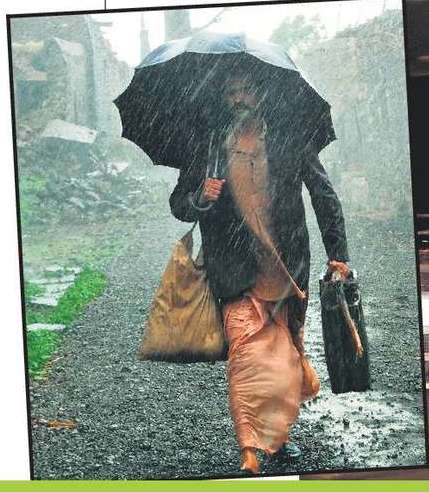
Actor Sohum Shah is “elated” that the 2018 folk horror drama Tumbbad is re-releasing in theatres on September 13. “I am really excited. Originally, yeh film kamaal nahin kar paayi thi theatres mein. Bahut logon ki shikayat thi ki humari film re-release kab hogi. Whenever I would put any post on social media, people would ask for a Tumbbad re-release in the comments section. I am glad it is finally happening. I might even surprise my fans by dropping by at the theatres unannounced,” he says.
Shah believes that Tumbbad “will finally get the audience it deserves”. The 42-year-old adds, “People realized the value of the film after it was released on OTT. Iss film ke saath na-insaafi hui thi. Yeh film aisi hai jise log theatres mein hi experience karna chaahte hain. This is not an OTT-type of film, given the kind of sound and VFX it has.”
The re-release trend brought several films back to the theatres, including Rehnaa Hai Terre Dil Mein (2001), Rockstar (2011) and Laila Majnu (2018).
Pointing out the value of a film releasing in theatres, Shah says, “The trend of re-releasing films has given a second chance to many films. Laila Majnu ko hi dekh lo... even Rockstar had a nostalgia value. I hope that my film also earns much more at the box office than it did with the original release.”
Analyzing the trend of re-releases: "Films are available for free online, but moviegoers want to see them on big screen"
8:21 AM
Niharika Lal (BOMBAY TIMES; August 31, 2024)
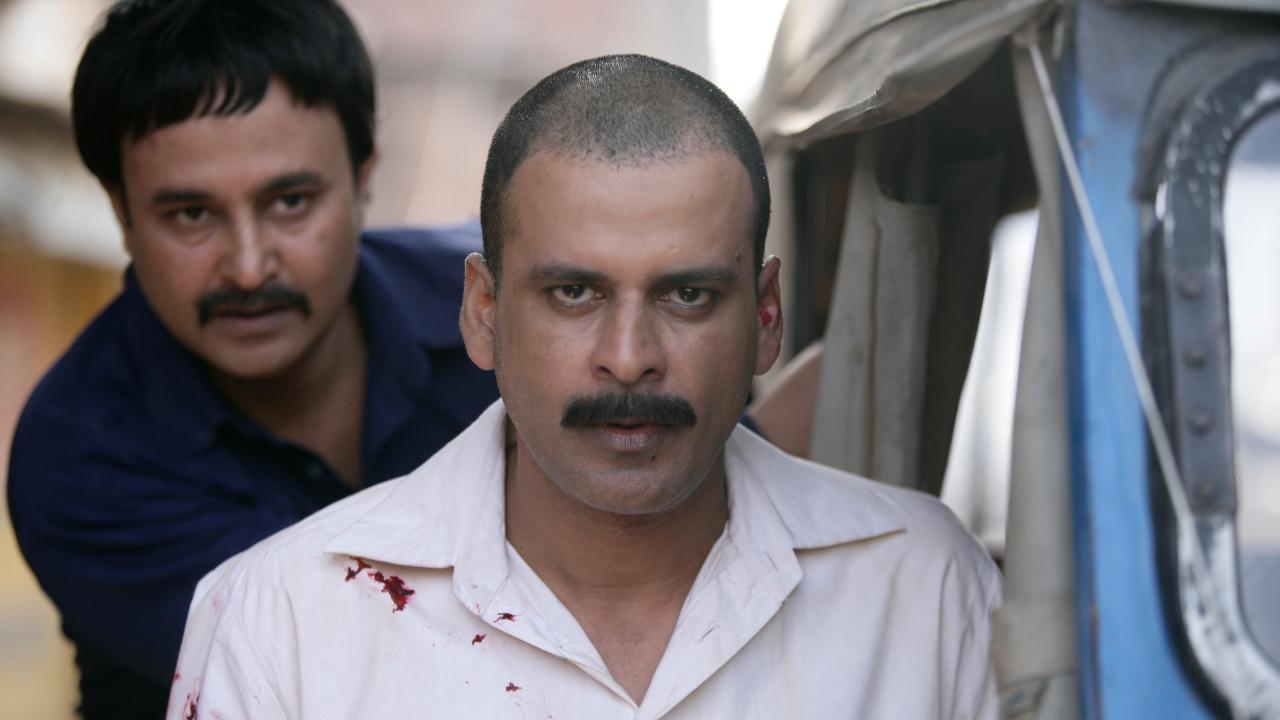
If the recent re-release announcements of Gangs Of Wasseypur and Rehnaa Hai Terre Dil Mein have you rushing to book tickets, you’re not alone. Cine buffs have been in for a treat with theatrical re-releases this year. Whether it’s to mark a film’s anniversary, generate buzz before a sequel, or simply revisit a cinematic hit, actors and filmmakers have been bringing their old films back to the big screen.
Films with a fan following being re-released
Ajay Bijli, MD of PVR INOX, says, “What’s interesting is that these films are available for free online, but moviegoers are still excited to see them on the big screen.”
Amit Sharma, MD, Miraj Cinema, adds, “September only has a couple of Hindi films scheduled for release. This is a major reason why cinemas are opting for re-releases of films with a strong fan following.”
‘The success of re-releases validates that people enjoy the theatrical experience’
Talking about re-releases, Yogesh Raizada, VP of Wave Cinemas, says, “Rereleases majorly work for two reasons – nostalgia for all things related to the 1990s, and a new audience that had only heard about these films but never had the chance to see them on the big screen.”
Kamal Gianchandani, president of MAI (Multiplex Association of India), adds, “The success of the re-releases validates how much people enjoy the theatrical experience. They are willing to come to cinemas despite these films being on TV and streaming platforms.”
A selection of Zoya Akhtar’s films were recently screened as part of her retrospective. Zoya Akhtar had said, “When we spoke about retrospective, there was one aspect of me which was like well, retrospective? Am I kind of done? And another part of me was jumping with joy that these films will be on the big screen again”
Imtiaz Ali’s Laila Majnu, which was first re-released in Srinagar, received an overwhelming response from the audience recently. “It gives us hope that people are coming to cinemas in huge numbers to watch old films,” the director said.
'A 3-4 week re-release calendar for Gangs Of Wasseypur'
Exhibitors say that the whole of September looks very empty and dull, with only a couple of Hindi films scheduled for release this month. This is a major reason why cinemas are opting for re-releases of films with a strong fan following.
Amit Sharma, MD Miraj Cinema says, "Whenever a film is re-released, it takes a little time to grow. People start learning about the film and its re-release. It's in the second and third week when the film starts picking up. So, we are planning a 3-4 week re-release calendar for Gangs of Wasseypur, which makes more sense."
'Playing of these older films in cinemas is a reflection of the fact that these films are doing well'
Kamal Gianchandani, president of MAI (Multiplex Association of India) says, "Some of these films can't even be classified as classics. There are several reasons for this - when these films were originally released, they were ahead of their time, or they simply didn't click with audiences. It's also a validation to how much people enjoy the theatrical experience that they are willing to come to cinemas to watch Rockstar or Jab We Met, despite these films being available on TV channels and streaming platforms. While there are various reasons why these re-releases work, the bottom line is that people are enjoying some of these older films, and it’s our job to bring them to all audiences. If people are enjoying older films in cinemas alongside new releases, then we are happy to offer them to our customers. Playing of these older films in cinemas is a reflection of the fact that these films are doing well."
The fact that Shah Rukh Khan is a humongous star is something I hadn’t made a provision for-Imtiaz Ali
8:19 AM
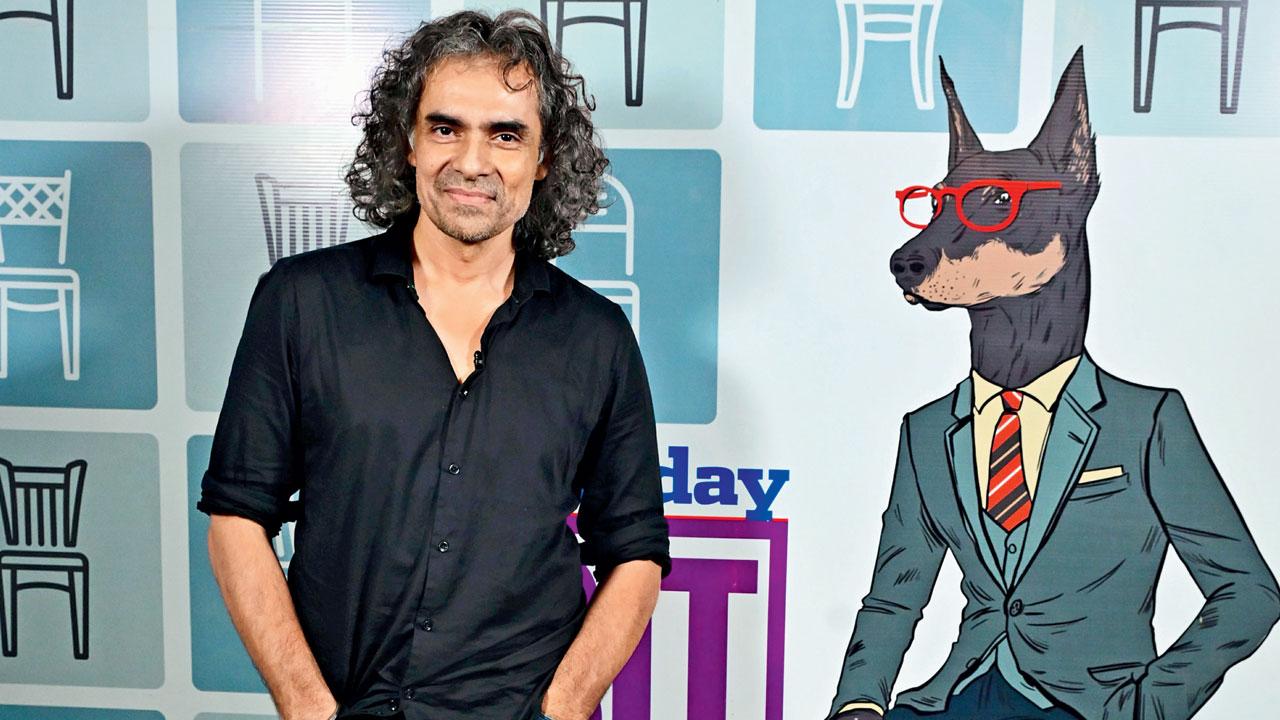
On Mid-day's Sit With Hitlist, Imtiaz Ali goes back in time to share anecdotes from his first film Socha Na Tha, right up to the latest, Amar Singh Chamkila
Mayank Shekhar (MID-DAY; August 17, 2024)
“Whatever you do, sir, just don’t fix the money [for your next film], before calling me,” actor Shahid Kapoor told director Imtiaz Ali, in 2007, when Jab We Met (JWM) had opened “lukewarm” in theatres.
It’s going to become a big film, Shahid suggested to Imtiaz, whispering to him then, “You could charge 2X of what you’re thinking [in lakhs], or you know what? It could even be a crore!”
Imtiaz was set to do Love Aaj Kal (2009). Negotiations were on. He waited it out, upon Shahid’s advice. He says, “It was Dinoo [producer Dinesh Vijan], who suffered! You ask him, he will never forget this. He is like, ‘Sir aapne jo number bola, [the number you quoted], my head hit the roof’. I said, blame Shahid!”
Shahid had recalled to us (on Sit with Hitlist), telling Imtiaz, not to carry a script with the name Geet (working title for JWM), given the heroine’s name on it, when shopping around for the hero!
But it’s actually Shahid, Imtiaz remembers now, who reminded him about the Jab We Met script, in the first place. He’d heard about it from others, while it was being passed around film industry folk.
Shahid had dates available. As did co-star Kareena Kapoor, who was going through the more important size-zero regimen for Tashan (2008), the supposed blockbuster in the making (that she explains in detail, in another episode of Sit with Hitlist).
Both said yes, and Imtiaz had literally a “window of 21 days” to get on shoot, while the screenplay wasn’t absolutely complete, dialogues had yet to be written, let alone pre-production, for locations to be locked, etc.
The script that Imtiaz had gone over to Shahid with is the same one that he met Ranbir Kapoor for, years later. That movie is still to be made—about time, we say! Ranbir took the said script with him to read, but asked Imtiaz about Rockstar (2011), instead.
It’s the story that, once upon a time—right after Imtiaz’s debut, Socha Na Tha (2005)—was to be made with UTV, starring John Abraham in the lead! Nothing came of that Rockstar.
Ranbir, in fact, narrated Imtiaz’s Rockstar story to Imtiaz himself. He’d heard it at a friend’s place, a few days from when they met: “Sir, let’s make that film,” he proposed.
Hearing Ranbir narrate the script, he knew that’s the actor to cast. This is post Ranbir’s debut, i.e. Sanjay Leela Bhansali’s Saawariya (2007), which Imtiaz hadn’t watched still. The reverse-narration was the clincher.
Now, there are wholly savable Word/Finaldraft documents, and the computer, of course. “Despite everything”, Imtiaz admits, he had lost that script.
He rewrote Rockstar, from memory, for Ranbir. “The common thing between Ranbir and [and his wife now] Alia Bhatt is that I met both at a screening,” Imtiaz recalls.
Alia did Highway (2014) with him. She was not the original choice. He had a maturer actor in mind for the role, someone perhaps in her 30s: “Aishwarya Rai, without the make-up, maybe. It was that kinda film.”
While his core crew wasn’t convinced about Alia in Highway, he got her over to the office, to narrate the film to everyone. Done with that, the unit was satisfied.
It’s a hack he’d learnt from Ranbir’s narration of Rockstar. He tried it on Alia. Two unrelated people, “who have a kid together now; how filmy,” Imtiaz laughs.
We remember Alia telling us (on Sit with Hitlist) about how she seduced Imtiaz into casting her in his film (any film)—when she set her eyes on the director, at the screening of Luv Shuv Tey Chicken Khurana (2012).
Which is not how Imtiaz remembers it: “She’s just sweet!”
He handed her a novella-like outline of Highway; called her up later to check on what she felt. He could tell she was petrified. Given that she’s in every scene of the film.
He went over to meet, where dad Mahesh Bhatt was convincing her to go for it: “He’s a nice director.” Alia had said it was simply her dream to work with Imtiaz.
In fact, this profile, heavily excerpted, is almost wholly around anecdotes that other guests on Sit with Hitlist, this conversation series, have narrated, on Imtiaz himself.
The entirely unedited, fun chat, on video, is uploaded online. The other person, who inevitably shows up in most conversations to do with Bombay film talents, who were similarly newbies in the ’90s, is Mahesh Bhatt, aka semi-godman Bhatt Saab!
Imtiaz says, “Bhatt Saab was the first person to offer me to direct a film. He was planning on retiring as a director. He had seen an episode of Imtihaan, a series I was doing for Star Plus. Manoj Bajpayee was in it. He called me up one day, and asked me to meet at his office.”
Imtiaz went over to Bhatt Saab’s workplace—far too packed with people, over a majlis, listening to warm sermons on life, films, the works. Imtiaz was intimated.
From across the floor, Bhatt Saab shouted out to Imtiaz, “I’ve seen the scenes you’ve shot; loved this, didn’t like that, blah blah, blah… You’re directing my next film. Now go, I don’t have time.”
Totally taken aback by what had happened, Imtiaz called Bhatt Saab back, from the pay-phone, downstairs, “‘Sir, I didn’t understand what you said.’ He laughed, and asked me to come back the next morning. That was a movie to do with two musicians. Bhatt Saab was going to write and produce it for Vishesh Films. I hope to make it someday.”
Imtiaz, as is widely known, was born and raised in Jamshedpur, then Bihar, now Jharkhand. You can see his Jamshedpur in Vikramditya Motwane’s Udaan (2010), which is not a happenstance.
As Vikramaditya had told us, he had got Imtiaz to read the script, who asked him to stay over with his family back in his hometown, to get a sense of the setting. It made sense for Udaan to be placed specifically in the steel township of Jamshedpur.
Imtiaz’s younger brother Sajid, a school kid then, used to show Vikramaditya around—who, in turn, felt Sajid would make for the perfect lead actor for Udaan.
The film remained stuck between producers, over years. By which time Sajid had grown up. He debuted as director with the romantic musical, Laila Majnu that, as we speak, six years later, has made a rerelease/comeback into theatres, vastly outpacing collections/footfalls, from when it first opened in 2018.
Vikramaditya and actor Abhay Deol were childhood buddies. Which is how Imtiaz and Vikramaditya met. Abhay, the young Deol in town, was looking to enter films, ideally with fresher ideas/talents.
Imtiaz, who had been working in television—after graduating in advertising, from Mumbai’s Xavier Institute of Communications—went over to Abhay’s place to narrate his script.
Abhay needed a close bouncing-board for a second-opinion. He called his friend Vikramaditya over. Likewise, Imtiaz says, he took his friend Anurag Kashyap along for the meeting.
Such is how Socha Na Tha (2005), both Imtiaz and Abhay’s debut film was born. Whether or not right there, and then, but certainly seeded in the same room.
Imtiaz’s career since has largely been marked by strong romantic films, but all the more associated with Punjab. For the Bombay film industry itself, Punjab, as the prime muse, is hardly a surprise.
Most top Bollywood stars and producers have had their ancestral roots in the land of five rivers. The nostalgia around which—sarson khet, bhangra, giddha, karva chauth—have inevitably showed up in their popular works.
Imtiaz, though, is from Bihar—having also spent seven years of growing up in Patna, where his father was posted. Not that he has an iota of a Bihari accent. Which, he says, is more because of Jamshedpur, which is an altogether cosmopolitan town.
He’s sure to switch into a Bihari twang, while responding to it. In the same way, he says, among Delhi-ites, can go full ‘Delhi’. That’s where he went, to Hindu College, to read English literature. He can similarly react to the Punjab accent.
How come Punjab, though? He wears a kada alright, that was gifted to him, when still in school, and he’d visited Punjab on a holiday then. But, that’s it.
“Punjab began with JWM,” he says. And has, of course, continued with his last film, Amar Singh Chamkila, the most deeply felt, insider’s account of the state, where both compassion and blood flow (always has).
Chamkila is also the most watched Indian film on Netflix.
Imtiaz had first set JWM in Rajasthan. But his feisty, female lead character, Geet, and her words, fitted in more with “Sikhani girls, who I had interacted with a lot in Delhi.”
The train of JWM, hence, moved to Punjab instead. Namely a small-town called Nabha. The locals thereafter guided him towards achieving authenticity. He’s since been drawn to “the land of grace, mysticism and love. All the great lovers in India have been from Punjab.”
Which isn’t to say he hasn’t subverted the setting enough, or gone with clichés of old-world Bollywood altogether. My favourite instance is him placing a Brazilian model, Giselli Monteiro, as a ‘kudi’ from the ancient Punjab pind, in Love Aaj Kal (2009)!
Imtiaz was looking to cast Giselli—visiting India on an assignment—as Saif Ali Khan’s Latin American girlfriend, in the London/modern portions of the pic. Looking at her, his co-producer, Preety Ali, suggested her for “Harleen Kaur [from Brazil] for Punjab!”
He had similarly picked Nargis Fakhri—half Czech, half Pakistani, fully American, from Jackson Heights, Queens, New York City, as a pucca Delhi-ite, from Kashmir, in Rockstar.
He spotted her in an ad, in a fashion magazine. Whether or not that casting convincingly worked out, Imtiaz reasons the idea behind it was to find a “dil todne ki machine [complete heartbreaker]—someone so out of the league, in terms of looks, face, body, even for Ranbir!”
In hindsight, he does feel he could’ve factored in the bit that she was American, into the script. Nargis’s casting was strongly criticised, if you recall, after the release of Rockstar.
Imtiaz defends himself with the same film’s successful rerun in theatres recently: “Nobody expressed a problem with it now.” Nargis’s character Heer is from St Stephen’s, which is the college across the road from Hindu, where Imtiaz went.
I reckon if it’s his most personal film, yet? Imtiaz agrees. More so, for its central question—about whether success, in general, let alone the arts, was possible, without experiencing sufficient turmoil in life.
It’s something Imtiaz had grappled with himself. He says, “During interviews for Chamkila, I realized, even Diljit [Dosanjh, his lead actor] had grappled with the same dilemma: ‘Koi tragedy nahin hai [No tragedy], how will I become a singer?’ And then he says, so nicely, ‘Koi baat nahin, continue karte hain [Never mind, let’s continue]!’”
The other theme that Imtiaz related to most deeply was “illogical attachment” with issues that, otherwise, we have no engagement with, but have empathy for—the fact of ‘Sadda Haq’!
“Even in my own movies, there are moments that move me, but I don’t know where they come from, in terms of a [direct] source. That said, the character, Jordan, is nothing like me. The thoughts are.”
At Hindu College, Imtiaz named and founded Ibtida, its dramatics society, that runs even today. During his time in Delhi, he belonged to what he calls the “Mandi House jhol”.
Meaning, the theatre scene in and around the National School of Drama (NSD), with independent groups, such as Act One, headed by N K Singh, that he was part of—along with the likes of Manoj Bajpayee, Piyush Mishra, Shoojit Sircar, Ashish Vidyarthi, Gajraj Rao, Prashant Narayanan, and the lot.
These are well-known names, and the list grows big enough to avoid recounting—for the number of creative talents, who moved to Bombay, around the same time, from Delhi, to work in the film industry.
Establishing a new filmic voice of sorts—Vishal Bhardwaj, also from Hindu; Tigmanshu Dhulia, from NSD; Kashyap, from Hansraj College; Saurabh Shukla, from next-door Khalsa (the latter two wrote Satya, 1988)…
Imtiaz, 53, says, “Somebody must do a study [on how that came to be]. We were all friends, or friends of friends; often crashing at each other’s homes. This was the generation that was both ‘Sholay’ and ‘Shyam Benegal’.”
Delhi’s Act One had a “sister-concern, with similar values”, Barry John’s Theatre Action Group (TAG), that shared talents, on occasion.
That’s from where emerged Shah Rukh Khan, who had dropped out of the mass communications programme at Jamia, after a successful stint on television in Delhi—establishing himself, soon enough, as the ‘King of Romance’ in Bollywood.
Imtiaz, as a director, broke out with the romantic genre as well. Surely, he would’ve thought of Shah Rukh for his star at some point?
“No, he was too big; never on the anvil. For that matter, even now, I can’t think of Amitabh Bachchan. He’s too big for me. Even Mr Bachchan doesn’t realise how big he is. I have seen people pull out theatre seats, because he’s appeared on the trailer for Geraftaar [1985]!”
Shah Rukh and Imtiaz did team up on a romance together—that’s Jab Harry Met Sejal (JHMS, 2017). It’s a film that, Imtiaz says, pretty much got triggered from a Facebook comment on Tamasha (2015).
Possibly his most polarizing picture—loved to death by many. While some got bored to death as well, questioning the realist basis of the male lead (Ranbir). Which is, to be honest, really their bad. If they didn’t get it, that is.
“Well, there is something snooty about the appreciation for Tamasha. It’s become the club that I never saw myself in. I used to think, I’m a sell-out. So, I just wanted to make an easy, accessible film [with JHMS],” Imtiaz says.
It was the biggest ticket film—genre, star, and director, perfectly in sync. But I don’t think he sees it that way. Again, in hindsight, criticisms or box-office apart, you wonder what he thinks he could’ve done differently with JHMS?
He says, “With theatre, television, and films, I’ve worked the same way. Written a story, and brought it together, through actors. Which is what I did with JHMS. The fact that Shah Rukh is a humongous star is something I hadn’t made a provision for. Because, in life, he’s such an easy and accessible person—he doesn’t give you that impression, either.”
“Of course, there are enough good things in the film, which get lost [when it’s not accepted]. But I could have brought in a flashback, a backstory, and Shah Rukh, as the star, could’ve been used to the best of his strengths.”
Going back to the Delhi crowd that made the ‘new Bollywood’ in the ’90s, as it were—where Imtiaz seems separate from the mainstream-indie, migrant directors, that emerged then, is foremost with music.
He remains among the few realistic, new-age filmmakers, indulging deeply with romance, song picturizations, lip-syncing, adapting soundtrack, as situations, into his scripts. That is, after all, an inherited art-form, syntax, and grammar—threatening to die with later talents.
All of it, he says, comes from growing up in Jamshedpur. If you’ve seen Cinema Paradiso (1988), that’s him—young boy sitting behind the projectionist, switching reels. His family owned Jamshedpur Talkies and Karim Talkies, two local theatres, that he had complete access to.
He says, “I’m inherently drawn to the ‘cinema-ness’ of cinema. The moving melodrama, that actually comes with music—to represent mood, feelings, turns [in the story], or time transition, through montage….
“And I found myself so lucky to be in the company of such crazy and kind musicians [Sandesh Shandilya, A R Rahman], who literally opened their doors for me [to work with them]. I find music composition to be the highest art form.”
In that respect, his strongest collaborator, in terms of writing, might well be the “shayar” Irshad Kamil, from Malerkotla (Punjab), whose lyric is essentially an extension of dialogues, in Imtiaz’s films—they’ve worked on each one together.
Imtiaz found Irshad, through Sandesh. They instantly bonded over the common love for poetry: “In this city [of Bombay], you crave that, and when you find a person like that, you catch that person!”
Speaking of getting caught, the most hilarious anecdote I’d heard about Imtiaz and Irshad was actually about how they were once caught by the police together.
This is on Versova beach, past midnight. Him, Sandesh and Irshad, lost to the world, discussing music (for Socha Na Tha).
“Those days, if we had to meet at night, it had to be outside. Homes were small. People would be sleeping inside.” In comes a cop, wondering what these guys were up to on the desolate beach.
“It was 2 am, but it’s not like we were up to anything nefarious… Irshad said we were making music.” Which is probably the lamest explanation/excuse the beat-cop would’ve heard in his life, over three men, allegedly gallivanting.
Next thing they know, they’ve been put inside a police van. Further, into the police station. They were right in the middle of having arrived at a track, though.
Each time they regrouped, whether in the van, or the police station, they simply carried on with cracking the idea: “Well, we knew, if we get the song right, none of this will matter!”
There is a charming stoicism about Imtiaz. You can sense it in his company. He’s also an engaged conversationalist, never repeating stuff you’ve heard him say before. Totally in the moment; mulling, responding, detaching, yet fully interested.
It’s probably the same way he handles personal fame. I know this from independent sources. As in, friends, who’ve bumped into him at local bars/restaurants in the past. Imtiaz being among the few directors, who’s so public a face.
As he puts it, in another context, quoting Buddha, “Eyes half open, half closed. Half with yourself, half with the world. It’s such day-dreamers, who drift into the film industry. Instead of the other way around. It’s a boon to make a living out of dreaming.”
Even while he was looking to make films, and surely, it’s a struggle for everyone, he says, he was fine, the way he was. “You never really make it, anyway. Manisha Koirala told me once that when she was in Bombay, auditioning for films, that was her life.
“If nothing ever happened, she was still satisfied. Only if she felt dissatisfied [for any other reason], she would have returned, done something else.”
That said, certainly the rigours of film as an industry can get to most—hits, flops, etc. Consider the unusually cold streak that Imtiaz had, JHMS onwards—in particular, Love Aaj Kal (2020), or even stuff helmed as producer, Thai Massage (2022), series such as She (2020), Dr Arora (2022).
Whatever one’s personal opinions on those works, and those are subjective, anyway—they didn’t turn out to be pop-culture moments, or at least haven’t, yet.
And that Chamkila (2024) was, effectively, the comeback, as it were? Does he ever feel that he’s on a rough patch? He says, “Always! Because you’re always engaged, with a certain [new/next] challenge. I’m only worried about that, at any point in time.”
Going by the theme of picking moments from Sit with Hitlist, when guests have brought him up, there is a not-so-positive one, if you may.
“Bring it on, I love negative stuff,” Imtiaz smiles. That’s when his lead actor Sara Ali Khan mentioned to us that she hated herself, in the new Love Aaj Kal! Or, at least, something to the effect.
On the film itself, he says, “You know, my English teacher, Swaroopa Mukherjee told me, when she saw Love Aaj Kal, that it remined her of her English classes.
“She said, ‘There is this strange thing that when you explain things to young people, and ask—have you understood? They say, ‘Yes miss, I’ve understood. But, actually, they haven’t.
They never say—no, I haven’t understood. There was something very sensitive in there, and the youngsters in the film, perhaps, didn’t get what you were trying to say’.”
He adds, “I’m not blaming Sara. The point is that direction is a process of working with an actor. The actor, who has surrendered, is not obliged to understand. They have said the words/lines. I couldn’t get through to the actors, to own the material [in Love Aaj Kal].”
Going beyond stars, it’s my turn now to pose to Imtiaz something that has annoyed people, at large. And that’s do with fans of JWM!
When asked during a recent interview about what he thought might happen to the it-couple, Geet and Aditya, if the film had a sequel? He said, they would be at the divorce-lawyer’s office!
Only fair that I pass on the outrage. Imtiaz laughs, “That interview was before a live audience. I just thought it was a smart thing to say!”
Nope, not letting go that easy. “Well, films have to be dramatic. So—what if, they’re at a divorce-lawyer’s office? That’s the question. Now, if that’s the beginning of the film—the end will be happy, right? You start at a crisis, and come to a solution!” Well saved.
Final question, and this has to do with an old print interview of Imtiaz’s, that’s remained in my head since. Chiefly because there was no follow-up to his answer, and I kept wondering exactly what he meant, when he once said, “Married men are the most ch***** version of themselves!”
Mercifully, he remembers that decade-old interview. He smiles, “There was a context to it. Some of which I’ve forgotten now. All that remained was the headline!”
Go on? “Well, marriage in itself is nothing. Relationship and vibes are important. Anyway, I don’t believe in bracketing relationships. The problem is when people start playing ‘married’. The same thing applies to the wife.
“And then you dumb yourself down, playing ‘rules of the game’. Rather than respect each other, for who you are. That’s when you become a bad version of yourself.”
Okay, explain with an example? “That husband and wife are supposed to do things together. Why? Let’s say, I wanna go on a solo-trip to Jhumritalaiya, or read a book. And she wants to go to Switzerland, or watch a movie.
“You would, if you were friends; so why not? But you’re married people. So, what? And then resentment sets in. You start keeping secrets from the one person, you’ve actually sworn never to keep secrets from.”
Aptly, we’ve ended with precious gyan on love, from Imtiaz. Outside of films, of course. “Disclaimer: Please don’t follow anything I say. I know nothing,” he signs off.
Percentage of people liking Rockstar is higher today-Imtiaz Ali
9:44 AM
Rishabh Suri (HINDUSTAN TIMES; June 13, 2024)
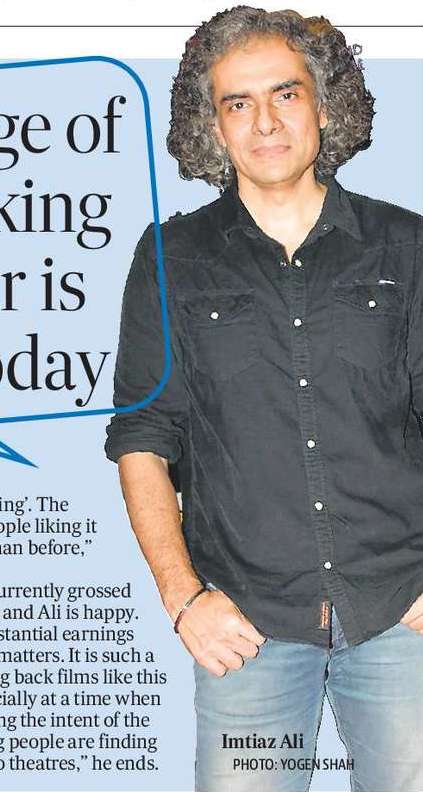
Imtiaz Ali is pleasantly surprised by the enthusiastic response to his 2011 film Rockstar, which has recently seen a resurgence in theatres 13 years after its original release. Despite being easily available online, the Ranbir Kapoor and Nargis Fakhri-starrer is drawing impressive crowds. “This response reinforces the idea of dreaming. I have seen Rockstar twice since its theatrical re-release,” exclaims the 52-year-old, who further reveals that he never got to see the film properly in a theatre in 2011.
Over the years, the movie has gained cult status among cine-lovers. However, at the time of its original release, the response was polarized. “It was the first time in my career that I received a split response. Some didn’t see the point; some said it was completely crazy. Some loved it. I remember the love; I thought these guys were ‘fidaa-ing’. The percentage of people liking it today is higher than before,” he says.
The film has currently grossed close to Rs. 3 crore, and Ali is happy. “It has made substantial earnings this time, which matters. It is such a great idea to bring back films like this to theatres, especially at a time when we are questioning the intent of the crowd and saying people are finding it difficult to go to theatres,” he ends.
BT Exclusive: Nargis Fakhri admits being in a relationship: "Yes, I have someone and I am happy
3:57 PM

Vinay MR Mishra (BOMBAY TIMES; December 19, 2023)
Twelve years ago, Nargis Fakhri made her Hindi movie debut with Imtiaz Ali’s Rockstar and witnessed overnight fame. But dealing with it wasn’t easy. She says, “I was overwhelmed by it. Imagine waking up one day and you are famous, you are just in a state of confusion.” A dozen years later, the actress, who is self-admittedly sensitive, has found a way to maintain a healthy relationship with the industry.
‘It was difficult to navigate my way in the Hindi film industry’
Talking about why she found it challenging to deal with the situation after the release of her debut films, she explains, “It was difficult to navigate my way in the Hindi film industry given my sensitivity. It was something people could not understand. Also, fame took me by surprise. From no one knowing you to everyone knowing you – people being intrusive didn’t make sense. Also, people rushing towards you to click pictures… all of this became overwhelming. You become anxious and insecure. Now, I am completely okay, because I have changed my perspective. I was fearful of everybody, even of those who loved me. I couldn’t believe that they loved me. Now I am just grateful.”
The actress, who recently made her digital debut with Tatlubaaz felt misunderstood at the early stage of her career. “I felt misunderstood because I didn’t do what everyone else did. I always followed my own path. People thought it was weird,” Nargis shares.
‘I wish I had a better support system’
Ask her, given another chance, how differently would she do things, and the Housefull 3 actress says, “I was never prepared for this (acting career). I wish I had a better support system to show me the way and make me understand how this is supposed to work. I was a carefree person; I accidently landed in India and had no plans to be an actor. Every year, I would say I am leaving, but I would stay back because I enjoyed acting. I wish there was somebody to guide and teach me.”
‘Good love is the one that’s stable’
On the personal front, Nargis is seeing Kashmir-born, LA-based businessman Tony Beig. Nargis who has never opened up about her relationship says, “I don’t want to go into the details, but yes, I have someone in my life. I am very happy,” she says.
She adds, “I am a very lucky person that I am loved by many. I am a partner person, so I love to do things with people I care about. And it doesn’t have to be just in a relationship. No, I am not an obsessed girlfriend. Everybody who is with me loves my company so much that they miss me when I am not around."
Ask her when would she make things official with Tony and she replies, “What is official (today)? Even married ones aren’t official. When you say you are in love, all the chemicals go in the wrong direction, but you are not functioning properly. That is the wrong (idea of) love. Good love is the stable; it is the one that makes you normal and home.”
Are you seeing Tony? “I am seeing him with my eyes?” she replies. Are you dating Tony, she again replies, “There are many dates in the calendar. In the future, we will send you a note (laughs).”
People still come to me and say they left their job after watching Tamasha-Imtiaz Ali
7:59 AM

Niharika Lal (BOMBAY TIMES; December 6, 2023)
On Sunday, Imtiaz Ali’s session at Kathakar – International Storytellers Festival continued for over three hours at Sunder Nursery, turning into a partial concert as his fans sang, danced, took photos, and passed letters to Imtiaz. Mohit Chauhan and Imtiaz also joined the audience as they broke into song.
Towards the end of the evening, around midnight, it was Imtiaz’s turn to narrate a story.
With a disclaimer, “It is part fact and part fiction,” Imtiaz shared a story of love, loss, and redemption, triggering many awws, sighs, and tears. However, he asked the audience not to record any audio or video because “some things should just be between us.”
“Tough times are always a part of life, drama, and every personality. If you want to tell a real story, you can’t avoid showing tough situations. However, I want to show life, and in the life I have seen, there are mental traumas and difficult phases. I feel that these issues should be spoken about more.“
Highway’s origin story
Discussing Highway (2014), Imtiaz said that this story idea was even older than Socha Na Tha (2005, Imtiaz’s directorial debut). Imtiaz shared that when he was in college and travelling from Jamshedpur to Delhi, they crossed Chambal. He was sitting near the train door with a female friend and when the TT asked him to shut the door and he refused.
The TT told him, “Ye Chambal ghaati ka ilaka hai, aur gaadi ruk-ruk ke chal rahi hai. Agar iss ladki ko kisi dacoit ne kheech liya, aap zindagi bhar khud ko maaf kar paoge?” Imtiaz told the audience, “It made me realize how narrow our experiences are. And from here came the idea – what if a girl is taken away from her life, will she want to come back?”
Imtiaz said, “Highway was a film with dacoits, but I didn’t want it to be A-rated because I really wanted young boys and girls to watch it. Usmein characters bahut aggressively bolte hain, lekin woh gaali nahi dete hain. And Randeep’s (Hooda) acting! Gaali ke bagair woh aggression lana zyada mushkil hota hai.”
Talking about Highway’s soundtrack, Imtiaz shared, “Highway was supposed to have only one song, that one lullaby, and I was not approaching Rahman sir because I thought how can I approach a music director for one song. But he said if you want me to do it, then I will do it. Finally, Highway had more songs than Rockstar; it had 13 songs. There were a lot of situations that were silent where we used songs later. There were no (separate) song sequences.”
‘People still come to me and say they left their job after watching Tamasha’
Imtiaz said that even after so many years of Tamasha (2015), people still come to him and say that they left their job after watching the film. Recalling a particular incident at a Mumbai cinema when he went to see the audience response to Tamasha, he said, “A woman came to me and said, ‘You should have made this film earlier. Ab toh bahut der ho gayi hai.’ The entire reaction to Tamasha can be ascertained from this one line. At some point, people should make a decision that can change the ending of their story.”
"A lot of people come to me and say, ‘Aapki film dekh kar maine naukri chhor di.’ Whenever someone says this, I feel that they should do well in their profession. It should not be like they come looking for me and say, ‘Iss aadmi ki wajah se maine naukri chhor di,’" he joked.
He added, “More power to those people who have taken the decision to change their life. Your life is in your hands, and there is no other way that it works other than how you make it work. From the bottom of my heart, I wish and pray for the best for such people.”
From Socha Na Tha to Love Aaj Kal, Rockstar and Tamasha - Imtiaz's film songs are as popular as his characters. Imtiaz shared that he is not a fan of how songs suddenly appear in films, as if the story has to wait for the song to get over, and he tries to avoid that in his films. “I used to find it very silly when a song breaks in, and suddenly, all laws of physics are sidelined. Suddenly, music appears from somewhere, and people who are not able to talk properly suddenly become great singers. I'm the kind of audience that would make fun of it. I want to have songs in my films, and I have struggled a lot with this in my films, figuring out how to include songs so that it is not jarring."
---------------------------------------
I would hate to be a safe film director. When I made Highway it was a huge risk, but it did do well. When I made Jab Harry Met Sejal, I was also coming out of Tamasha. Overall, the film didn’t do well, I would have liked the film to do better, it could’ve been made better
---------------------------------------
I don’t think any of my movies are really autobiographical. I try not to get into my movies. Because then it will be narrow and I will get confused. However, I have realized that there are certain reflections that have come from my life experiences, the people I have met in my life are reflected in my films
Films should have rich classical music, why dumb things down?-A R Rahman
8:29 AM

Niharika Lal (BOMBAY TIMES; December 4, 2023)
Wrapped in their jackets and shawls, Delhiites turned up to hear AR Rahman talk about storytelling, films and music at the Kathakar festival in Sunder Nursery on Friday evening. Rahman received so much love from the Delhi audience that they didn’t want to let him go, with Rahman saying, “I love you guys so much. I will come back again.” Rahman shared some insightful and straightforward comments on the music scenario in India.
‘WHY DO YOU WANT TO DUMB IT DOWN FOR THE AUDIENCE?’
Rahman shared that these days, filmmakers often want to oversimplify things. In reference to Gulzar’s comment that Rahman and Mani Ratnam didn’t interfere with excessive Urdu usage in songs in Dil Se.., he said, “That’s how it should be. It happens a lot these days – you dumb things down. ‘No, no, people are not going to understand that. Make it simple. Don’t do this and don’t do that.’ A poet or lyricist has a responsibility to the audience. Why do you want to dumb it down? Okay, you can dumb down one song, but not all songs. I feel like film music should have rich classical music – thumris, khayals. If you want one item song, it’s fine, do it. But for the rest of the stuff, let it live and breathe. Why can’t you figure out a way that the screenplay doesn’t make it boring? That’s the question I keep asking people.”
‘HATRED COMES WHEN ONE FAILS TO UNDERSTAND THE HUMANITY BEHIND ANY CULTURE’
Speaking about the films he wrote and directed, such as Le Musk and 99 Songs, Rahman said, “I’m slowly getting into storytelling. If people don’t have their own narratives, their narratives are just taken over. It is important to tell beautiful stories so that people can understand each other and different cultures. Hatred comes when you don’t understand the humanity behind any culture.”
When the host of the evening Mohit Chauhan asked Rahman how he identifies himself with music, Rahman responded, “That’s the question I’m asking myself. I’m still discovering myself. Long ago, my agent asked me, ‘How do I pitch you to people? You’re like a supermarket – you’re doing classical, Indian folk, film songs.’ But I love all kinds of music. I respect all cultures and people, and I never make fun of anything. I go deeper, and I find the truth in it.”
Recently, Rahman’s rendition of a poem by Bengali poet Kazi Nazrul Islam for the film Pippa was in the news after the poet’s family said that the new version distorted the original tune and rhythm. Without mentioning the song, Rahman said at the event, “Sometimes I get it, and sometimes I get caught in embarrassing situations, like the one last month. There are no bad intentions; there is no disrespect to anyone.”
‘YOU CAN’T MISS NIZAMUDDIN DARGAH IN DELHI’
“In Delhi, you can’t miss Nizamuddin sahab Dargah. For the song Kun Faya Kun (from Rockstar), Imtiaz Ali ji called me and asked ‘Can you add the word Nizamuddin in it?’ And I was like of course! It was not there initially; it was not meant to be there. It’s beyond religion and beyond everything. The President of Berklee (College of Music) told me, ‘One song of yours that I love is Kun Faya Kun.’ I don’t know what he understood about that song. Inherently, there is something in it.”
If Jab We Met was made today, Geet would just go off social media-Imtiaz Ali
8:39 AM

Sundas Jawed (BOMBAY TIMES; August 31, 2023)
Filmmaker, producer, screenwriter Imtiaz Ali was spotted in Kolkata recently with his daughter Ida and took to social media to share pictures of some of their food adventures. In between eating his heart out at pretty cafes and street food joints, the Jab We Met, Rockstar and Tamasha director spoke to us about his definition of love in IG times, the romance of train journeys and more. Read on to know more...
On why Kolkata is his favourite city in India..
I am from Jamshedpur; Calcutta was the first city I came to and still remains my favourite city in the country. I have been in the lanes of Kolkata several times and every time I try to discover at least one or two new places. This time it is a café in Hindustan park which is a beautiful, aesthetic place.
On Kolkata's unique architecture
What I have been seeing from the last few years, the Hindustan Park area is developing nicely in the way it has retained the cultural richness of the architecture. Kolkata is unique in the way it is home to the highest number of skilled artisans for flower decorations, weaving, painting, pandal making and various life arts. Besides some of the best looking buildings, it also has the best food in the country and I try to get here as often as I can.
If Jab We Met was made today..
Jab We met was very edgy in terms of how it was placed with missing trains, runaway bride and a boy and girl sharing a room. At that point of time, it was different, now it wouldn’t be. If the movie is made again, there would be only superficial changes in the story. One thing that would play a big role is social media, So if Geet of present day elopes and goes into hiding, she will be off social media or wouldn’t use her own name on her profile.
On the magic of travel and long-distance trains..
I love travelling and more than seeing beautiful places I have enjoyed the fact that I felt very different every time I went out of my home space. My travel out of Jamshedpur was mostly on train to Kolkata or some other place, but it was a very dreamy kind of world for me where not only was I thinking of different things that I wouldn’t be thinking of in my regular life, but I was also anonymous. So I could give any name any story to myself. Travel and storytelling to me are intrinsically related.
The role of music in his life and movies ..
Of all the things I do as a director, I enjoy shooting with music on set the most. The music directors that I have worked with have been true artistes and they have also been very gracious and generous in allowing me to come into the process of their music making. I owe a great deal to them for the fact that they have provided so much strength to my narrative, especially A R Rahman because he has taken the story forward to another zone with the music that he has provided for Rockstar, Tamasha and Highway.
On his favourite films..
There are parts of movies that I like but I am not my own fan. At one point we have been so engaged with these movies/songs that it doesn’t work for me in terms of entertainment anymore.
Imtiaz's favourite food stops
- Biryani from a renowned Mughlai restaurant in central Kolkata
- Tarun Niketan’s eating house for Bengali cuisine
- Iconic Park Street eatery for cakes: "Ida has been to Kolkata quite a few times and sometimes her birthday cake is ordered from the same Park Street confectionery. Both of us love it."
- Tangra for Chinese
----------------------------------------------
You get the best food in Kolkata at unnamed places and shops. A simple puri bhaji and chai or malai toast, absolutely inexpensive, are a few to name.
Nargis Fakhri didn’t know ‘dorky’ Ranbir Kapoor or ‘strange’ Imtiaz Ali before Rockstar
8:50 AM

HINDUSTAN TIMES (July 29, 2023)
Nargis Fakhri shot to fame with her performance in the Imtiaz Ali directorial Rockstar (2011). However, the actor revealed recently that she “hadn’t heard of” neither Ali nor the lead, Ranbir Kapoor, before starting the shoot.
In an interview with Mashable Middle East, Fakhri recalled how she came to be cast in the movie. She was spotted by the director in a jewellery campaign that was on billboards in India without her knowledge. She was contacted by a member of Ali’s team, who insisted that she meet the director on his trip to Prague.
“I was like, ‘Oh, what the hell, let me go meet this person. If he’s weird I’ll kick him in the b**ls and run’,” she said, adding, “[I go and see] this strange man with big curly hair… Good person, very nice, felt safe [and] told me the most beautiful story I’ve ever heard in my life. He said, ‘If you come to India, we can teach you the language’. I said ‘I don’t know’, because that’s a huge thing to do. After a couple of weeks, they asked again, and I said I’ll just go and try.” shares the Pakistani-Czech former model.
Recalling her experience with “dorky guy” Kapoor, Fakhri said, “Working with Ranbir was a blessing, in hindsight. I didn’t know who he was. But he’s very cool, and it was so much fun. I wasn’t nervous, because I didn’t know who they (many of the cast members) were, and when you don’t know, you don’t even care.”
I can’t tell you how many producers and actors rejected Jab We Met-Imtiaz Ali
8:19 AM
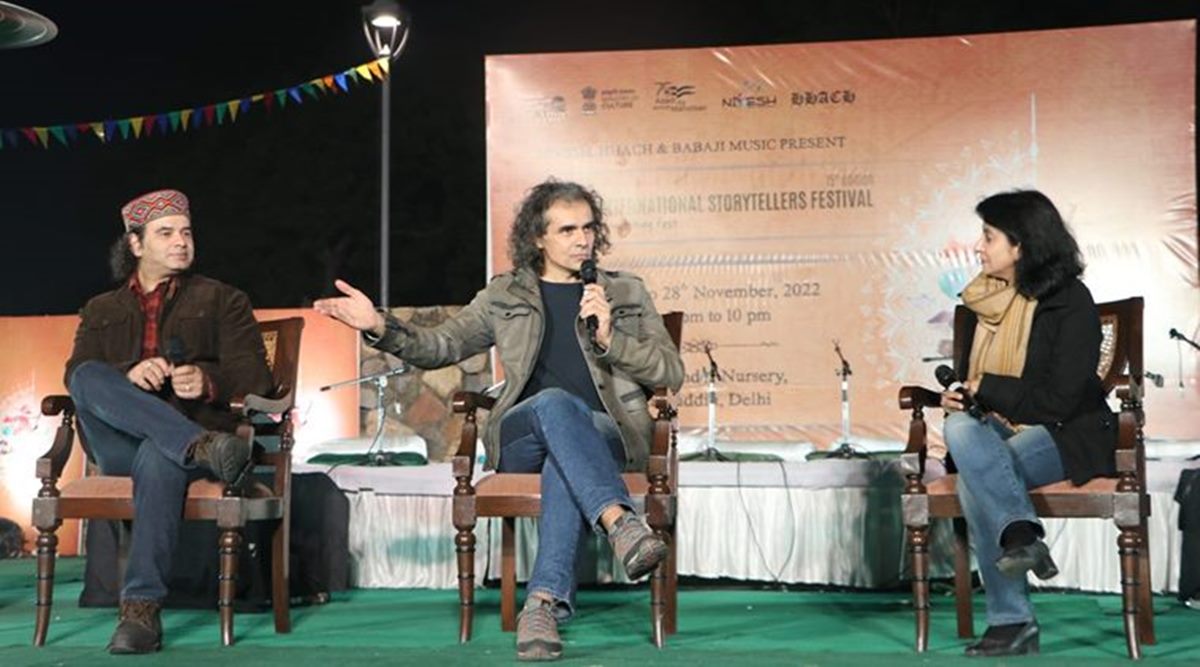
Riya Sharma (DELHI TIMES; December 2, 2022)
On a chilly winter Sunday night at Sunder Nursery, Imtiaz Ali turned into a storyteller for Delhiites at Kathakar International Storytelling Festival. For his fans, it was probably the ideal way to spend their Sunday evening, who came with the filmmaker’s portraits and CDs and posters of his films. In a conversation with Mohit Chauhan, Imtiaz highlighted his Delhi days, what made him miss the FIFA World Cup and why making music for Rockstar felt like a workshop.
‘DELHI GIRLS ARE VERY TALKATIVE, THEY TALK IN A CERTAIN STYLE’
Imtiaz has several stories to share when it comes to his days in Delhi. The moderator started with the disclaimer that there are stories we can talk about, and there are stories we cannot talk about. To which Imtiaz replied, “The story that I am thinking of, it’s a story with multiple characters.”
He added, “I had come to Delhi from Jamshedpur; I used to be a part of a theatre group called Act One while I was staying at the Hindu College’s hostel. We used to catch trains from Delhi to go to Jamshedpur. My friends would insist on going along with me because the best-looking girl would always be in my compartment. Buses mein bhi aisa hota tha. I used to find Delhi girls very talkative, they used to talk incessantly. They would go like, ‘Pata hai main ja rahi thi…’ there was a certain rhythm, unki personal baatein, relationship talks, yeh saari cheezein mere dimag mein thi. All stories of my life are incomplete in some ways, and I think it’s a good thing because they can complete themselves in my film.”
Imtiaz said that this story about these girls that he had met completed itself in Jab We Met. “That’s the same girl, and I have met her several times in several places but always in Delhi,” he added.
‘JAB WE MET WAS REJECTED THE MOST’
Imtiaz Ali said one of his most loved films, Jab We Met, was rejected the most. “But anything that is rejected is not necessarily bad. It is just not suited for that person, at that time. Everything that I have done, especially the ones that are successful, jo zyada chali hain, wahi zyada reject bhi hui hain. I can’t tell you how many producers and actors rejected it. Not because it was wrong, but it was not suited to them at that time. And this is what I want to say to young people – rejection is not a judgement of the quality of your work at all. You have to take rejections as a medal. If something is accepted easily, usually there is something wrong with it. So be afraid of things that are easily accepted; it means you have not found your depth in it,” said the filmmaker.
‘OVERWHELMED BY THE NUMBER OF PEOPLE WHO KEEP TELLING ME THEIR STORIES, WHICH ARE RELATED TO TAMASHA’
Imtiaz Ali’s Tamasha recently completed seven years. And when the moderator notified the audience about it, they broke into a loud cheer. “The people who cheered like that, the movie belongs to them,” said Imtiaz, adding, “I have constantly been overwhelmed by the number of people who keep coming to me over the years and telling me their stories, which is related to Tamasha, and how they took the decision to change the flow of their lives and follow the journey of their hearts. I feel guilty when someone tells me that they left their job because of my film. So many people have been positively motivated by the film’s story.”
WORKING ON ROCKSTAR WAS LIKE ATTENDING A WORKSHOP: MOHIT CHAUHAN
When Imtiaz asked Mohit about his connection with the hills, he said, “Main pahadon mein hi raha hoon, sab padhai karke main Delhi aaya. Ek abhi bhi jo sukoon hai, woh wahin milta hai. . . It is conducive to your art. If you sit close to nature, it gives you inspiration.”
Talking further about how the music for Rockstar was created, Mohit shared, “Rockstar was like a workshop....” Imtiaz added, “...Na tune thi, na lyrics thay, kuch bhi nahi tha. Sab kuch saath mein tha.”
“Kuch gaane jab Imtiaz ne mujhe bheje, like Jo Bhi Main was a 10-minute song with no lyrics, bas jam ho raha hai. Jab maine pehli baar suna toh main ghabra gaya. Maine socha dekh lenge, ek week baad inhone ek aur gaana bhej diya, aur woh bhi aisa tha toh main ghabra gaya. Par woh gaane rough diamond thay, jisse dheere-dheere tarasha jaane lage. Irshad (Kamil) sahab words saamne saamne likh rahe thay, it was an experience. It was amazing,” added Mohit.
WAS SUPPOSED TO WATCH A WORLD CUP MATCH IN QATAR BUT CHOSE TO COME TO DELHI INSTEAD: IMTIAZ ALI
Imtiaz, a regular speaker at the Kathakar International Storytelling Festival, shared, “It is true that the energy of this place is blessed in many ways. If you look around, you will find grand historical monuments and spirituality in proximity. Hazrat Nizamuddin Auliya is next door; Gurdwara Damdama Sahib is there. I feel in some ways, this is a very auspicious place. I was supposed to be at the Qatar World Cup and watching a match, and I was going to be taken there free of cost and somebody was organising the ticket as well. Unhone kaha aap kaun si team follow karte ho? I said I follow Brazil and this time I think we will win. I wanted to see a Brazil match but then there was also this, so I thought woh pata nahi, yeh dekh lete hain pehle. That was not the only reason, but I’m happy to be here instead.”
People could not see my hard work-Nargis Fakhri
7:58 AM

Nargis Fakhri shares how tough things were for her when she started out in showbiz
Rishabh Suri (HINDUSTAN TIMES; June 29, 2022)
After marking her Hindi film debut with Rockstar in 2011, Nargis Fakhri has only done over a dozen films till now. “My team is very picky about what I should be doing,” says the actor, adding, “Not being from the industry, I obviously have to take advice from people who are from the industry. Something like Madras Cafe (2013) came after Rockstar. Even though there was a break [of two years] between the two, I got recognized for good acting. I’m happy about the choices I made.”
Being an American, the actor had a tough time honing her Hindi-speaking skills. “People could not see it (her hard work). I didn’t see my family for two or three years. I studied Hindi for almost 10 hours in a small office. It was hard work, but also good luck at the same time, because my team was really good. They worked on getting the right projects for me,” shares Fakhri, who will be seen next in the Telugu period drama Hari Hara Veera Mallu.
Ask the 42-year-old if the slower than usual pace with her film outings was because she had fewer connections in the industry, and she shares, “I just lived life carefree, open to opportunities. I did modelling, and when I came to the film industry, I had really put in a lot of hard work.”
When Ranbir Kapoor began telling me the story of Rockstar, I saw Jordan in him-Imtiaz Ali
8:11 AM

Titas Chowdhury (HINDUSTAN TIMES; November 11, 2021)
Imtiaz Ali’s directorial Rockstar was released a decade ago, today. Over the years, it achieved cult status with the film being discussed by movie connoisseurs and ardent fans across platforms and clubs.
Talking about it, the filmmaker says, “I think that a film belongs to its viewers more than its makers. I know there are people who own the movie much more than I do.”
While Jordan, the character played by Ranbir Kapoor, left an indelible impression in everyone’s mind, Ali reveals that he was not his first choice. “I began trying to make Rockstar even before Ranbir became an actor. So, I was thinking of other actors to play this part. When I met Ranbir, he strangely knew the story of Rockstar. When he began telling me the story, I saw Jordan in him,” he shares.
The music album of the film, including songs like Phir Se Udd Chala, Katiya Karoon and Kun Faaya Kun, among many others, composed by A R Rahman continue to remain a rage.
Recalling the moment when Rahman came up with the first scratch of the movie’s music track, Ali shares, “It was the scratch of Phir Se Udd Chala. At that point, I didn’t think whether it’s a good song or people will remember it after so many years. All I knew was I felt something, almost like an experience. And that experience lasted throughout the making of the film.”

Even though Kizzie Basu is very far from a female action lead, Ahmed Khan felt he saw something-Sanjana Sanghi
7:46 AM

Rishabh Suri (HINDUSTAN TIMES; March 20, 2021)
Actor Sanjana Sanghi’s Bollywood journey as a lead actor kicked off in 2020 with Dil Bechara, which ranked among the most-watched films on OTT. And now, she’s already shooting for her second, Om, an action thriller, alongside Aditya Roy Kapur.
She feels it’s been ‘wonderful’ so far. “Since Rockstar (2011) when I was a child actor, we are audition actors. Be it just an ad or a small part in a film, you would get an audition call. You would then try and give your best in that room. When it wouldn’t work out, you won’t get a call back. Coming from there, to people seeing my work in Dil Bechara…the filmmaker I dreamt of collaborating with, saying they desire to work with me has been amazing. It’s been special,” says the 24-year-old.
Making the right choices, she adds, is tough. Which is why she was careful about which project she took up as her second film. It was Om’s director Ahmed Khan who called her up after watching Dil Bechara. “I found the journey of this one very exciting, because you are in a place where you are able to choose the genre. What was really at the back of my mind is that it has to be different from my first film, and it will really push me as an actor. The fans who are generous with their love, it was great for them too. I was kind of taking my time to lock in my second film. I got a call from Ahmed sir, who told me he’s making this massive action thriller with Adi. He said even though Kizzie Basu is very far from a female action lead, he felt he saw something,” Sanghi says with a laugh.
After she came on board the film, the team started shooting right amid the Coronavirus pandemic, in October 2020. And Sanghi admits that she did feel ‘really scared’ while shooting. “It (the pandemic) was peaking at that time, but what we realised two months down into filming, is that once the bubble got created and we got used to precautions, they became a part of our day. As actors, you are the only ones not wearing masks, so that paranoia sticks. After a couple of days, you tend to forget that, you just feel lucky that even in the midst of everything you are able to work and get such a huge film going,” she adds.
To me, Ranbir Kapoor defines what an artiste is-Sanjana Sanghi
8:25 AM

Rachana Dubey (BOMBAY TIMES; January 8, 2021)
Sanjana Sanghi might just be one-film-old as a leading lady, but she has been dabbling in acting since her teenage years in school. As a child artiste, she played Nargis Fakhri’s sister Mandy in Rockstar (2011) and was also seen as the younger version of Mita in Hindi Medium (2017). The actress, who made her debut as a leading lady opposite Sushant Singh Rajput in Dil Bechara, is currently filming her second outing with Aditya Roy Kapur.
In a recent chat with BT, Sanjana spoke about people whose artistry inspires her the most. She says, “I am an interview junkie. I love watching interviews and thinking about how and why someone must have said something. One of the actresses who I have closely followed is Anushka Sharma. I have always looked up to her. She does what she thinks is right for her, even in the way she handles her production company. She is inspiring in a big way. I am from Delhi and I know what it is to play a Dilliwali. Anushka captured those nuances well in the film, Band Baaja Baaraat (2010). Not once did I feel that she is not from Delhi and that she has spent most of her growing up years in Bengaluru. After that film, I keep track of everything she did."
The actress considers Ranbir Kapoor the perfect artiste. “He is the first actor I worked with. I look up to him as I have learned so much from him. To me, he, in a way, defines what an artiste is,” she shares, adding, “The biased person in me loves his character Jordan in Rockstar. I have seen the magic unfolding in front of my eyes. It was a mystical experience to see him transform into this character.”
95% of this industry are outsiders, 5% insiders, but mainstream is dominated by this 5%-Avinash Tiwary
8:30 AM

The actor, who tweeted about outsiders not getting equal opportunities, says that the nepotism debate is flawed. The casting process and what the audience consumes are also to be blamed, and not just star kids, he feels
Renuka Vyavahare (BOMBAY TIMES; July 20, 2020)
 Recently on social media, actor Avinash Tiwary, known for his work in Sajid Ali’s film Laila Majnu and web films, Bulbbul and Ghost Stories, reacted to R Balki’s take on nepotism. A few days ago, in an interview talking about the debate on nepotism, Balki had said, “Find me a better actor than Alia Bhatt and Ranbir Kapoor and we’ll argue.” Addressing the filmmaker’s views, director Shekhar Kapur tweeted, “Have huge respect for you, Balki. But I just saw Kai Po Che again last night. Three new young actors at that time. And stunning believable performances by each (sic).”
While writer and editor Apurva Asrani agreed with Avinash, filmmaker Anubhav Sinha defended Balki, and said, “I think what he meant was that they are both truly deserving stars despite their illustrious pedigree. And I agree with that.”
Speaking about his response to Balki and the nepotism discussion at large, Avinash in a chat with Bombay Times reasoned, “Everyone who is talented should get an opportunity. When I read Mr Balki’s statement, it almost said that yehi do log talented hain (Ranbir and Alia). I am not saying that look at me, I am more talented, but there are others who could be, but do they get a chance? I got my first film as a lead actor (Laila Majnu) after toiling for 15 years. I gave 21 screen tests for it and waited for three years for it to be made. Not many people can even afford to sustain this long. I am glad we have casting directors now, but how many casting directors cast the lead actors of a big film? Has Mr Balki found a casting director to cast his leads? The lead actors are often selected by the filmmakers. So, how would he know if there are better actors out there or not?”
He further explained, “Of course, Alia and Ranbir are brilliant actors and they would stand out even if they were outsiders. If Ranbir wasn’t from a film family, he would have probably taken 10 years to get a Rockstar, but he would have still bagged that kind of a film. Talent will shine through, and good work will be rewarded, but it isn’t a level playing field. Ayushmann Khurrana has taken eight or nine years to be a mainstream hero, Kartik Aaryan delivers 100-crore films today, but he too has been acting since 2010. That doesn’t happen with someone like Sara Ali Khan, who has a Simmba even before the release of Kedarnath. That’s an amazing privilege to have.”
Avinash, however, argues that we cannot blame the star kids here. “If my father was a big actor or producer, why wouldn’t I make use of my privilege? I hold the media and the audience accountable. The audience is the consumer. If they pay and watch cinema that is also being made beyond the mainstream, then it equalises things. Laila Majnu didn’t last in theatres even for a week. Why didn’t the audience go and watch Sushant’s Sonchiriya in theatres? It was a good film. Ab sab behti Ganga mein haath dho rahe hain. Ab yeh nepotism ka trend chal raha hai, so let’s talk about it,” he said.
The actor pointed out that the film industry is big enough to accommodate everyone, so the real issue lies in the casting of big-budget films. He explained, “Around 95 per cent of people in this industry are outsiders, 5 per cent may be insiders, but the mainstream is dominated by this 5 per cent, and all the eyeballs are on them. Most star kids assure filmmakers the returns as there’s so much media attention on them. The nepotism argument is flawed. We can’t blame a few individuals for nepotism. It’s the system and culture that needs to change. As an outsider, you are just happy to get an opportunity. My fight is not for validation. It’s for acknowledgement of my existence as an actor.”
When asked what is his take on the flak that Karan Johar has been drawing in the past month, he said, “Karan Johar gets a lot of flak for nepotism, but it was he, who cast me in Ghost Stories without even taking my screen test. I didn’t know him. I am not the kind to approach people easily either. So, I have seen both sides.”
Elaborating on his beginnings in showbiz, the actor said, “I started with a Doordarshan show for the acclaimed filmmaker, the late Lekh Tandon. In 2014, I did the TV show Yudh, starring Amitabh Bachchan. I thought it will change my life, but nothing happened as no one saw it. In 2015, I did a lovely ensemble film, Tu Hai Mera Sunday. I met Sajid (Imtiaz Ali’s brother) at the end of 2015 for Laila Majnu. They liked my screen test and verbally told me that I was their guy. I was barred from doing other work. But the whole of 2016 they kept auditioning other actors as I wasn’t mainstream enough. I remember telling Sajid that there could be better looking actors than me, but there’s no one who can play that part better. It took three years to make the film and within a week of its release, it disappeared from theatres. So, you are obviously upset. Aur kitna ladein? So, over the years, you learn to let go and focus on bigger things and life beyond movies.”
An open letter to Imtiaz Ali: Please let go of this ‘aaj’ avatar and bring back Imtiaz of ‘kal’!
2:28 PM

Dear Mr Imtiaz Ali,
As audiences laughed heartily in scenes which were supposed to be moving and emotional in your recently released flick Love Aaj Kal, I underwent through a mixture of emotions. Yes, even I was amused by the absurdities of what was unfolding in my front of eyes. But at the same time, I was also heartbroken that the same man who gave us films like Jab We Met, the old Love Aaj Kal and Highway is today being ridiculed in such a way.
When I see the recent films of Ram Gopal Varma or Subhash Ghai, I often wonder how these directors who once gave legendary and classic films are today delivering such pathetic kind of movies. I never in my wildest dreams imagined that you, too, would get into this category, after the twin debacles of Jab Harry Met Sejal and Love Aaj Kal. I am sure you have gone through the reviews and what people thought about the film. But may I suggest that if possible, please revisit your old classics and understand what worked so well with the audiences. You came up with path-breaking stuff in your films at one point like break-up party and setting your ex-partner’s photograph on fire and then flushing it. These quirks were very cool and cathartic and youth could identify with it easily. In the new Love Aaj Kal, it seemed like a wannabe version of you. You were trying too hard to impress the young crowd and you thought by showing them confused and not knowing how to healthily express their emotions will earn you brownie points. But the opposite happened, as you can see.
Then you attempted to put a character called Justice Chaudhary and it misfired and how. Firstly, the placement of the scene was wrong. His sequence comes immediately after the interval and there have been reports of viewers not even realizing that the second half has started! And did you conclude that just by showing that this stand-up comedian is a rage and that people are sharing his videos on Instagram will make you ‘cool’? I strongly feel this could have been a nice touch but his dialogues were so poor. In fact, the entire film has mostly bad dialogues that fail to elevate the impact.
Jab We Met’s Geet, old Love Aaj Kal’s Meera and Highway’s Veera were memorable female characters from your films. They were flawed and confused but there was so much depth to them. Audiences fell in love with them and many wished they had a Meera or Geet as their partner. Zoe, in the new Love Aaj Kal, meanwhile, is someone you wish you’ll never meet in your life. Female audiences loved you so much and were your biggest fans. But today, you have let them down.
Not just your fans, even your lead actors’ reputation has suffered. Sara Ali Khan has given a fine performance but since she played the obnoxious Zoe, even she became a laughing stock. One can hardly blame her here. She’s new and you are someone who has delivered classic films. Obviously, she has just followed your instructions. She was perhaps hoping that she’ll have a landmark performance and her career will get better the way it happened after Alia Bhatt and Kareena Kapoor Khan worked with you. The same applies for Kartik Aaryan – he was hoping for a Ranbir Kapoor’s Rockstar-zone performance. Today, their credibility has taken a beating.
One can’t deny that there were several things in the film that you got right. Randeep Hooda’s track was interesting and the twist in the tale is something that no one saw it coming. A few aspects and touches were a treat like the graffiti on the walls, an upscale bar giving out tequila shots from a tiny window resembling a hole-in-the-wall cheap liquor shop, etc. I also liked the way Veer’s desktop screen was mounted on a height as this is how many creative people have their system arranged at their place. A few dialogues had the classic Imtiaz Ali touch especially when Zoe says that her work is her boyfriend.
And these minute aspects give us hope that we still haven’t lost the kal-ka-Imtiaz Ali forever. It’ll be great if you can team up with some young writer, buzzing with great ideas, and who is in sync with your line of thought. I know you usually write your own stories and scripts but in the past, you did make an exception for Rockstar which was co-written by Muazzam Beg. Also, desperate times call for desperate measures. You have some interesting ideas to tell and it’s important it doesn’t get lost when transforming it on celluloid. A support of another writer can be a boon in such cases. If the writing is overall strong, then a few minuses will be ignored. I remember while watching the old Love Aaj Kal, viewers also laughed in the scene where Meera claims “Main baad mein maafi maang lungi tumse.” Viewers, however, got a lot to take back home with that film and they didn’t mind a few minuses on the way. But when there are too many such mindless scenes in the film, it gets problematic.
Finally, just ask yourself after watching the latest Love Aaj Kal – are you really happy with the end product? Is this the best you can deliver? If yes, then we completely respect your decision and if that is so, please at least keep the budgets under control. Don’t let the investors suffer so much. You are a producer yourself now and you’ll understand what I am saying here. However, if your answer to the aforementioned questions is ‘No’, then it’s time to take stock of the situation. Many moviegoers still love you and are hoping you make a solid comeback because we know you can do it. You’re probably the only one right now regularly making light-hearted urban romcoms. There’s a huge market for these films among the youth and you can fill the void, if you come up with a well-made film, like you did earlier. Hence, we request you to understand where you went wrong and correct the wrongs.
I hope this letter is taken in the right spirit, if it ever reaches you. And apologies if any of my words have hurt you.
Yours Truly,
Fenil Seta

Subscribe to:
Posts (Atom)