Showing posts with label Rekha Bhardwaj. Show all posts
Showing posts with label Rekha Bhardwaj. Show all posts
Let’s not call an item song a ghazal-Rekha Bhardwaj
10:13 AM

Debarati S Sen (BOMBAY TIMES; July 28, 2025)
“Youngsters want instant success,” shares Rekha Bhardwaj, emphasising how even if a film includes a ghazal today, it’s often just to create an instant hit. At the recently concluded ghazal festival Khazana in the city, the singer spoke about the power of live performances, how ghazals have evolved and why they must be treated with reverence. Excerpts:
‘Youngsters want instant gratification and success, toh focus change hota hai’
Rekha, who has lent her voice to songs like Phir Le Aaya Dil, Kabira and Genda Phool, among others, points out how the pursuit of virality creates pressure. She elaborates, “Youngsters want instant gratification, instant success and instant appreciation... toh focus change hota hai. Even if they include ghazals in a film, they will only do so to ensure it becomes a hit. Ek ajeeb sa pressure hai ki gaana hit hona chahiye. Phir toh mushkil hai. There are filmmakers who have used a certain Sufi ghazal in their film, but it’s actually an item song. Why don’t they call it what it is? If you are making an actress do belly dance on a ghazal, then you should call it an item song.”
While she dislikes the idea of using the term ‘ghazal’ loosely, she doesn’t entirely condemn item songs. She explains, “It’s not wrong to have an item song because it’s part of our culture — nautanki, kothe pe gaana bajana, it’s all part of our culture. Let’s take pride in that. There’s nothing wrong with having such songs if the situation calls for it in the film.”
‘Ghazal is a facet of love, romance and longing’
Rekha feels that what sets ghazals apart is their emotional core. “Ghazal ek poetry hai jise hum melody ke through express kartein hain. It’s a facet of love, romance, longing and shringaar ras. Ghazals are eternal. The best thing is that youngsters are taking up this form, more in the interiors than the metros. But this genre needs more exposure.”
‘Aaj ke ghazalon ka, qawaaliyon ka, rang badal raha hai’
The singer believes that there has been a generational shift in creative focus in movies and music. She says, “Yes, there aren’t many ghazals in film albums, but there are composers like Pritam, Vishal (Bhardwaj), who do include ghazals in their films. The only thing is that aaj kal ghazalon ka, qawaaliyon ka, rang badal raha hai, and ab aesthetics ke hisab se hota hai.”
She adds, “Youngsters apne exposure ke hisab se hi ghazal banayenge. If you take Urdu words from Google and put them in a ghazal, woh toh kam hi padega na.”
When I look back, I feel so fortunate that I could register my time with Haider-Vishal Bhardwaj
8:08 AM

Niharika Lal (BOMBAY TIMES; October 3, 2024)
Haider, based on Hamlet and set in 1995 during the peak of militancy in Kashmir, narrates the story of a family against the backdrop of politics. Talking about filming it in Kashmir, Vishal Bhardwaj says, “At that time, the average Kashmiri youth felt that Bollywood had cheated them, always portraying them as terrorists in phirans with AK-47s. So, they weren’t very cooperative. But later, when they saw the film, they called me.”
As the film completes 10 years, Vishal feels it was destined to be made. He says, “Now, when I look back, I feel so fortunate that I could register my time with Haider.”
As the film completes 10 years, we spoke to co-writer, director, composer, and producer Vishal Bhardwaj about the making of Haider, which has inspired numerous dissertations and research papers.
How Haider came into being
Vishal says, "I had been planning a Shakespeare trilogy and was working on Hamlet. Earlier, I had a different setting in mind for Hamlet. It was set in an espionage background. But when Gulzar Sahab read it, he mentioned that it felt like just another CIA movie with the tragedy of Hamlet in it. He was absolutely right. Then, simultaneously, things happened. I remember Rekha (Bhardwaj) reading Basharat’s book (Bashrat Peer's Curfewed Night) and her reaction to it. After that, I read the book and realized that, for a long time, I had also wanted to make a film about Kashmir. All these things came together. The structure became clear, we knew our characters, and of course, the history was there. It didn't take much time because there was so much clarity in our thoughts and in what we wanted to create."
Vishal Bhardwaj says that there are multiple scenes in the film that are not just memorable from the film, but from his entire career. He says, "And I'm not just talking about Shahid's monologue, which is very obvious. It was written for the gallery. But there are also 2-3 scenes between Tabu and Shahid, where they're in the Chinar Bagh before the interval, when they confront each other. Then there's a moment in the film when Shahid finally finds his father’s grave, and he breaks down. That scene was really... I had prepped Shahid, and we wanted to shoot with a telephoto lens, so the camera was really far. I told Shahid, 'Don't feel insecure because it's not a close-up. It's actually a very big close-up, and creatively, we want to shoot it with the tele-lens from very far'. He performed that scene so beautifully. He started crying, and we had two cameras capturing it. The way he was crying, I didn’t have the heart to shout cut. The camera was 400 meters away, and in the snow, I walked up to him, let him cry, and then hugged him, saying, 'It's cut, Shahid. It's done'."
Recalling another moment, he says, "We were shooting in the basement of a bungalow. So, -5°C felt like -15°C. Just as we were about to take the shot, Irrfan came to me and said, 'These lines are too few. Earlier, there were just 1-2 lines. I feel like saying more. I wish there was a poem written here'. I said, 'Okay, give me an hour, and I'll write a poem'. Everybody waited, and I wrote the poem right then and there. And then Irrfan performed it. My God, the way he performed it! When Shahid is leaving, and he recites that Faiz line, - Gulon mein rang bhare, baad-e-naubahaar chale, chale bhi aao ke gulshan ka karobaar chale. The way he says it - such a beautiful romantic couplet - and the way he performs it like a coded message in an espionage film. Irrfan ki kami na, every day in some way or the other, I feel the void of him not being here."
'I told Tabu that such parts are rarely written and that I'd be in pain all my life if she didn't play the role'
For casting, Vishal says, Tabu and Irrfan were both in his and Basharat's mind when they were writing those parts. He says, "But it took a long time to woo Tabu into that. She was very reluctant to play the mother. She rejected it twice, saying, 'No, I’m not going to play this. Why do you keep coming back to me? ' When I wrote the first draft and we started casting, after the rest of the cast was finalized, I went to her again, and she said, 'No, I’m not playing the mother.' The third time I went to her, I said, 'I'm coming to you because you're my friend; otherwise, I would have taken it on my ego. But you're my friend, and I want you to know that you're being blinded by the fact that you're playing a mother. Why don't you see it as Gertrude? See it as Gertrude's role, not Hamlet's mother'. I think that struck her. When she realized that, I told her that such parts are rarely written and that I'd be in pain all my life if she didn't play the role. And then she agreed to do it."
As for Irrfan, he says,"Uska toh jawab hi nahi tha. When he read the script, he said, 'This is such an important film to be made'."
One of the scenes in Haider was shot at a location where no film was shot in 30-35 years
The film was shot by cinematographer Pankaj Kumar, who was also the cinematographer for Ship of Theseus and Tumbbad. Vishal recalls, "At that time, Tumbbad hadn’t been released yet, and I was very impressed with the work on Ship Of Theseus. I then requested Anand Gandhi to show me some parts of Tumbbad, and when I saw it, I knew Pankaj was going to be my cameraman. I decided to shoot on location."
Haider’s ‘Hum hai, ya hum nahi’ monologue at Lal Chowk reminded people of Hamlet’s ‘To be or not to be’ and introduced the Indian audience to ‘chutzpah’.
About the scene’s shoot, Vishal says, “At that time, Lal Chowk was a different zone, and we were shooting behind Lal Chowk in the Press Club. And we shot it! It was destined. This film was destined to be made.”
Vishal recalls that there were multiple such locations. He says, “We went and shot at the Zaina Kadal Bridge, and nobody had shot there in the last 30-35 years since militancy started. And we went there and shot with mainstream stars like Tabu, Shahid, and Irrfan.”'
Jhelum hai ya Khul Kabhi, uss tarah ke gaane - that's the pace of my soul. It’s actually a texture of me'
Vishal Bhardwaj says that music was very close to the script of the film. He says,"Uss tarah ke deep romantic gaane banana, ya uss pace ka gaana banana jis tarah ka gaana Jhelum hai ya Khul Kabhi, uss tarah ke gaane - that's the pace of my soul. My real self is songs like Khul Kabhi Toh or Paani Paani Re (from Maachis) - those kinds of songs. It’s actually a texture of me."
Jhelum
"Jhelum gaana mera bahut purana composition hai. It had such a deep connection. The day my father died, I had composed the song that morning. I was sitting with him, and in the afternoon, he passed away. That song had such an emotional bond with me that I didn’t have the courage to use that composition for 30 years. Then Haider, being a father-son story, felt like the right place to use it. I never told this to anyone. That’s why Jhelum remains a very, very special song to me."
Bismil Bismil
"We created this song like a mousetrap where Shahid performs a play within a play. I wanted to create our own Ek Hasina Thi, Ek Deewana Tha moment in my way for Hamlet (laughs). Karz had a similar situation where Rishi Kapoor performs in front of Simi Garewal about the murder. Sukhwinder ko bahut khula gaane ki aadat hai - he's used to improvising a lot - but I told him, 'Is gaane mein track pe gaana padega, this is like an opera. We are telling a story in it'. Itna khoobsurat Gulzar sahab ne likha hai. I had only given him the phrase Bismil bismil bulbule bismil, and from that, he wrote an entire epic. He’s a master."
'Bismil is so un-Bollywood like'
The song was choreographed by Sudesh Adhana, who is a professor of contemporary dance in Norway at Oslo University. Vishal Bhardwaj met him when he was directing an opera in Paris at the Châtelet Theatre called The Flowering Tree.
Vishal says, "In that opera, I used long, oversized puppets by Dadi Pudumjee, a great puppeteer, and he introduced me to Sudesh. I worked with them for two months continuously in Paris, and right after that, I started shooting Haider. I brought all the sensibilities I learned during the opera, working with Dadi Pudumjee and Sudesh. It was so unconventional, so un-Bollywood-like. I'm saying this and I belong to Bollywood. And Sudesh won a National Award for that choreography."
Vishal shares, "There was a guy who was president of (student union) Kashmir University. When we were shooting in the university, a lot of problems occurred - there was a lathi charge, bottles were thrown, pata nahi kya-kya hua. The CRPF had to take us out and safeguard us. It felt like a battle between students and cops. The next day, we were shooting at another location, and that guy was there. We were showing the court chamber, and there was a character of a stenographer, and he was playing that role. After the shoot, he came to me and said, 'I was in disguise and wanted to check what you were shooting! (laughs). I think we made a mistake. You're not making the kind of film people usually come here to make'. When the film released, he somehow found my number and apologized to me for half an hour."
Did You Know?
-In July, when Vishal attended a tourism conference in Kashmir, he was told that after the film, the Martand Sun Temple where Bismil was shot became a popular tourist attraction, which prompted the ASI (Archaeological Survey of India) to remove encroachments from the site.
- Gulzar shot the song Tere Bina Zindagi Se Koi Shikwa Toh Nahi; at the same Martand Temple where Bismil was filmed.
- Khul Kabhi song from the film was Arijit Singh's first collaboration with Vishal Bhardwaj
After meeting Pankaj Udhas, aapko shaq hone lagta tha ki koi aadmi itna accha kaise ho sakta hai-Vishal Bhardwaj
8:37 AM

(L-R) Vishal Bhardwaj, Sudeep Banerji, Talat Aziz, Papon, Rekha Bhardwaj and Anup Jalota
Renowned singers who are a part of Pankaj Udhas’s musical dream, the annual two-day concert Khazana Festival in the city, remember the legend and talk about taking his legacy ahead
Debarati S Sen (BOMBAY TIMES; July 26, 2024)
It’s been around five months since Pankaj Udhas’s demise, and while his friends miss him deeply, they are eager to carry forward his musical legacy. The ghazal singer’s initiative, the annual two-day concert Khazana Festival, which helps raise funds for cancer and thalassemia patients, will take place on July 26 and 27 in Mumbai. For the last four months, the team, including Udhas’s daughters Nayaab and Reva, have been gearing up for the 23rd edition of this event.
On Wednesday afternoon, BT got an exclusive preview of the show, as we captured the musicians - Vishal Bhardwaj, Sudeep Banerji, Talat Aziz, Papon, Rekha Bhardwaj, Anup Jalota and Kavita Seth jamming during their rehearsal.
The concert this year is a tribute to our friend: Talat Aziz
Talat reminisced, “Back in 2001, we (Pankaj, Anup Jalota and I) were sitting in his study, and that’s where it all began. There are so many fond memories. We toured and did concerts in India and abroad for years. We would conclude most of our shows together. Pankaj would call Anup and me on stage after his performance, and together, we would sing Ghungroo Toot Gaye. The concert this year is a tribute to our friend.”
We will miss him tremendously on the stage: Anup Jalota
Another founding member, Anup Jalota, also Udhas’s close friend, says that the void Pankaj has left cannot be described. “Khazana without Pankaj Udhas is going to be like a soulless body because his vision and total involvement were unparalleled. We will sing some of his most beautiful ghazals, including Deewaron Se Milkar Rona, Dard Ki Barish Sahi Maddham Zara Aahista Chal, Chitthi Aai Hai, Chandi Jaisa Rang Hai Tera and others,” said Jalota.
Koi aadmi itna accha kaise ho sakta hai: Vishal Bhardwaj
Vishal Bhardwaj says, “I used to be an A&R (artists and repertoire) Manager at a recording company, and Pankaj’s brother Manhar Udhas used to sing there. I would go to his home in the capacity of an A&R Manager. Unko itni zyada tehzeeb thi, itni zyada humanity and humility thi, woh kamaal ki thi. He’d treat me as if I was the owner of the company. He was such a good human being ki aapko shaq hone lagta tha ki koi aadmi itna accha kaise ho sakta hai. But after two or three meetings, I realized he was genuinely like that.”
He adds, “All of us came together got this festival just for one person - Pankaj Udhas. Aisa lag raha hai ki woh ab bhi yahan par hain.”
We are celebrating his music, legacy and dreams: Rekha Bhardwaj
Rekha, who knew Udhas for a very long time, remembers, “Every year, the festival would go on until the wee hours, and once, he went on stage at around 2.45 a.m. He noticed that I had stayed back to just listen to him. He mentioned that and recited one sher, especially for me. That was such an honour, and that’s how he would make people feel special. I will always carry this memory in my heart.”
Pankaj ji had asked me to compose the theme song for Khazana: Sudeep Banerji
Sudeep Banerji, who has been an integral part of the festival for almost a decade, shared, “We were in the 15th year when Pankaj ji asked me to compose the theme song for Khazana. He gave me the entire responsibility, and it was a huge thing for me. I used to compose a lot for him, and not many people know that I also composed Pankaj ji’s last song, which is still unreleased. It was his dream to take the legacy of ghazals forward, and this year will be one of the biggest Khazana festivals ever.”
He began a fantastic legacy that has kept ghazal singing alive all these years: Kavita Seth
“Artiste toh bahut log hotein hain, but Pankaj ji kamaal ke insaan thhe. He began a fantastic legacy that has kept ghazal singing alive all these years. Few artistes are able to achieve this kind of love and devotion," said Kavita Seth.
It’s not even six months that he is gone, and everyone has come together for the festival with so much love: Papon
“We always do a medley in Khazana and last year we paid a tribute to Bhupinder Singh ji. I sat next to Pankaj Ji that evening and sang ‘Ek Akela Iss Shahar Mein’. This year’s medley will be for him and I’ll miss sitting next to him. Its not even six months that he is gone, and everyone has come together for the festival with so much love. This is the first year without him and we all want to take his legacy further ahead.”
----------------------------------
Soumya Vajpayee (HINDUSTAN TIMES; July 26, 2024)
Khazana - a Festival of Ghazals has been celebrating the genre for 23 years. A brainchild of music legends Talat Aziz, Anup Jalota and late Pankaj Udhas, the festival, alongside offering a platform to new talent, also works towards charitable causes such as raising funds for thalassemia and cancer survivors. This year, the theme of the two-day event is to celebrate the legacy of Udhas, who passed away in February.
While the artiste lineup for day one (today) features Aziz, Rekha Bhardwaj and Vishal Bhardwaj, Sudeep Banerji and Ananya Wadkar, day two will see Hariharan, Papon, Anup Jalota and Kavita Seth take the stage.
Aziz says, “This Khazana would be different because one of the main founders (Udhas) is no longer with us. But, as they say, the show must go on. I will perform my popular ghazals, including one of Pankaj’s favourites, Kaise Sukoon Paoon.”
Jalota adds, “Many of Pankaj’s ghazals will be sung by the singers, who have performed at the festival over the last 23 years. I don’t know which song to sing. I will plan when I get on stage. But, I’ll surely sing Chitthi Ayi Hai (Udhas’s ghazal from the 1993 film Naam) as a tribute to Pankaj.”
Banerji says it will be tough for him, “emotionally”. He explains, “Pankaj ji was the pillar and guiding force of the festival. He always treated me like a younger brother and always encouraged and appreciated by work. As he always wanted original compositions to be performed at the event, I would be singing some of my own compositions.”
Catch it live
What: Khazana - A Festival Of Ghazals
When: July 26 and 27
Where: Trident Hotel, Nariman Point
Timing: 7 pm onwards
We’re an insensitive society, giving trash to our kids as entertainment-Vishal and Rekha Bhardwaj
8:22 AM

Chandrima Pal (BOMBAY TIMES; June 28, 2024)
For the World Music Day concert in Kolkata, multi-hyphenate power couple Rekha and Vishal Bhardwaj took time off from their hectic schedule and many interactions with fellow artistes and filmmakers to speak to us. In a cosy room with a piano, family portraits and antiques, the duo shared their views on cinema, poetry, music and more.
There is considerable excitement around music and musicians being discovered on digital platforms. You have collaborated with some of them as well. Some argue that social media has no scope for a deeper engagement with music. What is your take on it?
Vishal Bhardwaj: I don’t mind using any means to reach out to as many people as possible with my work. That’s how you sell profound and aesthetic ideas like literature and music. It is like meethi dawai.
‘OTT broke the myth that everything has to be in English to be successful’
Rekha Bhardwaj: Besides, there are so many Instagram handles that are sharing good poetry, actors are reading from scripts, reciting couplets. I have discovered some very good music and talent in the process. Our film work gets a wider audience anyway. I see an opportunity in using the apps and various social media platforms to get people to discover the more serious and niche aspects of our craft.
The two of you met at Delhi University. Music and poetry brought you together and defines your relationship even today. Now when you visit college campuses or interact with young students, do you see the same passion and commitment towards music or poetry among them?
RB: It’s a bit of a mixed bag, really. You meet some people who are still very rooted and there are those who are not seriously invested into music. There are purists and there are people who have ‘jawani ka josh.’ There are very few who are taking up music and poetry seriously. Like the Kabir Cafe in Delhi, who seem to have some potential.
So if an aspiring musician comes to you, seeking your advice, would you encourage them to pursue music as a career? Or give them a sense of reality?
RB: I would first hear him or her out to see if there is talent and the inclination to do the hard work that is required to be successful. You see, if your definition of success is being liked by everyone, you are likely to be unhappy with whatever you do or achieve. If you get 100 followers, you will crave for a thousand more. And even then you will sulk. We have never craved numbers. But focussed on our art and people just came along, connected with our work. Like Gulzar Saab has always told us, “Success on your terms.”
VB: When we came up, they were very dark times. Now there are so many platforms to showcase your work. At that time there were only recording companies and they were advocating only popular music. Perhaps rightfully so. For them it was commerce. For us it is art. There’s a huge difference. But if you are really talented you can defy the odds with your perseverance and hard work. There is no room for arrogance or shortcuts here.
My question to you Vishal is why have Indian filmmakers stopped making films and music for children? Your composition Jungle Jungle Baat Chali Hai (lyrics by Gulzar) for Jungle Book still resonates. And after your Ruskin Bond adaptations, you did not return to the genre. Why is that?
(Smiles) I started this movement with Makdee and The Blue Umbrella and somewhere went on to do different kinds of work. We are a very insensitive adult society. We do nothing for our children, and in the name of entertainment we give them the trash of Bollywood, the really bad dubbed versions of foreign shows. But yes, we are planning a sequel of Makdee, and Shweta Prasad (played a double role) will be involved in the making of the film.
Isn’t there better scope for children’s movies and shows on the OTT platforms?
It is worse. OTT is not interested because they say they work on subscriptions and children are not their subscribers. They’ll never make any investments for Indian content for that age group. I tried working with Ruskin Bond’s Mr Oliver’s Diary (a gun-toting, violin playing headmaster, a leopard and other creatures). My long-time associate Aditya Nimbalkar and I had a script. I went to everyone. Trust me, no one was interested.
There is a lot of interesting work happening with languages on OTT though. We see productions with multilingual casts and stories that reflect the plurality that is India. Does this excite you as a filmmaker and composer?
I have been using various dialects and actors from the time I made Kaminey. There was a Bengali gangster, and a Nigerian one. I love all languages and dialects and the authenticity that they bring to any film. The biggest positive of OTT is this, they broke this myth that everything has to be done in English to be commercially successful. And I had a big problem with it. I had an issue with Richard Attenborough’s Gandhi. Because it was made in English by a Hollywood studio to appease the world market. In the film, beggars are begging in English in Indian streets. I felt so disconnected with it even though it was a beautiful cinematic experience. It just did not have that authenticity.
RB: Even in Slumdog Millionnaire…
VB: That’s right. In slums we do not speak in English or read Three Musketeers. I had a problem with that.
Vishal on his version of Patta Patta Buta Buta
I have been trying to work with this song for four decades. The lyrics are universal; you can put it in any context. It could be political or personal. Patta patta buta buta haal hamara jaane je…(hums) every leaf, every plant knows my state of mind except the flower…We are happy that we finally managed to give this classic our own touch, and released it on World Music Day.
------------------------------
"It was a beautiful concert in Kolkata. Vishal and Shubha Mudgal, Papon and I blended Kabir and Lalan Fakir, Amrita Pritam and Sahir Ludhianvi respectively" - Rekha Bhardwaj.
"Meera and Kabir, it is good in a way. Chalo shuruwat toh ki hai!"- Vishal Bharadwaj
It’s been our dream to perform together on stage-Vishal Bhardwaj, Rekha Bhardwaj
8:48 AM

Debarati S Sen (BOMBAY TIMES; November 10, 2023)
Music brought Vishal and Rekha Bhardwaj together, and their passion for music has only strengthened their bond over the years. The duo always dreamt of singing together on stage, but that never really happened until now. After over three decades of being together, the couple will perform for an upcoming concert this month for a special cause.
In an exclusive conversation, filmmaker-composer-singer Vishal Bhardwaj and singer Rekha Bhardwaj talk about their love for music and what keeps them connected and rooted.
During your Hindu College days, music was what brought you both close. That was decades ago. What took you both so long to come together on stage?
Vishal: I never thought I was a good singer, I always considered myself to be a composer. Later in my career, I started singing tracks. I used to sing Lata ji’s (Lata Mangeshkar) dummy tracks. I would sing to explore songs with musicians on track and then the singer would dub. In that process, mujhe bahut zyada experience aaya gaane ka. Kai baar aisa hua ki sab logon ne bola ki yeh meri awaaz mein accha lag raha tha. So, maine apni singing bahut late in life discover ki. Rekha is classically trained, and I am not. Mujhe stage fright bhi tha bahut zyada. Jab mere shows hone lage, mujhe stage ka confidence aaya. So now, I can dare to sing with her.
Rekha: It’s always been a dream. Vishal aur hum bahut saalon se chah rahe thay ki we should perform together. Aur Gulzar saab bahut kehte hain ki saath mein program karo, hum log saath kartein hain. Pankaj Udhas and his daughter Nayaab planned this concert for the welfare of Thalassemia patients, and we are happy to support the cause.
Vishal: What Naayab and Pankaj Ji is doing (for Thalassemia patients) is commendable and great. Iss cause ki ladai pata nahi kab khatam hogi. Pata nahi kab iska ilaaj ho payega. If we can contribute even a little from our side in this fight, it will be great.
While this will be the first time the two of you will be singing together on stage, you must’ve sung together earlier, too?
Vishal: Long ago, we had sung a duet together. When the Copyright Act was passed in 2012, we had performed for Parliamentarians at the Parliament House. Kapil Sibal sahab liked old songs, toh unki farmaish pe maine aur Rekha ne Haal Kaisa Hai Janab Ka gaya tha. Bahut maza aaya tha.
Have you both been doing a lot of riyaaz for this performance?
Vishal: Riyaz nahi, hum log tayyari kar rahein hain. Bahut mehnat kar rahein hain. We are doing this for the first time, toh kafi nervousness bhi hai. It should be extraordinary. The other thing is that hamare keys ka bhi issue hai. Rekha has a low-pitched voice and mine is a high pitched one jo normal male voice hota hai. So we have to design a duet ki kaise hum log ek middle ground mein aa jayein ki Rekha ke liye high na ho aur mere liye bahut low na ho.
Rekha: We will also sing solos along with duets. Aisa nahi hai ki saare duets hi honge.
What keeps two creative people like you going so strong for over three decades? Just like everyone you must have also faced challenges and hiccups in your relationship. How have you dealt with them?
Rekha: Actually, four decades. We’ve known each other since 1984. During college, we were friends, and then we started dating. Yes, mushiklein aatien hain relationship mein. But I think the emotional bonding and our compatibility, jo music ko lekar hai, helps. Now, we have started giving each other space. Beech-beech mein problems aatien hain. There is no formula for a perfect relationship. You have to accept the other person with all his or her good and bad.
Vishal: Yes. There is a formula. You have to keep working on your relationship and on yourself every day. That’s the only formula. When you are in a relationship, then you have to do both these things. You may have a different point of view on various things – brushing you teeth, waking up in the morning, reading at night or watching laptop, then you have to work towards that. Relationships are a everyday work. Auto pilot pe rakkh diya yeh kabhie nahi ho sakta hai.
Rekha: I have realised that jaise jaise expectations kam hone lagtien hain, that helps a lot. Otherwise you keep expecting the other person to react the way you want them to.
Vishal: You should never want to change the other person. You have to be ready to change yourself and then the relationship will work.
Rekha, in an Instagram post, you said, ‘What kept us close was the crazy streak we both have, perhaps still have’. Tell us more about this crazy streak…
Rekha: When we met in college, Vishal was singing for a programme. Later, at the annual function, all the participants had to sing Ramaiya Vastavaiya on stage. Hum dono do corners mein they, and we went really crazy. Hamara kya hain na, we get carried away. We don’t care for the world and just do our own thing. It’s not that ki we plan it. Aaj tak hum aisa kartein hain. Hum emotionally bhi carried away ho jaatein hain. While singing also hamare mazak jo chalta hai, bahut funny sa ho jata hai. Masti mein pagalpan ho jata hai.
Wouldn’t you like to add anything to this?
Vishal: Nahi, nahi, bol hi diya hai inhone. (laughs)
Rekha: Saari details toh share nahi ki jaa sakti hai. (laughs) Hamara ek bada cute sa memory hai. Earlier, when Vishal wouldn’t be so busy, our son Aasmaan was fond of DJing and he would put on music after our meals and we would all dance! There were times when we have stood on his windowsill and danced! We have had wild times.
You have played state-level cricket Under 19. You have a passion for cricket. What do you feel about the ongoing World Cup?
Vishal: India is playing so well. I hope that we win the world cup!
I am not talented enough to go into the studio, learn, and sing a song-Rekha Bhardwaj
9:05 AM
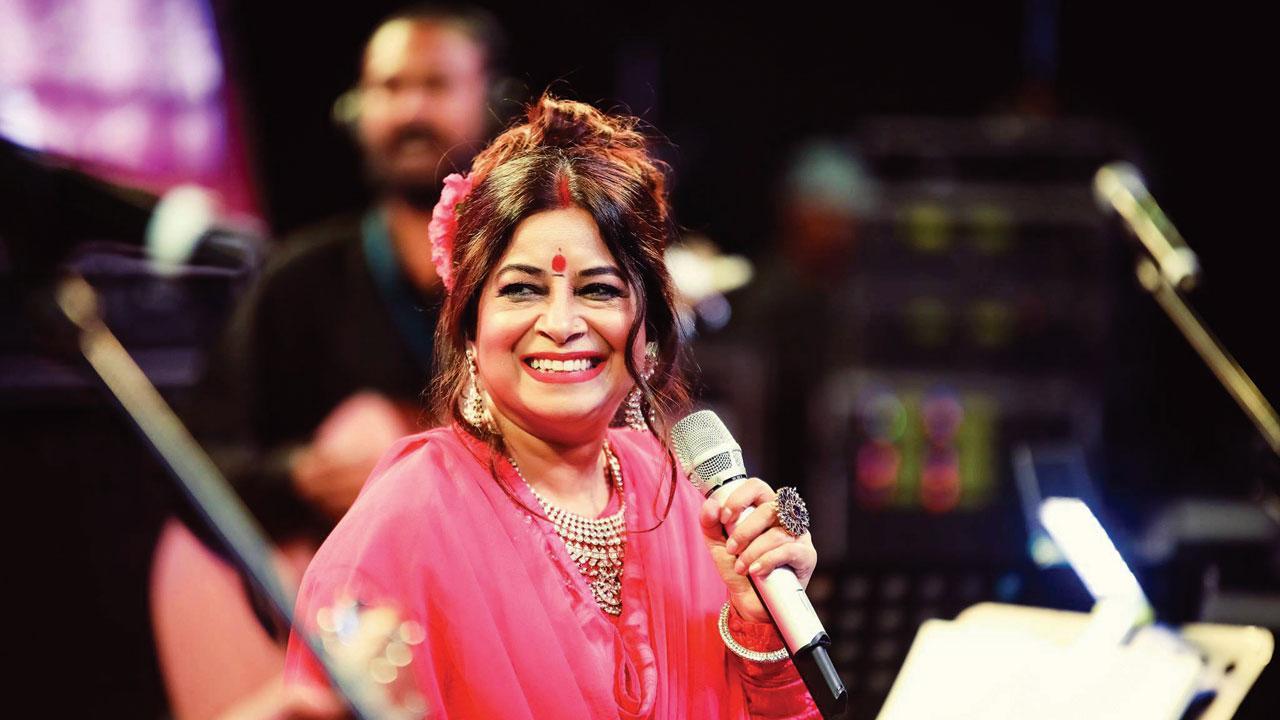
Her collaborative work with Sneha Khanwalkar finally seeing the light of day, Rekha Bhardwaj on how their next track ticked several boxes for her
Uma Ramasubramanian (MID-DAY; October 18, 2021)
Rekha Bhardwaj finds herself in Sneha Khanwalkar’s fold again with Turiya Turiya, from the upcoming web series, Tabbar. While the number aimed at enhancing the fast-paced narrative, Bhardwaj says the opportunity enabled her to tick several boxes off her wish-list. “Singing the Baba Farid [poetry] was a blessing because, while I wanted to sing it, I couldn’t do it myself. For this song, I [verified] the pronunciation. I spoke to a language coach hired from Chandigarh and requested for her audio of the pronunciation and meaning. It helped me enhance my craft. I believe in polishing and honing my skills. I am not talented enough to go into the studio, learn, and sing a song; I have to [rehearse] and absorb it to make it my own,” says the singer.
Bhardwaj shares a special bond with Khanwalkar. However, a spate of recent collaborations haven’t seen the light of day. With this track, the veteran is glad to have finally “broken the jinx”. “It is like a reward that we have got for our hard work. I feel happy when young composers notice and appreciate us for our hard work. It tells me that I am on the right path, even now.”
The Sony LIV show, featuring Pawan Malhotra, Supriya Pathak, Ranvir Shorey, Gagan Arora, and Paramvir Singh Cheema, revolves around a middle-aged couple with two grown-up sons. A series of incidents turn their lives upside-down.
Behind the scenes, Bhardwaj’s life too took a different turn. Accustomed to rendering tracks within the comforting space of a studio, she soon found herself in need to learn the tropes of technology amid the pandemic. She shared the experience with her filmmaker-husband Vishal Bhardwaj, who “learnt, and taught me to operate [software], while I learnt to record on it. The film, 14 Phere, was worked upon in this way. I still prefer to record in studios with music directors. But, I am happy I learnt [technology] when it was needed.”
Excited I’m now going to explore Agatha Christie, like I did with Shakespeare-Vishal Bhardwaj
7:51 AM

Anshul Chaturvedi (BOMBAY TIMES; October 19, 2020)

“I had hoped this will be over in two or three months. But then I realised that this is not going to go away so soon. And as a filmmaker, I became very confused as time went by. How will I make the films I had planned to? How do I shoot? How do I shoot a scene in a public place? If I have a crowd in the backdrop, they will all be wearing masks. And in what time period is a film set — if it is post Coronavirus, will all characters be wearing masks? I became very confused,” he narrates the frustration of a locked-in filmmaker.
Denied the option to do what he had planned to do, he explored what he could do, where he was – in the hills, largely locked in.
“My location and my situation gave me an idea – of the sort of movie that can be made in such a situation,” he cheerfully narrates. “For a long time, I have had a love for murder mysteries. I am a big (Alfred) Hitchcock fan. He made films inside a single home – have you seen Rope? He made that film in nine shots! And that meant nine reels – each shot was the maximum length of a reel. That was the mastery of Hitchcock. And then there was Psycho, North By Northwest, The Man Who Knew Too Much – I loved those films!”
Then he comes to the other master of these situations, the one he is engrossed with presently.
“And I love Agatha Christie. India has a huge fan base of hers. And people of our generation, those who did not grow up with mobile phones and social media – you know we lived on novels! Summer vacation, libraries... those memories, wishing that the book never ends!”
But those with mobiles and social media – have they been able to escape her influence altogether?
“No, perhaps they haven’t. After speaking to my son and a few others, I realised that even the current generation is a fan of hers. Agatha Christie has not faded with time. Now, it so happened that about a couple of years back, there was an outreach, they wanted to bring their franchise to India. But I was busy, things did not really move ahead. But now, as we were all locked indoors in Coronavirus, I realise that there is only one type of film that can be made without too much trouble in this situation – the Agatha Christie murder mystery type. I love Hercule Poirot, I love Miss Marple. So I got in touch with them again...”
Er, who exactly is they and them?
“Agatha Christie Limited is a big estate and Agatha’s great grandson, James Prichard, is the Chairman. Did you know that after Shakespeare, she is the second largest selling author in the world? And I felt very honoured, very fortunate, that I have worked with Shakespeare’s works and now I will have a chance to work on an Agatha Christie project... So many movies have been made on Agatha’s stories all over the world. And many of her stories are already taken. Recently, the British director Kenneth Branagh, the one who made Murder On The Orient Express and Death On The Nile – he has acquired the rights for all Hercule Poirot stories, for instance.”
“Anyway, in this lockdown, I contacted the estate. We started discussing if we could make a movie in India. We clicked well, but it was a very long process. They offered me many novels, out of which I picked the first one (he attempts to keep the title a secret, for now).”
And this first film will introduce a young heroine thrown into solving a murder, who teams up with an unlikely companion to unravel the case. Future films will follow the duo as they continue investigating multiple murder mysteries.
“I proposed to the estate that I want to take two characters from the story, a boy and a girl who are not professional detectives, and make a franchise out of them – and they loved the idea! I’m going to place the story in Auli since the whole plot is rooted in mountains, and the mountains are a character in the story (fans, here’s your hint).”
Does he look at her works differently now than he did in the school summer vacations?
“When I first read her novels, I am not sure I fully appreciated her skill. Today, when I read her again, I marvel at the characters she created – you look at it differently when you are also a writer. The dysfunctionalities, the motivation – I realised that she wrote such great human dramas. Even if you take away the murder mysteries from her stories, the relationships are so deep and layered that you can still make a film on them.”
He pauses, then exclaims: “I am so excited because this gives me an opportunity to explore Agatha Christie in our context – like I have been doing with Shakespeare with Haider and Maqbool and Omkara. Place them in our social, political backdrop.”
A Hindi film based on an Agatha story?
“Bilkul! Iss mein gaane bhi honge!”
Why not a bilingual, perhaps? To sell Agatha back to an English audience, globally?
“But now the language barrier has been broken, hasn’t it? Narcos, Fauda and so many shows on digital platforms – they have broken the language barrier. It doesn’t really stop you anymore.”
Point. Has the casting been done?
“We are still in that process.”
I cannot resist a question here. Will they be genuine new talent, or will they be an extension of – well – nepotism?
Vishal breaks into boisterous laughter that pauses the conversation for a couple of minutes.
“I have a different take on nepotism. I came from outside, so I cannot be a supporter of it, right? But I don’t agree with the branding of our industry. Nobody says anything to the biggest industrialists in the country if one generation takes on the work of the earlier one. In our space, it is a very fair deal actually – your break does not make you a star. It is such a cut-throat business. Why does everyone only count the names of those who have survived and grown? Count the list of names who are from within the industry and who have failed. Woh list barabar ki hai – actually uss se zyada hi milegi aap ko. Aap nahi bana sakte kisi ko star! And if someone has talent – maine aaj tak kisi ko rukte hue nahi dekha. In our country, we enjoy commenting on cricket and cinema. And our cricketers, they don’t say anything political, anything controversial. They stay apolitical and so they largely stay out of trouble. We filmmakers speak out on things and so hamara yeh hashra kiya jaata hai.”
As a filmmaker, and as an outspoken one at that sometimes, what does he find troublesome? Online trolling?
“I don’t care for trolls. I don’t read the comments after I write something. And if (spouse) Rekha or (son) Aasman see anything about me, I have told them, if it’s something good, let me know, else don’t bother. In fact, I want to make a film on the troll army.”
That’s a smart comment, or a straight one?
“No, genuinely. I really want to make a film on them. I want to acknowledge the sincerity of their efforts, the great job they are doing, every single day. The organisation, the dedication, the commitment – hats off to them! They should be given due credit.”
I could always pick up the phone on Pandit Jasraj for guidance-Rekha Bhardwaj
8:21 AM

His contribution to classical music and bhajans has been tremendous. It is his devotion to his craft that saw him through so many decades
As told to Sonia Lulla (MID-DAY; August 18, 2020)
He has influenced me ever since I was a child. When I would go for [cultural events] in Delhi, I would browse through their brochures in advance to see if Pandit Jasraj ji was performing. You didn't need to understand classical music to enjoy his performance because it flowed in such a way that people would forget everything else. His voice was divine and mystical. Apart from the way he sang, his persona was [admirable]. He had a front-lock that would rest on his face, and had a certain aura.
His contribution to classical music and bhajans has been tremendous. It is his devotion to his craft that saw him through so many decades. In his teenage years, he left the tabla, and took to singing. He had faith in and a deep connection with his craft. Even now, he was in the US to teach [music].
It has been a while since I met him. We keep thinking that we will pay a visit to someone, and then we lose the opportunity. Now, there's nobody to look up to. If we needed guidance, we could pick up the phone [and seek it from him]. The artistes of his generation have undergone a different level of [training]. We practise in air-conditioned rooms; one can only imagine what they had gone through to reach where they are.
Dhoop Aane Do describes my feelings about Coronavirus, says Vishal Bhardwaj on song with Gulzar
8:40 AM

Vishal Bhardwaj, Gulzar and Rekha Bhardwaj talk about their latest collaboration, a song that’s not just on the Coronavirus pandemic, but on positivity and caring for nature
Niharika Lal (BOMBAY TIMES; July 5, 2020)
 'Meethi meethi hai, bahut khoobsurat hai' — this is how Gulzar describes the earth in his latest creation, Dhoop Aane Do, a song on the Coronavirus. The track is a collaboration between Gulzar, Vishal Bhardwaj and Rekha Bhardwaj, and is about positivity, hope, and caring for nature.
I DON’T LIKE SONGS THAT COME WHEN TRAGEDY STRIKES, BUT DHOOP AANE DO FELT NICE: VISHAL
Even before the lockdown began, one of Vishal’s friends had contacted him for a song on the Coronavirus. Vishal says, “He said we should be the first ones to create a song on the Coronavirus, but I don’t like songs that come when tragedy strikes. Then, multiple songs on the virus kept releasing, and one day, Gulzar sahab told me about Dhoop Aane Do, and it felt so nice. I told him this was what I was going through, and what I was feeling inside.”
For Rekha, the song is not just about the pandemic. She shares, “More than a COVID-19 song, it is an environment-based song. It is being released in the time of the Coronavirus, but it is timeless. For me, that is the depiction of the song and that’s what I told Gulzar sahab and Vishal.”
 EVERYONE’S TALKING ABOUT FIGHTING THE PANDEMIC, BUT WE ARE THE ONES AT FAULT: GULZAR
Reflecting about how the pandemic is a result of the damage inflicted on the environment, Gulzar says, “Iss waqt jo halaat hain, jo mahamaari (pandemic) chal rahi hai, everybody is talking about fighting this pandemic. But when you see it, kasoor toh hamara hai – itni khoobsurat dharti hai, humne apni dharti ki qadar nahi ki. Isko sambhala nahi humne. Toh woh thodi si shikayat hai.” He adds that while writing, he was visualising the earth. “Mere saamne visual Mother Earth ka tha, ki humein itni pyaari mitti mili hai, jahan humein panaah mili hui hai. Isse bacha kar rakho,” he says.
GULZAR’S COOK, VISHAL’S SON SHOT VIDEOS FOR THE SONG
About how the song and the collaboration came about, Gulzar shares, “I narrated it to Vishal, and he took it up. Ideology uski apni hai. We’ve decided we’ll do more songs in this period. Let’s have more songs and poems on saving the environment and earth. It’s a global cause,” adding, “Both Vishal and Rekha are classical singers. Bahut ruhaaniyat (spiritualism) hai Rekha ki awaaz mein. And, Vishal is a wonderful singer. Both of them have done justice to the song.”
Due to the lockdown, the recording process was more complicated than usual. Rekha says, “Vishal learnt the software, recorded the song, and then uploaded on his iPad to send to musicians. Then, the chorus was added. Vishal shot a video for which everything was rehearsed and planned. Mere videos Vishal ne record kiye, phir kuch galat ho jata tha toh do-teen baar karna hota tha. From recording to shooting videos, it’s more hard work, but the outcome is beautiful.” Vishal adds, “Gulzar sahab’s cook shot his portions. My son and my assistant, who lives nearby, shot my video. All the musicians collaborated from their homes.”
Current trends like Punjabi pop, remixes or TikTok doesn’t uproot me as an artist-Rekha Bhardwaj
7:59 AM

To take her guru’s legacy forward, Rekha Bhardwaj has contributed to a new edition of a landmark book by him
Urmi Chanda (MUMBAI MIRROR; March 16, 2020)
Bongaa: ‘Unmusical’; idiotically out of tune and unaware of it.

You’re a classical singer, but also part of the Hindi film music industry where there is little appreciation for classical music at present. Why did you feel the need to revive this book now, when the roost is ruled by remixes, Punjabi pop and TikTok stars?
My roots are in classical music, and just because the current trends include Punjabi pop, remixes or TikTok, it doesn’t uproot me as an artist. And contrary to what it may seem, a lot of young people continue to take up classical music as a profession, it is a popular performance category in music reality shows too. Also, it’s not like the entire Hindi film music industry has forgotten its classical sensibilities. There are still music composers like Amit Trivedi, Shankar-Ehsaan-Loy, Pritam, Sachin-Jigar, who are making music that blends classical tunes with other elements, and I think it’s okay. Everyone has the right to express their musicality and choose the music that appeals to them. As for why now, I think the time is right. Many of the young generation of musicians I interact with seem genuinely interested in knowing more about classical music, but do not know where to start. This book is an excellent starting point for anyone curious about this art form. I feel fortunate to be able to utilise my position and bring the focus back on this important piece of work. As they say, there are only two ways of bringing light into the world — be a lamp or a mirror. I am just upholding a mirror to my Guruji’s luminosity.
In your foreword to the book, you warmly describe your relationship with Pandit Amarnath and the way it embodied the guru-shishya tradition. Have you had such a relationship with any of your students?
To be anything close to what my guru was like, takes immense patience and practice. As a performer and a busy artist, I’ve not really had the time or opportunity to take on any long-term students. I’m still learning myself. But as and when possible, I share my riyaaz with some of my peers and fellow artistes and those are always wonderful experiences. The guru-shishya tradition may not be as common today as it once was, but there still continue to be teachers and schools that uphold those values and teach their students the old way. For example, the respective schools of Pt Hariprasad Chaurasiya and Pt Jasraj, the Gandharva Mahavidyalaya in Delhi, and the Gundecha Brothers in Bhopal still teach in the old tradition.
Pt Amarnath’s decision to write this musicological dictionary in English can be said to be a ‘progressive’ step since this is a field where ‘linguistic purity’ is valued over Westernisms. What do you, as his student and an artist, think of that?
I’d just say, my Guru was very farsighted and decided to write this dictionary in English because he knew that would become the language of choice among the youth eventually. He wrote in an easy manner that would help musically even an elementary reader understand it easily. Remarkably though, he chose transcriptions over translations, when it came to describing technical terms. Instead of terms like ‘legato’ or ‘staccato’, he stuck to Hindi terminology that was best understood by practitioners of Hindustani Classical music. No matter what the current trends, this is a timeless piece of work and essential to any serious student and artist.
If you had to pass on one bit of your Guruji’s wisdom to the aspiring students of today, what would it be?
The most important piece of advice our Guruji gave us was “Listen to yourself.” It was meant to be both, musical and life advice, and practicing that sincerely would always ensure we picked the right path. Listening to oneself allows us to see our own weaknesses and strengths, understand the areas that need work, and to know what we truly are and want instead of being told that by society.
What is that one new term/phrase that you would add to this dictionary?
Frankly speaking, I would not dare to add anything to this dictionary, because that would be like sacrilege for me. I’m pretty orthodox in that sense; I take my responsibility of preserving my guru’s knowledge as it is very seriously. All I’ve done is added a very brief foreword and updated the book with some important profiles of musicians who were his contemporaries (he had written only of artists from the earlier generations). All we want is for this book to reach more people, translate it into other languages, and publish some more of his works in the hope that his art and wisdom remain immortal.
We realised that there are people who aren't into aggressive politics or harsh messaging-Swara Bhasker
10:41 AM

Organisers of 10-city event 'India, My Valentine', which will start in Delhi on Feb 14 and end in Mumbai on Feb 16, say they will reach out to those who may not turn up at protest, but will go to a cultural event
Gaurav Sarkar (MID-DAY; February 10, 2020)
At a time when the country is polarised and lines have been drawn between the Left and Right with CAA-NRC-NPR at the epicentre, one could say there's been little bhaichaara and pyaar and more nafrat and aag. To counter this, love seems all set to be in the air next weekend, that is, the Valentine's Day weekend, when 10 cities across the country are expected to come together to celebrate their one true love — India.
The event is being organised by a group of citizens under the umbrella platform, India My Valentine. This includes people from the film fraternity Swara Bhasker, Vikas Katyal, Aditi Anand, activist Fahad Ahmad (above), Kabeer Palshikar and entrepreneur Richard Jacob, among others.
The celebratory and collaborative programme aims at celebrating the February 14 weekend with music and spoken word. So far, the event is to take place in ten cities including New Delhi, Kolkata, Indore, Jaipur, Kochi, and Hyderabad. The opening ceremony will be held in New Delhi on February 14 and the closing concert on February 16 will be held in Mumbai.
"The event will reaffirm our faith in our fraternity; in our unity; in our Constitution — as Indians — no matter what our political differences may be," reads the concept note. "We will help you curate the line-up of talent and artists and help coordinate the event in your city. Logistical and financial responsibility will belong to the local groups."
The note further read: "We gather to celebrate the India we know and love — the India of tolerance, the India of acceptance, the India that strove to be a better place for even her most oppressed children, the India that was a dream. We celebrate the India of Tagore and Gandhi, the India of Ashfaqullah, Bismil, Savitribai Phule, Fatima. The India of Bhagat Singh and Ambedkar."
Facilitating hosts, artists The organisers will act as facilitators between potential venue sites and the artists themselves. Those interested in bringing the event to their city can contact them at Indiamyvalentine@gmail.com.
"It is a sort of callout," said Bhasker, who is one of the organisers. "We realised that there are people who aren't into aggressive politics or harsh messaging. They might not come for a protest but they will come to attend an evening of cultural performances such as spoken word, poetry, and music. The name 'India, My Valentine' represents the fact that no matter how many differences the electorate might have over political views, we love India."
India, My Valentine will also act as a liaison between artists and the venue. The city-based venues will have the freedom to choose the content for the event. For instance, whether or not to mention the Citizenship (Amendment) Act, the National Register of Citizens (NRC), and the National Population Register (NPR) will be up to the individual venues.
"On the other hand, some venues are hardcore protest sites themselves. So it is open to interpretation," Bhasker said.
The organisers have also received requests from smaller towns of Uttar Pradesh. "We are concerned about the artists' safety. We won't compromise on security," Bhasker said.
"Most of the current protests are taking place in echo chambers. The Right wing has successfully polarised them. Whether we have been able to reach across this echo chamber is unclear," she added.
"It is heartening to see the response. People from all across the country have offered their spaces to host the event or participate as performers. It goes to show how deeply the events of the past months have captured the imagination of the youth," she said.
Ahmad, on the other hand, said, "The idea is to celebrate an India that gives equal rights to everyone without any discrimination. We will restore that India for which our freedom fighters fought. India is my first love because it gives us everything today that we have in our life."
Participating Artistes
Vishal Dadlani (music/vocals), Rekha Bhardwaj (music/vocals), Swanand Kirkire (poetry/vocals), Aditi Mittal (stand-up), Kaneez Surka (stand-up), Sanjay Rajoura (stand-up), Ankur Tewari (music/vocals), Saba Azad (music/vocals), Madara (rap), Aamir Aziz (spoken word), Sabika Naqvi (spoken word), Himanshu Bajpai (dastangoi — Urdu storytelling), Dolly Singh (YouTube sketches)

After Mumbai Mirror report, help pours in for Vanraj Bhatia
7:48 AM

Sangeet Natak Akademi and admirers offer financial support
Alka Dhupkar (MUMBAI MIRROR; September 19, 2019)
 Days after Mirror highlighted the plight of top music composer Vanraj Bhatia, who is penniless, isolated and bedridden in his Napean Sea Road apartment, citizens have begun to loosen their purse strings.
The Delhi-based Sangeet Natak Akademi (SNA), an autonomous body under the ministry of culture, has decided to offer a one-time financial assistance to the virtuoso composer, who had scored the music for Shyam Benegal classics like Ankur and Bhumika as well as TV series Yatra and Discovery of India. A group of friends is also raising funds through WhatsApp to provide him with an aid of Rs 25,000 every month.
On Wednesday, SNA chairperson Shekhar Sen, writer and executive member of SNA Atul Tiwari, and singer and executive member of SNA Chhaya Ganguly visited Bhatia at his rented flat in Rungta Housing Colony on Napean Sea Road.
Sen said he learned of Bhatia’s condition through Mirror’s front page report on September 15.
He said Bhatia’s association with the SNA—he was conferred with the Akademi’s Tagore Akademi Ratna award in 2012—prompted the three to make a personal visit to his house. “Atul Tiwari had worked with Vanraj ji in the past.”
He said the visit livened up the 92-year-old recluse and that they were struck by his sharp memory. “He shared stories of working on Discovery of India as well as with [late theatre doyen Ebrahim] Alkazi and [late playwright and actor] Girish Karnad.”
Sen said the SNA’s aid will be announced soon. “It should not be viewed as an aid. It is our duty to help him out for his contribution to the field of music,” he added.
He said the SNA will also soon document Bhatia’s life as part of its ‘Meet a Maestro’ series, which aims to help youngsters learn about those who shaped the music industry. “The way he combined Western and Indian music, as well as the combination of tribal and folk music in his scores will archived soon.”
Jaipur-based technocrat Pavan Jha and his friends from India and abroad are chipping in, too. They have created a WhatsApp group titled ‘Thank You Vanraj Sir’, through which they are raising funds and plan to contribute Rs 25,000 every month. “We want to pay Vanraj ji back for his contributions through the years.” Jha, too, insisted that the aid not be viewed as help. “We want the SNA to make put a system in place to support senior artists in their old age,” he said.
Jha claimed music industry veterans like Shubha Mudgal and Rekha Bhardwaj have also expressed willingness help Bhatia out.
Prakash Borgaonkar, state director of NGO HelpAge India, which works for the rights and welfare of elderly citizens, said he has reached out to Bhatia as well. “We have mobile medical vans and can offer assistance for medical checkups.”
We are caterers of mediocrity-Rekha Bhardwaj
8:28 AM

Rekha Bharadwaj breaks down why the finesse in the independent music industry isn't arguably translating to Bollywood
Sonia Lulla (MID-DAY; February 18, 2019)
Ashe chronicles the goings-on in the Bollywood music industry, Rekha Bhardwaj sprinkles this conversation by drawing examples of artistes and films, spanning decades. Her fine observation skills and deep understanding of cinema trends are made evident, even though she isn't one to go to town when critiquing the industry. Set to serenade fans on an upcoming episode of MTV Unplugged, Bharadwaj talks to mid-day about the reason behind the increasing gap in the quality of music being churned out in and out of the film industry.
Edited excerpts from the interview:
There is a lot of talent in the independent music scene. Why do you think that quality arguably isn't translating to Bollywood music?
[Independent music] platforms still have a long way to go [before they can become popular]. Abroad, an artiste first releases an album, then the song is picked up for a film. But, songs are an integral part of our films, [and hence] we have incorporated film songs [on this platform too], to meet the demand. We are, primarily, a melodramatic society, and caterers of mediocrity. A majority of our population appreciates mediocrity, and that's why it exists in films and fine arts. Also, since crores are invested in films, certain requirements must be met. Today, the film business is a three-day affair, governed by collections from Friday through Sunday. Few are [driven] by a creative pursuit. The independent music genre has come to the fore after 20 years. I struggled for 11 years to release the album that was to launch me. There's a lot that we have to do to put up the quality [of music] that we desire. Rural audience won't appreciate sophisticated music. They would prefer folk music, while the youngsters would, maybe, choose noisy tunes. Remixes too are horribly executed. They are derogatory to the original classic.
How do you suggest that can change?
Artistes should be more concerned about content, [which comprises] language, diction and musicality. The younger musicians must educate themselves about our musical heritage. Also, [a lot depends on] aesthetics. I've sung many item songs, and am proud of all of them, including Namak Ishq Ka, and Ghagra. When Gulzar sa'ab writes a naughty, raunchy song, you will still find it aesthetically appealing. Aesthetics must be maintained in the lyrics, composition and rendition.
Is the industry receptive of singers with unique voices, like your own?
After Namak Ishq Ka, a lot has changed. The younger lot of composers have a background in Western music, and are hence open to experimenting with all sort of voices. Jagga Jasoos, for instance, had so many new voices, and a beautiful range of singing. Also, pronunciation must be paid heed to. For example, in Bombay Velvet, all the songs were nice. Some singers, like Neeti Mohan, paid attention to diction. When singing in Urdu, one should be certain to pronounce correctly. Neeti was, while a few others weren't. When the diction is correct, 60 per cent of your job as a singer is done. Unfortunately, even lyricist don't care if their words are being pronounced right. We pay heed to accents and pronunciation when singing English numbers. But, Hindi songs are tackled with carelessness.
You've often spoken positively about the influence of Western music in India. Why is that so?
This is something that was even evident in old music. In fact, earlier, Catholic musicians from Goa formed a major part of our industry. If you listen to older melodies, like Madan Mohan's Khelo Na Mere Dil Se, you'll notice that the introductory music will not reveal the melody that comes in later. The music arrangers then were classically trained in Western music, and also understood Indian nuances. The young generation is talented since they are exposed to all genres. But, there's a thin line between good and bad influences.
How does a platform like MTV Unplugged benefit the industry?
When a song is composed for a film, it's based on situations. Here, we're not bound by demands. I've recreated Darling [for the show], and used a brass section. There are two originals too, one of them being an Amrita Pritam poem.
HOT: Check out Malaika Arora's item song 'Hello Hello' in Pataakha
8:06 AM

The actress returns to the screen after three years with a special track for Vishal Bhardwaj’s next
Roshmila Bhattacharya (MUMBAI MIRROR; September 3, 2018)
Mirror was the first to report (August 20) that Vishal Bhardwaj has roped in Malaika Arora for a special appearance in his upcoming comedy-drama Pataakha which revolves around two warring sisters from a small village in Rajasthan. The song in question is “Hello Hello”, set to tune by Vishal and crooned by his singer-wife Rekha. With references to WhatsApp and social networking, it is carefully coached in desi lingo by Gulzar.
Now, we have got a picture of the actress in action and going by her latka-jhtakas, “Hello, Hello” promises all the sizzle of Bipasha Basu in Omkara’s “Beedi Jalaile” and “Namak Ishq Ka” and Priyanka Chopra’s Kaminey act, “Raat Ke Dhai Baje”.
Talking about her return to the screen three years after the special track, “Fashion Khatam Mujhpe”, in the 2015 romcom, Dolly Ki Doli, Malaika said that she has immense respect for Vishal and Gulzar. “Rekha has sung the song. They have created magic in the past and I’m happy to be a part of this track. I love the title of the film and the title of the song,” she asserted.
Choreographed by Ganesh Acharya, the song was filmed on August 23 and 24 at a studio in Mira Road. “There were about 18-20 dancers accompanying Malaika and they were so much in sync that the song was wrapped up in a day and a half. It’s going to be a real pataakha,” promises a source from the sets.

Malaika Arora to feature in a sizzling song in Vishal Bhardwaj's Pataakha
8:08 AM

Roshmila Bhattacharya (MUMBAI MIRROR; August 20, 2018)
Vishal Bhardwaj has lit a few fireworks already with the first trailer of his upcoming film, Pataakha, which is based on a short story by Charan Singh Pathik that revolves around two warring sisters from a small village in Rajasthan. They tear each other’s hair out, wrestle in the muck and finally manage to break free of each other only to land up married in the same family. And even as everyone is talking about Sanya Malhotra and a new-and-improved Radhika Madan’s fiery histrionics, Mirror has learnt that a sizzling siren is now getting ready to swing into the picture. Vishal has roped in Malaika Arora for a special number which promises to be all that Bipasha Basu’s “Beedi Jalaile” and “Namak Ishq Ka” were, and more.
Malaika, who is still remembered for her moves in “Chaiya Chaiya” from Mani Ratnam’s Dil Se and Dabbang’s “Munni Badnam Hui”, will be grooving to “Hello Hello”. Sung by Rekha Bhardwaj, it is to be filmed this week. Rehearsals are already on in a Mira Road Studio.
 According
to a source close to the development, Vishal needed a no-holds-barred
song at a village fair and who better than Malaika to pull it off. “She
has the earthy sensuality needed for the song and is known to burn up
the dance floor with her moves. Even though it’s a desi number, like his
earlier special appearance tracks, this one too should strike a chord
with everyone, and will be playing in discotheques and dandiyas soon,”
informs the source.
According
to a source close to the development, Vishal needed a no-holds-barred
song at a village fair and who better than Malaika to pull it off. “She
has the earthy sensuality needed for the song and is known to burn up
the dance floor with her moves. Even though it’s a desi number, like his
earlier special appearance tracks, this one too should strike a chord
with everyone, and will be playing in discotheques and dandiyas soon,”
informs the source.
The lyrics have been penned by Gulzar and set to music by Vishal. It is being choreographed by Ganesh Acharya who had also done “Namak Ishq Ka”. In fact, Vishal, Rekha, Gulzar and Ganesh were also associated with the Omkara track which is hailed as a benchmark in subtle raunchiness.
Malaika has not been seen in films of late but has been a regular on TV, appearing in four seasons of the reality show, India’s Got Talent, and last year, in India’s Top Model, as a judge. Her last appearance on screen was three years ago in a special appearance number, “Fashion Khatam Mujhpe”, in the 2015 romcom, Dolly Ki Doli, which she had co-produced with her ex-husband Arbaaz Khan. She had also turned up in “Pandeyjee Seeti” with Salman Khan and Sonakshi Sinha in the Dabbang sequel, produced and directed by Arbaaz.
Vishal Bhardwaj has learnt to write in meter, which I can’t. It’s my turn to learn that from him-Gulzar
7:50 AM

It’s a creative overload when Bollywood’s quintessential guru-shishya, filmmaker-poets Gulzar and Vishal Bhardwaj come together. Here, they not only muse on their times together, but also the three ‘c’s — cinema, censorship and children’s films
Rachana Dubey (BOMBAY TIMES; January 8, 2018)
This guru-shishya’s exchanges are what literary and artistic dreams are probably made of. The seamless blending of their crafts, as a pensmith and a composer-storyteller,over the years often makes it difficult to analyse their works independent of the other. So, it was a momentous day for admirers when they came together at an literary event recently — Gulzar for his first book as a novelist,and his protégé, Vishal Bhardwaj for his first book as a poet. Off the stage, Bombay Times sat them down for a conversation to understand their views of marrying creative liberties and art in modern times, their mutual love for poetry and children’s literature and what really makes their association so special.
Gulzar saab, your protégé has followed into your footsteps as a poet now, and added another feather to his cap...
Yes, Vishal is a poet and a certified one with his first book. A lot of people ask me if he is inspired by me. I just tell them one thing, yeh mera naam le leta hai, bahut si ladkiyan iske chaaron aur phirti hain, batata nahi hai mujhe (Vishal laughs loudly). He tells them that he’s inspired by me. You know the traits of these poets…Yeh badmaashi bhi ek trait hai.
Vishal, do you agree with him?
I can never disagree with him about anything. The truth is that he genuinely inspires me. If I had to put it in numbers, it would be more than 100 per cent. Everything about Gulzar saab inspires me.I know all his poetries by heart. If you quote even a word from any of them,trust me, I can recite the entire poem for you. It’s his films, his songs and his poetry that have made me who I am.
Did you also use his poetry to woo your wife Rekha (who blushes at the mention)?
Vishal: The first film Rekha ji and I saw together was a film, Ijaazat (1987), made by Gulzar saab. Now, that is romance of another kind. Our kind.
Gulzar: Inka record kuch theek nahi hai (laughs). I am not responsible isko bargalane ke liye.
Is there any one of your collaborations, across the years, that you could pin down as the best that you’ve done together?
Gulzar: You can never like any one thing, because everything has a reference and was meant to be a certain way in that time zone. We like everything we have done, and we own everything we have worked together for. It’s not right to place a finger on one piece of work and say, ‘this is the best we have done so far’. We belong to all the work we have done and vice versa. There is not one piece of work that happened by chance, there was conscious effort on both our parts.
Vishal, what have been your takeaways from the exchanges you’ve had with a mentor like Gulzar saab?
Vishal: I became a director because of him. He inspired me to become a director and in turn, to be a writer and a visualiser.
Gulzar: Once during our early years as collaborators, Vishal had said, ‘Yeh peti leke main nahi ghoom sakta.’ I had told him then, ‘Yeh cinema ek hi shaqs ki zubaan samajhta hai, woh hai director.’’ For years, he has persistently written and directed his films. His imagination is very strong. And I have enjoyed every step of our journey. In fact, he has learnt to write in meter, which I can’t. It’s my turn to learn that from him. For me, his poems are like my child’s hand and finger impressions. Whenever I’d ask for one of his earlier poems, he would go looking for them all over. He has written so many poems over the years that it became important to put these pearls together in a chain and not let them get lost in the sands of time.
Vishal, what is the kind of feedback you get for your work from Gulzar saab?
He is very honest. If he likes something, he says it, and if he doesn’t, he still says it; in simple words — koi parda nahi hai.
Does Gulzar saab have inputs to offer on your films?
When I’m working on the film’s edit, there’s one session that I have with him. He edits my films, pins down things in each one of them and tells me what I could do away with. While he tells me what he thinks,he consciously ensures that he doesn’t force me to accept what he says.
Filmmakers and their creative liberties have come under the scanner in recent times. It is unlike the time when Gulzar saab underlined social and political matters through several of his films like Mere Apne (1971) and Aandhi (1975). Do you think creative thinking is being confined today?
Vishal: Situations and times change and as filmmakers, artistes and creative thinkers, you have to adapt to the given circumstances. You can always say what you have to, but you can change the style of saying things. I say what I want to in my films, but in a manner that is suited for the times. In fact, I believe that this is a good time for creative and artistic thinkers as creativity always flourishes in such times. Jab aapko kone mein dabaaya jaata hai, tabhi to cheekh nikalti hai. Jab tak logon ko bilkul corner nahi kiya jaata, tab tak koi react nahi karta. If you are not pushed to the hilt, you won’t make the effort.
Gulzar: The most important thing is that you have to be yourself and not simply mirror trends or a herd thought. Be honest with yourself. Remember, you are the historian of your times. You are noting everything about the society that you are living in. Your work has an exchange with society, it doesn’t exist in isolation as it’s the history of people and the times. That’s the reason why I am also against the culture of remixing old Hindi songs. By remixing, you are simply destroying something that has a period and a thought behind it. One should preserve it as it is. It is unfair to the creator if you try to revisit it or contemporise something. If someone thought of a film in black and white, why colour it? Don’t damage it in the name of restoration.
Accha hai humein kisi ne thonk kar, kohni maar kar hila diya. Ahsaas ho gaya ki hum soye nahi hain.
Both of you have created a lot of content for children. Gulzar saab, you’ve voiced your concern about the dearth of content for kids. BT had also raised this point in its Children’s Day edition while speaking to a crosssection of filmmakers. What are your thoughts on it?
Gulzar: Children’s literature is neglected in our country. Having said that,we can’t force it on anyone to create it. It can’t be imposed. You can’t do anything unless you like children, bond with them and understand their psyche. In fact, major languages like Hindi and Urdu don’t have anything to offer children. We have imports from other countries, which are dubbed and dumped before them. You have to create stories for them all the time. Marathi, Malayalam and Bangla are the languages that offer a lot of literature for children. There’s a reason I never refuse a function or an invitation from a school. I like children. I have to confess: when I meet children, I know they are teaching me, I’m not teaching them anything. As individuals, you have to absorb that aspect and give it back to them as stories, poems, films.
Are Vishal and you working on something for kids?
We have been doing it for years, and we will continue to do so.

Vishal Bhardwaj and Rekha Bhardwaj reunite on TV
7:35 AM

Natasha Coutinho (MUMBAI MIRROR; November 15, 2017)
After collaborating in films, Vishal and Rekha Bhardwaj are coming together to perform on the small screen. The filmmaker-composer and his singer wife will be belting out hit numbers from VB’s filmography, including “Chappa Chappa”, “Chhod Aaye Hum” and “Pani Pani” from Maachis, “Pehli Baar Mohabbat” from Kaminey, “Dil Toh Bachcha Hai Ji” from Ishqiya and “Naina” from Omkara, among others, for MTV Unplugged.
“The songs I have chosen are some of my best compositions. Some of them are 23 years old but feel timeless and relevant. I sing all my songs for referential purposes before they are recorded by other artistes. Many times, I have been asked to share my version of the songs. I feel close to them and love to sing them,” Vishal told Mirror.
About his collaborations with Rekha, who has delivered some of the most memorably tracks in his films in her lilting voice, VB said, “I have only performed a few times on stage, primarily college competitions. I remember once, Rekha and I had gone to the Parliament when the Copyright Law was passed along with other composers, singers and authors. We performed 'Chhod do Aanchal' for the nostalgia element.”
Why Bollywood is now a magnet for international musicians
12:22 PM

Soumya Vajpayee Tiwari (MID-DAY; October 2, 2016)
It's believed that music bridges the gaps between countries. This holds true for several years of cultural exchange between India and Pakistan. A few years ago, many Indian filmmakers had started banking on popular international musicians for the success of their films’ soundtracks. While Thai pop sensation Tata Young sang Dhoom Machale for Dhoom (2004), American R&B singer-songwriter Akon (above) sang Chammak Challo in the Shah Rukh Khan-starrer Ra.One (2011). Also, Snoop Dogg donned Indian attire and did bhangra with Akshay Kumar in Singh Is Kinng (2008). The rapper grooved to the tunes of the title song of the film. But there was a lull in the trend for a while. Now, it seems to be making a comeback. Several international artistes have started embarking towards Bollywood again.

New voyage
Akon has come on board for a track in Tum Bin 2, alongside Pakistani singer Atif Aslam. The makers of the movie have also signed West Indies cricketer Dwayne Bravo (above), aka DJ Bravo, for a song. This marks the cricketer-musician’s Bollywood playback debut. There’s also buzz around UK-based popular teen band, The Vamps, who are part of Ajay Devgn’s upcoming film Shivaay’s soundtrack. The band also did a music video, Beliya, with composer duo Vishal-Shekhar recently. While Pakistani singers Ghulam Ali, Rahat Fateh Ali Khan, Atif Aslam and Ali Zafar have been part of Bollywood’s music space for a long time, the latest entrant from across the border is singer Quratulain Balouch (below). She has made an impression with her powerful rendition of the song Kaari Kaari from Pink.

Strong connect
Anubhav Sinha, the producer-director of Tum Bin 2, says he shares a great bond with Akon ever since they worked together on Ra.One. Explaining why he decided to get Akon and Bravo on board, the filmmaker says, “Akon has a huge fan base in India. And Dwayne’s single, Champion, got close to 25 million hits. Collaborating with artistes of that stature makes sense, because they are 75 per cent Indian at heart, owing to their existing bond with the place that has a lot of their fans.”
Ajay Devgn, the producer-director of Shivaay reveals that he was clueless who The Vamps (below) were. “But my daughter jumped when she heard their name. She told me they are massive. That’s when we decided to have them on board,” says the actor-filmmaker.

Worth spending on
Though getting international artistes on board can burn a hole in filmmakers’ pocket, they are still preferred, as they help generate buzz around new movies. “International artistes are expensive. However, attaching an international name to a film’s soundtrack attracts global audience. It helps in the pre-publicity for a movie. Today, with films being a competitive business and every movie vying for the audience’s attention, one off associations gives a film high recall value,” explains Sinha, adding that such associations also help bridge cross-cultural synergies.
Devgn doesn’t feel getting international musicians on board is expensive. “Though it’s a time-consuming affair, when you look at it, you realise that the entertainment world is shrinking. Besides it’s never a matter of pricing. It’s more about how the energies align to create great content,” he says.
Filmmakers feel having international musicians adds value to their projects. “Today, every film requires good music to sustain itself in the market. Anything 'foreign' excites the masses, which, in turn, boosts the musical score of the film,” says Sinha.
Ajay adds the trend adds 'immense value' to the project. “Today’s generation, whether in Mumbai or Varanasi or anywhere in the world, is a global generation. They can’t get enough of new content. So, such collaborations work.”
No insecurity
But are Indian singers welcoming of the trend? Singer Rekha Bhardwaj loves the fact that more and more international singers are singing for Bollywood. “I feel it’s great. If a film song has rap, and if a filmmaker can get one of world’s best rappers for the track, then why not? There’s no question of being insecure, as every singer is special in his or her own right,” she says.

The Jagjit Singh concert that wife Chitra will finally attend
8:15 AM

While fighting for royalty over Jagjit memorial concerts, wife to attend tribute show on his death anniversary
Shlipi Sampad & Soumya Vajpayee Tiwari (MID-DAY; September 26, 2016)
It all started with recreating Jagjit Singh’s iconic number, Koi Fariyaad, from Tum Bin (2001) for the trailer of the film’s sequel. Following a rousing response on YouTube (10 million views in five days), director Anubhav Sinha and producer Bhushan Kumar have planned a tribute concert on the ghazal king’s fifth death anniversary on October 10.
What’s more, it will see the participation of his wife, Chitra Singh, who has been locked in a legal battle with event organisers and performers for using the musical maestro’s songs and pictures without coughing up royalty. On September 14, mid-day (PM edition) had reported about how she has been running between courts to reclaim her legendary husband’s properties.
When we reached out to Chitra, she told us the tribute concert is being organised by the Jagjit Singh Foundation. Titled Tum Bin Misses Jagjit at Rang Sharda, Bandra, will bring music industry stalwarts under the same roof. Sources share the line-up includes Talat Aziz, Mika, Ankit Tiwari, Arijit Singh and Rekha Bhardwaj. “In fact, Rekha will perform a duet with her filmmaker-lyricist husband Vishal Bhardwaj for the first time. Celebs from the fields of film, sports and business will also be invited and it will be streamed live for fans. Since Koi Fariyaad featured in each of Jagjitji’s concerts, the tribute event will have the soulful track being presented in various renditions,” says an insider.
The original ghazal, penned by Faaiz Anwar, was composed by Nikhil Vinay. The recreated version used Jagjit Singh’s voice recorded in 2000. Producer Bhushan says, “This is the first time I have seen audiences waking up to music in such a big way. It generally takes a week to ascertain fan reaction to a film’s music, but in this case, it has been phenomenal in every sense. Koi Fariyaad, a ghazal, has challenged the perception of the youth’s music consumption. That’s what prompted us to organise a concert to pay homage to the legend.”

Subscribe to:
Comments (Atom)